EP2092095B1 - Garn und herstellungsverfahren dafür - Google Patents
Garn und herstellungsverfahren dafür Download PDFInfo
- Publication number
- EP2092095B1 EP2092095B1 EP07825465.3A EP07825465A EP2092095B1 EP 2092095 B1 EP2092095 B1 EP 2092095B1 EP 07825465 A EP07825465 A EP 07825465A EP 2092095 B1 EP2092095 B1 EP 2092095B1
- Authority
- EP
- European Patent Office
- Prior art keywords
- conductive strips
- fibres
- yarn
- movement
- conductive
- Prior art date
- Legal status (The legal status is an assumption and is not a legal conclusion. Google has not performed a legal analysis and makes no representation as to the accuracy of the status listed.)
- Not-in-force
Links
Images


Classifications
-
- D—TEXTILES; PAPER
- D01—NATURAL OR MAN-MADE THREADS OR FIBRES; SPINNING
- D01D—MECHANICAL METHODS OR APPARATUS IN THE MANUFACTURE OF ARTIFICIAL FILAMENTS, THREADS, FIBRES, BRISTLES OR RIBBONS
- D01D5/00—Formation of filaments, threads, or the like
- D01D5/0007—Electro-spinning
- D01D5/0061—Electro-spinning characterised by the electro-spinning apparatus
- D01D5/0076—Electro-spinning characterised by the electro-spinning apparatus characterised by the collecting device, e.g. drum, wheel, endless belt, plate or grid
Definitions
- This invention relates to a yarn made from electrostatically spun fibres and a process for the manufacture of such a yarn.
- Electrostatic spinning of fibres was first described in US Patent 692,631 .
- a droplet of polymer solution or melt is placed in a high electric field.
- the repulsion between the induced like-charges in the droplet compete with the surface tension of the liquid and when a sufficiently strong electric field is applied, typically 0.5-4 kV/cm, the electrostatic forces overcome the surface tension of the fluid and a jet of polymer solution or melt is ejected from the droplet.
- Electrostatic instability leads to rapid, chaotic whipping of the jet, leading in turn to fast evaporation of the solvent as well as stretching and thinning of the polymer fiber that is left behind.
- the formed fibers are then collected on a counter electrode, typically in the form of a nonwoven web.
- the collected fibers are usually quiet uniform and can have fiber diameters of several micrometers, down to as low as 5 nm.
- nano-fibrous materials that make them very attractive for numerous applications are their high specific surface area (surface area/unit mass), high aspect ratio (length/diameter) and their biomimicking potential. These properties lead to the potential application of electrospun fibres in such diverse fields as high-performance filters, absorbent textiles, fibre reinforced composites, biomedical textiles for wound dressings, tissue engineering scaffolding and drug-release materials, nano- and microelectronic devices, electromagnetic shielding, photovoltaic devices and high-performance electrodes, as well as a range of nano-fibre based sensors.
- the replacement of only a small percentage of the fibres or yarns in a traditional textile fabric with yarns of similar diameter, but now made up of several thousands of nano-fibres, can significantly increase the toughness and specific surface area of the fabric without increasing its overall mass.
- the complete fabric can even be made from nano-fibre yarns. This has important implications in protective clothing applications, where lightweight, breathable fabrics with protection against extreme temperatures, ballistics, and chemical or biological agents are often required.
- nano-fibre textiles also exhibit extremely soft handling characteristics and have been proposed for use in the production of artificial leather and artificial cashmere
- US Patent 2,187,306 describes a process by which a core-spun yarn can be made by electrostatically spinning fibers onto a pre-formed yarn or sliver of fibers
- US Patent 2,109,333 describes a process in which electrostatically spun staple fibers can be made into a yarn.
- PCT Application WO 2005/073442 A1 describes a process in which a nonwoven web of electrostatically spun fibers is cut into ribbons, or the web is spun in thin ribbon strips from the start. The nonwoven ribbons are then twisted using an air twister to form continuous yarns.
- Kim describes a special configuration in which a C-shaped nozzle block containing thousands of spinning nozzles is placed adjacent to a drum collector rotating with high linear velocity. Narrow webs of reasonably aligned fibres are collected off the rotating drum surface in a continuous fashion and twisted together to form a continuous yarn.
- the ideal process for preparing continuous yarns from electrostatically spun fibres should be up-scalable, result in high degrees of fibre alignment and work for all polymers and/or polymer blends that can be electrostatically spun into fibres.
- the yarns obtained from the various processes described in the prior art invariably suffer from one or more drawbacks.
- the obtained yarns have very low or random degrees of alignment of fibres along the yarn axis. Alignment of fibres is very important for yarn strength since it ensures an optimally shared distribution of the tensile load between the fibres when the yarn is placed under tension. In other words, lower degrees of fibre alignment lead to lower strength yarns.
- Another drawback of some of the processes, like Ko's self-assembled yarn, is that it is difficult or costly to scale-up the process.
- yarns cannot be made from water-soluble or water-sensitive polymers. This can be a major drawback if one considers that many of the biodegradable polymers for tissue engineering applications are water-sensitive.
- a yarn spun from a plurality of nano-fibres characterized in that at least some of the nano-fibres are folded with the folds occurring at predeterminable distances, as defined in present claim 1.
- predeterminable distances to be integer multiples of at least one specific spacing; for at least some fibres to have a plurality of folds; and for the fibres to be substantially aligned in the same direction.
- the invention also provides a process for producing said yarn which includes electrostatically spinning a plurality of fibres onto a plurality of moving conductive strips inclined to their direction of movement such that the fibres span at least some of the conductive strips, collecting the fibres from the conductive strips and forming the fibres into a yarn.
- the conductive strips to be separated from each other by an insulating gap; for the insulating gap to be an air gap or to be filled with an insulating material; for the conductive strips to be parallel to each other; for the conductive strips to be spaced apart at predetermined, preferably equal, distances; and for the spacing between conductive strips to be between 1 ⁇ m and 300mm.
- Still further features of the invention provide for the conductive strips to be inclined between 5° and 175° to their direction of movement, preferably 90° to their direction of movement; for the conductive strips to have a uniform thickness, preferably between 100nm and 30mm; for the conductive strips to be held at electric ground potential or at a potential with opposite polarity to that of the electrostatic spinning source; and for the distance between the electrostatic spinning source and the conductive strips to be uniform, preferably between 0.5mm and 500mm.
- Yet further features of the invention provide for the spinning to occur bottom-up with the electrostatic spinning source below the conductive strips, alternatively in a top-down or side-by-side fashion; for the fibres to be formed into a yarn by mechanical or electrostatic means; and for the yarn to be collected on a take-up roller.
- the invention still further provides apparatus for producing a yarn including an electrostatic spinning source and a plurality of conductive strips arranged to collect fibres from the spinning source and movable with respect thereto and a web collector and a web twister arranged in series therewith, characterized in that the conductive strips are inclined to their direction of movement such that the fibres span at least some of the conductive strips.
- the conductive strips to be carried on a moving surface; for the surface to include a belt, a pair of belts spaced apart or drum; for the conductive strips to be insulated from each other; for the conductive strips to be parallel to each other; for the conductive strips to be equally spaced apart; and for the spacing between conductive strips to be between 1 ⁇ m and 300mm.
- Still further features of the invention provide for the conductive strips to be inclined between 5° and 175° to their direction of movement, preferably 90° to their direction of movement; for the conductive strips to have a uniform thickness, preferably between 100nm and 30mm; for the conductive strips to be held at electric ground potential; and for the distance between the electrostatic spinning source and the conductive strips to be uniform, preferably between 0.5mm and 500mm.
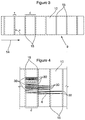
- Apparatus (1) for producing a yarn (2) from nano-fibres is shown in Figures 1 to 5 and includes an electrostatic spinning source (6) having a plurality of electrostatic spinning jets (4) with a fibre collector (9) spaced apart therefrom.
- the spinning source (6) is located 100mm below the collector (9).
- any suitable orientation could be used, including a top-down or side-by-side orientation, with a separating distance of between 0.5mm and 500mm.
- the electrostatic spinning source (6) makes use of a traditional needle-based spinning apparatus, but could also use a multiple-needle setup, needleless spinning techniques, or any other electrostatic fibre-forming process.
- the apparatus (1) thus far described is of fairly conventional configuration.
- the collector (9) includes an endless belt (10) supported between a pair of rollers (11, 12). One of the rollers (12) is driven so that the top of the belt (10) moves in the direction of the arrow (14).
- the belt (10) has a plurality of conductive strips (15) thereon inclined at angle ( ⁇ ) to its length, and hence the direction of movement of the belt (10).
- the conductive strips (15) are made from copper and each has a thickness (t) of between 100nm and 30mm. In this embodiment the thickness (t), or width, of each is uniform and is 1 mm (but shown on an exaggerated scale for illustrative purposes).
- the material of the belt (10), in this embodiment a rubberlike material, insulates the conductive strips (15) from each other along their length. However, the ends of the conductive strips (15) are conductively connected and maintained at ground potential.
- the inclination ( ⁇ ) of the conductive strips (15) to the direction of movement of the belt (10) is between 5° and 175° and the distance (d) between each between 1 ⁇ m and 300mm.
- the conductive strips (15) are parallel to each other and are inclined at 90° to the direction of movement of the belt (10) with a distance (d) of 10 mm between each.
- the conductive strips (15) are of uniform height.
- An electric potential (20) is applied in conventional fashion between the nozzles (7) and conductive strips (15).
- the conductive strips (15) are held at electric ground potential.
- the belt (10) feeds onto web collector rollers (22, 23), which in turn feed into a web twister (25).
- Drawing rollers (26) and a take-up roller (28) are located after the twister (25) in conventional fashion.
- nano-fibres (4) are electrostatically drawn to the conductive strips (15).
- the fibres (4) each tend to span a pair or a number of adjacent conductive strips (15) by folding between these.
- the distance between each fold (30) for a fibre thus corresponds to the predetermined distance (d) between the conductive strips (15) and will either be equal to (d) or an integer multiple of (d).
- the fibres (4) collected on the belt (10) are drawn off in conventional fashion by the web collector rollers (22, 23) and fed into the web twister (25), which forms the fibres (4) into a yarn (2).
- the drawing rollers (26) stretch the yarn (2) before it is collected on the take-up roller (28).
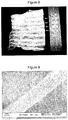
- the pre-yarn web (5a) prior to being fed in to the web twister (25) is shown in Figure 6 and has the appearance of a sheet formed by a plurality of fibres which extend substantially in the direction of travel of the belt (10).
- the location of the folds (30) in the fibres which correspond to the conductive strips (15) are clearly visible as parallel lines (32) of high fibre density across the width of the web (5a).
- each fold may be somewhat chaotic given the extremely thin diameter of each fibre compared to the thickness of the conductive strips and the rate at which the fibres are being produced (often in the order of kilometres per minute).
- each fold may include a number of random loops or other random patterns which increases the fibre density at each conductive strip.
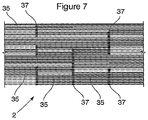
- FIG. 7 An enlarged view of part of a yarn (2) produced by the apparatus (1) is shown in Figure 7 .
- the folded fibres (35) are clearly visible with the folds (37) spaced the distance (d) or an integer multiple thereof apart.
- the spacing of the folds (37) is predeterminable as it reflects the spacing of the conductive strips (15).
- the fibres are also uniformly oriented in the direction of the length of the yarn.
- the conductive strips could be carried in any suitable manner, including on a rotating drum. Further alternately, the conductive strips could be secured by their ends between a pair of belts to have a ladder-like configuration with the conductive strips separated from each other by an air gap. The conductive strips could be separated by any suitable insulating material and need not be evenly spaced, parallel or of the same thickness.
- the conductive strips, being elongate conductive surfaces, can have any suitable configuration and could be made of any suitable material.
- the conductive strips could be wire-like or tape-like or even provided by the edge of a plate or similar element.
- the folds in the fibres found in the yarn will reflect the spacing of the will be found to repeat itself in the length of the yarn as the conductive strips move into and out of alignment with the electrostatic spinning fiber source.
- the electrostatic spinning source and fibre collector could be configured in any suitable manner, including for upward and sideward spinning, and any suitable number and configuration of spinning nozzles or needle-less sources can be used.
- any suitable material, or combination of materials can be used for making the nano-fibres.
Landscapes
- Engineering & Computer Science (AREA)
- Mechanical Engineering (AREA)
- Textile Engineering (AREA)
- Nonwoven Fabrics (AREA)
- Spinning Methods And Devices For Manufacturing Artificial Fibers (AREA)
- Yarns And Mechanical Finishing Of Yarns Or Ropes (AREA)
Claims (18)
- Ein Garn, welches aus einer Vielzahl von Nanofasern gesponnen ist, dadurch gekennzeichnet, dass zumindest einige der Nanofasern gefaltet sind, wobei die Falten in Abständen auftreten, die durch eine Vielzahl von sich bewegenden leitfähigen Streifen (15) vorgegeben sind, wobei das Garn erhältlich ist durch das Verfahren des elektrostatischen Spinnens einer Vielzahl von Fasern auf einer Vielzahl von sich bewegenden leitfähigen Streifen (15) geneigt zu ihrer Bewegungsrichtung, so dass die Fasern die gestreckten leitfähigen Oberflächen von mindestens einigen der leitfähigen Streifen (15) überspannen, Sammeln der Fasern von den leitfähigen Streifen (15) und Formen der Fasern in das Garn.
- Ein Garn nach Anspruch 1, wobei die vorbestimmbaren Abstände ganzzahlige Vielfache von mindestens einem bestimmten Abstand sind.
- Ein Garn nach Anspruch 1 oder Anspruch 2, wobei zumindest einigte Fasern eine Vielzahl von Falten aufweisen.
- Ein Garn nach einem der vorhergehenden Ansprüche, wobei die Fasern im Wesentlichen in derselben Richtung ausgerichtet sind.
- Ein Verfahren zum Herstellen des Garns gemäß Patentanspruch 1, welches elektrostatisches Spinnen einer Vielzahl von Fasern auf einer Vielzahl von sich bewegenden leitfähigen Streifen (15) geneigt zu ihrer Bewegungsrichtung, so dass die Fasern die gestreckten leitfähigen Oberflächen von mindestens einigen der leitfähigen Streifen (15) überspannen, Sammeln der Fasern von den leitfähigen Streifen (15) und Formen der Fasern in ein Garn beinhaltet.
- Ein Verfahren nach Anspruch 5, wobei die leitfähigen Streifen (15) durch einen isolierenden Spalt voneinander getrennt sind.
- Ein Verfahren gemäß Anspruch 5 oder 6, wobei die leitfähigen Streifen (15) parallel zueinander sind.
- Ein Verfahren nach Anspruch 7, wobei die leitfähigen Streifen (15) in vorbestimmten gleichen Abständen zwischen 1µm und 300mm voneinander beabstandet sind.
- Ein Verfahren nach einem der Ansprüche 5 bis 8, wobei die leitfähigen Streifen (15) zwischen 5° und 175° zu ihrer Bewegungsrichtung geneigt sind, vorzugsweise 90° zu ihrer Bewegungsrichtung.
- Ein Verfahren nach einem der Ansprüche 5 bis 9, wobei die leitfähigen Streifen (15) eine einheitliche Dicke zwischen 100nm und 30mm aufweisen.
- Ein Verfahren nach Anspruch 10, wobei der Abstand zwischen der elektrostatischen Spinnquelle (6) und den leitfähigen Streifen (15) zwischen 0.5mm und 500mm beträgt und die elektrostatische Spinnquelle (6) und die leitfähigen Streifen (15) auf elektrischem Grundpotential oder auf einem Potential mit entgegengesetzter Polarität zu derjenigen der elektrostatischen Spinnquelle (6) gehalten werden.
- Ein Verfahren nach einem der Ansprüche 5 bis 11, wobei die Fasern durch mechanische oder elektrostatische Mittel in ein Garn geformt werden.
- Vorrichtung zum Herstellen eines Garns, aufweisend eine elektrostatische Spinnquelle (6) und eine Vielzahl von leitfähigen Streifen (15), welche angeordnet sind, um Fasern von der Spinnquelle (6) zu Sammeln und beweglich in Bezug dazu zu sein, und einen Gewebe-Sammler und einen Gewebe-Zwirner (25), die in Serie dazu angeordnet sind, dadurch gekennzeichnet, dass die leitfähigen Streifen (15) geneigt zu ihrer Bewegungsrichtung sind, so dass die Fasern zumindest einige der leitfähigen Streifen (15) überspannen.
- Vorrichtung nach Anspruch 13, wobei die leitfähigen Streifen (15) auf einer beweglichen Oberfläche getragen werden.
- Vorrichtung nach einem der Ansprüche 13 oder 14, wobei die leitfähigen Streifen (15) parallel zueinander sind.
- Vorrichtung nach einem der Ansprüche 13 bis 15, wobei die leitfähigen Streifen (15) in vorbestimmten gleichen Abständen zwischen 1µm und 300mm voneinander beabstandet sind.
- Vorrichtung nach einem der Ansprüche 13 bis 16, wobei die leitfähigen Streifen (15) zwischen 5° und 175° zu ihrer Bewegungsrichtung geneigt sind, vorzugsweise 90° zu ihrer Bewegungsrichtung.
- Vorrichtung nach einem der Ansprüche 13 bis 17, wobei die leitfähigen Streifen (15) eine einheitliche Dicke zwischen 100nm und 30mm aufweisen.
Applications Claiming Priority (3)
| Application Number | Priority Date | Filing Date | Title |
|---|---|---|---|
| ZA200609605 | 2006-11-20 | ||
| ZA200703634 | 2007-05-04 | ||
| PCT/IB2007/003177 WO2008062264A2 (en) | 2006-11-20 | 2007-10-23 | A yarn and a process for manufacture thereof |
Publications (2)
| Publication Number | Publication Date |
|---|---|
| EP2092095A2 EP2092095A2 (de) | 2009-08-26 |
| EP2092095B1 true EP2092095B1 (de) | 2017-03-08 |
Family
ID=39430104
Family Applications (1)
| Application Number | Title | Priority Date | Filing Date |
|---|---|---|---|
| EP07825465.3A Not-in-force EP2092095B1 (de) | 2006-11-20 | 2007-10-23 | Garn und herstellungsverfahren dafür |
Country Status (3)
| Country | Link |
|---|---|
| US (1) | US8522520B2 (de) |
| EP (1) | EP2092095B1 (de) |
| WO (1) | WO2008062264A2 (de) |
Families Citing this family (16)
| Publication number | Priority date | Publication date | Assignee | Title |
|---|---|---|---|---|
| WO2008125971A1 (en) | 2007-04-17 | 2008-10-23 | Stellenbosch University | A process for the production of fibres |
| CZ2007727A3 (cs) * | 2007-10-18 | 2009-04-29 | Nanopeutics S. R. O. | Sberná elektroda zarízení pro výrobu nanovláken elektrostatickým zvláknováním polymerních matric, a zarízení obsahující tuto sbernou elektrodu |
| CZ2007728A3 (cs) * | 2007-10-18 | 2009-04-29 | Elmarco S. R. O. | Zarízení pro výrobu vrstvy nanovláken elektrostatickým zvláknováním polymerních matric |
| GB2494277A (en) | 2011-08-29 | 2013-03-06 | Univ Heriot Watt | Electro-spinning nanofibres onto a moving wire card |
| JP5943149B2 (ja) * | 2013-07-22 | 2016-06-29 | 村田機械株式会社 | 糸製造装置 |
| US9945053B2 (en) * | 2013-07-22 | 2018-04-17 | Murata Machinery, Ltd. | Yarn manufacturing apparatus |
| WO2015011760A1 (ja) * | 2013-07-22 | 2015-01-29 | 村田機械株式会社 | 糸製造装置 |
| GB201316577D0 (en) | 2013-09-18 | 2013-10-30 | Isis Innovation | Electrospun filaments |
| WO2015075658A1 (en) | 2013-11-20 | 2015-05-28 | The Stellenbosch Nanofiber Company (Pty) Limited | Electrospun fibre collection and handling |
| CZ306018B6 (cs) | 2014-12-22 | 2016-06-22 | Technická univerzita v Liberci | Způsob a zařízení pro výrobu textilního kompozitního materiálu obsahujícího polymerní nanovlákna, textilní kompozitní materiál obsahující polymerní nanovlákna |
| KR101885822B1 (ko) * | 2016-07-26 | 2018-09-06 | 전북대학교산학협력단 | 롤투롤 방식의 투명 나노섬유 제조장치 |
| WO2018162950A1 (en) | 2017-03-07 | 2018-09-13 | The Stellenbosch Nanofiber Company (Pty) Ltd | Apparatus and method for the production of fine fibers |
| JP6818669B2 (ja) * | 2017-09-25 | 2021-01-20 | 株式会社東芝 | 電界紡糸装置 |
| EP4041946A1 (de) | 2019-10-07 | 2022-08-17 | The Stellenbosch Nanofiber Company (Pty) Ltd | Verfahren zur herstellung einer kosmetischen komponente |
| JP7689302B2 (ja) * | 2021-05-19 | 2025-06-06 | パナソニックIpマネジメント株式会社 | 繊維集合体の製造装置及び製造方法 |
| CZ2022370A3 (cs) * | 2022-09-02 | 2024-03-13 | Technická univerzita v Liberci | Způsob výroby nanovlákenné příze střídavým elektrickým zvlákňováním roztoku nebo taveniny polymeru a zařízení k provádění způsobu |
Citations (1)
| Publication number | Priority date | Publication date | Assignee | Title |
|---|---|---|---|---|
| DE689870C (de) * | 1937-08-19 | 1940-04-08 | Anton Formhals Dipl Ing | Verfahren zur Herstellung von kuenstlichen Fasern aus faserbildenden Fluessigkeiten,insbesondere Acetylcellulose |
Family Cites Families (16)
| Publication number | Priority date | Publication date | Assignee | Title |
|---|---|---|---|---|
| US692631A (en) | 1899-10-06 | 1902-02-04 | Charles S Farquhar | Apparatus for electrically dispersing fluids. |
| GB364780A (en) | 1929-12-07 | 1932-01-14 | Anton Formhals | Improvements in or relating to processes and apparatus for the production of artificial filaments |
| US2109333A (en) | 1936-03-04 | 1938-02-22 | Richard Schreiber Gastell | Artificial fiber construction |
| US2123992A (en) | 1936-07-01 | 1938-07-19 | Richard Schreiber Gastell | Method and apparatus for the production of fibers |
| US2187306A (en) | 1937-07-28 | 1940-01-16 | Richard Schreiber Gastell | Artificial thread and method of producing same |
| US2349950A (en) | 1937-08-18 | 1944-05-30 | Formhals Anton | Method and apparatus for spinning |
| US6106913A (en) * | 1997-10-10 | 2000-08-22 | Quantum Group, Inc | Fibrous structures containing nanofibrils and other textile fibers |
| KR100491228B1 (ko) | 2003-02-24 | 2005-05-24 | 김학용 | 나노섬유로 구성된 연속상 필라멘트의 제조방법 |
| US20090189319A1 (en) * | 2004-02-02 | 2009-07-30 | Kim Hak-Yong | Process of preparing continuous filament composed of nanofibers |
| JP5031559B2 (ja) | 2004-06-17 | 2012-09-19 | コリア リサーチ インスティチュート オブ ケミカル テクノロジー | フィラメント束状の長繊維及びその製造方法 |
| US8926933B2 (en) * | 2004-11-09 | 2015-01-06 | The Board Of Regents Of The University Of Texas System | Fabrication of twisted and non-twisted nanofiber yarns |
| WO2006052039A1 (en) | 2004-11-12 | 2006-05-18 | Hak-Yong Kim | A process of preparing continuos filament composed of nano fibers |
| CN100334268C (zh) | 2005-03-25 | 2007-08-29 | 东南大学 | 纳米纤维长丝束的制备方法 |
| KR100621428B1 (ko) | 2005-06-17 | 2006-09-07 | 전북대학교산학협력단 | 전기방사를 이용한 연속상 필라멘트의 제조방법 및 이로제조된 연속상 필라멘트 |
| CN100427652C (zh) | 2005-11-11 | 2008-10-22 | 东南大学 | 复合纳米纤维长丝束制备装置及其制备方法 |
| CN100390332C (zh) | 2005-11-25 | 2008-05-28 | 清华大学 | 一种电纺丝发生和收集的装置及方法 |
-
2007
- 2007-10-23 WO PCT/IB2007/003177 patent/WO2008062264A2/en not_active Ceased
- 2007-10-23 US US12/515,513 patent/US8522520B2/en not_active Expired - Fee Related
- 2007-10-23 EP EP07825465.3A patent/EP2092095B1/de not_active Not-in-force
Patent Citations (1)
| Publication number | Priority date | Publication date | Assignee | Title |
|---|---|---|---|---|
| DE689870C (de) * | 1937-08-19 | 1940-04-08 | Anton Formhals Dipl Ing | Verfahren zur Herstellung von kuenstlichen Fasern aus faserbildenden Fluessigkeiten,insbesondere Acetylcellulose |
Also Published As
| Publication number | Publication date |
|---|---|
| EP2092095A2 (de) | 2009-08-26 |
| US20110247311A1 (en) | 2011-10-13 |
| US8522520B2 (en) | 2013-09-03 |
| WO2008062264A3 (en) | 2008-10-30 |
| WO2008062264A2 (en) | 2008-05-29 |
Similar Documents
| Publication | Publication Date | Title |
|---|---|---|
| EP2092095B1 (de) | Garn und herstellungsverfahren dafür | |
| Zhou et al. | Manufacturing technologies of polymeric nanofibres and nanofibre yarns | |
| Bazbouz et al. | Alignment and optimization of nylon 6 nanofibers by electrospinning | |
| US20140331455A1 (en) | Method and machinery for making nanofibres | |
| CN106835412B (zh) | 一种静电纺纳米纤维带加捻成纱线的方法和装置 | |
| Dabirian et al. | Novel method for nanofibre yarn production using two differently charged nozzles | |
| US20080102145A1 (en) | Conjugate Electrospinning Devices, Conjugate Nonwoven and Filament Comprising Nanofibers Prepared by Using the Same | |
| CN105220246B (zh) | 一种静电纺纳米纤维的多股喷气摩擦成纱装置及制备方法 | |
| Su et al. | Yarn formation of nanofibers prepared using electrospinning | |
| CN103132194A (zh) | 一种取向电纺纳米纤维纺纱方法及其装置 | |
| CN101280468B (zh) | 多针v型槽滚筒式静电纺装置及纳米纤维束的制备方法 | |
| Sanatgar et al. | The influence of solvent type and polymer concentration on the physical properties of solid state polymerized PA66 nanofiber yarn | |
| He et al. | Multineedle electrospinning | |
| CN101037809A (zh) | 聚酰胺6/66共聚物长丝纱的连续静电纺丝方法 | |
| Göktepe et al. | Long path towards to success in electrospun nanofiber yarn production since 1930’s: a critical review | |
| Ali et al. | Electrospinning of continuous nanofiber bundles and twisted nanofiber yarns | |
| CN101589182B (zh) | 纱线及其制造方法 | |
| CN104711719A (zh) | 旋转收集器制备静电纺纳米纤维纱线装置及其制备方法 | |
| Mondal et al. | Electrospun self‐assembled nanofiber yarns | |
| Zhou et al. | Developments in electrospinning of nanofiber yarns | |
| WO2015075658A1 (en) | Electrospun fibre collection and handling | |
| Chvojka et al. | Production of poly (vinylalcohol) nanoyarns using a special saw-like collector | |
| Yeum et al. | Fabrication of highly aligned poly (vinyl alcohol) nanofibers and its yarn by electrospinning | |
| CA3249577A1 (en) | Assembly of polymer staple nanofiber yarn | |
| Smit et al. | Continuous yarns from electrospun nanofibers |
Legal Events
| Date | Code | Title | Description |
|---|---|---|---|
| PUAI | Public reference made under article 153(3) epc to a published international application that has entered the european phase |
Free format text: ORIGINAL CODE: 0009012 |
|
| 17P | Request for examination filed |
Effective date: 20090619 |
|
| AK | Designated contracting states |
Kind code of ref document: A2 Designated state(s): AT BE BG CH CY CZ DE DK EE ES FI FR GB GR HU IE IS IT LI LT LU LV MC MT NL PL PT RO SE SI SK TR |
|
| DAX | Request for extension of the european patent (deleted) | ||
| 17Q | First examination report despatched |
Effective date: 20120112 |
|
| GRAP | Despatch of communication of intention to grant a patent |
Free format text: ORIGINAL CODE: EPIDOSNIGR1 |
|
| INTG | Intention to grant announced |
Effective date: 20160916 |
|
| STAA | Information on the status of an ep patent application or granted ep patent |
Free format text: STATUS: GRANT OF PATENT IS INTENDED |
|
| GRAS | Grant fee paid |
Free format text: ORIGINAL CODE: EPIDOSNIGR3 |
|
| GRAA | (expected) grant |
Free format text: ORIGINAL CODE: 0009210 |
|
| STAA | Information on the status of an ep patent application or granted ep patent |
Free format text: STATUS: THE PATENT HAS BEEN GRANTED |
|
| AK | Designated contracting states |
Kind code of ref document: B1 Designated state(s): AT BE BG CH CY CZ DE DK EE ES FI FR GB GR HU IE IS IT LI LT LU LV MC MT NL PL PT RO SE SI SK TR |
|
| REG | Reference to a national code |
Ref country code: GB Ref legal event code: FG4D |
|
| REG | Reference to a national code |
Ref country code: CH Ref legal event code: EP Ref country code: AT Ref legal event code: REF Ref document number: 873608 Country of ref document: AT Kind code of ref document: T Effective date: 20170315 |
|
| REG | Reference to a national code |
Ref country code: IE Ref legal event code: FG4D |
|
| REG | Reference to a national code |
Ref country code: DE Ref legal event code: R096 Ref document number: 602007050106 Country of ref document: DE |
|
| REG | Reference to a national code |
Ref country code: NL Ref legal event code: FP |
|
| REG | Reference to a national code |
Ref country code: LT Ref legal event code: MG4D |
|
| PG25 | Lapsed in a contracting state [announced via postgrant information from national office to epo] |
Ref country code: FI Free format text: LAPSE BECAUSE OF FAILURE TO SUBMIT A TRANSLATION OF THE DESCRIPTION OR TO PAY THE FEE WITHIN THE PRESCRIBED TIME-LIMIT Effective date: 20170308 Ref country code: GR Free format text: LAPSE BECAUSE OF FAILURE TO SUBMIT A TRANSLATION OF THE DESCRIPTION OR TO PAY THE FEE WITHIN THE PRESCRIBED TIME-LIMIT Effective date: 20170609 Ref country code: LT Free format text: LAPSE BECAUSE OF FAILURE TO SUBMIT A TRANSLATION OF THE DESCRIPTION OR TO PAY THE FEE WITHIN THE PRESCRIBED TIME-LIMIT Effective date: 20170308 |
|
| REG | Reference to a national code |
Ref country code: AT Ref legal event code: MK05 Ref document number: 873608 Country of ref document: AT Kind code of ref document: T Effective date: 20170308 |
|
| PG25 | Lapsed in a contracting state [announced via postgrant information from national office to epo] |
Ref country code: BG Free format text: LAPSE BECAUSE OF FAILURE TO SUBMIT A TRANSLATION OF THE DESCRIPTION OR TO PAY THE FEE WITHIN THE PRESCRIBED TIME-LIMIT Effective date: 20170608 Ref country code: ES Free format text: LAPSE BECAUSE OF FAILURE TO SUBMIT A TRANSLATION OF THE DESCRIPTION OR TO PAY THE FEE WITHIN THE PRESCRIBED TIME-LIMIT Effective date: 20170308 Ref country code: SE Free format text: LAPSE BECAUSE OF FAILURE TO SUBMIT A TRANSLATION OF THE DESCRIPTION OR TO PAY THE FEE WITHIN THE PRESCRIBED TIME-LIMIT Effective date: 20170308 Ref country code: LV Free format text: LAPSE BECAUSE OF FAILURE TO SUBMIT A TRANSLATION OF THE DESCRIPTION OR TO PAY THE FEE WITHIN THE PRESCRIBED TIME-LIMIT Effective date: 20170308 |
|
| PG25 | Lapsed in a contracting state [announced via postgrant information from national office to epo] |
Ref country code: IT Free format text: LAPSE BECAUSE OF FAILURE TO SUBMIT A TRANSLATION OF THE DESCRIPTION OR TO PAY THE FEE WITHIN THE PRESCRIBED TIME-LIMIT Effective date: 20170308 Ref country code: SK Free format text: LAPSE BECAUSE OF FAILURE TO SUBMIT A TRANSLATION OF THE DESCRIPTION OR TO PAY THE FEE WITHIN THE PRESCRIBED TIME-LIMIT Effective date: 20170308 Ref country code: AT Free format text: LAPSE BECAUSE OF FAILURE TO SUBMIT A TRANSLATION OF THE DESCRIPTION OR TO PAY THE FEE WITHIN THE PRESCRIBED TIME-LIMIT Effective date: 20170308 Ref country code: RO Free format text: LAPSE BECAUSE OF FAILURE TO SUBMIT A TRANSLATION OF THE DESCRIPTION OR TO PAY THE FEE WITHIN THE PRESCRIBED TIME-LIMIT Effective date: 20170308 Ref country code: EE Free format text: LAPSE BECAUSE OF FAILURE TO SUBMIT A TRANSLATION OF THE DESCRIPTION OR TO PAY THE FEE WITHIN THE PRESCRIBED TIME-LIMIT Effective date: 20170308 |
|
| PG25 | Lapsed in a contracting state [announced via postgrant information from national office to epo] |
Ref country code: IS Free format text: LAPSE BECAUSE OF FAILURE TO SUBMIT A TRANSLATION OF THE DESCRIPTION OR TO PAY THE FEE WITHIN THE PRESCRIBED TIME-LIMIT Effective date: 20170708 Ref country code: PL Free format text: LAPSE BECAUSE OF FAILURE TO SUBMIT A TRANSLATION OF THE DESCRIPTION OR TO PAY THE FEE WITHIN THE PRESCRIBED TIME-LIMIT Effective date: 20170308 Ref country code: PT Free format text: LAPSE BECAUSE OF FAILURE TO SUBMIT A TRANSLATION OF THE DESCRIPTION OR TO PAY THE FEE WITHIN THE PRESCRIBED TIME-LIMIT Effective date: 20170710 |
|
| REG | Reference to a national code |
Ref country code: DE Ref legal event code: R097 Ref document number: 602007050106 Country of ref document: DE |
|
| PLBE | No opposition filed within time limit |
Free format text: ORIGINAL CODE: 0009261 |
|
| STAA | Information on the status of an ep patent application or granted ep patent |
Free format text: STATUS: NO OPPOSITION FILED WITHIN TIME LIMIT |
|
| PG25 | Lapsed in a contracting state [announced via postgrant information from national office to epo] |
Ref country code: DK Free format text: LAPSE BECAUSE OF FAILURE TO SUBMIT A TRANSLATION OF THE DESCRIPTION OR TO PAY THE FEE WITHIN THE PRESCRIBED TIME-LIMIT Effective date: 20170308 |
|
| PGFP | Annual fee paid to national office [announced via postgrant information from national office to epo] |
Ref country code: TR Payment date: 20171023 Year of fee payment: 11 |
|
| 26N | No opposition filed |
Effective date: 20171211 |
|
| PG25 | Lapsed in a contracting state [announced via postgrant information from national office to epo] |
Ref country code: SI Free format text: LAPSE BECAUSE OF FAILURE TO SUBMIT A TRANSLATION OF THE DESCRIPTION OR TO PAY THE FEE WITHIN THE PRESCRIBED TIME-LIMIT Effective date: 20170308 |
|
| PGFP | Annual fee paid to national office [announced via postgrant information from national office to epo] |
Ref country code: NL Payment date: 20171023 Year of fee payment: 11 Ref country code: GB Payment date: 20171024 Year of fee payment: 11 |
|
| PG25 | Lapsed in a contracting state [announced via postgrant information from national office to epo] |
Ref country code: MC Free format text: LAPSE BECAUSE OF FAILURE TO SUBMIT A TRANSLATION OF THE DESCRIPTION OR TO PAY THE FEE WITHIN THE PRESCRIBED TIME-LIMIT Effective date: 20170308 |
|
| REG | Reference to a national code |
Ref country code: CH Ref legal event code: PL |
|
| REG | Reference to a national code |
Ref country code: IE Ref legal event code: MM4A |
|
| REG | Reference to a national code |
Ref country code: FR Ref legal event code: ST Effective date: 20180629 |
|
| PG25 | Lapsed in a contracting state [announced via postgrant information from national office to epo] |
Ref country code: LI Free format text: LAPSE BECAUSE OF NON-PAYMENT OF DUE FEES Effective date: 20171031 Ref country code: CH Free format text: LAPSE BECAUSE OF NON-PAYMENT OF DUE FEES Effective date: 20171031 Ref country code: LU Free format text: LAPSE BECAUSE OF NON-PAYMENT OF DUE FEES Effective date: 20171023 |
|
| REG | Reference to a national code |
Ref country code: BE Ref legal event code: MM Effective date: 20171031 |
|
| PG25 | Lapsed in a contracting state [announced via postgrant information from national office to epo] |
Ref country code: FR Free format text: LAPSE BECAUSE OF NON-PAYMENT OF DUE FEES Effective date: 20171031 Ref country code: BE Free format text: LAPSE BECAUSE OF NON-PAYMENT OF DUE FEES Effective date: 20171031 |
|
| PG25 | Lapsed in a contracting state [announced via postgrant information from national office to epo] |
Ref country code: MT Free format text: LAPSE BECAUSE OF NON-PAYMENT OF DUE FEES Effective date: 20171023 |
|
| PG25 | Lapsed in a contracting state [announced via postgrant information from national office to epo] |
Ref country code: IE Free format text: LAPSE BECAUSE OF NON-PAYMENT OF DUE FEES Effective date: 20171023 |
|
| PGFP | Annual fee paid to national office [announced via postgrant information from national office to epo] |
Ref country code: DE Payment date: 20181024 Year of fee payment: 12 Ref country code: CZ Payment date: 20181113 Year of fee payment: 12 |
|
| REG | Reference to a national code |
Ref country code: NL Ref legal event code: MM Effective date: 20181101 |
|
| GBPC | Gb: european patent ceased through non-payment of renewal fee |
Effective date: 20181023 |
|
| PG25 | Lapsed in a contracting state [announced via postgrant information from national office to epo] |
Ref country code: HU Free format text: LAPSE BECAUSE OF FAILURE TO SUBMIT A TRANSLATION OF THE DESCRIPTION OR TO PAY THE FEE WITHIN THE PRESCRIBED TIME-LIMIT; INVALID AB INITIO Effective date: 20071023 |
|
| PG25 | Lapsed in a contracting state [announced via postgrant information from national office to epo] |
Ref country code: NL Free format text: LAPSE BECAUSE OF NON-PAYMENT OF DUE FEES Effective date: 20181101 |
|
| PG25 | Lapsed in a contracting state [announced via postgrant information from national office to epo] |
Ref country code: GB Free format text: LAPSE BECAUSE OF NON-PAYMENT OF DUE FEES Effective date: 20181023 Ref country code: CY Free format text: LAPSE BECAUSE OF NON-PAYMENT OF DUE FEES Effective date: 20170308 |
|
| REG | Reference to a national code |
Ref country code: DE Ref legal event code: R119 Ref document number: 602007050106 Country of ref document: DE |
|
| PG25 | Lapsed in a contracting state [announced via postgrant information from national office to epo] |
Ref country code: DE Free format text: LAPSE BECAUSE OF NON-PAYMENT OF DUE FEES Effective date: 20200501 Ref country code: CZ Free format text: LAPSE BECAUSE OF NON-PAYMENT OF DUE FEES Effective date: 20191023 |
|
| PG25 | Lapsed in a contracting state [announced via postgrant information from national office to epo] |
Ref country code: TR Free format text: LAPSE BECAUSE OF NON-PAYMENT OF DUE FEES Effective date: 20181023 |