EP2093054A1 - Revêtement sans désalignement de pièces de support à chambre creuse et de pièces de support massives à l'aide de systèmes de colle à plusieurs composants - Google Patents
Revêtement sans désalignement de pièces de support à chambre creuse et de pièces de support massives à l'aide de systèmes de colle à plusieurs composants Download PDFInfo
- Publication number
- EP2093054A1 EP2093054A1 EP08003020A EP08003020A EP2093054A1 EP 2093054 A1 EP2093054 A1 EP 2093054A1 EP 08003020 A EP08003020 A EP 08003020A EP 08003020 A EP08003020 A EP 08003020A EP 2093054 A1 EP2093054 A1 EP 2093054A1
- Authority
- EP
- European Patent Office
- Prior art keywords
- glue
- laminating
- calender
- hardener
- plant
- Prior art date
- Legal status (The legal status is an assumption and is not a legal conclusion. Google has not performed a legal analysis and makes no representation as to the accuracy of the status listed.)
- Granted
Links
- 230000001070 adhesive effect Effects 0.000 title claims description 60
- 239000000853 adhesive Substances 0.000 title claims description 58
- 238000003475 lamination Methods 0.000 title description 20
- 239000003292 glue Substances 0.000 claims abstract description 92
- 238000010030 laminating Methods 0.000 claims abstract description 92
- 238000006243 chemical reaction Methods 0.000 claims abstract description 52
- 238000000034 method Methods 0.000 claims abstract description 33
- 239000011247 coating layer Substances 0.000 claims abstract description 19
- 238000001704 evaporation Methods 0.000 claims abstract description 13
- 238000001035 drying Methods 0.000 claims abstract description 11
- 239000007787 solid Substances 0.000 claims abstract description 9
- 239000004848 polyfunctional curative Substances 0.000 claims description 46
- 238000009499 grossing Methods 0.000 claims description 41
- 229910000831 Steel Inorganic materials 0.000 claims description 36
- 239000010959 steel Substances 0.000 claims description 36
- 238000001816 cooling Methods 0.000 claims description 21
- 239000005011 phenolic resin Substances 0.000 claims description 20
- KXGFMDJXCMQABM-UHFFFAOYSA-N 2-methoxy-6-methylphenol Chemical compound [CH]OC1=CC=CC([CH])=C1O KXGFMDJXCMQABM-UHFFFAOYSA-N 0.000 claims description 19
- 229920001568 phenolic resin Polymers 0.000 claims description 19
- 241000196324 Embryophyta Species 0.000 claims description 18
- 238000003825 pressing Methods 0.000 claims description 13
- 230000000754 repressing effect Effects 0.000 claims description 13
- 230000008020 evaporation Effects 0.000 claims description 12
- 239000004033 plastic Substances 0.000 claims description 12
- 229920003023 plastic Polymers 0.000 claims description 12
- 239000000463 material Substances 0.000 claims description 11
- 239000002985 plastic film Substances 0.000 claims description 6
- 229920006255 plastic film Polymers 0.000 claims description 6
- 229920001971 elastomer Polymers 0.000 claims description 4
- 239000005060 rubber Substances 0.000 claims description 4
- 229920001296 polysiloxane Polymers 0.000 claims description 2
- 239000003054 catalyst Substances 0.000 abstract description 5
- 238000007599 discharging Methods 0.000 abstract 4
- 238000006073 displacement reaction Methods 0.000 abstract 1
- 239000010410 layer Substances 0.000 description 13
- 239000006223 plastic coating Substances 0.000 description 11
- XLYOFNOQVPJJNP-UHFFFAOYSA-N water Substances O XLYOFNOQVPJJNP-UHFFFAOYSA-N 0.000 description 10
- 238000004140 cleaning Methods 0.000 description 9
- 238000006068 polycondensation reaction Methods 0.000 description 6
- 238000012545 processing Methods 0.000 description 6
- 230000035484 reaction time Effects 0.000 description 4
- 230000009467 reduction Effects 0.000 description 4
- 239000006228 supernatant Substances 0.000 description 4
- WSFSSNUMVMOOMR-UHFFFAOYSA-N Formaldehyde Chemical compound O=C WSFSSNUMVMOOMR-UHFFFAOYSA-N 0.000 description 3
- 229920000877 Melamine resin Polymers 0.000 description 3
- ISWSIDIOOBJBQZ-UHFFFAOYSA-N Phenol Chemical compound OC1=CC=CC=C1 ISWSIDIOOBJBQZ-UHFFFAOYSA-N 0.000 description 3
- 239000004698 Polyethylene Substances 0.000 description 3
- 239000004743 Polypropylene Substances 0.000 description 3
- XSQUKJJJFZCRTK-UHFFFAOYSA-N Urea Chemical compound NC(N)=O XSQUKJJJFZCRTK-UHFFFAOYSA-N 0.000 description 3
- 230000015572 biosynthetic process Effects 0.000 description 3
- 239000004202 carbamide Substances 0.000 description 3
- 230000003111 delayed effect Effects 0.000 description 3
- 239000000428 dust Substances 0.000 description 3
- 230000008030 elimination Effects 0.000 description 3
- 238000003379 elimination reaction Methods 0.000 description 3
- 238000005516 engineering process Methods 0.000 description 3
- 238000004519 manufacturing process Methods 0.000 description 3
- JDSHMPZPIAZGSV-UHFFFAOYSA-N melamine Chemical compound NC1=NC(N)=NC(N)=N1 JDSHMPZPIAZGSV-UHFFFAOYSA-N 0.000 description 3
- 239000000123 paper Substances 0.000 description 3
- 239000002245 particle Substances 0.000 description 3
- -1 polyethylene Polymers 0.000 description 3
- 229920000573 polyethylene Polymers 0.000 description 3
- 239000005020 polyethylene terephthalate Substances 0.000 description 3
- 229920000139 polyethylene terephthalate Polymers 0.000 description 3
- 229920001155 polypropylene Polymers 0.000 description 3
- 230000008569 process Effects 0.000 description 3
- 230000035939 shock Effects 0.000 description 3
- 238000012546 transfer Methods 0.000 description 3
- 239000002023 wood Substances 0.000 description 3
- 238000004220 aggregation Methods 0.000 description 2
- 230000002776 aggregation Effects 0.000 description 2
- 239000012876 carrier material Substances 0.000 description 2
- 239000003795 chemical substances by application Substances 0.000 description 2
- 239000011093 chipboard Substances 0.000 description 2
- 238000005034 decoration Methods 0.000 description 2
- 239000000835 fiber Substances 0.000 description 2
- 230000002123 temporal effect Effects 0.000 description 2
- 244000043261 Hevea brasiliensis Species 0.000 description 1
- 230000006750 UV protection Effects 0.000 description 1
- 238000005299 abrasion Methods 0.000 description 1
- 238000010521 absorption reaction Methods 0.000 description 1
- 239000012790 adhesive layer Substances 0.000 description 1
- 150000001298 alcohols Chemical class 0.000 description 1
- 239000011248 coating agent Substances 0.000 description 1
- 238000000576 coating method Methods 0.000 description 1
- 239000002131 composite material Substances 0.000 description 1
- 230000006835 compression Effects 0.000 description 1
- 238000007906 compression Methods 0.000 description 1
- 238000010276 construction Methods 0.000 description 1
- 230000001419 dependent effect Effects 0.000 description 1
- 238000013461 design Methods 0.000 description 1
- 238000000605 extraction Methods 0.000 description 1
- 230000002349 favourable effect Effects 0.000 description 1
- 238000011065 in-situ storage Methods 0.000 description 1
- 239000004615 ingredient Substances 0.000 description 1
- 230000002401 inhibitory effect Effects 0.000 description 1
- 230000005764 inhibitory process Effects 0.000 description 1
- 239000002075 main ingredient Substances 0.000 description 1
- 238000002844 melting Methods 0.000 description 1
- 230000008018 melting Effects 0.000 description 1
- WSFSSNUMVMOOMR-NJFSPNSNSA-N methanone Chemical group O=[14CH2] WSFSSNUMVMOOMR-NJFSPNSNSA-N 0.000 description 1
- 230000004048 modification Effects 0.000 description 1
- 238000012986 modification Methods 0.000 description 1
- 229920003052 natural elastomer Polymers 0.000 description 1
- 229920001194 natural rubber Polymers 0.000 description 1
- 238000005457 optimization Methods 0.000 description 1
- 239000004800 polyvinyl chloride Substances 0.000 description 1
- 230000001681 protective effect Effects 0.000 description 1
- 230000002829 reductive effect Effects 0.000 description 1
- 238000000926 separation method Methods 0.000 description 1
- 238000007711 solidification Methods 0.000 description 1
- 230000008023 solidification Effects 0.000 description 1
- 230000008961 swelling Effects 0.000 description 1
- 229920003051 synthetic elastomer Polymers 0.000 description 1
- 239000005061 synthetic rubber Substances 0.000 description 1
- 238000009816 wet lamination Methods 0.000 description 1
Images
Classifications
-
- B—PERFORMING OPERATIONS; TRANSPORTING
- B32—LAYERED PRODUCTS
- B32B—LAYERED PRODUCTS, i.e. PRODUCTS BUILT-UP OF STRATA OF FLAT OR NON-FLAT, e.g. CELLULAR OR HONEYCOMB, FORM
- B32B38/00—Ancillary operations in connection with laminating processes
- B32B38/18—Handling of layers or the laminate
- B32B38/1825—Handling of layers or the laminate characterised by the control or constructional features of devices for tensioning, stretching or registration
- B32B38/1833—Positioning, e.g. registration or centering
-
- B—PERFORMING OPERATIONS; TRANSPORTING
- B32—LAYERED PRODUCTS
- B32B—LAYERED PRODUCTS, i.e. PRODUCTS BUILT-UP OF STRATA OF FLAT OR NON-FLAT, e.g. CELLULAR OR HONEYCOMB, FORM
- B32B37/00—Methods or apparatus for laminating, e.g. by curing or by ultrasonic bonding
- B32B37/12—Methods or apparatus for laminating, e.g. by curing or by ultrasonic bonding characterised by using adhesives
- B32B37/1284—Application of adhesive
-
- B—PERFORMING OPERATIONS; TRANSPORTING
- B32—LAYERED PRODUCTS
- B32B—LAYERED PRODUCTS, i.e. PRODUCTS BUILT-UP OF STRATA OF FLAT OR NON-FLAT, e.g. CELLULAR OR HONEYCOMB, FORM
- B32B2607/00—Walls, panels
-
- B—PERFORMING OPERATIONS; TRANSPORTING
- B32—LAYERED PRODUCTS
- B32B—LAYERED PRODUCTS, i.e. PRODUCTS BUILT-UP OF STRATA OF FLAT OR NON-FLAT, e.g. CELLULAR OR HONEYCOMB, FORM
- B32B37/00—Methods or apparatus for laminating, e.g. by curing or by ultrasonic bonding
- B32B37/14—Methods or apparatus for laminating, e.g. by curing or by ultrasonic bonding characterised by the properties of the layers
- B32B37/16—Methods or apparatus for laminating, e.g. by curing or by ultrasonic bonding characterised by the properties of the layers with all layers existing as coherent layers before laminating
- B32B37/22—Methods or apparatus for laminating, e.g. by curing or by ultrasonic bonding characterised by the properties of the layers with all layers existing as coherent layers before laminating involving the assembly of both discrete and continuous layers
Definitions
- the invention relates to a system and a method for the offset-free laminating of solid and hollow-chamber support pieces with multi-component adhesive systems.
- Such systems or methods are used for example in the furniture industry to modify the surfaces of furniture.
- Laminating machines are known in which a carrier piece to be laminated is first passed through a surface cleaning device with edge cleaning brushes.
- the edge cleaning brushes serve to clean the carrier piece longitudinal edges of chip and dust particles, and are arranged vertically in the inlet region of the surface cleaning device.
- the surface cleaning of the carrier piece top side and underside of chip and dust particles is carried out by two brush rollers with fiber stocking, which are made for example of horsehair or Mexico-fiber.
- the chip and dust particles that accumulate during cleaning are disposed of by means of extraction systems provided by the customer.
- the carrier piece passes through a pre-pressing device comprising a calender with steel rollers.
- the pre-press device serves to smooth the carrier piece top and bottom, to compensate for different temperature levels within a carrier piece by contact heat transfer, and to improve the quality of the output carrier piece by compacting and smoothing the carrier piece surface.
- the temperature compensation within the carrier piece is required for a subsequent effective application of a hardener, since it accelerates the hardening of the hardener prevents the support piece and at the same time reduces the moisture content of the support piece.
- the smoothing improves the laminating quality, since the carrier piece surface is compacted under high pressure and thus also the swelling behavior of individual chips of the carrier piece after a glue application is reduced to a minimum.
- the support piece passes through a hardener applicator.
- the application of the hardener takes place via rollers on one or both sides of the support pieces.
- the support pieces are transported through an evaporation zone, in each of which above and below the support piece an evaporation device for drying the hardener is arranged.
- the evaporation device comprises a plurality of infrared radiators, which apply heat to the support piece and thus cause the hardener to dry.
- the carrier pieces are transported to a glue application device, in which the application of the glue via (metering) rollers takes place on one or both sides of the carrier pieces.
- the glue is rolled up with pressure on the previously applied hardener.
- the rollers are cooled with low-power cooling units of approx. 3 to 6 kW.
- the temperature in the gap between the rolls is cooled by the cooling devices to about 18 to 20 ° C and kept constant at this temperature. This cooling of the rollers prevents the heat transfer from the carrier pieces from the evaporation zone in the glue application device, so that there is only a small temperature difference between the surface of the support piece and the glue to be applied in order to avoid a shock reaction between the carrier piece and glue.
- the carrier pieces are transported to a laminating device.
- the carrier pieces pass through a reaction zone in which the glue reacts with the hardener, ie the so-called gelling phase of the Two-component adhesive system takes place.
- the gelling phase the adhesive effect of the two-component adhesive system of hardener and glue is formed.
- the laminating device arranged after the reaction zone comprises a calender with steel rollers.
- the incoming coating layer is laminated to the carrier pieces under pressure and temperature.
- the laminated support piece is fed to a repressor comprising a calender with steel rollers.
- a repressor comprising a calender with steel rollers.
- the laminated surface of the support piece is smoothed and the adhesive or glue joint, between the surface of the support piece and the coating layer, cures.
- the cured glue joint of the two-component adhesive system is glass-hard, so that a subsequent further compression or smoothing of the surface of the support piece is not possible.
- the finished laminated carrier now leaves the laminating system to be further processed outside the plant.
- the known Kaschierstrom has several disadvantages. So far, in the laminating technique, in particular in the lamination with two-component adhesive systems such as two-component adhesive systems based on phenolic resin, worked for procedural reasons with short distances between the glue application device and the laminating. In this case, the length of the distance from the glue application device to the laminating device, ie the length of the reaction zone, was generally about a maximum of about 3.0 m. The length of the route is due to the two-component adhesive system used.
- the central molecule is formaldehyde, which is mixed with other molecules, such as, for example, phenol, Urea and melamine, with elimination (polycondensation) of water molecules in a temporal cycle to an adhesive layer or glue joint responds.
- the glue joint reacts during lamination and repressing into a solid, glass-hard state of aggregation.
- the temperature of the steel rollers of the laminating or Nachpresskalanders is in each case about 180 ° C.
- the length of the distance between the glue application device and the laminating device is thus dependent on the gelling phase of the two-component adhesive system and the reaction time required for the adhesive system to cure. Consequently, the reaction zone must not be too short, since the two-component adhesive system takes some time to gel, nor may the reaction zone be too long, otherwise the glue joint hardens too quickly, so that the surface of the laminated support piece can not be smoothed in the re-pressing step , For these reasons, so far in the laminating technique with reaction zones of a maximum length of about 3.0 m has been used.
- Carrier pieces with a length of more than 3.0 m also could not be processed so far, because carrier pieces with a greater length could not pass freely through the reaction zone, ie they were still in the glue application device and / or already in the laminating device when passing through the reaction zone clamped.
- An object of the invention is therefore to provide a system and method for laminating solid and hollow-core support pieces with multi-component adhesive systems, wherein the production of support pieces is optimized.
- a system for laminating solid and hollow-chamber support pieces with multi-component adhesive systems which comprises: a hardener application device for applying a hardener on at least one surface of a carrier piece to be laminated; an evaporation device for drying the hardener; a glue application device for applying a glue to the dried hardener; a reaction zone for reacting the glue with the hardener; and a laminating device for laminating a tapered coating layer on the carrier piece.
- the inventive system is characterized by an arranged in the reaction zone alignment device for offset-free alignment of the support piece with a leading support piece.
- the alignment of the continuous carrier pieces is preferably carried out with parallel to the passage direction of the carrier pieces arranged belt conveyors, which make contact with the carrier pieces with flat toothed belt.
- the support pieces of the laminating device, as well as the subsequent devices, fed without offset By aligning in the reaction zone, the support pieces of the laminating device, as well as the subsequent devices, fed without offset.
- the lamination of the carrier pieces takes place in such a way that the coating layer protrudes slightly beyond the lateral edges of the respective carrier pieces. Since the carrier pieces are aligned without offset in the reaction zone and then fed directly to the laminating device, the coating layer is laminated to each carrier piece with the same lateral supernatant. After the carrier piece is finished laminated, it can thus be fed directly to a device which removes the lateral projection without having to readjust each time for each carrier piece. It is essential that the successive support pieces have no offset from each other, since otherwise a relative to the other support pieces offset support piece would be damaged when removing the supernatant.
- the offset-free alignment of the support pieces in the Reaction zone thus optimizes the production of support pieces, since the lamination is carried out at each support piece with the same supernatant and subsequent removal of
- the term "laminating” comprises the bonding of a carrier material with a coating material by means of a suitable laminating agent (multi-component adhesive system).
- the lamination serves to apply a protective and / or decorative layer to a material (carrier piece) and / or to achieve an addition of favorable material properties, such as increasing the abrasion resistance of a carrier piece, scratch resistance, UV resistance, etc.
- offset-free Aligning is understood to be such an alignment that the successive support pieces are not offset substantially laterally from each other.
- the maximum lateral offset in plastic materials is preferably 0mm, while the maximum lateral offset in natural materials is preferably less than 0.3mm.
- carrier piece includes carrier materials of various types, such as, for example, hardboard, chipboard, melamine chipboard, plastic plates, MDF boards, HDF boards, honeycomb boards, wood composite boards or doors.
- the support pieces may have, in addition to a flat, an uneven, bowl-shaped, convex or concave-shaped surface, or be supported as hollow-chamber support pieces in the interior by such elements, as in the case of doors or honeycomb panels.
- the multi-component adhesive system comprises a two-component phenolic resin based adhesive system.
- Phenol resin adhesives comprise formaldehyde as the main ingredient, with others Ingredients such as phenol, urea and melamine are present.
- the temperature of the glue is below room temperature before application.
- the temperature of the glue is in a range of 17 to -20 ° C, preferably 15 to -8 ° C, more preferably 12 to 0 ° C, most preferably 12 to 6 ° C.
- the glue is preferably cooled by means of an external cooling device and / or a cooling unit arranged in the glue application device.
- the glue is cooled to temperatures below room temperature by means of a high-performance cooling device, which is arranged outside the glue application device, and / or a cooling unit, such as a cooling coil, in a glue reservoir arranged in-situ on the glue application device ,
- a high-performance cooling device which is arranged outside the glue application device, and / or a cooling unit, such as a cooling coil, in a glue reservoir arranged in-situ on the glue application device
- the performance of the refrigerator and / or the cooling unit may be selected according to the particular requirements so that the desired temperature of the glue is achievable.
- room temperature is meant temperatures in the range of 18 to 25 ° C.
- the glues of the multi-component adhesive system allow for cooling down to the low-grade range.
- the glue By cooling the glue to temperatures below room temperature, the polycondensation (elimination of water) is inhibited.
- the reaction time of the adhesive system of hardener and glue inhibited.
- a Nachpressvorraum for repressing and a smoothing device for smoothing the laminated carrier piece are arranged in the direction of passage after the laminating.
- the laminating device and the post-pressing device each comprise at least one calender with steel rollers
- the smoothing device comprises at least one calender with elastic roller surface.
- the term "calender” includes a system of at least two rollers arranged on top of one another, which are preferably heatable.
- the at least one calender of the laminating device comprises steel rollers with which the coating layer is laminated onto the respective carrier piece.
- the Nachpressvoretti comprises at least one calender with steel rollers, which serve to smooth the laminated coating layer.
- the smoothing device at least one calender with an elastic roller surface is arranged.
- lamination with multi-component adhesive systems required heat and high pressures in the calender and, therefore, laminating with rolls having an elastic surface has hitherto not been considered useful.
- the applicants of the present invention have found that a flattening device downstream of the laminating and post-pressing device can significantly improve the quality of lamination.
- the additional smoothing is made possible by the delayed reaction time of the adhesive system, which is due to the cooling of the glue.
- the at least one calender with steel rollers of the laminating device and the at least one calender with steel rollers of the pressing device transmit the required heat and the required pressures for the Glue joint.
- the at least one calender with elastic roller surface of the smoothing device is used for further smoothing the surface of the laminated support piece, wherein unevenness, bowls, etc. are compensated.
- the arrangement of the smoothing device which comprises at least one calender with elastic roll surface, thus unevenness in the surface of the support piece, even in multi-component adhesive systems, such as two-component adhesive systems based on phenolic resin, can be easily compensated and laminated. As a result, the quality of the finished laminated carrier pieces can be significantly improved.
- the combination of steel rollers and rollers with an elastic surface is also suitable for the lamination of hollow-chamber support pieces, such as doors and honeycomb panels. With the individual rollers each relatively lower pressures can be applied to the support piece and thus damage to the support piece can be prevented by excessive pressure.
- hollow chamber carrier pieces of the highest quality can also be laminated with multi-component adhesive systems, in particular two-component adhesive systems based on phenolic resin.
- the at least one calender with steel rollers of the laminating device has a lower temperature than the at least one calender with steel rollers of the afterpressing device and / or the at least one calender with elastic roller surface of the smoothing device.
- the temperature of the subsequent calender in the direction of passage from the laminating device to the smoothing device, is gradually increased relative to the preceding calender.
- the arrangement of several, successive calenders it is possible to introduce different temperatures immediately after each other in the glue joint.
- the temperature is on the steel rollers of the laminating chosen so that it is compatible with plastic coating layers, ie does not melt the plastic coating layers.
- the temperature at the steel rollers of the laminating device is about 70 to 100 ° C.
- coating layers of conventional plastics such as polyethylene (PE), polypropylene (PP), polyvinyl chloride (PVC) or polyethylene terephthalate (PET) are rolled without causing vapor bubble formation.
- PE polyethylene
- PP polypropylene
- PVC polyvinyl chloride
- PET polyethylene terephthalate
- the temperature of the respective subsequent rolls can now be increased in the direction of passage, without bringing the plastic coating layer in the plastic region and damage.
- the temperature of the Nachpressvorraumraumiques for smoothing device is gradually increased to about 160 ° C on the rollers of the smoothing device.
- the laminating device and the post-pressing device each comprise a calender with steel rollers
- the smoothing device comprises two calenders with elastic roller surface.
- the elastic roller surface may comprise a rubber or silicone.
- the rubber may include natural rubber or synthetic rubber.
- the temperature of the respective rollers of the calender can be increased slowly.
- the steel rollers of the calender of the laminating device preferably have a temperature between 70 and 100 ° C, which, as mentioned above, allows the processing of plastic coating layers.
- the temperature is gradually increased to about 160 ° C, from the rollers of the calender of the Nachpressvoriques, over the rollers of the first calender of the smoothing device, to the rollers of the second calender of the smoothing device.
- the polycondensation also takes place gradually, ie the water is split off stepwise.
- carrier pieces Due to the gradual elimination of water, the period corresponding to that in which the carrier piece absorbs the split-off water is extended accordingly. The gradual separation of water, and the resulting delayed absorption of water through the support piece, also leads to a slower solidification of the glue joint. As a result, carrier pieces can be "wet-on-wet" laminated, that is, the wet glue is applied to the still moist hardener layer. In particular, it is possible to wet-wet plastic coating layers with multi-component adhesive systems, preferably two-component adhesive systems based on phenolic resin.
- the coating layer may comprise any suitable type of film or paper which, in turn, has a variety of decorations, e.g. Wood decor, can have.
- the coating layer comprises a plastic material, preferably a plastic film, which may have a decor.
- plastic films preferably PE, PET or PP films are used.
- the reaction zone has a greater length than the total length of the carrier piece to be laminated, so that the carrier piece can be aligned without offset in it.
- the length of the reaction zone is configured such that the support piece has already left the glue application device in alignment in its entire length, and wherein it has not yet reached the laminating device with its leading edge.
- the length of the reaction zone can be designed such that carrier pieces with a total length of preferably up to 6.5 m can be aligned without offset in the reaction zone.
- the length of the reaction zone can be configured such that in the reaction zone support pieces can be aligned offset-free, the total length is more than 6.5m.
- the length of the reaction zone is preferably 7.5 m for support pieces up to 6.5 m in length. This allows an offset-free alignment even of long support pieces, since they are neither with their trailing edge in the glue application device are still with their leading edge in the laminating.
- the temporal cycle of the multi-component adhesive system can be changed or retarded by various factors to allow for long processing To allow pieces of support.
- Time cycle is understood to be the duration of the gelling phase of the multi-component adhesive system, ie the duration in which the adhesive effect of the multi-component adhesive system of hardener and glue is formed. Aligning the support pieces is possible only in this gelling phase.
- the following factors may influence and retard the timing cycle of the multi-component adhesive system in the laminator, so as to allow extension of the alignment line: temperature reduction of the pre-press calender; Temperature reduction of the evaporation zone; Order reduction of the hardener; Increase in the order of the glue; chemical reaction inhibition of the glue with the hardener by extreme cooling of the glue, for example via an external cooling device; Production speed increase of the entire laminating plant; and / or reduction of the catalyst (reaction accelerator) in the hardener.
- the extension of the reaction zone is particularly advantageous in the Completeline technology (Flächenkaschieren with subsequent edge sheathing of the support pieces).
- the carrier pieces are aligned without offset in the passage in the reaction zone with an alignment device.
- the alignment device may comprise a lateral guide system for the offset-free alignment of the successive support pieces.
- the orientation of the carrier pieces is centered in the center of the reaction zone.
- the invention provides a method for laminating solid and hollow chamber support pieces with multi-component adhesive systems.
- the method comprises the following steps: applying a hardener to at least one surface of a support piece to be laminated; Drying the hardener; Applying a glue to the dried hardener; Reacting the glue with the hardener; and laminating a tapered coating layer on the carrier piece.
- the method is characterized in that, during the step of reacting the glue with the hardener, the support piece is aligned with a leading piece of support without offset.
- the multi-component adhesive system comprises a two component phenolic resin based adhesive system.
- the glue is cooled to a temperature below room temperature prior to application.
- the size of the glue may be cooled to a temperature in the range of 17 to -20 ° C, preferably 15 to -8 ° C, more preferably 12 to 0 ° C, most preferably 12 to 6 ° C.
- the laminating step is followed by a repressing step and a step of smoothing the laminated carrier piece.
- the lamination step and the repressing step can each be carried out with at least one calender with steel rolls, and the smoothing step can be carried out with at least one elastic roll surface calender.
- the at least one calender with Steel rolls, with which the laminating step is carried out a lower temperature than the at least one calender with steel rollers, with which the step of repressing is performed, and / or the at least one calender with elastic roller surface, with which carried out the step of smoothing becomes.
- the temperature of the subsequent calender may be gradually increased from the laminating step to the smoothing step to the preceding calender, respectively.
- the lamination step and the repressing step are each performed with a calender with steel rolls, and the smoothening step is performed with two calender rolls having an elastic roll surface.
- the coating layer comprises a plastic material, preferably a plastic film, which may have a decor.
- the step of applying the glue in a glue application device and the laminating step are carried out in a laminating device, wherein the carrier piece has already left the glue application device in its entire length in the step of aligning, and the carrier piece with its leading edge Laminating device has not yet reached.
- carrier pieces with an overall length of preferably up to 6.5 m can be aligned without offset.
- carrier pieces are aligned offset free, the total length is more than 6.5m.
- the carrier piece and the leading carrier piece bear against each other in the steps of applying the hardener, drying the hardener and applying the glue Push each other.
- the carrier piece and the leading carrier piece are preferably pulled apart during the step of aligning, wherein the carrier piece is then aligned without offset.
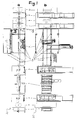
- Fig. 1a and Fig. 1b describes a plant and a method for the offset-free lamination of solid and hollow-core support pieces with multi-component adhesive systems according to a preferred embodiment of the invention.
- a preferred embodiment of a laminating system according to the invention which is generally designated 20.
- the structure of the laminating system 20 as well as the method according to the invention carried out on the laminating system 20 are explained below.
- the lamination is done with a two component adhesive system based on phenolic resin.
- a support piece (not shown) to be laminated is first passed through a cleaning device 1 with cleaning brushes.
- the structure of such a cleaning device 1 is known in the field of laminating equipment.
- the support piece is guided by a pre-pressing device 2, before it passes through a hardener-application device 3 in the direction of passage, ie from left to right in the figures.
- the structure of the pre-pressing device 2 and hardener application device 3 are also known in the art.
- the evaporation device 4a may comprise a plurality of infrared radiators, which apply heat to the support piece and thus cause a drying of the hardener. It is also contemplated that drying of the hardener adjacent to the infrared emitters is effected by air currents. In this case, a high flow of air can be passed through the evaporator, so that with less heat supplied by the infrared radiator nevertheless effective drying of the curing agent is effected.
- the carrier piece is cooled by the air flow, so that the temperature difference between the carrier piece and glue can be kept low.
- the carrier pieces After the carrier pieces have left the evaporation zone 4, they are transported to a glue application device 5 for applying a glue to the dried hardener.
- the size of the glue in the glue applicator 5 is cooled to a temperature below room temperature by a powerful external refrigerator (not shown).
- the cooling of the glue is preferably carried out at temperatures between 12 and 6 ° C. Cooling of the size inhibits the polycondensation of the phenolic resin-based two-component adhesive system, allowing subsequent transport on a lengthened alignment line in a reaction zone 6.
- the carrier pieces are fed to the reaction zone 6.
- the glue reacts with the hardener, ie the gelling phase of the two-component phenolic resin-based adhesive system takes place.
- the reaction zone 6 has a length of about 7.5 m, so that carrier pieces with a length of up to about 6.5m can be aligned without offset.
- the length of the reaction zone 6 can be adapted to the respective requirements, so that also support pieces with a length of more than 6.5m can be aligned without offset.
- the alignment is carried out by an arranged in the reaction zone 6 alignment device 6a, by means of which the support piece can be aligned without offset with a leading support piece.
- the alignment device 6a comprises a multipart guide system for the offset-free alignment of the support pieces.
- the alignment device 6a comprises three guide elements arranged on each longitudinal side of the reaction zone 6 (see FIG Fig. 1b ). To align the support pieces move the guide elements, as indicated by the arrows in Fig. 1b indicated at the same time to the center of the reaction zone 6 and move the support piece in the direction of the center of the reaction zone 6 until they touch the respective support piece on its two longitudinal sides and thus cause a center-centered alignment of respective support pieces.
- the laminating device 7 comprises a calender with steel rollers, which laminates the incoming coating layer 6b under pressure and temperature onto the carrier pieces. Subsequently, the laminated carrier piece is fed to a repressing device 8, which likewise comprises a calender with steel rollers. After leaving the Nachpressvorraum 8, the support piece of a smoothing device 9, 10 is supplied, comprising two calenders with elastic roller surface. At the preferred Embodiment include the two calenders of the smoother 9, 10 rollers with a rubber surface.
- the use of rubberized rollers allows unevenness in the surface of the support piece, even with two-component adhesive systems based on phenolic resin, to be easily compensated and laminated.
- the subsequent smoothing is made possible by the delayed reaction time of the adhesive system, which is due to the glue cooling to temperatures below room temperature.
- the smoothing device 9, 10 in the direction of passage after the laminating device 7 and the Nachpressvoriques 8 is additionally arranged.
- the temperature of the subsequent calender, in the direction of passage from the laminating device 7 to the smoother 9, 10, respectively, to the preceding calender is gradually increased.
- the temperature at the steel rollers of the laminating device 7 is preferably between 70 and 100 ° C, so that even coating layers of plastic can be rolled without causing vapor bubble formation.
- the temperature of the respective rollers of the Nachpressvorraum 8 for smoothing device 9, 10 is gradually increased, the temperature to the roller of the smoothing device 10 to about 160 ° C is increased. Due to the arrangement of several calenders in a row, it is thus also possible by setting different temperatures on the respective rolls, to laminate plastic coating layers with the highest quality.
Landscapes
- Laminated Bodies (AREA)
- Lining Or Joining Of Plastics Or The Like (AREA)
- Catalysts (AREA)
Priority Applications (4)
| Application Number | Priority Date | Filing Date | Title |
|---|---|---|---|
| ES08003020T ES2425872T3 (es) | 2008-02-19 | 2008-02-19 | Equipo y procedimiento para laminación sin desplazamiento de componentes de soporte masivos y de doble pared con sistemas adhesivos multicomponente |
| EP08003020.8A EP2093054B1 (fr) | 2008-02-19 | 2008-02-19 | Installation et procédé pour le revêtement sans désalignement de pièces de support à chambre creuse et de pièces de support massives à l'aide de systèmes de colle à plusieurs composants |
| PL08003020T PL2093054T3 (pl) | 2008-02-19 | 2008-02-19 | Instalacja i sposób bezprzesunięciowego laminowania litych i pustokomorowych przedmiotów nośnikowych za pomocą wieloskładnikowych układów klejących |
| HK10100184.4A HK1132479B (en) | 2010-01-08 | Equipment and method for displacement-free lamination of massive and twin-wall support components with multi-component adhesive systems |
Applications Claiming Priority (1)
| Application Number | Priority Date | Filing Date | Title |
|---|---|---|---|
| EP08003020.8A EP2093054B1 (fr) | 2008-02-19 | 2008-02-19 | Installation et procédé pour le revêtement sans désalignement de pièces de support à chambre creuse et de pièces de support massives à l'aide de systèmes de colle à plusieurs composants |
Publications (2)
| Publication Number | Publication Date |
|---|---|
| EP2093054A1 true EP2093054A1 (fr) | 2009-08-26 |
| EP2093054B1 EP2093054B1 (fr) | 2013-05-29 |
Family
ID=39591547
Family Applications (1)
| Application Number | Title | Priority Date | Filing Date |
|---|---|---|---|
| EP08003020.8A Not-in-force EP2093054B1 (fr) | 2008-02-19 | 2008-02-19 | Installation et procédé pour le revêtement sans désalignement de pièces de support à chambre creuse et de pièces de support massives à l'aide de systèmes de colle à plusieurs composants |
Country Status (3)
| Country | Link |
|---|---|
| EP (1) | EP2093054B1 (fr) |
| ES (1) | ES2425872T3 (fr) |
| PL (1) | PL2093054T3 (fr) |
Citations (3)
| Publication number | Priority date | Publication date | Assignee | Title |
|---|---|---|---|---|
| GB1159114A (en) * | 1966-01-24 | 1969-07-23 | Harris Lebus Ltd | Improvements in the Treatment of Wood Surfaces |
| DE10358547B3 (de) * | 2003-12-15 | 2005-06-16 | Tünkers Maschinenbau Gmbh | Kaschiermaschine |
| US20070039678A1 (en) | 2005-08-18 | 2007-02-22 | Akzo Nobel Coatings International B.V. | Method for production of layered substrates |
-
2008
- 2008-02-19 ES ES08003020T patent/ES2425872T3/es active Active
- 2008-02-19 EP EP08003020.8A patent/EP2093054B1/fr not_active Not-in-force
- 2008-02-19 PL PL08003020T patent/PL2093054T3/pl unknown
Patent Citations (3)
| Publication number | Priority date | Publication date | Assignee | Title |
|---|---|---|---|---|
| GB1159114A (en) * | 1966-01-24 | 1969-07-23 | Harris Lebus Ltd | Improvements in the Treatment of Wood Surfaces |
| DE10358547B3 (de) * | 2003-12-15 | 2005-06-16 | Tünkers Maschinenbau Gmbh | Kaschiermaschine |
| US20070039678A1 (en) | 2005-08-18 | 2007-02-22 | Akzo Nobel Coatings International B.V. | Method for production of layered substrates |
Also Published As
| Publication number | Publication date |
|---|---|
| HK1132479A1 (en) | 2010-02-26 |
| EP2093054B1 (fr) | 2013-05-29 |
| ES2425872T3 (es) | 2013-10-17 |
| PL2093054T3 (pl) | 2013-10-31 |
Similar Documents
| Publication | Publication Date | Title |
|---|---|---|
| EP0794855B1 (fr) | Dispositif et procede de traitement de surfaces | |
| EP2242646B1 (fr) | Procédé de fabrication d'un stratifié | |
| EP2902196B1 (fr) | Procédé de fabrication d'un matériau dérivé du bois et matériau dérivé du bois constitué d'une plaque de support et d'un placage | |
| EP3023261B1 (fr) | Procédé d'affinement d'une plaque en bois | |
| WO2017097705A1 (fr) | Panneau décoratif et procédé de fabrication dudit panneau | |
| EP2829415A1 (fr) | Procédé de fabrication d'un panneau mural et de sol décoré | |
| DE3010060C2 (fr) | ||
| DE102012100800B4 (de) | Verfahren zum Imprägnieren von Werkstoffplatten, imprägnierte Werkstoffplatte und Anlage zur Herstellung einer imprägnierten Werkstoffplatte | |
| EP3132945B1 (fr) | Procede de fabrication d'un panneau mural ou de sol decore | |
| EP2223800A1 (fr) | Produit décoratif, procédé de fabrication d'un produit décoratif et utilisation d'un produit décoratif pour fabriquer une surface de support décorée | |
| EP1154891A1 (fr) | Processus continu et dispositif pour appliquer un materiau de revetement sur des chants poreux de pieces a usiner | |
| EP3587108B1 (fr) | Panneau sandwich contrecollé | |
| EP2274176B1 (fr) | Panneau en bois reconstitué comportant un revêtement laminé brillant et procédé de fabrication d'un tel panneau | |
| EP1894711B1 (fr) | Procédé et dispositif destinés à la fabrication d'un panneau de construction léger | |
| EP3088204B1 (fr) | Procédé de fabrication d'un panneau mural ou de sol décoré | |
| EP2093054B1 (fr) | Installation et procédé pour le revêtement sans désalignement de pièces de support à chambre creuse et de pièces de support massives à l'aide de systèmes de colle à plusieurs composants | |
| EP3290175A1 (fr) | Procede de traitement de surfaces en bois | |
| DE202008018209U1 (de) | Versatzfreies Kaschieren von massiven und Hohlkammer-Trägerstücken mit Mehrkomponenten-Klebstoffsystemen | |
| DE102007034543B4 (de) | Verfahren und Vorrichtung zur Herstellung einer Leichtbauplatte sowie Leichtbauplatte | |
| WO2004033577A2 (fr) | Procede de production de bois colle a courtes etapes | |
| DE102007003746B4 (de) | Verfahren und Vorrichtung zum beidseitigen Beschichten einer Platte | |
| EP4005757A1 (fr) | Procédé et installation de fabrication de panneaux de matière | |
| EP4585319B1 (fr) | Procédé de fabrication d'un panneau de coffrage à béton utilisable plusieurs fois ainsi que panneau de coffrage à béton | |
| DE10230206A1 (de) | Vorrichtung und Verfahren zur kontinuierlichen Herstellung einer Holzwerkstoffplatte sowie zur Beschichtung derselben mit einem Film- oder Folienmaterial | |
| EP2186635A2 (fr) | Méthode pour revêtir des plaques de matière dérivée du bois avec une couche d'usure |
Legal Events
| Date | Code | Title | Description |
|---|---|---|---|
| PUAI | Public reference made under article 153(3) epc to a published international application that has entered the european phase |
Free format text: ORIGINAL CODE: 0009012 |
|
| AK | Designated contracting states |
Kind code of ref document: A1 Designated state(s): AT BE BG CH CY CZ DE DK EE ES FI FR GB GR HR HU IE IS IT LI LT LU LV MC MT NL NO PL PT RO SE SI SK TR |
|
| AX | Request for extension of the european patent |
Extension state: AL BA MK RS |
|
| 17P | Request for examination filed |
Effective date: 20091214 |
|
| 17Q | First examination report despatched |
Effective date: 20100108 |
|
| REG | Reference to a national code |
Ref country code: HK Ref legal event code: DE Ref document number: 1132479 Country of ref document: HK |
|
| AKX | Designation fees paid |
Designated state(s): AT BE BG CH CY CZ DE DK EE ES FI FR GB GR HR HU IE IS IT LI LT LU LV MC MT NL NO PL PT RO SE SI SK TR |
|
| GRAP | Despatch of communication of intention to grant a patent |
Free format text: ORIGINAL CODE: EPIDOSNIGR1 |
|
| RIC1 | Information provided on ipc code assigned before grant |
Ipc: B32B 37/12 20060101ALI20121210BHEP Ipc: B32B 38/18 20060101AFI20121210BHEP Ipc: B32B 37/22 20060101ALI20121210BHEP |
|
| GRAS | Grant fee paid |
Free format text: ORIGINAL CODE: EPIDOSNIGR3 |
|
| GRAA | (expected) grant |
Free format text: ORIGINAL CODE: 0009210 |
|
| AK | Designated contracting states |
Kind code of ref document: B1 Designated state(s): AT BE BG CH CY CZ DE DK EE ES FI FR GB GR HR HU IE IS IT LI LT LU LV MC MT NL NO PL PT RO SE SI SK TR |
|
| REG | Reference to a national code |
Ref country code: GB Ref legal event code: FG4D Free format text: NOT ENGLISH |
|
| REG | Reference to a national code |
Ref country code: CH Ref legal event code: EP |
|
| REG | Reference to a national code |
Ref country code: AT Ref legal event code: REF Ref document number: 614100 Country of ref document: AT Kind code of ref document: T Effective date: 20130615 |
|
| REG | Reference to a national code |
Ref country code: IE Ref legal event code: FG4D Free format text: LANGUAGE OF EP DOCUMENT: GERMAN |
|
| REG | Reference to a national code |
Ref country code: DE Ref legal event code: R096 Ref document number: 502008010007 Country of ref document: DE Effective date: 20130725 |
|
| REG | Reference to a national code |
Ref country code: ES Ref legal event code: FG2A Ref document number: 2425872 Country of ref document: ES Kind code of ref document: T3 Effective date: 20131017 |
|
| REG | Reference to a national code |
Ref country code: LT Ref legal event code: MG4D |
|
| PG25 | Lapsed in a contracting state [announced via postgrant information from national office to epo] |
Ref country code: LT Free format text: LAPSE BECAUSE OF FAILURE TO SUBMIT A TRANSLATION OF THE DESCRIPTION OR TO PAY THE FEE WITHIN THE PRESCRIBED TIME-LIMIT Effective date: 20130529 Ref country code: PT Free format text: LAPSE BECAUSE OF FAILURE TO SUBMIT A TRANSLATION OF THE DESCRIPTION OR TO PAY THE FEE WITHIN THE PRESCRIBED TIME-LIMIT Effective date: 20130930 Ref country code: NO Free format text: LAPSE BECAUSE OF FAILURE TO SUBMIT A TRANSLATION OF THE DESCRIPTION OR TO PAY THE FEE WITHIN THE PRESCRIBED TIME-LIMIT Effective date: 20130829 Ref country code: GR Free format text: LAPSE BECAUSE OF FAILURE TO SUBMIT A TRANSLATION OF THE DESCRIPTION OR TO PAY THE FEE WITHIN THE PRESCRIBED TIME-LIMIT Effective date: 20130830 Ref country code: SI Free format text: LAPSE BECAUSE OF FAILURE TO SUBMIT A TRANSLATION OF THE DESCRIPTION OR TO PAY THE FEE WITHIN THE PRESCRIBED TIME-LIMIT Effective date: 20130529 Ref country code: FI Free format text: LAPSE BECAUSE OF FAILURE TO SUBMIT A TRANSLATION OF THE DESCRIPTION OR TO PAY THE FEE WITHIN THE PRESCRIBED TIME-LIMIT Effective date: 20130529 Ref country code: IS Free format text: LAPSE BECAUSE OF FAILURE TO SUBMIT A TRANSLATION OF THE DESCRIPTION OR TO PAY THE FEE WITHIN THE PRESCRIBED TIME-LIMIT Effective date: 20130929 Ref country code: SE Free format text: LAPSE BECAUSE OF FAILURE TO SUBMIT A TRANSLATION OF THE DESCRIPTION OR TO PAY THE FEE WITHIN THE PRESCRIBED TIME-LIMIT Effective date: 20130529 |
|
| REG | Reference to a national code |
Ref country code: PL Ref legal event code: T3 |
|
| REG | Reference to a national code |
Ref country code: HK Ref legal event code: GR Ref document number: 1132479 Country of ref document: HK |
|
| REG | Reference to a national code |
Ref country code: NL Ref legal event code: VDEP Effective date: 20130529 |
|
| PG25 | Lapsed in a contracting state [announced via postgrant information from national office to epo] |
Ref country code: BG Free format text: LAPSE BECAUSE OF FAILURE TO SUBMIT A TRANSLATION OF THE DESCRIPTION OR TO PAY THE FEE WITHIN THE PRESCRIBED TIME-LIMIT Effective date: 20130829 Ref country code: HR Free format text: LAPSE BECAUSE OF FAILURE TO SUBMIT A TRANSLATION OF THE DESCRIPTION OR TO PAY THE FEE WITHIN THE PRESCRIBED TIME-LIMIT Effective date: 20130529 |
|
| PG25 | Lapsed in a contracting state [announced via postgrant information from national office to epo] |
Ref country code: LV Free format text: LAPSE BECAUSE OF FAILURE TO SUBMIT A TRANSLATION OF THE DESCRIPTION OR TO PAY THE FEE WITHIN THE PRESCRIBED TIME-LIMIT Effective date: 20130529 |
|
| PG25 | Lapsed in a contracting state [announced via postgrant information from national office to epo] |
Ref country code: CZ Free format text: LAPSE BECAUSE OF FAILURE TO SUBMIT A TRANSLATION OF THE DESCRIPTION OR TO PAY THE FEE WITHIN THE PRESCRIBED TIME-LIMIT Effective date: 20130529 Ref country code: DK Free format text: LAPSE BECAUSE OF FAILURE TO SUBMIT A TRANSLATION OF THE DESCRIPTION OR TO PAY THE FEE WITHIN THE PRESCRIBED TIME-LIMIT Effective date: 20130529 Ref country code: EE Free format text: LAPSE BECAUSE OF FAILURE TO SUBMIT A TRANSLATION OF THE DESCRIPTION OR TO PAY THE FEE WITHIN THE PRESCRIBED TIME-LIMIT Effective date: 20130529 Ref country code: SK Free format text: LAPSE BECAUSE OF FAILURE TO SUBMIT A TRANSLATION OF THE DESCRIPTION OR TO PAY THE FEE WITHIN THE PRESCRIBED TIME-LIMIT Effective date: 20130529 |
|
| PG25 | Lapsed in a contracting state [announced via postgrant information from national office to epo] |
Ref country code: RO Free format text: LAPSE BECAUSE OF FAILURE TO SUBMIT A TRANSLATION OF THE DESCRIPTION OR TO PAY THE FEE WITHIN THE PRESCRIBED TIME-LIMIT Effective date: 20130529 Ref country code: NL Free format text: LAPSE BECAUSE OF FAILURE TO SUBMIT A TRANSLATION OF THE DESCRIPTION OR TO PAY THE FEE WITHIN THE PRESCRIBED TIME-LIMIT Effective date: 20130529 |
|
| PLBE | No opposition filed within time limit |
Free format text: ORIGINAL CODE: 0009261 |
|
| STAA | Information on the status of an ep patent application or granted ep patent |
Free format text: STATUS: NO OPPOSITION FILED WITHIN TIME LIMIT |
|
| 26N | No opposition filed |
Effective date: 20140303 |
|
| REG | Reference to a national code |
Ref country code: DE Ref legal event code: R097 Ref document number: 502008010007 Country of ref document: DE Effective date: 20140303 |
|
| BERE | Be: lapsed |
Owner name: FRIZ KASCHIERTECHNIK G.M.B.H. Effective date: 20140228 |
|
| PG25 | Lapsed in a contracting state [announced via postgrant information from national office to epo] |
Ref country code: LU Free format text: LAPSE BECAUSE OF FAILURE TO SUBMIT A TRANSLATION OF THE DESCRIPTION OR TO PAY THE FEE WITHIN THE PRESCRIBED TIME-LIMIT Effective date: 20140219 Ref country code: MC Free format text: LAPSE BECAUSE OF FAILURE TO SUBMIT A TRANSLATION OF THE DESCRIPTION OR TO PAY THE FEE WITHIN THE PRESCRIBED TIME-LIMIT Effective date: 20130529 |
|
| REG | Reference to a national code |
Ref country code: CH Ref legal event code: PL |
|
| PG25 | Lapsed in a contracting state [announced via postgrant information from national office to epo] |
Ref country code: CH Free format text: LAPSE BECAUSE OF NON-PAYMENT OF DUE FEES Effective date: 20140228 Ref country code: LI Free format text: LAPSE BECAUSE OF NON-PAYMENT OF DUE FEES Effective date: 20140228 |
|
| REG | Reference to a national code |
Ref country code: IE Ref legal event code: MM4A |
|
| PG25 | Lapsed in a contracting state [announced via postgrant information from national office to epo] |
Ref country code: IE Free format text: LAPSE BECAUSE OF NON-PAYMENT OF DUE FEES Effective date: 20140219 Ref country code: BE Free format text: LAPSE BECAUSE OF NON-PAYMENT OF DUE FEES Effective date: 20140228 |
|
| REG | Reference to a national code |
Ref country code: AT Ref legal event code: MM01 Ref document number: 614100 Country of ref document: AT Kind code of ref document: T Effective date: 20140219 |
|
| PG25 | Lapsed in a contracting state [announced via postgrant information from national office to epo] |
Ref country code: AT Free format text: LAPSE BECAUSE OF NON-PAYMENT OF DUE FEES Effective date: 20140219 |
|
| PG25 | Lapsed in a contracting state [announced via postgrant information from national office to epo] |
Ref country code: MT Free format text: LAPSE BECAUSE OF FAILURE TO SUBMIT A TRANSLATION OF THE DESCRIPTION OR TO PAY THE FEE WITHIN THE PRESCRIBED TIME-LIMIT Effective date: 20130529 |
|
| PG25 | Lapsed in a contracting state [announced via postgrant information from national office to epo] |
Ref country code: CY Free format text: LAPSE BECAUSE OF FAILURE TO SUBMIT A TRANSLATION OF THE DESCRIPTION OR TO PAY THE FEE WITHIN THE PRESCRIBED TIME-LIMIT Effective date: 20130529 |
|
| PG25 | Lapsed in a contracting state [announced via postgrant information from national office to epo] |
Ref country code: HU Free format text: LAPSE BECAUSE OF FAILURE TO SUBMIT A TRANSLATION OF THE DESCRIPTION OR TO PAY THE FEE WITHIN THE PRESCRIBED TIME-LIMIT; INVALID AB INITIO Effective date: 20080219 |
|
| REG | Reference to a national code |
Ref country code: FR Ref legal event code: PLFP Year of fee payment: 9 |
|
| PGFP | Annual fee paid to national office [announced via postgrant information from national office to epo] |
Ref country code: GB Payment date: 20160822 Year of fee payment: 9 |
|
| PGFP | Annual fee paid to national office [announced via postgrant information from national office to epo] |
Ref country code: ES Payment date: 20160817 Year of fee payment: 9 Ref country code: TR Payment date: 20160810 Year of fee payment: 9 |
|
| REG | Reference to a national code |
Ref country code: FR Ref legal event code: PLFP Year of fee payment: 10 |
|
| GBPC | Gb: european patent ceased through non-payment of renewal fee |
Effective date: 20170219 |
|
| REG | Reference to a national code |
Ref country code: FR Ref legal event code: PLFP Year of fee payment: 11 |
|
| PG25 | Lapsed in a contracting state [announced via postgrant information from national office to epo] |
Ref country code: GB Free format text: LAPSE BECAUSE OF NON-PAYMENT OF DUE FEES Effective date: 20170219 |
|
| PGFP | Annual fee paid to national office [announced via postgrant information from national office to epo] |
Ref country code: DE Payment date: 20180222 Year of fee payment: 11 |
|
| PGFP | Annual fee paid to national office [announced via postgrant information from national office to epo] |
Ref country code: IT Payment date: 20180221 Year of fee payment: 11 Ref country code: PL Payment date: 20180116 Year of fee payment: 11 Ref country code: FR Payment date: 20180221 Year of fee payment: 11 |
|
| REG | Reference to a national code |
Ref country code: ES Ref legal event code: FD2A Effective date: 20180704 |
|
| PG25 | Lapsed in a contracting state [announced via postgrant information from national office to epo] |
Ref country code: ES Free format text: LAPSE BECAUSE OF NON-PAYMENT OF DUE FEES Effective date: 20170220 |
|
| REG | Reference to a national code |
Ref country code: DE Ref legal event code: R119 Ref document number: 502008010007 Country of ref document: DE |
|
| PG25 | Lapsed in a contracting state [announced via postgrant information from national office to epo] |
Ref country code: DE Free format text: LAPSE BECAUSE OF NON-PAYMENT OF DUE FEES Effective date: 20190903 |
|
| PG25 | Lapsed in a contracting state [announced via postgrant information from national office to epo] |
Ref country code: FR Free format text: LAPSE BECAUSE OF NON-PAYMENT OF DUE FEES Effective date: 20190228 Ref country code: IT Free format text: LAPSE BECAUSE OF NON-PAYMENT OF DUE FEES Effective date: 20190219 |
|
| PG25 | Lapsed in a contracting state [announced via postgrant information from national office to epo] |
Ref country code: PL Free format text: LAPSE BECAUSE OF NON-PAYMENT OF DUE FEES Effective date: 20190219 |
|
| PG25 | Lapsed in a contracting state [announced via postgrant information from national office to epo] |
Ref country code: TR Free format text: LAPSE BECAUSE OF NON-PAYMENT OF DUE FEES Effective date: 20170219 |