EP2093383B1 - Leitschaufel und Leitschaufelanordnung - Google Patents
Leitschaufel und Leitschaufelanordnung Download PDFInfo
- Publication number
- EP2093383B1 EP2093383B1 EP08254064A EP08254064A EP2093383B1 EP 2093383 B1 EP2093383 B1 EP 2093383B1 EP 08254064 A EP08254064 A EP 08254064A EP 08254064 A EP08254064 A EP 08254064A EP 2093383 B1 EP2093383 B1 EP 2093383B1
- Authority
- EP
- European Patent Office
- Prior art keywords
- vane
- circumferential extension
- platform
- flange
- circumferential
- Prior art date
- Legal status (The legal status is an assumption and is not a legal conclusion. Google has not performed a legal analysis and makes no representation as to the accuracy of the status listed.)
- Ceased
Links
Images



Classifications
-
- F—MECHANICAL ENGINEERING; LIGHTING; HEATING; WEAPONS; BLASTING
- F01—MACHINES OR ENGINES IN GENERAL; ENGINE PLANTS IN GENERAL; STEAM ENGINES
- F01D—NON-POSITIVE DISPLACEMENT MACHINES OR ENGINES, e.g. STEAM TURBINES
- F01D9/00—Stators
- F01D9/02—Nozzles; Nozzle boxes; Stator blades; Guide conduits, e.g. individual nozzles
- F01D9/04—Nozzles; Nozzle boxes; Stator blades; Guide conduits, e.g. individual nozzles forming ring or sector
- F01D9/042—Nozzles; Nozzle boxes; Stator blades; Guide conduits, e.g. individual nozzles forming ring or sector fixing blades to stators
-
- F—MECHANICAL ENGINEERING; LIGHTING; HEATING; WEAPONS; BLASTING
- F01—MACHINES OR ENGINES IN GENERAL; ENGINE PLANTS IN GENERAL; STEAM ENGINES
- F01D—NON-POSITIVE DISPLACEMENT MACHINES OR ENGINES, e.g. STEAM TURBINES
- F01D25/00—Component parts, details, or accessories, not provided for in, or of interest apart from, other groups
- F01D25/16—Arrangement of bearings; Supporting or mounting bearings in casings
- F01D25/162—Bearing supports
-
- F—MECHANICAL ENGINEERING; LIGHTING; HEATING; WEAPONS; BLASTING
- F01—MACHINES OR ENGINES IN GENERAL; ENGINE PLANTS IN GENERAL; STEAM ENGINES
- F01D—NON-POSITIVE DISPLACEMENT MACHINES OR ENGINES, e.g. STEAM TURBINES
- F01D25/00—Component parts, details, or accessories, not provided for in, or of interest apart from, other groups
- F01D25/24—Casings; Casing parts, e.g. diaphragms, casing fastenings
- F01D25/246—Fastening of diaphragms or stator-rings
Definitions
- the present invention relates to vanes and vane assemblies for use with gas turbine engines.
- Known vane (or stator) assemblies such as low pressure compressor (LPC) exit guide vane assemblies for gas turbine engines, often include an inner shroud ring, and outer shroud ring, and a plurality of vane details having airfoils that bridge an annular gap between the inner and outer shroud rings in a cascade configuration.
- LPC low pressure compressor
- an inner end of each vane detail includes a platform that is riveted to the inner shroud ring.
- An outer end of each vane detail lacks a platform like the inner end, but instead has a "free" end that is potted within an opening in the outer shroud using a "slug" of conformable material (e.g., rubber, etc.).
- Potting the outer ends of the vane details facilitates assembly processes, and provides a damping effect during engine operation.
- Clips or other retainers are sometimes also used to retain the potted ends of the vane details relative to a shroud.
- the riveted connection is often located at the inner shroud ring and the potted connection at the outer shroud ring, because some engine designs provide a more secure and desirable mounting arrangement relative to the engine structural frame at the inner shroud location.
- a vane having the features of the preamble of claim 1 is disclosed in EP-A-1,596,036 - US-A-2003/0185673 describes a flow rectifying member and its unit and method for producing flow rectifying member.
- the amount of space available for securing the platforms of the vane details is limited, particularly at the inner shroud.
- the vane detail platforms have been positioned next to each other in close proximity in a nested configuration.
- known nested designs are not readily scaled to allow any number of vanes within a given vane assembly in an engine, but rather face maximum vane count limits.
- the present invention provides an alternative vane and vane assembly configuration that allows for relatively high vane counts.
- the present invention provides a vane for a gas turbine engine as claimed in claim 1.
- a vane assembly includes a plurality of vanes with the first circumferential extension of one vane engaging the second circumferential extension of an adjacent vane to define a shiplap joint.
- the present invention provides a vane (or stator) and an assembly thereof for use in a gas turbine engine.
- Each vane includes an integrally formed platform with a flange configured for attachment with an adjacent, similarly-configured vane in a shiplap joint.
- FIG. 1 is a schematic cross-sectional view of an exemplary two-spool gas turbine engine 20.
- the engine 20 includes a fan 22, a low-pressure compressor (LPC) section 24, a high-pressure compressor (HPC) section 26, a combustor assembly 28, a high-pressure turbine (HPT) section 30, and a low-pressure turbine (LPT) section 34 all arranged about an engine centerline C L .
- LPC low-pressure compressor
- HPC high-pressure compressor
- HPT high-pressure turbine
- LPT low-pressure turbine
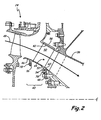
- FIG. 2 is a cross-sectional view of a portion of the gas turbine engine 20 at an aft region of the LPC section 24 upstream from an intermediate case 36 and the HPC section 26 (not visible in FIG. 2 ).
- a LPC exit guide vane assembly 40 is shown at the aft end of the LPC section 24.
- the assembly 40 includes an outer diameter (OD) shroud ring 42, a plurality of vanes 44 arranged about the engine centerline C L in a cascade configuration, an upstream (or forward) ring 46, and a downstream (or aft) ring 48.
- a generally annular primary flowpath, represented schematically by arrow 49, is defined through the LPC exit guide vane assembly 40, with an OD boundary of the primary flowpath 49 defined by the OD shroud ring 42.
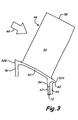
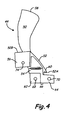
- FIGS. 3-5 illustrate one vane 44 for use with the LPC exit guide vane assembly 40.
- FIG. 3 is a side view of the vane 44
- FIG. 4 is a front view of the vane 44
- FIG. 5 is an isometric view of the vane 44.
- the vane 44 includes an airfoil portion 50, a platform 52, a first flange 54 and a second flange 56.
- Each vane can be made of metallic materials such as titanium, nickel, cobalt, aluminum, etc. and alloys containing such metals.
- the vanes 44 can be fabricated using known processes such as casting, forging, machining, etc. Coatings (not specifically shown) can be applied to portions of the vanes 44 as desired.
- the airfoil portion 50 has an aerodynamic curvature (e.g., a three-dimensional "bowed" profile) to interact with fluid passing along the primary flowpath 49 through the LPC section 24.
- the airfoil portion 50 has a free end (or tip) 58, that is, an end without an integral shroud or platform.
- the free end 58 of the airfoil portion 50 is configured to be inserted into a slot in the OD shroud ring 42 and potted with a conformable material (e.g., rubber) in a conventional manner.
- the free end 58 of the airfoil portion 50 is positioned radially outward in the LPC exit guide vane assembly 40 (see FIG. 2 ).
- the platform 52 is arranged at an opposite end of the airfoil portion 50 from the free end 58, and can have a parallelogram-shaped profile.
- the platform 52 can be positioned radially inward in the LPC exit guide vane assembly 40, as shown in FIG. 2 , to define a segment of an inner diameter (ID) boundary of the primary flowpath 49.
- the airfoil portion 50 is integrally formed with platform 52.
- the platform 52 can define a lip 60 at a downstream edge 52A to provide sealing or other functionality, as explained further below.
- the first and second flanges 54 and 56 both extend from the platform 52 away from the airfoil portion 50, that is, in a radially inward direction.
- the first and second flanges 54 and 56 can both be configured to be substantially perpendicular to the engine centerline C L when the vane 44 is installed in the LPC exit guide vane assembly 40 of the engine 20.
- the first flange 54 is arranged adjacent to the lip 60 at the downstream edge 52A of the platform 52, and can be integrally formed with the platform 52.
- the first flange 54 includes a first circumferential extension 62 and a second circumferential extension (or lobe) 64.
- the first and second circumferential extensions 62 and 64 meet at a central portion 66.
- Openings 68 and 70 are located in the first and second circumferential extensions 62 and 64, respectively, which enable the first flange 54 to be secured to the downstream ring 48 with suitable fasteners, such as rivets (see FIGS. 2 and 7 ).
- the first circumferential extension 62 is integrally joined to the platform 52 along an entire radially outward extent of the first circumferential extension 62, and is generally circumferentially aligned with platform 52.
- the central portion 66 is positioned at a circumferential edge of the platform 52, and the second circumferential extension extends from the central portion 66 beyond the circumferential edge of the platform 52 in a cantilevered configuration.
- the first and second circumferential extensions 62 and 64 are both substantially planar. However a chamfered edge 72 is provided at a distal end of the cantilevered second circumferential extension 64 at an aft face thereof.
- a cutaway portion is defined in the first flange 54 at a forward face of the first circumferential extension 62.
- the cutaway portion at the first circumferential extension 62 has a shape that corresponds to that of the second circumferential extension 64.
- the cutaway portion extends to a radially inward edge of the first circumferential extension 62 but its radially outward extent does not reach the platform 52.
- a depth of the cutaway portion (measured in the axial direction) at the first circumferential extension 62 can be at least as great as a thickness of the second circumferential extension 64 (measured in the axial direction), with a thickness of the central portion 66 being equal to a total distance between an aft face of the first circumferential extension 62 and a forward face of the second circumferential extension 64.
- the first flange 54 is configured to form a shiplap joint when engaged with an adjacent vane 44 of similar configuration, as explained further below.
- the first and second circumferential extensions 62 and 64 are axially offset, such that the forward face of the first circumferential extension 62 within the cutaway portion is substantially axially aligned (i.e., co-planar) with the aft face of the second circumferential extension 64.
- the second flange 56 is arranged at an upstream edge 52B of the platform opposite the first flange 54, and in the illustrated embodiment is substantially planar, with a substantially rectangular profile, and axially aligned with the upstream edge 52A. Circumferential edges of the second flange 56 are aligned with the circumferential edges of the platform 52 in the illustrated embodiment.
- the second flange 56 includes an opening 74, enabling the second flange 56 to be secured to the upstream ring 46 with a suitable fastener, such as a rivet (see FIG. 2 ).
- the second flange 56 can be integrally formed with the platform 52.
- FIG. 6 is a perspective view of the LPC exit guide vane assembly 40 during assembly and prior to installation in the engine 20, and FIG. 7 is an enlarged perspective view of a portion of the LPC exit guide vane assembly 40 at region VII of FIG. 6 .
- a plurality of the vanes 44 (only some of the vanes 44 are labeled in FIG. 6 for simplicity) are positioned adjacent one another in a cascade configuration, with the airfoil portions 50 spanning an annular gap between the integral platform segments 52 (at the ID flowpath boundary) and the OD shroud ring 42.
- adjacent vanes 44 may need to be at least partially unseated relative to the downstream ring 48 while the last vane 44 is wiggled into position and the adjacent vanes 44 reseated against the downstream ring 48.
- the "free" ends (or tips) 58 of the vanes 44 are inserted into slots in the OD shroud ring 42 and potted using a conformable material such as rubber.
- Temporary fasteners 76 are used to secure the second flange 56 (not visible in FIG. 6 ) of each vane 44 to the upstream ring 46. The temporary fasteners 76 are systematically removed and replaced by rivets 78 during the assembly process.
- Rivets 78 are also used to secure the first flange 54 to the downstream ring 48.
- a sealant e.g., rubber sealant
- a sealant can be applied between the platforms 52 of adjacent vanes 44, to help reduce fluid leakage at the ID boundary of the primary flowpath 49.
- the first flanges 54 of adjacent vanes 44 engage each other in a shiplap joint.
- the second circumferential extension 64 of the first flange 54 of one vane 44 is positioned adjacent to the first circumferential extension 62 of another vane 44.
- the aft face of the given second circumferential extension 64 is positioned in the cutaway portion along the forward face of the given first circumferential extension 62 to define a mating plane, with the opening 70 in the second circumferential extension 64 aligned with the opening 68 in the first circumferential extension 62.
- a rivet 78 positioned through both of the aligned openings 68 and 70 can commonly secure the first flanges 54 of two adjacent vanes 44 to the downstream ring 48.
- the configuration of the shiplap joint in the illustrated embodiment, with the first circumferential extension 62 offset so as to be positioned generally aft of the second circumferential extension 64, can help reduce tensile stress in the rivets 78.
- operational loading on the airfoil portion 50 will tend to cause the first circumferential extension 62 to pull away from the downstream ring 48 and the second circumferential extension 64 (located at a suction side of the airfoil portion 50, as best shown in FIG. 5 ) to push toward the downstream ring 48.
- the illustrated embodiment of the shiplap joint causes the operational loads transmitted through the second circumferential extensions 64 to offset those transmitted through the first circumferential extensions 62, thereby helping to lessen overall tensile loading on the rivets 78.
- the OD shroud ring 42 and the downstream ring 48 each include connection features, such as bayonet mount lugs, bolt holes, etc., to enable the LPC exit guide vane assembly 40 to be mounted and secured within the gas turbine engine 20.
- the downstream ring 48 provides the primary structural support attachment between the assembly 40 and the rest of the engine 20 (see FIG. 2 ).
- the lip 60 When the LPC exit guide vane assembly 40 is assembled in the engine 20, the lip 60 extends downstream (or aft) of the first flange 54, creating an overhang adjacent to the shiplap joint (see FIG. 2 ) that helps reduce fluid leakage from the primary flowpath 49. In the event of a part liberation event, such as a failure of one of the rivets 78 during engine operation, the lip 60 also helps to contain the liberated part, limiting the risk of the liberated part entering the primary flowpath 49 and causing domestic object damage (DOD).
- DOD domestic object damage
- the vanes 44 of the LPC exit guide vane assembly 40 require repair or replacement, it is possible to remove the rivets 78 (or other fasteners) attaching the selected vane 44 and adjacent vanes 44.
- the selected vane 44 can be removed or replaced, and then the LPC exit guide vane assembly 40 reassembled in the manner described above with regard to the installation of the last vane in the assembly.
- vane assemblies having vanes secured at a shiplap joint according to the present invention can be positioned relatively close together, allowing relatively high vane counts. This is particularly advantageous where it is desired to secure vanes with fasteners (e.g., rivets) at ID locations, where space is more limited than at corresponding OD locations.
- the present invention also places fasteners (e.g., rivets) for securing the vanes away from an engine's primary flowpath, which helps promote aerodynamic efficiency and also helps limit a risk of DOD.
- the present invention has been described with reference to preferred embodiments, workers skilled in the art will recognize that changes may be made in form and detail without departing from the scope of the invention.
- the present invention can be applied to nearly any vane assembly for a gas turbine engine, and the particular shape and configuration of the airfoil portion, platform, and flanges of each vane can vary as desired for particular applications.
- the illustrated embodiments depict a shiplap joint at an ID location of a vane assembly, in alternative embodiments of the present invention the shiplap joint can be located at an OD location of the vane assembly.
Landscapes
- Engineering & Computer Science (AREA)
- Mechanical Engineering (AREA)
- General Engineering & Computer Science (AREA)
- Structures Of Non-Positive Displacement Pumps (AREA)
- Turbine Rotor Nozzle Sealing (AREA)
Claims (15)
- Schaufel (44) für einen Gasturbinenmotor, wobei die Schaufel (44) aufweist:einen Schaufelblattprofilabschnitt (50), der erste und zweite Enden hat, die in einer ersten Richtung beabstandet sind, wobei das erste Ende des Schaufelblattprofilabschnitts eine frei umströmte Spitze (58) definiert;eine Plattform (52), die am zweiten. Ende des Schaufelblattprofilabschnitts (50) angeformt ist, wobei die Plattform (52) konfiguriert ist, um ein Strömungsweg-Begrenzungssegment zu definieren; und dadurch gekennzeichnet, dass sie weiter aufweist:einen ersten Flansch (54), der sich von der Plattform (52) weg vom Schaufelblattprofilabschnitt (50) erstreckt, wobei der erste Flansch (54) ein erstes Umfangs-Verlängerungsstück (62) und ein angrenzendes zweites Umfangs-Verlängerungsstück (64) definiert;wobei das erste und das zweite Umfangs-Verlängerungsstück (62, 64) je Vorder- und Rückseiten definieren, und wobei das erste und das zweite Umfangs-Verlängerungsstück (62, 64) in einer zweiten Richtung versetzt sind, so dass die Vorderseite des ersten Umfangs-Verlängerungsstücks (62) im Wesentlichen mit der Rückseite des zweiten Umfangs-Verlängerungsstücks (64) in der zweiten Richtung fluchtet; wobei:das zweite Umfangs-Verlängerungsstück (64) sich über die Plattform (52) hinaus in einer Umfangsrichtung erstreckt.
- Schaufel nach Anspruch 1, wobei der erste Flansch (54) an die Plattform (52) angeformt ist.
- Schaufel (44) für einen Gasturbinenmotor nach Anspruch 2, wobei:die erste Richtung eine radiale Richtung ist;der erste Flansch (54) sich im Wesentlichen radial von der Plattform (52) erstreckt und einen ausgeschnittenen Abschnitt an einer Vorderseite des ersten Umfangs-Verlängerungsstücks (62) definiert;das zweite Umfangs-Verlängerungsstück (64) ein angrenzender Lappen ist; und der ausgeschnittene Abschnitt und der Lappen komplementäre Formen haben.
- Schaufel nach einem der vorhergehenden Ansprüche, die weiter aufweist:ein erstes Bolzenloch (68), das im ersten Umfangs-Verlängerungsstück (62) definiert ist.
- Schaufel nach Anspruch 4, die weiter aufweist:ein zweites Bolzenloch (70), das im zweiten Umfangs-Verlängerungsstück (64) definiert ist, wobei das erste und das zweite Bolzenloch (68, 70) konfiguriert sind, um eine Verbindung mit einer angrenzenden Schaufel (44) gleicher Konfiguration von der Art einer Überfälzung zu erlauben.
- Schaufel nach einem der vorhergehenden Ansprüche, wobei das erste Umfangs-Verlängerungsstück (62) an die Plattform (52) entlang eines ganzen Außenumfangs des ersten Umfangs-Verlängerungsstücks (62) anschließt.
- Schaufel nach einem der vorhergehenden Ansprüche, wobei das zweite Umfangs-Verlängerungsstück (64) an das erste Umfangs-Verlängerungsstück (62) in einer freitragenden Konfiguration anschließt.
- Schaufel nach einem der vorhergehenden Ansprüche, wobei das erste Umfangs-Verlängerungsstück (62) im Wesentlichen in Umfangsrichtung mit der Plattform (52) fluchtet.
- Schaufel nach einem der vorhergehenden Ansprüche, wobei das erste Ende des Schaufelblattprofilabschnitts (50) konfiguriert ist, um bezüglich des zweiten Endes in einem Gasturbinenmotor radial außen positioniert zu werden.
- Schaufel nach einem der vorhergehenden Ansprüche, die weiter aufweist:einen zweiten Flansch (56), der sich von der Plattform (52) weg vom Schaufelblattprofilabschnitt (50) erstreckt.
- Schaufel nach Anspruch 10, wobei der erste Flansch (54) sich an einer hinteren Kante der Plattform (52) befindet, und wobei der zweite Flansch (56) sich an einer vorderen Kante der Plattform (52) befindet.
- Schaufelanordnung für einen Gasturbinenmotor, wobei die Anordnung aufweist:einen Mantelring (42), der mehrere Öffnungen aufweist;mehrere Schaufeln (44), wie sie in den vorhergehenden Ansprüchen beansprucht sind, wobei:das erste Ende des Schaufelblattprofilabschnitts an einer der mehreren Öffnungen im Mantelring eingekapselt ist; unddie ersten und zweiten Umfangs-Verlängerungsstücke (62, 64) radial versetzt sind, so dass das erste Umfangs-Verlängerungsstück (62) jeder Schaufel (44) in das zweite Umfangs-Verlängerungsstück (64) einer angrenzenden der mehreren Schaufeln (44) eingreift, um eine Überfälzung zu definieren.
- Anordnung nach Anspruch 12, wobei jede der mehreren Schaufeln (44) weiter aufweist:ein erstes Bolzenloch (68), das im ersten Umfangs-Verlängerungsstück (62) des ersten Flansches (54) definiert ist; undein zweites Bolzenloch (70), das im zweiten Umfangs-Verlängerungsstück (64) des ersten Flansches (54) definiert ist, wobei das erste Bolzenloch (68) jeder Schaufel mit dem zweiten Bolzenloch (70) einer angrenzenden der mehreren Schaufeln (44) fluchtet, um die Überfälzung mechanisch mit Bolzen zu sichern.
- Anordnung nach Anspruch 12 oder 13, wobei der Mantelring (42) ein Außendurchmesser-Mantelring (42) ist.
- Anordnung oder Schaufel nach einem der vorhergehenden Ansprüche, wobei die Plattform (52) weiter aufweist:eine Lippe (60), die sich hinten über den ersten Flansch (54) hinaus erstreckt.
Applications Claiming Priority (1)
| Application Number | Priority Date | Filing Date | Title |
|---|---|---|---|
| US12/070,466 US8511983B2 (en) | 2008-02-19 | 2008-02-19 | LPC exit guide vane and assembly |
Publications (2)
| Publication Number | Publication Date |
|---|---|
| EP2093383A1 EP2093383A1 (de) | 2009-08-26 |
| EP2093383B1 true EP2093383B1 (de) | 2011-03-23 |
Family
ID=40750767
Family Applications (1)
| Application Number | Title | Priority Date | Filing Date |
|---|---|---|---|
| EP08254064A Ceased EP2093383B1 (de) | 2008-02-19 | 2008-12-18 | Leitschaufel und Leitschaufelanordnung |
Country Status (3)
| Country | Link |
|---|---|
| US (1) | US8511983B2 (de) |
| EP (1) | EP2093383B1 (de) |
| DE (1) | DE602008005705D1 (de) |
Families Citing this family (22)
| Publication number | Priority date | Publication date | Assignee | Title |
|---|---|---|---|---|
| US8002515B2 (en) * | 2008-09-08 | 2011-08-23 | General Electric Company | Flow inhibitor of turbomachine shroud |
| EP2295724B1 (de) * | 2009-08-28 | 2012-02-29 | Siemens Aktiengesellschaft | Leitschaufel für eine axial durchströmbare Turbomaschine und zugehörige Leitschaufelanordnung |
| CH704140A1 (de) * | 2010-11-29 | 2012-05-31 | Alstom Technology Ltd | Schaufelanordnung für eine rotierende Strömungsmaschine. |
| US8966756B2 (en) * | 2011-01-20 | 2015-03-03 | United Technologies Corporation | Gas turbine engine stator vane assembly |
| US8966755B2 (en) | 2011-01-20 | 2015-03-03 | United Technologies Corporation | Assembly fixture for a stator vane assembly |
| US8834109B2 (en) * | 2011-08-03 | 2014-09-16 | United Technologies Corporation | Vane assembly for a gas turbine engine |
| DK2739861T3 (da) * | 2011-08-04 | 2019-11-04 | Novenco Building & Ind A/S | Aksialblæser |
| FR2983247B1 (fr) * | 2011-11-29 | 2014-12-26 | Snecma | Ensemble redresseur - carter intermediaire pour une turbomachine |
| WO2013180916A1 (en) * | 2012-05-30 | 2013-12-05 | United Technologies Corporation | Assembly fixture for a stator vane assembly |
| US9045985B2 (en) * | 2012-05-31 | 2015-06-02 | United Technologies Corporation | Stator vane bumper ring |
| US9447693B2 (en) | 2012-07-30 | 2016-09-20 | United Technologies Corporation | Compliant assembly |
| WO2014138147A2 (en) * | 2013-03-07 | 2014-09-12 | United Technologies Corporation | Structural guide vane for gas turbine engine |
| US20140290211A1 (en) * | 2013-03-13 | 2014-10-02 | United Technologies Corporation | Turbine engine including balanced low pressure stage count |
| US20150267610A1 (en) * | 2013-03-13 | 2015-09-24 | United Technologies Corporation | Turbine enigne including balanced low pressure stage count |
| US20150013301A1 (en) * | 2013-03-13 | 2015-01-15 | United Technologies Corporation | Turbine engine including balanced low pressure stage count |
| WO2014151097A1 (en) * | 2013-03-15 | 2014-09-25 | United Technologies Corporation | Reinforced composite case |
| WO2015017040A2 (en) * | 2013-07-30 | 2015-02-05 | United Technologies Corporation | Gas turbine engine vane ring arrangement |
| BE1022361B1 (fr) * | 2014-11-06 | 2016-03-17 | Techspace Aero Sa | Stator mixte de compresseur de turbomachine axiale. |
| FR3115321B1 (fr) | 2020-10-20 | 2023-03-03 | Safran Aircraft Engines | étage de redressement d’un flux d’air pour une turbomachine |
| BE1029074B1 (fr) | 2021-02-02 | 2022-08-29 | Safran Aero Boosters | Ensemble redresseur pour compresseur de turbomachine d'aeronef |
| GB202108717D0 (en) | 2021-06-18 | 2021-08-04 | Rolls Royce Plc | Vane joint |
| US20240309810A1 (en) * | 2023-03-14 | 2024-09-19 | Raytheon Technologies Corporation | Introducing steam into core air upstream of turbine engine diffuser plenum |
Family Cites Families (18)
| Publication number | Priority date | Publication date | Assignee | Title |
|---|---|---|---|---|
| US2632397A (en) | 1949-02-10 | 1953-03-24 | Chrysler Corp | Rotor wheel |
| GB678085A (en) | 1949-02-15 | 1952-08-27 | Rolls Royce | Improvements in or relating to compressors and turbines |
| US3351319A (en) | 1966-09-01 | 1967-11-07 | United Aircraft Corp | Compressor and fan exit guide vane assembly |
| CH482915A (de) * | 1967-11-03 | 1969-12-15 | Sulzer Ag | Leitvorrichtung für Axialturbine |
| US4832568A (en) | 1982-02-26 | 1989-05-23 | General Electric Company | Turbomachine airfoil mounting assembly |
| US4492517A (en) * | 1983-01-06 | 1985-01-08 | General Electric Company | Segmented inlet nozzle for gas turbine, and methods of installation |
| FR2600379B1 (fr) | 1986-06-18 | 1988-09-02 | Snecma | Redresseur de soufflante de turboreacteur multiflux |
| US4827588A (en) | 1988-01-04 | 1989-05-09 | Williams International Corporation | Method of making a turbine nozzle |
| US5441385A (en) * | 1993-12-13 | 1995-08-15 | Solar Turbines Incorporated | Turbine nozzle/nozzle support structure |
| US5411370A (en) | 1994-08-01 | 1995-05-02 | United Technologies Corporation | Vibration damping shroud for a turbomachine vane |
| US6409472B1 (en) | 1999-08-09 | 2002-06-25 | United Technologies Corporation | Stator assembly for a rotary machine and clip member for a stator assembly |
| US6543995B1 (en) | 1999-08-09 | 2003-04-08 | United Technologies Corporation | Stator vane and stator assembly for a rotary machine |
| US6343912B1 (en) | 1999-12-07 | 2002-02-05 | General Electric Company | Gas turbine or jet engine stator vane frame |
| US6821087B2 (en) | 2002-01-21 | 2004-11-23 | Honda Giken Kogyo Kabushiki Kaisha | Flow-rectifying member and its unit and method for producing flow-rectifying member |
| US6932568B2 (en) | 2003-02-27 | 2005-08-23 | General Electric Company | Turbine nozzle segment cantilevered mount |
| US7189064B2 (en) | 2004-05-14 | 2007-03-13 | General Electric Company | Friction stir welded hollow airfoils and method therefor |
| GB0505978D0 (en) * | 2005-03-24 | 2005-04-27 | Alstom Technology Ltd | Interlocking turbine blades |
| US7481618B2 (en) | 2005-12-21 | 2009-01-27 | Rolls-Royce Plc | Mounting arrangement |
-
2008
- 2008-02-19 US US12/070,466 patent/US8511983B2/en active Active
- 2008-12-18 DE DE602008005705T patent/DE602008005705D1/de active Active
- 2008-12-18 EP EP08254064A patent/EP2093383B1/de not_active Ceased
Also Published As
| Publication number | Publication date |
|---|---|
| DE602008005705D1 (de) | 2011-05-05 |
| EP2093383A1 (de) | 2009-08-26 |
| US20090208332A1 (en) | 2009-08-20 |
| US8511983B2 (en) | 2013-08-20 |
Similar Documents
| Publication | Publication Date | Title |
|---|---|---|
| EP2093383B1 (de) | Leitschaufel und Leitschaufelanordnung | |
| EP1965031B1 (de) | Mantelringdichtung | |
| EP3022394B1 (de) | Turbinendüse mit einer prallplatte | |
| EP2204539B1 (de) | Statoranordnung für einen Gasturbinenmotor | |
| US9382809B2 (en) | Seal assembly, method and turbomachine | |
| EP2620591B1 (de) | Leitschaufelanordnung für Gasturbinentriebwerk mit innerem Abdeckring | |
| US9222363B2 (en) | Angular sector of a stator for a turbine engine compressor, a turbine engine stator, and a turbine engine including such a sector | |
| EP2568121B1 (de) | Konischer stufenformiger Dichtmaterialträger und zugehörige ringförmige Dichtung | |
| EP3147461A1 (de) | Elastische ringdichtung für einen gasturbinenmotor und zugehörige dichtungsanordnung | |
| NL2006077C2 (en) | Turbine shroud mounting apparatus with anti-rotation feature. | |
| EP2615256B1 (de) | T-federdichtung einer gasturbine | |
| EP3205870B1 (de) | Statorschaufelstruktur und bläsertriebwerk damit | |
| US20130333350A1 (en) | Airfoil including adhesively bonded shroud | |
| EP2855898B1 (de) | Statorschaufel-stossfängerring | |
| US20100086401A1 (en) | Stator vane assembly | |
| US20200141256A1 (en) | Turbine Snap in Spring Seal | |
| EP2855896B1 (de) | Fehlervermeidung für statorschaufel | |
| US9068475B2 (en) | Stator vane assembly | |
| EP3712381B1 (de) | Innendeckbandanordnung für leitschaufeln | |
| CN112539087B (zh) | 弹簧密封件中的涡轮卡扣 | |
| US10738638B2 (en) | Rotor blade with wheel space swirlers and method for forming a rotor blade with wheel space swirlers | |
| US11035238B2 (en) | Airfoil including adhesively bonded shroud | |
| US11480061B2 (en) | Method for replacing metal airfoil with ceramic airfoil, and related turbomachine blade | |
| EP2540964B1 (de) | System und Verfahren zum Unterstützen einer Leitschaufelanordnung |
Legal Events
| Date | Code | Title | Description |
|---|---|---|---|
| PUAI | Public reference made under article 153(3) epc to a published international application that has entered the european phase |
Free format text: ORIGINAL CODE: 0009012 |
|
| AK | Designated contracting states |
Kind code of ref document: A1 Designated state(s): AT BE BG CH CY CZ DE DK EE ES FI FR GB GR HR HU IE IS IT LI LT LU LV MC MT NL NO PL PT RO SE SI SK TR |
|
| AX | Request for extension of the european patent |
Extension state: AL BA MK RS |
|
| 17P | Request for examination filed |
Effective date: 20090928 |
|
| 17Q | First examination report despatched |
Effective date: 20091117 |
|
| AKX | Designation fees paid |
Designated state(s): DE GB |
|
| GRAP | Despatch of communication of intention to grant a patent |
Free format text: ORIGINAL CODE: EPIDOSNIGR1 |
|
| GRAS | Grant fee paid |
Free format text: ORIGINAL CODE: EPIDOSNIGR3 |
|
| GRAA | (expected) grant |
Free format text: ORIGINAL CODE: 0009210 |
|
| AK | Designated contracting states |
Kind code of ref document: B1 Designated state(s): DE GB |
|
| REG | Reference to a national code |
Ref country code: GB Ref legal event code: FG4D |
|
| REF | Corresponds to: |
Ref document number: 602008005705 Country of ref document: DE Date of ref document: 20110505 Kind code of ref document: P |
|
| REG | Reference to a national code |
Ref country code: DE Ref legal event code: R096 Ref document number: 602008005705 Country of ref document: DE Effective date: 20110505 |
|
| PLBE | No opposition filed within time limit |
Free format text: ORIGINAL CODE: 0009261 |
|
| STAA | Information on the status of an ep patent application or granted ep patent |
Free format text: STATUS: NO OPPOSITION FILED WITHIN TIME LIMIT |
|
| 26N | No opposition filed |
Effective date: 20111227 |
|
| REG | Reference to a national code |
Ref country code: DE Ref legal event code: R097 Ref document number: 602008005705 Country of ref document: DE Effective date: 20111227 |
|
| REG | Reference to a national code |
Ref country code: DE Ref legal event code: R082 Ref document number: 602008005705 Country of ref document: DE Representative=s name: SCHMITT-NILSON SCHRAUD WAIBEL WOHLFROM PATENTA, DE |
|
| REG | Reference to a national code |
Ref country code: DE Ref legal event code: R082 Ref document number: 602008005705 Country of ref document: DE Representative=s name: SCHMITT-NILSON SCHRAUD WAIBEL WOHLFROM PATENTA, DE Ref country code: DE Ref legal event code: R081 Ref document number: 602008005705 Country of ref document: DE Owner name: UNITED TECHNOLOGIES CORP. (N.D.GES.D. STAATES , US Free format text: FORMER OWNER: UNITED TECHNOLOGIES CORPORATION, HARTFORD, CONN., US |
|
| REG | Reference to a national code |
Ref country code: DE Ref legal event code: R081 Ref document number: 602008005705 Country of ref document: DE Owner name: RAYTHEON TECHNOLOGIES CORPORATION (N.D.GES.D.S, US Free format text: FORMER OWNER: UNITED TECHNOLOGIES CORP. (N.D.GES.D. STAATES DELAWARE), FARMINGTON, CONN., US |
|
| P01 | Opt-out of the competence of the unified patent court (upc) registered |
Effective date: 20230519 |
|
| PGFP | Annual fee paid to national office [announced via postgrant information from national office to epo] |
Ref country code: GB Payment date: 20231121 Year of fee payment: 16 |
|
| PGFP | Annual fee paid to national office [announced via postgrant information from national office to epo] |
Ref country code: DE Payment date: 20231121 Year of fee payment: 16 |
|
| REG | Reference to a national code |
Ref country code: DE Ref legal event code: R119 Ref document number: 602008005705 Country of ref document: DE |
|
| GBPC | Gb: european patent ceased through non-payment of renewal fee |
Effective date: 20241218 |
|
| PG25 | Lapsed in a contracting state [announced via postgrant information from national office to epo] |
Ref country code: DE Free format text: LAPSE BECAUSE OF NON-PAYMENT OF DUE FEES Effective date: 20250701 |
|
| PG25 | Lapsed in a contracting state [announced via postgrant information from national office to epo] |
Ref country code: GB Free format text: LAPSE BECAUSE OF NON-PAYMENT OF DUE FEES Effective date: 20241218 |