EP2093484A1 - Lampe de tunnel - Google Patents
Lampe de tunnel Download PDFInfo
- Publication number
- EP2093484A1 EP2093484A1 EP09002459A EP09002459A EP2093484A1 EP 2093484 A1 EP2093484 A1 EP 2093484A1 EP 09002459 A EP09002459 A EP 09002459A EP 09002459 A EP09002459 A EP 09002459A EP 2093484 A1 EP2093484 A1 EP 2093484A1
- Authority
- EP
- European Patent Office
- Prior art keywords
- temperature
- lamp
- luminaire
- heat
- luminaire according
- Prior art date
- Legal status (The legal status is an assumption and is not a legal conclusion. Google has not performed a legal analysis and makes no representation as to the accuracy of the status listed.)
- Withdrawn
Links
- 239000007788 liquid Substances 0.000 claims abstract description 9
- 230000003139 buffering effect Effects 0.000 claims abstract description 5
- 239000007787 solid Substances 0.000 claims abstract description 5
- 230000007704 transition Effects 0.000 claims abstract 2
- 238000005338 heat storage Methods 0.000 claims description 33
- XLYOFNOQVPJJNP-UHFFFAOYSA-N water Substances O XLYOFNOQVPJJNP-UHFFFAOYSA-N 0.000 claims description 18
- 239000012530 fluid Substances 0.000 claims description 9
- 239000011159 matrix material Substances 0.000 claims description 6
- 230000006378 damage Effects 0.000 claims description 5
- 239000012188 paraffin wax Substances 0.000 claims description 4
- 230000007613 environmental effect Effects 0.000 claims description 3
- 230000001419 dependent effect Effects 0.000 claims description 2
- 230000004907 flux Effects 0.000 description 10
- 239000000463 material Substances 0.000 description 10
- 238000001816 cooling Methods 0.000 description 5
- 239000012782 phase change material Substances 0.000 description 4
- 230000007423 decrease Effects 0.000 description 3
- 239000002245 particle Substances 0.000 description 3
- 239000003566 sealing material Substances 0.000 description 3
- 229910000679 solder Inorganic materials 0.000 description 3
- 238000010521 absorption reaction Methods 0.000 description 2
- 230000015572 biosynthetic process Effects 0.000 description 2
- 239000002826 coolant Substances 0.000 description 2
- 230000008878 coupling Effects 0.000 description 2
- 238000010168 coupling process Methods 0.000 description 2
- 238000005859 coupling reaction Methods 0.000 description 2
- 238000005755 formation reaction Methods 0.000 description 2
- 238000010438 heat treatment Methods 0.000 description 2
- 238000005286 illumination Methods 0.000 description 2
- 239000011505 plaster Substances 0.000 description 2
- 239000004033 plastic Substances 0.000 description 2
- DGAQECJNVWCQMB-PUAWFVPOSA-M Ilexoside XXIX Chemical compound C[C@@H]1CC[C@@]2(CC[C@@]3(C(=CC[C@H]4[C@]3(CC[C@@H]5[C@@]4(CC[C@@H](C5(C)C)OS(=O)(=O)[O-])C)C)[C@@H]2[C@]1(C)O)C)C(=O)O[C@H]6[C@@H]([C@H]([C@@H]([C@H](O6)CO)O)O)O.[Na+] DGAQECJNVWCQMB-PUAWFVPOSA-M 0.000 description 1
- 230000009172 bursting Effects 0.000 description 1
- 230000008020 evaporation Effects 0.000 description 1
- 238000001704 evaporation Methods 0.000 description 1
- 239000011521 glass Substances 0.000 description 1
- 239000003365 glass fiber Substances 0.000 description 1
- 229910052602 gypsum Inorganic materials 0.000 description 1
- 239000010440 gypsum Substances 0.000 description 1
- 230000017525 heat dissipation Effects 0.000 description 1
- 238000009413 insulation Methods 0.000 description 1
- 230000008018 melting Effects 0.000 description 1
- 238000002844 melting Methods 0.000 description 1
- 239000000203 mixture Substances 0.000 description 1
- 230000003287 optical effect Effects 0.000 description 1
- 230000000149 penetrating effect Effects 0.000 description 1
- 230000035515 penetration Effects 0.000 description 1
- 238000002135 phase contrast microscopy Methods 0.000 description 1
- 229910052708 sodium Inorganic materials 0.000 description 1
- 239000011734 sodium Substances 0.000 description 1
- 229910001220 stainless steel Inorganic materials 0.000 description 1
- 239000010935 stainless steel Substances 0.000 description 1
- 239000000126 substance Substances 0.000 description 1
- 230000002123 temporal effect Effects 0.000 description 1
- 230000005641 tunneling Effects 0.000 description 1
- 238000009423 ventilation Methods 0.000 description 1
- 239000002699 waste material Substances 0.000 description 1
Images


Classifications
-
- F—MECHANICAL ENGINEERING; LIGHTING; HEATING; WEAPONS; BLASTING
- F21—LIGHTING
- F21V—FUNCTIONAL FEATURES OR DETAILS OF LIGHTING DEVICES OR SYSTEMS THEREOF; STRUCTURAL COMBINATIONS OF LIGHTING DEVICES WITH OTHER ARTICLES, NOT OTHERWISE PROVIDED FOR
- F21V25/00—Safety devices structurally associated with lighting devices
- F21V25/12—Flameproof or explosion-proof arrangements
-
- F—MECHANICAL ENGINEERING; LIGHTING; HEATING; WEAPONS; BLASTING
- F21—LIGHTING
- F21V—FUNCTIONAL FEATURES OR DETAILS OF LIGHTING DEVICES OR SYSTEMS THEREOF; STRUCTURAL COMBINATIONS OF LIGHTING DEVICES WITH OTHER ARTICLES, NOT OTHERWISE PROVIDED FOR
- F21V29/00—Protecting lighting devices from thermal damage; Cooling or heating arrangements specially adapted for lighting devices or systems
- F21V29/50—Cooling arrangements
- F21V29/51—Cooling arrangements using condensation or evaporation of a fluid, e.g. heat pipes
-
- F—MECHANICAL ENGINEERING; LIGHTING; HEATING; WEAPONS; BLASTING
- F21—LIGHTING
- F21V—FUNCTIONAL FEATURES OR DETAILS OF LIGHTING DEVICES OR SYSTEMS THEREOF; STRUCTURAL COMBINATIONS OF LIGHTING DEVICES WITH OTHER ARTICLES, NOT OTHERWISE PROVIDED FOR
- F21V29/00—Protecting lighting devices from thermal damage; Cooling or heating arrangements specially adapted for lighting devices or systems
- F21V29/15—Thermal insulation
-
- F—MECHANICAL ENGINEERING; LIGHTING; HEATING; WEAPONS; BLASTING
- F21—LIGHTING
- F21W—INDEXING SCHEME ASSOCIATED WITH SUBCLASSES F21K, F21L, F21S and F21V, RELATING TO USES OR APPLICATIONS OF LIGHTING DEVICES OR SYSTEMS
- F21W2131/00—Use or application of lighting devices or systems not provided for in codes F21W2102/00-F21W2121/00
- F21W2131/10—Outdoor lighting
- F21W2131/101—Outdoor lighting of tunnels or the like, e.g. under bridges
-
- F—MECHANICAL ENGINEERING; LIGHTING; HEATING; WEAPONS; BLASTING
- F21—LIGHTING
- F21Y—INDEXING SCHEME ASSOCIATED WITH SUBCLASSES F21K, F21L, F21S and F21V, RELATING TO THE FORM OR THE KIND OF THE LIGHT SOURCES OR OF THE COLOUR OF THE LIGHT EMITTED
- F21Y2115/00—Light-generating elements of semiconductor light sources
- F21Y2115/10—Light-emitting diodes [LED]
Definitions
- the present invention relates to a luminaire, in particular a tunnel luminaire, with a luminous means, preferably in the form of at least one LED, a normal operating temperature, which is established during operation of the luminaire in intended environmental conditions, and a predetermined allowable limit operating temperature.
- tunnel lights In order to ensure safety in a tunnel even in the event of accidents and fire, tunnel lights must have a high thermal load capacity in order to maintain illumination of the tunnel even at very high temperatures for a sufficient period of time.
- tunnels require that the tunnel lighting be designed so that it remains in operation for at least one hour with at least 25% of the full illuminance in case of fire at an ambient temperature of 250 ° C.
- Tunnel lighting previously either sodium vapor lamps, which can be arranged as a single luminaires with large distances, or fluorescent lamps, which can form more or less continuous strip lights used.
- thermal capacity it is not the illuminant alone that is decisive.
- the required thermal capacity must also be achieved by the other lighting components in order to ensure the required illuminance in case of fire.
- both the lamps including electrical equipment such. Throttle, ballast, ignitors, transformers, etc. as well as all accessories including solder joints, plastic insulated cables, terminals, sealing materials, electronic parts, etc. are protected from the intense heat and are designed to be temperature resistant accordingly. Not only an actual destruction of the components must be avoided for a long time, but it must also be avoided excessive waste of the illuminance to ensure sufficient illumination in the tunnel in the sense of emergency lighting, which allows an escape or rescue operations.
- the electronic components of the lamp such as lighting, control gear, the lighting controlling and / or energy-supplying components such as electronic components, circuit boards and the like and solder joints, plastic insulated cables, terminals, sealing materials, etc. at Presence of a cooling device often dimensioned weaker in thermal terms and operated closer to their load limits, since the cooling device replaces or reduces the otherwise necessary temperature reserve in normal operation.
- the present invention seeks to provide an improved luminaire, in particular tunnel luminaire, of the type mentioned, avoids the disadvantages of the prior art and further develops the latter in an advantageous manner.
- a heat buffer for buffering external external heat acting on the luminaire comprising a heat accumulator with a phase changer whose phase change temperature is from solid to liquid and / or from liquid to gaseous below the permissible limit operating temperature of the luminaire is above the normal operating temperature of the luminaire.
- a heat accumulator absorbs so to speak the heat acting on the lamp in case of fire, whereby heating of the lamp or its components over the respective permissible limit temperature is prevented.
- phase change material for the heat storage, which changes its phase state only when the normal operating temperature is exceeded, an extremely high amount of heat at a constant temperature can be absorbed in the event of a fire or any other related, strong increase in ambient temperature until the heat accumulator has reached, so to speak, its latent absorption capacity given a certain phase change temperature and allows the temperature of the luminaire to rise.
- a cooling device for example.
- this heat buffering can not be approached to a comparable extent, since there the phase change has already occurred at normal operating temperatures, so that the large heat capacity no longer due to the change of the phase state is available when a fire occurs.
- the heat accumulator or its phase changer thus advantageously changes its phase state only when the luminaire is subjected to substantial ambient or external heat, as occurs, for example, in the event of a fire.
- This approach is based on the consideration that the energy or heat which penetrates into the luminaire in the event of a fire at an ambient temperature of, for example, 250 ° C., is of a magnitude which is relatively easy to absorb with a heat buffer (eg Water 2257kJ / kgK). It turns out that even with little or even lack of insulation of the lamp housing and / or covering the illuminant cover the energy or heat that enters the lamp due to the temperature difference between inside and outside, has an order of magnitude that relatively easy with Help a suitable heat storage medium or heat buffer can be intercepted.
- a heat buffer eg Water 2257kJ / kgK
- thermal coupling of the thermally critical inner light parts, in particular the lamp, to the heat storage and / or thermal decoupling of the inner light parts, in particular the lamp, given by the housing so that it can be prevented that the light inside or the lighting components, in particular the operating devices that control the light source and / or energy-supplying components such as electronic components, printed circuit boards and the like, as well as solder joints, plastic-insulated lines, terminals, sealing materials, etc. significantly heat the phase change temperature of the heat storage.
- the luminaire comprises a luminaire housing which encloses at least one luminous means, but advantageously also further luminaire components and protects against external influences. It is advantageously provided in development of the invention that the aforementioned heat storage in the interior of said lamp housing is arranged. As a result, the heat entering the luminaire housing passes into the heat accumulator serving as a heat sink, before it can heat up the temperature-critical luminaire components.
- phase change temperature is from solid to liquid or from liquid to gaseous in a range which is suitable for the interior of the lamp, in particular sufficiently far below the permissible operating temperature limit of the lamp.
- the permissible limit operating temperature depends on various factors, in particular, the durability of the materials and the luminous flux behavior of the light source used is taken into account. With regard to the aforementioned luminous flux behavior, it should be noted that all lamps basically emit less luminous flux with increasing ambient temperature before they give up their function.
- LEDs can be used, which can withstand a temperature well above 100 ° C, but with such LEDs
- the luminous flux at such high ambient temperatures can decrease sharply, so that it no longer produces the desired illuminance in the tunnel.
- the acting as a heat storage, phase-changing material is advantageously chosen as a function of the permitted operating temperature limit and function of the normal operating temperature of the lamp, advantageously such that the phase change temperature at least 10 ° C, preferably at least 30 ° C below said allowable limit operating temperature and / or at least 10 ° C, preferably at least 30 ° C above said Noral iststemperatur.
- the phase change temperature may also be 50 ° C or more below the stated limit temperature allowed for the luminaire. The better the thermal coupling of the critical parts to the heat accumulator, the smaller this temperature difference can be to the limit operating temperature and possibly even less than 10 ° C.
- luminous flux decrease of, for example, LEDs is acceptable, and thus temperatures of about 100 ° C are allowed, can be provided as a phase changer advantageously a water reservoir or water can be used as a buffer medium.
- Water has an evaporation temperature of about 100 ° C and an extremely high latent heat storage capacity (2257kJ / kgK), whereby water is basically very well suited as a heat storage.
- the size of the water reservoir can basically be chosen differently and adapted to the conditions of the lamp and the requirements of the temporal thermal capacity. According to an advantageous embodiment of the invention, an amount of water of 0.5 to 1.5 liters can be stored in the reservoir, which may have to withstand very long desired service life, the lamp must withstand the thermal load, if necessary, more than 1.5 Liter, or less than 0.5 liter can be stored if necessary shorter service life.
- phase change materials can be used which have a lower phase change temperature than water.
- phase changer paraffins whose melting temperature may be between 20 ° C and 60 ° C depending on the composition.
- phase changers in particular paraffins, can in principle be present in various physical formations and be integrated or incorporated into the luminaire.
- the phase-changing material in particular the corresponding paraffin, be embedded in a carrier matrix, which can be accomplished in various configurations, for example in the form of particles in a rigid and / or flexible material matrix.
- a carrier matrix may have various shapes, for example in the form of gypsum boards, glass fiber tiles, plaster layers or application pastes and the like.
- the particles may also be integrated into the luminaire housing, in order to achieve a temperature buffering immediately upon penetration of the heat into the housing.
- the abovementioned limit operating temperature can basically be determined according to various criteria or is subject to various criteria which may vary depending on the design of the luminaire.
- the limit operating temperature is limited by the physical capacity of the lighting components, ie the components relevant to operation must not heat up so much that they are destroyed.
- the limit operating temperature in each case below the destruction temperature of the lamp, experienced in the essential components of the lamp destruction.
- the permissible limit operating temperature is limited by the required even in case of fire luminous flux. As is known, the luminous flux and thus the illuminance of a luminaire generated in the tunnel decreases with increasing temperature.
- the temperature of the lamp in its interior must not exceed a corresponding value, which, however, also depends on the location. Thus, for example, it can be less "bad” if the lamp itself already reaches, for example, 180 ° C. than if, for example, the printed circuit board reaches 150 ° C.
- the said limit operating temperature is substantially not higher than the temperature at which the actual illuminance of the luminaire is still at least 10%, preferably at least 25%, more preferably 50% of the maximum illuminance of the luminaire.
- it may be the material stability or the luminous flux drop which limits the limit operating temperature.
- the material stability For example, in more soft (temperature-sensitive) materials, it will be the material failure that limits the limit operating temperature, while when using hard materials for the components, it will be the luminous flux drop that limits the limit operating temperature.
- the lighting components are selected and designed such that said operating limit temperature in the range of 60 ° C to 200 ° C, in particular about 90 ° C to 150 ° C.
- the latent heat storage is advantageously designed in a further development of the invention such that the phase change temperature is a maximum of 110 ° C and advantageously 100 ° C or less.
- the aforementioned normal operating temperature can basically be determined according to various criteria or subject to various criteria that may vary depending on the design of the lamp.
- the normal operating temperature is the temperature of the luminaire, which, during normal operation, has an intended duty cycle, in particular continuous operation, in the intended ambient conditions, in particular temperatures set, wherein said luminaire temperature can take different values depending on the design of the lamp at different locations of the lamp. It makes sense, the luminous temperature in the area or the environment of the heat sink or in normal operation, so under normal environmental conditions such as ambient temperatures, shading, convection, etc., adjusting temperature of the phase change material itself considered. If said heat accumulator is arranged in the interior of a luminaire housing, the temperature inside the housing can be taken as the normal operating temperature.
- the phase changer is configured and arranged such that its temperature during normal operation of the luminaire is below its phase change temperature or the heat accumulator does not heat up by the intrinsic heat of the luminaire alone beyond the phase change temperature.
- the ambient conditions are the usual climatic conditions normally encountered in tunnels, which, depending on the tunneling training, are usually moderate temperatures in the range of -20 ° C to + 50 ° C and more typically between -10 ° C and + 25 ° C, low wind and low altitudes Ventilation and shading are required.
- the normal operating temperature of the luminaire is regularly below its limit operating temperature, for example. Depending on the luminaire design, the normal operating temperature can be at least 10 ° C. or even 20 ° C. or more below the mentioned limit operating temperature.
- a plurality of LEDs are provided as the light source, which can advantageously be mounted directly on a printed circuit board, via which the LEDs are supplied with power and / or driven.
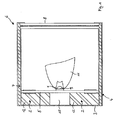
- drawn tunnel light 6 comprises a luminaire housing 4, which comprises a trough-shaped base body 7 with walls made of stainless steel, which is closed to one side by means of a glazing, which is formed in the illustrated embodiment as banksmannverasglung 8 in the form of two thermal glass panes, but also simply glazed or other configurations.
- a multiplicity of point-shaped light sources in the form of LEDs 9 are provided as luminous means 1, of which in the sectional view according to FIG Fig. 1 only one LED 9 can be seen.
- the mentioned LEDs 9 are mounted in the illustrated embodiment on a printed circuit board 5 which is fixed relative to the lamp housing 4 and may include the power supply and control of the LEDs 9.
- Other lighting modules such as control gear and / or power supply components such as lines, terminals or electronic components 10 may also be included in the lamp housing 4 and in particular be arranged on the circuit board 5.
- optical components such as a lens 11 and / or reflectors and the like may be placed in the interior of the lamp housing 4.
- a heat accumulator 2 is provided in the lamp housing 4, which is designed as a latent heat storage and comprises a phase changer 3 and a phase-changing material whose phase change temperature is below the permissible operating temperature limit of the lamp 6.
- a heat storage 2 a water reservoir 12 which is thermally (thermally conductive) coupled to the thermally critical components and advantageously arranged in the illustrated embodiment directly on the back of said circuit board 5 and with this in surface contact.
- a water or heat storage fluid reservoir 12 can also be prefabricated as a separate module and placed inside the lamp housing 4, advantageously thermally coupled to the critical components, ie the Reservoirwandungen are not formed directly from the housing or Bauteilwandungen, but by separate Reservoirwandungen ,
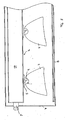
- the heat storage tubes sit at the folded ends of a bow-shaped support piece 15 which is connected to the back of the LED circuit board with this.
- the heat storage tubes 13 may also be arranged closer to the circuit board 5, For example, on a plate-shaped support piece 15 which is connected to the back of the circuit board 5 with this area, like this Fig. 4 shows.
- the heat storage tubes 13 and the water or heat storage reservoir are formed closed and can include the fluid stationary, ie there must be no circulation of the fluid contained provided.
- the tubes or the reservoir are provided with a pressure relief valve 14 to prevent bursting when heating or after reaching the absorption capacity (latent heat), or provided by other suitable overpressure safety devices such as an expansion chamber.
- the pressure relief valve can advantageously pass through the housing and open into the environment of the lamp housing 4 outside of it, cf. Fig. 5 ,
- printed circuit board 5 with the LED's 9 arranged thereon and arranged on the back of said circuit board 5 fluid reservoir extend substantially over the entire length of the lamp, in the illustrated embodiment, the two heat storage tubes 13 along the longitudinal direction on the length of the luminaire Luminaire interior extend.
- the light bulbs included in the interior of the lamp including the circuit board 5 or other equipment and the heat storage in the form of the water reservoir 12 of the lamp housing 4, so that the penetrating into the housing heat initially only the inside of the lamp air heats up, which then in turn, of course, try to heat the aforementioned light parts inside, but initially only goes into the heat sink formed by the water reservoir. Due to the thermal decoupling of the lamp housing is avoided, however, that the hot housing gives off heat directly to the thermally critical lighting components.
- the heat accumulator 2 is at least partially integrated into the walls of the lamp housing 4.
- paraffin particles can be embedded in a suitable amount in a suitable matrix material such as plaster, said matrix material can advantageously form a plate which form a wall of the lamp housing 4 or can cover such a wall of the lamp housing 4.
- a part advantageously also substantially the entire inside of the trough-shaped basic body 7 of the lamp housing 4 may be clad with latent heat storage plates.
Landscapes
- Engineering & Computer Science (AREA)
- General Engineering & Computer Science (AREA)
- Arrangement Of Elements, Cooling, Sealing, Or The Like Of Lighting Devices (AREA)
- Non-Portable Lighting Devices Or Systems Thereof (AREA)
Applications Claiming Priority (1)
| Application Number | Priority Date | Filing Date | Title |
|---|---|---|---|
| DE102008009945A DE102008009945A1 (de) | 2008-02-20 | 2008-02-20 | Tunnelleuchte |
Publications (1)
| Publication Number | Publication Date |
|---|---|
| EP2093484A1 true EP2093484A1 (fr) | 2009-08-26 |
Family
ID=40566177
Family Applications (1)
| Application Number | Title | Priority Date | Filing Date |
|---|---|---|---|
| EP09002459A Withdrawn EP2093484A1 (fr) | 2008-02-20 | 2009-02-20 | Lampe de tunnel |
Country Status (2)
| Country | Link |
|---|---|
| EP (1) | EP2093484A1 (fr) |
| DE (1) | DE102008009945A1 (fr) |
Cited By (3)
| Publication number | Priority date | Publication date | Assignee | Title |
|---|---|---|---|---|
| WO2011104308A1 (fr) | 2010-02-25 | 2011-09-01 | Ibs Umwelt- Und Verkehrstechnik Gmbh | Lampe |
| ITPI20100024A1 (it) * | 2010-03-09 | 2011-09-10 | Ivan Spera | Struttura di lampada a led per l'illuminazione pubblica, civile, o industriale. |
| WO2017207683A1 (fr) | 2016-06-04 | 2017-12-07 | Swareflex Gmbh | Lentille optique pour applications d'éclairage |
Families Citing this family (1)
| Publication number | Priority date | Publication date | Assignee | Title |
|---|---|---|---|---|
| EP2295847A2 (fr) | 2009-09-15 | 2011-03-16 | Broll Systemtechnik KG | Luminaire, en particulier luminaire de tunnel |
Citations (3)
| Publication number | Priority date | Publication date | Assignee | Title |
|---|---|---|---|---|
| EP1684006A2 (fr) * | 2005-01-19 | 2006-07-26 | Patent-Treuhand-Gesellschaft für elektrische Glühlampen mbH | Dispositif d'éclairage, en particulier pour tunnels |
| US20070086196A1 (en) | 2005-10-18 | 2007-04-19 | National Tsing Hua University | Heat dissipation devices for and LED lamp set |
| EP1780804A1 (fr) | 2005-10-25 | 2007-05-02 | L&C Lighting Technology Corp. | Dispositif à diodes électroluminescentes avec un dispositif de dissipation de chaleur actif |
Family Cites Families (4)
| Publication number | Priority date | Publication date | Assignee | Title |
|---|---|---|---|---|
| DE10149898B4 (de) * | 2001-10-10 | 2006-02-09 | Lmt Leuchten + Metall Technik Gmbh | Feuergeschützte Leuchte und Anordnung |
| TWI225713B (en) * | 2003-09-26 | 2004-12-21 | Bin-Juine Huang | Illumination apparatus of light emitting diodes and method of heat dissipation thereof |
| EP1523041A1 (fr) * | 2004-12-08 | 2005-04-13 | Jeffrey Chen | Assemblage de diodes électroluminescentes avec dissipation de chaleur à haute performance |
| DE202006002797U1 (de) * | 2006-02-20 | 2006-05-11 | Kolb, Klaus | Elektrische Leuchteinrichtung mit Leuchtdioden |
-
2008
- 2008-02-20 DE DE102008009945A patent/DE102008009945A1/de not_active Withdrawn
-
2009
- 2009-02-20 EP EP09002459A patent/EP2093484A1/fr not_active Withdrawn
Patent Citations (3)
| Publication number | Priority date | Publication date | Assignee | Title |
|---|---|---|---|---|
| EP1684006A2 (fr) * | 2005-01-19 | 2006-07-26 | Patent-Treuhand-Gesellschaft für elektrische Glühlampen mbH | Dispositif d'éclairage, en particulier pour tunnels |
| US20070086196A1 (en) | 2005-10-18 | 2007-04-19 | National Tsing Hua University | Heat dissipation devices for and LED lamp set |
| EP1780804A1 (fr) | 2005-10-25 | 2007-05-02 | L&C Lighting Technology Corp. | Dispositif à diodes électroluminescentes avec un dispositif de dissipation de chaleur actif |
Cited By (5)
| Publication number | Priority date | Publication date | Assignee | Title |
|---|---|---|---|---|
| WO2011104308A1 (fr) | 2010-02-25 | 2011-09-01 | Ibs Umwelt- Und Verkehrstechnik Gmbh | Lampe |
| AT509564B1 (de) * | 2010-02-25 | 2015-06-15 | Ibs Umwelt Und Verkehrstechnik Gmbh | Leuchte |
| ITPI20100024A1 (it) * | 2010-03-09 | 2011-09-10 | Ivan Spera | Struttura di lampada a led per l'illuminazione pubblica, civile, o industriale. |
| WO2017207683A1 (fr) | 2016-06-04 | 2017-12-07 | Swareflex Gmbh | Lentille optique pour applications d'éclairage |
| CN109313325A (zh) * | 2016-06-04 | 2019-02-05 | 施华法斯有限公司 | 用于照明目的的光学透镜 |
Also Published As
| Publication number | Publication date |
|---|---|
| DE102008009945A1 (de) | 2009-08-27 |
Similar Documents
| Publication | Publication Date | Title |
|---|---|---|
| EP2954253B1 (fr) | Luminaire de façade | |
| DE2510321A1 (de) | System zur nutzung der sonnenenergie | |
| DE102010013559B4 (de) | Beleuchtungsvorrichtung für Fahrzeuge | |
| EP2093484A1 (fr) | Lampe de tunnel | |
| EP3404190A2 (fr) | Élément multi-vitrage présentant la possibilité d'ouverture pour l'espace intermédiaire | |
| EP2350522B1 (fr) | Dispositif d éclairage à led, notamment pour tunnels | |
| DE102020005140B4 (de) | Scheinwerfer für ein Fahrzeug | |
| DE102004053680B4 (de) | Beleuchtungskörper | |
| DE202008017960U1 (de) | LED-basiertes Beleuchtungssystem | |
| DE69707339T2 (de) | Interne und externe Druck-Kompensationsvorrichtung für Doppelverglasungen | |
| DE102009013941A1 (de) | Beleuchtungseinrichtung für ein Kraftfahrzeug | |
| DE3225566A1 (de) | Befestigungselement an spiegeln fuer solar-reflektoren | |
| DE102022112411A1 (de) | Wärmetauscherpaneel zur Temperierung eines Raumes | |
| DE3643668A1 (de) | Vorrichtung zum speichern und/oder uebertragen von waerme | |
| AT509564B1 (de) | Leuchte | |
| DE10354355B4 (de) | Vorrichtung zum Temperieren von Räumen | |
| EP1302722A2 (fr) | Luminaire protegé contre le feu | |
| DE3622109A1 (de) | Leuchte fuer brandgefaehrdete raeume | |
| AT509663B1 (de) | Fassade und verfahren zum steuern der wärmetechnischen eigenschaften der fassade | |
| DE102016001350A1 (de) | Verfahren und Vorichtung zur Breitstellung von Räumwärme und Warmwasser durch Nutzung der solaren Strahlungsenergie | |
| DE102007024929B3 (de) | Einbaukassette für Unterflurhebebühnen mit Ausstattungen zur Trocken- und Sauberhaltung des Innenraums | |
| DE19956916A1 (de) | Beleuchtungssystem für Räume | |
| DE102019124910A1 (de) | Profil, Gebäudelementanordung und Verwendung | |
| DE202013100848U1 (de) | Vorrichtung zur Temperierung eines Raumes | |
| DE2724504A1 (de) | Geraet zur waermegewinnung aus sonnenenergie |
Legal Events
| Date | Code | Title | Description |
|---|---|---|---|
| PUAI | Public reference made under article 153(3) epc to a published international application that has entered the european phase |
Free format text: ORIGINAL CODE: 0009012 |
|
| AK | Designated contracting states |
Kind code of ref document: A1 Designated state(s): AT BE BG CH CY CZ DE DK EE ES FI FR GB GR HR HU IE IS IT LI LT LU LV MC MK MT NL NO PL PT RO SE SI SK TR |
|
| AX | Request for extension of the european patent |
Extension state: AL BA RS |
|
| AKX | Designation fees paid |
Designated state(s): AT BE BG CH CY CZ DE DK EE ES FI FR GB GR HR HU IE IS IT LI LT LU LV MC MK MT NL NO PL PT RO SE SI SK TR |
|
| STAA | Information on the status of an ep patent application or granted ep patent |
Free format text: STATUS: THE APPLICATION IS DEEMED TO BE WITHDRAWN |
|
| 18D | Application deemed to be withdrawn |
Effective date: 20100301 |