EP2093957A1 - Verfahren und vorrichtung zur fehlerverschleierung - Google Patents
Verfahren und vorrichtung zur fehlerverschleierung Download PDFInfo
- Publication number
- EP2093957A1 EP2093957A1 EP07845902A EP07845902A EP2093957A1 EP 2093957 A1 EP2093957 A1 EP 2093957A1 EP 07845902 A EP07845902 A EP 07845902A EP 07845902 A EP07845902 A EP 07845902A EP 2093957 A1 EP2093957 A1 EP 2093957A1
- Authority
- EP
- European Patent Office
- Prior art keywords
- slice
- module
- channel
- sub
- allocation rule
- Prior art date
- Legal status (The legal status is an assumption and is not a legal conclusion. Google has not performed a legal analysis and makes no representation as to the accuracy of the status listed.)
- Withdrawn
Links
Images



Classifications
-
- H—ELECTRICITY
- H04—ELECTRIC COMMUNICATION TECHNIQUE
- H04N—PICTORIAL COMMUNICATION, e.g. TELEVISION
- H04N19/00—Methods or arrangements for coding, decoding, compressing or decompressing digital video signals
- H04N19/10—Methods or arrangements for coding, decoding, compressing or decompressing digital video signals using adaptive coding
- H04N19/169—Methods or arrangements for coding, decoding, compressing or decompressing digital video signals using adaptive coding characterised by the coding unit, i.e. the structural portion or semantic portion of the video signal being the object or the subject of the adaptive coding
- H04N19/17—Methods or arrangements for coding, decoding, compressing or decompressing digital video signals using adaptive coding characterised by the coding unit, i.e. the structural portion or semantic portion of the video signal being the object or the subject of the adaptive coding the unit being an image region, e.g. an object
- H04N19/174—Methods or arrangements for coding, decoding, compressing or decompressing digital video signals using adaptive coding characterised by the coding unit, i.e. the structural portion or semantic portion of the video signal being the object or the subject of the adaptive coding the unit being an image region, e.g. an object the region being a slice, e.g. a line of blocks or a group of blocks
-
- H—ELECTRICITY
- H04—ELECTRIC COMMUNICATION TECHNIQUE
- H04L—TRANSMISSION OF DIGITAL INFORMATION, e.g. TELEGRAPHIC COMMUNICATION
- H04L5/00—Arrangements affording multiple use of the transmission path
- H04L5/003—Arrangements for allocating sub-channels of the transmission path
- H04L5/0044—Allocation of payload; Allocation of data channels, e.g. PDSCH or PUSCH
-
- H—ELECTRICITY
- H04—ELECTRIC COMMUNICATION TECHNIQUE
- H04N—PICTORIAL COMMUNICATION, e.g. TELEVISION
- H04N19/00—Methods or arrangements for coding, decoding, compressing or decompressing digital video signals
- H04N19/85—Methods or arrangements for coding, decoding, compressing or decompressing digital video signals using pre-processing or post-processing specially adapted for video compression
- H04N19/89—Methods or arrangements for coding, decoding, compressing or decompressing digital video signals using pre-processing or post-processing specially adapted for video compression involving methods or arrangements for detection of transmission errors at the decoder
- H04N19/895—Methods or arrangements for coding, decoding, compressing or decompressing digital video signals using pre-processing or post-processing specially adapted for video compression involving methods or arrangements for detection of transmission errors at the decoder in combination with error concealment
Definitions
- the present invention relates to the field of video transmission technologies and in particular to a method and system for concealing errors, a transmitting end, and a receiving end.
- OFDM Orthogonal Frequency Division Multiplexing
- the OFDM channel is characterized by time varying and frequency selection fading, and tends to generate errors in the transmission process.
- Video data transmitted over OFDM channels is vulnerable to errors. Especially in the case of burst errors, video transmission may incur massive packet loss. Consequently, a large number of video blocks are lost at the receiving end, which impairs the video data recovery quality drastically. When errors occur, the receiving end needs to conceal the errors of data in order to recover the original video data as far as possible.
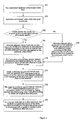
- Figure 1 shows the process of concealing errors of video data transmitted over OFDM channels in the prior art.
- the process includes the following steps:
- Step 101 Video data is received.
- Step 102 Channel encoding for video data is performed.
- Step 103 Quadrature Amplitude Modulation (QAM) mapping for encoded data is performed.
- QAM Quadrature Amplitude Modulation
- Step 104 Pilot signals are inserted into the set OFDM sub-channel.
- Step 105 Inverse Fast Fourier Transform (IFFT) for the QAM-mapped data and the inserted pilot signals is performed to obtain OFDM symbols.
- IFFT Inverse Fast Fourier Transform
- Step 106 A guard interval is inserted between OFDM symbols to obtain a complete OFDM signal.
- Step 107 After receiving the OFDM signal, the receiving end removes the guard interval, performs Fast Fourier Transform (FFT), performs channel feature estimation and correction and channel decoding according to the inserted pilot signal, and obtains the original compressed video data.
- FFT Fast Fourier Transform
- Step 108 The receiving end decompresses the compressed video data, and detects errors of video data.
- the receiving end conceals the errors through time domain, for example, video data whose position is related to the position of the erroneous data in adjacent frame, or space domain, for example, adjacent video data in the same frame, and recovers the video data.
- the transmitting end inserts check information into video data; the receiving end may detect errors of the video data through the check information.
- the defects of the prior art are: when many errors occur continuously, the errors of several continuous frames usually occur on multiple adjacent OFDM sub-channels concurrently. Namely, the adjacent data in the same frame and the data in the counterpart position of the adjacent frame generate errors concurrently. It is evident that: on this occasion, the errors occur on the same area of the continuous frame, and hence it is impossible to use the space relevance or time relevance to conceal errors of data effectively or recover the original video data correctly, which deteriorates the video output quality.
- Various embodiments of the present invention provide a method and system for concealing errors, a transmitting end, and a receiving end to improve the efficiency of concealing errors.
- a method for concealing errors includes:
- a system for concealing errors includes:
- the transmitting end further includes:
- the receiving end further includes:
- the embodiment of the present invention uses a transmitting end to split the compressed video data into slice structures, and allocate the adjacent slice structures to non-adjacent OFDM sub-channels or sub-channel groups, which slashes the probability of errors simultaneously occurring on the adjacent slice structures in the same video frame, improves the error concealment efficiency and video recovery quality greatly.
- the embodiment of the present invention updates the rules of allocating adjacent slice structures to non-adjacent OFDM sub-channels or sub-channel groups, which slashes the probability of errors simultaneously occurring on the slice structures in the counterpart position of the adjacent video frame, and further improves the error concealment efficiency and video recovery quality.
- Figure 1 shows the process of transmitting video data on an OFDM channel and concealing errors in the related art
- Figure 2 shows the process of transmitting video data on an OFDM channel and concealing errors in an embodiment of the present invention
- Figure 3 shows the process of transmitting video data on an OFDM channel and concealing errors when the compressed video data is a stream-oriented application according to the first embodiment of the present invention
- Figure 4 shows the process of transmitting video data on an OFDM channel and concealing errors when the compressed video data is a packet-oriented application according to the second embodiment of the present invention
- Figures 5-1, 5-2 and 5-3 are instances of concealing errors after frequency domain interleaving is performed for the compressed video data in an embodiment of the present invention
- Figures 6-1, 6-2 and 6-3 are instances of concealing errors after frequency domain interleaving and time domain interleaving are performed for the compressed video data in an embodiment of the present invention
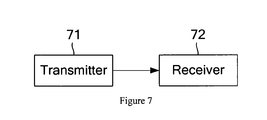
- Figure 7 shows the composition of a system for transmitting compressed video data on an OFDM channel and concealing errors in an embodiment of the present invention
- Figure 8 shows the structure of a transmitting end provided in an embodiment of the present invention
- Figure 9 is the first schematic diagram of the structure of a frequency domain interleaving module of the transmitting end in an embodiment of the present invention.
- Figure 10 is the second schematic diagram of the structure of a frequency domain interleaving module of the transmitting end in an embodiment of the present invention.
- Figure 11 shows the structure of a receiving end provided in an embodiment of the present invention.
- the core idea of the present invention is: a transmitting end splits the input compressed video data into slice structures, allocates adjacent slice structures to non-adjacent OFDM sub-channels or sub-channel groups, and sends them to a receiving end; the receiving end rearranges the slice structures on the OFDM sub-channels or sub-channel groups, and detects errors; if any error is detected on a slice structure, the receiving end conceals the error of the slice structure according to the slice structure which is chronologically or spatially related to the erroneous slice structure.
- the method for allocating adjacent slice structure to non-adjacent OFDM sub-channels or sub-channel groups is called "frequency domain interleaving method”.
- the rule of allocating the slice structures to OFDM sub-channels or sub-channel groups may be modified at intervals. Namely, different frequency domain interleaving methods are used at different times. This method is called “time domain interleaving method”.
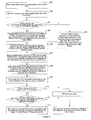
- Figure 2 shows the process of concealing errors during transmission of compressed video data on an OFDM channel in an embodiment of the present invention.
- the process includes the following steps:
- Step 201 Compressed video data is received.
- Step 202 The received compressed video data is split into slice structures.
- the method of splitting a slice structure is defined in the existing video compression standards.
- the slice structure of the compressed video data may be split according to the video compression standards.
- Step 203 It is determined whether the conditions of updating the slice allocation rule are currently satisfied. If satisfied, the process proceeds to 204; otherwise, step 205 is performed.
- Step 204 Adjacent slice structures are allocated to non-adjacent OFDM sub-channels or sub-channel groups according to the slice allocation rule which is preset and different from the rule applied to the previous video frame. The process proceeds to step 206.
- Step 205 Adjacent slice structures are allocated to non-adjacent OFDM sub-channels or sub-channel groups according to the slice allocation rule which is the same as the rule applied to the previous video frame.
- the total number of OFDM sub-channels (M) is greater than the total number of slice structures (N).
- Step 206 Channel encoding, space domain interleaving and QAM mapping are performed for the slice structure allocated to each OFDM sub-channel or sub-channel group.
- Step 207 A pilot signal is inserted onto the OFDM sub-channel; IFFT and guard interval insertion are performed for the data obtained from mapping of QAM and the inserted pilot signal to obtain OFDM signals, and the OFDM signals are sent to the receiving end.
- the spatial domain interleaving method used in this step is the same as the spatial domain interleaving method in the prior art.
- Step 208 After receiving the OFDM signal, the receiving end removes the guard interval, performs Fast Fourier Transform (FFT), performs channel correction and channel decoding according to the inserted pilot signal, and obtains the original slice structure on each OFDM sub-channel or sub-channel group.
- FFT Fast Fourier Transform
- Step 209 The receiving end decompresses the compressed video data composed of slice structures, and detects errors; if any error is detected on a slice structure, the receiving end conceals the error of the slice structure according to the successfully received slice structure which is chronologically or spatially related to the erroneous slice structure.
- the slice structure chronologically related to the erroneous slice structure refers to the slice structure which is located in the reference video frame of the video frame containing the erroneous slice structure, and is related to the position of the erroneous slice structure.
- the reference video frame may be the frame which is one or two frames ahead of the current video frame.
- the reference video frame information is sent to the decoder through compressed code streams.
- the slice structure is composed of macro blocks. Each macro block includes motion vector information which indicates the motion distance of the macro block in the current video frame relative to the reference video frame. Therefore, according to the motion vector information of one macro block, another macro block closest to the foregoing macro block (namely, the one most pertinent to the foregoing macro block) can be searched out in the reference video frame.
- the macro block most pertinent to the erroneous macro block may be searched out in the reference video frame according to the motion vector information in the erroneous macro block, and the errors of the erroneous macro block may be concealed according to the pertinent macro block.
- the slice structure spatially related to the erroneous slice structure refers to the slice structure which is located in the video frame containing the erroneous slice structure, and is adjacent to the erroneous slice structure.
- errors of the macro block may be concealed by using the macro block which is located in the slice structure prior to or next to the erroneous slice structure and located in the position identical to or adjacent to the position of the erroneous macro block in the slice structure.
- the compressed video data transmitted over an OFDM channel breaks down into stream-oriented application and packet-oriented application.
- the receiving end must know the rule of the transmitting end allocating slice structures to OFDM sub-channels or sub-channels groups, so as to rearrange the slice structures on the received OFDM sub-channels or sub-channel groups and recover the original compressed video data.
- the compressed video data is transmitted in the form of packets.
- Each slice structure includes several packets, and each packet has a serial number. The serial number of the packet is sent together with the packet data to the receiving end.
- the receiving end does not need to know the rule of the transmitting end allocating slice structures to the OFDM sub-channels or sub-channel groups; and only needs to rearrange the slice structures according to the serial number of each packet in the slice structure, so as to obtain the original compressed video data.
- the method for concealing errors is described below in the scenarios that the compressed video data is oriented to streams and packets respectively.
- Figure 3 shows the process of concealing errors during transmission of compressed video data on an OFDM channel according to the first embodiment of the present invention.
- the process includes the following steps:
- Step 301 The transmitting end receives compressed video data streams.
- Step 302 The transmitting end splits the received compressed video data into slice structures.
- Step 303 The transmitting end determines whether the conditions of updating the slice allocation rule are currently satisfied. If the conditions are satisfied, the process proceeds to 304; otherwise, step 305 is performed.
- Step 304 The transmitting end allocates adjacent slice structures to non-adjacent OFDM sub-channels or sub-channel groups according to the slice allocation rule which is preset and different from the rule applied to the previous video frame; and allocates the currently updated slice allocation rule information to the preset OFDM sub-channel.
- the process proceeds to step 306.
- Each OFDM sub-channel or sub-channel group corresponds to a buffer.
- the slice structure is allocated to the buffer corresponding to the OFDM sub-channel or sub-channel group.
- the slice allocation rule may be updated every a fixed number of frames. After detecting that the number of currently received video frames is equal to the threshold for updating the preset slice allocation rule, the transmitting end updates the slice allocation rule. Alternatively, the transmitting end updates the slice allocation rule at intervals, namely, updates after detecting that the current time hits the preset update time. Alternatively, the transmitting end updates the slice allocation rule as indicated by the receiving end. Generally, when the receiving end performs channel feature estimation for the OFDM sub-channel, if detecting that the quality of the OFDM sub-channel is deteriorated (for example, lower than the preset channel quality), the receiving endsends an indication of updating slice allocation rules to the transmitting end.
- the receiving end sends an indication of updating the slice allocation rule to transmitting end.
- the receiving end sends an indication of updating the slice allocation rule to the transmitting end.
- the transmitting end and the receiving end negotiate the specific OFDM sub-channel to which the currently updated slice allocation rule information is distributed beforehand; or the network administrator pre-configures the rule information onto the transmitting end and the receiving end.
- the slice allocation rule information is allocated to idle OFDM sub-channels not occupied by the slice structure. For example, if the first idle OFDM sub-channel not occupied by the slice structure is preset for the purpose of storing the currently updated slice allocation rule information, supposing that there are 22 OFDM sub-channels numbered 0-21, of which sub-channels 0-19 are allocated to the slice structure, then sub-channels numbered 20 may be used to transmit the currently applied slice allocation rule information; and the sub-channel numbered 21 may be used to transmit other control information. If an OFDM sub-channel is occupied by a slice structure, the slice allocation rule information together with a slice structure is allocated to an OFDM sub-channel.
- Step 305 Adjacent slice structures are allocated to non-adjacent OFDM sub-channels or sub-channel groups according to the slice allocation rule which is the same as the rule applied to the previous video frame.
- Step 306 Channel encoding, space domain interleaving and QAM mapping consecutively are performed for the slice structure allocated to each OFDM sub-channel or sub-channel group.
- Step 307 A pilot signal is inserted onto the OFDM sub-channel; IFFT and guard interval insertion are performed for the data obtained from mapping of QAM and the inserted pilot signal to obtain OFDM signals, and the OFDM signals are sent to the receiving end.
- Step 308 After receiving the OFDM signal, the receiving end removes the guard interval, performs Fast Fourier Transform (FFT), performs channel correction and channel decoding according to the inserted pilot signal consecutively, and obtains the original slice structure on each OFDM sub-channel or sub-channel group.
- FFT Fast Fourier Transform
- Step 309 The receiving end determines whether updated slice allocation rule information exists on the preset OFDM sub-channel; if exists, the process proceeds to 310; otherwise, step 311 is performed.
- Step 310 The receiving end uses the slice allocation rule information to update the currently saved slice allocation rule information, and arrange the OFDM sub-channels or the slice structures on the sub-channel according to the updated slice allocation rule information. The process proceeds to step 312.
- Step 311 The receiving end arranges the OFDM sub-channels or the slice structures on the sub-channel according to the currently saved slice allocation rule information.
- Step 312 The receiving end decompresses the compressed video data composed of slice structures, and determines whether any slice structure has errors. If any slice structure has errors, the process proceeds to step 313; otherwise, the process ends.
- Step 313 The receiving end determines whether the slice structure in the counterpart position of the erroneous slice structure in the adjacent video frame is received successfully; if received successfully, the process proceeds to 314; otherwise, step 315 is performed.
- Step 314 The receiving end conceals the errors of the erroneous slice structures according to the slice structure in the counterpart position in the adjacent video frame. The process is ended.
- An adjacent video frame may be the frame prior to or next to the current video frame.
- Step 315 The receiving end conceals the errors of the erroneous slice structures according to the slice structure which is successfully received by the current video frame and adjacent to the erroneous slice structure.
- the adjacent slice structure may be the slice structure prior to or next to the current slice structure in the same video frame.
- the slice allocation rule information may take no part in channel encoding, spatial domain interleaving, and QAM mapping, and undergo IFFT and guard interval insertion together with the slice structure on other OFDM sub-channels. Accordingly, the receiving end can obtain the original slice allocation rule information only by removing the guard interval and performing IFFT operation for the data on the preset OFDM sub-channel, without the need of channel feature estimation or correction, QAM inverse mapping, spatial domain de-interleaving, and channel decoding.
- the transmitting end and the receiving end may pre-negotiate the applicable slice allocation rule before transmitting compressed video data, and the conditions of updating the allocation rule; alternatively, the network administrator may pre-configure the slice allocation rule and the conditions of updating the allocation rules onto the transmitting end and the receiving end.
- Figure 4 shows the process of concealing errors when the compressed video data is oriented to packets according to the second embodiment of the present invention.
- the process includes the following steps:
- Step 401 The transmitting end receives compressed video packet data.
- Step 402 The transmitting end splits the received compressed video packet data into slice structures.
- Step 403 The transmitting end determines whether the conditions of updating the slice allocation rule are currently satisfied. If the conditions are satisfied, the process proceeds to 404; otherwise, step 405 is performed.
- Step 404 The transmitting end allocates adjacent slice structures to non-adjacent OFDM sub-channels or sub-channel groups according to the slice allocation rule which is preset and different from the rule applied to the previous video frame. The process proceeds to step 406.
- Step 405 The transmitting end allocates adjacent slice structures to non-adjacent OFDM sub-channels or sub-channel groups according to the slice allocation rule which is the same as the rule applied to the previous video frame.
- Step 406 The transmitting end performs channel encoding, space domain interleaving and QAM mapping consecutively for the slice structure allocated to each OFDM sub-channel or sub-channel group.
- Step 407 The transmitting end inserts a pilot signal onto the OFDM sub-channel; performs IFFT and guard interval insertion for the data obtained from mapping of QAM and the inserted pilot signal to obtain OFDM signals, and sends the OFDM signals to the receiving end.
- Step 408 After receiving the OFDM signal, the receiving end removes the guard interval, performs Fast Fourier Transform (FFT), performs channel correction and channel decoding according to the inserted pilot signal consecutively, and obtains the original slice structure on each OFDM channel.
- FFT Fast Fourier Transform
- Step 409 According to the serial number of the packet data in the slice structure, the receiving end arranges the slice structure.
- Step 410 The receiving end decompresses the compressed video data of slice structures, and determines whether any slice structure has errors. If any slice structure has errors, the process proceeds to step 411; otherwise, the process ends.
- Step 411 The receiving end determines whether the slice structure in the counterpart position of the erroneous slice structure in the adjacent video frame is received successfully; if received successfully, the process proceeds to 412; otherwise step 413 is performed.
- Step 412 The receiving end conceals the errors of the erroneous slice structures according to the slice structure in the counterpart position in the adjacent video frame. The process is ended.
- Step 413 The receiving end conceals the errors of the erroneous slice structures according to the slice structure which is successfully received by the current video frame and adjacent to the erroneous slice structure.
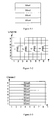
- Figure 5-1 is a schematic diagram of splitting a slice structure of compressed video data
- Figure 5-2 is a schematic diagram of allocating slice structures on each OFDM sub-channel when no frequency domain interleaving is performed for the compressed video data
- Figure 5-3 is a schematic diagram of allocating slice structures on each OFDM sub-channel when frequency domain interleaving is performed for the compressed video data.
- the OFDM sub-channels 4 and 5 generate burst errors between time 2 and time 7
- slices 1-4 may be affected by the errors concurrently when no frequency domain interleaving is performed for the compressed video data; because slices 1-4 are adjacent areas, the burst errors make it impossible to conceal errors effectively for the compressed video data in a large area, and impossible to recover correct compressed video data.
- one slice structure can be transmitted on only one OFDM sub-channel. Therefore, the errors of sub-channels 4 and 5 affect slice 3 and slice 6 only, and it is easy to use slice 2 and slice 4 to cover errors of slice 3, and use slice 5 and slice 7 to conceal errors of slice 6. As a result, the error data can be recovered effectively.
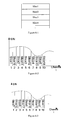
- Figure 6-1 is a schematic diagram of splitting a slice structure of compressed video data
- Figure 6-2 is a schematic diagram of allocating slice structures on each OFDM sub-channel when a frequency domain interleaving method is applied at time t0
- Figure 6-3 is a schematic diagram of allocating slice structures on each OFDM sub-channel when another frequency domain interleaving method is applied at time tl.
- burst errors occur on OFDM sub-channels 7-9 at time t0, slices 4, 13 and 5 are affected by errors.
- slice 1, 10 and 2 are affected.
- the frequency domain interleaving method only needs to ensure that the adjacent slice structures are allocated to non-adjacent OFDM sub-channels or sub-channel groups.
- Three frequency domain interleaving methods under the present invention are described below.
- ⁇ A ⁇ in the following formula means rounding-down of A if A is a rational number.
- N an even number
- y i x ⁇ i / 2 ⁇ * 2 + 1 - i % 2
- i 0 , 1 , ... , N - 1
- N an odd number
- y i x ⁇ i / 2 ⁇ * 2 + 1 - i % 2
- i 0 , 1 , ... , N - 2
- y N - 1 x N - 1
- z 0 y 0
- z i y 1 + ⁇ i - 1 / 2 ⁇ * 2 + 1 - i - 1 % 2
- i 1 , 2 , ... , N - 1
- mapping relation between the serial number ( x i ) of the slice structure and the serial number ( z i ) of the OFDM sub-channel or sub-channel group when the total number of slice structures (N) is an even number "10" or odd number "9” is given below:
- mapping relation between the serial number ( x i ) of the slice structure and the serial number ( z i ) of the OFDM sub-channel or sub-channel group when the total number of slice structures (N) is an even number "10" or odd number "9” is given below:
- Table 4: Mapping relation between the serial number ( x i ) of the slice structure and the serial number ( z i ) of the OFDM sub-channel or sub-channel group when N 9 and the one-second interleaving method A is applied x i z i 0 8 1 0 2 4 3 1 4 5 5 2 6 6 7 3 8 7
- mapping relation between the serial number ( x i ) of the slice structure and the serial number ( z i ) of the OFDM sub-channel or sub-channel group when the total number of slice structures (N) is an even number "10" or odd number "9” is given below:
- the time domain interleaving method in an embodiment of the present invention aims to map the slice structures in the counterpart position of adjacent video frames to different OFDM sub-channels or sub-channel groups, so that the errors can be concealed by using the slice structure in the counterpart position of the adjacent video frame when errors occur on the slice structure due to long fading of some OFDM sub-channels or sub-channel groups.
- Two time-domain interleaving methods in an embodiment of the present invention are given below:
- the interleaving handover method is: the same frequency domain interleaving method is applied repeatedly at preset intervals or every preset number of video frames, measured in time intervals or video frames; and different frequency domain interleaving methods are applied at adjacent preset intervals or every preset number of adjacent video frames.
- the frequency domain interleaving method is a two-time odd-even interleaving method; if M is an odd number, the frequency interleaving method is one-second interleaving method A.
- the principles of the interleaving tandem handover method are: the same frequency domain interleaving method is applied repeatedly at preset intervals or every preset number of video frames; and different frequency domain interleaving methods are applied at adjacent preset intervals or every preset number of adjacent video frames; the same or different frequency domain interleaving operation is performed twice in at least one preset time interval or preset number of video frames.
- the frequency domain interleaving method is one-second interleaving method A; when M is an odd number, the one-second interleaving method A is applied first, and the one-second interleaving method B is applied to the obtained result.
- mapping relations are listed below between the serial number ( x i ) of the slice structure and the serial number ( z i ) of the OFDM sub-channel or sub-channel group when the total number of slice structures (N) is 10 or 9: Table 9: For odd-number video frames and even-number video frames, different mapping relations between the serial number ( x i ) of the slice structure and the serial number ( z i ) of the OFDM sub-channel or sub-channel group when the total number of slice structures (N) is 10 and interleaving tandem handover is applied Serial number of slice structure ( x i ) Serial number of OFDM sub-channel or sub-channel group corresponding to even-number video frame ( z i ) Serial number of OFDM sub-channel or sub-channel group corresponding to z i ) odd-number video frame ( z i ) 0 1 3 1 3 5 2 0 1 3 5 7 4 2 0 5 7 9 6 4 2
- Figure 7 shows the composition of a system for concealing errors during transmission of compressed video data on an OFDM channel in an embodiment of the present invention.
- the system includes:
- FIG. 8 shows the structure of a transmitting end provided in an embodiment of the present invention.
- a transmitting end 71 includes:
- FIG. 9 is the first schematic diagram for the structure of a frequency domain interleaving module provided in an embodiment of the present invention.
- a frequency domain interleaving module includes:
- FIG. 10 is the second schematic diagram for the structure of a frequency domain interleaving module provided in an embodiment of the present invention.
- a frequency domain interleaving module includes: an allocation rule update determining module 1001, a slice structure allocating module 1002, and a slice allocation rule information allocating module 1003.
- the allocation rule update determining module 1001 is the same as the allocation rule update determining module 901; the slice structure allocating module 1002 is the same as the slice structure allocating module 902; the slice allocation rule information allocating module 1003 is different from the slice allocation rule information allocating module 903 in that: the slice allocation rule information allocating module 1003 allocates the slice allocation rule information from the slice structure allocating module 1002 to the OFDM sub-channel, and then sends the data on the OFDM sub-channel to the IFFT module 718.
- FIG 11 shows the structure of a receiving end provided in an embodiment of the present invention.
- a receiving end 72 includes:
- the receiving end 72 includes a time domain de-interleaving control module 730, configured to send the slice allocation rule information (which is configured on the time domain interleaving control module, or is sent from the channel decoding module 726 or FFT module 722 and is updated on a preset OFDM sub-channel) to the frequency domain de-interleaving module 727, whereupon the frequency domain de-interleaving module 727 arranges the slice structures according to the slice allocation rule information.
- the slice allocation rule information which is configured on the time domain interleaving control module, or is sent from the channel decoding module 726 or FFT module 722 and is updated on a preset OFDM sub-channel
- the invention may be realized through software and general hardware platforms or through hardware only. In most cases, it is preferred to use software plus general hardware platforms. Based on such understanding, the technical solution provided in embodiments of the invention or contributions to the prior art can be embodied in software products.
- the software is stored in a storage medium and incorporates several instructions to instruct a computer device, for example, a PC, a server, or a network device, to execute the method provided in the embodiments of the present invention. It should be appreciated that the foregoing is only preferred embodiments of the invention and is not used to limit the invention. Any modification, equivalent substitution, and improvement without departing from the spirit and principle of this invention shall be covered in the protection scope of the invention.
Landscapes
- Engineering & Computer Science (AREA)
- Signal Processing (AREA)
- Multimedia (AREA)
- Computer Networks & Wireless Communication (AREA)
- Detection And Prevention Of Errors In Transmission (AREA)
Applications Claiming Priority (2)
| Application Number | Priority Date | Filing Date | Title |
|---|---|---|---|
| CN200610167247.8A CN100586193C (zh) | 2006-12-12 | 2006-12-12 | 误码掩盖方法和系统 |
| PCT/CN2007/003547 WO2008071085A1 (fr) | 2006-12-12 | 2007-12-12 | Procédé et système de masquage d'erreurs |
Publications (2)
| Publication Number | Publication Date |
|---|---|
| EP2093957A1 true EP2093957A1 (de) | 2009-08-26 |
| EP2093957A4 EP2093957A4 (de) | 2011-11-23 |
Family
ID=39511253
Family Applications (1)
| Application Number | Title | Priority Date | Filing Date |
|---|---|---|---|
| EP07845902A Withdrawn EP2093957A4 (de) | 2006-12-12 | 2007-12-12 | Verfahren und vorrichtung zur fehlerverschleierung |
Country Status (4)
| Country | Link |
|---|---|
| US (1) | US20090245392A1 (de) |
| EP (1) | EP2093957A4 (de) |
| CN (1) | CN100586193C (de) |
| WO (1) | WO2008071085A1 (de) |
Cited By (5)
| Publication number | Priority date | Publication date | Assignee | Title |
|---|---|---|---|---|
| WO2012161784A1 (en) * | 2011-03-04 | 2012-11-29 | Alcatel Lucent | Virtual aggregation of fragmented wireless spectrum |
| GB2498992A (en) * | 2012-02-02 | 2013-08-07 | Canon Kk | Transmission of encoded image slices over plural assigned channels |
| US9021330B2 (en) | 2012-05-15 | 2015-04-28 | Alcatel Lucent | System and method for multi-channel FEC encoding and transmission of data |
| US9030953B2 (en) | 2011-03-04 | 2015-05-12 | Alcatel Lucent | System and method providing resilient data transmission via spectral fragments |
| US9496982B2 (en) | 2011-03-04 | 2016-11-15 | Alcatel Lucent | System and method providing resilient data transmission via spectral fragments |
Families Citing this family (12)
| Publication number | Priority date | Publication date | Assignee | Title |
|---|---|---|---|---|
| US8274880B2 (en) * | 2005-03-30 | 2012-09-25 | Apple Inc. | Systems and methods for OFDM channelization |
| JP4460011B2 (ja) | 2008-05-27 | 2010-05-12 | 国立大学法人広島大学 | 動画像配信システム、動画像配信方法、動画像配信システムにおけるサーバおよび動画像配信システムにおけるユーザ端末 |
| CN101355407A (zh) * | 2008-09-26 | 2009-01-28 | 北京新岸线移动多媒体技术有限公司 | 用于地面移动多媒体广播的接收机、接收装置和接收方法 |
| US8964838B2 (en) * | 2008-12-17 | 2015-02-24 | Apple Inc. | Video coding system using sub-channels and constrained prediction references to protect against data transmission errors |
| US20100150230A1 (en) * | 2008-12-17 | 2010-06-17 | Apple Inc. | Video coding system using sub-channels and constrained prediction references to protect against data transmission errors |
| CN101990092B (zh) * | 2009-07-29 | 2015-04-01 | 中兴通讯股份有限公司 | 无线视频通讯系统中差错控制的方法、装置及系统 |
| CN101964913B (zh) * | 2010-08-27 | 2012-02-29 | 南京邮电大学 | 基于模糊分类的帧间误码掩盖方法 |
| FR2972588A1 (fr) | 2011-03-07 | 2012-09-14 | France Telecom | Procede de codage et decodage d'images, dispositif de codage et decodage et programmes d'ordinateur correspondants |
| FR2977111A1 (fr) | 2011-06-24 | 2012-12-28 | France Telecom | Procede de codage et decodage d'images, dispositif de codage et decodage et programmes d'ordinateur correspondants |
| US9525444B2 (en) * | 2013-07-19 | 2016-12-20 | Analog Devices Global | Adaptive element shuffler |
| CA2921750C (en) * | 2013-08-22 | 2021-11-30 | Thomson Licensing | Low adjacent channel interference mode for a digital television system |
| JP6615879B2 (ja) | 2014-12-31 | 2019-12-04 | エルジー エレクトロニクス インコーポレイティド | 放送信号送信装置、放送信号受信装置、放送信号送信方法及び放送信号受信方法 |
Family Cites Families (18)
| Publication number | Priority date | Publication date | Assignee | Title |
|---|---|---|---|---|
| US5519780A (en) * | 1993-12-03 | 1996-05-21 | Scientific-Atlanta, Inc. | System and method for providing compressed digital teletext services and teletext support services |
| US6304594B1 (en) * | 1998-07-27 | 2001-10-16 | General Dynamics Government Systems Corporation | Interference detection and avoidance technique |
| US6292917B1 (en) * | 1998-09-30 | 2001-09-18 | Agere Systems Guardian Corp. | Unequal error protection for digital broadcasting using channel classification |
| JP3728578B2 (ja) * | 1999-03-31 | 2005-12-21 | 富士通株式会社 | マルチキャリア伝送における不均一誤り保護方法並びにその符号器及び復号器 |
| US6788349B2 (en) * | 2000-04-12 | 2004-09-07 | Her Majesty Of Queen In Right Of Canada, As Respresented By The Minister Of Industry | Method and system for broadcasting a digital data signal within an analog TV signal using Orthogonal Frequency Division Multiplexing |
| US6289000B1 (en) * | 2000-05-19 | 2001-09-11 | Intellon Corporation | Frame control encoder/decoder for robust OFDM frame transmissions |
| US6598200B1 (en) | 2000-06-02 | 2003-07-22 | Nortel Networks Limited | Method and apparatus for frequency domain data frame transmission |
| KR100510434B1 (ko) * | 2001-04-09 | 2005-08-26 | 니폰덴신뎅와 가부시키가이샤 | Ofdm신호전달 시스템, ofdm신호 송신장치 및ofdm신호 수신장치 |
| US20030119452A1 (en) * | 2001-10-19 | 2003-06-26 | Samsung Electronics Co., Ltd. | Apparatus and method for controlling transmission power of downlink data channel in a mobile communication system supporting MBMS |
| KR20050076155A (ko) * | 2004-01-19 | 2005-07-26 | 삼성전자주식회사 | 영상 프레임의 에러 은닉 장치 및 방법 |
| GB2415336B (en) * | 2004-06-18 | 2006-11-08 | Toshiba Res Europ Ltd | Bit interleaver for a mimo system |
| JP2008519480A (ja) * | 2004-11-04 | 2008-06-05 | コーニンクレッカ フィリップス エレクトロニクス エヌ ヴィ | ビデオデコード処理においてエラーを隠蔽する方法及び装置 |
| CN1784009A (zh) * | 2004-12-01 | 2006-06-07 | Ut斯达康通讯有限公司 | 增强视频传输鲁棒性的数据分割方法及相关错误掩盖方法 |
| KR100809551B1 (ko) * | 2005-03-08 | 2008-03-04 | 재단법인서울대학교산학협력재단 | 이동 통신 시스템에서 귀환 비트를 이용하여 메시지를 시공간 터보 부호화하여 송신하는 장치 및 방법 |
| CN100459717C (zh) * | 2005-04-20 | 2009-02-04 | 华为技术有限公司 | 基于h.264的压缩视频传输误码消除方法 |
| WO2006122313A2 (en) * | 2005-05-11 | 2006-11-16 | Qualcomm Incorporated | A method and apparatus for unified error concealment framework |
| CA2653602A1 (en) * | 2006-06-21 | 2007-12-27 | Qualcomm Incorporated | Wireless resource allocation methods and apparatus |
| US8229423B2 (en) * | 2006-08-22 | 2012-07-24 | Qualcomm Incorporated | Broadcast and multicast services in wireless communication systems |
-
2006
- 2006-12-12 CN CN200610167247.8A patent/CN100586193C/zh not_active Expired - Fee Related
-
2007
- 2007-12-12 EP EP07845902A patent/EP2093957A4/de not_active Withdrawn
- 2007-12-12 WO PCT/CN2007/003547 patent/WO2008071085A1/zh not_active Ceased
-
2009
- 2009-06-12 US US12/483,454 patent/US20090245392A1/en not_active Abandoned
Cited By (9)
| Publication number | Priority date | Publication date | Assignee | Title |
|---|---|---|---|---|
| WO2012161784A1 (en) * | 2011-03-04 | 2012-11-29 | Alcatel Lucent | Virtual aggregation of fragmented wireless spectrum |
| KR20130130064A (ko) * | 2011-03-04 | 2013-11-29 | 알까뗄 루슨트 | 단편화된 무선 스펙트럼의 가상 집성 |
| JP2014512735A (ja) * | 2011-03-04 | 2014-05-22 | アルカテル−ルーセント | 断片化されたワイヤレス・スペクトルの仮想集約 |
| US9030953B2 (en) | 2011-03-04 | 2015-05-12 | Alcatel Lucent | System and method providing resilient data transmission via spectral fragments |
| US9496982B2 (en) | 2011-03-04 | 2016-11-15 | Alcatel Lucent | System and method providing resilient data transmission via spectral fragments |
| US9686062B2 (en) | 2011-03-04 | 2017-06-20 | Alcatel Lucent | Virtual aggregation of fragmented wireless spectrum |
| GB2498992A (en) * | 2012-02-02 | 2013-08-07 | Canon Kk | Transmission of encoded image slices over plural assigned channels |
| GB2498992B (en) * | 2012-02-02 | 2015-08-26 | Canon Kk | Method and system for transmitting video frame data to reduce slice error rate |
| US9021330B2 (en) | 2012-05-15 | 2015-04-28 | Alcatel Lucent | System and method for multi-channel FEC encoding and transmission of data |
Also Published As
| Publication number | Publication date |
|---|---|
| EP2093957A4 (de) | 2011-11-23 |
| WO2008071085A1 (fr) | 2008-06-19 |
| CN101202922A (zh) | 2008-06-18 |
| CN100586193C (zh) | 2010-01-27 |
| US20090245392A1 (en) | 2009-10-01 |
Similar Documents
| Publication | Publication Date | Title |
|---|---|---|
| EP2093957A1 (de) | Verfahren und vorrichtung zur fehlerverschleierung | |
| EP3657720B1 (de) | Midamble-anzeige und empfangsverfahren und -vorrichtung | |
| US6944348B2 (en) | Apparatus and method for coding/decoding | |
| EP2919428B1 (de) | Verfahren und system zum übertragen und empfangen von signalen | |
| EP2496023A1 (de) | Verfahren, vorrichtung und system zur downlinkkanal-übertragung | |
| RU2008152401A (ru) | Устройство перемежения и приемник для сигнала, сформированного устройством перемежения | |
| US8391130B2 (en) | Method and apparatus for estimating and reducing interference in wireless communication systems | |
| US20180279318A1 (en) | Method and device for beam failure recovery | |
| EP2695320B1 (de) | Steuerdatenübertragung mittels unterteilten steuerdaten | |
| US9337957B2 (en) | Method and device for interleaving processing in a WLAN system | |
| US10924213B2 (en) | Device and method for receiving broadcast signal | |
| KR100927353B1 (ko) | 채널을 통해 전송되는 부호화된 비디오 신호에서 데이터손실들을 완화하는 비디오 부호화 및 복호 방법 | |
| CN106304389B (zh) | 一种资源碰撞的指示方法及装置 | |
| CN116388928A (zh) | 一种极性码的编码装置及方法 | |
| CN101964690A (zh) | 一种harq合并译码方法、装置及系统 | |
| EP2665202A1 (de) | Verfahren und vorrichtung zur zuordnung eines räumlicher datenstroms zu einem zeitlichen datenstrom sowie datenübertragungsverfahren und vorrichtung | |
| JP2002009727A (ja) | Ofdm伝送システムのac送受信方法および送信装置、受信装置 | |
| CN119172034A (zh) | 广播信号的收发设备和方法 | |
| KR20090082970A (ko) | 이동통신 시스템에서 주파수 영역 프로세싱 장치 및 방법 | |
| JP2000174640A (ja) | 信号処理方法、信号処理装置、送信方法、送信装置、受信方法及び受信装置 | |
| JP2008252629A (ja) | 無線通信システムおよびその通信における符号化制御方法 |
Legal Events
| Date | Code | Title | Description |
|---|---|---|---|
| PUAI | Public reference made under article 153(3) epc to a published international application that has entered the european phase |
Free format text: ORIGINAL CODE: 0009012 |
|
| 17P | Request for examination filed |
Effective date: 20090610 |
|
| AK | Designated contracting states |
Kind code of ref document: A1 Designated state(s): AT BE BG CH CY CZ DE DK EE ES FI FR GB GR HU IE IS IT LI LT LU LV MC MT NL PL PT RO SE SI SK TR |
|
| DAX | Request for extension of the european patent (deleted) | ||
| A4 | Supplementary search report drawn up and despatched |
Effective date: 20111025 |
|
| RIC1 | Information provided on ipc code assigned before grant |
Ipc: H04N 7/26 20060101ALI20111020BHEP Ipc: H04L 27/26 20060101AFI20111020BHEP Ipc: H04L 5/00 20060101ALI20111020BHEP Ipc: H04N 7/68 20060101ALI20111020BHEP |
|
| 17Q | First examination report despatched |
Effective date: 20121025 |
|
| RIC1 | Information provided on ipc code assigned before grant |
Ipc: H04L 27/26 20060101AFI20150922BHEP Ipc: H04N 19/174 20140101ALI20150922BHEP Ipc: H04N 19/895 20140101ALI20150922BHEP Ipc: H04L 5/00 20060101ALI20150922BHEP |
|
| STAA | Information on the status of an ep patent application or granted ep patent |
Free format text: STATUS: THE APPLICATION IS DEEMED TO BE WITHDRAWN |
|
| 18D | Application deemed to be withdrawn |
Effective date: 20160211 |