EP2095886A2 - Appareil de distinction d'une feuille de papier, appareil de traitement de feuille de papier et procédé de distinction d'une feuille de papier - Google Patents
Appareil de distinction d'une feuille de papier, appareil de traitement de feuille de papier et procédé de distinction d'une feuille de papier Download PDFInfo
- Publication number
- EP2095886A2 EP2095886A2 EP08016265A EP08016265A EP2095886A2 EP 2095886 A2 EP2095886 A2 EP 2095886A2 EP 08016265 A EP08016265 A EP 08016265A EP 08016265 A EP08016265 A EP 08016265A EP 2095886 A2 EP2095886 A2 EP 2095886A2
- Authority
- EP
- European Patent Office
- Prior art keywords
- discriminating
- gaps
- blades
- paper sheets
- rotating drum
- Prior art date
- Legal status (The legal status is an assumption and is not a legal conclusion. Google has not performed a legal analysis and makes no representation as to the accuracy of the status listed.)
- Granted
Links
Images




Classifications
-
- B—PERFORMING OPERATIONS; TRANSPORTING
- B07—SEPARATING SOLIDS FROM SOLIDS; SORTING
- B07B—SEPARATING SOLIDS FROM SOLIDS BY SIEVING, SCREENING, SIFTING OR BY USING GAS CURRENTS; SEPARATING BY OTHER DRY METHODS APPLICABLE TO BULK MATERIAL, e.g. LOOSE ARTICLES FIT TO BE HANDLED LIKE BULK MATERIAL
- B07B1/00—Sieving, screening, sifting, or sorting solid materials using networks, gratings, grids, or the like
- B07B1/18—Drum screens
- B07B1/22—Revolving drums
- B07B1/24—Revolving drums with fixed or moving interior agitators
-
- B—PERFORMING OPERATIONS; TRANSPORTING
- B07—SEPARATING SOLIDS FROM SOLIDS; SORTING
- B07B—SEPARATING SOLIDS FROM SOLIDS BY SIEVING, SCREENING, SIFTING OR BY USING GAS CURRENTS; SEPARATING BY OTHER DRY METHODS APPLICABLE TO BULK MATERIAL, e.g. LOOSE ARTICLES FIT TO BE HANDLED LIKE BULK MATERIAL
- B07B13/00—Grading or sorting solid materials by dry methods, not otherwise provided for; Sorting articles otherwise than by indirectly controlled devices
- B07B13/003—Separation of articles by differences in their geometrical form or by difference in their physical properties, e.g. elasticity, compressibility, hardness
-
- B—PERFORMING OPERATIONS; TRANSPORTING
- B07—SEPARATING SOLIDS FROM SOLIDS; SORTING
- B07B—SEPARATING SOLIDS FROM SOLIDS BY SIEVING, SCREENING, SIFTING OR BY USING GAS CURRENTS; SEPARATING BY OTHER DRY METHODS APPLICABLE TO BULK MATERIAL, e.g. LOOSE ARTICLES FIT TO BE HANDLED LIKE BULK MATERIAL
- B07B4/00—Separating solids from solids by subjecting their mixture to gas currents
- B07B4/02—Separating solids from solids by subjecting their mixture to gas currents while the mixtures fall
- B07B4/025—Separating solids from solids by subjecting their mixture to gas currents while the mixtures fall the material being slingered or fled out horizontally before falling, e.g. by dispersing elements
-
- B—PERFORMING OPERATIONS; TRANSPORTING
- B07—SEPARATING SOLIDS FROM SOLIDS; SORTING
- B07B—SEPARATING SOLIDS FROM SOLIDS BY SIEVING, SCREENING, SIFTING OR BY USING GAS CURRENTS; SEPARATING BY OTHER DRY METHODS APPLICABLE TO BULK MATERIAL, e.g. LOOSE ARTICLES FIT TO BE HANDLED LIKE BULK MATERIAL
- B07B7/00—Selective separation of solid materials carried by, or dispersed in, gas currents
- B07B7/02—Selective separation of solid materials carried by, or dispersed in, gas currents by reversal of direction of flow
-
- B—PERFORMING OPERATIONS; TRANSPORTING
- B07—SEPARATING SOLIDS FROM SOLIDS; SORTING
- B07C—POSTAL SORTING; SORTING INDIVIDUAL ARTICLES, OR BULK MATERIAL FIT TO BE SORTED PIECE-MEAL, e.g. BY PICKING
- B07C1/00—Measures preceding sorting according to destination
- B07C1/10—Sorting according to size or flexibility
- B07C1/16—Sorting according to thickness or stiffness
-
- B—PERFORMING OPERATIONS; TRANSPORTING
- B65—CONVEYING; PACKING; STORING; HANDLING THIN OR FILAMENTARY MATERIAL
- B65G—TRANSPORT OR STORAGE DEVICES, e.g. CONVEYORS FOR LOADING OR TIPPING, SHOP CONVEYOR SYSTEMS OR PNEUMATIC TUBE CONVEYORS
- B65G47/00—Article or material-handling devices associated with conveyors; Methods employing such devices
- B65G47/52—Devices for transferring articles or materials between conveyors i.e. discharging or feeding devices
- B65G47/56—Devices for transferring articles or materials between conveyors i.e. discharging or feeding devices to or from inclined or vertical conveyor sections
- B65G47/57—Devices for transferring articles or materials between conveyors i.e. discharging or feeding devices to or from inclined or vertical conveyor sections for articles
Definitions
- the present invention relates to a paper sheet discriminating apparatus, a paper sheet processing apparatus, and a paper sheet discriminating method, applied to, for example, a mail processor and configured to discriminate mail pieces by the thickness.
- a mail processor In a mail processor, a plurality of types of mail pieces of different thicknesses that are supplied from a supply section are loaded into a discriminating apparatus and discriminated by the thickness. Thereafter, mail pieces of a desired thickness are conveyed, and sorted and stored in sorting boxes, based on their sorting information.
- a discriminating region is defined by arranging elongated discriminating blades in a cylinder along the inner peripheral surface of a rotating drum with their transverse end portions superposed on one another with gaps between them.
- the discriminating blades are revolved around the center of the discriminating region as the rotating drum rotates, whereby those mail pieces which are thinner than the gaps, among a plurality of mail pieces of different thicknesses in the discriminating region, are passed through the gaps and discriminated (see, for example, Jpn. Pat. Appln. KOKAI Publication No. 2000-255761 ).
- the apparatus is increased in size and cost and requires a larger installation space.
- the present invention has been made in consideration of these circumferences, and its object is to provide a paper sheet discriminating apparatus, a paper sheet processing apparatus, and a paper sheet discriminating method, capable of increasing the discriminating capacity without increasing the apparatus size and of reducing the installation space as well as the equipment cost.
- a paper sheet discriminating apparatus comprises: a rotating drum; a plurality of discriminating blades which are arranged in a cylinder within the rotating drum along an inner peripheral surface thereof, to define a discriminating region which is loaded with a plurality of paper sheets of different thicknesses, transverse end portions of the discriminating blades being superposed with gaps therebetween; a drive device which rotates the rotating drum to revolve the discriminating blades around the center of the discriminating region, thereby causing those paper sheets which are thinner than the gaps, out of the paper sheets of the different thicknesses in the discriminating region, to pass through the gaps; and a control device which performs control to change a rotating state of the rotating drum driven by the drive device.
- a paper sheet processing apparatus comprises: a feeding device which supplies a plurality of paper sheets of different thicknesses; a rotating drum provided on the paper-sheet feeding side of the feeding device; a plurality of discriminating blades which are arranged in a cylinder within the rotating drum along an inner peripheral surface thereof, to define a discriminating region which is loaded with the paper sheets of the different thicknesses, transverse end portions of the discriminating blades being superposed with gaps therebetween; a drive device which rotates the rotating drum to revolve the discriminating blades around the center of the discriminating region, thereby causing those paper sheets which are thinner than the gaps, out of the paper sheets of the different thicknesses in the discriminating region, to pass through the gaps; a control device which performs control to change a rotating state of the rotating drum driven by the drive device; a conveying device which conveys the paper sheets delivered from the rotating drum through the gaps between the discriminating blades; and a sorting/storing device which sorts and stores the paper sheets conveyed by the conveying device,
- a paper sheet discriminating method comprises: arranging a plurality of discriminating blades in a cylinder within a rotating drum along an inner peripheral surface thereof, to define a discriminating region, such that transverse end portions of the discriminating blades are superposed with gaps therebetween, and loading the discriminating region with a plurality of paper sheets of different thicknesses; rotating the rotating drum by means of a drive device to revolve the discriminating blades around the center of the discriminating region, thereby causing those paper sheets which are thinner than the gaps, out of the paper sheets of the different thicknesses in the discriminating region, to pass through the gaps; and performing control to change a rotating state of the rotating drum driven by the drive device.
- a paper sheet discriminating apparatus capable of increasing the discriminating capacity without increasing the apparatus size and of reducing the installation space as well as the equipment cost.
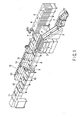
- FIG. 1 is a general configuration view showing a mail processor as a paper sheet processing apparatus according to one embodiment of the invention.
- number 1 denotes a transfer conveyor that conveys a large number of mail letters (hereinafter referred to as letters) as paper sheets to be deposited in a lump.
- a hopper conveyor 2 for use as a feeding device is provided on the unloading side of the transfer conveyor 1.
- the hopper conveyor 2 receives and conveys the letters upward.
- a rotary letter discriminating apparatus 3 which receives letters dropped from the hopper conveyor 2 and discriminates their thicknesses.
- a takeout device 4 that picks up the letters one by one is disposed on the unloading side of the letter discriminating apparatus 3. The letters picked up from the takeout device 4 are conveyed along a transfer path.
- a width discriminating section 6, hardness discriminating section 7, thickness detecting section 8, rejection section 9, address reading section 10, switchback section 11, up-down reversal section 12, imprinting section 13, inside-out inversion section 14, barcode reading section 15, and sorting/storing section 16 as a sorting/storing device are successively arranged along the direction in which the letters are conveyed.
- the letters that are loaded in a lump onto the transfer conveyor 1 are delivered onto the hopper conveyor 2 as the conveyor 1 runs.
- the letters are conveyed upward and loaded into the letter discriminating apparatus 3.
- the letters in the letter discriminating apparatus 3 is checked for thickness and delivered in the manner described in detail later.
- the delivered letters are picked up one by one by the takeout device 4 and conveyed to the width discriminating section 6, in which they are checked for width.
- the letters are conveyed to the hardness discriminating section 7, in which they are checked for hardness.
- the checked or discriminated letters are fed to the thickness detecting section 8, in which they are checked for thickness. Those letters which have thicknesses greater than a predetermined thickness are rejected through the rejection section 9.
- Those letters which are not rejected are fed to the address reading section 10, in which addresses thereon are read. Thereafter, the accepted letters are conveyed through the switchback section 11 and the up-down reversal section 12 to the imprinting section 13, in which they are imprinted. The imprinted letters are fed through the inside-out inversion section 14 to the barcode reading section 15, in which barcodes thereon are read. Based on the read information, thereafter, the letters are sorted and stored in the sorting/storing section 16.
- FIG. 2 is an exterior view showing the rotary letter discriminating apparatus 3.
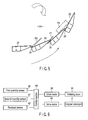
- the letter discriminating apparatus 3 contains a rotating drum 21 therein. Within the drum 21, a plurality of elongated discriminating blades 22 are integrally arranged along its inner peripheral surface. The discriminating blades 22 are arranged in a cylinder to define a discriminating region 24 with their transverse end portions superposed on one another. As shown in FIG. 5 , gaps 25 are formed individually at superposed portions of the discriminating blades 22. Although letters P1 and P2 that are thinner than each gap 25 can pass through the gaps 25, letters P3 that are thicker than each gap 25 cannot. As shown in FIG. 4 , moreover, a residual sensor 42 for use as a residual detection device that optically detects the quantity of remaining letters is provided in the discriminating region 24.
- a drive motor 28 is connected to the rotating drum 21 through a power transmission mechanism 27.
- the drum 21 is rotated counterclockwise by the motor 28.
- the discriminating blades 22 are revolved counterclockwise around the center of the discriminating region 24 as the drum 21 rotates.
- the rotating drum 21 and the discriminating region 24 are tilted so that their letter-receiving side is higher than the non-receiving side.
- the letters can be moved along the respective inner bottom surfaces of the blades to the non-receiving side and discharged as the drum 21 rotates.
- a chute section 30 that guides the letters P1 and P2 discharged from the rotating drum 21 is provided on the non-receiving side of the drum 21.
- the chute section 30 is underlain by a transfer conveyor 31 for use as a conveying device that conveys the letters P1 and P2 toward the takeout device 4.
- a chute section 33 that guides the letters P3 discharged from the discriminating region 24 is provided on the non-receiving side of the region 24.
- the chute section 33 is underlain by a storage section 34 that stores the discharged letters P3.
- the hopper conveyor 2 is provided on its top side with a first quantity sensor 36, such as an ultrasonic sensor, for use as a first measuring device that detects the quantity of letters conveyed by the hopper conveyor 2.
- the transfer conveyor 31 is provided on its top side with a second quantity sensor 37, such as an ultrasonic sensor, for use as a second measuring device that detects the quantity of letters conveyed by the transfer conveyor 31.
- the hopper conveyor 2 is passed around and between a driving roller 43 and driven rollers 44 and 45.
- the driving roller 43 is rotated by the drive motor 46, whereby the hopper conveyor 2 is run in the direction of the arrow.
- the first and second quantity sensors 36 and 37 and the residual sensor 42 are connected to a control section 40 for use as a control device through a transmitter circuit.
- the control section 40 is connected with the drive motor 28 for the rotating drum 21 and the drive motor 46 for the hopper conveyor 2 through a control circuit.
- the control section 40 is configured to vary the rotational speed of the drive motor 28, thereby increasing or reducing the speed of revolution of the discriminating blades 22, when a predetermined value is exceeded by the detected quantity of letters transmitted from the first quantity sensor 36, that is, when a large number of letters are detected at a time by the sensor 36. Under this speed control, a mass of letters loaded at a time into the discriminating region 24 can be jogged to be broken.
- control section 40 concludes that too great a quantity of letters for the discriminating capacity have been loaded into the discriminating region 24, and stops the discriminating blades 22 from being revolved by the drive motor 28.
- control section 40 is configured to stop the control for varying the rotational speed of the rotating drum 21 when the residual sensor 42 detects remaining letters less than a predetermined quantity.
- control section 40 concludes that the loading of the letters from the hopper conveyor 2 is too much, and stops the operation of the drive motor 46 for the hopper conveyor, thereby stopping the loading of the letters.
- the rotating drum 21 is rotated by the drive motor 28 to revolve the discriminating blades 22 counterclockwise around the center of the discriminating region 24. Thereupon, the gaps 25 between the blades 22 are moved forward.
- the transfer conveyor 1 and the hopper conveyor 2 run in this state, the plurality of types of letters P1 to P3 of different thicknesses are conveyed and loaded into the discriminating region 24, as shown in FIG. 7 .
- the letters P1 to P3 in the discriminating region 24 are dropped onto the discriminating blades 22 that constitute the lower side of the discriminating region 24, they are obliquely scraped up and conveyed as the blades 22 move. Thereupon, the letters P1 to P3 are moved by their own weight toward the gaps 25 between the discriminating blades 22.
- the letters P1 and P2 that are thinner than the gaps 25 between the blades 22 are delivered from the discriminating region 24 into the rotating drum 21 through the gaps 25.
- the letters P3 that are thicker than the gaps 25 are guided and discharged to the non-receiving side of the discriminating region 24 without passing through the gaps 25, and are stored into the storage section 34 through the chute section 33.
- the thin letters P1 and P2 are discriminated from the thick letters P3.
- the lump of letters cannot be broken even when the discriminating blades 22 are revolved at a constant speed.
- the thin letters P1 and P2 are intercepted by the thick letters P3, so that the chances of their reaching the discriminating blades 22 are reduced. Consequently, the thin letters P1 and P2 cannot pass through the gaps 25 between the blades 22 and may possibly be guided and discharged together with the thick letters P3 to the non-receiving side of the discriminating region 24.
- the quantity of letters loaded into the discriminating region 24 is detected by the first quantity sensor 36.
- the control section 40 varies the rotational speed of the drive motor 28, thereby increasing or reducing the speed of revolution of the discriminating blades 22.
- a pile of letters in the discriminating region 24 can be jogged to be broken, as shown in FIG. 8 .
- the time before the letters P1 and P2 reach the discriminating blades 22 can be shortened, and the chances of their reaching the blades 22 can be increased.
- the thin letters P1 and P2 can be securely delivered from the discriminating region 24 into the rotating drum 21 through the gaps 25.
- the thin letters P1 and P2 delivered into the rotating drum 21 are discharged onto the transfer conveyor 31 through the chute section 30 and conveyed to the takeout device 4.
- the thick letters P3 are discharged from the discriminating region 24 and stored into the storage section 34 through the chute section 33.
- the control section 40 concludes that the loading of the letters into the discriminating region 24 by the hopper conveyor 2 is too much, and stops the drive of the drive motor 46 for the hopper conveyor. Thereupon, the travel of the hopper conveyor 2 is stopped, so that the loading of the letters into the discriminating region 24 is stopped.
- the quantity of letters conveyed to the takeout device 4 by the transfer conveyor 31 is detected by the second quantity sensor 37. If the predetermined value is exceeded by the quantity of letters detected by the second quantity sensor 37, the control section 40 concludes that too great a quantity of letters for the discriminating capacity have been loaded into the discriminating region 24, and stops the drive of the drive motor 28 to stop the revolution of the discriminating blades 22.
- control section 40 concludes that control for varying the speed of revolution of the discriminating blades 22 is unnecessary, and stops the drive of the drive motor 28 to stop the revolution of the blades 22.
- the speed of revolution of the discriminating blades 22 is increased or reduced if it is detected that the quantity of letters loaded into the discriminating region 24 of the rotating drum 21 is greater than a predetermined quantity, so that the lump of letters in the discriminating region 24 can be jogged to be broken.
- the time before the letters P1 and P2 reach the discriminating blades 22 can be shortened, and the chances of their reaching the blades 22 can be increased.
- the thin letters P1 and P2 can be securely passed through the gaps 25 and discriminated without increasing the size of the apparatus.
- control section 40 concludes that the loading of the letters into the discriminating region 24 by the hopper conveyor 2 is too much, and stops the loading of the letters. Thus, the letters cannot be jammed in the discriminating region 24.
- the second quantity sensor 37 detects that the quantity of letters discriminated and delivered toward the takeout device 4 is not less than the predetermined quantity, it is concluded that too great a quantity of letters for the discriminating capacity have been loaded into the discriminating region 24, and the drive of the drive motor 28 is stopped. Thus, an appropriate quantity of letters can be fed into the takeout device 4, so that the letters cannot be jammed in a post-processing step.
- the lump of letters is broken by varying the rotational speed of the rotating drum 21.
- the lump of letters may be broken by intermittently repeating the start and stop of the operation of the rotating drum 21.
- the rotational speed of the rotating drum 21 may be changed automatically and periodically instead of performing the speed control for the drum 21 by measuring the quantity of letters using the first quantity sensor 36.
- FIG. 9 is a side view showing a rotary letter discriminating apparatus 50 according to a second embodiment of the invention
- FIG. 10 is a front view of the apparatus 50.
- the letter discriminating apparatus 50 contains a rotating drum 51 therein. Within the drum 51, a plurality of elongated first discriminating blades 52a are integrally arranged along its inner peripheral surface. The discriminating blades 52a are arranged in a cylinder to define an inside discriminating region 54a with their transverse end portions superposed on one another. As shown in FIG. 11 , first gaps 55a are formed individually at superposed portions of the discriminating blades 52a. Although letters P1 and P2 that are thinner than each first gap 55a are allowed to pass through the gaps 55a, letters P3 that are thicker than each gap 55a are not.
- a plurality of elongated second discriminating blades 52b are integrally arranged along its inner peripheral surface so as to be situated outside the elongated discriminating blades 52a.
- the second discriminating blades 52b are arranged in a cylinder to define an outside discriminating region 54b with their transverse end portions superposed on one another.
- second gaps 55b that are narrower than the first gaps 55a are formed individually at superposed portions of the discriminating blades 52b.
- the thick letters P3 are postal matter of corrugated cardboard
- the moderately thick letters P2 are relatively thick sealed letters
- the thin letters P1 are postcards.
- the rotating drum 51 is connected with a drive mechanism 58 for use as a drive device, whereby the drum 51 is rotated counterclockwise.
- the first and second discriminating blades 52a and 52b are revolved around the center of the inside and outside discriminating regions 54a and 54b as the rotating drum 51 rotates.
- the rotating drum 51 and the inside and outside discriminating regions 54a and 54b are tilted so that their letter-receiving side is higher than the non-receiving side.
- the letters can be moved along the respective inner bottom surfaces of the blades to the non-receiving side and discharged as the drum 51 rotates.
- a chute section 60 that guides the letters P1 discharged from the rotating drum 51 is provided on the non-receiving side of the drum 51.
- the chute section 60 is underlain by a transfer conveyor 61 for use as a conveying device that conveys the letters P1 toward the takeout device 4.
- a chute section 63a that guides the letters P3 discharged from the inside discriminating region 54a is provided on the non-receiving side of the region 54a.
- the chute section 63a is underlain by a first storage section 64a for use as a first storage device that stores the letters P3.
- a chute section 63b that guides the letters P2 discharged from the outside discriminating region 54b is provided on the non-receiving side of the region 54b.
- the chute section 63b is underlain by a second storage section 64b for use as a second storage device that stores the letters P2.
- the rotating drum 51 is rotated by the drive mechanism 58 to revolve the first and second discriminating blades 52a and 52b that constitute the inside and outside discriminating regions 54a and 54b, thereby moving the first and second gaps 55a and 55b.
- the transfer conveyor 61 and the hopper conveyor 2 run in this state, the plurality of types of letters P1 to P3 of different thicknesses are conveyed and loaded into the inside discriminating region 54a, as shown in FIG. 11 .
- the letters P1 to P3 in the inside discriminating region 54a are dropped onto the discriminating blades 52a that constitute the lower side of the discriminating region 54a, they are obliquely scraped up and conveyed as the blades 52a revolve.
- the letters P1 to P3 are moved by their own weight toward the first gaps 55a between the discriminating blades 52a. Then, the letters P1 and P2 that are thinner than the first gaps 55a between the discriminating blades 52a, out of all the letters P1 to P3, are delivered from the inside discriminating region 54a to the outside discriminating region 54b through the first gaps 55a. Further, the letters P3 that are thicker than the first gaps 55a are guided and discharged along the discriminating blades 52a of the inside discriminating region 54a to the exit side, and are stored into the first storage section 64a through the chute section 63a. Thus, the thin letters P1 and P2 are first discriminated from the thick letters P3.
- the letters P1 and P2 delivered to the outside discriminating region 54b are dropped onto the discriminating blades 52b that constitute the lower side of the discriminating region 54b, they are obliquely scraped up and conveyed as the blades 52a revolve. Thereupon, the letters P1 and P2 are moved by their own weight toward the second gaps 55b between the discriminating blades 52b. Then, only the letters P1 that are thinner than the second gaps 55b between the discriminating blades 52b, out of the letters P1 and P2, are delivered from the outside discriminating region 54b into the rotating drum 51 through the second gaps 55b. Further, the letters P2 that are thicker than the second gaps 55b are guided and discharged along the discriminating blades 52b of the outside discriminating region 54b to the exit side, and are stored into the second storage section 64b through the chute section 63b.
- the letters P1 that are delivered from the outside discriminating region 54b into the rotating drum 51 are delivered to the transfer conveyor 61 through the chute section 60 and conveyed to the takeout device 4.
- the inside and outside discriminating regions 54a and 54b are arranged within the rotating drum 51. After the thick letters P3 and the letters P1 and P2 thinner than the letters P3 are discriminated in the inside discriminating region 54a, the moderately thick letters P2 and the letters P1 thinner than the letters P2 are discriminated in the outside discriminating region 54b. In other words, the letters are discriminated again in the outside discriminating region 54b after they are roughly discriminated. Even if a large quantity of letters are loaded in a lump, therefore, they can be discriminated without increasing the size of the discriminating apparatus. Further, the three types of thicknesses of the letters can be discriminated without using a plurality of discriminating apparatuses.
Landscapes
- Engineering & Computer Science (AREA)
- Mechanical Engineering (AREA)
- Sorting Of Articles (AREA)
- Controlling Sheets Or Webs (AREA)
Applications Claiming Priority (3)
| Application Number | Priority Date | Filing Date | Title |
|---|---|---|---|
| JP2008048415 | 2008-02-28 | ||
| JP2008070046A JP5091735B2 (ja) | 2008-03-18 | 2008-03-18 | 紙葉類選別装置、紙葉類処理装置及び紙葉類選別方法 |
| JP2008208537A JP5562537B2 (ja) | 2008-02-28 | 2008-08-13 | 紙葉類選別装置、紙葉類処理装置及び紙葉類選別方法 |
Publications (3)
| Publication Number | Publication Date |
|---|---|
| EP2095886A2 true EP2095886A2 (fr) | 2009-09-02 |
| EP2095886A3 EP2095886A3 (fr) | 2014-12-24 |
| EP2095886B1 EP2095886B1 (fr) | 2016-04-20 |
Family
ID=40673849
Family Applications (1)
| Application Number | Title | Priority Date | Filing Date |
|---|---|---|---|
| EP08016265.4A Ceased EP2095886B1 (fr) | 2008-02-28 | 2008-09-16 | Appareil de séparation de feuilles de papier et procédé de distinction de feuilles de papier |
Country Status (3)
| Country | Link |
|---|---|
| US (1) | US20090218259A1 (fr) |
| EP (1) | EP2095886B1 (fr) |
| KR (1) | KR100993450B1 (fr) |
Cited By (1)
| Publication number | Priority date | Publication date | Assignee | Title |
|---|---|---|---|---|
| CN104438041A (zh) * | 2014-11-29 | 2015-03-25 | 肖金坚 | 一种可调节式物料筛分装置 |
Families Citing this family (2)
| Publication number | Priority date | Publication date | Assignee | Title |
|---|---|---|---|---|
| FI20175776A1 (fi) * | 2017-08-31 | 2019-03-01 | Andritz Oy | Erotuslaite |
| US10814522B2 (en) * | 2017-11-13 | 2020-10-27 | United States Gypsum Company | Stucco paper screen assembly |
Family Cites Families (11)
| Publication number | Priority date | Publication date | Assignee | Title |
|---|---|---|---|---|
| US2567494A (en) * | 1947-04-24 | 1951-09-11 | Scott Viner Company | Conveyer belt aligning mechanism |
| US2895610A (en) * | 1956-06-04 | 1959-07-21 | Post Office | Segregating apparatus |
| GB824565A (en) * | 1956-06-04 | 1959-12-02 | Post Office | Improvements in or relating to segregating apparatus |
| JPS5124263A (en) | 1974-08-23 | 1976-02-27 | Nippon Electric Co | Jubinbutsutono doramugataatsusasenbetsuki |
| US4141451A (en) * | 1978-01-04 | 1979-02-27 | Domtar Inc. | Chip thickness classifier |
| GB2100691B (en) * | 1981-06-23 | 1985-01-09 | Post Office | A mail discriminator |
| US4535895A (en) * | 1982-04-13 | 1985-08-20 | Computer Services Corporation | Sorting device |
| US6305552B1 (en) * | 1999-03-12 | 2001-10-23 | Universal Leaf Tobacco Company, Inc. | Apparatus for removing matter from tobacco stems |
| DE10038690C1 (de) * | 2000-08-08 | 2001-07-26 | Siemens Ag | Vorrichtung zum Trennen von Sendungen in Dickenklassen |
| DE10158426B4 (de) * | 2001-11-29 | 2004-02-26 | Axmann-Fördertechnik GmbH | Vorrichtung zum Sortieren von flächigen Stückgütern und Sortieranlage mit wenigstens einer derartigen Vorrichtung |
| SE523673C2 (sv) * | 2002-09-11 | 2004-05-11 | Posten Ab | Förfarande och arrangemang vid sorteringsanordning |
-
2008
- 2008-08-28 KR KR1020080084324A patent/KR100993450B1/ko not_active Expired - Fee Related
- 2008-09-15 US US12/210,625 patent/US20090218259A1/en not_active Abandoned
- 2008-09-16 EP EP08016265.4A patent/EP2095886B1/fr not_active Ceased
Cited By (1)
| Publication number | Priority date | Publication date | Assignee | Title |
|---|---|---|---|---|
| CN104438041A (zh) * | 2014-11-29 | 2015-03-25 | 肖金坚 | 一种可调节式物料筛分装置 |
Also Published As
| Publication number | Publication date |
|---|---|
| EP2095886B1 (fr) | 2016-04-20 |
| KR20090093761A (ko) | 2009-09-02 |
| US20090218259A1 (en) | 2009-09-03 |
| EP2095886A3 (fr) | 2014-12-24 |
| KR100993450B1 (ko) | 2010-11-09 |
Similar Documents
| Publication | Publication Date | Title |
|---|---|---|
| US8261917B2 (en) | Apparatus and method for processing articles of different dimensions | |
| EP1481929B1 (fr) | Dispositif d'alimentation de documents et méthode associée | |
| EP2095886A2 (fr) | Appareil de distinction d'une feuille de papier, appareil de traitement de feuille de papier et procédé de distinction d'une feuille de papier | |
| JP2007290850A (ja) | 紙葉類集積繰出装置 | |
| US10777033B2 (en) | Paper sheet redirecting unit and paper sheet processing apparatus using the same | |
| US5845785A (en) | Apparatus and method for processing shipping articles provided with shipping addresses | |
| KR101487447B1 (ko) | 지폐계수기 | |
| US12240721B2 (en) | Device for handling notes of value | |
| JP5562537B2 (ja) | 紙葉類選別装置、紙葉類処理装置及び紙葉類選別方法 | |
| WO2009130783A1 (fr) | Dispositif de traitement de pièces de monnaie | |
| KR20090002195U (ko) | 우편물 순로 구분 및 분류 장치의 비규격 우편물 제거장치 | |
| KR102357061B1 (ko) | 지폐처리장치 및 방법 | |
| JP5091735B2 (ja) | 紙葉類選別装置、紙葉類処理装置及び紙葉類選別方法 | |
| CN109071136B (zh) | 纸张片材处理设备以及纸张片材处理方法 | |
| JPH09227002A (ja) | 紙葉処理装置 | |
| JP2575599B2 (ja) | 紙葉類の反転装置並びに該装置を備えた紙葉類処理装置 | |
| KR100318738B1 (ko) | 전자사진 프로세서의 양면인쇄 장치 | |
| KR100690028B1 (ko) | 봉투 처리장치 | |
| JP5589349B2 (ja) | 紙葉類処理装置 | |
| JPH01172175A (ja) | 紙葉集積装置 | |
| JP2022168999A (ja) | 硬貨処理機および硬貨包装搬出装置 | |
| KR101616963B1 (ko) | 봉투와 내용물의 분리 장치 | |
| JP5139872B2 (ja) | 紙葉類取扱装置及び紙葉類取扱方法 | |
| JP2000264468A (ja) | 紙葉類処理装置 | |
| JPH07137859A (ja) | 紙葉類取出装置 |
Legal Events
| Date | Code | Title | Description |
|---|---|---|---|
| PUAI | Public reference made under article 153(3) epc to a published international application that has entered the european phase |
Free format text: ORIGINAL CODE: 0009012 |
|
| 17P | Request for examination filed |
Effective date: 20080916 |
|
| AK | Designated contracting states |
Kind code of ref document: A2 Designated state(s): AT BE BG CH CY CZ DE DK EE ES FI FR GB GR HR HU IE IS IT LI LT LU LV MC MT NL NO PL PT RO SE SI SK TR |
|
| AX | Request for extension of the european patent |
Extension state: AL BA MK RS |
|
| RIC1 | Information provided on ipc code assigned before grant |
Ipc: B07B 1/24 20060101AFI20140730BHEP Ipc: B07C 1/16 20060101ALI20140730BHEP Ipc: B07B 7/02 20060101ALI20140730BHEP Ipc: B07B 4/02 20060101ALI20140730BHEP Ipc: B07B 13/00 20060101ALI20140730BHEP |
|
| PUAL | Search report despatched |
Free format text: ORIGINAL CODE: 0009013 |
|
| AK | Designated contracting states |
Kind code of ref document: A3 Designated state(s): AT BE BG CH CY CZ DE DK EE ES FI FR GB GR HR HU IE IS IT LI LT LU LV MC MT NL NO PL PT RO SE SI SK TR |
|
| AX | Request for extension of the european patent |
Extension state: AL BA MK RS |
|
| RIC1 | Information provided on ipc code assigned before grant |
Ipc: B07C 1/16 20060101ALI20141119BHEP Ipc: B07B 1/24 20060101AFI20141119BHEP Ipc: B07B 13/00 20060101ALI20141119BHEP Ipc: B07B 7/02 20060101ALI20141119BHEP Ipc: B07B 4/02 20060101ALI20141119BHEP |
|
| AKX | Designation fees paid |
Designated state(s): DE FR GB IT |
|
| AXX | Extension fees paid |
Extension state: AL Extension state: MK Extension state: RS Extension state: BA |
|
| GRAP | Despatch of communication of intention to grant a patent |
Free format text: ORIGINAL CODE: EPIDOSNIGR1 |
|
| INTG | Intention to grant announced |
Effective date: 20151111 |
|
| GRAS | Grant fee paid |
Free format text: ORIGINAL CODE: EPIDOSNIGR3 |
|
| GRAA | (expected) grant |
Free format text: ORIGINAL CODE: 0009210 |
|
| AK | Designated contracting states |
Kind code of ref document: B1 Designated state(s): DE FR GB IT |
|
| REG | Reference to a national code |
Ref country code: GB Ref legal event code: FG4D |
|
| REG | Reference to a national code |
Ref country code: DE Ref legal event code: R096 Ref document number: 602008043691 Country of ref document: DE |
|
| REG | Reference to a national code |
Ref country code: FR Ref legal event code: PLFP Year of fee payment: 9 |
|
| REG | Reference to a national code |
Ref country code: DE Ref legal event code: R097 Ref document number: 602008043691 Country of ref document: DE |
|
| PLBE | No opposition filed within time limit |
Free format text: ORIGINAL CODE: 0009261 |
|
| STAA | Information on the status of an ep patent application or granted ep patent |
Free format text: STATUS: NO OPPOSITION FILED WITHIN TIME LIMIT |
|
| 26N | No opposition filed |
Effective date: 20170123 |
|
| REG | Reference to a national code |
Ref country code: FR Ref legal event code: PLFP Year of fee payment: 10 |
|
| REG | Reference to a national code |
Ref country code: FR Ref legal event code: PLFP Year of fee payment: 11 |
|
| PGFP | Annual fee paid to national office [announced via postgrant information from national office to epo] |
Ref country code: IT Payment date: 20210811 Year of fee payment: 14 Ref country code: FR Payment date: 20210812 Year of fee payment: 14 |
|
| PGFP | Annual fee paid to national office [announced via postgrant information from national office to epo] |
Ref country code: GB Payment date: 20210811 Year of fee payment: 14 |
|
| PGFP | Annual fee paid to national office [announced via postgrant information from national office to epo] |
Ref country code: DE Payment date: 20220609 Year of fee payment: 15 |
|
| GBPC | Gb: european patent ceased through non-payment of renewal fee |
Effective date: 20220916 |
|
| PG25 | Lapsed in a contracting state [announced via postgrant information from national office to epo] |
Ref country code: FR Free format text: LAPSE BECAUSE OF NON-PAYMENT OF DUE FEES Effective date: 20220930 |
|
| PG25 | Lapsed in a contracting state [announced via postgrant information from national office to epo] |
Ref country code: IT Free format text: LAPSE BECAUSE OF NON-PAYMENT OF DUE FEES Effective date: 20220916 Ref country code: GB Free format text: LAPSE BECAUSE OF NON-PAYMENT OF DUE FEES Effective date: 20220916 |
|
| REG | Reference to a national code |
Ref country code: DE Ref legal event code: R119 Ref document number: 602008043691 Country of ref document: DE |
|
| PG25 | Lapsed in a contracting state [announced via postgrant information from national office to epo] |
Ref country code: DE Free format text: LAPSE BECAUSE OF NON-PAYMENT OF DUE FEES Effective date: 20240403 |