EP2096057A2 - Vorrichtung zum Trennen und Herausnehmen von Papierbogen - Google Patents
Vorrichtung zum Trennen und Herausnehmen von Papierbogen Download PDFInfo
- Publication number
- EP2096057A2 EP2096057A2 EP09002738A EP09002738A EP2096057A2 EP 2096057 A2 EP2096057 A2 EP 2096057A2 EP 09002738 A EP09002738 A EP 09002738A EP 09002738 A EP09002738 A EP 09002738A EP 2096057 A2 EP2096057 A2 EP 2096057A2
- Authority
- EP
- European Patent Office
- Prior art keywords
- sheets
- paper
- pile
- separation
- guide
- Prior art date
- Legal status (The legal status is an assumption and is not a legal conclusion. Google has not performed a legal analysis and makes no representation as to the accuracy of the status listed.)
- Withdrawn
Links
- 238000000926 separation method Methods 0.000 claims abstract description 86
- 238000000605 extraction Methods 0.000 claims description 94
- 230000007246 mechanism Effects 0.000 claims description 37
- 238000012546 transfer Methods 0.000 claims description 16
- 238000007664 blowing Methods 0.000 abstract description 3
- 238000001514 detection method Methods 0.000 description 16
- 230000003068 static effect Effects 0.000 description 10
- 230000000694 effects Effects 0.000 description 9
- 230000005484 gravity Effects 0.000 description 7
- 230000001603 reducing effect Effects 0.000 description 7
- 238000012986 modification Methods 0.000 description 6
- 230000004048 modification Effects 0.000 description 6
- 239000000919 ceramic Substances 0.000 description 5
- 238000012545 processing Methods 0.000 description 5
- 238000000034 method Methods 0.000 description 4
- XLYOFNOQVPJJNP-UHFFFAOYSA-N water Substances O XLYOFNOQVPJJNP-UHFFFAOYSA-N 0.000 description 3
- 230000002950 deficient Effects 0.000 description 2
- 230000001154 acute effect Effects 0.000 description 1
- 238000011161 development Methods 0.000 description 1
- 238000006073 displacement reaction Methods 0.000 description 1
- 238000001704 evaporation Methods 0.000 description 1
- 230000008020 evaporation Effects 0.000 description 1
- 238000002474 experimental method Methods 0.000 description 1
- 238000007689 inspection Methods 0.000 description 1
- 238000003475 lamination Methods 0.000 description 1
- 239000000463 material Substances 0.000 description 1
- 239000002184 metal Substances 0.000 description 1
- 229910052751 metal Inorganic materials 0.000 description 1
- 239000000203 mixture Substances 0.000 description 1
- 230000003287 optical effect Effects 0.000 description 1
Images




Classifications
-
- B—PERFORMING OPERATIONS; TRANSPORTING
- B65—CONVEYING; PACKING; STORING; HANDLING THIN OR FILAMENTARY MATERIAL
- B65H—HANDLING THIN OR FILAMENTARY MATERIAL, e.g. SHEETS, WEBS, CABLES
- B65H3/00—Separating articles from piles
- B65H3/46—Supplementary devices or measures to assist separation or prevent double feed
- B65H3/52—Friction retainers acting on under or rear side of article being separated
- B65H3/5207—Non-driven retainers, e.g. movable retainers being moved by the motion of the article
- B65H3/5215—Non-driven retainers, e.g. movable retainers being moved by the motion of the article the retainers positioned under articles separated from the top of the pile
-
- B—PERFORMING OPERATIONS; TRANSPORTING
- B65—CONVEYING; PACKING; STORING; HANDLING THIN OR FILAMENTARY MATERIAL
- B65H—HANDLING THIN OR FILAMENTARY MATERIAL, e.g. SHEETS, WEBS, CABLES
- B65H1/00—Supports or magazines for piles from which articles are to be separated
- B65H1/08—Supports or magazines for piles from which articles are to be separated with means for advancing the articles to present the articles to the separating device
- B65H1/24—Supports or magazines for piles from which articles are to be separated with means for advancing the articles to present the articles to the separating device with means for relieving or controlling pressure of the pile
-
- B—PERFORMING OPERATIONS; TRANSPORTING
- B65—CONVEYING; PACKING; STORING; HANDLING THIN OR FILAMENTARY MATERIAL
- B65H—HANDLING THIN OR FILAMENTARY MATERIAL, e.g. SHEETS, WEBS, CABLES
- B65H3/00—Separating articles from piles
- B65H3/46—Supplementary devices or measures to assist separation or prevent double feed
- B65H3/48—Air blast acting on edges of, or under, articles
-
- B—PERFORMING OPERATIONS; TRANSPORTING
- B65—CONVEYING; PACKING; STORING; HANDLING THIN OR FILAMENTARY MATERIAL
- B65H—HANDLING THIN OR FILAMENTARY MATERIAL, e.g. SHEETS, WEBS, CABLES
- B65H3/00—Separating articles from piles
- B65H3/46—Supplementary devices or measures to assist separation or prevent double feed
- B65H3/56—Elements, e.g. scrapers, fingers, needles, brushes, acting on separated article or on edge of the pile
-
- B—PERFORMING OPERATIONS; TRANSPORTING
- B65—CONVEYING; PACKING; STORING; HANDLING THIN OR FILAMENTARY MATERIAL
- B65H—HANDLING THIN OR FILAMENTARY MATERIAL, e.g. SHEETS, WEBS, CABLES
- B65H3/00—Separating articles from piles
- B65H3/46—Supplementary devices or measures to assist separation or prevent double feed
- B65H3/60—Loosening articles in piles
- B65H3/62—Loosening articles in piles by swinging, agitating, or knocking the pile
-
- B—PERFORMING OPERATIONS; TRANSPORTING
- B65—CONVEYING; PACKING; STORING; HANDLING THIN OR FILAMENTARY MATERIAL
- B65H—HANDLING THIN OR FILAMENTARY MATERIAL, e.g. SHEETS, WEBS, CABLES
- B65H7/00—Controlling article feeding, separating, pile-advancing, or associated apparatus, to take account of incorrect feeding, absence of articles, or presence of faulty articles
- B65H7/02—Controlling article feeding, separating, pile-advancing, or associated apparatus, to take account of incorrect feeding, absence of articles, or presence of faulty articles by feelers or detectors
-
- B—PERFORMING OPERATIONS; TRANSPORTING
- B65—CONVEYING; PACKING; STORING; HANDLING THIN OR FILAMENTARY MATERIAL
- B65H—HANDLING THIN OR FILAMENTARY MATERIAL, e.g. SHEETS, WEBS, CABLES
- B65H2301/00—Handling processes for sheets or webs
- B65H2301/40—Type of handling process
- B65H2301/42—Piling, depiling, handling piles
- B65H2301/423—Depiling; Separating articles from a pile
- B65H2301/4234—Depiling; Separating articles from a pile assisting separation or preventing double feed
- B65H2301/42342—Depiling; Separating articles from a pile assisting separation or preventing double feed vibrating
-
- B—PERFORMING OPERATIONS; TRANSPORTING
- B65—CONVEYING; PACKING; STORING; HANDLING THIN OR FILAMENTARY MATERIAL
- B65H—HANDLING THIN OR FILAMENTARY MATERIAL, e.g. SHEETS, WEBS, CABLES
- B65H2406/00—Means using fluid
- B65H2406/30—Suction means
- B65H2406/35—Other elements with suction surface, e.g. plate or wall
- B65H2406/351—Other elements with suction surface, e.g. plate or wall facing the surface of the handled material
-
- B—PERFORMING OPERATIONS; TRANSPORTING
- B65—CONVEYING; PACKING; STORING; HANDLING THIN OR FILAMENTARY MATERIAL
- B65H—HANDLING THIN OR FILAMENTARY MATERIAL, e.g. SHEETS, WEBS, CABLES
- B65H2511/00—Dimensions; Position; Numbers; Identification; Occurrences
- B65H2511/20—Location in space
-
- B—PERFORMING OPERATIONS; TRANSPORTING
- B65—CONVEYING; PACKING; STORING; HANDLING THIN OR FILAMENTARY MATERIAL
- B65H—HANDLING THIN OR FILAMENTARY MATERIAL, e.g. SHEETS, WEBS, CABLES
- B65H2513/00—Dynamic entities; Timing aspects
- B65H2513/40—Movement
-
- B—PERFORMING OPERATIONS; TRANSPORTING
- B65—CONVEYING; PACKING; STORING; HANDLING THIN OR FILAMENTARY MATERIAL
- B65H—HANDLING THIN OR FILAMENTARY MATERIAL, e.g. SHEETS, WEBS, CABLES
- B65H2515/00—Physical entities not provided for in groups B65H2511/00 or B65H2513/00
- B65H2515/30—Forces; Stresses
- B65H2515/34—Pressure, e.g. fluid pressure
-
- B—PERFORMING OPERATIONS; TRANSPORTING
- B65—CONVEYING; PACKING; STORING; HANDLING THIN OR FILAMENTARY MATERIAL
- B65H—HANDLING THIN OR FILAMENTARY MATERIAL, e.g. SHEETS, WEBS, CABLES
- B65H2515/00—Physical entities not provided for in groups B65H2511/00 or B65H2513/00
- B65H2515/50—Vibrations; Oscillations
-
- B—PERFORMING OPERATIONS; TRANSPORTING
- B65—CONVEYING; PACKING; STORING; HANDLING THIN OR FILAMENTARY MATERIAL
- B65H—HANDLING THIN OR FILAMENTARY MATERIAL, e.g. SHEETS, WEBS, CABLES
- B65H2701/00—Handled material; Storage means
- B65H2701/10—Handled articles or webs
- B65H2701/19—Specific article or web
- B65H2701/1912—Banknotes, bills and cheques or the like
Definitions
- the present invention relates to a separation/extraction apparatus for separating sheets of paper or paper-like medium from a pile of sheets of the medium in which sheets of paper or paper-like medium are stacked on a one-by-one basis, and extracting the separated sheet of paper or paper-like medium.
- sheets of paper also called paper-like medium
- a printer copying machine
- ATM automated teller machine
- banknote processing machine mail processing machine
- sheets of paper or paper-like medium such as printing paper, banknotes, copying paper, sealed letters, postcards, cards, securities, and the like are handled.
- the inspection/processing apparatus is provided with a separation/extraction apparatus for separating sheets of paper from a pile of sheets of the medium in which sheets of paper are stacked one on top of the other on a one-by-one basis, and extracting the separated sheets of paper or paper-like medium.
- a separation/extraction apparatus in which a vibrator is brought into contact with a top surface of the pile of sheets of the medium in a spot-like form to vibrate the sheets of paper or paper-like medium, thereby lowering the adhesion force between the sheets of paper in advance.
- An object of the invention is to provide a separation/extraction apparatus capable of efficiently providing an effect of reducing friction between stocked sheets, and obtaining a sufficient undoing effect.
- a separation/extraction apparatus comprising:
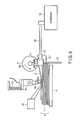
- FIG. 1 shows a separation/extraction apparatus according to a first embodiment of the present invention
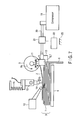
- FIG. 2 shows an arrangement relationship between each section shown in FIG. 1
- the separation/extraction apparatus shown in FIG. 1 is provided with a support base 4 on which a pile of sheets of the medium 3 formed by stacking sheets of paper or paper-like medium 1 one on top of the other is placed.
- the support base 4 supports the pile of sheets of the medium 3, and is driven to be elevated or lowered by a drive mechanism 28. Accordingly, a position of the uppermost surface of the pile of sheets of the medium 3 is adjusted by the drive mechanism 28.
- the pile of sheets of the medium is configured by stacking sheets of paper normally having a rectangular (oblong) shape one on top of the other, and hence it is formed into a cube (cuboid) as long as the sheets of paper are arranged by putting the positions of the sheets of paper in order.
- the pile of sheets of the medium 3 has top and bottom surfaces, and front and back side surfaces.
- the pile of sheets of the medium includes right and left side surfaces.
- the bottom surface corresponds to a surface in contact with the support base 4
- the top surface corresponds to a surface of sheets of paper of the uppermost surface of the pile of sheets of the medium opposed to the bottom surface.
- the front side surface is faced to the front which is defined as a transfer direction in which the sheets of paper are extracted, and the back side surface is opposed to the front side surface, and corresponds to a rear surface opposite to the transfer direction.
- the pile of sheets of the medium is not formed into a cuboid, and is formed into a shape obtained by inclining the surfaces of a cube in accordance with the inclination of the support base 4.
- a detection sensor 12 having a contactor which detects a height of the pile of sheets of the medium 3, i.e., a position of the sheets of paper 2 of the uppermost surface is arranged to be in contact with the sheets of paper 2, the detection sensor 12 being, for example, a rotary lever detection sensor provided with a roller at a distal end thereof.
- the roller of the contact type sensor is caused to be in contact with the sheets of paper 2 of the uppermost surface of the pile of sheets of the medium 3, the angle of the rotary lever is detected, and the height of the top surface of the pile of sheets of the medium 3 is detected.
- the detection sensor 12 is not limited to the contact type, and may be replaced with a non-contact sensor such as an optical displacement gage.
- a vibrator unit 10 for applying ultrasonic vibration to the pile of sheets of the medium 3 is arranged in such a manner that a distal end (contact end) of the vibrator unit 10 is in contact with the pile of sheets of the medium 3.
- the vibrator unit 10 is mechanically connected to a pressing spring 15 for pressing the vibrator unit 10 against the pile of sheets of the medium 3 at a constant pressure, and the pressing force applied from the vibrator unit 10 to the pile of sheets of the medium 3 is maintained constant by the pressing spring 15.
- ultrasonic vibration V0 is applied from the vibrator unit 10 to the pile of sheets of the medium 3 in a direction substantially perpendicular to the surface of the pile of sheets of the medium 3.
- the contactor (roller) of the detection sensor 12 be in contact with the pile of sheets of the medium 3 at a position close to a contact position (vibration application position) on the pile of sheets of the medium 3 at which the vibrator 14 of the vibrator unit 10 is brought into contact with the pile of sheets of the medium 3.
- the contactor (roller) of the detection sensor 12 be in contact with the pile of sheets of the medium 3 on the opposite side of the contact position of the vibrator 14 to the extraction direction of the sheets of paper 2, the contact position being used as a reference.
- the pile of sheets of the medium 3 is blown up by the side surface air 6, 7, and hence in order to accurately detect the height of the sheets of paper 2 of the uppermost surface to be used as a reference, it is desirable that the contact point of the detection part 12 be arranged at the above-mentioned position.
- the vibrator unit 10 has a structure in which the vibrator 25 is connected to an ultrasonic horn 14.
- the vibrator 25 is called a bolted vibrator, has a structure in which an electrode is extended from the inside of a piezo-ceramic part serving as a piezoelectric element to the outside, and the piezo-ceramic part is bolted between a pair of columnar blocks by a bolt, and the ultrasonic horn 14 is screwed on the blocks, thereby fixing the ultrasonic horn 14 to the vibrator 25.
- this vibrator 25 when the disk-like piezo-ceramic part is ultrasonically vibrated in accordance with a drive voltage applied to the electrode, the entire vibrator unit 10 is vibrated, and the vibration is transmitted to a vibrating surface of the columnar block.
- the amplitude of the piezo-ceramic part is relatively small, and there is the possibility of the piezo-ceramic part being unable to apply vibration capable of sufficiently undoing the sheets of paper or paper-like medium 1 and 2 to the pile of sheets of the medium 3 even when the ultrasonic vibration V0 is extracted from the vibrating surface of the columnar block, and is applied to the surface of the pile of sheets of the medium 3.
- the vibrator 25 is mechanically connected to the ultrasonic horn 14.
- the vibrator 25 is vibrated by being driven by a drive signal from a vibrator drive unit 35.
- the vibrator unit 10 provided with the ultrasonic horn 14 described above is vibrated at the distal end section in a direction V0 substantially perpendicular to the surface of the pile of sheets of the medium 3.
- both the friction between the distal end of the ultrasonic horn 14 and the sheets of paper 2 of the uppermost surface, and the friction between the uppermost surface sheets of paper 2 and the sheets of paper 1 stacked thereunder become sufficiently low. In this state, by transferring away the uppermost surface sheets of paper or paper-like medium, it is possible to realize separation with less duplicate extraction.
- the ultrasonic horn 14 may not necessarily be provided.
- the effective ultrasonic frequency is set at a frequency in the range of about 18 kHz to 28 kHz as a low frequency of an audible frequency range or higher.
- the separation/extraction apparatus shown in FIG. 1 is provided with a front side surface guide 5 for putting the positions of the sheets of paper 1 in order.
- the front side surface guide 5 is not limited to the form shown in FIG. 3 , and may be formed as shown in FIG. 4 or 5 .
- the front side surface guide 5 is brought into contact with the front side surface of the pile of sheets of the medium 3, thereby putting the positions of the sheets of paper 2 in order.
- a separation part 13 is provided in contact with the front side surface guide 5 in the extraction direction of the front side surface guide 5.
- the separation part 13 has an inclined surface formed in the direction in which the sheets of paper 2 is extracted from the top surface of the pile of sheets of the medium 3.
- a feed roller 9 serving as an extraction mechanism for extracting sheets of paper 2 of the uppermost surface from the pile of sheets of the medium 3 is arranged above the upper end of the front side surface guide 5. Accordingly, a guide opening is defined between the feed roller 9 and the guide end of the front side surface guide 5.
- the feed roller 9 is also arranged to form a gap G between itself and the inclined surface of the separation part 13, thereby defining a transfer path communicating with the guide opening.
- the feed roller 9 is driven to be rotated by a rotation drive mechanism 30, and is connected to a suction mechanism 32 to be given a negative pressure therein.
- a sheets of paper 1 undone and extracted by the ultrasonic vibration of the vibrator unit 10 is sucked by the feed roller 9 given the negative pressure, directed to the inclined surface of the separation part 13, and is transferred along the inclined surface of the separation part 13 with the rotation of the feed roller 9 indicated by an arrow R0.
- the feed roller 9 is formed into a cylindrical shape, and is provided with a suction part 11 including a negative-pressure chamber communicating with the suction mechanism 32.
- a flexible sheet such as a rubber sheet having a suction opening is stuck on the outer circumference or a part of the circumference of the feed roller 9.
- the suction mechanism 32 is provided with a first electromagnetic valve (not shown) for the suction part, and a negative pressure is supplied to the negative pressure chamber of the suction part 11 in accordance with opening/closing of the first electromagnetic valve. After the rotation of the feed roller 9 is settled, the first valve is opened in response to a detection signal from the detection sensor 12, and a vacuum (negative pressure) is supplied to the negative pressure chamber from the suction mechanism 32.
- the tip end of the sheets of paper 2 is sucked by the suction opening of the suction part 11, the sheets of paper 2 is pulled up with the rotation of the feed roller 9, and the tip end of the sheets of paper 2 is guided into the gap G.
- the extraction mechanism 32 using vacuum suction/attraction is adopted as a mechanism for extracting the sheets of paper 1 while preventing duplicate extraction from occurring.
- a friction separation mechanism utilizing frictional force may be used as the extraction mechanism in place of the extraction mechanism 32 using the vacuum suction/attraction.
- the separation part 13 includes a cavity (not shown) communicating with the suction mechanism 32, and the cavity communicates with a plurality of opening sections opened in the inclined surface along which the sheets of paper or paper-like medium 2 is transferred through a channel (not shown).
- the suction mechanism 32 is provided with a second electromagnetic valve (not shown) for the separation part, and a negative pressure is supplied to the cavity of the separation part 13 in accordance with opening/closing of the second electromagnetic valve.
- the second electromagnetic valve is opened, a negative pressure is supplied to the cavity of the separation part 13 from the suction mechanism 32, suction force is produced at the opening sections of the inclined surface, and the sheets of paper 2 is sucked by the opening sections on the inclined surface.
- the suction force at the suction part 11, and the suction force at the opening sections on the inclined surface are appropriately selected and are matched with each other, whereby the sheets of paper is transferred along the inclined surface with the rotation of the feed roller 9.
- the vibrator unit 10 is brought into point contact with the sheets of paper 2 of the uppermost surface of the pile of sheets of the medium 3, and vibration is applied thereto, whereby it is possible to make the adhesion force between the sheets of paper 1 and 2 small in advance. That is, the adhesion force between the sheets of paper 1 and 2 in the form of a stack is reduced in advance, the frictional force between the sheets of paper 2 and the sheets of paper stacked thereunder is sufficiently reduced, and then the sheets of paper 2 are extracted, whereby it is possible to prevent duplicate extraction of the sheets of paper 1 and 2 from occurring.
- air blow-off parts 6 and 7 are provided on both sides in front of the pile of sheets of the medium 3.
- the air blow-off part 6, 7 communicates with an air supply unit 34, and air supplied from the air supply unit 34 is supplied to the sheets of paper 1 and 2 constituting the pile of sheets of the medium 3 from the air blow-off parts 6 and 7. Accordingly, with respect to even sheets of paper 1 and 2 (so-called soft sheets of paper or paper-like medium 1, 2) having small stiffness, it is possible to effectively undo the sheets of paper or paper-like medium.
- sheets of paper largely differ in stiffness (Young's modulus) depending on the material, size, thickness, and ambient environment (particularly, humidity).
- Young's modulus of sheets of paper including postcards is in the range of about 1 to 20 [GPa].
- the Young's modulus is in the range of about 1 to 3 GPa.
- the sheets of paper is called an unbending sheets of paper or paper-like medium, and when the Young's modulus is low, the sheets of paper is called a soft sheets of paper or paper-like medium.
- the stiffness largely differs depending on the usage state, i.e., a folded state, crumpled state, and brand-new state.
- a brand-new banknote is said to be high in Young's modulus (unbending), and a crumpled banknote is said to be soft.
- sheets of paper having the Young's modulus equal to about 1 GPa or less are soft sheets of paper or paper-like medium.
- the air undoing is not good at undoing of sheets of paper of brand-new banknotes, and is liable to be affected by the friction between the sheets of paper or paper-like medium.
- undoing utilizing the ultrasonic vibration is adopted in addition to the undoing utilizing air, it becomes possible to stably separate and extract the sheets of paper irrespective of the state of friction between the sheets of paper 1, 2 or the state of stiffness of the sheets of paper or paper-like medium.
- undoing utilizing ultrasonic vibration and undoing utilizing air may be simultaneously adopted and used. Further, the undoing system may be selected in accordance with the state of the paper stack. For example, after the sheets of paper 1, 2 are undone by being subjected to undoing utilizing ultrasonic vibration and undoing utilizing air, only one of the undoing utilizing ultrasonic vibration and undoing utilizing air may be performed. When the undoing utilizing ultrasonic vibration is not performed, the vibrator unit 10 is retracted by means of a moving mechanism. Further, a sensor for detecting the stacked state of the pile of sheets of the medium may be separately provided, and the state (undone state) of the stack of the pile of sheets of the medium may be detected.
- the air blow-off parts 6 and 7 be provided to be opposed to each other on one part or both parts of the side surface of the pile of sheets of the medium 3 perpendicular to the extraction direction, and air be blown upon the vicinity of the tip end section of the pile of sheets of the medium 3, i.e., the tip end sections of the sheets of paper 1, 2 extracted by the feed roller 9.
- the tip end section of the pile of sheets of the medium 3 binding of the sheets of paper 1, 2 is small as compared with the central part of the pile of sheets of the medium 3, air can easily enter the inside of the pile of sheets of the medium 3, and hence it is possible to undo the sheets of paper 1, 2 at the time of extraction of the sheets of paper 1, 2.
- the air supply unit 34 is configured, specifically, as shown in FIG. 6 . That is, the air supply unit 34 is provided with a compressor 19, and when an electromagnetic valve (not shown) is opened, compressed air from the compressor 19 is supplied to the air blow-off parts 6 and 7 through, for example, a hose or a pipe. Thus, the compressed air is blown upon the front end section of the sheets of paper 1, 2 on the guide side from the air blow-off parts 6 and 7.
- Ionized air is spouted out from the air blow-off parts 6 and 7, and the electric charge of the electrostatically charged sheets of paper 1, 2 can be removed.
- Ionized air is supplied to a charged stack of sheets of paper 1, 2, only the electric charge on the surface of the paper stack is removed, and the electric charges between the sheets of paper 1, 2 cannot be removed.
- Ionized air is blown into small gaps between the sheets of paper 1, 2 formed by slightly separating the sheets of paper 1, 2 from each other by the ultrasonic vibration, whereby the ionized air spreads over the gaps between the sheets of paper 1, 2, and secure removal of the electric charges is enabled. Accordingly, it becomes possible to perform stable separation/extraction of the sheets of paper 2 even in an environment in which humidity is low, and electrification is easily caused.
- the air supply unit 34 for supplying ionized air is, specifically, provided with a static eliminator 21 at an airflow supply path part 20 thereof as shown in FIG. 7 , and the static eliminator 21 is connected to a high-voltage power source 22 connected to the ground 23.
- the static eliminator 21 is provided with an electrode needle, and a positive high voltage and a negative high voltage are alternately applied to the electrode needle from the high-voltage power source 22.
- a corona discharge is caused in the static eliminator 21 concomitantly with the application of the high voltage, the compressed air supplied from the compressor 19 is ionized, and the ionized air is blown upon the front end section of the sheets of paper or paper-like medium 1, 2 on the guide side from the air blow-off parts 6 and 7.
- a metallic body lowers the static eliminating capability, and hence it is desirable that the housing or the like of the air blow-off parts 6 and 7 be not made of metal.
- the high-voltage power source 22 needs to be connected to the ground electrode, or to be connected to the ground without fail. If the power source 22 is not grounded, there is the possibility of electrification occurring inside the static eliminator 21, a discharge occurring from the static eliminator 21, and the static eliminator itself being damaged.
- a humidifier 24 may be provided in the airflow supply path part 20.
- the method of humidifying compressed air using a humidifier 24 includes the method of a steam type (water is boiled), the method of an evaporation type (water is evaporated), the method of an ultrasonic type (water is formed into fine grains, and spouted out in that form), and the like, and each of them can be used.
- the compressed air is made to contain moisture by the humidifier 24, the humidity in the air is raised, and the humidified air is blown over the front end section of the sheets of paper 1, 2 on the guide side. Accordingly, the sheets of paper 1, 2 are hard to be electrified so that the sheets of paper 1, 2 become easy to be separated from each other.
- a gap G having a distance ⁇ H1 between the upper end of the front side surface guide 5 and the outer circumference of the feed roller 9 is formed as shown in FIG. 2 , and a distance ⁇ H2 is given between the distal end of the vibrator unit 10 at which the body 10 is in contact with the sheets of paper 2, i.e., the uppermost surface of the pile of sheets of the medium 3, and a virtual plane which is parallel with this sheets of paper 2 and is in contact with the outer circumference of the feed roller 9.
- the distance ⁇ H2 is determined in such a manner that ⁇ H2 is equal to or larger than ⁇ H1.
- the arrangement shown in FIG. 2 is based on the following reasons.
- the sheets of paper undone by largely reducing friction between the sheets of paper 1, 2 by applying vibration to the top surface of the pile of sheets of the medium 3, i.e., by a so-called vacuum extraction separation system are fed piece by piece.
- the support base 4 is controlled in such a manner that the height of the top surface of the pile of sheets of the medium 3 is within a certain height range at all times, or the pressing force between the contact section of the vibrating unit 10 and the sheets of paper 1, 2 is within a certain range.
- the height of the sheets of paper 2 before the vibrator 14 is brought into contact with the sheets of paper 2 be equal to or less than the height of the distal end section of the front side surface guide 5 ( ⁇ H1 ⁇ ⁇ H2).
- the support base 4 be controlled in such a manner that the height of the sheets of paper 2 of the uppermost surface is equal to or less than the height of the upper end section of the front side surface guide 5 in the extraction direction ( ⁇ H1 ⁇ ⁇ H2).
- the side surface air 6, 7 is not limited to the both sides, and may be provided only on one side.
- a position signal of the uppermost surface position of the pile of sheets of the medium 3 detected by the sensor 12 as shown in FIG. 2 is supplied to a control unit 36, then is compared with a reference position in the control unit 36, and a difference signal is supplied to the drive mechanism 28. Accordingly, the support base 4 is controlled by the drive mechanism 28, and the uppermost surface position of the pile of sheets of the medium 3 is maintained at a constant position. Further, the rotation drive unit 30 is operated in accordance with a rotation instruction from the control unit 36, and the feed roller 9 is rotated at a constant rotational speed by a rotation drive signal from the rotation drive unit 30.
- the air supply unit 34 is operated in accordance with an air supply instruction from the control unit 36, air is supplied to the air blow section from the air supply unit 34 to be spouted out toward the pile of sheets of the medium 3.
- a first and second suction instruction signals are supplied to the suction mechanism 32 from the control unit 36 on the basis of the detection signal from the detection sensor 12, the first and second valves are opened, and the electromagnetic valve and a suction motor are stopped by an extraction operation end signal. Accordingly, until the motor is stopped, suction/attraction occurs at the suction part 11 and the separation part 13 by the first and second suction start instructions.
- a rotation start signal is supplied to the rotation drive unit 30 from the control unit 36, and rotation of the feed roller 9 is started.
- the first electromagnetic valve of the suction mechanism 32 is closed, and the suction mechanism 32 is kept in the non-suction state.
- the control unit 36 supplies an operation start signal to the drive mechanism 28, the drive mechanism 28 operates to raise the support base 4 on which the pile of sheets of the medium 3 is placed, and the pile of sheets of the medium 3 is elevated.
- the control unit 36 controls the drive unit 28 to maintain the uppermost surface position of the pile of sheets of the medium 3 as it is. Further, when the height of the pile of sheets of the medium 3 is maintained at the optimum position (predetermined height), the control unit instructs the vibrator drive unit 35 to start vibration, and the vibrator drive unit 35 supplies a drive signal to the vibrator 25 to start vibration. Thus, ultrasonic vibration is applied to the pile of sheets of the medium 3, thereby undoing the sheets of paper 1, and making the sheets of paper 1 transferable.
- a first instruction is supplied to the first electromagnetic valve of the suction mechanism 32 from the control unit 36 on the basis of a detection signal from the detection sensor 12, the first electromagnetic valve is opened, and the tip end of the sheets of paper 2 is sucked when the suction part 11 of the feed roller 9 is opposed to the separation part 13.
- the tip end section of the sheets of paper 2 is lifted by the suction force produced between the feed roller 9 and the sheets of paper 2 of the uppermost surface of the pile of sheets of the medium 3, and the air supplied from the side surface air 6, 7, then is sucked by and attracted to the suction part 11 of the feed roller 9, the sheets of paper 2 is extracted by the frictional force of the rubber sheet on the surface of the suction part 11, and is then taken into sheets of paper processing apparatus (not shown) through the separation part 13 for preventing duplicate extraction.
- the feed roller may feed a sheet of paper per rotation, or may feed a plurality of paper sheets per rotation.
- the second electromagnetic valve is opened by a second instruction, and suction force for sucking the sheets of paper 1 is produced at the separation part 13. Accordingly, while the sheets of paper 2 is fed, the succeeding sheets of paper 1 which is liable to enter the gap G following the preceding sheets of paper 2 is prevented from entering the gap G.
- the sensor 12 detects the height of the pile of sheets of the medium 3
- the support base 4 is raised by the drive mechanism 28 so that the height of the sheets of paper 2 can be maintained at a predetermined height, and the pile of sheets of the medium 3 is maintained at the predetermined height.
- the sheets of paper 1 are stacked in the direction of gravity.
- the stacking of the sheets of paper 1 is not limited to the case where the sheets of paper 1 and 2 are stacked in the gravity direction, and the sheets of paper 1 and 2 may be arranged and stacked in column on the support base 4 to be in close contact with each other so that the sheets of paper 1 and 2 can be stacked one on top of the other in the direction perpendicular to the gravity.
- the transfer direction is opposite to the gravity direction in the arrangement of FIG. 1 so that the front side surface guide 5 can be arranged in the upper part, and the right side in the drawing of FIG. 1 is defined as the upper part.
- the sheets of paper of the uppermost surface is, not only when the direction in which the sheets of paper are stacked on the support base is the direction against the gravity, but also when the direction is substantially horizontal, defined as the sheets of paper positioned farthest from the support base while the direction in which the sheets of paper are stacked on the support base is used as a point of reference. Accordingly, in a pile of sheets of the medium in which sheets of paper are arranged and stacked in column to be in close contact with each other, sheets of paper which is the object of extraction, and is exposed at the outermost part corresponds to the sheets of paper of the uppermost surface.
- the front side surface guide 5 shown in FIG. 1 is arranged to be connected to the inclined surface of the separation part 13 as shown in FIG. 3 , and the end face of the front side surface guide 5 is formed substantially perpendicular (substantially perpendicular along the transfer path) to the contact surface of the front side surface guide 5 to be brought into contact with the sheets of paper 1.
- the end section of the front side surface guide 5 may be bent into an L-shape to be buried in the inclined surface of the separation part 13 as shown in FIG. 4 . Further, as shown in FIG.
- the separation part 13 may be provided on the front side surface guide 5, and the part of the inclined surface of the separation part 13 on the entry side of the sheets of paper 1 may be provided with an entry end formed perpendicular to the contact surface of the front side surface guide 5 to be brought into contact with the sheets of paper 1.
- this entry end is separate from the guide 5, the entry end is called a guide end substantially functioning as a guide.
- the part through which the tip end section of the sheets of paper 1, 2 enters the separation part is formed into a smooth curved surface.
- the above part is formed into a smooth curved surface, it becomes possible for a plurality of sheets of paper 1, 2 to easily enter the gap in an overlapping manner, and hence it is desirable that the entry section of the sheets of paper 2 be formed into a right-angled shape as shown in FIGS. 1 to 5 .
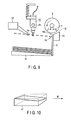
- FIG. 9 shows a modification example of the separation/extraction apparatus shown in FIG. 1 .
- the support base 4 includes a carrying surface which is perpendicular to the front side surface guide 5, and on which the pile of sheets of the medium 3 is placed.
- the support base 4 may include a carrying surface forming an acute angle (angle smaller than 90°) with the front side surface guide 5 as shown in FIG. 10 .
- a support base 41 having an inclined carrying surface includes a carrying surface inclined in a direction perpendicular to the sheets of paper extraction direction W.
- the carrying surface is inclined in such a manner that when the pile of sheets of the medium 3 is set on the carrying surface, force for putting the positions of the sheets of paper in order utilizing the gravity acts in the extraction direction (transfer direction) W, and in a direction perpendicular to the direction W, and the sheets of paper 1, 2 are brought into contact with the front side surface guide 5 in a forwardly falling state.
- the pile of sheets of the medium 3 is shifted to the front side surface guide 5 in the extraction direction, with the position thereof being put in order by the guide 5.
- the angle formed by the horn 14 and the sheets of paper 2 of the uppermost surface of the pile of sheets of the medium 3 is not a right angle, and the vibrator unit 10 is obliquely brought into contact with the sheets of paper 2 (as if the vibrating body is inclined in the direction opposite to the extraction direction).
- a component of the force resulting from the oblique contact of the vibrator unit 10 is produced in the extraction direction W, thereby making it easier to put the positions of the sheets of paper in order by the front side surface guide 5.
- the height of the uppermost surface sheets of paper 2 is arranged lower than the upper end of the front side surface guide, thereby preventing a large number of sheets of paper 1 from entering the separation part, and preventing defective extraction from occurring.
- banknotes as the sheets of paper 1, 2 are supplementarily fed into the apparatus from a direction perpendicular to the extraction direction, from the side surface side of the pile of sheets of the medium 3 having the larger height of the inclined support base. That is, the apparatus housing is provided with a door, and when the door is opened, the sheets of paper 1, 2 are fed onto the support base 4 from the direction substantially perpendicular to the extraction direction.
- the support base 4 is inclined to be lowered in the replenishment direction.
- the surface of the support base may be inclined in such a manner that the height of the support base 4 is lowered in the extraction direction W, and in the feed direction of the sheets of paper 1, 2.
- the apparatus may be provided with height adjustment mechanisms 48-1 to 48-4 in advance at four corners on the bottom surface of the apparatus housing 50 as shown in FIG. 11 , and the entire apparatus may be inclined.
- the apparatus housing 50 inclined, it is possible to incline the carrying surface of the support base 4 toward the guide 5 like the support base 41 shown in FIG. 9 .
Landscapes
- Engineering & Computer Science (AREA)
- Mechanical Engineering (AREA)
- Sheets, Magazines, And Separation Thereof (AREA)
Applications Claiming Priority (1)
| Application Number | Priority Date | Filing Date | Title |
|---|---|---|---|
| JP2008051057A JP2009208858A (ja) | 2008-02-29 | 2008-02-29 | 分離取出装置 |
Publications (2)
| Publication Number | Publication Date |
|---|---|
| EP2096057A2 true EP2096057A2 (de) | 2009-09-02 |
| EP2096057A3 EP2096057A3 (de) | 2011-12-28 |
Family
ID=40785516
Family Applications (1)
| Application Number | Title | Priority Date | Filing Date |
|---|---|---|---|
| EP09002738A Withdrawn EP2096057A3 (de) | 2008-02-29 | 2009-02-26 | Vorrichtung zum Trennen und Herausnehmen von Papierbogen |
Country Status (3)
| Country | Link |
|---|---|
| US (1) | US7802785B2 (de) |
| EP (1) | EP2096057A3 (de) |
| JP (1) | JP2009208858A (de) |
Cited By (2)
| Publication number | Priority date | Publication date | Assignee | Title |
|---|---|---|---|---|
| CN102050336A (zh) * | 2009-10-30 | 2011-05-11 | 株式会社东芝 | 纸张类取出装置以及纸张类处理装置 |
| EP2815995A1 (de) * | 2013-06-21 | 2014-12-24 | BÖWE SYSTEC GmbH | Beilagenanleger für flache Güter |
Families Citing this family (14)
| Publication number | Priority date | Publication date | Assignee | Title |
|---|---|---|---|---|
| JP4127708B2 (ja) * | 2006-05-23 | 2008-07-30 | 株式会社東芝 | 紙状媒体の分離取り出し装置 |
| WO2011013230A1 (ja) | 2009-07-30 | 2011-02-03 | 株式会社 東芝 | 束状態検知システム及び分離取出装置 |
| JP5500432B2 (ja) * | 2010-02-10 | 2014-05-21 | 株式会社リコー | 給紙装置及び画像形成装置 |
| JP2012071902A (ja) * | 2010-09-27 | 2012-04-12 | Toshiba Corp | 媒体搬送装置及び制御方法 |
| KR101578771B1 (ko) * | 2014-02-18 | 2015-12-18 | 노틸러스효성 주식회사 | 이매 검지용 초음파 센서 및 이를 이용한 이매 검지 방법 |
| EP2962968B1 (de) * | 2014-07-01 | 2017-05-10 | Wincor Nixdorf International GmbH | Vorrichtung zum Vereinzeln von Blattgut |
| JP6925928B2 (ja) * | 2017-10-10 | 2021-08-25 | 株式会社東芝 | 給紙装置 |
| JP2019214461A (ja) * | 2018-06-13 | 2019-12-19 | ホリゾン・インターナショナル株式会社 | 用紙スタックの側面を揃える装置 |
| WO2020058964A1 (en) * | 2018-09-23 | 2020-03-26 | Nilesh Dhirajlal Parmar | A sheet feeder and method of making the same |
| JP7417379B2 (ja) * | 2019-08-09 | 2024-01-18 | 理想科学工業株式会社 | シート供給装置 |
| CN110510235A (zh) * | 2019-08-20 | 2019-11-29 | 武汉鸿印社科技有限公司 | 一种印刷机用纸张均匀进料装置 |
| CN113460741A (zh) * | 2021-06-21 | 2021-10-01 | 长葛市大阳纸业有限公司 | 具有纸张发散装置的印刷机 |
| DE102022100819A1 (de) * | 2022-01-14 | 2023-07-20 | Koenig & Bauer Ag | Rüttelvorrichtung sowie ein Verfahren zum Betreiben einer Rüttelvorrichtung |
| WO2024014841A1 (ko) * | 2022-07-13 | 2024-01-18 | 주식회사 엘지에너지솔루션 | 흡착 장치 |
Citations (1)
| Publication number | Priority date | Publication date | Assignee | Title |
|---|---|---|---|---|
| JP2007145567A (ja) | 2005-11-30 | 2007-06-14 | Toshiba Corp | 分離取出装置 |
Family Cites Families (23)
| Publication number | Priority date | Publication date | Assignee | Title |
|---|---|---|---|---|
| JPS5394563A (en) * | 1977-01-31 | 1978-08-18 | Matsushita Electric Works Ltd | Anti-static treatment of melamine-impregnated paper |
| JPH02137340U (de) * | 1989-04-19 | 1990-11-15 | ||
| JPH0648602A (ja) | 1992-07-28 | 1994-02-22 | Nasuka:Kk | 超音波薄板剥離装置 |
| JP3220553B2 (ja) | 1993-02-19 | 2001-10-22 | キヤノン株式会社 | 給紙装置及び画像形成装置 |
| US5478066A (en) * | 1992-11-02 | 1995-12-26 | Canon Kabushiki Kaisha | Sheet supply apparatus |
| JP3513674B2 (ja) * | 1994-12-28 | 2004-03-31 | ニスカ株式会社 | 給紙装置 |
| DE19943029A1 (de) * | 1998-10-08 | 2000-04-13 | Heidelberger Druckmasch Ag | Vorrichtung und Verfahren zur Vereinzelung von Bedruckstoffbögen |
| JP3730465B2 (ja) * | 1998-11-24 | 2006-01-05 | 株式会社東芝 | 紙葉類処理装置 |
| JP4266067B2 (ja) * | 2000-04-28 | 2009-05-20 | 株式会社東芝 | 紙葉類の取出装置及び紙葉類の取出方法 |
| JP2003312873A (ja) * | 2002-04-17 | 2003-11-06 | Pfu Ltd | 給紙装置およびその制御方法 |
| JP3801954B2 (ja) * | 2002-04-23 | 2006-07-26 | 株式会社丸山機械製作所 | 紙束捌き装置 |
| US6994340B2 (en) * | 2002-09-12 | 2006-02-07 | Xerox Corporation | Sheet feeding apparatus having an air fluffer |
| JP4152766B2 (ja) * | 2003-02-14 | 2008-09-17 | ホリゾン・インターナショナル株式会社 | 給紙装置 |
| JP2004091212A (ja) * | 2003-07-31 | 2004-03-25 | Nisca Corp | 給紙装置 |
| JP2004002044A (ja) * | 2003-08-20 | 2004-01-08 | Mitsubishi Heavy Ind Ltd | 枚葉印刷機の給紙装置 |
| JP4297808B2 (ja) * | 2004-03-03 | 2009-07-15 | ホリゾン・インターナショナル株式会社 | 丁合機 |
| JP2006248691A (ja) * | 2005-03-10 | 2006-09-21 | Fuji Xerox Co Ltd | シート搬送装置及びこれを用いた画像形成装置 |
| JP2007145582A (ja) * | 2005-11-30 | 2007-06-14 | Toshiba Corp | 媒体分離取出機構 |
| JP2007238206A (ja) * | 2006-03-06 | 2007-09-20 | Toshiba Corp | 分離取出装置 |
| US7591459B2 (en) * | 2006-04-03 | 2009-09-22 | Canon Kabushiki Kaisha | Sheet feeding apparatus and image forming apparatus |
| JP2007331944A (ja) * | 2006-05-15 | 2007-12-27 | Canon Inc | シート給送装置及び画像形成装置 |
| JP4127708B2 (ja) * | 2006-05-23 | 2008-07-30 | 株式会社東芝 | 紙状媒体の分離取り出し装置 |
| JP4302148B2 (ja) * | 2007-03-12 | 2009-07-22 | 株式会社東芝 | 紙葉類分離装置,紙葉類分離取り出し装置,紙葉類処理装置,紙葉類分離方法,そして紙葉類分離取り出し方法 |
-
2008
- 2008-02-29 JP JP2008051057A patent/JP2009208858A/ja active Pending
-
2009
- 2009-02-26 US US12/393,264 patent/US7802785B2/en active Active
- 2009-02-26 EP EP09002738A patent/EP2096057A3/de not_active Withdrawn
Patent Citations (1)
| Publication number | Priority date | Publication date | Assignee | Title |
|---|---|---|---|---|
| JP2007145567A (ja) | 2005-11-30 | 2007-06-14 | Toshiba Corp | 分離取出装置 |
Cited By (4)
| Publication number | Priority date | Publication date | Assignee | Title |
|---|---|---|---|---|
| CN102050336A (zh) * | 2009-10-30 | 2011-05-11 | 株式会社东芝 | 纸张类取出装置以及纸张类处理装置 |
| EP2316763A3 (de) * | 2009-10-30 | 2012-09-19 | Kabushiki Kaisha Toshiba | Blattaufnahmevorrichtung und Blattverarbeitungsvorrichtung |
| CN102050336B (zh) * | 2009-10-30 | 2014-05-07 | 株式会社东芝 | 纸张类取出装置以及纸张类处理装置 |
| EP2815995A1 (de) * | 2013-06-21 | 2014-12-24 | BÖWE SYSTEC GmbH | Beilagenanleger für flache Güter |
Also Published As
| Publication number | Publication date |
|---|---|
| JP2009208858A (ja) | 2009-09-17 |
| US20090218752A1 (en) | 2009-09-03 |
| US7802785B2 (en) | 2010-09-28 |
| EP2096057A3 (de) | 2011-12-28 |
Similar Documents
| Publication | Publication Date | Title |
|---|---|---|
| US7802785B2 (en) | Apparatus for separating and extracting sheets utilizing a vibration and an air flow | |
| US8336870B2 (en) | Bundle-state detection apparatus and separation and extraction apparatus | |
| CA1289583C (en) | Front air knife improvement for a top vacuum corrugation feeder | |
| US7708268B2 (en) | Separator and feeder with vibrator for sheets of paper medium | |
| CN101434352A (zh) | 供纸装置以及图像形成装置 | |
| EP1330404B1 (de) | Verfahren zur zuführung von umschlägen | |
| JP2007238206A (ja) | 分離取出装置 | |
| JP2788382B2 (ja) | 給紙装置 | |
| CA1302449C (en) | Low cost rear air knife top vacuum corrugation feeder | |
| JP2001354331A (ja) | シート分離装置およびシート給送装置 | |
| JP2005067898A (ja) | 紙さばきのための方法及び装置 | |
| JP2009227399A (ja) | 分離取出装置 | |
| CN100355637C (zh) | 纸张类取出装置以及纸张类取出方法 | |
| JP3085909B2 (ja) | 画像形成装置の排紙装置 | |
| JPS61254438A (ja) | 給紙装置 | |
| JP3220553B2 (ja) | 給紙装置及び画像形成装置 | |
| JPS61254439A (ja) | 給紙装置 | |
| JP4302148B2 (ja) | 紙葉類分離装置,紙葉類分離取り出し装置,紙葉類処理装置,紙葉類分離方法,そして紙葉類分離取り出し方法 | |
| JP2001192133A (ja) | 画像処理装置におけるシート材の供給機構 | |
| JP2014231431A (ja) | 分離取出装置、及び分離取出方法 | |
| JP3177667B2 (ja) | 紙葉材給送装置 | |
| JPH101235A (ja) | シート体の払い出し装置 | |
| JPH01220652A (ja) | シート送り出し装置 | |
| JP2006021851A (ja) | 給紙装置 | |
| JPH08337348A (ja) | 媒体集積装置 |
Legal Events
| Date | Code | Title | Description |
|---|---|---|---|
| PUAI | Public reference made under article 153(3) epc to a published international application that has entered the european phase |
Free format text: ORIGINAL CODE: 0009012 |
|
| 17P | Request for examination filed |
Effective date: 20090226 |
|
| AK | Designated contracting states |
Kind code of ref document: A2 Designated state(s): AT BE BG CH CY CZ DE DK EE ES FI FR GB GR HR HU IE IS IT LI LT LU LV MC MK MT NL NO PL PT RO SE SI SK TR |
|
| AX | Request for extension of the european patent |
Extension state: AL BA RS |
|
| PUAL | Search report despatched |
Free format text: ORIGINAL CODE: 0009013 |
|
| AK | Designated contracting states |
Kind code of ref document: A3 Designated state(s): AT BE BG CH CY CZ DE DK EE ES FI FR GB GR HR HU IE IS IT LI LT LU LV MC MK MT NL NO PL PT RO SE SI SK TR |
|
| AX | Request for extension of the european patent |
Extension state: AL BA RS |
|
| RIC1 | Information provided on ipc code assigned before grant |
Ipc: B65H 1/24 20060101ALI20111122BHEP Ipc: B65H 3/56 20060101ALI20111122BHEP Ipc: B65H 3/48 20060101ALI20111122BHEP Ipc: B65H 3/62 20060101ALI20111122BHEP Ipc: B65H 3/52 20060101AFI20111122BHEP |
|
| AKX | Designation fees paid |
Designated state(s): DE FR GB |
|
| STAA | Information on the status of an ep patent application or granted ep patent |
Free format text: STATUS: THE APPLICATION HAS BEEN WITHDRAWN |
|
| 18W | Application withdrawn |
Effective date: 20120907 |