EP2096497A1 - Procédé de fabrication de toner et appareil de granulation de toner - Google Patents
Procédé de fabrication de toner et appareil de granulation de toner Download PDFInfo
- Publication number
- EP2096497A1 EP2096497A1 EP09153869A EP09153869A EP2096497A1 EP 2096497 A1 EP2096497 A1 EP 2096497A1 EP 09153869 A EP09153869 A EP 09153869A EP 09153869 A EP09153869 A EP 09153869A EP 2096497 A1 EP2096497 A1 EP 2096497A1
- Authority
- EP
- European Patent Office
- Prior art keywords
- toner
- fine particle
- press rolls
- press
- granulating
- Prior art date
- Legal status (The legal status is an assumption and is not a legal conclusion. Google has not performed a legal analysis and makes no representation as to the accuracy of the status listed.)
- Granted
Links
Images
Classifications
-
- B—PERFORMING OPERATIONS; TRANSPORTING
- B01—PHYSICAL OR CHEMICAL PROCESSES OR APPARATUS IN GENERAL
- B01J—CHEMICAL OR PHYSICAL PROCESSES, e.g. CATALYSIS OR COLLOID CHEMISTRY; THEIR RELEVANT APPARATUS
- B01J2/00—Processes or devices for granulating materials, e.g. fertilisers in general; Rendering particulate materials free flowing in general, e.g. making them hydrophobic
- B01J2/22—Processes or devices for granulating materials, e.g. fertilisers in general; Rendering particulate materials free flowing in general, e.g. making them hydrophobic by pressing in moulds or between rollers
-
- G—PHYSICS
- G03—PHOTOGRAPHY; CINEMATOGRAPHY; ANALOGOUS TECHNIQUES USING WAVES OTHER THAN OPTICAL WAVES; ELECTROGRAPHY; HOLOGRAPHY
- G03G—ELECTROGRAPHY; ELECTROPHOTOGRAPHY; MAGNETOGRAPHY
- G03G9/00—Developers
- G03G9/08—Developers with toner particles
- G03G9/0802—Preparation methods
- G03G9/0804—Preparation methods whereby the components are brought together in a liquid dispersing medium
- G03G9/0806—Preparation methods whereby the components are brought together in a liquid dispersing medium whereby chemical synthesis of at least one of the toner components takes place
-
- G—PHYSICS
- G03—PHOTOGRAPHY; CINEMATOGRAPHY; ANALOGOUS TECHNIQUES USING WAVES OTHER THAN OPTICAL WAVES; ELECTROGRAPHY; HOLOGRAPHY
- G03G—ELECTROGRAPHY; ELECTROPHOTOGRAPHY; MAGNETOGRAPHY
- G03G9/00—Developers
- G03G9/08—Developers with toner particles
- G03G9/0802—Preparation methods
- G03G9/0808—Preparation methods by dry mixing the toner components in solid or softened state
-
- G—PHYSICS
- G03—PHOTOGRAPHY; CINEMATOGRAPHY; ANALOGOUS TECHNIQUES USING WAVES OTHER THAN OPTICAL WAVES; ELECTROGRAPHY; HOLOGRAPHY
- G03G—ELECTROGRAPHY; ELECTROPHOTOGRAPHY; MAGNETOGRAPHY
- G03G9/00—Developers
- G03G9/08—Developers with toner particles
- G03G9/0802—Preparation methods
- G03G9/081—Preparation methods by mixing the toner components in a liquefied state; melt kneading; reactive mixing
-
- G—PHYSICS
- G03—PHOTOGRAPHY; CINEMATOGRAPHY; ANALOGOUS TECHNIQUES USING WAVES OTHER THAN OPTICAL WAVES; ELECTROGRAPHY; HOLOGRAPHY
- G03G—ELECTROGRAPHY; ELECTROPHOTOGRAPHY; MAGNETOGRAPHY
- G03G9/00—Developers
- G03G9/08—Developers with toner particles
- G03G9/0802—Preparation methods
- G03G9/0815—Post-treatment
-
- G—PHYSICS
- G03—PHOTOGRAPHY; CINEMATOGRAPHY; ANALOGOUS TECHNIQUES USING WAVES OTHER THAN OPTICAL WAVES; ELECTROGRAPHY; HOLOGRAPHY
- G03G—ELECTROGRAPHY; ELECTROPHOTOGRAPHY; MAGNETOGRAPHY
- G03G9/00—Developers
- G03G9/08—Developers with toner particles
- G03G9/0802—Preparation methods
- G03G9/0817—Separation; Classifying
-
- G—PHYSICS
- G03—PHOTOGRAPHY; CINEMATOGRAPHY; ANALOGOUS TECHNIQUES USING WAVES OTHER THAN OPTICAL WAVES; ELECTROGRAPHY; HOLOGRAPHY
- G03G—ELECTROGRAPHY; ELECTROPHOTOGRAPHY; MAGNETOGRAPHY
- G03G9/00—Developers
- G03G9/08—Developers with toner particles
- G03G9/0819—Developers with toner particles characterised by the dimensions of the particles
-
- G—PHYSICS
- G03—PHOTOGRAPHY; CINEMATOGRAPHY; ANALOGOUS TECHNIQUES USING WAVES OTHER THAN OPTICAL WAVES; ELECTROGRAPHY; HOLOGRAPHY
- G03G—ELECTROGRAPHY; ELECTROPHOTOGRAPHY; MAGNETOGRAPHY
- G03G9/00—Developers
- G03G9/08—Developers with toner particles
- G03G9/0821—Developers with toner particles characterised by physical parameters
Definitions
- the present invention relates to a method for producing a toner for use in image forming methods such as an electrophotographic method, a latent electrostatic recording method, a latent electrostatic printing method, a toner jet system recording method, and the like.
- a toner for developing a latent electrostatic image is used in image forming methods such as an electrophotographic method.
- a production method of such a toner is roughly divided into a pulverization method and polymerization method, and the pulverization method is known as a simpler and more popular method.
- a binder resin for fixing the toner to a transfer material and a colorant are used, and, if necessary, other materials such as a charge control agent, magnetic material, and a release agent are used.
- These toner materials are mixed and subjected to melting and kneading. Subsequent to cooling down and solidification, the kneaded mixture is finely pulverized by a pulverizer unit and then the resultant is classified by a classifier unit according to a desired particle size distribution. After that, a fluidizer, etc. is added to the resultant, whereby a toner for image formation is produced.
- a toner including a resin having a low melting point and a release agent typically a wax, and having a smaller particle size has been dominant in the market.
- fine particle toner (so called substandard toner) whose particle size is less than a predetermined size is generated in the pulverizing and classifying process.
- the fine particle toner thus generated is collected for reuse.
- JP-A Japanese Patent Application Laid-Open
- JP-A No. 05-034976 discloses a method in which the substandard toner is added to a dispersed mixture obtained in a dispersing and mixing process so as to be reused.
- JP-A No. 06-186775 discloses a method in which the fine particle toner is uniformly sprinkled onto intermediate products of the toner after a kneading process, dissolved by the heat retained in the intermediate products of the toner, and subjected to cooling and pulverizing, whereby a toner product having a predetermined grain size is regenerated.
- JP-A No. 08-069126 discloses a method in which, a kneading process for the fine particle toner is provided separately from a normal toner production process through which a batch-type and continuous-type extruder with single or double-shaft feed screws, which is the same one used in the normal toner production process and, after that, followed by the normal toner production process or the resultant fine particle toner is processed into a coarse powder, followed by coarse pulverizing process.
- JP-A No. 10-161343 discloses a method in which the fine particle toner collected and discharged through a classifying process is heated to be melted or softened, the melted or softened substance is extruded by a pressure extruder, and the extruded substance then is mixed into a kneaded substance before cooling after a kneading process.
- JP-A No. 06-266157 discloses a toner manufacturing method using a granulating apparatus.
- JP-A No. 2006-259017 discloses a method that uses a degasifier for increasing the bulk density of the fine particle toner before a granulation process.
- JP-B Japanese Patent (JP-B) No. 3435587 discloses a method in which both granulated fine particles and raw fine particles which is not granulated are reused.
- breakage of resin molecule occurs when the fine particle toner is re-kneaded by a kneader. This may reduce the molecular weight of the resin to cause fixing performance to deteriorate or may reduce mechanical strength thereof to cause durability performance to deteriorate.
- JP-A No. 10-161343 energy loss occurs since an electric power is required when a pressure extruder is heated using a heater. Further, a substance softened and/or melted by heating remains in a vessel and is not completely discharged from the apparatus, and a maintenance work for removing the residue needs to be carried out every time one process is completed or before activation of the apparatus after the stop thereof.
- the toner produced in a state where the feed-neck phenomenon that the substandard fine particle toner does not bite into the screw portion of a kneader well occurs does not reach a sufficient mixing state as compared to the toner in which the recycled fine particle toner is not used, deteriorating dispersibility of the material. Due to the deterioration in the dispersibility of the material and occurrence of the feed-neck phenomenon, the discharge amount from the kneader becomes extremely small, thereby reducing producing capability.
- the size of the apparatus is increased and, accordingly a space for use in producing the toner is increased, resulting in deterioration of industrial practicality. Further, even if the degassing effect is sufficient in the initial stage, it is gradually reduced due to clogging of the degassing part and the like, making it difficult to constantly obtain a predetermined granulated product. Therefore, a periodical maintenance work needs to be carried out for the degassing part, and further, a cumbersome work is required in order to maintain the granulation performance at a constant level, causing deterioration of productivity and increase in cost, which severely limits its industrial applicability.
- the substandard fine particle toner generated in the above production processes contains silica having high lubricant effect.
- the fine particle toner containing silica having high lubricant effect or fine particle toner containing carbon black is directly recycled to a material mixing process, so-called feed-neck phenomenon that the mixed material does not bite into an extruder well occurs. This impedes the progress of the kneading process to significantly deteriorate productivity. Even if a delay of the production process does not occur in the initial state of the kneading process, the delay gradually emerges, resulting in a significant reduction in the productivity.
- the above methods do not mention how a granulating apparatus is configured and what conditions under which the toner production process is carried out in order to achieve a predetermined particle bulk density, to prevent the feed-neck phenomenon, and to basically omit a maintenance work for an apparatus to be employed.
- the above methods do not mention a technique that sets the speed ratio of two press rolls which is proposed in the present invention. Further, an invention that can lead to mass production techniques as the present invention does has not yet been disclosed.
- An object of the present invention is to provide a method for granulating a toner and a toner granulating apparatus capable of achieving significantly increasing productivity and stably maintaining the high productivity without strengthening productive facilities by using a compact and low-cost granulating apparatus with less maintenances, even when a fine particle toner containing additive such as carbon black or silica having high lubricant effect, or normal fine particle toner is used.
- a fine particle toner containing carbon black or silica having lubricant effect, as well as a normal fine particle toner stably bites into the two press rolls by out of synchronization of rotation between the two press rolls.
- a granulated toner extremely stable in quality and to provide a toner production method and a toner granulating apparatus capable of attaining high productivity.
- toner production method maintenance of equipment to be used can be saved. Further, a degassing unit or both a pressure means for pressing the press roll section and heater means for heating the press roll section can be omitted. Further, a V-shaped grove or concave groove need not be formed on the surface of the two press rolls serving as a means for biting the fine particle toner, resulting in energy saving and cost reduction.
- the present invention relates to a toner production method that reuses a fine particle toner having a particle diameter failing to meet a predetermined standard diameter which is generated in pulverizing and classifying process following processes of mixing (mixing and stirring), kneading (melting and kneading), and cooling carried out for toner material including at least a binder resin, release agent and pigment.
- Processing of mixing and stirring, melting and kneading, pulverizing, and classifying can be carried out in the same manner as conventionally known methods, and the same apparatuses as those used in the conventionally known methods can be used to carry out the above processes.
- a general mixer with rotating blades is used to mechanically mix the toner material containing a binder resin, colorant such as pigment, and the like.
- a mixing and stirring process can be carried out under normal conditions without any particular limitation.
- the mixture obtained in the above mixing and stirring process is melted and kneaded using a kneader.
- the kneader may be a single-screw or double-screw continuous kneader or a batch kneader such as a roll mill mixer.
- Model KTK double screw extruder by Kobe Steel, Ltd.
- Model TEM extruder by Toshiba Machine Co., Ltd.
- double screw extruders by KCK Co., Ltd.
- Model PCM double screw extruder by Ikegai Tekko Co., Ltd.
- co-kneaders by Buss Co., Ltd.
- This melting and kneading process is preferably carried out under proper conditions so as not to cause breakage of the molecular chain of the binder resin.
- the melting and kneading temperature is set with reference to the softening point of the binder resin. When the melting and kneading temperature is excessively lower than the softening point, dispersion may not proceed. On the other hand, when the melting and kneading temperature is excessively higher than the softening point, severe breakage occurs.
- the kneaded mixture obtained in the melting and kneading process is pulverized.
- the kneaded mixture is coarsely pulverized and then finely pulverized.
- the pulverized material is classified in an air stream by a centrifugal force to prepare a toner (developer) having a predetermined particle diameter, e.g., an average particle diameter of from 3 ⁇ m to 20 ⁇ m.
- a toner developer
- this toner can directly be used as developer
- the roundness of the pulverized toner may be increased to a range from 0.94 to 0.99 using a power treatment apparatus such as "Therfusion System” manufactured by Hosokawa Micron Corporation or Hybridizer (made by Nara Kikai Seisakusho Co., Ltd.).
- the toner production method according to the present invention is featured in that, in a method of granulating a toner for use in an electrophotographic method, a granulating apparatus having two or more, preferably, two press rolls which are disposed left and right at the middle portion of the granulating apparatus and whose rotational speeds are different from each other is used to granulate a toner. It is preferable that the two press rolls used in the granulating apparatus employed in the toner production method according to the present invention are controlled to be driven in an independent manner. To achieve this, drive units (motors) that use an inverter to drive the press rolls are independently controlled.
- the rotational speed set in the drive units can freely be changed by operation on a touch panel. Alternatively, in the case where Ringcone continuously variable transmission is used as a speed changer, the rotational speed can be set or changed through setting buttons, select switches, or the like provided on the speed changer.
- a common drive unit can be used by setting the rotational speed ratio using a speed changer (e.g., gear).
- a speed changer e.g., gear
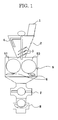
- FIG. 1 is an overall view of a preferable example of a toner granulating apparatus for used in the toner production method according to the present invention.
- Fine particles fine particle toner
- a supply port fine particle toner supply tube 1 arranged at an upper portion of a hopper 2, and then stored in the hopper 2.
- the fine particles stored in the hopper 2 are forcibly fed to a press roll section 5 by a rotation of a screw 3 and a agitator 4.
- the screw 3 and agitator 4 are coaxially driven in the granulating apparatus used in the toner production method according to the present invention, they may be driven independently.
- the press roll section 5 preferably includes a press roll 51 and a press roll 52 having the same diameters.
- the press rolls 51 and 52 rotate at a rotational speed arbitrarily set by independent drive units to press the fine particles. More specifically, not shown drive units (motors) are provided independently of each other.
- the drive units each have a speed changer to rotate the press rolls 51 and 52. This configuration allows finer adjustment of the rotational speeds of the respective press rolls, as compared with a case where a single drive unit provided with a fixed gear is used to drive the two press rolls 51 and 52. This prevents occurrence of the feed-neck of the fine particle toner and prevents small lumps from being generated in the granulated toner.
- the two press rolls 51 and 52 are of energy-saving type. More specifically, a hydraulic pressure means for adjusting the gap between the rolls 51 and 52 and a heater means are omitted. With this configuration, it is possible to prevent occurrence of breakage of the molecular chains of the binder resin and deterioration of toner performance. Further, cost and installation space of facilities employed in a toner production process are reduced and, further, the heater means is not provided, so that it can be said that the granulating apparatus of the present invention is an environmentally-preferred apparatus.
- an inverter speed changer that can directly change the rotational speed of the drive unit or a speed changer that can extremely suppress a reduction of the torque transmitted from the drive unit, such as Ringcone continuously variable transmission, may be used, as described above.
- the two press rolls can be driven by a common drive means.
- independent drive units are provided for respective two press rolls to generate a difference in the rotational speed between them.
- the rotational speed ratio between the press rolls is set in the range of 0.45 to 0.95, preferably in the range of 0.50 to 0.90, and more preferably in the range of 0.75 to 0.85.
- the rotational speed ratio between the press rolls is less than 0.40, fine particle toner bites into one of press rolls whose rotational speed is lower than that of the other, making it difficult to produce a desired granulated product and significantly deteriorating the productivity.
- the rotational speed ratio between the press rolls is higher than 0.95, the biting of the fine toner particles becomes insufficient, making it difficult to produce a desired granulated product.
- the rotational speed is preferably set to 20 r/min (20 rpm) or less and more preferably to 10 r/min (10 rpm) or less.
- the two press rolls are preferably inwardly rotated in such a direction as to press out the fine particle toner from the top to bottom direction relative to the two press rolls so as to cause the fine particle toner to bite into the two press rolls.
- the distance between the press rolls 51 and 52 is set in the range of, e.g., 500 ⁇ m to 2000 ⁇ m, and preferably in a range of 800 ⁇ m to 1200 ⁇ m.
- the diameter of the two press rolls having substantially the same diameter is set in the range of 100 mm to 600 mm, preferably in the range of 150 mm to 500 mm, and more preferably in the range of 150 mm to 300 mm.
- the gear ratio is set in a range of 1:0.4 to 1:0.95 (higher speed gear is set to 1), preferably set in a range of 1:0.5 to 1:0.9, and more preferably in a range of 1:0.75 to 1: 0.85.
- the fine particle toner pressed in and passed through the press roll section 5 is scraped off from the press rolls 51 and 52 by a scraper 6 and drop to a pulverizer 7 by its own weight.
- the pressed fine particle toner that has passed through the pulverizer 7 is fed to a particle sizer 8 where a toner having a predetermined particle size is selected and discharged.
- the discharged toner is collected as a granulated product or fed to the subsequent process.
- the rotation speed of the pulverizer 7 and particle sizer 8 is not especially limited, and it is sufficient for the pulverizer 7 and particle sizer 8 to operate at a regular rotational speed (e.g., 100 rpm or more).
- the rotation speeds of the respective units of the granulating apparatus, including the press rolls, can be arbitrarily set by inverter control, and optimum production conditions can easily be set in accordance with the type of the fine particles by operation on a touch panel.
- Examples of the release agent used in the present invention include natural waxes such as candelilla wax, carnauba wax, and rice wax; montan wax, paraffin wax, sazol wax, low molecular weight polyethylene, low molecular weight polypropylene, and alkyl phosphate ester.
- an appropriate release agent can be selected in accordance with the kind of binder resin and the kind of material used for the surface portion of an image fixing roller. It is preferable that the release agent have a melting point in the range of 65°C to 90°C. When the melting point of the release agent is lower than 65°C, blocking of toner tends to occur during the storage thereof. When the melting point of the release agent is higher than 90°C, the off-set phenomenon tends to easily take place if the image fixing roller is in a low temperature range.
- coloring agent for use in the present invention known pigments can be employed.
- black pigment examples include carbon black, oil furnace black, channel black, lamp back, Azine dyes such as aniline black, metallic salt azo dyes, metallic oxides, and composite metallic oxides.
- yellow pigment examples include Cadmium Yellow, Mineral Fast Yellow, Nickel Titan Yellow, Naples Yellow, Naphthol Yellow S, Hansa Yellow G, Hansa Yellow 10G, Benzidine Yellow GR, Quinoline Yellow Lake, Permanent Yellow NCG, and Tartrazine Lake.
- red pigment examples include colcothar, Cadmium Red, Permanent Red 4R, Lithol Red, Pyrazolone Red, Lake Red D, Brilliant Carmine 6B, Eosine Lake, Rhodamine Lake B, Alizarine Lake, and Brilliant Carmine 3B.
- blue pigment examples include Cobalt Blue, Alkali Blue, Victoria Blue Lake, Phthalocyanine Blue, metal-free Phthalocyanine Blue, Phthalocyanine Blue partially chlorinated, Fast Sky Blue and Indanthrene Blue BC.
- These pigments are all dried pigment particles and can be employed alone or in combination.
- binder resin for use in the present invention known resins such as a vinyl resin, a polyester resin, and a polyol resin may be used. These resins may be used either singly or as mixtures. Among them, a polyester resin, and a polyol resin are preferably used.
- vinyl resin examples include homopolymers of styrene and substituted styrenes such as polystyrene, poly-p-chlorostyrene, and polyvinyl toluene; styrene-based copolymers such as styrene-p-chlorostyrene copolymer, styrene-propylene copolymer, styrene-vinyltoluene copolymer, styrene-vinylnaphthalene copolymer, styrene-methyl acrylate copolymer, styrene-ethyl acrylate copolymer, styrene-butyl acrylate copolymer, styrene-octyl acrylate copolymer, styrene-methyl methacrylate copolymer, styrene-ethyl methacrylate copolymer,
- the polyester resin serving as the binder resin can be prepared by condensation polymerization using a dihydric alcohol component selected from the following group A and a dibasic acid component selected from the following group B. Furthermore, a polyhydric alcohol having three or more hydroxyl groups, or a polycarboxylic acid having three or more carboxyl groups selected from the following group C may be added to the above-mentioned components A and B.
- Group A ethylene glycol, triethylene glycol, 1,2-propylene glycol, 1,3-propylene glycol, 1,4-butanediol, neopentyl glycol, 1,4-butenediol, 1,4-bis(hydroxymethyl)cyclohexane, bisphenol A, hydrogenated bisphenol A, a reaction product of polyoxyethylene and bisphenol A, polyoxypropylene(2,2)-2,2-bis(4-hydroxyphenyl)propane, and polyoxypropylene(3,3)-2,2-bis(4-hydroxyphenyl)propane.
- Group B maleic acid, fumaric acid, mesaconic acid, citraconic acid, itaconic acid, glutaconic acid, phthalic acid, isophthalic acid, terephthalic acid, cyclohexane-dicarboxylic acid, succinic acid, adipic acid, sebacic acid, malonic acid, linolenic acid; anhydrides of the above acids; and esters of the above acids and a lower alcohol.
- Group C polyhydric alcohols having three or more hydroxyl groups, such as glycerin, trimethylolpropane, and pentaerythritol; and polycarboxylic acids having three or more carboxyl groups, such as trimellitic acid and pyromellitic acid.
- the polyol resin which is preferably used as the binder resin for the toner of the present invention, is prepared by allowing the following components to react: an epoxy resin, an alkylene oxide adduct of a dihydric phenol or a glycidyl ether of the alkylene oxide adduct; a compound having in the molecule thereof one active hydrogen atom which is capable of reacting with epoxy group; and a compound having in the molecule thereof two or more active hydrogen atoms which are capable of reacting with epoxy group.
- the above-mentioned resins may be used together with the other resins, for example, epoxy resin, polyamide resin, urethane resin, phenolic resin, butyral resin, rosin, modified rosin, and terpene resin when necessary.
- epoxy resin a polycondensation product of a bisphenol such as bisphenol A or bisphenol F and epichlorohydrin is a representative example.
- a charge control agent is preferably incorporated in the toner particles (internal addition), or may be mixed with the toner particles
- Examples of a charge control agent may include: nigrosine, azine dyes having 2-16 carbon atoms (Japanese Patent Application Publication (JP-B) No. 42-1627 ); basic dyes including, e.g., C.I. Basic Yellow 2 (C.I. 41000), C.I. Basic Yellow 3, C.I. Basic Red 1, C.I. Basic Red 9 (C.I. 42500), C.I. Basic Violet 1 (C.I. 42535), C.I. Basic Violet 3 (C.I. 42555), C.I. Basic Violet 10 (C.I. 45170), C.I. Basic Violet 14 (C.I. 42510), C.I. Basic Blue 1 (C.I. 42025), C.I.
- basic dyes including, e.g., C.I. Basic Yellow 2 (C.I. 41000), C.I. Basic Yellow 3, C.I. Basic Red 1, C.I. Basic Red 9 (C.I. 42500), C.I. Basic Violet 1 (C.
- Basic Blue 3 (C.I. 51005), C.I. Basic Blue 5 (C.I. 42140), C.I. Basic Blue 7 (C.I. 42595), C.I. Basic Blue 9 (C.I. 52015), C.I. Basic Blue 24 (C.I. 52030), C.I. Basic Blue 25 (C.I. 52025), C.I. Basic Green 4 (C.I. 42000), and lake pigments formed from these basic dyes with laking agents,; C.I. Solvent Black 8 (C.I.
- quarternary ammonium chlorides such as benzomethyl-hexadecylammonium chloride and decyl-trimethylammonium chloride
- dialkyltin compounds such as dibutyl and dioctyl
- dialkyltin borate compounds guanidine derivatives
- polyamine resins such as a vinyl polymer containing an amino group and a condensation-type polymer containing an amino group
- the toner produced in the present invention may be used as a one-component developer or two-component developer.
- it is mixed with carrier particles.
- a carrier particle a magnetic particle such as iron powder, ferrite powder, nickel powder, magnetite powder, a resin-coated carrier in which the surface of magnetic particles is coated with a resin such as a fluorine-based resin, a vinyl-based resin, or a silicone-based resin, and a magnetic material dispersion-type carrier in which magnetic particles are dispersed in a resin.
- the carrier preferably has an average particle diameter of 30 ⁇ m to 80 ⁇ m.
- inorganic fine particles may be externally added to the toner.
- the inorganic fine particles include oxides and composite oxides of one or more of Si, Ti, Al, Mg, Ca, Sr, Ba, In, Ga, Ni, Mn, W, Fe, Co, Zn, Cr, Mo, Cu, Ag, and V are useful.
- fine particles of silicon dioxide (silica), titanium dioxide and alumina are preferably used.
- the above-mentioned inorganic fine particles are preferably surface-treated with hydrophobized agent.
- loose apparent density will be described as the property of the fine particle toner and granulated product.
- the loose apparent density was measured according to the following method using a graduated cylinder.
- Binder resin polyester resin 100 parts
- Charge control agent zinc salt of 3,5 di-tert-butyl salicylic acid 2 parts
- Release agent carnauba wax 3 parts
- Pigment C.I. pigment yellow 180 5 parts
- the above toner material was melted and kneaded in a kneader, cooled and solidified, and coarsely pulverized, followed by (finely) pulverizing the resultant material using a jet mill and classifying the pulverized material. Then, 300 kg fine particle toner generated when a toner product having a volume-average particle diameter of 8.5 ⁇ m (volume-average particle diameter measured by Multisizer) is obtained was prepared.
- Binder resin polyester resin 100 parts
- Charge control agent zinc salt of 3,5 di-tert-butyl salicylic acid 2 parts
- Release agent carnauba wax 3 parts
- Pigment carbon black 3.5 parts
- the above toner material was melted and kneaded in a kneader, cooled and solidified, and coarsely pulverized, followed by (finely) pulverizing the resultant material using a jet mill and classifying the pulverized material. Then, 300 kg fine particle toner generated when a toner product having a volume-average particle diameter of 8.5 ⁇ m (volume-average particle diameter measured by Multisizer) is obtained was prepared. Further, 3.5 parts of carbon black having a nominal volume-average particle diameter of 10 nm was added to 100 parts of the fine particle toner, followed by intentional mixing to obtain sample 2 to be used in the following examples (Comparative example 3 and Examples 6 to 8: Table 2).
- samples 1 and 2 were granulated using the granulating apparatus shown in FIG. 1 under the following conditions and conditions shown in Tables 1 to 3 and then evaluated based on the criteria shown in Table 4.
- the press rolls 51 and 52 of the granulating apparatus used here have the same roll diameter of 230 mm and same roll width of 230 mm, and the distance between the rolls 51 and 52 is 1000 ⁇ m.
- about half (75 mm) of the entire width of each press roll is used as an effective width in a steady state where two press rolls are driven at different speeds. Guides are provided at both ends of each press roll so as to define the effective width.
- Tables 1 to 3 show the conditions and results in Examples and Comparative examples using the fine toner particles containing silica.
- Table 2 shows the conditions and results in Examples and Comparative example using the fine particle toner to which carbon black has externally been added.
- the "Roll rotational speed” in Tables means the rotational speed of the press rolls and “Roll rotational speed ratio” means the ratio of rotational speed between the press rolls.
- "Ratio of loose apparent density before and after granulation” in the "Result” field represents a value (*2/*1) obtained by dividing the ratio of loose apparent density after granulation (*2) by the ratio of loose apparent density before granulation (*1).
- Table 3 shows conditions of a pulverizer and particle sizer in Examples and Comparative examples.
- Table 4 shows the criterion for three-level evaluation of toner material biting property in Tables 1 and 2.
- Table 1 Comparative Example 1 Example 1
- Example 2 Example 3 Comparative Example 2
- Example 4 Example 5 Condition Parts by weight of silica (based on 100 parts by weight of fine particles) 0.6 1.0 Loose apparent density of fine particle toner (g/cc)*1 0.19 0.14 Roll rotational speed (r/min) Right 10 3 4 8 10 1 2 Left 10 4 5 10 10 2 3 Roll rotational speed ratio 1.00 0.75 0.80 0.80 1.00 0.5 0.67 Result Loose apparent density of granulated particles (g/cc)*2 0.22 0.39 0.39 0.30 0.16 0.30 0.36 Processing power (kg/Hr) 7 20 38 18 5 13 18 Material biting property at time of introduction to kneader C A A B C B A Ratio of loose apparent density before and after granulation *
- Example 7 23 kg/Hr processing power, which is about three times that in Comparative example 3, was obtained in Example 6. In Example 7, 36 kg/Hr, which is four and half times that in Comparative example 3, was obtained. In Example 8, 14 kg/Hr, which is about twice that in Comparative example 3, was obtained.
Landscapes
- Physics & Mathematics (AREA)
- General Physics & Mathematics (AREA)
- Chemical & Material Sciences (AREA)
- Organic Chemistry (AREA)
- Chemical Kinetics & Catalysis (AREA)
- Developing Agents For Electrophotography (AREA)
- Glanulating (AREA)
Applications Claiming Priority (2)
| Application Number | Priority Date | Filing Date | Title |
|---|---|---|---|
| JP2008050135 | 2008-02-29 | ||
| JP2008264996A JP5182001B2 (ja) | 2008-02-29 | 2008-10-14 | トナーの製造方法およびトナー造粒装置 |
Publications (2)
| Publication Number | Publication Date |
|---|---|
| EP2096497A1 true EP2096497A1 (fr) | 2009-09-02 |
| EP2096497B1 EP2096497B1 (fr) | 2012-06-13 |
Family
ID=40627388
Family Applications (1)
| Application Number | Title | Priority Date | Filing Date |
|---|---|---|---|
| EP09153869A Active EP2096497B1 (fr) | 2008-02-29 | 2009-02-27 | Procédé de fabrication de toner et appareil de granulation de toner |
Country Status (3)
| Country | Link |
|---|---|
| US (1) | US8114565B2 (fr) |
| EP (1) | EP2096497B1 (fr) |
| JP (1) | JP5182001B2 (fr) |
Cited By (8)
| Publication number | Priority date | Publication date | Assignee | Title |
|---|---|---|---|---|
| ITMI20100046A1 (it) * | 2010-01-19 | 2011-07-20 | Unimer Spa | Procedimento industriale idoneo ad ottenere la conformazione scagliettata di fertilizzanti mangimi ed ogni qualsivoglia prodotto a partire da un procedimento preliminare di pellettatura |
| CN104162381A (zh) * | 2014-08-13 | 2014-11-26 | 西安交通大学 | 一种辊式挤压造粒机 |
| CN109174264A (zh) * | 2018-07-11 | 2019-01-11 | 盐城康鼎机械有限公司 | 一种再生混凝土粉碎装置 |
| CN109569428A (zh) * | 2019-01-09 | 2019-04-05 | 张振洋 | 一种有机肥生产造粒工艺 |
| CN110721767A (zh) * | 2019-10-29 | 2020-01-24 | 谢诚浩 | 一种工业固体废弃物处理机及处理方法 |
| CN112237886A (zh) * | 2020-10-30 | 2021-01-19 | 桃江县新辉生物质颗粒有限公司 | 自干燥式生物质颗粒制粒装置 |
| CN117443285A (zh) * | 2023-12-05 | 2024-01-26 | 南通市汉威机械制造有限公司 | 一种用于制造颗粒肥料的造粒机 |
| CN118634729A (zh) * | 2024-08-16 | 2024-09-13 | 山东淄博新达制药有限公司 | 一种氨酚黄那敏颗粒制备装置 |
Families Citing this family (5)
| Publication number | Priority date | Publication date | Assignee | Title |
|---|---|---|---|---|
| CN108786657A (zh) * | 2018-06-30 | 2018-11-13 | 郭凯 | 一种不停机可调节模辊间隙的立式颗粒成型装置 |
| CN111111557B (zh) * | 2020-01-16 | 2022-06-03 | 河南郑矿机器有限公司 | 一种对辊制粒机 |
| CN112138743B (zh) * | 2020-08-19 | 2022-07-19 | 辽宁龙宇新材料有限公司 | 一种化工颜料破碎装置 |
| CN113877705B (zh) * | 2021-09-29 | 2022-11-01 | 南京澳博工业智能科技研究院有限公司 | 一种矿物加工原料多级破碎装置 |
| KR102648299B1 (ko) * | 2021-10-06 | 2024-03-18 | 최병국 | 복합 플라스틱의 재활용을 위한 용융 성형장치 |
Citations (10)
| Publication number | Priority date | Publication date | Assignee | Title |
|---|---|---|---|---|
| JPS5542752B2 (fr) | 1977-04-13 | 1980-11-01 | ||
| JPS597385B2 (ja) | 1981-04-08 | 1984-02-17 | オリエント化学工業株式会社 | 静電荷像現像用トナ− |
| JPH0534976A (ja) | 1991-07-30 | 1993-02-12 | Mita Ind Co Ltd | 電子写真用トナーの製造方法 |
| JPH06186775A (ja) | 1992-12-16 | 1994-07-08 | Bando Chem Ind Ltd | トナーの微粉再生方法 |
| JPH06266158A (ja) * | 1993-03-16 | 1994-09-22 | Mitsubishi Kasei Corp | 静電荷像現像用トナーの製造方法 |
| JPH06266157A (ja) | 1993-03-12 | 1994-09-22 | Minolta Camera Co Ltd | 電子写真用トナーの製造方法 |
| JPH0869126A (ja) | 1994-08-31 | 1996-03-12 | Mitsubishi Chem Corp | 静電荷像現像用トナーの製造方法 |
| JPH10161343A (ja) | 1996-12-02 | 1998-06-19 | Fuji Xerox Co Ltd | 静電荷像現像用トナーの製造方法 |
| JP3435587B2 (ja) | 1995-11-06 | 2003-08-11 | コニカ株式会社 | 電子写真用トナー及びその製造方法 |
| JP2006259017A (ja) | 2005-03-16 | 2006-09-28 | Ricoh Co Ltd | 電子写真用トナーの製造方法及び製造装置、電子写真用トナー、画像形成方法及び画像形成装置 |
Family Cites Families (15)
| Publication number | Priority date | Publication date | Assignee | Title |
|---|---|---|---|---|
| JPH0854751A (ja) * | 1994-08-12 | 1996-02-27 | Mita Ind Co Ltd | 電子写真用トナーの製造方法 |
| JP3079148B2 (ja) | 1994-08-29 | 2000-08-21 | 京セラミタ株式会社 | 単層型有機感光体を用いてのリサイクル現像法 |
| JP3061771B2 (ja) * | 1997-11-19 | 2000-07-10 | 株式会社栗本鐵工所 | 粉体成形機 |
| CA2298879C (fr) * | 1999-02-22 | 2004-09-14 | Hideo Noda | Appareil d'ejection liquide et methode d'ejection liquide |
| JP3572232B2 (ja) * | 1999-12-22 | 2004-09-29 | 株式会社伊藤製作所 | 混練造粒装置 |
| JP2001255702A (ja) | 2000-03-13 | 2001-09-21 | Ricoh Co Ltd | 電子写真用トナーの製造方法及び製造装置 |
| JP2002072561A (ja) | 2000-08-31 | 2002-03-12 | Ricoh Co Ltd | 静電荷像現像用トナーの製造方法 |
| JP3562460B2 (ja) | 2000-10-25 | 2004-09-08 | 株式会社島津製作所 | 電気泳動装置 |
| DE10120765A1 (de) * | 2001-04-27 | 2002-10-31 | Krupp Foerdertechnik Gmbh | Mehrwalzenbrecher |
| JP2005049411A (ja) | 2003-07-29 | 2005-02-24 | Ricoh Co Ltd | 静電荷像現像用トナーの製造方法、トナー、現像剤および画像形成方法 |
| ITPD20040130A1 (it) * | 2004-05-20 | 2004-08-20 | Marcato Spa | Macchina per pasta ad uso domestico migliorata. |
| JP2007011239A (ja) * | 2005-07-04 | 2007-01-18 | Kao Corp | 電子写真用黒色トナーの製造方法 |
| JP4850535B2 (ja) * | 2006-02-21 | 2012-01-11 | 花王株式会社 | トナーの製造方法 |
| JP2007271784A (ja) * | 2006-03-30 | 2007-10-18 | Casio Electronics Co Ltd | 電子写真用トナーの製造方法 |
| JP4094655B2 (ja) * | 2007-09-28 | 2008-06-04 | 三菱化学株式会社 | 静電荷像現像用トナーの製造方法 |
-
2008
- 2008-10-14 JP JP2008264996A patent/JP5182001B2/ja not_active Expired - Fee Related
-
2009
- 2009-02-20 US US12/389,908 patent/US8114565B2/en not_active Expired - Fee Related
- 2009-02-27 EP EP09153869A patent/EP2096497B1/fr active Active
Patent Citations (10)
| Publication number | Priority date | Publication date | Assignee | Title |
|---|---|---|---|---|
| JPS5542752B2 (fr) | 1977-04-13 | 1980-11-01 | ||
| JPS597385B2 (ja) | 1981-04-08 | 1984-02-17 | オリエント化学工業株式会社 | 静電荷像現像用トナ− |
| JPH0534976A (ja) | 1991-07-30 | 1993-02-12 | Mita Ind Co Ltd | 電子写真用トナーの製造方法 |
| JPH06186775A (ja) | 1992-12-16 | 1994-07-08 | Bando Chem Ind Ltd | トナーの微粉再生方法 |
| JPH06266157A (ja) | 1993-03-12 | 1994-09-22 | Minolta Camera Co Ltd | 電子写真用トナーの製造方法 |
| JPH06266158A (ja) * | 1993-03-16 | 1994-09-22 | Mitsubishi Kasei Corp | 静電荷像現像用トナーの製造方法 |
| JPH0869126A (ja) | 1994-08-31 | 1996-03-12 | Mitsubishi Chem Corp | 静電荷像現像用トナーの製造方法 |
| JP3435587B2 (ja) | 1995-11-06 | 2003-08-11 | コニカ株式会社 | 電子写真用トナー及びその製造方法 |
| JPH10161343A (ja) | 1996-12-02 | 1998-06-19 | Fuji Xerox Co Ltd | 静電荷像現像用トナーの製造方法 |
| JP2006259017A (ja) | 2005-03-16 | 2006-09-28 | Ricoh Co Ltd | 電子写真用トナーの製造方法及び製造装置、電子写真用トナー、画像形成方法及び画像形成装置 |
Cited By (10)
| Publication number | Priority date | Publication date | Assignee | Title |
|---|---|---|---|---|
| ITMI20100046A1 (it) * | 2010-01-19 | 2011-07-20 | Unimer Spa | Procedimento industriale idoneo ad ottenere la conformazione scagliettata di fertilizzanti mangimi ed ogni qualsivoglia prodotto a partire da un procedimento preliminare di pellettatura |
| CN104162381A (zh) * | 2014-08-13 | 2014-11-26 | 西安交通大学 | 一种辊式挤压造粒机 |
| CN104162381B (zh) * | 2014-08-13 | 2016-01-20 | 西安交通大学 | 一种辊式挤压造粒机 |
| CN109174264A (zh) * | 2018-07-11 | 2019-01-11 | 盐城康鼎机械有限公司 | 一种再生混凝土粉碎装置 |
| CN109569428A (zh) * | 2019-01-09 | 2019-04-05 | 张振洋 | 一种有机肥生产造粒工艺 |
| CN110721767A (zh) * | 2019-10-29 | 2020-01-24 | 谢诚浩 | 一种工业固体废弃物处理机及处理方法 |
| CN112237886A (zh) * | 2020-10-30 | 2021-01-19 | 桃江县新辉生物质颗粒有限公司 | 自干燥式生物质颗粒制粒装置 |
| CN117443285A (zh) * | 2023-12-05 | 2024-01-26 | 南通市汉威机械制造有限公司 | 一种用于制造颗粒肥料的造粒机 |
| CN117443285B (zh) * | 2023-12-05 | 2024-05-17 | 南通市汉威机械制造有限公司 | 一种用于制造颗粒肥料的造粒机 |
| CN118634729A (zh) * | 2024-08-16 | 2024-09-13 | 山东淄博新达制药有限公司 | 一种氨酚黄那敏颗粒制备装置 |
Also Published As
| Publication number | Publication date |
|---|---|
| US8114565B2 (en) | 2012-02-14 |
| US20090220885A1 (en) | 2009-09-03 |
| JP2009230101A (ja) | 2009-10-08 |
| JP5182001B2 (ja) | 2013-04-10 |
| EP2096497B1 (fr) | 2012-06-13 |
Similar Documents
| Publication | Publication Date | Title |
|---|---|---|
| EP2096497B1 (fr) | Procédé de fabrication de toner et appareil de granulation de toner | |
| KR101548090B1 (ko) | 분체 입자용 열 처리 장치 및 토너의 제조 방법 | |
| JPH09258487A (ja) | 電子写真用カラートナー及びその製造方法 | |
| EP1026552B1 (fr) | Procede de production de toner | |
| JP3591010B2 (ja) | 静電荷像現像用トナーの製造方法 | |
| JP2993624B2 (ja) | カラートナーの製造方法 | |
| JP3456025B2 (ja) | 静電荷像現像用トナーの製造方法 | |
| JP4850535B2 (ja) | トナーの製造方法 | |
| JP3010326B2 (ja) | カラートナーの製造方法 | |
| JP4049704B2 (ja) | 静電荷像現像用トナー及びその製造方法 | |
| JP4322577B2 (ja) | 粉体混練方法および粉体混練装置 | |
| JP4493409B2 (ja) | 静電荷像現像用トナーおよびその製造方法 | |
| JP2002072561A (ja) | 静電荷像現像用トナーの製造方法 | |
| JP3511066B2 (ja) | 混練機 | |
| JP3417180B2 (ja) | 電子写真用トナー及びその製造方法 | |
| JP3603709B2 (ja) | トナー混練方法及びトナー製造方法とそれを用いて製造された電子写真用トナー | |
| JP3598918B2 (ja) | トナー混練装置及びトナー製造方法とそれを用いて製造された電子写真用トナー | |
| JP4424614B2 (ja) | トナーの製造方法 | |
| JP3991037B2 (ja) | トナーの製造方法 | |
| JPH10161343A (ja) | 静電荷像現像用トナーの製造方法 | |
| JP5282517B2 (ja) | 静電荷像現像用トナーの製造方法及び静電荷像現像用トナー | |
| JPH11327206A (ja) | 静電荷像現像用トナーの製造方法 | |
| JPH0854751A (ja) | 電子写真用トナーの製造方法 | |
| JPH1119925A (ja) | 溶融混練装置 | |
| JP2004138967A (ja) | トナー製造方法 |
Legal Events
| Date | Code | Title | Description |
|---|---|---|---|
| PUAI | Public reference made under article 153(3) epc to a published international application that has entered the european phase |
Free format text: ORIGINAL CODE: 0009012 |
|
| AK | Designated contracting states |
Kind code of ref document: A1 Designated state(s): AT BE BG CH CY CZ DE DK EE ES FI FR GB GR HR HU IE IS IT LI LT LU LV MC MK MT NL NO PL PT RO SE SI SK TR |
|
| AX | Request for extension of the european patent |
Extension state: AL BA RS |
|
| 17P | Request for examination filed |
Effective date: 20100225 |
|
| AKX | Designation fees paid |
Designated state(s): DE FR GB |
|
| GRAP | Despatch of communication of intention to grant a patent |
Free format text: ORIGINAL CODE: EPIDOSNIGR1 |
|
| GRAS | Grant fee paid |
Free format text: ORIGINAL CODE: EPIDOSNIGR3 |
|
| GRAA | (expected) grant |
Free format text: ORIGINAL CODE: 0009210 |
|
| AK | Designated contracting states |
Kind code of ref document: B1 Designated state(s): DE FR GB |
|
| REG | Reference to a national code |
Ref country code: GB Ref legal event code: FG4D |
|
| REG | Reference to a national code |
Ref country code: DE Ref legal event code: R096 Ref document number: 602009007528 Country of ref document: DE Effective date: 20120816 |
|
| PLBE | No opposition filed within time limit |
Free format text: ORIGINAL CODE: 0009261 |
|
| STAA | Information on the status of an ep patent application or granted ep patent |
Free format text: STATUS: NO OPPOSITION FILED WITHIN TIME LIMIT |
|
| 26N | No opposition filed |
Effective date: 20130314 |
|
| REG | Reference to a national code |
Ref country code: DE Ref legal event code: R097 Ref document number: 602009007528 Country of ref document: DE Effective date: 20130314 |
|
| REG | Reference to a national code |
Ref country code: FR Ref legal event code: PLFP Year of fee payment: 8 |
|
| REG | Reference to a national code |
Ref country code: FR Ref legal event code: PLFP Year of fee payment: 9 |
|
| REG | Reference to a national code |
Ref country code: FR Ref legal event code: PLFP Year of fee payment: 10 |
|
| PGFP | Annual fee paid to national office [announced via postgrant information from national office to epo] |
Ref country code: GB Payment date: 20180216 Year of fee payment: 10 |
|
| GBPC | Gb: european patent ceased through non-payment of renewal fee |
Effective date: 20190227 |
|
| PG25 | Lapsed in a contracting state [announced via postgrant information from national office to epo] |
Ref country code: GB Free format text: LAPSE BECAUSE OF NON-PAYMENT OF DUE FEES Effective date: 20190227 |
|
| P01 | Opt-out of the competence of the unified patent court (upc) registered |
Effective date: 20230522 |
|
| PGFP | Annual fee paid to national office [announced via postgrant information from national office to epo] |
Ref country code: DE Payment date: 20260218 Year of fee payment: 18 |
|
| PGFP | Annual fee paid to national office [announced via postgrant information from national office to epo] |
Ref country code: FR Payment date: 20260218 Year of fee payment: 18 |