EP2097716B1 - Vermessungsinstrument und vermessungsverfahren - Google Patents
Vermessungsinstrument und vermessungsverfahren Download PDFInfo
- Publication number
- EP2097716B1 EP2097716B1 EP06829874.4A EP06829874A EP2097716B1 EP 2097716 B1 EP2097716 B1 EP 2097716B1 EP 06829874 A EP06829874 A EP 06829874A EP 2097716 B1 EP2097716 B1 EP 2097716B1
- Authority
- EP
- European Patent Office
- Prior art keywords
- instrument
- image
- image sensor
- ground
- captured
- Prior art date
- Legal status (The legal status is an assumption and is not a legal conclusion. Google has not performed a legal analysis and makes no representation as to the accuracy of the status listed.)
- Active
Links
Images


Classifications
-
- G—PHYSICS
- G01—MEASURING; TESTING
- G01C—MEASURING DISTANCES, LEVELS OR BEARINGS; SURVEYING; NAVIGATION; GYROSCOPIC INSTRUMENTS; PHOTOGRAMMETRY OR VIDEOGRAMMETRY
- G01C11/00—Photogrammetry or videogrammetry, e.g. stereogrammetry; Photographic surveying
- G01C11/04—Interpretation of pictures
- G01C11/06—Interpretation of pictures by comparison of two or more pictures of the same area
-
- G—PHYSICS
- G01—MEASURING; TESTING
- G01C—MEASURING DISTANCES, LEVELS OR BEARINGS; SURVEYING; NAVIGATION; GYROSCOPIC INSTRUMENTS; PHOTOGRAMMETRY OR VIDEOGRAMMETRY
- G01C15/00—Surveying instruments or accessories not provided for in groups G01C1/00 - G01C13/00
- G01C15/002—Active optical surveying means
Definitions
- the inventive concept disclosed herein relates generally to the positioning of geodetic instruments. More particularly, the inventive concept relates to the determination of position and height over the ground for an instrument by means of an image capturing device.
- optical surveying instruments or geodetic instruments such as tachymeters or total stations
- sighting means or optical plummets centered on the instrument vertical axis for positioning the instrument over a geodetically fixed reference point.
- an optical mark is sometimes used, which is co-aligned with the optical plummet and used for aligning the instrument and the reference point.
- the sighting axis of the optical plummet In order for the positioning of the instrument to be accurate, the sighting axis of the optical plummet must be accurately aligned with the instrument vertical rotation axis. Consequently, the assembly of the instrument during manufacture requires a time consuming step of mounting the elements for the optical plummet, and calibration for each individual instrument is typically required in order to ensure that the sighting axis of the optical plummet is properly co-aligned with the instrument vertical rotational axis.
- US-A-6,044,567 discloses a geodetic device in which a position-sensitive photoreceiver or a CCD matrix comprising CCD elements is used for providing control signals to motor-operated drives for positioning a vertical axis of the device over a ground point.
- EP 0 971 207 A1 discloses a geodetic instrument comprising a CCD line sensor capable of receiving a line image of a patterned target placed on the ground below the instrument, and means for displacing the CCD line sensor by effecting a rotation such that a different line image impinges upon said sensor before and after the displacement.
- the first and second signals of the CCD line sensor corresponding to the first and second line images of the target are processed to calculate instrument nadir and height of the instrument relative to the ground.
- a camera or similar device capable of capturing an image of the ground below the instrument.
- the image capturing device may be a CCD, a CMOS sensor or the like.
- the image captured by the camera may be displayed on a screen for indicating to the operator which portion of the ground is seen by the camera, together with a cross hair, a dot or similar for indicating the instrument nadir.
- any displacement between the desired origin of coordinates and the instrument nadir may be accounted for without physically moving the instrument. It suffices that the desired origin of coordinates is within the field of view of the image capturing device and that the instrument height above the ground is known.
- instrument nadir is the downwards direction of the instrument's vertical rotational axis.
- the desired origin of coordinates may be indicated, for example, by means of a recognized pattern on the ground under the instrument, or by an operator manually indicating the desired origin on a screen or the like showing the captured image.
- the plummet means comprises an image capturing device or image sensor, such as a camera of suitable type.
- image capturing device is positioned such that the downwards view along the vertical rotational axis of the instrument falls within the field of view of the image capturing device, thus alleviating the need for extremely accurate mounting.
- the center point of the image capturing device (center pixel of the image sensor) will generally not coincide with the vertical rotational axis of the instrument.
- a procedure disclosed herein may be followed for relating the image captured by the camera to the vertical rotational axis of the instrument. This procedure may be seen as one example of a method for calibrating the image capturing device with respect to the instrument vertical rotational axis.
- a first image is captured by the camera.
- the instrument is then rotated, e.g. 180 degrees (200 gon), about its vertical axis to a new rotational position.
- a second image is captured by the camera.
- the first and second images are then processed in order to find the instrument nadir (the vertical rotational axis) with respect to the captured images.
- any displacement of the center point for the image capturing device with respect to the instrument nadir or vertical rotational axis can be found by calculating the merging distance required in order to make the two captured images overlap, wherein the instrument nadir will correspond to half the merging distance in the captured images. In this manner, it is possible to identify which point (e.g. pixel) on the image sensor that corresponds to the instrument nadir. On the instrument screen, a cross hair, a dot or similar may then be displayed at the calculated instrument nadir if desired.
- the nadir point over which the instrument rotates during use may be indicated on a screen, to aid an operator during placement of the instrument.
- the operator may in the image shown on the instrument screen indicate a desired origin of coordinates for measurement to be made using the instrument. Any difference between the desired origin of coordinates and the determined instrument center point or nadir may then be accounted for by a mathematical displacement of the instrument coordinate system, without any need for further physical repositioning of the instrument. This may prove to be an important advantage for the operator, minimizing the time required for accurately positioning the instrument over a predetermined ground mark. As long as the desired origin of coordinates is within the field of view of the image capturing device (the camera), a mathematical displacement may provide for the offset.
- an image capturing device such as a CCD or a CMOS sensor, for capturing an image along the downwards vertical rotational axis of the instrument.
- a lens is typically provided in front of the image capturing device, as will be understood.
- the image capturing device is suitably arranged in fixed relation to the instrument alidade, such that the captured image will be rotated together with the instrument alidade.
- the instrument further typically comprises means for storing image processing software and processing means, effective to perform image processing of the captured images.
- image processing may be performed by software, hardware, firmware or any other suitable means for analyzing and processing digital images.
- the instrument is further provided with a screen, upon which the captured images may be shown.
- the screen may also be used for displaying a cross hair or a dot, representing the instrument center line (instrument nadir) with respect to the captured image.
- an operator may be provided means for indicating a point, such as a desired origin of coordinates in the displayed image.
- the screen may be a touch screen, or means may be provided for moving a cursor over the displayed image.
- the general inventive concepts disclosed herein may also be utilized for determining the instrument height over the ground.
- a method for determining a height above ground for a geodetic instrument comprising an image sensor, lens means for forming an image on said image sensor, and means for effecting a parallel displacement of a ray impinging upon said image sensor, comprising the steps of:
- embodiments of the present invention may comprise reflecting elements, such as prisms or the like, which are displaced from the instrument vertical axis and which have the purpose of directing images of the ground under the instrument towards the image capturing device.
- reflecting elements such as prisms or the like
- the reflecting elements providing an image of the ground under the instrument at a non-normal angle of incidence
- the corresponding reading on the image sensor will be displaced from the center.
- two such reflecting elements will provide two readings on the image capturing device.
- the reflecting elements are designed such that they provide a parallel displacement of the field of view into the image capturing device.
- the methods disclosed herein are preferably performed by using computer software incorporated into the geodetic instrument.
- the present invention also relates to computer software for performing the methods.
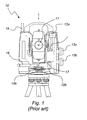
- Figure 1 shows a partially cut-out picture of a prior art total station 10.
- the total station is provided with usual devices and sub-components, such as a center unit 11 for performing distance measurements, servo motors 12a, 12b for aiming the instrument, manual knobs 13a, 13b for manual aiming of the instrument, means 14a, 14b for determining vertical and horizontal rotation angles of the instrument, an antenna 15 for radio communication, etc.
- the total station has an optical plummet 16, comprising an eyepiece extending from the housing and into a position at the center axis of the total station.
- deflecting means such as a mirror or a prism 17, which provides for a view downwards along the vertical rotational axis of the instrument.
- This optical plummet is during use of the instrument used for assisting positioning of the instrument's vertical rotational axis over a desired ground point. The operator typically looks into the eyepiece and physically positions the total station at the desired location guided by the view provided by the optical plummet.
- the eyepiece In order for this procedure to be effective, at least two tasks must be performed very accurately. Firstly, the eyepiece must be mounted, during assembly of the total station, such that the view provided coincides with the vertical rotational axis of the total station. In particular, the mirror or prism 17 that provides the downwards view must be positioned very accurately at the vertical axis of the instrument. Secondly, the operator must carefully position the total station 10 at the desired location. While manufacturing technology may allow for the eyepiece to be correctly positioned during the assembly of the instrument, it is still a time consuming and costly manufacturing step typically requiring manual fine tuning of the eyepiece position. Further, even when the eyepiece is correctly mounted in the total station, correct positioning of the instrument during use is entirely at the responsibility of the operator, and relies upon his or her skill to be accurate in handling the total station in the field.
- an image capturing device/sensor 22 such as a CCD, a CMOS sensor or the like.
- Such total station 20 is shown in figure 2 .
- the image capturing device need not be centered exactly at the instrument vertical axis. Rather, it suffices that the instrument vertical axis coincides with some portion of the image capturing device, such that the instrument nadir can be captured. As will be described in more detail below, image processing and a method according to the present invention may then be used for determining the instrument nadir.
- the following procedure may advantageously be followed during manufacture for calibrating the position of the image sensor 22 with respect to the instrument vertical rotational axis.
- the positional relationship between the sensor 22 and the moving parts of the instrument 20 will remain substantially constant, and a second calibration is normally not required.
- the instrument is delivered to the end user without being calibrated, and the end user may then follow this procedure at least once for making the calibration.
- the end user may also wish to recalibrate the instrument if, for example, the environmental conditions have changed considerably, or following a system reset or for any other reason.
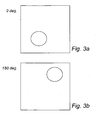
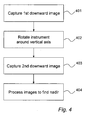
- a first image of the ground below the instrument is captured ( figure 4 , step 401) by the image capturing device 22. As illustrated in figure 3a , this first image is captured at a relative rotational position for the instrument of 0 degrees. As will be understood, this may be any rotational position which has been selected for the first image. Then, the instrument is rotated (step 402) to a new rotational position, in this example 180 degrees relative to the first rotational position, and a second image of the ground below the instrument is captured (step 403) as shown in figure 3b . It should be noted that the instrument has then been rotated about the vertical rotational axis thereof, and the task of determining instrument nadir relative to the captured images will be equivalent to determining the rotational center of the images captured.
- image processing within the instrument is used for calculating the merging distance required in order to make the captured images overlap.
- one of the two captured images in this example is mathematically rotated to correspond to the rotational position of the other image.
- the second image may be mathematically rotated from 180 degrees to 0 degrees, or the first image may be rotated from 0 degrees to 180 degrees. This mathematical rotation of the image is made relative to the image center (or reference) point (x 0 ,y 0 ).
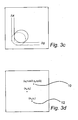
- the images will typically be displaced relative to each other, as illustrated in figure 3c , wherein the broken circle represents the mathematically rotated image.
- Image processing in the instrument determines the merging distance, illustrated in figure 3c as ⁇ x and ⁇ y.
- the eccentricity of the image capturing device i.e. the displacement of the image sensor center (x 0 ,y 0 ) relative to the true instrument center (the vertical rotational axis) is given by half the merging distance.
- the image center center pixel of the image sensor 22
- the vertical rotational axis instrument axis
- instrument nadir is located at (x 0 + ⁇ x/2,y 0 + ⁇ y/2). It will be appreciated that either or both of these coordinates may be negative or positive, depending on the eccentricity of the image capturing device.
- two images are captured at mutual rotational positions of 180 degrees. It will be understood, however, that other rotations are possible and that more than two images may be captured.
- the image processing capabilities of the instrument may be designed to handle suitable selections in this regard.
- the thus calculated instrument nadir may during use be displayed on a screen of the instrument to provide information to the operator.
- the operator has the option to physically position and reposition the instrument until a desired origin of coordinates for a subsequent measurement coincides with the calculated instrument nadir. More preferably, however, the operator is given the option to indicate the desired origin of coordinates on the screen of the instrument (or the origin may be identified automatically by image processing and subsequently verified by the operator). This may be accomplished, for example, by the use of a touch screen or by allowing an indicator or cursor to be moved across the screen. The operator may then indicate the desired origin of coordinates to be (x 1 ,y 1 ), as illustrated in figure 3d .
- Software in the instrument may then provide for the mathematical displacement from the instrument nadir at (x 0 + ⁇ x/2,y 0 + ⁇ y/2) to the desired origin of coordinates at (x 1 ,y 1 ), such that the subsequent measurements performed with the instrument are related to the desired origin at (x 1 ,y 1 ).
- the origin may be indicated by a larger marker, such as a circle, where the "true" origin is located at the center of mass of the marker.
- Embodiments of the present invention may also be designed and structured such that the instrument height above the ground can be determined using the image capturing device, as will now be described with reference to figures 5 and 6 .
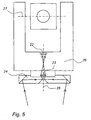
- Figure 5 shows schematically a surveying instrument 20 according to the present invention, having the capability of determining the instrument height above the ground below the instrument.
- means such as reflecting prisms 24 (as will be described below) for providing a stereoscopic view of the ground below the instrument.
- prisms or similar means
- the instrument comprises an image capturing device 22 (such as a CCD or a CMOS sensor, as described above), which may be used for capturing an image or a video feed of the ground below the instrument.
- a lens 23 is provided for forming an image of the ground onto the image sensor 22.
- the distance between the lens 23 and the image sensor 22 is preferably substantially equal to the focal length f of the lens 23.
- the image capturing device and the lens are generally positioned on the vertical rotational axis 25 of the instrument; however, accurate positioning of these elements on the vertical rotational axis is not required, since calibration as described above is preferably performed in order to determine image center with respect to instrument center, i.e. center pixel of sensor 22 with respect to the vertical rotation axis 25.
- Reflecting elements in the form of a pair of rhomboid prisms 24 are mounted adjacent the lens, in order to provide a displacement of the image rays from the ground below the instrument.
- the displacement is a parallel displacement (thus not affecting the angle of incidence towards the lens).
- the alidade 26 of the instrument is controlled to rotate about the vertical rotation axis 25 in order to point the instrument in a desired horizontal direction.
- the center unit may also be controlled to rotate about a horizontal rotation axis 27 in order to point the instrument in a desired vertical direction.
- the prisms 24 effecting the parallel displacement of the rays towards the sensor 22 need not rotate with the alidade 26, but may be fixed under the instrument.
- Figure 6 may be useful for understanding how the instrument height may be determined. It should be noted that figure 6 is not drawn to scale, but angles and dimensions are exaggerated for illustrative purposes.
- the image capturing device 22 has a certain field of view on the ground below the instrument (the size of which depends on the optical system).
- the two rhomboid prisms 24 effect a parallel displacement of a respective image within the field of view towards the instrument vertical axis 25 by total internal reflection at the outer edges thereof. After passage through the prisms, the respective image is again reflected by total internal reflection towards the lens 23.
- the rhomboid prisms 24 cause a parallel displacement of the respective images, such that they both enter the lens and are focused towards the image sensor. As illustrated, a single feature within the field of view will cause two separate indications on the image sensor, separated by a distance s .
- means 28 for capturing one of the images at the time For example, there may be provided color filters, which allow the sensor to read out one image separate from the other, where one image may be captured in the green and the other image in the red. Alternatively, mechanical, electromechanical or electronic shutters or the like may be provided, such that only one of the two displaced images at the time reaches the image sensor.
- the height of the prisms above the ground is designated by h . This is the height that is to be determined. Once the height h has been determined, it is a straightforward task to find the height of any other portion of the instrument by adding or subtracting appropriate structural dimensions of the instrument, as will be understood. Under the assumption that the prisms, the lens and the image capturing device are all firmly mounted in the instrument, the height h can be related to the displacement s between the images formed on the image sensor.
- nadir point i.e. at a point where the extension of the vertical axis 25 of the instrument intersects the ground.
- the accuracy in the height determination is a few millimeters or better, depending on the resolution of the image capturing device.
- h 1.5 m
- x 0.04 m
- f 0.04 m
- ⁇ s 1.0 ⁇ m
- the accuracy in the height measurement according to this principle becomes
- the accuracy will be within about 1 mm or better.
- a geodetic instrument wherein an image sensor is used for locating the instrument above a desired point on the ground.
- the positioning of the image sensor with respect to the instrument vertical rotation axis is determined, or calibrated, using a method where two images are captured at different horizontal rotational positions for the instrument, and where the center pixel of the image sensor is related to the vertical rotation axis by means of image processing. It is also disclosed how reflecting elements, such as prisms, may be used for providing stereoscopic vision that can be used for determining the instrument height above the ground.
Landscapes
- Engineering & Computer Science (AREA)
- Physics & Mathematics (AREA)
- General Physics & Mathematics (AREA)
- Radar, Positioning & Navigation (AREA)
- Remote Sensing (AREA)
- Multimedia (AREA)
- Length Measuring Devices By Optical Means (AREA)
- Studio Devices (AREA)
- Measurement Of Optical Distance (AREA)
Claims (17)
- Verfahren zum Betreiben eines geodätischen Instruments (20) mit einem Bildsensor (22) zum Aufnehmen eines Bildes des Bodens unter dem Instrument, umfassend folgende Schritte:Aufnehmen eines ersten Bildes (401) unter Verwendung des Bildsensors;Drehen des Instruments um seine senkrechte Achse (402) in eine neue Drehposition;Aufnehmen eines zweiten Bildes (403) unter Verwendung des Bildsensors; undVerarbeiten der aufgenommenen Bilder (404), um einen Fußpunkt für die senkrechte Drehachse des Instruments mit Bezug auf den Bildsensor zu korrelieren.
- Verfahren nach Anspruch 1, wobei das erste und das zweite Bild an Drehpositionen aufgenommen werden, die im Wesentlichen um 180 Grad im Verhältnis zueinander liegen.
- Verfahren nach Anspruch 1 oder 2, ferner umfassend den Schritt des Anzeigens eines Bildes des Bodens unter dem Instrument auf einem Bildschirm des Instruments und des Angebens des Fußpunktes in dem Bild auf dem Bildschirm.
- Verfahren nach einem der Ansprüche 1 bis 3, ferner umfassend den Schritt des Erfassens eines erwünschten Koordinatenursprungs und des Verknüpfens des erwünschten Koordinatenursprungs mit dem Fußpunkt des Instruments, wobei diese Verknüpfung des Ursprungs mit dem Fußpunkt des Instruments bei nachfolgenden geodätischen Messungen verwendet wird, die von dem Instrument ausgeführt werden, um die Instrumentenmessungen mit dem gewünschten Koordinatenursprung zu verknüpfen.
- Verfahren nach Anspruch 4, wobei der erwünschte Koordinatenursprung aus einer Angabe erfasst wird, die in einem der aufgenommenen Bilder erfolgt.
- Verfahren zum Bestimmen einer Höhe über dem Boden für ein geodätisches Instrument, das einen Bildsensor (22), Linsenmittel (23) zum Formen eines Bildes auf dem Bildsensor und Mittel (24) zum Ausführen einer Parallelverschiebung eines Strahls, der auf den Bildsensor trifft, umfasst, umfassend folgende Schritte:Aufnehmen eines ersten Bildes des Bodens unter Verwendung einer Parallelverschiebung des Strahls;Aufnehmen eines zweiten Bildes des Bodens;Bestimmen einer Trennung zwischen dem ersten und dem zweiten Bild auf dem Bildsensor; undBerechnen der Höhe basierend auf dem Betrag der Parallelverschiebung, der Trennung und der Fokaldistanz der Linsenmittel.
- Verfahren nach Anspruch 6, wobei das zweite Bild unter Verwendung einer Parallelverschiebung gleicher Größenordnung aufgenommen wird wie diejenige, die zum Aufnehmen des ersten Bildes verwendet wird, jedoch in einer anderen Richtung.
- Geodätisches Instrument (20), umfassend:eine Basis;eine Alhidade, die drehbar auf der Basis montiert ist;einen Bildsensor (22), der strukturiert und eingerichtet ist, um ein Bild aufzunehmen, wobei der Bildsensor in einem festen Verhältnis zu der Alhidade positioniert ist und ausgerichtet ist, um ein Bild des Bodens unter dem Instrument aufzunehmen; undeinen Bildprozessor, der dazu geeignet ist, um mindestens zwei Bilder zu verarbeiten, die in verschiedenen Drehwinkeln der Alhidade aufgenommen werden, um den Fußpunkt des Instruments mit dem Bildsensor zu verknüpfen.
- Instrument nach Anspruch 8, ferner umfassend eine Eingabevorrichtung zum Empfangen eines Koordinatenursprungs, der mit dem aufgenommenen Bild verknüpft ist, und Mittel zum Bestimmen der Verschiebung zwischen dem Fußpunkt des Instruments und dem Koordinatenursprung.
- Geodätisches Instrument, umfassend einen Bildsensor (22), Linsenmittel (23) zum Formen eines Bildes auf dem Bildsensor und Mittel (24) zum Ausführen einer Parallelverschiebung eines Strahls, der auf den Bildsensor trifft, und ferner umfassend:Mittel (28) zum Bereitstellen auf dem Bildsensor eines ersten Bildes des Bodens unter dem Instrument unter Verwendung einer Parallelverschiebung des Strahls;Mittel (28) zum Bereitstellen auf dem Bildsensor eines zweiten Bildes des Bodens unter dem Instrument;Mittel zum Bestimmen einer Trennung zwischen dem ersten und dem zweiten Bild, die auf dem Bildsensor bereitgestellt werden; undMittel zum Berechnen der Instrumentenhöhe (h) über dem Boden, basierend auf dem Betrag der Parallelverschiebung (s), der Trennung und der Fokaldistanz (f) der Linsenmittel.
- Instrument nach Anspruch 10, wobei die Mittel zum Bereitstellen des zweiten Bildes (28) eine Parallelverschiebung gleicher Größenordnung verwenden wie diejenige, die zum Aufnehmen des ersten Bildes verwendet wird, jedoch in einer anderen Richtung.
- Instrument nach Anspruch 10 oder 11, wobei der Abstand zwischen den Linsenmitteln und dem Bildsensor im Wesentlichen gleich dem Fokalabstand (f) der Linsenmittel ist.
- Instrument nach einem der Ansprüche 10 bis 12, umfassend ein reflektierendes Prisma (24) zum Ausführen der Parallelverschiebung.
- Instrument nach einem der Ansprüche 10 bis 13, ferner umfassend mindestens ein Filter zum Trennen der ersten und zweiten Bilder.
- Instrument nach einem der Ansprüche 10 bis 13, ferner umfassend mindestens eine Blende zum Trennen der ersten und zweiten Bilder.
- Computer-Software, die auf einem computerlesbaren Medium gespeichert ist, wobei die Software Anweisungen für einen Prozessor in einem geodätischen Instrument enthält, um das Verfahren nach einem der Ansprüche 1 bis 5 auszuführen, wenn sie ausgeführt wird.
- Computer-Software, die auf einem computerlesbaren Medium gespeichert ist, wobei die Software Anweisungen für einen Prozessor in einem geodätischen Instrument enthält, um das Verfahren nach einem der Ansprüche 6 bis 7 auszuführen, wenn sie ausgeführt wird.
Applications Claiming Priority (1)
| Application Number | Priority Date | Filing Date | Title |
|---|---|---|---|
| PCT/EP2006/012535 WO2008077432A1 (en) | 2006-12-27 | 2006-12-27 | Geodetic instrument and related method |
Publications (2)
| Publication Number | Publication Date |
|---|---|
| EP2097716A1 EP2097716A1 (de) | 2009-09-09 |
| EP2097716B1 true EP2097716B1 (de) | 2013-07-31 |
Family
ID=38255852
Family Applications (1)
| Application Number | Title | Priority Date | Filing Date |
|---|---|---|---|
| EP06829874.4A Active EP2097716B1 (de) | 2006-12-27 | 2006-12-27 | Vermessungsinstrument und vermessungsverfahren |
Country Status (4)
| Country | Link |
|---|---|
| US (1) | US7908752B2 (de) |
| EP (1) | EP2097716B1 (de) |
| CN (1) | CN101568800B (de) |
| WO (1) | WO2008077432A1 (de) |
Families Citing this family (11)
| Publication number | Priority date | Publication date | Assignee | Title |
|---|---|---|---|---|
| EP2106533B1 (de) * | 2007-01-25 | 2011-03-09 | Trimble AB | Ausrichten eines geodetischen instruments |
| CN101970985B (zh) | 2008-02-29 | 2013-06-12 | 特林布尔公司 | 确定觇标相对于带有至少两台相机的测量仪的坐标 |
| US8897482B2 (en) * | 2008-02-29 | 2014-11-25 | Trimble Ab | Stereo photogrammetry from a single station using a surveying instrument with an eccentric camera |
| DE112011103632T5 (de) * | 2010-10-25 | 2013-08-01 | Faro Technologies, Inc. | Automatisiertes Warmlaufen sowie Stabilitätsprüfung für Lasernachführungsgeräte |
| CN102261905B (zh) * | 2011-04-25 | 2012-11-07 | 西安北方光电有限公司 | 基于光学望远成像系统的ccd中心及焦平面调整方法 |
| US10531187B2 (en) * | 2016-12-21 | 2020-01-07 | Nortek Security & Control Llc | Systems and methods for audio detection using audio beams |
| EP3640677B1 (de) | 2018-10-17 | 2023-08-02 | Trimble Jena GmbH | Verfolger einer vermessungsvorrichtung zur verfolgung eines ziels |
| EP3640590B1 (de) | 2018-10-17 | 2021-12-01 | Trimble Jena GmbH | Vermessungsvorrichtung zur vermessung eines objekts |
| EP4553538A3 (de) * | 2019-02-15 | 2025-08-13 | Trimble Inc. | Vermessungsinstrument und verfahren zur kalibrierung eines vermessungsinstruments |
| USD937105S1 (en) * | 2019-03-21 | 2021-11-30 | Trimble Jena Gmbh | Geodetic apparatus |
| US11257234B2 (en) * | 2019-05-24 | 2022-02-22 | Nanjing Polagis Technology Co. Ltd | Method for three-dimensional measurement and calculation of the geographic position and height of a target object based on street view images |
Family Cites Families (9)
| Publication number | Priority date | Publication date | Assignee | Title |
|---|---|---|---|---|
| CN2300883Y (zh) * | 1997-03-28 | 1998-12-16 | 李兵 | 可记录和显示目标影像的全站仪的照准装置 |
| DE19716304C1 (de) * | 1997-04-18 | 1998-05-20 | Zeiss Carl Jena Gmbh | Geodätisches Gerät |
| JP3965593B2 (ja) | 1998-07-08 | 2007-08-29 | 株式会社トプコン | 測量機の求心位置測定装置及び測量機 |
| DE19941638C1 (de) * | 1999-08-27 | 2000-12-14 | Zeiss Carl Jena Gmbh | Geodätisches Gerät mit Laseranordnung |
| EP1515152A1 (de) * | 2003-09-12 | 2005-03-16 | Leica Geosystems AG | Verfahren zur Richtungsbestimmung zu einem zu vermessenden Objekt |
| JP4424665B2 (ja) * | 2004-07-30 | 2010-03-03 | 株式会社 ソキア・トプコン | 測量機 |
| ATE465428T1 (de) * | 2006-10-06 | 2010-05-15 | Leica Geosystems Ag | Zielobjekt zur retroreflexion einer optischen strahlung |
| EP1990607A1 (de) * | 2007-05-10 | 2008-11-12 | Leica Geosystems AG | Positionsbestimmungsverfahren für ein geodätisches Vermessungsgerät |
| US7841094B2 (en) * | 2009-01-27 | 2010-11-30 | Trimble Kaiserslautern Gmbh | Optical instrument with angle indicator and method for operating the same |
-
2006
- 2006-12-27 EP EP06829874.4A patent/EP2097716B1/de active Active
- 2006-12-27 CN CN2006800568047A patent/CN101568800B/zh active Active
- 2006-12-27 US US12/448,604 patent/US7908752B2/en active Active
- 2006-12-27 WO PCT/EP2006/012535 patent/WO2008077432A1/en not_active Ceased
Also Published As
| Publication number | Publication date |
|---|---|
| US20100037474A1 (en) | 2010-02-18 |
| CN101568800B (zh) | 2011-08-17 |
| US7908752B2 (en) | 2011-03-22 |
| CN101568800A (zh) | 2009-10-28 |
| EP2097716A1 (de) | 2009-09-09 |
| WO2008077432A1 (en) | 2008-07-03 |
Similar Documents
| Publication | Publication Date | Title |
|---|---|---|
| EP2247921B1 (de) | Bestimmung von koordinaten eines ziels in bezug auf vermessungsinstrumente mit einer kamera | |
| US7930835B2 (en) | Aiming of a geodetic instrument | |
| CN101663561B (zh) | 多点测量方法及测量装置 | |
| US8629905B2 (en) | Localization of a surveying instrument in relation to a ground mark | |
| CN103547939B (zh) | 用于具有扫描功能的装置的校准方法 | |
| EP2240740B1 (de) | Lokalisierung eines vermessungsinstruments in bezug auf eine bodenmarkierung | |
| US9322652B2 (en) | Stereo photogrammetry from a single station using a surveying instrument with an eccentric camera | |
| EP2247922B1 (de) | Bestimmung von koordinaten eines ziels in bezug auf ein vermessungsinstrument mit mindestens zwei kameras | |
| CN1727845B (zh) | 测量仪 | |
| Walser | Development and calibration of an image assisted total station | |
| US20030160757A1 (en) | Surveying system | |
| JP2002202127A (ja) | 光電式レーザ測距装置 | |
| CN102985787A (zh) | 具有自动高精度觇标点照准功能的大地测量装置 | |
| US7908752B2 (en) | Geodetic instrument and related method | |
| CN110274581B (zh) | 全站仪、确定全站仪的仪器误差的方法和机器可读介质 | |
| EP2607846B1 (de) | Vermessungsgerät | |
| EP2240741B1 (de) | Lokalisierung eines vermessungsinstruments in bezug auf eine bodenmarkierung |
Legal Events
| Date | Code | Title | Description |
|---|---|---|---|
| PUAI | Public reference made under article 153(3) epc to a published international application that has entered the european phase |
Free format text: ORIGINAL CODE: 0009012 |
|
| 17P | Request for examination filed |
Effective date: 20090611 |
|
| AK | Designated contracting states |
Kind code of ref document: A1 Designated state(s): AT BE BG CH CY CZ DE DK EE ES FI FR GB GR HU IE IS IT LI LT LU LV MC NL PL PT RO SE SI SK TR |
|
| DAX | Request for extension of the european patent (deleted) | ||
| GRAP | Despatch of communication of intention to grant a patent |
Free format text: ORIGINAL CODE: EPIDOSNIGR1 |
|
| RIN1 | Information on inventor provided before grant (corrected) |
Inventor name: WESTERMARK, MAGNUS Inventor name: SVANHOLM, SET Inventor name: HERTZMAN, MIKAEL |
|
| GRAS | Grant fee paid |
Free format text: ORIGINAL CODE: EPIDOSNIGR3 |
|
| GRAA | (expected) grant |
Free format text: ORIGINAL CODE: 0009210 |
|
| AK | Designated contracting states |
Kind code of ref document: B1 Designated state(s): AT BE BG CH CY CZ DE DK EE ES FI FR GB GR HU IE IS IT LI LT LU LV MC NL PL PT RO SE SI SK TR |
|
| REG | Reference to a national code |
Ref country code: GB Ref legal event code: FG4D Ref country code: CH Ref legal event code: EP |
|
| REG | Reference to a national code |
Ref country code: AT Ref legal event code: REF Ref document number: 624900 Country of ref document: AT Kind code of ref document: T Effective date: 20130815 |
|
| REG | Reference to a national code |
Ref country code: IE Ref legal event code: FG4D |
|
| REG | Reference to a national code |
Ref country code: DE Ref legal event code: R096 Ref document number: 602006037678 Country of ref document: DE Effective date: 20130926 |
|
| REG | Reference to a national code |
Ref country code: AT Ref legal event code: MK05 Ref document number: 624900 Country of ref document: AT Kind code of ref document: T Effective date: 20130731 |
|
| REG | Reference to a national code |
Ref country code: NL Ref legal event code: VDEP Effective date: 20130731 |
|
| REG | Reference to a national code |
Ref country code: LT Ref legal event code: MG4D |
|
| PG25 | Lapsed in a contracting state [announced via postgrant information from national office to epo] |
Ref country code: AT Free format text: LAPSE BECAUSE OF FAILURE TO SUBMIT A TRANSLATION OF THE DESCRIPTION OR TO PAY THE FEE WITHIN THE PRESCRIBED TIME-LIMIT Effective date: 20130731 Ref country code: CY Free format text: LAPSE BECAUSE OF FAILURE TO SUBMIT A TRANSLATION OF THE DESCRIPTION OR TO PAY THE FEE WITHIN THE PRESCRIBED TIME-LIMIT Effective date: 20130807 Ref country code: BE Free format text: LAPSE BECAUSE OF FAILURE TO SUBMIT A TRANSLATION OF THE DESCRIPTION OR TO PAY THE FEE WITHIN THE PRESCRIBED TIME-LIMIT Effective date: 20130731 Ref country code: PT Free format text: LAPSE BECAUSE OF FAILURE TO SUBMIT A TRANSLATION OF THE DESCRIPTION OR TO PAY THE FEE WITHIN THE PRESCRIBED TIME-LIMIT Effective date: 20131202 Ref country code: LT Free format text: LAPSE BECAUSE OF FAILURE TO SUBMIT A TRANSLATION OF THE DESCRIPTION OR TO PAY THE FEE WITHIN THE PRESCRIBED TIME-LIMIT Effective date: 20130731 Ref country code: SE Free format text: LAPSE BECAUSE OF FAILURE TO SUBMIT A TRANSLATION OF THE DESCRIPTION OR TO PAY THE FEE WITHIN THE PRESCRIBED TIME-LIMIT Effective date: 20130731 Ref country code: IS Free format text: LAPSE BECAUSE OF FAILURE TO SUBMIT A TRANSLATION OF THE DESCRIPTION OR TO PAY THE FEE WITHIN THE PRESCRIBED TIME-LIMIT Effective date: 20131130 |
|
| PG25 | Lapsed in a contracting state [announced via postgrant information from national office to epo] |
Ref country code: SI Free format text: LAPSE BECAUSE OF FAILURE TO SUBMIT A TRANSLATION OF THE DESCRIPTION OR TO PAY THE FEE WITHIN THE PRESCRIBED TIME-LIMIT Effective date: 20130731 Ref country code: LV Free format text: LAPSE BECAUSE OF FAILURE TO SUBMIT A TRANSLATION OF THE DESCRIPTION OR TO PAY THE FEE WITHIN THE PRESCRIBED TIME-LIMIT Effective date: 20130731 Ref country code: FI Free format text: LAPSE BECAUSE OF FAILURE TO SUBMIT A TRANSLATION OF THE DESCRIPTION OR TO PAY THE FEE WITHIN THE PRESCRIBED TIME-LIMIT Effective date: 20130731 Ref country code: GR Free format text: LAPSE BECAUSE OF FAILURE TO SUBMIT A TRANSLATION OF THE DESCRIPTION OR TO PAY THE FEE WITHIN THE PRESCRIBED TIME-LIMIT Effective date: 20131101 Ref country code: NL Free format text: LAPSE BECAUSE OF FAILURE TO SUBMIT A TRANSLATION OF THE DESCRIPTION OR TO PAY THE FEE WITHIN THE PRESCRIBED TIME-LIMIT Effective date: 20130731 Ref country code: PL Free format text: LAPSE BECAUSE OF FAILURE TO SUBMIT A TRANSLATION OF THE DESCRIPTION OR TO PAY THE FEE WITHIN THE PRESCRIBED TIME-LIMIT Effective date: 20130731 |
|
| PG25 | Lapsed in a contracting state [announced via postgrant information from national office to epo] |
Ref country code: CY Free format text: LAPSE BECAUSE OF FAILURE TO SUBMIT A TRANSLATION OF THE DESCRIPTION OR TO PAY THE FEE WITHIN THE PRESCRIBED TIME-LIMIT Effective date: 20130731 |
|
| PG25 | Lapsed in a contracting state [announced via postgrant information from national office to epo] |
Ref country code: DK Free format text: LAPSE BECAUSE OF FAILURE TO SUBMIT A TRANSLATION OF THE DESCRIPTION OR TO PAY THE FEE WITHIN THE PRESCRIBED TIME-LIMIT Effective date: 20130731 Ref country code: SK Free format text: LAPSE BECAUSE OF FAILURE TO SUBMIT A TRANSLATION OF THE DESCRIPTION OR TO PAY THE FEE WITHIN THE PRESCRIBED TIME-LIMIT Effective date: 20130731 Ref country code: RO Free format text: LAPSE BECAUSE OF FAILURE TO SUBMIT A TRANSLATION OF THE DESCRIPTION OR TO PAY THE FEE WITHIN THE PRESCRIBED TIME-LIMIT Effective date: 20130731 Ref country code: CZ Free format text: LAPSE BECAUSE OF FAILURE TO SUBMIT A TRANSLATION OF THE DESCRIPTION OR TO PAY THE FEE WITHIN THE PRESCRIBED TIME-LIMIT Effective date: 20130731 Ref country code: EE Free format text: LAPSE BECAUSE OF FAILURE TO SUBMIT A TRANSLATION OF THE DESCRIPTION OR TO PAY THE FEE WITHIN THE PRESCRIBED TIME-LIMIT Effective date: 20130731 |
|
| PG25 | Lapsed in a contracting state [announced via postgrant information from national office to epo] |
Ref country code: IT Free format text: LAPSE BECAUSE OF FAILURE TO SUBMIT A TRANSLATION OF THE DESCRIPTION OR TO PAY THE FEE WITHIN THE PRESCRIBED TIME-LIMIT Effective date: 20130731 Ref country code: ES Free format text: LAPSE BECAUSE OF FAILURE TO SUBMIT A TRANSLATION OF THE DESCRIPTION OR TO PAY THE FEE WITHIN THE PRESCRIBED TIME-LIMIT Effective date: 20130731 |
|
| PLBE | No opposition filed within time limit |
Free format text: ORIGINAL CODE: 0009261 |
|
| STAA | Information on the status of an ep patent application or granted ep patent |
Free format text: STATUS: NO OPPOSITION FILED WITHIN TIME LIMIT |
|
| 26N | No opposition filed |
Effective date: 20140502 |
|
| REG | Reference to a national code |
Ref country code: CH Ref legal event code: PL |
|
| REG | Reference to a national code |
Ref country code: DE Ref legal event code: R097 Ref document number: 602006037678 Country of ref document: DE Effective date: 20140502 |
|
| GBPC | Gb: european patent ceased through non-payment of renewal fee |
Effective date: 20131227 |
|
| PG25 | Lapsed in a contracting state [announced via postgrant information from national office to epo] |
Ref country code: MC Free format text: LAPSE BECAUSE OF FAILURE TO SUBMIT A TRANSLATION OF THE DESCRIPTION OR TO PAY THE FEE WITHIN THE PRESCRIBED TIME-LIMIT Effective date: 20130731 Ref country code: LU Free format text: LAPSE BECAUSE OF FAILURE TO SUBMIT A TRANSLATION OF THE DESCRIPTION OR TO PAY THE FEE WITHIN THE PRESCRIBED TIME-LIMIT Effective date: 20131227 |
|
| REG | Reference to a national code |
Ref country code: IE Ref legal event code: MM4A |
|
| REG | Reference to a national code |
Ref country code: FR Ref legal event code: ST Effective date: 20140829 |
|
| PG25 | Lapsed in a contracting state [announced via postgrant information from national office to epo] |
Ref country code: CH Free format text: LAPSE BECAUSE OF NON-PAYMENT OF DUE FEES Effective date: 20131231 Ref country code: LI Free format text: LAPSE BECAUSE OF NON-PAYMENT OF DUE FEES Effective date: 20131231 Ref country code: IE Free format text: LAPSE BECAUSE OF NON-PAYMENT OF DUE FEES Effective date: 20131227 |
|
| PG25 | Lapsed in a contracting state [announced via postgrant information from national office to epo] |
Ref country code: GB Free format text: LAPSE BECAUSE OF NON-PAYMENT OF DUE FEES Effective date: 20131227 Ref country code: FR Free format text: LAPSE BECAUSE OF NON-PAYMENT OF DUE FEES Effective date: 20131231 |
|
| PG25 | Lapsed in a contracting state [announced via postgrant information from national office to epo] |
Ref country code: TR Free format text: LAPSE BECAUSE OF FAILURE TO SUBMIT A TRANSLATION OF THE DESCRIPTION OR TO PAY THE FEE WITHIN THE PRESCRIBED TIME-LIMIT Effective date: 20130731 |
|
| PG25 | Lapsed in a contracting state [announced via postgrant information from national office to epo] |
Ref country code: BG Free format text: LAPSE BECAUSE OF FAILURE TO SUBMIT A TRANSLATION OF THE DESCRIPTION OR TO PAY THE FEE WITHIN THE PRESCRIBED TIME-LIMIT Effective date: 20130731 Ref country code: HU Free format text: LAPSE BECAUSE OF FAILURE TO SUBMIT A TRANSLATION OF THE DESCRIPTION OR TO PAY THE FEE WITHIN THE PRESCRIBED TIME-LIMIT; INVALID AB INITIO Effective date: 20061227 |
|
| PGFP | Annual fee paid to national office [announced via postgrant information from national office to epo] |
Ref country code: DE Payment date: 20251229 Year of fee payment: 20 |