EP2101876B1 - Dispositif de traitement de problèmes cutanés - Google Patents
Dispositif de traitement de problèmes cutanés Download PDFInfo
- Publication number
- EP2101876B1 EP2101876B1 EP07865047A EP07865047A EP2101876B1 EP 2101876 B1 EP2101876 B1 EP 2101876B1 EP 07865047 A EP07865047 A EP 07865047A EP 07865047 A EP07865047 A EP 07865047A EP 2101876 B1 EP2101876 B1 EP 2101876B1
- Authority
- EP
- European Patent Office
- Prior art keywords
- skin
- ultrasound
- piezoelectric
- user
- treatment
- Prior art date
- Legal status (The legal status is an assumption and is not a legal conclusion. Google has not performed a legal analysis and makes no representation as to the accuracy of the status listed.)
- Not-in-force
Links
- 238000011282 treatment Methods 0.000 title claims description 54
- 238000002604 ultrasonography Methods 0.000 claims description 113
- 239000012530 fluid Substances 0.000 claims description 11
- 239000007788 liquid Substances 0.000 claims description 6
- RYGMFSIKBFXOCR-UHFFFAOYSA-N Copper Chemical compound [Cu] RYGMFSIKBFXOCR-UHFFFAOYSA-N 0.000 claims description 5
- 229910052802 copper Inorganic materials 0.000 claims description 5
- 239000010949 copper Substances 0.000 claims description 5
- 229910052782 aluminium Inorganic materials 0.000 claims description 4
- XAGFODPZIPBFFR-UHFFFAOYSA-N aluminium Chemical compound [Al] XAGFODPZIPBFFR-UHFFFAOYSA-N 0.000 claims description 4
- 229910052751 metal Inorganic materials 0.000 claims description 4
- 239000002184 metal Substances 0.000 claims description 4
- 238000005476 soldering Methods 0.000 claims description 3
- 238000003466 welding Methods 0.000 claims description 3
- 229910001369 Brass Inorganic materials 0.000 claims description 2
- 239000010951 brass Substances 0.000 claims description 2
- 238000004891 communication Methods 0.000 claims description 2
- 210000003491 skin Anatomy 0.000 description 132
- 239000010410 layer Substances 0.000 description 65
- 206010000496 acne Diseases 0.000 description 29
- 238000000034 method Methods 0.000 description 28
- 208000002874 Acne Vulgaris Diseases 0.000 description 25
- 210000001519 tissue Anatomy 0.000 description 21
- 230000003902 lesion Effects 0.000 description 15
- 206010040882 skin lesion Diseases 0.000 description 15
- 231100000444 skin lesion Toxicity 0.000 description 15
- 239000011148 porous material Substances 0.000 description 14
- 208000002474 Tinea Diseases 0.000 description 10
- 238000013461 design Methods 0.000 description 10
- 230000002538 fungal effect Effects 0.000 description 10
- 238000010438 heat treatment Methods 0.000 description 10
- 241000894007 species Species 0.000 description 10
- 239000000499 gel Substances 0.000 description 9
- 239000003795 chemical substances by application Substances 0.000 description 8
- 230000006378 damage Effects 0.000 description 8
- 239000002085 irritant Substances 0.000 description 8
- 231100000021 irritant Toxicity 0.000 description 8
- 238000001816 cooling Methods 0.000 description 7
- 210000004207 dermis Anatomy 0.000 description 7
- 239000003814 drug Substances 0.000 description 7
- 239000003860 topical agent Substances 0.000 description 7
- 206010017533 Fungal infection Diseases 0.000 description 6
- 208000031888 Mycoses Diseases 0.000 description 6
- 206010067152 Oral herpes Diseases 0.000 description 6
- 241000223238 Trichophyton Species 0.000 description 6
- 230000001225 therapeutic effect Effects 0.000 description 6
- 241000894006 Bacteria Species 0.000 description 5
- OMPJBNCRMGITSC-UHFFFAOYSA-N Benzoylperoxide Chemical compound C=1C=CC=CC=1C(=O)OOC(=O)C1=CC=CC=C1 OMPJBNCRMGITSC-UHFFFAOYSA-N 0.000 description 5
- 241001480035 Epidermophyton Species 0.000 description 5
- 230000005540 biological transmission Effects 0.000 description 5
- 230000008878 coupling Effects 0.000 description 5
- 238000010168 coupling process Methods 0.000 description 5
- 238000005859 coupling reaction Methods 0.000 description 5
- 239000006071 cream Substances 0.000 description 5
- 229940079593 drug Drugs 0.000 description 5
- 210000002615 epidermis Anatomy 0.000 description 5
- 230000008569 process Effects 0.000 description 5
- 230000003716 rejuvenation Effects 0.000 description 5
- 238000009210 therapy by ultrasound Methods 0.000 description 5
- 201000004647 tinea pedis Diseases 0.000 description 5
- 230000000699 topical effect Effects 0.000 description 5
- 230000037303 wrinkles Effects 0.000 description 5
- 208000004898 Herpes Labialis Diseases 0.000 description 4
- 208000010195 Onychomycosis Diseases 0.000 description 4
- 201000010618 Tinea cruris Diseases 0.000 description 4
- 241000893966 Trichophyton verrucosum Species 0.000 description 4
- 208000027418 Wounds and injury Diseases 0.000 description 4
- 230000001580 bacterial effect Effects 0.000 description 4
- 230000008901 benefit Effects 0.000 description 4
- 230000006870 function Effects 0.000 description 4
- 210000003780 hair follicle Anatomy 0.000 description 4
- 208000015181 infectious disease Diseases 0.000 description 4
- 208000014674 injury Diseases 0.000 description 4
- 229910052451 lead zirconate titanate Inorganic materials 0.000 description 4
- 201000005882 tinea unguium Diseases 0.000 description 4
- 239000004342 Benzoyl peroxide Substances 0.000 description 3
- 241001480037 Microsporum Species 0.000 description 3
- 239000002033 PVDF binder Substances 0.000 description 3
- 241000223229 Trichophyton rubrum Species 0.000 description 3
- 208000036142 Viral infection Diseases 0.000 description 3
- 235000019400 benzoyl peroxide Nutrition 0.000 description 3
- 208000037265 diseases, disorders, signs and symptoms Diseases 0.000 description 3
- 208000035475 disorder Diseases 0.000 description 3
- 230000008029 eradication Effects 0.000 description 3
- 210000004013 groin Anatomy 0.000 description 3
- 230000003779 hair growth Effects 0.000 description 3
- 230000035876 healing Effects 0.000 description 3
- 229920002981 polyvinylidene fluoride Polymers 0.000 description 3
- 238000003825 pressing Methods 0.000 description 3
- 230000009385 viral infection Effects 0.000 description 3
- XLYOFNOQVPJJNP-UHFFFAOYSA-N water Substances O XLYOFNOQVPJJNP-UHFFFAOYSA-N 0.000 description 3
- 241001480043 Arthrodermataceae Species 0.000 description 2
- 206010003399 Arthropod bite Diseases 0.000 description 2
- 208000035143 Bacterial infection Diseases 0.000 description 2
- 206010005913 Body tinea Diseases 0.000 description 2
- 241000222122 Candida albicans Species 0.000 description 2
- 102000008186 Collagen Human genes 0.000 description 2
- 108010035532 Collagen Proteins 0.000 description 2
- 241000186427 Cutibacterium acnes Species 0.000 description 2
- 206010012504 Dermatophytosis Diseases 0.000 description 2
- 241000196324 Embryophyta Species 0.000 description 2
- 239000004593 Epoxy Substances 0.000 description 2
- ULGZDMOVFRHVEP-RWJQBGPGSA-N Erythromycin Chemical compound O([C@@H]1[C@@H](C)C(=O)O[C@@H]([C@@]([C@H](O)[C@@H](C)C(=O)[C@H](C)C[C@@](C)(O)[C@H](O[C@H]2[C@@H]([C@H](C[C@@H](C)O2)N(C)C)O)[C@H]1C)(C)O)CC)[C@H]1C[C@@](C)(OC)[C@@H](O)[C@H](C)O1 ULGZDMOVFRHVEP-RWJQBGPGSA-N 0.000 description 2
- 206010017543 Fungal skin infection Diseases 0.000 description 2
- 241000233866 Fungi Species 0.000 description 2
- 241000893980 Microsporum canis Species 0.000 description 2
- 241001460074 Microsporum distortum Species 0.000 description 2
- PXHVJJICTQNCMI-UHFFFAOYSA-N Nickel Chemical compound [Ni] PXHVJJICTQNCMI-UHFFFAOYSA-N 0.000 description 2
- 208000003251 Pruritus Diseases 0.000 description 2
- 241000191940 Staphylococcus Species 0.000 description 2
- 241000194017 Streptococcus Species 0.000 description 2
- 241000130764 Tinea Species 0.000 description 2
- 241001045770 Trichophyton mentagrophytes Species 0.000 description 2
- 238000005299 abrasion Methods 0.000 description 2
- 206010000269 abscess Diseases 0.000 description 2
- 238000010521 absorption reaction Methods 0.000 description 2
- 230000003213 activating effect Effects 0.000 description 2
- 230000004913 activation Effects 0.000 description 2
- 208000022362 bacterial infectious disease Diseases 0.000 description 2
- 230000015572 biosynthetic process Effects 0.000 description 2
- 230000004397 blinking Effects 0.000 description 2
- 229940095731 candida albicans Drugs 0.000 description 2
- 229920001436 collagen Polymers 0.000 description 2
- 230000037319 collagen production Effects 0.000 description 2
- 238000000151 deposition Methods 0.000 description 2
- 230000000881 depressing effect Effects 0.000 description 2
- 230000000994 depressogenic effect Effects 0.000 description 2
- 230000037304 dermatophytes Effects 0.000 description 2
- 238000011161 development Methods 0.000 description 2
- 230000018109 developmental process Effects 0.000 description 2
- 238000010586 diagram Methods 0.000 description 2
- 230000009977 dual effect Effects 0.000 description 2
- 230000000694 effects Effects 0.000 description 2
- 230000002708 enhancing effect Effects 0.000 description 2
- 210000004905 finger nail Anatomy 0.000 description 2
- PCHJSUWPFVWCPO-UHFFFAOYSA-N gold Chemical compound [Au] PCHJSUWPFVWCPO-UHFFFAOYSA-N 0.000 description 2
- 229910052737 gold Inorganic materials 0.000 description 2
- 239000010931 gold Substances 0.000 description 2
- 210000003128 head Anatomy 0.000 description 2
- 230000028993 immune response Effects 0.000 description 2
- 230000002427 irreversible effect Effects 0.000 description 2
- 238000013532 laser treatment Methods 0.000 description 2
- HFGPZNIAWCZYJU-UHFFFAOYSA-N lead zirconate titanate Chemical compound [O-2].[O-2].[O-2].[O-2].[O-2].[Ti+4].[Zr+4].[Pb+2] HFGPZNIAWCZYJU-UHFFFAOYSA-N 0.000 description 2
- 239000006210 lotion Substances 0.000 description 2
- 239000000463 material Substances 0.000 description 2
- 230000010534 mechanism of action Effects 0.000 description 2
- 239000012528 membrane Substances 0.000 description 2
- 230000035515 penetration Effects 0.000 description 2
- 229940055019 propionibacterium acne Drugs 0.000 description 2
- 230000005855 radiation Effects 0.000 description 2
- 206010037844 rash Diseases 0.000 description 2
- 231100000075 skin burn Toxicity 0.000 description 2
- 230000005236 sound signal Effects 0.000 description 2
- 239000000126 substance Substances 0.000 description 2
- 208000024891 symptom Diseases 0.000 description 2
- BWMISRWJRUSYEX-SZKNIZGXSA-N terbinafine hydrochloride Chemical compound Cl.C1=CC=C2C(CN(C\C=C\C#CC(C)(C)C)C)=CC=CC2=C1 BWMISRWJRUSYEX-SZKNIZGXSA-N 0.000 description 2
- 201000003875 tinea corporis Diseases 0.000 description 2
- 210000004906 toe nail Anatomy 0.000 description 2
- 229940042129 topical gel Drugs 0.000 description 2
- SGKRLCUYIXIAHR-AKNGSSGZSA-N (4s,4ar,5s,5ar,6r,12ar)-4-(dimethylamino)-1,5,10,11,12a-pentahydroxy-6-methyl-3,12-dioxo-4a,5,5a,6-tetrahydro-4h-tetracene-2-carboxamide Chemical compound C1=CC=C2[C@H](C)[C@@H]([C@H](O)[C@@H]3[C@](C(O)=C(C(N)=O)C(=O)[C@H]3N(C)C)(O)C3=O)C3=C(O)C2=C1O SGKRLCUYIXIAHR-AKNGSSGZSA-N 0.000 description 1
- FFTVPQUHLQBXQZ-KVUCHLLUSA-N (4s,4as,5ar,12ar)-4,7-bis(dimethylamino)-1,10,11,12a-tetrahydroxy-3,12-dioxo-4a,5,5a,6-tetrahydro-4h-tetracene-2-carboxamide Chemical compound C1C2=C(N(C)C)C=CC(O)=C2C(O)=C2[C@@H]1C[C@H]1[C@H](N(C)C)C(=O)C(C(N)=O)=C(O)[C@@]1(O)C2=O FFTVPQUHLQBXQZ-KVUCHLLUSA-N 0.000 description 1
- 206010063409 Acarodermatitis Diseases 0.000 description 1
- 201000006082 Chickenpox Diseases 0.000 description 1
- 241000723368 Conium Species 0.000 description 1
- 241000255925 Diptera Species 0.000 description 1
- 241001635598 Enicostema Species 0.000 description 1
- 208000001688 Herpes Genitalis Diseases 0.000 description 1
- 208000009889 Herpes Simplex Diseases 0.000 description 1
- 208000007514 Herpes zoster Diseases 0.000 description 1
- 208000006877 Insect Bites and Stings Diseases 0.000 description 1
- 241001465754 Metazoa Species 0.000 description 1
- 206010027626 Milia Diseases 0.000 description 1
- 206010054107 Nodule Diseases 0.000 description 1
- 206010033733 Papule Diseases 0.000 description 1
- 206010037888 Rash pustular Diseases 0.000 description 1
- 241000447727 Scabies Species 0.000 description 1
- 241000242583 Scyphozoa Species 0.000 description 1
- 241000270295 Serpentes Species 0.000 description 1
- BQCADISMDOOEFD-UHFFFAOYSA-N Silver Chemical compound [Ag] BQCADISMDOOEFD-UHFFFAOYSA-N 0.000 description 1
- 241000700584 Simplexvirus Species 0.000 description 1
- 208000003589 Spider Bites Diseases 0.000 description 1
- 239000004098 Tetracycline Substances 0.000 description 1
- 206010043866 Tinea capitis Diseases 0.000 description 1
- 241000159241 Toxicodendron Species 0.000 description 1
- 241000159243 Toxicodendron radicans Species 0.000 description 1
- 241000871311 Toxicodendron vernix Species 0.000 description 1
- 241001584775 Tunga penetrans Species 0.000 description 1
- 206010046980 Varicella Diseases 0.000 description 1
- 239000012790 adhesive layer Substances 0.000 description 1
- 230000002411 adverse Effects 0.000 description 1
- 239000003570 air Substances 0.000 description 1
- 238000013459 approach Methods 0.000 description 1
- -1 botanicals Substances 0.000 description 1
- 238000004364 calculation method Methods 0.000 description 1
- 239000000919 ceramic Substances 0.000 description 1
- 230000008859 change Effects 0.000 description 1
- 238000006243 chemical reaction Methods 0.000 description 1
- 238000004140 cleaning Methods 0.000 description 1
- 239000011248 coating agent Substances 0.000 description 1
- 238000000576 coating method Methods 0.000 description 1
- 239000000356 contaminant Substances 0.000 description 1
- 239000002826 coolant Substances 0.000 description 1
- 208000031513 cyst Diseases 0.000 description 1
- 238000013016 damping Methods 0.000 description 1
- 230000008021 deposition Effects 0.000 description 1
- 238000002059 diagnostic imaging Methods 0.000 description 1
- 229960003722 doxycycline Drugs 0.000 description 1
- 230000002500 effect on skin Effects 0.000 description 1
- 238000005516 engineering process Methods 0.000 description 1
- 229960003276 erythromycin Drugs 0.000 description 1
- 230000008713 feedback mechanism Effects 0.000 description 1
- 239000006260 foam Substances 0.000 description 1
- 210000002683 foot Anatomy 0.000 description 1
- 201000004946 genital herpes Diseases 0.000 description 1
- 210000004247 hand Anatomy 0.000 description 1
- 230000036541 health Effects 0.000 description 1
- 238000007654 immersion Methods 0.000 description 1
- 230000006872 improvement Effects 0.000 description 1
- 230000004968 inflammatory condition Effects 0.000 description 1
- 230000002757 inflammatory effect Effects 0.000 description 1
- 239000004615 ingredient Substances 0.000 description 1
- 230000010354 integration Effects 0.000 description 1
- 230000002452 interceptive effect Effects 0.000 description 1
- 230000007803 itching Effects 0.000 description 1
- 230000002147 killing effect Effects 0.000 description 1
- 230000000670 limiting effect Effects 0.000 description 1
- 238000004519 manufacturing process Methods 0.000 description 1
- 238000002483 medication Methods 0.000 description 1
- 229960004023 minocycline Drugs 0.000 description 1
- 238000012544 monitoring process Methods 0.000 description 1
- 210000000282 nail Anatomy 0.000 description 1
- 229910052759 nickel Inorganic materials 0.000 description 1
- 235000015097 nutrients Nutrition 0.000 description 1
- 230000003287 optical effect Effects 0.000 description 1
- 229940127249 oral antibiotic Drugs 0.000 description 1
- 229940126701 oral medication Drugs 0.000 description 1
- 230000010355 oscillation Effects 0.000 description 1
- 230000007170 pathology Effects 0.000 description 1
- 230000037368 penetrate the skin Effects 0.000 description 1
- 210000002640 perineum Anatomy 0.000 description 1
- 230000002062 proliferating effect Effects 0.000 description 1
- 102000004169 proteins and genes Human genes 0.000 description 1
- 108090000623 proteins and genes Proteins 0.000 description 1
- 230000001823 pruritic effect Effects 0.000 description 1
- 208000029561 pustule Diseases 0.000 description 1
- 230000009467 reduction Effects 0.000 description 1
- 230000002829 reductive effect Effects 0.000 description 1
- 230000008929 regeneration Effects 0.000 description 1
- 238000011069 regeneration method Methods 0.000 description 1
- 230000002441 reversible effect Effects 0.000 description 1
- 208000005687 scabies Diseases 0.000 description 1
- 210000004761 scalp Anatomy 0.000 description 1
- 210000001732 sebaceous gland Anatomy 0.000 description 1
- 210000002374 sebum Anatomy 0.000 description 1
- 230000001953 sensory effect Effects 0.000 description 1
- 229910052709 silver Inorganic materials 0.000 description 1
- 239000004332 silver Substances 0.000 description 1
- 239000000344 soap Substances 0.000 description 1
- 239000007787 solid Substances 0.000 description 1
- 230000007480 spreading Effects 0.000 description 1
- 238000003892 spreading Methods 0.000 description 1
- 230000004936 stimulating effect Effects 0.000 description 1
- 238000006467 substitution reaction Methods 0.000 description 1
- 239000002344 surface layer Substances 0.000 description 1
- 238000001356 surgical procedure Methods 0.000 description 1
- 210000004243 sweat Anatomy 0.000 description 1
- 229960002180 tetracycline Drugs 0.000 description 1
- 229930101283 tetracycline Natural products 0.000 description 1
- 235000019364 tetracycline Nutrition 0.000 description 1
- 150000003522 tetracyclines Chemical class 0.000 description 1
- 229940124597 therapeutic agent Drugs 0.000 description 1
- 201000009642 tinea barbae Diseases 0.000 description 1
- 230000000451 tissue damage Effects 0.000 description 1
- 231100000827 tissue damage Toxicity 0.000 description 1
- 230000017423 tissue regeneration Effects 0.000 description 1
- 241001529453 unidentified herpesvirus Species 0.000 description 1
- 230000002792 vascular Effects 0.000 description 1
- 230000003612 virological effect Effects 0.000 description 1
- 235000013343 vitamin Nutrition 0.000 description 1
- 239000011782 vitamin Substances 0.000 description 1
- 229940088594 vitamin Drugs 0.000 description 1
- 229930003231 vitamin Natural products 0.000 description 1
- 238000005406 washing Methods 0.000 description 1
- 239000002699 waste material Substances 0.000 description 1
Images



Classifications
-
- A—HUMAN NECESSITIES
- A61—MEDICAL OR VETERINARY SCIENCE; HYGIENE
- A61N—ELECTROTHERAPY; MAGNETOTHERAPY; RADIATION THERAPY; ULTRASOUND THERAPY
- A61N7/00—Ultrasound therapy
-
- A—HUMAN NECESSITIES
- A61—MEDICAL OR VETERINARY SCIENCE; HYGIENE
- A61B—DIAGNOSIS; SURGERY; IDENTIFICATION
- A61B8/00—Diagnosis using ultrasonic, sonic or infrasonic waves
- A61B8/54—Control of the diagnostic device
- A61B8/546—Control of the diagnostic device involving monitoring or regulation of device temperature
-
- A—HUMAN NECESSITIES
- A61—MEDICAL OR VETERINARY SCIENCE; HYGIENE
- A61B—DIAGNOSIS; SURGERY; IDENTIFICATION
- A61B17/00—Surgical instruments, devices or methods
- A61B2017/00681—Aspects not otherwise provided for
- A61B2017/00734—Aspects not otherwise provided for battery operated
-
- A—HUMAN NECESSITIES
- A61—MEDICAL OR VETERINARY SCIENCE; HYGIENE
- A61B—DIAGNOSIS; SURGERY; IDENTIFICATION
- A61B18/00—Surgical instruments, devices or methods for transferring non-mechanical forms of energy to or from the body
- A61B2018/00005—Cooling or heating of the probe or tissue immediately surrounding the probe
-
- A—HUMAN NECESSITIES
- A61—MEDICAL OR VETERINARY SCIENCE; HYGIENE
- A61N—ELECTROTHERAPY; MAGNETOTHERAPY; RADIATION THERAPY; ULTRASOUND THERAPY
- A61N7/00—Ultrasound therapy
- A61N2007/0056—Beam shaping elements
Definitions
- This invention relates to an ultrasound device for treatment of a user's skin by means of ultrasound, comprising a signal generator configured for generating a driving signal having a frequency of equal to or greater than about 10MHz, and an ultrasound element comprising a piezoelectric and a heat sink coupled to the piezoelectric such that a temperature gradient exists across the thickness of the piezoelectric when the signal generator transmits the driving signal to the piezoelectric.
- One of the main causes of acne is improper drainage of the hair follicle caused by a plug of dead cells or dirt that trap oil and bacteria.
- the hair follicle opening is approximately 50 ⁇ m to about 100 ⁇ m in diameter.
- the opening of any other pore on the skin is substantially smaller.
- the opening of a sweat pore is less than about 30 ⁇ m in diameter.
- Benzoyl peroxide is one of the most commonly used ingredients in over-the-counter treatments, and it can be very effective in treating mild cases of non-inflammatory acne. It is safe for children as well as adults, and may be combined with other topical or oral treatments. For patients who suffer from moderate to severe acne, doctors may prescribe a combination of topical remedies and oral antibiotics.
- the most common oral medications used to treat acne are tetracycline, minocycline, doxycycline and erythromycin.
- Methods ofrejuvenating skin range from the aggressive face lift surgery and skin resurfacing by lasers (for example, using CO 2 lasers) or chemical peel, to the less effective non-ablative lasers systems, and RF energy skin rejuvenation systems, micro dermabrasion, the use ofabrasive devices as well as various lotions and creams. Additional alternative methods include UV, infrared and light radiation, laser treatment, mechanical abrasion or ultrasound energy. Most of these systems are large and in most cases require professional treatment. A need exists for effective skin rejuvenation devices.
- WO 02/094375 A1 discloses an ultrasonic therapeutic device of the kind mentioned in the opening paragraph.
- a piezoelectric ultrasound element is mounted on the rear side of a membrane arranged in an emission head of the device.
- a peltier element is mounted in the emission head in thermal contact with the membrane in order to heat or cool the skin during operation.
- a cooling medium can be pumped by a micro pump through a cooling channel in order to remove the heat generated by the ultrasound element during operation.
- an ultrasound device is characterized in that the thickness of the piezoelectric is about (2N+1) ⁇ /2, wherein ⁇ is the wavelength of the driving signal and N is a non-zero integer.
- An ultrasound device comprises an ultrasound generating element and a controller in a housing, the ultrasound generating element being capable of heating tissue through ultrasound energy absorption and direct thermal transport to a desired peak temperature in a time duration ofless than 120 seconds.
- the peak temperature in tissue produced during the procedure is preferably less than 70°C to reduce the risk ofbums.
- the ultrasound generating element consists of a piezoelectric element made of ceramic (for example, lead zirconate titanate, PZT) or plastic (polyvinylidine difluoride, PVDF) that can efficiently generate ultrasound energy at a frequency of greater than 10 MHz and less than 50 MHz.
- the piezoelectric element couples to a backing medium which can be air, foam, or metal.
- a metal backing medium can be used to conduct heat away from the piezoelectric element and prevent significant heating ofthe piezoelectric element.
- a cooling element can be integrated into the device.
- the cooling element cools the piezoelectric element during the procedure; possible cooling elements include thermoelectric coolers and convective cooling of the backing medium.
- An ultrasound device is suitable in the treatment of skin conditions, such as acne, warts and skin wrinkles.
- the device is used in combination with topical agents used in the treatment of skin conditions.
- This topical agent can be applied by the user or can be applied with the devices described herein.
- the present invention can also be combined with acne treatment creams and gels to further accelerate treatment.
- creams or gels containing benzoyl peroxide could be applied before or after applying the device.
- the ultrasound device according to the invention can be used in methods for reducing or eliminating hair growth. According to these methods, by the application of focused ultrasonic energy the hair follicle and root can be damaged sufficiently to reduce hair growth.
- a device is configured to dissipate heat without substantially interfering or adversely effecting the ability to transmit high-frequency ultrasound energy beneath the skin surface for treatment, without requiring focused ultrasound energy to achieve a therapeutic treatment temperature or delivered thermal energy over time close to the skin surface, e.g., the dermis layer, or just below the epidermis, and without burning the skin surface.
- non-focused, or planar ultrasound energy of at least 10 MHz is used to uniformly heat an area of tissue beneath the skin surface, e.g., about 2mm below the skin surface, without a significant risk that the skin surface will burn during treatment.
- thermally coupling the heat sink to the rear surface ofthe piezoelectric (rather than, e.g., placing a heat dissipating solid andlor circulating fluid between the piezoelectric and skin surface), it is possible to heat the area close to the skin surface without a risk that the outer skin surface will burn as a result ofthe skin being placed adjacent to a heated piezoelectric.
- a consumer device e.g., battery powered, hand-held device
- a consumer device can be used to effectively treat a skin condition just below the skin surface, e.g., about 2 mm below the surface, using greater than 10 MHz ultrasound energy, without an unacceptable risk ofinjury to the skin surface.
- an ultrasound device may use a matching layer covering the front surface of the piezoelectric.
- the matching layer may be planar whereby planar or non-converging acoustic waveforms are transmitted into the skin.
- a plurality of focusing lenses may be used when isolated regions of the skin surface are treated.
- a topical gel, water or acoustic coupling gel is dispensed from the ultrasound device, or simply manually placed in contact with the surface ofthe piezoelectric or matching layer covering a piezoelectric in order to remove air gaps. Further, the liquid may be therapeutic and used to both treat a skin condition and eliminate air gaps.
- a handheld ultrasound device for treatment of a user's skin includes a signal generator configured for generating a driving signal having a frequency of equal to or greater than about 10 MHz and an ultrasound element coupled to the signal generator and adapted for converting the driving signal to a sound wave, the element being tuned to an odd harmonic of the signal frequency.
- a method for self-treating a skin condition using a consumer hand-held device includes the steps of providing in the hand-held device an ultrasound element having a piezoelectric defining an ultrasound transmitting end, placing, using the one hand, the transmitting end against the skin condition, activating, using the one hand, the piezoelectric while the one hand holds the transmitting end against the skin condition, and removing the transmitting end when a sensory signal is emitted from the hand-held device.
- a method for therapeutic treatment using an ultrasound device having a transmitting end includes the steps ofplacing the transmitting end on a skin condition, and treating the skin condition including the step ofheating the skin with ultrasonic energy of equal to or greater than about 10 MHz using planar ultrasonic waves emitted from the transmitting end, such that the skin surface temperature is less than a temperature of skin adjacent to the skin surface.
- Figure 1 shows a sectional view of a handheld ultrasound device for treating the skin.
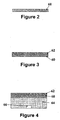
- Figure 2 shows a sectional view taken through one embodiment ofan ultrasound generating element, which uses air as a backing medium.
- Figure 3 shows a sectional view taken through another embodiment ofthe ultrasound generating element, which includes a thin impedance matching layer.
- Figure 4 shows a sectional view taken through another embodiment of the ultrasound generating element, which includes a thin impedance matching layer and backing layer with integrated temperature sensor.
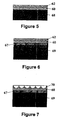
- Figure 5 shows a sectional view taken through another embodiment of the ultrasound generating element, which includes a high thermal conductivity backing layer.
- Figure 6 shows a sectional view taken through another embodiment of the ultrasound generating element, which includes a matching layer between the ultrasound generating element and the high thermal conductivity backing layer.
- Figure 7 shows an alternative transducer design that includes an array of ultrasound focusing lenses that can be used to produce a line or grid of heated tissue.
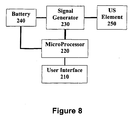
- Figure 8 shows a block diagram for an ultrasound device that uses a microprocessor.
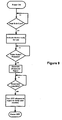
- Figure 9 is a flow diagram depicting a method of operation for the device of Figure 1 .
- Figure 10 shows the calculated temperature profile in the transducer and tissue during a treatment procedure using a single element ultrasound generating element ( Figure 2 ).
- Figure 11 shows the calculated temperature profile in the transducer and tissue during a treatment procedure using an ultrasound generating element with a high thermal conductivity backing layer( Figure 5 ).
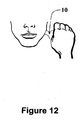
- Figure 12 shows how the device might be used to treat a blemish on the face.
- Figure 13 is a cross-sectional view of the device of Figure 1 showing a dispenser for dispensing a fluid near a transmitting end of the device.
- the device has an on/off switch and a button that activates an ultrasound generating element when the device is placed on the targeted site, e.g., a skin blemish, acne, etc. Activation of the device causes an ultrasound generating element to deliver ultrasound energy into the skin to thereby heat the affected area of the skin.
- the ultrasound generating element operates at a frequency of greater than 5 MHz and delivers ultrasound energy below the skin surface to heat tissue to a peak temperature of less than 70 °C in less than 20 seconds. The total heat transferred is low enough to prevent bums, typically less than about 50 J/cm 2 and for most applications less than about 5 J/cm 2 .
- the devices described herein utilize ultrasound energy, heat energy, or a combination of the two for killing bacteria.
- the devices described herein may also utilize ultrasound energy, heat energy, or a combination of the two for selective tissue heating that allows the user to achieve temporary pore enlargements for cleaning of the skin pores and expulsion of unwanted debris and undesired substances filling the pores, thus reducing the size of unseemly pores and enhancing the health and appearance of the skin.
- the device described herein is also designed to allow treatment of the skin more effectively with possibly lower doses of rejuvenating agents.
- the device described herein is also designed to allow treatment of the skin more effectively by using ultrasound energy to improve penetration of rejuvenating agents (e.g. vitamins, botanicals, pharmaceuticals).
- the method also contemplates ultrasound energy and/or thermal energy deposition into the skin to allow selective injury to the upper layers of the skin and new, more elastic collagen production. Not intending to limit the mechanism of action, it is believed that the controlled damage to the epidermis and upper layers of the dermis result in new collagen production and dual action via the use of a combined thermal heating and ultrasound absorption.
- the disclosed compact hand held devices can be safely used by adolescents and adults wishing to improve the texture and appearance of their skin and to minimize the appearance of acne, blemished skin, or fine wrinkles.
- the invention is a hand held device that can be used safely to heat a controlled layer of the skin to allow skin rejuvenation and collagen regeneration without collateral damage to adjacent tissue and while enhancing skin condition and appearance.
- the total heat energy transferred is low enough to prevent bums, typically less than about 50 J/cm 2 and for most applications less than about 10 J/cm 2 .
- the heat When heat is used in the treatment of skin conditions, the heat may be applied in a pulsing or a non-pulsing manner.
- the temperature used in the treatment is greater than about 45°C.
- the preferable range of temperatures is from about 40° to about 80°C.
- the high temperatures disclosed herein can be applied to the skin without causing bums as the temperatures are applied for short periods of time, preferably for less than about 1 second.
- the temperatures described herein could be the peak temperature achieved by the device on the skin surface or could be the peak temperature in the tissue below the skin surface at the application site.
- peak temperatures achieved are greater than about 40°C, greater than about 45°C, greater than about 50°C, greater than about 55°C, greater than about 60°C, greater than about 65°C, greater than about 70°C, greater than about 75°C, greater than about 80°C, greater than about 85°C, greater than about 90°C, greater than about 95°C.
- the preferred time for achieving the peak temperature with heat in both the pulse and/or non-pulse applications is from about less than about 1 second to about 60 seconds. Preferred times includes about 1 second, about 2 second, about 5 second, about 10 second, about 20 second, about 30 second, about 40 second, about 50 second, about 60 second, about 120 second.
- the piezoelectric element When the device is applied to the skin the piezoelectric element is preferably allowed to cool before another application is made to the skin.
- the element is cooled to about less than about 20°C, less than about 25°C, less than about 30°C, less than about 35°C, less than about 40°C, less than about 45°C, less than about 50°C, less than about 55°C, less than about 60°C.
- the time period for maintaining the cooled temperature is preferably about 5 seconds. Preferred time periods also include less than about 5 seconds, less than about 4 seconds, less than about 3 seconds, less than about 2 seconds, or less than about 1 second.
- FIG. 1 shows a cross-sectional view of one embodiment of a hand held treatment device 10 suitable for use by a consumer.
- the dispenser may be powered by batteries 20.
- the circuit board 30 includes a microprocessor 35 (e.g. microchip PIC16F676) that accepts user input to control and deliver treatment.
- the device 10 has an ergonomically shaped housing for the elements of the device 10.
- the device may be activated by depressing a button 40 located on the surface of the housing.
- the button 40 when depressed activates ultrasound drive electronics 45 that power an ultrasound transducer 50 located at the tip of the device 10.
- An optional infrared temperature sensor 55 monitors the temperature of the ultrasound transducer and can be used to control treatment and use. Alternatively, a thermocouple or other contact temperature sensor could be used.
- the device includes a dispenser for dispensing a liquid or gel near the transmitting end of the device.
- This dispenser may be used to remove any air gaps between the skin surface and the surface of the transducer element 50.
- the dispenser may serve a dual role of acoustic coupling and providing a therapeutic agent directly into the pores of the skin as part of the ultrasound skin treatment.
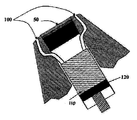
- a transmitting end of the device of Figure 1 includes fluid dispensing channels 100 to fill the gap between the ultrasound element 50 and the skin when the device is placed against the skin for treatment.
- the channels or tubes 100 are in fluid communication with a reservoir 110 for dispensing the fluid when a user or device activated pump 120 is actuated.
- a user interface 210 controls the operation of the device 10
- an ultrasound transducer 250 transmits ultrasound energy when excited by a driving signal produced by a signal generator 230, which is powered by a battery 240.
- a microprocessor 220 controls the operation of signal generator 230 based on input from the user interface 210 and may conduct other functions as well, such as monitoring the temperature at the ultrasound element 250.
- User interface 210 provides an interface for a user to activate the device (via button 40) and may also include a status LED indicator, mode selector and audio signals to indicate when a treatment is complete.
- a status LED indicator In normal use the front surface of the ultrasound transducer 50 is pressed up against skin and the treatment button 40 pressed to deliver treatment. When the treatment is completed the device generates a sound, e.g., a buzzing sound, to indicate that treatment has completed.
- the user interface 210 may include buttons, switches, or touch screens for selecting operating modes of the device and to generate the continuous drive voltage that excites the piezoelectric.
- the user can select different power levels or multi-pulse heating formats.
- An additional push button could be used to power the device and select operating modes. For example, pressing the button turns on the device at a low setting, pressing it again changes to high power setting, pressing it a second time changes to a multiple pulse heating format. Each time the button is pressed it cycles through all the possible modes.
- the current mode can be displayed by a series of LED's or a small LCD.
- the signals from the user interface 210 are received by microprocessor 220 (e.g. PIC16F676 by Microchip inc.) that controls the functions of the drive signal generator 230.
- the drive signal generator 230 may be pre-set for a specific driving frequency based on the ultrasound element (or transducer) 250, or may be tunable among various driving frequencies.
- a feedback mechanism (not depicted) may be used to align or tune the driving frequency with the resonance frequency of the transducer. This process may also be controlled by the microprocessor 220.
- the signal generator 230 applies a sinusoidal or square wave voltage across a piezoelectric element.
- the driving frequency is matched to an odd-harmonic of the piezoelectric element's fundamental resonance frequency.
- an ultrasound device may be constructed that is simpler in design and may not require a microprocessor.
- the signal generator is preset to run for a fixed time period, and its driving frequency tuned to the manufactured piezoelectric and backing layer at the point of assembly.
- the signal generator and piezoelectric are preset to deliver a fixed amount of thermal energy for every treatment according to a preset driving frequency.
- a thermo-couple may be used to break the circuit if the temperature exceeds an amount that might lead to skin bums.
- the user interface may have only an on-off button that activates the ultrasound, and an LED or audio signal to indicate that the device is activated or that a treatment has finished.
- Ultrasound transducer 250 is used to deliver ultrasound energy to the target site in the skin.
- the operating frequency for transducer 250 is typically within the range of 5 MHz to 100 MHz.
- the transducer is configured so that it can efficiently deliver high frequency (preferably, > 10 MHz) and high power ultrasound energy for a hand-held device that a consumer can use.
- the transducer is rugged enough so that it is not susceptible to damage, e.g., as when operated by an adolescent for treating acne.
- FIG. 2 shows one example of a transducer 60, a thin piezoelectric element 60 (e.g. PZT, or polyvinylidene fluoride (PVDF)).
- a thin piezoelectric element 60 e.g. PZT, or polyvinylidene fluoride (PVDF)
- the thickness of the piezoelectric element 60 should be half the wavelength ( ⁇ ) of the driving frequency wavelength from the signal generator 230.
- ⁇ the thickness of the piezoelectric element 60
- the element's thickness is thin and consequently fragile.
- a thicker and, therefore more rugged element 60 may be used if the element 60 is tuned to an off-harmonic, preferably the third harmonic.
- the thickness of the element 60 is three times that of the primary resonance frequency (15 MHz), i.e., 417 ⁇ m.
- the thickness may be tuned to the 5 th , 7 th , 9 th etc. off-harmonics with a corresponding increase in the thickness of the piezoelectric element 60.
- Figure 3 shows an alternative transducer design that adds a matching layer 62 to the front surface of the piezoelectric element 60.
- the matching layer 62 is typically a quarter wavelength thick and has a characteristic impedance that is the geometric mean of the piezoelectric element and body tissue.
- a matching layer 62 may improve the transmission of the ultrasound into the tissue.
- a detailed discussion of matching layers may be found in " The Physics of Medical Imaging” Ed. Steve Webb (1988 ), and “ Ultrasound in Medicine” Ed. F. A. Duck, A.C. Baker, H.C. Starritt (1997 ).
- Figure 4 shows an alternative transducer design that adds a supporting backing layer 64 to the piezoelectric element 60. Unlike pulsed imaging transducers that use an absorbing backing layer, this design uses a low density polymer or foam to minimize the amount of ultrasound energy that is radiated into the backing layer.
- the matching layer 62 is optional.
- This design can integrate a temperature sensor 66 that is monitored and used to guide treatment.
- An integrated temperature sensor is an alternative to a non-contact infrared temperature sensor that can be integrated into the device.
- Figure 5 shows an alternative transducer design that uses a high thermal conductivity backing layer 68.
- Any high thermal conductivity material can be used including copper, brass, aluminum, silver, and gold.
- the backing layer 68 is acoustically matched according to the operating characteristics of the piezoelectric element 60.
- the backing layer 68 can be bonded to the piezoelectric element using ultrasonic welding, soldering, or epoxy.
- the thickness of the bonding layer should be less then about ⁇ /1 to reduce acoustic losses and shifts in the resonance frequency.
- the thickness of the resonant backing layer 68 could be adjusted by small amounts to account for the effects of intermediate thin layers, such as an adhesive layer.
- the role of the high thermal conductivity backing layer 68 is to conduct heat away from the piezoelectric element 60 and the skin.
- this backing layer 68 is air cooled to improve cooling of the piezoelectric element 60.
- a thermoelectric cooler could be coupled to the backing layer 68 to further lower the piezoelectric element temperature. As is shown in FIGS. 10 and 11 cooling can significantly reduce the skin surface temperature and allow more ultrasound energy to penetrate the skin without risking a burn at the skin surface.
- the matching layer 62 is optional.
- FIG 6 shows an alternative transducer design that includes a matching layer 67 between the piezoelectric element 60 and a thick high thermal conductivity backing layer 69.
- the thickness of the matching layer 67 should be ⁇ /4, where is the ultrasound wavelength at the operating ultrasound frequency as measured in the matching layer 67 (e.g. for aluminum, and ultrasound frequency of 15 MHz, the thickness is approximately 0.18 mm).
- the matching layer 67 should have a characteristic impedance which is the geometric mean of the piezoelectric element 60 impedance and the backing layer 69 impedance.
- a matching layer 67 may be desirable when the impedances of the piezoelectric element and high thermal conductivity backing layer 69 are significantly different.
- a suitable backing layer 69 material is copper.
- the backing layer thickness should be thick enough to provide total damping of the ultrasound.
- the matching layer 62 is optional.
- the ultrasonic energy transmitted from the forward or front surface of the ultrasound element uses a matching layer that does not focus ultrasonic energy.
- the ultrasonic energy transmitted may be thought of as planar, uniform or non-focused.
- the emitted sound waves do not converge so as to increase the total amount of energy delivered to a specific area. Instead, all areas at the same depth beneath the transmitting end of the device are subjected to approximately the same amount of ultrasonic energy. Examples of these embodiments include devices that have an ultrasound element as shown in Figs. 1-6 .
- a non-focused transmitting end is preferred for a consumer operated device because this can make the treatment of a skin condition simpler and safer to use by a consumer.
- focusing elements there may be a concomitant need to constantly re-position the device about the skin during a treatment session in order to effectively treat specific areas associated with a skin condition. That is, when the ultrasonic energy is focused, the treated area is small which can require that the device be moved about to treat a larger area. Also, when the ultrasonic energy is focused, there is a greater risk that misuse could lead to ultrasound focus occurring at the skin surface which could lead to a burn of the surface of the skin.
- lenses or focusing elements may be used to focus ultrasonic energy in one region of the skin.
- Figure 7 shows an alternative transducer design that includes a line or array of ultrasound focusing lenses 70 that can be used to focus ultrasound energy so as to produce a line or grid of high intensity beams.
- This lenses can heat small regions of tissue (approximately 100 micron in diameter) to higher temperatures (e.g., > 60 C), which can produce tissue damage for stimulating tissue repair and ultimately reduce wrinkles. Because each of the damaged areas within the grid are surrounded by undamaged tissue the healing can occur faster.
- the tip integrates a plurality of openings that are connected through an electronic valve to a fluid reservoir.
- the valve opens for a fraction of a second to eject fluid or gel to fill the gap between the transducer surface and the skin.
- a replaceable cartridge within the device acts as a fluid reservoir.
- the fluid can be water, ultrasound gel, or therapeutic lotions. This embodiment eliminates the need by the user to apply water, gel, or cream to the tip of the device or skin surface before applying the device.
- a piezoelectric element with integral heat sink that can efficiently generate ultrasound energy of 5 MHz or higher may be assembled according to the following approach.
- a high piezoceramic element e.g., TR300 High Density (PZT 8), produced by TRS Technologies, is cut to a desired size, e.g., 6 mm diameter, and thickness consistent with the desired fundamental resonance frequency, e.g., the third harmonic of 15 MHz or 5 MHz.
- a conducting electrode e.g., electroless Nickel electrodes with or without an Immersion Gold coating.
- electrodes may be extended at the sides of the element to facilitate attaching wires to the side rather than to transmitting surface.
- the backing layer 68/69 may have a surface area over its thickness that matches that of the piezoelectric element, or the backing layer 68/69 may include a ledge for mounting the piezoelectric to the housing of the handheld device.
- the exact resonance frequency of the piezoelectric element is determined automatically by the control electronics.
- the control electronics varies the drive signal frequency over a preset range that covers the expected possible resonant frequency of the piezoelectric element.
- the resonant frequency can be identified by detecting the maximum oscillation amplitude or alternatively by detecting the change in the characteristic circuit impedance.
- An automatic calibration technique allows low cost manufacturing techniques to be used to produce the piezoelectric element. For example, in order to make a low cost and easily adjustable circuit design a programmable clock oscillator, e.g., ECS-P55 may be used for tuning the signal generator to the ultrasound element's resonance frequency. Another option would be to select among several oscillators, e.g., 14.7 - 15.3 MHz, to use for each device, depending on the resonance frequency of the specific ultrasound element manufactured for the device.
- Figure 10 shows the calculated temperature profile from 0 to 20 seconds when a simple single piezoelectric element is used ( Figure 2 ).
- the vertical axis denotes the temperature in degrees Celsius and the horizontal axis the skin depth.
- the surface of the skin is at 0 meters and the transducer extends from 0.5x 10 -3 to 0 meters.
- the multiple curves plot the predicted temperature at each Z location over a period of 20 seconds.
- T15 for t 15 seconds
- T20 for t 20 seconds
- the tissue extends from 0 to -4x10 -3 meters.
- peak temperatures are generated at the skin surface due to both ultrasound energy and thermal energy from the transducer.
- Figure 11 shows a similar calculation for the transducer design of Figure 5 that uses a high thermal conductivity backing layer.
- the peak temperature occurs at about 2 mm below the skin surface because thermal conduction into the pre-cooled high thermal conductivity backing layer reduces thermal conduction of the generated heat into tissue.
- the backing layer due to its thermal mass, acts as a heat sink for heat generated by the piezoelectric.
- T is the temperature in Kelvin at depth x and is a function of time, and ⁇ is a function of burn injury. Integration is carried out over the time the basal layer temperature is greater then or equal to 44 °C.
- Figure 12 depicts how device 10 may be used to treat a blemish on the face.
- the device 10 is activated and then placed in contact with the skin.
- a "fire” button is pressed to deliver energy to the ultrasound element, which then transfers ultrasound energy into the skin.
- the resulting heating of the skin acts to open pores and accelerate clearing of the blemish.
- a topical agent is applied before device 10 is applied to the skin as shown in Figure 12 .
- the topical agent may be applied by hand or the agent may be first applied to the tip or the ultrasound transmission end of the device 10 and then placed in contact with the skin when the device is placed against the skin as shown in Figure 12 .
- the agent is applied after the ultrasound treatment. Applying the topical agent (or drug) at the target site, and then placing the transmitting end of the device 10 (e.g., surface of ultrasound element 50 or a matching layer) against the treated skin prior to treatment may improve results.
- Topical agents can act as an acoustic coupling medium for improving sound transmission (i.e., the liquid eliminates air pockets between the skin and transducer surfaces). Ultrasound treatment while the agent or drug is on the skin may also cause the agent or drug to penetrate deeper into the affected pores thereby improving its effectiveness.
- Topical agents may include topical gels or creams, e.g., a topical gel with benzoyl peroxide for treatment of acne. Such agents may be applied before or after treatment with the device. Preferably, the area to be treated is first washed with mild soap or cleanser. After washing the area, the topical acne gel is applied and the device applied a minimum of one time to heat the target site. Then a topical acne gel may be applied again. This process may be repeated twice a day.
- a flow process for device 10 is depicted in Figure 9 .
- the power is turned on.
- the device 10 may first check to see whether the backing layer or heat sink has reached a sufficiently cool temperature so that ultrasound treatment will not overheat the skin surface. During this time, a status LED may indicate this pending status by blinking, which indicates to the user that the device 10 is not yet ready for use.
- the microprocessor 220 may periodically read a temperature sensed by a sensor coupled to the backing layer. After the microprocessor has determined that the backing layer has reached a temperature that should result in the temperature gradient depicted in Figure 11 when the transducer is energized and placed against the target skin, the LED status ceases blinking. This indicates to the user that the device is ready for use. Alternatively, or in addition a thermo-couple may be used to prevent transducer from being energized until the backing layer has fallen below a threshold temperature.
- the control then senses whether the activating "pulse button" is depressed, which turns on the ultrasound signal generator. After the predetermined amount of time has elapsed, the ultrasound treatment ends and the user notified by a buzzer.
- the treatment period may by a single, continuous treatment period or a series of pulses as the user is depressing the button. Further, the treatment period or protocol may be selectable by the user, as discussed earlier.
- the minimum time between treatments may be controlled by a timer or sensed temperature monitored by a microprocessor.
- the device operates for a predetermined duration and then shuts off. The time interval in this case being selected so that the device delivers a pre-set amount of energy based on the operating frequency.
- the total heat energy delivered is low enough to prevent bums at the skin surface, typically less than 50 J/cm 2 and for most applications less than about 5 J/cm 2.
- the devices described herein are suitable for use in the treatment of various skin conditions and lesions. Examples of such skin conditions and lesions are provided herein, but are not limited to the conditions and lesions described herein.
- Bacterial and fungal skin infections lead to common lesions such as acne, pimples and under-nail fungal infections.
- Other lesions are caused by irritants, which may be introduced as a result of bug bites or by exposure to other natural or man-made skin irritants.
- Still other skin lesions are caused by viral infection, a common example being the lesions known as "cold sores" or "fever blisters.”
- acne vulgaris is associated with the Gram-positive anaerobic bacterium, Propionibacterium acnes. Abscess formation can also occur from a number of primarily bacterial species (commonly Staphylococcus and Streptococcus) as well as fungal species, such as dermatophytes.
- a further type of skin lesions are viral skin lesions such as cold sores, also known as fever blisters.
- Cold sores are usually caused by strains of the Herpes Simplex virus and commonly result in lesions on and near the lips and inside the mouth of an infected individual.
- a further type of skin lesion are fungal infections, also known as fungal dermatitis, including conditions known medically as Tinea corporis, Tinea pedis, Tinea unguium, Tinea capitis, Tinea cruris, and Tinea barbae.
- Particularly troublesome is the condition known as Tinea unguium which is a fungal infection occuring under toenails or fingernails, a condition also referred to medically as onychomycosis or ringworm of the nails.
- Onychomycosis may be caused by several types of fungi, including Trichophyton mentagrophytes, Candida albicans or Trichophyton rubrum.
- Tinea corporis also known as tinea circinata or tinea glabrosa and referred to generally as ringworm of the body, is a fungal infection or dermatophytosis of the glabrous skin, i.e., areas of skin other than bearded area, scalp, groin, hands and feet, generally caused by fungal species such as those of Microsporum such as Microsporum canis, Trichophyton such as Trichophyton rubrum, T. Mentagrophytes, and Epidermophyton, particularly by the fungal species of Trichophyton and Epidermophyton.
- the condition generally includes the presence of one or more well-demarcated erythematous, scaly mascules with slightly raised borders and central healing, producing annular outlines.
- Various other types of lesions may also occur, such as those that are vesicular, eczematous, psoriasiform, verrucous, plaque-like, or deep.
- Tinea cruris also referred to generally as "jock itch" or ringworm of the groin
- jock itch or ringworm of the groin
- Tinea cruris is a fungal infection or dermatophytosis of the groin, perineum and perineal regions, generally seen in males, and sometimes spreading to contiguous areas, generally caused by fungal species such as those of Microsporum, Trichophyton, and Epidermophyton, particularly by the fungal species of Trichophyton and Epidermophyton.
- the condition generally includes severely pruritic, sharply demarcated lesions with a raised erythematous margin and thin, dry scaling. Tinea cruris often accompanies tinea pedis (also known as "athlete's foot”).
- Tinea pedis results in interdigital lesions.
- Athlete's foot is an itching, malodorous, uncomfortable disorder resulting from large numbers of ordinary, nonvirulent bacteria proliferating in the fungus infected interspace.
- Certain insect bites and contact with certain plants can expose skin to irritants that result in an itchy or painful immune response.
- the symptoms generally manifest soon after the introduction of the irritant, but can persist or sporadically reoccur for extended periods of time when the irritant is not effectively removed or inactivated by the immune response.
- the invention relates to methods and devices for the treatment of skin conditions and skin lesions involving the application of ultrasound and thermal energy to the infected or irritated tissue.
- the invention can be used to treat skin lesions caused by bacterial, fungal or viral infections through the application of an amount of heat.
- a skin condition or skin lesion that can be treated according to the present invention is any infected or irritated tissue that can be effectively treated by the application of heat.
- the lesions can be the result of infection by a bacterial strain including but not limited to strains such as Propionibacterium acnes, Staphylococcus species or Streptococcus species.
- the present invention provides methods and devices for the treatment of skin lesions such as the kind commonly associated with acne vulgaris. These skin lesions include pustular eruptions and localized abscesses such as cysts, nodules, pustules, papules, comedones (blackheads) and the like. These lesions include those that are commonly referred to as pimples, whiteheads, zits, acne and the like.
- the lesions can further be result of infection by fungal species, including but not limited to fungal species capable of producing conditions such as toenail or fingernail infections, ringworm and the like.
- fungal species include Microsporum species such as Microsporum canis, Trichophyton species such as Trichophyton rubrum, Trichophyton. Mentagrophytes, Epidermophyton species, Candida albicans, and the like.
- Such fungal species are sometimes referred to broadly as "dermatophytes”.
- the skin lesions can be the result of viral infections, including infections caused by Herpes viruses such as Herpes simplex types I and II (cold sores and genital herpes), Varicella zoster (chicken pox) and the like.
- Herpes viruses such as Herpes simplex types I and II (cold sores and genital herpes), Varicella zoster (chicken pox) and the like.
- embodiments of the present invention provide methods and devices for the application of ultrasound and heat for the treatment of skin lesions caused by an irritant.
- skin irritants that can be treated by the present invention include those introduced by bug bites, such as mosquito, chigger, ant, spider bites, scabies and the like.
- Other skin irritants introduced by other animal species, such as jellyfish, snakes and the like, or by plants such as poison ivy, poison oak, poison sumac and the like, can also be treated using the methods and devices of the present invention.
- treating means to slow, halt or even reverse the development of skin lesions or conditions and to reduce the lesion's or condition's healing time.
- Therapeutic benefit can be achieved by eradication or amelioration of the underlying disorder being treated, e.g., eradication or amelioration of the acne, and/or eradication or amelioration of one or more of the physiological symptoms associated with the condition being treated, notwithstanding that the patient may still be afflicted with the underlying disorder.
Landscapes
- Health & Medical Sciences (AREA)
- Life Sciences & Earth Sciences (AREA)
- Engineering & Computer Science (AREA)
- Biomedical Technology (AREA)
- Nuclear Medicine, Radiotherapy & Molecular Imaging (AREA)
- Radiology & Medical Imaging (AREA)
- Animal Behavior & Ethology (AREA)
- General Health & Medical Sciences (AREA)
- Public Health (AREA)
- Veterinary Medicine (AREA)
- Physics & Mathematics (AREA)
- Biophysics (AREA)
- Pathology (AREA)
- Heart & Thoracic Surgery (AREA)
- Medical Informatics (AREA)
- Molecular Biology (AREA)
- Surgery (AREA)
- Thermotherapy And Cooling Therapy Devices (AREA)
- Percussion Or Vibration Massage (AREA)
- Surgical Instruments (AREA)
- Medicinal Preparation (AREA)
Claims (13)
- Dispositif à ultrasons (10) destiné au traitement de problèmes cutanés par ultrasons, comprenant :- un générateur de signal (230) configuré pour générer un signal de commande d'une fréquence égale ou supérieure à environ 10 MHz ; et- un élément à ultrasons (50, 250) comprenant un piézoélectrique (60) et un dissipateur thermique (68, 69) couplé au piézoélectrique de telle sorte qu'il y a un gradient de température à travers l'épaisseur du piézoélectrique lorsque le générateur de signal transmet le signal de commande au piézoélectrique,caractérisé en ce que l'épaisseur du piézoélectrique (60) est d'environ (2N + 1) λ / 2, dans lequel λ est la longueur d'onde du signal de commande et N est un entier non nul.
- Dispositif (10) selon la revendication 1, dans lequel le générateur de signal (230) fonctionne à une fréquence d'harmonique impair de la fréquence fondamentale du piézoélectrique (60).
- Dispositif (10) selon la revendication 1 ou 2, dans lequel le piézoélectrique (60) a une surface avant conçue pour être placée de façon proximale à la peau de l'utilisateur et une surface arrière distale de la peau de l'utilisateur, et dans lequel le dissipateur thermique (68) comprend un métal et est couplé au piézoélectrique par collage, soudage ou brasage du métal sur la surface arrière du piézoélectrique.
- Dispositif (10) selon l'une quelconque des revendications précédentes, dans lequel le gradient de température est au moins d'environ 10 degrés / millimètre.
- Dispositif (10) selon l'une quelconque des revendications précédentes, dans lequel le dissipateur thermique (68) a une épaisseur adaptée à un multiple de la longueur d'onde d'un signal ultrasonore mesuré dans le dissipateur thermique.
- Dispositif (10) selon l'une quelconque des revendications précédentes, l'élément à ultrasons (50, 250) comprenant en outre une couche d'adaptation (67) disposée entre le dissipateur thermique (69) et le piézoélectrique (60), ladite couche d'adaptation ayant une impédance caractéristique qui est la moyenne géométrique de l'impédance du piézoélectrique et de l'impédance du dissipateur thermique.
- Dispositif (10) selon la revendication 6, dans lequel le dissipateur thermique (69) est en cuivre ou laiton et la couche d'adaptation (67) est en aluminium.
- Dispositif (10) selon l'une quelconque des revendications précédentes, dans lequel le dispositif est configuré pour réduire la température de l'élément à ultrasons d'environ 25 degrés Celsius avant l'envoi du signal de commande au piézoélectrique (60).
- Dispositif (10) selon l'une quelconque des revendications précédentes, dans lequel le signal de commande est un signal de commande de 15 MHz et l'épaisseur du piézoélectrique (60) est égale à environ la moitié de la longueur d'onde d'un signal de 5 MHz.
- Dispositif (10) selon l'une quelconque des revendications précédentes, dans lequel l'élément à ultrasons (50, 250) comporte un élément d'adaptation (62) couplé au piézoélectrique (60) et l'élément d'adaptation est configuré pour être placé contre la peau.
- Dispositif (10) selon la revendication 10, dans lequel l'élément d'adaptation (62) comprend des lentilles de mise au point (70).
- Dispositif (10) selon l'une quelconque des revendications précédentes, comprenant en outre un logement maintenant le générateur de signal (230) et l'élément à ultrasons (50, 250), le logement comportant- une partie de préhension pour permettre à l'utilisateur de tenir l'élément à ultrasons dans une main de telle sorte que la main de l'utilisateur peut placer l'élément à ultrasons à proximité fonctionnelle de la peau de l'utilisateur, et- un interrupteur (40) pour amener le générateur de signal à générer le signal de commande, l'interrupteur étant configuré de telle sorte que la main de l'utilisateur peut actionner l'interrupteur pendant que l'élément à ultrasons est situé à proximité fonctionnelle de la peau de l'utilisateur,- dans lequel une partie du piézoélectrique (60) est configurée pour être mise en contact avec la peau.
- Dispositif selon l'une quelconque des revendications précédentes, comprenant en outre :- une extrémité, l'élément à ultrasons (50, 250) étant disposé au niveau de l'extrémité ;- un réservoir (110) de gel ou liquide, et- un distributeur (100) en communication fluidique avec le réservoir et configuré pour distribuer le gel ou liquide du réservoir.
Applications Claiming Priority (3)
| Application Number | Priority Date | Filing Date | Title |
|---|---|---|---|
| US87276306P | 2006-12-04 | 2006-12-04 | |
| US11/947,607 US9492686B2 (en) | 2006-12-04 | 2007-11-29 | Devices and methods for treatment of skin conditions |
| PCT/US2007/086178 WO2008070580A2 (fr) | 2006-12-04 | 2007-11-30 | Dispositifs et procédés de traitement de problèmes cutanés |
Publications (2)
| Publication Number | Publication Date |
|---|---|
| EP2101876A2 EP2101876A2 (fr) | 2009-09-23 |
| EP2101876B1 true EP2101876B1 (fr) | 2013-01-09 |
Family
ID=39303722
Family Applications (1)
| Application Number | Title | Priority Date | Filing Date |
|---|---|---|---|
| EP07865047A Not-in-force EP2101876B1 (fr) | 2006-12-04 | 2007-11-30 | Dispositif de traitement de problèmes cutanés |
Country Status (5)
| Country | Link |
|---|---|
| US (1) | US9492686B2 (fr) |
| EP (1) | EP2101876B1 (fr) |
| CN (1) | CN101622031B (fr) |
| TW (1) | TW200831152A (fr) |
| WO (1) | WO2008070580A2 (fr) |
Families Citing this family (148)
| Publication number | Priority date | Publication date | Assignee | Title |
|---|---|---|---|---|
| US6050943A (en) | 1997-10-14 | 2000-04-18 | Guided Therapy Systems, Inc. | Imaging, therapy, and temperature monitoring ultrasonic system |
| US6641591B1 (en) | 1999-08-26 | 2003-11-04 | John H. Shadduck | Instruments and techniques for controlled removal of epidermal layers |
| US7914453B2 (en) | 2000-12-28 | 2011-03-29 | Ardent Sound, Inc. | Visual imaging system for ultrasonic probe |
| US7393325B2 (en) | 2004-09-16 | 2008-07-01 | Guided Therapy Systems, L.L.C. | Method and system for ultrasound treatment with a multi-directional transducer |
| US9011336B2 (en) | 2004-09-16 | 2015-04-21 | Guided Therapy Systems, Llc | Method and system for combined energy therapy profile |
| US7824348B2 (en) | 2004-09-16 | 2010-11-02 | Guided Therapy Systems, L.L.C. | System and method for variable depth ultrasound treatment |
| US8444562B2 (en) | 2004-10-06 | 2013-05-21 | Guided Therapy Systems, Llc | System and method for treating muscle, tendon, ligament and cartilage tissue |
| US8535228B2 (en) | 2004-10-06 | 2013-09-17 | Guided Therapy Systems, Llc | Method and system for noninvasive face lifts and deep tissue tightening |
| US10864385B2 (en) | 2004-09-24 | 2020-12-15 | Guided Therapy Systems, Llc | Rejuvenating skin by heating tissue for cosmetic treatment of the face and body |
| US9694212B2 (en) | 2004-10-06 | 2017-07-04 | Guided Therapy Systems, Llc | Method and system for ultrasound treatment of skin |
| KR20240113495A (ko) | 2004-10-06 | 2024-07-22 | 가이디드 테라피 시스템스, 엘.엘.씨. | 초음파 치료 시스템 |
| US11883688B2 (en) | 2004-10-06 | 2024-01-30 | Guided Therapy Systems, Llc | Energy based fat reduction |
| US8133180B2 (en) | 2004-10-06 | 2012-03-13 | Guided Therapy Systems, L.L.C. | Method and system for treating cellulite |
| US20060111744A1 (en) | 2004-10-13 | 2006-05-25 | Guided Therapy Systems, L.L.C. | Method and system for treatment of sweat glands |
| US9827449B2 (en) | 2004-10-06 | 2017-11-28 | Guided Therapy Systems, L.L.C. | Systems for treating skin laxity |
| US8690778B2 (en) | 2004-10-06 | 2014-04-08 | Guided Therapy Systems, Llc | Energy-based tissue tightening |
| US11235179B2 (en) | 2004-10-06 | 2022-02-01 | Guided Therapy Systems, Llc | Energy based skin gland treatment |
| EP2279699B1 (fr) | 2004-10-06 | 2019-07-24 | Guided Therapy Systems, L.L.C. | Procédé pour l'amélioration cosmétique non invasive de la cellulite |
| US7758524B2 (en) | 2004-10-06 | 2010-07-20 | Guided Therapy Systems, L.L.C. | Method and system for ultra-high frequency ultrasound treatment |
| US11207548B2 (en) | 2004-10-07 | 2021-12-28 | Guided Therapy Systems, L.L.C. | Ultrasound probe for treating skin laxity |
| US11724133B2 (en) | 2004-10-07 | 2023-08-15 | Guided Therapy Systems, Llc | Ultrasound probe for treatment of skin |
| EP1875327A2 (fr) | 2005-04-25 | 2008-01-09 | Guided Therapy Systems, L.L.C. | Procede et systeme pour ameliorer la securite de peripherique d'ordinateur |
| US8048089B2 (en) | 2005-12-30 | 2011-11-01 | Edge Systems Corporation | Apparatus and methods for treating the skin |
| WO2007092610A2 (fr) | 2006-02-07 | 2007-08-16 | Tivamed, Inc. | dispositif et procede pour remodeler le vagin |
| US10172644B2 (en) | 2006-03-29 | 2019-01-08 | Edge Systems Llc | Devices, systems and methods for treating the skin |
| US9566088B2 (en) | 2006-03-29 | 2017-02-14 | Edge Systems Llc | Devices, systems and methods for treating the skin |
| US20080008978A1 (en) * | 2006-05-08 | 2008-01-10 | Tyrell, Inc. | Treatment device and method for treating or preventing periodontal disease through application of heat |
| US20080183110A1 (en) * | 2006-09-06 | 2008-07-31 | Davenport Scott A | Ultrasound system and method for hair removal |
| US20080195000A1 (en) * | 2006-09-06 | 2008-08-14 | Spooner Gregory J R | System and Method for Dermatological Treatment Using Ultrasound |
| US20090171253A1 (en) * | 2006-09-06 | 2009-07-02 | Cutera, Inc. | System and method for dermatological treatment using ultrasound |
| US9566454B2 (en) | 2006-09-18 | 2017-02-14 | Guided Therapy Systems, Llc | Method and sysem for non-ablative acne treatment and prevention |
| EP2152351B1 (fr) | 2007-05-07 | 2016-09-21 | Guided Therapy Systems, L.L.C. | Procédés et systèmes de modulation de substances médicamenteuses utilisant l'énergie acoustique |
| US20150174388A1 (en) | 2007-05-07 | 2015-06-25 | Guided Therapy Systems, Llc | Methods and Systems for Ultrasound Assisted Delivery of a Medicant to Tissue |
| US20090048590A1 (en) * | 2007-08-15 | 2009-02-19 | Tyrell, Inc. | Systems and methods for treating nail-bed fungus through application of heat |
| US20090118684A1 (en) * | 2007-11-05 | 2009-05-07 | Da Silva Luiz B | Thermal personal care systems and methods |
| WO2009088884A1 (fr) | 2008-01-04 | 2009-07-16 | Edge Systems Corporation | Appareil et procédé pour le traitement de la peau |
| WO2009090632A2 (fr) | 2008-01-17 | 2009-07-23 | Syneron Medical Ltd. | Appareil d'épilation à usage personnel et son procédé d'utilisation |
| MX2010007407A (es) | 2008-01-24 | 2010-08-16 | Syneron Medical Ltd | Dispositivo, aparato, y metodo para tratamiento de tejido adiposo. |
| WO2009097451A1 (fr) | 2008-01-29 | 2009-08-06 | Edge Systems Corporation | Appareil et procédé de traitement de la peau |
| US8814836B2 (en) | 2008-01-29 | 2014-08-26 | Edge Systems Llc | Devices, systems and methods for treating the skin using time-release substances |
| US8972177B2 (en) * | 2008-02-26 | 2015-03-03 | Microsoft Technology Licensing, Llc | System for logging life experiences using geographic cues |
| WO2009135634A1 (fr) * | 2008-05-07 | 2009-11-12 | Buettner Klaus | Dispositif et procédé destinés à agir sur des virus de l'herpès et/ou sur les substances pouvant pénétrer dans la peau d'êtres vivants lors de la piqûre par un insecte ou similaires |
| KR102087909B1 (ko) | 2008-06-06 | 2020-03-12 | 얼테라, 인크 | 코스메틱 치료 시스템 |
| US12102473B2 (en) | 2008-06-06 | 2024-10-01 | Ulthera, Inc. | Systems for ultrasound treatment |
| US20090312693A1 (en) * | 2008-06-13 | 2009-12-17 | Vytronus, Inc. | System and method for delivering energy to tissue |
| US8702769B2 (en) * | 2008-09-11 | 2014-04-22 | Syneron Medical Ltd | Safe skin treatment apparatus for personal use and method for its use |
| WO2010032235A1 (fr) | 2008-09-21 | 2010-03-25 | Syneron Medical Ltd. | Procédé et appareil de traitement cutané personnel |
| US8585618B2 (en) * | 2008-12-22 | 2013-11-19 | Cutera, Inc. | Broad-area irradiation of small near-field targets using ultrasound |
| JP2012513837A (ja) | 2008-12-24 | 2012-06-21 | ガイデッド セラピー システムズ, エルエルシー | 脂肪減少および/またはセルライト処置のための方法およびシステム |
| US20100249670A1 (en) * | 2009-03-20 | 2010-09-30 | Cutera, Inc. | High-power multiple-harmonic ultrasound transducer |
| US20100298744A1 (en) * | 2009-04-30 | 2010-11-25 | Palomar Medical Technologies, Inc. | System and method of treating tissue with ultrasound energy |
| BR112012002204A2 (pt) | 2009-08-20 | 2019-09-24 | Syneron Medical Ltd | método e aparelho para tratamento estético não invasivo de pele e subderme. |
| KR101643799B1 (ko) * | 2009-09-18 | 2016-07-28 | 비베베, 아이엔씨. | 질 재건 기구 및 방법 |
| US9108232B2 (en) * | 2009-10-28 | 2015-08-18 | Megasonic Sweeping, Incorporated | Megasonic multifrequency apparatus with matched transducers and mounting plate |
| US8715186B2 (en) | 2009-11-24 | 2014-05-06 | Guided Therapy Systems, Llc | Methods and systems for generating thermal bubbles for improved ultrasound imaging and therapy |
| IN2012DN06605A (fr) * | 2009-12-31 | 2015-10-23 | Zetroz Llc | |
| PT2564338T (pt) * | 2010-04-28 | 2021-05-14 | Empi Corp | Sistemas e métodos para modulação de terapia por onda de pressão |
| RU2589614C2 (ru) * | 2010-05-27 | 2016-07-10 | Конинклейке Филипс Электроникс Н.В. | Ультразвуковой преобразователь для избирательной генерации ультразвуковых волн и тепла |
| KR200453417Y1 (ko) * | 2010-06-04 | 2011-05-03 | 박세환 | 급속 가열이 가능한 피지선 질환 치료장치의 발열부 구조 |
| US8192429B2 (en) | 2010-06-29 | 2012-06-05 | Theravant, Inc. | Abnormality eradication through resonance |
| WO2012011098A1 (fr) * | 2010-07-19 | 2012-01-26 | Ultrashape Ltd. | Procédés et systèmes de traitement d'une onychomycose à l'aide d'énergie ultrasonore focalisée |
| US9504446B2 (en) | 2010-08-02 | 2016-11-29 | Guided Therapy Systems, Llc | Systems and methods for coupling an ultrasound source to tissue |
| EP2600783A4 (fr) | 2010-08-02 | 2017-05-17 | Guided Therapy Systems, L.L.C. | Systèmes et procédés de traitement ultrasonore |
| US20120089052A1 (en) * | 2010-10-12 | 2012-04-12 | Yuchen Zhou | Massaging device with multiple ultrasonic transducers |
| US9492645B2 (en) * | 2010-10-12 | 2016-11-15 | La Pierres, Inc. | Skin treatment device with an integrated specimen dispenser |
| US9623225B2 (en) * | 2010-11-02 | 2017-04-18 | La Pierres, Inc. | Specimen dispensing device |
| US8857438B2 (en) | 2010-11-08 | 2014-10-14 | Ulthera, Inc. | Devices and methods for acoustic shielding |
| AU2011354720A1 (en) * | 2011-01-14 | 2013-05-30 | Debra Ann Arrington | Medical device with temperature sensor |
| CN102379795A (zh) * | 2011-06-03 | 2012-03-21 | 张伟 | 一种电动痒痒挠 |
| KR101885378B1 (ko) * | 2011-06-10 | 2018-08-29 | 엘지전자 주식회사 | 초음파 기반 휴대용 제세동기 |
| WO2013009785A2 (fr) | 2011-07-10 | 2013-01-17 | Guided Therapy Systems, Llc. | Système et procédé pour améliorer l'aspect extérieur de la peau en utilisant les ultrasons comme source d'énergie |
| KR20190080967A (ko) | 2011-07-11 | 2019-07-08 | 가이디드 테라피 시스템스, 엘.엘.씨. | 조직에 초음파원을 연결하는 시스템 및 방법 |
| KR101905237B1 (ko) | 2012-01-11 | 2018-10-05 | 시네론 메디컬 리미티드 | 큰 면적의 신체를 성형하는 애플리케이터 |
| US9263663B2 (en) | 2012-04-13 | 2016-02-16 | Ardent Sound, Inc. | Method of making thick film transducer arrays |
| US10085879B2 (en) | 2012-04-17 | 2018-10-02 | Empire Technology Development, Llc | Heat treatment device |
| US9510802B2 (en) | 2012-09-21 | 2016-12-06 | Guided Therapy Systems, Llc | Reflective ultrasound technology for dermatological treatments |
| US9710607B2 (en) * | 2013-01-15 | 2017-07-18 | Itrace Biomedical Inc. | Portable electronic therapy device and the method thereof |
| CN204017181U (zh) | 2013-03-08 | 2014-12-17 | 奥赛拉公司 | 美学成像与处理系统、多焦点处理系统和执行美容过程的系统 |
| EP3437575B1 (fr) | 2013-03-15 | 2021-04-21 | Edge Systems LLC | Dispositifs et systèmes de traitement de la peau |
| US10238812B2 (en) | 2013-03-15 | 2019-03-26 | Edge Systems Llc | Skin treatment systems and methods using needles |
| US10561862B2 (en) | 2013-03-15 | 2020-02-18 | Guided Therapy Systems, Llc | Ultrasound treatment device and methods of use |
| RU2679295C2 (ru) * | 2013-03-22 | 2019-02-06 | Конинклейке Филипс Н.В. | Неинвазивное устройство для лечения кожи лазерным светом |
| US20140303608A1 (en) | 2013-04-08 | 2014-10-09 | Scientific Image Center Management, Inc. | System and method for providing treatment feedback for a thermal treatment device |
| CN103316435A (zh) * | 2013-07-01 | 2013-09-25 | 纪建平 | 一种杀菌方法 |
| JP6389521B2 (ja) * | 2013-07-24 | 2018-09-12 | コーニンクレッカ フィリップス エヌ ヴェKoninklijke Philips N.V. | 頸動脈狭窄の自動スクリーニングのための非撮像型2次元アレイプローブ及びシステム |
| US9456777B2 (en) | 2013-08-23 | 2016-10-04 | Elwha Llc | Systems, methods, and devices for assessing microbiota of skin |
| US9805171B2 (en) | 2013-08-23 | 2017-10-31 | Elwha Llc | Modifying a cosmetic product based on a microbe profile |
| US9526480B2 (en) | 2013-11-27 | 2016-12-27 | Elwha Llc | Devices and methods for profiling microbiota of skin |
| WO2015027055A1 (fr) * | 2013-08-23 | 2015-02-26 | Elwha Llc | Systèmes, procédés et dispositifs pour l'administration d'un traitement à une surface cutanée |
| US9390312B2 (en) | 2013-08-23 | 2016-07-12 | Elwha Llc | Systems, methods, and devices for assessing microbiota of skin |
| US10010704B2 (en) | 2013-08-23 | 2018-07-03 | Elwha Llc | Systems, methods, and devices for delivering treatment to a skin surface |
| US10152529B2 (en) | 2013-08-23 | 2018-12-11 | Elwha Llc | Systems and methods for generating a treatment map |
| US9557331B2 (en) | 2013-08-23 | 2017-01-31 | Elwha Llc | Systems, methods, and devices for assessing microbiota of skin |
| US9549703B2 (en) | 2013-11-27 | 2017-01-24 | Elwha Llc | Devices and methods for sampling and profiling microbiota of skin |
| US9811641B2 (en) | 2013-08-23 | 2017-11-07 | Elwha Llc | Modifying a cosmetic product based on a microbe profile |
| US20160184614A1 (en) * | 2013-08-27 | 2016-06-30 | University Of Washington Through Its Center For Commercialization | Systems and methods for treating abscesses and infected fluid collections |
| CN105705104A (zh) | 2013-09-09 | 2016-06-22 | 迪迪卡玛有限责任公司 | 手持皮肤整平装置及皮肤整平方法 |
| US10441307B2 (en) | 2013-09-09 | 2019-10-15 | Dd Karma Llc | Hand held dermaplaning device and dermaplaning process |
| US9918539B2 (en) | 2013-09-09 | 2018-03-20 | Dd Karma Llc | Hand held dermaplaning device and dermaplaning process |
| FR3010618B1 (fr) * | 2013-09-18 | 2018-01-05 | Oreal | Dispositif a effet peltier pour creer une sensation de froid ou de chaud |
| KR102262231B1 (ko) * | 2013-10-29 | 2021-06-08 | 삼성메디슨 주식회사 | 초음파 프로브 및 이를 포함하는 초음파 영상 장치 |
| US9610037B2 (en) | 2013-11-27 | 2017-04-04 | Elwha Llc | Systems and devices for profiling microbiota of skin |
| US9526450B2 (en) | 2013-11-27 | 2016-12-27 | Elwha Llc | Devices and methods for profiling microbiota of skin |
| US9186278B2 (en) | 2013-11-27 | 2015-11-17 | Elwha Llc | Systems and devices for sampling and profiling microbiota of skin |
| WO2015089426A1 (fr) * | 2013-12-12 | 2015-06-18 | Guided Therapy Systems, Llc | Système et procédé pour l'embellissement cosmétique des lèvres |
| EP3087805B1 (fr) | 2013-12-23 | 2018-05-30 | Whirlpool Corporation | Circuit interrupteur pour générateur radiofréquence |
| KR101563500B1 (ko) * | 2014-02-28 | 2015-10-27 | 삼성메디슨 주식회사 | 프로브용 겔 패치 및 이를 포함한 초음파 진단 장치 |
| TW201538238A (zh) * | 2014-04-11 | 2015-10-16 | Univ Nat Taiwan | 超音波產生裝置 |
| SG11201608691YA (en) | 2014-04-18 | 2016-11-29 | Ulthera Inc | Band transducer ultrasound therapy |
| US10179229B2 (en) | 2014-12-23 | 2019-01-15 | Edge Systems Llc | Devices and methods for treating the skin using a porous member |
| WO2016106396A1 (fr) | 2014-12-23 | 2016-06-30 | Edge Systems Llc | Dispositifs et procédés de traitement de la peau à l'aide d'une bille ou d'un élément à mèche |
| WO2016205835A1 (fr) | 2015-06-18 | 2016-12-22 | Dd Karma Llc | Dispositif de dermaplaning portatif et procédé de dermaplaning |
| EP4197517A1 (fr) | 2015-07-08 | 2023-06-21 | HydraFacial LLC | Dispositifs, systèmes et procédés pour favoriser la pousse des cheveux |
| PL3328493T3 (pl) * | 2015-07-29 | 2020-11-02 | Koninklijke Philips N.V. | Stymulacja porostu włosów |
| AU2016326439A1 (en) * | 2015-09-22 | 2018-03-29 | Johnson & Johnson Consumer Inc. | Methods for enhancing topical application of a benefit agent |
| JP6646992B2 (ja) * | 2015-10-01 | 2020-02-14 | 伊藤超短波株式会社 | 超音波治療器 |
| ES2907725T3 (es) | 2015-12-21 | 2022-04-26 | Dd Karma Llc | Dispositivo de suavizado dérmico portátil |
| CA3007665A1 (fr) | 2016-01-18 | 2017-07-27 | Ulthera, Inc. | Dispositif a ultrasons compact possedant un reseau a ultrasons peripherique annulaire electriquement connecte a une carte de circuit imprime flexible et son procede d'assemblage |
| WO2017127552A1 (fr) * | 2016-01-19 | 2017-07-27 | Arbonne International, Llc | Dispositifs et méthodes ciblées pour traitement de soins de la peau |
| IL326076A (en) | 2016-06-06 | 2026-03-01 | Sofwave Medical Ltd | Ultrasound system and transducer |
| IL264440B (en) | 2016-08-16 | 2022-07-01 | Ulthera Inc | Systems and methods for cosmetic treatment of the skin using ultrasound |
| PL3308752T3 (pl) | 2016-10-11 | 2020-09-21 | Dermapharm Ag | Urządzenie do hipertermicznego leczenia świądu |
| US20190009110A1 (en) * | 2017-07-06 | 2019-01-10 | Slender Medical Ltd. | Ultrasound energy applicator |
| CN111386170A (zh) | 2017-11-29 | 2020-07-07 | 远程声波控股公司 | 超声加工设备、超声加工设备的配置方法及具有这种超声加工设备的系统 |
| AU2017445156C1 (en) * | 2017-12-29 | 2022-12-08 | Tomi Environmental Solutions, Inc. | Decontamination device and method using ultrasonic cavitation |
| TW202529848A (zh) | 2018-01-26 | 2025-08-01 | 美商奧賽拉公司 | 用於多個維度中的同時多聚焦超音治療的系統和方法 |
| WO2019164836A1 (fr) | 2018-02-20 | 2019-08-29 | Ulthera, Inc. | Systèmes et procédés de traitement cosmétique combiné de la cellulite par ultrasons |
| AU2019204574A1 (en) | 2018-06-27 | 2020-01-23 | Viveve, Inc. | Methods for treating urinary stress incontinence |
| EP3829713B1 (fr) | 2018-08-02 | 2025-10-01 | Sofwave Medical Ltd. | Système de traitement de tissu adipeux |
| JP2022513577A (ja) | 2018-11-30 | 2022-02-09 | ウルセラ インコーポレイテッド | 超音波処置の効能を増強させるためのシステムおよび方法 |
| IT201900000679A1 (it) * | 2019-01-16 | 2020-07-16 | Fenix Group S R L | Dispositivo integrato per il trattamento personalizzato non-invasivo di inestetismi cutanei e metodo multifase associato |
| CN110237449B (zh) * | 2019-04-30 | 2022-01-25 | 四川省人民医院 | 一种手持充电式超声正性肌力治疗装置 |
| CA3137928A1 (fr) | 2019-07-15 | 2021-01-21 | Ulthera, Inc. | Systemes et procedes de mesure de l'elasticite par imagerie d'ondes de cisaillement multi-foyer a ultrasons dans de multiples dimensions |
| CN114040796A (zh) * | 2019-07-16 | 2022-02-11 | 斯迈索尼卡股份有限公司 | 超声设备以及相关使用方法 |
| US11291474B2 (en) | 2020-01-06 | 2022-04-05 | Ed F. Nicolas | Skin treatment tool applicator tip |
| US12397318B2 (en) * | 2020-09-18 | 2025-08-26 | Honeywell International Inc. | Ultrasonic transducer health status monitor |
| US20220134059A1 (en) * | 2020-10-29 | 2022-05-05 | Becton, Dickinson And Company | Iv catheter insertion guide |
| CA3203037A1 (fr) | 2020-12-31 | 2022-07-07 | Ariel Sverdlik | Refroidissement de dispositifs d'alimentation en energie ultrasonore sur des cartes de circuit imprime |
| CN112869865B (zh) * | 2021-01-11 | 2022-09-02 | 贵阳德漫多医疗科技有限公司 | 一种皮肤热剥脱装置 |
| USD1065551S1 (en) | 2021-09-10 | 2025-03-04 | Hydrafacial Llc | Skin treatment device |
| USD1016615S1 (en) | 2021-09-10 | 2024-03-05 | Hydrafacial Llc | Container for a skin treatment device |
| CA3231401A1 (fr) | 2021-09-10 | 2023-03-16 | Hydrafacial Llc | Dispositifs, systemes et methodes pour le traitement de la peau |
| USD1042807S1 (en) | 2021-10-11 | 2024-09-17 | Hydrafacial Llc | Skin treatment tip |
| USD1116120S1 (en) | 2021-10-11 | 2026-03-03 | Hydrafacial Llc | Skin treatment device |
| USD1112778S1 (en) | 2022-03-04 | 2026-02-10 | Hydrafacial Llc | Light therapy device for skin care |
| EP4360692B1 (fr) * | 2022-10-27 | 2025-08-20 | Cesare Quaranta | Appareil électronique pour le traitement d'imperfections corporelles |
| IT202200022128A1 (it) * | 2022-10-27 | 2024-04-27 | Cesare Quaranta | Apparecchiatura elettronica per il trattamento degli inestetismi del corpo |
| USD1084369S1 (en) | 2023-02-10 | 2025-07-15 | Hydrafacial Llc | Skin treatment tip |
Citations (5)
| Publication number | Priority date | Publication date | Assignee | Title |
|---|---|---|---|---|
| US4571520A (en) * | 1983-06-07 | 1986-02-18 | Matsushita Electric Industrial Co. Ltd. | Ultrasonic probe having a backing member of microballoons in urethane rubber or thermosetting resin |
| US6500141B1 (en) * | 1998-01-08 | 2002-12-31 | Karl Storz Gmbh & Co. Kg | Apparatus and method for treating body tissue, in particular soft surface tissue with ultrasound |
| US20040001809A1 (en) * | 2002-06-26 | 2004-01-01 | Pharmasonics, Inc. | Methods and apparatus for enhancing a response to nucleic acid vaccines |
| US20050075571A1 (en) * | 2003-09-18 | 2005-04-07 | Siemens Medical Solutions Usa, Inc. | Sound absorption backings for ultrasound transducers |
| EP1591073A1 (fr) * | 2003-01-31 | 2005-11-02 | Hitachi Medical Corporation | Sonde ultrasonore et dispositif ultrasonore |
Family Cites Families (32)
| Publication number | Priority date | Publication date | Assignee | Title |
|---|---|---|---|---|
| EP0219988B1 (fr) | 1985-09-27 | 1993-10-20 | Mentor O & O Inc. | Instrument manuel autonome à ultrason pour usage ophtalmologique |
| US5213103A (en) * | 1992-01-31 | 1993-05-25 | Acoustic Imaging Technologies Corp. | Apparatus for and method of cooling ultrasonic medical transducers by conductive heat transfer |
| US6635075B2 (en) | 1993-10-04 | 2003-10-21 | Huan-Chen Li | Method and apparatus for treatment of skin itch and disease |
| DE4421795C1 (de) * | 1994-06-22 | 1996-01-04 | Siemens Ag | In den Körper eines Lebewesens einführbare Quelle therapeutischer akustischer Wellen |
| US6049159A (en) * | 1997-10-06 | 2000-04-11 | Albatros Technologies, Inc. | Wideband acoustic transducer |
| US6050943A (en) * | 1997-10-14 | 2000-04-18 | Guided Therapy Systems, Inc. | Imaging, therapy, and temperature monitoring ultrasonic system |
| US6325769B1 (en) | 1998-12-29 | 2001-12-04 | Collapeutics, Llc | Method and apparatus for therapeutic treatment of skin |
| CN1224626A (zh) * | 1998-01-25 | 1999-08-04 | 王芷龙 | 内窥式超声介入治疗探头 |
| US20030060736A1 (en) | 1999-05-14 | 2003-03-27 | Martin Roy W. | Lens-focused ultrasonic applicator for medical applications |
| AU7362400A (en) | 1999-09-10 | 2001-04-10 | Transurgical, Inc. | Occlusion of tubular anatomical structures by energy application |
| US20050240170A1 (en) * | 1999-10-25 | 2005-10-27 | Therus Corporation | Insertable ultrasound probes, systems, and methods for thermal therapy |
| US6743222B2 (en) * | 1999-12-10 | 2004-06-01 | Candela Corporation | Method of treating disorders associated with sebaceous follicles |
| US6692450B1 (en) | 2000-01-19 | 2004-02-17 | Medtronic Xomed, Inc. | Focused ultrasound ablation devices having selectively actuatable ultrasound emitting elements and methods of using the same |
| US6595934B1 (en) * | 2000-01-19 | 2003-07-22 | Medtronic Xomed, Inc. | Methods of skin rejuvenation using high intensity focused ultrasound to form an ablated tissue area containing a plurality of lesions |
| US6533803B2 (en) * | 2000-12-22 | 2003-03-18 | Advanced Medical Applications, Inc. | Wound treatment method and device with combination of ultrasound and laser energy |
| WO2002094375A1 (fr) | 2001-03-29 | 2002-11-28 | Sobet Ag | Appareil portable pour le soulagement de la douleur |
| CA2460175C (fr) * | 2001-09-21 | 2009-02-10 | Ya-Man Ltd. | Sonde de traitement cosmetique ultrasonore |
| JP2003180843A (ja) | 2001-12-17 | 2003-07-02 | Ya Man Ltd | プローブおよび美容器 |
| TWI220386B (en) * | 2002-01-21 | 2004-08-21 | Matsushita Electric Works Ltd | Ultrasonic transdermal permeation device |
| WO2003070105A1 (fr) * | 2002-02-20 | 2003-08-28 | Liposonix, Inc. | Traitement et imagerie ultrasonores de tissu adipeux |
| US7314447B2 (en) | 2002-06-27 | 2008-01-01 | Siemens Medical Solutions Usa, Inc. | System and method for actively cooling transducer assembly electronics |
| US20050209588A1 (en) * | 2003-09-04 | 2005-09-22 | Crum, Kaminski & Larson, Llc | HIFU resculpturing and remodeling of heart valves |
| US20050154332A1 (en) * | 2004-01-12 | 2005-07-14 | Onda | Methods and systems for removing hair using focused acoustic energy |
| JP2005245521A (ja) * | 2004-03-01 | 2005-09-15 | Japan Natural Laboratory Co Ltd | イオン導入器、超音波美顔器並びに化粧品添加物を使用する美肌又は美容システム。 |
| US7758524B2 (en) * | 2004-10-06 | 2010-07-20 | Guided Therapy Systems, L.L.C. | Method and system for ultra-high frequency ultrasound treatment |
| KR20240113495A (ko) * | 2004-10-06 | 2024-07-22 | 가이디드 테라피 시스템스, 엘.엘.씨. | 초음파 치료 시스템 |
| WO2006042168A1 (fr) * | 2004-10-06 | 2006-04-20 | Guided Therapy Systems, L.L.C. | Procede et systeme pour le traitement thermique controle de tissus superficiels humains |
| US20060111744A1 (en) * | 2004-10-13 | 2006-05-25 | Guided Therapy Systems, L.L.C. | Method and system for treatment of sweat glands |
| US8133180B2 (en) * | 2004-10-06 | 2012-03-13 | Guided Therapy Systems, L.L.C. | Method and system for treating cellulite |
| US7494492B2 (en) * | 2004-12-10 | 2009-02-24 | Therative, Inc. | Skin treatment device |
| CA2597719A1 (fr) * | 2005-02-18 | 2006-08-24 | Palomar Medical Technologies, Inc. | Dispositif de traitement dermatologique |
| US8237335B2 (en) * | 2005-07-20 | 2012-08-07 | Ust, Inc. | Thermally enhanced ultrasound transducer means |
-
2007
- 2007-11-29 US US11/947,607 patent/US9492686B2/en not_active Expired - Fee Related
- 2007-11-30 EP EP07865047A patent/EP2101876B1/fr not_active Not-in-force
- 2007-11-30 WO PCT/US2007/086178 patent/WO2008070580A2/fr not_active Ceased
- 2007-11-30 CN CN200780050813XA patent/CN101622031B/zh not_active Expired - Fee Related
- 2007-12-03 TW TW096145884A patent/TW200831152A/zh unknown
Patent Citations (5)
| Publication number | Priority date | Publication date | Assignee | Title |
|---|---|---|---|---|
| US4571520A (en) * | 1983-06-07 | 1986-02-18 | Matsushita Electric Industrial Co. Ltd. | Ultrasonic probe having a backing member of microballoons in urethane rubber or thermosetting resin |
| US6500141B1 (en) * | 1998-01-08 | 2002-12-31 | Karl Storz Gmbh & Co. Kg | Apparatus and method for treating body tissue, in particular soft surface tissue with ultrasound |
| US20040001809A1 (en) * | 2002-06-26 | 2004-01-01 | Pharmasonics, Inc. | Methods and apparatus for enhancing a response to nucleic acid vaccines |
| EP1591073A1 (fr) * | 2003-01-31 | 2005-11-02 | Hitachi Medical Corporation | Sonde ultrasonore et dispositif ultrasonore |
| US20050075571A1 (en) * | 2003-09-18 | 2005-04-07 | Siemens Medical Solutions Usa, Inc. | Sound absorption backings for ultrasound transducers |
Also Published As
| Publication number | Publication date |
|---|---|
| US20080139974A1 (en) | 2008-06-12 |
| TW200831152A (en) | 2008-08-01 |
| WO2008070580A2 (fr) | 2008-06-12 |
| CN101622031B (zh) | 2013-01-23 |
| EP2101876A2 (fr) | 2009-09-23 |
| CN101622031A (zh) | 2010-01-06 |
| WO2008070580A3 (fr) | 2008-07-31 |
| US9492686B2 (en) | 2016-11-15 |
Similar Documents
| Publication | Publication Date | Title |
|---|---|---|
| EP2101876B1 (fr) | Dispositif de traitement de problèmes cutanés | |
| US7749260B2 (en) | Devices and methods for treatment of skin conditions | |
| US20230347184A1 (en) | Acoustic device for skin treatment and methods of using the same | |
| CN101087567B (zh) | 处理皮肤状况的装置和方法 | |
| US11097133B2 (en) | Method and system for combined energy therapy profile | |
| JP6749108B2 (ja) | ヒト表面組織の制御された熱処理のための方法およびシステム | |
| EP3056246B1 (fr) | Système pour le traitement non ablatif de l'acné et sa prévention | |
| EP2409728B1 (fr) | Système pour le traitement de tissus par ultrasons | |
| US10624660B2 (en) | Methods and systems for removal of a foreign object from tissue | |
| US8753295B2 (en) | Treatment of warts and other dermatological conditions using topical ultrasonic applicator | |
| US20050055018A1 (en) | Method and device for sub-dermal tissue treatment | |
| US20150025420A1 (en) | Ultrasound treatment device and methods of use | |
| CA2726349A1 (fr) | Systeme et procede pour administrer de l'energie a des tissus | |
| EP2152367B1 (fr) | Système permettant un profil combiné de thérapie énergétique | |
| EP1830730B1 (fr) | Dispositif de traitement d'etats cutanes | |
| KR20180061105A (ko) | 초음파 변환기 | |
| HK1109321A (zh) | 处理皮肤状况的装置和方法 | |
| HK1116713B (en) | System for ultrasound tissue treatment | |
| HK1116713A (en) | System for ultrasound tissue treatment | |
| HK1166619A (en) | System for ultrasound tissue treatment |
Legal Events
| Date | Code | Title | Description |
|---|---|---|---|
| PUAI | Public reference made under article 153(3) epc to a published international application that has entered the european phase |
Free format text: ORIGINAL CODE: 0009012 |
|
| 17P | Request for examination filed |
Effective date: 20090706 |
|
| AK | Designated contracting states |
Kind code of ref document: A2 Designated state(s): AT BE BG CH CY CZ DE DK EE ES FI FR GB GR HU IE IS IT LI LT LU LV MC MT NL PL PT RO SE SI SK TR |
|
| DAX | Request for extension of the european patent (deleted) | ||
| RAP1 | Party data changed (applicant data changed or rights of an application transferred) |
Owner name: KONINKLIJKE PHILIPS ELECTRONICS N.V. |
|
| 17Q | First examination report despatched |
Effective date: 20101108 |
|
| GRAP | Despatch of communication of intention to grant a patent |
Free format text: ORIGINAL CODE: EPIDOSNIGR1 |
|
| GRAS | Grant fee paid |
Free format text: ORIGINAL CODE: EPIDOSNIGR3 |
|
| GRAA | (expected) grant |
Free format text: ORIGINAL CODE: 0009210 |
|
| AK | Designated contracting states |
Kind code of ref document: B1 Designated state(s): AT BE BG CH CY CZ DE DK EE ES FI FR GB GR HU IE IS IT LI LT LU LV MC MT NL PL PT RO SE SI SK TR |
|
| REG | Reference to a national code |
Ref country code: GB Ref legal event code: FG4D |
|
| REG | Reference to a national code |
Ref country code: AT Ref legal event code: REF Ref document number: 592385 Country of ref document: AT Kind code of ref document: T Effective date: 20130115 Ref country code: CH Ref legal event code: EP |
|
| REG | Reference to a national code |
Ref country code: IE Ref legal event code: FG4D |
|
| REG | Reference to a national code |
Ref country code: DE Ref legal event code: R096 Ref document number: 602007028014 Country of ref document: DE Effective date: 20130307 |
|
| PG25 | Lapsed in a contracting state [announced via postgrant information from national office to epo] |
Ref country code: SI Free format text: LAPSE BECAUSE OF FAILURE TO SUBMIT A TRANSLATION OF THE DESCRIPTION OR TO PAY THE FEE WITHIN THE PRESCRIBED TIME-LIMIT Effective date: 20130109 |
|
| REG | Reference to a national code |
Ref country code: NL Ref legal event code: VDEP Effective date: 20130109 |
|
| REG | Reference to a national code |
Ref country code: AT Ref legal event code: MK05 Ref document number: 592385 Country of ref document: AT Kind code of ref document: T Effective date: 20130109 |
|
| REG | Reference to a national code |
Ref country code: LT Ref legal event code: MG4D |
|
| PG25 | Lapsed in a contracting state [announced via postgrant information from national office to epo] |
Ref country code: BE Free format text: LAPSE BECAUSE OF FAILURE TO SUBMIT A TRANSLATION OF THE DESCRIPTION OR TO PAY THE FEE WITHIN THE PRESCRIBED TIME-LIMIT Effective date: 20130109 Ref country code: LT Free format text: LAPSE BECAUSE OF FAILURE TO SUBMIT A TRANSLATION OF THE DESCRIPTION OR TO PAY THE FEE WITHIN THE PRESCRIBED TIME-LIMIT Effective date: 20130109 Ref country code: AT Free format text: LAPSE BECAUSE OF FAILURE TO SUBMIT A TRANSLATION OF THE DESCRIPTION OR TO PAY THE FEE WITHIN THE PRESCRIBED TIME-LIMIT Effective date: 20130109 Ref country code: IS Free format text: LAPSE BECAUSE OF FAILURE TO SUBMIT A TRANSLATION OF THE DESCRIPTION OR TO PAY THE FEE WITHIN THE PRESCRIBED TIME-LIMIT Effective date: 20130509 Ref country code: ES Free format text: LAPSE BECAUSE OF FAILURE TO SUBMIT A TRANSLATION OF THE DESCRIPTION OR TO PAY THE FEE WITHIN THE PRESCRIBED TIME-LIMIT Effective date: 20130420 Ref country code: BG Free format text: LAPSE BECAUSE OF FAILURE TO SUBMIT A TRANSLATION OF THE DESCRIPTION OR TO PAY THE FEE WITHIN THE PRESCRIBED TIME-LIMIT Effective date: 20130409 Ref country code: SE Free format text: LAPSE BECAUSE OF FAILURE TO SUBMIT A TRANSLATION OF THE DESCRIPTION OR TO PAY THE FEE WITHIN THE PRESCRIBED TIME-LIMIT Effective date: 20130109 |
|
| PG25 | Lapsed in a contracting state [announced via postgrant information from national office to epo] |
Ref country code: GR Free format text: LAPSE BECAUSE OF FAILURE TO SUBMIT A TRANSLATION OF THE DESCRIPTION OR TO PAY THE FEE WITHIN THE PRESCRIBED TIME-LIMIT Effective date: 20130410 Ref country code: NL Free format text: LAPSE BECAUSE OF FAILURE TO SUBMIT A TRANSLATION OF THE DESCRIPTION OR TO PAY THE FEE WITHIN THE PRESCRIBED TIME-LIMIT Effective date: 20130109 Ref country code: FI Free format text: LAPSE BECAUSE OF FAILURE TO SUBMIT A TRANSLATION OF THE DESCRIPTION OR TO PAY THE FEE WITHIN THE PRESCRIBED TIME-LIMIT Effective date: 20130109 Ref country code: PT Free format text: LAPSE BECAUSE OF FAILURE TO SUBMIT A TRANSLATION OF THE DESCRIPTION OR TO PAY THE FEE WITHIN THE PRESCRIBED TIME-LIMIT Effective date: 20130509 Ref country code: LV Free format text: LAPSE BECAUSE OF FAILURE TO SUBMIT A TRANSLATION OF THE DESCRIPTION OR TO PAY THE FEE WITHIN THE PRESCRIBED TIME-LIMIT Effective date: 20130109 Ref country code: PL Free format text: LAPSE BECAUSE OF FAILURE TO SUBMIT A TRANSLATION OF THE DESCRIPTION OR TO PAY THE FEE WITHIN THE PRESCRIBED TIME-LIMIT Effective date: 20130109 |
|
| REG | Reference to a national code |
Ref country code: CH Ref legal event code: PFA Owner name: KONINKLIJKE PHILIPS N.V., NL Free format text: FORMER OWNER: KONINKLIJKE PHILIPS ELECTRONICS N.V., NL |
|
| RAP2 | Party data changed (patent owner data changed or rights of a patent transferred) |
Owner name: KONINKLIJKE PHILIPS N.V. |
|
| PG25 | Lapsed in a contracting state [announced via postgrant information from national office to epo] |
Ref country code: RO Free format text: LAPSE BECAUSE OF FAILURE TO SUBMIT A TRANSLATION OF THE DESCRIPTION OR TO PAY THE FEE WITHIN THE PRESCRIBED TIME-LIMIT Effective date: 20130109 Ref country code: DK Free format text: LAPSE BECAUSE OF FAILURE TO SUBMIT A TRANSLATION OF THE DESCRIPTION OR TO PAY THE FEE WITHIN THE PRESCRIBED TIME-LIMIT Effective date: 20130109 Ref country code: CZ Free format text: LAPSE BECAUSE OF FAILURE TO SUBMIT A TRANSLATION OF THE DESCRIPTION OR TO PAY THE FEE WITHIN THE PRESCRIBED TIME-LIMIT Effective date: 20130109 Ref country code: SK Free format text: LAPSE BECAUSE OF FAILURE TO SUBMIT A TRANSLATION OF THE DESCRIPTION OR TO PAY THE FEE WITHIN THE PRESCRIBED TIME-LIMIT Effective date: 20130109 Ref country code: EE Free format text: LAPSE BECAUSE OF FAILURE TO SUBMIT A TRANSLATION OF THE DESCRIPTION OR TO PAY THE FEE WITHIN THE PRESCRIBED TIME-LIMIT Effective date: 20130109 |
|
| PLBE | No opposition filed within time limit |
Free format text: ORIGINAL CODE: 0009261 |
|
| STAA | Information on the status of an ep patent application or granted ep patent |
Free format text: STATUS: NO OPPOSITION FILED WITHIN TIME LIMIT |
|
| PG25 | Lapsed in a contracting state [announced via postgrant information from national office to epo] |
Ref country code: CY Free format text: LAPSE BECAUSE OF FAILURE TO SUBMIT A TRANSLATION OF THE DESCRIPTION OR TO PAY THE FEE WITHIN THE PRESCRIBED TIME-LIMIT Effective date: 20130109 |
|
| 26N | No opposition filed |
Effective date: 20131010 |
|
| PG25 | Lapsed in a contracting state [announced via postgrant information from national office to epo] |
Ref country code: IT Free format text: LAPSE BECAUSE OF FAILURE TO SUBMIT A TRANSLATION OF THE DESCRIPTION OR TO PAY THE FEE WITHIN THE PRESCRIBED TIME-LIMIT Effective date: 20130109 |
|
| REG | Reference to a national code |
Ref country code: DE Ref legal event code: R097 Ref document number: 602007028014 Country of ref document: DE Effective date: 20131010 |
|
| REG | Reference to a national code |
Ref country code: DE Ref legal event code: R082 Ref document number: 602007028014 Country of ref document: DE Representative=s name: MEISSNER, BOLTE & PARTNER GBR, DE |
|
| REG | Reference to a national code |
Ref country code: DE Ref legal event code: R082 Ref document number: 602007028014 Country of ref document: DE Representative=s name: MEISSNER BOLTE PATENTANWAELTE RECHTSANWAELTE P, DE Effective date: 20140331 Ref country code: DE Ref legal event code: R081 Ref document number: 602007028014 Country of ref document: DE Owner name: KONINKLIJKE PHILIPS N.V., NL Free format text: FORMER OWNER: KONINKLIJKE PHILIPS ELECTRONICS N.V., EINDHOVEN, NL Effective date: 20140331 Ref country code: DE Ref legal event code: R082 Ref document number: 602007028014 Country of ref document: DE Representative=s name: MEISSNER, BOLTE & PARTNER GBR, DE Effective date: 20140331 |
|
| REG | Reference to a national code |
Ref country code: CH Ref legal event code: PL |
|
| PG25 | Lapsed in a contracting state [announced via postgrant information from national office to epo] |
Ref country code: CH Free format text: LAPSE BECAUSE OF NON-PAYMENT OF DUE FEES Effective date: 20131130 Ref country code: LI Free format text: LAPSE BECAUSE OF NON-PAYMENT OF DUE FEES Effective date: 20131130 Ref country code: MC Free format text: LAPSE BECAUSE OF FAILURE TO SUBMIT A TRANSLATION OF THE DESCRIPTION OR TO PAY THE FEE WITHIN THE PRESCRIBED TIME-LIMIT Effective date: 20130109 |
|
| REG | Reference to a national code |
Ref country code: IE Ref legal event code: MM4A |
|
| PG25 | Lapsed in a contracting state [announced via postgrant information from national office to epo] |
Ref country code: IE Free format text: LAPSE BECAUSE OF NON-PAYMENT OF DUE FEES Effective date: 20131130 |
|
| PG25 | Lapsed in a contracting state [announced via postgrant information from national office to epo] |
Ref country code: LU Free format text: LAPSE BECAUSE OF NON-PAYMENT OF DUE FEES Effective date: 20131130 Ref country code: HU Free format text: LAPSE BECAUSE OF FAILURE TO SUBMIT A TRANSLATION OF THE DESCRIPTION OR TO PAY THE FEE WITHIN THE PRESCRIBED TIME-LIMIT; INVALID AB INITIO Effective date: 20071130 |
|
| PG25 | Lapsed in a contracting state [announced via postgrant information from national office to epo] |
Ref country code: MT Free format text: LAPSE BECAUSE OF FAILURE TO SUBMIT A TRANSLATION OF THE DESCRIPTION OR TO PAY THE FEE WITHIN THE PRESCRIBED TIME-LIMIT Effective date: 20130109 |
|
| REG | Reference to a national code |
Ref country code: FR Ref legal event code: PLFP Year of fee payment: 9 |
|
| REG | Reference to a national code |
Ref country code: FR Ref legal event code: PLFP Year of fee payment: 10 |
|
| REG | Reference to a national code |
Ref country code: FR Ref legal event code: PLFP Year of fee payment: 11 |
|
| PGFP | Annual fee paid to national office [announced via postgrant information from national office to epo] |
Ref country code: TR Payment date: 20171116 Year of fee payment: 11 Ref country code: FR Payment date: 20171129 Year of fee payment: 11 |
|
| PGFP | Annual fee paid to national office [announced via postgrant information from national office to epo] |
Ref country code: GB Payment date: 20171130 Year of fee payment: 11 |
|
| PGFP | Annual fee paid to national office [announced via postgrant information from national office to epo] |
Ref country code: DE Payment date: 20180131 Year of fee payment: 11 |
|
| REG | Reference to a national code |
Ref country code: DE Ref legal event code: R119 Ref document number: 602007028014 Country of ref document: DE |
|
| GBPC | Gb: european patent ceased through non-payment of renewal fee |
Effective date: 20181130 |
|
| PG25 | Lapsed in a contracting state [announced via postgrant information from national office to epo] |
Ref country code: FR Free format text: LAPSE BECAUSE OF NON-PAYMENT OF DUE FEES Effective date: 20181130 Ref country code: DE Free format text: LAPSE BECAUSE OF NON-PAYMENT OF DUE FEES Effective date: 20190601 |
|
| PG25 | Lapsed in a contracting state [announced via postgrant information from national office to epo] |
Ref country code: GB Free format text: LAPSE BECAUSE OF NON-PAYMENT OF DUE FEES Effective date: 20181130 |
|
| PG25 | Lapsed in a contracting state [announced via postgrant information from national office to epo] |
Ref country code: TR Free format text: LAPSE BECAUSE OF NON-PAYMENT OF DUE FEES Effective date: 20181130 |