EP2103222B1 - Procédé et appareil pour traitement mécanique d'un organe ou organes extraits de la viande de volaille abattue - Google Patents
Procédé et appareil pour traitement mécanique d'un organe ou organes extraits de la viande de volaille abattue Download PDFInfo
- Publication number
- EP2103222B1 EP2103222B1 EP08102829A EP08102829A EP2103222B1 EP 2103222 B1 EP2103222 B1 EP 2103222B1 EP 08102829 A EP08102829 A EP 08102829A EP 08102829 A EP08102829 A EP 08102829A EP 2103222 B1 EP2103222 B1 EP 2103222B1
- Authority
- EP
- European Patent Office
- Prior art keywords
- organ
- organs
- package
- rollers
- gizzard
- Prior art date
- Legal status (The legal status is an assumption and is not a legal conclusion. Google has not performed a legal analysis and makes no representation as to the accuracy of the status listed.)
- Not-in-force
Links
- 210000000056 organ Anatomy 0.000 title claims description 319
- 238000000034 method Methods 0.000 title claims description 21
- 244000144977 poultry Species 0.000 title claims description 12
- 210000004317 gizzard Anatomy 0.000 claims description 116
- 210000002784 stomach Anatomy 0.000 claims description 28
- 210000004185 liver Anatomy 0.000 claims description 27
- 210000002216 heart Anatomy 0.000 claims description 21
- 238000003306 harvesting Methods 0.000 claims description 20
- 210000000232 gallbladder Anatomy 0.000 claims description 9
- 210000001198 duodenum Anatomy 0.000 claims description 6
- 239000002699 waste material Substances 0.000 claims description 3
- 230000001902 propagating effect Effects 0.000 claims description 2
- 230000001141 propulsive effect Effects 0.000 claims description 2
- 238000005406 washing Methods 0.000 description 9
- 210000000936 intestine Anatomy 0.000 description 6
- 238000000926 separation method Methods 0.000 description 5
- 210000001835 viscera Anatomy 0.000 description 4
- 230000008901 benefit Effects 0.000 description 3
- XLYOFNOQVPJJNP-UHFFFAOYSA-N water Substances O XLYOFNOQVPJJNP-UHFFFAOYSA-N 0.000 description 3
- 230000009286 beneficial effect Effects 0.000 description 2
- 230000000694 effects Effects 0.000 description 2
- 210000004072 lung Anatomy 0.000 description 2
- 210000000253 proventriculus Anatomy 0.000 description 2
- 230000002153 concerted effect Effects 0.000 description 1
- 230000003467 diminishing effect Effects 0.000 description 1
- 230000009977 dual effect Effects 0.000 description 1
- 230000002035 prolonged effect Effects 0.000 description 1
- 238000003307 slaughter Methods 0.000 description 1
- 230000003068 static effect Effects 0.000 description 1
Images




Classifications
-
- A—HUMAN NECESSITIES
- A22—BUTCHERING; MEAT TREATMENT; PROCESSING POULTRY OR FISH
- A22C—PROCESSING MEAT, POULTRY, OR FISH
- A22C17/00—Other devices for processing meat or bones
- A22C17/14—Working-up animal intestines ; Treatment thereof for the manufacture of natural sausage casings; Apparatus for cutting intestines; Machines for pulling intestines to pieces
-
- A—HUMAN NECESSITIES
- A22—BUTCHERING; MEAT TREATMENT; PROCESSING POULTRY OR FISH
- A22B—SLAUGHTERING
- A22B5/00—Accessories for use during or after slaughtering
- A22B5/18—Cleaning the stomach of slaughtered animals
-
- A—HUMAN NECESSITIES
- A22—BUTCHERING; MEAT TREATMENT; PROCESSING POULTRY OR FISH
- A22C—PROCESSING MEAT, POULTRY, OR FISH
- A22C21/00—Processing poultry
- A22C21/06—Eviscerating devices for poultry
Definitions
- the invention concerns a method for mechanically processing an organ or organs taken out from slaughtered poultry in a processing device or processing line, which organ or organs form part of an organ package and wherein said organ or organs are separated from the organ package.
- organ package taken out from the poultry also includes the intestines.
- the invention also relates to a processing line for harvesting an organ or organs from an organ package taken out from slaughtered poultry, which processing line comprises at least one processing device for processing an organ or organs from said organ package.
- the processing device may for instance concern a divider unit comprising a conveyor for organ packages having conveyor pans forming part of the conveyor, which conveyor pans are intended to receive the organ packages.
- the processing device may however further concern an organ harvester, a gizzard processing device and/or a gizzard peeler as to be detailed hereinafter.
- EP-A-1 769 681 teaches a method and device for mechanically processing a cluster of organs of a slaughtered animal, wherein the cluster is taken out of and separated from the body of the slaughtered animal.
- a clamping device is used to fix a particular organ within the cluster which cluster is conveyed along a predetermined path. Then tissue connections in the cluster are broken on the basis of the spatial orientation of the cluster which is derived from the spot where the concerning organ is clamped.
- methods and processing lines for mechanically processing an organ or organs taken out from slaughtered poultry with the aim to harvest the separate organs from the organ package are suffering from diverse problems such as that organ packages or organs thereof are lost during processing, damage occurs to organs such as the liver and the heart and unintentionally certain organs such as gallbladders are not removed or organs are not entirely separated and cause obstructions in the processing line. Further problems are connected to the use of huge amounts of water and energy. Notably also the processing lines of the prior art are comprising many parts and are expensive whilst such lines are still suffering from the problem that the organ packages are not handled well.
- EP-A-0 541 150 teaches a method and apparatus for dividing a package removed from a bird into separate parts, wherein the package comprises intestines, liver, and heart with lungs. During execution of the method the intestines, liver, and heart with lungs occupy a defined spatial orientation with respect to each other.
- US-A-5,041,052 discloses a method and apparatus for removing the liver from poultry viscera by mechanically stretching the viscera connected to the liver in order to pull the gallbladder away from the liver, and mechanically cutting between the liver and the gallbladder to separate the liver from the viscera and the gallbladder. Also in this known method the organs in the poultry viscera occupy a defined spatial orientation.
- WO 00/33661 discloses a method for mechanically processing an organ or organs that form part of an organ package in which the organ package is spatially oriented in a preselected order by the processing device without notably or substantially breaking tissue connections in the package so as to cause that harvesting of organs from the package occurs in a preselected sequence that depends on the location of the organ package in the processing device or processing line.
- the spatial orientation of the organ package is carried out by conveyor means that simultaneously subject the organ or organs in said package to a propulsive force for moving the package through the processing device or processing line, and that stopping means arrange for temporarily delaying the movement of the organ packages in the conveying direction so as to prolong said conveyor means acting on the organ packages for providing it with the predetermined orientation.
- the benefit of the method of the invention particularly comes into view due to the feature that the organ package is conveyed to the processing device or processing line such that the organs in the package are randomly oriented.
- the handling and the processing of the organ package thus occurs in a very robust manner which is rather insensitive to disturbances due to the manner of presentation or introduction of the organ package to the processing device or processing line.
- the processing of the organs or organ that form part of the organ package is preferably carried out by separating the edible parts from the inedible parts of the organ package.
- the harvesting of organs occurs after removing the non-edible parts from the organ package, such as the gallbladder, and other parts such as the intestines and the crop.
- this duodenum is drawn away from the remainder of the organ package so as to expose tissue connections between the gallbladder and other parts of the organ package to a cutting instrument.
- Another aspect of the method according to the invention is that harvesting of organs is executed by tearing or cutting tissue connections that connect said organs to the remainder of the organ package.
- the invention is also embodied in a processing line in which the method of the invention can be employed and which serves for harvesting an organ or organs from an organ package taken out from slaughtered poultry.
- a processing line comprises at least one processing device in which the organ or organs from the organ package are processed and has at least an entry and an exit, and processing means embodied as conveyor means arranged between the entry and exit which are arranged for simultaneously providing a preselected orientation to the organ package and propagating said organ package from the entry to the exit, wherein further said processing device is provided with waste discharge means for disposal of inedible portions from the organ package.
- the conveyor means cooperate with stopping means for temporarily delaying the movement of the organ packages in the conveying direction so as to prolong said conveyor means acting on the organ packages for providing it with the predetermined orientation.
- One of the processing devices may be an organ harvester for harvesting an organ selected from the group comprising heart, liver, gizzard, pre-stomach, and combinations thereof, and/or a gizzard peeler.
- a gizzard processing device for separating a pre-stomach from a gizzard and a gizzard peeler for subsequently peeling said gizzard.
- a gizzard this refers to the ventriculus
- a pre-stomach this refers to the proventriculus.
- a further aspect of the processing line according to the invention is that it may comprise a divider unit in a conveyor line for transporting organ packages, for selectively transferring organ packages from said conveyor line to parallel sub-lines for harvesting organs from said organ packages in each of said parallel sub-lines.
- an organ harvester has an in-feed for organ packages and one or more exits for an organ or organs that are separated from said organ packages and wherein conveyor means are provided for moving the organ packages or parts thereof from the in-feed towards the exit or exits.
- the conveyor means are arranged to bring the organ packages in a predetermined orientation wherein inedible portions of the packages including the duodenum are below edible portions of the packages, wherein the conveyor means cooperate with stopping means for temporarily delaying the movement of the organ packages in the conveying direction so as to prolong said conveyor means acting on the organ packages for providing it with the predetermined orientation. This allows for an accurate separation of the edible portions from the inedible portions of the package.
- downstream the conveyor means is a first separator for detaching the inedible portions from the organ package.
- a specific feature of the organ harvester according to the invention is that the first separator is a cutter with catch and drawing means below said cutter, wherein the catch and drawing means are arranged to catch part of the inedible portions of the organ package and subsequently draw said portions so as to cause that the cutter effectively cuts the tissue connections between said inedible portions and the remainder of the organ package.
- the catch and drawing means are executed as cooperating rollers having during operation opposite rotational directions, which rollers each are provided with a first section having a first radius and a second section having a second radius, wherein the first radius is larger than the second radius, and the rollers are arranged such that during operation the respective first sections and the respective second sections of said rollers execute a mirror-image movement.
- This is preferably arranged such that the cooperating rollers of the catch and drawing means have at the said first sections intermeshing teeth, and that the said second sections of the rollers define a nip in between them when said second sections are adjacent to each other. Said nip is effective for catching the concerning inedible portions of the organ package therein.
- the cutting of the tissue connections is most securely effected when the cutter has a central tongue and slits on both sides adjacent thereto for receiving in at least one of said slits tissue connections of the organ package, and wherein the central tongue and/or said slits are provided with cutting edges.
- the conveyor means comprise at least one endless belt that cooperates with a transport-unit selected from the group comprising a second endless belt and a roller, wherein between said at least one endless belt and said transport-unit a nip is provided that allows inedible portions of the organ packages to pass there through.
- the at least one endless belt contributes to the effective combined operation on the organ packages wherein the package is conveyed in its intended direction and simultaneously processed by the organ harvester such that a separation occurs from edible portions and inedible portions of the organ package.
- the at least one endless belt and the transport-unit each are provided circumferentially with cooperating grooves that during operation move in opposite rotational directions, and notably that the at least one endless belt and/or the second endless belt each have a direction of movement which is perpendicular to the conveying direction of the conveyor means.
- a very special feature of the endless belt is, that adjacent to the transport-unit the grooves of the at least one endless belt are shaped as part of a pitched groove and that distant from the transport-unit the grooves of the at least one endless belt are shaped as staggered groove portions.
- This feature contributes tremendously to the effectivity of both the conveying function (due to the pitched groove adjacent the transport-unit) and the separation function which is heavily promoted by the grooves having staggered portions at locations distant from the transport-unit.
- downstream of the conveyor means is a second separator for separating an organ or organs from the organ packages, wherein in the conveying direction the second separator is located behind the first separator.
- the design of the second separator is preferably such that it comprises at least two cooperating first rollers that are at least in part circumferentially provided with grooves, and that said first rollers define a preferably adjustable nip between said rollers for selectively allowing preselected first organs from said organ package to pass through, and that during operation said first rollers rotate in opposite directions in order to convey the organ packages and simultaneously promote said preselected first organ or organs to pass through said nip.
- the second separator comprises at least in part of the organ packages' path of conveyance a screw transporter.
- the separation function benefits from positioning the screw transporter above the supporting means for the organ or organs to be transported, wherein the supporting means are cooperating second rollers with at least in part a smooth surface, which second rollers have a nip in between preventing the passage therethrough of a preselected second organ or organs.
- the supporting means and screw transporter are preferably so dimensioned that the screw transporter and the supporting means define a space for receiving therein the organ or organs.
- a further aspect of the organ harvester of the invention is that the first rollers and the second rollers are unitary and define a narrowing nip in between said rollers as seen in the conveying direction of said rollers, so as to cause that preselected first organs are moved through said nip at the wider part of said nip whilst preselected second organs remain supported and conveyed by said rollers. This promotes selective harvesting of organs at preselected positions along the processing line.
- a further desirable feature of the organ harvester according to the invention is that the screw transporter comprises an axis that is circumferentially provided with a spiralling wall, wherein adjacent parts of said wall are spaced apart so as to enable receiving a preselected second organ or organs there between, and that there is a closing wall at the exit of the screw transporter that connects the adjacent parts of the spiralling wall.
- the said closing wall acts as separating means for the last organ to be separated from the organ packages, such that during operation said closing wall (which is arranged at the exit of the screw transporter) provides a pulling force on a preselected second organ or organs in order to break tissue connections that connect said second organ or organs to a preselected first organ or organs that are arranged below the cooperating rollers that support the second organ or organs of the organ packages.
- the screw transporter is arranged such that it separates and detaches the preselected first organs from the preselected second organs of the organ package.
- the organ package can have a diversity of organs, it is preferable that the organ package comprises at least a heart and/or a liver and/or a gizzard and/or a pre-stomach and that the organ harvester supplies these organs or a selection thereof through its exit or exits. Hence at predetermined points harvesting of subsequently liver, heart, and gizzard with pre-stomach can occur.
- the invention is further embodied in a gizzard processing device having an in-feed for an unprocessed gizzard-package and an exit or exits for parts of the gizzard-package such as a pre-stomach and/or a gizzard.
- This gizzard processing device is in accordance with the invention characterized in that the in-feed comprises cooperating rollers having helically shaped grooves for positioning the gizzard-package in an upright position with the gizzard above the pre-stomach, and for transporting the gizzard-package in its conveying direction.
- the gizzard processing device of the invention preferably is provided with a cutting device near the end of the cooperating rollers for breaking the tissue connections between the gizzard and the pre-stomach.
- the gizzard processing device comprises a slope portion with a centrally positioned knife and slopes extending on both sides of the knife at a predetermined angle with respect to the knife.
- the gizzard can be easily opened and subsequently spread into a so called butterfly shape.
- the slopes extend symmetrically on both sides of the knife and that the angle of the slopes gradually develops as seen in the conveying direction of the gizzard so as to cause the gizzard, after it's being cut by the knife, to be spread into a completely open shape.
- washing beam for the gizzard that comprises grooves and a water supply having its outlet or outlets in said grooves for washing out the gizzard's contents.
- the washing beam is normally located behind the slope-portion as seen in the gizzard's conveying direction. Further aspects of the invention are embodied in a gizzard peeler which may be combined with the gizzard processing device of the invention or be applied independently.
- the gizzard peeler of the invention has an in-feed for an opened gizzard and an exit for a peeled gizzard and is provided with transportation means for moving the gizzard from the in-feed to the exit. Both the in-feed and the exit may be provided with washing drums for washing the opened gizzard and the peeled gizzard respectively.
- the gizzard peeler is further characterized in that it comprises a series of rollersets, each rollerset comprising a first roller and a second roller that in use rotate in opposite directions. Due to this opposite rotation of the rollers that are comprised in each rollerset a very effective peeling of the gizzard can take place.
- a further characterizing feature of the gizzard peeler according to the invention is that each of the rollersets partly borders a space that is arranged for receipt of the gizzard.
- rollersets collectively form a substantially cylindrical case or form part of such a case for the gizzard.
- the cooperating rollers of each rollerset does not only provide effective peeling, but also ensure transportation from the gizzard from the in-feed section to the exit of the peeler.
- rollersets are rotatable around a central body axis of the case.
- the gizzard peeler of the invention can effectively be executed such that it is provided with a rotatable plate having a circular series of holes, and that the first roller of each rollerset has its axis received in one of said holes such that each hole receives one of said axes, and that a gear is provided that intermeshes with teeth provided on selected rollers of said rollersets. Due to the combined operation of the rotatable plate and the gear, the rollers of the rollersets can be put in concerted motion.
- first and second rollers of each rollerset have intermeshing teeth. This ensures coordinated action of the first and second rollers of each rollerset.
- One and all is preferable done such that the gear intermeshes with only one selected roller of each rollerset, and that the non-selected roller only intermeshes with said selected roller.
- the intermeshing teeth of the first and second roller are helically shaped. This is most effective for both the transportation function and the peeling function of the rollers that are comprised in each rollerset.
- a further beneficial feature of the gizzard peeler of the invention is that a stopper disc is provided between the in-feed and the exit. This can effectively prolong the peeling action on the gizzards.
- the stopper disc is having a central portion which is circumferentially provided with resilient flaps.
- FIG. 1 a top view is shown of a processing line for harvesting an organ or organs from an organ package taken out from slaughtered poultry wherein subsequently different processing devices are employed which can also be employed independently and separate from the other processing devices that are placed in the processing line.
- Organ packages are supplied by means of an endless conveyor 1 which may have any conventional form such as an endless conveyor with pans in which the organ packages are transported, but may also be embodied in the form of transport shackles which can be commanded to release the organ packages at the entrance of at least one processing line or at the location of a divider unit 2, if multiple processing (sub-)lines are employed.
- the divider unit 2 divides the stream of organ packages into as many parallel streams as desired. The figure shows that the division occurs into three parallel lines, each line comprising at least one organ harvester 3 for harvesting hearts at exit 6, livers at exit 7 and gizzards with pre-stomach at exit 4. Exit 4 connects to a gizzard processing device as will be discussed hereinafter.
- exit 8 is provided for disposal of inedible portions of the organ packages that are processed in the organ harvester 3 of the concerning line.
- An exit 5 for gizzards with pre-stomach is provided in case it is not intended to further process these gizzards.
- the gizzards with pre-stomach can be entered at an in-feed 18 of a gizzard processing device 17 which is followed by a gizzard peeler 13 providing peeled gizzards at its exit 14. Any waste leaves the gizzard processing device 17 at exit 11 and leaves the gizzard peeler 13 at its exit 15.
- the gizzard peeler 13 also includes a separate entry 16 for manually inputting any gizzards which require a further peeling operation.
- the gizzard processing device 17 together with the gizzard peeler 13 are indicated with reference numeral 9.
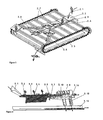
- Fig. 2 separately shows the divider unit for use in the processing line of the invention.
- This divider unit can be used with particular advantage in high speed modern slaughter houses in which more than 12000 birds per hour are processed. With the application of the divider unit the organ packages that are obtained from the birds can be divided over several parallel processing sub-lines in order to reduce the processing speed that is required for each separate processing sub-line.
- the divider unit of the invention employs an endless conveyor chain 2.5 to which pans 2.2, 2.3 and 2.4 are attached.
- said conveyor pans 2.2, 2.3 and 2.4 the organ packages are delivered at the in-feed part 2.1 of the divider unit.
- the conveyor pans 2.2, 2.3 and 2.4 are slideably mounted on bars 2.7 which are perpendicular to the conveying direction of the divider unit. Provision is further made for positioning means 2.6 that cooperate with the conveyor pans 2.2, 2.3 and 2.4 for positioning said pans along the bar or bars 2.7 so as to move the respective pans 2.2, 2.3 and 2.4 and the organ packages contained in said pans to preselected entries of further processing devices, in particular to the organ harvester 3 (see Fig. 1 ) that is placed downstream the divider unit.
- the organ harvester 3 as shown in Fig. 1 is schematically shown in a perspective view. Parts of this organ harvester that are not relevant for the disclosure of the invention are omitted.
- organ packages can be thrown or released into the gutter 3.1 whereby the organ packages have a random orientation.
- the organ packages are dropped onto in-feed giblet rollers 3.2 (for a clearer picture see also Fig. 5 and Fig 6 ).
- the in-feed giblet rollers 3.2 are preferably conically shaped creating an opening between the rollers allowing the intestines forming part of the organ packages to pass through.
- a giblet belt 3.3 which in the shown embodiment is combined with a transport-unit in the form of a roller 3.4 (see fig. 5 ), but, which may also be replaced by a second giblet belt as the one shown with reference numeral 3.3.
- the combined operation of the giblet belt 3.3 and the transport-unit 3.4 forces the softer parts of the organ packages including the duodenum underneath the opening between the transport-unit 3.4 and giblet belt 3.3 leaving the heart, liver and gizzard with pre-stomach on top.
- hinging stopping plates 3.5 to slow down the organ packages so as to improve the drawing of the intestines underneath the opening between the transport-unit 3.4 and giblet belt 3.3.
- a first separator 3.6 Downstream the conveyor means 3.3, 3.4 is a first separator 3.6 which has the purpose to remove the inedible parts of the organ package, leaving the heart, liver and gizzard and pre-stomach undamaged.
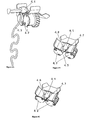
- This first separator is shown in detail in Fig. 4A-4C respectively and is provided with a cutter 4.1 and with catch and drawing means 4.2 below said cutter 4.1.
- the catch and drawing means 4.2 are arranged to catch part of the inedible portions 4.3 of the organ package and subsequently draw said portions so as to cause that the cutter 4.1 can effectively cut the tissue connections between said inedible portions 4.3 and the remainder of the organ package 4.4 which is on top of the separator.
- the catch and drawing means 4.2 are executed as cooperating rollers. These cooperating rollers have during operation opposite rotational directions and are provided with a first section having a first radius and a second section having a second radius, wherein the first radius is larger than the second radius.
- these sections with the second (smaller) radius are shown closest to each other such that a nip 4.5 is provided in between the rollers of the catch and drawing means 4.2 that allows that the softer part 4.3 of the organ package can be caught in the nip 4.5 such that it enters into one of the slits 4.6, 4.7 next to a central tongue 4.1 of the cutter.
- the catch and drawing means 4.2 effectively catch the softer part 4.3 of the organ package due to rotation of the rollers thereof, which rollers are arranged to close the nip 4.5 by having the sections with their first radius move close to each other. Due to this movement the softer part 4.3 of the organ package is gripped and drawn further into one of said slits 4.6, 4.7 adjacent to the central tongue 4.1. Cutting edges that are provided at this central tongue 4.1 respectively at the edges of said slits 4.6, 4.7 effect that tissue connections between the part of the organ package on top of the separator and the part of the organ package below this separator are broken.
- the remainder of the organ package is fed via a chute 3.7 onto a second separator 3.9 having inter alia an exit 3.10 for the heart removed from the organ package, an exit 3.13 for the liver that is removed from the organ package, and an exit 3.14 for the gizzard which is removed from the organ package. Also, there is an exit 3.15 provided below the organ harvester which is intended for disposal of all the inedible parts of the organ package.
- the operation of the second separator 3.9 of the organ harvester shown in Fig. that is located behind the first separator 3.6 is further discussed hereinafter with reference to Figs. 7 and 8 .
- the organ package is provided to the second separator shown in Figs. 7 and 8 by passing it thereon via a chute 3.7.
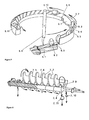
- the organ package 7.1 drops then onto cooperating rollers 7.2 which rollers have pitched grooves on their outer surfaces.
- the cooperating rollers have sufficient space between them to allow the heart and liver to be separated to pass in between. Due to the pitched grooves, the heart 7.3 and liver 7.4 are pulled underneath said rollers 7.2 and the remainder of the organ package 7.1 is conveyed further in the conveying direction indicated with the arrows A.
- the nip between the rollers 7.2 is adjustable so as to be able to selectively define the position at which the heart 7.3 and liver 7.4 will pass the nip between said rollers 7.2.
- a screw transporter 7.5 is provided above the rollers 7.2 in order to effect conveyance of the remainder of the organ package that resides on top of the rollers 7.2, particularly at the part of the rollers where no pitched groove is applied.
- said opening has a diminishing dimension so as to prevent the further passage of the remainder of the organ package on top of the rollers 7.2.
- the screw transporter 7.5 comprises an axis 7.6 that circumferentially is provided with a spiralling wall 7.7 such that adjacent parts of said wall 7.7 are spaced apart enabling to receive an organ from the organ package therebetween.
- this organ notably the gizzard with the pre-stomach attached thereto, is supported by the rollers 7.2.
- a so-called gizzard guide 7.8 which for clarity purposes is not shown in Fig. 8 .
- Fig. 8 shows that the screw transporter 7.5 is provided with a closing wall 7.9 near the exit of the screw transporter that connects adjacent parts of the spiralling wall 7.7.
- tissue connections are broken that connect the gizzard and pre-stomach to parts of the organ package that are caught between and below the nip of the rollers 7.2, by pulling the gizzard with pre-stomach away and tearing thereby said tissue connections so as to eventually allow the gizzard with pre-stomach to exit as indicated with reference numeral 7.10.
- the liver 7.11 which up to that point has remained attached to the gizzard is allowed to exit at 7.11 as well.
- the gizzard and the pre-stomach that attaches thereto can be processed further in a gizzard processing device as schematically shown in Fig. 9 .
- the gizzard and the pre-stomach can be fed to cooperating rollers 9.1 via an in-feed 10 of a chute 18 as shown in Fig. 1 .
- Feeding in the gizzard and pre-stomach can be done in a random orientation since the cooperating rollers 9.1 arrange that the gizzard 9.2 assumes an upright position with the pre-stomach being caught below the gizzard 9.2 in the nip between the rollers 9.1.
- the said rollers 9.1 are further provided with an helical groove causing that the gizzard-package is transported in the direction of a cutting device 9.3 at which the pre-stomach is separated from the gizzard 9.2.
- a pusher 9.4 arranges for the movement of the gizzard 9.2 such that it arrives at a slope portion 9.5 of the gizzard processing device, which is provided with a centrally positioned knife 9.6 and slopes 9.7 extending on both sides of the knife 9.6 at a predetermined angle with respect to said knife 9.6.
- This slope section cuts the gizzard 9.2 gradually open while spreading both sides of the gizzard that are separated from each other into a so called butterfly shape while releasing stones and other contents from the gizzard.
- the slopes 9.7 gradually develop in the conveying direction of the gizzard 9.2 so as to cause that the gizzard can be spread widely open into a completely opened shape.
- the gizzard processing device is further provided with a washing beam 9.9 for the gizzard, that comprises grooves 9.10 at which water supply outlets extend for washing out the gizzard contents that has not yet left the gizzard after it's being cut open by the knife 9.6.
- the washer outlets are not shown in the Figure, however it is completely clear for the artisan how to implement same.
- the gizzard processing device has a part which folds the gizzard inside-out such that it maybe further cleaned and peeled in a subsequent gizzard peeler as shown in Figs. 10-12 .
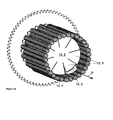
- the gizzard peeler as shown in Figs. 10-12 comprises a series of roller sets 10.3, 10.4. Each rollerset comprising a first roller 10.4 and a second roller 10.3 that in use rotate in opposite directions.
- each of the rollersets 10.3, 10.4 partly borders a space for receipt of the gizzard 10.5 and that the rollersets 10.3, 10.4 collectively form a substantially cylindrical case for said gizzard (see Fig. 10 ) or form part of such a case as shown in Fig. 11 .
- some rollersets are replaced by plates 11.1 which plates however together with all the rollersets shape the case in which the gizzard 10.5 is received.
- rollersets 10.3, 10.4 are rotatable around a central body axis of the case, such that the case constitutes a revolving enclosure for the gizzard 10.5, and the individual rollers 10.3, 10.4 execute a combined dual rotation both along their own axis and around the central body axis of the case.
- FIG. 10 and Fig. 11 Schematically both Fig. 10 and Fig. 11 further show that the first roller 10.4 has teeth that intermesh with a gear 10.2 and that there is a rotatable plate 10.1 that is provided with a circular series of holes 10.6. Each of these holes is intended to receive an axis, for instance the axes of the first rollers 10.4. Further the first rollers 10.4 and second rollers 10.3 have intermeshing teeth. Due to the combined operation of these intermeshing teeth of the first rollers 10.4 and second rollers 10.3, the rotation of the plate 10.1 causes that the first rollers 10.4 will rotate around their own axis. Due to the static positioning of the gear 10.2 consequently also the second rollers 10.3 will rotate albeit in the opposite direction of first rollers 10.4 due to the intermeshing teeth of the first and second rollers 10.3, 10.4.
- Figures 10 and 11 further show that the intermeshing teeth of the first and second rollers 10.3, 10.4 are helically shaped which not only promotes the peeling action on the gizzards 10.5, but also promotes movement of the gizzards 10.5 in the conveying direction indicated with arrow B.
- Fig. 12 shows that the gizzard peeler may be provided with a stopper disc 12.1 between the peeler's in-feed and its exit.
- This stopper disc 12.1 preferably has a central portion 12.2 which circumferentially is provided with resilient flaps 12.3 to delay the movement of the gizzard 12.5 in its conveying direction indicated with arrow B, causing that the peeling action on the gizzard 12.5 is prolonged.
- the gizzard peeler may be provided with a washing unit, such as a washing drum, at its in-feed and/or its exit.
- a washing unit such as a washing drum
Landscapes
- Life Sciences & Earth Sciences (AREA)
- Engineering & Computer Science (AREA)
- Food Science & Technology (AREA)
- Wood Science & Technology (AREA)
- Zoology (AREA)
- Processing Of Meat And Fish (AREA)
- Apparatuses For Bulk Treatment Of Fruits And Vegetables And Apparatuses For Preparing Feeds (AREA)
- Control And Other Processes For Unpacking Of Materials (AREA)
- Medical Preparation Storing Or Oral Administration Devices (AREA)
Claims (33)
- Procédé pour traiter mécaniquement un organe ou des organes extraits d'une volaille abattue dans un dispositif de traitement ou chaîne de traitement, lequel organe ou lesquels organes font partie d'un paquet d'organes, et dans lequel ledit organe ou lesdits organes sont séparés du paquet d'organes, dans lequel le paquet d'organes est spatialement orienté par le dispositif de traitement dans un ordre présélectionné sans casser en particulier des connexions de tissu dans le paquet afin de causer que la collecte d'organes du paquet se rpoduise dans une séquence présélectionnée qui dépend de l'emplacement du paquet d'organes dans le dispositif de traitement ou la chaîne de traitement, caractérisé en ce que l'orientation spatiale du paquet d'organes est réalisée par des moyens à convoyeur qui soumettent simultanément l'organe ou les organes dans ledit paquet à une force de propulsion pour déplacer le paquet à travers le dispositif de traitement ou la chaîne de traitement, et que des moyens d'arrêt sont agencés pour retarder temporairement le mouvement des paquets d'organes dans la direction de convoyage afin de prolonger l'action desdits moyens à convoyer sur les paquets d'organes pour leur donner la bonne orientation.
- Procédé selon la revendication 1, caractérisé en ce que le paquet d'organes est convoyé jusqu'au dispositif de traitement ou la chaîne de traitement, moyennant quoi les organes dans le paquet sont orientés de manière aléatoire.
- Procédé selon les revendications 1 ou 2, dans lequel la collecte des organes a lieu après le retrait d'au moins la vésicule biliaire du paquet d'organes.
- Procédé selon la revendication 3, dans lequel le paquet d'organes comprend un duodénum qui est écarté du reste du paquet d'organes afin d'exposer les connexions de tissu entre la vésicule biliaire et les autres organes du paquet d'organes à un instrument de coupe.
- Procédé selon l'une quelconque des revendications 1 à 4, caractérisé en ce que la collecte des organes est exécutée en déchirant ou en coupant les connexions de tissu qui raccordent lesdits organes au reste du paquet d'organes.
- Procédé selon l'une quelconque des revendications 1 à 5, caractérisé en ce que le paquet d'organes comprend n'importe quelle combinaison d'organes choisis dans le groupe comprenant le coeur, le foie, le gésier, le pré-estomac.
- Chaîne de traitement pour collecter un organe ou des organes d'un paquet d'organes extrait d'une volaille abattue, comprenant au moins un dispositif de traitement pour traiter un organe ou des organes dudit paquet d'organes, dans laquelle le au moins un dispositif de traitement est un collecteur d'organe pour collecter un organe choisi dans le groupe comprenant le coeur, le foie, le gésier, le pré-estomac et leurs combinaisons, et/ou un dispositif de traitement de gésier et/ou un éplucheur de gésier, lequel collecteur d'organe comprend une entrée et une sortie, et des moyens de traitement mis en oeuvre sous la forme de moyens à convoyeur agencés entre l'entrée et la sortie qui sont agencés pour fournir simultanément une orientation présélectionnée au paquet d'organes et propager ledit paquet d'organes de l'entrée à la sortie, dans laquelle, en outre, ledit dispositif de traitement est prévu avec des moyens de décharge de déchet pour jeter les parties non comestibles du paquet d'organes, caractérisée en ce que les moyens de à convoyeur coopèrent avec des moyens d'arrêt pour retarder temporairement le mouvement des paquets d'organes dans la direction de convoyage afin de prolonger l'action desdits moyens à convoyeur sur les paquets d'organes pour leur donner une orientation prédéterminée.
- Chaîne de traitement selon la revendication 7, dans laquelle une série de dispositifs de traitement sont agencés pour collecter de manière séquentielle d'un paquet d'organes, un ou plusieurs organes du groupe comprenant un coeur, un foie, un gésier avec un pré-estomac fixé à ce dernier.
- Chaîne de traitement selon la revendication 7 ou 8, comprenant un dispositif de traitement de gésier pour séparer un pré-estomac d'un gésier et un éplucheur de gésier pour éplucher ensuite ledit gésier.
- Chaîne de traitement selon l'une quelconque des revendications 7 à 9, caractérisé en ce qu'elle comprend une unité de division dans une ligne de convoyeur pour transporter les paquets d'organes, afin de transférer sélectivement les paquets d'organes de ladite ligne de convoyeur à des lignes auxiliaires parallèles pour collecter les organes desdits paquets d'organes dans chacune desdites lignes auxiliaires parallèles.
- Collecteur d'organe ayant une entrée pour les paquets d'organes et une ou plusieurs sorties pour un organe ou les organes qui sont séparés desdits paquets d'organes et des moyens à convoyeur entre l'entrée et les une ou plusieurs sorties afin de déplacer les paquets d'organes ou des parties de ces derniers de l'entrée vers la sortie ou les sorties, lesquels moyens à convoyeur sont agencés pour amener les paquets d'organes dans une orientation prédéterminée, dans laquelle les parties non comestibles, desdits paquets, comprenant le duodénum, sont au-dessous des parties comestibles desdits paquets, caractérisé en ce que les moyens à convoyeur coopèrent avec des moyens d'arrêt pour retarder temporairement le mouvement des paquets d'organes dans la direction de transport afin de prolonger l'action desdits moyens à convoyeur sur les paquets d'organes pour leur donner l'orientation prédéterminée.
- Collecteur d'organe selon la revendication 11, caractérisé en ce que, en aval des moyens de transporteur, on trouve un premier séparateur pour détacher les parties non comestibles du paquet d'organes.
- Collecteur d'organe selon la revendication 12, caractérisé en ce que le premier séparateur est un dispositif de coupe avec des moyens de saisie et de retrait au-dessous dudit dispositif de coupe, dans lequel les moyens de saisie et de retrait sont agencés pour saisir une partie des parties non comestibles du paquet d'organes et retirer ensuite lesdites parties afin d'amener le dispositif de coupe à couper efficacement les raccordements de tissu entre lesdites parties non comestibles et le reste du paquet d'organes.
- Collecteur d'organe selon la revendication 13, caractérisé en ce que les moyens de saisie et de retrait sont réalisés sous forme de rouleaux coopérants ayant, pendant le fonctionnement, des directions de rotation opposées, lesquels rouleaux sont chacun prévus avec une première section ayant un premier rayon et une seconde section ayant un second rayon, dans lequel le premier rayon est plus grand que le second rayon, et les rouleaux sont agencés de sorte que pendant le fonctionnement, les premières sections respectives et les secondes sections respectives desdits rouleaux exécutent un mouvement en miroir.
- Collecteur d'organe selon la revendication 14, caractérisé en ce que les rouleaux coopérants des moyens de saisie et de retrait ont, au niveau desdites premières sections, des dents d'engrènement et en ce que lesdites secondes sections des rouleaux définissent une ligne de contact entre eux lorsque lesdites secondes sections sont adjacentes entre elles.
- Collecteur d'organe selon l'une quelconque des revendications 13 à 15, caractérisé en ce que le dispositif de coupe a une languette centrale et des fentes des deux côtés adjacents à cette dernière pour recevoir dans au moins l'une desdites fentes, les raccordements de tissu du paquet d'organes, dans lequel la languette centrale et/ou lesdites fentes sont prévues avec des bords de coupe.
- Collecteur d'organe selon l'une quelconque des revendications 11 à 16, caractérisé en ce que les moyens à convoyeur comprennent au moins une courroie sans fin qui coopère avec une unité de transport choisie dans le groupe comprenant une seconde courroie sans fin et un rouleau, dans lequel entre ladite au moins une courroie sans fin et ladite unité de transport, on prévoit une ligne de contact qui permet aux parties non comestibles des paquets d'organes de passer à travers.
- Collecteur d'organe selon la revendication 17, caractérisé en ce que la au moins une courroie sans fin et l'unité de transport sont chacune prévues de manière circonférentielle avec des rainures coopérantes qui, pendant le fonctionnement, se déplacent dans des directions de rotation opposées.
- Collecteur d'organe selon la revendication 17 ou 18, caractérisé en ce que la au moins une courroie sans fin et/ou la seconde courroie sans fin ont chacune une direction de mouvement qui est perpendiculaire à la direction de transport des moyens à convoyeur.
- Collecteur d'organe selon l'une quelconque des revendications 17 à 19, caractérisé en ce que, adjacentes à l'unité de transport, les rainures de la au moins une courroie sans fin sont formées comme une partie d'une rainure inclinée.
- Collecteur d'organe selon l'une quelconque des revendications 17 à 20, caractérisé en ce que, à distance de l'unité de transport, les rainures de la au moins une courroie sans fin sont formées comme des parties de rainure en quinconce.
- Collecteur d'organe selon l'une quelconque des revendications 11 à 21, caractérisé en ce que, en aval des moyens à convoyeur, on trouve un second séparateur pour séparer un organe ou des organes du paquet d'organes.
- Collecteur d'organe selon la revendication 22, caractérisé en ce que dans la direction de convoyage, le second séparateur est positionné derrière le premier séparateur.
- Collecteur d'organe selon la revendication 22 ou 23, caractérisé en ce que le second séparateur comprend au moins deux premiers rouleaux coopérants qui sont au moins en partie circonférentiellement prévus avec des rainures, et en ce que lesdits premiers rouleaux définissent une ligne de contact de préférence ajustable entre lesdits rouleaux pour permettre sélectivement aux premiers organes présélectionnés dudit paquet d'organes de passer à travers, et en ce que, pendant le fonctionnement, lesdits premiers rouleaux tournent dans des directions opposées afin de transporter le paquet d'organes et favoriser simultanément lesdits premiers organes présélectionnés pour passer à travers ladite ligne de contact.
- Collecteur d'organe selon l'une quelconque des revendications 22 à 24, caractérisé en ce que le second séparateur comprend au moins sur une partie de la trajectoire de convoyage du paquet d'organes, un transporteur à vis.
- Collecteur d'organe selon la revendication 25, caractérisé en ce que le transporteur à vis est positionné au-dessus des moyens de support pour l'organe ou les organes à transporter.
- Collecteur d'organe selon la revendication 26, caractérisé en ce que les moyens de support sont des seconds rouleaux coopérants avec au moins une partie d'une surface lisse, lesquels seconds rouleaux ont une ligne de contact entre eux empêchant le passage d'un second organe ou de seconds organes présélectionnés.
- Collecteur d'organe selon la revendication 26 ou 27, caractérisé en ce que le transporteur à vis et les moyens de support définissent un espace pour recevoir à l'intérieur de ce dernier, l'organe ou les organes.
- Collecteur d'organe selon l'une quelconque des revendications 24 à 28, caractérisé en ce que les premiers rouleaux et les seconds rouleaux sont unitaires et définissent une ligne de contact progressivement rétrécie entre lesdits rouleaux, lorsqu'observée dans la direction de transport desdits rouleaux, afin de provoquer le déplacement des premiers organes présélectionnés à travers ladite ligne de contact au niveau de la partie la plus large de ladite ligne de contact alors que les seconds organes présélectionnés restent supportés et transportés par lesdits rouleaux.
- Collecteur d'organe selon l'une quelconque des revendications 24 à 29, caractérisé en ce que le transporteur à vis comprend un axe qui est circonférentiellement prévu avec une paroi en spirale, dans lequel les parties adjacentes de ladite paroi sont espacées afin de permettre la réception d'un second ou de seconds organes présélectionnés entre elles, et en ce qu'il y a une paroi de fermeture à la sortie du transporteur à vis qui raccorde les parties adjacentes de la paroi en spirale.
- Collecteur d'organe selon l'une quelconque des revendications 24 à 30, caractérisé en ce que le transporteur à vis est agencé pour séparer et détacher les premiers organes présélectionnés des seconds organes présélectionnés dudit paquet d'organes.
- Collecteur d'organe selon l'une quelconque des revendications 25 à 31, caractérisé en ce qu'il est agencé de sorte que, pendant le fonctionnement, la paroi de fermeture à la sortie du transporteur à vis agit sur un second organe ou les seconds organes présélectionnés pour rompre les connexions de tissu qui raccordent ledit second organe ou lesdits seconds organes à un premier organe ou des premiers organes présélectionnés qui sont agencés au-dessous des rouleaux coopérants qui supportent ledit second organe ou lesdits seconds organes du paquet d'organes.
- Collecteur d'organe selon l'une quelconque des revendications 11 à 32, caractérisé en ce que lorsque le paquet d'organes comprend au moins un coeur et/ou un foie et/ou un gésier et/ou un pré-estomac, le collecteur est adapté pour amener lesdits organes ou une sélection de ces derniers à sa sortie ou ses sorties.
Priority Applications (9)
| Application Number | Priority Date | Filing Date | Title |
|---|---|---|---|
| EP10177672.2A EP2294922B1 (fr) | 2008-03-20 | 2008-03-20 | Un éplucheur au gésier |
| DK10177672.2T DK2294922T3 (en) | 2008-03-20 | 2008-03-20 | Device for skinning crows |
| DK10177674.8T DK2305045T3 (da) | 2008-03-20 | 2008-03-20 | Kråsebehandlingsanordning |
| EP10177674.8A EP2305045B1 (fr) | 2008-03-20 | 2008-03-20 | Dispositif pour procéder des gésiers |
| DK08102829.2T DK2103222T3 (da) | 2008-03-20 | 2008-03-20 | Fremgangsmåde og apparatur til mekanisk bearbejdning af et organ eller organer udtaget af slagtet fjerkræ |
| EP08102829A EP2103222B1 (fr) | 2008-03-20 | 2008-03-20 | Procédé et appareil pour traitement mécanique d'un organe ou organes extraits de la viande de volaille abattue |
| US12/408,496 US9004987B2 (en) | 2008-03-20 | 2009-03-20 | Method and apparatus for mechanically processing an organ or organs taken out from slaughtered poultry |
| US13/157,854 US8303383B2 (en) | 2008-03-20 | 2011-06-10 | Method and apparatus for mechanically processing an organ or organs taken out from slaughtered poultry |
| US13/157,794 US8920222B2 (en) | 2008-03-20 | 2011-06-10 | Method and apparatus for mechanically processing an organ or organs taken out from slaughtered poultry |
Applications Claiming Priority (1)
| Application Number | Priority Date | Filing Date | Title |
|---|---|---|---|
| EP08102829A EP2103222B1 (fr) | 2008-03-20 | 2008-03-20 | Procédé et appareil pour traitement mécanique d'un organe ou organes extraits de la viande de volaille abattue |
Related Child Applications (4)
| Application Number | Title | Priority Date | Filing Date |
|---|---|---|---|
| EP10177674.8A Division-Into EP2305045B1 (fr) | 2008-03-20 | 2008-03-20 | Dispositif pour procéder des gésiers |
| EP10177674.8A Division EP2305045B1 (fr) | 2008-03-20 | 2008-03-20 | Dispositif pour procéder des gésiers |
| EP10177672.2A Division-Into EP2294922B1 (fr) | 2008-03-20 | 2008-03-20 | Un éplucheur au gésier |
| EP10177672.2A Division EP2294922B1 (fr) | 2008-03-20 | 2008-03-20 | Un éplucheur au gésier |
Publications (2)
| Publication Number | Publication Date |
|---|---|
| EP2103222A1 EP2103222A1 (fr) | 2009-09-23 |
| EP2103222B1 true EP2103222B1 (fr) | 2012-10-10 |
Family
ID=39629031
Family Applications (3)
| Application Number | Title | Priority Date | Filing Date |
|---|---|---|---|
| EP08102829A Not-in-force EP2103222B1 (fr) | 2008-03-20 | 2008-03-20 | Procédé et appareil pour traitement mécanique d'un organe ou organes extraits de la viande de volaille abattue |
| EP10177674.8A Active EP2305045B1 (fr) | 2008-03-20 | 2008-03-20 | Dispositif pour procéder des gésiers |
| EP10177672.2A Not-in-force EP2294922B1 (fr) | 2008-03-20 | 2008-03-20 | Un éplucheur au gésier |
Family Applications After (2)
| Application Number | Title | Priority Date | Filing Date |
|---|---|---|---|
| EP10177674.8A Active EP2305045B1 (fr) | 2008-03-20 | 2008-03-20 | Dispositif pour procéder des gésiers |
| EP10177672.2A Not-in-force EP2294922B1 (fr) | 2008-03-20 | 2008-03-20 | Un éplucheur au gésier |
Country Status (3)
| Country | Link |
|---|---|
| US (3) | US9004987B2 (fr) |
| EP (3) | EP2103222B1 (fr) |
| DK (3) | DK2103222T3 (fr) |
Cited By (1)
| Publication number | Priority date | Publication date | Assignee | Title |
|---|---|---|---|---|
| CN106614991A (zh) * | 2016-10-31 | 2017-05-10 | 惠州市欧野科技有限公司 | 一种快速剥除鸭内金的工具 |
Families Citing this family (27)
| Publication number | Priority date | Publication date | Assignee | Title |
|---|---|---|---|---|
| US8632380B2 (en) | 2010-01-26 | 2014-01-21 | Foodmate B.V. | Method and apparatus for removing a sleeve of meat from an animal part having bone with knuckles on each of its opposite ends |
| US8157625B2 (en) | 2010-01-26 | 2012-04-17 | Foodmate Bv | Method and apparatus for collecting meat from an animal part |
| US8789684B2 (en) | 2010-04-19 | 2014-07-29 | Foodmate Bv | Rotatable article support for a conveyor |
| US8757354B2 (en) | 2010-04-19 | 2014-06-24 | Foodmate Bv | Turning block alignment |
| NL2004574C2 (en) | 2010-04-19 | 2011-10-20 | Foodmate B V | Rotatable article support for a conveyor. |
| NL2004573C2 (en) | 2010-04-19 | 2011-10-20 | Foodmate B V | Turning block alignment. |
| NL2006075C2 (en) | 2011-01-26 | 2012-07-30 | Foodmate B V | Rotationally indexed article support for a conveyor system having an alignment station. |
| US8727839B2 (en) | 2011-01-21 | 2014-05-20 | Foodmate Bv | Poultry wing cutter for narrow pitch poultry lines |
| US8882571B2 (en) | 2011-01-26 | 2014-11-11 | Foodmate Bv | Method of deboning animal thighs for separating and collecting meat therefrom and apparatus for performing the method |
| EP2667728B1 (fr) | 2011-01-26 | 2015-07-29 | Foodmate B.V. | Procédé de désossage de cuisses d'animaux pour en séparer et en recueillir la viande et appareil pour mettre en oeuvre le procédé |
| US8267241B2 (en) | 2011-01-26 | 2012-09-18 | Foodmate Bv | Rotationally indexed article support for a conveyor system having an alignment station |
| US8430728B2 (en) | 2011-02-14 | 2013-04-30 | Foodmate Bv | Special cut poultry wing cutter |
| RU2476164C1 (ru) * | 2012-01-18 | 2013-02-27 | Государственное бюджетное образовательное учреждение высшего профессионального образования "Кубанский государственный медицинский университет" Министерства здравоохранения и социального развития Российской Федерации (ГБОУ ВПО КубГМУ Минздравсоцразвития России) | Способ дуоденопластики при хронической язве луковицы двенадцатиперстной кишки, осложненной декомпенсированным стенозом и пенетрацией в интрапанкреатическую часть общего желчевыносящего протока |
| US8439730B1 (en) * | 2012-02-15 | 2013-05-14 | Remington Holdings Llc | Gizzard processing apparatus |
| NL2009033C2 (en) | 2012-06-19 | 2013-12-23 | Foodmate B V | Weighing method and apparatus. |
| US8808068B2 (en) | 2012-10-29 | 2014-08-19 | Foodmate Bv | Method of and system for automatically removing meat from an animal extremity |
| NL2009718C2 (en) | 2012-10-29 | 2014-05-01 | Foodmate B V | Method of mechanically removing skin from animal parts. |
| US9078453B2 (en) | 2013-11-01 | 2015-07-14 | Foodmate B.V. | Method and system for automatically deboning poultry breast caps containing meat and a skeletal structure to obtain breast fillets therefrom |
| NL2013777C2 (en) * | 2013-11-13 | 2015-06-18 | Marel Stork Poultry Proc Bv | System, method, and carousel device for skin removal from defeathered whole leg or drumstick poultry products. |
| US8961274B1 (en) | 2013-12-18 | 2015-02-24 | Foodmate Bv | Selective tendon cutter and method |
| NL2012464B1 (en) * | 2014-03-18 | 2015-12-15 | Meyn Food Proc Technology Bv | Method, processing device and processing line for mechanically processing an organ or organs taken out from slaughtered poultry. |
| NL2012465B1 (en) | 2014-03-18 | 2015-12-15 | Meyn Food Proc Technology Bv | Method, processing device and processing line for mechanically processing an organ or organs taken out from slaughtered poultry. |
| NL2012466B1 (en) | 2014-03-18 | 2015-12-15 | Meyn Food Proc Technology Bv | Method, processing device and processing line for mechanically processing an organ or organs taken out from slaughtered poultry. |
| NL2014512B1 (en) | 2015-03-24 | 2017-01-19 | Meyn Food Proc Technology Bv | Apparatus for mechanically processing an organ or organs taken out from slaughtered poultry. |
| KR101883546B1 (ko) * | 2016-05-20 | 2018-07-31 | 김인환 | 닭의 모래주머니 세척장치 |
| CN106387003B (zh) * | 2016-11-22 | 2018-12-14 | 江苏万力生物科技有限公司 | 一种用于生产肝素钠产品的刮肠机 |
| CN118216552A (zh) * | 2024-05-06 | 2024-06-21 | 杭州申浙家禽有限公司 | 剥胗机的剥除机构 |
Family Cites Families (68)
| Publication number | Priority date | Publication date | Assignee | Title |
|---|---|---|---|---|
| US2516499A (en) | 1945-02-09 | 1950-07-25 | Edward J Albright | Conveyer for eviscerating apparatus |
| US2738547A (en) * | 1950-12-04 | 1956-03-20 | Gordon W Johnson Company | Poultry treating apparatus |
| DE1202722B (de) | 1959-05-14 | 1965-10-07 | Otto Haensel Ges Mit Beschraen | Vorrichtung zum Befoerdern von Schokoladetafeln oder -riegeln |
| US3172148A (en) * | 1963-10-30 | 1965-03-09 | Carl J Hill | Poultry gizzard processing apparatus |
| US3579714A (en) * | 1968-11-21 | 1971-05-25 | John C Edwards | Gizzard processing device |
| GB1418016A (en) | 1972-12-07 | 1975-12-17 | Amf Inc | Dispensing of particulate material |
| US4057875A (en) * | 1976-11-03 | 1977-11-15 | Hill Carl J | Feed apparatus for poultry gizzard processing machine |
| US4090275A (en) * | 1976-12-15 | 1978-05-23 | Jorgensen Olaf V | Conveyor tray system for entrails |
| US4215450A (en) * | 1978-10-31 | 1980-08-05 | Poss Design Limited | Skinning machine |
| US4538325A (en) * | 1980-08-19 | 1985-09-03 | Centennial Machine Company, Inc. | Gizzard harvesting machine |
| DE3276922D1 (en) * | 1981-03-04 | 1987-09-17 | Stork Pmt | Device for separating the gizzard from the connected entrails of slaughtered poultry |
| US4608732A (en) | 1982-05-04 | 1986-09-02 | Hill William J | Gizzard harvesting process |
| US4570296A (en) * | 1982-05-04 | 1986-02-18 | Hill William J | Gizzard harvesting apparatus |
| US4590643A (en) * | 1983-01-26 | 1986-05-27 | Hill William J | High yield gizzard harvesting apparatus |
| US4682386A (en) | 1983-07-13 | 1987-07-28 | Systemate B.V. | Poultry breast filleting system |
| NL8402165A (nl) | 1984-07-06 | 1986-02-03 | Meyn Pieter | Werkwijze en inrichting voor het verwijderen van borstvlees van een gevogeltekarkas. |
| US4715092A (en) | 1985-01-04 | 1987-12-29 | Automatic Packaging Systems, Inc. | Apparatus and method for cutting slaughtered poultry into separate pieces |
| US4691412A (en) | 1985-07-08 | 1987-09-08 | Oswald Brown | Bivalve mollusk shucker |
| US4691410A (en) | 1986-03-17 | 1987-09-08 | Perdue Incorporated | Gizzard harvester |
| US4748722A (en) | 1986-03-17 | 1988-06-07 | Perdue Incorporated | Gizzard harvester |
| US4815166A (en) * | 1988-01-19 | 1989-03-28 | Foodcraft Equipment Company | Method and apparatus for processing turkey gizzards |
| US4827570A (en) | 1988-01-25 | 1989-05-09 | Simon-Johnson, Inc. | Method and apparatus for removing breast meat from poultry carcass |
| US4799292A (en) | 1988-03-25 | 1989-01-24 | Centennial Machine Company, Inc. | Gizzard peeling apparatus |
| DE3811317A1 (de) | 1988-04-02 | 1989-10-19 | Nordischer Maschinenbau | Verfahren zum gewinnen des fleisches von den koerpern geschlachteten gefluegels und vorrichtung zur durchfuehrung des verfahrens |
| US4951352A (en) * | 1990-02-02 | 1990-08-28 | Grover S. Harben, Iii | Apparatus and process for harvesting hearts and livers of poultry |
| DE4008719A1 (de) | 1990-03-19 | 1991-09-26 | Nordischer Maschinenbau | Verfahren zum filetieren von gefluegelkoerpern |
| US5186678A (en) * | 1990-08-01 | 1993-02-16 | Cantrell Machine Company, Inc. | Heart and liver harvesting system |
| US5041052A (en) | 1990-08-01 | 1991-08-20 | Cantrell Machine Company, Inc. | Liver harvesting system and method |
| US5041053A (en) | 1990-08-01 | 1991-08-20 | Cantrell Machine Company, Inc. | Heart harvesting system and method |
| US5098336A (en) | 1990-10-17 | 1992-03-24 | Delong Horace J | Poultry peeling apparatus |
| NL9002287A (nl) * | 1990-10-19 | 1992-05-18 | Stork Pmt | Werkwijze en inrichting voor het scheiden van hart, longen en lever van het ingewandenpakket van een vogel. |
| NL9002551A (nl) * | 1990-11-22 | 1992-06-16 | Stork Pmt | Inrichting voor het selectief verwijderen van organen uit een slachtdier. |
| DE4105564A1 (de) | 1991-02-22 | 1992-08-27 | Nordischer Maschinenbau | Einrichtung zum bearbeiten von gefluegelkoerpern |
| NL9101694A (nl) * | 1991-10-09 | 1993-05-03 | Meyn Maschf | Inrichting voor het bewerken van spiermagen van gevogelte. |
| US5197917A (en) | 1991-10-11 | 1993-03-30 | Stork Gamco, Inc. | Apparatus for removing skin from animal parts |
| NL9101856A (nl) * | 1991-11-07 | 1993-06-01 | Meyn Maschf | Werkwijze en inrichting voor het in losse onderdelen scheiden van een uit een vogel verwijderd pakket bestaande uit darmen, lever en hart met longen. |
| NL9200599A (nl) | 1992-03-31 | 1993-10-18 | Meyn Maschf | Inrichting voor het transporteren van uit vogels verwijderde ingewandenpakketten. |
| NL9300815A (nl) * | 1992-09-10 | 1994-04-05 | Stork Pmt | Werkwijze en inrichting voor het verwijderen en verwerken van een organenpakket van een slachtdier. |
| DE4234040C2 (de) | 1992-10-09 | 1997-05-22 | Nordischer Maschinenbau | Verfahren zum maschinellen Gewinnen des Fleisches von Geflügelkörpern und Einrichtung zur Durchführung des Verfahrens |
| DE4304781C1 (de) | 1993-02-17 | 1994-09-22 | Nordischer Maschinenbau | Verfahren zum Abtrennen der Flügel von Geflügelkörpern |
| US5314374A (en) | 1993-06-14 | 1994-05-24 | Jay Koch | Apparatus for removing tenders from a poultry carcass |
| NL9400665A (nl) * | 1994-04-26 | 1995-12-01 | Meyn Maschf | Werkwijze en inrichting voor het in delen scheiden van een uit een geslachte vogel verwijderd ingewandenpakket. |
| NL9401198A (nl) | 1994-07-21 | 1996-03-01 | Stork Pmt | Werkwijze en inrichting voor het fileren van de romp van geslacht gevogelte. |
| US5466185A (en) | 1994-08-08 | 1995-11-14 | Foodcraft Equipment Company | Removing breast meat from poultry |
| NL9401887A (nl) * | 1994-11-11 | 1996-06-03 | Stork Pmt | Werkwijze en inrichting voor het scheiden van ten minste één stuk ingewandsweefsel van ten minste één daarmee verbonden orgaan. |
| NL1000798C2 (nl) * | 1995-07-14 | 1997-01-15 | Meyn Maschf | Inrichting voor het in losse onderdelen verdelen van een samenstel uit hart en longen. |
| US5697837A (en) | 1995-07-17 | 1997-12-16 | Sytemate Holland, B.V. | Poultry breast filleting apparatus |
| NL1000935C2 (nl) | 1995-08-04 | 1997-02-06 | Stork Pmt | Inrichting en werkwijze voor het bewerken van een slachtdier. |
| BR9704625A (pt) | 1996-01-19 | 1999-12-07 | Johnson Food Equipment Inc | Método e aparelho para eviscerar aves domésticas para alimento, inclusive o papo. |
| US5833527A (en) | 1996-01-23 | 1998-11-10 | Systemate Holland, B.V. | Poultry breast filleting apparatus |
| NL1002831C2 (nl) | 1996-04-10 | 1997-10-14 | Meyn Maschf | Inrichting voor het fileren van het borststuk van geslacht gevogelte. |
| US6382401B2 (en) | 1998-06-25 | 2002-05-07 | Yamato Scale Company, Limited | Boxing system using conveyor apparatus |
| DE19848498A1 (de) * | 1998-10-21 | 2000-05-04 | Nordischer Maschinenbau | Filetiervorrichtung |
| ES2183626T3 (es) | 1998-12-07 | 2003-03-16 | Linco Food Systems As | Metodo y aparato para separar paquetes intestinales de aves sacrificadas, en particular de pollos. |
| NL1012703C2 (nl) | 1999-04-06 | 2000-10-09 | Stork Pmt | Werkwijze en inrichting voor het bewerken van een gevogeltepoot. |
| NL1013471C2 (nl) | 1999-11-03 | 2001-05-04 | Systemate Group Bv | Slokdarmsnijder. |
| US6283847B1 (en) | 2000-02-10 | 2001-09-04 | Allan Todd Berry | Poultry breast cartilage harvesting system |
| US6630561B2 (en) * | 2000-04-24 | 2003-10-07 | Ube Industries, Ltd. | Crystalline polyesterpolyol and hot-melt adhesive |
| US7017730B2 (en) * | 2000-05-12 | 2006-03-28 | Lockheed Martin Corporation | Bi-directional mail tray pusher |
| DK175558B1 (da) * | 2000-09-15 | 2004-12-06 | Slagteriernes Forskningsinst | Apparat og fremgangsmåde til automatisk at adskille lever fra et pluckssæt fra en slagtekrop |
| DK2258203T3 (en) | 2002-12-20 | 2018-01-15 | Marel Stork Poultry Proc Bv | Method and apparatus for processing a body part of slaughtered poultry |
| NL1022858C2 (nl) | 2003-03-06 | 2004-09-16 | Meyn Food Proc Technology Bv | Fileerstraat voor gevogelte. |
| NL1023819C2 (nl) * | 2003-07-04 | 2005-01-05 | Meyn Food Proc Technology Bv | Inrichting voor het verbreken van weefselverbindingen in aan de poten hangend gevogelte. |
| US7314405B2 (en) | 2005-02-17 | 2008-01-01 | Viscofan, S.A. | Feeder for meat pieces made of entire muscles for a piston stuffing machine |
| NL1033313C2 (nl) | 2007-01-31 | 2008-08-01 | Vanderlande Ind Nederland | Sorteerinrichting met name voor bagagestukken. |
| NL1033604C2 (nl) | 2007-03-27 | 2008-09-30 | Stork Pmt | Systeem en werkwijze voor het bewerken van een karkasdeel van geslacht gevogelte. |
| US7500910B2 (en) | 2007-08-06 | 2009-03-10 | Johnson Food Equipment, Inc. | Device and method for clamping and cutting |
| NL2002836C2 (en) * | 2009-05-04 | 2010-11-08 | Meijn Food Proc Technology B V | Gizzard peeler and method of peeling a gizzard. |
-
2008
- 2008-03-20 EP EP08102829A patent/EP2103222B1/fr not_active Not-in-force
- 2008-03-20 EP EP10177674.8A patent/EP2305045B1/fr active Active
- 2008-03-20 DK DK08102829.2T patent/DK2103222T3/da active
- 2008-03-20 EP EP10177672.2A patent/EP2294922B1/fr not_active Not-in-force
- 2008-03-20 DK DK10177672.2T patent/DK2294922T3/en active
- 2008-03-20 DK DK10177674.8T patent/DK2305045T3/da active
-
2009
- 2009-03-20 US US12/408,496 patent/US9004987B2/en not_active Expired - Fee Related
-
2011
- 2011-06-10 US US13/157,854 patent/US8303383B2/en active Active
- 2011-06-10 US US13/157,794 patent/US8920222B2/en active Active
Cited By (1)
| Publication number | Priority date | Publication date | Assignee | Title |
|---|---|---|---|---|
| CN106614991A (zh) * | 2016-10-31 | 2017-05-10 | 惠州市欧野科技有限公司 | 一种快速剥除鸭内金的工具 |
Also Published As
| Publication number | Publication date |
|---|---|
| US20090239457A1 (en) | 2009-09-24 |
| US8920222B2 (en) | 2014-12-30 |
| EP2294922A2 (fr) | 2011-03-16 |
| DK2103222T3 (da) | 2013-01-28 |
| EP2305045A2 (fr) | 2011-04-06 |
| DK2294922T3 (en) | 2017-10-09 |
| EP2305045B1 (fr) | 2018-09-05 |
| US8303383B2 (en) | 2012-11-06 |
| DK2305045T3 (da) | 2019-01-02 |
| EP2294922A3 (fr) | 2012-06-13 |
| EP2294922B1 (fr) | 2017-06-28 |
| EP2305045A3 (fr) | 2012-06-13 |
| EP2103222A1 (fr) | 2009-09-23 |
| US20110237171A1 (en) | 2011-09-29 |
| US9004987B2 (en) | 2015-04-14 |
| US20110244773A1 (en) | 2011-10-06 |
Similar Documents
| Publication | Publication Date | Title |
|---|---|---|
| US9004987B2 (en) | Method and apparatus for mechanically processing an organ or organs taken out from slaughtered poultry | |
| EP3157342B1 (fr) | Système et procédé pour extraire le fémur d'un produit de jambe de volaille déplumé | |
| EP0431607A1 (fr) | Machine à enlever les ailes de volailles abattues | |
| US9320287B2 (en) | System and method for harvesting saddle meat from a carcass part of slaughtered poultry | |
| JP2014121336A (ja) | 解体処理した家禽の死骸部分を処理するためのシステム及び方法 | |
| US4590643A (en) | High yield gizzard harvesting apparatus | |
| KR101659804B1 (ko) | 생선 가공 장치 | |
| KR100751820B1 (ko) | 생선 가공방법 및 그 가공장치 | |
| PL184395B1 (pl) | Urządzenie do młócenia tytoniu | |
| CN114206118B (zh) | 一种用于给家禽去内脏的方法、用于去除家禽内脏之前的预准备装置、去内脏系统和收集器装置 | |
| EP3075258B1 (fr) | Procédé et appareil pour traitement mécanique d'un organe ou organes extraits de la viande de volaille abattue | |
| US4466158A (en) | Method and apparatus for separating viscera from and splitting gizzards | |
| US4570294A (en) | Apparatus for separating the gizzards from the entrails of poultry and for further processing the gizzards | |
| US4325165A (en) | Gizzard splitter | |
| KR100517285B1 (ko) | 고추꼭지 제거기 | |
| JP3170222B2 (ja) | 葉もぎ装置 | |
| US11825855B2 (en) | Processing line and method for harvesting hearts from viscera packages taken out and detached from poultry carcasses | |
| NL1000799C2 (nl) | Inrichting voor het verwijderen van de maag uit een door een transporteur voortbewogen ingewandenpakket dat verwijderd is uit een geslachte vogel. | |
| RU2156576C1 (ru) | Устройство для разделки кальмара | |
| FR2758048A1 (fr) | Procede de conditionnement temporaire de volatiles, notamment des palmipedes a foie gras et dispositif associe |
Legal Events
| Date | Code | Title | Description |
|---|---|---|---|
| PUAI | Public reference made under article 153(3) epc to a published international application that has entered the european phase |
Free format text: ORIGINAL CODE: 0009012 |
|
| AK | Designated contracting states |
Kind code of ref document: A1 Designated state(s): AT BE BG CH CY CZ DE DK EE ES FI FR GB GR HR HU IE IS IT LI LT LU LV MC MT NL NO PL PT RO SE SI SK TR |
|
| AX | Request for extension of the european patent |
Extension state: AL BA MK RS |
|
| 17P | Request for examination filed |
Effective date: 20100315 |
|
| 17Q | First examination report despatched |
Effective date: 20100413 |
|
| AKX | Designation fees paid |
Designated state(s): DE DK FR GB NL |
|
| GRAP | Despatch of communication of intention to grant a patent |
Free format text: ORIGINAL CODE: EPIDOSNIGR1 |
|
| RIN1 | Information on inventor provided before grant (corrected) |
Inventor name: SPIJKER, REMCO Inventor name: JANSEN, TOM, CORNELIS |
|
| GRAS | Grant fee paid |
Free format text: ORIGINAL CODE: EPIDOSNIGR3 |
|
| GRAA | (expected) grant |
Free format text: ORIGINAL CODE: 0009210 |
|
| AK | Designated contracting states |
Kind code of ref document: B1 Designated state(s): DE DK FR GB NL |
|
| REG | Reference to a national code |
Ref country code: GB Ref legal event code: FG4D |
|
| REG | Reference to a national code |
Ref country code: DE Ref legal event code: R096 Ref document number: 602008019238 Country of ref document: DE Effective date: 20121206 |
|
| REG | Reference to a national code |
Ref country code: NL Ref legal event code: T3 |
|
| REG | Reference to a national code |
Ref country code: DK Ref legal event code: T3 |
|
| PLBE | No opposition filed within time limit |
Free format text: ORIGINAL CODE: 0009261 |
|
| STAA | Information on the status of an ep patent application or granted ep patent |
Free format text: STATUS: NO OPPOSITION FILED WITHIN TIME LIMIT |
|
| 26N | No opposition filed |
Effective date: 20130711 |
|
| REG | Reference to a national code |
Ref country code: DE Ref legal event code: R097 Ref document number: 602008019238 Country of ref document: DE Effective date: 20130711 |
|
| REG | Reference to a national code |
Ref country code: FR Ref legal event code: PLFP Year of fee payment: 9 |
|
| PGFP | Annual fee paid to national office [announced via postgrant information from national office to epo] |
Ref country code: NL Payment date: 20160326 Year of fee payment: 9 Ref country code: DK Payment date: 20160329 Year of fee payment: 9 |
|
| PGFP | Annual fee paid to national office [announced via postgrant information from national office to epo] |
Ref country code: GB Payment date: 20160329 Year of fee payment: 9 Ref country code: FR Payment date: 20160328 Year of fee payment: 9 |
|
| PGFP | Annual fee paid to national office [announced via postgrant information from national office to epo] |
Ref country code: DE Payment date: 20160331 Year of fee payment: 9 |
|
| REG | Reference to a national code |
Ref country code: DE Ref legal event code: R119 Ref document number: 602008019238 Country of ref document: DE |
|
| REG | Reference to a national code |
Ref country code: DK Ref legal event code: EBP Effective date: 20170331 |
|
| REG | Reference to a national code |
Ref country code: NL Ref legal event code: MM Effective date: 20170401 |
|
| GBPC | Gb: european patent ceased through non-payment of renewal fee |
Effective date: 20170320 |
|
| REG | Reference to a national code |
Ref country code: FR Ref legal event code: ST Effective date: 20171130 |
|
| PG25 | Lapsed in a contracting state [announced via postgrant information from national office to epo] |
Ref country code: NL Free format text: LAPSE BECAUSE OF NON-PAYMENT OF DUE FEES Effective date: 20170401 Ref country code: FR Free format text: LAPSE BECAUSE OF NON-PAYMENT OF DUE FEES Effective date: 20170331 Ref country code: DE Free format text: LAPSE BECAUSE OF NON-PAYMENT OF DUE FEES Effective date: 20171003 |
|
| PG25 | Lapsed in a contracting state [announced via postgrant information from national office to epo] |
Ref country code: GB Free format text: LAPSE BECAUSE OF NON-PAYMENT OF DUE FEES Effective date: 20170320 |
|
| PG25 | Lapsed in a contracting state [announced via postgrant information from national office to epo] |
Ref country code: DK Free format text: LAPSE BECAUSE OF NON-PAYMENT OF DUE FEES Effective date: 20170331 |