EP2103570A2 - Synthèse de poudre LiMnP04 nanométrique cristalline électroactive - Google Patents
Synthèse de poudre LiMnP04 nanométrique cristalline électroactive Download PDFInfo
- Publication number
- EP2103570A2 EP2103570A2 EP09007910A EP09007910A EP2103570A2 EP 2103570 A2 EP2103570 A2 EP 2103570A2 EP 09007910 A EP09007910 A EP 09007910A EP 09007910 A EP09007910 A EP 09007910A EP 2103570 A2 EP2103570 A2 EP 2103570A2
- Authority
- EP
- European Patent Office
- Prior art keywords
- limnpo
- powder
- water
- crystalline
- carbon
- Prior art date
- Legal status (The legal status is an assumption and is not a legal conclusion. Google has not performed a legal analysis and makes no representation as to the accuracy of the status listed.)
- Withdrawn
Links
- 229910000668 LiMnPO4 Inorganic materials 0.000 title claims abstract description 67
- 239000000843 powder Substances 0.000 title abstract description 30
- 230000015572 biosynthetic process Effects 0.000 title description 5
- 238000003786 synthesis reaction Methods 0.000 title description 5
- 230000002441 reversible effect Effects 0.000 claims abstract description 20
- 239000005518 polymer electrolyte Substances 0.000 claims description 4
- 239000011244 liquid electrolyte Substances 0.000 claims description 2
- 229910052799 carbon Inorganic materials 0.000 abstract description 26
- OKTJSMMVPCPJKN-UHFFFAOYSA-N Carbon Chemical compound [C] OKTJSMMVPCPJKN-UHFFFAOYSA-N 0.000 abstract description 25
- 239000000203 mixture Substances 0.000 abstract description 24
- XLYOFNOQVPJJNP-UHFFFAOYSA-N water Substances O XLYOFNOQVPJJNP-UHFFFAOYSA-N 0.000 abstract description 21
- 238000001556 precipitation Methods 0.000 abstract description 14
- 238000004519 manufacturing process Methods 0.000 abstract description 11
- 239000000654 additive Substances 0.000 abstract description 10
- 230000000996 additive effect Effects 0.000 abstract description 10
- 238000000034 method Methods 0.000 abstract description 10
- 238000009835 boiling Methods 0.000 abstract description 8
- 239000002131 composite material Substances 0.000 abstract description 7
- WAEMQWOKJMHJLA-UHFFFAOYSA-N Manganese(2+) Chemical compound [Mn+2] WAEMQWOKJMHJLA-UHFFFAOYSA-N 0.000 abstract description 6
- 239000010406 cathode material Substances 0.000 abstract description 6
- 239000002243 precursor Substances 0.000 abstract description 4
- 230000008569 process Effects 0.000 abstract description 4
- 238000010438 heat treatment Methods 0.000 abstract description 3
- 230000001376 precipitating effect Effects 0.000 abstract description 3
- 239000002105 nanoparticle Substances 0.000 abstract description 2
- 239000002245 particle Substances 0.000 description 28
- LYCAIKOWRPUZTN-UHFFFAOYSA-N Ethylene glycol Chemical compound OCCO LYCAIKOWRPUZTN-UHFFFAOYSA-N 0.000 description 24
- IAZDPXIOMUYVGZ-UHFFFAOYSA-N Dimethylsulphoxide Chemical compound CS(C)=O IAZDPXIOMUYVGZ-UHFFFAOYSA-N 0.000 description 22
- 239000002244 precipitate Substances 0.000 description 17
- 239000000243 solution Substances 0.000 description 17
- 239000000047 product Substances 0.000 description 13
- 239000011149 active material Substances 0.000 description 12
- 238000009826 distribution Methods 0.000 description 11
- SECXISVLQFMRJM-UHFFFAOYSA-N N-Methylpyrrolidone Chemical compound CN1CCCC1=O SECXISVLQFMRJM-UHFFFAOYSA-N 0.000 description 10
- CZMRCDWAGMRECN-UGDNZRGBSA-N Sucrose Chemical compound O[C@H]1[C@H](O)[C@@H](CO)O[C@@]1(CO)O[C@@H]1[C@H](O)[C@@H](O)[C@H](O)[C@@H](CO)O1 CZMRCDWAGMRECN-UGDNZRGBSA-N 0.000 description 8
- 229930006000 Sucrose Natural products 0.000 description 8
- 230000000052 comparative effect Effects 0.000 description 8
- 239000005720 sucrose Substances 0.000 description 8
- 239000007864 aqueous solution Substances 0.000 description 7
- 238000000576 coating method Methods 0.000 description 7
- 238000011068 loading method Methods 0.000 description 7
- WHXSMMKQMYFTQS-UHFFFAOYSA-N Lithium Chemical compound [Li] WHXSMMKQMYFTQS-UHFFFAOYSA-N 0.000 description 6
- 239000011248 coating agent Substances 0.000 description 6
- 239000002482 conductive additive Substances 0.000 description 6
- 229910052744 lithium Inorganic materials 0.000 description 6
- 229910001416 lithium ion Inorganic materials 0.000 description 6
- 238000002156 mixing Methods 0.000 description 6
- 229910052493 LiFePO4 Inorganic materials 0.000 description 5
- NBIIXXVUZAFLBC-UHFFFAOYSA-N Phosphoric acid Chemical compound OP(O)(O)=O NBIIXXVUZAFLBC-UHFFFAOYSA-N 0.000 description 5
- 239000003792 electrolyte Substances 0.000 description 5
- 239000011572 manganese Substances 0.000 description 5
- 239000002904 solvent Substances 0.000 description 5
- 239000000126 substance Substances 0.000 description 5
- WMFOQBRAJBCJND-UHFFFAOYSA-M Lithium hydroxide Chemical compound [Li+].[OH-] WMFOQBRAJBCJND-UHFFFAOYSA-M 0.000 description 4
- 239000002033 PVDF binder Substances 0.000 description 4
- 239000006229 carbon black Substances 0.000 description 4
- 239000011888 foil Substances 0.000 description 4
- 229910001496 lithium tetrafluoroborate Inorganic materials 0.000 description 4
- 239000000463 material Substances 0.000 description 4
- 229920002981 polyvinylidene fluoride Polymers 0.000 description 4
- 239000002002 slurry Substances 0.000 description 4
- 238000003756 stirring Methods 0.000 description 4
- ZMXDDKWLCZADIW-UHFFFAOYSA-N N,N-Dimethylformamide Chemical compound CN(C)C=O ZMXDDKWLCZADIW-UHFFFAOYSA-N 0.000 description 3
- 229910019142 PO4 Inorganic materials 0.000 description 3
- 235000011180 diphosphates Nutrition 0.000 description 3
- GLXDVVHUTZTUQK-UHFFFAOYSA-M lithium;hydroxide;hydrate Chemical compound [Li+].O.[OH-] GLXDVVHUTZTUQK-UHFFFAOYSA-M 0.000 description 3
- ISPYRSDWRDQNSW-UHFFFAOYSA-L manganese(II) sulfate monohydrate Chemical compound O.[Mn+2].[O-]S([O-])(=O)=O ISPYRSDWRDQNSW-UHFFFAOYSA-L 0.000 description 3
- 235000021317 phosphate Nutrition 0.000 description 3
- 150000003013 phosphoric acid derivatives Chemical class 0.000 description 3
- 239000007787 solid Substances 0.000 description 3
- FEWLNYSYJNLUOO-UHFFFAOYSA-N 1-Piperidinecarboxaldehyde Chemical compound O=CN1CCCCC1 FEWLNYSYJNLUOO-UHFFFAOYSA-N 0.000 description 2
- XTHFKEDIFFGKHM-UHFFFAOYSA-N Dimethoxyethane Chemical compound COCCOC XTHFKEDIFFGKHM-UHFFFAOYSA-N 0.000 description 2
- 229910001305 LiMPO4 Inorganic materials 0.000 description 2
- KWYHDKDOAIKMQN-UHFFFAOYSA-N N,N,N',N'-tetramethylethylenediamine Chemical compound CN(C)CCN(C)C KWYHDKDOAIKMQN-UHFFFAOYSA-N 0.000 description 2
- WYURNTSHIVDZCO-UHFFFAOYSA-N Tetrahydrofuran Chemical compound C1CCOC1 WYURNTSHIVDZCO-UHFFFAOYSA-N 0.000 description 2
- 125000001931 aliphatic group Chemical group 0.000 description 2
- 239000000010 aprotic solvent Substances 0.000 description 2
- 235000013877 carbamide Nutrition 0.000 description 2
- 238000010668 complexation reaction Methods 0.000 description 2
- 239000006184 cosolvent Substances 0.000 description 2
- 238000000354 decomposition reaction Methods 0.000 description 2
- JBKVHLHDHHXQEQ-UHFFFAOYSA-N epsilon-caprolactam Chemical compound O=C1CCCCCN1 JBKVHLHDHHXQEQ-UHFFFAOYSA-N 0.000 description 2
- 229910052748 manganese Inorganic materials 0.000 description 2
- 238000005259 measurement Methods 0.000 description 2
- 230000006911 nucleation Effects 0.000 description 2
- 238000010899 nucleation Methods 0.000 description 2
- HNJBEVLQSNELDL-UHFFFAOYSA-N pyrrolidin-2-one Chemical compound O=C1CCCN1 HNJBEVLQSNELDL-UHFFFAOYSA-N 0.000 description 2
- 238000005245 sintering Methods 0.000 description 2
- 150000003467 sulfuric acid derivatives Chemical class 0.000 description 2
- RYHBNJHYFVUHQT-UHFFFAOYSA-N 1,4-Dioxane Chemical compound C1COCCO1 RYHBNJHYFVUHQT-UHFFFAOYSA-N 0.000 description 1
- AGRIQBHIKABLPJ-UHFFFAOYSA-N 1-Pyrrolidinecarboxaldehyde Chemical compound O=CN1CCCC1 AGRIQBHIKABLPJ-UHFFFAOYSA-N 0.000 description 1
- NJPQAIBZIHNJDO-UHFFFAOYSA-N 1-dodecylpyrrolidin-2-one Chemical compound CCCCCCCCCCCCN1CCCC1=O NJPQAIBZIHNJDO-UHFFFAOYSA-N 0.000 description 1
- HBBGRARXTFLTSG-UHFFFAOYSA-N Lithium ion Chemical compound [Li+] HBBGRARXTFLTSG-UHFFFAOYSA-N 0.000 description 1
- PWHULOQIROXLJO-UHFFFAOYSA-N Manganese Chemical compound [Mn] PWHULOQIROXLJO-UHFFFAOYSA-N 0.000 description 1
- 229920000914 Metallic fiber Polymers 0.000 description 1
- FXHOOIRPVKKKFG-UHFFFAOYSA-N N,N-Dimethylacetamide Chemical compound CN(C)C(C)=O FXHOOIRPVKKKFG-UHFFFAOYSA-N 0.000 description 1
- WPPOGHDFAVQKLN-UHFFFAOYSA-N N-Octyl-2-pyrrolidone Chemical compound CCCCCCCCN1CCCC1=O WPPOGHDFAVQKLN-UHFFFAOYSA-N 0.000 description 1
- XSQUKJJJFZCRTK-UHFFFAOYSA-N Urea Chemical compound NC(N)=O XSQUKJJJFZCRTK-UHFFFAOYSA-N 0.000 description 1
- 238000002441 X-ray diffraction Methods 0.000 description 1
- 238000005054 agglomeration Methods 0.000 description 1
- 230000002776 aggregation Effects 0.000 description 1
- 150000001408 amides Chemical class 0.000 description 1
- 239000004202 carbamide Substances 0.000 description 1
- 230000015556 catabolic process Effects 0.000 description 1
- 150000001875 compounds Chemical class 0.000 description 1
- 239000002322 conducting polymer Substances 0.000 description 1
- 229920001940 conductive polymer Polymers 0.000 description 1
- 230000001186 cumulative effect Effects 0.000 description 1
- 230000001351 cycling effect Effects 0.000 description 1
- 238000006731 degradation reaction Methods 0.000 description 1
- 230000006866 deterioration Effects 0.000 description 1
- 238000009792 diffusion process Methods 0.000 description 1
- 238000010494 dissociation reaction Methods 0.000 description 1
- 230000005593 dissociations Effects 0.000 description 1
- 239000007772 electrode material Substances 0.000 description 1
- 230000002708 enhancing effect Effects 0.000 description 1
- 238000005562 fading Methods 0.000 description 1
- GNOIPBMMFNIUFM-UHFFFAOYSA-N hexamethylphosphoric triamide Chemical compound CN(C)P(=O)(N(C)C)N(C)C GNOIPBMMFNIUFM-UHFFFAOYSA-N 0.000 description 1
- 229910052739 hydrogen Inorganic materials 0.000 description 1
- 239000001257 hydrogen Substances 0.000 description 1
- -1 hydrogen ions Chemical class 0.000 description 1
- 238000010191 image analysis Methods 0.000 description 1
- 230000006872 improvement Effects 0.000 description 1
- 229910001386 lithium phosphate Inorganic materials 0.000 description 1
- 229920002521 macromolecule Polymers 0.000 description 1
- LCEDQNDDFOCWGG-UHFFFAOYSA-N morpholine-4-carbaldehyde Chemical compound O=CN1CCOCC1 LCEDQNDDFOCWGG-UHFFFAOYSA-N 0.000 description 1
- 229910052609 olivine Inorganic materials 0.000 description 1
- 239000010450 olivine Substances 0.000 description 1
- 239000005486 organic electrolyte Substances 0.000 description 1
- 230000000704 physical effect Effects 0.000 description 1
- 229920000642 polymer Polymers 0.000 description 1
- 239000011164 primary particle Substances 0.000 description 1
- 239000000376 reactant Substances 0.000 description 1
- 230000035484 reaction time Effects 0.000 description 1
- 230000009467 reduction Effects 0.000 description 1
- 238000003980 solgel method Methods 0.000 description 1
- NVBFHJWHLNUMCV-UHFFFAOYSA-N sulfamide Chemical compound NS(N)(=O)=O NVBFHJWHLNUMCV-UHFFFAOYSA-N 0.000 description 1
- HXJUTPCZVOIRIF-UHFFFAOYSA-N sulfolane Chemical compound O=S1(=O)CCCC1 HXJUTPCZVOIRIF-UHFFFAOYSA-N 0.000 description 1
- 238000001308 synthesis method Methods 0.000 description 1
- YLQBMQCUIZJEEH-UHFFFAOYSA-N tetrahydrofuran Natural products C=1C=COC=1 YLQBMQCUIZJEEH-UHFFFAOYSA-N 0.000 description 1
- TWQULNDIKKJZPH-UHFFFAOYSA-K trilithium;phosphate Chemical compound [Li+].[Li+].[Li+].[O-]P([O-])([O-])=O TWQULNDIKKJZPH-UHFFFAOYSA-K 0.000 description 1
- 150000003672 ureas Chemical class 0.000 description 1
Images



Classifications
-
- C—CHEMISTRY; METALLURGY
- C01—INORGANIC CHEMISTRY
- C01B—NON-METALLIC ELEMENTS; COMPOUNDS THEREOF; METALLOIDS OR COMPOUNDS THEREOF NOT COVERED BY SUBCLASS C01C
- C01B25/00—Phosphorus; Compounds thereof
- C01B25/16—Oxyacids of phosphorus; Salts thereof
- C01B25/26—Phosphates
- C01B25/37—Phosphates of heavy metals
-
- C—CHEMISTRY; METALLURGY
- C01—INORGANIC CHEMISTRY
- C01B—NON-METALLIC ELEMENTS; COMPOUNDS THEREOF; METALLOIDS OR COMPOUNDS THEREOF NOT COVERED BY SUBCLASS C01C
- C01B25/00—Phosphorus; Compounds thereof
- C01B25/16—Oxyacids of phosphorus; Salts thereof
- C01B25/26—Phosphates
- C01B25/45—Phosphates containing plural metal, or metal and ammonium
Definitions
- the invention describes a method for making nano-sized crystalline LiMnPO 4 powder (hereafter called LMP) with controlled morphology by direct precipitation at low temperature. It also describes a method for making a carbon coated LiMnPO 4 composite powder (hereafter called C-LMP) with enhanced electrochemical performances.
- LMP nano-sized crystalline LiMnPO 4 powder
- C-LMP carbon coated LiMnPO 4 composite powder
- the manufacturing method described yields a powder for use as cathode material in Li batteries with high reversible capacity and good rate properties.
- the invention relates to a LMP powder for use as cathode material in Li batteries. It also describes a preferred manufacturing method involving a precipitation step of nanometric LiMnPO 4 followed by a carbon coating step.
- LiFePO 4 was the most investigated and its commercialization is now a reality thanks to very high performances in term of reversible capacity, rate properties and cycle life (International Publication n° WO2004/001881 A2 ).
- LiMnPO 4 Due to the optimal value of its redox potential, LiMnPO 4 appears to be the best candidate among the LiMPO 4 family. Indeed, because the potential of Mn 3+ /Mn 2+ is 4.1 V vs. Li + /Li more energy can be extracted from the system for equivalent capacity, thus solving the main issue from LiFePO 4 which has been reported to be the low specific energy density ( Chen et al., JES, 149 (2002) A1184 ). Furthermore, this 4.1 V working potential is just below the limit of stability of the common organic electrolytes used in Li batteries thus allowing good cycle life without any degradation of the electrolyte in the battery.
- a preferred approach for solving these conductivity problems is to make a composite material by minimizing the particle size of the olivine material thereby reducing the diffusion path length for lithium ions in the cathode material and establishing a large contact area with conductive additives such as carbon in order to enhance the electronic conductivity.
- LiFePO 4 could be synthesised as carbon free material ( Nuspl et al., Proceedings of IMLB 12th Meeting, Nara, Japan, June 2004, ISBN1-56677-415-2, Abs. 293 ) and being electroactive as such, it has been clearly demonstrated than LiMnPO 4 must be used as a composite material with conductive additive (e.g. carbon). Therefore, the goal when developing LiMnPO 4 for battery application is to optimise the physical properties of the bare LiMnPO 4 in order to reduce at its maximum the amount of conductive additive that must be added during the synthesis process.
- conductive additive e.g. carbon
- the invented process allows for the manufacture of crystalline LiMnPO 4 powder, comprising the steps of: providing a water-based mixture having at a pH between 6 and 10, containing a dipolar aprotic additive, and Li (I) , Mn (II) and P (V) as precursor components; and heating said water-based mixture to a temperature between 60 °C and its boiling point, thereby precipitating crystalline LiMnPO 4 powder.
- the obtained powder can be subjected to a post-treatment by heating it in non-oxidising conditions.
- a pH of between 6 and 8 is however preferred to avoid any precipitation of Li 3 PO 4 .
- the additive is preferably a dipolar aprotic compound without chelating or complexation propensity.
- the production of the crystalline LiMnPO 4 powder or the thermal post-treatment can advantageously be performed in the presence of at least one further component, in particular a carbon containing or electron conducting substance, or the precursor of an electron conducting substance.
- Li (I) is as LiOH.
- P (V) can be introduced as H 3 PO 4 .
- the pH of the water-based mixture can be obtained by adjusting the ratio of LiOH to H 3 PO 4 .
- a water-based mixture with an atmospheric boiling point of between 100 and 150°C, and preferably between 100 and 120 °C.
- Dimethylsulfoxide (DMSO) is preferably used as the dipolar aprotic additive.
- the water-based mixture advantageously contains between 5 and 50 %mol, and preferably between 10 and 30 %mol, of DMSO. A lower DMSO concentrations result in a coarser particle size distribution; higher concentrations limit the availability of water, forcing to increase the volume of the apparatus.
- the step of post treatment of the LiMnPO 4 is advantageously performed at a temperature of up to 650°C, and preferably of at least 300 °C.
- the lower limit is chosen in order to enhance the crystallinity of the precipitated LiMnPO 4 ; the upper limit is chosen so as to avoid the decomposition of the LiMnPO 4 into manganese phosphides.
- the electron conducting substance can be carbon, in particular conductive carbon or carbon fibres.
- a precursor of an electron conducting substance can be used, in particular a polymer or sugar-type macromolecule.
- the invention also pertains to a crystalline LiMnPO 4 powder for use as electrode material in a battery, having a particle size distribution with an average particle size d50 of less than 60 nm, and preferably of more than 20 nm.
- the maximum particle size is preferably less than or equal to 300 nm, preferably 200 nm.
- the particle size distribution is preferably mono-modal and the ratio (d90 - d10) / d50 is advantageously less than 0.8, preferably less than 0.65, and more preferably less than 0.5.
- the crystalline LiMnPO 4 powder advantageously contains less than 10 %wt of conductive additive, preferably less than 9 %wt. Conductive carbons, carbon fibres, amorphous carbons resulting from decomposition of organic carbon containing substances, electron conducting polymers, metallic powders, and metallic fibres are particularly well suited as conductive additives.
- the invention also pertains to the use of the novel crystalline LiMnPO 4 powder for the manufacture of a lithium insertion-type electrode, by mixing said powder with a conductive carbon-bearing additive.
- the invention also pertains to an electrode mix comprising the novel crystalline LiMnPO 4 powder.
- an electrode mix for secondary lithium-batteries with non-aqueous liquid electrolyte it advantageously comprises at least 80 %wt of LiMnPO 4 , and is characterised by a reversible capacity of at least 80 %, and preferably at least 85 % of the theoretical capacity (171 mAh/g), when used as an active component in a cathode which is cycled between 2.5 and 4.5 V vs . Li + /Li at a discharge rate of 0.1 C at 25 °C.
- an electrode mix for secondary lithium-batteries with non-aqueous gel-like polymer electrolyte it advantageously comprises at least 80 %wt of LiMnPO 4 , characterised by a reversible capacity of at least 80 %, and preferably at least 85 % of the theoretical capacity, when used as an active component in a cathode which is cycled between 2.5 and 4.5 V vs . Li + /Li at a discharge rate of 0.1 C at 25 °C.
- an electrode mix for secondary lithium-batteries with non-aqueous dry polymer electrolyte it advantageously comprises at least 70 %wt of LiMnPO 4 , characterised by a reversible capacity of at least 80 %, and preferably at least 85 % of the theoretical capacity, when used as an active component in a cathode which is cycled between 2.5 and 4.5 V vs . Li + /Li at a discharge rate of 0.1 C at 25°C.
- the invention thus discloses a LMP powder with small particle size of typically 30 - 60 nm, and narrow particle size distribution, obtained by direct precipitation at low temperature.
- This optimisation of the LiMnPO 4 crystallite morphology combined with appropriate carbon coating method allows using low C additive content ( ⁇ 9 %wt) for reaching high reversible capacity ( ⁇ 145 mAh/g) at current rate of C/10 and at room temperature (25 °C), thus making this product of practical interest for lithium batteries.
- the atmospheric boiling point of the water-based mixture is advisably between 100 and 150 °C, preferably between 100 and 120 °C.
- a water-miscible additive as a co-solvent that will increase the precipitate nucleation kinetics thus reducing the size of the LiMnPO 4 nanometric particles.
- useful co-solvents should be aprotic, i.e. show only a minor or complete absence of dissociation accompanied by release of hydrogen ions.
- Co-solvents showing complexation or chelating properties such as ethylene glycol do not appear suitable as they will reduce the kinetics of precipitation of LiMnPO 4 and thus lead to larger particle sizes.
- Suitable dipolar aprotic solvents are dioxane, tetrahydrofuran, N-(C 1 -C 18 -alkyl)pyrrolidone, ethylene glycol dimethyl ether, C 1 -C 4 -alkylesters of aliphatic C 1 -C 6 -carboxylic acids, C 1 -C 6 -dialkyl ethers, N,N-di-(C 1 -C 4 -alkyl)amides of aliphatic C 1 -C 4 -carboxylic acids, sulfolane, 1,3-di-( C 1 -C 8 -alkyl)-2-imidazolidinone, N-(C 1 -C 8 -alkyl)caprolactam, N,N,N', N'-tetra-(C 1 -C 8 -alkyl)urea, 1,3-di-(C 1 -C 8 -alkyl)-3,4,5,6-t
- DMSO is added to an equimolar solution of 0.1 M Mn (II) in MnSO 4 .H 2 O and 0.1 M P (V) in H 3 PO 4 , dissolved in H 2 O under stirring.
- the amount of DMSO is adjusted in order to reach a global composition of 50 %vol water and 50 %vol DMSO corresponding to respectively about 80 %mol and 20 %mol.
- an aqueous solution of 0.3 M LiOH.H 2 O is added to the solution at 25 °C; in order to increase the pH up to a value between 6.5 and 7.5.
- the final Li:Mn:P ratio is close to 3:1:1.
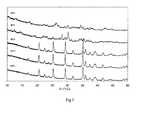
- a third step the temperature of the solution is increased up to the solvent boiling point, which is 108 to 110 °C. After 6 h, the obtained precipitate is filtered and washed thoroughly with water. The pure crystalline LiMnPO 4 thus obtained is shown in Fig. 1 (108°C).
- the dried LiMnPO 4 precipitate is poured into a 30 %wt aqueous solution of sucrose (100 g LiMnPO 4 for 140 g sucrose solution) and stirred for 2 h.
- the mixture is dried at 150 °C under air during 12 h and, after careful deagglomeration, heat treated at 600 °C for 5 h under a slightly reducing N 2 /H 2 90/10 flow.
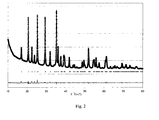
- FIG. 2 shows the refined XRD pattern of the obtained carbon coated LiMnPO 4 .
- the crystallite size has been deduced from XRD to be 37 +/- 6 nm, which is much smaller than that obtained by Yonemura et al. (79.1 nm from XRD).
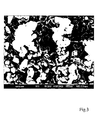
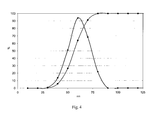
- the picture on Fig. 3 shows monodisperse small crystalline particles in the 30 - 60 nm range. The volumetric particle size distribution of the product was measured by using image analysis.
- a slurry was prepared by mixing the C-LiMnPO 4 powder with 2.5 %wt carbon black (in order to reach 10 %wt total C content in the electrode) and 10 % PVDF into N-methylpyrrolidone (NMP) and deposited on an Al-foil as current collector.
- the obtained electrode containing 80 %wt active material was used to manufacture coin cells, using a loading of 5.7 mg/cm 2 active material.
- the negative electrodes are made of metallic Li.
- the coin cells are cycled in LiBF 4 based electrolyte between 2.5 and 4.5 V.
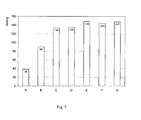
- Fig. 5 shows that high reversible capacity is obtained at low rate with 148 mAh/g (E).
- Fig. 6 shows that an excellent discharge capacity is maintained up to at least a discharge rate of 1 C (curve E).
- the capacity at 1 C is 113 mAh/g; corresponding to 66 % of the theoretical capacity.
- results reported by Kwon et al. show a lower overall reversible capacity and higher losses, especially at rates above 1C, even though only 72 % of active material was used in the electrode mixture, together with a loading of only 1.45 - 3.7 mg/cm 2 .
- the lower active material content and the lower loading intend to give an upward bias to the reversible capacity measured.
- the precipitation is performed like in Example 1 except that the temperature of the solution is limited to 100 °C. After 6h, the obtained precipitate is filtered and washed thoroughly with water. The pure crystalline LiMnPO 4 thus obtained is shown in Fig. 1 (100 °C).
- the dried LiMnPO 4 precipitate is poured into a 30 %wt aqueous solution of sucrose (100 g LiMnPO 4 for 140 g sucrose solution) and stirred for 2 h.
- the mixture is dried at 150 °C under air during 12 h and, after careful deagglomeration, heat treated at 600 °C for 5 h under a slightly reducing N 2 /H 2 90/10 flow.
- a well crystallized LiMnPO 4 powder containing 8.4 %wt carbon coating is produced this way.
- a slurry was prepared by mixing the C-LiMnPO 4 powder with 1.6 %wt carbon black (in order to reach 10 %wt total C content in the electrode) and 10 % PVDF into N-methylpyrrolidone (NMP) and deposited on an Al foil as current collector.
- NMP N-methylpyrrolidone
- the obtained electrode containing 80 %wt active material was used to manufacture coin cells, using a loading of 6.2 mg/cm 2 active material.
- the negative electrodes are made of metallic Li.
- the coin cells are cycled in LiBF 4 based electrolyte between 2.5 and 4.5 V.
- Fig. 5 shows that high reversible capacity is obtained at low rate with 144 mAh/g (F).
- the precipitation is performed like in Example 1, except that the temperature of the solution is limited to 85 °C. After 6 h, the obtained precipitate is filtered and washed thoroughly with water. The pure crystalline LiMnPO 4 thus obtained is shown in Fig. 1 (85 °C).
- the dried LiMnPO 4 precipitate is poured into a 30 %wt aqueous solution of sucrose (100 g LiMnPO 4 for 140 g sucrose solution) and stirred for 2h.
- the mixture is dried at 150 °C under air during 12 h and, after careful deagglomeration, heat treated at 600 °C for 5 h under a slightly reducing N 2 /H 2 90/10 flow.
- a well crystallized LiMnPO 4 powder containing 8.3 %wt carbon coating is produced this way.
- a slurry was prepared by mixing the C-LiMnPO 4 powder with 1.7 %wt carbon black (in order to reach 10 %wt total C content in the electrode) and 10 % PVDF into N-methylpyrrolidone (NMP) and deposited on an Al foil as current collector.
- NMP N-methylpyrrolidone
- the obtained electrode containing 80 %wt active material was used to manufacture coin cells, using a loading of 6.4 mg/cm 2 active material.
- the negative electrodes are made of metallic Li.
- the coin cells are cycled in LiBF 4 based electrolyte between 2.5 and 4.5 V. Fig.
- FIG. 5 shows that high reversible capacity is obtained at low rate with 147 mAh/g (G).
- Fig. 6 shows that an excellent discharge capacity is maintained up to at least a discharge rate of 1C (curve G).
- the capacity at 1 C is 107 mAh/g, corresponding to 63 % of the theoretical capacity.
- the precipitation is performed as in Example , except that the temperature of the solution is limited to 60 °C. After 6 h, the obtained precipitate is filtered and washed thoroughly with water. The product thus obtained is shown in Fig. 1 (60 °C) and corresponds to a mixture of various phosphates, sulphates and pyrophosphates species. No pure LiMnPO 4 is obtained this way.
- the precipitation is performed as in Example 1, except that the temperature of the solution is kept at 25 °C. After 6 h stirring at 25 °C, the obtained precipitate is filtered and washed thoroughly with water. The product thus obtained is shown in Fig. 1 (25 °C) and corresponds to a mixture of various phosphates, sulphates and pyrophosphates species. No pure LiMnPO 4 is obtained this way.
- EG ethylene glycol
- EG ethylene glycol
- 0.1 M Mn (II) in MnSO 4 .H 2 O and 0.1 M P (V) in H 3 PO 4 dissolved in H 2 O under stirring.
- the amount of EG is adjusted in order to reach a global composition of 50 %vol water and 50 %vol EG.
- an aqueous solution of 0.3 M LiOH.H 2 O is added to the solution at 25 °C, in order to increase the pH up to a value between 6.5 and 7.5.
- the final Li:Mn:P ratio is close to 3:1:1.
- a third step the temperature of the solution is increased up to the solvent boiling point, which is 108 to 110 °C. After 6 h, the precipitate is filtered and washed thoroughly with water. The pure crystalline LiMnPO 4 thus obtained is shown in Fig. 7 .
- the dried LiMnPO 4 precipitate is poured into a 30 %wt aqueous solution of sucrose (100 g LiMnPO 4 for 140 g sucrose solution) and stirred for 2 h.
- the mixture is dried at 150 °C under air during 12 h and, after careful deagglomeration, heat treated at 600 °C for 5 h under a slightly reducing N 2 /H 2 90/10 flow.
- a well crystallized LiMnPO 4 powder containing 8.5 %wt carbon coating is produced this way.
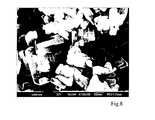
- the SEM picture on Fig. 8 shows monodisperse small crystalline particles in the 100 - 150 nm range.
- a slurry was prepared by mixing the C-LiMnPO 4 powder with 1.5 %wt carbon black (in order to reach 10 %wt total C content in the electrode) and 10 % PVDF into N-methylpyrrolidone (NMP) and deposited on an Al-foil as current collector.
- the obtained electrode containing 80 %wt active material was used to manufacture coin cells, using a loading of 5.9 mg/cm 2 active material.
- the negative electrodes are made of metallic Li.
- the coin cells are cycled in LiBF 4 based electrolyte between 2.5 and 4.5 V. Reversible capacity values at low rate of 43 mAh/g are obtained, which is significantly inferior to capacities obtained in the examples of the invention. Despite high phase purity, this large difference is believed to arise from the much larger particle size compared to product according to the invention. It emphasizes the need for an additive that does not reduce the kinetics of nucleation of LiMnPO 4 .
- an aqueous solution of 0.3 M LiOH.H 2 O is added to the solution at 25 °C; in order to increase the pH up to a value between 6.5 and 7.5.
- the final Li:Mn:P ratio is close to 3:1:1.
- a third step the temperature of the solution is increased up its boiling point, which is 100 °C. After 6 h, the obtained precipitate is filtered and washed thoroughly with water.
- the product thus obtained is shown in Fig. 9 and corresponds to a mixture of LiMnPO 4 and various phosphates and pyrophosphates species. No pure LiMnPO 4 is obtained this way. This emphasizes the need for an additive as co-solvent during the precipitation.
Landscapes
- Chemical & Material Sciences (AREA)
- Organic Chemistry (AREA)
- Inorganic Chemistry (AREA)
- Battery Electrode And Active Subsutance (AREA)
- Secondary Cells (AREA)
Priority Applications (1)
| Application Number | Priority Date | Filing Date | Title |
|---|---|---|---|
| EP09007910A EP2103570A3 (fr) | 2006-12-22 | 2007-11-19 | Synthèse de poudre LiMnP04 nanométrique cristalline électroactive |
Applications Claiming Priority (4)
| Application Number | Priority Date | Filing Date | Title |
|---|---|---|---|
| EP06292049 | 2006-12-22 | ||
| US88150807P | 2007-01-22 | 2007-01-22 | |
| EP09007910A EP2103570A3 (fr) | 2006-12-22 | 2007-11-19 | Synthèse de poudre LiMnP04 nanométrique cristalline électroactive |
| EP07819855A EP2032504B1 (fr) | 2006-12-22 | 2007-11-19 | SYNTHÈSE D'UNE POUDRE DE LiMnPO4 NANOMÉTRIQUE CRISTALLINE ÉLECTROACTIVE |
Related Parent Applications (2)
| Application Number | Title | Priority Date | Filing Date |
|---|---|---|---|
| EP07819855A Division EP2032504B1 (fr) | 2006-12-22 | 2007-11-19 | SYNTHÈSE D'UNE POUDRE DE LiMnPO4 NANOMÉTRIQUE CRISTALLINE ÉLECTROACTIVE |
| EP07819855.3 Division | 2007-11-19 |
Publications (2)
| Publication Number | Publication Date |
|---|---|
| EP2103570A2 true EP2103570A2 (fr) | 2009-09-23 |
| EP2103570A3 EP2103570A3 (fr) | 2011-12-21 |
Family
ID=39184673
Family Applications (2)
| Application Number | Title | Priority Date | Filing Date |
|---|---|---|---|
| EP09007910A Withdrawn EP2103570A3 (fr) | 2006-12-22 | 2007-11-19 | Synthèse de poudre LiMnP04 nanométrique cristalline électroactive |
| EP07819855A Active EP2032504B1 (fr) | 2006-12-22 | 2007-11-19 | SYNTHÈSE D'UNE POUDRE DE LiMnPO4 NANOMÉTRIQUE CRISTALLINE ÉLECTROACTIVE |
Family Applications After (1)
| Application Number | Title | Priority Date | Filing Date |
|---|---|---|---|
| EP07819855A Active EP2032504B1 (fr) | 2006-12-22 | 2007-11-19 | SYNTHÈSE D'UNE POUDRE DE LiMnPO4 NANOMÉTRIQUE CRISTALLINE ÉLECTROACTIVE |
Country Status (4)
| Country | Link |
|---|---|
| EP (2) | EP2103570A3 (fr) |
| JP (1) | JP4465412B2 (fr) |
| CA (1) | CA2672952C (fr) |
| WO (1) | WO2008077447A1 (fr) |
Families Citing this family (23)
| Publication number | Priority date | Publication date | Assignee | Title |
|---|---|---|---|---|
| US7815708B2 (en) | 2003-09-29 | 2010-10-19 | Umicore | Process and apparatus for recovery of non-ferrous metals from zinc residues |
| CA2672954C (fr) | 2006-12-22 | 2014-07-22 | Umicore | Synthese de lifempo4....nanometrique cristalline |
| EP2130248B1 (fr) | 2007-03-19 | 2011-06-15 | Umicore | Matière d'insertion/extraction de li à une seule phase à température ambiante pour une utilisation dans une batterie à base de li |
| JP5510036B2 (ja) * | 2009-05-28 | 2014-06-04 | Tdk株式会社 | 活物質、活物質の製造方法及びリチウムイオン二次電池 |
| MA32521B1 (fr) | 2009-12-31 | 2011-08-01 | Univ Mohammed V Agdal | ELABORATION DE MATERIAUX CATHODIQUES MnPO4, nH2O EN FILM MINCE |
| CN103270628B (zh) | 2010-12-17 | 2016-06-29 | 住友大阪水泥股份有限公司 | 电极材料及其制造方法 |
| US8945498B2 (en) | 2011-03-18 | 2015-02-03 | Semiconductor Energy Laboratory Co., Ltd. | Method for manufacturing lithium-containing composite oxide |
| US9577261B2 (en) | 2011-03-18 | 2017-02-21 | Semiconductor Energy Laboratory Co., Ltd. | Lithium ion secondary battery and method for manufacturing the same |
| KR102131859B1 (ko) | 2011-03-25 | 2020-07-08 | 가부시키가이샤 한도오따이 에네루기 켄큐쇼 | 리튬 이온 2차 전지 |
| JP5772197B2 (ja) * | 2011-05-09 | 2015-09-02 | ソニー株式会社 | リチウムイオン二次電池用活物質、リチウムイオン二次電池用電極、リチウムイオン二次電池、電子機器、電動工具、電動車両および電力貯蔵システム |
| DE102011106326B3 (de) * | 2011-07-01 | 2013-01-03 | Süd-Chemie AG | Verfahren zur Herstellung von nanopartikulären Lithiumübergangsmetallphosphaten; nanopartikuläres Lithiumübergangsmetallphosphat und Kathode damit |
| US9249524B2 (en) | 2011-08-31 | 2016-02-02 | Semiconductor Energy Laboratory Co., Ltd. | Manufacturing method of composite oxide and manufacturing method of power storage device |
| US9118077B2 (en) | 2011-08-31 | 2015-08-25 | Semiconductor Energy Laboratory Co., Ltd. | Manufacturing method of composite oxide and manufacturing method of power storage device |
| JP5621740B2 (ja) * | 2011-09-22 | 2014-11-12 | 住友大阪セメント株式会社 | 電極材料及び電極並びに電極材料の製造方法 |
| JP2013089393A (ja) * | 2011-10-14 | 2013-05-13 | Gs Yuasa Corp | 二次電池用活物質及び二次電池用活物質の製造方法 |
| JP6216965B2 (ja) * | 2012-01-31 | 2017-10-25 | 住友大阪セメント株式会社 | 電極材料と電極板及びリチウムイオン電池並びに電極材料の製造方法、電極板の製造方法 |
| KR20150084995A (ko) | 2012-11-12 | 2015-07-22 | 미쯔이 죠센 가부시키가이샤 | 전극 재료 및 전극 재료의 제조 방법 |
| JP2014179291A (ja) | 2013-03-15 | 2014-09-25 | Sumitomo Osaka Cement Co Ltd | 電極材料及び電極並びにリチウムイオン電池 |
| CN104183845B (zh) * | 2014-08-21 | 2016-04-27 | 浙江大学 | 一种磷酸锰锂纳米颗粒及其制备方法 |
| CN104183847B (zh) * | 2014-08-21 | 2016-08-31 | 浙江大学 | 一种磷酸锰锂纳米椭球及其制备方法 |
| CN104183846B (zh) * | 2014-08-21 | 2016-04-27 | 浙江大学 | 一种磷酸锰锂纳米颗粒及其制备方法 |
| JP6917161B2 (ja) | 2016-03-03 | 2021-08-11 | 株式会社半導体エネルギー研究所 | リチウムイオン二次電池用の正極活物質、二次電池、電池制御ユニットおよび電子機器 |
| GB201609016D0 (en) * | 2016-05-23 | 2016-07-06 | Johnson Matthey Plc | Battery cathode materials |
Citations (2)
| Publication number | Priority date | Publication date | Assignee | Title |
|---|---|---|---|---|
| WO2004001881A2 (fr) | 2002-06-21 | 2003-12-31 | Umicore | Poudres carbonees contenant du lithium et leur procede de production |
| US6749967B2 (en) | 2000-04-25 | 2004-06-15 | Sony Corporation | Positive electrode active material and non-aqueous electrolyte cell |
Family Cites Families (5)
| Publication number | Priority date | Publication date | Assignee | Title |
|---|---|---|---|---|
| DE10117904B4 (de) * | 2001-04-10 | 2012-11-15 | Zentrum für Sonnenenergie- und Wasserstoff-Forschung Baden-Württemberg Gemeinnützige Stiftung | Binäre, ternäre und quaternäre Lithiumeisenphosphate, Verfahren zu ihrer Herstellung und ihre Verwendung |
| EP1261050A1 (fr) * | 2001-05-23 | 2002-11-27 | n.v. Umicore s.a. | Poudre de phosphate de lithium et d'un métal de transition pour piles rechargeables |
| DE10353266B4 (de) * | 2003-11-14 | 2013-02-21 | Süd-Chemie Ip Gmbh & Co. Kg | Lithiumeisenphosphat, Verfahren zu seiner Herstellung und seine Verwendung als Elektrodenmaterial |
| DE102005015613A1 (de) * | 2005-04-05 | 2006-10-12 | Süd-Chemie AG | Kristallines Ionenleitendes Nanomaterial und Verfahren zu seiner Herstellung |
| US8133616B2 (en) * | 2006-02-14 | 2012-03-13 | Dow Global Technologies Llc | Lithium manganese phosphate positive material for lithium secondary battery |
-
2007
- 2007-11-19 CA CA2672952A patent/CA2672952C/fr not_active Expired - Fee Related
- 2007-11-19 JP JP2009522188A patent/JP4465412B2/ja active Active
- 2007-11-19 WO PCT/EP2007/009968 patent/WO2008077447A1/fr not_active Ceased
- 2007-11-19 EP EP09007910A patent/EP2103570A3/fr not_active Withdrawn
- 2007-11-19 EP EP07819855A patent/EP2032504B1/fr active Active
Patent Citations (2)
| Publication number | Priority date | Publication date | Assignee | Title |
|---|---|---|---|---|
| US6749967B2 (en) | 2000-04-25 | 2004-06-15 | Sony Corporation | Positive electrode active material and non-aqueous electrolyte cell |
| WO2004001881A2 (fr) | 2002-06-21 | 2003-12-31 | Umicore | Poudres carbonees contenant du lithium et leur procede de production |
Non-Patent Citations (11)
| Title |
|---|
| CHEN ET AL., JES, vol. 149, 2002 |
| DE1ACOURT ET AL., CHEM. MATER, vol. 16, 2004, pages 93 |
| DELACOURT ET AL., CHEM. MATER., vol. 16, 2004, pages 93 |
| HOWEVER; PADHI ET AL., JES, vol. 144, 1997, pages 1188 |
| KWON ET AL., ESSL, vol. 9, 2006, pages A277 |
| LI ET AL., ESSL, vol. 5, 2002, pages A135 |
| NAM-HEE KWON ET AL: "Enhanced Electrochemical Performance of Mesoparticulate LiMnPO4 for Lithium Ion Batteries", ELECTROCHEMICAL AND SOLID-STATE LETTERS, IEEE SERVICE CENTER, PISCATAWAY, NJ, US, vol. 9, no. 6, 3 April 2006 (2006-04-03), pages A277 - A280, XP002454685, ISSN: 1099-0062, DOI: 10.1149/1.2191432 * |
| NUSPL ET AL., PROCEEDINGS OF IMLB 12TH MEETING, June 2004 (2004-06-01) |
| OKADA ET AL., J. POWER SOURCES, vol. 430, 2001, pages 97 - 98 |
| PADHI ET AL., JES, vol. 144, 1997, pages 1188 |
| YONEMURA ET AL., JES, vol. 151, 2004, pages A1352 |
Also Published As
| Publication number | Publication date |
|---|---|
| EP2032504A1 (fr) | 2009-03-11 |
| JP2009544563A (ja) | 2009-12-17 |
| CA2672952A1 (fr) | 2008-07-03 |
| EP2103570A3 (fr) | 2011-12-21 |
| CA2672952C (fr) | 2014-08-05 |
| WO2008077447A1 (fr) | 2008-07-03 |
| EP2032504B1 (fr) | 2012-08-01 |
| JP4465412B2 (ja) | 2010-05-19 |
Similar Documents
| Publication | Publication Date | Title |
|---|---|---|
| EP2032504B1 (fr) | SYNTHÈSE D'UNE POUDRE DE LiMnPO4 NANOMÉTRIQUE CRISTALLINE ÉLECTROACTIVE | |
| US20090197174A1 (en) | Synthesis of Electroactive Crystalline Nanometric LiMnPO4 Powder | |
| EP2094605B1 (fr) | SYNTHÈSE DE LiFeMPO4....NANOMÉTRIQUE CRISTALLINE | |
| KR101298315B1 (ko) | 결정성 나노메트릭 LiFePO₄ | |
| KR101502184B1 (ko) | Li계 배터리에 사용하기 위한 상온 단상 Li 삽입/추출 물질 | |
| KR101401836B1 (ko) | 결정성 나노메트릭 LiFeMPO₄의 합성 방법 | |
| WO2013099409A1 (fr) | Procédé de fabrication de phosphate de fer, phosphate de lithium et de fer, matière d'électrode active et batterie secondaire | |
| CA2773497A1 (fr) | Materiau d'electrode positif |
Legal Events
| Date | Code | Title | Description |
|---|---|---|---|
| PUAI | Public reference made under article 153(3) epc to a published international application that has entered the european phase |
Free format text: ORIGINAL CODE: 0009012 |
|
| AC | Divisional application: reference to earlier application |
Ref document number: 2032504 Country of ref document: EP Kind code of ref document: P |
|
| AK | Designated contracting states |
Kind code of ref document: A2 Designated state(s): AT BE BG CH CY CZ DE DK EE ES FI FR GB GR HU IE IS IT LI LT LU LV MC MT NL PL PT RO SE SI SK TR |
|
| PUAL | Search report despatched |
Free format text: ORIGINAL CODE: 0009013 |
|
| AK | Designated contracting states |
Kind code of ref document: A3 Designated state(s): AT BE BG CH CY CZ DE DK EE ES FI FR GB GR HU IE IS IT LI LT LU LV MC MT NL PL PT RO SE SI SK TR |
|
| AX | Request for extension of the european patent |
Extension state: AL BA HR MK RS |
|
| RIC1 | Information provided on ipc code assigned before grant |
Ipc: C01B 25/45 20060101ALI20111111BHEP Ipc: C01B 25/37 20060101AFI20111111BHEP |
|
| 17P | Request for examination filed |
Effective date: 20120621 |
|
| 17Q | First examination report despatched |
Effective date: 20160621 |
|
| STAA | Information on the status of an ep patent application or granted ep patent |
Free format text: STATUS: THE APPLICATION HAS BEEN WITHDRAWN |
|
| 18W | Application withdrawn |
Effective date: 20161004 |