EP2103573A2 - Lithiumionenleitender Festelektrolyt und Verfahren zu dessen Herstellung - Google Patents
Lithiumionenleitender Festelektrolyt und Verfahren zu dessen Herstellung Download PDFInfo
- Publication number
- EP2103573A2 EP2103573A2 EP09003879A EP09003879A EP2103573A2 EP 2103573 A2 EP2103573 A2 EP 2103573A2 EP 09003879 A EP09003879 A EP 09003879A EP 09003879 A EP09003879 A EP 09003879A EP 2103573 A2 EP2103573 A2 EP 2103573A2
- Authority
- EP
- European Patent Office
- Prior art keywords
- glass
- lithium ion
- component
- glass ceramics
- ion conductive
- Prior art date
- Legal status (The legal status is an assumption and is not a legal conclusion. Google has not performed a legal analysis and makes no representation as to the accuracy of the status listed.)
- Granted
Links
Images
Classifications
-
- C—CHEMISTRY; METALLURGY
- C03—GLASS; MINERAL OR SLAG WOOL
- C03C—CHEMICAL COMPOSITION OF GLASSES, GLAZES OR VITREOUS ENAMELS; SURFACE TREATMENT OF GLASS; SURFACE TREATMENT OF FIBRES OR FILAMENTS MADE FROM GLASS, MINERALS OR SLAGS; JOINING GLASS TO GLASS OR OTHER MATERIALS
- C03C10/00—Devitrified glass ceramics, i.e. glass ceramics having a crystalline phase dispersed in a glassy phase and constituting at least 50% by weight of the total composition
- C03C10/0009—Devitrified glass ceramics, i.e. glass ceramics having a crystalline phase dispersed in a glassy phase and constituting at least 50% by weight of the total composition containing silica as main constituent
-
- C—CHEMISTRY; METALLURGY
- C03—GLASS; MINERAL OR SLAG WOOL
- C03C—CHEMICAL COMPOSITION OF GLASSES, GLAZES OR VITREOUS ENAMELS; SURFACE TREATMENT OF GLASS; SURFACE TREATMENT OF FIBRES OR FILAMENTS MADE FROM GLASS, MINERALS OR SLAGS; JOINING GLASS TO GLASS OR OTHER MATERIALS
- C03C10/00—Devitrified glass ceramics, i.e. glass ceramics having a crystalline phase dispersed in a glassy phase and constituting at least 50% by weight of the total composition
- C03C10/0018—Devitrified glass ceramics, i.e. glass ceramics having a crystalline phase dispersed in a glassy phase and constituting at least 50% by weight of the total composition containing SiO2, Al2O3 and monovalent metal oxide as main constituents
- C03C10/0027—Devitrified glass ceramics, i.e. glass ceramics having a crystalline phase dispersed in a glassy phase and constituting at least 50% by weight of the total composition containing SiO2, Al2O3 and monovalent metal oxide as main constituents containing SiO2, Al2O3, Li2O as main constituents
-
- C—CHEMISTRY; METALLURGY
- C03—GLASS; MINERAL OR SLAG WOOL
- C03C—CHEMICAL COMPOSITION OF GLASSES, GLAZES OR VITREOUS ENAMELS; SURFACE TREATMENT OF GLASS; SURFACE TREATMENT OF FIBRES OR FILAMENTS MADE FROM GLASS, MINERALS OR SLAGS; JOINING GLASS TO GLASS OR OTHER MATERIALS
- C03C4/00—Compositions for glass with special properties
- C03C4/18—Compositions for glass with special properties for ion-sensitive glass
-
- H—ELECTRICITY
- H01—ELECTRIC ELEMENTS
- H01M—PROCESSES OR MEANS, e.g. BATTERIES, FOR THE DIRECT CONVERSION OF CHEMICAL ENERGY INTO ELECTRICAL ENERGY
- H01M10/00—Secondary cells; Manufacture thereof
- H01M10/05—Accumulators with non-aqueous electrolyte
- H01M10/052—Li-accumulators
- H01M10/0525—Rocking-chair batteries, i.e. batteries with lithium insertion or intercalation in both electrodes; Lithium-ion batteries
-
- H—ELECTRICITY
- H01—ELECTRIC ELEMENTS
- H01M—PROCESSES OR MEANS, e.g. BATTERIES, FOR THE DIRECT CONVERSION OF CHEMICAL ENERGY INTO ELECTRICAL ENERGY
- H01M10/00—Secondary cells; Manufacture thereof
- H01M10/05—Accumulators with non-aqueous electrolyte
- H01M10/056—Accumulators with non-aqueous electrolyte characterised by the materials used as electrolytes, e.g. mixed inorganic/organic electrolytes
- H01M10/0561—Accumulators with non-aqueous electrolyte characterised by the materials used as electrolytes, e.g. mixed inorganic/organic electrolytes the electrolyte being constituted of inorganic materials only
- H01M10/0562—Solid materials
-
- H—ELECTRICITY
- H01—ELECTRIC ELEMENTS
- H01M—PROCESSES OR MEANS, e.g. BATTERIES, FOR THE DIRECT CONVERSION OF CHEMICAL ENERGY INTO ELECTRICAL ENERGY
- H01M2300/00—Electrolytes
- H01M2300/0017—Non-aqueous electrolytes
- H01M2300/0065—Solid electrolytes
- H01M2300/0068—Solid electrolytes inorganic
- H01M2300/0071—Oxides
-
- Y—GENERAL TAGGING OF NEW TECHNOLOGICAL DEVELOPMENTS; GENERAL TAGGING OF CROSS-SECTIONAL TECHNOLOGIES SPANNING OVER SEVERAL SECTIONS OF THE IPC; TECHNICAL SUBJECTS COVERED BY FORMER USPC CROSS-REFERENCE ART COLLECTIONS [XRACs] AND DIGESTS
- Y02—TECHNOLOGIES OR APPLICATIONS FOR MITIGATION OR ADAPTATION AGAINST CLIMATE CHANGE
- Y02E—REDUCTION OF GREENHOUSE GAS [GHG] EMISSIONS, RELATED TO ENERGY GENERATION, TRANSMISSION OR DISTRIBUTION
- Y02E60/00—Enabling technologies; Technologies with a potential or indirect contribution to GHG emissions mitigation
- Y02E60/10—Energy storage using batteries
-
- Y—GENERAL TAGGING OF NEW TECHNOLOGICAL DEVELOPMENTS; GENERAL TAGGING OF CROSS-SECTIONAL TECHNOLOGIES SPANNING OVER SEVERAL SECTIONS OF THE IPC; TECHNICAL SUBJECTS COVERED BY FORMER USPC CROSS-REFERENCE ART COLLECTIONS [XRACs] AND DIGESTS
- Y10—TECHNICAL SUBJECTS COVERED BY FORMER USPC
- Y10T—TECHNICAL SUBJECTS COVERED BY FORMER US CLASSIFICATION
- Y10T29/00—Metal working
- Y10T29/49—Method of mechanical manufacture
- Y10T29/49002—Electrical device making
- Y10T29/49108—Electric battery cell making
Definitions
- the present invention contains subject matter related to Japanese Patent Application No. 2008-071178 filed with the Japan Patent Office on March 19, 2008, the entire contents of which are incorporated herein by reference.
- the present invention relates to a lithium ion conductive glass ceramics which is high in ionic conductivity, thermally and chemically stable and easy for the production.
- Lithium ion conductive glass ceramics disclosed in JP-A-11-157872 and JP-A-2000-34134 are known as an electrolyte material of a lithium ion battery.
- the lithium ion conductive glass ceramics are obtained by depositing a crystalline in the interior of a glass by the heat treatment of a raw glass having a specified composition; and therefore, pores do not substantially exist in the interior so that the ionic conduction are not hindered by the pores. Accordingly, the lithium ion conductive glass ceramics have a characteristic feature that they are excellent in ionic conductivity as compared with lithium ion conductive oxide ceramics.
- the glass ceramics disclosed in JP-A-11-157872 involves a problem that its raw glass is low in thermal stability; and although it has high lithium ion conductivity, it was difficult to increase the thermal stability of the raw glass.
- the thermal stability of the raw glass is low, there is caused a problem that in casting a molten glass in a die and performing molding, breakage is easily generated in the glass, and hence, the thermal control at the time of glass molding must be strictly carried out, leading to an increase of the production costs.
- the thermal stability is low, there is also caused a problem that devitrification is easy to occur at the time of glass molding.
- JP-A-2000-34134 for the purpose of enhancing the thermal stability of a glass, it is successfully made to largely enhance (Tx - Tg) which is employed for evaluating the thermal stability of a glass by the addition of an M' 2 O 3 component (wherein M' is one or two or more members selected among In, Fe, Cr, Sc, Y, La, Ce, Pr, Nd, Sm, Eu, Gd, Tb, Dy, Ho, Er, Tm, Yb and Lu).
- M' is one or two or more members selected among In, Fe, Cr, Sc, Y, La, Ce, Pr, Nd, Sm, Eu, Gd, Tb, Dy, Ho, Er, Tm, Yb and Lu.
- M' is one or two or more members selected among In, Fe, Cr, Sc, Y, La, Ce, Pr, Nd, Sm, Eu, Gd, Tb, Dy, Ho, Er, Tm, Yb and Lu.
- raw materials having the foregoing M' component are
- an object of the invention is to provide a lithium ion conductive glass ceramics which is high in lithium ion conductivity, high in thermal stability of a raw glass and easy for molding.
- the thermal stability of the raw glass is tremendously enhanced, even in the case of casting a molten glass of the raw glass in a die, it is possible to stably mold the raw glass under a wide temperature condition. Also, since an impact which is given to the molten glass is tolerated to some extent, it is not necessary to strictly control an outflow velocity, an outflow condition and so on of the molten glass. Then, a high value can be obtained as the lithium ion conductivity of the glass ceramics obtained by the sequent heat treatment (crystallization).
- the composition of the glass ceramics of the invention can be expressed in terms of % by mass on the oxide basis.
- oxide basis as referred to herein are concerned with a method of expressing the composition of each of components to be incorporated in a crystallized glass of the invention on the assumption that oxides, nitrates and so on which are used as raw materials of constitutional components of the crystallized glass of the invention are all decomposed at the time of melting and converted into oxides; and the terms "% by mass on the oxide basis” as referred to herein express the amount of each of the components to be incorporated in the crystallized glass while defining the total sum of the mass of this formed oxide as 100 % by mass.
- composition of the glass ceramics expressed on the foregoing oxide basis is the same as the component of its raw glass.
- composition of the glass ceramics is expressed in terms of % by mass on the oxide basis unless otherwise indicated.
- the present inventor has found that by especially limiting the range of the ZrO 2 component to from 0.5 % to 2.5 %, not only the stability of the raw glass can be tremendously enhanced, but high lithium ion conductivity can be obtained.
- the content of the ZrO 2 component is less than 0.5 %, since nucleus generation of the crystallization decrease, the crystallization temperature necessary for obtaining high ionic conductivity becomes high. By raising the crystallization temperature, the ionic conductivity can be increased. However, at the same time, the crystalline growth is excessively advanced, leading to the generation of a crack or an internal pore.
- the content of the ZrO 2 component exceeds 2.5 %, the glass is hardly melted, and a higher melt temperature is necessary.
- a lower limit of the content of the ZrO 2 component is more preferably 0.7 %, and most preferably 0.9 %.
- an upper limit value of the content of the ZrO 2 component is more preferably 2.1 %, and most preferably 2 %.
- the thermal stability of a glass is evaluated in terms of a value of (Tx - Tg) which is a difference between Tx (°C) (crystallization temperature of the glass) and Tg (°C) (transition temperature of the glass).
- Tx °C
- Tg transition temperature of the glass
- the thermal stability of the raw glass is largely enhanced; and the value of (Tx - Tg) is 70°C or more.
- the lithium ion conductivity is slightly interior, the value of (Tx - Tg) can be a value of 160°C at maximum.
- the value of (Tx - Tg) can be a value of 72°C or more in a more synthetically preferred embodiment and can be a value of 74°C or more in the most preferred embodiment.
- the glass ceramics of the invention has a crystalline phase of Ll 1+x+z M x (Ge 1-y Ti y ) 2-x P 3-z Si z O 12 , wherein 0 ⁇ x ⁇ 0.6, 0.2 ⁇ y ⁇ 0.8, 0 ⁇ z ⁇ 0.5, and M is one or two members selected from Al and Ga.
- M is one or two members selected from Al and Ga.
- the Li 2 O component is a component which is capable of providing an Li + ion carrier and useful for bringing lithium ion conductivity.
- a lower limit of the content of the Li 2 O component is preferably 3.5 % or more, more preferably 3.7 % or more, and most preferably 3. 9 % or more.
- an upper limit of the content of the Li 2 O component is not more than 5.0 %, more preferably not more than 4.8 %, and most preferably not more than 4.6 %.
- the P 2 O 5 component is a useful component for forming a glass and is also a constitutional component of the foregoing crystalline phase.
- the content of this component is less than 50 %, the melt temperature of the glass is high so that the vitrification hardly occurs.
- the vitrification hardly occurs hot molding of a glass is hardly achieved, and in particular, it is likely difficult to obtain a glass in a bulk shape (for example, 200 cm 3 or more).
- a lower limit value of the content of the P 2 O 5 component is preferably 50 % or more, more preferably 50.5 % or more, and most preferably 51 % or more.
- an upper limit value of the content of the P 2 O 5 component is preferably not more than 55 %, more preferably not more than 54.5 %, and most preferably not more than 54 %.
- a P 2 O 5 /ZrO 2 value which is a mass % ratio of the P 2 O 5 component to the ZrO 2 component is preferably 25 or more, more preferably 30 or more, and most preferably 35 or more.
- the P 2 O 5 /ZrO 2 value which is a mass % ratio of the P 2 O 5 component to the ZrO 2 component is preferably not more than 100, more preferably not more than 90, and most preferably not more than 75.
- the GeO 2 component is a useful component for forming a glass and is also a component which can be a constitutional component of the lithium ion conductive crystalline phase.
- a lower limit value of the content of the GeO 2 component is preferably 10 % or more, more preferably 11 % or more, and most preferably 11.5 % or more.
- an upper limit value of the content of the GeO 2 component is preferably not more than 30 %, more preferably not more than 28 %, and most preferably not more than 26 %.
- the TiO 2 component is a useful component for forming a glass and is also a component which can be a constitutional component of the lithium ion conductive crystalline phase.
- a lower limit value of the content of the TiO 2 component is preferably 8 % or more, more preferably 9 % or more, and most preferably 10 % or more.
- an upper limit value of the content of the TiO 2 component is preferably not more 22 %, more preferably not more than 21 %, and most preferably not more than 20 %.
- the M 2 O 3 component (wherein M is one or two members selected from Al and Ga) is able to enhance the thermal stability of the raw glass and at the same time, brings an effect for enhancing the lithium ion conductivity upon solid dissolution of an Al 3+ and/or Ga 3+ ion into the foregoing crystalline phase. Therefore, a lower limit value of the content of the M 2 O 3 component is preferably 5 % or more, more preferably 6 % or more, and most preferably 7 % or more. However, when the content of the M 2 O 3 component exceeds 12 %, the thermal stability of a glass is rather deteriorated, and the conductivity of the glass ceramics is lowered, too. Therefore, an upper limit value of the content of the M 2 O 3 component is preferably not more than 12 %, more preferably not more than 11 %, and most preferably not more than 10 %.
- the SiO 2 component is able to enhance the melt properties and thermal stability of the raw glass and at the same time, contributes to an enhancement of the lithium ion conductivity upon solid dissolution of an Si 4+ ion into the foregoing crystalline phase. Therefore, the SiO 2 component can be arbitrarily incorporated.
- the content of the SiO 2 component exceeds 2.5 %, a crack is easily formed at the time of crystallization, whereby the lithium ion conductivity is lowered.
- the content of the SiO 2 component is preferably not more than 2.5 %, more preferably not more than 2.2 %, and most preferably not more than 2 %.
- the M' 2 O 3 component (wherein M' is one or two or more members selected among In, Fe, Cr, Sc, Y, La, Ce, Pr, Nd, Sm, Eu, Gd, Tb, Dy, Ho, Er, Tm, Yb and Lu) is effective for enhancing the melt properties and thermal stability of a glass, and therefore, it can be incorporated in an amount of up to 5 % in total. Since such a component is very expensive with respect to the price of raw materials distributed in the market, it is preferable that such a component is not substantially incorporated.
- the amount of such a material should be limited to not more than 3 %. When such a material is added in an amount exceeding 3 %, the conductivity is remarkably lowered following the addition amount thereof.
- the lithium ion conductive glass ceramics of the invention can be produced by the following method. That is, prescribed amounts of respective starting raw materials are weighed and uniformly mixed; and the mixture is then charged in a platinum pot and heated for melting in an electric furnace. The temperature is raised to 1,200 to 1,400°C, and the mixture is melted while keeping this temperature for 2 hours or more. Thereafter, the molten glass is cast on an iron plate to prepare a plate-shaped glass. The thus obtained glass is heat treated (crystallized) at from 600 to 1,000°C for from 1 to 24 hours.
- a glass ceramics with high lithium ion conductivity which is composed of, as a main crystalline phase, Li 1+x+z M x (Ge 1- yTi y ) 2-x P 3-z Si z O 12 (wherein 0 ⁇ x ⁇ 0.6, 0.2 ⁇ y ⁇ 0.8, 0 ⁇ z ⁇ 0.5, and M is Al and/or Ga), is obtained.
- the glass powder is press molded, put in an electric furnace and heated at from 800 to 1,000°C, thereby obtaining a glass ceramics with high lithium ion conductivity, which is composed of, as a main crystalline phase, the foregoing crystalline phase.
- a value of the lithium ion conductivity of the lithium ion conductive glass ceramics of the invention, which can be obtained, is preferably 5.0 ⁇ 10 -5 S ⁇ cm -1 or more, more preferably 8.0 ⁇ 10 -5 S ⁇ cm -1 or more, and most preferably 1.0 ⁇ 10 -4 S ⁇ cm -1 or more.
- the glass ceramics obtained in the foregoing method may be processed according to the size of a battery to be prepared.
- the glass ceramics may be processed in a thin-plate form as the shape, and known grinding methods and polishing methods which are usually adopted in glasses or glass ceramics may be adopted.
- a lower limit value of its thickness is preferably 0.5 ⁇ m or more, more preferably 1 ⁇ m or more, and most preferably 5 ⁇ m or more.
- an upper limit value of the thickness is preferably not more than 1,000 ⁇ m, more preferably not more than 500 ⁇ m, and most preferably not more than 300 ⁇ m.
- a transition metal compound or a carbon material capable of intercalating lithium therein for the positive electrode material of the lithium primary battery of the invention, it is possible to use a transition metal compound or a carbon material capable of intercalating lithium therein.
- a transition metal oxide containing at least one member selected among manganese, cobalt, nickel, vanadium, niobium, molybdenum and titanium, graphite, carbon and the like are useful.
- metallic lithium an alloy capable of deintercalating lithium therefrom, for example, a lithium-aluminum alloy, a lithium-indium alloy, etc. and the like are useful.
- a transition metal compound capable of intercalating therein and deintercalating therefrom lithium can be used.
- a transition metal oxide containing at least one member selected among manganese, cobalt, nickel, vanadium, niobium, molybdenum and titanium and the like are useful.
- this lithium ion secondary battery as an active material to be used for its negative electrode material, it is preferred to use metallic lithium, an alloy capable of intercalating therein and deintercalating therefrom lithium, for example, a lithium-aluminum alloy, a lithium-indium alloy, etc., a transition metal oxide of titanium, vanadium, etc. and a carbon based material, for example, graphite, etc.
- metallic lithium an alloy capable of intercalating therein and deintercalating therefrom lithium, for example, a lithium-aluminum alloy, a lithium-indium alloy, etc., a transition metal oxide of titanium, vanadium, etc. and a carbon based material, for example, graphite, etc.
- the solid electrolyte of the invention can be suitably used as an electrolyte of a lithium-air battery.
- a lithium-air battery can be used by using lithium metal as a negative electrode, disposing the solid electrolyte of the invention and forming a porous carbon based material as a positive electrode.
- H 3 PO 4 , Al(PO 3 ) 3 and Li 2 CO 3 all of which are manufactured by Nippon Chemical Industrial Co., Ltd.; SiO 2 , manufactured by Nitchitsu Co., Ltd.; TiO 2 , manufactured by Sakai Chemical Industry Co. , Ltd. ; GeO 2 , manufactured by Sumitomo Metal Mining Co., Ltd.; and ZrO 2 , manufactured by Nippon Denko Co., Ltd. were used as raw materials.
- Comparative Example 2 when the temperature of the die was not higher than 200°C, the glass was very likely broken; and at a temperature of 350°C or higher, the devitrification was observed on the bottom, and the moldable temperature range was narrow as compared with Examples 1 to 4. In Comparative Example 3, a glass which is free from the devitrification could not be obtained regardless of the die temperature.
- the obtained glass was crushed to an extent of about 0.5 mm and measured for a glass transition point (Tx) and a crystallization starting temperature (Tg) using NETSZCH's thermal analyzer STA-409, thereby determining a value of (Tx - Tg) (°C) exhibiting the stability of a glass. At that time, in the case where a glass could not be obtained due to the occurrence of devitrification, the measurement was not carried out.
- the obtained glass block was cut and processed in a disk shape having a size of ⁇ 25.7 mm and 1 mm in thickness, interposed by an alumina-made setter and heat treated at 890°C for 12 hours, thereby carrying out a crystallization treatment.
- the glass ceramics after the crystallization had a size of ⁇ 25.4 mm and 1 mm in thickness.
- the both surfaces of this disk-shaped glass ceramics were ground and polished to obtain a glass ceramics having a size of ⁇ 25.4 mm and 0.25 mm in thickness.
- the both surfaces of the glass ceramics were subjected to sputtering with gold as a target using a quick coater, manufactured by Sanyu Electron Co., Ltd., thereby installing a gold electrode.
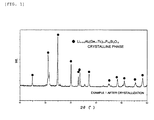
- the lithium ion conductivity at 25°C was calculated by means of the complex impedance measurement by an alternating current two-terminal method using Solartron's impedance analyzer SI-1260. Also, a crystalline deposited on the glass ceramics was indentified using a Philips' powder X-ray diffraction measuring device.
- Example 1 a powder X-ray diffraction pattern of Example 1 is shown in Fig. 1 .
- Table 1 Composition (% by mass) Example 1
- Example 2 Example 3
- Example 4 Comparative Example 1 Comparative Example 2 Comparative Example 3 Li 2 O 4.2 4.3 4.3 4.1 4.2 4.4 4.2 Al 2 O 3 8.0 8.1 8.0 7.9 8.0 8.0 Ga 2 O 3 7.8 SiO 2 1.0 1.2 1.3 1.2 1.1 1.5 1.0 P 2 O 5 52.3 53.0 53.6 52.8 52.5 54.2 51.9 TiO 2 13.2 16.7 19.8 15.1 13.6 23.6 12.3 GeO 2 20.1 15.4 11.8 18.2 20.5 7.9 19.0 ZrO 2 1.2 1.3 1.1 0.8 0.2 0.4 3.6 100.0 100.0 100.0 100.0 100.0 100.0 100.0 100.0 100.0 Tx - Tg (°C) 102.7 81.3 74.9 97.3 98.6 56.5 Not measured due to devitrification Ionic conductivity (Scm -1 /25°C)
Landscapes
- Chemical & Material Sciences (AREA)
- Engineering & Computer Science (AREA)
- Chemical Kinetics & Catalysis (AREA)
- General Chemical & Material Sciences (AREA)
- Materials Engineering (AREA)
- Life Sciences & Earth Sciences (AREA)
- Geochemistry & Mineralogy (AREA)
- Organic Chemistry (AREA)
- Crystallography & Structural Chemistry (AREA)
- Manufacturing & Machinery (AREA)
- Electrochemistry (AREA)
- Ceramic Engineering (AREA)
- Dispersion Chemistry (AREA)
- Condensed Matter Physics & Semiconductors (AREA)
- General Physics & Mathematics (AREA)
- Inorganic Chemistry (AREA)
- Physics & Mathematics (AREA)
- Glass Compositions (AREA)
- Primary Cells (AREA)
- Secondary Cells (AREA)
- Conductive Materials (AREA)
Applications Claiming Priority (1)
| Application Number | Priority Date | Filing Date | Title |
|---|---|---|---|
| JP2008071178A JP5616002B2 (ja) | 2008-03-19 | 2008-03-19 | リチウムイオン伝導性固体電解質およびその製造方法 |
Publications (3)
| Publication Number | Publication Date |
|---|---|
| EP2103573A2 true EP2103573A2 (de) | 2009-09-23 |
| EP2103573A3 EP2103573A3 (de) | 2010-04-21 |
| EP2103573B1 EP2103573B1 (de) | 2017-06-07 |
Family
ID=40679356
Family Applications (1)
| Application Number | Title | Priority Date | Filing Date |
|---|---|---|---|
| EP09003879.5A Active EP2103573B1 (de) | 2008-03-19 | 2009-03-18 | Lithiumionenleitender festelektrolyt und verfahren zu dessen herstellung |
Country Status (3)
| Country | Link |
|---|---|
| US (1) | US8883355B2 (de) |
| EP (1) | EP2103573B1 (de) |
| JP (1) | JP5616002B2 (de) |
Cited By (1)
| Publication number | Priority date | Publication date | Assignee | Title |
|---|---|---|---|---|
| CN113871683A (zh) * | 2021-09-18 | 2021-12-31 | 宁波行殊新能源科技有限公司 | 一种改善非水电解质电池高温性能的方法 |
Families Citing this family (15)
| Publication number | Priority date | Publication date | Assignee | Title |
|---|---|---|---|---|
| JP5536996B2 (ja) * | 2008-07-29 | 2014-07-02 | 株式会社オハラ | リチウムイオン伝導性ガラスセラミックスの製造方法 |
| JP5473537B2 (ja) * | 2009-10-29 | 2014-04-16 | 株式会社オハラ | リチウムイオン伝導性ガラスセラミックスおよびその製造方法 |
| CN102884666B (zh) * | 2010-03-26 | 2015-12-02 | 丰田自动车株式会社 | 固体电解质材料和全固态锂二次电池 |
| KR20120036589A (ko) * | 2010-10-08 | 2012-04-18 | 삼성전자주식회사 | 리튬 이온 전도체, 이의 제조방법 및 이를 포함하는 리튬 공기 전지 |
| JP5677181B2 (ja) * | 2011-04-26 | 2015-02-25 | 京セラ株式会社 | 固体電解質およびそれを用いた二次電池 |
| JP5721540B2 (ja) * | 2011-05-30 | 2015-05-20 | 株式会社オハラ | リチウムイオン伝導性無機物質 |
| US10333123B2 (en) | 2012-03-01 | 2019-06-25 | Johnson Ip Holding, Llc | High capacity solid state composite cathode, solid state composite separator, solid-state rechargeable lithium battery and methods of making same |
| US10084168B2 (en) | 2012-10-09 | 2018-09-25 | Johnson Battery Technologies, Inc. | Solid-state battery separators and methods of fabrication |
| CN105683105A (zh) | 2013-08-28 | 2016-06-15 | 康宁股份有限公司 | 正磷酸锂玻璃、对应的玻璃-陶瓷以及锂离子传导性nzp玻璃陶瓷 |
| JP6763965B2 (ja) | 2015-12-21 | 2020-09-30 | ジョンソン・アイピー・ホールディング・エルエルシー | 固体電池、セパレータ、電極および製造方法 |
| US10218044B2 (en) | 2016-01-22 | 2019-02-26 | Johnson Ip Holding, Llc | Johnson lithium oxygen electrochemical engine |
| KR102732519B1 (ko) | 2019-01-24 | 2024-11-20 | 삼성전자주식회사 | 복합막 및 이를 포함한 리튬이차전지 |
| US12021244B2 (en) | 2020-01-21 | 2024-06-25 | Samsung Electronics Co., Ltd. | Cathode including base-resistant compound and lithium-air battery including the same |
| DE102021128377A1 (de) | 2021-10-29 | 2023-05-04 | Schott Ag | Lithiumionenleitendes Material mit verbesserter Dendritenstabilität |
| EP4592259A1 (de) * | 2022-09-20 | 2025-07-30 | Agc Inc. | Kristallisiertes glas und verfahren zur herstellung von kristallisiertem glas |
Citations (3)
| Publication number | Priority date | Publication date | Assignee | Title |
|---|---|---|---|---|
| JPH11157872A (ja) | 1997-02-14 | 1999-06-15 | Ohara Inc | リチウムイオン伝導性ガラスセラミックスおよびこれを用いた電池、ガスセンサー |
| JP2000034134A (ja) | 1998-07-16 | 2000-02-02 | Ohara Inc | リチウムイオン伝導性ガラスセラミックスおよびこれを用いた電池、ガスセンサー |
| JP2008071178A (ja) | 2006-09-14 | 2008-03-27 | Ricoh Co Ltd | 見積り情報管理装置、見積り情報管理方法及び見積り情報管理プログラム |
Family Cites Families (13)
| Publication number | Priority date | Publication date | Assignee | Title |
|---|---|---|---|---|
| US7211532B2 (en) * | 1995-11-15 | 2007-05-01 | Kabushiki Kaisha Ohara | Alkali ion conductive glass-ceramics and electric cells and gas sensors using the same |
| JP3012211B2 (ja) * | 1996-02-09 | 2000-02-21 | 株式会社オハラ | リチウムイオン伝導性ガラスセラミックスおよびこれを用いた電池、ガスセンサー |
| EP1029828B1 (de) | 1996-10-28 | 2003-02-26 | Kabushiki Kaisha Ohara | Lithium-Ionen leitende Glaskeramiken und damit hergestellte elektrische Zellen und Glassensoren |
| JP4090148B2 (ja) * | 1999-05-28 | 2008-05-28 | 株式会社オハラ | リチウムイオン伝導性ガラスセラミックスの製造方法 |
| JP2002012446A (ja) * | 2000-06-27 | 2002-01-15 | Central Glass Co Ltd | 透明絶縁性被膜形成用硼リン酸系ガラス |
| EP1552572A2 (de) * | 2002-10-15 | 2005-07-13 | Polyplus Battery Company | Ionisch leitfähige zusammensetzungen zum schutz aktiver metallanoden |
| US6845622B2 (en) | 2003-03-27 | 2005-01-25 | Intel Corporation | Phase-change refrigeration apparatus with thermoelectric cooling element and methods |
| JP3793532B2 (ja) * | 2003-10-14 | 2006-07-05 | ペンタックス株式会社 | CaO−MgO−SiO2系生体活性ガラス及びそれを用いたリン酸カルシウム焼結体 |
| TW200638568A (en) * | 2004-12-02 | 2006-11-01 | Ohara Kk | All solid lithium ion secondary battery and a solid electrolyte therefor |
| BRPI0614743A2 (pt) * | 2005-08-09 | 2011-04-12 | Polyplus Battery Co Inc | estruturas de vedação flexìveis para ánodos de metal ativos protegidos |
| JP5153065B2 (ja) * | 2005-08-31 | 2013-02-27 | 株式会社オハラ | リチウムイオン二次電池および固体電解質 |
| JP4873925B2 (ja) * | 2005-10-28 | 2012-02-08 | 株式会社オハラ | リチウムイオン二次電池およびその製造方法 |
| JP2008273791A (ja) * | 2007-04-27 | 2008-11-13 | Ohara Inc | リン酸塩系ガラス、リン酸塩系ガラスからなるガラスセラミックス、およびそれらの製造方法 |
-
2008
- 2008-03-19 JP JP2008071178A patent/JP5616002B2/ja active Active
-
2009
- 2009-03-18 EP EP09003879.5A patent/EP2103573B1/de active Active
- 2009-03-19 US US12/383,047 patent/US8883355B2/en active Active
Patent Citations (3)
| Publication number | Priority date | Publication date | Assignee | Title |
|---|---|---|---|---|
| JPH11157872A (ja) | 1997-02-14 | 1999-06-15 | Ohara Inc | リチウムイオン伝導性ガラスセラミックスおよびこれを用いた電池、ガスセンサー |
| JP2000034134A (ja) | 1998-07-16 | 2000-02-02 | Ohara Inc | リチウムイオン伝導性ガラスセラミックスおよびこれを用いた電池、ガスセンサー |
| JP2008071178A (ja) | 2006-09-14 | 2008-03-27 | Ricoh Co Ltd | 見積り情報管理装置、見積り情報管理方法及び見積り情報管理プログラム |
Cited By (2)
| Publication number | Priority date | Publication date | Assignee | Title |
|---|---|---|---|---|
| CN113871683A (zh) * | 2021-09-18 | 2021-12-31 | 宁波行殊新能源科技有限公司 | 一种改善非水电解质电池高温性能的方法 |
| CN113871683B (zh) * | 2021-09-18 | 2022-06-17 | 宁波梅山保税港区锂泰企业管理合伙企业(有限合伙) | 一种改善非水电解质电池高温性能的方法 |
Also Published As
| Publication number | Publication date |
|---|---|
| EP2103573B1 (de) | 2017-06-07 |
| US8883355B2 (en) | 2014-11-11 |
| US20090239153A1 (en) | 2009-09-24 |
| EP2103573A3 (de) | 2010-04-21 |
| JP2009227474A (ja) | 2009-10-08 |
| JP5616002B2 (ja) | 2014-10-29 |
Similar Documents
| Publication | Publication Date | Title |
|---|---|---|
| EP2103573B1 (de) | Lithiumionenleitender festelektrolyt und verfahren zu dessen herstellung | |
| JP5536996B2 (ja) | リチウムイオン伝導性ガラスセラミックスの製造方法 | |
| US6485622B1 (en) | Lithium ion conductive glass-ceramics and electric cells and gas sensors using the same | |
| JP5940101B2 (ja) | リチウムイオン伝導性ガラスセラミック及び前記ガラスセラミックの使用 | |
| US5702995A (en) | Lithium ion conductive glass-ceramics | |
| US7211532B2 (en) | Alkali ion conductive glass-ceramics and electric cells and gas sensors using the same | |
| US6030909A (en) | Lithium ion conductive glass-ceramics and electric cells and gas sensors using the same | |
| JP7394757B2 (ja) | 非晶質固体電解質およびそれを用いた全固体二次電池 | |
| JP6007909B2 (ja) | リチウムイオン伝導性ガラスセラミックスの製造方法 | |
| JP5473537B2 (ja) | リチウムイオン伝導性ガラスセラミックスおよびその製造方法 | |
| JP3012211B2 (ja) | リチウムイオン伝導性ガラスセラミックスおよびこれを用いた電池、ガスセンサー | |
| KR102445216B1 (ko) | 리튬이온 전도체 전구체 유리 및 리튬이온 전도체 | |
| CN101811828A (zh) | Nasicon结构微晶玻璃钠离子固体电解质及其制备方法 | |
| JPH11157872A (ja) | リチウムイオン伝導性ガラスセラミックスおよびこれを用いた電池、ガスセンサー | |
| KR20200083618A (ko) | 고체 전해질 | |
| EP4009411A1 (de) | Lithium-ionen leitendes material und verfahren zu seiner herstellung | |
| JP2000026135A (ja) | リチウムイオン伝導性ガラスセラミックスおよびこれを用いた電池、ガスセンサ― | |
| JP2024125009A (ja) | ナトリウムイオン電池用部材、ナトリウムイオン電池用部材の形成材料、及び、ナトリウムイオン電池 | |
| JP6969374B2 (ja) | 酸化物電解質焼結体の製造方法、及び、その製造方法に用いるガーネット型イオン伝導性酸化物 | |
| CN110407579A (zh) | 一种具有超高q值微波介质材料及其制备方法 | |
| JP2014017137A (ja) | リチウムイオン伝導性ガラスセラミックス | |
| EP1028094B1 (de) | Lithium-Ionen leitende Glaskeramiken und damit hergestellte elektrische Zellen und Gassensoren | |
| JP2013112599A (ja) | リチウムイオン伝導体前駆体ガラスおよびリチウムイオン伝導体 | |
| EP4257563A1 (de) | Leitfähige lithium-ionen-glaskeramik und ihre herstellung | |
| CN113692662B (zh) | 陶瓷材料 |
Legal Events
| Date | Code | Title | Description |
|---|---|---|---|
| PUAI | Public reference made under article 153(3) epc to a published international application that has entered the european phase |
Free format text: ORIGINAL CODE: 0009012 |
|
| AK | Designated contracting states |
Kind code of ref document: A2 Designated state(s): AT BE BG CH CY CZ DE DK EE ES FI FR GB GR HR HU IE IS IT LI LT LU LV MC MK MT NL NO PL PT RO SE SI SK TR |
|
| AX | Request for extension of the european patent |
Extension state: AL BA RS |
|
| 17P | Request for examination filed |
Effective date: 20100202 |
|
| PUAL | Search report despatched |
Free format text: ORIGINAL CODE: 0009013 |
|
| AK | Designated contracting states |
Kind code of ref document: A3 Designated state(s): AT BE BG CH CY CZ DE DK EE ES FI FR GB GR HR HU IE IS IT LI LT LU LV MC MK MT NL NO PL PT RO SE SI SK TR |
|
| AX | Request for extension of the european patent |
Extension state: AL BA RS |
|
| RIC1 | Information provided on ipc code assigned before grant |
Ipc: C03C 10/00 20060101ALI20100318BHEP Ipc: C03C 4/18 20060101AFI20090608BHEP Ipc: H01M 10/36 20100101ALI20100318BHEP |
|
| 17Q | First examination report despatched |
Effective date: 20100716 |
|
| AKX | Designation fees paid |
Designated state(s): AT BE BG CH CY CZ DE DK EE ES FI FR GB GR HR HU IE IS IT LI LT LU LV MC MK MT NL NO PL PT RO SE SI SK TR |
|
| STAA | Information on the status of an ep patent application or granted ep patent |
Free format text: STATUS: EXAMINATION IS IN PROGRESS |
|
| GRAP | Despatch of communication of intention to grant a patent |
Free format text: ORIGINAL CODE: EPIDOSNIGR1 |
|
| STAA | Information on the status of an ep patent application or granted ep patent |
Free format text: STATUS: GRANT OF PATENT IS INTENDED |
|
| INTG | Intention to grant announced |
Effective date: 20161216 |
|
| GRAS | Grant fee paid |
Free format text: ORIGINAL CODE: EPIDOSNIGR3 |
|
| GRAA | (expected) grant |
Free format text: ORIGINAL CODE: 0009210 |
|
| STAA | Information on the status of an ep patent application or granted ep patent |
Free format text: STATUS: THE PATENT HAS BEEN GRANTED |
|
| AK | Designated contracting states |
Kind code of ref document: B1 Designated state(s): AT BE BG CH CY CZ DE DK EE ES FI FR GB GR HR HU IE IS IT LI LT LU LV MC MK MT NL NO PL PT RO SE SI SK TR |
|
| REG | Reference to a national code |
Ref country code: GB Ref legal event code: FG4D |
|
| GRAA | (expected) grant |
Free format text: ORIGINAL CODE: 0009210 |
|
| REG | Reference to a national code |
Ref country code: CH Ref legal event code: EP Ref country code: AT Ref legal event code: REF Ref document number: 899090 Country of ref document: AT Kind code of ref document: T Effective date: 20170615 |
|
| REG | Reference to a national code |
Ref country code: IE Ref legal event code: FG4D |
|
| REG | Reference to a national code |
Ref country code: DE Ref legal event code: R096 Ref document number: 602009046442 Country of ref document: DE |
|
| REG | Reference to a national code |
Ref country code: NL Ref legal event code: MP Effective date: 20170607 |
|
| REG | Reference to a national code |
Ref country code: LT Ref legal event code: MG4D |
|
| PG25 | Lapsed in a contracting state [announced via postgrant information from national office to epo] |
Ref country code: FI Free format text: LAPSE BECAUSE OF FAILURE TO SUBMIT A TRANSLATION OF THE DESCRIPTION OR TO PAY THE FEE WITHIN THE PRESCRIBED TIME-LIMIT Effective date: 20170607 Ref country code: HR Free format text: LAPSE BECAUSE OF FAILURE TO SUBMIT A TRANSLATION OF THE DESCRIPTION OR TO PAY THE FEE WITHIN THE PRESCRIBED TIME-LIMIT Effective date: 20170607 Ref country code: LT Free format text: LAPSE BECAUSE OF FAILURE TO SUBMIT A TRANSLATION OF THE DESCRIPTION OR TO PAY THE FEE WITHIN THE PRESCRIBED TIME-LIMIT Effective date: 20170607 Ref country code: ES Free format text: LAPSE BECAUSE OF FAILURE TO SUBMIT A TRANSLATION OF THE DESCRIPTION OR TO PAY THE FEE WITHIN THE PRESCRIBED TIME-LIMIT Effective date: 20170607 Ref country code: GR Free format text: LAPSE BECAUSE OF FAILURE TO SUBMIT A TRANSLATION OF THE DESCRIPTION OR TO PAY THE FEE WITHIN THE PRESCRIBED TIME-LIMIT Effective date: 20170908 Ref country code: NO Free format text: LAPSE BECAUSE OF FAILURE TO SUBMIT A TRANSLATION OF THE DESCRIPTION OR TO PAY THE FEE WITHIN THE PRESCRIBED TIME-LIMIT Effective date: 20170907 |
|
| REG | Reference to a national code |
Ref country code: AT Ref legal event code: MK05 Ref document number: 899090 Country of ref document: AT Kind code of ref document: T Effective date: 20170607 |
|
| PG25 | Lapsed in a contracting state [announced via postgrant information from national office to epo] |
Ref country code: NL Free format text: LAPSE BECAUSE OF FAILURE TO SUBMIT A TRANSLATION OF THE DESCRIPTION OR TO PAY THE FEE WITHIN THE PRESCRIBED TIME-LIMIT Effective date: 20170607 Ref country code: BG Free format text: LAPSE BECAUSE OF FAILURE TO SUBMIT A TRANSLATION OF THE DESCRIPTION OR TO PAY THE FEE WITHIN THE PRESCRIBED TIME-LIMIT Effective date: 20170907 Ref country code: SE Free format text: LAPSE BECAUSE OF FAILURE TO SUBMIT A TRANSLATION OF THE DESCRIPTION OR TO PAY THE FEE WITHIN THE PRESCRIBED TIME-LIMIT Effective date: 20170607 Ref country code: LV Free format text: LAPSE BECAUSE OF FAILURE TO SUBMIT A TRANSLATION OF THE DESCRIPTION OR TO PAY THE FEE WITHIN THE PRESCRIBED TIME-LIMIT Effective date: 20170607 |
|
| PG25 | Lapsed in a contracting state [announced via postgrant information from national office to epo] |
Ref country code: AT Free format text: LAPSE BECAUSE OF FAILURE TO SUBMIT A TRANSLATION OF THE DESCRIPTION OR TO PAY THE FEE WITHIN THE PRESCRIBED TIME-LIMIT Effective date: 20170607 Ref country code: RO Free format text: LAPSE BECAUSE OF FAILURE TO SUBMIT A TRANSLATION OF THE DESCRIPTION OR TO PAY THE FEE WITHIN THE PRESCRIBED TIME-LIMIT Effective date: 20170607 Ref country code: EE Free format text: LAPSE BECAUSE OF FAILURE TO SUBMIT A TRANSLATION OF THE DESCRIPTION OR TO PAY THE FEE WITHIN THE PRESCRIBED TIME-LIMIT Effective date: 20170607 Ref country code: SK Free format text: LAPSE BECAUSE OF FAILURE TO SUBMIT A TRANSLATION OF THE DESCRIPTION OR TO PAY THE FEE WITHIN THE PRESCRIBED TIME-LIMIT Effective date: 20170607 Ref country code: CZ Free format text: LAPSE BECAUSE OF FAILURE TO SUBMIT A TRANSLATION OF THE DESCRIPTION OR TO PAY THE FEE WITHIN THE PRESCRIBED TIME-LIMIT Effective date: 20170607 |
|
| PG25 | Lapsed in a contracting state [announced via postgrant information from national office to epo] |
Ref country code: IT Free format text: LAPSE BECAUSE OF FAILURE TO SUBMIT A TRANSLATION OF THE DESCRIPTION OR TO PAY THE FEE WITHIN THE PRESCRIBED TIME-LIMIT Effective date: 20170607 Ref country code: IS Free format text: LAPSE BECAUSE OF FAILURE TO SUBMIT A TRANSLATION OF THE DESCRIPTION OR TO PAY THE FEE WITHIN THE PRESCRIBED TIME-LIMIT Effective date: 20171007 Ref country code: PL Free format text: LAPSE BECAUSE OF FAILURE TO SUBMIT A TRANSLATION OF THE DESCRIPTION OR TO PAY THE FEE WITHIN THE PRESCRIBED TIME-LIMIT Effective date: 20170607 |
|
| REG | Reference to a national code |
Ref country code: DE Ref legal event code: R097 Ref document number: 602009046442 Country of ref document: DE |
|
| REG | Reference to a national code |
Ref country code: FR Ref legal event code: PLFP Year of fee payment: 10 |
|
| PLBE | No opposition filed within time limit |
Free format text: ORIGINAL CODE: 0009261 |
|
| STAA | Information on the status of an ep patent application or granted ep patent |
Free format text: STATUS: NO OPPOSITION FILED WITHIN TIME LIMIT |
|
| PG25 | Lapsed in a contracting state [announced via postgrant information from national office to epo] |
Ref country code: DK Free format text: LAPSE BECAUSE OF FAILURE TO SUBMIT A TRANSLATION OF THE DESCRIPTION OR TO PAY THE FEE WITHIN THE PRESCRIBED TIME-LIMIT Effective date: 20170607 |
|
| 26N | No opposition filed |
Effective date: 20180308 |
|
| PG25 | Lapsed in a contracting state [announced via postgrant information from national office to epo] |
Ref country code: SI Free format text: LAPSE BECAUSE OF FAILURE TO SUBMIT A TRANSLATION OF THE DESCRIPTION OR TO PAY THE FEE WITHIN THE PRESCRIBED TIME-LIMIT Effective date: 20170607 |
|
| REG | Reference to a national code |
Ref country code: CH Ref legal event code: PL |
|
| GBPC | Gb: european patent ceased through non-payment of renewal fee |
Effective date: 20180318 |
|
| PG25 | Lapsed in a contracting state [announced via postgrant information from national office to epo] |
Ref country code: MC Free format text: LAPSE BECAUSE OF FAILURE TO SUBMIT A TRANSLATION OF THE DESCRIPTION OR TO PAY THE FEE WITHIN THE PRESCRIBED TIME-LIMIT Effective date: 20170607 |
|
| REG | Reference to a national code |
Ref country code: BE Ref legal event code: MM Effective date: 20180331 |
|
| REG | Reference to a national code |
Ref country code: IE Ref legal event code: MM4A |
|
| PG25 | Lapsed in a contracting state [announced via postgrant information from national office to epo] |
Ref country code: LU Free format text: LAPSE BECAUSE OF NON-PAYMENT OF DUE FEES Effective date: 20180318 |
|
| PG25 | Lapsed in a contracting state [announced via postgrant information from national office to epo] |
Ref country code: IE Free format text: LAPSE BECAUSE OF NON-PAYMENT OF DUE FEES Effective date: 20180318 |
|
| PG25 | Lapsed in a contracting state [announced via postgrant information from national office to epo] |
Ref country code: LI Free format text: LAPSE BECAUSE OF NON-PAYMENT OF DUE FEES Effective date: 20180331 Ref country code: CH Free format text: LAPSE BECAUSE OF NON-PAYMENT OF DUE FEES Effective date: 20180331 Ref country code: BE Free format text: LAPSE BECAUSE OF NON-PAYMENT OF DUE FEES Effective date: 20180331 Ref country code: GB Free format text: LAPSE BECAUSE OF NON-PAYMENT OF DUE FEES Effective date: 20180318 |
|
| PGFP | Annual fee paid to national office [announced via postgrant information from national office to epo] |
Ref country code: FR Payment date: 20190131 Year of fee payment: 16 |
|
| PG25 | Lapsed in a contracting state [announced via postgrant information from national office to epo] |
Ref country code: MT Free format text: LAPSE BECAUSE OF NON-PAYMENT OF DUE FEES Effective date: 20180318 |
|
| PG25 | Lapsed in a contracting state [announced via postgrant information from national office to epo] |
Ref country code: TR Free format text: LAPSE BECAUSE OF FAILURE TO SUBMIT A TRANSLATION OF THE DESCRIPTION OR TO PAY THE FEE WITHIN THE PRESCRIBED TIME-LIMIT Effective date: 20170607 |
|
| PG25 | Lapsed in a contracting state [announced via postgrant information from national office to epo] |
Ref country code: PT Free format text: LAPSE BECAUSE OF FAILURE TO SUBMIT A TRANSLATION OF THE DESCRIPTION OR TO PAY THE FEE WITHIN THE PRESCRIBED TIME-LIMIT Effective date: 20170607 Ref country code: HU Free format text: LAPSE BECAUSE OF FAILURE TO SUBMIT A TRANSLATION OF THE DESCRIPTION OR TO PAY THE FEE WITHIN THE PRESCRIBED TIME-LIMIT; INVALID AB INITIO Effective date: 20090318 |
|
| PG25 | Lapsed in a contracting state [announced via postgrant information from national office to epo] |
Ref country code: MK Free format text: LAPSE BECAUSE OF NON-PAYMENT OF DUE FEES Effective date: 20170607 Ref country code: CY Free format text: LAPSE BECAUSE OF FAILURE TO SUBMIT A TRANSLATION OF THE DESCRIPTION OR TO PAY THE FEE WITHIN THE PRESCRIBED TIME-LIMIT Effective date: 20170607 |
|
| PG25 | Lapsed in a contracting state [announced via postgrant information from national office to epo] |
Ref country code: FR Free format text: LAPSE BECAUSE OF NON-PAYMENT OF DUE FEES Effective date: 20200331 |
|
| PGFP | Annual fee paid to national office [announced via postgrant information from national office to epo] |
Ref country code: DE Payment date: 20250319 Year of fee payment: 17 |