EP2105487A2 - Fabrication de noir de carbone, de composants de combustibles et de matières premières à base d'hydrocarbures pour l'énergie chimique à partir de déchets contenant du caoutchouc - Google Patents
Fabrication de noir de carbone, de composants de combustibles et de matières premières à base d'hydrocarbures pour l'énergie chimique à partir de déchets contenant du caoutchouc Download PDFInfo
- Publication number
- EP2105487A2 EP2105487A2 EP07870641A EP07870641A EP2105487A2 EP 2105487 A2 EP2105487 A2 EP 2105487A2 EP 07870641 A EP07870641 A EP 07870641A EP 07870641 A EP07870641 A EP 07870641A EP 2105487 A2 EP2105487 A2 EP 2105487A2
- Authority
- EP
- European Patent Office
- Prior art keywords
- reactor
- solvent
- thermolysis
- rubber crumb
- rubber
- Prior art date
- Legal status (The legal status is an assumption and is not a legal conclusion. Google has not performed a legal analysis and makes no representation as to the accuracy of the status listed.)
- Withdrawn
Links
- 239000002699 waste material Substances 0.000 title claims description 22
- 238000004519 manufacturing process Methods 0.000 title claims description 9
- 239000006229 carbon black Substances 0.000 title description 2
- VNWKTOKETHGBQD-UHFFFAOYSA-N methane Chemical compound C VNWKTOKETHGBQD-UHFFFAOYSA-N 0.000 title 1
- 229920001971 elastomer Polymers 0.000 claims abstract description 49
- 239000005060 rubber Substances 0.000 claims abstract description 49
- 239000002904 solvent Substances 0.000 claims abstract description 36
- 229930195733 hydrocarbon Natural products 0.000 claims abstract description 34
- 150000002430 hydrocarbons Chemical class 0.000 claims abstract description 34
- 238000001149 thermolysis Methods 0.000 claims abstract description 33
- 239000000047 product Substances 0.000 claims abstract description 31
- 238000000034 method Methods 0.000 claims abstract description 20
- 239000004215 Carbon black (E152) Substances 0.000 claims abstract description 17
- 239000007795 chemical reaction product Substances 0.000 claims abstract description 15
- 239000003795 chemical substances by application Substances 0.000 claims abstract description 5
- 239000007789 gas Substances 0.000 claims description 23
- OKTJSMMVPCPJKN-UHFFFAOYSA-N Carbon Chemical compound [C] OKTJSMMVPCPJKN-UHFFFAOYSA-N 0.000 claims description 17
- 229910052799 carbon Inorganic materials 0.000 claims description 16
- 239000011551 heat transfer agent Substances 0.000 claims description 9
- 239000000203 mixture Substances 0.000 claims description 9
- 238000000227 grinding Methods 0.000 claims description 8
- JTJMJGYZQZDUJJ-UHFFFAOYSA-N phencyclidine Chemical class C1CCCCN1C1(C=2C=CC=CC=2)CCCCC1 JTJMJGYZQZDUJJ-UHFFFAOYSA-N 0.000 claims description 7
- 238000009826 distribution Methods 0.000 claims description 6
- 239000000126 substance Substances 0.000 claims description 6
- 238000012546 transfer Methods 0.000 claims description 5
- 238000005056 compaction Methods 0.000 claims description 4
- 239000000446 fuel Substances 0.000 claims description 4
- 239000011261 inert gas Substances 0.000 claims description 4
- 238000004939 coking Methods 0.000 claims description 2
- 125000000217 alkyl group Chemical group 0.000 claims 1
- 238000001704 evaporation Methods 0.000 claims 1
- 239000004615 ingredient Substances 0.000 claims 1
- 239000007788 liquid Substances 0.000 description 15
- 238000009835 boiling Methods 0.000 description 12
- 238000004064 recycling Methods 0.000 description 9
- 238000000926 separation method Methods 0.000 description 7
- 238000010438 heat treatment Methods 0.000 description 5
- IJGRMHOSHXDMSA-UHFFFAOYSA-N Atomic nitrogen Chemical compound N#N IJGRMHOSHXDMSA-UHFFFAOYSA-N 0.000 description 4
- 150000004996 alkyl benzenes Chemical class 0.000 description 4
- 239000012634 fragment Substances 0.000 description 4
- 229910052751 metal Inorganic materials 0.000 description 4
- 239000002184 metal Substances 0.000 description 4
- YXFVVABEGXRONW-UHFFFAOYSA-N Toluene Chemical compound CC1=CC=CC=C1 YXFVVABEGXRONW-UHFFFAOYSA-N 0.000 description 3
- 238000004140 cleaning Methods 0.000 description 3
- -1 e.g. Substances 0.000 description 3
- 238000010926 purge Methods 0.000 description 3
- 238000007670 refining Methods 0.000 description 3
- 238000010992 reflux Methods 0.000 description 3
- 239000007787 solid Substances 0.000 description 3
- XLYOFNOQVPJJNP-UHFFFAOYSA-N water Substances O XLYOFNOQVPJJNP-UHFFFAOYSA-N 0.000 description 3
- 230000008901 benefit Effects 0.000 description 2
- 238000001833 catalytic reforming Methods 0.000 description 2
- 239000000571 coke Substances 0.000 description 2
- 239000010791 domestic waste Substances 0.000 description 2
- 239000000428 dust Substances 0.000 description 2
- 230000000694 effects Effects 0.000 description 2
- 229910052757 nitrogen Inorganic materials 0.000 description 2
- 229920000620 organic polymer Polymers 0.000 description 2
- 239000003960 organic solvent Substances 0.000 description 2
- 238000012856 packing Methods 0.000 description 2
- 239000002245 particle Substances 0.000 description 2
- 238000003825 pressing Methods 0.000 description 2
- 229910052761 rare earth metal Inorganic materials 0.000 description 2
- 150000002910 rare earth metals Chemical class 0.000 description 2
- 238000002407 reforming Methods 0.000 description 2
- 238000010091 synthetic rubber production Methods 0.000 description 2
- 230000002411 adverse Effects 0.000 description 1
- 230000015572 biosynthetic process Effects 0.000 description 1
- 239000006227 byproduct Substances 0.000 description 1
- OKTJSMMVPCPJKN-YPZZEJLDSA-N carbon-10 atom Chemical compound [10C] OKTJSMMVPCPJKN-YPZZEJLDSA-N 0.000 description 1
- 238000006243 chemical reaction Methods 0.000 description 1
- 238000002485 combustion reaction Methods 0.000 description 1
- 238000009833 condensation Methods 0.000 description 1
- 230000005494 condensation Effects 0.000 description 1
- 238000001816 cooling Methods 0.000 description 1
- 238000013461 design Methods 0.000 description 1
- 238000005516 engineering process Methods 0.000 description 1
- 239000003546 flue gas Substances 0.000 description 1
- 238000005243 fluidization Methods 0.000 description 1
- 239000012535 impurity Substances 0.000 description 1
- 239000002440 industrial waste Substances 0.000 description 1
- 239000013067 intermediate product Substances 0.000 description 1
- 238000012545 processing Methods 0.000 description 1
- 238000000197 pyrolysis Methods 0.000 description 1
- 230000003134 recirculating effect Effects 0.000 description 1
- 238000011084 recovery Methods 0.000 description 1
- 238000010092 rubber production Methods 0.000 description 1
- 238000010517 secondary reaction Methods 0.000 description 1
- 239000012265 solid product Substances 0.000 description 1
- 238000010025 steaming Methods 0.000 description 1
- 238000003860 storage Methods 0.000 description 1
Images

Classifications
-
- C—CHEMISTRY; METALLURGY
- C10—PETROLEUM, GAS OR COKE INDUSTRIES; TECHNICAL GASES CONTAINING CARBON MONOXIDE; FUELS; LUBRICANTS; PEAT
- C10B—DESTRUCTIVE DISTILLATION OF CARBONACEOUS MATERIALS FOR PRODUCTION OF GAS, COKE, TAR, OR SIMILAR MATERIALS
- C10B53/00—Destructive distillation, specially adapted for particular solid raw materials or solid raw materials in special form
- C10B53/07—Destructive distillation, specially adapted for particular solid raw materials or solid raw materials in special form of solid raw materials consisting of synthetic polymeric materials, e.g. tyres
-
- C—CHEMISTRY; METALLURGY
- C10—PETROLEUM, GAS OR COKE INDUSTRIES; TECHNICAL GASES CONTAINING CARBON MONOXIDE; FUELS; LUBRICANTS; PEAT
- C10B—DESTRUCTIVE DISTILLATION OF CARBONACEOUS MATERIALS FOR PRODUCTION OF GAS, COKE, TAR, OR SIMILAR MATERIALS
- C10B49/00—Destructive distillation of solid carbonaceous materials by direct heating with heat-carrying agents including the partial combustion of the solid material to be treated
- C10B49/02—Destructive distillation of solid carbonaceous materials by direct heating with heat-carrying agents including the partial combustion of the solid material to be treated with hot gases or vapours, e.g. hot gases obtained by partial combustion of the charge
- C10B49/04—Destructive distillation of solid carbonaceous materials by direct heating with heat-carrying agents including the partial combustion of the solid material to be treated with hot gases or vapours, e.g. hot gases obtained by partial combustion of the charge while moving the solid material to be treated
- C10B49/08—Destructive distillation of solid carbonaceous materials by direct heating with heat-carrying agents including the partial combustion of the solid material to be treated with hot gases or vapours, e.g. hot gases obtained by partial combustion of the charge while moving the solid material to be treated in dispersed form
- C10B49/10—Destructive distillation of solid carbonaceous materials by direct heating with heat-carrying agents including the partial combustion of the solid material to be treated with hot gases or vapours, e.g. hot gases obtained by partial combustion of the charge while moving the solid material to be treated in dispersed form according to the "fluidised bed" technique
-
- C—CHEMISTRY; METALLURGY
- C10—PETROLEUM, GAS OR COKE INDUSTRIES; TECHNICAL GASES CONTAINING CARBON MONOXIDE; FUELS; LUBRICANTS; PEAT
- C10B—DESTRUCTIVE DISTILLATION OF CARBONACEOUS MATERIALS FOR PRODUCTION OF GAS, COKE, TAR, OR SIMILAR MATERIALS
- C10B51/00—Destructive distillation of solid carbonaceous materials by combined direct and indirect heating
-
- C—CHEMISTRY; METALLURGY
- C10—PETROLEUM, GAS OR COKE INDUSTRIES; TECHNICAL GASES CONTAINING CARBON MONOXIDE; FUELS; LUBRICANTS; PEAT
- C10G—CRACKING HYDROCARBON OILS; PRODUCTION OF LIQUID HYDROCARBON MIXTURES, e.g. BY DESTRUCTIVE HYDROGENATION, OLIGOMERISATION, POLYMERISATION; RECOVERY OF HYDROCARBON OILS FROM OIL-SHALE, OIL-SAND, OR GASES; REFINING MIXTURES MAINLY CONSISTING OF HYDROCARBONS; REFORMING OF NAPHTHA; MINERAL WAXES
- C10G1/00—Production of liquid hydrocarbon mixtures from oil-shale, oil-sand, or non-melting solid carbonaceous or similar materials, e.g. wood, coal
- C10G1/10—Production of liquid hydrocarbon mixtures from oil-shale, oil-sand, or non-melting solid carbonaceous or similar materials, e.g. wood, coal from rubber or rubber waste
-
- Y—GENERAL TAGGING OF NEW TECHNOLOGICAL DEVELOPMENTS; GENERAL TAGGING OF CROSS-SECTIONAL TECHNOLOGIES SPANNING OVER SEVERAL SECTIONS OF THE IPC; TECHNICAL SUBJECTS COVERED BY FORMER USPC CROSS-REFERENCE ART COLLECTIONS [XRACs] AND DIGESTS
- Y02—TECHNOLOGIES OR APPLICATIONS FOR MITIGATION OR ADAPTATION AGAINST CLIMATE CHANGE
- Y02P—CLIMATE CHANGE MITIGATION TECHNOLOGIES IN THE PRODUCTION OR PROCESSING OF GOODS
- Y02P20/00—Technologies relating to chemical industry
- Y02P20/141—Feedstock
- Y02P20/143—Feedstock the feedstock being recycled material, e.g. plastics
Definitions
- This invention relates to the chemical industry and to recycling of rubber-containing industrial and household waste, e.g., worn-out tires.
- Production is carried out primarily by thermolysis of rubber crumb in a supercritical hydrocarbon gas. After thermolysis of rubber a carbon black, which is close by its composition to that used in the rubber production, a wide fraction of hydrocarbons and a small quantity of a hydrocarbon gas are obtained.
- Obtained products may be used both directly and after processing - refining.
- a method which consists of recycling of rubber-containing waste for producing engine fuel and chemical raw stock by thermal fluidization (thermolysis) of waste in a hydrocarbon solvent, which is a by-product of the synthetic rubber production, at a pressure ranging from 1 to 6 MPa, a temperature from 270 to 420°C and a solvent-waste ratio 2 - 4 : 1.
- thermal fluidization thermolysis
- a method for recycling organic polymer waste includes thermolysis of a solvent, namely, alkyl benzene, at a pressure not lower than 6.1 MPa, a temperature at least 210°C and a solvent-waste mass ratio from 1:1 to 4.2:1.
- a solvent namely, alkyl benzene
- thermolysis-product distillate fraction having a boiling temperature above 210°C.
- a method for recycling organic polymer waste in an organic solvent, namely alkyl benzene, at a temperature above 270-420°C and a pressure up to 6 MPa and at a solvent-waste mass ration 2 - 4 : 1 in the presence of a rare-earth metal is known also ( RU, No. 2110535 , C 08 J 11/04, publ. 10.05.1998).
- the solvent-waste ratio will be 0.2.
- a plant capacity is 1 ton/hour, which is equal to 2.5 m 3 /hour
- a reactor volume will reach 100 m 3 and at a given temperature and pressure a reactor weight will be equal to 40 - 300 tons, which would be hardly acceptable for a small-capacity plant.
- every invention out of the above-said has its own disadvantages, i.e., difficulties with obtaining waste from the synthetic rubber production in one case, a high pressure (more than 6.1 MPa) in the second case, valuable rare earth-metal impurities in technical carbon in the third case, the use of a heavy fraction (the boiling temperature above 220°C) as the solvent in the fourth case (which will lead to the increased coke formation and poorer properties of the industrial carbon (IC) and carburization of production apparatuses).
- the closest to the claimed method is the one for recycling rubber-containing waste in an organic solvent at the temperature of 435°C and a pressure ranging from 2.9 to 6 MPa, separating a liquid fraction from the non-dissolved product, distilling the liquid fraction into two fractions: one having a boiling point up to 220°C, which is a light hydrocarbon fraction (LHF), and the other one having the boiling point above 220°C.
- the solvent-waste ratio is within the limits from 1 to 3.0.
- a fraction part having the boiling point up to 220°C is subjected to catalytic reforming and is used as a solvent. ( RU, No. 2220986 , C 08 J 11/04, C 08 L 21/00, publ. 10.01.2004).
- the fraction of liquid light hydrocarbons is fed into a fire tubular furnace and then to a reforming reactor having the temperature of 500°C and to the main reactor.
- the objective of the invention is to improve the method performance characteristics.
- the claimed invention eliminates the above disadvantages of the known method ( RU, No. 2220986 ) due to:
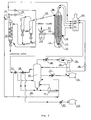
- Rubber-containing raw stock 1 comprising worn-out tires, electric cables, rubber articles production waste, household waste, etc., comes to the section 2 for receiving, storing and preparing raw stock and then to the section 3 for grinding raw stock and separating fragments after grinding.
- Metal fragments 4 after grinding, all types of cords, metal wires, etc. are transferred to the section 5 for stockpiling, pressing, packing and shipping commercial products.
- Rubber crumb 6 is fed to the plant 7 for rubber crumb thermolysis.
- Liquid thermolysis products 8 are transferred by pipelines to the tank farm 9 for subsequent sale, and industrial carbon 10 is cooled and, if necessary, refined in the section 11 for refining industrial carbon and is also fed to the storage section 5.
- the production line includes necessary general plant facilities 12, namely, a cooling tower, a recycling water system, a power sub-station, an inert-gas (e.g., nitrogen) generator, a steam generator, etc.
- necessary general plant facilities 12 namely, a cooling tower, a recycling water system, a power sub-station, an inert-gas (e.g., nitrogen) generator, a steam generator, etc.
- Rubber crumb from the rubber (tires) grinding line is fed by a transporter to the feeding bin 13 of the screw extruder 14 which forces rubber crumb to the reactor 15 being a cylindrical vessel with a fluidized bed of rubber crumb and industrial carbon, which bottom portion is provided with the tapered distribution device 16 having the nozzle 37.
- the supercritical hydrocarbon gas pressure in the reactor is about 4 MPa.
- the coil 17 is arranged within the reactor 15.
- a heat-transfer agent is fed through the fitting 18 into a cavity between the shell of the reactor 15 and the tapered distribution device 16.
- a fluidized bed in the reactor 15 ensures a high heat-transfer coefficient from a heat-transfer agent to rubber crumb.
- a fluidizing agent - heat-transfer agent-solvent - is taken from the rectifying column 19, heated in the heat-exchangers 20 and 21 by counter-flows of thermolysis products and a heavy bottom product from the rectifying column 19.
- the heat-transfer agent is heated in the furnace 22 and fed to the coil 17 of the reactor 15, where the thermolysis temperature is maintained at the level of 320-350°C by heat-transfer through the walls of the coil 17, after which the solvent is returned to the furnace 22 for additional heating and is fed to the reactor 15 through the fitting 18 and then through the nozzle 37 for heating continuously fed rubber crumb up to a temperature ranging from 320°C to 350°C through the walls of the tapered distribution device 16 and through direct contact with it.
- Reaction products are removed from the reactor 15 through the fitting 36, throttled to a pressure from 0.7 to 0.4 MPa in the throttling device 23; then industrial carbon is separated from a hydrocarbon gas in several consecutive stages of the cyclones 24 and is fed to the steam-stripping column 25, where remaining hydrocarbons are removed from industrial carbon by superheated water steam.
- This steam is also used for transporting industrial carbon from the cyclones 24 to the steam-stripping column 25 through pipelines.
- the solvent performs the functions of a fluidizing agent, a heat-transfer agent and a remover of all thermolysis products from the reactor simultaneously.
- Purge gases from the steam-stripping column 25 are added to the main gas flow going from the cyclones 24 in the pipeline 26. Then the gas is finally cleaned from dust in the fine cleaning filter 27, which is regularly cleaned by superheated water steam, and is fed in two flows as raw stock to the rectifying column 19.
- the main gas flow is cooled in the heat-exchanger 21 with heat recovery to the direct flow of the heat-transfer agent and after this it is fed to the column 19.
- the other gas flow going through the pipeline 34 transfers part of its heat in the reboiler 34, and after this it is also fed to the rectifying column 19.
- the rectifying column 19 is used for separating gas raw stock into a gas, a light fraction of liquid hydrocarbons, a heavy fraction of liquid hydrocarbons and, individually, a distillate, which is used as a solvent.
- Non-condensed gas from the dome 15 of the column 19 is cooled and condensed in the reflux condenser 30, after which it is separated in the three-phase separator 29 into a hydrocarbon gas, liquid light hydrocarbons and H 2 O condensate.
- H 2 O condensate from the bottom 28 of the three-phase separator 29 is evaporated in the steam generator 26 and overheated in the furnace 22 to the temperature about 450°C.
- the hydrocarbon gas from the separator 29 is used for combustion in the furnace 22.
- the liquid light product is fed to the upper plate of the rectifying column 19 as a reflux.
- a part of the liquid light product may be taken as a light gasoline having a boiling temperature below 70°C and transported to the product warehouse 35.
- Commercial hydrocarbon fraction having a boiling temperature below 200°C is taken from the middle of the column 19 and is also fed to the warehouse 35 through the cooler 31.
- the distillate-solvent from the column 19 is fed for recycling by sequentially heating it in the heat-exchangers 20, 21 and the furnace 22.
- a heavy hydrocarbon product having a boiling temperature above 200°C is taken from the bottom of the column 19 and is sequentially cooled down in the heat-exchanger 20 and the cooler 32, after which it is transported to the warehouse 25.
- Heat of a part of the counter-flow going through the pipeline 34 is used in the evaporator-reboiler 33 for a bottom product.
- an inert gas e.g., nitrogen, is fed to the bin 13.
- a significant advantage of the proposed production line is the absence of waste (except for furnace flue gases) and the complete recycling of waste.
- the method of rubber crumb thermolysis was realized at a demonstration pilot plant to the full scale at a capacity up to 10 kilos of rubber crumb per hour (with the exception that an electroheating furnace was used instead of the above fire tubular furnace and a gravitational separator was used instead of the above-said cyclone). During long operation run the demonstration plant showed operability of both the method on the whole and individual devices and machinery within the thermolysis parameters stated in this application.
- the organic solvent-rubber crumb weight ratio was varied from 0.2 to 0.34, the temperature of the RC and IC fluidized bed in the reactor 15 was varied in the range from 320°C to 420°C, the pressure in the gravitational separator was varied from 0.1 to 1 MPa, the weight ratio between the circulated solvent and the processed rubber crumb was from 2 to 8.
- thermolysis products output varied within the following limits:
- the concentration of alkyl aromatic hydrocarbons C6-C8 varied within the limits from 40 to 70%.
- the pressure in the reactor 15 was continuously maintained at the level of 4.0 ⁇ 0.2 MPa.
- Rubber crumb having particle size up to 4 millimeters was used as raw stock.
- the claimed method for producing industrial carbon, hydrocarbon fuel components and raw stock for the chemical industry may be most successfully applied in the field of chemical recycling of rubber-containing waste, e.g., worn-out tires.
Landscapes
- Chemical & Material Sciences (AREA)
- Engineering & Computer Science (AREA)
- Oil, Petroleum & Natural Gas (AREA)
- Organic Chemistry (AREA)
- Materials Engineering (AREA)
- Chemical Kinetics & Catalysis (AREA)
- Combustion & Propulsion (AREA)
- General Chemical & Material Sciences (AREA)
- Dispersion Chemistry (AREA)
- Life Sciences & Earth Sciences (AREA)
- Wood Science & Technology (AREA)
- Separation, Recovery Or Treatment Of Waste Materials Containing Plastics (AREA)
- Production Of Liquid Hydrocarbon Mixture For Refining Petroleum (AREA)
- Pigments, Carbon Blacks, Or Wood Stains (AREA)
Applications Claiming Priority (2)
| Application Number | Priority Date | Filing Date | Title |
|---|---|---|---|
| RU2006146634/04A RU2352600C2 (ru) | 2006-12-27 | 2006-12-27 | Способ производства технического углерода, компонентов углеводородных топлив и сырья для химической промышленности из сырья - резиносодержащих промышленных и бытовых отходов |
| PCT/RU2007/000728 WO2008079054A2 (fr) | 2006-12-27 | 2007-12-25 | Fabrication de noir de carbone, de composants de combustibles et de matières premières à base d'hydrocarbures pour l'énergie chimique à partir de déchets contenant du caoutchouc |
Publications (1)
| Publication Number | Publication Date |
|---|---|
| EP2105487A2 true EP2105487A2 (fr) | 2009-09-30 |
Family
ID=39563058
Family Applications (1)
| Application Number | Title | Priority Date | Filing Date |
|---|---|---|---|
| EP07870641A Withdrawn EP2105487A2 (fr) | 2006-12-27 | 2007-12-25 | Fabrication de noir de carbone, de composants de combustibles et de matières premières à base d'hydrocarbures pour l'énergie chimique à partir de déchets contenant du caoutchouc |
Country Status (9)
| Country | Link |
|---|---|
| US (1) | US20090291043A1 (fr) |
| EP (1) | EP2105487A2 (fr) |
| CN (1) | CN101568619A (fr) |
| AU (1) | AU2007338972A1 (fr) |
| CA (1) | CA2673530A1 (fr) |
| EA (1) | EA200900712A1 (fr) |
| NZ (1) | NZ577973A (fr) |
| RU (1) | RU2352600C2 (fr) |
| WO (1) | WO2008079054A2 (fr) |
Families Citing this family (8)
| Publication number | Priority date | Publication date | Assignee | Title |
|---|---|---|---|---|
| RU2422478C1 (ru) * | 2009-12-02 | 2011-06-27 | Общество С Ограниченной Ответственностью "Сервис Порт. Аг" | Способ переработки органических отходов и устройство для переработки органических отходов |
| DE102010011621A1 (de) * | 2010-03-16 | 2011-09-22 | Eme-Tech Gmbh | Pyrolyse organischer Abfälle |
| RU2460743C2 (ru) * | 2010-05-21 | 2012-09-10 | Кирилл Зыськович Бочавер | Процесс и установка по переработке резиносодержащих отходов |
| EP2697315B1 (fr) | 2011-04-14 | 2017-11-29 | Alpha Recyclage Franche Comte | Methode d'obtention de noir de carbone a partir de dechets de caoutchouc et son dispositif |
| DE102011051888A1 (de) * | 2011-07-15 | 2013-01-17 | Vera Margraf-Gerdau | Adsorptionsvlies, insbesondere zur Adsorption von petrochemischen Substanzen aus flüssigen Phasen und/oder zur Adsorption von Geruchsstoffen aus Gasphasen mit zumindest einem Spinnvlies und Verfahren zur Herstellung eines Adsorptionsvlieses |
| CN116134118A (zh) | 2020-09-14 | 2023-05-16 | 埃科莱布美国股份有限公司 | 用于塑料衍生的合成原料的冷流添加剂 |
| JP2024509805A (ja) | 2021-03-10 | 2024-03-05 | エコラボ ユーエスエー インコーポレイティド | プラスチック由来の合成原料のための安定添加剤 |
| EP4416248A1 (fr) | 2021-10-14 | 2024-08-21 | Ecolab Usa Inc. | Agents antisalissure pour matières premières synthétiques dérivées du plastique |
Family Cites Families (9)
| Publication number | Priority date | Publication date | Assignee | Title |
|---|---|---|---|---|
| JPS5140882B2 (fr) * | 1973-01-05 | 1976-11-06 | ||
| US4175211A (en) * | 1977-03-14 | 1979-11-20 | Mobil Oil Corporation | Method for treatment of rubber and plastic wastes |
| DD255353A1 (de) * | 1986-12-22 | 1988-03-30 | Akad Wissenschaften Ddr | Verfahren zur rueckgewinnung von russ |
| WO1995020007A1 (fr) | 1994-01-25 | 1995-07-27 | Platonov Vladimir Vladimirovic | Procede de retraitement de dechets contenant du caoutchouc |
| RU2110535C1 (ru) | 1997-10-29 | 1998-05-10 | Общество с ограниченной ответственностью "ЭКОДЕСТ" | Способ переработки органических промышленных и бытовых полимерных отходов |
| RU2167168C1 (ru) * | 2000-08-17 | 2001-05-20 | Летечин Владимир Михайлович | Способ переработки органических полимерных отходов |
| RU2213107C2 (ru) * | 2001-01-16 | 2003-09-27 | Летечин Владимир Михайлович | Способ переработки полимерных отходов |
| RU2220986C1 (ru) * | 2003-04-24 | 2004-01-10 | Общество с ограниченной ответственностью "Н.Т.Д Таманно" | Способ переработки резиносодержащих отходов |
| RU2250239C1 (ru) * | 2003-08-26 | 2005-04-20 | Матвеев Алексей Викторович | Способ переработки резиносодержащих отходов |
-
2006
- 2006-12-27 RU RU2006146634/04A patent/RU2352600C2/ru not_active IP Right Cessation
-
2007
- 2007-12-25 WO PCT/RU2007/000728 patent/WO2008079054A2/fr not_active Ceased
- 2007-12-25 CA CA002673530A patent/CA2673530A1/fr not_active Abandoned
- 2007-12-25 EP EP07870641A patent/EP2105487A2/fr not_active Withdrawn
- 2007-12-25 NZ NZ577973A patent/NZ577973A/en unknown
- 2007-12-25 AU AU2007338972A patent/AU2007338972A1/en not_active Abandoned
- 2007-12-25 CN CNA2007800481141A patent/CN101568619A/zh active Pending
- 2007-12-25 US US12/448,559 patent/US20090291043A1/en not_active Abandoned
- 2007-12-25 EA EA200900712A patent/EA200900712A1/ru unknown
Non-Patent Citations (1)
| Title |
|---|
| See references of WO2008079054A2 * |
Also Published As
| Publication number | Publication date |
|---|---|
| CN101568619A (zh) | 2009-10-28 |
| NZ577973A (en) | 2010-11-26 |
| CA2673530A1 (fr) | 2008-07-03 |
| AU2007338972A1 (en) | 2008-07-03 |
| EA200900712A1 (ru) | 2009-12-30 |
| US20090291043A1 (en) | 2009-11-26 |
| RU2352600C2 (ru) | 2009-04-20 |
| WO2008079054A2 (fr) | 2008-07-03 |
| RU2006146634A (ru) | 2008-07-20 |
| WO2008079054A3 (fr) | 2008-08-14 |
Similar Documents
| Publication | Publication Date | Title |
|---|---|---|
| US20090291043A1 (en) | Production of carbon black, components of hydrocarbon fuels and raw material for the chemical industry from rubber-containing waste | |
| EP1725633B1 (fr) | Procede et centrale destines a la transformation de dechets en combustible liquide | |
| US4085030A (en) | Pyrolysis of carbonaceous materials with solvent quench recovery | |
| US4102773A (en) | Pyrolysis with cyclone burner | |
| EP1235886B1 (fr) | Pyrolyse flash dans un reacteur cyclone | |
| US11987756B2 (en) | Process for PVC-containing mixed plastic waste pyrolysis in a reactor handling three phases of products | |
| US4166786A (en) | Pyrolysis and hydrogenation process | |
| EP2417223B1 (fr) | Appareil pour la thermolyse de déchets de matières plastiques et procédé pour la thermolyse de déchets de matières plastiques | |
| US4145274A (en) | Pyrolysis with staged recovery | |
| JP7483120B2 (ja) | 熱分解によるプラスチックのモノマーへの変換 | |
| US4162959A (en) | Production of hydrogenated hydrocarbons | |
| US11746298B2 (en) | Process for recovering polymer oil | |
| JPH06500592A (ja) | ポリマーからのモノマー回収 | |
| EP3312223B1 (fr) | Procédé de destruction thermique de déchets de polyéthylène et de polypropylène | |
| US12319819B1 (en) | Thermolysis system and method for obtaining recovered carbon black and fuel from disused tires | |
| CA2558347C (fr) | Dispositif et procede d'extraction d'hydrocarbures fractionnes a partir de materiaux synthetiques et/ou de residus huileux | |
| KR101599358B1 (ko) | 미분해 바이오매스의 재활용이 가능한 바이오 오일 제조 장치 및 그 방법 | |
| EP2792729A1 (fr) | Procédé d'hydrotraitement d'une alimentation de liquide contenant des hydrocarbures dans les composants de carburant | |
| AU2021106834A4 (en) | A system for the chemical recycling of end of life plastics to a plastic feedstock and fuel products using a multi-stage pyrolysis kiln | |
| HK1135724A (en) | The production of carbon black, components of hydrocarbon fuels and a raw material for the chemical industry from rubber-containing waste | |
| RU2804969C1 (ru) | Способ получения жидких углеводородов из отходов термопластов и устройство для его осуществления | |
| KR20250149653A (ko) | 열분해 플라스틱의 탈기를 위한 시스템 및 처리 방법 | |
| CN101255238A (zh) | 用于连续分解废聚合物材料的方法和装置 | |
| WO2025109439A1 (fr) | Procédé augmenté de conversion d'un polymère en produits hydrocarbonés | |
| KR20050022696A (ko) | 폐플라스틱 유화시스템 |
Legal Events
| Date | Code | Title | Description |
|---|---|---|---|
| PUAI | Public reference made under article 153(3) epc to a published international application that has entered the european phase |
Free format text: ORIGINAL CODE: 0009012 |
|
| 17P | Request for examination filed |
Effective date: 20090605 |
|
| AK | Designated contracting states |
Kind code of ref document: A2 Designated state(s): AT BE BG CH CY CZ DE DK EE ES FI FR GB GR HU IE IS IT LI LT LU LV MC MT NL PL PT RO SE SI SK TR |
|
| DAX | Request for extension of the european patent (deleted) | ||
| STAA | Information on the status of an ep patent application or granted ep patent |
Free format text: STATUS: THE APPLICATION HAS BEEN WITHDRAWN |
|
| 18D | Application deemed to be withdrawn |
Effective date: 20110701 |
|
| 18W | Application withdrawn |
Effective date: 20110815 |