EP2105516A1 - Plaque métallique à haute résistance ayant une excellente résistance au recuit de détente et un durcissement du joint à basse température - Google Patents
Plaque métallique à haute résistance ayant une excellente résistance au recuit de détente et un durcissement du joint à basse température Download PDFInfo
- Publication number
- EP2105516A1 EP2105516A1 EP09003060A EP09003060A EP2105516A1 EP 2105516 A1 EP2105516 A1 EP 2105516A1 EP 09003060 A EP09003060 A EP 09003060A EP 09003060 A EP09003060 A EP 09003060A EP 2105516 A1 EP2105516 A1 EP 2105516A1
- Authority
- EP
- European Patent Office
- Prior art keywords
- steel sheet
- strength steel
- strength
- subjected
- steel
- Prior art date
- Legal status (The legal status is an assumption and is not a legal conclusion. Google has not performed a legal analysis and makes no representation as to the accuracy of the status listed.)
- Granted
Links
Images
Classifications
-
- C—CHEMISTRY; METALLURGY
- C22—METALLURGY; FERROUS OR NON-FERROUS ALLOYS; TREATMENT OF ALLOYS OR NON-FERROUS METALS
- C22C—ALLOYS
- C22C38/00—Ferrous alloys, e.g. steel alloys
- C22C38/02—Ferrous alloys, e.g. steel alloys containing silicon
-
- C—CHEMISTRY; METALLURGY
- C21—METALLURGY OF IRON
- C21D—MODIFYING THE PHYSICAL STRUCTURE OF FERROUS METALS; GENERAL DEVICES FOR HEAT TREATMENT OF FERROUS OR NON-FERROUS METALS OR ALLOYS; MAKING METAL MALLEABLE, e.g. BY DECARBURISATION OR TEMPERING
- C21D1/00—General methods or devices for heat treatment, e.g. annealing, hardening, quenching or tempering
- C21D1/18—Hardening; Quenching with or without subsequent tempering
- C21D1/25—Hardening, combined with annealing between 300 degrees Celsius and 600 degrees Celsius, i.e. heat refining ("Vergüten")
-
- C—CHEMISTRY; METALLURGY
- C21—METALLURGY OF IRON
- C21D—MODIFYING THE PHYSICAL STRUCTURE OF FERROUS METALS; GENERAL DEVICES FOR HEAT TREATMENT OF FERROUS OR NON-FERROUS METALS OR ALLOYS; MAKING METAL MALLEABLE, e.g. BY DECARBURISATION OR TEMPERING
- C21D1/00—General methods or devices for heat treatment, e.g. annealing, hardening, quenching or tempering
- C21D1/26—Methods of annealing
- C21D1/30—Stress-relieving
-
- C—CHEMISTRY; METALLURGY
- C21—METALLURGY OF IRON
- C21D—MODIFYING THE PHYSICAL STRUCTURE OF FERROUS METALS; GENERAL DEVICES FOR HEAT TREATMENT OF FERROUS OR NON-FERROUS METALS OR ALLOYS; MAKING METAL MALLEABLE, e.g. BY DECARBURISATION OR TEMPERING
- C21D8/00—Modifying the physical properties of ferrous metals or ferrous alloys by deformation combined with, or followed by, heat treatment
- C21D8/02—Modifying the physical properties of ferrous metals or ferrous alloys by deformation combined with, or followed by, heat treatment during manufacturing of plates or strips
-
- C—CHEMISTRY; METALLURGY
- C22—METALLURGY; FERROUS OR NON-FERROUS ALLOYS; TREATMENT OF ALLOYS OR NON-FERROUS METALS
- C22C—ALLOYS
- C22C38/00—Ferrous alloys, e.g. steel alloys
- C22C38/001—Ferrous alloys, e.g. steel alloys containing N
-
- C—CHEMISTRY; METALLURGY
- C22—METALLURGY; FERROUS OR NON-FERROUS ALLOYS; TREATMENT OF ALLOYS OR NON-FERROUS METALS
- C22C—ALLOYS
- C22C38/00—Ferrous alloys, e.g. steel alloys
- C22C38/002—Ferrous alloys, e.g. steel alloys containing In, Mg, or other elements not provided for in one single group C22C38/001 - C22C38/60
-
- C—CHEMISTRY; METALLURGY
- C22—METALLURGY; FERROUS OR NON-FERROUS ALLOYS; TREATMENT OF ALLOYS OR NON-FERROUS METALS
- C22C—ALLOYS
- C22C38/00—Ferrous alloys, e.g. steel alloys
- C22C38/04—Ferrous alloys, e.g. steel alloys containing manganese
-
- C—CHEMISTRY; METALLURGY
- C22—METALLURGY; FERROUS OR NON-FERROUS ALLOYS; TREATMENT OF ALLOYS OR NON-FERROUS METALS
- C22C—ALLOYS
- C22C38/00—Ferrous alloys, e.g. steel alloys
- C22C38/06—Ferrous alloys, e.g. steel alloys containing aluminium
-
- C—CHEMISTRY; METALLURGY
- C22—METALLURGY; FERROUS OR NON-FERROUS ALLOYS; TREATMENT OF ALLOYS OR NON-FERROUS METALS
- C22C—ALLOYS
- C22C38/00—Ferrous alloys, e.g. steel alloys
- C22C38/18—Ferrous alloys, e.g. steel alloys containing chromium
- C22C38/24—Ferrous alloys, e.g. steel alloys containing chromium with vanadium
-
- C—CHEMISTRY; METALLURGY
- C22—METALLURGY; FERROUS OR NON-FERROUS ALLOYS; TREATMENT OF ALLOYS OR NON-FERROUS METALS
- C22C—ALLOYS
- C22C38/00—Ferrous alloys, e.g. steel alloys
- C22C38/18—Ferrous alloys, e.g. steel alloys containing chromium
- C22C38/26—Ferrous alloys, e.g. steel alloys containing chromium with niobium or tantalum
-
- C—CHEMISTRY; METALLURGY
- C22—METALLURGY; FERROUS OR NON-FERROUS ALLOYS; TREATMENT OF ALLOYS OR NON-FERROUS METALS
- C22C—ALLOYS
- C22C38/00—Ferrous alloys, e.g. steel alloys
- C22C38/18—Ferrous alloys, e.g. steel alloys containing chromium
- C22C38/28—Ferrous alloys, e.g. steel alloys containing chromium with titanium or zirconium
-
- C—CHEMISTRY; METALLURGY
- C22—METALLURGY; FERROUS OR NON-FERROUS ALLOYS; TREATMENT OF ALLOYS OR NON-FERROUS METALS
- C22C—ALLOYS
- C22C38/00—Ferrous alloys, e.g. steel alloys
- C22C38/18—Ferrous alloys, e.g. steel alloys containing chromium
- C22C38/40—Ferrous alloys, e.g. steel alloys containing chromium with nickel
- C22C38/42—Ferrous alloys, e.g. steel alloys containing chromium with nickel with copper
-
- C—CHEMISTRY; METALLURGY
- C22—METALLURGY; FERROUS OR NON-FERROUS ALLOYS; TREATMENT OF ALLOYS OR NON-FERROUS METALS
- C22C—ALLOYS
- C22C38/00—Ferrous alloys, e.g. steel alloys
- C22C38/18—Ferrous alloys, e.g. steel alloys containing chromium
- C22C38/40—Ferrous alloys, e.g. steel alloys containing chromium with nickel
- C22C38/46—Ferrous alloys, e.g. steel alloys containing chromium with nickel with vanadium
-
- C—CHEMISTRY; METALLURGY
- C22—METALLURGY; FERROUS OR NON-FERROUS ALLOYS; TREATMENT OF ALLOYS OR NON-FERROUS METALS
- C22C—ALLOYS
- C22C38/00—Ferrous alloys, e.g. steel alloys
- C22C38/18—Ferrous alloys, e.g. steel alloys containing chromium
- C22C38/40—Ferrous alloys, e.g. steel alloys containing chromium with nickel
- C22C38/48—Ferrous alloys, e.g. steel alloys containing chromium with nickel with niobium or tantalum
-
- C—CHEMISTRY; METALLURGY
- C22—METALLURGY; FERROUS OR NON-FERROUS ALLOYS; TREATMENT OF ALLOYS OR NON-FERROUS METALS
- C22C—ALLOYS
- C22C38/00—Ferrous alloys, e.g. steel alloys
- C22C38/18—Ferrous alloys, e.g. steel alloys containing chromium
- C22C38/40—Ferrous alloys, e.g. steel alloys containing chromium with nickel
- C22C38/50—Ferrous alloys, e.g. steel alloys containing chromium with nickel with titanium or zirconium
-
- C—CHEMISTRY; METALLURGY
- C22—METALLURGY; FERROUS OR NON-FERROUS ALLOYS; TREATMENT OF ALLOYS OR NON-FERROUS METALS
- C22C—ALLOYS
- C22C38/00—Ferrous alloys, e.g. steel alloys
- C22C38/18—Ferrous alloys, e.g. steel alloys containing chromium
- C22C38/40—Ferrous alloys, e.g. steel alloys containing chromium with nickel
- C22C38/58—Ferrous alloys, e.g. steel alloys containing chromium with nickel with more than 1.5% by weight of manganese
-
- C—CHEMISTRY; METALLURGY
- C21—METALLURGY OF IRON
- C21D—MODIFYING THE PHYSICAL STRUCTURE OF FERROUS METALS; GENERAL DEVICES FOR HEAT TREATMENT OF FERROUS OR NON-FERROUS METALS OR ALLOYS; MAKING METAL MALLEABLE, e.g. BY DECARBURISATION OR TEMPERING
- C21D2211/00—Microstructure comprising significant phases
- C21D2211/004—Dispersions; Precipitations
-
- C—CHEMISTRY; METALLURGY
- C21—METALLURGY OF IRON
- C21D—MODIFYING THE PHYSICAL STRUCTURE OF FERROUS METALS; GENERAL DEVICES FOR HEAT TREATMENT OF FERROUS OR NON-FERROUS METALS OR ALLOYS; MAKING METAL MALLEABLE, e.g. BY DECARBURISATION OR TEMPERING
- C21D9/00—Heat treatment, e.g. annealing, hardening, quenching or tempering, adapted for particular articles; Furnaces therefor
- C21D9/50—Heat treatment, e.g. annealing, hardening, quenching or tempering, adapted for particular articles; Furnaces therefor for welded joints
Definitions
- the present invention relates to a high-strength steel sheet resistant to strength reduction and excellent in low-temperature toughness of a weld heat affected zone (hereinafter, sometimes referred to as "HAZ”), even when subjected for a long time to a stress-relief annealing process (hereinafter, sometimes referred to as "SR process”) after being processed by welding.
- HZ weld heat affected zone
- SR process stress-relief annealing process
- Makers of large steel pressure vessels are promoting on-site assembly of overseas tanks for cost reduction in recent years. It has been usual to complete a tank by carrying out processes including a cutting process for cutting out steel workpieces, a shaping process for bending the steel workpieces, an assembling process for assembling the steel workpieces by welding, an SR process (local heat treatment) for processing some of the steel workpieces, and a final assembling process at the maker's plant and to transport the completed tank to an installation site.
- SR process local heat treatment
- TMCP Thermo-Mechanical Control Process
- TMCP steel Thermo-Mechanical Control Process
- the TMCP steels are widely used in growing fields from the steel sheets for welded structures centering on shipbuilding to the steel sheets for pressure vessels such as tanks. Even when a pressure vessel is structured by using such TMCP steel, there is a possibility that the strength of the steel sheet could be remarkably decreased when subjected to an SR process treatment for such a long time.
- the steel sheet is generally made to have high-strength before an SR process; however, in order to maintain high-strength under a severe SR process condition, the steel sheet needs to contain a large amount of an alloy element, which causes a problem that the HAZ toughness (in particular, low-temperature toughness) of welded structures is deteriorated.
- a "tough and hard steel for pressure vessels" containing basically Cr at 0.26 to 0.75% and Mo at 0.45 to 0. 60% is presented in, for example, Japanese Patent Application Laid-Open No. S57-116756 .
- Cr is added to the steel to suppress the coarsening of carbide grains due to an SR process and to suppress strength reduction due to an SR process.
- the technique intends to suppress the coarsening of Fe 3 C grains into large M 23 C 6 grains due to processing by a long SR process by adding Cr.
- Cr is contained in a relatively wide range of content; however, only high-strength steels having a Cr content of 0.29% or more are disclosed, and hence it is expected that those high-strength steels are unsatisfactory in the low-temperature toughness of HAZ.
- the present invention has been made in view of the above situations, and an object of the invention is to provide a high-strength steel sheet resistant to strength reduction (that is, excellent in resistance to stress-relief annealing process) even when subjected for a long time to stress-relief annealing process after being processed by welding and excellent in low-temperature toughness of HAZ (hereinafter in the present invention, the property is referred to as "low-temperature joint toughness").
- the high-strength steel sheet according to this aspect it is also useful to further contain Cu at 0.04 to 0.50%, Ni at 0.04 to 0.50%, and Ca at 0.0005 to 0.0040% or the like in addition to the above basic elements, if needed; and the property of the steel sheet can be further improved in accordance with the types of the elements contained.
- the following advantages can be obtained by controlling a composition of chemical elements in a steel sheet such that a DE value represented by the above Equation (1) and a carbon equivalent Ceq represented by the above Equation (2) satisfy specified ranges, respectively: a dislocation density ⁇ of the steel sheet can be maintained at a certain value or more after an SR process; strength reduction can be suppressed after the SE process; and the steel sheet can be made to be excellent in the low-temperature joint toughness.
- a high-strength steel sheet is extremely useful as a material for tanks (pressure vessels) or the like subjected to a severe SR process.
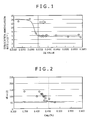
- Fig. 1 is a graph showing the relation between the DE value and the dislocation annihilation rate k.
- Fig. 2 is a graph showing the relation between the carbon equivalent Ceq and the HAZ toughness (vE -46 ).
- the present inventors have made studies on steel sheets from various aspects, aiming to attain a steel sheet that is resistant to strength reduction even when subjected for a long time to an SR process and excellent in the low-temperature toughness.
- a dislocation density ⁇ thereof can be maintained at a certain value or more (2.5 ⁇ 10 14 /m 2 or more) after being subjected for a long time to an SR process, thereby the above aim is successfully attained; and they have completed the present invention.
- the constitution, and the operation/effect of the present invention will be described along the history in which the invention has been completed.
- the present inventors have considered that strength reduction in a steel sheet due to an SR process is caused by a loss of transformation toughening entailed by a decrease in the dislocation density p.
- the "transformation toughening” is a strengthening mechanism of which basic principle is that "dislocation is pinned by a direct interaction between dislocations present on different slip planes". That is, a higher dislocation density causes a larger obstacle mutually, allowing the steel sheet to be strengthened.
- a steel has higher strength as the dislocation density ⁇ remains in larger amounts after being subjected to an SR process.
- a steel subjected to a normal reheating, quenching and tempering process hereinafter, referred to as a "QT (Quench-Temper) steel
- QT Quench-Temper
- almost dislocations are annihilated by a quenching process prior to an SR process
- TMCP steel almost dislocations are annihilated by being subjected to a severe SR process even when the steel has a high dislocation density before being subjected to the SR process.
- the present inventors have assumed that it is needed that dislocations in a TMCP steel are made not to be annihilated to the least possible extent in order to use the dislocations for securing the strength of the steel after being subjected to an SR process. Based on the assumption, the inventors have further developed the study on the effects of the dislocation density and chemical elements on the strength after being subjected to an SR process.
- an amount of elements that remain as precipitations and are effective for suppressing the dislocation annihilation is an amount that a DE value defined by the following Equation (1) is 0.0340% or more. More preferably, a DE value is 0.0370% or more.
- DE value Ti + Nb + 0.3 V + 0.0075 Cr where, [Ti], [Nb], [V], and [Cr] represent contents (mass %) of Ti, Nb, V, and Cr, respectively.
- a steel sheet of the present invention is also required to have a carbon equivalent Ceq defined by the following Equation (2) of 0.45% or less, in order to keep the low-temperature joint toughness good.
- the carbon equivalent Ceq is obtained by converting each element's influence exerted on the low-temperature joint toughness to a carbon amount, and is used in various fields (ASTM Standards). In the present invention, such carbon equivalent Ceq is used as the criteria for judging low temperature joint toughness.
- the resistance to SR process after being subjected to a severe SR process and the low-temperature joint toughness thereof can be made excellent, by making a DE value defined by the above Equation (1) be 0.0340% or more and a carbon equivalent Ceq defined by the above Equation (2) be 0.45% or less.
- the "severe SR process” should refer to not only the time for which the process is being carried out, but also the relation with the temperature at which the process is being carried out.
- a condition with a P value which is defined by the following Equation (3), of 18.8 or more is considered to be the criteria for judging a severe SR process objectively.
- Si acts as a deoxidation agent in melting a steel, and has an effect of increasing strength thereof. Si should be contained in an amount of 0.05% or more in order to demonstrate such effect effectively. However, when contained in too much amounts, the weldability is deteriorated; hence, Si should be contained in an amount of 0.50% or less.
- the preferable lower limit of Si content is 0.20%, and the preferable higher limit thereof is 0.40%.
- Mn is an element having an effect of increasing strength of a steel sheet. Mn should be contained in an amount of 1.3% or more in order to demonstrate such effect effectively. However, when contained in too much amounts, Mn impairs the weldability; hence, Mn should be contained in an amount of 1.9% or less.
- the preferable lower limit of Mn content is 1.40%, and the preferable higher limit thereof is 1.6%.
- Al is added as a deoxidation agent; however, when contained in an amount of 0.01% or less, the effect is not demonstrated sufficiently, and when contained in too much amounts exceeding 0.05%, it impairs the cleanness of a steel sheet; hence, Al should be contained in an amount of 0.05% or less.
- the preferable lower limit of Al content is 0.015%, and the preferable higher limit thereof is 0.03%.
- Ti demonstrates an effect of suppressing dislocation annihilation by forming precipitations; therefore, it is an effective element for securing the strength of a steel sheet after being subjected to an SR process.
- Ti is required to be contained in an amount of 0.005% or more in order to demonstrate such effect.
- Ti impairs the weldability of the steel sheet; hence, Ti should be contained in an amount of 0.025%.
- the preferable higher limit of Ti content is 0.020%.
- Nb is not only effective for improving the quenching property and for further strengthening the dislocation introduction effect (described later) by a non-recrystallization rolling, but also demonstrates an effect that, in a steel sheet of the present invention, V and Cr are made to remain as respective carbides in the sheet by combined addition of V and Cr with Nb, when the sheet is being subjected to an SR process, contributing to suppression of the dislocation annihilation.
- Nb should be contained in an amount of 0.005% or more in order to demonstrate such effect. However, when contained in too much amounts, Nb impairs the weldability of the steel sheet; hence, Nb should be contained in amount of 0.025 % or less.
- the preferable lower limit of Nb content is 0.010%.
- V and Cr originally have high solid solubility with cementite, but the solid solubility thereof is reduced by combined addition with Nb, causing the formation of VC and Cr 2 C.
- the precipitations remain stably even when being subj ected to an SR process.
- V should be contained in an amount of 0.005% or more and Cr is in an amount of 0.05% or more, in order to demonstrate such effect.
- V should be contained in an amount of 0.06% or less, and Cr in an amount of 0.25% or less.
- the preferable lower limit of V content is 0.020%, and the preferable higher limit thereof is 0.040%; and the preferable lower limit of Cr content is 0.10%.
- N forms precipitations in a weld heat affected zone (HAZ) of a welded joint along with Ti, and is an effective element for suppressing the coarsening of the structure by pinning.
- HZ weld heat affected zone
- N should be contained in an amount of 0.0030% or more in order to demonstrate such effect. However, when contained in too much amounts exceeding 0.01%, N impairs the weldability.
- Basic elements in a high-strength steel sheet of the present invention are as stated above, and the balance thereof consists of iron and inevitable impurities.
- the inevitable impurities include P, S, and O or the like that are possibly mixed therein as steel materials or in the production process.
- P and S decrease the weldability and the toughness after being subjected to an SR process; hence, P is preferably contained in an amount of 0.020% or less, and S in an amount of 0.01% or less.
- a steel sheet of the present invention does not include Mo actively; however, when Mo is contained up to 0.02%, Mo is handled as an inevitable impurity.
- either element is preferably contained in an amount of 0.50% or less. In order to demonstrate the effect by these elements, either element is preferably contained in an amount of 0.04% or more. When either element is contained in an amount of below the number, the element is handled as an inevitable impurity.
- Ca is effective for improving the toughness of a steel sheet by controlling inclusions; however, when contained in an excessive amount, Ca deteriorates the toughness of the steel; hence, Ca is preferably contained in an amount of 0.0040% or less. Ca is preferably contained in an amount of 0.0005% or more in order to demonstrate such effect.
- a chemical elements composition of the sheet, and a DE value and a carbon equivalent Ceq represented by the above Equations (1) and (2) meet the specified ranges, respectively, dislocation annihilation created when being subjected to an SR process is suppressed such that a certain amount of dislocations remains, allowing strength reduction after being subjected to the SR process to be suppressed.
- dislocation density is used for securing strength as follows: the above TMCP process is used effectively such that dislocation is introduced on its way by rolling in a non-recrystalline temperature region, the dislocation being continued to remain after the transformation with the use of controlled cooling carried out after the rolling.
- HZ toughness low-temperature joint toughness
- tensile strength TS after being subjected to an SR process tensile strength TS after being subjected to an SR process
- dislocation density ⁇ and dislocation annihilation rate k were measured in the following way.
- Each steel sheet after being subjected to an SR process was subjected to multilayer deposit welding by shielded metal arc welding with a welding heat input of 50kJ/cm.
- a specimen in accordance with ASTM A370-05 was taken from t (t: sheet thickness)/4 portion (center of the width of a HAZ) in the direction perpendicular to the direction of the welding line, such that the HAZ toughness was evaluated.
- An absorbed energy (vE -46 ) was measured after a Charpy impact test was carried out at -46°C in accordance with ASTM A370-05. At the time, the absorbed energy (vE -46 ) was measured with respect to three specimens of each steel sheet and an average of them was determined.
- a steel sheet with an average of vE -46 of 55J or more was evaluated as excellent in the HAZ toughness.
- dislocation density ⁇ was calculated based on the following apparatus, measurement conditions, and Equation (5):
- RAD-RU300 made by Rigaku Corporation
- a reduction rate (d ⁇ /dt 1 ) of the dislocation density when a material with a dislocation density ⁇ is subjected to a heat treatment at a constant temperature for t 1 hours, is calculated by the following Equation (6).
- k is referred to as a dislocation annihilation rate; and a smaller k means that the dislocation is more difficult to be annihilated (that is, has a higher effect of suppressing dislocation annihilation) .
- dislocation annihilation rate k was calculated in order to compare effects of suppressing dislocation annihilation.
- Nos. 1 to 4 do not meet any one of requirements specified by the present invention; hence, any one of properties is deteriorated. Specifically, the DE values of Nos. 1 to 3 do not fall within the range specified by the invention; hence, the dislocation annihilation rates k are large.
- the DE value of No. 4 falls within the range specified by the invention; hence, the dislocation annihilation rate k is small; however, the carbon equivalent Ceq exceeds the range specified by the invention; hence the HAZ toughness is deteriorated.
- the relation between the DE value and the dislocation annihilation rate k is shown in Fig. 1
- the relation between the carbon equivalent Ceq and the HAZ toughness is shown in Fig. 2 . It can be understood that it is important: to increase a DE value to 0.0340 (%) or more in order to keep the dislocation density ⁇ high; and to lower a carbon equivalent Ceq to 0.45 (%) or less in order to secure good HAZ toughness.
Landscapes
- Chemical & Material Sciences (AREA)
- Engineering & Computer Science (AREA)
- Materials Engineering (AREA)
- Mechanical Engineering (AREA)
- Metallurgy (AREA)
- Organic Chemistry (AREA)
- Physics & Mathematics (AREA)
- Thermal Sciences (AREA)
- Crystallography & Structural Chemistry (AREA)
- Health & Medical Sciences (AREA)
- Child & Adolescent Psychology (AREA)
- Heat Treatment Of Steel (AREA)
Applications Claiming Priority (1)
| Application Number | Priority Date | Filing Date | Title |
|---|---|---|---|
| JP2008088136A JP5305709B2 (ja) | 2008-03-28 | 2008-03-28 | 耐応力除去焼鈍特性と低温継手靭性に優れた高強度鋼板 |
Publications (2)
| Publication Number | Publication Date |
|---|---|
| EP2105516A1 true EP2105516A1 (fr) | 2009-09-30 |
| EP2105516B1 EP2105516B1 (fr) | 2014-02-12 |
Family
ID=40459803
Family Applications (1)
| Application Number | Title | Priority Date | Filing Date |
|---|---|---|---|
| EP09003060.2A Not-in-force EP2105516B1 (fr) | 2008-03-28 | 2009-03-03 | Plaque métallique à haute résistance ayant une excellente résistance au recuit de détente et un durcissement du joint à basse température |
Country Status (4)
| Country | Link |
|---|---|
| US (1) | US8394209B2 (fr) |
| EP (1) | EP2105516B1 (fr) |
| JP (1) | JP5305709B2 (fr) |
| CN (1) | CN101545073B (fr) |
Cited By (3)
| Publication number | Priority date | Publication date | Assignee | Title |
|---|---|---|---|---|
| EP2258884A4 (fr) * | 2008-03-28 | 2011-06-29 | Kobe Steel Ltd | Tôle d'acier à haute résistance qui présente une excellente résistance au recuit de détente et une excellente ténacité de joint à basse température |
| CN102409242A (zh) * | 2011-11-25 | 2012-04-11 | 宝山钢铁股份有限公司 | 一种高强度气瓶用合金钢、气瓶及其制备方法 |
| EP2803741A4 (fr) * | 2012-01-12 | 2015-12-02 | Nippon Steel & Sumitomo Metal Corp | Acier faiblement allié |
Families Citing this family (6)
| Publication number | Priority date | Publication date | Assignee | Title |
|---|---|---|---|---|
| JP5457859B2 (ja) * | 2010-01-27 | 2014-04-02 | 株式会社神戸製鋼所 | 低温靭性および落重特性に優れた溶接金属 |
| JP5643542B2 (ja) * | 2010-05-19 | 2014-12-17 | 株式会社神戸製鋼所 | 疲労特性に優れた厚鋼板 |
| CN102321847A (zh) * | 2011-10-20 | 2012-01-18 | 南京钢铁股份有限公司 | 一种海洋平台用调质结构厚钢板及其生产方法 |
| CN103695785B (zh) * | 2013-12-11 | 2016-08-17 | 莱芜钢铁集团有限公司 | 一种低温高压管道连接件用钢及其连铸圆坯的制造方法 |
| CN103938092B (zh) * | 2014-03-24 | 2016-05-11 | 济钢集团有限公司 | 一种高疲劳强度热成型重型卡车桥壳钢板 |
| JP7726367B2 (ja) * | 2022-02-28 | 2025-08-20 | Jfeスチール株式会社 | 鋼板、部材、それらの製造方法、冷延鋼板用熱延鋼板の製造方法及び冷延鋼板の製造方法 |
Citations (14)
| Publication number | Priority date | Publication date | Assignee | Title |
|---|---|---|---|---|
| JPS57116756A (en) | 1981-01-08 | 1982-07-20 | Sumitomo Metal Ind Ltd | High tensile stractural steel for pressure vessel |
| JPS57120652A (en) | 1981-01-16 | 1982-07-27 | Sumitomo Metal Ind Ltd | High strength tough steel for pressure vessel |
| EP0320003A1 (fr) * | 1987-12-11 | 1989-06-14 | Nippon Steel Corporation | Procédé de fabrication d'acier à bas rapport de la limite d'élasticité à la résistance à la rupture |
| JPH01275719A (ja) * | 1988-04-26 | 1989-11-06 | Sumitomo Metal Ind Ltd | 高強度高靭性を有する厚鋼板の製造法 |
| JPH08283904A (ja) * | 1995-04-17 | 1996-10-29 | Nippon Steel Corp | 溶接熱影響部靱性の優れた鋼材およびその製造方法 |
| JPH1088277A (ja) * | 1996-09-19 | 1998-04-07 | Kawasaki Steel Corp | 非調質高張力厚肉鋼材とその製造方法 |
| JPH10195596A (ja) * | 1997-01-10 | 1998-07-28 | Nkk Corp | レーザ切断性に優れた鋼板 |
| JPH11131177A (ja) * | 1997-08-29 | 1999-05-18 | Nippon Steel Corp | 溶接後熱処理の省略可能な中常温圧力容器用鋼板およびその製造方法 |
| JPH11310846A (ja) * | 1999-03-29 | 1999-11-09 | Sumitomo Metal Ind Ltd | 疲労亀裂進展抑制効果を有する鋼板 |
| JP2000336453A (ja) * | 1999-03-25 | 2000-12-05 | Nippon Steel Corp | 溶接熱影響部の靭性に優れた鋼材およびその製造方法 |
| JP2001089825A (ja) * | 1999-07-22 | 2001-04-03 | Nippon Steel Corp | 溶接熱影響部の靭性に優れた鋼材およびその製造方法 |
| JP2002003983A (ja) * | 2000-04-21 | 2002-01-09 | Nippon Steel Corp | 溶接性と低温靭性に優れた低降伏比高張力鋼及びその製造方法 |
| WO2002048417A1 (fr) * | 2000-12-14 | 2002-06-20 | Posco | Plaque d'acier obtenue par precipitation du tin et du zrn destinee a des structures soudees, son procede de fabrication et materiau de soudure utilisant ce procede |
| EP1662014A1 (fr) * | 2003-06-12 | 2006-05-31 | JFE Steel Corporation | Plaque d'acier et tube d'acier soude ayant un faible rapport d'ecoulement, une resistance elevee et une resilience elevee, et procede pour les produire |
Family Cites Families (8)
| Publication number | Priority date | Publication date | Assignee | Title |
|---|---|---|---|---|
| CA952415A (en) * | 1970-05-20 | 1974-08-06 | Eiji Miyoshi | Process and apparatus for manufacture of strong tough steel plates |
| JPS63203721A (ja) * | 1987-02-18 | 1988-08-23 | Kobe Steel Ltd | 耐水素誘起割れ性及び耐応力腐食割れ性にすぐれる熱延鋼板の製造方法 |
| JPH05295432A (ja) * | 1992-04-21 | 1993-11-09 | Nkk Corp | オンライン加工熱処理による高強度高靭性鋼板の製造方法 |
| JPH07286214A (ja) * | 1994-04-18 | 1995-10-31 | Nippon Steel Corp | 耐水素誘起割れ特性及びdwtt特性の優れた高強度厚手ホットコイルの製造方法 |
| JPH083636A (ja) * | 1994-06-17 | 1996-01-09 | Sumitomo Metal Ind Ltd | 低降伏比高靱性鋼の製造方法 |
| JPH09287027A (ja) | 1996-04-19 | 1997-11-04 | Sumitomo Metal Ind Ltd | 高強度高靱性継目無鋼管の製造方法 |
| JPH11229077A (ja) * | 1998-02-12 | 1999-08-24 | Nippon Steel Corp | 多層盛溶接部のctod特性に優れた鋼板およびその製造方法 |
| CA2415573C (fr) * | 2003-01-02 | 2007-11-13 | Sumitomo Metal Industries, Ltd. | Soudure d'acier a haute resistance et a resistance amelioree a la fissuration a froid et methode de soudage |
-
2008
- 2008-03-28 JP JP2008088136A patent/JP5305709B2/ja not_active Expired - Fee Related
-
2009
- 2009-01-26 US US12/359,517 patent/US8394209B2/en not_active Expired - Fee Related
- 2009-02-12 CN CN2009100041034A patent/CN101545073B/zh not_active Expired - Fee Related
- 2009-03-03 EP EP09003060.2A patent/EP2105516B1/fr not_active Not-in-force
Patent Citations (14)
| Publication number | Priority date | Publication date | Assignee | Title |
|---|---|---|---|---|
| JPS57116756A (en) | 1981-01-08 | 1982-07-20 | Sumitomo Metal Ind Ltd | High tensile stractural steel for pressure vessel |
| JPS57120652A (en) | 1981-01-16 | 1982-07-27 | Sumitomo Metal Ind Ltd | High strength tough steel for pressure vessel |
| EP0320003A1 (fr) * | 1987-12-11 | 1989-06-14 | Nippon Steel Corporation | Procédé de fabrication d'acier à bas rapport de la limite d'élasticité à la résistance à la rupture |
| JPH01275719A (ja) * | 1988-04-26 | 1989-11-06 | Sumitomo Metal Ind Ltd | 高強度高靭性を有する厚鋼板の製造法 |
| JPH08283904A (ja) * | 1995-04-17 | 1996-10-29 | Nippon Steel Corp | 溶接熱影響部靱性の優れた鋼材およびその製造方法 |
| JPH1088277A (ja) * | 1996-09-19 | 1998-04-07 | Kawasaki Steel Corp | 非調質高張力厚肉鋼材とその製造方法 |
| JPH10195596A (ja) * | 1997-01-10 | 1998-07-28 | Nkk Corp | レーザ切断性に優れた鋼板 |
| JPH11131177A (ja) * | 1997-08-29 | 1999-05-18 | Nippon Steel Corp | 溶接後熱処理の省略可能な中常温圧力容器用鋼板およびその製造方法 |
| JP2000336453A (ja) * | 1999-03-25 | 2000-12-05 | Nippon Steel Corp | 溶接熱影響部の靭性に優れた鋼材およびその製造方法 |
| JPH11310846A (ja) * | 1999-03-29 | 1999-11-09 | Sumitomo Metal Ind Ltd | 疲労亀裂進展抑制効果を有する鋼板 |
| JP2001089825A (ja) * | 1999-07-22 | 2001-04-03 | Nippon Steel Corp | 溶接熱影響部の靭性に優れた鋼材およびその製造方法 |
| JP2002003983A (ja) * | 2000-04-21 | 2002-01-09 | Nippon Steel Corp | 溶接性と低温靭性に優れた低降伏比高張力鋼及びその製造方法 |
| WO2002048417A1 (fr) * | 2000-12-14 | 2002-06-20 | Posco | Plaque d'acier obtenue par precipitation du tin et du zrn destinee a des structures soudees, son procede de fabrication et materiau de soudure utilisant ce procede |
| EP1662014A1 (fr) * | 2003-06-12 | 2006-05-31 | JFE Steel Corporation | Plaque d'acier et tube d'acier soude ayant un faible rapport d'ecoulement, une resistance elevee et une resilience elevee, et procede pour les produire |
Cited By (5)
| Publication number | Priority date | Publication date | Assignee | Title |
|---|---|---|---|---|
| EP2258884A4 (fr) * | 2008-03-28 | 2011-06-29 | Kobe Steel Ltd | Tôle d'acier à haute résistance qui présente une excellente résistance au recuit de détente et une excellente ténacité de joint à basse température |
| US8398787B2 (en) | 2008-03-28 | 2013-03-19 | Kobe Steel, Ltd. | High-strength steel sheet excellent in resistance to stress-relief annealing and low temperature joint toughness |
| CN102409242A (zh) * | 2011-11-25 | 2012-04-11 | 宝山钢铁股份有限公司 | 一种高强度气瓶用合金钢、气瓶及其制备方法 |
| CN102409242B (zh) * | 2011-11-25 | 2014-06-04 | 宝山钢铁股份有限公司 | 一种高强度气瓶用合金钢、气瓶及其制备方法 |
| EP2803741A4 (fr) * | 2012-01-12 | 2015-12-02 | Nippon Steel & Sumitomo Metal Corp | Acier faiblement allié |
Also Published As
| Publication number | Publication date |
|---|---|
| JP2009242826A (ja) | 2009-10-22 |
| US20090246067A1 (en) | 2009-10-01 |
| EP2105516B1 (fr) | 2014-02-12 |
| JP5305709B2 (ja) | 2013-10-02 |
| CN101545073A (zh) | 2009-09-30 |
| US8394209B2 (en) | 2013-03-12 |
| CN101545073B (zh) | 2011-12-14 |
Similar Documents
| Publication | Publication Date | Title |
|---|---|---|
| EP2105516B1 (fr) | Plaque métallique à haute résistance ayant une excellente résistance au recuit de détente et un durcissement du joint à basse température | |
| EP1375681B1 (fr) | Acier à haute résistance et tenacité éléveés, procédé pour sa fabrication et procédé de fabrication des tubes d'acier à haute résistance et tenacité éléveés | |
| EP2272994A1 (fr) | Acier ayant une résistance à la traction élevée et son procédé de fabrication | |
| EP2305850B1 (fr) | Produits d'acier épais de haute résistance présentant d'excellentes caractéristiques en termes d'endurance et d'aptitude au soudage, acier en forme de h ultra épais de haute résistance et procédés de fabrication de ceux-ci | |
| KR101846759B1 (ko) | 강판 및 그 제조 방법 | |
| US9790579B2 (en) | High tensile strength steel plate having excellent weld heat-affected zone low-temperature toughness and method for producing same | |
| EP2180074B1 (fr) | Acier faiblement allié à haute résistance présentant une excellente résistance à la fragilisation dans un environnement d'hydrogène haute pression et procédé de fabrication de l'acier | |
| EP2130937B1 (fr) | Conduit d'acier soudé à haute résistance ayant un métal de soudure présentant une excellente résistance à la fissuration à basse température et son procédé de fabrication | |
| EP3617337A1 (fr) | ACIER RICHE EN Mn ET SON PROCÉDÉ DE PRODUCTION | |
| EP2811045B1 (fr) | Métal de base pour une plaque d'acier plaquée à haute ténacité donnant une soudure ayant une excellente ténacité et procédé de fabrication de ladite plaque d'acier plaquée | |
| EP2128294B1 (fr) | Métal commun pour plaque revêtue d'acier ayant une grande force et une excellente résistance dans la zone affectée par la chaleur de soudage, et son procédé de production | |
| EP3666911A1 (fr) | Produit d'acier à haute résistance et son procédé de fabrication | |
| EP1416059B1 (fr) | Materiau de base pour une plaque d'acier plaqué ayant une bonne résistance mécanique à basse température dans la zone affectée par la chaleur de soudage et méthode de production de plaque en acier | |
| EP3276024A1 (fr) | Tôle d'acier épaisse pour tuyau de construction, procédé pour la production de tôle d'acier épaisse pour tuyau de construction et tuyau de construction | |
| EP3276025A1 (fr) | Tôle d'acier pour tube de construction, procédé de fabrication de tôle d'acier pour tube de construction, et tube de construction | |
| EP3831973A1 (fr) | Acier à haute teneur en manganèse et son procédé de production | |
| EP1932934A1 (fr) | Plaque d'acier à haute résistance résistant à la perte de résistance résultant d'un recuit de détente et excellente en soudabilité | |
| EP3128033B1 (fr) | Plaque d'acier à haute résistance à la traction et son procédé de production | |
| EP3276027B1 (fr) | Tôle d'acier pour tuyaux de structure, procédé de production de tuyau de structure, et tuyau de structure | |
| CN101006192A (zh) | 焊接性和韧性均优异的抗拉强度为550MPa级以上的高强度钢材及其制造方法 | |
| US8398787B2 (en) | High-strength steel sheet excellent in resistance to stress-relief annealing and low temperature joint toughness | |
| US20210292876A1 (en) | Austenitic Heat Resistant Alloy and Welded Joint Including the Same | |
| WO2021054345A1 (fr) | Tôle d'acier épaisse et son procédé de production | |
| JP2527564B2 (ja) | 溶接強度および靭性に優れた析出硬化型ステンレス鋼 | |
| JP2003089844A (ja) | 溶接継手の疲労強度に優れた溶接構造用厚鋼板およびその製造方法 |
Legal Events
| Date | Code | Title | Description |
|---|---|---|---|
| PUAI | Public reference made under article 153(3) epc to a published international application that has entered the european phase |
Free format text: ORIGINAL CODE: 0009012 |
|
| AK | Designated contracting states |
Kind code of ref document: A1 Designated state(s): AT BE BG CH CY CZ DE DK EE ES FI FR GB GR HR HU IE IS IT LI LT LU LV MC MK MT NL NO PL PT RO SE SI SK TR |
|
| AX | Request for extension of the european patent |
Extension state: AL BA RS |
|
| 17P | Request for examination filed |
Effective date: 20100128 |
|
| 17Q | First examination report despatched |
Effective date: 20100401 |
|
| AKX | Designation fees paid |
Designated state(s): BE DE GB LU |
|
| GRAP | Despatch of communication of intention to grant a patent |
Free format text: ORIGINAL CODE: EPIDOSNIGR1 |
|
| RIC1 | Information provided on ipc code assigned before grant |
Ipc: C22C 38/04 20060101ALI20130729BHEP Ipc: C22C 38/24 20060101ALI20130729BHEP Ipc: C22C 38/50 20060101ALI20130729BHEP Ipc: C22C 38/48 20060101ALI20130729BHEP Ipc: C21D 9/50 20060101ALN20130729BHEP Ipc: C21D 1/30 20060101ALI20130729BHEP Ipc: C22C 38/06 20060101ALI20130729BHEP Ipc: C22C 38/42 20060101ALI20130729BHEP Ipc: C21D 1/25 20060101ALI20130729BHEP Ipc: C22C 38/02 20060101AFI20130729BHEP Ipc: C22C 38/46 20060101ALI20130729BHEP Ipc: C22C 38/28 20060101ALI20130729BHEP Ipc: C22C 38/26 20060101ALI20130729BHEP Ipc: C22C 38/58 20060101ALI20130729BHEP Ipc: C22C 38/00 20060101ALI20130729BHEP Ipc: C21D 8/02 20060101ALI20130729BHEP |
|
| INTG | Intention to grant announced |
Effective date: 20130819 |
|
| GRAS | Grant fee paid |
Free format text: ORIGINAL CODE: EPIDOSNIGR3 |
|
| GRAA | (expected) grant |
Free format text: ORIGINAL CODE: 0009210 |
|
| AK | Designated contracting states |
Kind code of ref document: B1 Designated state(s): BE DE GB LU |
|
| REG | Reference to a national code |
Ref country code: GB Ref legal event code: FG4D |
|
| REG | Reference to a national code |
Ref country code: DE Ref legal event code: R096 Ref document number: 602009021752 Country of ref document: DE Effective date: 20140327 |
|
| REG | Reference to a national code |
Ref country code: DE Ref legal event code: R097 Ref document number: 602009021752 Country of ref document: DE |
|
| PLBE | No opposition filed within time limit |
Free format text: ORIGINAL CODE: 0009261 |
|
| STAA | Information on the status of an ep patent application or granted ep patent |
Free format text: STATUS: NO OPPOSITION FILED WITHIN TIME LIMIT |
|
| 26N | No opposition filed |
Effective date: 20141113 |
|
| REG | Reference to a national code |
Ref country code: DE Ref legal event code: R097 Ref document number: 602009021752 Country of ref document: DE Effective date: 20141113 |
|
| PGFP | Annual fee paid to national office [announced via postgrant information from national office to epo] |
Ref country code: DE Payment date: 20200218 Year of fee payment: 12 Ref country code: GB Payment date: 20200219 Year of fee payment: 12 |
|
| PGFP | Annual fee paid to national office [announced via postgrant information from national office to epo] |
Ref country code: BE Payment date: 20200217 Year of fee payment: 12 Ref country code: LU Payment date: 20200224 Year of fee payment: 12 |
|
| REG | Reference to a national code |
Ref country code: DE Ref legal event code: R119 Ref document number: 602009021752 Country of ref document: DE |
|
| GBPC | Gb: european patent ceased through non-payment of renewal fee |
Effective date: 20210303 |
|
| REG | Reference to a national code |
Ref country code: BE Ref legal event code: MM Effective date: 20210331 |
|
| PG25 | Lapsed in a contracting state [announced via postgrant information from national office to epo] |
Ref country code: DE Free format text: LAPSE BECAUSE OF NON-PAYMENT OF DUE FEES Effective date: 20211001 Ref country code: GB Free format text: LAPSE BECAUSE OF NON-PAYMENT OF DUE FEES Effective date: 20210303 Ref country code: LU Free format text: LAPSE BECAUSE OF NON-PAYMENT OF DUE FEES Effective date: 20210303 |
|
| PG25 | Lapsed in a contracting state [announced via postgrant information from national office to epo] |
Ref country code: BE Free format text: LAPSE BECAUSE OF NON-PAYMENT OF DUE FEES Effective date: 20210331 |