EP2105697A2 - Linsenhalterung und Linsenformmessvorrichtung - Google Patents
Linsenhalterung und Linsenformmessvorrichtung Download PDFInfo
- Publication number
- EP2105697A2 EP2105697A2 EP09156485A EP09156485A EP2105697A2 EP 2105697 A2 EP2105697 A2 EP 2105697A2 EP 09156485 A EP09156485 A EP 09156485A EP 09156485 A EP09156485 A EP 09156485A EP 2105697 A2 EP2105697 A2 EP 2105697A2
- Authority
- EP
- European Patent Office
- Prior art keywords
- lens
- holding
- hole
- main body
- mounting
- Prior art date
- Legal status (The legal status is an assumption and is not a legal conclusion. Google has not performed a legal analysis and makes no representation as to the accuracy of the status listed.)
- Granted
Links
- 239000002390 adhesive tape Substances 0.000 claims description 5
- 210000000078 claw Anatomy 0.000 description 34
- 230000007246 mechanism Effects 0.000 description 16
- 238000010276 construction Methods 0.000 description 7
- 238000012545 processing Methods 0.000 description 7
- 238000003780 insertion Methods 0.000 description 6
- 230000037431 insertion Effects 0.000 description 6
- 239000002184 metal Substances 0.000 description 5
- 238000005259 measurement Methods 0.000 description 4
- 238000001514 detection method Methods 0.000 description 2
- 238000007730 finishing process Methods 0.000 description 2
- 238000012423 maintenance Methods 0.000 description 2
- 244000241796 Christia obcordata Species 0.000 description 1
- 101100012902 Saccharomyces cerevisiae (strain ATCC 204508 / S288c) FIG2 gene Proteins 0.000 description 1
- 238000013459 approach Methods 0.000 description 1
- 238000012790 confirmation Methods 0.000 description 1
- 239000000470 constituent Substances 0.000 description 1
- 239000000463 material Substances 0.000 description 1
- 238000012986 modification Methods 0.000 description 1
- 230000004048 modification Effects 0.000 description 1
- 238000012546 transfer Methods 0.000 description 1
Images




Classifications
-
- G—PHYSICS
- G01—MEASURING; TESTING
- G01B—MEASURING LENGTH, THICKNESS OR SIMILAR LINEAR DIMENSIONS; MEASURING ANGLES; MEASURING AREAS; MEASURING IRREGULARITIES OF SURFACES OR CONTOURS
- G01B5/00—Measuring arrangements characterised by the use of mechanical techniques
- G01B5/20—Measuring arrangements characterised by the use of mechanical techniques for measuring contours or curvatures
Definitions
- the present invention relates to a lens holder capable of confirming a mounted state of a lens and a lens shape measuring apparatus using the lens holder and configured to measure a lens shape such as a lens shape of an eyeglass frame, a shape of a demo lens, a template for a lens, or the like.
- a lens holder used for holding a lens, a template, a demo lens or the like when measuring a shape of the lens and so on, or used for holding an eyeglass lens between a pair of lens rotating shafts of a lens contour processing apparatus when grinding the eyeglass lens.
- a flange type lens holder in which a flange, for example, an elongate egg-shaped flange is integrally provided on one end of a shaft portion, or a lens absorbing jig (absorbing cup) in which a rubber cup is integrally provided on one end of a shaft portion.
- this flange-type lens holder there is known an adhesive-type lens holder in which the lens shape is adhered to the flange by a double-faced adhesive tape, or a screw fixing-type lens shape in which a positioning pin provided on the flange is engaged in a positioning hole of a template and the template is fixed to the flange by means of a fixing screw inserted into a center hole of the template. Meanwhile, in the lens absorbing jig, the lens can be held on the shaft portion by absorbing the lens to a rubber cup.
- a lens shape measuring apparatus in which a shaft portion of a lens holding member configured to hold a lens is fitted in a cylinder or engaging tube portion of a lens holder, the lens holder is set to the lens shape measuring apparatus in such a manner that the lens is located downward, a circumferential edge of the lens is measured by a measuring element from below, and lens shape data (lens shape information) for processing a contour of the eyeglass lens is obtained (for reference, see Japanese Patent No. 3602175 , FIG 10 ).
- a lens shape measuring apparatus for an eyeglass lens frame wherein, for example, a lens is attached to a lens absorbing jig, a cylinder or engaging tube portion of a lens holder is clamped to a shaft portion a lens absorbing jig by means of a circular clamping member provided on the lens holder, the lens is located downward and thus the lens holder is set to the apparatus, a circumferential edge of the lens is measured by a measuring element from below, and lens shape information for processing an eyeglass lens (lens shape information) is obtained (for reference, see Japanese Patent No. 3989593 , FIG.6 ).
- the shaft portion of the lens holder by which the lens is held is engaged in the cylinder or engaging tube portion, without providing a clamping member in the lens holder, since the engaging tube portion of the lens holder is directed downward, in the case that an engaging state of the shaft portion to the engaging tube portion is loose, when measuring the lens shape contour by abutting the measuring element against the circumference edge of the lens, the lens holding member and the lens are out of place from the engaging tube portion of the lens holder, there is a problem that the lens shape contour cannot be correctly measured.
- a lens like an elongate crab eye having short height such as a recent rimless frame in which holes for mounting metal fittings are formed.
- a lens shape as mentioned above is measured by the lens shape measuring apparatus, if the lens like the elongate crab eye (crab eye-like lens shape) is attached to a normal lens holding member, the positions of the holes are hidden, so that there is a possibility that the positions of the holes cannot be correctly detected.
- the circumferential edge of the eyeglass is processed by the lens processing apparatus based upon the above-mentioned lens shape information. After finishing process of the thus ground eyeglass, when forming the holes in the eyeglass, there has been a possibility that the holes are formed in wrong positions.
- the clamping member of the lens is circular in shape, such as a recent rimless frame, if the lens like the elongate crab eye having short height (crab eye-like lens shape) is attached to the lens of a normal lens holding member, the positions of the holes cannot be detected, since the positions of the holes cannot be correctly recognized, after finishing process of the thus ground eyeglass, when forming holes in the eyeglass, there has been a possibility that the holes would be formed in wrong positions.
- An object of the present invention is to provide a lens holder and a lens shape measuring apparatus using the lens holder and enabling the user to look at positions of holes of a lens in the face, the apparatus being adapted to correctly perform the detection of the positions of the holes for automatically measuring the positions of the holes.
- a lens holder includes a lens holding member having a mounting shaft portion and configured to hold a lens provided with at least one hole mounting a fitting for a rimless frame or a dummy lens provided with at least one hole, a main body including an opened bottom surface, a shaft holding cylinder provided in the main body and configured to hold the mounting shaft portion of the lens holding member, a clamping member configured to clamp the shaft holding cylinder to the mounting shaft portion of the lens holding member, and at least one confirming hole provided in the main body.
- the confirming hole is configured to look at the hole of the lens or the dummy lens.
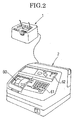
- reference numeral 1 denotes a lens shape measuring apparatus according to an embodiment of the present invention and reference 2 a grinding apparatus (lens processing apparatus) connected to the lens shape measuring apparatus 1.
- the lens shape measuring apparatus is configured to measure a shape of a lens to be processed and obtain eyeglass frame-contour data.
- the grinding apparatus is configured to grind a lens material to be processed into a finished eyeglass lens, based on the eyeglass-contour data obtained from the lens shape apparatus 1.
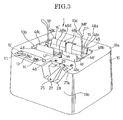
- the lens shape measuring apparatus 1 includes an apparatus body 10 having an opening 10b in the middle of an upper surface 10a and a switch portion (operation panel) 11 mounted on the upper surface 10a of the body 10.
- the switch portion 11 includes a mode changing switch 12 for changing over right and left measurement modes, a start switch 13 serving as a lens shape measurement starting device (frame template measurement starting device) and as a lens frame measurement starting device, and a transfer switch 14 for transferring data.
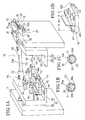
- the apparatus 1 further includes eyeglass frame holding mechanisms (lens holding member) 15, 15' for holding right and left lens frames LF, RF of the eyeglass frame MF of eyeglasses M as shown in FIG.3 , an operation mechanism 16 as shown in FIG.1 . Further, since each of the frame holding mechanisms 15, 15' as shown in FIG.1 has the same structure, the former frame holding mechanism 15 of them will be described with reference to FIG.1 and thus description concerning the latter frame holding mechanism 15' is omitted.
- reference numerals 17 and 18 denote supporters which are fixed upward and downward to a chassis (not shown) within the body 10 of the apparatus and mounted in parallel to each other, reference numeral 19 an engaging pin projecting from an outside surface (a surface opposite to the supporter 17) of the supporter 18, reference numeral 20 an arc-shaped slit provided in an upper end portion of the supporter 18, and reference numerals 21 and 22 mounting holes formed in the supporters 17 and 18.
- the circular slit 20 is concentric with the mounting hole 22.
- These mounting holes 21, 22 are located between the arc-shaped slit 20 and an engaging pin 19, and the arc-shaped slit 20 is formed in a concentric manner with the mounting holes 21, 22.
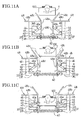
- the operation mechanism 16 includes an operation shaft 23 rotatably held in the mounting holes 21, 22 of the supporters 17, 18, as shown in FIGs.1A and 3 , a driven gear 24 fixed to an end portion of the operation shaft 23 on the side of the supporter 18, a rotation shaft 25 passing through the supporter 18 and a front surface 10c of the body 10, a driving gear 26 fixed to an end portion of the rotation shaft 25 (or formed integrally with the rotation shaft 25) and engaged with the driving gear 24, and an operation lever 27 mounted on the other end portion of the rotation shaft 25.
- reference numeral 23a denotes a flat portion formed on the operation shaft 23 and extending close to the two end portions of the operation shaft 23.
- the main body 10 of the apparatus is formed with a concave portion 28 extending from the front surface 10c to the upper surface 10a, and the concave portion 28a is formed with a circular projection 29. Signs “open” and “close” are provided in the upper surface 10a and are positioned on right and left sides of the projection 29, respectively.
- the lever 27 is disposed on a front surface of the concave portion 28, and a curved portion, namely, instruction portion 27a is mounted on an upper portion of the lever 27 and is movable on the projection 29.
- the upper surface 10a is formed with a cut portion 10d which is located between the frame holding mechanisms 15, 15' and faces an opening 10b.
- the two-position holding mechanism 30 includes a circular slit 20, a movable pin 31 projecting from a side surface of the driving gear 24 and passing through the circular slit 20, and a spring 32 (tension coil spring) interposed between the movable pin 31 and the engagement pin 19. Since the circular slit 20 is concentric with the mounting hole 22, as mentioned above, the circular slit 20 is also concentric with the driven gear 24 and the operation shaft 23. For this reason, the movable pin 31 is held by one of two end portions 20a and 20b of the circular slit 20 by the spring 32.
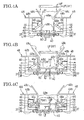
- the operation mechanism 16 further includes a pair of barrel shafts 33, 33 held such that the pair of barrel shafts 33, 33 are movable in a longitudinal direction of the operation shaft 23 and are slightly rotatable in a circumferential direction. Between a flat portion 33b of a cut-circular through-hole 33a of the barrel shaft 33 and the flat portion 23a of the operation shaft 23, a slight gap S is formed as shown in FIGs.1B and 1C .
- string-like bodies 34 (only one is shown in FIG.1A ) are mounted, each of which includes a portion which is elastic because of its own elastic force.
- the string-like body 34 includes a spring (elastic portion) 35, an end of which is fixed to the barrel shaft 33 and a wire 36 connected to the other end of the spring 35.
- the frame holding mechanism 15 includes a pair of movable supporters 37, 37 (sliders) held in the body 10, which are movable in a horizontal direction and are movable to close (or away from) each other.
- Each of the movable supporters 37, 37 is shaped like "L" which includes a horizontal plate portion 38 and a vertical plate portion 39 which vertically extends from an end of the horizontal plate portion 38.
- the barrel shaft 33 is held rotatably but cannot be moved in an axial direction.
- the frame holding mechanism 15 further includes a tension coil spring 40 which is arranged between the horizontal plate portions 38, 38 of the movable supporters 37, 37 as shown in FIG.4 , a supporting plate 41 fixed in the center of a front end of the horizontal plate portion 38, and a claw mounting plate 42 interposed between the vertical plate portion 39 and a part of the supporting plate 41 which projects from the horizontal plate portion 38 upward.
- the claw mounting plate 42 is held by both the supporting plate 41 and the vertical plate portion 39 so as to be rotatable centering a shaft-shaped supporting projection 42c of a side portion 42a. Another shaft-like supporting projection of a rear side portion of the claw mounting plate 42 is not shown.
- a tapered holding claw 43 projects from a front end of the other side portion 42b of the claw mounting plate 42 as a first holding bar, and a rear end portion 44a of a shaft-like holding claw 44 as a second holding bar is held rotatably on a rear end of the other side portion of the claw mounting plate 42 by a supporting shaft 45.
- the holding claw 44 of which a base is shaped like a square plate as shown in FIG.1D and the front end portion is tapered, is rotatable on the supporting shaft 45 and is allowed to relatively approach the supporting claw 43 or recede therefrom. Additionally, the front end portion of the holding claw 44 and the claw mounting plate 42 are urged to be opened by a torsion spring (not shown) wound on the supporting shaft 45.
- an "L"-shaped engagement claw 46 is projected therefrom and is positioned above the holding claw 44.
- An edge-like claw 46a of a front end portion of the engagement claw 46 which extends downward is engaged with the supporting claw 44.
- the edge-shaped claw portion 46a of the engagement claw 46 is engaged with a middle portion of the holding claw 44.
- an idle pulley 47 is mounted which is rotatably attached to the vertical plate portion 39.
- the wire 36 is put on the idle pulley 47, and an end of the wire 36 is situated in a substantial center between the two side portions 42a, 42b and is fixed to the claw mounting plate 42.
- the movable supporters 37, 37 have two opposite sides which are covered with a frame guide member 48 shown in FIGs.4A and 4B .
- the frame guide member 48 includes a vertical plate portion 48a fixed to a front end of the horizontal plate portion 38, a horizontal plate portion 48b fixed to an upper end of the vertical plate portion 39, and an inclined guide plate 48c connected to a corner, at which the plate portions 48a and 48b are connected to each other, and inclining to the horizontal plate portion 48b.
- an aperture 48d is formed corresponding to the holding claws 43 and 44, and the holding claw 44 projects from the aperture 48d.
- the front end portion of the holding claw 43 is to be positioned within the aperture 48d in an open state in which the holding claws 44 and 43 are widened at its maximum, as shown in FIGs.4A and 4B .
- the vertical plate portions 48a, 48a of the frame guiding members 48, 48 extend in the direction perpendicular to the direction in which the movable frames 37, 37 move close to or away from one another.
- the vertical plate portions 48a, 48a are situated parallel to one another and sides on which they face one another correspond to holding surfaces.
- the holding surfaces of the pair of vertical plate portions 48a, 48a move close to and away from one another when the movable frames 37, 37 move close to or away from one another.
- the lens shape measuring apparatus 1 includes a lens shape measuring device (not shown) for measuring the contour of the rim of the eyeglass frame MF, that is, that of the lens frames LF, RF of the eyeglass frame MF.
- the lens shape measuring device is disposed in the lower part of the holding space.
- a measuring device for example, a feeler 50 is moved along a groove 51 of an eyeglass frame F and thereby a position to which the feeler 50 has been moved is detected by detecting device (not shown).
- the lens-shaped measuring device calculates a radius pi from the geometrical center of a lens frame to the feeler 50 according to an angle ⁇ i at which the feeler 50 moves around the geometrical center. In other words, it can calculate lens contour information ( ⁇ i, ⁇ i) on the geometrical center in the polar coordinates form. Since well-known art can be applied to this structure, a further detailed explanation thereof is omitted.
- the lens grinder 2 includes a processing portion 60 (not shown in detail) for grinding the rim of a lens T to be processed.
- the lens is held between a pair of lens rotational shafts of a carriage, the rotation of the lens rotational shafts and the pivotal up and down movement of the carriage is controlled according to the lens contour information ( ⁇ i, ⁇ i), and the rim of the lens is ground with a rotating grindstone. Since this structure is well known, a detailed explanation thereof is omitted.
- FIGs.5A to 5C respectively show a lens holder (a lens holding member) 100 with a bottom thereof opened.
- the lens shape measuring apparatus includes a lens holder 100 having a main body 101 extending in right and left directions, as shown in FIGs.5A to 5C and FIG. 6 .
- the main body 101 of the lens holder 100 includes an upper wall 102, end walls 103, 104 extending down from the edges in the longitudinal direction of the upper wall 102, and side walls 105, 106 extending downward from the side edges in the widthwise direction of the upper wall 102.
- the main body 101 of the lens holder 100 is opened downward.
- a pair of insertion holes 107, 107 to insert the holding claws 43, 44 therethrough, as mentioned-above are formed along each of the side walls 105, 106 and the upper wall 102 as shown in FIG.6 , respectively.
- the insertion holes 107, 107 of each of the side walls 105, 106 are formed in a spaced manner along the longitudinal direction.
- in the lower edge part of the side walls 105,106 are formed with V-shaped cut portions 108, 108, which are opened downward, corresponding to the insertion holes 107, 107 (see FIG.6 ).
- a projection 109 for positioning in the side wall 105 is formed a projection 109 for positioning, which is located in the center along the longitudinal direction and between the insertion holes 107, 107 and projects outwardly.
- the projection 109 is engaged with the cut portion 10d formed in the upper surface 10a of the main body 10 of the measuring apparatus as shown in FIG.3 , so that a situation to set the lens holder 100 in can be specified.
- the cut portion 10d is opened at the opening 10b and is formed corresponding to the space between the frame guiding members 48, 48 situated behind in FIG.3 .
- the side wall 105 are formed with wide cut portions 110, 110 which are located in the center along the longitudinal direction of the lens holder 100 and between the insertion holes 107, 107, and opens downward as shown in FIG.6 .
- This cut portion 110 is used for confirmation to hold the lens T.
- the upper wall 102 is formed with a circular and cylindrical projection 111.
- an annular and flange-like upper wall 111a In an upper end of the projection 111 is formed with an annular and flange-like upper wall 111a.
- a large diameter confirming hole 112 Inside of the upper wall 111a is formed with a large diameter confirming hole 112 to confirm the attachment condition (clamping condition).
- the confirming hole 112 is formed with an enlarged diameter portion 112a in which a part thereof gradually enlarges outwardly.
- a step portion 112b which directs toward a direction of the center of the holder 100.
- a rib 111c which projects into the main body 101 of the holder 100, as shown in FIG.9 .
- the rib 111c is formed with a stopper portion 111d.
- the knob portion 113 includes erecting portions 113a, 113b each of which protrudes upwardly from a part in the side of the side walls 105, 106 of the upper wall 111a, respectively, and a connecting (joining-together) portion 113c which connects upper ends of the erecting portions 113a, 113b so as to form a reversed U-like shape as viewed from a front.
- the connecting portion 113c includes supporting portions 113c1, 113c2 which are integral with erecting portions 113a, 113b, respectively, and supporting portions 113c3, 113c3 which are connected to the supporting portions 113c1, 113c2 and extends arcuately along the circular hole 114.
- a center line O of the widthwise direction of the connecting portion113c is interposed to pass through a center O1 of the projection 111 which is made circular and tube-like.
- the erecting portions 113a, 113b and supporting portions 113c1, 113c2 of the connecting portion 113c have U-like shape cross-sections.
- a supporting portion 115 which is formed to a circular shape along a circular hole and extends downwardly into the main body 101 of the holder 100.
- the supporting tube 115 includes a large diameter tube portion 115a provided in the middle portion in upward and downward directions, and a small diameter tube portion 115b connected to a lower end of the large diameter tube portion 115a.
- a male screw tube portion 116 is formed in an outer circumferential surface in an outer circumferential surface in an outer circumferential surface as shown in FIG.8 .
- a bottom portion 115c of the small diameter portion 115b is integrally formed with a shaft holding portion 115d connected to the small diameter tube portion 115b.
- a shaft holding portion 115d is integrally formed with a rib-like positioning projection 117 which extends in a diametrical direction and a widthwise direction of the main body 101 of the holder 100.
- the shaft holding cylinder 115d is formed with a cut-out slit (not shown) which extends down to a lower end thereof.
- the lens holder 100 further includes a clamping member 118.
- the clamping member 118 includes a tube-like portion 119 concentric with the supporting tube portion 115, and a pair of operating portions 120, 120 provided in the tube-like portion 119, as shown in FIGS.6 and 9 .
- the tube-like portion 119 includes a large diameter operating tube portion 119a provided on an upper end, an intermediate diameter female threaded tube portion 119b, a small diameter tube portion 119c connected to a lower end of the female threaded tube portion 119b, and a flange 119d connected to a lower end of the tube portion 119c and projecting toward a center side thereof. And, the male threaded tube portion116 of the supporting tube portion 115 is screwed into the female threaded tube portion 119b.
- portions which are disposed in opposing sides with each other are formed with a pair of operating portions 120, 120, as shown in FIG.10 .
- the operating portion 120 includes a projecting operating portion 120a having a U-like shape when viewed from a bottom, and a triangular-shaped plate-like projection 120b. Additionally, the operating portion 120 includes the projecting operating portion 120a and the plate-like projection 120b is formed to a butterfly-wing shape when viewed from a top.
- one of the operating portions 120, 120 is formed with a threaded hole 120 as shown in FIG.6 .
- a screw S as a stopper is screwed into the threaded hole 120 as shown in FIG.9 .
- a tube-like pushing member 121 is interposed between the small diameter tube portion 115b of the supporting tube portion 115 and the tube portion 119c of the clamping member 118.
- the tube-like pushing member 121 includes an engaging tube portion 121 a which is rotatably engaged in an inner circumferential surface of the tube portion 119c, and a pushing tube portion 121b provided below the engaging tube portion 121a.
- the pushing tube portion 121b is curved toward the center side as an inner circumferential surface gradually goes to a lower end.
- the pushing tube portion 121b is formed with a thin hinged portion 121b1 connected to the engaging tube portion 121a and a thick pushing portion 121b2 provided on a lower end thereof.
- an outer circumferential surface of a lower end of the pushing tube portion 121b is formed with a large R-like shape engaging portion 121c.
- Engaged in an intermediate portion in upper and lower directions is an inner edge of the flange 119d.
- the lens holder 100 includes a lens holding member (a lens shape mounting jig) 122, as shown in FIGs.6 to 8 .
- the lens holder 122 includes a mounting shaft portion 123 and a flange-shaped lens holding portion 124 integrally formed with the mounting shaft portion 123.
- the mounting shaft portion 123 is formed with a positioning slit 123a which engages the positioning projection 117, as shown in FIG.8 .
- the lens is held on the lens holding portion 124 by a double-faced adhesive tape 125.
- the lens holding member 122 configured to hold the lens T on the lens-shaped holding portion 124 by way of a double-faced adhesive tape 125 is shown, it is not necessarily limited to this embodiment.
- the lens holding portion 124 may be replaced with the lens shape absorbing jig as the lens holding member.
- the construction in which the positioning groove instead of the positioning slit 123a may be employed.
- the flange 119d of the clamping member 118 engages the R-like shape engaging portion 121 of the tube-like pushing member 121 in a substantially center position in upward and downward directions as shown in FIG.8 , under the condition that the tube-like pushing member 121 does not clamp the shaft holding cylinder 115d of the supporting tube portion 115.
- the circumferential surfaces of the pair of operating portions 120, 120 of the clamping member 118 are directed toward the widthwise direction of the main body 101 of the holder 100.
- the widthwise center line 02 of the operating portions 120, 120 is set to be substantially perpendicular to the side walls 105, 106 of the main body 101 of the holder 100.
- the direction of the positioning projecting portion 117 extends in a widthwise direction of the main body 101 of the holder 100.
- the lens T there may be used a template, a dummy lens or the like having holes h1 to h3 for mounting metal fittings of a rimless frame, as shown in FIGs.5 and 9 and the like. If the lens T is held on the lens holding portion 124 by means of a double-faced adhesive tape 125, the holes h1 to h3 are substantially situated in a direction to which the positioning slit 123a extends.
- the mounting shaft portion 123 is engaged with the shaft holding cylinder 115d of the supporting tube portion 115 while confirming the mounting shaft portion 123 through the cut-out portion 110.
- the positioning projection 117 within the shaft holding cylinder 115d is engaged with the positioning slit 123a of the mounting shaft portion 123 while slightly reciprocating the mounting shaft portion 123 around its axis.
- the mounting shaft portion 123 is slightly press-fitted into the shaft holding cylinder 115d, if an open end of the main body 101 of the holder 100 is directed downwardly, the mounting shaft portion 123 can not be pull out of the shaft holding cylinder 115d.
- the flange 119d of the clamping member 118 rises along the R-like shape engaging portion 121c, and thus the flange 119d is configured to press and move the engaging portion 121c toward the center side of the tube-like pushing member 121.
- the pressing portion 121b of the tube-like pressing member 121 is configured to press the shaft holding cylinder 115d to clamp the mounting shaft portion 123 to the shaft holding portion 115d.
- a not shown detecting device for detecting the lens shape detects the lens holder 100 and inputs detecting signals into a not shown arithmetic control circuit and then the arithmetic control circuit abuts a feeler used for a template (a measuring element used for a template) against a circumferential surface of the lens T to thereby measure a contour of the lens T.
- a feeler used for the template employs the same well-known construction as that disclosed in Japanese Patent Laid-Open No. 10-156685 , a detailed explanation thereof is omitted.
- a manually standing and falling feeler of common knowledge the same well-known feeler as that disclosed in Japanese Patent Laid-Open No. 4-12215 for the template may be employed without depending on such an automatic detection type feeler.
- the inclined guiding plate portions 48c, 48c of the frame guiding members 48, 48 are inclined in a direction of becoming more distant from one another as running upward.
- the interval of the frame guiding members 48, 48 that is, that of the movable frameworks 37, 37, becomes wider by the guiding action of the inclined guiding plate portions 48c, 48c, so that the rim of the eyeglass frame MF (i.e., the lens frames LF, RF of the eyeglass frame MF), is moved onto the holding claws 43, 43 and is hooked thereon.
- the operating lever 27 is operated in an opposite way to the aforementioned operation, so that the constituent members are operated reversely.
- a mounting member for setting the lens shape to a frame holding mechanism when detecting two-dimensional shape of a lens shape of a rimless frame or hole positions of a dummy lens used for sports that is, a member to clamp the lens shape by means of a screw mechanism for holding the lens shape, the clamping member is shaped to enable the hole positions to correctly look in the face when the clamping member completes its clamping operation.
- the lens shape measuring apparatus is adapted to measure a contour of a circumferential edge of the lens shape which is held on the lens holder 100 by way of a measuring element used for the lens T to thereby obtain the information concerning the lens shape.
- the lens holder 100 includes a lens holding member 122 for holding the lens shape in which holes for mounting metal fittings of a rimless frame or a dummy lens are formed, a main body 101 of the holder 100 which opens downward, a shaft holding cylinder 115d which is located in the main body 101 of the holder 100, and engages and holds the mounting shaft portion 123 of the lens holding member 122, a clamping member 118 in which the shaft holding cylinder is clamped against and fixed to the mounting shaft portion 123 of the lens holding member 122.
- the clamping member 118 of the lens shape measuring apparatus has a graspable butterfly shape.
- the clamping member 118 has a butterfly shape such that two fans are attached with apexes thereof being faced to one another, it is possible for a user to grasp them easily and thus the clamping member 118 fits the user hand perfectly, when clamping operation is performed.
- threaded portions may be adjusted so as not to cover the holes of the lens shape when the clamping operation is performed.
- the lens shape measuring apparatus enables the user to measure the positions of the holes by looking in the holes of the lens shape in the face and enables to automatically measure the positions of the holes, it is possible to correctly detect the positions of the holes.
Landscapes
- Physics & Mathematics (AREA)
- General Physics & Mathematics (AREA)
- A Measuring Device Byusing Mechanical Method (AREA)
- Grinding And Polishing Of Tertiary Curved Surfaces And Surfaces With Complex Shapes (AREA)
- Eyeglasses (AREA)
Applications Claiming Priority (1)
| Application Number | Priority Date | Filing Date | Title |
|---|---|---|---|
| JP2008088199A JP5238322B2 (ja) | 2008-03-28 | 2008-03-28 | 玉型形状測定装置 |
Publications (3)
| Publication Number | Publication Date |
|---|---|
| EP2105697A2 true EP2105697A2 (de) | 2009-09-30 |
| EP2105697A3 EP2105697A3 (de) | 2010-12-08 |
| EP2105697B1 EP2105697B1 (de) | 2018-07-04 |
Family
ID=40810351
Family Applications (1)
| Application Number | Title | Priority Date | Filing Date |
|---|---|---|---|
| EP09156485.6A Ceased EP2105697B1 (de) | 2008-03-28 | 2009-03-27 | Linsenhalterung und Linsenformmessvorrichtung |
Country Status (3)
| Country | Link |
|---|---|
| US (1) | US8004693B2 (de) |
| EP (1) | EP2105697B1 (de) |
| JP (1) | JP5238322B2 (de) |
Cited By (2)
| Publication number | Priority date | Publication date | Assignee | Title |
|---|---|---|---|---|
| CN108120358A (zh) * | 2017-12-15 | 2018-06-05 | 芜湖致通汽车电子有限公司 | 一种移动式检测真空筒用装置 |
| CN114323948A (zh) * | 2021-12-30 | 2022-04-12 | 江苏天工科技股份有限公司 | 一种眼镜架用丝材抗拉强度测试设备及其使用方法 |
Families Citing this family (6)
| Publication number | Priority date | Publication date | Assignee | Title |
|---|---|---|---|---|
| JP5204527B2 (ja) * | 2008-03-28 | 2013-06-05 | 株式会社トプコン | 玉型形状測定装置 |
| DE102008060589B4 (de) * | 2008-12-05 | 2015-06-03 | Schneider Gmbh & Co. Kg | Verfahren zum Bearbeiten und Berechnen einer als Halbfertigfabrikat ausgebildeten optischen Linse |
| DE102008060590B4 (de) * | 2008-12-05 | 2014-09-04 | Schneider Gmbh & Co. Kg | Verfahren und Vorrichtung zur Randvermessung von optischen Linsen |
| CN105334223B (zh) * | 2015-11-14 | 2017-11-28 | 苏州光韵达光电科技有限公司 | 一种全自动smt模板及检测系统 |
| CN105241408B (zh) * | 2015-11-18 | 2017-11-17 | 上海衡拓液压控制技术有限公司 | 两相交小孔共面度检测装置及方法 |
| CN105334232A (zh) * | 2015-11-20 | 2016-02-17 | 苏州光韵达光电科技有限公司 | 一种可移动的激光模板检测装置 |
Citations (4)
| Publication number | Priority date | Publication date | Assignee | Title |
|---|---|---|---|---|
| JPH0412215A (ja) | 1990-04-28 | 1992-01-16 | Topcon Corp | レンズ型板の形状計測装置 |
| JPH10156685A (ja) | 1996-11-29 | 1998-06-16 | Topcon Corp | レンズ形状データ表示装置 |
| JP3602175B2 (ja) | 1994-12-09 | 2004-12-15 | 株式会社トプコン | リムレスレンズ用穴開け装置とこれを用いた玉摺機とこの玉摺機に使用されるメガネ用形状測定装置 |
| JP3989593B2 (ja) | 1997-05-26 | 2007-10-10 | 株式会社トプコン | 眼鏡フレームの玉型形状測定装置 |
Family Cites Families (8)
| Publication number | Priority date | Publication date | Assignee | Title |
|---|---|---|---|---|
| US3769755A (en) * | 1971-08-06 | 1973-11-06 | Gentex Corp | Lens cutting and bevel edging machine |
| DE19804428A1 (de) * | 1998-02-05 | 1999-08-19 | Wernicke & Co Gmbh | Verfahren zum Markieren oder Bohren von Löchern in Brillengläsern und Vorrichtung zur Durchführung des Verfahrens |
| JP3839185B2 (ja) * | 1999-04-30 | 2006-11-01 | 株式会社ニデック | 眼鏡レンズ加工装置 |
| JP3792069B2 (ja) * | 1999-05-31 | 2006-06-28 | 株式会社ニデック | 玉型形状測定装置及びこれを有する眼鏡レンズ加工装置 |
| AU2001234127A1 (en) * | 2000-02-22 | 2001-09-03 | Hoya Corporation | Lens layout block device |
| JP2002168614A (ja) * | 2000-09-14 | 2002-06-14 | Topcon Corp | 型板保持具 |
| JP3990266B2 (ja) * | 2002-04-08 | 2007-10-10 | Hoya株式会社 | 保持ホルダーおよび眼鏡枠形状測定装置 |
| JP4098046B2 (ja) * | 2002-09-20 | 2008-06-11 | 株式会社トプコン | レンズ研削加工装置 |
-
2008
- 2008-03-28 JP JP2008088199A patent/JP5238322B2/ja active Active
-
2009
- 2009-03-27 US US12/382,961 patent/US8004693B2/en active Active
- 2009-03-27 EP EP09156485.6A patent/EP2105697B1/de not_active Ceased
Patent Citations (4)
| Publication number | Priority date | Publication date | Assignee | Title |
|---|---|---|---|---|
| JPH0412215A (ja) | 1990-04-28 | 1992-01-16 | Topcon Corp | レンズ型板の形状計測装置 |
| JP3602175B2 (ja) | 1994-12-09 | 2004-12-15 | 株式会社トプコン | リムレスレンズ用穴開け装置とこれを用いた玉摺機とこの玉摺機に使用されるメガネ用形状測定装置 |
| JPH10156685A (ja) | 1996-11-29 | 1998-06-16 | Topcon Corp | レンズ形状データ表示装置 |
| JP3989593B2 (ja) | 1997-05-26 | 2007-10-10 | 株式会社トプコン | 眼鏡フレームの玉型形状測定装置 |
Cited By (3)
| Publication number | Priority date | Publication date | Assignee | Title |
|---|---|---|---|---|
| CN108120358A (zh) * | 2017-12-15 | 2018-06-05 | 芜湖致通汽车电子有限公司 | 一种移动式检测真空筒用装置 |
| CN114323948A (zh) * | 2021-12-30 | 2022-04-12 | 江苏天工科技股份有限公司 | 一种眼镜架用丝材抗拉强度测试设备及其使用方法 |
| CN114323948B (zh) * | 2021-12-30 | 2024-05-28 | 江苏天工科技股份有限公司 | 一种眼镜架用丝材抗拉强度测试设备及其使用方法 |
Also Published As
| Publication number | Publication date |
|---|---|
| EP2105697B1 (de) | 2018-07-04 |
| EP2105697A3 (de) | 2010-12-08 |
| JP5238322B2 (ja) | 2013-07-17 |
| JP2009243951A (ja) | 2009-10-22 |
| US8004693B2 (en) | 2011-08-23 |
| US20090244525A1 (en) | 2009-10-01 |
Similar Documents
| Publication | Publication Date | Title |
|---|---|---|
| EP2105697B1 (de) | Linsenhalterung und Linsenformmessvorrichtung | |
| US6325700B1 (en) | Eyeglass-frame-shape measuring device and eyeglass-lens processing apparatus having the same | |
| EP1854584B1 (de) | Zeichner, Greifer und Objekteinführer für einen Linsenaufbau eines Brillenrahmens | |
| EP0844047B1 (de) | Vorrichtung zum Messen des Umfangs einer linsenförmigen Schablone gefertigt zur Montage in den Rahmen eines Brillengestells | |
| EP0881037B1 (de) | Vorrichtung zum Messen der Form einer Brillenlinse | |
| EP1050372B2 (de) | Brillenglasbearbeitungsvorrichtung | |
| US6728656B2 (en) | Lens frame shape measuring apparatus | |
| US6006592A (en) | Apparatus for measuring the contour of a lens-shaped template formed to be fit in a lens frame of an eyeglass frame | |
| KR101327238B1 (ko) | 연결 블록 장착이 용이한 자동 렌즈 블록커 | |
| US7407432B2 (en) | Lens suction jig installing apparatus and method of determining lens position using apparatus thereof | |
| JPH08155806A (ja) | リムレスレンズの部品取付用の取付穴あけ装置 | |
| US6497482B1 (en) | Target lens shape measuring device and eyeglass-lens processing apparatus having the same | |
| CN210550075U (zh) | 一种钣金件加工装置 | |
| US2256527A (en) | Indicating device | |
| JP2002168614A (ja) | 型板保持具 | |
| US6855042B1 (en) | Retaining device for a block or suction element | |
| KR20190061182A (ko) | 차량용 헤드업 디스플레이 장치 | |
| JPH09290399A (ja) | リムレスレンズの部品取付用の取付穴あけ装置 | |
| JPH0829486B2 (ja) | レンズ形状測定機 | |
| JP2003172906A (ja) | 型板取付具及び基準型板 | |
| JPH0799329B2 (ja) | 眼鏡レンズ枠又は型板形状測定装置 | |
| JP5204526B2 (ja) | レンズ枠形状測定装置 | |
| JPH0225441B2 (de) | ||
| JPH0129618Y2 (de) | ||
| US1373032A (en) | Manttfactttbe of |
Legal Events
| Date | Code | Title | Description |
|---|---|---|---|
| PUAI | Public reference made under article 153(3) epc to a published international application that has entered the european phase |
Free format text: ORIGINAL CODE: 0009012 |
|
| AK | Designated contracting states |
Kind code of ref document: A2 Designated state(s): AT BE BG CH CY CZ DE DK EE ES FI FR GB GR HR HU IE IS IT LI LT LU LV MC MK MT NL NO PL PT RO SE SI SK TR |
|
| AX | Request for extension of the european patent |
Extension state: AL BA RS |
|
| PUAL | Search report despatched |
Free format text: ORIGINAL CODE: 0009013 |
|
| AK | Designated contracting states |
Kind code of ref document: A3 Designated state(s): AT BE BG CH CY CZ DE DK EE ES FI FR GB GR HR HU IE IS IT LI LT LU LV MC MK MT NL NO PL PT RO SE SI SK TR |
|
| AX | Request for extension of the european patent |
Extension state: AL BA RS |
|
| 17P | Request for examination filed |
Effective date: 20110607 |
|
| AKX | Designation fees paid |
Designated state(s): DE FR GB |
|
| 17Q | First examination report despatched |
Effective date: 20130402 |
|
| GRAP | Despatch of communication of intention to grant a patent |
Free format text: ORIGINAL CODE: EPIDOSNIGR1 |
|
| STAA | Information on the status of an ep patent application or granted ep patent |
Free format text: STATUS: GRANT OF PATENT IS INTENDED |
|
| INTG | Intention to grant announced |
Effective date: 20171201 |
|
| GRAJ | Information related to disapproval of communication of intention to grant by the applicant or resumption of examination proceedings by the epo deleted |
Free format text: ORIGINAL CODE: EPIDOSDIGR1 |
|
| STAA | Information on the status of an ep patent application or granted ep patent |
Free format text: STATUS: EXAMINATION IS IN PROGRESS |
|
| INTC | Intention to grant announced (deleted) | ||
| GRAR | Information related to intention to grant a patent recorded |
Free format text: ORIGINAL CODE: EPIDOSNIGR71 |
|
| GRAS | Grant fee paid |
Free format text: ORIGINAL CODE: EPIDOSNIGR3 |
|
| STAA | Information on the status of an ep patent application or granted ep patent |
Free format text: STATUS: GRANT OF PATENT IS INTENDED |
|
| GRAA | (expected) grant |
Free format text: ORIGINAL CODE: 0009210 |
|
| STAA | Information on the status of an ep patent application or granted ep patent |
Free format text: STATUS: THE PATENT HAS BEEN GRANTED |
|
| AK | Designated contracting states |
Kind code of ref document: B1 Designated state(s): DE FR GB |
|
| INTG | Intention to grant announced |
Effective date: 20180530 |
|
| REG | Reference to a national code |
Ref country code: GB Ref legal event code: FG4D |
|
| REG | Reference to a national code |
Ref country code: DE Ref legal event code: R096 Ref document number: 602009053020 Country of ref document: DE |
|
| REG | Reference to a national code |
Ref country code: DE Ref legal event code: R097 Ref document number: 602009053020 Country of ref document: DE |
|
| PLBE | No opposition filed within time limit |
Free format text: ORIGINAL CODE: 0009261 |
|
| STAA | Information on the status of an ep patent application or granted ep patent |
Free format text: STATUS: NO OPPOSITION FILED WITHIN TIME LIMIT |
|
| 26N | No opposition filed |
Effective date: 20190405 |
|
| REG | Reference to a national code |
Ref country code: DE Ref legal event code: R119 Ref document number: 602009053020 Country of ref document: DE |
|
| GBPC | Gb: european patent ceased through non-payment of renewal fee |
Effective date: 20190327 |
|
| PG25 | Lapsed in a contracting state [announced via postgrant information from national office to epo] |
Ref country code: DE Free format text: LAPSE BECAUSE OF NON-PAYMENT OF DUE FEES Effective date: 20191001 Ref country code: GB Free format text: LAPSE BECAUSE OF NON-PAYMENT OF DUE FEES Effective date: 20190327 |
|
| PG25 | Lapsed in a contracting state [announced via postgrant information from national office to epo] |
Ref country code: FR Free format text: LAPSE BECAUSE OF NON-PAYMENT OF DUE FEES Effective date: 20190331 |