EP2106703B1 - Process for producing ultra-thin biscuits with a smooth surface - Google Patents
Process for producing ultra-thin biscuits with a smooth surface Download PDFInfo
- Publication number
- EP2106703B1 EP2106703B1 EP08290305A EP08290305A EP2106703B1 EP 2106703 B1 EP2106703 B1 EP 2106703B1 EP 08290305 A EP08290305 A EP 08290305A EP 08290305 A EP08290305 A EP 08290305A EP 2106703 B1 EP2106703 B1 EP 2106703B1
- Authority
- EP
- European Patent Office
- Prior art keywords
- dough
- starch
- product
- biscuit
- gelatinised
- Prior art date
- Legal status (The legal status is an assumption and is not a legal conclusion. Google has not performed a legal analysis and makes no representation as to the accuracy of the status listed.)
- Not-in-force
Links
- 235000015895 biscuits Nutrition 0.000 title claims description 63
- 238000000034 method Methods 0.000 title claims description 34
- 230000008569 process Effects 0.000 title claims description 31
- 229920000881 Modified starch Polymers 0.000 claims description 69
- 229920002472 Starch Polymers 0.000 claims description 36
- 235000019698 starch Nutrition 0.000 claims description 35
- 239000008107 starch Substances 0.000 claims description 31
- XLYOFNOQVPJJNP-UHFFFAOYSA-N water Substances O XLYOFNOQVPJJNP-UHFFFAOYSA-N 0.000 claims description 25
- WQZGKKKJIJFFOK-GASJEMHNSA-N Glucose Natural products OC[C@H]1OC(O)[C@H](O)[C@@H](O)[C@@H]1O WQZGKKKJIJFFOK-GASJEMHNSA-N 0.000 claims description 22
- 239000008103 glucose Substances 0.000 claims description 22
- 239000004615 ingredient Substances 0.000 claims description 22
- 235000000346 sugar Nutrition 0.000 claims description 22
- 235000013312 flour Nutrition 0.000 claims description 21
- 238000002156 mixing Methods 0.000 claims description 17
- 241000209140 Triticum Species 0.000 claims description 16
- 235000021307 Triticum Nutrition 0.000 claims description 16
- 239000000203 mixture Substances 0.000 claims description 14
- 244000299461 Theobroma cacao Species 0.000 claims description 13
- 235000019219 chocolate Nutrition 0.000 claims description 12
- 239000000843 powder Substances 0.000 claims description 10
- 244000061456 Solanum tuberosum Species 0.000 claims description 8
- 235000002595 Solanum tuberosum Nutrition 0.000 claims description 8
- 239000005862 Whey Substances 0.000 claims description 7
- 102000007544 Whey Proteins Human genes 0.000 claims description 7
- 108010046377 Whey Proteins Proteins 0.000 claims description 7
- 235000010855 food raising agent Nutrition 0.000 claims description 7
- 239000007788 liquid Substances 0.000 claims description 7
- 239000000796 flavoring agent Substances 0.000 claims description 6
- 235000019634 flavors Nutrition 0.000 claims description 6
- 240000003183 Manihot esculenta Species 0.000 claims description 5
- 235000016735 Manihot esculenta subsp esculenta Nutrition 0.000 claims description 5
- 239000004368 Modified starch Substances 0.000 claims description 5
- 240000008042 Zea mays Species 0.000 claims description 5
- 235000016383 Zea mays subsp huehuetenangensis Nutrition 0.000 claims description 5
- 235000002017 Zea mays subsp mays Nutrition 0.000 claims description 5
- 238000004040 coloring Methods 0.000 claims description 5
- 239000003995 emulsifying agent Substances 0.000 claims description 5
- 235000009973 maize Nutrition 0.000 claims description 5
- 235000019426 modified starch Nutrition 0.000 claims description 5
- 150000003839 salts Chemical class 0.000 claims description 5
- 235000020357 syrup Nutrition 0.000 claims description 5
- 239000006188 syrup Substances 0.000 claims description 5
- 238000005520 cutting process Methods 0.000 claims description 4
- 239000000839 emulsion Substances 0.000 claims description 4
- 238000007664 blowing Methods 0.000 claims description 2
- 238000000465 moulding Methods 0.000 claims description 2
- 238000005507 spraying Methods 0.000 claims description 2
- 239000000047 product Substances 0.000 description 122
- 239000003925 fat Substances 0.000 description 16
- 235000019197 fats Nutrition 0.000 description 16
- 108010068370 Glutens Proteins 0.000 description 9
- 230000015572 biosynthetic process Effects 0.000 description 9
- 235000021312 gluten Nutrition 0.000 description 9
- 229920001592 potato starch Polymers 0.000 description 9
- 235000014121 butter Nutrition 0.000 description 8
- 238000002844 melting Methods 0.000 description 8
- 230000008018 melting Effects 0.000 description 8
- 239000000523 sample Substances 0.000 description 8
- 239000007787 solid Substances 0.000 description 8
- OWEGMIWEEQEYGQ-UHFFFAOYSA-N 100676-05-9 Natural products OC1C(O)C(O)C(CO)OC1OCC1C(O)C(O)C(O)C(OC2C(OC(O)C(O)C2O)CO)O1 OWEGMIWEEQEYGQ-UHFFFAOYSA-N 0.000 description 7
- GUBGYTABKSRVRQ-PICCSMPSSA-N Maltose Natural products O[C@@H]1[C@@H](O)[C@H](O)[C@@H](CO)O[C@@H]1O[C@@H]1[C@@H](CO)OC(O)[C@H](O)[C@H]1O GUBGYTABKSRVRQ-PICCSMPSSA-N 0.000 description 7
- 238000010586 diagram Methods 0.000 description 7
- 238000009472 formulation Methods 0.000 description 7
- 238000005259 measurement Methods 0.000 description 7
- 235000009508 confectionery Nutrition 0.000 description 6
- 238000005516 engineering process Methods 0.000 description 6
- 229920002261 Corn starch Polymers 0.000 description 5
- 235000019759 Maize starch Nutrition 0.000 description 5
- 102000004190 Enzymes Human genes 0.000 description 4
- 108090000790 Enzymes Proteins 0.000 description 4
- 240000004808 Saccharomyces cerevisiae Species 0.000 description 4
- 229940088598 enzyme Drugs 0.000 description 4
- 238000000855 fermentation Methods 0.000 description 4
- 230000004151 fermentation Effects 0.000 description 4
- 230000009477 glass transition Effects 0.000 description 4
- 238000010438 heat treatment Methods 0.000 description 4
- 238000004519 manufacturing process Methods 0.000 description 4
- 230000000284 resting effect Effects 0.000 description 4
- 229920001353 Dextrin Polymers 0.000 description 3
- 239000004375 Dextrin Substances 0.000 description 3
- 239000004131 EU approved raising agent Substances 0.000 description 3
- 238000006243 chemical reaction Methods 0.000 description 3
- 238000001816 cooling Methods 0.000 description 3
- 235000019425 dextrin Nutrition 0.000 description 3
- 238000006911 enzymatic reaction Methods 0.000 description 3
- 239000012467 final product Substances 0.000 description 3
- 230000004907 flux Effects 0.000 description 3
- 239000011521 glass Substances 0.000 description 3
- 235000016709 nutrition Nutrition 0.000 description 3
- 239000002245 particle Substances 0.000 description 3
- 235000018102 proteins Nutrition 0.000 description 3
- 102000004169 proteins and genes Human genes 0.000 description 3
- 230000035807 sensation Effects 0.000 description 3
- 235000019615 sensations Nutrition 0.000 description 3
- 235000011888 snacks Nutrition 0.000 description 3
- 235000019605 sweet taste sensations Nutrition 0.000 description 3
- PZNPLUBHRSSFHT-RRHRGVEJSA-N 1-hexadecanoyl-2-octadecanoyl-sn-glycero-3-phosphocholine Chemical compound CCCCCCCCCCCCCCCCCC(=O)O[C@@H](COP([O-])(=O)OCC[N+](C)(C)C)COC(=O)CCCCCCCCCCCCCCC PZNPLUBHRSSFHT-RRHRGVEJSA-N 0.000 description 2
- UDHXJZHVNHGCEC-UHFFFAOYSA-N Chlorophacinone Chemical compound C1=CC(Cl)=CC=C1C(C=1C=CC=CC=1)C(=O)C1C(=O)C2=CC=CC=C2C1=O UDHXJZHVNHGCEC-UHFFFAOYSA-N 0.000 description 2
- LKDRXBCSQODPBY-VRPWFDPXSA-N D-fructopyranose Chemical compound OCC1(O)OC[C@@H](O)[C@@H](O)[C@@H]1O LKDRXBCSQODPBY-VRPWFDPXSA-N 0.000 description 2
- GXCLVBGFBYZDAG-UHFFFAOYSA-N N-[2-(1H-indol-3-yl)ethyl]-N-methylprop-2-en-1-amine Chemical compound CN(CCC1=CNC2=C1C=CC=C2)CC=C GXCLVBGFBYZDAG-UHFFFAOYSA-N 0.000 description 2
- 235000019482 Palm oil Nutrition 0.000 description 2
- 108091005804 Peptidases Proteins 0.000 description 2
- 239000004365 Protease Substances 0.000 description 2
- OENHQHLEOONYIE-UKMVMLAPSA-N all-trans beta-carotene Natural products CC=1CCCC(C)(C)C=1/C=C/C(/C)=C/C=C/C(/C)=C/C=C/C=C(C)C=CC=C(C)C=CC1=C(C)CCCC1(C)C OENHQHLEOONYIE-UKMVMLAPSA-N 0.000 description 2
- 238000004458 analytical method Methods 0.000 description 2
- TUPZEYHYWIEDIH-WAIFQNFQSA-N beta-carotene Natural products CC(=C/C=C/C=C(C)/C=C/C=C(C)/C=C/C1=C(C)CCCC1(C)C)C=CC=C(/C)C=CC2=CCCCC2(C)C TUPZEYHYWIEDIH-WAIFQNFQSA-N 0.000 description 2
- 235000013734 beta-carotene Nutrition 0.000 description 2
- 239000011648 beta-carotene Substances 0.000 description 2
- 229960002747 betacarotene Drugs 0.000 description 2
- 230000015556 catabolic process Effects 0.000 description 2
- 239000003795 chemical substances by application Substances 0.000 description 2
- 239000003240 coconut oil Substances 0.000 description 2
- 235000019864 coconut oil Nutrition 0.000 description 2
- 230000001066 destructive effect Effects 0.000 description 2
- 235000013601 eggs Nutrition 0.000 description 2
- 235000013305 food Nutrition 0.000 description 2
- 238000009776 industrial production Methods 0.000 description 2
- JVTAAEKCZFNVCJ-UHFFFAOYSA-N lactic acid Chemical compound CC(O)C(O)=O JVTAAEKCZFNVCJ-UHFFFAOYSA-N 0.000 description 2
- 235000004213 low-fat Nutrition 0.000 description 2
- 239000002184 metal Substances 0.000 description 2
- 239000000178 monomer Substances 0.000 description 2
- 239000003346 palm kernel oil Substances 0.000 description 2
- 235000019865 palm kernel oil Nutrition 0.000 description 2
- 239000002540 palm oil Substances 0.000 description 2
- 239000004033 plastic Substances 0.000 description 2
- 229920003023 plastic Polymers 0.000 description 2
- 108090000623 proteins and genes Proteins 0.000 description 2
- 238000004904 shortening Methods 0.000 description 2
- 235000020374 simple syrup Nutrition 0.000 description 2
- 239000008347 soybean phospholipid Substances 0.000 description 2
- 238000003860 storage Methods 0.000 description 2
- 150000008163 sugars Chemical class 0.000 description 2
- LSNNMFCWUKXFEE-UHFFFAOYSA-L sulfite Chemical class [O-]S([O-])=O LSNNMFCWUKXFEE-UHFFFAOYSA-L 0.000 description 2
- 235000011270 sweet biscuits Nutrition 0.000 description 2
- 238000002076 thermal analysis method Methods 0.000 description 2
- 238000012546 transfer Methods 0.000 description 2
- 229940100445 wheat starch Drugs 0.000 description 2
- OENHQHLEOONYIE-JLTXGRSLSA-N β-Carotene Chemical compound CC=1CCCC(C)(C)C=1\C=C\C(\C)=C\C=C\C(\C)=C\C=C\C=C(/C)\C=C\C=C(/C)\C=C\C1=C(C)CCCC1(C)C OENHQHLEOONYIE-JLTXGRSLSA-N 0.000 description 2
- IIZPXYDJLKNOIY-JXPKJXOSSA-N 1-palmitoyl-2-arachidonoyl-sn-glycero-3-phosphocholine Chemical compound CCCCCCCCCCCCCCCC(=O)OC[C@H](COP([O-])(=O)OCC[N+](C)(C)C)OC(=O)CCC\C=C/C\C=C/C\C=C/C\C=C/CCCCC IIZPXYDJLKNOIY-JXPKJXOSSA-N 0.000 description 1
- VVOIQBFMTVCINR-WWMZEODYSA-N 11-deoxycorticosterone pivalate Chemical compound C1CC2=CC(=O)CC[C@]2(C)[C@@H]2[C@@H]1[C@@H]1CC[C@H](C(=O)COC(=O)C(C)(C)C)[C@@]1(C)CC2 VVOIQBFMTVCINR-WWMZEODYSA-N 0.000 description 1
- HZWWPUTXBJEENE-UHFFFAOYSA-N 5-amino-2-[[1-[5-amino-2-[[1-[2-amino-3-(4-hydroxyphenyl)propanoyl]pyrrolidine-2-carbonyl]amino]-5-oxopentanoyl]pyrrolidine-2-carbonyl]amino]-5-oxopentanoic acid Chemical compound C1CCC(C(=O)NC(CCC(N)=O)C(=O)N2C(CCC2)C(=O)NC(CCC(N)=O)C(O)=O)N1C(=O)C(N)CC1=CC=C(O)C=C1 HZWWPUTXBJEENE-UHFFFAOYSA-N 0.000 description 1
- 108010005094 Advanced Glycation End Products Proteins 0.000 description 1
- GUBGYTABKSRVRQ-XLOQQCSPSA-N Alpha-Lactose Chemical compound O[C@@H]1[C@@H](O)[C@@H](O)[C@@H](CO)O[C@H]1O[C@@H]1[C@@H](CO)O[C@H](O)[C@H](O)[C@H]1O GUBGYTABKSRVRQ-XLOQQCSPSA-N 0.000 description 1
- 241000894006 Bacteria Species 0.000 description 1
- 102000002322 Egg Proteins Human genes 0.000 description 1
- 108010000912 Egg Proteins Proteins 0.000 description 1
- 108010061711 Gliadin Proteins 0.000 description 1
- 108010073178 Glucan 1,4-alpha-Glucosidase Proteins 0.000 description 1
- GUBGYTABKSRVRQ-QKKXKWKRSA-N Lactose Natural products OC[C@H]1O[C@@H](O[C@H]2[C@H](O)[C@@H](O)C(O)O[C@@H]2CO)[C@H](O)[C@@H](O)[C@H]1O GUBGYTABKSRVRQ-QKKXKWKRSA-N 0.000 description 1
- 102000035195 Peptidases Human genes 0.000 description 1
- 102100037486 Reverse transcriptase/ribonuclease H Human genes 0.000 description 1
- QAOWNCQODCNURD-UHFFFAOYSA-N Sulfuric acid Chemical compound OS(O)(=O)=O QAOWNCQODCNURD-UHFFFAOYSA-N 0.000 description 1
- 235000009470 Theobroma cacao Nutrition 0.000 description 1
- 244000290333 Vanilla fragrans Species 0.000 description 1
- 235000009499 Vanilla fragrans Nutrition 0.000 description 1
- 235000012036 Vanilla tahitensis Nutrition 0.000 description 1
- 102000004139 alpha-Amylases Human genes 0.000 description 1
- 108090000637 alpha-Amylases Proteins 0.000 description 1
- 229940024171 alpha-amylase Drugs 0.000 description 1
- 238000000540 analysis of variance Methods 0.000 description 1
- WQZGKKKJIJFFOK-VFUOTHLCSA-N beta-D-glucose Chemical compound OC[C@H]1O[C@@H](O)[C@H](O)[C@@H](O)[C@@H]1O WQZGKKKJIJFFOK-VFUOTHLCSA-N 0.000 description 1
- GUBGYTABKSRVRQ-QUYVBRFLSA-N beta-maltose Chemical compound OC[C@H]1O[C@H](O[C@H]2[C@H](O)[C@@H](O)[C@H](O)O[C@@H]2CO)[C@H](O)[C@@H](O)[C@@H]1O GUBGYTABKSRVRQ-QUYVBRFLSA-N 0.000 description 1
- 230000033228 biological regulation Effects 0.000 description 1
- 235000008429 bread Nutrition 0.000 description 1
- 238000004364 calculation method Methods 0.000 description 1
- 238000005119 centrifugation Methods 0.000 description 1
- 235000013339 cereals Nutrition 0.000 description 1
- 238000010411 cooking Methods 0.000 description 1
- 230000008878 coupling Effects 0.000 description 1
- 238000010168 coupling process Methods 0.000 description 1
- 238000005859 coupling reaction Methods 0.000 description 1
- 230000001186 cumulative effect Effects 0.000 description 1
- 238000006731 degradation reaction Methods 0.000 description 1
- 230000002939 deleterious effect Effects 0.000 description 1
- 238000003745 diagnosis Methods 0.000 description 1
- ORXJMBXYSGGCHG-UHFFFAOYSA-N dimethyl 2-methoxypropanedioate Chemical compound COC(=O)C(OC)C(=O)OC ORXJMBXYSGGCHG-UHFFFAOYSA-N 0.000 description 1
- 238000006073 displacement reaction Methods 0.000 description 1
- 238000001035 drying Methods 0.000 description 1
- 230000000694 effects Effects 0.000 description 1
- 235000013345 egg yolk Nutrition 0.000 description 1
- 210000002969 egg yolk Anatomy 0.000 description 1
- 235000012438 extruded product Nutrition 0.000 description 1
- 235000019625 fat content Nutrition 0.000 description 1
- 235000016022 filled biscuits Nutrition 0.000 description 1
- 230000006870 function Effects 0.000 description 1
- 230000008821 health effect Effects 0.000 description 1
- 230000007062 hydrolysis Effects 0.000 description 1
- 238000006460 hydrolysis reaction Methods 0.000 description 1
- 238000010348 incorporation Methods 0.000 description 1
- 238000011534 incubation Methods 0.000 description 1
- 239000004310 lactic acid Substances 0.000 description 1
- 235000014655 lactic acid Nutrition 0.000 description 1
- 239000008101 lactose Substances 0.000 description 1
- 235000010445 lecithin Nutrition 0.000 description 1
- 239000000787 lecithin Substances 0.000 description 1
- 229940067606 lecithin Drugs 0.000 description 1
- 239000000463 material Substances 0.000 description 1
- 239000012528 membrane Substances 0.000 description 1
- 235000013336 milk Nutrition 0.000 description 1
- 239000008267 milk Substances 0.000 description 1
- 210000004080 milk Anatomy 0.000 description 1
- 230000007935 neutral effect Effects 0.000 description 1
- 230000031787 nutrient reservoir activity Effects 0.000 description 1
- 239000003921 oil Substances 0.000 description 1
- 235000019198 oils Nutrition 0.000 description 1
- 230000010355 oscillation Effects 0.000 description 1
- 235000012108 plain biscuits Nutrition 0.000 description 1
- 229920002635 polyurethane Polymers 0.000 description 1
- 239000004814 polyurethane Substances 0.000 description 1
- 235000013606 potato chips Nutrition 0.000 description 1
- 235000012015 potatoes Nutrition 0.000 description 1
- 235000008476 powdered milk Nutrition 0.000 description 1
- 238000012545 processing Methods 0.000 description 1
- 230000010349 pulsation Effects 0.000 description 1
- 230000001105 regulatory effect Effects 0.000 description 1
- 230000000717 retained effect Effects 0.000 description 1
- 238000000518 rheometry Methods 0.000 description 1
- 230000001953 sensory effect Effects 0.000 description 1
- 235000020183 skimmed milk Nutrition 0.000 description 1
- 235000002639 sodium chloride Nutrition 0.000 description 1
- 239000001117 sulphuric acid Substances 0.000 description 1
- 235000011149 sulphuric acid Nutrition 0.000 description 1
- 238000003786 synthesis reaction Methods 0.000 description 1
- 239000003190 viscoelastic substance Substances 0.000 description 1
- 230000000007 visual effect Effects 0.000 description 1
- 230000003313 weakening effect Effects 0.000 description 1
- 238000003466 welding Methods 0.000 description 1
- 235000008939 whole milk Nutrition 0.000 description 1
- 238000013316 zoning Methods 0.000 description 1
Images




Classifications
-
- A—HUMAN NECESSITIES
- A21—BAKING; EDIBLE DOUGHS
- A21D—TREATMENT OF FLOUR OR DOUGH FOR BAKING, e.g. BY ADDITION OF MATERIALS; BAKING; BAKERY PRODUCTS
- A21D13/00—Finished or partly finished bakery products
- A21D13/40—Products characterised by the type, form or use
-
- A—HUMAN NECESSITIES
- A21—BAKING; EDIBLE DOUGHS
- A21D—TREATMENT OF FLOUR OR DOUGH FOR BAKING, e.g. BY ADDITION OF MATERIALS; BAKING; BAKERY PRODUCTS
- A21D13/00—Finished or partly finished bakery products
- A21D13/04—Products made from materials other than rye or wheat flour
- A21D13/043—Products made from materials other than rye or wheat flour from tubers, e.g. manioc or potato
-
- A—HUMAN NECESSITIES
- A21—BAKING; EDIBLE DOUGHS
- A21D—TREATMENT OF FLOUR OR DOUGH FOR BAKING, e.g. BY ADDITION OF MATERIALS; BAKING; BAKERY PRODUCTS
- A21D13/00—Finished or partly finished bakery products
- A21D13/20—Partially or completely coated products
- A21D13/24—Partially or completely coated products coated after baking
-
- A—HUMAN NECESSITIES
- A21—BAKING; EDIBLE DOUGHS
- A21D—TREATMENT OF FLOUR OR DOUGH FOR BAKING, e.g. BY ADDITION OF MATERIALS; BAKING; BAKERY PRODUCTS
- A21D13/00—Finished or partly finished bakery products
- A21D13/30—Filled, to be filled or stuffed products
- A21D13/32—Filled, to be filled or stuffed products filled or to be filled after baking, e.g. sandwiches
-
- A—HUMAN NECESSITIES
- A21—BAKING; EDIBLE DOUGHS
- A21D—TREATMENT OF FLOUR OR DOUGH FOR BAKING, e.g. BY ADDITION OF MATERIALS; BAKING; BAKERY PRODUCTS
- A21D13/00—Finished or partly finished bakery products
- A21D13/40—Products characterised by the type, form or use
- A21D13/45—Wafers
-
- A—HUMAN NECESSITIES
- A21—BAKING; EDIBLE DOUGHS
- A21D—TREATMENT OF FLOUR OR DOUGH FOR BAKING, e.g. BY ADDITION OF MATERIALS; BAKING; BAKERY PRODUCTS
- A21D2/00—Treatment of flour or dough by adding materials thereto before or during baking
- A21D2/08—Treatment of flour or dough by adding materials thereto before or during baking by adding organic substances
- A21D2/14—Organic oxygen compounds
- A21D2/18—Carbohydrates
- A21D2/186—Starches; Derivatives thereof
-
- A—HUMAN NECESSITIES
- A23—FOODS OR FOODSTUFFS; TREATMENT THEREOF, NOT COVERED BY OTHER CLASSES
- A23L—FOODS, FOODSTUFFS OR NON-ALCOHOLIC BEVERAGES, NOT OTHERWISE PROVIDED FOR; PREPARATION OR TREATMENT THEREOF
- A23L7/00—Cereal-derived products; Malt products; Preparation or treatment thereof
- A23L7/10—Cereal-derived products
- A23L7/117—Flakes or other shapes of ready-to-eat type; Semi-finished or partly-finished products therefor
Definitions
- This invention relates generally to a process for making thin and smooth biscuits, optionally curved biscuits and biscuits obtainable by said process.
- the savoury category includes crackers, extruded products, fried chips and bread substitutes.
- candidates for ultra-thin products are crackers and chips.
- Sweet biscuits include plain biscuits, filled biscuits (sandwich), biscuits with a chocolate cover, and cakes.
- Cracker dough is low in fat and sugars, rich in flour, and the wheat flour develops a gluten network when given mechanical energy and contact with water.
- the storage proteins of wheat, glutenins and gliadins interact to form a viscoelastic network, giving the dough its elasticity and extensibility.
- this network needs to be slightly weakened in order to decrease the elasticity and maintain a good extensibility, so as to limit distortion of the dough pieces after cutting, while maintaining a good tolerance to sheeting between gauge rolls.
- the weakening of the gluten network can be done in three ways, defining three main families of crackers: by yeast fermentation, by enzyme (protease) treatment, or by addition of sulfites.
- the resting time is not convenient for industrial production, requiring space and energy for the dough fermentation/resting, and causing high losses of prepared dough in the case of unexpected stops in production, because the dough rheology depends on a gluten network.
- Formulations using pre-gelatinised starches are known for the production of chips (for example from Patent US 3 998 975 ), but generally associated with frying of the dough pieces. Frying gives high contents of fat in the final products, and the solution to obtain low-fat products have been de-fatting of the fried products. Some examples have been reported of oven-baked chips, but with forming and baking technologies that are not compatible with asymmetric shapes, as for example in Patent Application EP 1 656 834 A2 .
- Pre-gelatinised starches have been used in oven-baked crackers, but in general to obtain a blistered product, giving uneven shapes with air bubbles, so that the products are not smooth and not very thin either.
- the dough piece needs to be formed during heat treatment, to obtain its shape before reaching the glass transition temperature of the starches.
- Chips a snack product obtained from dough containing potato in the form of flakes or starch, that is formed into dough pieces and then cooked either by frying or by baking.
- the most common way of forming the dough pieces into a defined shape is by frying the dough piece while placed between a mould and a counter-mould.
- the three-dimensionally shaped chips known are generally savoury products, not sweet products, and their surface state is generally rough.
- Frying is incompatible with the application of a chocolate layer on the biscuit after baking, as all fats and oils compatible with frying cause fat blooming of chocolate. Also, frying gives products with fat contents typically ranging from 30 to 40 g/100g, whereas baked products may have low fat contents, typically from 15 to 25 g/100g.
- Patent Application EP 1 656 834 A2 describes the production of snack chips using a thin chain link strip of dough blanks by baking the strips in an oven and breaking them apart into individual chips after baking. It is noticeable that the baking of a dough strip is not compatible with an asymmetric dough piece shape; furthermore, in the hypothesis of pre-cuts and post-baking breaking, the breaking may generate rough edges which are not desirable.
- blisters are often formed on the surface of baked crackers. They are formed when the water in the dough evaporates during baking. Gaseous H 2 0 molecules diffuse into the air bubbles that are incorporated into the dough during mixing, and make these small gas bubbles expand in size. If the dough has film-forming components such as a developed gluten network, gums or pre-gelatinised starches, the gas is sufficiently retained by the membranes of the gas bubbles for these bubbles to inflate before exploding, forming blisters on the surface of the baked product. For some products, blisters are wanted, giving an extra airiness to the product and a typical visual aspect.
- the blisters can be formed randomly and be quite large for a plain cut-out dough piece, or more regularly spaced on the product surface if docker pins are used.
- the particles will give a granular texture and taste to the final product.
- the described solution applies to a product of different texture and higher water content than the one treated in the present case.
- a solution is thus requested to avoid blisters, either via formulation or process, or at least to control the formation of blisters to an acceptable degree.
- Sweet sheeted biscuits are not thin, their thickness being typically between 4 and 8 mm, and if they have a low rugosity, their surface is not smooth since it is also marked by the docker pins that are used to avoid blisters, and their surface is slightly curved between the docker pins, not flat.
- No product is known combining the shape and fineness of a chip, with a sweet taste and a smooth surface, and the possibility of adding a chocolate layer.
- the present invention relates to a process for making a thin biscuit having a smooth surface, comprising:
- NS/PS ⁇ 8 and/or NS ⁇ 0.8, and more particularly NS ⁇ 0.72.
- a more crispy product may be obtained with WF ⁇ 0.6, and more particularly WF ⁇ 0.42.
- WF ⁇ 0.6 Preferably, 1.7 ⁇ NS/PS ⁇ 7, NS ⁇ 0.69, PS ⁇ 0.27 and WF ⁇ 0.18.
- the pre-gelatinised starch may comprise at least 1% of physically modified starch, e.g. maize waxy starch.
- the pre-gelatinised starch may be at least partly non modified starch from potato and/or wheat and/or maize and/or tapioca.
- the dough pieces may be in the form of strips that are cut into individual dough pieces after baking, but it is preferable that the sheeted dough be cut into individual dough pieces, as such individual pieces won't have rough edges due to post-baking breaking, and may have more sophisticated and/or asymmetrical shapes.
- the dough uses pre-gelatinised starch to obtain a starch network rather than a gluten network, giving the dough a consistency which allows it to be sheeted into a fine layer, and baked on an open belt or mould after having been cut into strips or individual pieces.
- the native starch may be between 20 and 44%, the pre-gelatinised starch between 4 and 17%, the wheat flour between 10 and 27%, and the water between 6 and 11%.
- the sugar may be between 12 and 24%.
- the mixing may comprise:
- the perforated surface may comprise holes or slits.
- the perforated surface may be a convex mould for receiving at least one dough piece.
- Said convex moulds may be mounted on a conveyor moving along a first axis, the longitudinal axis of the convex moulds being perpendicular to the first axis.
- the process preferably comprises in a further step a layer of spraying in at least one step a layer of chocolate on top of the biscuit.
- the invention also relates to a biscuit having a smooth surface, liable of being manufactured by a process as mentioned above characterized in that is has:
- the Young elastic modulus E' (as defined below) may be between 10 8 Pa and 4 10 8 Pa, and more particularly between 1.5 10 8 Pa and 3.5 10 8 Pa.
- the elasticity is given to the dough by the gluten network formed when wheat flour is hydrated and mixed into a dough.
- the gluten network of a cracker dough is weakened either by fermentation by yeasts and/or lactic acid bacteria, or the protein bonds are cut by the use of added enzymes (proteases) followed by incubation at a specific temperature and duration.
- the dough for the product according to the invention is based on a dough consistency given by the use of pre-gelatinised starch(es) giving a starch network rather than a gluten network.
- the pre-gelatinised starch gives a good dough consistency allowing the dough to be sheeted into a fine layer for example between 0.2 and 1 mm, cut out to flat thin dough pieces, namely strips or individual pieces of the wanted shape, and transferred to an oven belt or mould for baking.
- the dough is preferably a mixture of flour, native and pre-gelatinised starches, fat and lecithin (or another emulsifier) and/or sugar.
- Flour may be dispensed with, but a dough devoid of flour is more expensive and may be hard or granular, although still acceptable for processing.
- sugar e.g. of sugar syrup leads to a softer dough.
- An increase in sugar syrup level must be compensated by decrease of water levels.
- Other ingredients can be added, such as malt dextrin, maltose, milk derivatives such as whey powder, skimmed milk powder and/or whole milk powder, egg products such as liquid or dried egg yolk and/or white or whole egg, flavours, salt, and colouring agent, but no leavening agent.
- pre-gelatinised starch For the pre-gelatinised starch, several sources can be used, for example starch from potato, wheat, maize or tapioca. The best result is obtained with physically-modified pre-gelatinised waxy maize starch. Non-modified pre-gelatinised maize starches give shorter dough and more fragile products. Tapioca starch gives small elastic dough pieces with less cohesiveness and a final product with a less crunchy texture. Pre-gelatinised potato starch gives a more granular structure and a powdery, dry sensation while eating the baked biscuit. Nevertheless, all those sources are acceptable, as the dough can be processed and the product obtained is thin, smooth, pleasant in taste and acceptable in texture.
- the baked product should be thin and with a smooth, even surface, in order to obtain a final chocolate-covered product with a smooth chocolate surface.
- the chocolate layer is very thin, typically 0.3 to 0.6 mm, the biscuit surface must be very smooth to avoid irregularities that would be visible through the chocolate layer.
- the present invention results in products as thin as fried chip products (0.8-1.9 mm), but with a significantly smoother surface, with a rugosity not significantly different from the unmarked parts of the surface of a classical sheeted biscuit manufactured with raising agents ("Lu Petit Beurre" type). These parts that are not marked by the docker pins generally used to evacuate the water and the gas produced by raising agents, are smoothened like the surface of a blown balloon because of the raising of the dough during cooking.
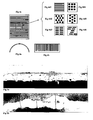
- Surface rugosity for a product according to the invention is between 0.05 and 0.25 mm and typically 0.1-0.2 mm, versus 0.4-0.7 mm for a typical fried chip product and 0.05-0.2 mm as well for the unmarked parts of a classical sheeted biscuit with raising agents (see Figure 5 ).
- the dough is sheeted to a thickness of 0.2-1 mm, giving a baked biscuit of 0.9-2.5 mm.
- dough moisture contents is a parameter, as too high dough moisture levels leads to the formation of a film of starch resulting in blistering of the products during baking.
- Certain ingredients such as solid fat particles or certain pre-gelatinised starches in a granular form which are incompletely hydrated during dough mixing, can help avoid blister formation.
- the granular structure gives porosity to the dough sheet creating "chimneys" helping air and water evacuate during baking.
- these ingredients give an unpleasant texture to the final products, in particular a sandy and dry taste for certain starches such as potato starch in granular form.
- the products are baked on a perforated belt or mould, enabling air and water vapour to evacuate from both the top and bottom of the biscuit.
- the ratio of native to pre-gelatinised starch is important, as a too low level of pre-gelatinised starches gives dough with too little cohesiveness, extensibility and elasticity, making it impossible to sheet to a reasonably thin layer. Too high levels of pre-gelatinised starches give a too stiff dough that is elastic but not cohesive, breaking into pieces before sheeting.
- the sugar content is a lever to balance the texture, and also the product handling after baking, as higher sugar content gives products that remain plastic for a longer time during cooling. Adjusting sugar content is a lever to give a good balance between sweet taste, dough consistency and post-baking plasticity.
- Biscuits are expected to have a golden brown colour. But as a significant amount of flour is replaced by starch in this product, few proteins are available for Maillard browning reactions. To boost those reactions, the quantity of reducing sugars, e.g. glucose, lactose or maltose, can be increased; a simple way to increase this quantity is to replace part of the icing sugar and water by some glucose syrup.
- the incorporation of some sweet whey powder which brings both reducing sugar and proteins, also advantageously increases the coloration during baking.
- the addition of reducing sugar and whey powder, as well as the adjustment of baking time and temperature profile, give a more brownish coloration.
- a colouring agent such as beta-carotene or cocoa powder can be added to the dough. A pleasant colour was obtained whilst using beta-carotene at a dosage between 0.001 and 0.01%, giving Minolta L-a-b values of respectively 68 - 74, -0.5 - +1.5 and 46 - 50.
- the taste can be enhanced using flavours, comprising notes of vanilla, butter, malt, nuts, Maillard reaction products and similar warm and round flavour notes.
- fats can be used, such as butter, concentrated butter, shortening, palm oil, palm kernel oil, coconut oil etc.
- the choice of the fat will result from the identification of the best compromise between organoleptic features, nutritional features, cost features, industrial convenience and compatibility with chocolate.
- Concentrated butter gives the best results in term of organoleptic likeness.
- a mixture of 50-100% concentrated butter, 0.5-45% palm oil, 0-2.5% palm kernel oil and 0-2.5% coconut oil is a good compromise, especially as it is cheaper than pure concentrated butter.
- (vi) includes added water and water content of glucose syrup.
- WF wheat flour
- NS native potato starch
- PS pre-gelatinised starch
- Area 0 non-workable area. The recipe cannot be processed, or the product obtained is totally rejected in term of appearance (blisters) or texture (cardboard). This area is defined by the following conditions:
- Points P1, P2, P3, P13 and P14 of the ternary diagram are part of area 0.
- Area 1 workable area.
- the recipe can be processed with some difficulty and the product is rather poor in appearance and texture; however the product obtained can present some interesting side characteristics, such as low cost, specific nutritional profile as gluten-free profile, deliberate blisters or granularity.
- This area is defined by the following conditions:
- area 1 is divided into 1a (high PS and low NS/PS) and 1b (high NS and high NS/PS).
- Area 1a corresponds to a still acceptable probability of blisters and a risk of too hard, elastic and film-forming dough
- area 1b corresponds to a granular texture and an acceptable risk of non-cohesive dough.
- Points P4, P5 and P11 of the ternary diagram are part of area 1.
- Area 2 rather acceptable area.
- the recipe can be processed without major issue, and the product obtained is rather acceptable regarding most of sought parameters (dimensions, appearance), though the texture is still not optimal.
- the product obtained can present some interesting side characteristics, such as low cost, specific nutritional profile as gluten-free profile, or deliberate granularity.
- This area is defined by the following conditions:
- area 2 is divided into 2a (high WF) and 2b (high NS).
- Area 2a corresponds to insufficiently crispy texture
- area 2b corresponds to slightly too granular texture and not enough cohesive dough.
- Points P6 and P10 of the ternary diagram are part of area 2.
- Area 3 acceptable area.
- the recipe can be processed without major issue, and the product obtained is very acceptable regarding sought parameters (dimensions, appearance, texture). This area is defined by the following conditions:
- Point P9 of the ternary diagram is part of area 3.
- Area 4 optimal area.
- the recipe can be processed without any difficulty, and the product obtained reaches all sought parameters. This area is defined by the following conditions:
- Points P7, P8 and P12 are part of area 4.
- Residual moisture after baking ranges from 0.5 to 2%, typically from 0.8 to 1.2%. A low moisture is one of the keys to obtain a pleasant texture.
- Mixing is done ( Figure 3a ) by first mixing the dry ingredients, particularly the flour, starches and sugar, and optionally the smaller dry ingredients.
- the liquid ingredients in particular melted butter and/or shortening and water, and optionally the smaller dry ingredients, are premixed to form an emulsion before introduction to the mixer.
- the emulsion is kept between 40°C and 90°C, more particularly between 45°C and 80°C, and preferably between 55°C and 65°C.
- the mixer MIX - typically a double Z blade - is equipped with a heated double jacket, holding the temperature of the double jacket between 50°C and 70°C, typically 60°C.
- the high temperature of the mixer double jacket and of the ingredients is important so as to get a cohesive dough, that develops some elasticity during the mixing, thanks to the formation of a sugar and pre-gelatinised starch network that compensates for the poorness of gluten network. More precisely, a good network is obtained only when the dough reaches a temperature of 40°C-45°C minimum during its mixing, and not higher than 70°C and more particularly no higher than 65°C. This temperature cycle can be short, as the dough remains cohesive and elastic enough even if it has cooled down to 20-25°C when it gets sheeted.
- the typical mixing time to obtain such a dough temperature is 3 to 6 min at a speed between 50 and 90 rpm.
- the dough When mixing at lower temperatures than 40°C, the dough does not develop enough elasticity and cohesiveness; as a result it behaves rather as an aggregate than a dough, and cannot be sheeted to any thickness compatible with a reasonably thin product.
- Forming ( Figure 3b ) is done by a classical sheet and cut technology.
- Biscuits are sheeted by 2 to 5, typically 3 to 4 gauge rolls GR, to a final thickness between 0.2 mm and 1.0 mm, typically between 0.4 mm and 0.8 mm, and preferably between 0.5 mm and 0.6 mm.
- Dough pieces of the wanted shape are cut out from the dough sheet by a rotary cutter RC, and the scrap is recycled into the hopper of the sheeting line.
- Specific shapes including asymmetric shapes or shapes with holes in the dough piece, can be formed as they are compatible with the global process.
- the dough sheet can be cut into continuous ribbons and baked as such, before being cut crosswise after baking into individual shells.
- this option is not the preferred one, as the edges generated by post-baking cutting are not as precise as those obtained from pre-baking cut out.
- the cut dough piece is flat, and the optional curvature needs to be given during heat treatment, in this case oven baking Figure 3c ).
- oven baking Figure 3c Three options are possible, either to bake the product on a curved support, or to partially bake it on a flat oven belt, then transfer it to a forming device and then finish the baking, or to bake it on a flat oven belt, and shape it at oven outlet before glass transition takes place, typically before it cools down to less than 75°C, while the product is still plastic and the structure not fully set.
- the first case has been privileged because it ensures a more stable formation of the product and simplifies the industrial equipment.
- the heating technology can be direct gas flame, but it should be preferably indirect heating as forced convection.
- direct gas flame will result in a high variability in colour, within products and onto each individual product, as the thinness of the dough piece or ribbon makes it very sensitive to direct exposure to radiative heat flux.
- the use of a classical forced convection baking tunnel allows a thorough control of colour and moisture. Best results are obtained with a convective heat flux close to 2 kW/m 2 , a radiative heat flux close to 0.5 kW/m 2 , a rather low temperature - between 160 and 180°C all along the oven - and an average baking time - between 4 and 6 min.
- the baking of the product can be seen as a simple drying out, as no strong energy boost is required to get any leavening, whereas the product remains thin all along baking reaction which makes water evacuation easier than with a classical raised biscuit or cracker.
- classical biscuits or crackers require significantly higher temperatures - usually between 200 and 250°C.
- Formulations giving a coarse texture - typically those with a high ratio of native starch on pre-gelatinised starch - can be baked on a continuous surface, but for formulations giving a smooth surface, blisters occur even at low and optimised water levels if baked on a continuous surface. Having resort to perforated oven belt or moulds enables water and trapped air to evacuate and result in a biscuit without blisters, within the scope defined in the chapter about formulation.
- Figure 4 shows a scheme of an individual mould with various examples of perforation patterns (d1 to d6), as holes or slits.
- the moulds can be individual, or designed to hold several dough pieces length wise or cross wise. They can be fixed by clips or by welding on transversal bars, the latter being driven forth and back all along the oven by one or several chains as in a classical technique used in bakery for tunnel ovens or fermentation chambers.
- the product contains in most of the cases a significant amount of sugar and has a very high ratio between the surface in contact with the mould and the weight of the biscuit - typically between 10 and 15 cm 2 /g - the product sticks to the baking moulds. It cannot be de-moulded right at the exit of the oven, as sugar is still very sticky above 90°C, but on the other side it is not ideal to wait for a natural cooling down to 30-40°C, as a long non-heated conveyor length at the end of the oven would severely deteriorate the heat balance and the metal immobilisation of the oven.
- a solution has been developed to remove baked biscuits from their moulds after a quite short passage - no more than 45 sec - outside of the baking tunnel, at a temperature between 50°C and 70°C, a few seconds after the glass transition has taken place and the products start behaving as solid and elastic sheets and no more as soft and viscous sheets.
- This solution consists in coupling air blowing from underneath and depression conveyor from above, so as to simultaneously cool, blow and suck the products. It is illustrated in Figure 3d .
- the depression conveyor runs in the same direction and at approximately the same speed as the baking conveyor, and the gap in-between the running moulds and the running conveyor may be as small as 3 mm to 10 mm, along a "takeoff" length longer than the distance occupied by three consecutive rows of products, a "flight” length longer than the distance occupied by two consecutive rows of products, and a "landing" length - located above the next cooling conveyor and corresponding to the drop of depression - longer than the distance occupied by one row of products.
- the conveyor itself may be porous to air, and can be made for instance of a perforated polyurethane band of 1 to 2 mm thickness, typically 1.2-1.5 mm, with holes diameter between 0.5 and 6 mm, typically 4 mm, spaced out by 3 to 20 mm, with a total perforation ratio (defined as the ratio of surface of holes on total surface) between 3 and 20%, typically 4-10%.
- the band may have enough softness to follow closely the possible curvature of the products on a minimum width of 10 mm.
- the delta of pressure between both sides of the band may be between 0.05 and 0.5 bar, typically between 0.1 and 0.2 bar.
- the surface of aspiration above the conveyor can be limited to apertures in the shape of narrow rectangles located above each file of products, with a width of 5 to 30 mm, and a length superior to the distance occupied by five consecutive rows of products, typically superior to 350 mm.
- the measurement of E' and E" is done by DMTA (Dynamic Mechanical Thermal Analysis), with a MKIIIE analyser from TA-Instrument.
- the method consists in imparting by means of a movable clamp an harmonic stress ⁇ (expressed in Pa or N/m 2 ) at a pulsation ⁇ (in rad/s or in s -1 ) through a one-point flexion applied on a rectangular sample of the product, and recording in parallel the resulting strain ⁇ (dimensionless parameter expressing the relative distortion).
- ⁇ Harmonic Mechanical Thermal Analysis
- each sample is a rectangle cut out from the product, with a thickness T (in m) equal to the thickness of the product, a length L of 8 10 -3 m free to move in-between the stationary clamp and the movable clamp, and a width between 10 -2 and 1.2 10 -2 m.
- the stress ⁇ (in Pa) is the ratio ( F/L 2 ) of the force F (in N) applied by the movable clamp on a square surface L 2 (in m 2 ) having a side equal to the length L of the sample let free to move.
- ⁇ ⁇ /E'
- ⁇ 0 Different values of ⁇ 0 have been chosen for each product, in order to work in the linear domain for each product, i.e . in the small, non-destructive distortion domain. All those values of ⁇ 0 have been chosen among three possible values: 0.008%, 0.01% and 0.04%.
- E', tan ⁇ and E" have been measured at 1 Hz along a range of temperature covering most of the "real life zone" 25-40°C, within which no significant evolution has been noticed (see Figure 7b).
- DTMA one-point flexion in harmonic mode at 1 Hz
- the characteristics of the final baked biscuit are the following:
- the product may for example have a length between 30 and 100 mm, a projected width between 20 and 75 mm, with a surface between 5 and 70 cm 2 , and preferably between 20 and 30 cm 2 .
- the product can be considered as a sweet biscuit because it has a similar composition and sweet taste.
- the dough forming technology used is similar to that used for producing crackers, and the shape of the product is close to that of a chip.
- the biscuit according to the invention can have a thinness and a three dimensional shape similar to those of a wafer.
- it can be seen as a hybrid of a chip, a cracker, a biscuit and a wafer.
- the table below compares its physical characteristics with related standard products.
- Table 5a Means (scale from 0 to 60): Invented product Chip Cracker Biscuit THICK 8.61 11.40 26.23 28.37 STICKY 20.23 24.64 31.41 32.79 SMOOTH 34.11 16.71 19.16 35.27 CRUMBLY 34.76 30.77 36.26 29.83 CRISPY 38.19 36.04 30.81 34.67 MELTING 39.13 32.01 28.03 19.76 DRY 42.81 38.70 32.36 40.37 LIGHT 44.36 40.80 35.36 22.93
- Table 5b Results of the analysis of variance : Significant differences ( p ⁇ 5%): THICK Invented product, Chips ⁇ Crackers, Biscuits STICKY Invented product, Chips ⁇ Crackers, Biscuits SMOOTH Chips, Crackers ⁇ Invented product, Biscuits CRUMBLY Biscuits, Chips ⁇
- the biscuit according to the invention is:
Landscapes
- Life Sciences & Earth Sciences (AREA)
- Engineering & Computer Science (AREA)
- Food Science & Technology (AREA)
- Health & Medical Sciences (AREA)
- Nutrition Science (AREA)
- Chemical & Material Sciences (AREA)
- Polymers & Plastics (AREA)
- Molecular Biology (AREA)
- Bakery Products And Manufacturing Methods Therefor (AREA)
- Confectionery (AREA)
Priority Applications (14)
| Application Number | Priority Date | Filing Date | Title |
|---|---|---|---|
| PL08290305T PL2106703T3 (pl) | 2008-03-31 | 2008-03-31 | Sposób wytwarzania ultra-cienkich herbatników o gładkiej powierzchni |
| EP08290305A EP2106703B1 (en) | 2008-03-31 | 2008-03-31 | Process for producing ultra-thin biscuits with a smooth surface |
| ES08290305T ES2384283T3 (es) | 2008-03-31 | 2008-03-31 | Procedimiento para producir galletas ultradelgadas con una superficie lisa |
| EP08807216A EP2262380A1 (en) | 2008-03-31 | 2008-06-25 | Process for producing ultra-thin biscuits with a smooth surface. |
| UAA201011976A UA97891C2 (ru) | 2008-03-31 | 2008-06-25 | Способ производства сверхтонкого печенья с гладкой поверхностью |
| US12/935,830 US20110111105A1 (en) | 2008-03-31 | 2008-06-25 | Process For Producing Ultra-Thin Biscuits With A Smooth Surface |
| NZ588119A NZ588119A (en) | 2008-03-31 | 2008-06-25 | Process for producing ultra-thin biscuits with a smooth surface |
| CN2008801284910A CN101983016B (zh) | 2008-03-31 | 2008-06-25 | 生产具有平滑表面的超薄饼干的方法 |
| AU2008354316A AU2008354316A1 (en) | 2008-03-31 | 2008-06-25 | Process for producing ultra-thin biscuits with a smooth surface. |
| CA2719333A CA2719333A1 (en) | 2008-03-31 | 2008-06-25 | Process for producing ultra-thin biscuits with a smooth surface. |
| RU2010144532/13A RU2459413C2 (ru) | 2008-03-31 | 2008-06-25 | Способ изготовления ультратонкого печенья с гладкой поверхностью |
| PCT/IB2008/002663 WO2009122235A1 (en) | 2008-03-31 | 2008-06-25 | Process for producing ultra-thin biscuits with a smooth surface. |
| KR1020107022832A KR20110007129A (ko) | 2008-03-31 | 2008-06-25 | 평활 표면을 갖는 초박형 비스킷의 제조방법 |
| ZA2010/06592A ZA201006592B (en) | 2008-03-31 | 2010-09-15 | Process for producing ultra-thin biscuits with a smooth surface |
Applications Claiming Priority (1)
| Application Number | Priority Date | Filing Date | Title |
|---|---|---|---|
| EP08290305A EP2106703B1 (en) | 2008-03-31 | 2008-03-31 | Process for producing ultra-thin biscuits with a smooth surface |
Publications (2)
| Publication Number | Publication Date |
|---|---|
| EP2106703A1 EP2106703A1 (en) | 2009-10-07 |
| EP2106703B1 true EP2106703B1 (en) | 2012-05-16 |
Family
ID=39846958
Family Applications (2)
| Application Number | Title | Priority Date | Filing Date |
|---|---|---|---|
| EP08290305A Not-in-force EP2106703B1 (en) | 2008-03-31 | 2008-03-31 | Process for producing ultra-thin biscuits with a smooth surface |
| EP08807216A Withdrawn EP2262380A1 (en) | 2008-03-31 | 2008-06-25 | Process for producing ultra-thin biscuits with a smooth surface. |
Family Applications After (1)
| Application Number | Title | Priority Date | Filing Date |
|---|---|---|---|
| EP08807216A Withdrawn EP2262380A1 (en) | 2008-03-31 | 2008-06-25 | Process for producing ultra-thin biscuits with a smooth surface. |
Country Status (13)
| Country | Link |
|---|---|
| US (1) | US20110111105A1 (pl) |
| EP (2) | EP2106703B1 (pl) |
| KR (1) | KR20110007129A (pl) |
| CN (1) | CN101983016B (pl) |
| AU (1) | AU2008354316A1 (pl) |
| CA (1) | CA2719333A1 (pl) |
| ES (1) | ES2384283T3 (pl) |
| NZ (1) | NZ588119A (pl) |
| PL (1) | PL2106703T3 (pl) |
| RU (1) | RU2459413C2 (pl) |
| UA (1) | UA97891C2 (pl) |
| WO (1) | WO2009122235A1 (pl) |
| ZA (1) | ZA201006592B (pl) |
Families Citing this family (26)
| Publication number | Priority date | Publication date | Assignee | Title |
|---|---|---|---|---|
| RU2425566C1 (ru) * | 2010-07-12 | 2011-08-10 | Олег Иванович Квасенков | Способ получения диабетических вафель (варианты) |
| USD655887S1 (en) * | 2010-12-16 | 2012-03-20 | Frito-Lay North America, Inc. | Ready to eat snack piece |
| USD646866S1 (en) * | 2010-12-16 | 2011-10-18 | Frito-Lay North America, Inc. | Ready to eat snack piece |
| USD656296S1 (en) * | 2010-12-16 | 2012-03-27 | Frito-Lay North America, Inc. | Ready to eat snack piece |
| US20130196033A1 (en) * | 2012-02-01 | 2013-08-01 | Frito-Lay North America, Inc. | Crisp Bread Snack Foods |
| USD733574S1 (en) * | 2012-08-20 | 2015-07-07 | Jennifer E. Walker-Spry | Earring keeper |
| USD711067S1 (en) * | 2012-11-07 | 2014-08-19 | Cj Cheiljedang Corporation | Snack food |
| CN113749133A (zh) * | 2012-12-14 | 2021-12-07 | 洲际大品牌有限责任公司 | 在顶部和底部具有压凹的饼干 |
| US10375968B2 (en) | 2013-03-15 | 2019-08-13 | Frito-Lay North America, Inc. | Method for making a shaped snack chip |
| CN103210984B (zh) * | 2013-03-19 | 2014-12-17 | 安徽麦船食品科技有限公司 | 一种营养巧克力曲奇饼干及其制备方法 |
| CN103230050B (zh) * | 2013-04-22 | 2014-05-07 | 马氏庄园南京食品有限公司 | 一种巧克力椰香卷及其制备方法 |
| USD909007S1 (en) | 2014-03-30 | 2021-02-02 | Intercontinental Great Brands Llc | Thin biscuit sandwich |
| AU358082S (en) | 2014-03-30 | 2014-10-07 | Intercontinental Great Brands Llc | Biscuit |
| US20190216101A1 (en) * | 2016-04-26 | 2019-07-18 | Compañía De Galletas Noel S.A.S. | Method for producing dough from flour and starch mixtures |
| CN106490281A (zh) * | 2016-12-28 | 2017-03-15 | 郑州荣利达生物科技有限公司 | 一种巧克力曲奇饼干及其制备方法 |
| DE102017001106A1 (de) * | 2017-02-07 | 2018-08-09 | Merck Patent Gmbh | Färbung von Oblaten und ähnlichen Backwaren |
| CN107242266B (zh) * | 2017-05-02 | 2020-10-27 | 华南理工大学 | 一种基于3d打印技术制作营养杂粮饼干的方法 |
| CN111107752B (zh) * | 2017-06-13 | 2022-11-22 | 玉米产品开发公司 | 由蜡质木薯制成的烘培小吃涂层 |
| CN121549436A (zh) * | 2019-08-14 | 2026-02-24 | 洲际大品牌有限责任公司 | 糖食片产品及其制备方法 |
| BE1027647B1 (nl) | 2019-10-11 | 2021-05-10 | Biscuiterie Jules Destrooper Nv | Werkwijze voor het vervaardigen van een fijn koekje |
| US20220408737A1 (en) * | 2019-12-06 | 2022-12-29 | Intercontinental Great Brands Llc | High-acid baked good and method of making baked good |
| AU2021202440A1 (en) * | 2021-03-29 | 2022-10-13 | James Gordon Cashmore | Biodegradable and/or edible tableware |
| CN115530198A (zh) * | 2021-06-29 | 2022-12-30 | 洲际大品牌有限责任公司 | 烘焙物 |
| JP2023065894A (ja) * | 2021-10-28 | 2023-05-15 | 株式会社ニップン | ビスケット類の割れ防止方法 |
| CN115715551B (zh) * | 2022-11-03 | 2024-05-28 | 哈尔滨商业大学 | 一种预糊化米粉及双蛋白饼干制备方法 |
| CN121647288A (zh) * | 2024-09-11 | 2026-03-13 | 洲际伟大品牌有限公司 | 基于马铃薯的薄型薄脆饼干 |
Family Cites Families (10)
| Publication number | Priority date | Publication date | Assignee | Title |
|---|---|---|---|---|
| US3502479A (en) * | 1966-06-20 | 1970-03-24 | Lipton Inc Thomas J | Process of making a snack product |
| US4380191A (en) * | 1977-03-25 | 1983-04-19 | Gallegos Rafael C | Dough forming and cooking apparatus |
| US4374863A (en) * | 1981-03-02 | 1983-02-22 | The Procter & Gamble Co. | Compositions and methods for providing nonadherent dough for baked goods |
| US4834996A (en) * | 1985-09-05 | 1989-05-30 | Nabisco Brands, Inc. | Extruded starch snack foods and process |
| IT1258841B (it) * | 1992-01-31 | 1996-02-29 | Barilla Flli G & R | Biscotto con elevato contenuto di cereali |
| US5747092A (en) * | 1996-04-25 | 1998-05-05 | Nabisco Technology Company | Production of crispy wheat-based snacks having surface bubbles |
| EP1203536B1 (en) * | 1996-07-01 | 2005-09-14 | The Procter & Gamble Company | Snacks prepared form a dough comprising modified starches |
| RU2240695C2 (ru) * | 2002-06-05 | 2004-11-27 | Общество с ограниченной ответственностью "Фламинго-Маркет" | Состав для приготовления печенья с фруктовой начинкой |
| US6893673B2 (en) | 2002-07-18 | 2005-05-17 | Frito-Lay North America, Inc. | Method for controlling snack product blistering through the use of solid lipid particles |
| US20070154607A1 (en) * | 2003-11-03 | 2007-07-05 | Ulate-Rodriguez Jorge A | Dough and method for preparing leavened food product |
-
2008
- 2008-03-31 PL PL08290305T patent/PL2106703T3/pl unknown
- 2008-03-31 EP EP08290305A patent/EP2106703B1/en not_active Not-in-force
- 2008-03-31 ES ES08290305T patent/ES2384283T3/es active Active
- 2008-06-25 CN CN2008801284910A patent/CN101983016B/zh not_active Expired - Fee Related
- 2008-06-25 AU AU2008354316A patent/AU2008354316A1/en not_active Abandoned
- 2008-06-25 EP EP08807216A patent/EP2262380A1/en not_active Withdrawn
- 2008-06-25 US US12/935,830 patent/US20110111105A1/en not_active Abandoned
- 2008-06-25 RU RU2010144532/13A patent/RU2459413C2/ru not_active IP Right Cessation
- 2008-06-25 CA CA2719333A patent/CA2719333A1/en not_active Abandoned
- 2008-06-25 UA UAA201011976A patent/UA97891C2/ru unknown
- 2008-06-25 KR KR1020107022832A patent/KR20110007129A/ko not_active Withdrawn
- 2008-06-25 WO PCT/IB2008/002663 patent/WO2009122235A1/en not_active Ceased
- 2008-06-25 NZ NZ588119A patent/NZ588119A/xx not_active IP Right Cessation
-
2010
- 2010-09-15 ZA ZA2010/06592A patent/ZA201006592B/en unknown
Also Published As
| Publication number | Publication date |
|---|---|
| UA97891C2 (ru) | 2012-03-26 |
| EP2262380A1 (en) | 2010-12-22 |
| ES2384283T3 (es) | 2012-07-03 |
| PL2106703T3 (pl) | 2012-08-31 |
| ZA201006592B (en) | 2011-08-31 |
| KR20110007129A (ko) | 2011-01-21 |
| CA2719333A1 (en) | 2009-10-08 |
| NZ588119A (en) | 2012-11-30 |
| EP2106703A1 (en) | 2009-10-07 |
| CN101983016B (zh) | 2013-01-02 |
| CN101983016A (zh) | 2011-03-02 |
| RU2010144532A (ru) | 2012-05-10 |
| AU2008354316A1 (en) | 2009-10-08 |
| US20110111105A1 (en) | 2011-05-12 |
| WO2009122235A1 (en) | 2009-10-08 |
| RU2459413C2 (ru) | 2012-08-27 |
Similar Documents
| Publication | Publication Date | Title |
|---|---|---|
| EP2106703B1 (en) | Process for producing ultra-thin biscuits with a smooth surface | |
| Davidson | Biscuit baking technology: processing and engineering manual | |
| US4927655A (en) | Heat processed food base | |
| US5340598A (en) | Method for producing spherical shaped baked goods | |
| US4927656A (en) | Method of producing edible vessel | |
| EP1328157B1 (en) | Food product with enhanced crispiness | |
| Cauvain et al. | The Chorleywood bread process | |
| US9801391B2 (en) | Process for the production of cookies having improved organoleptic properties | |
| US8241689B2 (en) | Production of baked snack chips with irregular shape having notched edges | |
| EP2281461B1 (en) | Cookie products having enhanced stability | |
| JP2000262219A (ja) | 安定化したチーズケーキ製品 | |
| Bozkurt et al. | Principles and recent applications of vacuum technology in the processing of dough-based cereal products: A comprehensive review | |
| US20070259090A1 (en) | Low-calorie foods and process of making the same | |
| Sykes et al. | Biscuit, cookie and cracker process and recipes | |
| US20130316044A1 (en) | Bread having improved texture and taste and method for producing same | |
| EP2944198B1 (en) | Process for the production of a shelf-stable filled sponge-type bakery product | |
| Sarwar et al. | Industrial applications of cereals | |
| Singla et al. | Technology of Biscuits | |
| Sai Manohar | Baking | |
| Townsend | Cookies, crackers, and other flour confectionery | |
| JP3295664B2 (ja) | プレッツェルおよびプレッツェルの製造方法 | |
| Fuentes et al. | Production of Wheat-Based Snacks | |
| EP3040001A2 (en) | Process of making biscuit and snack products | |
| JP2005312349A (ja) | パイ包み餅の製造方法、及びパイ包み餅 | |
| Fuentes et al. | 10 ProductionBased of Wheat |
Legal Events
| Date | Code | Title | Description |
|---|---|---|---|
| PUAI | Public reference made under article 153(3) epc to a published international application that has entered the european phase |
Free format text: ORIGINAL CODE: 0009012 |
|
| AK | Designated contracting states |
Kind code of ref document: A1 Designated state(s): AT BE BG CH CY CZ DE DK EE ES FI FR GB GR HR HU IE IS IT LI LT LU LV MC MT NL NO PL PT RO SE SI SK TR |
|
| AX | Request for extension of the european patent |
Extension state: AL BA MK RS |
|
| RIN1 | Information on inventor provided before grant (corrected) |
Inventor name: TRONSMO, KARI Inventor name: MACHADO, LUIS Inventor name: GAUDUCHON, LUC Inventor name: BESSE, NICOLAS |
|
| 17P | Request for examination filed |
Effective date: 20100331 |
|
| AKX | Designation fees paid |
Designated state(s): AT BE BG CH CY CZ DE DK EE ES FI FR GB GR HR HU IE IS IT LI LT LU LV MC MT NL NO PL PT RO SE SI SK TR |
|
| GRAP | Despatch of communication of intention to grant a patent |
Free format text: ORIGINAL CODE: EPIDOSNIGR1 |
|
| GRAS | Grant fee paid |
Free format text: ORIGINAL CODE: EPIDOSNIGR3 |
|
| GRAA | (expected) grant |
Free format text: ORIGINAL CODE: 0009210 |
|
| AK | Designated contracting states |
Kind code of ref document: B1 Designated state(s): AT BE BG CH CY CZ DE DK EE ES FI FR GB GR HR HU IE IS IT LI LT LU LV MC MT NL NO PL PT RO SE SI SK TR |
|
| REG | Reference to a national code |
Ref country code: GB Ref legal event code: FG4D |
|
| REG | Reference to a national code |
Ref country code: CH Ref legal event code: EP |
|
| REG | Reference to a national code |
Ref country code: NL Ref legal event code: T3 |
|
| REG | Reference to a national code |
Ref country code: AT Ref legal event code: REF Ref document number: 557595 Country of ref document: AT Kind code of ref document: T Effective date: 20120615 |
|
| REG | Reference to a national code |
Ref country code: IE Ref legal event code: FG4D |
|
| REG | Reference to a national code |
Ref country code: ES Ref legal event code: FG2A Ref document number: 2384283 Country of ref document: ES Kind code of ref document: T3 Effective date: 20120703 |
|
| REG | Reference to a national code |
Ref country code: DE Ref legal event code: R096 Ref document number: 602008015591 Country of ref document: DE Effective date: 20120719 |
|
| REG | Reference to a national code |
Ref country code: PL Ref legal event code: T3 |
|
| REG | Reference to a national code |
Ref country code: LT Ref legal event code: MG4D Effective date: 20120516 |
|
| PG25 | Lapsed in a contracting state [announced via postgrant information from national office to epo] |
Ref country code: NO Free format text: LAPSE BECAUSE OF FAILURE TO SUBMIT A TRANSLATION OF THE DESCRIPTION OR TO PAY THE FEE WITHIN THE PRESCRIBED TIME-LIMIT Effective date: 20120816 Ref country code: SE Free format text: LAPSE BECAUSE OF FAILURE TO SUBMIT A TRANSLATION OF THE DESCRIPTION OR TO PAY THE FEE WITHIN THE PRESCRIBED TIME-LIMIT Effective date: 20120516 Ref country code: FI Free format text: LAPSE BECAUSE OF FAILURE TO SUBMIT A TRANSLATION OF THE DESCRIPTION OR TO PAY THE FEE WITHIN THE PRESCRIBED TIME-LIMIT Effective date: 20120516 Ref country code: IS Free format text: LAPSE BECAUSE OF FAILURE TO SUBMIT A TRANSLATION OF THE DESCRIPTION OR TO PAY THE FEE WITHIN THE PRESCRIBED TIME-LIMIT Effective date: 20120916 Ref country code: LT Free format text: LAPSE BECAUSE OF FAILURE TO SUBMIT A TRANSLATION OF THE DESCRIPTION OR TO PAY THE FEE WITHIN THE PRESCRIBED TIME-LIMIT Effective date: 20120516 Ref country code: CY Free format text: LAPSE BECAUSE OF FAILURE TO SUBMIT A TRANSLATION OF THE DESCRIPTION OR TO PAY THE FEE WITHIN THE PRESCRIBED TIME-LIMIT Effective date: 20120516 |
|
| REG | Reference to a national code |
Ref country code: AT Ref legal event code: MK05 Ref document number: 557595 Country of ref document: AT Kind code of ref document: T Effective date: 20120516 |
|
| PG25 | Lapsed in a contracting state [announced via postgrant information from national office to epo] |
Ref country code: PT Free format text: LAPSE BECAUSE OF FAILURE TO SUBMIT A TRANSLATION OF THE DESCRIPTION OR TO PAY THE FEE WITHIN THE PRESCRIBED TIME-LIMIT Effective date: 20120917 Ref country code: GR Free format text: LAPSE BECAUSE OF FAILURE TO SUBMIT A TRANSLATION OF THE DESCRIPTION OR TO PAY THE FEE WITHIN THE PRESCRIBED TIME-LIMIT Effective date: 20120817 Ref country code: LV Free format text: LAPSE BECAUSE OF FAILURE TO SUBMIT A TRANSLATION OF THE DESCRIPTION OR TO PAY THE FEE WITHIN THE PRESCRIBED TIME-LIMIT Effective date: 20120516 Ref country code: SI Free format text: LAPSE BECAUSE OF FAILURE TO SUBMIT A TRANSLATION OF THE DESCRIPTION OR TO PAY THE FEE WITHIN THE PRESCRIBED TIME-LIMIT Effective date: 20120516 Ref country code: HR Free format text: LAPSE BECAUSE OF FAILURE TO SUBMIT A TRANSLATION OF THE DESCRIPTION OR TO PAY THE FEE WITHIN THE PRESCRIBED TIME-LIMIT Effective date: 20120516 |
|
| PG25 | Lapsed in a contracting state [announced via postgrant information from national office to epo] |
Ref country code: AT Free format text: LAPSE BECAUSE OF FAILURE TO SUBMIT A TRANSLATION OF THE DESCRIPTION OR TO PAY THE FEE WITHIN THE PRESCRIBED TIME-LIMIT Effective date: 20120516 Ref country code: CZ Free format text: LAPSE BECAUSE OF FAILURE TO SUBMIT A TRANSLATION OF THE DESCRIPTION OR TO PAY THE FEE WITHIN THE PRESCRIBED TIME-LIMIT Effective date: 20120516 Ref country code: EE Free format text: LAPSE BECAUSE OF FAILURE TO SUBMIT A TRANSLATION OF THE DESCRIPTION OR TO PAY THE FEE WITHIN THE PRESCRIBED TIME-LIMIT Effective date: 20120516 Ref country code: DK Free format text: LAPSE BECAUSE OF FAILURE TO SUBMIT A TRANSLATION OF THE DESCRIPTION OR TO PAY THE FEE WITHIN THE PRESCRIBED TIME-LIMIT Effective date: 20120516 Ref country code: RO Free format text: LAPSE BECAUSE OF FAILURE TO SUBMIT A TRANSLATION OF THE DESCRIPTION OR TO PAY THE FEE WITHIN THE PRESCRIBED TIME-LIMIT Effective date: 20120516 Ref country code: SK Free format text: LAPSE BECAUSE OF FAILURE TO SUBMIT A TRANSLATION OF THE DESCRIPTION OR TO PAY THE FEE WITHIN THE PRESCRIBED TIME-LIMIT Effective date: 20120516 |
|
| PLBE | No opposition filed within time limit |
Free format text: ORIGINAL CODE: 0009261 |
|
| STAA | Information on the status of an ep patent application or granted ep patent |
Free format text: STATUS: NO OPPOSITION FILED WITHIN TIME LIMIT |
|
| 26N | No opposition filed |
Effective date: 20130219 |
|
| PGFP | Annual fee paid to national office [announced via postgrant information from national office to epo] |
Ref country code: ES Payment date: 20130326 Year of fee payment: 6 Ref country code: GB Payment date: 20130327 Year of fee payment: 6 Ref country code: CH Payment date: 20130325 Year of fee payment: 6 Ref country code: FR Payment date: 20130405 Year of fee payment: 6 Ref country code: DE Payment date: 20130327 Year of fee payment: 6 |
|
| PGFP | Annual fee paid to national office [announced via postgrant information from national office to epo] |
Ref country code: PL Payment date: 20130314 Year of fee payment: 6 |
|
| REG | Reference to a national code |
Ref country code: DE Ref legal event code: R097 Ref document number: 602008015591 Country of ref document: DE Effective date: 20130219 |
|
| PG25 | Lapsed in a contracting state [announced via postgrant information from national office to epo] |
Ref country code: BG Free format text: LAPSE BECAUSE OF FAILURE TO SUBMIT A TRANSLATION OF THE DESCRIPTION OR TO PAY THE FEE WITHIN THE PRESCRIBED TIME-LIMIT Effective date: 20120816 |
|
| PGFP | Annual fee paid to national office [announced via postgrant information from national office to epo] |
Ref country code: BE Payment date: 20130327 Year of fee payment: 6 |
|
| PGFP | Annual fee paid to national office [announced via postgrant information from national office to epo] |
Ref country code: NL Payment date: 20130326 Year of fee payment: 6 |
|
| PG25 | Lapsed in a contracting state [announced via postgrant information from national office to epo] |
Ref country code: MC Free format text: LAPSE BECAUSE OF NON-PAYMENT OF DUE FEES Effective date: 20130331 |
|
| REG | Reference to a national code |
Ref country code: IE Ref legal event code: MM4A |
|
| PG25 | Lapsed in a contracting state [announced via postgrant information from national office to epo] |
Ref country code: IE Free format text: LAPSE BECAUSE OF NON-PAYMENT OF DUE FEES Effective date: 20130331 |
|
| PG25 | Lapsed in a contracting state [announced via postgrant information from national office to epo] |
Ref country code: MT Free format text: LAPSE BECAUSE OF FAILURE TO SUBMIT A TRANSLATION OF THE DESCRIPTION OR TO PAY THE FEE WITHIN THE PRESCRIBED TIME-LIMIT Effective date: 20120516 |
|
| REG | Reference to a national code |
Ref country code: DE Ref legal event code: R119 Ref document number: 602008015591 Country of ref document: DE |
|
| REG | Reference to a national code |
Ref country code: NL Ref legal event code: V1 Effective date: 20141001 |
|
| REG | Reference to a national code |
Ref country code: CH Ref legal event code: PL |
|
| GBPC | Gb: european patent ceased through non-payment of renewal fee |
Effective date: 20140331 |
|
| REG | Reference to a national code |
Ref country code: FR Ref legal event code: ST Effective date: 20141128 |
|
| REG | Reference to a national code |
Ref country code: DE Ref legal event code: R119 Ref document number: 602008015591 Country of ref document: DE Effective date: 20141001 |
|
| PG25 | Lapsed in a contracting state [announced via postgrant information from national office to epo] |
Ref country code: CH Free format text: LAPSE BECAUSE OF NON-PAYMENT OF DUE FEES Effective date: 20140331 Ref country code: LI Free format text: LAPSE BECAUSE OF NON-PAYMENT OF DUE FEES Effective date: 20140331 Ref country code: DE Free format text: LAPSE BECAUSE OF NON-PAYMENT OF DUE FEES Effective date: 20141001 Ref country code: FR Free format text: LAPSE BECAUSE OF NON-PAYMENT OF DUE FEES Effective date: 20140331 Ref country code: GB Free format text: LAPSE BECAUSE OF NON-PAYMENT OF DUE FEES Effective date: 20140331 |
|
| PG25 | Lapsed in a contracting state [announced via postgrant information from national office to epo] |
Ref country code: NL Free format text: LAPSE BECAUSE OF NON-PAYMENT OF DUE FEES Effective date: 20141001 |
|
| PG25 | Lapsed in a contracting state [announced via postgrant information from national office to epo] |
Ref country code: IT Free format text: LAPSE BECAUSE OF NON-PAYMENT OF DUE FEES Effective date: 20140331 |
|
| REG | Reference to a national code |
Ref country code: ES Ref legal event code: FD2A Effective date: 20150424 |
|
| PG25 | Lapsed in a contracting state [announced via postgrant information from national office to epo] |
Ref country code: PL Free format text: LAPSE BECAUSE OF NON-PAYMENT OF DUE FEES Effective date: 20140331 |
|
| PG25 | Lapsed in a contracting state [announced via postgrant information from national office to epo] |
Ref country code: TR Free format text: LAPSE BECAUSE OF FAILURE TO SUBMIT A TRANSLATION OF THE DESCRIPTION OR TO PAY THE FEE WITHIN THE PRESCRIBED TIME-LIMIT Effective date: 20120516 |
|
| REG | Reference to a national code |
Ref country code: PL Ref legal event code: LAPE |
|
| PG25 | Lapsed in a contracting state [announced via postgrant information from national office to epo] |
Ref country code: ES Free format text: LAPSE BECAUSE OF NON-PAYMENT OF DUE FEES Effective date: 20140401 Ref country code: LU Free format text: LAPSE BECAUSE OF NON-PAYMENT OF DUE FEES Effective date: 20130331 Ref country code: HU Free format text: LAPSE BECAUSE OF FAILURE TO SUBMIT A TRANSLATION OF THE DESCRIPTION OR TO PAY THE FEE WITHIN THE PRESCRIBED TIME-LIMIT; INVALID AB INITIO Effective date: 20080331 |
|
| PG25 | Lapsed in a contracting state [announced via postgrant information from national office to epo] |
Ref country code: CZ Free format text: LAPSE BECAUSE OF NON-PAYMENT OF DUE FEES Effective date: 20130331 |
|
| PG25 | Lapsed in a contracting state [announced via postgrant information from national office to epo] |
Ref country code: BE Free format text: LAPSE BECAUSE OF NON-PAYMENT OF DUE FEES Effective date: 20140331 |