EP2107604A2 - Leistungshalbleitermodul mit hermetisch dichter Schaltungsanordnung und Herstellungsverfahren hierzu - Google Patents
Leistungshalbleitermodul mit hermetisch dichter Schaltungsanordnung und Herstellungsverfahren hierzu Download PDFInfo
- Publication number
- EP2107604A2 EP2107604A2 EP09004421A EP09004421A EP2107604A2 EP 2107604 A2 EP2107604 A2 EP 2107604A2 EP 09004421 A EP09004421 A EP 09004421A EP 09004421 A EP09004421 A EP 09004421A EP 2107604 A2 EP2107604 A2 EP 2107604A2
- Authority
- EP
- European Patent Office
- Prior art keywords
- power semiconductor
- layer
- sealing surface
- connection
- substrate
- Prior art date
- Legal status (The legal status is an assumption and is not a legal conclusion. Google has not performed a legal analysis and makes no representation as to the accuracy of the status listed.)
- Granted
Links
Images

Classifications
-
- H—ELECTRICITY
- H10—SEMICONDUCTOR DEVICES; ELECTRIC SOLID-STATE DEVICES NOT OTHERWISE PROVIDED FOR
- H10W—GENERIC PACKAGES, INTERCONNECTIONS, CONNECTORS OR OTHER CONSTRUCTIONAL DETAILS OF DEVICES COVERED BY CLASS H10
- H10W72/00—Interconnections or connectors in packages
-
- H—ELECTRICITY
- H10—SEMICONDUCTOR DEVICES; ELECTRIC SOLID-STATE DEVICES NOT OTHERWISE PROVIDED FOR
- H10W—GENERIC PACKAGES, INTERCONNECTIONS, CONNECTORS OR OTHER CONSTRUCTIONAL DETAILS OF DEVICES COVERED BY CLASS H10
- H10W76/00—Containers; Fillings or auxiliary members therefor; Seals
- H10W76/10—Containers or parts thereof
-
- H—ELECTRICITY
- H10—SEMICONDUCTOR DEVICES; ELECTRIC SOLID-STATE DEVICES NOT OTHERWISE PROVIDED FOR
- H10W—GENERIC PACKAGES, INTERCONNECTIONS, CONNECTORS OR OTHER CONSTRUCTIONAL DETAILS OF DEVICES COVERED BY CLASS H10
- H10W70/00—Package substrates; Interposers; Redistribution layers [RDL]
- H10W70/60—Insulating or insulated package substrates; Interposers; Redistribution layers
- H10W70/611—Insulating or insulated package substrates; Interposers; Redistribution layers for connecting multiple chips together
-
- H—ELECTRICITY
- H10—SEMICONDUCTOR DEVICES; ELECTRIC SOLID-STATE DEVICES NOT OTHERWISE PROVIDED FOR
- H10W—GENERIC PACKAGES, INTERCONNECTIONS, CONNECTORS OR OTHER CONSTRUCTIONAL DETAILS OF DEVICES COVERED BY CLASS H10
- H10W70/00—Package substrates; Interposers; Redistribution layers [RDL]
- H10W70/60—Insulating or insulated package substrates; Interposers; Redistribution layers
- H10W70/67—Insulating or insulated package substrates; Interposers; Redistribution layers characterised by their insulating layers or insulating parts
- H10W70/688—Flexible insulating substrates
-
- H—ELECTRICITY
- H10—SEMICONDUCTOR DEVICES; ELECTRIC SOLID-STATE DEVICES NOT OTHERWISE PROVIDED FOR
- H10W—GENERIC PACKAGES, INTERCONNECTIONS, CONNECTORS OR OTHER CONSTRUCTIONAL DETAILS OF DEVICES COVERED BY CLASS H10
- H10W72/00—Interconnections or connectors in packages
- H10W72/071—Connecting or disconnecting
- H10W72/077—Connecting of TAB connectors
-
- H—ELECTRICITY
- H10—SEMICONDUCTOR DEVICES; ELECTRIC SOLID-STATE DEVICES NOT OTHERWISE PROVIDED FOR
- H10W—GENERIC PACKAGES, INTERCONNECTIONS, CONNECTORS OR OTHER CONSTRUCTIONAL DETAILS OF DEVICES COVERED BY CLASS H10
- H10W72/00—Interconnections or connectors in packages
- H10W72/30—Die-attach connectors
-
- H—ELECTRICITY
- H10—SEMICONDUCTOR DEVICES; ELECTRIC SOLID-STATE DEVICES NOT OTHERWISE PROVIDED FOR
- H10W—GENERIC PACKAGES, INTERCONNECTIONS, CONNECTORS OR OTHER CONSTRUCTIONAL DETAILS OF DEVICES COVERED BY CLASS H10
- H10W72/00—Interconnections or connectors in packages
- H10W72/60—Strap connectors, e.g. thick copper clips for grounding of power devices
-
- H—ELECTRICITY
- H10—SEMICONDUCTOR DEVICES; ELECTRIC SOLID-STATE DEVICES NOT OTHERWISE PROVIDED FOR
- H10W—GENERIC PACKAGES, INTERCONNECTIONS, CONNECTORS OR OTHER CONSTRUCTIONAL DETAILS OF DEVICES COVERED BY CLASS H10
- H10W72/00—Interconnections or connectors in packages
- H10W72/701—Tape-automated bond [TAB] connectors
-
- H—ELECTRICITY
- H10—SEMICONDUCTOR DEVICES; ELECTRIC SOLID-STATE DEVICES NOT OTHERWISE PROVIDED FOR
- H10W—GENERIC PACKAGES, INTERCONNECTIONS, CONNECTORS OR OTHER CONSTRUCTIONAL DETAILS OF DEVICES COVERED BY CLASS H10
- H10W74/00—Encapsulations, e.g. protective coatings
- H10W74/40—Encapsulations, e.g. protective coatings characterised by their materials
- H10W74/47—Encapsulations, e.g. protective coatings characterised by their materials comprising organic materials, e.g. plastics or resins
- H10W74/476—Organic materials comprising silicon
-
- H—ELECTRICITY
- H10—SEMICONDUCTOR DEVICES; ELECTRIC SOLID-STATE DEVICES NOT OTHERWISE PROVIDED FOR
- H10W—GENERIC PACKAGES, INTERCONNECTIONS, CONNECTORS OR OTHER CONSTRUCTIONAL DETAILS OF DEVICES COVERED BY CLASS H10
- H10W76/00—Containers; Fillings or auxiliary members therefor; Seals
- H10W76/10—Containers or parts thereof
- H10W76/12—Containers or parts thereof characterised by their shape
- H10W76/13—Containers comprising a conductive base serving as an interconnection
- H10W76/138—Containers comprising a conductive base serving as an interconnection having another interconnection being formed by a cover plate parallel to the conductive base, e.g. sandwich type
-
- H—ELECTRICITY
- H10—SEMICONDUCTOR DEVICES; ELECTRIC SOLID-STATE DEVICES NOT OTHERWISE PROVIDED FOR
- H10W—GENERIC PACKAGES, INTERCONNECTIONS, CONNECTORS OR OTHER CONSTRUCTIONAL DETAILS OF DEVICES COVERED BY CLASS H10
- H10W90/00—Package configurations
-
- H—ELECTRICITY
- H10—SEMICONDUCTOR DEVICES; ELECTRIC SOLID-STATE DEVICES NOT OTHERWISE PROVIDED FOR
- H10W—GENERIC PACKAGES, INTERCONNECTIONS, CONNECTORS OR OTHER CONSTRUCTIONAL DETAILS OF DEVICES COVERED BY CLASS H10
- H10W90/00—Package configurations
- H10W90/401—Package configurations characterised by multiple insulating or insulated package substrates, interposers or RDLs
-
- H—ELECTRICITY
- H10—SEMICONDUCTOR DEVICES; ELECTRIC SOLID-STATE DEVICES NOT OTHERWISE PROVIDED FOR
- H10W—GENERIC PACKAGES, INTERCONNECTIONS, CONNECTORS OR OTHER CONSTRUCTIONAL DETAILS OF DEVICES COVERED BY CLASS H10
- H10W72/00—Interconnections or connectors in packages
- H10W72/071—Connecting or disconnecting
- H10W72/073—Connecting or disconnecting of die-attach connectors
- H10W72/07331—Connecting techniques
-
- H—ELECTRICITY
- H10—SEMICONDUCTOR DEVICES; ELECTRIC SOLID-STATE DEVICES NOT OTHERWISE PROVIDED FOR
- H10W—GENERIC PACKAGES, INTERCONNECTIONS, CONNECTORS OR OTHER CONSTRUCTIONAL DETAILS OF DEVICES COVERED BY CLASS H10
- H10W72/00—Interconnections or connectors in packages
- H10W72/071—Connecting or disconnecting
- H10W72/073—Connecting or disconnecting of die-attach connectors
- H10W72/07331—Connecting techniques
- H10W72/07336—Soldering or alloying
-
- H—ELECTRICITY
- H10—SEMICONDUCTOR DEVICES; ELECTRIC SOLID-STATE DEVICES NOT OTHERWISE PROVIDED FOR
- H10W—GENERIC PACKAGES, INTERCONNECTIONS, CONNECTORS OR OTHER CONSTRUCTIONAL DETAILS OF DEVICES COVERED BY CLASS H10
- H10W72/00—Interconnections or connectors in packages
- H10W72/071—Connecting or disconnecting
- H10W72/076—Connecting or disconnecting of strap connectors
- H10W72/07631—Techniques
-
- H—ELECTRICITY
- H10—SEMICONDUCTOR DEVICES; ELECTRIC SOLID-STATE DEVICES NOT OTHERWISE PROVIDED FOR
- H10W—GENERIC PACKAGES, INTERCONNECTIONS, CONNECTORS OR OTHER CONSTRUCTIONAL DETAILS OF DEVICES COVERED BY CLASS H10
- H10W72/00—Interconnections or connectors in packages
- H10W72/60—Strap connectors, e.g. thick copper clips for grounding of power devices
- H10W72/651—Materials of strap connectors
- H10W72/652—Materials of strap connectors comprising metals or metalloids, e.g. silver
-
- H—ELECTRICITY
- H10—SEMICONDUCTOR DEVICES; ELECTRIC SOLID-STATE DEVICES NOT OTHERWISE PROVIDED FOR
- H10W—GENERIC PACKAGES, INTERCONNECTIONS, CONNECTORS OR OTHER CONSTRUCTIONAL DETAILS OF DEVICES COVERED BY CLASS H10
- H10W72/00—Interconnections or connectors in packages
- H10W72/90—Bond pads, in general
- H10W72/921—Structures or relative sizes of bond pads
- H10W72/926—Multiple bond pads having different sizes
-
- H—ELECTRICITY
- H10—SEMICONDUCTOR DEVICES; ELECTRIC SOLID-STATE DEVICES NOT OTHERWISE PROVIDED FOR
- H10W—GENERIC PACKAGES, INTERCONNECTIONS, CONNECTORS OR OTHER CONSTRUCTIONAL DETAILS OF DEVICES COVERED BY CLASS H10
- H10W72/00—Interconnections or connectors in packages
- H10W72/90—Bond pads, in general
- H10W72/941—Dispositions of bond pads
- H10W72/944—Dispositions of multiple bond pads
-
- H—ELECTRICITY
- H10—SEMICONDUCTOR DEVICES; ELECTRIC SOLID-STATE DEVICES NOT OTHERWISE PROVIDED FOR
- H10W—GENERIC PACKAGES, INTERCONNECTIONS, CONNECTORS OR OTHER CONSTRUCTIONAL DETAILS OF DEVICES COVERED BY CLASS H10
- H10W90/00—Package configurations
- H10W90/701—Package configurations characterised by the relative positions of pads or connectors relative to package parts
- H10W90/761—Package configurations characterised by the relative positions of pads or connectors relative to package parts of strap connectors
- H10W90/764—Package configurations characterised by the relative positions of pads or connectors relative to package parts of strap connectors between a chip and a stacked insulating package substrate, interposer or RDL
Definitions
- the invention describes a power semiconductor module and a manufacturing method for this purpose, wherein the circuit arrangement of the power semiconductor module is hermetically sealed against environmental influences. Especially when using electric drives in vehicles or other applications in harsh environments, it is advantageous to form the power semiconductor module particularly. This design was intended to protect the circuit arrangement of the power semiconductor module from the effects of high temperature fluctuations, especially in combination with moisture.
- prepregs are known power semiconductor modules according to the DE 196 17 055 C1 wherein so-called prepregs are disclosed for internal isolation of the power semiconductor module.
- prepregs which cure under pressure and / or temperature and thus form a material connection with at least one connection partner.
- connection means of an alternating sequence of conductive and insulating layers for circuit-compatible connection of the circuit arrangement of a power semiconductor module.
- Such connection devices are particularly preferred for compact structures of power semiconductor modules.
- disk cells have long been known which have one or more hermetically sealed against environmental influences power semiconductor components in their interior.
- Such disc cells usually have no complex circuit arrangements, such as three-phase bridge circuits, as they are known from power semiconductor modules with plastic housings.
- the invention has for its object to provide a power semiconductor module and a manufacturing method thereof, wherein the circuit arrangement of the power semiconductor module is hermetically sealed against environmental influences and wherein the circuit arrangement is simultaneously accessible to a flexible design with ease of manufacture.
- the starting point of the invention is a circuit arrangement of a power semiconductor module with a substrate, with conductor tracks arranged thereon and power semiconductor components arranged thereon, and with a connecting device arranged for this purpose.
- the term circuit arrangement is understood to be the sum of all conductor tracks and semiconductor components required for the electrical function.
- the connecting device used here is an alternating layer sequence of at least two electrically conductive layers and at least one electrically insulating layer.
- the interconnects of the circuit arrangement are formed on the substrate and electrically isolated from each other. They carry the power semiconductor components and form part of the circuit-compatible connections of the power semiconductor components.
- the other circuit-compliant connections are by means of the connection device educated.
- at least one of the electrically conductive layers is structured in itself and forms connecting tracks. It may also be preferred if vias are provided between different electrically conductive layers.
- the substrate has a first sealing surface surrounding the circuit arrangement without interruption.
- This can be configured as a frame around the circuit arrangement and can be embodied, for example, as a metallic layer analogous to the conductor tracks or as a free area on the substrate.
- This first sealing surface is hermetically sealed by means of a connecting layer with an associated second sealing surface of the connecting device, either on a metallic or an insulating layer.
- This compound is preferably formed as a pressure sintered connection.
- the term of the pressure sintered connection not only as the known compound of two metals by means of a sintered metal but also the electrically insulating compound with a prepreg instead of the sintered metal, wherein the temperature and pressure conditions during the formation of the compound those of a known pressure sintered compound comply with sintered metal.
- a gel-like insulating material for example a silicone gel, is arranged.
- Fig. 1 shows a section of a power semiconductor module with a connecting device according to the prior art in side view.
- Fig. 2 shows a section of a power semiconductor module with a connecting device according to the prior art in plan view.
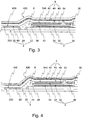
- Fig. 3 shows a detail of a first embodiment of a power semiconductor module according to the invention in side view.
- Fig. 4 shows a section of a second embodiment of a power semiconductor module according to the invention in side view.
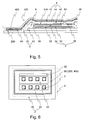
- Fig. 5 shows a detail of a third embodiment of a power semiconductor module according to the invention in side view.
- Fig. 6 shows a plan view of a substrate of a power semiconductor module according to the invention.
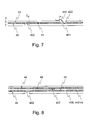
- Fig. 7 shows a section of a first connection means of a power semiconductor module according to the invention.
- Fig. 8 shows a section of a second connection device of a power semiconductor module according to the invention.
- Fig. 1 shows a section of a power semiconductor module with a connecting device (4) according to the prior art in side view.
- a substrate (2) Shown here is a substrate (2), as it is often known as so-called. DCB (direct copper bonding) or IMS (insulated metal substrate) substrate, without this being a limitation to such substrates.
- the substrate (2) has an insulating layer (20) arranged thereon and electrically insulated from each other conductor tracks (22 a / b).
- One of these conductor tracks (22a) carries here a unhoused semiconductor component (3), for example a power transistor as it is used by way of example for driving three-phase motors.
- a sintered metal layer (52) is arranged for the electrically conductive connection between the first conductor (22a) carrying the semiconductor component (3) and an associated contact surface (32) on the first main surface of the semiconductor component (3).
- This sintered metal layer (52) constitutes an electrically conductive connection of high reliability after the pressure sintering process of manufacture.
- the second main surface of the semiconductor component (3) has two contact surfaces (34, 36).
- the connecting device (4) is designed here as a metallic foil (40), preferably made of copper with a noble metal coating in the region of the sintered connections (50, 52).
- the thickness of this metallic foil (40) is chosen such that it has at least the same current carrying capacity as a wire bonding connection according to the prior art.
- connection device (4) represents the electrically conductive connection between the emitter connection surface (34) of the semiconductor component (3) and a second conductor track (22b) of the substrate (2).
- the connection of the connection device (4) to the second conductor track (22b) is likewise designed as a pressure sintered connection.
- the metallic foil (40) has an arcuate course (420) between the two contact surfaces.
- an insulating material (6) is arranged in the volume region formed by the arcuate course (420) of the connecting device (4), the substrate (2) and the semiconductor device (3). This insulating material was applied during the manufacturing process in those areas which is then covered by a connecting device (4). In this embodiment, this is the area in addition to the lateral edge (30) of the semiconductor component (3) and an outer part of the upper edge (38), cf. Fig. 2 ,
- the insulating material used (6) is a multi-component silicone compound which has been applied in a metering or casting process at the edge of the semiconductor device (3) and was crosslinked by means of a UV exposure.
- a certain toughness of the insulating material (6) is given, and on the other hand, such a silicone compound is also suitable for internal insulation, if the circuit arrangement has been designed for correspondingly high voltages.
- Fig. 2 shows a section of a power semiconductor module with a connecting device according to the prior art in plan view. Shown here are the same parts of Wegungsanorndung as under Fig. 1 described.
- the insulating material (6) serves on the one hand in a two-dimensional pressure introduction in the context of Drucksintertress in the direction of the drawing plane as quasihydostatic element which distributes the pressure evenly at its interfaces and thus prevents damage to the semiconductor device during pressurization.
- the insulating material (6) also serves the already described electrical insulation of the circuit arrangement of the power semiconductor module according to the invention.
- Fig. 3 shows a detail of a first embodiment of a power semiconductor module according to the invention in side view.
- the basic structure of the substrate (2) as well as the power semiconductor device (3) arranged on the conductor track (22) is identical to that of FIG Fig. 1 described.
- the connecting device (4) here has an alternating construction of at least three layers, the layer sequence starting from the substrate (2) starting with a first electrically conductive layer (40), to which a first insulating (44) and then another conductive layer (42) follows.
- the connecting device (4) extends beyond the entire circuit arrangement and beyond the first sealing surface (200), cf. Fig. 6 ,
- the substrate (2) has a sealing surface (200) formed only peripherally around the circuit arrangement, which is arranged here on a metallic layer (24) formed analogously to the conductor tracks (22).
- a sintered metal layer (60) is arranged on the first, here metallic sealing surface (200), which in a pressure sintering process with the second sealing surface (400), here on the first conductive layer (40) of Connecting device (4) is arranged connected.
- the connection partners that is to say the first (200) and second sealing surfaces (400), with a noble metal coating.
- a gel-type insulating material (6) is arranged circumferentially around the respective power semiconductor components (3), advantageously up to the first sealing surface (200). This encloses the power semiconductor component (3) not only at its outer edge (30) but also covers its main surface facing away from the subrate at its edge (38).
- Fig. 4 shows a section of a second embodiment of a power semiconductor module according to the invention in side view.
- the design of the power semiconductor component (3) and the structure of the connecting device (4) are largely identical to those of Fig. 3 described.
- the connection device projects at least partially further beyond the first sealing surface (200) on the side facing away from the power semiconductor component (3) in order, for example, to be connected to connection elements for external load and auxiliary connections.
- the substrate (2) does not have a metallic layer as the first sealing surface (200) but exclusively a region of the base body (20) of the substrate (2) completely enclosing the circuit arrangement, ie a region on the DCB substrate ceramics.
- Sintered metal can again be used here as connecting layer (60), in which case, however, a noble metal coating would have to be deposited on the respective sealing surface (200, 400).
- a bonding layer (60) is a prepreg, which is arranged like a frame around the circuit around and thus completely encloses the circuit arrangement (see. Fig. 6 ).
- the connection of the prepreg (60) with the first (200) and second sealing surface (400) is also created at the same time, wherein the second sealing surface (400) again has a partial surface of the first electrically conductive layer (40) of the connecting device (4).
- Fig. 5 shows a detail of a third embodiment of a power semiconductor module according to the invention in side view. This differs from the second embodiment according to Fig. 4 in that the second sealing surface (400) is part of the first insulating layer (44) of the connecting device (4).
- the connecting layer (60) is advantageously designed as a prepreg.
- Fig. 6 shows a plan view of a substrate (2) of a power semiconductor module according to the invention. Shown here is the substrate (2) with the circuit arrangement consisting of three printed conductors (22) and arranged on two of these printed conductors power semiconductor components (3). Also shown schematically is the connecting layer (4), which is congruent with the circumferential first sealing surface (200) on the substrate (2) and the second sealing surface (400) on the connecting device (4).
- circuit-compatible connection of the power semiconductor components (3) with one another or with a further conductor track (22) is effected by the connecting device (4) shown only in outline. It can be seen that this invention, the entire circuit arrangement and the first sealing surface (200) surmounted in order to achieve a hermetically sealed termination of the circuit to environmental influences.
- Fig. 7 shows a section of a first connection device (4) of a power semiconductor module according to the invention. Shown here is a via (404) from the interrupted (422) second electrically conductive layer (42) through a recess (442) of the insulating layer (44) to the first electrically conductive layer (40). This is here designed as a wire bond connection (404). Also shown is an interruption (402) of the first electrically conductive layer (40), by way of example for producing two mutually insulated connection paths for the emitter connection and the gate connection of a power semiconductor component, cf. Fig. 3 to 5 ).
- the circumferential first and second sealing surfaces it may not only be necessary to connect the circumferential first and second sealing surfaces, but also to provide a spacing (x) between openings (402, 422) of the electrically conductive layers (40, 42). It is thus particularly preferred if two such openings (40, 42) have a distance (x) from one another which has at least ten times the thickness (d) of the insulating layer (44) arranged between the electrically conductive layers (40, 42) ,
- Fig. 8 shows a section of a second connection device (4) of a power semiconductor module according to the invention. Shown here is a connection device with three electrically conductive layers (40, 42, 46) and two insulating layers (44, 48) arranged between each.
- the first and second electrically conductive layers (40, 42) have plated-through holes (406) for the circuit-compatible connection, while the third electrically conductive layer (46) is uninterrupted and can serve as an example for shielding the circuit arrangement.
- Each of the individual layers of this connection device is suitable for arranging the second sealing surface (400) thereon.
Landscapes
- Structures Or Materials For Encapsulating Or Coating Semiconductor Devices Or Solid State Devices (AREA)
- Combinations Of Printed Boards (AREA)
- Structure Of Printed Boards (AREA)
Abstract
Description
- Die Erfindung beschreibt ein Leistungshalbleitermodul und ein Herstellungsverfahren hierzu, wobei die Schaltungsanordnung des Leistungshalbleitermoduls hermetisch dicht gegen Umwelteinflüsse abgeschlossen ist. Speziell bei der Verwendung elektrischer Antriebe in Fahrzeugen oder anderen Anwendung in rauer Umgebung ist es vorteilhaft das Leistungshalbleitermodul besonders auszubilden. Diese Ausbildung sollte die Schaltungsanordnung des Leistungshalbleitermoduls vor den Einflüssen hoher Temperaturschwankungen besonders in Verbindung mit Feuchtigkeit zu schützen.
- Bekannt sind Leistungshalbleitermodule gemäß der
DE 196 17 055 C1 wobei zur inneren Isolierung des Leistungshalbleitermoduls sog. Prepregs offenbart sind. Hier und im Weiteren sollen unter Prepregs verschiedene Ausgestaltungen von Halbzeugen aus einem isolierenden Stoff und einer Kunststoffmatrix verstanden werden, die unter Druckund/oder Temperaturbeaufschlagung aushärten und somit eine stoffschlüssige Verbindung mit mindestens einem Verbindungspartner ausbilden. - Ebenfalls, beispielhaft aus der
DE 10 2004 021 927 A1 sind verschiedenartig angeordnete gelartige Isolierstoffe zu inneren Isolierung der Leistungshalbleitermodule bekannt. Gemäß dem Stand der Technik weisen diese Leistungshalbleitermodule ein Kunststoffgehäuse mit nach außen führenden Anschlusselementen für die Last- und Hilfsanschlüsse auf. - Beispielhaft aus der
DE 103 55 925 A1 sind Verbindungseinrichtungen aus einer alternierenden Folge von leitenden und isolierenden Schichten zur schaltungsgerechten Verbindung der Schaltungsanordnung eines Leistungshalbleitermoduls bekannt. Derartige Verbindungseinrichtungen sind besonders bevorzugt für kompakte Aufbauten von Leistungshalbleitermodulen. - Ebenso sind seit langem Scheibenzellen bekannt, die ein oder mehrere hermetisch gegen Umwelteinflüsse abgeschlossene Leistungshalbleiterbauelemente in ihrem Inneren aufweisen. Derartige Scheibenzellen weisen meist keine komplexen Schaltungsanordnungen, wie Dreiphasen-Brückenschaltungen, auf, wie sie von Leistungshalbleitermodulen mit Kunststoffgehäusen bekannt sind.
- Der Erfindung liegt die Aufgabe zugrunde ein Leistungshalbleitermodul und ein Herstellungsverfahren hierzu anzugeben, wobei die Schaltungsanordnung des Leistungshalbleitermoduls hermetisch gegen Umwelteinflüsse abgedichtet ist und wobei die Schaltungsanordnung gleichzeitig einer flexiblen Ausgestaltung bei einfacher Herstellbarkeit zugänglich ist.
- Diese Aufgabe wird erfindungsgemäß gelöst, durch ein Leistungshalbleitermodul mit den Merkmalen des Anspruchs 1 sowie durch ein Herstellungsverfahren gemäß Anspruch 6. Bevorzugte Ausführungsformen sind in den abhängigen Ansprüchen beschrieben.
- Ausgangspunkt der Erfindung ist eine Schaltungsanordnung eines Leistungshalbleitermoduls mit einem Substrat, mit hierauf angeordneten Leiterbahnen und hierauf angeordneten Leistungshalbleiterbauelementen und einer hierzu angeordneten Verbindungseinrichtung. Hierbei wird unter Schaltungsanordnung die Summe aller für die elektrische Funktion notwendigen Leiterbahnen und Halbleiterbauelemente verstanden. Als Verbindungseinrichtung dient hierbei eine alternierende Schichtfolge mindestens zweier elektrisch leitender Schichten und mindestens einer elektrisch isolierenden Schicht. Die Leiterbahnen der Schaltungsanordnung sind auf dem Substrat ausgebildet und gegeneinander elektrisch isoliert. Sie tragen die Leistungshalbleiterbauelemente und bilden einen Teil der schaltungsgerechten Verbindungen der Leistungshalbleiterbauelemente. Die weiteren schaltungsgerechten Verbindungen werden mittels der Verbindungseinrichtung ausgebildet. Hierzu ist mindestens eine der elektrisch leitenden Schichten in sich strukturiert und bildet Verbindungsbahnen aus. Es kann ebenso bevorzugte sein, wenn zwischen verschiedenen elektrisch leitenden Schichten Durchkontaktierungen vorgesehen sind.
- Erfindungsgemäß weist das Substrat eine erste die Schaltungsanordnung unterbrechungsfrei umschließende Dichtfläche auf. Diese kann als Rahmen um die Schaltungsanordnung ausgestaltet sein und beispielhaft als eine metallische Schicht analog den Leiterbahnen oder als freie Fläche auf dem Substrat ausgebildet sein. Diese erste Dichtfläche ist mittels einer Verbindungsschicht mit einer zugeordneten zweiten Dichtfläche der Verbindungseinrichtung, entweder auf einer metallischen oder einer isolierenden Schicht, hermetisch dicht verbunden. Diese Verbindung ist vorzugsweise als eine Drucksinterverbindung ausgebildet.
- Es soll hier und im Folgenden der Begriff der Drucksinterverbindung nicht nur als die bekannte Verbindung zweier Metalle mittels eines Sintermetalls sondern auch die elektrisch isolierende Verbindung mit eines Prepregs anstelle des Sintermetalls verstanden werden, wobei die Temperatur und Druckbedingungen während der Ausbildung der Verbindung denjenigen einer bekannten Drucksinterverbindung mittels Sintermetall entsprechen.
- Das erfindungsgemäße Verfahren zu Ausbildung eines derartigen Leistungshalbleitermoduls ist durch die folgenden wesentlichen Schritte gekennzeichnet:
- Anordnen der Leistungshalbleiterbauelemente auf den zugeordneten Leiterbahnen des Substrats, wobei es hierbei bevorzugt ist eine Sintermetallschicht zwischen dem jeweiligen Leistungshalbleiterbauelement und er zugeordneten Fläche auf der Leiterbahn anzuordnen;
- Anordnen der Verbindungsschicht, beispielhaft ausgebildet als Sintermetallschicht oder als Prepreg, auf der ersten Dichtfläche;
- Anordnen der Verbindungseinrichtung zu den Leistungshalbleiterbauelementen, zu der ersten Dichtfläche und zu dem Substrat; hierbei wird selbstverständlich auch die zweite Dichtfläche zur Verbindungsschicht und damit auch zur ersten Dichtfläche ausgerichtet;
- Druck- und vorzugsweise auch Temperaturbeaufschlagung auf das Substrat, auf die Leistungshalbleiterbauelemente und auf die Verbindungseinrichtung, wodurch die Drucksinterverbindung zwischen der ersten und zweiten Dichtfläche ausgebildet wird.
- Hierbei kann es besonders bevorzugt sein, wenn nach der Anordnung der Leistungshalbleiterbauelement vollständig um diese herum und umlaufend auf dem Rand der dem Substrat abgewandten Hauptfläche ein gelartiger Isolierstoff, beispielhaft ein Silikongel, angeordnet wird.
- Besonders bevorzugte Weiterbildungen dieser Schaltungsanordnung sind in der jeweiligen Beschreibung der Ausführungsbeispiele genannt. Die erfinderische Lösung wird zudem an Hand der Ausführungsbeispiele und der
Fig. 1 bis 8 weiter erläutert. -
Fig. 1 zeigt einen Ausschnitt aus einem Leistungshalbleitermodul mit einer Verbindungseinrichtung nach dem Stand der Technik in Seitenansicht. -
Fig. 2 zeigt einen Ausschnitt aus einem Leistungshalbleitermodul mit einer Verbindungseinrichtung nach dem Stand der Technik in Draufsicht. -
Fig. 3 zeigt einen Ausschnitt einer ersten Ausgestaltung eines erfindungsgemäßen Leistungshalbleitermoduls in Seitenansicht. -
Fig. 4 zeigt einen Ausschnitt einer zweiten Ausgestaltung eines erfindungsgemäßen Leistungshalbleitermoduls in Seitenansicht. -
Fig. 5 zeigt einen Ausschnitt einer dritten Ausgestaltung eines erfindungsgemäßen Leistungshalbleitermoduls in Seitenansicht. -
Fig. 6 zeigt eine Draufsicht auf ein Substrat eines erfindungsgemäßen Leistungshalbleitermoduls. -
Fig. 7 zeigt einen Ausschnitt einer ersten Verbindungseinrichtung eines erfindungsgemäßen Leistungshalbleitermoduls. -
Fig. 8 zeigt einen Ausschnitt einer zweiten Verbindungseinrichtung eines erfindungsgemäßen Leistungshalbleitermoduls. -
Fig. 1 zeigt einen Ausschnitt aus einem Leistungshalbleitermodul mit einer Verbindungseinrichtung (4) nach dem Stand der Technik in Seitenansicht. Auf eine Darstellung des Gehäuses und der notwendigen externen Last- und Hilfsanschlusselemente wird hier und bei allen folgenden Abbildungen verzichtet. Dargestellt ist hierbei ein Substrat (2), wie es häufig als sog. DCB- (direct copper bonding) oder IMS- (insulated metal substrate) Substrat bekannt ist, ohne dass diese eine Beschränkung auf derartige Substrate bedeuten soll. Das Substrat (2) weist eine isolierende Lage (20) mit hierauf angeordneten und elektrisch voneinander isolierten Leiterbahnen (22 a/b) auf. Eine dieser Leiterbahnen (22a) trägt hier ein ungehaustes Halbleiterbauelement (3), beispielsweise einen Leistungstransistor wie er beispielhaft zur Ansteuerung von Drehstrommotoren eingesetzt wird. - Zur elektrisch leitenden Verbindung zwischen der ersten das Halbleiterbauelement (3) tragenden Leiterbahn (22a) und einer zugeordneten Kontaktfläche (32) auf der ersten Hauptfläche des Halbleiterbauelements (3) ist eine Sintermetallschicht (52) angeordnet. Diese Sintermetallschicht (52) stellt nach dem Drucksinterprozess der Herstellung eine elektrisch leitende Verbindung hoher Zuverlässigkeit dar.
- Die zweite Hauptfläche des Halbleiterbauelements (3) weist zwei Kontaktflächen (34, 36) auf. Eine erste großflächige Emitteranschlussfläche (34) und eine weitere kleinere Gateanschlussfläche (36). Auf der Emitteranschlussfläche (34) ist wiederum eine Sintermetallschicht angeordnet. Diese dient der elektrischen Verbindung der Emitteranschlussfläche (34) mit der Verbindungseinrichtung 4.
- Die Verbindungseinrichtung (4) ist hier als metallische Folie (40), vorzugsweise aus Kupfer mit Edelmetallbeschichtung im Bereich der Sinterverbindungen (50, 52) ausgebildet. Die Dicke dieser metallischen Folie (40) ist derart gewählt, dass sie mindestens die gleiche Stromtragfähigkeit aufweist wie eine Drahtbondverbindung gemäß dem Stand der Technik.
- Die Verbindungseinrichtung (4) stellt die elektrisch leitende Verbindung zwischen der Emitteranschlussfläche (34) des Halbleiterbauelements (3) und einer zweiten Leiterbahn (22b) des Substrats (2) dar. Die Verbindung der Verbindungseinrichtung (4) zur zweiten Leiterbahn (22b) ist ebenfalls als Drucksinterverbindung ausgebildet. Vorzugsweise weist die metallische Folie (40) einen bogenförmigen Verlauf (420) zwischen den beiden Kontaktflächen auf.
- In dem Volumenbereich der durch den bogenförmigen Verlauf (420) der Verbindungseinrichtung (4), dem Substrat (2) und dem Halbleiterbauelement (3) gebildet wird ist ein Isolierstoff (6) angeordnet. Dieser Isolierstoff wurde während des Herstellungsprozesses in demjenigen Bereiche aufgebracht der anschließend von einer Verbindungseinrichtung (4) überdeckt wird. Bei dieser Ausgestaltung ist dies der Bereich neben dem seitlichen Rand (30) des Halbleiterbauelements (3) sowie ein äußerer Teil des oberen Randes (38), vgl.
Fig. 2 . - Vorzugsweise ist der verwendete Isolierstoff (6) eine mehrkomponentige Silikonverbindung, die in einem Dosier- oder Gießverfahren am Rand des Halbleiterbauelements (3) aufgetragen wurde und mittels einer UV- Belichtung vernetzt wurde. Somit ist einerseits eine gewisse Zähigkeit des Isolierstoffs (6) gegeben, und andererseits eignet sich eine derartige Silikonverbindung auch zur inneren Isolation, falls die Schaltungsanordnung für entsprechend hohe Spannungen entworfen wurde.
-
Fig. 2 zeigt einen Ausschnitt aus einem Leistungshalbleitermodul mit einer Verbindungseinrichtung nach dem Stand der Technik in Draufsicht. Dargestellt sind hierbei die gleichen Teile der Schaltungsanorndung wie unterFig. 1 beschrieben. - Hierbei ist die flächige Ausdehnung des Isolierstoffes (6) im Bereich zwischen den Kontaktflächen (500, 540) der Verbindungseinrichtung (4) mit der Leiterbahn (22b) sowie dem Halbleiterbauelement (3) bzw. dessen Emitteranschlussfläche (34) sowie auch im Bereich neben der Verbindungseinrichtung (4) dargestellt.
- Gemäß dieser Ausgestaltung dient der Isolierstoff (6) einerseits bei einer flächigen Druckeinleitung im Rahmen der Drucksinterverbindung in Richtung der Zeichnungsebene als quasihydostatisches Element, das den Druck auf an seinen Grenzflächen gleichmäßig verteilt und somit einer Beschädigung des Halbleiterbauelement während der Druckbeaufschlagung verhindert. Anderseits dienst es auch der bereits beschrieben elektrischen Isolation der Schaltungsanordnung des erfindungsgemäßen Leistungshalbleitermoduls.
-
Fig. 3 zeigt einen Ausschnitt einer ersten Ausgestaltung eines erfindungsgemäßen Leistungshalbleitermoduls in Seitenansicht. Der grundlegende Aufbau des Substrats (2), wie auch des auf der Leiterbahn (22) angeordneten Leistungshalbleiterbauelements (3) ist identisch demjenigen unterFig. 1 beschrieben. Die Verbindungseinrichtung (4) weist hier allerdings einen alternierenden Aufbau aus mindestens drei Schichten auf, wobei die Schichtfolge vom Substrat (2) aus betrachtet mit einer ersten elektrisch leitenden Schicht (40) beginnt, auf die eine erste isolierende (44) und dann wieder eine leitende Schicht (42) folgt. Die Verbindungseinrichtung (4) erstreckt sich hierbei über die gesamt Schaltungsanordnung und über die erste Dichtfläche (200) hinaus, vgl.Fig. 6 . - Erfindungsgemäß weist das Substrat (2) eine erst umlaufend um die Schaltungsanordnung ausgebildete Dichtfläche (200) auf, die hier auf einer analog den Leiterbahnen (22) ausgebildeten metallischen Schicht (24) angeordnet ist. Gemäß dem erfindungsgemäßen Verfahren zur Herstellung eines derartigen Leistungshalbleitermoduls wird auf der ersten, hier metallischen Dichtfläche (200) eine Sintermetallschicht (60) angeordnet, die in einem Drucksinterverfahren mit der zweiten Dichtfläche (400), die hier auf der ersten leitenden Schicht (40) der Verbindungseinrichtung (4) angeordnet ist verbunden. Zur Ausbildung diese Sinterverbindungen ist es selbstverständlich bevorzugt die Verbindungspartner, also die erste (200) und zweite Dichtfläche (400) mit einer Edelmetallbeschichtung zu versehen. Es ist besonders bevorzugt in einem Arbeitsschritt mehrere Sinterverbindungen gleichzeitig auszubilden, also sowohl die Sinterverbindungen der beiden Dichtflächen (200, 400) sowie auch die Sinterverbindungen des Leistungshalbleiterbauelements (3), also die Verbindung zur zugeordneten Leiterbahn (22) als auch zur ersten metallischen Schicht (40) der Verbindungseinrichtung (4).
- Weiterhin dargestellt ist, dass umlaufend um die jeweiligen Leistungshalbleiterbauelemente (3), vorteilhafterweise bis heran an die erste Dichtfläche (200) ein gelartiger Isolierstoff (6) angeordnet ist. Dieser umschließt das Leistungshalbleiterbauelement (3) nicht nur an seinem äußeren Rand (30) sondern überdeckt auch dessen dem Subrat abgewandte Hauptfläche an ihrem Rand (38).
-
Fig. 4 zeigt einen Ausschnitt einer zweiten Ausgestaltung eines erfindungsgemäßen Leistungshalbleitermoduls in Seitenansicht. Die Ausbildung des Leistungshalbleiterbauelements (3) sowie der Aufbau der Verbindungseinrichtung (4) sind weitgehend identisch demjenigen unterFig. 3 beschrieben. Die Verbindungseinrichtung ragt hier allerdings an der dem Leistungshalbleiterbauelement (3) abgewandten Seite zumindest teilweise weiter über die erste Dichtfläche (200) hinaus, um beispielhaft mit Anschlusselementen für externe Last- und Hilfsanschlüsse verbunden zu werden. - Das Substrat (2) weist hier als erste Dichtfläche (200) allerdings keine metallische Schicht auf, sondern ausschließlich einen die Schaltungsanordnung vollständig umschließenden frei gesparten Bereich des Grundkörpers (20) des Substrats (2), also bei einem DCB- Substrat einen Bereich auf der Keramik.
- Hier kann nun als Verbindungsschicht (60) wiederum Sintermetall verwendet werden, wobei dann allerdings auf der jeweiligen Dichtfläche (200, 400) eine Edelmetallbeschichtung abgeschieden werden müsste. Alternativ und bevorzugt wird hier als Verbindungsschicht (60) ein Prepreg eingesetzt, das rahmenartig um die Schaltungsanordnung herum angeordnet ist und die Schaltungsanordnung somit vollständig umschließt (vgl.
Fig. 6 ). Im Rahmen der Sinterverbindungen des Leistungshalbleiterbauelements (3) wird hierbei gleichzeitig auch die Verbindung des Prepregs (60) mit der ersten (200) und zweiten Dichtfläche (400) erstellt, wobei die zweite Dichtfläche (400) hier wiederum eine Teilfläche der ersten elektrisch leitenden Schicht (40) der Verbindungseinrichtung (4) ist. -
Fig. 5 zeigt einen Ausschnitt einer dritten Ausgestaltung eines erfindungsgemäßen Leistungshalbleitermoduls in Seitenansicht. Diese unterscheidet sich von der zweiten Ausgestaltung gemäßFig. 4 dahingehend, dass die zweite Dichtfläche (400) Teilfläche der ersten isolierenden Schicht (44) der Verbindungseinrichtung (4) ist. Die Verbindungsschicht (60) ist hier vorteilhafterweise als Prepreg ausgebildet. -
Fig. 6 zeigt eine Draufsicht auf ein Substrat (2) eines erfindungsgemäßen Leistungshalbleitermoduls. Dargestellt ist hierbei das Substrat (2) mit der Schaltungsanordnung bestehend aus drei Leiterbahnen (22) und auf zwei dieser Leiterbahnen angeordneten Leistungshalbleiterbauelementen (3). Ebenfalls schematisch dargestellt ist die Verbindungsschicht (4), die deckungsgleich mit der umlaufenden ersten Dichtfläche (200) auf dem Substrat (2) und der zweiten Dichtfläche (400) auf der Verbindungseinrichtung (4) ist. - Die schaltungsgerechte Verbindung der Leistungshalbleiterbauelemente (3) miteinander oder mit einer weiteren Leiterbahn (22) erfolgt durch die nur im Umriss dargestellte Verbindungseinrichtung (4). Es ist hierbei ersichtlich, dass diese erfindungsgemäß die gesamte Schaltungsanordnung und die erste Dichtfläche (200) überragt, um einen hermetisch dichten Abschluss der Schaltungsanordnung gegenüber Umwelteinflüssen zu erreichen.
-
Fig. 7 zeigt einen Ausschnitt einer ersten Verbindungseinrichtung (4) eines erfindungsgemäßen Leistungshalbleitermoduls. Dargestellt ist hierbei eine Durchkontaktierung (404) von der unterbrochenen (422) zweiten elektrisch leitenden Schicht (42) durch eine Ausnehmung (442) der isolierenden Schicht (44) zur ersten elektrisch leitenden Schicht (40). Diese ist hier ausgebildet als eine Drahtbondverbindung (404). Ebenfalls dargestellt ist eine Unterbrechung (402) der ersten elektrisch leitenden Schicht (40), beispielhaft zur Erzeugung zweier voneinander isolierter Verbindungsbahnen für den Emitteranschluss und den Gateanschluss eines Leistungshalbleiterbauelements, vgl.Fig. 3 bis 5 ). - Zum hermetischen Abschluss der Schaltungsanordnung kann es nicht nur notwendig sein, die umlaufenden ersten und zweiten Dichtflächen miteinander zu verbinden, sondern auch einen Abstand (x) zwischen Öffnungen (402, 422) der elektrisch leitenden Schichten (40, 42) vorzusehen. Es ist somit besonders bevorzugt, wenn zwei derartige Öffnungen (40, 42) einen Abstand (x) voneinander aufweisen, der mindestens das Zehnfache der Dicke (d) der zwischen den elektrisch leitenden Schichten (40, 42) angeordnete isolierende Schicht (44) aufweist.
-
Fig. 8 zeigt einen Ausschnitt einer zweiten Verbindungseinrichtung (4) eines erfindungsgemäßen Leistungshalbleitermoduls. Dargestellt ist hier eine Verbindungseinrichtung mit drei elektrisch leitenden Schichten (40, 42, 46) und zwei jeweils dazwischen angeordneten isolierenden Schichten (44, 48). Die erste und zweite elektrisch leitende Schicht (40, 42) weist zur schaltungsgerechten Verbindung Durchkontaktierungen (406) auf, während die dritte elektrisch leitende Schicht (46) nicht unterbrochen ist und beispielhaft der Abschirmung der Schaltungsanordnung dienen kann. - Jede der einzelnen Schichten dieser Verbindungseinrichtung besonders aber auch die dritte ununterbrochene elektrisch leitfähige Schicht (46) ist geeignet, um hierauf die zweite Dichtfläche (400) anzuordnen.
Claims (10)
- Leistungshalbleitermodul mit einem Substrat (2) einer hierauf ausgebildete Schaltungsanordnung mit einer Mehrzahl gegeneinander elektrisch isolierter Leiterbahnen (22) und mit hierauf angeordneten Leistungshalbleiterbauelementen (3), die mittels einer Verbindungseinrichtung (4), bestehend aus einer alternierenden Schichtfolge mindestens zweier elektrisch leitender Schichten (40, 42, 46) und mindestens einer elektrisch isolierenden Schicht (44, 48), schaltungsgerecht verbunden sind
wobei das Substrat (2) eine die Schaltungsanordnung unterbrechungsfrei umschließende erste Dichtfläche (200) aufweist und diese Dichtfläche (200) mittels einer Verbindungsschicht (60) mit einer zugeordneten zweiten Dichtfläche (400) auf einer Schicht der Verbindungseinrichtung (4) verbunden ist. - Leistungshalbleitermodul nach Anspruch 1,
wobei die erste Dichtfläche (200) auf einer metallischen Schicht (24) angeordnet ist und mittels einer Drucksinterverbindung und einer Sintermetallschicht als Verbindungsschicht (60) mit einer elektrisch leitenden Schicht (40, 42, 46) der Verbindungseinrichtung (4) hermetisch dicht verbunden ist. - Leistungshalbleitermodul nach Anspruch 1,
wobei die erste Dichtfläche (200) auf einer metallische Schicht oder als eine Isolierfläche des Substrats (2) ausgebildet ist und mittels einer Drucksinterverbindung und einem Prepreg als Verbindungsschicht (60) mit der zweiten Dichtfläche (400) hermetisch dicht verbunden ist. - Leistungshalbleitermodul nach Anspruch 1,
wobei die zweite Dichtfläche (400) auf einer leitenden Schicht (40, 42, 46) oder auf einer isolierenden Schicht (44, 48) der Verbindungseinrichtung (4) ausgebildet ist. - Leistungshalbleitermodul nach Anspruch 1,
wobei umlaufend um die jeweiligen Leistungshalbleiterbauelemente (3) ein gelartiger Isolierstoff (6) angeordnet ist. - Herstellungsverfahren für ein Leistungshalbleitermodul nach Anspruch 1, gekennzeichnet durch die wesentlichen Schritte:• Anordnen der Leistungshalbleiterbauelemente (3) auf den zugeordneten Leiterbahnen (22) des Substrats (2);• Anordnen der Verbindungsschicht (60) auf der ersten Dichtfläche (200);• Anordnen der Verbindungseinrichtung (4) zu den Leistungshalbleiterbauelementen (3), zu der ersten Dichtfläche (200) und zu den Leiterbahnen (22) des Substrats (2);• Druckbeaufschlagung auf das Substrat (2), auf die Leistungshalbleiterbauelemente (3) und auf die Verbindungseinrichtung (4).
- Herstellungsverfahren nach Anspruch 6,
wobei nach der Anordnung der Leistungshalbleiterbauelemente (3) um diese (30) und den Rand (38) der dem Substrat (2) abgewandten Hauptfläche bedeckend ein gelartiger Isolierstoff (6) angeordnet wird - Herstellungsverfahren nach Anspruch 6,
wobei die Verbindung des jeweiligen Leistungshalbleiterbauelements (3) mit der zugeordneten Leiterbahn (22) und einer metallischen Schicht (40, 42, 46) der Verbindungseinrichtung (4) als Sinterverbindung ausbildet wird. - Herstellungsverfahren nach Anspruch 6,
wobei die Verbindungsschicht (60) eine Sintermetallschicht ist und deren stoffschlüssig Verbindung mit der ersten metallisch ausgebildeten Dichtfläche (200) und der zugeordneten zweiten Dichtfläche (400) auf einer metallischen Schicht (40, 42, 46) der Verbindungseinrichtung (4) gleichzeitig mit der Sinterverbindung der Leistungshalbleiterbauelemente (3) mit den Leiterbahnen (22) und der ersten metallischen Schicht (40) der Verbindungseinrichtung (4) ausgebildet wird. - Herstellungsverfahren nach Anspruch 6,
wobei die Verbindungsschicht (60) ein Prepreg ist und dessen stoffschlüssige Verbindung mit der ersten Dichtfläche (200) und der zugeordneten zweiten Dichtfläche (400) der Verbindungseinrichtung (4) gleichzeitig mit der Sinterverbindung der Leistungshalbleiterbauelemente (3) mit den Leiterbahnen (22) und der ersten metallischen Schicht (40) der Verbindungseinrichtung (4) ausgebildet wird.
Applications Claiming Priority (1)
| Application Number | Priority Date | Filing Date | Title |
|---|---|---|---|
| DE102008017454A DE102008017454B4 (de) | 2008-04-05 | 2008-04-05 | Leistungshalbleitermodul mit hermetisch dichter Schaltungsanordnung und Herstellungsverfahren hierzu |
Publications (3)
| Publication Number | Publication Date |
|---|---|
| EP2107604A2 true EP2107604A2 (de) | 2009-10-07 |
| EP2107604A3 EP2107604A3 (de) | 2010-11-03 |
| EP2107604B1 EP2107604B1 (de) | 2014-09-10 |
Family
ID=40886253
Family Applications (1)
| Application Number | Title | Priority Date | Filing Date |
|---|---|---|---|
| EP09004421.5A Active EP2107604B1 (de) | 2008-04-05 | 2009-03-27 | Leistungshalbleitermodul mit hermetisch dichter Schaltungsanordnung und Herstellungsverfahren hierzu |
Country Status (6)
| Country | Link |
|---|---|
| US (1) | US8324717B2 (de) |
| EP (1) | EP2107604B1 (de) |
| JP (1) | JP5537825B2 (de) |
| KR (1) | KR101574343B1 (de) |
| CN (1) | CN101552255B (de) |
| DE (1) | DE102008017454B4 (de) |
Cited By (2)
| Publication number | Priority date | Publication date | Assignee | Title |
|---|---|---|---|---|
| EP2747133A3 (de) * | 2012-12-19 | 2018-01-03 | General Electric Company | Leistungsmodulgehäuse mit Kühlflüssigkeitsbehälter |
| US20220285281A1 (en) * | 2020-02-27 | 2022-09-08 | Micron Technology, Inc. | Semiconductor devices with flexible connector array |
Families Citing this family (18)
| Publication number | Priority date | Publication date | Assignee | Title |
|---|---|---|---|---|
| DE102008017454B4 (de) | 2008-04-05 | 2010-02-04 | Semikron Elektronik Gmbh & Co. Kg | Leistungshalbleitermodul mit hermetisch dichter Schaltungsanordnung und Herstellungsverfahren hierzu |
| DE102009024385B4 (de) * | 2009-06-09 | 2011-03-17 | Semikron Elektronik Gmbh & Co. Kg | Verfahren zur Herstellung eines Leistungshalbleitermoduls und Leistungshalbleitermodul mit einer Verbindungseinrichtung |
| DE102010038731B3 (de) * | 2010-07-30 | 2011-12-08 | Semikron Elektronik Gmbh & Co. Kg | Submodul und Leistungshalbleitermodul |
| DE102010039824B4 (de) * | 2010-08-26 | 2018-03-29 | Semikron Elektronik Gmbh & Co. Kg | Leistungsbaugruppe mit einer flexiblen Verbindungseinrichtung |
| DE102010062547B4 (de) * | 2010-12-07 | 2021-10-28 | Semikron Elektronik Gmbh & Co. Kg | Verfahren zur Herstellung einer Schaltungsanordnung |
| KR102034717B1 (ko) * | 2013-02-07 | 2019-10-21 | 삼성전자주식회사 | 파워모듈용 기판, 파워모듈용 터미널 및 이들을 포함하는 파워모듈 |
| DE102013102828B4 (de) * | 2013-03-20 | 2018-04-12 | Semikron Elektronik Gmbh & Co. Kg | Leistungsbaugruppe mit einer als Folienverbund ausgebildeten Verbindungseinrichtung |
| DE102014214057A1 (de) * | 2014-07-18 | 2016-01-21 | Zf Friedrichshafen Ag | Elektronische Getriebesteuerungseinrichtung und Verfahren zum Herstellen derselben |
| DE102014114097B4 (de) | 2014-09-29 | 2017-06-01 | Danfoss Silicon Power Gmbh | Sinterwerkzeug und Verfahren zum Sintern einer elektronischen Baugruppe |
| DE102014114093B4 (de) | 2014-09-29 | 2017-03-23 | Danfoss Silicon Power Gmbh | Verfahren zum Niedertemperatur-Drucksintern |
| US10056319B2 (en) * | 2016-04-29 | 2018-08-21 | Delta Electronics, Inc. | Power module package having patterned insulation metal substrate |
| DE102017215039A1 (de) * | 2017-08-29 | 2019-02-28 | Siemens Aktiengesellschaft | Leistungsmodul und Verfahren zur Herstellung eines solchen Leistungsmoduls |
| JP6939542B2 (ja) * | 2017-12-28 | 2021-09-22 | 株式会社オートネットワーク技術研究所 | 電気接続装置 |
| DE102019112477B4 (de) * | 2019-05-13 | 2024-03-14 | Semikron Elektronik Gmbh & Co. Kg | Leistungshalbleiterbauelement mit einer Kontakteinrichtung |
| DE102020121033B4 (de) * | 2020-08-10 | 2024-08-29 | Semikron Elektronik Gmbh & Co. Kg | Leistungselektronische Schalteinrichtung, Leistungshalbleitermodul damit und Verfahren zur Herstellung |
| JP7809922B2 (ja) * | 2021-06-16 | 2026-02-03 | 富士電機株式会社 | 半導体装置 |
| DE102021123636B4 (de) * | 2021-09-13 | 2024-01-25 | Semikron Elektronik Gmbh & Co. Kg | Leistungshalbleitermodul mit einer Substratanordnung, mit Leistungshalbleiterbauelementen und mit einer Folienstapelanordnung |
| DE102022125597A1 (de) * | 2022-10-05 | 2024-04-11 | Semikron Elektronik Gmbh & Co. Kg | Leistungselektronische Anordnung und Leistungshalbleitermodul hiermit |
Citations (3)
| Publication number | Priority date | Publication date | Assignee | Title |
|---|---|---|---|---|
| DE19617055C1 (de) | 1996-04-29 | 1997-06-26 | Semikron Elektronik Gmbh | Halbleiterleistungsmodul hoher Packungsdichte in Mehrschichtbauweise |
| DE10355925A1 (de) | 2003-11-29 | 2005-06-30 | Semikron Elektronik Gmbh | Leistungshalbleitermodul und Verfahren seiner Herstellung |
| DE102004021927A1 (de) | 2004-05-04 | 2005-12-01 | Semikron Elektronik Gmbh & Co. Kg | Verfahren zur inneren elektrischen Isolation eines Substrats für ein Leistungshalbleitermodul |
Family Cites Families (14)
| Publication number | Priority date | Publication date | Assignee | Title |
|---|---|---|---|---|
| DE1594165A1 (de) * | 1966-01-12 | 1971-02-04 | Metallgesellschaft Ag | Haftmittel fuer die Bindung von Kautschuk auf Werkstoffen |
| JPH04139737A (ja) * | 1990-09-29 | 1992-05-13 | Toshiba Lighting & Technol Corp | 半導体チップの実装方法 |
| US5637922A (en) * | 1994-02-07 | 1997-06-10 | General Electric Company | Wireless radio frequency power semiconductor devices using high density interconnect |
| DE59713027D1 (de) * | 1996-09-30 | 2010-03-25 | Infineon Technologies Ag | Mikroelektronisches bauteil in sandwich-bauweise |
| CN1146988C (zh) * | 1997-12-08 | 2004-04-21 | 东芝株式会社 | 半导体功率器件的封装及其组装方法 |
| DE10314172B4 (de) * | 2003-03-28 | 2006-11-30 | Infineon Technologies Ag | Verfahren zum Betreiben einer Anordnung aus einem elektrischen Bauelement auf einem Substrat und Verfahren zum Herstellen der Anordnung |
| US7023078B2 (en) * | 2003-05-06 | 2006-04-04 | Seiko Instruments Inc. | Packages for communication devices |
| WO2005096374A1 (de) * | 2004-03-15 | 2005-10-13 | Siemens Aktiengesellschaft | Elektrotechnisches erzeugnis mit einem elektrischen bauelement und einer vergussmasse zur elektrischen isolierung des bauelements sowie verfahren zum herstellen des erzeugnisses |
| DE102004057421B4 (de) * | 2004-11-27 | 2009-07-09 | Semikron Elektronik Gmbh & Co. Kg | Druckkontaktiertes Leistungshalbleitermodul für hohe Umgebungstemperaturen und Verfahren zu seiner Herstellung |
| DE102004061936A1 (de) * | 2004-12-22 | 2006-07-06 | Siemens Ag | Anordnung eines Halbleitermoduls und einer elektrischen Verschienung |
| DE102005047567B3 (de) * | 2005-10-05 | 2007-03-29 | Semikron Elektronik Gmbh & Co. Kg | Leistungshalbleitermodul mit Isolationszwischenlage und Verfahren zu seiner Herstellung |
| JP4598687B2 (ja) * | 2006-02-09 | 2010-12-15 | 株式会社日立製作所 | 金属超微粒子使用接合材及びそれを用いた半導体装置 |
| DE102007006706B4 (de) * | 2007-02-10 | 2011-05-26 | Semikron Elektronik Gmbh & Co. Kg | Schaltungsanordnung mit Verbindungseinrichtung sowie Herstellungsverfahren hierzu |
| DE102008017454B4 (de) | 2008-04-05 | 2010-02-04 | Semikron Elektronik Gmbh & Co. Kg | Leistungshalbleitermodul mit hermetisch dichter Schaltungsanordnung und Herstellungsverfahren hierzu |
-
2008
- 2008-04-05 DE DE102008017454A patent/DE102008017454B4/de active Active
-
2009
- 2009-03-25 JP JP2009073924A patent/JP5537825B2/ja active Active
- 2009-03-27 EP EP09004421.5A patent/EP2107604B1/de active Active
- 2009-04-02 CN CN2009101330510A patent/CN101552255B/zh active Active
- 2009-04-03 KR KR1020090028914A patent/KR101574343B1/ko active Active
- 2009-04-06 US US12/384,508 patent/US8324717B2/en active Active
Patent Citations (3)
| Publication number | Priority date | Publication date | Assignee | Title |
|---|---|---|---|---|
| DE19617055C1 (de) | 1996-04-29 | 1997-06-26 | Semikron Elektronik Gmbh | Halbleiterleistungsmodul hoher Packungsdichte in Mehrschichtbauweise |
| DE10355925A1 (de) | 2003-11-29 | 2005-06-30 | Semikron Elektronik Gmbh | Leistungshalbleitermodul und Verfahren seiner Herstellung |
| DE102004021927A1 (de) | 2004-05-04 | 2005-12-01 | Semikron Elektronik Gmbh & Co. Kg | Verfahren zur inneren elektrischen Isolation eines Substrats für ein Leistungshalbleitermodul |
Cited By (3)
| Publication number | Priority date | Publication date | Assignee | Title |
|---|---|---|---|---|
| EP2747133A3 (de) * | 2012-12-19 | 2018-01-03 | General Electric Company | Leistungsmodulgehäuse mit Kühlflüssigkeitsbehälter |
| US20220285281A1 (en) * | 2020-02-27 | 2022-09-08 | Micron Technology, Inc. | Semiconductor devices with flexible connector array |
| US11908803B2 (en) * | 2020-02-27 | 2024-02-20 | Micron Technology, Inc. | Semiconductor devices with flexible connector array |
Also Published As
| Publication number | Publication date |
|---|---|
| DE102008017454B4 (de) | 2010-02-04 |
| EP2107604A3 (de) | 2010-11-03 |
| KR101574343B1 (ko) | 2015-12-03 |
| US20100090328A1 (en) | 2010-04-15 |
| CN101552255A (zh) | 2009-10-07 |
| JP2009253280A (ja) | 2009-10-29 |
| JP5537825B2 (ja) | 2014-07-02 |
| US8324717B2 (en) | 2012-12-04 |
| DE102008017454A1 (de) | 2009-12-31 |
| EP2107604B1 (de) | 2014-09-10 |
| KR20090106354A (ko) | 2009-10-08 |
| CN101552255B (zh) | 2012-11-14 |
Similar Documents
| Publication | Publication Date | Title |
|---|---|---|
| EP2107604B1 (de) | Leistungshalbleitermodul mit hermetisch dichter Schaltungsanordnung und Herstellungsverfahren hierzu | |
| EP1956647B1 (de) | Schaltungsanordnung mit Verbindungseinrichtung sowie Herstellungsverfahren hierzu | |
| EP1255299B1 (de) | Leistungshalbleitermodul in Druckkontaktierung | |
| EP1898466A2 (de) | Gehauste Halbleiterschaltungsanordnung mit Kontakteinrichtung | |
| EP1841299A2 (de) | Verbindungseinrichtung für elektronishche Bauelemente | |
| DE102005047567B3 (de) | Leistungshalbleitermodul mit Isolationszwischenlage und Verfahren zu seiner Herstellung | |
| EP2040295A2 (de) | Anordnung mit einer Verbindungseinrichtung und mindestens einem Halbleiterbauelement | |
| DE102015116165A1 (de) | Verfahren zur Herstellung einer leistungselektronischen Schalteinrichtung und leistungselektronische Schalteinrichtung | |
| DE102011080153A1 (de) | Flexible verbindung von substraten in leistungshalbleitermodulen | |
| DE102013108185B4 (de) | Verfahren zur Herstellung einer leistungselektronischen Schalteinrichtung und leistungselektronische Schalteinrichtung | |
| EP2055155A1 (de) | Steuergerät für ein kraftfahrzeug | |
| EP3979313B1 (de) | Leistungselektronische einrichtung und leistungshalbleitermodul damit | |
| DE102009024385B4 (de) | Verfahren zur Herstellung eines Leistungshalbleitermoduls und Leistungshalbleitermodul mit einer Verbindungseinrichtung | |
| DE102011078806B4 (de) | Herstellungsverfahren für ein leistungselektronisches System mit einer Kühleinrichtung | |
| DE102010002945A1 (de) | Schaltungsanordnung und zugehöriges steuergerät für ein kraftfahrzeug | |
| DE102008026347B4 (de) | Leistungselektronische Anordnung mit einem Substrat und einem Grundkörper | |
| EP3338302A1 (de) | Schaltungsträger, leistungselektronikanordnung mit einem schaltungsträger | |
| DE102014203306A1 (de) | Herstellen eines Elektronikmoduls | |
| DE102023113073B4 (de) | Leistungshalbleiterbauelement mit Kontakteinrichtung und Herstellungsverfahren hierfür | |
| DE102009050178B3 (de) | Leistungshalbleitermodul mit einem eine dreidimensionale Oberflächenkontur aufweisenden Substrat sowie Herstellungsverfahren hierzu | |
| DE102016214310B4 (de) | Schaltungsträger, Leistungsschaltungsanordnung mit einem Schaltungsträger, Verfahren zum Herstellen eines Schaltungsträgers | |
| DE102010012457B4 (de) | Schaltungsanordnung mit einer elektrischen Komponente und einer Verbundfolie | |
| DE102022111579A1 (de) | Verfahren zur Herstellung einer leistungselektronischen Schalteinrichtung und leistungselektronische Schalteinrichtung | |
| DE102010062453A1 (de) | Halbleiterbauelement mit erhöhter Stabilität gegenüber thermomechanischen Einflüssen sowie Verfahren zur Kontaktierung eines Halbleiters | |
| DE102015213085A1 (de) | Leistungsmodul sowie Verfahren zum Herstellen eines Leistungsmoduls |
Legal Events
| Date | Code | Title | Description |
|---|---|---|---|
| PUAI | Public reference made under article 153(3) epc to a published international application that has entered the european phase |
Free format text: ORIGINAL CODE: 0009012 |
|
| AK | Designated contracting states |
Kind code of ref document: A2 Designated state(s): AT BE BG CH CY CZ DE DK EE ES FI FR GB GR HR HU IE IS IT LI LT LU LV MC MK MT NL NO PL PT RO SE SI SK TR |
|
| AX | Request for extension of the european patent |
Extension state: AL BA RS |
|
| PUAL | Search report despatched |
Free format text: ORIGINAL CODE: 0009013 |
|
| AK | Designated contracting states |
Kind code of ref document: A3 Designated state(s): AT BE BG CH CY CZ DE DK EE ES FI FR GB GR HR HU IE IS IT LI LT LU LV MC MK MT NL NO PL PT RO SE SI SK TR |
|
| AX | Request for extension of the european patent |
Extension state: AL BA RS |
|
| RIC1 | Information provided on ipc code assigned before grant |
Ipc: H01L 21/60 20060101ALI20100930BHEP Ipc: H01L 23/538 20060101ALI20100930BHEP Ipc: H01L 23/29 20060101AFI20090729BHEP Ipc: H01L 23/00 20060101ALI20100930BHEP |
|
| 17P | Request for examination filed |
Effective date: 20101014 |
|
| 17Q | First examination report despatched |
Effective date: 20110519 |
|
| AKX | Designation fees paid |
Designated state(s): AT BE BG CH CY CZ DE DK EE ES FI FR GB GR HR HU IE IS IT LI LT LU LV MC MK MT NL NO PL PT RO SE SI SK TR |
|
| GRAP | Despatch of communication of intention to grant a patent |
Free format text: ORIGINAL CODE: EPIDOSNIGR1 |
|
| INTG | Intention to grant announced |
Effective date: 20140612 |
|
| GRAS | Grant fee paid |
Free format text: ORIGINAL CODE: EPIDOSNIGR3 |
|
| GRAA | (expected) grant |
Free format text: ORIGINAL CODE: 0009210 |
|
| AK | Designated contracting states |
Kind code of ref document: B1 Designated state(s): AT BE BG CH CY CZ DE DK EE ES FI FR GB GR HR HU IE IS IT LI LT LU LV MC MK MT NL NO PL PT RO SE SI SK TR |
|
| REG | Reference to a national code |
Ref country code: GB Ref legal event code: FG4D Free format text: NOT ENGLISH |
|
| REG | Reference to a national code |
Ref country code: CH Ref legal event code: EP |
|
| REG | Reference to a national code |
Ref country code: IE Ref legal event code: FG4D Free format text: LANGUAGE OF EP DOCUMENT: GERMAN |
|
| REG | Reference to a national code |
Ref country code: AT Ref legal event code: REF Ref document number: 687075 Country of ref document: AT Kind code of ref document: T Effective date: 20141015 |
|
| REG | Reference to a national code |
Ref country code: DE Ref legal event code: R096 Ref document number: 502009009921 Country of ref document: DE Effective date: 20141023 |
|
| PG25 | Lapsed in a contracting state [announced via postgrant information from national office to epo] |
Ref country code: NO Free format text: LAPSE BECAUSE OF FAILURE TO SUBMIT A TRANSLATION OF THE DESCRIPTION OR TO PAY THE FEE WITHIN THE PRESCRIBED TIME-LIMIT Effective date: 20141210 Ref country code: FI Free format text: LAPSE BECAUSE OF FAILURE TO SUBMIT A TRANSLATION OF THE DESCRIPTION OR TO PAY THE FEE WITHIN THE PRESCRIBED TIME-LIMIT Effective date: 20140910 Ref country code: ES Free format text: LAPSE BECAUSE OF FAILURE TO SUBMIT A TRANSLATION OF THE DESCRIPTION OR TO PAY THE FEE WITHIN THE PRESCRIBED TIME-LIMIT Effective date: 20140910 Ref country code: GR Free format text: LAPSE BECAUSE OF FAILURE TO SUBMIT A TRANSLATION OF THE DESCRIPTION OR TO PAY THE FEE WITHIN THE PRESCRIBED TIME-LIMIT Effective date: 20141211 Ref country code: SE Free format text: LAPSE BECAUSE OF FAILURE TO SUBMIT A TRANSLATION OF THE DESCRIPTION OR TO PAY THE FEE WITHIN THE PRESCRIBED TIME-LIMIT Effective date: 20140910 Ref country code: LT Free format text: LAPSE BECAUSE OF FAILURE TO SUBMIT A TRANSLATION OF THE DESCRIPTION OR TO PAY THE FEE WITHIN THE PRESCRIBED TIME-LIMIT Effective date: 20140910 |
|
| REG | Reference to a national code |
Ref country code: NL Ref legal event code: VDEP Effective date: 20140910 |
|
| REG | Reference to a national code |
Ref country code: LT Ref legal event code: MG4D |
|
| PG25 | Lapsed in a contracting state [announced via postgrant information from national office to epo] |
Ref country code: CY Free format text: LAPSE BECAUSE OF FAILURE TO SUBMIT A TRANSLATION OF THE DESCRIPTION OR TO PAY THE FEE WITHIN THE PRESCRIBED TIME-LIMIT Effective date: 20140910 Ref country code: HR Free format text: LAPSE BECAUSE OF FAILURE TO SUBMIT A TRANSLATION OF THE DESCRIPTION OR TO PAY THE FEE WITHIN THE PRESCRIBED TIME-LIMIT Effective date: 20140910 Ref country code: LV Free format text: LAPSE BECAUSE OF FAILURE TO SUBMIT A TRANSLATION OF THE DESCRIPTION OR TO PAY THE FEE WITHIN THE PRESCRIBED TIME-LIMIT Effective date: 20140910 |
|
| PG25 | Lapsed in a contracting state [announced via postgrant information from national office to epo] |
Ref country code: NL Free format text: LAPSE BECAUSE OF FAILURE TO SUBMIT A TRANSLATION OF THE DESCRIPTION OR TO PAY THE FEE WITHIN THE PRESCRIBED TIME-LIMIT Effective date: 20140910 |
|
| PG25 | Lapsed in a contracting state [announced via postgrant information from national office to epo] |
Ref country code: RO Free format text: LAPSE BECAUSE OF FAILURE TO SUBMIT A TRANSLATION OF THE DESCRIPTION OR TO PAY THE FEE WITHIN THE PRESCRIBED TIME-LIMIT Effective date: 20140910 Ref country code: CZ Free format text: LAPSE BECAUSE OF FAILURE TO SUBMIT A TRANSLATION OF THE DESCRIPTION OR TO PAY THE FEE WITHIN THE PRESCRIBED TIME-LIMIT Effective date: 20140910 Ref country code: SK Free format text: LAPSE BECAUSE OF FAILURE TO SUBMIT A TRANSLATION OF THE DESCRIPTION OR TO PAY THE FEE WITHIN THE PRESCRIBED TIME-LIMIT Effective date: 20140910 Ref country code: PT Free format text: LAPSE BECAUSE OF FAILURE TO SUBMIT A TRANSLATION OF THE DESCRIPTION OR TO PAY THE FEE WITHIN THE PRESCRIBED TIME-LIMIT Effective date: 20150112 Ref country code: EE Free format text: LAPSE BECAUSE OF FAILURE TO SUBMIT A TRANSLATION OF THE DESCRIPTION OR TO PAY THE FEE WITHIN THE PRESCRIBED TIME-LIMIT Effective date: 20140910 Ref country code: IS Free format text: LAPSE BECAUSE OF FAILURE TO SUBMIT A TRANSLATION OF THE DESCRIPTION OR TO PAY THE FEE WITHIN THE PRESCRIBED TIME-LIMIT Effective date: 20150110 |
|
| PG25 | Lapsed in a contracting state [announced via postgrant information from national office to epo] |
Ref country code: PL Free format text: LAPSE BECAUSE OF FAILURE TO SUBMIT A TRANSLATION OF THE DESCRIPTION OR TO PAY THE FEE WITHIN THE PRESCRIBED TIME-LIMIT Effective date: 20140910 |
|
| REG | Reference to a national code |
Ref country code: DE Ref legal event code: R097 Ref document number: 502009009921 Country of ref document: DE |
|
| PLBE | No opposition filed within time limit |
Free format text: ORIGINAL CODE: 0009261 |
|
| STAA | Information on the status of an ep patent application or granted ep patent |
Free format text: STATUS: NO OPPOSITION FILED WITHIN TIME LIMIT |
|
| PG25 | Lapsed in a contracting state [announced via postgrant information from national office to epo] |
Ref country code: DK Free format text: LAPSE BECAUSE OF FAILURE TO SUBMIT A TRANSLATION OF THE DESCRIPTION OR TO PAY THE FEE WITHIN THE PRESCRIBED TIME-LIMIT Effective date: 20140910 |
|
| 26N | No opposition filed |
Effective date: 20150611 |
|
| PG25 | Lapsed in a contracting state [announced via postgrant information from national office to epo] |
Ref country code: IT Free format text: LAPSE BECAUSE OF FAILURE TO SUBMIT A TRANSLATION OF THE DESCRIPTION OR TO PAY THE FEE WITHIN THE PRESCRIBED TIME-LIMIT Effective date: 20140910 |
|
| PG25 | Lapsed in a contracting state [announced via postgrant information from national office to epo] |
Ref country code: LU Free format text: LAPSE BECAUSE OF FAILURE TO SUBMIT A TRANSLATION OF THE DESCRIPTION OR TO PAY THE FEE WITHIN THE PRESCRIBED TIME-LIMIT Effective date: 20150327 Ref country code: MC Free format text: LAPSE BECAUSE OF FAILURE TO SUBMIT A TRANSLATION OF THE DESCRIPTION OR TO PAY THE FEE WITHIN THE PRESCRIBED TIME-LIMIT Effective date: 20140910 |
|
| REG | Reference to a national code |
Ref country code: CH Ref legal event code: PL |
|
| PG25 | Lapsed in a contracting state [announced via postgrant information from national office to epo] |
Ref country code: SI Free format text: LAPSE BECAUSE OF FAILURE TO SUBMIT A TRANSLATION OF THE DESCRIPTION OR TO PAY THE FEE WITHIN THE PRESCRIBED TIME-LIMIT Effective date: 20140910 |
|
| REG | Reference to a national code |
Ref country code: IE Ref legal event code: MM4A |
|
| PG25 | Lapsed in a contracting state [announced via postgrant information from national office to epo] |
Ref country code: LI Free format text: LAPSE BECAUSE OF NON-PAYMENT OF DUE FEES Effective date: 20150331 Ref country code: IE Free format text: LAPSE BECAUSE OF NON-PAYMENT OF DUE FEES Effective date: 20150327 Ref country code: CH Free format text: LAPSE BECAUSE OF NON-PAYMENT OF DUE FEES Effective date: 20150331 |
|
| REG | Reference to a national code |
Ref country code: FR Ref legal event code: PLFP Year of fee payment: 8 |
|
| REG | Reference to a national code |
Ref country code: AT Ref legal event code: MM01 Ref document number: 687075 Country of ref document: AT Kind code of ref document: T Effective date: 20150327 |
|
| PG25 | Lapsed in a contracting state [announced via postgrant information from national office to epo] |
Ref country code: AT Free format text: LAPSE BECAUSE OF NON-PAYMENT OF DUE FEES Effective date: 20150327 |
|
| PG25 | Lapsed in a contracting state [announced via postgrant information from national office to epo] |
Ref country code: MT Free format text: LAPSE BECAUSE OF FAILURE TO SUBMIT A TRANSLATION OF THE DESCRIPTION OR TO PAY THE FEE WITHIN THE PRESCRIBED TIME-LIMIT Effective date: 20140910 |
|
| REG | Reference to a national code |
Ref country code: FR Ref legal event code: PLFP Year of fee payment: 9 |
|
| PG25 | Lapsed in a contracting state [announced via postgrant information from national office to epo] |
Ref country code: HU Free format text: LAPSE BECAUSE OF FAILURE TO SUBMIT A TRANSLATION OF THE DESCRIPTION OR TO PAY THE FEE WITHIN THE PRESCRIBED TIME-LIMIT; INVALID AB INITIO Effective date: 20090327 Ref country code: BG Free format text: LAPSE BECAUSE OF FAILURE TO SUBMIT A TRANSLATION OF THE DESCRIPTION OR TO PAY THE FEE WITHIN THE PRESCRIBED TIME-LIMIT Effective date: 20140910 |
|
| PG25 | Lapsed in a contracting state [announced via postgrant information from national office to epo] |
Ref country code: BE Free format text: LAPSE BECAUSE OF NON-PAYMENT OF DUE FEES Effective date: 20150331 |
|
| PG25 | Lapsed in a contracting state [announced via postgrant information from national office to epo] |
Ref country code: TR Free format text: LAPSE BECAUSE OF FAILURE TO SUBMIT A TRANSLATION OF THE DESCRIPTION OR TO PAY THE FEE WITHIN THE PRESCRIBED TIME-LIMIT Effective date: 20140910 |
|
| REG | Reference to a national code |
Ref country code: FR Ref legal event code: PLFP Year of fee payment: 10 |
|
| PG25 | Lapsed in a contracting state [announced via postgrant information from national office to epo] |
Ref country code: MK Free format text: LAPSE BECAUSE OF FAILURE TO SUBMIT A TRANSLATION OF THE DESCRIPTION OR TO PAY THE FEE WITHIN THE PRESCRIBED TIME-LIMIT Effective date: 20140910 |
|
| PGFP | Annual fee paid to national office [announced via postgrant information from national office to epo] |
Ref country code: DE Payment date: 20250204 Year of fee payment: 17 |
|
| PGFP | Annual fee paid to national office [announced via postgrant information from national office to epo] |
Ref country code: FR Payment date: 20250210 Year of fee payment: 17 |
|
| PGFP | Annual fee paid to national office [announced via postgrant information from national office to epo] |
Ref country code: GB Payment date: 20250206 Year of fee payment: 17 |
|
| REG | Reference to a national code |
Ref country code: DE Ref legal event code: R081 Ref document number: 502009009921 Country of ref document: DE Owner name: SEMIKRON DANFOSS ELEKTRONIK GMBH & CO. KG, DE Free format text: FORMER OWNER: SEMIKRON ELEKTRONIK GMBH & CO. KG, 90431 NUERNBERG, DE |
|
| REG | Reference to a national code |
Ref country code: DE Ref legal event code: R079 Ref document number: 502009009921 Country of ref document: DE Free format text: PREVIOUS MAIN CLASS: H01L0023290000 Ipc: H10W0074400000 |