EP2108468A2 - Umbördelverfahren und Umbördelvorrichtung - Google Patents
Umbördelverfahren und Umbördelvorrichtung Download PDFInfo
- Publication number
- EP2108468A2 EP2108468A2 EP09165980A EP09165980A EP2108468A2 EP 2108468 A2 EP2108468 A2 EP 2108468A2 EP 09165980 A EP09165980 A EP 09165980A EP 09165980 A EP09165980 A EP 09165980A EP 2108468 A2 EP2108468 A2 EP 2108468A2
- Authority
- EP
- European Patent Office
- Prior art keywords
- roller
- hemming
- work
- guide
- guide roller
- Prior art date
- Legal status (The legal status is an assumption and is not a legal conclusion. Google has not performed a legal analysis and makes no representation as to the accuracy of the status listed.)
- Withdrawn
Links
Images











Classifications
-
- B—PERFORMING OPERATIONS; TRANSPORTING
- B21—MECHANICAL METAL-WORKING WITHOUT ESSENTIALLY REMOVING MATERIAL; PUNCHING METAL
- B21D—WORKING OR PROCESSING OF SHEET METAL OR METAL TUBES, RODS OR PROFILES WITHOUT ESSENTIALLY REMOVING MATERIAL; PUNCHING METAL
- B21D39/00—Application of procedures in order to connect objects or parts, e.g. coating with sheet metal otherwise than by plating; Tube expanders
- B21D39/02—Application of procedures in order to connect objects or parts, e.g. coating with sheet metal otherwise than by plating; Tube expanders of sheet metal by folding, e.g. connecting edges of a sheet to form a cylinder
- B21D39/021—Application of procedures in order to connect objects or parts, e.g. coating with sheet metal otherwise than by plating; Tube expanders of sheet metal by folding, e.g. connecting edges of a sheet to form a cylinder for panels, e.g. vehicle doors
-
- B—PERFORMING OPERATIONS; TRANSPORTING
- B21—MECHANICAL METAL-WORKING WITHOUT ESSENTIALLY REMOVING MATERIAL; PUNCHING METAL
- B21D—WORKING OR PROCESSING OF SHEET METAL OR METAL TUBES, RODS OR PROFILES WITHOUT ESSENTIALLY REMOVING MATERIAL; PUNCHING METAL
- B21D19/00—Flanging or other edge treatment, e.g. of tubes
- B21D19/02—Flanging or other edge treatment, e.g. of tubes by continuously-acting tools moving along the edge
- B21D19/04—Flanging or other edge treatment, e.g. of tubes by continuously-acting tools moving along the edge shaped as rollers
- B21D19/043—Flanging or other edge treatment, e.g. of tubes by continuously-acting tools moving along the edge shaped as rollers for flanging edges of plates
-
- B—PERFORMING OPERATIONS; TRANSPORTING
- B21—MECHANICAL METAL-WORKING WITHOUT ESSENTIALLY REMOVING MATERIAL; PUNCHING METAL
- B21D—WORKING OR PROCESSING OF SHEET METAL OR METAL TUBES, RODS OR PROFILES WITHOUT ESSENTIALLY REMOVING MATERIAL; PUNCHING METAL
- B21D39/00—Application of procedures in order to connect objects or parts, e.g. coating with sheet metal otherwise than by plating; Tube expanders
- B21D39/02—Application of procedures in order to connect objects or parts, e.g. coating with sheet metal otherwise than by plating; Tube expanders of sheet metal by folding, e.g. connecting edges of a sheet to form a cylinder
- B21D39/021—Application of procedures in order to connect objects or parts, e.g. coating with sheet metal otherwise than by plating; Tube expanders of sheet metal by folding, e.g. connecting edges of a sheet to form a cylinder for panels, e.g. vehicle doors
- B21D39/023—Application of procedures in order to connect objects or parts, e.g. coating with sheet metal otherwise than by plating; Tube expanders of sheet metal by folding, e.g. connecting edges of a sheet to form a cylinder for panels, e.g. vehicle doors using rollers
-
- B—PERFORMING OPERATIONS; TRANSPORTING
- B25—HAND TOOLS; PORTABLE POWER-DRIVEN TOOLS; MANIPULATORS
- B25J—MANIPULATORS; CHAMBERS PROVIDED WITH MANIPULATION DEVICES
- B25J11/00—Manipulators not otherwise provided for
-
- Y—GENERAL TAGGING OF NEW TECHNOLOGICAL DEVELOPMENTS; GENERAL TAGGING OF CROSS-SECTIONAL TECHNOLOGIES SPANNING OVER SEVERAL SECTIONS OF THE IPC; TECHNICAL SUBJECTS COVERED BY FORMER USPC CROSS-REFERENCE ART COLLECTIONS [XRACs] AND DIGESTS
- Y10—TECHNICAL SUBJECTS COVERED BY FORMER USPC
- Y10T—TECHNICAL SUBJECTS COVERED BY FORMER US CLASSIFICATION
- Y10T29/00—Metal working
- Y10T29/49—Method of mechanical manufacture
- Y10T29/49826—Assembling or joining
- Y10T29/49893—Peripheral joining of opposed mirror image parts to form a hollow body
-
- Y—GENERAL TAGGING OF NEW TECHNOLOGICAL DEVELOPMENTS; GENERAL TAGGING OF CROSS-SECTIONAL TECHNOLOGIES SPANNING OVER SEVERAL SECTIONS OF THE IPC; TECHNICAL SUBJECTS COVERED BY FORMER USPC CROSS-REFERENCE ART COLLECTIONS [XRACs] AND DIGESTS
- Y10—TECHNICAL SUBJECTS COVERED BY FORMER USPC
- Y10T—TECHNICAL SUBJECTS COVERED BY FORMER US CLASSIFICATION
- Y10T29/00—Metal working
- Y10T29/49—Method of mechanical manufacture
- Y10T29/49826—Assembling or joining
- Y10T29/49908—Joining by deforming
- Y10T29/49915—Overedge assembling of seated part
-
- Y—GENERAL TAGGING OF NEW TECHNOLOGICAL DEVELOPMENTS; GENERAL TAGGING OF CROSS-SECTIONAL TECHNOLOGIES SPANNING OVER SEVERAL SECTIONS OF THE IPC; TECHNICAL SUBJECTS COVERED BY FORMER USPC CROSS-REFERENCE ART COLLECTIONS [XRACs] AND DIGESTS
- Y10—TECHNICAL SUBJECTS COVERED BY FORMER USPC
- Y10T—TECHNICAL SUBJECTS COVERED BY FORMER US CLASSIFICATION
- Y10T29/00—Metal working
- Y10T29/49—Method of mechanical manufacture
- Y10T29/49826—Assembling or joining
- Y10T29/49908—Joining by deforming
- Y10T29/49915—Overedge assembling of seated part
- Y10T29/49922—Overedge assembling of seated part by bending over projecting prongs
-
- Y—GENERAL TAGGING OF NEW TECHNOLOGICAL DEVELOPMENTS; GENERAL TAGGING OF CROSS-SECTIONAL TECHNOLOGIES SPANNING OVER SEVERAL SECTIONS OF THE IPC; TECHNICAL SUBJECTS COVERED BY FORMER USPC CROSS-REFERENCE ART COLLECTIONS [XRACs] AND DIGESTS
- Y10—TECHNICAL SUBJECTS COVERED BY FORMER USPC
- Y10T—TECHNICAL SUBJECTS COVERED BY FORMER US CLASSIFICATION
- Y10T29/00—Metal working
- Y10T29/53—Means to assemble or disassemble
- Y10T29/53709—Overedge assembling means
-
- Y—GENERAL TAGGING OF NEW TECHNOLOGICAL DEVELOPMENTS; GENERAL TAGGING OF CROSS-SECTIONAL TECHNOLOGIES SPANNING OVER SEVERAL SECTIONS OF THE IPC; TECHNICAL SUBJECTS COVERED BY FORMER USPC CROSS-REFERENCE ART COLLECTIONS [XRACs] AND DIGESTS
- Y10—TECHNICAL SUBJECTS COVERED BY FORMER USPC
- Y10T—TECHNICAL SUBJECTS COVERED BY FORMER US CLASSIFICATION
- Y10T29/00—Metal working
- Y10T29/53—Means to assemble or disassemble
- Y10T29/53709—Overedge assembling means
- Y10T29/53787—Binding or covering
- Y10T29/53791—Edge binding
Definitions
- the present invention relates to a hemming working method and a hemming working apparatus for folding to bend a hem portion of a work by using a work roller.
- hemming working for folding to bend a flange constituted by erecting a hem portion of a panel in a direction of an inner side of the panel with regard to hem portions of a bonnet, a trunk, a door and a wheel house of an automobile.
- roll hemming working of positioning to hold a panel above a die and folding to bend a flange at an end portion of the panel while pressing a roller thereto.
- the work when the work is constituted by a box structure or the like, the work is highly rigid and bending is not produced, and therefore, a die is not effectively operated at a portion having a clearance and there is a concern of bringing about a wrinkle in a wavy shape at a portion to be hemmed. Further, when a press force of a roller is excessively increased to eliminate a clearance, the work is distorted.
- hemming working there is proposed a method of carrying out hemming working by setting a work to a die provided at an exclusive space for carrying out an exclusive step and rolling a unit held at a front end of a robot along a flange (refer to, for example, JP-A-07-060370 , JP-B2-2924569 ).
- a movement of a press roller constituting a roller for hemming working in hemming working is controlled only by a movement of a robot, particularly in preparatory bending, it is difficult to regulate an attitude and a press force of the press roller, for example, when a rolling speed of the press roller is made to be high, there is a concern of bringing about a working failure in which a flange is excessively folded to bend or wavy.
- JP-B2-2924569 although there is provided a guide portion of guiding a direction of rolling a roller for hemming constituting a roller for hemming working, a groove for guiding is constituted only by one streak, and therefore, different hemming rollers need to be used in preparatory bending and finish bending, and an extraneous time period is required for interchanging the rollers.
- the rolling speed of the roller for hemming is made to be high, a moving locus and a teaching locus (a guiding direction of a guide groove) of a robot are considerably shifted from each other, a friction between the guide portion and the guide groove is increased, depending on cases, there is a concern that the guide portion rides over the guide groove.
- the roller for hemming and the guide portion are coaxially and integrally constituted, and therefore, when the guide portion rides over the guide groove, the roller for hemming is floated from the flange and there is a concern of bringing about an extreme working failure.
- a roller shaft for coaxially and integrally supporting the roller for hemming and the guide portion is constituted to be able to move up and down while maintaining a horizontal state by a universal joint, and in positioning before hemming working, the guide portion can be moved in a lower direction to be installed at the guide groove by a pinching cylinder for moving the roller shaft up and down.
- the roller shaft is fixed to a wrist portion of the robot by a press force of the pinching cylinder, and therefore, as described above, the guide portion rides over the guide groove by increasing a friction between the guide portion and the guide groove, the roller for hemming is floated up from the flange, and there is a concern of bringing about an extreme working failure.
- a roller is vertically pressed to a flange to be folded to bend at a work start portion, and therefore, a change in a stress and a shape at a boundary portion of a portion of leaving a portion of the flange to be erected and a fold-to-bend portion and there is a concern of bringing about a wrinkle.
- a panel member of a door or the like of a vehicle is constituted by combining an inner panel and an outer panel.
- the inner panel is pinched by carrying out hemming working of folding to bend a flange of the outer panel, thereafter, spot welding is carried out further to ensure a bonding strength.
- a projection may be provided at the inner panel, the flange may be folded to bend such that the flange is brought into contact with an upper portion of the projection, thereafter, spot welding may be carried out by pressing a welding electrode to press the projection from a surface of the flange. Thereby, a current is concentrated on the projected portion to achieve firmly melting and a welding stress is promoted.
- a hemming roller capable of folding to bend a flange without crushing a projection provided at a panel member, a roll hemming method, and a weld structure welding a panel worked by the method with high strength.
- JP-Y2-2561596 describes a hemming working apparatus including a guide roller for increasing a press force in hemming and providing a guide portion with which the guide roller is engaged to a die mounted with a work.
- JP-B2-2579530 discloses technical thought in which hemming working by a work roller is carried out at a linear portion of a work, and hemming working is carried out by a forming die at a corner portion having a small radius of curvature of the work.
- a bonnet, a trunk and a door or the like of an automobile as described above normally includes a corner portion having a small radius of curvature.
- Fig.29A and Fig.29B are views for explaining a basic principle of a roller hemming method according to a related art.
- the related art is disclosed in, for example, JP-B-07-090299 .
- a rolling hemming apparatus 8100 is constituted by a lower die 8102 provided with a guide face 8101 and a flat roller 8104 rotatably supported by a robot hand 8103.
- An outer panel 8107 having a flange 8106 is mounted on the lower die 8102, and an inner panel 8108 is mounted on the outer panel 8107. Further, the flat roller 8104 is rotated while being in line with the guide face 8101 to fold to bend the flange 8106 indicated by an imaginary line by about 45° up to a position indicated by a bold line.
- the step is referred to as a tackedly bending step or a primary bending step.
- a direction of the flat roller 8104 is changed by the robot hand 8103. Further, the flange 8106 indicated by an imaginary line is completely folded to bend up to a position indicated by a bold line.
- the step is referred to as a regular bending step or a secondary bending step.
- Fig.30B is a view for explaining a problem of the rolling method of the related art.
- the work 8110 is a bonnet in which a front hem portion 8111 and a rear hem portion 8112 are bent.
- a front end portion 8115 of a flange 8113 becomes remoter from a bending center 8116 than a base portion 8114 of the flange 8113. That is, when a radius of the base portion 8114 is designated notation R1 and a radius of the front end portion 8115 is designated by notation R2, R1 ⁇ R2.
- a peripheral length of the front end portion 8115 becomes larger than a peripheral length of the base portion 8114.
- a similar peripheral length difference is present also at a guide face 8120 shown in Fig.30B .
- a radius of one hem (which is proximate to the bending center) 8121 of the guide face 8120 is designated by notation R3 and a radius of other hem 8122 is designated by notation R4, R3 ⁇ R4.
- R3 a radius of one hem (which is proximate to the bending center) 8121 of the guide face 8120
- R4 a radius of other hem 8122
- a lower die 8124 including the guide face 8120 is constituted by hard steel and also the flat roller 8123 is constituted by hard steel. Therefore, at least one of the guide face 8120 and the flat roller 8123 is worn, and it is difficult to continue hemming working.
- JP-B-07-090299 is not applicable to hemming working constituting an object by the work 8110 in which the front hem portion 8111 and the rear hem portion 8112 are bent.
- FIG.31 is a view for explaining a basic constitution of other related art.
- a hemming apparatus 9100 is constituted by guide cylinders 9103, 9103 fixedly provided at a support member 9102 attached to a front end of a robot arm 9101, slide shafts 9104, 9104 slidably guided to be supported by the guide cylinders 9103, 9103, sliders 9105, 9105 fixed to the slide shafts 9104, 9104, a cylinder 9106 coupled to the sliders 9105, 9105 and fixedly provided to the support member 9102, a hemming roller 9107 axially supported rotatably by the sliders 9105, 9105, a guide roller 9108 axially supported by the support member 9102, a guide rail 9111 for preparatory bending for guiding the guide roller 9108 and provided to a lower die 9109 to be inclined in a lower direction, and a guide rail 9112 for regular bending for guiding the guide roller 9108 and provided to the lower die 9109 vertically in a lower
- the guide roller 9108 is engaged with the guide rail 9112 for regular bending.
- the hemming roller 9107 is disposed in a horizontal direction.
- regular bending working of constituting a pinched state is carried out by folding to bend an end hem 9114 of a lower side sheet 9113 which has been preparatorily bent by 45° over an end hem 9116 of an upper side sheet 9115. Hems of the lower side sheet 9113 and the upper side sheet 9115 can be connected thereby.
- the guide roller 9108 is constituted by a shape similar to that of a flanged wheel, and therefore, when the guide rail 9112 for regular bending is bent abruptly to some degree or more, the guide roller 9108 is derailed. Therefore, the hemming apparatus 9100 of the related art of Fig.31 is applicable only to an end hem 9114 gradually bent in a head and tail direction of the drawing.
- a radius of curvature is an inverse number of a radius.
- a work of a bonnet or the like of a vehicle includes corner portions having large radii of curvature at four corners thereof. Such a work cannot be worked by the hemming apparatus 9100.
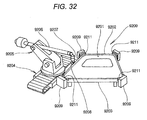
- FIG.32 is a view for explaining a basic constitution of still other related art.
- a hemming forming apparatus 9200 is constituted by a jig 9203 for receiving an outer panel 9202 mounted with an inner panel 9201, an articulated robot 9205 mounted on a conveyor apparatus 9204 arranged in a side direction of the jig 9203, a roller holder 9207 attached to a front end of a robot arm 9206 of the articulated 9205, a forming roller 9208 attached to a front end of the roller holder 9207, die driving apparatus 9209 respectively arranged at vicinities of four corner portions of the jig 9203, and forming dies 9211 respectively attached to the die driving apparatus 9209.
- the forming roller 9208 is run by being pressed from an upper side substantially at a linear portion having a small radius of curvature, by pressing to form the four corner portions having large radii of curvature respectively by the forming dies 9211, hemming working can be finished by folding to bend a fold-to-bend portion provided to the outer panel 9202 to the inner panel 9201.
- the linear portion of the work is worked by the forming roller 9208, and the four corner portions of the work are worked by the forming dies 9211. 4 pieces of the forming dies 9211 are needed, and therefore, the hemming forming apparatus 9200 becomes expensive.
- hemming working is difficult for the portion having a large radius of curvature, and according to the related art of Fig.32 , although hemming working of the portion having the large curvature can be carried out, the hemming apparatus becomes expensive.
- a hemming working method of pinching a work by a moving die and a roller and subjecting a flange provided at an end portion of the work to hemming working is provided with an approaching step of holding the moving die by carrying means and making the moving die approach the work, a floating step of making the moving die displaceable relative to the work by reducing a force of the carrying means for maintaining an attitude thereof, and a contacting step of bringing a surface of the moving die into contact with the work by mounting means provided at the moving die in a state of holding the moving die by the carrying means.
- the approaching step can be constituted by a high speed by setting the carrying means to a large output, and the work can be prevented from being deformed at a contacting step by setting the mounting means to a low output.
- a hemming working apparatus is provided with a moving die and a roller for pinching a work and subjecting a flange provided at an end portion of the work to hemming working, carrying means for making the moving die approach the work, adjusting means for reducing a force of maintaining an attitude when the carrying means makes the moving die approach the work, and mounting means provided at the moving die for bringing a surface of the moving die into contact with the work in a state of holding the moving die by the carrying means.
- the maintaining force adjusting means the force of the carrying means for maintaining the attitude is reduced when the moving die approaches the work, and therefore, the rigidity of the movable portion of the carrying means is lowered. Therefore, when the moving die is mounted to the work by the mounting means, the moving die is brought into contact with the work while being displaced to constitute the pertinent attitude in conformity with the shape of the surface.
- the carrying means is brought into the floating state and the moving die is made to be displaceable, and the moving die is brought into contact with the work by the mounting means.
- the rigidity of the movable portion of the carrying means is lowered, and therefore, the movable portion is pertinently deformed, and the moving die is brought into contact with the work while being displaced to constitute the pertinent attitude in conformity with the surface shape. Therefore, the moving die is not excessively pressed to the work in an unaligned state, and the work can be prevented from being deformed.
- the approaching step can be constituted by a high speed by setting the carrying means to a large output and the work can be prevented from being deformed in the contacting step by setting the mounting means to a low output.
- the moving die is applicable generally regardless of a size of a total of the work. Further, the moving die is applicable also on a production line, and therefore, it is not necessary to provide a space exclusive for hemming working separately from the production line.
- the die in a hemming working method of pinching a work by a die and a roller and subjecting a flange provided at an end portion of the work to hemming working, the die is elastically urged to the work such that the die can be brought into contact with the work at a portion of pressing the work by the roller and the die can be separated from the work at other than the portion of working the work.
- a hemming apparatus is provided with a die and a roller for pinching a work and subjecting a flange provided at an end portion of the work to hemming working, and an elastic member provided between the die and the work and elongatable and contractable in a pressing direction of the roller.
- the die by elastically urging the die to the work such that only the portion pressed by the roller can be brought into contact with the die and the die can be separated from the work at other than the pressed portion, the work can firmly be brought into contact with the die at the pressed portion, the hemming portion can be worked to be folded to bend in a pertinent shape, and warping or deformation of the work can be prevented.
- the work is brought into contact with the die and the hemming portion can be worked to be folded to bend in a pertinent shape. Further, by elastically urging the die to the work such that the die can be separated from the work at other than the pressed portion, a clearance is not forcibly crushed and warping or deformation of the work can be prevented.
- a hemming working method of carrying out hemming working for a flange of a work by using a hemming roller displaceably supported by a moving mechanism when the hemming roller is made to approach the work by the moving mechanism, a displacement of the hemming roller relative to the moving mechanism is restricted, and in the hemming working, the hemming roller is made to be displaceable relative to the moving mechanism.
- a receiving roller for pinching the work along with the hemming roller and displaceably supported by the moving mechanism, when the hemming roller is made to approach the work, the hemming roller and the receiving roller are brought into a state of restricting displacements thereof relative to the moving mechanism, and in the hemming working, the hemming roller and the receiving roller are brought into a state of being displaceable relative to the moving mechanism in a state of maintaining a press force or a distance between the hemming roller and the receiving roller to a predetermined value.
- the hemming roller can be made to follow the flange of the work at a higher speed and accurately and further uniform hemming working can be carried out.
- a hemming working apparatus is provided with a hemming roller for carrying out hemming working for a flange of a work, a receiving roller for pinching the work along with the hemming roller, a hemming unit including a movable mechanism for making the hemming roller and the receiving roller proximate to each other and remote from each other, a moving mechanism for supporting the hemming unit and moving the hemming unit to a predetermined position, and a floating mechanism for displaceably connecting the hemming unit to the moving mechanism.
- the hemming roller can be made to follow the flange at a higher speed and accurately.
- the restricting means capable of restricting a displacement of the hemming unit relative to the moving mechanism by the floating mechanism, the operation at the floating mechanism can be restricted in accordance with an operating step.
- the moving mechanism comprises a base portion connected to the moving mechanism by way of the floating mechanism, and a movable portion constituted to be able to displace the hemming roller and the receiving roller in directions of making the hemming roller and the receiving roller proximate to each other and remote from each other relative to the base portion
- the restricting means comprises a first locking portion provided at the movable portion, and a second locking portion provided at the moving mechanism and engaged with the first locking portion.
- the roller can be made to follow the work at a high speed and accurately along the flange and a hemming working time period can be shortened and a working failure can be avoided. Further, according to the invention, before hemming working, the roller for hemming working can swiftly be positioned to the work, the cycle time can be shortened.
- a hemming working apparatus having a hemming roller for carrying out hemming working for a flange of a work is provided with a moving mechanism for supporting the hemming roller and moving the hemming roller to a predetermined position, and a guide member for guiding the hemming roller along the flange while restricting a displacement of the hemming roller relative to the flange in a direction of a rotating shaft of the hemming roller.
- the hemming roller is provided displaceably in the direction of the rotating shaft of the hemming roller relative to the moving mechanism.
- the hemming roller can be made to follow the flange at a high speed and accurately.
- the roller can be made to follow the flange at a high speed and accurately, the hemming working time period can be shortened and the working failure can be avoided.
- the roller in a hemming working method of folding to bend a flange of a work in a direction of an inner side of the work by a roller, the roller is rolled in an extending direction of the flange while being displaced in a direction orthogonal to the extending direction.
- an angle of folding to bend the flange can be adjusted in accordance with the portion to be worked, a change in the shape becomes gradual, wrinkle or crack or the like can be prevented from being brought about.
- a hemming working apparatus for folding to bend a flange of a work in a direction of an inner side of the work by a roller is provided with a distance restricting portion projected in a direction of erecting the flange and brought into contact with the roller on an outer side of an end portion of the work.
- the distance restricting portion includes an inclined face a height of which is changed in the extending direction.
- a hemming working apparatus for folding to bend a flange of a work in a direction of an inner side of the work by a roller
- the guide portion comprises a parallel portion extended in parallel with the flange, and a separating portion for separating the work in a direction of an outer side thereof by being compared with the parallel portion at a portion of starting and (or) a portion of finishing hemming working for the flange such that the roller is made to be gradually proximate to or remote from the flange.
- the roll hemming method comprising a step of rolling the hemming roller in a first direction of extending the flange such that the ring-like recessed portion passes above the projection by bringing the first circular pillar into contact with an end portion of an outer face of the flange to press and bringing the second circular pillar into contact with a base portion of the outer face of the flange to press, and a step of rolling the hemming roller in a second direction intersected with the first direction such that the ring-like recessed portion passes above the projection by bringing the first circular arc pillar and the second circular pillar into
- the projection in rolling the hemming roller in the first direction of extending the flange, when the ring-like recessed portion is made to pass above the projection above the flange to be folded to bend, the projection is not crushed. Further, when the hemming roller is rolled again the second direction intersected with the first direction and the ring-like recessed portion is made to pass above the projection also at this occasion, a portion remaining as a hollow bulge in the first direction is pressed centering on the projection above the flange. Thereby, the flange becomes a stratified projection centering on the projection of the inner panel.
- the stratified projection is a small projection which is not almost provided with the hollow portion, and a current can be concentrated thereon in spot welding thereafter.
- a hemming roller is provided with a first circular pillar for pressing an end portion of an outer face of a flange, a second circular pillar coaxial with the first circular pillar and having a diameter the same as a diameter of the first circular pillar for pressing a base portion of an outer face of the flange, and a ring-like recessed portion provided between the first circular pillar and the second circular pillar.
- a hemming roller is preferably used for the above-descried roll hemming method and does not press to crush the projection of the inner panel. Further, by rolling the hemming roller in two different directions constituting an intersection thereof by the projection, a hollow bulge is hardly present by the flange centering on the projection, and a current can be concentrated thereon in spot welding thereafter.
- the ring-like recessed portion is constituted by a shape of a circular arc in a section thereof.
- a press mark is difficult to be attached to the flange by a boundary portion between the ring-like recessed portion and the first circular pillar and a boundary portion between the ring-like recessed portion and the second circular pillar.
- a welded structure according to the invention is formed by using a hemming roller having a first circular pillar and a second circular pillar coaxial with each other and having the same diameter and a ring-like recessed portion provided between the circular pillar and the second circular pillar, pinching an inner panel having a projection by folding to bend a flange of an outer panel, providing a stratified projection centering on the projection by rolling the hemming roller such that the ring-like recessed portion passes above the projection in two different directions constituting an intersection thereof by the projection, and carrying out a spot welding by bringing an welding electrode into contact with the stratified projection.
- spot welding a current is made to flow concentratedly to between two layers of the stratified projection, melting is achieved firmly by sufficiently generating heat and a high welding strength is achieved.
- the ring-like recessed portion is made to pass above the projection on the flange to be folded to bend, and therefore, the projection is not crushed. Further, the hemming roller is rolled again in the second direction intersected with the first direction and also at this occasion, the ring-like recessed portion is made to pass above the projection, and therefore, the portion remaining as the bulge along the first direction centering on the projection is pressed on the flange. Thereby, the flange becomes the small stratified projection in which the hollow portion is hardly present centering on the projection of the inner panel and the current can be concentrated thereon in the spot welding thereafter.
- the hemming roller is preferably used for the roll hemming method and does not press to crush the projection of the inner panel. Further, by rolling the hemming roller in two different directions constituting an intersection by the projection, the stratified projection is provided by removing almost the hollow bulge at the bulged portion centering on the projection, and the current can be concentrated thereon in spot welding thereafter.
- the current is mad to flow concentratedly to between two layers of the stratified projection in carrying out spot welding, firm melting is achieved by sufficiently generating heat and the high welding strength is achieved.
- a hemming working method for carrying out hemming working for a hem portion of a work by using a work roller movably supported by moving means including a step of displacing the work roller in a direction of a rotating axis thereof in hemming working.
- the invention is effective for hemming working of a portion having a radius of curvature at the hem portion of the work where the error tends to be increased, for example, a corner portion of the work or a hem portion having a meandering shape.
- the hemming working method for carrying out hemming working for the hem portion of the work by using the work roller movably supported by the moving means, and a guide roller arranged to pinch the work to be opposed to the work roller including a step of relatively changing directions of rolling the work roller and the guide roller in the hemming working.
- the guide roller can be made to follow the hem portion of the work accurately in a state in which the work roller is made to be independent from the guide roller.
- a hemming apparatus comprising a work roller for carrying out hemming working for a hem portion of a work, a guide roller arranged to pinch the work to be opposed to the work roller, a die arranged between the work roller and the guide roller, mounted with the work at a surface thereof, and provided with a guide portion for guiding the guide roller at a back face thereof, moving means for movably supporting the work roller and the guide roller, and position displacing means for displacing positions of the work roller and the guide roller relative to each other by constituting a reference thereof by the guide portion.
- the apparatus even when it is difficult to provide a guide portion of the guide roller along the hem portion of the work as in, for example, a portion of the work having a radius of curvature of the corner portion or the like, working can be carried out by displacing the relative positions of the work roller and the guide roller constituting the reference by the guide portion by the position displacing means. Therefore, the work roller can be made to follow the hem portion of the work accurately.
- a hemming working apparatus comprising a work roller for carrying out hemming working for a hem portion of a work, a guide roller arranged to pinch the work to be opposed to the work roller, a die arranged between the work roller and the guide roller, mounted with the work at a surface thereof, and provided with a guide portion for guiding the guide roller at a back face thereof, moving means for movably supporting the work roller and the guide roller, and direction changing means for changing directions of rolling the work roller and the guide roller relative to each other.
- the apparatus even when it is difficult to provide the guide portion of the guide roller along the hem portion of the work as in the corner portion or the like, working can be carried out by relatively changing the directions of rolling the work roller and the guide roller by the direction changing means. Therefore, the work roller can be made to follow the hem portion of the work accurately in a state of making the work roller independent from the guide roller.
- the work roller can be made to follow accurately to the hem portion of the work.
- the work roller can be made to follow the hem portion of the work by making the work roller independent from the guide roller.
- a hemming working roller used for hemming working of folding to bend a flange erected at a work
- the hemming working roller comprising a primary bending face comprising a taper face inclined to a roller rotating shaft by a first angle, and a secondary bending face comprising a taper face inclined to the roller rotating shaft by a second angle
- the hemming working roller is used for two stages of hemming working of bending the flange by about a half of a total bending angle by the primary bending face and bending the flange completely by the secondary bending face.
- the hemming working roller is a roller preferable for a work a hem portion of which is bent, includes the primary bending face comprising the taper face and the secondary bending face comprising the taper face.
- the primary bending face comprising the taper face
- the secondary bending face can be made to be in line with the guide portion.
- a peripheral speed difference is not brought about between the secondary bending face and the guide portion, and therefore, there is not a concern of bringing about defect or wear at the secondary bending face or the guide portion.
- a roller hemming apparatus used for hemming working for folding to bend a flange erected at a work
- the roller hemming apparatus including a work mounting member for mounting the work, a hemming working roller having a primary bending face comprising a taper face inclined to a roller rotating shaft by a first angle and a secondary bending face comprising a taper face inclined to the roller rotating shaft by a second angle, a roller moving mechanism for moving the hemming working roller relative to the work along the flange, and a guide portion for guiding the secondary bending face when the flange is bent by the primary bending face.
- the roller hemming apparatus is a roller hemming apparatus preferable for a work a hem portion of which is bent and includes the hemming working roller having the primary bending face comprising the taper face and the secondary bending face comprising the taper face.
- the primary bending is carried out by the primary bending face
- the secondary bending face can be made to be in line with the guide portion.
- a peripheral speed difference is not brought about between the secondary bending face and the guide portion, and therefore, there is not a concern of bringing about defect or wear at the secondary bending face or the guide portion.
- a roller hemming working method of folding to bend a flange erected at a work by a roller comprising a preparing step of preparing a hemming working roller having a primary bending face comprising a taper face inclined to a roller rotating shaft by a first angle and a secondary bending face comprising a taper face inclined to the roller rotating shaft by a second angle, and a guide portion for guiding the secondary bending face when the flange is bent by the primary bending face, a primary bending step of bending the flange by the primary bending face by about a half of a total flange bending angle while making the secondary bending face in line with the guide portion, and a secondary bending step of completely bending the flange by the secondary bending face.
- the roller hemming method is a roller hemming method preferable for a work a hem portion of which is bent and carries out hemming by the hemming working roller having the primary bending face comprising the taper face and the secondary bending face comprising the taper face.
- the primary bending face When primary bending is carried out by the primary bending face, the secondary bending face can be made to be in line with the guide portion.
- a peripheral speed difference is not brought about between the secondary bending face and the guide portion, and therefore, there is not a concern of bringing about defect or wear at the secondary bending face or the guide portion.
- a roller hemming apparatus of folding to bend an erected flange by preparing a die including a guide groove at a lower face thereof and a press roller moved independently from the die and a guide member progressing and regressing to and from the press roller, mounting a plate member including the erected flange at a hem thereof on an upper face of the die, fitting the guide member to the guide groove, and operating the press roller to the erected flange under a state thereof, wherein the guide member includes a spherical member rolled along the guide groove.
- the guide member includes the spherical member rolled along the guide groove.
- the spherical body is not detached from the guide groove having a large radius of curvature. Therefore, there can be provided a roll hemming apparatus which is able to carry out hemming working of a portion having a large radius of curvature and inexpensive.
- the roller hemming apparatus is a simple apparatus constituted by the die having the guide groove, the press roller and the guide member, and therefore, low cost formation of the roller hemming apparatus can easily be achieved.
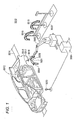
- FIG.1 is an outline perspective view for explaining a behavior of carrying out hemming working for a flange of a wheel arch portion of a vehicle by a hemming working apparatus according to a first exemplary embodiment of the invention.
- a hemming working apparatus 3010 according to the first exemplary embodiment is an apparatus set to a middle step of a production line 3014 for assembling and working a vehicle 3012 as a work in a so-to-speak white body for carrying out hemming working for a flange 3017 of a wheel arch portion 3016 on a left rear wheel side.
- the wheel arch portion 3016 is constituted by a shape of substantially a circular arc of about 180°.
- the flange 3017 is constituted by a shape of being bent by 90° from an end portion 3016a (refer to two-dotted chain line of Fig. 5 ) of the wheel arch portion 3016 to an inner side by 90°.
- the hemming working apparatus 3010 includes a moving die 3018 to be brought into contact with the wheel arch portion 3016 of the vehicle 3012, a robot 3022 as a moving mechanism for moving the moving die 3018 and supporting a hemming unit 3020 at a front end thereof, a photoelectric sensor 3023 for detecting that the vehicle 3012 is carried to a predetermined position of the production line 3014, and a controller 3024 for carrying out a comprehensive control.
- the robot 3022 is of an industrial articulated type, and can move the hemming unit 3020 to an arbitrary position and in an arbitrary attitude by a programmed operation. Further, a vicinity of the robot 3022 is provided with a storing base 3026 arranged with a plurality of kinds of the moving dies 3018 in accordance with kinds of the vehicle 3012, and a position data of the storing base 3026 is stored to the controller 3024.
- the controller 3024 is connected to an external production control computer, not illustrated, for controlling an operation of the production line 3014, and information indicating a kind or the like of the vehicle 3012 carried on the production line 3014 is supplied to the controller 3024.
- the hemming unit 3020 is supported by way of a bracket 3022a fixed to a front end of the robot 3022, and is contained at inside of an outer box 3021 attached to the bracket 3022a, and is provided with a hemming roller 3030 provided to project from a hole portion 3021 a at an upper face of the outer box 3021, and a guide roller 3022 as a receiving roller.
- a chuck 3034 is provided at a front end face of the outer box 3021.
- the chuck 3034 includes a pair of fingers 3036 opened and closed under an operation of the controller 3024 and is used for moving the moving die 3018.
- the hemming roller 3030 and the guide roller 3032 are axially supported rotatably by support shafts 3030a and 3032a. Further, the hemming roller 3030 and the guide roller 3032 are made to be movable in X direction (direction of aligning the support shafts 3030a and 3032a), and can be pressed to a member pinched by the hemming roller 3030 and the guide roller 3032. Further, the hemming roller 3030 and the guide roller 3032 are supported by the robot 3032 by way of a floating mechanism, not illustrated, and can be moved in X direction and Y direction (axial directions of the support shafts 3030a and 3032a) while maintaining positions thereof relative to each other and are moved drivenly and elastically by an external force. That is, the support shaft 3030a and the support shaft 3032a are cooperatively made to be movable in X direction while maintaining an adjusted interval therebetween.
- the hemming roller 3030 is constituted by a taper roller 3038 provided at a front end side, and a circular cylinder roller 3040 provided on a base end side by a structure integral with a taper roller 3038.
- the taper roller 3038 is a frustrum of a circular cone in a converging shape inclined by 45° in a side view thereof, and an edge line length L1 (refer to Fig.7 ) is set to be slightly longer than a height H of the flange 3017.
- the circular cylinder roller 3040 is constituted by a shape of a circular cylinder having a diameter slightly larger than a maximum diameter portion on the base end side of the taper roller 3038.
- the guide roller 3032 is constituted by a shape of a circular disk a surrounding of which is set to a narrow width and made to be engageable with a first groove 3052 or a second groove 3054 (refer to Fig.7 ) provided at the moving die 3018. That is, by the first groove 3052 and the second groove 3054 and the guide roller 3032 operated as a guide member, the hemming roller 3030 is guided along the flange 3017 while restraining a displacement relative to the flange 3017 in Y direction constituting an axial direction of the support shaft 3030a of the hemming roller 3030 and X direction constituting a direction of aligning the support axis 3030a and 3032a. Further, a position in Y direction of the guide roller 3032 coincides with a position of a center of a height L2 (L2/2) of the circular cylinder roller 3040 of the hemming roller 3030 (refer to Fig.7 ).
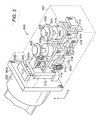
- Fig.3 is a perspective view of the hemming unit 3020
- Fig.4 is a partially sectional side view showing the hemming unit 3020 before hemming working
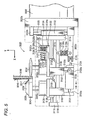
- Fig.5 is a partially sectional side view showing the hemming unit 3020 in hemming working.
- the outer box 3021 is illustrated perspectively by a two-dotted chain line to be able to optically recognize a structure of the hemming unit 3020.
- the hemming unit 3020 includes the hemming roller 3030 and the guide roller 3032, the support shafts 3030a and 3032a for axially supporting these, a first movable portion 3100 as a movable portion having the support shaft 3032a at an upper end face thereof, a second movable portion 3102 as a movable portion having the support shaft 3032a at an upper end face thereof, a cylinder 3106 for connecting and displacing in X direction the first movable portion 3100 and the second movable portion 3102, and a base portion 3110 for supporting the first movable portion 3100, the second movable portion 3012 and the cylinder 3106 relative to the robot 3022.
- the base portion 3110 is constituted by a shape of a substantially channel-like shape in which a lower side thereof is longer than an upper side thereof in a side view thereof (refer to Fig.4 ), and the base portion 3110 is provided with a third movable portion 3114 displaceably supported in Y direction by a second rail 3025 extended in Y direction to be supported by a support member 3022b fixed to a bracket 3022a and substantially in a channel-like shape in a side view thereof (refer to Fig.4 ) by way of a linear guide 3112, a base 3116 in a rectangular shape projected from a slightly lower portion of a center in Y direction of the third movable portion 3114, a front end support member 3118 in a rectangular shape provided at a front end face of the base 3116, a flat plate 3120a in a rectangular shape projected from an upper portion of the third movable portion 3114 in a direction in parallel with the base 3116, and a partitioning portion 3120b in a rectangular
- first supporting means 3126 and second supporting means 3127 are arranged in series between a side face 3102b of an upper portion of the second movable portion 3120 on a side of the third movable portion 3114, and a side face 3124a projected from a front end portion of an extending portion 3122 extended from the second movable portion 3120 to a side of the third movable portion 3114 in Y direction so as not to be brought into contact with the flat plate 3120a, and the partitioning portion 3120b is provided to partition therebetween.
- a first rail 3128 is extended in parallel with the base 3116 at an upper space of the base 3116 at which the third movable portion 3114 and the front end support member 3118 are opposed to each other. Further, the first movable portion 3100 and the second movable portion 3102 are supported by the first support rail 3128 displaceably in X direction respectively by way of linear guides 3100 and 3132. That is, the first movable portion 3100 and the second movable portion 3102 are supported by the base portion 3110 by way of the linear guides 3130 and 3132 or the like, and these function as a movable mechanism.
- the second movable portion 3102 is supported by the first supporting means 3126 and the second supporting means 3127 drivenly and elastically in X direction by interposing the above-described partitioning portion 3120b. That is, when the second movable portion 3102 is displaced in a direction of being separated from the first movable portion 3100, the second supporting means 3127 is contracted by the partitioning portion 3120b, and when the second movable portion 3102 is displaced in a direction of being proximate to the first movable portion 3100, the first supporting means 3126 is contracted by the partitioning portion 3120b.
- a horizontally projected portion 3022c projected in X direction from a lower end face of the support member 3022b and the base 3116 are drivenly and elastically supported by third supporting means 3138.
- third supporting means 3138 Although a pair of two pieces of the third supporting means are provided to connect end portions on both sides of the horizontally projected portion 3022c and the base 3116, one piece thereof may naturally be constituted to connect center portions in width directions of the horizontally projected portion 3022c and the base 3116.
- the third supporting means 3126, the second supporting means 3127 and the third supporting means 3138 are constructed by similar constitutions
- the first supporting means 3126 is constituted by a shaft portion 3126a and a spring 3126b installed at a surrounding of the shaft portion 3126a
- the second supporting means 3127 is constituted by a shaft portion 3127a and a spring 3127b arranged at a surrounding of the shaft portion 3127a
- the third supporting means 3138 is constituted by a shaft portion 3138a and a spring 3138b installed at a surrounding of the shaft portion 3138a.
- the respective shaft portions 3126a, 3127a, and 3128a may be constituted by hydraulic dampers or pneumatic dampers or the like.
- the first supporting means 3126 and the second supporting means 3127 are constructed by the above-described constitutions, and therefore, as described above, the second movable portion 3102 is supported at the base portion 3110 displaceably in X direction by the linear guide 3132, and drivenly and elastically supported in X direction relative to the base portion 3110 by the first supporting means 3126 and the second supporting means 3127 by way of the partitioning portion 3120b.
- the third supporting means is constructed by the above-described constitution, and therefore, the base 3116 is drivenly and elastically supported in Y direction relative to the horizontally projected portion 3022c fixed to the robot 3022 by the third supporting means.
- the second movable portion 3102 includes one side face 3102a and other side face 3102c extended in a lower direction, the other side face 3102c is provided with a first stopper 3134 as a first locking portion, and the first stopper 3134 is engageable with a second stopper 3136 provided at a front end portion of the horizontally projected portion 3122c. That is, a front end of the first stopper 3134 is constituted by a projected portion substantially in a shape of a frustrum of a circular cone, and the second stopper 3136 is constituted by a recessed portion substantially in a shape of a cone capable of inserting the front end of the first stopper 3134.
- the first stopper 3134 and the second stopper 3136 are engaged in a state in which an interval between the hemming roller 3030 and the guide roller 3032 is maximally opened by extending a rod 3104 of the cylinder 3106, that is, in a state in which the hemming roller 3030 is separated from the vehicle 3012 before hemming working or after hemming working, mentioned later.
- the first stopper 3134 and the second stopper 3136 are not engaged with each other in a state in which the interval between the hemming roller 3030 and the guide roller 3032 is narrowed by retracting the rod 3104 and the cylinder 3106 as shown by Fig.5 , that is, in a state in which the hemming roller 3030 is brought into contact with the vehicle 3012 in hemming working, mentioned later.
- the first movable portion 3100 is brought into contact with and supported by the front end support member 3138 by a press force in a direction opposed to the side of the second movable portion 3102 by the rod 3104 connected to the cylinder 3106.
- the first movable portion 3100 is held in a state of being proximate to the second movable portion 3102 by a force attracted to a side of the second movable portion 3102 by the rod 3104.
- the hemming unit 3020 according to the first exemplary embodiment is constituted as described above. Therefore, in a state in which the first stopper 3134 and the second stopper 3136 are not engaged with each other as shown by Fig.5 , the first movable portion 3100 and the second movable portion 3102 are supported by the base portion 3110 integrally and displaceably in X direction by way of the linear guides 3130 and 3132, and the displacement in X direction is drivenly and elastically supported by the first supporting means 3126 and the second supporting means 3127.
- the base portion 3116 supporting the first movable portion 3100 and the second movable portion 3102 in this way is supported by the robot 3022 displaceably in Y direction by way of the linear guide 3112, the displacement in Y direction is drivenly and elastically supported by the third supporting means 3038. Therefore, in this case, the first movable portion 3100 and the second movable portion 3102, in other words, the hemming roller 3030 and the guide roller 3032 are supported by the robot 3022 displaceably in X direction and Y direction and drivenly and elastically.
- the linear guides 3132, 3130 and 3132, the first supporting means 3126, the second supporting means 3127 and the third supporting means 3138 are operated as the floating mechanism interposed between the hemming unit 3020 and the robot 3022, and a performance of the guide roller 3032 following the first groove 3052 or the second groove 3054 in hemming working is considerably promoted, and the hemming roller 3030 can be made to follow the flange 3017 at high speed and accurately, and details thereof will be described later (refer to Fig.9 and Fig.10 ).
- the hemming roller 3030 and the guide roller 3032 are made to be proximate to position the vehicle 3012 and the moving die 3018, for example, before hemming working, by restricting the floating mechanism, the positioning can swiftly be carried out and details thereof will be described later.
- the moving die 3018 is constituted by constituting a base by a die plate 3029.
- the die plate 3049 is constituted by a plate shape, a side thereof brought into contact with the wheel arch portion 3016 is referred to as a surface 3049a (refer to Fig.7 ) and a face on an opposed side thereof is referred to as a back face 3049b to be differentiated from each other.
- a work side in view from an end portion 3016a of a wheel arch portion 3016 is referred to as an inner side, and a side opposed thereto (lower side in Fig.7 ) is referred as an outer side to be differentiated from each other.
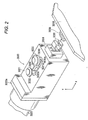
- the die plate 3049 is constituted by a shape of a plate in an arch shape the surface 3049a of which is brought into contact with a surrounding of the wheel arch portion 3016, and the surface 3049a is set to a three-dimensional curved face in conformity with a surface of the vehicle 3012. Therefore, when the moving die 3018 is attached to the wheel arch portion 3016, the first groove 3052 and the second groove 3054 are arranged in parallel with the flange 3017, and the surface 3049a is brought into face contact with the vehicle 3012 by a wide area.
- the moving die 3018 includes an outer side circular arc portion 3050 formed along slightly on an outer side of the end portion 3016a of the wheel arch portion 3016, the first groove 3052 and the second groove 3054 provided in parallel with each other along the outer side circular arc portion 3050 at the back face 3049b, a knob 3056 provided at the back face 3049b, three clamp mechanisms 3058 provided at the surrounding, a pipe 3060 for supplying and recovering a compressed fluid to and from the clamp mechanism 3058, and a control valve 3062 for controlling to switch a fluid supply direction of the pipe 3060 or the like.
- the control valve 3062 is controlled by the controller 3024.
- the first groove 3052 is provided on an outer side of being projected from the end portion 3016a of the flange 3017 on the die plate 3049, and the second groove 3054 is provided on an inner side of the end portion 3016a.
- the moving die 3018 is small-sized since the moving die 3018 is brought into contact only with the surrounding of the wheel arch portion 3016. Further, the moving die 3018 is brought into contact with the vehicle 3012 from a side face thereof, and therefore, the moving die 3018 is not applied with a weight of the vehicle 3122, and the moving die 3018 is not constituted by a load resistant structure, and therefore, the moving die 3018 is set to be light-weighted. Therefore, the moving die 3018 is made to be movable simply and conveniently by the robot 3022 by grabbing the knob 3056 by the chuck 3034 (refer to Fig.1 and Fig.2 ).
- the clamp mechanism 3058 includes a stay 3064 extended from an end portion of the die plate 3049, a cylinder 3066 pivotably provided to the stay 3064, and an opening/closing lever 3068 inclined centering on a support shaft provided at the stay 3064.
- One end portion of the opening/closing lever 3068 constitutes a grip portion 3068a engaged with and held by a reference position of the vehicle 3012, and an end portion on an opposed side is rotatably coupled to a rod 3066a of the cylinder 3066 by way of a support shaft.
- the opening/closing lever 3068 is closed to hold the vehicle 3012 by the grip portion 3068a, and by contracting the rod 3066a, the opening/closing lever 3068 is opened (refer to a two-dotted chain line portion of Fig.6 ), and the moving die 3018 is made to be able to be proximate or separated from the vehicle 3012.
- a stop position of the vehicle 3012 on the production line 3014 is more ore less shifted from a rectified value
- the moving die 3018 is accurately positioned to the wheel arch portion 3016 by the clamp mechanism 3058.
- the outer side circular arc portion 3050 is arranged on an outer side (lower side of Fig.7 ) of the end portion 3016a of the wheel arch portion 3016.
- the first groove 3052 is slightly on an outer side of the end portion 3016a
- the second groove 3054 is on an inner side of the end portion 3016a. That is, the first groove 3052 and the second groove 3054 are arranged at positions substantially symmetrical with each other by constituting a reference by the end portion 3016a and in parallel with each other along the end portion 3016a.
- step S301 information of a vehicle kind of the vehicle 3012 carried successively is confirmed from the production control computer, thereafter, the robot 3022 returns the currently grabbed moving die 3018 to a rectified position of the storing base 3026 and grabs other moving die 3018 in correspondence with the vehicle kind by the chuck 3034.
- the hold and switch operation is not needed, further, when a plurality of pieces of the vehicles 3012 of the same vehicle kind is continuously carried, it is not naturally needed to hold and change the moving die 3018.
- step S302 the operation is at standby until the vehicle 3012 is carried by confirming a signal of the photoelectric sensor 3023.
- the vehicle 3012 is carried by the production line 3014 and is stopped at a predetermined position at a vicinity of the robot 3022.
- the operation proceeds to step S303 at a time point of confirming carrying of the vehicle 3012 by the photoelectric sensor 3023.
- the opening/closing lever 3068 of the clamp mechanism 3058 is closed by bringing the surface 3049a of the moving die 3018 into contact with the wheel arch portion 3016 of the vehicle 3012 by operating the robot 3022 and driving to switch the control valve 3062.
- the moving die 3018 is attached to the wheel arch portion 3016 and is accurately positioned to fix. That is, at step S303, the vehicle 3012 constituting a large-sized weighted object is completely stopped, and by making the small-sized and light-weighted moving die 3018 proximate thereto, positioning and fixing are carried out simply and conveniently.
- the moving die 3018 may be made to be proximate thereto while correcting a path of moving the robot 3022 while confirming a position of the moving die 3018 relative to the wheel arch portion 3016 in real time by a predetermined sensor. Further, positioning may be carried out by providing a reference pin at the moving die 3018 and inserting the reference pin into a predetermined reference hole of the vehicle 3012. Both of the positioning means may naturally be used.
- step S304 after opening the finger 3036 of the chuck 3034, the hemming unit 3020 is temporarily separated from the moving die 3018.
- the hemming unit 3020 is made to be proximate to and positioned to the outer side circular arc portion 3050 of the moving die 3018, and the guide roller 3032 is engaged with the first groove 3052.
- the first stopper 3134 and the second stopper 3136 are engaged with each other by bringing about a state of extending the rod 3014 of the cylinder 3106.
- the interval between the hemming roller 3030 and the guide roller 3032 is brought into a maximally separated state, the flange 3017 and the die plate 3049 is made to be able to be easily inserted to the separated portion, further, by maintaining a state of restricting the floating operation at the hemming unit 302, the hemming roller 3030 and the guide roller 3032 are positioned in a state of being integrally fixed to the robot 3022 without bringing about rocking or rattling.
- the hemming working apparatus 3010 of the embodiment achieves a simple and excellent positioning function of sufficiently separating the interval between the hemming roller 3030 and the guide roller 3032 by only extending the rod 3104 of the cylinder 3016 and preventing rocking or rattling of the hemming unit 3020 including the hemming roller 3030 and the guide roller 3032 by restricting the floating mechanism simultaneously.
- step S304 similar to step S305, the floating operation of the hemming unit 3020 may be restricted, in this case, there can be restrained occurrence of noise sound or vibration at the front end portion of the robot 3022 caused by rocking or rattling of the hemming unit 3020 in an operation of moving the robot 3022.
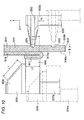
- step S306 the rod 3014 of the cylinder 3106 is contracted, the guide roller 3032 and the hemming roller 3030 are made to be proximate to each other, and as shown by Fig.7 , the moving die 3018 is pinched by the guide roller 3032 and the circular cylinder roller 3040.
- the flange 3017 is pressed by the taper roller 3038 and is inclined to bend by 45° along the conical face.
- a distance between the guide roller 3032 and the circular cylinder roller 3040 is rectified by a width w between a bottom portion of the first groove 3052 and the surface 3049a and the guide roller 3032 and the circular cylinder roller 3040 are not made to be excessively proximate to each other. Therefore, the flange 3017 is not bent by a rectified amount or more or is not constituted by a wavy shape. Further, the moving die 3018 can firmly be pinched by arranging the guide roller 3032 and the circular cylinder roller 3040 such that positions thereof in Y direction coincide with each other. Thereby, the moving die 3018 is not applied with a moment force and an elastic deformation or a shift can be prevented from being brought about.
- the engagement between the first stopper 3134 and the second stopper 3136 is disengaged and the restriction of the floating mechanism is released at the hemming unit 3020. That is, according to the hemming working apparatus 3010 of the first exemplary embodiment, by a simple operation of retracting the rod 3014 of the cylinder 3106, the operation of pressing the flange 3017 is carried out by the taper roller 3038, further, also the restriction of the floating mechanism is released to be able to prepare for hemming working explained in the following steps.
- a first hemming step of inclining to bend the flange 3017 by 45° in an inner side direction is continuously carried out. That is, there is carried out a first hemming step of rolling the hemming roller 3030 and the guide roller 3032 while rotating the hemming roller 3030 and the guide roller 3032 in directions reverse to each other in a state of maintaining a press force and a distance therebetween to predetermined values and continuously bending the flange 3017 by a conical face of the taper roller 3038.
- the hemming roller 3030 and the guide roller 3032 are supported by the floating mechanism as described above, and therefore, the hemming roller 3030 and the guide roller 3032 can be displaced in X direction and Y direction while maintaining positions thereof relative to each other, and even when more or less error is present in a locus of operating the robot 3022, the guide roller 3032 can be moved by accurately following the first groove 3052, and therefore, a speed of rolling the hemming roller 3030 and the guide roller 3032 can be constituted by a high speed.
- the taper roller 3038 can press and deform the flange 3017 in a rectified direction. Further, an accuracy of operating the robot 3022 is not needed to be an extremely high accuracy, and high speed formation of the operating speed and simplification of control procedure are achieved. Hemming working by the first hemming step is carried out over an entire length of the flange 3017.
- step S308 as shown by a two-dotted chain line portion of Fig.10 , the rod 3104 of the cylinder 3106 is more or less extended, and a distance between the hemming roller 3030 and the guide roller 3032 is slightly prolonged to be separated from the vehicle 3012 and the moving die 3018.
- the rod 3104 is extended more or less as described above in consideration that the distance of moving the hemming unit 3020 at the following step S309 is comparatively short or the like.
- the hemming roller 3030 and the guide roller 3032 are moved in an arrow mark Y1 direction by moving the hemming unit 3020.
- the moving distance is equal to a distance between the first groove 3052 and the second groove 3054.
- the guide roller 3032 is engaged with the second groove 3054 by retracting the rod 3104 of the cylinder 3106. Further, the guide roller 3032 and the hemming roller 3030 are made to be proximate to each other, and as shown by Fig.10 , the moving die 3018 is pressed to pinch by the guide roller 3032 and the circular cylinder roller 3040. In this way, the operating procedure in moving the guide roller 3032 from the first groove 3052 to the second groove 3054 is simple and the guide roller 3032 is only moved in the arrow mark Y1 direction while making the direction of the hemming unit 3020 constant. Further, also the moving distance is comparatively short, and therefore, the shifting is finished in a short period of time.
- the flange 3017 is pressed by the circular cylinder roller 3040 and is bent to be brought into contact with the back face of the wheel arch portion 3016. That is, the flange 3017 is further bent by 45° from the first hemming step, that is, by 90° from an initial angle.
- step S311 by rolling the guide roller 3032 while engaging the guide roller 3032 with the second groove 3054, a second hemming step of folding to bend the flange 3017 to be brought into contact with the back face of the wheel arch portion 3016 is continuously carried out. That is, the second hemming step is carried out by continuously bending the flange 3017 by an outer peripheral circular cylinder face of the circular cylinder roller 3040 by rolling the hemming roller 3030 and the guide roller 3032 in directions reverse to each other in a state of maintaining a press force or a distance between the hemming roller 3030 and the guide roller 3032 to predetermined values.
- the second groove 3054 is provided on the side of the back face 3049b of the die plate 3049, and therefore, the flange 3017 and the die plate 3049 are firmly pressed by being pinched by the circular cylinder roller 3040 and the guide roller 3032, further, a press force is not dispersed to other portion and there is not a stopper of restricting the press force and the press force is concentratedly operated to the flange 3017. Thereby, the flange 3017 is firmly bent.
- the hemming roller 3030 and the guide roller 3032 are moved on an accurate path along the second groove 3054 by the operation of the floating mechanism and the working is carried out over the entire length of the flange 3017.
- step S312 similar to step S308, the rod 3104 of the cylinder 3106 is retracted, and the distance between the hemming roller 3030 and the guide roller 3032 is slightly prolonged to be separated from the moving die 3018. Further, the hemming unit 3020 is temporarily separated from the moving die 3018.
- a processing of opening the moving die 3018 is carried out. That is, after changing the direction of the hemming unit 3020, the hemming unit is made to be proximate to the back face 3049b, the knob 3056 is grabbed by the chuck 3034, further, the opening/closing lever 3068 of the clamp mechanism 3058 is opened by driving to switch the control valve 3062.
- a standby processing is carried out at step S314. That is, the moving die 3018 is separated from the vehicle 3012 by moving the robot 3022 to a predetermined standby position.
- the controller 3024 informs that the hemming working has normally been finished to the production control computer.
- the informed production control computer confirms that a condition is established for other requirement and drives the production line 3014 and carry the vehicle 3012 finished with the hemming working to a next step.
- the hemming unit 3020 including the hemming roller 3030 and the guide roller 3032 is supported by the robot 3022 displaceably in X direction constituting the direction of aligning the support shaft 3030a and the support shaft 3032a and in Y direction constituting the axial directions of the support shaft 3030a and the support shaft 3032a by way of the floating mechanism constituted by the linear guides 3112, 3130 and 3132, the first supporting means 3126, the second supporting means 3127 and the third supporting means 3138, and therefore, a performance of the guide rollers 3032 of following the first groove 3052 and the second groove 3054 in hemming working is significantly promoted, the hemming roller 3030 is made to be able to accurately follow the flange 3017, and a drawback that the guide roller 3032 rides over the first groove 3052 or the second groove 3054 can be avoided.
- the guide roller 3032 can be moved by accurately following the first groove 3052. Therefore, the speed of rolling the hemming roller 3030 and the guide roller 3032 can be constituted by a high speed, and a time period of an operation required for hemming working can be shortened.
- the hemming working apparatus 3010 includes the first stopper 3134 and the second stopper 3136 constituting the restricting means for restricting the floating mechanism, and therefore, the operation of the floating mechanism can be restricted in accordance with respective operation steps. Therefore, by restricting the operation of the floating mechanism in positioning the hemming roller 3030 and the guide roller 3032, the hemming roller 3030 and the guide roller 3032 can accurately and swiftly be positioned in a state of being integrally fixed to the robot 3022 without bringing about rocking or rattling.
- use or restriction of the floating mechanism in accordance with the respective operation steps can be selected integrally with an operation of extracting or an operation of retracting the rod 3014 of the cylinder 3106 of making the hemming roller 3030 and the guide roller 3032 proximate to each other and remote from each other. That is, in positioning the hemming roller 3030 and the guide roller 3032, by extending the rod 3104 for separating the hemming roller 3030 and the guide roller 3032, the first stopper 3134 and the second stopper 3136 are engaged and the floating mechanism is restricted.
- hemming working apparatus 3010 by using the small-sized and light weighted moving die 3018, hemming working can be carried out by bringing the moving die 3018 into contact with the vehicle 3012 carried on the production line 3014, and an exclusive space for hemming working is not needed. Further, hemming working is carried out in the production line 3014 similar to other assembling and working step, and therefore, a productivity is promoted by dispensing with time and labor of carrying the vehicle 3012 to other exclusive space only for the hemming working.
- the hemming working apparatus 3010 working is carried out while bringing the moving die 3018 into contact with a working portion of the work, and therefore, the hemming working apparatus 3010 is applied regardless of the size of the work.
- the moving die 3018 is small-sized and light-weighted, and therefore, a plurality of pieces of the moving dies can be stored to the storing base 3026, storing and control thereof is simple and convenient, the robot 3022 can carry out hemming working by selecting the moving die 3018 in accordance with the vehicle kind, and a general purpose performance is promoted.
- the hemming roller 3030 can be used both in the first roll hemming and the second roll hemming, and therefore, interchange of the roller is not needed.
- the first groove 3052 and the second groove 3054 are provided on the side of the back face 3049b, and therefore, in the second hemming step, the flange 3017 and the die plate 3049 can be pinched to press by the circular cylinder roller 3040 and the guide roller 3032.
- one piece of the robot 3022 can be made to serve as the moving means of the moving die 3018 and the working means of the hemming working.
- the invention is not limited to the above-described embodiment but can naturally adopt various constitutions without deviating from the gist of the invention.
- the operation of engaging the first stopper 3134 and the second stopper 3136 as means for restricting the floating mechanism is operated integrally with operations of making the hemming roller 3030 and the guide roller 3032 proximate to each other and remote from each other
- the invention is not limited thereto but the restricting means may be constituted to operate separately from the operations of making the hemming roller 3030 and the guide roller 3032 proximate to each other and remote from each other to be controlled by the controller 3024 or the like.
- first groove 3052 and the second groove 3054 are not necessarily limited to the groove shape so far as the guide roller 3032 is guided thereby, for example, a peripheral face of the guide roller 3032 may be provided with a ring-groove by constituting a projected rail (guide streak).
- the floating mechanism is applicable also to other than the hemming working apparatus using the guide roller 3032 as in the embodiment, for example, an apparatus of omitting the guide roller 3032 may be constructed by a constitution in which an upper end face of the second movable portion 3012 is arranged with the hemming roller 3030, the front end support member 3138 is extended to a lower side, and the rod 3104 of the cylinder 3106 is fixed to the front end support member 3118.
- the floating mechanism can naturally be provided to operate to only either one of the side of the guide roller 3032 or the side of the hemming roller 3030 in accordance with a condition of using the hemming working apparatus or the like.
- the invention is not limited thereto but is naturally applicable to other portion by setting a corresponding moving die thereto.
- a hem portion of a front wheel house, a hem portion of a door, a hem portion of a bonnet and a hem portion of a trunk and the like in the vehicle 3012 can be pointed out.
- roll hemming is not limited to a case of folding to bend one sheet of a thin plate but, for example, an end portion of an inner panel constituting a thin plate provided separately may be pinched by folding to bend the flange 3017.
- Fig.12 is a perspective view for explaining a behavior of carrying out hemming working for a hem portion of a work W constituted by an outer panel 7012 and an inner panel 7014 by a hemming working apparatus 7010 according to a second exemplary embodiment of the invention.
- the hemming working apparatus 7010 according to the second exemplary embodiment carries out hemming working for the work W by folding to bend a flange 7016 of a shape of being erected from a hem portion of the outer panel 7012 of the work W substantially orthogonally.
- a hemming working method according to the second exemplary embodiment is carried out by the hemming working apparatus 7010.
- the hemming working apparatus 7010 includes a work table 7018 for mounting the work W, and a robot (moving means) 7022 for supporting a hemming unit 7020 at a front end thereof.
- the work W is supported above the work table 7018 by way of a die 7024. Further, the work W may be carried in and carried out to and from the work table 7018 by predetermined work automatic exchanging means.
- the robot 7022 is of an industrial articulated type and can move the hemming unit 7020 to an arbitrary position and in an arbitrary attitude by a programmed operation.
- the robot 7022 can carry out motion teaching while actually carrying out a motion by an operation of a teaching pendant, not illustrated. Further, the operation teaching can also be carried out by an offline processing using a three-dimensional CAD (Computer Aided Design) or the like without operating the actual robot 7022.
- the robot 7022 is operated under a control of a controller 7026 constituting a control apparatus.
- Fig.13 is a partially enlarged plane view showing a periphery of a corner portion Cn constituting a portion having a radius of curvature of the hem portion of the work W supported on the die 7024. Further, Fig.13 illustrates the outer panel 7012, the inner panel 7014 and the flange 7016 summarizingly as the work W for simplicity.
- first groove 7027 and the second groove 7028 are groove portions functioning as guide portions of guiding a guide roller 7032 mentioned later and are formed in a linear shape in parallel with a linear portion of the hem portion of the work W. That is, the first groove 7027 and the second groove 7028 are provided substantially in parallel with the linear portion of the work W and provided to be gradually remote or proximate to and from the corner portion Cn of the work W.
- first groove 7027 and the second groove 7028 are constituted by a bent shape along the corner portion Cn at the corner portion Cn constituted by a comparatively small radius of curvature, there is a possibility of derailing the guide roller 7032 or making the guide roller 7032 bite or the like as described above.
- the first groove 7027 and the second groove 7028 are constituted by a first groove prestep portion 7027a and a second groove prestep portion 7028a extended in a vertical direction, and a first groove post step portion 7027b and a second groove post step portion 7028b extended in a horizontal direction in Fig.13 . Although these are selectively used in subjecting a periphery of the corner portion Cn of the work W to hemming working, a detailed thereof will be described later.
- the hemming unit 7020 is supported by way of a bracket 7022a fixed to a front end of the robot 7022 and is contained at inside of an outer box 7021 attached to the bracket 7022a.
- the hemming unit 7020 includes a hemming roller (work roller) 7030 and a guide roller 7032 projected from a long hole portion 7021 a formed at a side face of the outer box 7021.
- a direction of projecting a rotating shaft of the hemming roller 7030 from the hole portion 7021 a is rectified as X1 direction
- a direction opposed thereto is rectified as X2 direction
- a direction directed from the guide roller 7032 to the hemming roller 7030 is rectified as Y1 direction
- a direction opposed thereto is rectified as Y2 direction in a direction of aligning the hemming roller 7030 and the guide roller 7032.
- X1 direction and X2 direction are summarizingly referred to as X direction
- Y1 direction and Y2 direction are summarizingly referred to as Y direction.
- the hemming roller 7030 is axially supported rotatably by a support shaft 7030a at a front end face of a slider 7036 constituting an extruding mechanism (position displacing means) 7034 projected from the hole portion 7021a in X1 direction.
- a support frame 7033 in a U-like shape is constituted by a bottom plate 7033a and a pair of side plates 7033b, 7033b projected from both ends in X direction of the bottom plate 7033a in Y1 direction.
- the guide roller 7032 is axially supported rotatably by a support shaft 7032a between the pair of side plates 7033b, 7033b.
- Axial directions of the support shafts 7033a and 7032a are directed in X direction.
- a lower face of the bottom plate 7033a is axially supported turnably by a turning shaft (direction changing means) 7042 projected from a support member 7035 projected from the hole portion 7021 a in X1 direction, in a Y1 direction.
- An axis center of the turning shaft 7024 passes a center of the guide roller 7032. Therefore, according to the guide roller supported by the support frame 7033, a rolling direction thereof is constituted turnably by the turning shaft 7042.
- the hemming roller 7030 and the guide roller 7032 are made to be movable in Y direction, and by adjusting an interval between the support shaft 7030a and the support shaft 7032a, the work W pinched by the hemming roller 7030 and the guide roller 7032 can be pressed.
- the hemming roller 7030 and the guide roller 7032 are supported by the robot 7022 by way of a floating mechanism mentioned later, and constituted to be movable in X direction and Y direction while maintaining positions relative to each other drivenly and elastically movably by an external force.
- the hemming roller 7030 is constituted by a taper roller 7038 provided at a front end side, and a circular cylinder roller 7040 provided on a base end side by a structure integral with the taper roller 7038.
- the taper roller 7038 is a frustrum of a circular cone in a converging shape inclined by 45° in a side view thereof.
- the circular cylinder roller 3040 is constituted by a shape of a circular cylinder having a diameter slightly larger than that of a maximum diameter portion on the base end side of the taper roller 7038.
- the guide roller 7032 is constituted by a shape of a circular disk a surrounding of which is set to a narrow width and is made to be engageable with the first groove 7027 or the second groove 7028 provided at the die 7024 (refer to Fig.17 or the like).
- the guide roller 7032 achieves a function of guiding the hemming roller 7030 along the flange 7016 while restraining a displacement in X direction and Y direction relative to the flange 7016 of the hemming roller 7030.
- Fig.15 is a perspective view showing a structure of the hemming unit 7020
- Fig.16 is a partially sectional side view showing a state before hemming working of the hemming unit 7020
- Fig.17 is a partially sectional side view showing a state in hemming working of the hemming unit 7020.
- the outer box 7021 is illustrated perspectively by a two-dotted chain line to be able to optically recognize the structure of the hemming unit 7020.
- the hemming unit 7020 includes an extuding mechanism 7034 for supporting the hemming roller 7030 displaceably in an axial direction thereof (X direction) and a locking mechanism 7044 for selectively controlling to switch an allowability of the turning operation of the guide roller 7032. Further, the hemming unit 7020 includes a first movable portion 7046 for supporting the extruding mechanism 7034 at a front end (end face in X1 direction), a second movable portion 7048 for supporting the support member 7035 and the locking mechanism 7044 at a front end (end face in X1 direction), and a cylinder 7050 and a rod 7052 for displacing the first movable portion 7046 and the second movable portion 7048 in Y direction. The first movable portion 7046, the second movable portion 7048 and the cylinder 7050 are supported by the robot 7022 by way of a base portion 7054.
- the extruding mechanism 7034 includes a support member 7056 in a square pillar shape formed with a hole portion 7056a, a motor 7058, a ball screw 7060 connected to a rotating shaft of the motor 7058, and a slider 7036 formed with a hole portion 7036c inwardly mounted with nuts 7036a and 7036b screwed to the ball screw 7036.
- the motor 7058 is, for example, a servo motor.
- the locking mechanism 7044 includes a rod 7064 for supporting a butting portion 7062 in a flat plate shape at a front end thereof, and a cylinder 7066 for displacing the rod 7064 in X direction.
- the locking mechanism 7074 when the rod 7064 is extended in X1 direction and the butting portion 7062 is brought into contact with the side plate 7033b of the support frame 7033 for supporting the guide roller 7032 (refer to Fig.20 ), the turning operation of the guide roller 7032 centering on the turning shaft 7042 is prohibited (locked) under a driving operation of the cylinder 7066.
- the hemming unit 7020 is constituted such that a lower portion of the butting portion 7062 is also brought into contact with the side face in X2 direction of the support member 7035 when locked by the locking mechanism 7044.
- the hemming roller 7030 and the guide roller 7032 are constituted to be able to displace a position in the axial direction relatively under the operation of the extruding mechanism 7034 and constituted to be able to change a rolling (advancing) direction relatively under the operation of the turning shaft 7042.
- the operation of the cylinder 7050, the motor 7058, and the cylinder 7066 are controlled to drive by the controller 7026 similar to the operation of the robot 7022.
- the base portion 7054 includes a long plate 7068 in a long flat plate shape extended in Y direction in a side view thereof (refer to Fig.16 ), a flat plate 7070 shorter than the long plate 7068 provided to align in X1 direction of the long plate 7068, and a third movable portion 7072 for connecting the long plate 7068 and an end face of the flat plate 7070 on Y2 side.
- the long plate 7068 is projected from a portion of the third movable portion 7072 slightly on X2 direction of a center thereof in Y1 direction.
- a front end (Y1 direction end face) of the long plate 7068 is fixed with the front end support member 7074 in the flat plate shape.
- the third movable portion 7072 is supported by a rail 7076 extended to be supported in X direction between support members 7022b and 7022c fixed to the bracket 7022a displaceably in X direction by way of a linear guide 7078.
- first supporting means 7084 and second supporting means 7086 are arranged in series between the support member 7035 fixed to the second movable portion 7048 and a support member 7082 projected from a front end (Y2 direction end portion) of an extended portion 7080 extended from the second movable portion 7048 in Y2 direction in X1 direction so as not to be brought into contact with the flat plate 7070.
- a partitioning portion 7017 is provided between the first supporting means 7084 and the second supporting means 7086 to partition these.
- a rail 7088 is extended in parallel with the long plate 7068 on X1 side of the long plate 7068.
- the first movable portion 7046 and the second movable portion 7048 are supported by the rail 7088 displaceably in Y direction respectively by way of linear guides 7090 and 7092. That is, the first movable portion 7046 and the second movable portion 7048 are supported by the base portion 7054 by way of the linear guides 7090 and 7092 and the rail 7088 or the like.
- the second movable portion 7048 is drivenly and elastically supported in Y direction by way of the first supporting means 7084 and the second supporting means 7086 by interposing the partitioning portion 7087. That is, when the second movable portion 7048 is displaced in a direction of being separated from the first movable portion 7046, the second supporting means 7086 is contracted by the partitioning portion 7087 (refer to Fig.16 ), and when the second movable portion 7048 is displaced in a direction of being proximate to the first movable portion 7046, the first supporting means 7084 is contracted by the partitioning portion 7087 (refer to Fig.17 ).
- the projected portion 7022d projected from the support member 7022c in Y1 direction and the long plate 7068 are drivenly and elastically supported by third supporting means 7094.
- third supporting means 7094 it is preferable to provide a pair of two pieces of the third supporting means 7094 to connect both side end portions of the projected portion 7022d and the long plate 7068 in a width direction (direction orthogonal to X direction and Y direction), one piece thereof can also be constituted to connect center portions in width directions of the projected portion 7022d and the long plate 7068.
- the first supporting means 7084 is constituted by a shaft portion 7084a and a spring 7084b installed at a surrounding of the shaft portion 7084a.
- the second supporting means 7086 is constituted by a shaft portion 7086a and a spring 7084b installed at a surrounding of the shaft portion 7084a.
- the third supporting means 7094 is constituted by a shaft portion 7094 and a spring 7094b installed at a surrounding of the shaft portion 7094a.
- the respective shaft portions 7084a, 7086a, 7094a may be constituted by, for example, hydraulic dumpers or pneumatic dumpers or the like.
- the first supporting means 7084 and the second supporting means 7086 are constructed by the above-described constitutions. Therefore, the second movable portion 7048 is supported by the linear guide 7092 displaceably in Y direction relative to the base portion 7054, and drivenly and elastically supported in Y direction relative to the first supporting means 7084, the second supporting means 7086 and the partitioning portion 7087.
- the third supporting means 7094 is constructed by the above-described constitution, and therefore, the base portion 7054 is drivenly and elastically supported in X direction relative to the projected portion 7022d fixed to the robot 7022 by the third supporting means 7094.
- a first stopper 7096 projected in Y2 direction is provided at a back face of a portion of the second movable portion 7048 connected with the cylinder 7050 on the base end side extended in X2 direction.
- the first stopper 7096 is engageable with a second stopper 7098 opened in Y1 direction at a front end (Y1 direction end portion) of the projected portion 7022d. That is, a front end of the first stopper 7096 is constituted by a projected shape substantially in a shape of a frustrum of a circular cone, and the second stopper 7098 is constituted by a recessed shape substantially in a shape of a cone capable of inserting the front end of the first stopper 7096.
- the first stopper 7096 and the second stopper 7098 are engaged with each other in a state in which a rod 7052 of the cylinder 7050 is extended and an interval between the hemming roller 7030 and the guide roller 7032 is maximally opened, that is, in a state in which the hemming roller 7030 is remote from the work W before hemming working or after hemming working mentioned later.
- the first stopper 7096 and the second stopper 7098 are not engaged with each other in a state in which the rod 7052 of the cylinder 7050 is contracted and the interval between the hemming roller 7030 and the guide roller 7032 are narrowed as shown by Fig.17 , that is, in a state in which the hemming roller 7030 is brought into contact with the work W in hemming working mentioned later.
- the first movable portion 7046 is brought into contact with and supported by the front end support member 7074 by a press force in Y1 direction by the rod 7052 connected to the cylinder 7050 in a state in which the first stopper 7096 and the second stopper 7098 are engaged with each other (refer to Fig.16 ).
- the first movable portion 7046 is held in a state of being proximate to the second movable portion 7048 by an attracting force in Y2 direction by the rod 7052.
- the hemming unit 7020 of the hemming working apparatus 7010 according to the second exemplary embodiment is constituted as described above. That is, the hemming roller 7030 is constituted to be displaceable by the extruding mechanism 7034 in the axial direction (X direction) of the support shaft 7030a. Further, the guide roller 7032 is constituted to be turnable by the turning shaft 7042 along with the support frame 7033 for pinching the support shaft 7032a. Further, the operation of turning the guide roller 7032 by such a turning shaft 7042 can be locked or unlocked under the operation of the locking mechanism 7044.
- the first movable portion 7046 and the second movable portion 7048 are supported by the base portion 7054 integrally and displaceably in Y direction by way of the linear guides 7090 and 7092, and the displacement in Y direction is drivenly and elastically supported by the first supporting means 7084 and the second supporting means 7086.
- the base portion 7054 for supporting the first movable portion 7046 and the second movable portion 7048 in this way is supported by the robot 7022 displaceably in X direction by way of the linear guide 7078 and the displacement in X direction is drivenly and elastically supported by the third supporting means 7094. Therefore, the first movable portion 7046 and the second movable portion 7048, that is, the hemming roller 7030 and the guide roller 7032 are supported by the robot 7022 displaceably in X direction and Y direction and drivenly and elastically.
- the linear guides 7078, 7090, 7092, the first supporting means 7084, the second supporting means 7086 and the third supporting means 7094 are operated as a floating mechanism interposed between the hemming unit 7020 and the robot 7022.
- an explanation will be given of the hemming working method according to the second exemplary embodiment by exemplifying a case of carrying out hemming working in an order of arrow marks 1 through 4 for a linear portion of the work W indicated by arrow marks 1, 3 and a corner portion Cn indicated by arrow marks 2, 4 of Fig.19A and Fig.19B .
- arrow marks 1 through 4 indicate directions of rolling (advancing) the hemming roller 7030 and arrow marks A and B indicate a direction of rolling (advancing) the guide roller 7032.
- the second groove 7028 is omitted and the outer panel 7012, the inner panel 7014 and the flange 7016 are summarizingly illustrated as the work W.
- the work W is mounted above the die 7024 fixed onto the work table 7018.
- the work W is arranged such that the linear portion and the first groove 7027 are in parallel with each other in a state of corresponding the corner portion Cn to a corner portion of the die 7024.
- the robot 7022 is operated under the control of the controller 7026, and the guide roller 7032 is engaged with the first groove prestep portion 7027a of the first groove 7027 contiguous to the linear portion of the work W (refer to Fig.19A ).
- the hemming unit 7020 there is brought about a state in which the rod 7064 of the cylinder 7066 is extended in X1 direction and the butting portion 7062 is brought into contact with the side plate 7033b of the support frame 7033. That is, the locking mechanism 7044 is brought into the locked state. Thereby, the turning operation by the turning shaft 7042 of the guide roller 7032 is brought into the locked state, and the operation of engaging with the first groove prestep portion 7027a as described above can swiftly and easily be carried out.
- the rod 7052 of the cylinder 7050 is extended and the first stopper 7096 and the second stopper 7098 are brought into an engaged state. That is, the floating mechanism is brought into a restricted state.
- the hemming roller 7030 and the guide roller 7032 are positioned in a state of being integrally fixed to the robot 7022 without bringing about rocking or rattling by the floating mechanism. Therefore, positioning of the hemming roller 7030 and the guide roller 7032 can further swiftly and accurately be carried out.
- step S703 the rod 7052 of the cylinder 7050 is retracted, the guide roller 7032 and the hemming roller 7030 are made to be proximate to each other, and the die 7024 is pinched by the guide roller 7032 and the circular cylinder roller 7040 (refer to Fig.20 ). Then, the flange 7016 is pressed by the taper roller 7038 to be inclined by 45° along the conical face to bend.
- step S704 there is started the first hemming step for inclining the flange 7016 of the linear portion of the work W by 45° in the inner side direction to bend along the arrow mark 1 by the hemming roller 7030 by rolling the guide roller 7032 in the arrow mark A direction of Fig.19A while being engaged with the first groove prestep portion 7027a by bringing the locking mechanism 7044 into the locked state (refer to Fig.22 ).
- the first hemming step of continuously bending the flange 7016 by the circular conical face of the taper roller 7038 by rolling the hemming roller 7030 and the guide roller 7032 in the same direction (arrow mark 1 direction) while rotating the hemming roller 7030 and the guide roller 7032 in directions reverse to each other in a state of maintaining a press force or a distance therebetween at a predetermined value.
- the locking mechanism 7044 is brought into a locked state as described above, and therefore, the guide roller 7032 and the hemming roller 7030 are rolled respectively in directions along the arrow mark A and the arrow mark 1 without shifting the rolling directions.
- the hemming roller 7030 and the guide roller 7032 are supported by way of the floating mechanism, and therefore, the hemming roller 7030 and the guide roller 7032 are displaceable in X direction and Y direction while maintaining positions thereof relative to each other.
- the guide roller 7032 can be moved to accurately follow the first groove prestep portion 7027a, and the speed of rolling the hemming roller 7030 and the guide roller 7032 can be made to be a high speed.
- step S705 is carried out.
- step S705 when the hemming roller 7030 and the guide roller 7032 reach the corner portion inlet, as shown by Fig.21 , the rod 7064 of the cylinder 7066 is retracted, and the locking mechanism 7044 is brought into the unlocked state. Simultaneously, the robot 7022 is going to move the hemming roller 7030 along a shape of the corner portion Cn of the work W, that is, in the arrow mark 2 direction. Then, since the locking mechanism 7044 is brought into the unlocked state as described above, the guide roller 7032 is operated to turn centering on the turning shaft 7042. Therefore, as shown by Fig.19A , the guide roller 7032 is rolled in the arrow mark A direction and the hemming roller 7030 is rolled in the arrow mark 2 direction by the robot 7022.
- the hemming roller 7030 is going to be gradually separated from the corner portion Cn by being dragged by the guide roller 7032.
- the hemming roller 7030 is supported by the extruding mechanism 7034, and therefore, the hemming roller 7030 can be extruded in the axial direction by the extruding mechanism 7034 relative to the guide roller 7032 gradually separated from the corner portion Cn.
- the hemming roller 7030 when hemming working is carried out in the arrow mark 2 direction to be along the shape of the corner portion Cn, by carrying out the working while gradually extruding the hemming roller 7030 by the extruding mechanism 7034, the hemming roller 7030 can be rolled to be along the corner portion Cn of the work W. Thereby, the flange 7016 of the corner portion Cn can firmly be subjected to hemming working by the hemming roller 7030.
- step S706 is carried out successively.
- the hemming roller 7030 and the guide roller 7032 are separated from the work W and the die 7024 by prolonging the distance between the hemming roller 7030 and the guide roller 7032 by extending the rod 7052 of the cylinder 7050.
- step S707 by extending the rod 7064 of the cylinder 7066, the butting portion 7062 is brought into contact with the side plate 7033b of the support frame 7033, the guide roller 7032 is returned to an original point position (position at which the direction of rolling the guide roller 7032 and the direction of rolling the hemming roller 7030 become the same direction) and the locking mechanism 7044 is brought into the locked state. Further, the robot 7022 is operated in the state of restricting the floating mechanism, and the guide roller 7032 is engaged with the first groove post step portion 7027b contiguous to the linear portion of the work (arrow mark 3 in Fig.19B ).
- step S703 the rod 7052 of the cylinder 7050 is retracted, the guide roller 7032 and the hemming roller 7030 are made to be proximate to each other, and the die 7024 is pinched by the guide roller 7032 and the circular cylinder roller 7040 (refer to Fig.20 ). Then, the flange 7016 is pressed by the taper roller 7038 and is inclined by 45° along the conical face to bend.
- step S708 similar to step S704, there is restarted the first hemming step of inclining the flange 7010 of the linear portion of the work W by 45° in the inner side direction to bend along the arrow mark 3 direction by the hemming roller 7030 by rolling the guide roller 7032 in the arrow mark B direction of Fig.19B while engaging the guide roller 7032 with the first groove post step portion 7027B while bringing the locking mechanism 7044 into the locked state. That is, hemming working is started from a direction reverse to that of step S704 to the center (point Cn2) of the corner portion Cn.
- step S709 is successively carried out.
- step S709 when the hemming roller 7030 and the guide roller 7032 reach point Cn3, as shown by Fig.21 , the rod 7064 of the cylinder 7066 is retracted, and the locking mechanism 7044 is brought into the unlocked state. Simultaneously, the robot 7022 is going to move the hemming roller 7030 along the shape of the corner portion Cn of the work W, that is, in the arrow mark 4 direction. Then, the locking mechanism 7044 is brought into the unlocked state as described above, and therefore, the guide roller 7032 is operated to turn centering on the turning shaft 7042. Therefore, similar to step S705, as shown by Fig.19B , the guide roller 7032 is rolled in the arrow mark B direction and the hemming roller 7030 is rolled in the arrow mark 4 direction by the robot 7022.
- the hemming roller 7030 when the hemming roller 7030 is rolled in the arrow mark 4 direction, similar to step S705, by extending the hemming roller 7030 by the extruding mechanism 7034 to work, the hemming roller 7030 can be rolled along the corner portion Cn of the work W.
- the first hemming step for the flange 7016 at a periphery of the corner portion Cn of the work W is finished.
- step S710 the hemming roller 7030 and the guide roller 7032 are separated from the work W and the die 7024 by prolonging the distance between the hemming roller and the guide roller 7032 by extending the rod 7052 of the cylinder 7050.
- a second hemming step finish bending, regular hemming
- step S711 first, the guide roller 7032 is engaged with the second groove prestep portion 7028a of the second groove 7028 in the state of restricting the floating mechanism by locking the locking mechanism. Successively, the work W and the die 7024 are pinched by making the hemming roller 7030 and the guide roller 7032 proximate to each other, and the flange 7016 is folded to bend by 90° (refer to Fig.23 ).
- the second hemming step of bending the flange 7016 further by 45° from the first hemming step to the inner side direction, that is, by 90° from an initial angle by the circular cylinder roller 7040 of the hemming roller 7030 by rolling the guide roller 7032 while being engaged with the second groove 7028. That is, the second hemming step is carried out by continuously bending the flange 7016 by an outer peripheral circular cylinder face of the circular cylinder roller 7040 by rolling the hemming roller 7030 and the guide roller 7032 while being rotated in directions reverse to each other in a state of maintaining a press force or a distance therebetween at a predetermined value.
- the second hemming step similar to the first hemming step explained in the steps S703 through S710, working is carried out in the order of arrow marks 1 through 4 shown in Fig.19A and Fig.19B .
- an operation of switching to lock and unlock the locking mechanism 7044, and an operation of switching to operate and restrict the floating mechanism may be carried out similar to the operations of the first hemming step.
- the flange 7016 of the periphery of the corner portion Cn of the work W is firmly bent in the inner side direction to finish hemming working according to the second exemplary embodiment.
- the hemming roller 7030 can accurately follow the flange 7016 independently from the guide roller 7032. In other words, even when there is an error (difference) between the locus of the guide roller 7032 and the shape of the flange 7016, working can be carried out in a state of maintaining the rotating shaft of the hemming roller orthogonal to the flange 7016.
- the extruding mechanism 7034 even when the error between the locus of the guide roller 7032 and the shape of the flange 7016 is large, the error can be absorbed by displacing the hemming roller 7030 in the axial direction. Further, when the hemming roller 7030 is displaced in the axial direction by using the extruding mechanism 7034 in this way, in a case of increasing, for example, a working speed, a case in which hardness of the work W is high or the like, depending on a condition of a use thereof, there is a case in which a resistance (working reaction force) of the flange 7016 produced at the hemming unit 7020 is varied.
- the hemming roller 7030 can be made to follow accurately along the shape of the hem portion of the work W. Further, hemming working for the linear portion or the portion having the radius of curvature of the corner portion or the like of the work W can be carried out by one piece of the hemming working apparatus 7010, and therefore, a general purpose performance of an equipment is promoted, and cost can be reduced.
- the guide roller 7032 is returned to the original point position by extending the rod 7064 of the cylinder 7066.
- the operation of returning the guide roller 7032 to the original point position can further swiftly be carried out by using a hemming unit 7020a including a support member 7035a constituted by changing a front end portion (X1 direction end portion) of the support member 7035 by which the turning shaft 7042 is axially supported as shown by Fig.24 .
- the hemming unit 7020a includes the support member 7035a in place of the support member 7035 in comparison with the hemming unit 7020. Further, at the support member 7035a, the turning shaft 7042 is supported by a torsional coil spring (torsional spring) 7100 and a bearing 7102.
- torsional coil spring torsional spring
- the guide roller 7032 is swiftly returned to the original point position by a repulsive force of the torsional coil spring 7100 when the guide roller 7032 is detached from the first groove 7027 or the second groove 7028 after carrying out an operation of turning the guide roller 7032 centering on the turning shaft 7042, that is, after finishing hemming working up to, for example, arrow mark 2 of Fig.19A . Therefore, steps thereafter can further swiftly be started. That is, the torsional coil spring 7100 is operated as an original point returning mechanism of the guide roller 7032. Further, the original point position returning mechanism can be realized even by, for example, a constitution of pinching the turning shaft 7042 by two of coil spring horizontally laid in X direction other than the constitution of using the coil spring 7100.
- hemming working apparatus 7010 is constituted such that an axis center of the turning shaft 7042 passes a center of the guide roller 7032, a position of installing the turning shaft 7042 in X direction can also be changed as shown by Fig.25 or Fig.26 .
- the position in X direction of the turning shaft 7042 may be set to a position offset in the base end direction (X2 direction) relative to the center of the guide roller 7032 (refer to Fig.25 ), or a position offset in the front end direction (X1 direction) (refer to Fig.26 ) or the like, and these may pertinently be set in accordance with the shape of the work W constituting an object of working, a size of the radius of curvature of the corner portion Cn or the like.
- the hemming working apparatus 7010 can preferably be used for the radius of curvature portion of the work W other than the corner portion Cn.
- the hemming working apparatus 7010 can effectively be used also for the work W a hem portion of which is constituted by a meandering shape (slalom shape) as shown by Fig.27 . Further, as shown by Fig.
- hemming working can be carried out by utilizing an operation of pushing out or pulling in the hemming roller 7030 by the extruding mechanism 7034 while bringing the locking mechanism 7044 into the locked state and the work W having a corner portion or a hem portion constituted by a meandering shape having an amplitude smaller than the width of the hemming roller 7030.
- the portion having the radius of curvature at the hem portion of the work can effectively be worked other than the linear portion and the corner portion Cn of the work W.
- the hemming roller 7030 is displaced in the axial direction by the extruding mechanism 7034
- the extruding mechanism 7034 is mounted to a side of the guide roller 7032 and the guide roller 7032 is displaced in the axial direction.
- the turning shaft 7042 and the locking mechanism 7044 are operated to the guide roller 7032, these can also be mounted to the side of the hemming roller 7030.
- first groove 7027 and the second groove 7028 may be made to be able to guide the guide roller 7032, these are not limited to the groove shape but, for example, a ring-like groove may be provided at a peripheral face of the guide roller 7032 by constituting a projected rail (guide portion).
Landscapes
- Engineering & Computer Science (AREA)
- Mechanical Engineering (AREA)
- Robotics (AREA)
- Bending Of Plates, Rods, And Pipes (AREA)
- Soil Working Implements (AREA)
- Finish Polishing, Edge Sharpening, And Grinding By Specific Grinding Devices (AREA)
- Punching Or Piercing (AREA)
- Straightening Metal Sheet-Like Bodies (AREA)
- Processing Of Meat And Fish (AREA)
- Forging (AREA)
Applications Claiming Priority (10)
| Application Number | Priority Date | Filing Date | Title |
|---|---|---|---|
| JP2005350884A JP4523542B2 (ja) | 2005-12-05 | 2005-12-05 | ヘミング加工方法及び加工装置 |
| JP2005350809A JP4690875B2 (ja) | 2005-12-05 | 2005-12-05 | ヘミング加工方法及び加工装置 |
| JP2005350619A JP4617249B2 (ja) | 2005-12-05 | 2005-12-05 | ヘミング加工方法及びヘミング加工装置 |
| JP2005350821A JP4469784B2 (ja) | 2005-12-05 | 2005-12-05 | ヘミング加工方法及び加工装置 |
| JP2005350615A JP4562648B2 (ja) | 2005-12-05 | 2005-12-05 | ヘミング加工装置 |
| JP2006051234A JP4559374B2 (ja) | 2006-02-27 | 2006-02-27 | ローラヘミング装置及びローラヘミング加工方法 |
| JP2006066738A JP4865370B2 (ja) | 2006-03-10 | 2006-03-10 | ロールヘミング方法及び溶接構造物 |
| JP2006187582A JP5033368B2 (ja) | 2006-07-07 | 2006-07-07 | ローラヘミング装置 |
| JP2006202039A JP5027459B2 (ja) | 2006-07-25 | 2006-07-25 | ヘミング加工方法及びヘミング加工装置 |
| EP06834042A EP1958714B1 (de) | 2005-12-05 | 2006-12-05 | Umbördelverfahren und umbördelvorrichtung |
Related Parent Applications (1)
| Application Number | Title | Priority Date | Filing Date |
|---|---|---|---|
| EP06834042A Division EP1958714B1 (de) | 2005-12-05 | 2006-12-05 | Umbördelverfahren und umbördelvorrichtung |
Publications (2)
| Publication Number | Publication Date |
|---|---|
| EP2108468A2 true EP2108468A2 (de) | 2009-10-14 |
| EP2108468A3 EP2108468A3 (de) | 2009-12-09 |
Family
ID=38122816
Family Applications (5)
| Application Number | Title | Priority Date | Filing Date |
|---|---|---|---|
| EP09165975A Not-in-force EP2108466B1 (de) | 2005-12-05 | 2006-12-05 | Umbördelverfahren und Umbördelvorrichtung |
| EP06834042A Not-in-force EP1958714B1 (de) | 2005-12-05 | 2006-12-05 | Umbördelverfahren und umbördelvorrichtung |
| EP09165982A Ceased EP2116318B1 (de) | 2005-12-05 | 2006-12-05 | Umbördelvorrichtung |
| EP09165977A Ceased EP2110190B1 (de) | 2005-12-05 | 2006-12-05 | Umbördelverfahren und Umbördelvorrichtung |
| EP09165980A Withdrawn EP2108468A3 (de) | 2005-12-05 | 2006-12-05 | Umbördelverfahren und Umbördelvorrichtung |
Family Applications Before (4)
| Application Number | Title | Priority Date | Filing Date |
|---|---|---|---|
| EP09165975A Not-in-force EP2108466B1 (de) | 2005-12-05 | 2006-12-05 | Umbördelverfahren und Umbördelvorrichtung |
| EP06834042A Not-in-force EP1958714B1 (de) | 2005-12-05 | 2006-12-05 | Umbördelverfahren und umbördelvorrichtung |
| EP09165982A Ceased EP2116318B1 (de) | 2005-12-05 | 2006-12-05 | Umbördelvorrichtung |
| EP09165977A Ceased EP2110190B1 (de) | 2005-12-05 | 2006-12-05 | Umbördelverfahren und Umbördelvorrichtung |
Country Status (6)
| Country | Link |
|---|---|
| US (2) | US8272243B2 (de) |
| EP (5) | EP2108466B1 (de) |
| CN (6) | CN101811164B (de) |
| CA (1) | CA2632539C (de) |
| DE (2) | DE602006020362D1 (de) |
| WO (1) | WO2007066670A1 (de) |
Families Citing this family (51)
| Publication number | Priority date | Publication date | Assignee | Title |
|---|---|---|---|---|
| US8272243B2 (en) * | 2005-12-05 | 2012-09-25 | Honda Motor Co., Ltd. | Hemming working method and working apparatus |
| DE102007002856B4 (de) * | 2007-01-15 | 2012-02-09 | Edag Gmbh & Co. Kgaa | Vorrichtung zum Bördeln und Schweißen oder Löten von Bauteilen |
| JP5101901B2 (ja) * | 2007-02-07 | 2012-12-19 | 本田技研工業株式会社 | ヘミング加工方法及びヘミング加工装置 |
| US20100281940A1 (en) * | 2009-03-12 | 2010-11-11 | Harrow Aaron E | Vertical air compliant hemming head |
| JP5399135B2 (ja) * | 2009-06-09 | 2014-01-29 | トヨタ自動車株式会社 | ヘミング加工装置 |
| JP5215946B2 (ja) * | 2009-06-12 | 2013-06-19 | 本田技研工業株式会社 | ローラヘミング装置およびローラヘミング方法 |
| KR101163696B1 (ko) * | 2009-12-03 | 2012-07-09 | 기아자동차주식회사 | 차량의 휠 하우스용 헤밍장치 |
| CN103429488B (zh) * | 2011-03-18 | 2017-03-15 | 丰田自动车株式会社 | 车辆用轮罩部结构 |
| CN103252423B (zh) * | 2012-02-16 | 2015-07-22 | 北京环都人工环境科技有限公司 | 滚边机 |
| WO2013175554A1 (ja) * | 2012-05-21 | 2013-11-28 | 株式会社安川電機 | ロボットおよびロボットシステム |
| CN103302154B (zh) * | 2012-10-26 | 2016-07-20 | 青岛嘉龙自动化设备有限公司 | 金属板料滚边装置及其方法 |
| US9547416B2 (en) | 2012-11-14 | 2017-01-17 | Facebook, Inc. | Image presentation |
| US20140196516A1 (en) * | 2013-01-17 | 2014-07-17 | Hirotec America, Inc. | Rotary wheelhouse roller hemming assembly |
| US8820822B2 (en) * | 2013-02-07 | 2014-09-02 | GM Global Technology Operations LLC | Wheel house liner with hemmed edge, and system and method of manufacturing thereof |
| JP6300066B2 (ja) * | 2013-11-28 | 2018-03-28 | スズキ株式会社 | パネル部品の接合方法 |
| US9505051B2 (en) | 2014-07-09 | 2016-11-29 | The Boeing Company | Mobile platforms for performing operations along an exterior of a fuselage assembly |
| US10435940B2 (en) * | 2014-09-11 | 2019-10-08 | Republic Doors and Frames | Welded steel door |
| JP6360027B2 (ja) * | 2014-11-14 | 2018-07-18 | フェルロボティクス コンプライアント ロボット テクノロジー ゲーエムベーハーFerrobotics Compliant Robot Technology GmbH | ロボットローラヘミングの装置と方法 |
| US10144048B2 (en) * | 2014-11-19 | 2018-12-04 | Ford Global Technologies, Llc | High stiffness and high access forming tool for incremental sheet forming |
| DE202014105862U1 (de) * | 2014-12-04 | 2016-03-03 | Kuka Systems Gmbh | Falzwerkzeug und Falzeinrichtung |
| DE102015100659B4 (de) | 2015-01-19 | 2023-01-05 | Fft Produktionssysteme Gmbh & Co. Kg | Bördelsystem, Bördeleinheit und Bördelverfahren für ein autarkes Bördeln |
| CN104785598B (zh) * | 2015-04-27 | 2017-04-19 | 安徽鲲鹏装备模具制造有限公司 | 一种辊轧折边机 |
| JP6520478B2 (ja) * | 2015-06-30 | 2019-05-29 | 株式会社デンソーウェーブ | ロボットアームの操作システム |
| US10220515B2 (en) * | 2015-11-30 | 2019-03-05 | Seiko Epson Corporation | Robot and control method for robot |
| DE102015223921A1 (de) * | 2015-12-01 | 2017-06-01 | Siemens Healthcare Gmbh | Verfahren zum Betreiben eines medizinisch-robotischen Geräts sowie medizinisch-robotisches Gerät |
| DE102016211571A1 (de) * | 2016-06-28 | 2017-12-28 | Audi Ag | Rollfalzvorrichtung und Verfahren zum Falzen eines Kantenbereichs eines Blechteils |
| JP6512665B2 (ja) * | 2016-11-04 | 2019-05-15 | 株式会社Subaru | ローラヘミング装置、及びローラヘミング方法 |
| CN106523493B (zh) * | 2016-11-15 | 2019-03-05 | 大同新成新材料股份有限公司 | 一种受电弓滑板包边机 |
| CN106617441B (zh) * | 2016-11-15 | 2018-04-03 | 中山市理创机械设备有限公司 | 一种布料粘合机 |
| CN107008820B (zh) * | 2017-05-11 | 2019-03-29 | 无锡市光彩机械制造有限公司 | 一种提升筒全自动生产线 |
| CN107186493A (zh) * | 2017-07-24 | 2017-09-22 | 西莱特电梯(中国)有限公司 | 电梯门套生产线 |
| CN107442627A (zh) * | 2017-08-04 | 2017-12-08 | 芜湖瑞德机械科技有限公司 | 高效弯弧翻边器及其使用方法 |
| JP6502432B2 (ja) * | 2017-08-17 | 2019-04-17 | 孝久 三浦 | ダイならびにローラーヘミング加工システムおよび金属ワークにローラーヘミング加工を施す方法 |
| CN107931453B (zh) * | 2017-11-24 | 2023-10-17 | 安徽鲲鹏装备模具制造有限公司 | 一种冷柜内胆的底板预铆接设备 |
| CN110465570B (zh) * | 2018-05-11 | 2022-11-25 | 富泰华工业(深圳)有限公司 | 滚压机构 |
| CN108637060B (zh) * | 2018-05-30 | 2019-09-24 | 芜湖同创模具机械有限公司 | 一种刹车片用弧形钢背板加工装置 |
| EP3856429A4 (de) * | 2018-09-27 | 2022-06-22 | Inno-Spin LLC | Mehrachsige walzformverfahren, systeme und produkte |
| DE102018132090A1 (de) * | 2018-11-13 | 2020-05-14 | Magna International Inc. | Verfahren und Vorrichtung zum Verformen von Materialien mit geringer Verformbarkeit |
| KR20200068802A (ko) * | 2018-12-05 | 2020-06-16 | 현대자동차주식회사 | 패널 헤밍장치 및 이를 이용하여 헤밍하는 방법 |
| CN109702018B (zh) * | 2019-02-22 | 2023-08-25 | 江苏劲嘉新型包装材料有限公司 | 可调式压辊装置 |
| JP7294869B2 (ja) * | 2019-04-25 | 2023-06-20 | 株式会社Subaru | ローラヘム加工装置及び該装置を用いた予備曲げ加工方法 |
| CN110014635B (zh) * | 2019-05-17 | 2021-08-03 | 东莞市贸隆机械制造有限公司 | 板材折边机 |
| WO2021010060A1 (ja) * | 2019-07-12 | 2021-01-21 | 本田技研工業株式会社 | 接合品用半製品と、それを用いた接合品の製造方法 |
| CN110328266B (zh) * | 2019-08-16 | 2024-04-09 | 江苏三迪机车制造有限公司 | 折边组件及折边方法 |
| CN111687264B (zh) * | 2020-06-19 | 2022-04-22 | 中国科学院工程热物理研究所 | 一种用于托板螺帽的扇形托板的制备装置及方法 |
| TWI762025B (zh) | 2020-11-10 | 2022-04-21 | 財團法人工業技術研究院 | 鈑件摺邊裝置 |
| CN112775343A (zh) * | 2021-01-21 | 2021-05-11 | 天永机械电子(太仓)有限公司 | 一种顶盖天窗滚边设备 |
| JP2023094786A (ja) * | 2021-12-24 | 2023-07-06 | 川崎重工業株式会社 | ロボット制御装置、ロボットシステム、ロボット制御プログラム |
| CN118067169B (zh) * | 2024-04-17 | 2024-07-23 | 洛阳石化工程建设集团有限责任公司 | 环境状态变化量记录仪器的收纳支撑装置及其使用方法 |
| US12508641B1 (en) * | 2024-11-26 | 2025-12-30 | Fca Us Llc | Hemming apparatus |
| CN120115574B (zh) * | 2025-05-14 | 2025-08-12 | 四川福摩斯工业技术有限公司 | 一种用于汽车车门的机器人滚边设备 |
Citations (7)
| Publication number | Priority date | Publication date | Assignee | Title |
|---|---|---|---|---|
| JPH06297046A (ja) | 1993-04-16 | 1994-10-25 | Torai Eng Kk | ヘミング加工方法およびヘミング加工装置 |
| JPH0760370A (ja) | 1993-08-04 | 1995-03-07 | Taiho Seiki Co Ltd | ヘミング加工装置 |
| JPH0790299B2 (ja) | 1991-08-01 | 1995-10-04 | トライエンジニアリング株式会社 | ローラー式ヘミング加工方法 |
| JP2579530B2 (ja) | 1988-06-24 | 1997-02-05 | マツダ株式会社 | ヘミング成形方法 |
| JP2561596Y2 (ja) | 1992-04-03 | 1998-01-28 | 関東自動車工業株式会社 | ヘミング装置 |
| JP2924569B2 (ja) | 1993-06-03 | 1999-07-26 | 日産自動車株式会社 | ヘミング装置 |
| JP2005349471A (ja) | 2004-05-11 | 2005-12-22 | Honda Motor Co Ltd | ロールヘミング加工方法及び加工装置 |
Family Cites Families (69)
| Publication number | Priority date | Publication date | Assignee | Title |
|---|---|---|---|---|
| US3680346A (en) * | 1971-01-04 | 1972-08-01 | Rudolph R Wilcox | Crimping tool |
| US3875692A (en) * | 1973-12-17 | 1975-04-08 | Sylvan S Teel | Quick change number indicator |
| US3889618A (en) * | 1974-06-26 | 1975-06-17 | Clark Equipment Co | Rolling apparatus |
| US4021909A (en) * | 1976-02-13 | 1977-05-10 | Dayco Corporation | Hand portable device for fastening a holding bar on a printing blanket and method of fastening same |
| JP2675347B2 (ja) | 1988-09-06 | 1997-11-12 | マツダ株式会社 | ヘミング成形装置 |
| JPH0829360B2 (ja) * | 1989-08-15 | 1996-03-27 | 日産自動車株式会社 | ロールヘム加工装置 |
| JPH03258428A (ja) * | 1990-03-07 | 1991-11-18 | Toyota Motor Corp | ヘミング加工部ずれ防止方法 |
| JPH04157028A (ja) | 1990-10-15 | 1992-05-29 | Nissan Motor Co Ltd | ヘミング加工装置 |
| JPH04253524A (ja) * | 1991-01-29 | 1992-09-09 | Mitsubishi Motors Corp | ヘミング加工方法及びそれに用いるヘミング加工用工具 |
| JPH0578327A (ja) | 1991-09-18 | 1993-03-30 | Hokuriku Seiyaku Co Ltd | ジベンゾシクロヘプタピリジン誘導体 |
| JP2579530Y2 (ja) | 1992-04-06 | 1998-08-27 | 日本電信電話株式会社 | 自走式地震探査起震装置 |
| JP2561596B2 (ja) | 1992-06-08 | 1996-12-11 | 三洋化成工業株式会社 | 樹脂用改質剤 |
| EP0577876B1 (de) * | 1992-07-09 | 1996-09-04 | TRIENGINEERING Co., Ltd. | Vorrichtung zum Verbinden eines Werkstücks |
| JP3258428B2 (ja) | 1993-04-02 | 2002-02-18 | 日本インター株式会社 | 複合半導体装置の製造方法 |
| JPH0768324A (ja) * | 1993-08-31 | 1995-03-14 | Taiho Seiki Co Ltd | ヘミング加工装置 |
| JPH07132327A (ja) | 1993-09-14 | 1995-05-23 | Toyota Motor Corp | ローラヘミング装置 |
| JPH0790299A (ja) | 1993-09-24 | 1995-04-04 | Fudo Kagaku:Kk | 洗濯用ペースト状カリ石鹸 |
| JPH07227677A (ja) | 1994-02-21 | 1995-08-29 | Kanto Auto Works Ltd | スポット溶接装置 |
| NL9400927A (nl) * | 1994-06-08 | 1996-01-02 | Johan Massee | Werkwijze en inrichting voor het vormen van een rand aan een lampreflector. |
| US5623805A (en) * | 1995-04-20 | 1997-04-29 | M.I.C. Industries, Inc. | Seaming device capable of seaming curved and straight panels |
| DE29606725U1 (de) * | 1996-04-16 | 1996-08-14 | Trumpf Gmbh & Co, 71254 Ditzingen | Maschine zum Umbiegen eines Blechrandes |
| JP3824777B2 (ja) * | 1998-04-30 | 2006-09-20 | 関東自動車工業株式会社 | ローラヘミング装置 |
| JP3563349B2 (ja) * | 1998-09-08 | 2004-09-08 | トライエンジニアリング株式会社 | ローラー転圧式加工装置及びローラー転圧式加工方法 |
| SE513776C2 (sv) * | 1999-03-18 | 2000-11-06 | Abb Ab | Falsningsverktyg, förfarande för dess framställning samt användning av detta verktyg |
| SE514087C2 (sv) | 1999-04-19 | 2000-12-18 | Abb Ab | Förfarande vid sammanfogning |
| JP3669259B2 (ja) | 2000-09-28 | 2005-07-06 | トヨタ車体株式会社 | ロールヘミング加工方法及びそれに用いるロールヘミング装置 |
| JP3642020B2 (ja) * | 2000-11-09 | 2005-04-27 | トヨタ車体株式会社 | ロールヘミング加工方法 |
| AU2001218764A1 (en) * | 2000-12-15 | 2002-06-24 | Spiro S.A. | Folded-seam connection, method of producing it and device |
| DE10111374B4 (de) * | 2001-03-09 | 2005-02-03 | Audi Ag | Bördelvorrichtung zum Umlegen einer Bördelkante eines Werkstücks durch Rollfalzen |
| US6439371B1 (en) * | 2001-03-14 | 2002-08-27 | Valiant Corporation | Workpiece loader/unloader system |
| JP2002349564A (ja) * | 2001-05-31 | 2002-12-04 | Thk Co Ltd | 直線案内装置の軌道レール取付構造 |
| JP2003103325A (ja) | 2001-09-26 | 2003-04-08 | Nissan Motor Co Ltd | ロールヘム加工装置およびロールヘム加工方法 |
| JP3623474B2 (ja) * | 2001-10-31 | 2005-02-23 | トライエンジニアリング株式会社 | ヘミング加工装置およびヘミング加工方法 |
| JP2004050265A (ja) * | 2002-07-23 | 2004-02-19 | Ito Takashi | 金型 |
| FR2843549B1 (fr) * | 2002-08-13 | 2005-05-27 | Process Conception Ing Sa | Procede et dispositif d'assemblage de pieces par sertissage d'un bord peripherique |
| DE60300614T2 (de) * | 2003-01-20 | 2005-12-01 | Comau S.P.A., Beinasco | Rollbördelwerkzeug und Bördelverfahren |
| JP2005014069A (ja) | 2003-06-27 | 2005-01-20 | Torai Engineering Kk | ローラ式曲げ加工装置およびその加工方法 |
| CN1222377C (zh) | 2003-09-04 | 2005-10-12 | 卢惠林 | 工字轮卷边成型工艺 |
| ITTO20030726A1 (it) * | 2003-09-23 | 2005-03-24 | Comau Spa | Procedimento ed impianto per la graffatura di pezzi di lamiera |
| JP4157028B2 (ja) | 2003-12-26 | 2008-09-24 | 有限会社クスベ産業 | 法面緑化工法 |
| US7152447B2 (en) * | 2004-03-30 | 2006-12-26 | Tesco Engineering, Inc. | Roller type hemming apparatus |
| US20050217339A1 (en) * | 2004-03-30 | 2005-10-06 | Tesco Engineering Inc. | Roller type hemming apparatus |
| DE102004016385B3 (de) * | 2004-04-02 | 2005-09-08 | Audi Ag | Rollfalzvorrichtung zum Verbinden der Plattenränder zweier Blechplatten mittels eines Falzrandes |
| JP2005333756A (ja) * | 2004-05-21 | 2005-12-02 | Alps Electric Co Ltd | 静電吸引駆動装置 |
| US20050262912A1 (en) * | 2004-05-25 | 2005-12-01 | Tesco Engineering, Inc. | Robotic roller hemming alignment apparatus and method |
| US7290423B2 (en) * | 2004-06-28 | 2007-11-06 | Gm Global Technology Operations, Inc. | Roller hemming apparatus and method |
| DE202004012580U1 (de) * | 2004-08-10 | 2005-09-22 | Kuka Schweissanlagen Gmbh | Falzwerkzeug zum Roboterfalzen |
| DE502005001712D1 (de) * | 2004-09-24 | 2007-11-29 | Edag Eng & Design Ag | Bördelvorrichtung und Bördelverfahren mit Bauteilschutz |
| DE202005005880U1 (de) * | 2005-04-13 | 2005-09-29 | Edag Engineering + Design Ag | Bördelvorrichtung mit Werkstückschutz |
| US20060225631A1 (en) * | 2005-04-08 | 2006-10-12 | Tesco Engineering Inc. | Roller type hemming apparatus |
| DE112005003561B4 (de) * | 2005-04-27 | 2012-01-19 | Honda Motor Co., Ltd. | Walz-Umschlagverfahren und Walz-Umschlagvorrichtung |
| JP4870479B2 (ja) * | 2005-06-21 | 2012-02-08 | 本田技研工業株式会社 | ヘミング加工方法及びヘミング加工装置 |
| JP4939774B2 (ja) * | 2005-06-22 | 2012-05-30 | 本田技研工業株式会社 | ローラヘミング装置及びローラヘミング方法 |
| US7204116B2 (en) * | 2005-07-05 | 2007-04-17 | Tesco Engineering, Inc. | Flanging apparatus for roller hemming |
| US8272243B2 (en) * | 2005-12-05 | 2012-09-25 | Honda Motor Co., Ltd. | Hemming working method and working apparatus |
| DE102006028833A1 (de) * | 2006-06-21 | 2007-12-27 | Thyssenkrupp Drauz Nothelfer Gmbh | Verfahren zum Falzen eines Randes eines Blechbauteils, insbesondere eines Blechbauteils einer Kfz.-Karosserie |
| JP5101901B2 (ja) * | 2007-02-07 | 2012-12-19 | 本田技研工業株式会社 | ヘミング加工方法及びヘミング加工装置 |
| JP5111911B2 (ja) * | 2007-03-23 | 2013-01-09 | 本田技研工業株式会社 | ヘミング加工方法及びパネルアセンブリ製造方法 |
| US20080236236A1 (en) * | 2007-03-30 | 2008-10-02 | Hirotec America, Inc. | Wheelhouse robotic roller hemming |
| JP5118384B2 (ja) * | 2007-04-19 | 2013-01-16 | 本田技研工業株式会社 | ヘミング加工方法 |
| US20090083962A1 (en) * | 2007-09-27 | 2009-04-02 | Langdon Incorporated | Flange-forming system for tube and related methods |
| US20090235712A1 (en) * | 2008-03-24 | 2009-09-24 | Hirotec America, Inc. | Integrated push pull roller head |
| US20090235713A1 (en) * | 2008-03-24 | 2009-09-24 | Hirotec America, Inc. | Magnetically actuated roller head |
| US20090235505A1 (en) * | 2008-03-24 | 2009-09-24 | Hirotec America, Inc. | Hem flange control roller |
| JP5215946B2 (ja) * | 2009-06-12 | 2013-06-19 | 本田技研工業株式会社 | ローラヘミング装置およびローラヘミング方法 |
| JP4795462B2 (ja) * | 2009-11-12 | 2011-10-19 | ファナック株式会社 | 力センサを搭載したロボットマニピュレータを用いたロールヘム加工装置 |
| JP2011131255A (ja) * | 2009-12-25 | 2011-07-07 | Honda Motor Co Ltd | ヘミング加工方法及びその装置 |
| US8640320B2 (en) * | 2011-02-10 | 2014-02-04 | GM Global Technology Operations LLC | Method of joining by roller hemming and solid state welding and system for same |
| KR101272938B1 (ko) * | 2011-10-13 | 2013-06-11 | 기아자동차주식회사 | 차량용 패널의 롤러 헤밍 시스템 |
-
2006
- 2006-12-05 US US12/096,109 patent/US8272243B2/en not_active Expired - Fee Related
- 2006-12-05 CA CA2632539A patent/CA2632539C/en not_active Expired - Fee Related
- 2006-12-05 EP EP09165975A patent/EP2108466B1/de not_active Not-in-force
- 2006-12-05 EP EP06834042A patent/EP1958714B1/de not_active Not-in-force
- 2006-12-05 CN CN 201010143461 patent/CN101811164B/zh not_active Expired - Fee Related
- 2006-12-05 EP EP09165982A patent/EP2116318B1/de not_active Ceased
- 2006-12-05 WO PCT/JP2006/324287 patent/WO2007066670A1/ja not_active Ceased
- 2006-12-05 DE DE200660020362 patent/DE602006020362D1/de active Active
- 2006-12-05 EP EP09165977A patent/EP2110190B1/de not_active Ceased
- 2006-12-05 CN CN 201010143452 patent/CN101811162B/zh not_active Expired - Fee Related
- 2006-12-05 CN CN 201010143462 patent/CN101817042B/zh not_active Expired - Fee Related
- 2006-12-05 EP EP09165980A patent/EP2108468A3/de not_active Withdrawn
- 2006-12-05 DE DE200660021647 patent/DE602006021647D1/de active Active
- 2006-12-05 CN CN 201010143453 patent/CN101817040A/zh active Pending
- 2006-12-05 CN CN 201010143455 patent/CN101817041B/zh not_active Expired - Fee Related
- 2006-12-05 CN CN 201010143454 patent/CN101811163B/zh not_active Expired - Fee Related
-
2012
- 2012-07-26 US US13/558,857 patent/US8914964B2/en active Active
Patent Citations (7)
| Publication number | Priority date | Publication date | Assignee | Title |
|---|---|---|---|---|
| JP2579530B2 (ja) | 1988-06-24 | 1997-02-05 | マツダ株式会社 | ヘミング成形方法 |
| JPH0790299B2 (ja) | 1991-08-01 | 1995-10-04 | トライエンジニアリング株式会社 | ローラー式ヘミング加工方法 |
| JP2561596Y2 (ja) | 1992-04-03 | 1998-01-28 | 関東自動車工業株式会社 | ヘミング装置 |
| JPH06297046A (ja) | 1993-04-16 | 1994-10-25 | Torai Eng Kk | ヘミング加工方法およびヘミング加工装置 |
| JP2924569B2 (ja) | 1993-06-03 | 1999-07-26 | 日産自動車株式会社 | ヘミング装置 |
| JPH0760370A (ja) | 1993-08-04 | 1995-03-07 | Taiho Seiki Co Ltd | ヘミング加工装置 |
| JP2005349471A (ja) | 2004-05-11 | 2005-12-22 | Honda Motor Co Ltd | ロールヘミング加工方法及び加工装置 |
Also Published As
| Publication number | Publication date |
|---|---|
| DE602006020362D1 (de) | 2011-04-07 |
| CN101817040A (zh) | 2010-09-01 |
| CN101811164B (zh) | 2013-07-10 |
| EP2116318B1 (de) | 2011-04-27 |
| EP2108466A2 (de) | 2009-10-14 |
| EP1958714A4 (de) | 2008-12-03 |
| CN101811162B (zh) | 2012-05-30 |
| EP2108468A3 (de) | 2009-12-09 |
| EP2110190B1 (de) | 2011-02-23 |
| US20080307630A1 (en) | 2008-12-18 |
| EP2108466A3 (de) | 2010-01-27 |
| DE602006021647D1 (de) | 2011-06-09 |
| EP1958714B1 (de) | 2011-09-28 |
| EP2110190A2 (de) | 2009-10-21 |
| EP2116318A2 (de) | 2009-11-11 |
| CN101811163B (zh) | 2013-12-25 |
| EP1958714A1 (de) | 2008-08-20 |
| CN101817041B (zh) | 2012-02-29 |
| EP2108466B1 (de) | 2013-03-20 |
| CA2632539A1 (en) | 2007-06-14 |
| US8272243B2 (en) | 2012-09-25 |
| CN101817042A (zh) | 2010-09-01 |
| US8914964B2 (en) | 2014-12-23 |
| US20120291508A1 (en) | 2012-11-22 |
| EP2116318A3 (de) | 2010-06-23 |
| EP2110190A3 (de) | 2010-04-07 |
| CN101811162A (zh) | 2010-08-25 |
| CN101817041A (zh) | 2010-09-01 |
| CN101817042B (zh) | 2012-07-04 |
| CN101811163A (zh) | 2010-08-25 |
| CN101811164A (zh) | 2010-08-25 |
| CA2632539C (en) | 2011-08-02 |
| WO2007066670A1 (ja) | 2007-06-14 |
Similar Documents
| Publication | Publication Date | Title |
|---|---|---|
| EP2108468A2 (de) | Umbördelverfahren und Umbördelvorrichtung | |
| US7950260B2 (en) | Hemming method and hemming apparatus | |
| CN101360573B (zh) | 折边加工方法和折边加工设备 | |
| US7870774B2 (en) | Roller hemming apparatus and roller hemming method | |
| EP0979692A2 (de) | Mehrachsiges Rollenfalzvorrichtung | |
| US6983633B2 (en) | Apparatus for roll hemming with zero angle deflection | |
| CN1898059B (zh) | 带有短凸缘的片材的成形和连接 | |
| JP5027459B2 (ja) | ヘミング加工方法及びヘミング加工装置 | |
| JP4617249B2 (ja) | ヘミング加工方法及びヘミング加工装置 | |
| CN218168333U (zh) | 一种钣金件开窗的滚动折边装置 | |
| EP1132157B1 (de) | Biege- und Falzverfahren sowie Biege- und Falzvorrichtung | |
| JP2010029877A (ja) | ヘミング加工装置 |
Legal Events
| Date | Code | Title | Description |
|---|---|---|---|
| PUAI | Public reference made under article 153(3) epc to a published international application that has entered the european phase |
Free format text: ORIGINAL CODE: 0009012 |
|
| 17P | Request for examination filed |
Effective date: 20090729 |
|
| AC | Divisional application: reference to earlier application |
Ref document number: 1958714 Country of ref document: EP Kind code of ref document: P |
|
| AK | Designated contracting states |
Kind code of ref document: A2 Designated state(s): DE GB |
|
| PUAL | Search report despatched |
Free format text: ORIGINAL CODE: 0009013 |
|
| AK | Designated contracting states |
Kind code of ref document: A3 Designated state(s): DE GB |
|
| 17Q | First examination report despatched |
Effective date: 20110117 |
|
| GRAP | Despatch of communication of intention to grant a patent |
Free format text: ORIGINAL CODE: EPIDOSNIGR1 |
|
| STAA | Information on the status of an ep patent application or granted ep patent |
Free format text: STATUS: THE APPLICATION IS DEEMED TO BE WITHDRAWN |
|
| 18D | Application deemed to be withdrawn |
Effective date: 20111118 |