EP2108643A1 - 4-Méthyl-4, 5-dihydro-1H-pyrazole-3-carboxamide utile en tant qu'antagoniste neutre de cannabinoïde CB1 - Google Patents
4-Méthyl-4, 5-dihydro-1H-pyrazole-3-carboxamide utile en tant qu'antagoniste neutre de cannabinoïde CB1 Download PDFInfo
- Publication number
- EP2108643A1 EP2108643A1 EP08384004A EP08384004A EP2108643A1 EP 2108643 A1 EP2108643 A1 EP 2108643A1 EP 08384004 A EP08384004 A EP 08384004A EP 08384004 A EP08384004 A EP 08384004A EP 2108643 A1 EP2108643 A1 EP 2108643A1
- Authority
- EP
- European Patent Office
- Prior art keywords
- compound
- methyl
- dihydro
- pyrazole
- chlorophenyl
- Prior art date
- Legal status (The legal status is an assumption and is not a legal conclusion. Google has not performed a legal analysis and makes no representation as to the accuracy of the status listed.)
- Withdrawn
Links
- IISILIPOXLJBPV-AGQSAPNSSA-N CC(CCCC1=C)N1NC(C([C@H]([C@H]1c(cc2)ccc2Cl)C=C)=NN1c(c(Cl)c1)ccc1Cl)=O Chemical compound CC(CCCC1=C)N1NC(C([C@H]([C@H]1c(cc2)ccc2Cl)C=C)=NN1c(c(Cl)c1)ccc1Cl)=O IISILIPOXLJBPV-AGQSAPNSSA-N 0.000 description 1
- LXQMIOVOECXUHG-ABKXIKBNSA-N C[C@@H]([C@H]1c(cc2)ccc2Cl)C(C(O)=O)=NN1c(c(Cl)c1)ccc1Cl Chemical compound C[C@@H]([C@H]1c(cc2)ccc2Cl)C(C(O)=O)=NN1c(c(Cl)c1)ccc1Cl LXQMIOVOECXUHG-ABKXIKBNSA-N 0.000 description 1
Images

Classifications
-
- C—CHEMISTRY; METALLURGY
- C07—ORGANIC CHEMISTRY
- C07D—HETEROCYCLIC COMPOUNDS
- C07D231/00—Heterocyclic compounds containing 1,2-diazole or hydrogenated 1,2-diazole rings
- C07D231/02—Heterocyclic compounds containing 1,2-diazole or hydrogenated 1,2-diazole rings not condensed with other rings
- C07D231/06—Heterocyclic compounds containing 1,2-diazole or hydrogenated 1,2-diazole rings not condensed with other rings having one double bond between ring members or between a ring member and a non-ring member
-
- A—HUMAN NECESSITIES
- A61—MEDICAL OR VETERINARY SCIENCE; HYGIENE
- A61P—SPECIFIC THERAPEUTIC ACTIVITY OF CHEMICAL COMPOUNDS OR MEDICINAL PREPARATIONS
- A61P3/00—Drugs for disorders of the metabolism
-
- A—HUMAN NECESSITIES
- A61—MEDICAL OR VETERINARY SCIENCE; HYGIENE
- A61P—SPECIFIC THERAPEUTIC ACTIVITY OF CHEMICAL COMPOUNDS OR MEDICINAL PREPARATIONS
- A61P3/00—Drugs for disorders of the metabolism
- A61P3/04—Anorexiants; Antiobesity agents
Definitions
- the present invention relates to 4-methyl-4,5-dihydro-1H-pyrazole-3-carboxamide, and pharmaceutically acceptable salts and solvates thereof. It further concerns pharmaceutical compositions comprising this compound as active ingredient as well as processes and intermediates for preparing this compound and compositions.
- the referred compound is a cannabinoid CB 1 neutral antagonist useful in the prophylaxis and treatment of food intake disorders.
- CB 1 and CB 2 are both G protein coupled (reviewed in Howlett et al., 2002).
- CB 1 receptors aka CNR1
- CB 2 receptors are found mainly on immune cells, one of their roles being to modulate cytokine release.
- Endogenous ligands -or "endocannabinoids"- for these receptors also exist (Pertwee 2004). These "endocannabinoids” together with their receptors and the biosynthetic and degradative enzymes for these ligands constitute the “endocannabinoid system", which is involved in feeding and metabolism.
- vagal afferents include vagal afferents, area postrema and brain stem nuclei, hypothalamus, and reward pathways.
- CB 1 receptors and their ligands are also found in the gut, liver, and adipose tissue.
- Vagal afferents, area postrema, and brain stem are also sites involved in emesis (Chambers et al., 2007).
- CB 1 - and CB 2 -selective agonists mixed CB 1 /CB 2 receptor agonists, such as CP55940, R-(+)-WIN55212 and ⁇ 9 -tetrahydrocannabinol ( ⁇ 9 -THC) (reviewed in Howlett et al., 2002), and selective antagonists the first of which were the CB 1 -selective SR141716A, AM251, AM281 and LY320135, and the CB 2 -selective SR144528 and AM630 (reviewed in Howlett et al., 2002).
- SR141716A, AM251, AM281, and LY320135 all behave as inverse agonists, producing effects in some CB 1 containing bioassay systems that are opposite in direction from those produced by agonists for these receptors.
- CB 1 cannabinoid receptor antagonists have been shown to reduce appetite and body weight in animal models and in human subjects (Cani et al. 2004).
- an agonist is a ligand that binds to a receptor and alters the receptor state resulting in a biological response.
- Conventional agonists increase receptor activity, whereas inverse agonists reduce it.
- an inverse agonist is defined as a ligand that by binding to receptors reduces the fraction of them in an active conformation.
- Inverse agonists show a preferential binding affinity for the inactive conformation of the receptor. In systems where constitutive activity of the receptor can be seen, inverse agonists induce the opposite action of that of agonists.
- a neutral antagonist refers to a ligand that binds to the receptor and is able to counteract the actions of agonists and inverse agonists for the same receptor impairing their responses.
- the neutral antagonist is not able to induce any activity by its own as it cannot discriminate between the different active and inactive conformations of the receptor.
- E min refers to the minimum effect or action that a certain ligand can produce.
- CB 1 inverse agonists present a negative E min value, corresponding to the decrease of endogenous basal receptor activity, and is associated with undesired side effects including depressive disorders, anxiety, mood alterations with depressive symptoms, nausea, and dizziness. Like the CB 1 inverse agonists, CB 1 neutral antagonists decrease appetite but without inducing the side-effects associated with inverse agonists (Sink et al., 2008).
- Inverse agonists and neutral antagonists of the CB 1 receptor may act on the central nervous system (CNS), on the peripherical system, or both. Those ones which can cross the Blood Brain Barrier (BBB) will act on both the CNS and the peripherical system. Crossing the BBB and acting on the CNS presents undesirable effects such as depressive disorders, anxiety, mood alterations with depressive symptoms, nausea, and dizziness. Those ligands which do not cross the BBB will act only on the peripherical system, which by means of gut hormones or nerve afferents will indirectly interact with the CNS to reduce appetite but without inducing the undesired side effects derived from the direct action at the CNS.
- CNS central nervous system
- BBB Blood Brain Barrier
- a candidate compound for reducing appetite would be a CB 1 neutral antagonist that does not cross the BBB.
- WO07/009689 relates to 4-substituted pyrazoline compounds, methods for their preparation, medicaments comprising these compounds as well as their use for the preparation of a medicament for the treatment of humans and animals.
- the medicament is suitable for the prophylaxis and/or treatment of food intake disorders, such as bulimia, anorexia, cachexia, obesity, type II diabetes mellitus, and appetency disorders.
- racemate compound denominated cis-5-(4-chlorophenyl)-1-(2,4-dichlorophenyl)-N-(2,6-dimethylpiperidin-1-yl)-4-methyl-4,5-dihydro-1H-pyrazole-3-carboxamide (see compound nr 103 on page 229). It is relevant to note that such denomination embraces 4 isomers resulting from the chiral carbon atoms 4 and 5 of the pyrazoline ring, and from the carbon atoms 2 and 6 of the piperidine ring.
- the present invention relates to a compound having the formula (I) and pharmaceutically acceptable salts and solvates thereof.
- compound of formula (I) is (4S,5S)-5-(4-chlorophenyl)-1-(2,4-dichlorophenyl)-N-( cis -2,6-dimethylpiperidin-1-yl)-4-methyl-4,5-dihydro-1H-pyrazole-3-carboxamide.
- the invention further relates to a process for the preparation of the compounds of the invention as well as to intermediates useful in the preparation of the mentioned compound.
- the invention further provides a pharmaceutical composition
- a pharmaceutical composition comprising a compound of the invention and a pharmaceutically acceptable carrier.
- Said compounds may be used as a medicament, in particular for decreasing body weight.
- the present invention relates to a compound having the formula (I) and pharmaceutically acceptable salts and solvates thereof.
- Said compound is also named (4S,5S)-5-(4-chlorophenyl)-1-(2,4-dichlorophenyl)-N-(2,6-dimethylpiperidin-1-yl)-4-methyl-4,5-dihydro-1H-pyrazole-3-carboxamide.
- the compound of the invention and intermediates thereof present two asymmetric centers at positions 4 and 5 of the pyrazoline ring. As indicated on the formulae depicted herein and the chemical name, these asymmetric centers occur each in the S configuration.
- the compound of the invention and intermediates thereof present as well an alicyclic group, i.e. the 2,6-dimethylpiperidine, which displays a cis-trans isomerism due to the presence of 2 methyl substituents.
- the 2,6-dimethylpiperidine may occur in the trans or cis configuration.
- the present invention relates to the compound (4S,5S)-5-(4-chlorophenyl)-1-(2,4-dichlorophenyl)-N-( cis -2,6-dimethylpiperidin-1-yl)-4-methyl-4,5-dihydro-1H-pyrazole-3-carboxamide.
- the present invention relates to the compound (4S,5S)-5-(4-chlorophenyl)-1-(2,4-dichlorophenyl)-N-(trans-2,6-dimethylpiperidin-1-yl)-4-methyl-4,5-dihydro-1H-pyrazole-3-carboxamide.
- the pure stereoisomeric form of the compound of the invention may be obtained by the application of art-known procedures.
- enantiomers may be separated from each other by treating the corresponding racemic isomers mixture by usual optical resolution methods such as fractional recrystallization method, optical resolution column chromatography method such as liquid chromatography using a chiral stationary phase, or diastereomer method; or separation methods such as recrystallization method, column chromatography method, amongst other.
- optical resolution methods such as fractional recrystallization method, optical resolution column chromatography method such as liquid chromatography using a chiral stationary phase, or diastereomer method
- separation methods such as recrystallization method, column chromatography method, amongst other.
- the racemic mixture of the compound the invention may be reacted with an optically active acid or base. Examples thereof are tartaric acid, dibenzoyl-tartaric acid, ditoluoyltartaric acid, and camphosulfonic acid.
- Said pure stereochemically isomeric form of the compound of the present invention may also be derived from the corresponding pure stereochemically isomeric form of the appropriate starting materials or intermediates, provided that the reaction occurs stereospecifically. Also, when the above reaction is carried out by using the starting material or intermediate that has been subjected to optical resolution or separation, the desired optical isomer or geometric isomer can be obtained.
- salt as mentioned herein is meant to comprise any stable salts, which the compound above is able to form.
- the salts can conveniently be obtained by treating the base form with such appropriate acids as inorganic acids, for example, hydrohalic acids, e.g. hydrochloric, hydrobromic and the like; sulfuric acid; nitric acid; phosphoric acid and the like; or organic acids, for example, acetic, propanoic, hydroxyacetic, 2-hydroxypropanoic, 2-oxopropanoic, oxalic, malonic, succinic, maleic, fumaric, malic, tartaric, 2-hydroxy-1,2,3-propane-tricarboxylic, methanesulfonic, ethanesulfonic, benzenesulfonic, 4-methylbenzene-sulfonic, cyclohexanesulfamic, 2-hydroxybenzoic, 4-amino-2-hydroxybenzoic, and the like acids.
- the salt form can be converted by treatment with
- the compound of the present invention may also be converted into its non-toxic metal or amine addition salt forms by treatment with appropriate organic and inorganic bases.
- Appropriate base salt forms comprise, for example, the ammonium salts, the alkali and earth alkaline metal salts, e.g. the lithium, sodium, potassium, magnesium, calcium salts and the like, salts with organic bases, e.g. the benzathine, N-methyl-D-glucamine, hydrabamine salts, and salts with amino acids such as, for example, arginine, lysine and the like.
- salts is also meant to include the hydrates or solvates which the compound of the present invention is able to form, including, e.g. the alcoholates such as methanolates or ethanolates.
- phrases “pharmaceutically acceptable” refers to molecular entities and compositions that do not produce adverse, allergic, or other untoward reactions when administered to an animal or a human.
- the compound of the present invention is in a salt form, preferably the salt is chloride or hydrochloride.
- solvate refers to those crystal forms of the compound of the present invention that contain either stoichiometric or non-stoichiometric amounts of solvent. Since water is a solvent, solvates also include hydrates. The term “pseudopolymorph” is synonym to solvate since it applies to polymorphic crystalline forms that have solvent molecules incorporated in their lattice structures. Examples of solvates are hydrates and alcoholates such as methanolates or ethanolates.
- the present invention provides a process for the preparation of a compound of formula (I), said process comprising the step of:
- the reaction can be carried out using the cis or trans configuration of the compound of formula (IV) to obtain the (4S,5S)-5-(4-chlorophenyl)-1-(2,4-dichlorophenyl)-N-( cis -2,6-dimethylpiperidin-1-yl)-4-methyl-4,5-dihydro-1H-pyrazole-3-carboxamide, or the (4S,5S)-5-(4-chlorophenyl)-1-(2,4-dichlorophenyl)-N-( trans -2,6-dimethylpiperidin-1-yl)-4-methyl-4,5-dihydro-1H-pyrazole-3-carboxamide, respectively.
- the present invention provides a process for the preparation of (4S,5S)-5-(4-chlorophenyl)-1-(2,4-dichlorophenyl)-N-( cis -2,6-dimethylpiperidin-1-yl)-4-methyl-4,5-dihydro-1H-pyrazole-3-carboxamide, said process comprising the step of:
- halo is generic to fluoro, chloro, bromo, and iodo.
- C 1-4 alkyl as a group or part of a group defines straight or branched chain saturated hydrocarbon radicals having from 1 to 4 carbon formula (III), with the use of an activating agent according to the methods known by the skilled in the art.
- activating agent may be selected from a halogenating agent, C 1-4 alkyl acid halide, aryl acid halide, benzyl acid halide, C 1-4 alkyl haloformate, aryl haloformate, and benzyl haloformate.
- halogenating agents examples include, but are not limited to, inorganic acid halides, thionyl chloride, cyanuric chloride, Vilsmeier reagent, Gold's reagent, chlorinated heterocycles, and combinations of halogenating agents such as halogens, CCl 4 , C 2 Cl 6 , or other alkyl halides with reducing agents such as triaryl or trialkyl phosphines or phosphites or a hydrogen halide in the presence of a dehydrating agent.
- C 1-4 alkyl acid halides include acetyl chloride, propionyl chloride, butanoyl chloride, and the like.
- Examples of aryl acid halides include phthaloyl chloride, isophthaloyl chloride, and terphthaloyl chloride.
- Examples of benzyl acid halides include benzoyl chloride, benzoyl fluoride, benzoyl bromide.
- Examples of C 1-4 alkyl haloformate include methyl chloroformate, ethyl chloroformate, isopropyl chloro-formate, and the like.
- Examples of aryl haloformate include phenyl chloroformate, phenyl fluoroformate, and the like.
- Examples of benzyl haloformates include benzyl chloroformate, benzyl fluoroformate, and the like.
- compound of formula (II) when compound of formula (II) is activated as a compound of formula (III), in which Z is halo, it may be convenient to add a base to the reaction mixture in order to neutralize a possible in situ formed acid, such as hydrochloric acid.
- the coupling reaction of step a1) can be enhanced by the addition of an activating agent of the coupling agent that can be selected from 1-hydroxybenzotriazole (HOBt) and 4-dimethylaminopyridine (4-DMAP).
- an activating agent of the coupling agent that can be selected from 1-hydroxybenzotriazole (HOBt) and 4-dimethylaminopyridine (4-DMAP).
- the coupling reaction of step a1) can optionally be performed in the presence of a base, preferably in the presence of a base selected from the group consisting of pyridine, dimethylaminopyridine, N-methylmorpholine, triethylamine, and diisopropylethylamine (DIPEA).
- a base selected from the group consisting of pyridine, dimethylaminopyridine, N-methylmorpholine, triethylamine, and diisopropylethylamine (DIPEA).
- reaction is carried out in the presence of EDCI and HOBt, optionally in the presence of N-methylmorpholine or triethylamine, in an aprotic reaction medium such as dimethylformamide or tetrahydrofuran, at a temperature between 20 °C and 30 °C for 15 to 24 hours as described in Tetrahedron Left. 2004, 45, 4977 .
- aprotic reaction medium such as dimethylformamide or tetrahydrofuran
- reaction can be carried out by using HBTU in the presence of a base such as diisopropylethylamine in an aprotic solvent, such as acetonitrile, preferably at a temperature between 20° and 30 °C for 15 to 24 hours.
- a base such as diisopropylethylamine
- an aprotic solvent such as acetonitrile
- step a2) of the process for the preparation of compound of formula (V) compound of formula (II) may be converted into an activated form, i.e. compound of atoms such as methyl, ethyl, propyl, 1-methylethyl, and butyl.
- Aryl as a group or part of a group is phenyl or naphthyl.
- the coupling reactions of each of steps a1) and a2) are conducted according to the methods known by the skilled in the art in a suitable solvent.
- suitable solvent is usually of inert nature, such as halogenated hydrocarbons, e.g. dichloromethane, chloroform, dipolar aprotic solvents such as acetonitrile, dimethylformamide, dimethylacemide, ethers such as tetrahydrofuran, diethyether, alcohols such as methanol, ethanol, chlorohydrocarbons such as 1,2-dichloroethane, dichloromethane, and the like.
- halogenated hydrocarbons e.g. dichloromethane, chloroform
- dipolar aprotic solvents such as acetonitrile, dimethylformamide, dimethylacemide
- ethers such as tetrahydrofuran, diethyether
- alcohols such as methanol, ethanol, chlorohydrocarbons such as 1,2-dich
- the coupling reaction of step a1) is performed in the presence of a coupling agent according to the methods known by the skilled in the art.
- a coupling agent may be selected from dicyclohexylcarbodiimide (DCC), N,N'-carbonyl-diimidazole (CDI), 2-ethoxy-1-ethoxycarbonyl-1,2-dihydroquinoline (EEDQ), 1-isobutyloxycarbonyl-2- isobutyloxy-1,2-dihydroquinoline (IIDQ), 1-(3-dimethylaminopropyl)-3-ethylcarbodiimide (EDCI), diisopropylcarbodiimide, N-ethyl-N'-[(3dimethylamino)propyl]carbodiimide (EDC), EDC hydrochlorate, 1-ethyl-3-(3-dimethylaminopropyl)carbodiimide hydrochloride (EDAC), benzotria
- compound of formula (II) is obtained by chiral HPLC separation or by diastereomeric resolution with chiral amines of racemate cis -5-(4-chlorophenyl)-1-(2,4-dichlorophenyl)-4-methyl-4,5-dihydro-1H-pyrazole-3-carboxylic acid.
- Racemate cis -5-(4-chlorophenyl)-1-(2,4-dichlorophenyl)-4-methyl-4,5-dihydro-1H-pyrazole-3-carboxylic acid can be prepared as described in WO07/009689 . It can be obtained from reacting 4-(4-chlorophenyl)-3-methyl-2-oxo-3-butenoic acid with 2,4-dichlorophenyl hydrazine or a salt thereof in acetic acid, isopropanol, and the like, and heating to allow cyclisation and formation of the pyrazoline ring.
- Cis -2,6-dimethyl-1-piperidinamine (CAS registry nr 39135-39-2) is commercially available from 3B Scientific Corporation, Pfaltz & Bauer Chemicals, Aldrich, Amfinecom, amongst other.
- a further embodiment of the present invention refers to a compound of formula (II), per se,
- Another embodiment of the present invention refers to the use of compound of formula (II) as an intermediate in the preparation of a compound of formula (I); in the preparation of compound (4S,5S)-5-(4-chlorophenyl)-1-(2,4-dichlorophenyl)-N-( cis -2,6-dimethylpiperidin-1-yl)-4-methyl-4,5-dihydro-1H-pyrazole-3-carboxamide; or in the preparation of compound (45,55)-5-(4-chlorophenyl)-1-(2,4-dichlorophenyl)-N-( trans -2,6-dimethylpiperidin-1-yl)-4-methyl-4,5-dihydro-1H-pyrazole-3-carboxamide; pharmaceutically acceptable salts, prodrugs, solvates, and crystals thereof, as referred to herein above.
- Another embodiment of the present invention refers to a compound of formula (III), per se, wherein Z represents halo, -O-CO-R 1 , or -O-CO-OR 1 ; and R 1 is C 1-4 alkyl, aryl, or benzyl.
- the invention refers to a compound of formula (IIIa), per se,
- compound of formula (III) and (IIIa) are useful as intermediates in the preparation of a compound of formula (I); in the preparation of compound (4S,5S)-5-(4-chlorophenyl)-1-(2,4-dichlorophenyl)-N-( cis -2,6-dimethylpiperidin-1-yl)-4-methyl-4,5-dihydro-1H-pyrazole-3-carboxamide; or in the preparation of compound (4S,5S)-5-(4-chlorophenyl)-1-(2,4-dichlorophenyl)-N-( trans -2,6-dimethylpiperidin-1-yl)-4-methyl-4,5-dihydro-1H-pyrazole-3-carboxamide; pharmaceutically acceptable salts, prodrugs, solvates, and crystals thereof, as referred to herein above.
- the intermediate racemate cis -5-(4-chlorophenyl)-1-(2,4-dichlorophenyl)-4-methyl-4,5-dihydro-1 H -pyrazol-3-carboxylic acid may be obtained in crystalline form, for instance by crystallization from toluene.
- crystalline is defined as a form in which the position of the molecules relative to one another is organised according to a three-dimensional lattice structure.
- the invention further provides a process for the preparation of intermediate racemate cis -5-(4-chlorophenyl)-1-(2,4-dichlorophenyl)-4-methyl-4,5-dihydro-1 H -pyrazol-3-carboxylic acid, in crystalline form, said process comprising the steps of:
- Bringing the solution or dispersion of the compound and solvents to a desired concentration does not necessarily imply an increase in the concentration of the compound. In certain cases, a decrease or no change in concentration could be preferable.
- bringing the said solution or dispersion to a desired temperature one will understand the acts of heating, cooling, or leaving at ambient temperature.
- the techniques used for obtaining a desired concentration are those common in the art, for instance, evaporation by atmospheric distillation, vacuum distillation, fractioned distillation, azeotropic distillation, film evaporation, other techniques well known in the art, or combinations thereof.
- An optional process for obtaining a desired concentration could as well involve the saturation of the solution of the compound to be crystallized and solvent, for example, by adding a sufficient volume of a nonsolvent to the solution to reach the saturation point.
- Other suitable techniques for saturating the solution include, by way of example, the introduction of additional compound to be crystallized to the solution and/or evaporation of a portion of the solvent from the solution.
- saturated solution encompasses solutions at their saturation points or exceeding their saturation points, i.e. supersaturated.
- Removing and/or separating any undesired material or impurities may be performed by purification, filtering, washing, precipitation, or similar techniques.
- Separation can be conducted by known solid-liquid separation techniques. Filtering procedures known to those skilled in the art can as well be used in the present process. The filtrations can be performed, amongst other methods, by centrifugation, or using Buchner style filter, Rosenmund filter or plates, or frame press. Preferably, in-line filtration or safety filtration may be advantageously intercalated in the processes disclosed above, in order to increase the purity of the resulting crystal form. Additionally, filtering agents such as silica gel, Arbocel, dicalite diatomite, or the like, may also be employed to separate impurities from the crystals of interest.
- filtering agents such as silica gel, Arbocel, dicalite diatomite, or the like, may also be employed to separate impurities from the crystals of interest.
- Crystals obtained may be also dried, and such drying process may optionally be used in the different crystallization passages, if more than one crystallization passage is applied. Drying procedures include all techniques known to those skilled in the art, such as heating, applying vacuum, circulating air or gas, adding a desiccant, freeze-drying, spray-drying, evaporating, or the like, or any combination thereof.
- the present invention concerns a pharmaceutical composition
- a pharmaceutical composition comprising a therapeutically effective amount of a compound of formula (I), compound (4S,5S)-5-(4-chlorophenyl)-1-(2,4-dichlorophenyl)-N-( cis- 2,6-dimethylpiperidin-1-yl)-4-methyl-4,5-dihydro-1H-pyrazole-3-carboxamide, or compound (4S,5S)-5-(4-chlorophenyl)-1-(2,4-dichlorophenyl)-N-( trans -2,6-dimethylpiperidin-1-yl)-4-methyl-4,5-dihydro-1H-pyrazole-3-carboxamide, and a pharmaceutically acceptable carrier.
- a therapeutically effective amount in this context is an amount sufficient to prophylactically act against, to stabilize or to reduce body weight, in subjects being at risk of being infected.
- this invention relates to a process of preparing a pharmaceutical composition as specified herein, which comprises intimately mixing a pharmaceutically acceptable carrier with a therapeutically effective amount of a compound of formula (I), compound (4S,5S)-5-(4-chlorophenyl)-1-(2,4-dichlorophenyl)-N-( cis -2,6-dimethylpiperidin-1-yl)-4-methyl-4,5-dihydro-1H-pyrazole-3-carboxamide, or compound (4S,5S)-5-(4-chlorophenyl)-1-(2,4-dichlorophenyl)-N-( trans -2,6-dimethylpiperidin-1-yl)-4-methyl-4,5-dihydro-1H-pyrazole-3-carboxamide.
- the compounds of the present invention may be formulated into various pharmaceutical forms for administration purposes.
- compositions there may be cited all compositions usually employed for systemically administering drugs.
- an effective amount of the compounds of the present invention, optionally in a pharmaceutically acceptable salt or solvate thereof, as the active ingredient is combined in intimate admixture with a pharmaceutically acceptable carrier, which carrier may take a wide variety of forms depending on the form of preparation desired for administration.
- a pharmaceutically acceptable carrier which carrier may take a wide variety of forms depending on the form of preparation desired for administration.
- These pharmaceutical compositions are desirable in unitary dosage form suitable, particularly, for administration orally, rectally, percutaneously, or by parenteral injection.
- any of the usual pharmaceutical media may be employed such as, for example, water, glycols, oils, alcohols and the like in the case of oral liquid preparations such as suspensions, syrups, elixirs, emulsions and solutions; or solid carriers such as starches, sugars, kaolin, lubricants, binders, disintegrating agents and the like in the case of powders, pills, capsules, and tablets.
- tablets and capsules represent the most advantageous oral dosage unit forms, in which case solid pharmaceutical carriers are obviously employed.
- the carrier will usually comprise sterile water, at least in large part, though other ingredients, for example, to aid solubility, may be included.
- injectable solutions for example, may be prepared in which the carrier comprises saline solution, glucose solution or a mixture of saline and glucose solution.
- injectable suspensions may also be prepared in which case appropriate liquid carriers, suspending agents and the like may be employed.
- solid form preparations which are intended to be converted, shortly before use, to liquid form preparations.
- the carrier optionally comprises a penetration enhancing agent and/or a suitable wetting agent, optionally combined with suitable additives of any nature in minor proportions, which additives do not introduce a significant deleterious effect on the skin.
- the compound of the present invention may also be administered via oral inhalation or insufflation by means of methods and formulations employed in the art for administration via this way.
- the compound of the present invention may be administered to the lungs in the form of a solution, a suspension or a dry powder, a solution being preferred. Any system developed for the delivery of solutions, suspensions or dry powders via oral inhalation or insufflation are suitable for the administration of the present compound.
- the present invention also provides a pharmaceutical composition adapted for administration by inhalation or insufflation through the mouth comprising a compound of the present invention and a pharmaceutically acceptable carrier.
- a pharmaceutical composition adapted for administration by inhalation or insufflation through the mouth comprising a compound of the present invention and a pharmaceutically acceptable carrier.
- the compounds of the present invention may be administered via inhalation of a solution in nebulized or aerosolized doses.
- the pharmaceutical composition will preferably comprise from 0.05 to 99 % by weight, more preferably from 0.1 to 70 % by weight, even more preferably from 0.1 to 50 % by weight of the active ingredient, and, from 1 to 99.95 % by weight, more preferably from 30 to 99.9 by weight %, even more preferably from 50 to 99.9 by weight % of a pharmaceutically acceptable carrier, all percentages being based on the total composition.
- Unit dosage form refers to physically discrete units suitable as unitary dosages, each unit containing a predetermined quantity of active ingredient calculated to produce the desired therapeutic effect in association with the required pharmaceutical carrier.
- unit dosage forms are tablets (including scored or coated tablets), capsules, pills, suppositories, powder packets, wafers, injectable solutions or suspensions and the like, and segregated multiples thereof.
- the daily dosage of the compounds according to the invention will, of course, vary with the mode of administration, the treatment desired and the severity of the food intake disorder. However, in general, satisfactory results will be obtained when the compounds according to the invention are administered at a daily dosage not exceeding 1 gram, e.g. in the range from 1 to 50 mg/kg body weight, preferably from 5 to 50 mg/kg, more preferably from 10 to 30 mg/kg.
- the compounds of the present invention are suitable for the treatment of food intake disorders, preferably bulimia, anorexia, cachexia, obesity, or type II diabetus mellitus (non-insuline dependent diabetes mellitus). It is particularly suitable in decreasing body weight.
- the compounds of the present invention are also suitable in the prophylaxis or treatment of appetency disorders, such as in reducing the desire for sweets.
- the compounds of the present invention may therefore be used as a medicament.
- Said use as a medicament or method of treatment comprises the systemic administration to subjects in need thereof of an amount effective to combat food intake disorders, in particular to decrease body weight.
- the present invention also relates to the use of the presents compounds in the manufacture of a medicament for the treatment or the prevention of food intake disorders, particularly for decreasing body weight.
- the present invention furthermore relates to a method of decreasing body weight in a warm-blooded animal, said method comprising the administration of an effective amount of a compound of the present invention, pharmaceutically acceptable salts, solvates, or crystal forms thereof.
- Binding affinity for CB 1 receptor was evaluated according to a modification of the Govaerts SJ, Hermans E and Lambert DM. "Comparison of cannabinoid ligand affinities and efficacies in murine tissues and in transfected cells expressing human recombinant cannabinoid receptors". Eur. J. Pharm. Sci. 2004, 23 (3): 233-43 described method. Human CB 1 receptor was transfected into HEK-293 cells and a stable clone obtained and membranes prepared from this clone was used as the membrane source for radioligand binding studies. [3H](+)-CP55940 was used as radioligand at a final concentration of 0.45 nM.
- the incubation buffer was Tris-HCl 50 mM, MgCl2 5mM, EDTA 1mM, BSA 0.5%, pH 7.4 and the non-specific binding was determined with 10 ⁇ M of HU210. Samples were incubated at 37oC for 60 min before filtration. Radioactivity on filters was measured with Wallac Winspectral 1414 counter by liquid scintillation in Ecoscint H (National Diagnostics, U.K.).
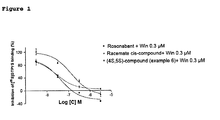
- Example 2 In-vitro determination of functional activity to human CB 1 -Receptors
- Human CB 1 membranes were prepared from stably transfected CHO cells. Incubation mixtures consisted of CHO-CB 1 membrane preparation at a final concentration of 15 ⁇ g of protein, compound (dose-response curve between 3 nM and 3 ⁇ M, final well concentration), Win 55,212-2 (0.3 ⁇ M final well concentration) and binding buffer (50 mM HEPES, pH 7.4, 100 mM KC1, 5mM MgCl 2 , 1 mM EDTA, 0.1 % wt/vol bovine serum albumin, 5 ⁇ M GDP, saponin 10 ⁇ g/ml).
- binding buffer 50 mM HEPES, pH 7.4, 100 mM KC1, 5mM MgCl 2 , 1 mM EDTA, 0.1 % wt/vol bovine serum albumin, 5 ⁇ M GDP, saponin 10 ⁇ g/ml).
- Example 5 Separation of (4 R , 5 R ) and (4 S , 5 S )-5-(4-chlorophenyl)-1-(2,4-dichlorophenyl)-4-methyl-4,5-dihydro-1H-pyrazole-3-carboxylic acid from racemate cis -5-(4-chlorophenyl)-1-(2,4-dichlorophenyl)-4-methyl-4,5-dihydro-1H-pyrazole-3-carboxylic acid
- (+)-cinchonine (765 mg, 2.60 mmol) was added in a second crystallization process. To this mixture MeCN was added in small portions until all solids were dissolved. The solution was allowed to cool to r.t. overnight. White crystals were formed, collected by filtration and washed with MeCN. The crystals were dried under vacuum.
- cis -2,6-dimethylaminopiperidine (8.01 g, 62.56 mmoles) and diisopropylethylamine (DIPEA) (2.695 g, 208.5 mmol, 35.7 mL) were dissolved in methylene chloride (DCM) (100 mL).
- DIPEA diisopropylethylamine
- reaction mixture was washed with water, followed by a saturated aqueous solution of sodium bicarbonate, then again with water, dried over sodium sulfate, filtered and evaporated to dryness in a rotavapor.
- the resulting crude was purified by silicagel chromatography using a CombiFlash Companion apparatus, using a gradient of cyclohexane and ethyl acetate to obtain a white solid (18.3 g, 71 % yield).
Landscapes
- Chemical & Material Sciences (AREA)
- Organic Chemistry (AREA)
- Health & Medical Sciences (AREA)
- Medicinal Chemistry (AREA)
- General Health & Medical Sciences (AREA)
- Hematology (AREA)
- Obesity (AREA)
- Bioinformatics & Cheminformatics (AREA)
- Chemical Kinetics & Catalysis (AREA)
- General Chemical & Material Sciences (AREA)
- Engineering & Computer Science (AREA)
- Nuclear Medicine, Radiotherapy & Molecular Imaging (AREA)
- Veterinary Medicine (AREA)
- Pharmacology & Pharmacy (AREA)
- Life Sciences & Earth Sciences (AREA)
- Animal Behavior & Ethology (AREA)
- Diabetes (AREA)
- Public Health (AREA)
- Child & Adolescent Psychology (AREA)
- Pharmaceuticals Containing Other Organic And Inorganic Compounds (AREA)
- Plural Heterocyclic Compounds (AREA)
Priority Applications (7)
| Application Number | Priority Date | Filing Date | Title |
|---|---|---|---|
| EP08384004A EP2108643A1 (fr) | 2008-04-10 | 2008-04-10 | 4-Méthyl-4, 5-dihydro-1H-pyrazole-3-carboxamide utile en tant qu'antagoniste neutre de cannabinoïde CB1 |
| US12/936,698 US20110028517A1 (en) | 2008-04-10 | 2009-04-07 | 4-methyl-4,5-dihydro-1h-pyrazole-3-carboxamide useful as a cannabinoid cb1 neutral antagonist |
| PCT/EP2009/054175 WO2009124950A2 (fr) | 2008-04-10 | 2009-04-07 | 4-méthyl-4,5-dihydro-1h-pyrazole-3-carboxamide utile en tant qu’antagoniste neutre des cannabinoïdes cb<sb>1</sb> |
| EP09730421A EP2282997A2 (fr) | 2008-04-10 | 2009-04-07 | 4-méthyl-4, 5-dihydro-1h-pyrazole-3-carboxamide utile en tant qu'antagoniste neutre de cannabinoïde cb1 |
| CL2009000845A CL2009000845A1 (es) | 2008-04-10 | 2009-04-07 | Compuestos derivados de(4s,5s)-5-(4-clorofenil)-1(2,4-diclorofenil)-n-(2,6-dimetilpiperidin-1-il)-4-metil-4,5-dihidro-1h-pirazol-3-carboxamida, antagonista de cb1; procedimiento de preparacion; compuestos intermediarios; composicion farmaceutica; y uso en el tratamiento de la obesidad, bulimia, caquexia y anorexia. |
| TW098111656A TW200946515A (en) | 2008-04-10 | 2009-04-08 | 4-methyl-4,5-dihydro-1H-pyrazole-3-carboxamide useful as a cannabinoid CB1 neutral antagonist |
| ARP090101240A AR071585A1 (es) | 2008-04-10 | 2009-04-08 | 4- metil-4,5-dihidro-1h-pirazol-3-carboxamida util como antagonista de cannabinoide cb1 |
Applications Claiming Priority (1)
| Application Number | Priority Date | Filing Date | Title |
|---|---|---|---|
| EP08384004A EP2108643A1 (fr) | 2008-04-10 | 2008-04-10 | 4-Méthyl-4, 5-dihydro-1H-pyrazole-3-carboxamide utile en tant qu'antagoniste neutre de cannabinoïde CB1 |
Publications (1)
| Publication Number | Publication Date |
|---|---|
| EP2108643A1 true EP2108643A1 (fr) | 2009-10-14 |
Family
ID=39684392
Family Applications (2)
| Application Number | Title | Priority Date | Filing Date |
|---|---|---|---|
| EP08384004A Withdrawn EP2108643A1 (fr) | 2008-04-10 | 2008-04-10 | 4-Méthyl-4, 5-dihydro-1H-pyrazole-3-carboxamide utile en tant qu'antagoniste neutre de cannabinoïde CB1 |
| EP09730421A Withdrawn EP2282997A2 (fr) | 2008-04-10 | 2009-04-07 | 4-méthyl-4, 5-dihydro-1h-pyrazole-3-carboxamide utile en tant qu'antagoniste neutre de cannabinoïde cb1 |
Family Applications After (1)
| Application Number | Title | Priority Date | Filing Date |
|---|---|---|---|
| EP09730421A Withdrawn EP2282997A2 (fr) | 2008-04-10 | 2009-04-07 | 4-méthyl-4, 5-dihydro-1h-pyrazole-3-carboxamide utile en tant qu'antagoniste neutre de cannabinoïde cb1 |
Country Status (6)
| Country | Link |
|---|---|
| US (1) | US20110028517A1 (fr) |
| EP (2) | EP2108643A1 (fr) |
| AR (1) | AR071585A1 (fr) |
| CL (1) | CL2009000845A1 (fr) |
| TW (1) | TW200946515A (fr) |
| WO (1) | WO2009124950A2 (fr) |
Families Citing this family (5)
| Publication number | Priority date | Publication date | Assignee | Title |
|---|---|---|---|---|
| JP6304503B2 (ja) * | 2015-10-16 | 2018-04-04 | マツダ株式会社 | 車両の側部車体構造 |
| UA123775C2 (uk) * | 2015-11-16 | 2021-06-02 | Естев Фармас'Ютікалз, С.А. | Оксадіазаспіросполуки для лікування зловживання наркотичними засобами та залежності від них |
| CN105699582B (zh) * | 2016-01-23 | 2017-05-03 | 河北科技大学 | 一种3‑氨基哌啶异构体的hplc检测方法 |
| CN105675782B (zh) * | 2016-01-23 | 2017-04-12 | 河北科技大学 | 一种3‑氨基哌啶手性纯度的分析方法 |
| WO2024212999A1 (fr) * | 2023-04-11 | 2024-10-17 | 微境生物医药科技(上海)有限公司 | Inhibiteur de cbl-b |
Citations (2)
| Publication number | Priority date | Publication date | Assignee | Title |
|---|---|---|---|---|
| WO2005077911A1 (fr) | 2004-02-17 | 2005-08-25 | Laboratorios Del Dr. Esteve S.A. | Composes de pyrazoline substituee, preparation et utilisation de ceux-ci comme medicaments |
| WO2007009689A1 (fr) | 2005-07-15 | 2007-01-25 | Laboratorios Del Dr.Esteve, S.A. | Derives de 4, 5-dihydr0-1h-pyrazole, preparation et utilisation de ceux-ci comme medicaments |
Family Cites Families (2)
| Publication number | Priority date | Publication date | Assignee | Title |
|---|---|---|---|---|
| WO2007009720A2 (fr) * | 2005-07-15 | 2007-01-25 | Laboratorios Del Dr. Esteve S.A. | Promedicaments de composes de pyrazoline, fabrication et utilisation comme medicaments |
| EP2151234A1 (fr) * | 2008-07-28 | 2010-02-10 | Laboratorios Del. Dr. Esteve, S.A. | Formulation pharmaceutique comprenant un composé récepteur CB1 dans une solution solide et/ou une dispersion solide |
-
2008
- 2008-04-10 EP EP08384004A patent/EP2108643A1/fr not_active Withdrawn
-
2009
- 2009-04-07 EP EP09730421A patent/EP2282997A2/fr not_active Withdrawn
- 2009-04-07 CL CL2009000845A patent/CL2009000845A1/es unknown
- 2009-04-07 US US12/936,698 patent/US20110028517A1/en not_active Abandoned
- 2009-04-07 WO PCT/EP2009/054175 patent/WO2009124950A2/fr not_active Ceased
- 2009-04-08 AR ARP090101240A patent/AR071585A1/es unknown
- 2009-04-08 TW TW098111656A patent/TW200946515A/zh unknown
Patent Citations (2)
| Publication number | Priority date | Publication date | Assignee | Title |
|---|---|---|---|---|
| WO2005077911A1 (fr) | 2004-02-17 | 2005-08-25 | Laboratorios Del Dr. Esteve S.A. | Composes de pyrazoline substituee, preparation et utilisation de ceux-ci comme medicaments |
| WO2007009689A1 (fr) | 2005-07-15 | 2007-01-25 | Laboratorios Del Dr.Esteve, S.A. | Derives de 4, 5-dihydr0-1h-pyrazole, preparation et utilisation de ceux-ci comme medicaments |
Non-Patent Citations (7)
| Title |
|---|
| GOVAERTS SJ; HERMANS E; LAMBERT DM.: "Comparison of cannabinoid ligand affinities and efficacies in murine tissues and in transfected cells expressing human recombinant cannabinoid receptors", EUR. J. PHARM. SCI., vol. 23, no. 3, 2004, pages 233 - 43, XP004601707, DOI: doi:10.1016/j.ejps.2004.07.013 |
| MESCHLER, J.P. ET AL.: "Inverse agonist properties of N-(piperidin-1-yl)-5-(4-chlorophenyl)-1-(2, 4-dichlorophenyl)-4-methyl-lH-pyrazole-3-carboxamide HCl (SR141716A) and 1-(2-chlorophenyl)-4-cyano-5-(4-methoxyphenyl)-lH-pyrazole-3-carboxyl ic acid phenylamide (CP-272871) for the CB(1) cannabinoid receptor", BIOCHEM. PHARMACOL., vol. 60, 2000, pages 1315 - 1323, XP002262541, DOI: doi:10.1016/S0006-2952(00)00447-0 |
| SALAMONE ET AL: "Cannabinoid CB1 receptor inverse agonists and neutral antagonists: Effects on food intake, food-reinforced behavior and food aversions", PHYSIOLOGY AND BEHAVIOR, ELSEVIER SCIENCE LTD., OXFORD, GB, vol. 91, no. 4, 5 July 2007 (2007-07-05), pages 383 - 388, XP022144010, ISSN: 0031-9384 * |
| TETRAHEDRON LEFT, vol. 45, 2004, pages 4977 |
| TETRAHEDRON LEFT., vol. 39, 1998, pages 1487 |
| TETRAHEDRON LEFT., vol. 43, 2002, pages 7685 |
| WIN, vol. 55, pages 212 - 2 |
Also Published As
| Publication number | Publication date |
|---|---|
| WO2009124950A2 (fr) | 2009-10-15 |
| AR071585A1 (es) | 2010-06-30 |
| WO2009124950A3 (fr) | 2010-03-04 |
| EP2282997A2 (fr) | 2011-02-16 |
| CL2009000845A1 (es) | 2009-08-21 |
| US20110028517A1 (en) | 2011-02-03 |
| TW200946515A (en) | 2009-11-16 |
Similar Documents
| Publication | Publication Date | Title |
|---|---|---|
| RU2451015C2 (ru) | Производные 1,2,4-триазола в качестве ингибиторов сигма рецептора | |
| RU2245878C2 (ru) | Производные 4,5-дигидро-1н-пиразола, обладающие cb1-антагонистической активностью | |
| KR100488610B1 (ko) | 카나비노이드수용체친화력을지닌3-피라졸카르복사미드유도체 | |
| EP1781619B1 (fr) | Inhibiteurs de récepteurs sigma | |
| SK3082003A3 (en) | 4,5-Dihydro-1H-pyrazole derivatives having CB1-antagonistic activity, method for the preparation thereof and their use | |
| EP1634873A1 (fr) | Inhibiteurs des récepteurs sigma | |
| CA2641144A1 (fr) | Derives pyrazole utilises en tant qu'inhibiteurs du recepteur sigma | |
| KR101609218B1 (ko) | 속해리성 도파민 2 수용체 길항제로서의 피페라진-1-일-트리플루오로메틸-치환된-피리딘 | |
| JP2008545739A (ja) | 新規なカンナビノイド受容体リガンド、それらを含む薬剤組成物、およびそれらの調製方法 | |
| CA2640753A1 (fr) | Inhibiteurs du recepteur sigma | |
| US20110028517A1 (en) | 4-methyl-4,5-dihydro-1h-pyrazole-3-carboxamide useful as a cannabinoid cb1 neutral antagonist | |
| EP1921071A1 (fr) | 1,2,3-Triazoles en tant qu'inhibiteurs du récepteur sigma | |
| JP7182562B2 (ja) | 2-([1,2,3]トリアゾール-2-イル)-安息香酸誘導体の製造 | |
| MX2008000738A (es) | Derivados de pirazolina sustituidos con azepano o azocano, su preparacion y uso como medicamentos. | |
| AU2006328483A1 (en) | 4,5-dihydro- (1H)-pyrazole derivatives as cannabinoid CB1 receptor modulators | |
| JP5193033B2 (ja) | ヒスタミンh3受容体薬剤、製剤及び治療的使用 | |
| EP1829875A1 (fr) | Dérivés de pyrazole comme inhibiteurs de récepteur Sigma | |
| MX2008013476A (es) | Procedimiento de produccion para compuestos biciclicos de tetrahidropirrol. | |
| KR20150042270A (ko) | N형 칼슘 채널 차단제로서의 사이클로펜틸피라졸 | |
| EP1829867A1 (fr) | Composés d'imidazole ayant une acitivité pharmaceutique vis-à-vis le recepteur sigma | |
| JP2009518452A (ja) | ジアリールトリアゾールメチルアミン誘導体これらの製造および治療におけるこれらの使用 | |
| KR20110023887A (ko) | CBı-길항 활성을 갖는 플루오로-치환된 3,4-디아릴-4,5-디하이드로-1H-피라졸-1-카복스아미딘 유도체 | |
| HK1147262A (en) | 4,5-dihydro-(1h)-pyrazole derivatives as cannabinoid cb1 receptor modulators |
Legal Events
| Date | Code | Title | Description |
|---|---|---|---|
| PUAI | Public reference made under article 153(3) epc to a published international application that has entered the european phase |
Free format text: ORIGINAL CODE: 0009012 |
|
| AK | Designated contracting states |
Kind code of ref document: A1 Designated state(s): AT BE BG CH CY CZ DE DK EE ES FI FR GB GR HR HU IE IS IT LI LT LU LV MC MT NL NO PL PT RO SE SI SK TR |
|
| AX | Request for extension of the european patent |
Extension state: AL BA MK RS |
|
| AKX | Designation fees paid | ||
| REG | Reference to a national code |
Ref country code: DE Ref legal event code: 8566 |
|
| STAA | Information on the status of an ep patent application or granted ep patent |
Free format text: STATUS: THE APPLICATION IS DEEMED TO BE WITHDRAWN |
|
| 18D | Application deemed to be withdrawn |
Effective date: 20100415 |