EP2109770B1 - Activation spécifique d'un lymphocyte régulateur et son utilisation pour le traitement de l'asthme, d'une maladie allergique, d'une maladie auto-immune, d'un rejet de greffe et pour une induction de tolerance - Google Patents
Activation spécifique d'un lymphocyte régulateur et son utilisation pour le traitement de l'asthme, d'une maladie allergique, d'une maladie auto-immune, d'un rejet de greffe et pour une induction de tolerance Download PDFInfo
- Publication number
- EP2109770B1 EP2109770B1 EP08708459.6A EP08708459A EP2109770B1 EP 2109770 B1 EP2109770 B1 EP 2109770B1 EP 08708459 A EP08708459 A EP 08708459A EP 2109770 B1 EP2109770 B1 EP 2109770B1
- Authority
- EP
- European Patent Office
- Prior art keywords
- seq
- treg
- cell
- cells
- hiv
- Prior art date
- Legal status (The legal status is an assumption and is not a legal conclusion. Google has not performed a legal analysis and makes no representation as to the accuracy of the status listed.)
- Not-in-force
Links
Images


Classifications
-
- A—HUMAN NECESSITIES
- A61—MEDICAL OR VETERINARY SCIENCE; HYGIENE
- A61K—PREPARATIONS FOR MEDICAL, DENTAL OR TOILETRY PURPOSES
- A61K38/00—Medicinal preparations containing peptides
- A61K38/16—Peptides having more than 20 amino acids; Gastrins; Somatostatins; Melanotropins; Derivatives thereof
- A61K38/162—Peptides having more than 20 amino acids; Gastrins; Somatostatins; Melanotropins; Derivatives thereof from virus
-
- A—HUMAN NECESSITIES
- A61—MEDICAL OR VETERINARY SCIENCE; HYGIENE
- A61K—PREPARATIONS FOR MEDICAL, DENTAL OR TOILETRY PURPOSES
- A61K39/00—Medicinal preparations containing antigens or antibodies
- A61K39/12—Viral antigens
- A61K39/21—Retroviridae, e.g. equine infectious anemia virus
-
- A—HUMAN NECESSITIES
- A61—MEDICAL OR VETERINARY SCIENCE; HYGIENE
- A61P—SPECIFIC THERAPEUTIC ACTIVITY OF CHEMICAL COMPOUNDS OR MEDICINAL PREPARATIONS
- A61P1/00—Drugs for disorders of the alimentary tract or the digestive system
-
- A—HUMAN NECESSITIES
- A61—MEDICAL OR VETERINARY SCIENCE; HYGIENE
- A61P—SPECIFIC THERAPEUTIC ACTIVITY OF CHEMICAL COMPOUNDS OR MEDICINAL PREPARATIONS
- A61P1/00—Drugs for disorders of the alimentary tract or the digestive system
- A61P1/04—Drugs for disorders of the alimentary tract or the digestive system for ulcers, gastritis or reflux esophagitis, e.g. antacids, inhibitors of acid secretion, mucosal protectants
-
- A—HUMAN NECESSITIES
- A61—MEDICAL OR VETERINARY SCIENCE; HYGIENE
- A61P—SPECIFIC THERAPEUTIC ACTIVITY OF CHEMICAL COMPOUNDS OR MEDICINAL PREPARATIONS
- A61P1/00—Drugs for disorders of the alimentary tract or the digestive system
- A61P1/14—Prodigestives, e.g. acids, enzymes, appetite stimulants, antidyspeptics, tonics, antiflatulents
-
- A—HUMAN NECESSITIES
- A61—MEDICAL OR VETERINARY SCIENCE; HYGIENE
- A61P—SPECIFIC THERAPEUTIC ACTIVITY OF CHEMICAL COMPOUNDS OR MEDICINAL PREPARATIONS
- A61P1/00—Drugs for disorders of the alimentary tract or the digestive system
- A61P1/16—Drugs for disorders of the alimentary tract or the digestive system for liver or gallbladder disorders, e.g. hepatoprotective agents, cholagogues, litholytics
-
- A—HUMAN NECESSITIES
- A61—MEDICAL OR VETERINARY SCIENCE; HYGIENE
- A61P—SPECIFIC THERAPEUTIC ACTIVITY OF CHEMICAL COMPOUNDS OR MEDICINAL PREPARATIONS
- A61P1/00—Drugs for disorders of the alimentary tract or the digestive system
- A61P1/18—Drugs for disorders of the alimentary tract or the digestive system for pancreatic disorders, e.g. pancreatic enzymes
-
- A—HUMAN NECESSITIES
- A61—MEDICAL OR VETERINARY SCIENCE; HYGIENE
- A61P—SPECIFIC THERAPEUTIC ACTIVITY OF CHEMICAL COMPOUNDS OR MEDICINAL PREPARATIONS
- A61P11/00—Drugs for disorders of the respiratory system
-
- A—HUMAN NECESSITIES
- A61—MEDICAL OR VETERINARY SCIENCE; HYGIENE
- A61P—SPECIFIC THERAPEUTIC ACTIVITY OF CHEMICAL COMPOUNDS OR MEDICINAL PREPARATIONS
- A61P11/00—Drugs for disorders of the respiratory system
- A61P11/02—Nasal agents, e.g. decongestants
-
- A—HUMAN NECESSITIES
- A61—MEDICAL OR VETERINARY SCIENCE; HYGIENE
- A61P—SPECIFIC THERAPEUTIC ACTIVITY OF CHEMICAL COMPOUNDS OR MEDICINAL PREPARATIONS
- A61P11/00—Drugs for disorders of the respiratory system
- A61P11/06—Antiasthmatics
-
- A—HUMAN NECESSITIES
- A61—MEDICAL OR VETERINARY SCIENCE; HYGIENE
- A61P—SPECIFIC THERAPEUTIC ACTIVITY OF CHEMICAL COMPOUNDS OR MEDICINAL PREPARATIONS
- A61P11/00—Drugs for disorders of the respiratory system
- A61P11/08—Bronchodilators
-
- A—HUMAN NECESSITIES
- A61—MEDICAL OR VETERINARY SCIENCE; HYGIENE
- A61P—SPECIFIC THERAPEUTIC ACTIVITY OF CHEMICAL COMPOUNDS OR MEDICINAL PREPARATIONS
- A61P11/00—Drugs for disorders of the respiratory system
- A61P11/16—Central respiratory analeptics
-
- A—HUMAN NECESSITIES
- A61—MEDICAL OR VETERINARY SCIENCE; HYGIENE
- A61P—SPECIFIC THERAPEUTIC ACTIVITY OF CHEMICAL COMPOUNDS OR MEDICINAL PREPARATIONS
- A61P13/00—Drugs for disorders of the urinary system
- A61P13/12—Drugs for disorders of the urinary system of the kidneys
-
- A—HUMAN NECESSITIES
- A61—MEDICAL OR VETERINARY SCIENCE; HYGIENE
- A61P—SPECIFIC THERAPEUTIC ACTIVITY OF CHEMICAL COMPOUNDS OR MEDICINAL PREPARATIONS
- A61P17/00—Drugs for dermatological disorders
-
- A—HUMAN NECESSITIES
- A61—MEDICAL OR VETERINARY SCIENCE; HYGIENE
- A61P—SPECIFIC THERAPEUTIC ACTIVITY OF CHEMICAL COMPOUNDS OR MEDICINAL PREPARATIONS
- A61P17/00—Drugs for dermatological disorders
- A61P17/02—Drugs for dermatological disorders for treating wounds, ulcers, burns, scars, keloids, or the like
-
- A—HUMAN NECESSITIES
- A61—MEDICAL OR VETERINARY SCIENCE; HYGIENE
- A61P—SPECIFIC THERAPEUTIC ACTIVITY OF CHEMICAL COMPOUNDS OR MEDICINAL PREPARATIONS
- A61P17/00—Drugs for dermatological disorders
- A61P17/04—Antipruritics
-
- A—HUMAN NECESSITIES
- A61—MEDICAL OR VETERINARY SCIENCE; HYGIENE
- A61P—SPECIFIC THERAPEUTIC ACTIVITY OF CHEMICAL COMPOUNDS OR MEDICINAL PREPARATIONS
- A61P17/00—Drugs for dermatological disorders
- A61P17/06—Antipsoriatics
-
- A—HUMAN NECESSITIES
- A61—MEDICAL OR VETERINARY SCIENCE; HYGIENE
- A61P—SPECIFIC THERAPEUTIC ACTIVITY OF CHEMICAL COMPOUNDS OR MEDICINAL PREPARATIONS
- A61P19/00—Drugs for skeletal disorders
- A61P19/02—Drugs for skeletal disorders for joint disorders, e.g. arthritis, arthrosis
-
- A—HUMAN NECESSITIES
- A61—MEDICAL OR VETERINARY SCIENCE; HYGIENE
- A61P—SPECIFIC THERAPEUTIC ACTIVITY OF CHEMICAL COMPOUNDS OR MEDICINAL PREPARATIONS
- A61P21/00—Drugs for disorders of the muscular or neuromuscular system
- A61P21/02—Muscle relaxants, e.g. for tetanus or cramps
-
- A—HUMAN NECESSITIES
- A61—MEDICAL OR VETERINARY SCIENCE; HYGIENE
- A61P—SPECIFIC THERAPEUTIC ACTIVITY OF CHEMICAL COMPOUNDS OR MEDICINAL PREPARATIONS
- A61P21/00—Drugs for disorders of the muscular or neuromuscular system
- A61P21/04—Drugs for disorders of the muscular or neuromuscular system for myasthenia gravis
-
- A—HUMAN NECESSITIES
- A61—MEDICAL OR VETERINARY SCIENCE; HYGIENE
- A61P—SPECIFIC THERAPEUTIC ACTIVITY OF CHEMICAL COMPOUNDS OR MEDICINAL PREPARATIONS
- A61P25/00—Drugs for disorders of the nervous system
-
- A—HUMAN NECESSITIES
- A61—MEDICAL OR VETERINARY SCIENCE; HYGIENE
- A61P—SPECIFIC THERAPEUTIC ACTIVITY OF CHEMICAL COMPOUNDS OR MEDICINAL PREPARATIONS
- A61P27/00—Drugs for disorders of the senses
- A61P27/02—Ophthalmic agents
-
- A—HUMAN NECESSITIES
- A61—MEDICAL OR VETERINARY SCIENCE; HYGIENE
- A61P—SPECIFIC THERAPEUTIC ACTIVITY OF CHEMICAL COMPOUNDS OR MEDICINAL PREPARATIONS
- A61P27/00—Drugs for disorders of the senses
- A61P27/02—Ophthalmic agents
- A61P27/14—Decongestants or antiallergics
-
- A—HUMAN NECESSITIES
- A61—MEDICAL OR VETERINARY SCIENCE; HYGIENE
- A61P—SPECIFIC THERAPEUTIC ACTIVITY OF CHEMICAL COMPOUNDS OR MEDICINAL PREPARATIONS
- A61P29/00—Non-central analgesic, antipyretic or antiinflammatory agents, e.g. antirheumatic agents; Non-steroidal antiinflammatory drugs [NSAID]
-
- A—HUMAN NECESSITIES
- A61—MEDICAL OR VETERINARY SCIENCE; HYGIENE
- A61P—SPECIFIC THERAPEUTIC ACTIVITY OF CHEMICAL COMPOUNDS OR MEDICINAL PREPARATIONS
- A61P3/00—Drugs for disorders of the metabolism
- A61P3/08—Drugs for disorders of the metabolism for glucose homeostasis
- A61P3/10—Drugs for disorders of the metabolism for glucose homeostasis for hyperglycaemia, e.g. antidiabetics
-
- A—HUMAN NECESSITIES
- A61—MEDICAL OR VETERINARY SCIENCE; HYGIENE
- A61P—SPECIFIC THERAPEUTIC ACTIVITY OF CHEMICAL COMPOUNDS OR MEDICINAL PREPARATIONS
- A61P35/00—Antineoplastic agents
-
- A—HUMAN NECESSITIES
- A61—MEDICAL OR VETERINARY SCIENCE; HYGIENE
- A61P—SPECIFIC THERAPEUTIC ACTIVITY OF CHEMICAL COMPOUNDS OR MEDICINAL PREPARATIONS
- A61P35/00—Antineoplastic agents
- A61P35/02—Antineoplastic agents specific for leukemia
-
- A—HUMAN NECESSITIES
- A61—MEDICAL OR VETERINARY SCIENCE; HYGIENE
- A61P—SPECIFIC THERAPEUTIC ACTIVITY OF CHEMICAL COMPOUNDS OR MEDICINAL PREPARATIONS
- A61P37/00—Drugs for immunological or allergic disorders
- A61P37/02—Immunomodulators
-
- A—HUMAN NECESSITIES
- A61—MEDICAL OR VETERINARY SCIENCE; HYGIENE
- A61P—SPECIFIC THERAPEUTIC ACTIVITY OF CHEMICAL COMPOUNDS OR MEDICINAL PREPARATIONS
- A61P37/00—Drugs for immunological or allergic disorders
- A61P37/02—Immunomodulators
- A61P37/04—Immunostimulants
-
- A—HUMAN NECESSITIES
- A61—MEDICAL OR VETERINARY SCIENCE; HYGIENE
- A61P—SPECIFIC THERAPEUTIC ACTIVITY OF CHEMICAL COMPOUNDS OR MEDICINAL PREPARATIONS
- A61P37/00—Drugs for immunological or allergic disorders
- A61P37/02—Immunomodulators
- A61P37/06—Immunosuppressants, e.g. drugs for graft rejection
-
- A—HUMAN NECESSITIES
- A61—MEDICAL OR VETERINARY SCIENCE; HYGIENE
- A61P—SPECIFIC THERAPEUTIC ACTIVITY OF CHEMICAL COMPOUNDS OR MEDICINAL PREPARATIONS
- A61P37/00—Drugs for immunological or allergic disorders
- A61P37/08—Antiallergic agents
-
- A—HUMAN NECESSITIES
- A61—MEDICAL OR VETERINARY SCIENCE; HYGIENE
- A61P—SPECIFIC THERAPEUTIC ACTIVITY OF CHEMICAL COMPOUNDS OR MEDICINAL PREPARATIONS
- A61P43/00—Drugs for specific purposes, not provided for in groups A61P1/00-A61P41/00
-
- A—HUMAN NECESSITIES
- A61—MEDICAL OR VETERINARY SCIENCE; HYGIENE
- A61P—SPECIFIC THERAPEUTIC ACTIVITY OF CHEMICAL COMPOUNDS OR MEDICINAL PREPARATIONS
- A61P5/00—Drugs for disorders of the endocrine system
- A61P5/14—Drugs for disorders of the endocrine system of the thyroid hormones, e.g. T3, T4
-
- A—HUMAN NECESSITIES
- A61—MEDICAL OR VETERINARY SCIENCE; HYGIENE
- A61P—SPECIFIC THERAPEUTIC ACTIVITY OF CHEMICAL COMPOUNDS OR MEDICINAL PREPARATIONS
- A61P7/00—Drugs for disorders of the blood or the extracellular fluid
- A61P7/06—Antianaemics
-
- C—CHEMISTRY; METALLURGY
- C07—ORGANIC CHEMISTRY
- C07K—PEPTIDES
- C07K14/00—Peptides having more than 20 amino acids; Gastrins; Somatostatins; Melanotropins; Derivatives thereof
- C07K14/005—Peptides having more than 20 amino acids; Gastrins; Somatostatins; Melanotropins; Derivatives thereof from viruses
-
- C—CHEMISTRY; METALLURGY
- C12—BIOCHEMISTRY; BEER; SPIRITS; WINE; VINEGAR; MICROBIOLOGY; ENZYMOLOGY; MUTATION OR GENETIC ENGINEERING
- C12N—MICROORGANISMS OR ENZYMES; COMPOSITIONS THEREOF; PROPAGATING, PRESERVING, OR MAINTAINING MICROORGANISMS; MUTATION OR GENETIC ENGINEERING; CULTURE MEDIA
- C12N7/00—Viruses; Bacteriophages; Compositions thereof; Preparation or purification thereof
-
- G—PHYSICS
- G01—MEASURING; TESTING
- G01N—INVESTIGATING OR ANALYSING MATERIALS BY DETERMINING THEIR CHEMICAL OR PHYSICAL PROPERTIES
- G01N33/00—Investigating or analysing materials by specific methods not covered by groups G01N1/00 - G01N31/00
- G01N33/48—Biological material, e.g. blood, urine; Haemocytometers
- G01N33/50—Chemical analysis of biological material, e.g. blood, urine; Testing involving biospecific ligand binding methods; Immunological testing
- G01N33/5005—Chemical analysis of biological material, e.g. blood, urine; Testing involving biospecific ligand binding methods; Immunological testing involving human or animal cells
- G01N33/5008—Chemical analysis of biological material, e.g. blood, urine; Testing involving biospecific ligand binding methods; Immunological testing involving human or animal cells for testing or evaluating the effect of chemical or biological compounds, e.g. drugs, cosmetics
- G01N33/5044—Chemical analysis of biological material, e.g. blood, urine; Testing involving biospecific ligand binding methods; Immunological testing involving human or animal cells for testing or evaluating the effect of chemical or biological compounds, e.g. drugs, cosmetics involving specific cell types
- G01N33/5047—Cells of the immune system
- G01N33/505—Cells of the immune system involving T-cells
-
- A—HUMAN NECESSITIES
- A61—MEDICAL OR VETERINARY SCIENCE; HYGIENE
- A61K—PREPARATIONS FOR MEDICAL, DENTAL OR TOILETRY PURPOSES
- A61K38/00—Medicinal preparations containing peptides
-
- C—CHEMISTRY; METALLURGY
- C07—ORGANIC CHEMISTRY
- C07K—PEPTIDES
- C07K16/00—Immunoglobulins [IG], e.g. monoclonal or polyclonal antibodies
- C07K16/18—Immunoglobulins [IG], e.g. monoclonal or polyclonal antibodies against material from animals or humans
-
- C—CHEMISTRY; METALLURGY
- C12—BIOCHEMISTRY; BEER; SPIRITS; WINE; VINEGAR; MICROBIOLOGY; ENZYMOLOGY; MUTATION OR GENETIC ENGINEERING
- C12N—MICROORGANISMS OR ENZYMES; COMPOSITIONS THEREOF; PROPAGATING, PRESERVING, OR MAINTAINING MICROORGANISMS; MUTATION OR GENETIC ENGINEERING; CULTURE MEDIA
- C12N2740/00—Reverse transcribing RNA viruses
- C12N2740/00011—Details
- C12N2740/10011—Retroviridae
- C12N2740/16011—Human Immunodeficiency Virus, HIV
- C12N2740/16033—Use of viral protein as therapeutic agent other than vaccine, e.g. apoptosis inducing or anti-inflammatory
-
- C—CHEMISTRY; METALLURGY
- C12—BIOCHEMISTRY; BEER; SPIRITS; WINE; VINEGAR; MICROBIOLOGY; ENZYMOLOGY; MUTATION OR GENETIC ENGINEERING
- C12N—MICROORGANISMS OR ENZYMES; COMPOSITIONS THEREOF; PROPAGATING, PRESERVING, OR MAINTAINING MICROORGANISMS; MUTATION OR GENETIC ENGINEERING; CULTURE MEDIA
- C12N2740/00—Reverse transcribing RNA viruses
- C12N2740/00011—Details
- C12N2740/10011—Retroviridae
- C12N2740/16011—Human Immunodeficiency Virus, HIV
- C12N2740/16111—Human Immunodeficiency Virus, HIV concerning HIV env
-
- C—CHEMISTRY; METALLURGY
- C12—BIOCHEMISTRY; BEER; SPIRITS; WINE; VINEGAR; MICROBIOLOGY; ENZYMOLOGY; MUTATION OR GENETIC ENGINEERING
- C12N—MICROORGANISMS OR ENZYMES; COMPOSITIONS THEREOF; PROPAGATING, PRESERVING, OR MAINTAINING MICROORGANISMS; MUTATION OR GENETIC ENGINEERING; CULTURE MEDIA
- C12N2740/00—Reverse transcribing RNA viruses
- C12N2740/00011—Details
- C12N2740/10011—Retroviridae
- C12N2740/16011—Human Immunodeficiency Virus, HIV
- C12N2740/16111—Human Immunodeficiency Virus, HIV concerning HIV env
- C12N2740/16122—New viral proteins or individual genes, new structural or functional aspects of known viral proteins or genes
-
- G—PHYSICS
- G01—MEASURING; TESTING
- G01N—INVESTIGATING OR ANALYSING MATERIALS BY DETERMINING THEIR CHEMICAL OR PHYSICAL PROPERTIES
- G01N2333/00—Assays involving biological materials from specific organisms or of a specific nature
- G01N2333/005—Assays involving biological materials from specific organisms or of a specific nature from viruses
- G01N2333/08—RNA viruses
- G01N2333/15—Retroviridae, e.g. bovine leukaemia virus, feline leukaemia virus, feline leukaemia virus, human T-cell leukaemia-lymphoma virus
- G01N2333/155—Lentiviridae, e.g. visna-maedi virus, equine infectious virus, FIV, SIV
- G01N2333/16—HIV-1, HIV-2
- G01N2333/162—HIV-1, HIV-2 env, e.g. gp160, gp110/120, gp41, V3, peptid T, DC4-Binding site
-
- G—PHYSICS
- G01—MEASURING; TESTING
- G01N—INVESTIGATING OR ANALYSING MATERIALS BY DETERMINING THEIR CHEMICAL OR PHYSICAL PROPERTIES
- G01N2333/00—Assays involving biological materials from specific organisms or of a specific nature
- G01N2333/435—Assays involving biological materials from specific organisms or of a specific nature from animals; from humans
- G01N2333/705—Assays involving receptors, cell surface antigens or cell surface determinants
- G01N2333/70503—Immunoglobulin superfamily, e.g. VCAMs, PECAM, LFA-3
- G01N2333/7051—T-cell receptor (TcR)-CD3 complex
Definitions
- an allergic disease, transplant rejection and an autoimmune disease have one fundamental principle in common, they all are triggered by an imbalanced immune system which reacts hyperactive against a specific exogenic and/or endogenic challenge and therewith contributes significantly to the disease status.
- Effector T cell-directed immunomodulation therefore is the key to successful treatment of asthma, an autoimmune condition, prevention of graft vs. host disease (GVHD) and prevention of graft rejection.
- GVHD graft vs. host disease
- Treg cells T lymphocytes
- CD4 + CD25 + Treg cells also designated as "naturally occurring Treg cells” (Sakaguchi 2005)
- Tr1 Tr1
- Th3 Th3
- Tr1 and Th3 are induced in the periphery
- CD4 + CD25 + Treg cells develop in the thymus and constitute 5-10% of peripheral CD4 + T cells in healthy man.
- Tr1 and Th3 exert their suppressive activity by production of IL-10 and TGF-beta, respectively (Shevach 2002).
- IPEX syndrome i mmunodysregulation, p olyendo-crinopathy and e nteropathy, X -linked
- IPEX shows aggressive autoimmunity, severe eczema, elevated IgE levels, eosinophilia and food allergies and early death (Fontenot and Rudensky 2005).
- Treg cells play an important role in asthma and autoimmune diseases and have a potential for treatment of GVHD and therewith transplantation tolerance (Robinson 2004, Sakaguchi 2005).
- Treg cells are rare in peripheral blood clinical application of human Treg cells depends on highly expensive ex vivo expansion of Treg cells (Hoffmann et al. 2004, Horwitz et al. 2003, Tang et al. 2003, Zheng et al. 2004).
- Bluestone and Tang went one step further: They are trying to solve the problem by not only increasing the amount of Treg cells for therapy but enhancing suppressive activity of Treg cells by activating Treg cells via triggering of the T cell receptor (TCR) by an anti-CD3 antibody (Bluestone and Tang 2004).
- TCR T cell receptor
- This approach resembles by far no Treg cell specific activation as anti-CD3 activates all T cell receptor-expressing cells which bears the obstacle that anti-CD3 treatment induces effector T cell function probably leading to uncontrolled proliferation and non-specific pro-inflammatory cytokine production and exaggeration of pathology.
- Treg cells have to be highly purified and activated ex vivo with anti-CD3 which again is a highly expensive and laborious procedure.
- the absence of a Treg cell specific marker makes it difficult to achieve high purity of Treg cells.
- a 4C8 monoclonal antibody can provide a costimulatory signal to human CD4+ T-cells and can induce regulatory T (Treg) cells via CD52, which is the antigene of 4C8mAb.
- Treg regulatory T
- Another approach is described in JP 02 152989 A .
- US 4,695,459 A describes certain auto-immune diseases that may be prevented or attenuated by using an anti-CD4 antibody that is cytotoxic to Leu3 (CD4) phenotype T-cells.
- US 6,455,497 B1 describes a method and materials for the treatment of inflammatory diseases such as rheumatoid arthritis by administering a pharmaceutically effective amount of an IL-16 polypeptide or an IL-16 mimiking molecule.
- WO 2007/035551 A describes an assay and a method for identifying a GPR 83 agonist capable of stimulating regulatory T-cell function. The ability of a test compound to stimulate a regulatory T-cell function has been investigated.
- US 2005/048587 A1 describes a method for identifying a tolerance modulatory compound using anti-CD3 and anti-CD28 antibodies as a stimulating agent.
- Treg cells can be activated, e.g. nonspecifically via CD3 (Thornton and Shevach 1998), or via CD28/B7 pathway (Shevach 2002, Bluestone and Tang 2004, Hunig and Dennehy 2005), or via CD4 ( WO04083247 ).
- WO 2004/072296 A2 describes a method for inhibiting an abnormal immune response by administering to a subject in need thereof a gp120 molecule or functional equivalent thereof in an amount effective to inhibit an abnormal immune response.
- the gp120 molecule inhibits the undesired infiltration of T cell, whereby the abnormal immune response is reduced to a normal level.
- It also describes a method for enhancing migration of antigen-specific immune cells towards an antigen-expressing target by administering to a subject in need thereof an agent that inhibits gp120-mediated fugetaxis in an amount effective to enhance migration of antigen-specific cytotoxic T lymphocytes towards an HIV virus or a cell-associated HIV virus.
- the modulation of regulatory T cells is not mentioned.
- the present invention bases on the new finding that a specific epitope of CD4 triggers activation of Treg cells. Said epitope overlaps with the known HIV-1 gp120-binding site but surprisingly binding to this site causes Treg cell activation. This finding was totally unexpected for the following reasons: Until now Treg cell activation via CD4 was attributed to a different epitope to which the monoclonal antibody BF5 ( WO04083247 ) binds. - Carriere et al., 1995 have investigated that the binding site of BF5 on CD4 is completely independent of the HIV-1 gp120-binding site.
- the present invention discloses a physiologically active CD4 epitope on a Treg cell which triggers suppressive activity of a Treg cell.
- the epitope described in the present invention has been identified as a region on the human CD4 protein (SEQ ID NO.: 2) spanning amino acid position No. 54 to 84 of SEQ ID NO.:2. Those 31 amino acids are explicitly given in SEQ ID NO.:1.
- a preferred peptide which is a CD4 fragment is selected from a group consisting of an isolated peptide spanning amino acid No. 1-31 of SEQ ID NO 1, No. 26 to 458 of SEQ ID NO.: 2, No. 26 to 419 of SEQ ID NO.:2, No. 26 to 207 of SEQ ID NO.: 2, No. 26 to 131 of SEQ ID NO.: 2 and No. 46 to 89 of SEQ ID NO.: 2. All said peptides are additionally characterized in that they all do harbor the critical amino acid Phenylalanine at residue 68 of SEQ ID NO.: 2.
- a “substance” of the present invention can be used in a method according to the present invention.
- the meaning of the term substance according to the present invention includes but is not limited to a peptide, a scaffolded peptide, an antibody, a fragment of an antibody, a nucleic acid molecule, a ribozyme, an organic compound or an inorganic compound.
- the new epitope serves as the basis for the synthesis of a new tool which can be used e.g. in a competition assay or screening assay according to the present invention for determining whether a substance can activate a regulatory T cell (Treg cell) via interaction with the epitope as set forth in SEQ ID No.:1.
- a tool is a peptide which is an isolated peptide spanning amino acid No. 1-31 of SEQ ID NO 1, or No. 26 to 458 of SEQ ID NO.: 2, or No. 26 to 419 of SEQ ID NO.:2, or No. 26 to 207 of SEQ ID NO.: 2, or No. 26 to 131 of SEQ ID NO.: 2 or No.
- SEQ ID NO.: 2 46 to 89 of SEQ ID NO.: 2., or is an isolated peptide spanning amino acid No. 1 to 31 of SEQ ID NO.: 1 and having additional up-stream and/or downstream amino acids with the prerequisite that the additional amino acids do not hinder binding of a substance to the amino acid stretch as set forth in SEQ ID No.:1.
- a preferred peptide consists of the peptide as set forth in SEQ ID NO.:1 and additionally consist of an additional up-stream amino acid or amino acid stretch which is selected from a group consisting of the amino acid or amino acid stretch as set forth in SEQ ID NO.: 2 at position 53, at position 52-53, at position 51-53, at position 50-53, at position 49-53, at position 48-53, at position 47-53, at position 46-53, at position 45-53, at position 44-53, at position 43-53, at position 42-53, at position 41-53, at position 40-53, at position 39-53, at position 38-53, at position 37-53, at position 36-53, at position 35-53, at position 34-53, at position 33-53, at position 32-53, at position 31-53, at position 30-53, at position 29-53, at position 28-53, at position 27-53, at position 26-53, at position 25-53, at position 24-53, at position 23-53, at position 22-53,
- a further preferred peptide consists of the peptide which is mentioned as "preferred peptide” in the paragraph above and additionally consists of at least one additional downstream amino acid as given in SEQ ID NO.: 2 at position 85, or additionally consists of amino acids as given in SEQ ID NO.:2 at position 85 to n, wherein n is an integer between 86-458, i.e.
- the finding that the epitope given in SEQ ID NO.:1 is a key to activate a Treg cell is a link between two different up to now unrelated technical fields, namely that of (a) HIV-1 related diseases with (b) diseases disclosed in the present invention e.g autoimmune disease, allergy, asthma, graft rejection and a diseases due to lacking immunotolerance caused by organ transplantation or by therapeutical administration of a non-self or self-biological entity to a human in need thereof and therewith allows a bundle of new uses as explained in the following:
- HIV-1 attachment or entry inhibitors are known in the art.
- the keyhole which allows HIV-1 to enter the cell can be used as the keyhole to activate Treg cells. Therefore, substances known in the art to interfere with HIV-1 attachment and cell entry (Markovic and Clouse 2004, Castagna et al. 2005), like e.g.
- HIV-1 gp120 itself, derivatives thereof, peptidomimetics, antibodies, aptamers or any low molecular weight (LMW) compound directed against the binding site of HIV-1 gp120 on CD4 could possibly be useful to activate a Treg cell and therewith can be useful for the treatment of a disease described in the present invention
- LMW low molecular weight
- HIV-1 gp120 is well-known in the art and its amino acid sequence as well as the respective gene has been published since years (Muesing et al. 1985, Starcich et al.1986, Jeffs et al. 1996). Additionally, methods for producing HIV-1 gp120 are known (Lasky et al. 1986, Leonard et al. 1990, Culp et al. 1991, Jeffs et al. 1996).
- HIV-1 attachment inhibitor or entry inhibitor A substance which can interfere with HIV-1 attachment and/or cell entry is commonly named HIV-1 attachment inhibitor or entry inhibitor. Such a substance, do either bind to (i) HIV-1, or (ii) to CD4, or (iii) HIV-1 and CD4 or (iv) co-receptor e.g. CCR5 or CXCR4.
- Such an inhibitor can be according to the present invention useful for the treatment of diseases like e.g. an autoimmune disease, an allergy, asthma or GVHD if it exerts property (ii) or (iii) and activates a Treg cell.
- the present invention discloses several assays which allow to determine whether a substance identified in the technical field of HIV-1 research to interfere with HIV-1 attachment and/or cell entry can be useful in the other above-mentioned technical fields like that of autoimmune diseases or allergies or asthma or organ transplantation. Therefore, the present invention teaches a short cut for identifying a substance which can be useful for the treatment of a disease according to the present invention.
- an appropriate pre-selected substance is (i) proven to interact at least with epitope (SEQ ID NO.:1), and/or is (ii) known from HIV-1 research as HIV-1 attachment inhibitor or entry inhibitor or synthetic mimetics of the CD4 binding site of HIV-1 gp120.
- Such a type of assay for determining whether a substance can interact with a specific peptide, i.e. epitope is not restricted to in vitro assays since cellular assays for achieving such an information on a substance or other in vitro formats are well known in the art and broadly used.
- the present invention discloses a method for determining whether a substance which can interfere with the interaction of HIV-1 gp120 with CD4 can be useful for positively influence a disease in which increase of activated regulatory T cells (Treg cells) can improve clinical picture comprising :
- Said measuring can be performed using a suitable read-out system such as:
- a disease according to the method above in which increase of activated regulatory T cells (Treg cells) can improve clinical picture is (i) a non-autoimmune inflammatory disease: allergic asthma, atopic dermatitis, food allergy, graft-versus-host disease, (ii) an autoimmune inflammatory disease: rheumatoid arthritis, rheumatic fever, systemic lupus erythematosus, ulcerative colitis, Crohn's disease, autoimmune inflammatory bowel disease, diabetes type I, multiple sclerosis, myasthenia gravis, psoriasis, pemphigus vulgaris, pemphigoid, ; (iii) an inflammatory disease due to organ transplantation; (iv) a bone marrow transplantation.
- a non-autoimmune inflammatory disease allergic asthma, atopic dermatitis, food allergy, graft-versus-host disease
- an autoimmune inflammatory disease rheumatoid arthritis, rheumatic fever, systemic l
- the solution of (a) does not only contain a Treg cell but also an inactivated syngenic CD3-depleted PBMC (peripheral blood mononuclear cell) or a dendritic cell (DC) and an allogeneic CD8 + T cell or an allogeneic CD4 + T cell.
- PBMC peripheral blood mononuclear cell
- DC dendritic cell
- an allogeneic CD8 + T cell or an allogeneic CD4 + T cell do additionally increase intracellular cAMP amount and therewith lead to a more sensitive readout system.
- the present invention is based on a method for determining whether a substance can activate a Treg cell via interaction with the HIV-1 gp120-binding site of CD4, comprising:
- the present invention also refers to a for a method which allow to identify a substance which can interact with the HIV-1 gp120-binding site of CD4 and therewith can be used for pre-selecting a substance which can interact with the HIV-1 gp120-binding site of CD4.
- the method comprises:
- This pre-selecting method can additionally be performed according to the present invention if instead of CD4 a peptide is used which comprises the amino acid stretch as set forth in SEQ ID NO.1 or instead of CD4 a peptide is used as set forth in SEQ ID NO.:1.
- a peptide is used selected from a group consisting of a peptide comprising the amino acid sequence as set forth in SEQ ID NO.: 3, SEQ ID NO.: 4, SEQ ID NO.: 5, SEQ ID NO.: 6, SEQ ID NO.: 7, SEQ ID NO.: 8, SEQ ID NO.: 9, and SEQ ID NO.: 10 or a peptide is used selected from a group consisting of a peptide consisting of the amino acid sequence as set forth in SEQ ID NO.: 3, SEQ ID NO.: 4, SEQ ID NO.: 5, SEQ ID NO.: 6, SEQ ID NO.: 7, SEQ ID NO.: 8, SEQ ID NO.: 9, and SEQ ID NO.: 10.
- the present invention also concerns a method for determining whether a substance can activate a regulatory T cell (Treg) via interaction with the epitope as set forth in SEQ ID NO: 1 comprising:
- the peptide used is selected from a group consisting of an isolated peptide spanning amino acid No. 1-31 of SEQ ID NO 1, No. 26 to 458 of SEQ ID NO.: 2, No. 26 to 419 of SEQ ID NO.:2, No. 26 to 207 of SEQ ID NO.: 2, No. 26 to 131 of SEQ ID NO.: 2 and No. 46 to 89 of SEQ ID NO.: 2 or the peptide used is an isolated peptide spanning amino acid No. 1 to 31 of SEQ ID NO.: 1 and having additional up-stream and/or downstream amino acids with the prerequisite that the additional amino acids do not hinder binding of a substance to the amino acid stretch as set forth in SEQ ID No.:1.
- Said additional up-stream amino acid or amino acid stretch is preferably selected from a group consisting of the amino acid or amino acid stretch as set forth in SEQ ID NO.: 2 at position 53, at position 52-53, at position 51-53, at position 50-53, at position 49-53, at position 48-53, at position 47-53, at position 46-53, at position 45-53, at position 44-53, at position 43-53, at position 42-53, at position 41-53, at position 40-53, at position 39-53, at position 38-53, at position 37-53, at position 36-53, at position 35-53, at position 34-53, at position 33-53, at position 32-53, at position 31-53, at position 30-53, at position 29-53, at position 28-53, at position 27-53, at position 26-53, at position 25-53, at position 24-53, at position 23-53, at position 22-53, at position 21-53, at position 20-53, at position 19-53, at position 18-53, at
- a more preferred peptide does additionally comprise downstream one or more amino acids as set forth in SEQ ID NO.: 2 at position 85, or at position 85 to n, wherein n is an integer between 86-458, i.e. position 85 to 86, 85 to 87, 85 to 88, 85 to 89, 85 to 90, 85 to 91, 85 to 92, 85 to 93, 85 to 94, 85 to 95, 85 to 96, 85 to 97, 85 to 98, 85 to 99, 85 to 100, 85 to 101, 85 to 102, 85 to 103, 85 to 104, 85 to 105, 85 to 106, 85 to 107, 85 to 108, 85 to 109, 85 to 110, 85 to 111, 85 to 112, 85 to 113, 85 to 114, 85 to 115, 85 to 116, 85 to 117, 85 to 118, 85 to 119, 85 to 120, 85 to 121, 85 to 122, 85 to 123, 85 to 124, 85 to 125, 85 to 126, 85
- the present invention therefore provides for Treg cell activators.
- Treg cell activators which are structurally a peptide or a polypeptide, preferably an antibody of a binding fragment thereof or a scaffolded peptide.
- the present invention further discloses a new antibody or a binding fragment thereof capable of binding to the peptide as set forth in SEQ ID NO.:1 with the proviso that the antibody or the antibody fragment is not OKT4A, OKT4D4, OKTcdr4a and not Leu3.
- Said disclaimed antibodies all relate to a totally different technical filed, namely HIV-1 research which is not related to the activation of Treg cells and disease according to the present invention.
- the present invention combines for the first time the technical field of (a) HIV-1 related diseases with (b) diseases according to the present invention e.g autoimmune disease, allergy, asthma, graft rejection and a diseases due to lacking immunotolerance caused by organ transplantation or by therapeutical administration of a non-self or self-biological entity to a human in need thereof.
- diseases according to the present invention e.g autoimmune disease, allergy, asthma, graft rejection and a diseases due to lacking immunotolerance caused by organ transplantation or by therapeutical administration of a non-self or self-biological entity to a human in need thereof.
- a further preferred Treg cell activator peptide is a peptide selected from a group consisting of a peptide comprising the amino acid sequence as set forth in SEQ ID NO.: 3, SEQ ID NO.: 4, SEQ ID NO.: 5, SEQ ID NO.: 6, SEQ ID NO.: 7, SEQ ID NO.: 8, SEQ ID NO.: 9, and SEQ ID NO.: 10, or is a peptide selected from a group consisting of a peptide consisting of the amino acid sequence as set forth in SEQ ID NO.: 3, SEQ ID NO.: 4, SEQ ID NO.: 5, SEQ ID NO.: 6, SEQ ID NO.: 7, SEQ ID NO.: 8, SEQ ID NO.: 9, and SEQ ID NO.: 10.
- a more preferred Treg cell activator polypeptide is selected from a group consisting of: HIV-1 gp120, NSC 13778 which chemical structure is disclosed in Yang et al. 2005 on page 6124 in Figure 1 , peptide2 which presents three HIV-1 gp120 fragments bound together through comformationally flexible scaffolds which chemical structure is disclosed in Franke et al. 2007 on page 4 at the bottom of the right column, monoclonal antibody OKT4A which binds to the HIV-1 gp120-binding region of CD4 as disclosed in Mizukami et al.
- Treg cell activators can be used as a medicament and for the preparation of a medicament for the treatment of a disease selected from a group consisting of (i) a non-autoimmune inflammatory disease: allergic asthma, atopic dermatitis, food allergy, graft-versus-host disease, (ii) an autoimmune inflammatory disease: rheumatoid arthritis, rheumatic fever, systemic lupus erythematosus, ulcerative colitis, Crohn's disease, autoimmune inflammatory bowel disease, diabetes type I, multiple sclerosis, myasthenia gravis, psoriasis, pemphigus vulgaris, pemphigoid, (iii) an inflammatory disease due to organ transplantation.
- a non-autoimmune inflammatory disease allergic asthma, atopic dermatitis, food allergy, graft-versus-host disease
- an autoimmune inflammatory disease rheumatoid arthritis, rheumatic fever, systemic lupus erythemato
- compositions comprising at least one Treg cell activator - preferably HIV-1 gp120 - as an active ingredient and can be formulated in conventional manner.
- Methods for making such formulations can be found in manuals, e.g. "Remington Pharmaceutical Science”.
- ingredients that are useful for formulating at least one substance according to the present invention are also found in WO99/18193 .
- the composition may be manufactured in a manner that is itself known, e.g. by mean of conventional mixing, dissolving, granulating, dragee-making, levitating, powdering, emulsifying, encapsulating, entrapping of lyophilizing processes.
- the disclosure teaches the use of a Treg cell activator for treating a disease which is characterized in that its clinical picture can be influenced positively by an increase of activated Treg cells which method comprises administering to a being preferably a human being in need of such a treatment a suitable amount of a pharmaceutical composition comprising at least one Treg cell activator, preferably HIV-1 gp120 or HIV-1 gp120 derived fragments and peptides thereof.
- the present invention provides therefore Treg cell activators for use in a method for treating (i) a non-autoimmune inflammatory disease: allergic asthma, atopic dermatitis, food allergy, graft-versus-host disease, ; (ii) an autoimmune inflammatory disease: rheumatoid arthritis, rheumatic fever, systemic lupus erythematosus, ulcerative colitis, Crohn's disease, autoimmune inflammatory bowel disease, diabetes type I, multiple sclerosis, myasthenia gravis, psoriasis, pemphigus vulgaris, pemphigoid, (iii) an inflammatory disease due to organ transplantation; (iv) a bone marrow transplantation.
- a non-autoimmune inflammatory disease allergic asthma, atopic dermatitis, food allergy, graft-versus-host disease, ;
- an autoimmune inflammatory disease rheumatoid arthritis, rheumatic fever, systemic lupus erythemat
- the present invention additionally discloses a use of a Treg cell activator according to the present invention for reducing and/or preventing an unwanted immune reaction due to a exogenously administered self or exogenously administered non-autologous recombinant polypeptide and provides for a method for reducing or preventing an unwanted immune reaction comprising: (a) adding a sufficient amount of at least one Treg cell activator according to the present invention to a non-human animal, preferably a non-human primate.
- the disclosure also describes a test system for determining whether a substance is a Treg cell activator according to the present invention comprising at least
- a peptide of b) is selected from a group consisting of an isolated peptide spanning amino acid No. 26 to 458 of SEQ ID NO.: 2, amino acid No. 26 to 419 of SEQ ID NO.: 2, amino acid No. 26 to 207 of SEQ ID NO.: 2, amino acid No. 26 to 131 of SEQ ID NO.: 2, and amino acid No. 46 to 89 of SEQ ID NO.: 2. or the peptide used is an isolated peptide spanning amino acid No. 1 to 31 of SEQ ID NO.: 1 and having additional up-stream and/or downstream amino acids with the prerequisite that the additional amino acids do not hinder binding of a substance to the amino acid stretch as set forth in SEQ ID No.:1..
- Said additional up-stream amino acid or amino acid stretch is preferably selected from a group consisting of the amino acid or amino acid stretch as set forth in SEQ ID NO.: 2 at position 53, at position 52-53, at position 51-53, at position 50-53, at position 49-53, at position 48-53, at position 47-53, at position 46-53, at position 45-53, at position 44-53, at position 43-53, at position 42-53, at position 41-53, at position 40-53, at position 39-53, at position 38-53, at position 37-53, at position 36-53, at position 35-53, at position 34-53, at position 33-53, at position 32-53, at position 31-53, at position 30-53, at position 29-53, at position 28-53, at position 27-53, at position 26-53, at position 25-53, at position 24-53, at position 23-53, at position 22-53, at position 21-53, at position 20-53, at position 19-53, at position 18-53, at
- a more preferred peptide does additionally comprise downstream one or more amino acids as set forth in SEQ ID NO.: 2 at position 85, or at position 85 to n, wherein n is an integer between 86-458, i.e. position 85 to 86, 85 to 87, 85 to 88, 85 to 89, 85 to 90, 85 to 91, 85 to 92, 85 to 93, 85 to 94, 85 to 95, 85 to 96, 85 to 97, 85 to 98, 85 to 99, 85 to 100, 85 to 101, 85 to 102, 85 to 103, 85 to 104, 85 to 105, 85 to 106, 85 to 107, 85 to 108, 85 to 109, 85 to 110, 85 to 111, 85 to 112, 85 to 113, 85 to 114, 85 to 115, 85 to 116, 85 to 117, 85 to 118, 85 to 119, 85 to 120, 85 to 121, 85 to 122, 85 to 123, 85 to 124, 85 to 125, 85 to 126, 85
- PBMC peripheral blood mononuclear cells
- Blood from buffy coats is diluted 1:1 with PBS (phosphate buffered saline) containing 0.2% Liquemine (Sodium-Heparin) and 2 mM EDTA at room temperature.
- PBS phosphate buffered saline
- Liquemine Sodium-Heparin
- 2 mM EDTA 2 mM EDTA at room temperature.
- the diluted blood is thoroughly pipetted onto prepared Ficoll layers (30 ml diluted blood per 15 ml Ficoll layer per 50ml tube) and centrifuged for 15 min. (minute) at 200 x g (with brake on) at room temperature. 8-10 ml of the upper fluid are carefully removed and the tubes centrifuged at 450 x g for 15 min. at room temperature (with brake off).
- PBMC are collected from the interphase of each gradient, washed three times with 50 ml PBS/1 mM EDTA separately, than pooled and wash two more times. Finally, PBMC are re-diluted in X-VIVO-15 (Cambrex, Verviers, Belgium) in cell culture medium and counted.
- antibody-coated magnetic beads are used (Miltenyi, Germany and or Dynal, Norway). Magnetic beads in this context are paramagnetic particles that are coupled to specific monoclonal antibodies. They are used to magnetically label the target cell population. The antibody-coated magnetic beads bind to the target cells. This labeled cell fraction is retained by magnetic force and can be recovered subsequently highly purified (positive selection). Before positive isolation of CD4 + CD25 - T helper cells PBMC are washed two times with 50 ml washing buffer according to the manufacturer's instructions (Miltenyi Germany).
- CD4 microbeads (Miltenyi Germany, 2-4 ⁇ L microbeads/10 7 PBMC) are used according to the manufacturer's instructions.
- the CD4 + fraction is isolated using a MACS separator (Miltenyi) according to the instructions of the manufacturer. MACS separator retains magnetic bead-labeled cells by magnetic force.
- Contaminating CD4 + CD25 + Treg cells are depleted in a second step by using CD25 Dynabeads, (Dynal, Norway) according to the instructions of the manufacturer (details see 2.1.4) using (0.5 beads/cell). This depletion procedure results in highly purified CD4 + CD25 - T helper cells (negative selection).
- CD4 + T helper cells are generated by using the negative isolation kit (Miltenyi Germany) according to the manufacturer's instructions. Before negative isolation of CD4 + T helper cells PBMC are washed two times with 50 ml washing buffer according to the manufacturer's instructions (Miltenyi Germany). For isolation of CD4 + T helper cells, PBMC are incubated with a cocktail of biotinylated CD45RO, CD8, CD14, CD16, CD19, CD56, CD36, CD123, anti-TCR ⁇ / ⁇ , and CD235a antibodies.
- CD4 + fraction is isolated using a MACS separator (Miltenyi) according to the instructions of the manufacturer. MACS separator retains magnetic bead-labeled cells by magnetic force. Contaminating CD4 + CD25 + Treg cells are depleted in a second step by using CD25 Dynabeads, (Dynal, Norway) according to the instructions of the manufacturer (details see 2.1.4) using 0.5 beads/cell.
- CD8 + T effector cells Before positive isolation of CD8 + T effector cells PBMC are washed two times with 50 ml washing buffer according to the manufacturer's instructions (Miltenyi Germany). For isolation of CD8 + CD25 - T-cells, CD8 microbeads (Miltenyi Germany, 2-4 ⁇ L microbeads/10 7 PBMC) are used according to the manufacturer's instructions. The CD8 + fraction is isolated using a MACS separator (Miltenyi) according to the instructions of the manufacturer. Contaminating CD8 + CD25 + T cells are depleted in a second step by using CD25 Dynabeads, (Dynal, Norway) according to the instructions of the manufacturer (details see 2.1.4) using (0.5 beads/cell). This depletion procedure results in highly purified CD8 + CD25 - T effector cells (negative selection).
- CD25 + CD25 + Treg cells positive and negative selection is combined.
- PBMC are washed with washing buffer according to the manufacturer's instructions (Miltenyi Germany) and subsequently incubated with CD25 microbeads (2 ⁇ L microbeads /10 7 PBMC) for 20 min. at 4°C in isolation buffer (1 ⁇ 10 8 /ml) according to the manufacturer's instructions. Afterwards, the cells are washed two times in PBS. The CD25 + fraction is isolated using a MACS separator (Miltenyi) according to the instructions of the manufacturer.
- the positively selected CD25 + fraction contains 65-80% CD4 + T cells and 20-35% contaminating CD19 + B cells, CD8 + T cells, and few CD14 + monocytes.
- the contaminating cells are depleted with Dynabeads (Dynal, Norway).
- the following amounts of beads are used: CD19 Dynabeads: 2 beads/cell, CD8 Dynabeads: 3 beads/cell, CD14 Dynabeads: 1 bead/cell.
- Collected Dynabeads are washed two times in 15-ml tubes with depletion buffer using the magnetic particle concentrator (Dynal) according to the manufacturer's instructions.
- CD25 + PBMC fraction (5 ⁇ 10 7 /ml) is added in depletion buffer and incubated for 20 min. at 4°C on a shaker (sample mixer, Dynal). Contaminating cells are depleted according to the manufacturer's instructions by the use of the magnetic particle concentrator. For higher purity of CD4 + CD25 + Treg cells Dynabeads depletion is repeated once (>98% after two rounds of depletion).
- Dendritic cells are generated from buffy coats of healthy volunteers.
- PBMC (2.1.6) are plated in 6-well tissue culture plates at a density of 15 x 10 6 cells/well in 3 ml X-VIVO-15 (Cambrex, Verviers, Belgium) plus 1.5% heat-inactivated autologous plasma containing 800 U/ml GM-CSF (Leukomax; Novartis, Basel, Switzerland) and 1,000 U/ml IL-4 (Strathmann Biotec, Hamburg, Germany). Cultures are fed every other day (days 2, 4 and 6) by removing 1 ml of the medium and adding back 1 ml fresh medium with cytokines.
- non-adherent cells were harvested and transferred to new 6 well plates and cultured further on in the presence of 10 ng/ml IL-1 ⁇ , 10 ng/ml TNF- ⁇ , 1,000 U/ml IL-6 (all from Strathmann, Biotech, Germany) and 1 ⁇ g/ml PGE 2 (Pharmacia-Upjohn, Uppsala, Sweden).
- Mature CD83 + DC are harvested at day 9 of culture.
- T cells are depleted from PBMC with CD3 Dynabeads (Dynal, Norway) by using 0.5 beads/cell. Collected Dynabeads are washed two times in 15 ml tubes with depletion buffer using the magnetic particle concentrator (Dynal) according to the manufacturer's instructions. PBMC (5 ⁇ 10 7 /ml) are added in depletion buffer and incubated for 20 min. at 4°C on a shaker (sample mixer, Dynal). CD3 + cells are depleted according to the manufacturer's instructions by the use of the magnetic particle concentrator resulting in a purity of > 98% CD3- PBMC.
- PBMC are isolated according to (2.1.1).
- CD25-expressing regulatory T cells in the PBMC preparation are depleted with CD25 Dynabeads (Dynal, Norway) according to the instructions of the manufacturer (details see 2.1.4) by using 0.5 beads/cell.
- Collected Dynabeads are washed two times in 15-ml tubes with depletion buffer using the magnetic particle concentrator (Dynal) according to the manufacturer's instructions.
- PBMC (5 ⁇ 10 7 /ml) are added in depletion buffer and incubated for 20 min. at 4°C on a shaker (sample mixer, Dynal).
- CD25 + cells are depleted according to the manufacturer's instructions by the use of the magnetic particle concentrator resulting in a purity of > 99% CD25-negative PBMC.
- Coculture suppression assay A Mixed leukocyte reaction (MLR)
- CD4 + T helper cells or CD8 + T effector cells with CD4 + CD25 + Treg cells and allogeneic DC have to be performed to analyze the suppressive activity of CD4 + CD25 + Treg cells on CD4 + T helper cells or CD8 + T effector cells. Therefore, 1 x 10 5 /well CD4 + T helper cells (2.1.2) or CD8 + T effector cells (2.1.3) are cocultured with different numbers of CD4 + CD25 + Treg cells (2.1.4; ratio 1:1 to 1:4) and 1 x 10 4 /well DC in 96 well flat bottom culture plates in X-VIVO 15 (Cambrex, Verviers, Belgium) in the presence or absence of a CD4-binding compound e.g.
- Mature dendritic cells (DC) generated as described (2.1.5) are from the same donor as CD4 + CD25 + Treg cells (syngenic) but allogeneic to the CD4 + T helper cells or CD8 + T effector cells are used for T cell stimulation.
- DC Mature dendritic cells
- CD4 + CD25 + Treg cells serine-derived T helper cells
- CD8 + T effector cells are activated by the allogeneic DC (MLR) resulting in a strong proliferation of the T cell subset.
- MLR allogeneic DC
- Non-activated CD4 + CD25 + Treg cells did not suppress this proliferation in absence of a Treg cell activating compound.
- a functional activation of CD4 + CD25 + Treg cells by a CD4-binding compound resulted in a reduced proliferation of CD4 + T helper cells or CD8 + T effector cells.
- Proliferation is determined after 4 days of culture by adding 37 kBq 3H-Thymindine (3H-Tdr) for additional 16 h.
- HIV-1 gp120 on the function of CD4 + CD25 + Treg cells isolated CD4 + CD25 + Treg cells (2.1.4) are co-cultured with syngenic, T cell-depleted and irradiated (50 Gy) PBMC (2.1.6) and allogeneic CD8 + T effector cells (2.1.3) in presence of varying concentrations (0.1-10 ⁇ g/ml) of different HIV-1 gp120 preparations. Briefly, 1x10 5 CD4 + CD25 + Treg cells are incubated with 3x10 5 syngenic T cell-depleted PBMC in the presence or absence of varying amounts of HIV-1 gp120.
- CD4 is added in different concentrations (0.1-10 ⁇ g/ml) to isolated CD4 + CD25 + Treg cells (2.1.4) cocultured with syngenic T cell-depleted PBMC (2.1.6) and allogeneic CD8 + T effector cells (2.1.3) in the presence of varying amounts of the substance.
- Enhanced proliferation of CD8 + effector cells resembles competitive binding to CD4 and blocked activation of a Treg cell via interaction with the epitope as set forth in SEQ ID NO:1. All cultures are performed in serum free X-VIVO-15 (Cambrex, Verviers, Belgium).
- PBMC can be treated with Mitomycin C (Sigma, Germany). Briefly, 3x10 7 PBMC are incubated in 3 ml MEM/10% FCS /180 ⁇ g Mitomycin C for 30 min at 37°C. Afterwards cells are washed 5 x using MEM/10% FCS. Subsequently cells are subjected to the assay.
- Mitomycin C Sigma, Germany
- Coculture suppression assay C Stimulation of T cells in presence of preactivated CD4 + CD25 + Treg cells and allogeneic PBMC
- isolated CD4 + CD25 + Treg cells are pre-cultured in X-VIVO-15 for 16-48 h alone, in presence of 0.5 ⁇ g/ml anti-CD3 monoclonal antibody (OKT-3) as positive control, or in presence of different concentrations of HIV-1 gp120. Afterwards, cells are washed intensively and added to cocultures of syngenic, irradiated (50 Gy) PBMC and allogeneic CD4 + T helper cells or CD8 + T effector cells. Proliferation is determined after additional 72 h by 3 H-Tdr incorporation (37 kBq/well).
- a reduced incorporated radioactivity resembles suppressed proliferation and identifies CD8 + inhibition and therewith identifies a substance to activate a Treg cell via interaction with the epitope as set forth in SEQ ID NO:1.
- T cell proliferation is measured.
- cells are pulsed with 3 H-Tdr (37 kBq/well, MB Biomedicals), and incorporated radioactivity is measured by using a liquid scintillation counter (Betaplate, Wallac/PerkinElmer).
- a Treg cell activating compound resting Treg cells cannot inhibit the proliferation of CD4 + T helper cells or CD8 + T effector cells (negative control).
- CD4 + T helper cells or CD8 + T effector cells are suppressed by CD4 + CD25 + Treg cells.
- a reduced incorporated radioactivity resembles suppressed proliferation and identifies CD4 + T helper cell or CD8 + T effector cell inhibition and therewith identifies that a CD4 + CD25 + Treg cell has been activated.
- CD4 + CD25 + Treg cells CD4 + T helper cells or CD8 + T effector cells
- flow cytometry after labeling of these population with Vibrant CFDA SE Cell Tracer Kit (Invitrogen Life Technologies, San Diego, USA) according to the manufacturer's protocol.
- CFDA labeling T cells (1x10 7 cells/ml) are incubated in PBS with 1 ⁇ M CFDA Vibrant CFDA SE Cell Tracer Kit (Invitrogen Life Technologies, San Diego, USA) at 37°C for 30 min. Thereafter, cells are washed with X-VIVO-15 and incubated for 30 min. at 37°C in the dark. After an additional wash the cells are counted and added to the cocultures. In addition, proliferation of cells is measured by flow cytometry after 4-6 days of culture.
- Treg cells not only inhibit the proliferation of cocultured CD4 + T helper cells or CD8 + T effector cells, they suppress also the cytokine synthesis of these T cells. Therefore, detection of cytokines produced by cocultured T cells is an alternative method to analyze the Treg cell activating potential of a reagent.
- isolated CD4 + CD25 + Treg cells accordinging to 2.1.4
- syngenic CD3-depleted PBMC accordinging to 2.1.6
- allogeneic CD8 + T effector cells accordinging to 2.1.3
- CD8 + T effector cells are polyclonal restimulated with 2.4 ⁇ g/ml phytohemagglutinin (PHA, Sigma, Germany) and 1 ng/ml PMA for 5 h in presence of monensin (BD GolgiStopTM, BD Biosciences Pharmingen 1.3 ⁇ M). Thereafter, cells are collected, washed with PBS, fixed and permeabilized according to the manufacturer's instruction (perm/fix solution, BD PharMingen, Germany) and stained with 0.5 ⁇ g/test of a cytokine-specific monoclonal antibody (anti-IFN- ⁇ , anti-IL-2, anti-TNF- ⁇ , all from BD PharMingen).
- PHA phytohemagglutinin
- PMA monensin
- cytokine production of CD4 + T helper cells or CD8 + T effector cells is analyzed by flow cytometry.
- Treg cells cannot inhibit the cytokine production of CD4 + T helper cells or CD8 + T effector cells (negative control).
- an activating CD4-binding compound or anti-CD3 monoclonal antibodies positive control
- the cytokine production of CD4 + T helper cells or CD8 + T effector cells is suppressed by functional activated Treg cells.
- a reduced cytokine production identifies inhibition and therewith identifies that a CD4 + CD25 + Treg cell has been activated.
- Treg cells inhibit the ability of CD8 + T effector cells and CD4 + T helper cells to express the ⁇ -chain of the IL-2 receptor, CD25. Therefore, the analysis of CD25 expression by flow cytometry is an additional method to evaluate the Treg cell activating potential of a reagent.
- isolated CD4 + CD25 + Treg cells accordinging to 2.1.4
- syngenic CD3-depleted PBMC accordinging to 2.1.6
- allogeneic CD8 + T effector cells or allogeneic CD4 + T helper cells accordinging to 2.1.3, 2.1.2 and 2.2.1, 2.2.2 and 2.2.3).
- alloreactive CD8 + T effector cells or allogeneic CD4 + T helper cells are stimulated with allogeneic PBMC from the same donor or DC as used in primary culture and expression of CD25 on alloreactive CD8 + T effector or allogeneic CD4 + T helper cells cells are analyzed 24 h thereafter by flow cytometry.
- Activation of Treg cells by the test compound results directly in an inhibited CD25 expression on the re-stimulated CD8 + T effector cells or CD4 + T helper cells.
- Treg cells In the absence of a Treg cell activating compound, Treg cells cannot inhibit the CD25 expression on re-stimulated CD8 + T effector cells or CD4 + T helper cells (negative control).
- CD25 expression of CD8 + T effector cells or CD4 + T helper cells is suppressed by Treg cells.
- a reduced CD25 expression identifies inhibition and therewith identifies that a CD4 + CD25 + Treg cell has been activated.
- Treg cells results in strong increase of cytosolic (i.e intracellular) cAMP. Therefore, the analysis of cAMP in Treg cells is an additional method to determine whether a substance which can interfere with HIV-1 gp120 binding to CD4 epitope of a CD4-positive cell can activate a Treg cell.
- freshly isolated CD4 + CD25 + Treg cells (1 ⁇ 10 5 - 1 x 10 6 /well) are incubated with anti-CD3 monoclonal antibody (OKT-3; 0.5 ⁇ g/ml) or HIV-1 gp120 (0.1-10 ⁇ g/ml; Protein Science Corp., Meriden, CT, USA) or left untreated for 16 hours.
- a cAMP-specific ELISA (ParameterTM Cyclic AMP Assay, Cat. No. KGE002; R&D Systems, Wiesbaden, Germany) is applied. Treg cells are washed three times in ice-cold PBS and subsequently lysed (1x10 7 /ml) using lysis buffer supplied by the manufacturer and applied to the ELISA according to the manufacturer's recommendations.
- Treg cells Activation of Treg cells by the test compound results directly in an increase of cytosolic cAMP.
- cytosolic cAMP In the absence of a Treg cell activating compound no increase of cAMP in CD4 + CD25 + Treg cells is detected (negative control).
- CD4 + CD25 + Treg cell show a strong increase of cytosolic cAMP.
- An increase of cytosolic cAMP identifies that a CD4 + CD25 + Treg cell has been activated. Data see Fig.2 .
- NOD-Scid mice non-obese diabetic/severe combined immunodeficient mice (mutant allele: Prkdc scid , strain: NOD.CB17- Prkdc scid , (Shultz et al 1995)) from the Central Laboratory Animal Facility of the University of Mainz (also purchasable from The Jackson Laboratory via Charles River Laboratories, Germany) are used as an animal model for transfer of peripheral human immune cells and thus for the in vivo analysis of immuno-regulatory interactions (Hesselton et al. 1995).
- Human peripheral blood mononuclear cells (PBMC) transferred into NOD-Scid mice induce an accelerating age-dependent graft-versus-host disease (GVHD).
- PBMC peripheral blood mononuclear cells
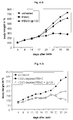
- the human PBMC-induced disease is characterized by lack of weight increase and weight loss, decreased mobility, hunched posture, ruffled fur and organ inflammation in the treated animals (Kizilisik and Al-Sebayel 1997). Transfer of human PBMC results in growth arrest or weight loss within 30 to 40 days (depending on the number of cells transferred) after transfer compared to untreated mice. Lack of weight increase / weight loss is used as a parameter to score GVHD severity. Control mice did not receive any PBMC. Data see Fig.3 .
- HIV-1 gp120 or a substance which can interfere with HIV-1 gp120-binding is administered in addition to the injection of human PBMC.
- Administration of HIV-1 gp120 or a substance which can interfere with HIV-1 gp120-binding induces an activation of human regulatory T cells in the PBMC fraction resulting in prevention of organ inflammation and prevention of growth arrest / weight loss similar to mice treated with human PBMC and additional human regulatory T cells or untreated mice. Lack of weight increase / weight loss is used as a parameter to score GVHD severity. Control mice did not receive any PBMC. Data see Fig.4 .
- NOD-Scid mice at the age of three to six days after birth are intraperitoneally injected with 1 x 10 7 human CD25-depleted PBMC (isolation of human CD25-depleted PBMC according to 2.1.7).
- GVHD is induced by 1 x 10 7 human CD25-depleted PBMC at the same magnitude as by transfer of 1 x 10 7 human non CD25-depleted PBMC into NOD-Scid mice.
- Mice receiving CD25-depleted PBMC and an additional administration of HIV gp120 are not protected from development of GVHD and weight loss.
- Prevention of GVHD by HIV gp120 or a substance which can interfere with HIV-1 gp120-binding depends on regulatory T cells. Lack of weight increase / weight loss is used as a parameter to score GVHD severity. Data see Fig.5 .
- HIV-1 gp120 treatment activates human CD4 + CD25 + Treg cells
- CD4 + CD25 + Treg cells are cocultured with T cell-depleted syngenic PBMC and allogeneic CD8 + T effector cells.
- proliferation of alloreactive CD8 + T effector cells is only suppressed by activated CD4 + CD25 + Treg cells such as upon additional anti-CD3 mAb stimulation or an activating HIV-1 gp120-mediated signal.
- Grey bars represent proliferation of CD8 + T cells and inactivated syngenic CD3-depleted PBMC, white bars represent the proliferation of CD4 + CD25 + Tregs and the black bars represent the proliferation of CD8 + T cells co-cultured with CD4 + CD25 + Tregs cells and inactivated syngenic CD3-depleted PBMC. Due to inactivation PBMC don't contribute to proliferation of the samples.
- Tregs don't show a significant proliferation under all conditions (without additional stimulus, or anti-CD3, or HIV-1 gp120 MN, or HIV-1 gp120 LAV, or HIV-1 gp120 CM).
- CD8 + T cells grey bars
- CD8 + T cells co-cultured with Treg cells black bars
- CD8 + T cells grey bars
- CD8 + T cells co-cultured with Treg cells black bars
- the effect is anti-CD3 dose-dependent.
- HIV-1 gp120 MN Upon stimulation with HIV-1 gp120 MN, or HIV-1 gp120 LAV, or HIV-1 gp120 CM CD8 + T cells co-cultured with Treg cells (black bars) in contrast to CD8 + T cells without Tregs (grey bars) reduced proliferation indicating HIV-1 gp120 activated Tregs.
- HIV-1 gp120 activates Tregs which subsequently exert suppressive activity on CD8 + T cells by reducing their proliferation.
- the suppressive activity of Treg cells and therefore the reduced proliferation is HIV-1 gp120 dose-dependent.
- CD4 + CD25 + regulatory T cells are left untreated ( ⁇ ) or stimulated with an anti-CD3 monoclonal Antibody (OKT-3; 1 ⁇ g/ml) or HIV-1 gp120 (1 ⁇ g/ml).
- OKT-3 an anti-CD3 monoclonal Antibody
- HIV-1 gp120 1 ⁇ g/ml
- the CD4 + CD25 + regulatory T cells are lysed (1x10 7 /ml) and the cytosolic cAMP concentration of 1x10 6 T cells is assessed using a cAMP-specific ELISA.
- CD4 + CD25 + regulatory,T cells (CD25) are left untreated ( ⁇ ) or stimulated with an anti-CD3 monoclonal Antibody (OKT-3; 1 ⁇ g/ml) or HIV-1 gp120 (1 ⁇ g/ml).
- OKT-3 an anti-CD3 monoclonal Antibody
- HIV-1 gp120 (1 ⁇ g/ml)
- the CD4 + CD25 + regulatory T cells are lysed (1x10 7 /ml) and the cytosolic cAMP concentration of 1x10 6 T cells is assessed using a cAMP-specific ELISA.
- Bars represent the amount of cytosolic (intracellular) cyclic AMP (cAMP) in untreated Treg cells or Treg cells treated with different stimuli.
- the upper bar represent Tregs left untreated ( ⁇ ) and shows the basal level of intracellular cAMP.
- Tregs are activated and show an increase of intracellular cAMP compared to the untreated control (upper bar) as demonstrated with the second bar.
- Treatment of Tregs with HIV-1 gp120 also induces an increase of intracellular cAMP as demonstrated with the lower bar. This demonstrated that activation of Treg cells with different stimuli induces an increase of cytosolic cAMP which can be used as readout for activation.
- Figure 3 Induction of GVHD by transfer of PBMC into NOD-Scid mice and prevention of GVHD by additional transfer of regulatory T cells (Tregs).
- NOD-Scid mice Three to six days old NOD-Scid mice are intraperitoneally injected with 1 x 10 7 human PBMC without (circles) or together with 2,5 x 10 6 human regulatory T cells (triangles). Control mice (rhombi) did not receive any PBMC. Mice having received PBMC develop a fatal GVHD, do not grow and die. Animals having additionally received regulatory T cells are protected from development of GVHD and develop normally (3 mice per group). Lack of weight increase / weight loss is used as a parameter to score GVHD severity. The diagram shows the relative body weight at different time points after transfer.
- Figure 4 Induction of GVHD by transfer of PBMC into NOD-Scid mice and prevention of GVHD by additional injection of HIV gp120.
- NOD-Scid mice Three to six days old NOD-Scid mice are intraperitoneally injected with 1 x 10 7 human PBMC without (circles) or together with 5 ⁇ g HIV gp120 (triangles). Control mice (rhombs) did not receive any PBMC. Mice having received PBMC develop a fatal GVHD, do not grow and die. Animals having additionally received HIV gp120 are protected from development of GVHD and develop normally (3 mice per group). Lack of weight increase / weight loss is used as a parameter to score GVHD severity. The diagram shows the relative body weight at different time points after transfer.
- Figure 5 Prevention of GVHD in NOD-Scid mice transferred with PBMC by additional injection of HIV gp120 depends on the presence of regulatory T cells.
- NOD-Scid mice Three to six days old NOD-Scid mice are intraperitoneally injected with 1 x 10 7 human CD25-depleted PBMC without (circles) or together with 5 ⁇ g HIV gp120 (triangles). Control mice (rhombi) do not receive any PBMC (3 mice per group). Mice having received CD25-depleted PBMC develop a fatal GVHD, do not grow and die. Animals having received 1 x 10 7 human CD25-depleted PBMC and additionally HIV gp120 are not protected from development of GVHD, also do not grow and die. Lack of weight increase / weight loss is used as a parameter to score GVHD severity. The diagram shows the relative body weight at different time points after transfer.
Landscapes
- Health & Medical Sciences (AREA)
- Life Sciences & Earth Sciences (AREA)
- Chemical & Material Sciences (AREA)
- Engineering & Computer Science (AREA)
- Medicinal Chemistry (AREA)
- General Health & Medical Sciences (AREA)
- Organic Chemistry (AREA)
- Bioinformatics & Cheminformatics (AREA)
- Animal Behavior & Ethology (AREA)
- Veterinary Medicine (AREA)
- Public Health (AREA)
- Pharmacology & Pharmacy (AREA)
- General Chemical & Material Sciences (AREA)
- Nuclear Medicine, Radiotherapy & Molecular Imaging (AREA)
- Chemical Kinetics & Catalysis (AREA)
- Immunology (AREA)
- Biomedical Technology (AREA)
- Hematology (AREA)
- Pulmonology (AREA)
- Virology (AREA)
- Cell Biology (AREA)
- Molecular Biology (AREA)
- Urology & Nephrology (AREA)
- Diabetes (AREA)
- Biochemistry (AREA)
- Gastroenterology & Hepatology (AREA)
- Microbiology (AREA)
- Dermatology (AREA)
- Genetics & Genomics (AREA)
- Proteomics, Peptides & Aminoacids (AREA)
- Biotechnology (AREA)
- Epidemiology (AREA)
- Neurology (AREA)
- Orthopedic Medicine & Surgery (AREA)
- Physical Education & Sports Medicine (AREA)
- Zoology (AREA)
- Wood Science & Technology (AREA)
- Physics & Mathematics (AREA)
- Pathology (AREA)
- Toxicology (AREA)
Claims (11)
- Procédé pour déterminer si une substance peut activer une cellule T régulatrice (Treg) par interaction avec le site de liaison HIV-1gp120 de CD4, comprenant les étapes consistant à :(a) présélectionner une substance qui peut interagir avec le site de liaison HIV-1gap120 de CD4,(b) fournir une solution comprenant une cellule Treg,(c) ajouter une substance présélectionnée selon (a) dans des conditions qui permettent l'interaction de la substance avec une cellule Treg,(d) mesurer si une cellule Treg a été activée, où une cellule Treg activée identifie la substance comme étant un activateur de cellule Treg, où l'étape (a) de la revendication 1 comprend les étapes consistant à :i) fournir une première solution comprenant CD4,ii) fournir une seconde solution comprenant CD4,iii) ajouter à la première solution une substance à tester et HIV-1gp120 dans des conditions qui permettent la liaison de HIV-1gp120 avec CD4,iv) ajouter à la seconde solution HIV-1gp120 dans des conditions identiques à c) permettant la liaison de HIV-1gp120 avec CD4,v) mesurer dans la première et dans la seconde solutions si la HIV-1gp120 s'est liée à CD4, où une quantité réduite de HIV-1gp120 liée dans la première solution indique que la substance peut interagir avec le site de liaison HIV-1gp120 de CD4.
- Procédé selon la revendication 1, dans lequel à l'étape (d) de la revendication 1, la mesure pour savoir si une cellule Treg a été activée est déterminée en mesurant la quantité de cAMP intracellulaire, et dans lequel une quantité accrue de cAMP intracellulaire est indicatrice d'une cellule Treg activée et identifie par conséquent la substance comme étant un activateur de cellule Treg.
- Procédé selon la revendication 1, dans lequel à la place de CD4, on utilise un peptide tel que mentionné dans l'ID SEQ n° : 1.
- Procédé selon la revendication 1 ou 3, dans lequel à la place de HIV-1gap120, on utilise un peptide sélectionné dans un groupe composé d'un peptide qui comprend la séquence d'acides aminés telle que mentionnée dans les ID SEQ n° : 3 ; ID SEQ n° : 4, ID SEQ n° : 5, ID SEQ n° : 6, ID SEQ n° : 7, ID SEQ n° : 8, ID SEQ n° : 9 et ID SEQ n° : 10.
- Procédé pour déterminer si une substance peut activer une cellule T régulatrice (Treg) par interaction avec l'épitope tel que mentionné dans l'ID SEQ n° : 1, et comprenant les étapes consistant à :(a) fournir une première solution comprenant une cellule Treg,(b) ajouter une substance à tester dans des conditions qui permettent une interaction de la substance avec une cellule Treg,(c) mesurer si une cellule Treg de la première solution a été activée,(d) fournir une seconde solution comprenant une cellule Treg,(e) ajouter la substance à tester et un peptide comprenant une séquence d'acides aminés telle que mentionnée dans l'ID SEQ n° : 1 dans des conditions identiques à (b),(f) mesurer si une cellule Treg de la seconde solution a été activée,(g) comparer les résultats obtenus à partir de (c) avec ceux obtenus à partir de (f), où une activation réduite de (f) identifie la substance comme étant un activateur de cellule Treg qui active une cellule Treg par interaction avec l'épitope tel que mentionné dans l'ID SEQ n° : 1.
- Procédé selon la revendication 5, dans lequel à l'étape (e) de la revendication 5, le peptide utilisé est un peptide isolé englobant les acides aminés n° 1 à 31 de l'ID SEQ n° : 1 et ayant des acides aminés supplémentaires en amont et/ou en aval avec le pré-requis selon lequel les acides aminés supplémentaires n'empêchent pas la liaison d'une substance à la plage d'acides aminés telle que mentionnée dans l'ID SEQ n° :1.
- Utilisation in vitro d'un activateur de cellule Treg pour activer une cellule T régulatrice (Treg) par interaction avec l'épitope de la cellule Treg tel que mentionné dans l'ID SEQ n° : 1, qui est- un anticorps ou un fragment de liaison de celui-ci capable de se lier au peptide tel que mentionné dans l'ID SEQ n° : 1, à la condition que l'anticorps ou le fragment d'anticorps ne soit pas
OKT4A, OKT4D, OKTcdr4a, MAX.12H5 et ne soit pas Leu3 ;
ou qui est- un peptide ou un polypeptide comprenant la séquence d'acides aminés telle que mentionnée dans les ID SEQ n° : 3 ; ID SEQ n° : 4, ID SEQ n° : 5, ID SEQ n° : 6, ID SEQ n° : 7, ID SEQ n° : 8, ID SEQ n° : 9 ou ID SEQ n° : 10 ;
ou qui est- HIV-1gp120. - Activateur de cellule Treg pour activer une cellule T régulatrice (Treg) par interaction avec l'épitope de la cellule Treg tel que mentionné dans l'ID SEQ n° : 1, qui est- un peptide ou un polypeptide composé de la séquence d'acides aminés telle que mentionnée dans les ID SEQ n° : 3 ; ID SEQ n° : 4, ID SEQ n° : 5, ID SEQ n° : 6, ID SEQ n° : 7, ID SEQ n° : 8, ID SEQ n° : 9 ou ID SEQ n° : 10.
- Activateur de cellule Treg pour activer une cellule T régulatrice (Treg) par interaction avec l'épitope de la cellule Treg tel que mentionné dans l'ID SEQ n° : 1, qui est- un anticorps ou un fragment de liaison de celui-ci capable de se lier au peptide tel que mentionné dans l'ID SEQ n° : 1, à la condition que l'anticorps ou le fragment d'anticorps ne soit pas
OKT4A, OKT4D, OKTcdr4a, MAX.12H5 et ne soit pas Leu3 ;
ou qui est- un peptide ou un polypeptide composé de la séquence d'acides aminés telle que mentionnée dans les ID SEQ n° : 3 ; ID SEQ n° : 4, ID SEQ n° : 5, ID SEQ n° : 6, ID SEQ n° : 7, ID SEQ n° : 8, ID SEQ n° : 9 ou ID SEQ n° : 10,
à utiliser en tant que médicament. - Activateur de cellule Treg pour activer une cellule T régulatrice (Treg) par interaction avec l'épitope de la cellule Treg tel que mentionné dans l'ID SEQ n° : 1, qui est- un anticorps ou un fragment de liaison de celui-ci capable de se lier au peptide tel que mentionné dans l'ID SEQ n° : 1, à la condition que l'anticorps ou le fragment d'anticorps ne soit pas
OKT4A, OKT4D, OKTcdr4a, MAX.12H5 et ne soit pas Leu3 ;
ou qui est- un peptide ou un polypeptide composé de la séquence d'acides aminés telle que mentionnée dans les ID SEQ n° : 3 ; ID SEQ n° : 4, ID SEQ n° : 5, ID SEQ n° : 6, ID SEQ n° : 7, ID SEQ n° : 8, ID SEQ n° : 9 ou ID SEQ n° : 10,
à utiliser dans un procédé de prévention ou de traitement d'une maladie sélectionnée parmi un groupe composé de (i) une maladie inflammatoire non-auto-immune : asthme allergique, dermatite atopique, allergie alimentaire, réaction de greffe contre hôte ; (ii) une maladie inflammatoire auto-immune : arthrite rhumatoïde, rhumatisme articulaire aigu, lupus érythémateux disséminé, rectocolite hémorragique, maladie de Crohn, affection abdominale inflammatoire auto-immune, diabète de type I, sclérose en plaques, myasténie gravis, psoriasis, pemphigus vulgaire, phemphigoïde, (iii) une maladie inflammatoire due à une transplantation d'organe ; (iv) une transplantation de moelle osseuse. - Composition pharmaceutique comprenant au moins un activateur de cellule Treg pour activer une cellule T régulatrice (Treg) par interaction avec l'épitope de la cellule Treg tel que mentionné dans l'ID SEQ n° : 1, qui est- un anticorps ou un fragment de liaison de celui-ci capable de se lier au peptide tel que mentionné dans l'ID SEQ n° : 1, à la condition que l'anticorps ou le fragment d'anticorps ne soit pas
OKT4A, OKT4D, OKTcdr4a, MAX.12H5 et ne soit pas Leu3 ;
ou qui est- un peptide ou un polypeptide composé de la séquence d'acides aminés telle que mentionnée dans les ID SEQ n° : 3 ; ID SEQ n° : 4, ID SEQ n° : 5, ID SEQ n° : 6, ID SEQ n° : 7, ID SEQ n° : 8, ID SEQ n° : 9 ou ID SEQ n° : 10.
Priority Applications (2)
| Application Number | Priority Date | Filing Date | Title |
|---|---|---|---|
| EP16166807.4A EP3112866B1 (fr) | 2007-02-01 | 2008-01-30 | Activation specifique d'un lymphocyte regulateur et son utilisation pour le traitement de l'asthme, d'une maladie allergique, d'une maladie autoimmune, d'un rejet de greffe et pour une induction de tolerance |
| EP08708459.6A EP2109770B1 (fr) | 2007-02-01 | 2008-01-30 | Activation spécifique d'un lymphocyte régulateur et son utilisation pour le traitement de l'asthme, d'une maladie allergique, d'une maladie auto-immune, d'un rejet de greffe et pour une induction de tolerance |
Applications Claiming Priority (4)
| Application Number | Priority Date | Filing Date | Title |
|---|---|---|---|
| EP07101604 | 2007-02-01 | ||
| EP07122424 | 2007-12-05 | ||
| PCT/EP2008/051144 WO2008092905A2 (fr) | 2007-02-01 | 2008-01-30 | Activation spécifique d'un lymphocyte t régulateur et son utilisation pour le traitement de l'asthme, d'une maladie allergique, d'une maladie auto-immune, d'un rejet de greffe et pour une induction de tolérance |
| EP08708459.6A EP2109770B1 (fr) | 2007-02-01 | 2008-01-30 | Activation spécifique d'un lymphocyte régulateur et son utilisation pour le traitement de l'asthme, d'une maladie allergique, d'une maladie auto-immune, d'un rejet de greffe et pour une induction de tolerance |
Related Child Applications (2)
| Application Number | Title | Priority Date | Filing Date |
|---|---|---|---|
| EP16166807.4A Division EP3112866B1 (fr) | 2007-02-01 | 2008-01-30 | Activation specifique d'un lymphocyte regulateur et son utilisation pour le traitement de l'asthme, d'une maladie allergique, d'une maladie autoimmune, d'un rejet de greffe et pour une induction de tolerance |
| EP16166807.4A Division-Into EP3112866B1 (fr) | 2007-02-01 | 2008-01-30 | Activation specifique d'un lymphocyte regulateur et son utilisation pour le traitement de l'asthme, d'une maladie allergique, d'une maladie autoimmune, d'un rejet de greffe et pour une induction de tolerance |
Publications (2)
| Publication Number | Publication Date |
|---|---|
| EP2109770A2 EP2109770A2 (fr) | 2009-10-21 |
| EP2109770B1 true EP2109770B1 (fr) | 2016-07-06 |
Family
ID=39363828
Family Applications (2)
| Application Number | Title | Priority Date | Filing Date |
|---|---|---|---|
| EP08708459.6A Not-in-force EP2109770B1 (fr) | 2007-02-01 | 2008-01-30 | Activation spécifique d'un lymphocyte régulateur et son utilisation pour le traitement de l'asthme, d'une maladie allergique, d'une maladie auto-immune, d'un rejet de greffe et pour une induction de tolerance |
| EP16166807.4A Active EP3112866B1 (fr) | 2007-02-01 | 2008-01-30 | Activation specifique d'un lymphocyte regulateur et son utilisation pour le traitement de l'asthme, d'une maladie allergique, d'une maladie autoimmune, d'un rejet de greffe et pour une induction de tolerance |
Family Applications After (1)
| Application Number | Title | Priority Date | Filing Date |
|---|---|---|---|
| EP16166807.4A Active EP3112866B1 (fr) | 2007-02-01 | 2008-01-30 | Activation specifique d'un lymphocyte regulateur et son utilisation pour le traitement de l'asthme, d'une maladie allergique, d'une maladie autoimmune, d'un rejet de greffe et pour une induction de tolerance |
Country Status (6)
| Country | Link |
|---|---|
| US (4) | US8557533B2 (fr) |
| EP (2) | EP2109770B1 (fr) |
| JP (2) | JP5867795B2 (fr) |
| CA (1) | CA2676170C (fr) |
| ES (2) | ES2825718T3 (fr) |
| WO (1) | WO2008092905A2 (fr) |
Families Citing this family (12)
| Publication number | Priority date | Publication date | Assignee | Title |
|---|---|---|---|---|
| WO2007127787A2 (fr) | 2006-04-25 | 2007-11-08 | Joslin Diabetes Center, Inc. | Lymphocytes t cd4+ de régulation spécifique auto-antigénique de l'insuline |
| US8557533B2 (en) * | 2007-02-01 | 2013-10-15 | Helmut Jonuleit | Screening method for the identification of agents capable of activating CD4+CD25+ regulatory T-cells through interactions with the HIV-1 GP120 binding site on CD4 |
| CN102027017A (zh) | 2008-03-13 | 2011-04-20 | 生物测试股份公司 | 一种治疗疾病的试剂 |
| PL2262838T3 (pl) | 2008-03-13 | 2016-10-31 | Środek do leczenia choroby | |
| AU2009224690B2 (en) | 2008-03-13 | 2014-10-09 | Biotest Ag | Agent for treating disease |
| PL2318020T3 (pl) * | 2008-06-30 | 2016-02-29 | Univ Heidelberg | Immunosupresyjne komórki krwi i sposób ich wytwarzania |
| GB0920944D0 (en) | 2009-11-30 | 2010-01-13 | Biotest Ag | Agents for treating disease |
| EP2471543A1 (fr) | 2010-12-02 | 2012-07-04 | Fraunhofer-Gesellschaft zur Förderung der angewandten Forschung e.V. | Induction de tolérance ou immunosuppression pour empêcher en particulier la réaction du greffon contre l'hôte (GvHD) par une pré-incubation de courte durée des suspensions de cellules transplantées, tissus ou organes revêtus par les ligands sur les molécules à la surface des cellules |
| EP2691515A2 (fr) * | 2011-03-31 | 2014-02-05 | President and Fellows of Harvard College | Population unique de lymphocytes t régulateurs qui régulent la régénération de tissu et la cicatrisation des plaies |
| US20160271086A1 (en) * | 2013-10-31 | 2016-09-22 | Sloan-Kettering Institute For Cancer Research | Methods and compositions for inducing regulatory t-cell generation |
| WO2019099788A1 (fr) * | 2017-11-16 | 2019-05-23 | Benaroya Sesearch Institute At Virginia Mason | Dosage de lymphocytes t régulateurs spécifiques d'un antigène |
| GB202401501D0 (en) | 2024-02-05 | 2024-03-20 | T Balance Therapeutics Gmbh | Medical use of regulatory t cell activator |
Citations (1)
| Publication number | Priority date | Publication date | Assignee | Title |
|---|---|---|---|---|
| WO2004072296A2 (fr) * | 2003-01-30 | 2004-08-26 | The General Hospital Corporation | Compositions permettant de moduler l'activite des cellules immunitaires et procedes de detection de l'activite des cellules immunitaires |
Family Cites Families (19)
| Publication number | Priority date | Publication date | Assignee | Title |
|---|---|---|---|---|
| US4695459A (en) * | 1984-12-26 | 1987-09-22 | The Board Of Trustees Of Leland Stanford Junior University | Method of treating autoimmune diseases that are mediated by Leu3/CD4 phenotype T cells |
| IL84154A0 (en) * | 1986-10-16 | 1988-03-31 | Microgenesys Inc | Polypeptides derived from the envelope gene of human immunodeficiency virus in recombinant baculovirus infected insect cells and vaccines against acquired immune deficiency syndrome containing the same |
| JPH0768273B2 (ja) | 1988-12-02 | 1995-07-26 | カルピス食品工業株式会社 | 抗hivペプチド |
| WO1991004273A2 (fr) * | 1989-09-22 | 1991-04-04 | Idec Pharmaceuticals Corp. | Nouveaux peptides associes a la region de liaison cd4 de la gp120 et leur mode d'emploi |
| GB8928874D0 (en) | 1989-12-21 | 1990-02-28 | Celltech Ltd | Humanised antibodies |
| CN1165147A (zh) | 1996-02-07 | 1997-11-19 | 武田药品工业株式会社 | 鸟嘌呤核苷酸结合蛋白偶联受体蛋白质,其生产和应用 |
| US6585979B1 (en) * | 1996-07-08 | 2003-07-01 | Genentech, Inc. | HIV envelope polypeptides and immunogenic composition |
| WO1999048514A1 (fr) * | 1998-03-25 | 1999-09-30 | Mayo Foundation For Medical Education And Research | Procedes et substances de traitement des maladies inflammatoires |
| US7608273B2 (en) * | 1998-08-12 | 2009-10-27 | University Of Western Ontario | Recombinant lentivirus encoding modified GP 120 signal sequences |
| US6337181B1 (en) * | 1998-12-21 | 2002-01-08 | Jeffrey Joseph Stewart | Method of specifying vaccine components for viral quasispecies |
| WO2000039304A2 (fr) * | 1998-12-31 | 2000-07-06 | Chiron Corporation | Polynucleotides codant pour des polypeptides antigeniques du type c du vih; polypeptides et leurs utilisations |
| SE9904660D0 (sv) | 1999-12-17 | 1999-12-17 | Astra Pharma Inc | Novel assays |
| EP1241249A1 (fr) | 2001-03-12 | 2002-09-18 | Gerold Schuler | Lymphocytes T CD4+CD25+ régulateurs provenant du sang humain |
| AU2003205627A1 (en) | 2002-02-01 | 2003-09-02 | Bayer Healthcare Ag | Diagnostics and therapeutics for diseases associated with gpr72 |
| EP1460088A1 (fr) * | 2003-03-21 | 2004-09-22 | Biotest AG | Anticorps humanisé contre CD4 avec des caractéristiques immunosuppressives |
| US20050048587A1 (en) * | 2003-07-17 | 2005-03-03 | Tolerrx, Inc. | Methods for identifying tolerance modulatory compounds and uses therefor |
| CA2569562C (fr) * | 2004-06-08 | 2013-12-03 | Vega Masignani | Proteines de fusion comprenant des modules cd4 minimaux, et procedes d'utilisation correspondants |
| US20070122845A1 (en) | 2005-09-19 | 2007-05-31 | Eisai R&D Management Co., Ltd. | Methods for identifying GPR83 agonists and GPR83 antagonists capable of modulating regulatory T cell function |
| US8557533B2 (en) | 2007-02-01 | 2013-10-15 | Helmut Jonuleit | Screening method for the identification of agents capable of activating CD4+CD25+ regulatory T-cells through interactions with the HIV-1 GP120 binding site on CD4 |
-
2008
- 2008-01-30 US US12/525,142 patent/US8557533B2/en not_active Expired - Fee Related
- 2008-01-30 JP JP2009547686A patent/JP5867795B2/ja not_active Expired - Fee Related
- 2008-01-30 ES ES16166807T patent/ES2825718T3/es active Active
- 2008-01-30 WO PCT/EP2008/051144 patent/WO2008092905A2/fr not_active Ceased
- 2008-01-30 ES ES08708459.6T patent/ES2593789T3/es active Active
- 2008-01-30 EP EP08708459.6A patent/EP2109770B1/fr not_active Not-in-force
- 2008-01-30 EP EP16166807.4A patent/EP3112866B1/fr active Active
- 2008-01-30 CA CA2676170A patent/CA2676170C/fr active Active
-
2013
- 2013-09-19 US US14/031,919 patent/US20140093509A1/en not_active Abandoned
-
2014
- 2014-05-08 JP JP2014097086A patent/JP6038070B2/ja active Active
-
2016
- 2016-10-05 US US15/285,561 patent/US10729742B2/en active Active
-
2020
- 2020-06-25 US US16/912,199 patent/US20200316167A1/en not_active Abandoned
Patent Citations (1)
| Publication number | Priority date | Publication date | Assignee | Title |
|---|---|---|---|---|
| WO2004072296A2 (fr) * | 2003-01-30 | 2004-08-26 | The General Hospital Corporation | Compositions permettant de moduler l'activite des cellules immunitaires et procedes de detection de l'activite des cellules immunitaires |
Non-Patent Citations (32)
| Title |
|---|
| AGRAWAL RACHANA ET AL: "The role of regulatory T cells in atopic dermatitis.", CURRENT PROBLEMS IN DERMATOLOGY 2011, vol. 41, 2011, pages 112 - 124, ISSN: 1662-2944 * |
| BALANDINA ANNA ET AL: "Functional defect of regulatory CD4(+)CD25+ T cells in the thymus of patients with autoimmune myasthenia gravis.", BLOOD 15 JAN 2005, vol. 105, no. 2, 15 January 2005 (2005-01-15), pages 735 - 741, XP003009669, ISSN: 0006-4971, DOI: doi:10.1182/blood-2003-11-3900 * |
| BENGHIAT FLEUR SAMANTHA ET AL: "Critical influence of natural regulatory CD25+ T cells on the fate of allografts in the absence of immunosuppression.", TRANSPLANTATION 27 MAR 2005, vol. 79, no. 6, 27 March 2005 (2005-03-27), pages 648 - 654, ISSN: 0041-1337 * |
| CARLIER VINCENT A ET AL: "Regulatory CD4+ T cells in allergic asthma.", EXPERT REVIEW OF CLINICAL IMMUNOLOGY SEP 2006, vol. 2, no. 5, September 2006 (2006-09-01), pages 737 - 744, ISSN: 1744-8409 * |
| CHORNY ALEJO ET AL: "Vasoactive intestinal peptide generates CD4+CD25+ regulatory T cells in vivo: therapeutic applications in autoimmunity and transplantation.", ANNALS OF THE NEW YORK ACADEMY OF SCIENCES JUL 2006, vol. 1070, July 2006 (2006-07-01), pages 190 - 195, XP002441867, ISSN: 0077-8923, DOI: doi:10.1196/annals.1317.011 * |
| CRISPIN JOSE C ET AL: "Quantification of regulatory T cells in patients with systemic lupus erythematosus.", JOURNAL OF AUTOIMMUNITY NOV 2003, vol. 21, no. 3, November 2003 (2003-11-01), pages 273 - 276, XP002549909, ISSN: 0896-8411, DOI: doi:10.1016/S0896-8411(03)00121-5 * |
| DIPAOLO RICHARD J ET AL: "CD4+CD25+ T cells prevent the development of organ-specific autoimmune disease by inhibiting the differentiation of autoreactive effector T cells.", JOURNAL OF IMMUNOLOGY (BALTIMORE, MD. : 1950) 1 DEC 2005, vol. 175, no. 11, 1 December 2005 (2005-12-01), pages 7135 - 7142, ISSN: 0022-1767 * |
| E. ANTIGA ET AL: "Regulatory T cells in skin lesions and blood of patients with bullous pemphigoid", JOURNAL OF THE EUROPEAN ACADEMY OF DERMATOLOGY AND VENEREOLOGY, 1 January 2013 (2013-01-01), pages 1 - 9, XP055076069, ISSN: 0926-9959, DOI: 10.1111/jdv.12091 * |
| EDINGER MATTHIAS ET AL: "CD4+CD25+ regulatory T cells preserve graft-versus-tumor activity while inhibiting graft-versus-host disease after bone marrow transplantation.", NATURE MEDICINE SEP 2003, vol. 9, no. 9, September 2003 (2003-09-01), pages 1144 - 1150, ISSN: 1078-8956 * |
| EHRENSTEIN MICHAEL R ET AL: "Compromised function of regulatory T cells in rheumatoid arthritis and reversal by anti-TNFalpha therapy.", THE JOURNAL OF EXPERIMENTAL MEDICINE 2 AUG 2004, vol. 200, no. 3, 2 August 2004 (2004-08-02), pages 277 - 285, XP002486681, ISSN: 0022-1007, DOI: doi:10.1084/jem.20040165 * |
| FYHRQUIST NANNA ET AL: "Foxp3+ cells control Th2 responses in a murine model of atopic dermatitis.", THE JOURNAL OF INVESTIGATIVE DERMATOLOGY JUN 2012, vol. 132, no. 6, June 2012 (2012-06-01), pages 1672 - 1680, ISSN: 1523-1747 * |
| HAAS JÜRGEN ET AL: "Reduced suppressive effect of CD4+CD25high regulatory T cells on the T cell immune response against myelin oligodendrocyte glycoprotein in patients with multiple sclerosis.", EUROPEAN JOURNAL OF IMMUNOLOGY NOV 2005, vol. 35, no. 11, November 2005 (2005-11-01), pages 3343 - 3352, XP055085663, ISSN: 0014-2980, DOI: doi:10.1002/eji.200526065 * |
| HEROLD KEVAN C ET AL: "Anti-CD3 monoclonal antibody in new-onset type 1 diabetes mellitus.", THE NEW ENGLAND JOURNAL OF MEDICINE 30 MAY 2002, vol. 346, no. 22, 30 May 2002 (2002-05-30), pages 1692 - 1698, ISSN: 1533-4406 * |
| KEARLEY JENNIFER ET AL: "Resolution of airway inflammation and hyperreactivity after in vivo transfer of CD4+CD25+ regulatory T cells is interleukin 10 dependent.", THE JOURNAL OF EXPERIMENTAL MEDICINE 5 DEC 2005, vol. 202, no. 11, 5 December 2005 (2005-12-05), pages 1539 - 1547, XP002548571, ISSN: 0022-1007, DOI: doi:10.1084/jem.20051166 * |
| KOHM ADAM P ET AL: "Cutting edge: CD4+CD25+ regulatory T cells suppress antigen-specific autoreactive immune responses and central nervous system inflammation during active experimental autoimmune encephalomyelitis.", JOURNAL OF IMMUNOLOGY, vol. 169, no. 9, 1 November 2002 (2002-11-01), pages 4712 - 4716, ISSN: 0022-1767 * |
| L. GRAY ET AL: "Genetic and Functional Analysis of R5X4 Human Immunodeficiency Virus Type 1 Envelope Glycoproteins Derived from Two Individuals Homozygous for the CCR5 32 Allele", JOURNAL OF VIROLOGY, vol. 80, no. 7, 14 March 2006 (2006-03-14), pages 3684 - 3691, XP055115233, ISSN: 0022-538X, DOI: 10.1128/JVI.80.7.3684-3691.2006 * |
| LEWKOWICH IAN P ET AL: "CD4+CD25+ T cells protect against experimentally induced asthma and alter pulmonary dendritic cell phenotype and function.", THE JOURNAL OF EXPERIMENTAL MEDICINE 5 DEC 2005, vol. 202, no. 11, 5 December 2005 (2005-12-05), pages 1549 - 1561, ISSN: 0022-1007 * |
| LINDLEY SHELLEY ET AL: "Defective suppressor function in CD4(+)CD25(+) T-cells from patients with type 1 diabetes.", DIABETES JAN 2005, vol. 54, no. 1, January 2005 (2005-01-01), pages 92 - 99, ISSN: 0012-1797 * |
| LIU HAIYING ET AL: "CD4+CD25+ regulatory T cells cure murine colitis: the role of IL-10, TGF-beta, and CTLA4.", JOURNAL OF IMMUNOLOGY (BALTIMORE, MD. : 1950) 15 NOV 2003, vol. 171, no. 10, 15 November 2003 (2003-11-15), pages 5012 - 5017, ISSN: 0022-1767 * |
| MORGAN MARY E ET AL: "CD25+ cell depletion hastens the onset of severe disease in collagen-induced arthritis.", ARTHRITIS AND RHEUMATISM MAY 2003, vol. 48, no. 5, May 2003 (2003-05-01), pages 1452 - 1460, ISSN: 0004-3591 * |
| MOTTET CHRISTIAN ET AL: "Cutting edge: cure of colitis by CD4+CD25+ regulatory T cells.", JOURNAL OF IMMUNOLOGY (BALTIMORE, MD. : 1950) 15 APR 2003, vol. 170, no. 8, 15 April 2003 (2003-04-15), pages 3939 - 3943, XP002275079, ISSN: 0022-1767 * |
| R. DICKOVER ET AL: "Role of Maternal Autologous Neutralizing Antibody in Selective Perinatal Transmission of Human Immunodeficiency Virus Type 1 Escape Variants", JOURNAL OF VIROLOGY, vol. 80, no. 13, 14 June 2006 (2006-06-14), pages 6525 - 6533, XP055115244, ISSN: 0022-538X, DOI: 10.1128/JVI.02658-05 * |
| SALOMON B ET AL: "B7/CD28 costimulation is essential for the homeostasis of the CD4+CD25+ immunoregulatory T cells that control autoimmune diabetes.", IMMUNITY APR 2000, vol. 12, no. 4, April 2000 (2000-04-01), pages 431 - 440, XP008040741, ISSN: 1074-7613, DOI: doi:10.1016/S1074-7613(00)80195-8 * |
| SUGIYAMA H ET AL: "CD4+CD25high regulatory T cells are markedly decreased in blood of patients with pemphigus vulgaris.", DERMATOLOGY (BASEL, SWITZERLAND) 2007, vol. 214, no. 3, 2007, pages 210 - 220, ISSN: 1018-8665 * |
| SUGIYAMA HIDEAKI ET AL: "Dysfunctional blood and target tissue CD4+CD25high regulatory T cells in psoriasis: mechanism underlying unrestrained pathogenic effector T cell proliferation.", JOURNAL OF IMMUNOLOGY (BALTIMORE, MD. : 1950) 1 JAN 2005, vol. 174, no. 1, 1 January 2005 (2005-01-01), pages 164 - 173, ISSN: 0022-1767 * |
| TAKAHASHI MAKOTO ET AL: "An inverse correlation of human peripheral blood regulatory T cell frequency with the disease activity of ulcerative colitis.", DIGESTIVE DISEASES AND SCIENCES APR 2006, vol. 51, no. 4, April 2006 (2006-04-01), pages 677 - 686, XP019277184, ISSN: 0163-2116 * |
| TANG QIZHI ET AL: "In vitro-expanded antigen-specific regulatory T cells suppress autoimmune diabetes.", THE JOURNAL OF EXPERIMENTAL MEDICINE 7 JUN 2004, vol. 199, no. 11, 7 June 2004 (2004-06-07), pages 1455 - 1465, XP002665683, ISSN: 0022-1007, DOI: doi:10.1084/JEM.20040139 * |
| UHLIG HOLM H ET AL: "Characterization of Foxp3+CD4+CD25+ and IL-10-secreting CD4+CD25+ T cells during cure of colitis.", JOURNAL OF IMMUNOLOGY (BALTIMORE, MD. : 1950) 1 NOV 2006, vol. 177, no. 9, 1 November 2006 (2006-11-01), pages 5852 - 5860, ISSN: 0022-1767 * |
| VAN WIJK F ET AL: "CD4+CD25+ T cells regulate the intensity of hypersensitivity responses to peanut, but are not decisive in the induction of oral sensitization.", CLINICAL AND EXPERIMENTAL ALLERGY : JOURNAL OF THE BRITISH SOCIETY FOR ALLERGY AND CLINICAL IMMUNOLOGY APR 2007, vol. 37, no. 4, April 2007 (2007-04-01), pages 572 - 581, ISSN: 0954-7894 * |
| XYSTRAKIS EMMANUEL ET AL: "Regulatory T cell therapy as individualized medicine for asthma and allergy.", CURRENT OPINION IN ALLERGY AND CLINICAL IMMUNOLOGY DEC 2007, vol. 7, no. 6, December 2007 (2007-12-01), pages 535 - 541, XP008132257, ISSN: 1528-4050, DOI: doi:10.1097/ACI.0b013e3282f14d7c * |
| Y. LIU ET AL: "Selection on the Human Immunodeficiency Virus Type 1 Proteome following Primary Infection", JOURNAL OF VIROLOGY, vol. 80, no. 19, 13 September 2006 (2006-09-13), pages 9519 - 9529, XP055116113, ISSN: 0022-538X, DOI: 10.1128/JVI.00575-06 * |
| ZHENG SONG GUO ET AL: "Transfer of regulatory T cells generated ex vivo modifies graft rejection through induction of tolerogenic CD4+CD25+ cells in the recipient.", INTERNATIONAL IMMUNOLOGY FEB 2006, vol. 18, no. 2, February 2006 (2006-02-01), pages 279 - 289, XP002442937, ISSN: 0953-8178, DOI: doi:10.1093/intimm/dxh368 * |
Also Published As
| Publication number | Publication date |
|---|---|
| US20200316167A1 (en) | 2020-10-08 |
| US20170014474A1 (en) | 2017-01-19 |
| WO2008092905A3 (fr) | 2008-10-09 |
| US10729742B2 (en) | 2020-08-04 |
| JP2010518810A (ja) | 2010-06-03 |
| US20140093509A1 (en) | 2014-04-03 |
| EP3112866B1 (fr) | 2020-07-29 |
| EP3112866A1 (fr) | 2017-01-04 |
| US20100074904A1 (en) | 2010-03-25 |
| ES2593789T3 (es) | 2016-12-13 |
| US8557533B2 (en) | 2013-10-15 |
| EP2109770A2 (fr) | 2009-10-21 |
| CA2676170C (fr) | 2021-01-05 |
| ES2825718T3 (es) | 2021-05-17 |
| CA2676170A1 (fr) | 2008-08-07 |
| JP2014156477A (ja) | 2014-08-28 |
| JP6038070B2 (ja) | 2016-12-07 |
| WO2008092905A2 (fr) | 2008-08-07 |
| JP5867795B2 (ja) | 2016-02-24 |
Similar Documents
| Publication | Publication Date | Title |
|---|---|---|
| EP3112866B1 (fr) | Activation specifique d'un lymphocyte regulateur et son utilisation pour le traitement de l'asthme, d'une maladie allergique, d'une maladie autoimmune, d'un rejet de greffe et pour une induction de tolerance | |
| Lu et al. | Major peptide autoepitopes for nucleosome-specific T cells of human lupus | |
| Jamieson et al. | Generation of functional thymocytes in the human adult | |
| Rininsland et al. | Granzyme B ELISPOT assay for ex vivo measurements of T cell immunity | |
| Kaneko et al. | Impaired induction of cytotoxic T lymphocytes by antagonism of a weak agonist borne by a variant hepatitis C virus epitope | |
| US20220373538A1 (en) | Composition for determination of cell-mediated immune responsiveness | |
| AU2008301240B2 (en) | A method for identifying antigen-specific regulatory T cells | |
| Martin et al. | HLA-DR, ICAM-1, CD40, CD40L, and CD86 are incorporated to a similar degree into clinical human immunodeficiency virus type 1 variants expanded in natural reservoirs such as peripheral blood mononuclear cells and human lymphoid tissue cultured ex vivo | |
| US20070178532A1 (en) | Identification, quantification, and characterization of t cells and t cell antigens | |
| Herberts et al. | Autoreactivity against induced or upregulated abundant self-peptides in HLA-A* 0201 following measles virus infection | |
| Carbone et al. | Reduced expression of major histocompatibility complex class I free heavy chains and enhanced sensitivity to natural killer cells after incubation of human lymphoid lines with β2‐microglobulin | |
| CA3251133A1 (fr) | Récepteurs immunitaires artificiels | |
| US20220409716A1 (en) | T-cell compositions and methods of making and using the same | |
| D’Orsogna et al. | Drug-induced alloreactivity: a new paradigm for allorecognition | |
| Mason et al. | Cross-reactive cytotoxic T lymphocytes against human immunodeficiency virus type 1 protease and gamma interferon-inducible protein 30 | |
| WO2010040853A1 (fr) | Procédé pour le criblage de substances candidates actives contre l'infection d'un sujet par un virus du vih et kits pour mettre en œuvre ledit procédé | |
| WO2008098787A2 (fr) | Cd83 comme commutateur moléculaire pour l'induction de lymphocytes t régulateurs (immunosuppresseurs) | |
| Burastero et al. | Immunological basis for IgE hyper-production in enfuvirtide-treated HIV-positive patients | |
| Effenberger | Isolation, Characerization and Functional Re-Expression of T Cell Receptors with Therapeutic Value for Adoptive T Cell Therapy | |
| Davey et al. | T-cell clones derived by CD3 stimulation from hepatitis C virus explanted liver tissue are not representative of dominant clones present in vivo | |
| Li | Weaponizing the Immune System to Fight Infectious Diseases: Developing Immunotherapeutics to Amplify and Reinvigorate Potent HIV and CMV-Specific CD8+ T Cell Responses | |
| Kawashima et al. | Identification and characterization of HIV-1 epitopes presented by HLA-A* 2603: comparison between HIV-1 epitopes presented by A* 2601 and A* 2603 | |
| Parsons | Lessons learned: natural killer cell education as a determinant of the anti-viral functional potential of natural killer cells | |
| Carboneov et al. | surface zyxwvutsrqponmlk | |
| Henklein et al. | Identification of HLA-B27-Restricted |
Legal Events
| Date | Code | Title | Description |
|---|---|---|---|
| PUAI | Public reference made under article 153(3) epc to a published international application that has entered the european phase |
Free format text: ORIGINAL CODE: 0009012 |
|
| 17P | Request for examination filed |
Effective date: 20090901 |
|
| AK | Designated contracting states |
Kind code of ref document: A2 Designated state(s): AT BE BG CH CY CZ DE DK EE ES FI FR GB GR HR HU IE IS IT LI LT LU LV MC MT NL NO PL PT RO SE SI SK TR |
|
| DAX | Request for extension of the european patent (deleted) | ||
| 17Q | First examination report despatched |
Effective date: 20100428 |
|
| APBK | Appeal reference recorded |
Free format text: ORIGINAL CODE: EPIDOSNREFNE |
|
| APBN | Date of receipt of notice of appeal recorded |
Free format text: ORIGINAL CODE: EPIDOSNNOA2E |
|
| RAP1 | Party data changed (applicant data changed or rights of an application transferred) |
Owner name: JONULEIT, HELMUT |
|
| APBR | Date of receipt of statement of grounds of appeal recorded |
Free format text: ORIGINAL CODE: EPIDOSNNOA3E |
|
| APBV | Interlocutory revision of appeal recorded |
Free format text: ORIGINAL CODE: EPIDOSNIRAPE |
|
| RAP1 | Party data changed (applicant data changed or rights of an application transferred) |
Owner name: TCF GMBH |
|
| GRAP | Despatch of communication of intention to grant a patent |
Free format text: ORIGINAL CODE: EPIDOSNIGR1 |
|
| INTG | Intention to grant announced |
Effective date: 20131009 |
|
| RIC1 | Information provided on ipc code assigned before grant |
Ipc: G01N 33/50 20060101AFI20151028BHEP Ipc: C07K 16/18 20060101ALI20151028BHEP Ipc: C07K 14/005 20060101ALI20151028BHEP |
|
| INTG | Intention to grant announced |
Effective date: 20151202 |
|
| GRAS | Grant fee paid |
Free format text: ORIGINAL CODE: EPIDOSNIGR3 |
|
| GRAP | Despatch of communication of intention to grant a patent |
Free format text: ORIGINAL CODE: EPIDOSNIGR1 |
|
| RAP1 | Party data changed (applicant data changed or rights of an application transferred) |
Owner name: UNIVERSITAETSMEDIZIN DER JOHANNES GUTENBERG-UNIVER |
|
| INTG | Intention to grant announced |
Effective date: 20160428 |
|
| GRAA | (expected) grant |
Free format text: ORIGINAL CODE: 0009210 |
|
| AK | Designated contracting states |
Kind code of ref document: B1 Designated state(s): AT BE BG CH CY CZ DE DK EE ES FI FR GB GR HR HU IE IS IT LI LT LU LV MC MT NL NO PL PT RO SE SI SK TR |
|
| REG | Reference to a national code |
Ref country code: GB Ref legal event code: FG4D |
|
| REG | Reference to a national code |
Ref country code: AT Ref legal event code: REF Ref document number: 811076 Country of ref document: AT Kind code of ref document: T Effective date: 20160715 Ref country code: CH Ref legal event code: EP |
|
| REG | Reference to a national code |
Ref country code: IE Ref legal event code: FG4D |
|
| REG | Reference to a national code |
Ref country code: DE Ref legal event code: R096 Ref document number: 602008044985 Country of ref document: DE |
|
| REG | Reference to a national code |
Ref country code: CH Ref legal event code: NV Representative=s name: PATENTANWAELTE SCHAAD, BALASS, MENZL AND PARTN, CH |
|
| REG | Reference to a national code |
Ref country code: NL Ref legal event code: FP |
|
| REG | Reference to a national code |
Ref country code: LT Ref legal event code: MG4D |
|
| REG | Reference to a national code |
Ref country code: ES Ref legal event code: FG2A Ref document number: 2593789 Country of ref document: ES Kind code of ref document: T3 Effective date: 20161213 |
|
| REG | Reference to a national code |
Ref country code: FR Ref legal event code: PLFP Year of fee payment: 10 |
|
| PG25 | Lapsed in a contracting state [announced via postgrant information from national office to epo] |
Ref country code: IT Free format text: LAPSE BECAUSE OF FAILURE TO SUBMIT A TRANSLATION OF THE DESCRIPTION OR TO PAY THE FEE WITHIN THE PRESCRIBED TIME-LIMIT Effective date: 20160706 Ref country code: NO Free format text: LAPSE BECAUSE OF FAILURE TO SUBMIT A TRANSLATION OF THE DESCRIPTION OR TO PAY THE FEE WITHIN THE PRESCRIBED TIME-LIMIT Effective date: 20161006 Ref country code: FI Free format text: LAPSE BECAUSE OF FAILURE TO SUBMIT A TRANSLATION OF THE DESCRIPTION OR TO PAY THE FEE WITHIN THE PRESCRIBED TIME-LIMIT Effective date: 20160706 Ref country code: IS Free format text: LAPSE BECAUSE OF FAILURE TO SUBMIT A TRANSLATION OF THE DESCRIPTION OR TO PAY THE FEE WITHIN THE PRESCRIBED TIME-LIMIT Effective date: 20161106 Ref country code: HR Free format text: LAPSE BECAUSE OF FAILURE TO SUBMIT A TRANSLATION OF THE DESCRIPTION OR TO PAY THE FEE WITHIN THE PRESCRIBED TIME-LIMIT Effective date: 20160706 Ref country code: LT Free format text: LAPSE BECAUSE OF FAILURE TO SUBMIT A TRANSLATION OF THE DESCRIPTION OR TO PAY THE FEE WITHIN THE PRESCRIBED TIME-LIMIT Effective date: 20160706 |
|
| PG25 | Lapsed in a contracting state [announced via postgrant information from national office to epo] |
Ref country code: BE Free format text: LAPSE BECAUSE OF FAILURE TO SUBMIT A TRANSLATION OF THE DESCRIPTION OR TO PAY THE FEE WITHIN THE PRESCRIBED TIME-LIMIT Effective date: 20160706 Ref country code: GR Free format text: LAPSE BECAUSE OF FAILURE TO SUBMIT A TRANSLATION OF THE DESCRIPTION OR TO PAY THE FEE WITHIN THE PRESCRIBED TIME-LIMIT Effective date: 20161007 Ref country code: PL Free format text: LAPSE BECAUSE OF FAILURE TO SUBMIT A TRANSLATION OF THE DESCRIPTION OR TO PAY THE FEE WITHIN THE PRESCRIBED TIME-LIMIT Effective date: 20160706 Ref country code: SE Free format text: LAPSE BECAUSE OF FAILURE TO SUBMIT A TRANSLATION OF THE DESCRIPTION OR TO PAY THE FEE WITHIN THE PRESCRIBED TIME-LIMIT Effective date: 20160706 Ref country code: LV Free format text: LAPSE BECAUSE OF FAILURE TO SUBMIT A TRANSLATION OF THE DESCRIPTION OR TO PAY THE FEE WITHIN THE PRESCRIBED TIME-LIMIT Effective date: 20160706 Ref country code: PT Free format text: LAPSE BECAUSE OF FAILURE TO SUBMIT A TRANSLATION OF THE DESCRIPTION OR TO PAY THE FEE WITHIN THE PRESCRIBED TIME-LIMIT Effective date: 20161107 |
|
| REG | Reference to a national code |
Ref country code: DE Ref legal event code: R097 Ref document number: 602008044985 Country of ref document: DE |
|
| PG25 | Lapsed in a contracting state [announced via postgrant information from national office to epo] |
Ref country code: EE Free format text: LAPSE BECAUSE OF FAILURE TO SUBMIT A TRANSLATION OF THE DESCRIPTION OR TO PAY THE FEE WITHIN THE PRESCRIBED TIME-LIMIT Effective date: 20160706 Ref country code: RO Free format text: LAPSE BECAUSE OF FAILURE TO SUBMIT A TRANSLATION OF THE DESCRIPTION OR TO PAY THE FEE WITHIN THE PRESCRIBED TIME-LIMIT Effective date: 20160706 |
|
| PLBE | No opposition filed within time limit |
Free format text: ORIGINAL CODE: 0009261 |
|
| STAA | Information on the status of an ep patent application or granted ep patent |
Free format text: STATUS: NO OPPOSITION FILED WITHIN TIME LIMIT |
|
| PG25 | Lapsed in a contracting state [announced via postgrant information from national office to epo] |
Ref country code: DK Free format text: LAPSE BECAUSE OF FAILURE TO SUBMIT A TRANSLATION OF THE DESCRIPTION OR TO PAY THE FEE WITHIN THE PRESCRIBED TIME-LIMIT Effective date: 20160706 Ref country code: BE Free format text: LAPSE BECAUSE OF FAILURE TO SUBMIT A TRANSLATION OF THE DESCRIPTION OR TO PAY THE FEE WITHIN THE PRESCRIBED TIME-LIMIT Effective date: 20160706 Ref country code: BG Free format text: LAPSE BECAUSE OF FAILURE TO SUBMIT A TRANSLATION OF THE DESCRIPTION OR TO PAY THE FEE WITHIN THE PRESCRIBED TIME-LIMIT Effective date: 20161006 Ref country code: SK Free format text: LAPSE BECAUSE OF FAILURE TO SUBMIT A TRANSLATION OF THE DESCRIPTION OR TO PAY THE FEE WITHIN THE PRESCRIBED TIME-LIMIT Effective date: 20160706 Ref country code: CZ Free format text: LAPSE BECAUSE OF FAILURE TO SUBMIT A TRANSLATION OF THE DESCRIPTION OR TO PAY THE FEE WITHIN THE PRESCRIBED TIME-LIMIT Effective date: 20160706 |
|
| PGRI | Patent reinstated in contracting state [announced from national office to epo] |
Ref country code: BE Effective date: 20170222 |
|
| 26N | No opposition filed |
Effective date: 20170407 |
|
| PG25 | Lapsed in a contracting state [announced via postgrant information from national office to epo] |
Ref country code: MC Free format text: LAPSE BECAUSE OF FAILURE TO SUBMIT A TRANSLATION OF THE DESCRIPTION OR TO PAY THE FEE WITHIN THE PRESCRIBED TIME-LIMIT Effective date: 20160706 |
|
| REG | Reference to a national code |
Ref country code: IE Ref legal event code: MM4A |
|
| REG | Reference to a national code |
Ref country code: FR Ref legal event code: PLFP Year of fee payment: 11 |
|
| PG25 | Lapsed in a contracting state [announced via postgrant information from national office to epo] |
Ref country code: IE Free format text: LAPSE BECAUSE OF NON-PAYMENT OF DUE FEES Effective date: 20170130 |
|
| PG25 | Lapsed in a contracting state [announced via postgrant information from national office to epo] |
Ref country code: MT Free format text: LAPSE BECAUSE OF NON-PAYMENT OF DUE FEES Effective date: 20170130 |
|
| REG | Reference to a national code |
Ref country code: AT Ref legal event code: UEP Ref document number: 811076 Country of ref document: AT Kind code of ref document: T Effective date: 20160706 |
|
| PG25 | Lapsed in a contracting state [announced via postgrant information from national office to epo] |
Ref country code: HU Free format text: LAPSE BECAUSE OF FAILURE TO SUBMIT A TRANSLATION OF THE DESCRIPTION OR TO PAY THE FEE WITHIN THE PRESCRIBED TIME-LIMIT; INVALID AB INITIO Effective date: 20080130 |
|
| PG25 | Lapsed in a contracting state [announced via postgrant information from national office to epo] |
Ref country code: SI Free format text: LAPSE BECAUSE OF FAILURE TO SUBMIT A TRANSLATION OF THE DESCRIPTION OR TO PAY THE FEE WITHIN THE PRESCRIBED TIME-LIMIT Effective date: 20160706 |
|
| PG25 | Lapsed in a contracting state [announced via postgrant information from national office to epo] |
Ref country code: CY Free format text: LAPSE BECAUSE OF NON-PAYMENT OF DUE FEES Effective date: 20160706 |
|
| PG25 | Lapsed in a contracting state [announced via postgrant information from national office to epo] |
Ref country code: TR Free format text: LAPSE BECAUSE OF FAILURE TO SUBMIT A TRANSLATION OF THE DESCRIPTION OR TO PAY THE FEE WITHIN THE PRESCRIBED TIME-LIMIT Effective date: 20160706 |
|
| REG | Reference to a national code |
Ref country code: DE Ref legal event code: R081 Ref document number: 602008044985 Country of ref document: DE Owner name: ACTITREXX GMBH, DE Free format text: FORMER OWNER: UNIVERSITAETSMEDIZIN DER JOHANNES GUTENBERG-UNIVERSITAET MAINZ, 55131 MAINZ, DE |
|
| REG | Reference to a national code |
Ref country code: LU Ref legal event code: PD Owner name: ACTITREXX GMBH; DE Free format text: FORMER OWNER: UNIVERSITAETSMEDIZIN DER JOHANNES GUTENBERG-UNIVERSITAET MAINZ Effective date: 20210803 |
|
| REG | Reference to a national code |
Ref country code: GB Ref legal event code: 732E Free format text: REGISTERED BETWEEN 20210902 AND 20210908 |
|
| REG | Reference to a national code |
Ref country code: ES Ref legal event code: PC2A Owner name: ACTITREXX GMBH Effective date: 20211011 |
|
| REG | Reference to a national code |
Ref country code: AT Ref legal event code: PC Ref document number: 811076 Country of ref document: AT Kind code of ref document: T Owner name: ACTITREXX GMBH, DE Effective date: 20210929 |
|
| REG | Reference to a national code |
Ref country code: NL Ref legal event code: PD Owner name: ACTITREXX GMBH; DE Free format text: DETAILS ASSIGNMENT: CHANGE OF OWNER(S), ASSIGNMENT; FORMER OWNER NAME: UNIVERSITAETSMEDIZIN DER JOHANNES GUTENBERG-UNIVERSITAET MAINZ Effective date: 20210916 |
|
| REG | Reference to a national code |
Ref country code: BE Ref legal event code: PD Owner name: ACTITREXX GMBH; DE Free format text: DETAILS ASSIGNMENT: CHANGE OF OWNER(S), ASSIGNMENT; FORMER OWNER NAME: UNIVERSITAETSMEDIZIN DER JOHANNES GUTENBERG-UNIVERSITAET MAINZ Effective date: 20211118 Ref country code: BE Ref legal event code: NG Ref country code: BE Ref legal event code: NE Effective date: 20161107 |
|
| PGFP | Annual fee paid to national office [announced via postgrant information from national office to epo] |
Ref country code: LU Payment date: 20220120 Year of fee payment: 15 |
|
| PGFP | Annual fee paid to national office [announced via postgrant information from national office to epo] |
Ref country code: GB Payment date: 20220125 Year of fee payment: 15 Ref country code: DE Payment date: 20220111 Year of fee payment: 15 Ref country code: CH Payment date: 20220125 Year of fee payment: 15 Ref country code: AT Payment date: 20220119 Year of fee payment: 15 |
|
| PGFP | Annual fee paid to national office [announced via postgrant information from national office to epo] |
Ref country code: NL Payment date: 20220120 Year of fee payment: 15 Ref country code: FR Payment date: 20220120 Year of fee payment: 15 Ref country code: ES Payment date: 20220216 Year of fee payment: 15 Ref country code: BE Payment date: 20220120 Year of fee payment: 15 |
|
| REG | Reference to a national code |
Ref country code: DE Ref legal event code: R119 Ref document number: 602008044985 Country of ref document: DE |
|
| REG | Reference to a national code |
Ref country code: CH Ref legal event code: PL |
|
| REG | Reference to a national code |
Ref country code: NL Ref legal event code: MM Effective date: 20230201 |
|
| REG | Reference to a national code |
Ref country code: AT Ref legal event code: MM01 Ref document number: 811076 Country of ref document: AT Kind code of ref document: T Effective date: 20230130 |
|
| GBPC | Gb: european patent ceased through non-payment of renewal fee |
Effective date: 20230130 |
|
| PG25 | Lapsed in a contracting state [announced via postgrant information from national office to epo] |
Ref country code: LU Free format text: LAPSE BECAUSE OF NON-PAYMENT OF DUE FEES Effective date: 20230130 |
|
| REG | Reference to a national code |
Ref country code: BE Ref legal event code: MM Effective date: 20230131 |
|
| PG25 | Lapsed in a contracting state [announced via postgrant information from national office to epo] |
Ref country code: NL Free format text: LAPSE BECAUSE OF NON-PAYMENT OF DUE FEES Effective date: 20230201 Ref country code: LI Free format text: LAPSE BECAUSE OF NON-PAYMENT OF DUE FEES Effective date: 20230131 Ref country code: GB Free format text: LAPSE BECAUSE OF NON-PAYMENT OF DUE FEES Effective date: 20230130 Ref country code: DE Free format text: LAPSE BECAUSE OF NON-PAYMENT OF DUE FEES Effective date: 20230801 Ref country code: CH Free format text: LAPSE BECAUSE OF NON-PAYMENT OF DUE FEES Effective date: 20230131 Ref country code: AT Free format text: LAPSE BECAUSE OF NON-PAYMENT OF DUE FEES Effective date: 20230130 |
|
| PG25 | Lapsed in a contracting state [announced via postgrant information from national office to epo] |
Ref country code: FR Free format text: LAPSE BECAUSE OF NON-PAYMENT OF DUE FEES Effective date: 20230131 Ref country code: BE Free format text: LAPSE BECAUSE OF FAILURE TO SUBMIT A TRANSLATION OF THE DESCRIPTION OR TO PAY THE FEE WITHIN THE PRESCRIBED TIME-LIMIT Effective date: 20230131 |
|
| REG | Reference to a national code |
Ref country code: ES Ref legal event code: FD2A Effective date: 20240402 |
|
| PG25 | Lapsed in a contracting state [announced via postgrant information from national office to epo] |
Ref country code: ES Free format text: LAPSE BECAUSE OF NON-PAYMENT OF DUE FEES Effective date: 20230131 |
|
| PG25 | Lapsed in a contracting state [announced via postgrant information from national office to epo] |
Ref country code: ES Free format text: LAPSE BECAUSE OF NON-PAYMENT OF DUE FEES Effective date: 20230131 |