EP2110185B1 - Procédé de production de structures élevées sur la surface d'un crayon - Google Patents
Procédé de production de structures élevées sur la surface d'un crayon Download PDFInfo
- Publication number
- EP2110185B1 EP2110185B1 EP08007474.3A EP08007474A EP2110185B1 EP 2110185 B1 EP2110185 B1 EP 2110185B1 EP 08007474 A EP08007474 A EP 08007474A EP 2110185 B1 EP2110185 B1 EP 2110185B1
- Authority
- EP
- European Patent Office
- Prior art keywords
- plastic
- preparation
- plastic preparation
- pen
- acrylate oligomer
- Prior art date
- Legal status (The legal status is an assumption and is not a legal conclusion. Google has not performed a legal analysis and makes no representation as to the accuracy of the status listed.)
- Active
Links
Images

Classifications
-
- B—PERFORMING OPERATIONS; TRANSPORTING
- B43—WRITING OR DRAWING IMPLEMENTS; BUREAU ACCESSORIES
- B43K—IMPLEMENTS FOR WRITING OR DRAWING
- B43K19/00—Non-propelling pencils; Styles; Crayons; Chalks
- B43K19/14—Sheathings
-
- B—PERFORMING OPERATIONS; TRANSPORTING
- B43—WRITING OR DRAWING IMPLEMENTS; BUREAU ACCESSORIES
- B43K—IMPLEMENTS FOR WRITING OR DRAWING
- B43K19/00—Non-propelling pencils; Styles; Crayons; Chalks
- B43K19/16—Making non-propelling pencils
-
- B—PERFORMING OPERATIONS; TRANSPORTING
- B43—WRITING OR DRAWING IMPLEMENTS; BUREAU ACCESSORIES
- B43K—IMPLEMENTS FOR WRITING OR DRAWING
- B43K23/00—Holders or connectors for writing implements; Means for protecting the writing-points
- B43K23/008—Holders comprising finger grips
-
- B—PERFORMING OPERATIONS; TRANSPORTING
- B05—SPRAYING OR ATOMISING IN GENERAL; APPLYING FLUENT MATERIALS TO SURFACES, IN GENERAL
- B05D—PROCESSES FOR APPLYING FLUENT MATERIALS TO SURFACES, IN GENERAL
- B05D1/00—Processes for applying liquids or other fluent materials
- B05D1/26—Processes for applying liquids or other fluent materials performed by applying the liquid or other fluent material from an outlet device in contact with, or almost in contact with, the surface
-
- B—PERFORMING OPERATIONS; TRANSPORTING
- B05—SPRAYING OR ATOMISING IN GENERAL; APPLYING FLUENT MATERIALS TO SURFACES, IN GENERAL
- B05D—PROCESSES FOR APPLYING FLUENT MATERIALS TO SURFACES, IN GENERAL
- B05D3/00—Pretreatment of surfaces to which liquids or other fluent materials are to be applied; After-treatment of applied coatings, e.g. intermediate treating of an applied coating preparatory to subsequent applications of liquids or other fluent materials
- B05D3/06—Pretreatment of surfaces to which liquids or other fluent materials are to be applied; After-treatment of applied coatings, e.g. intermediate treating of an applied coating preparatory to subsequent applications of liquids or other fluent materials by exposure to radiation
- B05D3/061—Pretreatment of surfaces to which liquids or other fluent materials are to be applied; After-treatment of applied coatings, e.g. intermediate treating of an applied coating preparatory to subsequent applications of liquids or other fluent materials by exposure to radiation using U.V.
- B05D3/065—After-treatment
- B05D3/067—Curing or cross-linking the coating
-
- B—PERFORMING OPERATIONS; TRANSPORTING
- B05—SPRAYING OR ATOMISING IN GENERAL; APPLYING FLUENT MATERIALS TO SURFACES, IN GENERAL
- B05D—PROCESSES FOR APPLYING FLUENT MATERIALS TO SURFACES, IN GENERAL
- B05D5/00—Processes for applying liquids or other fluent materials to surfaces to obtain special surface effects, finishes or structures
- B05D5/02—Processes for applying liquids or other fluent materials to surfaces to obtain special surface effects, finishes or structures to obtain a matt or rough surface
Definitions
- the invention relates to a method for producing raised structures on the surface of a pin.
- a pen here is a writing-cosmetic pencil o. The like. Understand.
- Such pins have a shaft made of wood or plastic.
- raised structures are applied from a non-slip material on the pin or shaft surface. The material is flowable in the initial state and solidifies after application.
- a pattern formed by a plurality of relatively small structures, such as a pebble pattern to achieve an accurate appearance it is necessary for all the structures to have exactly the same outline shape, height and contour.
- EP 1 177 108 For example, a wood-filled pencil is known, the raised structures of which are made by applying an aqueous, water-hardening polymer dispersion or a mixture of such dispersions. Pens coated with such material must be stored in dry rooms for up to two days after application. Accordingly, in order to accommodate the ongoing production of two days, large drying rooms are required, which is associated with high operating costs. The long drying time results from the slow evaporation rate of the water of the aqueous polymer dispersions, the high layer thickness and the skin formation occurring during drying.
- the raised structures obtained by this procedure may in themselves serve their purpose, but their manufacture is laborious and accordingly expensive.
- a drying step is also at an example of EP 1 514 700 A2 known processes using systems containing organic solvents for the raised structures. Drying is faster here than with aqueous systems. Apart from the technical effort to avoid a workload with solvent vapors, the volatility of the solvent prepares manufacturing problems. For example, there is a risk that the functionality of application equipment is affected by drying material. Especially when relatively large protruding nubs are to be produced from the pin surface, nozzles are particularly suitable for this because it allows large amounts of material to be applied. If, however, the outlet openings of the nozzles narrow due to the drying up of nubs, this influences the size and shape of the nubs, and thus the desired appearance of a nub pattern. To prevent this, it may be necessary to interrupt the manufacturing process to clean the applicators.
- EP 1 514 700 A2 Also, a method is described in which a radiation-curing solvent-free plastic preparation is applied by screen printing on the surface of wood pencils. Thereafter, the pins are immediately subjected to UV irradiation, which occurs almost immediately hardening of the applied structures. With the screen printing method, the amount of material to be applied to one point of the pin surface is limited, so that handle nubs of greater height, ie handle nubs, which protrude relatively far from the pin surface, can not be produced. For this purpose, nozzles are more suitable.
- the object of the invention is to propose a method for producing raised, serving as Griffnoppen structures on the surface of a pen, which can be easily performed in procedural perspective and in particular for generating clearly from the pin surface protruding handle knobs, especially on plastic pins or - shops suitable.
- a flowable plastic preparation which consists of 40% to 98% of a radiation-curable plastic composition formed from oligomer and monomer, 0.1% to 30% of a photoinitiator system, 0.3% to 30% amorphous silica and / or micronized amide wax, 0% to 59% colorant, 0% to 60% filler and 0% to 10% of other additives.
- the reactive monomer diluent contained in the plastic preparation dilutes the oligomer, and thus acts as an organic solvent. Unlike this, however, it combines chemically with the oligomer, so that it can not - as is the case with organic solvents - be removed by a drying process.
- the amorphous silicon dioxide is preferably flocked aggregates of SiO 2 particles produced in the flame.
- Micronized amide waxes are preferably waxes whose primary particles have a particle size of 5 ⁇ m to 30 ⁇ m.
- the preparation discharged from the nozzle runs extremely uniformly to form a smooth drop surface, but does not continue to run and widen uncontrollably, resulting in a nub pattern of very uniformly shaped nubs.
- the nozzle When the nozzle is removed from a drop of the plastic preparation applied to the pin surface, it separates from the preparation, without resulting in a threadline, ie the formation of a thinning with increasing distance of the nozzle and finally tearing material thread. If such threads pollute the pin surface, the pin must be rejected as scrap. The threads would also pollute the nozzles, which would mean a corresponding cleaning effort and downtime during production.
- Suitable acrylate oligomers are, in particular, those from the group consisting of aromatic and aliphatic epoxy acrylates, polyester, polyurethane, oligoether and amine-modified oligoether polyol acrylates.
- the photoinitiator system is preferably composed of 0.5% to 5% of a photoinitiator and 0.5% to 3% of a co-initiator together.
- the processability of the preparation can be improved by the addition of a leveling agent and lubricant in a proportion of 0.3% to 2% and a defoamer in a proportion of 0.1% to 1%.
- the said components have a favorable effect in terms of a smooth surface of the handle nubs.
- the plasticizer formulation may contain a filler, preferably selected from the group consisting of kaolin, talc, barium sulfate, titanium white, calcium carbonate and mica.
- a filler preferably selected from the group consisting of aluminum silicate hollow spheres, expanded hollow spheres, polyurethane soft-feel pellets, micronized plastics such as polypropylene or PTFE, and PE waxes are particularly suitable.
- the adhesion of the plastic preparation to different plastics can optionally be improved by pretreatment of the plastic surfaces.
- pretreatment of the plastic surfaces For example, Flaming, corona treatment and plasma treatment.
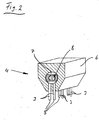
- the figure shows two plastic shafts 1 having a trigonal outline shape, on the surface of which rows of handle nubs 2 are secured by means of a device of FIG Fig. 2 shown type have been applied.
- the handle knobs protrude from the surface substantially radially with a height of up to 0.6 mm. Their width or diameter is about 2 mm.
- nubs other structures may be applied to the surface of the plastic shaft, for example, extending in the pen longitudinal strip-shaped, punctiform or any other structures.
- the raised structures or nubs can be applied to both an untreated plastic surface and provided with a paint coating.
- the plastic shafts are used for example for the production of mechanical pencils, such as mechanical pencils and the like. In addition to the mentioned plastic shafts, of course, surfaces of wooden pencils can be provided with raised structures.
- grip nubs - are applied by means of nozzles 3 to the respective surfaces which are part of an application device 4.
- handle knobs with circular outline shape nozzles 3 are used with a circular opening cross section 5.
- the nozzles 3 are arranged according to the desired nub pattern on a nozzle carrier 6, in the present case in a row of two.
- a cavity 7 is provided, with which the nozzles 3 are in fluid communication and which is fed via a central feed channel (not shown) with a plastic preparation.
- a central feed channel not shown
- a plastic preparation In order to achieve the most equal possible distribution of the flow of material to the nozzles 3, is within the cavity. 7 a corresponding device 8 available.
- UV-curable plastic preparations for transparent or colorless handle knobs with a diameter of 2 mm and a height of 0.5 mm for plastic shanks are comparative examples, they contain neither amorphous silicon dioxide nor micronized amide wax.
- the preparation according to Example A showed very strong stringing. She was also relatively viscous, which the entire order process designed more difficult. The applied droplets showed too little course, so that the desired diameter of the handle knobs was not reached. Because of the lack of course, the handle knobs were too high.
- the preparation according to Example B showed a slightly improved threading compared to A, but the applied mass had a clearly too strong course, so that there were nipples with irregular outline shape, greater width and too small height.
- the preparation according to Example C which contained amorphous silicon dioxide, showed a "very good" graded course of the droplets applied to the surface. Very good here means that the droplets run only so much that the handle nubs have the nominal diameter after UV curing.
- the threadline which is always present to some extent in plastic preparations of the present type, was significantly reduced compared to Formulations A and B in such a way that it neither deteriorates the spatial shape and surface smoothness of the handle nubs nor that the surface of the pin shafts would have been contaminated.
- the adhesion to ABS was good in all three examples, the cure very well.
- the formulation examples D and E are comparative examples, they contain neither amorphous silicon dioxide nor micronized amide wax.
- the receiving example H is a comparative example, it does not contain a monomer.
- raw material function D e F G H I Roskydal UA VP LS 2258 (Bayer Material Science) Aliphatic urethane acrylate, oligomer 75.8% 54.8% 54.8% 54.8% 73.8% 52.8% Roskydal UA XP 2491 (Bayer Material Science) Aliphatic urethane acrylate, oligomer 20% 20% 20% 20% 20% 20% 20% 20% 20% 20% 20% 20% 20% 20% 20% 20% 20% 20% 20% 20% 20% 20% 20% 20% 20% 20% 20% Laromer TPGDA (BASF) Tripropylene glycol triacrylate, reactive monomer diluent - 20% 18% 18% - 20% Irgacure 2959 (Ciba) Alpha-hydroxy ketone, photoinitiator 2% 2% 2% 2% 2% 2% 2% 2% 2% 2% 2% 2% 2% 2% 2% 2% 2% 2% 2% 2% 2% 2%
- Example D Example E
- Example F Example G
Landscapes
- Application Of Or Painting With Fluid Materials (AREA)
- Paints Or Removers (AREA)
- Inks, Pencil-Leads, Or Crayons (AREA)
- Compositions Of Macromolecular Compounds (AREA)
Claims (12)
- Procédé de production de structures en relief servant de tétons de préhension à la surface d'un crayon, dans lequel on produit une structure en relief en déposant, à l'aide d'une buse, une goutte d'une préparation de matière plastique à la surface du crayon, on éloigne la buse de la goutte appliquée à la surface du crayon et on expose la goutte à un rayonnement pour la durcir, la préparation de matière plastique contenant une masse de matière plastique pouvant être durcie par du rayonnement et se composant de la manière suivante :
masse de matière plastique formée d'oligomère et de monomère 40% à 98% système de photoamorceur 0,1% à 30% dioxyde de silicium amorphe et/ou cire d'amide micronisée 0,3% à 30% colorant 0% à 60% charge 0% à 60% autres additifs 0% à 10% - Procédé suivant la revendication 1,
caractérisé en ce qu'on utilise une préparation de matière plastique qui contient au moins un oligomère d'acrylate. - Procédé suivant la revendication 2,
caractérisé par l'utilisation d'une préparation de matière plastique contenant de 70% à 80% d'oligomère d'acrylate et de 1% à 25% de monomère d'acrylate. - Procédé suivant l'une des revendications 2 ou 3,
caractérisé par l'utilisation d'une préparation de matière plastique dans laquelle l'oligomère d'acrylate est choisi dans le groupe des époxy-acrylates, des polyester-acrylate, des polyuréthane-acrylate, des oligoéther-acrylate, des oligoéther-acrylate modifiés par une amine et des polyol-acrylate aromatiques et aliphatiques. - Procédé suivant la revendication 4,
caractérisé en ce que l'on utilise une préparation de matière plastique ayant de 70% à 80% d'oligomère d'uréthane-acrylate et de 1% à 15% de monomère d'acrylate - Procédé suivant l'une des revendications précédentes,
caractérisé en ce que la préparation de matière plastique contient de 1% à 8% du système de photoamorceur. - Procédé suivant la revendication 6,
caractérisé en ce que dans la préparation de matière plastique sont contenus de 0,5% à 5% d'un photoamorceur et 0,5% à 3% d'un co-amorceur. - Procédé suivant l'une des revendications précédentes,
caractérisé par l'utilisation d'une préparation de matière plastique ayant de 0,5% à 5% de dioxyde de silicium amorphe et/ou de cire d'amide micronisée. - Procédé suivant la revendication 8,
caractérisé en ce que à la surface du crayon est déposée une composition de matière plastique qui a la composition suivanteoligomère d'uréthane acrylate 70% à 80% monomère d'acrylate 1% à 15% dioxyde de silicium amorphe et/ou cire d'amide micronisée 0,5% à 5% photoamorceur 0,5% à 5% co-amorceur 0,5% à 3% autres additifs 0,1% à 10% - Procédé suivant la revendication 9,
caractérisé par l'utilisation d'une préparation de matière plastique contenant de 0,3% à 2% d'un agent nivelant et d'un agent lubrifiant et/ou de 0,1% à 1% d'un agent anti-mousse. - Procédé suivant l'une des revendications précédentes,
caractérisé par l'utilisation d'une préparation de matière plastique contenant une charge du groupe du kaolin, du talc, du sulfate de baryum, du blanc de titane, du carbonate de calcium et du mica. - Procédé suivant l'une des revendications précédentes,
caractérisé par l'utilisation d'une préparation de matière plastique contenant une charge du groupe de billes creuses en silicate d'aluminium, de billes creuses expansées, de petites billes en polyuréthane softfeeling, de matières plastiques micronisées, comme du polypropylène ou du PTFE, et des cires de PE.
Priority Applications (6)
| Application Number | Priority Date | Filing Date | Title |
|---|---|---|---|
| DE200820006230 DE202008006230U1 (de) | 2008-04-17 | 2008-04-17 | Kunststoffzubereitung zur Erzeugung erhabener Strukturen auf der Oberfläche eines Stiftes |
| EP08007474.3A EP2110185B1 (fr) | 2008-04-17 | 2008-04-17 | Procédé de production de structures élevées sur la surface d'un crayon |
| BRPI0900982A BRPI0900982B1 (pt) | 2008-04-17 | 2009-04-14 | preparado de material sintético para a produção de estruturas em relevo sobre a superfície de um lápis |
| PE2009000528A PE20100217A1 (es) | 2008-04-17 | 2009-04-16 | Procedimiento para la produccion de estructuras en altorrelieve sobre la superficie de un lapiz |
| CN200910134287.6A CN101559687B (zh) | 2008-04-17 | 2009-04-16 | 在笔的表面产生凸起结构的方法 |
| US12/425,575 US8349411B2 (en) | 2008-04-17 | 2009-04-17 | Method for producing raised structures on the surface of a pencil |
Applications Claiming Priority (1)
| Application Number | Priority Date | Filing Date | Title |
|---|---|---|---|
| EP08007474.3A EP2110185B1 (fr) | 2008-04-17 | 2008-04-17 | Procédé de production de structures élevées sur la surface d'un crayon |
Publications (2)
| Publication Number | Publication Date |
|---|---|
| EP2110185A1 EP2110185A1 (fr) | 2009-10-21 |
| EP2110185B1 true EP2110185B1 (fr) | 2013-06-12 |
Family
ID=39737815
Family Applications (1)
| Application Number | Title | Priority Date | Filing Date |
|---|---|---|---|
| EP08007474.3A Active EP2110185B1 (fr) | 2008-04-17 | 2008-04-17 | Procédé de production de structures élevées sur la surface d'un crayon |
Country Status (5)
| Country | Link |
|---|---|
| US (1) | US8349411B2 (fr) |
| EP (1) | EP2110185B1 (fr) |
| CN (1) | CN101559687B (fr) |
| BR (1) | BRPI0900982B1 (fr) |
| PE (1) | PE20100217A1 (fr) |
Families Citing this family (5)
| Publication number | Priority date | Publication date | Assignee | Title |
|---|---|---|---|---|
| US9102818B2 (en) * | 2010-05-17 | 2015-08-11 | Highcon Systems Ltd. | Method and system for surface adhesive rule technology |
| US20110294913A1 (en) | 2010-05-17 | 2011-12-01 | Michael Zimmer | Flexible material for surface adhesive rule |
| EP2479040B1 (fr) | 2011-01-19 | 2013-08-28 | Faber- Castell AG | Procédé de fabrication d'un crayon doté de structures surélevées |
| DE102014010308B4 (de) * | 2014-07-02 | 2016-10-27 | Staedtler Mars Gmbh & Co. Kg | Schreib-, Zeichen-, Markier- und/oder Malgerät oder Kosmetikgerät oder Eingabegerät für berührungsempfindliche Oberflächen und Verfahren zu dessen Herstellung |
| CN108659611B (zh) * | 2018-05-30 | 2021-05-28 | 丽水市德源文化用品有限公司 | 铅笔 |
Family Cites Families (10)
| Publication number | Priority date | Publication date | Assignee | Title |
|---|---|---|---|---|
| IT1269796B (it) * | 1994-05-19 | 1997-04-15 | Marco Rigamonti | Processo per la preparazione di articoli formati antigraffio e antiabrasione,a base di polimeri acrilici |
| WO2000068023A1 (fr) | 1999-05-07 | 2000-11-16 | A.W.Faber-Castell Unternehmensverwaltung Gmbh & Co. | Crayon a gaine de bois pour ecrire, colorier, dessiner ainsi que pour un usage cosmetique |
| WO2000069571A1 (fr) * | 1999-05-17 | 2000-11-23 | A.W. Faber-Castell Unternehmensverwaltung Gmbh & Co. | Dispositif pour l'application de structures en relief en matiere plastique sur des surfaces |
| DE10103375C1 (de) | 2001-01-26 | 2002-06-27 | Faber Castell Ag | Vorrichtung zum punkt - oder linienförmigen Auftragen einer fließfähigen Kunststoffmasse auf eine Oberfläche |
| DE10149151A1 (de) * | 2001-10-04 | 2003-04-30 | Staedtler J S Gmbh & Co Kg | Beschichtungsmittel und Beschichtung, zur Erzeugung von Oberflächen mit besonderem Effekt, sowie deren Verwendung |
| CN1582416A (zh) * | 2001-12-03 | 2005-02-16 | 昭和电工株式会社 | 光敏膜和印刷线路板用光敏组合物及其生产方法 |
| DE20314274U1 (de) | 2003-09-12 | 2004-05-27 | Faber-Castell Ag | Holzgefasster Stift für Schreib-, Mal-, Zeichen-, und Kosmetikzwecke |
| DE10348070B3 (de) * | 2003-10-13 | 2005-02-24 | Faber-Castell Ag | Holzgefasster Stift für Schreib-, Mal-, Zeichen- oder Kosmetikzwecke |
| ATE375260T1 (de) * | 2005-03-09 | 2007-10-15 | Faber Castell Ag | Verfahren zur herstellung von beschichtungen mit strukturierter oberfläche, verwendet insbesondere für stifte, und gegenstand mit strukturierter oberfläche |
| CN101104764B (zh) | 2007-07-17 | 2010-11-24 | 深圳市明远氟涂料有限公司 | 一种钢铁用重防腐涂料及其制备方法 |
-
2008
- 2008-04-17 EP EP08007474.3A patent/EP2110185B1/fr active Active
-
2009
- 2009-04-14 BR BRPI0900982A patent/BRPI0900982B1/pt active IP Right Grant
- 2009-04-16 CN CN200910134287.6A patent/CN101559687B/zh active Active
- 2009-04-16 PE PE2009000528A patent/PE20100217A1/es active IP Right Grant
- 2009-04-17 US US12/425,575 patent/US8349411B2/en active Active
Also Published As
| Publication number | Publication date |
|---|---|
| CN101559687A (zh) | 2009-10-21 |
| US20090263589A1 (en) | 2009-10-22 |
| BRPI0900982A2 (pt) | 2009-12-01 |
| EP2110185A1 (fr) | 2009-10-21 |
| BRPI0900982B1 (pt) | 2019-09-03 |
| PE20100217A1 (es) | 2010-04-25 |
| CN101559687B (zh) | 2014-03-12 |
| US8349411B2 (en) | 2013-01-08 |
Similar Documents
| Publication | Publication Date | Title |
|---|---|---|
| EP1514700B1 (fr) | Crayon à gaine de bois pour écrire, colorer, dessiner ainsi que pour un usage cosmétique | |
| DE102015110236B4 (de) | Verfahren und Vorrichtung zum Herstellen einer Struktur auf einer Oberfläche | |
| EP2891562B1 (fr) | Panneau avec couche décorative ainsi que procédé d'impression de plaques | |
| DE3112631A1 (de) | Gewindeteile fuer selbstsichernde schraubverbindungen und verfahren zu deren herstellung | |
| EP2110185B1 (fr) | Procédé de production de structures élevées sur la surface d'un crayon | |
| EP4212254A1 (fr) | Procédé et dispositif de traitement de surface | |
| DE3139813A1 (de) | Schleifmittel auf unterlage und verfahren zu seiner herstellung | |
| EP3401116A1 (fr) | Panneau de matière plastique pvc | |
| EP1700713B1 (fr) | Procédé de fabrication de revêtements avec une surface structurée, appliqué particulièrement pour des crayons, et objet avec une surface structurée | |
| WO2020260044A1 (fr) | Procédé pour fabriquer au moins un matériau de support pourvu d'un décor imprimé | |
| EP3348419A1 (fr) | Panneau de sol ou mural à surface structurée et décorée à base d'une plaque en fibrociment | |
| EP2479040B1 (fr) | Procédé de fabrication d'un crayon doté de structures surélevées | |
| DE4124210C2 (fr) | ||
| DE10124676A1 (de) | Verfahren und Vorrichtung zur Herstellung von Teilen mit einer Versiegelungsschicht auf der Oberfläche und derartige Teile | |
| DE3140316A1 (de) | Verfahren zur herstellung von kunststoff-verbundwerkstoffteilen | |
| EP1002842A1 (fr) | Composition de revêtement, particulièrement pour des surfaces poreuses ou pénétrables | |
| DE202008006230U1 (de) | Kunststoffzubereitung zur Erzeugung erhabener Strukturen auf der Oberfläche eines Stiftes | |
| EP0074494A1 (fr) | Procédé et appareil de marquage d'aires de circulation | |
| DE10334008A1 (de) | Verfahren zum Lackieren von Trägerwerkstoffen mit unterschiedlichen Glanzgradzonen und danach hergestellter Trägerwerkstoff | |
| EP1621331B1 (fr) | Procédé de fabrication d'une plaque avec une surface résistante aux salissures et plaque avec une surface résistante aux salissures | |
| DE10204228B4 (de) | Verwendung eines Beschichtungsmittels | |
| WO2020234149A1 (fr) | Procédé de production d'une surface décorative, notamment d'une pièce en bois | |
| EP0018529A1 (fr) | Masse de revêtement exempte de solvant et durcissable à froid | |
| DE2364188C3 (de) | Vorrichtung zum Beschichten von Flaschen mit einer hochviskosen Farbe | |
| DE102017007748A1 (de) | Extrudiertes Bauteil, insbesondere Schreibstift, aus einem Holzfaser-Polymer-Verbundwerkstoff |
Legal Events
| Date | Code | Title | Description |
|---|---|---|---|
| PUAI | Public reference made under article 153(3) epc to a published international application that has entered the european phase |
Free format text: ORIGINAL CODE: 0009012 |
|
| 17P | Request for examination filed |
Effective date: 20081029 |
|
| AK | Designated contracting states |
Kind code of ref document: A1 Designated state(s): AT BE BG CH CY CZ DE DK EE ES FI FR GB GR HR HU IE IS IT LI LT LU LV MC MT NL NO PL PT RO SE SI SK TR |
|
| AX | Request for extension of the european patent |
Extension state: AL BA MK RS |
|
| AKX | Designation fees paid |
Designated state(s): AT CZ DE FR IT |
|
| 17Q | First examination report despatched |
Effective date: 20100903 |
|
| GRAP | Despatch of communication of intention to grant a patent |
Free format text: ORIGINAL CODE: EPIDOSNIGR1 |
|
| GRAS | Grant fee paid |
Free format text: ORIGINAL CODE: EPIDOSNIGR3 |
|
| GRAA | (expected) grant |
Free format text: ORIGINAL CODE: 0009210 |
|
| AK | Designated contracting states |
Kind code of ref document: B1 Designated state(s): AT CZ DE FR IT |
|
| REG | Reference to a national code |
Ref country code: AT Ref legal event code: REF Ref document number: 616479 Country of ref document: AT Kind code of ref document: T Effective date: 20130615 |
|
| REG | Reference to a national code |
Ref country code: DE Ref legal event code: R096 Ref document number: 502008010096 Country of ref document: DE Effective date: 20130808 |
|
| PLBE | No opposition filed within time limit |
Free format text: ORIGINAL CODE: 0009261 |
|
| STAA | Information on the status of an ep patent application or granted ep patent |
Free format text: STATUS: NO OPPOSITION FILED WITHIN TIME LIMIT |
|
| 26N | No opposition filed |
Effective date: 20140313 |
|
| REG | Reference to a national code |
Ref country code: DE Ref legal event code: R097 Ref document number: 502008010096 Country of ref document: DE Effective date: 20140313 |
|
| REG | Reference to a national code |
Ref country code: FR Ref legal event code: PLFP Year of fee payment: 9 |
|
| REG | Reference to a national code |
Ref country code: DE Ref legal event code: R082 Ref document number: 502008010096 Country of ref document: DE Representative=s name: MEISSNER BOLTE PATENTANWAELTE RECHTSANWAELTE P, DE |
|
| REG | Reference to a national code |
Ref country code: FR Ref legal event code: PLFP Year of fee payment: 10 |
|
| REG | Reference to a national code |
Ref country code: FR Ref legal event code: PLFP Year of fee payment: 11 |
|
| P01 | Opt-out of the competence of the unified patent court (upc) registered |
Effective date: 20230523 |
|
| PGFP | Annual fee paid to national office [announced via postgrant information from national office to epo] |
Ref country code: AT Payment date: 20240417 Year of fee payment: 17 |
|
| PGFP | Annual fee paid to national office [announced via postgrant information from national office to epo] |
Ref country code: DE Payment date: 20250417 Year of fee payment: 18 |
|
| PGFP | Annual fee paid to national office [announced via postgrant information from national office to epo] |
Ref country code: IT Payment date: 20250430 Year of fee payment: 18 |
|
| PGFP | Annual fee paid to national office [announced via postgrant information from national office to epo] |
Ref country code: FR Payment date: 20250422 Year of fee payment: 18 |
|
| PGFP | Annual fee paid to national office [announced via postgrant information from national office to epo] |
Ref country code: CZ Payment date: 20250404 Year of fee payment: 18 |
|
| REG | Reference to a national code |
Ref country code: AT Ref legal event code: MM01 Ref document number: 616479 Country of ref document: AT Kind code of ref document: T Effective date: 20250417 |
|
| PG25 | Lapsed in a contracting state [announced via postgrant information from national office to epo] |
Ref country code: AT Free format text: LAPSE BECAUSE OF NON-PAYMENT OF DUE FEES Effective date: 20250417 |