EP2110657A1 - Optische Vorrichtung zur Analyse eines Diffusionsmediums auf einem Träger - Google Patents
Optische Vorrichtung zur Analyse eines Diffusionsmediums auf einem Träger Download PDFInfo
- Publication number
- EP2110657A1 EP2110657A1 EP09158148A EP09158148A EP2110657A1 EP 2110657 A1 EP2110657 A1 EP 2110657A1 EP 09158148 A EP09158148 A EP 09158148A EP 09158148 A EP09158148 A EP 09158148A EP 2110657 A1 EP2110657 A1 EP 2110657A1
- Authority
- EP
- European Patent Office
- Prior art keywords
- support
- scattering medium
- optical device
- medium
- diffusing
- Prior art date
- Legal status (The legal status is an assumption and is not a legal conclusion. Google has not performed a legal analysis and makes no representation as to the accuracy of the status listed.)
- Ceased
Links
Images

Classifications
-
- G—PHYSICS
- G01—MEASURING; TESTING
- G01N—INVESTIGATING OR ANALYSING MATERIALS BY DETERMINING THEIR CHEMICAL OR PHYSICAL PROPERTIES
- G01N21/00—Investigating or analysing materials by the use of optical means, i.e. using sub-millimetre waves, infrared, visible or ultraviolet light
- G01N21/17—Systems in which incident light is modified in accordance with the properties of the material investigated
- G01N21/47—Scattering, i.e. diffuse reflection
- G01N21/4795—Scattering, i.e. diffuse reflection spatially resolved investigating of object in scattering medium
-
- A—HUMAN NECESSITIES
- A61—MEDICAL OR VETERINARY SCIENCE; HYGIENE
- A61B—DIAGNOSIS; SURGERY; IDENTIFICATION
- A61B5/00—Measuring for diagnostic purposes; Identification of persons
- A61B5/0059—Measuring for diagnostic purposes; Identification of persons using light, e.g. diagnosis by transillumination, diascopy, fluorescence
- A61B5/0073—Measuring for diagnostic purposes; Identification of persons using light, e.g. diagnosis by transillumination, diascopy, fluorescence by tomography, i.e. reconstruction of 3D images from 2D projections
-
- G—PHYSICS
- G01—MEASURING; TESTING
- G01N—INVESTIGATING OR ANALYSING MATERIALS BY DETERMINING THEIR CHEMICAL OR PHYSICAL PROPERTIES
- G01N21/00—Investigating or analysing materials by the use of optical means, i.e. using sub-millimetre waves, infrared, visible or ultraviolet light
- G01N21/01—Arrangements or apparatus for facilitating the optical investigation
- G01N21/03—Cuvette constructions
- G01N21/0303—Optical path conditioning in cuvettes, e.g. windows; adapted optical elements or systems; path modifying or adjustment
-
- G—PHYSICS
- G01—MEASURING; TESTING
- G01N—INVESTIGATING OR ANALYSING MATERIALS BY DETERMINING THEIR CHEMICAL OR PHYSICAL PROPERTIES
- G01N21/00—Investigating or analysing materials by the use of optical means, i.e. using sub-millimetre waves, infrared, visible or ultraviolet light
- G01N21/62—Systems in which the material investigated is excited whereby it emits light or causes a change in wavelength of the incident light
- G01N21/63—Systems in which the material investigated is excited whereby it emits light or causes a change in wavelength of the incident light optically excited
- G01N21/64—Fluorescence; Phosphorescence
- G01N21/645—Specially adapted constructive features of fluorimeters
- G01N21/6456—Spatial resolved fluorescence measurements; Imaging
-
- A—HUMAN NECESSITIES
- A61—MEDICAL OR VETERINARY SCIENCE; HYGIENE
- A61B—DIAGNOSIS; SURGERY; IDENTIFICATION
- A61B2503/00—Evaluating a particular growth phase or type of persons or animals
- A61B2503/40—Animals
Definitions
- the present invention relates to an optical device for analyzing a scattering medium held by a support.
- One area of optical imaging concerns the analysis of a scattering medium, for example the analysis of biological tissues.
- the diffusing medium is subjected to an incident light beam.
- the wavelength of the incident beam is in the visible spectrum, typically in the red or the near infrared, which corresponds to the range of wavelengths in which the absorption of biological tissues is minimal.
- the incident light beam diffuses into the scattering medium and the diffuse light radiation which escapes from the scattering medium is detected by a sensor, for example a camera.
- the images provided by the sensor are analyzed to determine the optical properties of the scattering medium, for example to determine the distribution of the optical properties of diffusion and / or absorption of the scattering medium, for example to detect the presence of an abnormally absorbing zone and / or diffusing.
- markers are available in the diffusing medium which tend to concentrate in areas of interest.
- the markers When illuminated by the incident light beam, the markers emit radiation at a wavelength distinct from that of the incident beam. This radiation diffuses into the scattering medium and is detected and analyzed to determine the properties of the markers (for example, the localization and the local concentration of the markers).
- optical imaging techniques offer, for example for the detection and localization of cancerous tumors, an alternative to conventional imaging techniques such as X-ray and X-ray tomography, positron emission, magnetic resonance imaging, etc.
- the light source is in direct contact with the scattering medium.
- the incident light beam is guided to the scattering medium by optical fibers.
- the diffuse radiation emitted by the scattering medium can also be recovered by optical fibers and guided to the sensor.
- One advantage is that the environment of the scattering medium, in particular the support maintaining the diffusing medium, does not disturb the measurements.
- these optical devices are generally bulky because the accessible accuracy of the distribution of optical properties depends on the number of independent measurements that can be made, that is to say the number of optical fibers used.
- the light source is remote from the scattering medium.
- the structure of the optical device can then be simplified.
- the support maintaining the diffusing medium is generally designed so as to disturb as little as possible the propagation of light rays.
- the support consists of a non-absorbent and non-diffusing material for the useful wavelength range.
- Each optical device 10, 12 comprises a light source 14, for example a laser diode providing a monochromatic light beam 15 whose wavelength is, for example, 670 nanometers, and an image sensor 16 adapted to the detection of light. diffuse radiation.
- An analysis tool 17 is connected to the sensor 16 and performs a processing of the images acquired by the sensor 16.
- a scattering medium to be analyzed 18, for example a mouse, is arranged to receive the incident light beam 15 provided by the source 14.
- a lens 19 is disposed between the scattering medium 18 and the sensor 16.
- the axis of the sensor 16 may not be parallel to the incident beam 15. According to a variant, the images provided by the sensor 16 may be recorded by the sensor 16. tool 17 and subsequently analyzed by means of another computer.
- the medium 18 to be analyzed is held by a support 20 comprising an input plate 22 situated between the medium 18 and the light source 14 and an output plate 24 situated between the medium 18 and the sensor 16.
- the plates 22, 24 are transparent and parallel.
- the support 20 can be fixed and the light source 14 can move relative to the support 20.
- the medium 18 to be analyzed is held by a support 30 corresponding to a transparent tube comprising a cylindrical side wall 32 and a planar bottom 34.
- the support 20 is mounted on a rotary arm 38, the source 14 being able to to be fixed.
- the support 20, 30 is generally made of plastic or glass. However, the use of such media can cause the formation of artifacts on the images provided by the sensor 16. These artifacts can hinder or even prevent the analysis of the scattering medium 18.
- the present invention relates to an optical device for analyzing a scattering medium held by a support comprising a light source and a sensor, the light source being at a distance from the medium to be analyzed, the support making it possible to reduce or even eliminate the forming artifacts on the images acquired by the sensor.
- Another characteristic of the support is that it can be manufactured simply.
- Another feature is that the optical properties of the medium vary little over time.
- an embodiment of the present invention provides an optical device for analyzing a scattering medium.
- the device comprises at least one light source remote from the scattering medium and adapted to provide an incident light beam for illuminating the scattering medium; at least one sensor adapted to detect radiation emitted by the scattering medium; a support of the at least partially non-absorbing scattering medium for the incident light beam and the diffuse radiation. All or part of the support consists of a diffusing material whose reduced diffusion coefficient is greater than 0.1 cm -1 and less than 700 cm -1 .
- the reduced diffusion coefficient of the support is between 1 and 700 cm -1 .
- said material has an absorption coefficient of between 0.01 and 300 cm -1 .
- the support comprises at least one wall intended to be located between the source and the diffusing medium and / or between the diffusing medium and the sensor.
- the support has the shape of a cradle for receiving the scattering medium.
- An embodiment of the invention provides a support adapted to the optical device described above.
- One embodiment of the invention provides a use of the optical device described above, for performing by tomography a three-dimensional mapping of the absorption coefficient and / or the reduced diffusion coefficient of the scattering medium.
- One embodiment of the invention provides a use of the optical device described above, the incident light beam being at a first wavelength, the use of placing in the diffusing medium fluorophores sensitive to the first wavelength. and emitting the diffuse radiation at a second wavelength, the image providing sensor used to determine properties of the fluorophores and / or properties of the scattering medium.
- One embodiment of the invention provides a method of manufacturing the support described above.
- the method comprises the steps of preparing a powder of a diffusing material; mixing the powder with a solution of a substantially non-absorbent, non-diffusing and curable material; and injecting the resulting mixture into a mold to form the support.
- the method further comprises the step of mixing an additional solution of an absorbent material with the powder or solution.
- the Applicant has arrived at the present invention by an analysis of the phenomena at the origin of the formation of artifacts on the images provided by the sensor of an optical device for the analysis of a diffusing medium.
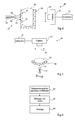
- the figure 3 schematically illustrates certain phenomena at the origin of the formation of artifacts that can be observed on the images acquired by the sensor 16 of the device 12 of the figure 2 .
- the support 30 is shown in lateral section.
- the incident light beam 15 has an opening angle and is schematically represented a light ray 40 of the incident beam 15 substantially perpendicular to the wall 32 and rays 42, 44 of the incident beam 15 inclined relative to the axis of the wall 32
- the light beam 40 passes through the support 30 without disturbance until reaching the scattering medium 18 to be analyzed.
- a first type of artifact results from light rays that directly reach the sensor 16 without having passed through the medium to be analyzed.
- This can result from an optical guidance of inclined spokes 42, 44 by the walls of the support 30.
- the inclined spokes 42 can be guided by the side wall 32 and the bottom 34 of the support 30, then escape from the support 30 and reach the sensor 16 directly without having passed through the scattering medium 18.
- the intensity of the light rays 42 that directly reach the sensor 16 may be significantly higher than that of diffuse radiation. Since the sensor 16 is generally adapted to the detection of low-intensity diffuse radiation, the fact that the light rays 42 reach the sensor 16 directly can lead to a saturation of the latter, rendering the acquired images unusable.
- fluorescence optical diffuse optical tomography may also use the image of diffuse radiation emitted by the scattering medium at the wavelength of the incident beam for calibration purposes.
- a second type of artefact results from defects 46 (inclusions, scratches, cracks, etc.) of the support 30. Indeed, when the light rays 44, optically guided by the wall 32, reach the defect 46, it can emit by reflection, refraction or diffraction a light beam 48. The defect 46 is then equivalent to a parasitic light source contributing to the radiation emitted by the scattering medium.
- the second type of artifact can be just as penalizing as the first type of artifact since it disturbs the analysis of the detected images insofar as the image processing algorithms provided by the sensor 16 are based on the assumption that the The properties of the illumination of the scattering medium 18 are well known, this illumination being able to result from a single source 14, from several point light sources, from extended sources, etc. In addition, since the distribution of these parasitic sources is not known, it is difficult to take them into account. This type of artifact can also occur for the optical device 10 shown in FIG. figure 1 .
- the present invention provides for using a diffusing material to carry out the support of the medium to be analyzed optically.
- the light rays of the incident beam diffusing as soon as they progress in the support, one observes a very fast attenuation of the light rays which tend to be guided optically by the support.
- This makes it possible to strongly reduce, or even to cancel, the proportion of light rays that can be guided optically by the support until it leaves the latter and reaches the image sensor directly or until the defects of the support are reached. which would behave like parasitic light sources.
- the diffusion coefficient of the material constituting the support is not chosen to be too high so as not to cause excessive attenuation of the diffuse radiation emitted by the scattering medium.
- the figure 4 represents a first embodiment of an optical device 49 according to the invention.
- the optical device 49 comprises the same elements as the device 12 shown in FIG. figure 3 with the difference that it comprises a support 50 consisting of a diffusing material.
- the lines 52 schematically denote the region of diffusion of the incident light beam 15 reaching the support 50.
- the support 50 has a tubular shape.
- the support 50 may have another shape and, for example, comprise two parallel plates, as for the optical device 10 shown in FIG. figure 1 .
- Such a support may also be applied against all or part of a surface of a scattering medium to be analyzed, without necessarily containing or supporting the scattering object to be analyzed in a given position.
- the objective is then to achieve a diffusion of the incident light produced by a light source placed at a distance from the support, providing the advantages described below.
- the support may be called diffusing intermediate medium, the intermediate adjective showing an arrangement between an external light source and the scattering medium to be analyzed.
- this support will be placed in contact with the surface of the diffusing medium, so as to constitute, with the scattering medium, a single diffusing assembly.
- the figure 5 represents a second embodiment of an optical device 54 according to the invention.
- the optical device 56 comprises the same elements as the device 10 shown in FIG. figure 3 with the difference that it comprises a support 56 consisting of a diffusing material and having the shape of a cradle in which is placed the scattering medium 18 to be analyzed.
- the shape of the support 56 is advantageously adapted to the diffusing medium 18. This makes it possible to reduce the possibilities of movement of the diffusing medium during the analysis, in particular when the diffusing medium is an animal or a being. human.
- the support itself is a diffusing object, it forms with the scattering medium to be analyzed a diffusing system whose external surface is precisely known since it corresponds to the external surface of the support. Since this surface may correspond to a simple geometrical shape, the resolution of the equations of propagation of light in the diffusing media can be simplified.
- Such a support makes it possible to reduce the surface luminous intensity on the surface of the diffusing medium.
- the invention will be of interest when the diffusing medium is a biological tissue and the light source is a laser source delivering an intense beam. In such a case, the incident beam, without prior diffusion, could generate lesions, such as burns, on the surface of the scattering medium analyzed.
- the incident beam is diffused before reaching the surface of the scattering medium, thus reducing the risk of lesion. It is then possible to increase the intensity of the incident ray, therefore the amount of light entering the diffusing medium, because of the light scattering upstream of the surface of the scattering medium.
- the optical diffusion properties and, in addition, optionally of absorption, of the support may be chosen close to those of the scattering medium to be analyzed.
- the reduced diffusion coefficient ⁇ s ' sup the material constituting the support is greater than 0.1 cm -1 and is preferably between 1 and 700 cm -1 .
- the absorption coefficient ⁇ at ' sup the material constituting the support may vary between 0 and 300 cm -1 and is preferably between 0.01 and 300 cm -1 .
- the support may consist entirely of a diffusing and optionally absorbent material. However, only one or more parts of the support may consist of the diffusing material, and possibly absorbent, the rest of the support being made of a substantially non-absorbent and non-diffusing material.
- the scattering portions are then advantageously provided at suitable locations of the support to prevent optical guiding phenomena from causing the formation of artifacts on the images acquired by the image sensor.
- the support according to the present invention can be used with an optical device in which the diffusing medium is immersed in an index matching liquid.
- the figure 6 represents in the form of a block diagram an example of a method of manufacturing a diffusing medium according to the invention.
- both the diffusion and absorption properties of the support are imposed.
- the diffusion properties of the support are established by the addition of diffusing particles, for example titanium dioxide particles, to an initially non-absorbent and non-diffusing material.
- the absorption properties of the support are established by adding an ink to the initial material, for example an ink marketed by Dabe under the name LOTUS Chinese Ink.
- the initial material is, for example, a non-absorbing and non-diffusing epoxy resin.
- the process begins at step 60 by preparing the amount of ink and the amount of titanium dioxide powder to be used.
- a reference absorbent solution containing ink diluted in ethanol.
- V T the volume of resin to be used
- ⁇ a (ref) corresponds to the absorption coefficient of the reference absorbent solution.
- the coefficient ⁇ a (ref) is, for example, measured beforehand using a spectrophotometer.
- C ref is the concentration of titanium dioxide particles in a reference diffusion solution
- ⁇ s ' ref is the reduced diffusion coefficient obtained for said reference solution.
- the reduced diffusion coefficient can be measured beforehand by diffuse reflectivity methods or time-resolved methods, for example the methods described in the publication of SL Jacques entitled “Time-resolved reflectance spectroscopy in turbid tissues" (IEEE Transactions on Biomedical Engineering 36, 1155-1161 (1989)). )).
- step 60 the ink volume V is taken from the reference absorbent solution and the volume taken is placed in a vial.
- the mass m of titanium dioxide is weighed and poured into the vial.
- the assembly can be placed in an ultrasonic bath to promote the elimination of possible aggregates.
- the process continues in step 62.
- step 62 the solution containing the ink and the titanium dioxide is mixed with the volume V T of resin.
- a resin consisting of a base and a catalyst
- the solution containing the ink and the titanium dioxide is mixed with the volume V T of resin.
- the vial containing the ink and the titanium dioxide can be rinsed with ethanol.
- the enclosure containing the resin-ink-titanium dioxide mixture is shaken to homogenize the assembly and can be placed in an ultrasonic bath. The process continues at step 64.
- step 64 the resin-ink-titanium dioxide mixture is placed in a mold adapted to the desired shape of the support.
- the resin can be allowed to polymerize at room temperature.
- a final step of machining the support may optionally be provided.
Landscapes
- Health & Medical Sciences (AREA)
- Life Sciences & Earth Sciences (AREA)
- Physics & Mathematics (AREA)
- Pathology (AREA)
- General Health & Medical Sciences (AREA)
- Analytical Chemistry (AREA)
- Chemical & Material Sciences (AREA)
- Immunology (AREA)
- General Physics & Mathematics (AREA)
- Biochemistry (AREA)
- Nuclear Medicine, Radiotherapy & Molecular Imaging (AREA)
- Medical Informatics (AREA)
- Surgery (AREA)
- Animal Behavior & Ethology (AREA)
- Radiology & Medical Imaging (AREA)
- Public Health (AREA)
- Veterinary Medicine (AREA)
- Molecular Biology (AREA)
- Biophysics (AREA)
- Heart & Thoracic Surgery (AREA)
- Biomedical Technology (AREA)
- Engineering & Computer Science (AREA)
- Optics & Photonics (AREA)
- Investigating Or Analysing Materials By Optical Means (AREA)
Applications Claiming Priority (1)
| Application Number | Priority Date | Filing Date | Title |
|---|---|---|---|
| FR0852633A FR2930343B1 (fr) | 2008-04-18 | 2008-04-18 | Dispositif optique pour l'analyse d'un milieu diffusant maintenu par un support |
Publications (1)
| Publication Number | Publication Date |
|---|---|
| EP2110657A1 true EP2110657A1 (de) | 2009-10-21 |
Family
ID=40070578
Family Applications (1)
| Application Number | Title | Priority Date | Filing Date |
|---|---|---|---|
| EP09158148A Ceased EP2110657A1 (de) | 2008-04-18 | 2009-04-17 | Optische Vorrichtung zur Analyse eines Diffusionsmediums auf einem Träger |
Country Status (3)
| Country | Link |
|---|---|
| US (1) | US8120784B2 (de) |
| EP (1) | EP2110657A1 (de) |
| FR (1) | FR2930343B1 (de) |
Families Citing this family (19)
| Publication number | Priority date | Publication date | Assignee | Title |
|---|---|---|---|---|
| US7884933B1 (en) * | 2010-05-05 | 2011-02-08 | Revolutionary Business Concepts, Inc. | Apparatus and method for determining analyte concentrations |
| JP5648957B2 (ja) | 2010-10-22 | 2015-01-07 | 浜松ホトニクス株式会社 | 乳房計測装置 |
| CN103712925B (zh) * | 2013-12-26 | 2015-09-23 | 天津大学 | 用于采集散射介质中径向扩散反射光的多路光纤锥套装置 |
| CN105277497A (zh) * | 2015-11-06 | 2016-01-27 | 浙江大学 | 连续光谱下检测农产品的光学特性参数的装置与方法 |
| US9730649B1 (en) | 2016-09-13 | 2017-08-15 | Open Water Internet Inc. | Optical imaging of diffuse medium |
| FR3076351A1 (fr) * | 2017-12-28 | 2019-07-05 | Commissariat A L'energie Atomique Et Aux Energies Alternatives | Dispositif d'analyse d'un echantillon |
| US10778911B2 (en) | 2018-03-31 | 2020-09-15 | Open Water Internet Inc. | Optical transformation device for imaging |
| US10778912B2 (en) | 2018-03-31 | 2020-09-15 | Open Water Internet Inc. | System and device for optical transformation |
| US10506181B2 (en) | 2018-03-31 | 2019-12-10 | Open Water Internet Inc. | Device for optical imaging |
| US10966612B2 (en) | 2018-06-14 | 2021-04-06 | Open Water Internet Inc. | Expanding beam optical element |
| US10962929B2 (en) | 2018-09-14 | 2021-03-30 | Open Water Internet Inc. | Interference optics for optical imaging device |
| US10874370B2 (en) | 2019-01-28 | 2020-12-29 | Open Water Internet Inc. | Pulse measurement in optical imaging |
| US10955406B2 (en) | 2019-02-05 | 2021-03-23 | Open Water Internet Inc. | Diffuse optical imaging with multiple beams |
| US11320370B2 (en) | 2019-06-26 | 2022-05-03 | Open Water Internet Inc. | Apparatus for directing optical and acoustic signals |
| US11581696B2 (en) | 2019-08-14 | 2023-02-14 | Open Water Internet Inc. | Multi-channel laser |
| US11622686B2 (en) | 2019-11-22 | 2023-04-11 | Open Water Internet, Inc. | Optical imaging with unshifted reference beam |
| US11819318B2 (en) | 2020-04-27 | 2023-11-21 | Open Water Internet Inc. | Optical imaging from light coherence |
| US11559208B2 (en) | 2020-05-19 | 2023-01-24 | Open Water Internet Inc. | Imaging with scattering layer |
| US11259706B2 (en) | 2020-05-19 | 2022-03-01 | Open Water Internet Inc. | Dual wavelength imaging and out of sample optical imaging |
Citations (5)
| Publication number | Priority date | Publication date | Assignee | Title |
|---|---|---|---|---|
| WO1999040411A1 (en) * | 1998-02-10 | 1999-08-12 | Daedalus I, Llc | APPARATUS FOR DETERMINATION OF pH, pCO2, HEMOGLOBIN AND HEMOGLOBIN OXYGEN SATURATION |
| WO2002042824A2 (de) * | 2000-11-24 | 2002-05-30 | P.A.L.M. Microlaser Technologies Ag | Aufnahmeelement zum aufnehmen eines mit einem mikroskop zu betrachtenden objekts, insbesondere eines biologischen objekts |
| WO2002095476A2 (en) * | 2001-05-22 | 2002-11-28 | Medical Research Council | Rotary stage for imaging a specimen |
| US20040015062A1 (en) * | 2000-11-27 | 2004-01-22 | Vasilis Ntziachristos | Fluorescence-mediated molecular tomography |
| WO2007057798A2 (en) * | 2005-11-18 | 2007-05-24 | Koninklijke Philips Electronics N.V. | Device for imaging an interior of a turbid medium |
Family Cites Families (7)
| Publication number | Priority date | Publication date | Assignee | Title |
|---|---|---|---|---|
| FI834756A0 (fi) * | 1983-12-22 | 1983-12-22 | Labsystems Oy | Kyvettenhet |
| JP3006123B2 (ja) * | 1991-03-18 | 2000-02-07 | ソニー株式会社 | 動脈硬さ観測装置 |
| JP2002501803A (ja) * | 1998-02-05 | 2002-01-22 | イン−ラインダイアグノスティックスコーポレイション | 非観血的血液成分モニタ方法および装置 |
| US6353226B1 (en) * | 1998-11-23 | 2002-03-05 | Abbott Laboratories | Non-invasive sensor capable of determining optical parameters in a sample having multiple layers |
| US6475800B1 (en) * | 1999-07-22 | 2002-11-05 | Instrumentation Metrics, Inc. | Intra-serum and intra-gel for modeling human skin tissue |
| US7322972B2 (en) * | 2002-04-10 | 2008-01-29 | The Regents Of The University Of California | In vivo port wine stain, burn and melanin depth determination using a photoacoustic probe |
| US7400754B2 (en) * | 2003-04-08 | 2008-07-15 | The Regents Of The University Of California | Method and apparatus for characterization of chromophore content and distribution in skin using cross-polarized diffuse reflectance imaging |
-
2008
- 2008-04-18 FR FR0852633A patent/FR2930343B1/fr active Active
-
2009
- 2009-04-17 US US12/425,558 patent/US8120784B2/en active Active
- 2009-04-17 EP EP09158148A patent/EP2110657A1/de not_active Ceased
Patent Citations (5)
| Publication number | Priority date | Publication date | Assignee | Title |
|---|---|---|---|---|
| WO1999040411A1 (en) * | 1998-02-10 | 1999-08-12 | Daedalus I, Llc | APPARATUS FOR DETERMINATION OF pH, pCO2, HEMOGLOBIN AND HEMOGLOBIN OXYGEN SATURATION |
| WO2002042824A2 (de) * | 2000-11-24 | 2002-05-30 | P.A.L.M. Microlaser Technologies Ag | Aufnahmeelement zum aufnehmen eines mit einem mikroskop zu betrachtenden objekts, insbesondere eines biologischen objekts |
| US20040015062A1 (en) * | 2000-11-27 | 2004-01-22 | Vasilis Ntziachristos | Fluorescence-mediated molecular tomography |
| WO2002095476A2 (en) * | 2001-05-22 | 2002-11-28 | Medical Research Council | Rotary stage for imaging a specimen |
| WO2007057798A2 (en) * | 2005-11-18 | 2007-05-24 | Koninklijke Philips Electronics N.V. | Device for imaging an interior of a turbid medium |
Non-Patent Citations (3)
| Title |
|---|
| DINTEN J.-M. ET AL: "Performance of different reflectance and diffuse optical imaging tomographic approaches in fluorescence molecular imaging of small animals", PROCEEDINGS OF SPIE. MEDICAL IMAGING 2006: PHYSICS OF MEDICAL IMAGING, vol. 6142, 2006, USA, pages 614215-1 - 614215-10, XP002507356 * |
| S. L. JACQUES: "Time- resolved reflectance spectroscopy in turbid tissues", IEEE TRANSACTIONS ON BIOMEDICAL ENGINEERING, vol. 36, 1989, pages 1155 - 1161 |
| SHARPE J: "Optical Projection Tomography", ANNU. REV. BIOMED. ENG., vol. 6, 9 April 2004 (2004-04-09), USA, pages 209 - 228, XP002507150 * |
Also Published As
| Publication number | Publication date |
|---|---|
| US20090262365A1 (en) | 2009-10-22 |
| US8120784B2 (en) | 2012-02-21 |
| FR2930343B1 (fr) | 2014-09-19 |
| FR2930343A1 (fr) | 2009-10-23 |
Similar Documents
| Publication | Publication Date | Title |
|---|---|---|
| EP2110657A1 (de) | Optische Vorrichtung zur Analyse eines Diffusionsmediums auf einem Träger | |
| EP2309249B1 (de) | Vorrichtung und Verfahren zur gestreuten Erregung in der Bildgebung | |
| US10024785B2 (en) | Solid hemoglobin-polymer biophotonic phantoms and their use | |
| EP0627620B1 (de) | Verfahren und Vorrichtung zur Messung innerer Eigenschaften eines Streumediums | |
| US5529065A (en) | Method for measuring scattering medium and apparatus for the same | |
| EP3167285B1 (de) | Vorrichtung und verfahren zur nicht-invasiven bestimmung der fruchtbarkeit und/oder des geschlechts von eiern | |
| CN1097729C (zh) | 利用散射光的测定方法及测定装置 | |
| Rajadhyaksha et al. | Detectability of contrast agents for confocal reflectance imaging of skin and microcirculation | |
| Šćepanović et al. | A multimodal spectroscopy system for real-time disease diagnosis | |
| Lapointe et al. | A multi-view time-domain non-contact diffuse optical tomography scanner with dual wavelength detection for intrinsic and fluorescence small animal imaging | |
| CN1342054A (zh) | 提供高对比度成像的方法和装置 | |
| JPH07209177A (ja) | 散乱吸収体計測方法及び散乱吸収体計測装置 | |
| CN1479864A (zh) | 特定成分信息测量装置 | |
| Moffitt et al. | Sized-fiber reflectometry for measuring local optical properties | |
| US8208982B2 (en) | Evanescent catheter system | |
| FR3032527A1 (fr) | Dispositif de mesure d'un signal optique retrodiffuse par un echantillon | |
| Lau et al. | Re-evaluation of model-based light-scattering spectroscopy for tissue spectroscopy | |
| Qu et al. | Excitation-and-collection geometry insensitive fluorescence imaging of tissue-simulating turbid media | |
| US7937226B2 (en) | Method and device for backscatter spectroscopy | |
| EP3502666A1 (de) | Messvorrichtung einer rückstreustrahlung von einer probe, und messverfahren, das eine solche vorrichtung verwendet | |
| Cao et al. | Lab-in-a-Phone: A lightweight oblique incidence reflectometer based on smartphone | |
| EP2021774B1 (de) | System mit einem dualen beleuchtungssystem und einer abbildungsvorrichtung sowie das system benutzendes verfahren | |
| Wycoff et al. | In vitro Assessment of lesion activity using simultaneous time-resolved reflectance imaging at 1300 and 1950 nm | |
| Perekatova et al. | Fluence compensated optoacoustic measurements of blood oxygen saturation in vivo at two optimal wavelengths | |
| FR2531854A1 (fr) | Appareil de mesure non invasive de la vitesse moyenne du courant sanguin dans des tissus vivants |
Legal Events
| Date | Code | Title | Description |
|---|---|---|---|
| PUAI | Public reference made under article 153(3) epc to a published international application that has entered the european phase |
Free format text: ORIGINAL CODE: 0009012 |
|
| AK | Designated contracting states |
Kind code of ref document: A1 Designated state(s): AT BE BG CH CY CZ DE DK EE ES FI FR GB GR HR HU IE IS IT LI LT LU LV MC MK MT NL NO PL PT RO SE SI SK TR |
|
| RAP1 | Party data changed (applicant data changed or rights of an application transferred) |
Owner name: COMMISSARIAT A L'ENERGIE ATOMIQUE ET AUX ENERGIES |
|
| 17P | Request for examination filed |
Effective date: 20100420 |
|
| STAA | Information on the status of an ep patent application or granted ep patent |
Free format text: STATUS: EXAMINATION IS IN PROGRESS |
|
| 17Q | First examination report despatched |
Effective date: 20170425 |
|
| STAA | Information on the status of an ep patent application or granted ep patent |
Free format text: STATUS: THE APPLICATION HAS BEEN REFUSED |
|
| 18R | Application refused |
Effective date: 20180627 |