EP2113582A2 - Verfahren zum Formen einer dicken keramischen Beschichtung mit verbesserter Beständigkeit - Google Patents
Verfahren zum Formen einer dicken keramischen Beschichtung mit verbesserter Beständigkeit Download PDFInfo
- Publication number
- EP2113582A2 EP2113582A2 EP09250902A EP09250902A EP2113582A2 EP 2113582 A2 EP2113582 A2 EP 2113582A2 EP 09250902 A EP09250902 A EP 09250902A EP 09250902 A EP09250902 A EP 09250902A EP 2113582 A2 EP2113582 A2 EP 2113582A2
- Authority
- EP
- European Patent Office
- Prior art keywords
- coating
- process according
- step comprises
- powder
- forming
- Prior art date
- Legal status (The legal status is an assumption and is not a legal conclusion. Google has not performed a legal analysis and makes no representation as to the accuracy of the status listed.)
- Granted
Links
Images
Classifications
-
- C—CHEMISTRY; METALLURGY
- C23—COATING METALLIC MATERIAL; COATING MATERIAL WITH METALLIC MATERIAL; CHEMICAL SURFACE TREATMENT; DIFFUSION TREATMENT OF METALLIC MATERIAL; COATING BY VACUUM EVAPORATION, BY SPUTTERING, BY ION IMPLANTATION OR BY CHEMICAL VAPOUR DEPOSITION, IN GENERAL; INHIBITING CORROSION OF METALLIC MATERIAL OR INCRUSTATION IN GENERAL
- C23C—COATING METALLIC MATERIAL; COATING MATERIAL WITH METALLIC MATERIAL; SURFACE TREATMENT OF METALLIC MATERIAL BY DIFFUSION INTO THE SURFACE, BY CHEMICAL CONVERSION OR SUBSTITUTION; COATING BY VACUUM EVAPORATION, BY SPUTTERING, BY ION IMPLANTATION OR BY CHEMICAL VAPOUR DEPOSITION, IN GENERAL
- C23C4/00—Coating by spraying the coating material in the molten state, e.g. by flame, plasma or electric discharge
- C23C4/04—Coating by spraying the coating material in the molten state, e.g. by flame, plasma or electric discharge characterised by the coating material
- C23C4/10—Oxides, borides, carbides, nitrides or silicides; Mixtures thereof
-
- C—CHEMISTRY; METALLURGY
- C23—COATING METALLIC MATERIAL; COATING MATERIAL WITH METALLIC MATERIAL; CHEMICAL SURFACE TREATMENT; DIFFUSION TREATMENT OF METALLIC MATERIAL; COATING BY VACUUM EVAPORATION, BY SPUTTERING, BY ION IMPLANTATION OR BY CHEMICAL VAPOUR DEPOSITION, IN GENERAL; INHIBITING CORROSION OF METALLIC MATERIAL OR INCRUSTATION IN GENERAL
- C23C—COATING METALLIC MATERIAL; COATING MATERIAL WITH METALLIC MATERIAL; SURFACE TREATMENT OF METALLIC MATERIAL BY DIFFUSION INTO THE SURFACE, BY CHEMICAL CONVERSION OR SUBSTITUTION; COATING BY VACUUM EVAPORATION, BY SPUTTERING, BY ION IMPLANTATION OR BY CHEMICAL VAPOUR DEPOSITION, IN GENERAL
- C23C4/00—Coating by spraying the coating material in the molten state, e.g. by flame, plasma or electric discharge
- C23C4/02—Pretreatment of the material to be coated, e.g. for coating on selected surface areas
-
- C—CHEMISTRY; METALLURGY
- C23—COATING METALLIC MATERIAL; COATING MATERIAL WITH METALLIC MATERIAL; CHEMICAL SURFACE TREATMENT; DIFFUSION TREATMENT OF METALLIC MATERIAL; COATING BY VACUUM EVAPORATION, BY SPUTTERING, BY ION IMPLANTATION OR BY CHEMICAL VAPOUR DEPOSITION, IN GENERAL; INHIBITING CORROSION OF METALLIC MATERIAL OR INCRUSTATION IN GENERAL
- C23C—COATING METALLIC MATERIAL; COATING MATERIAL WITH METALLIC MATERIAL; SURFACE TREATMENT OF METALLIC MATERIAL BY DIFFUSION INTO THE SURFACE, BY CHEMICAL CONVERSION OR SUBSTITUTION; COATING BY VACUUM EVAPORATION, BY SPUTTERING, BY ION IMPLANTATION OR BY CHEMICAL VAPOUR DEPOSITION, IN GENERAL
- C23C4/00—Coating by spraying the coating material in the molten state, e.g. by flame, plasma or electric discharge
- C23C4/04—Coating by spraying the coating material in the molten state, e.g. by flame, plasma or electric discharge characterised by the coating material
- C23C4/10—Oxides, borides, carbides, nitrides or silicides; Mixtures thereof
- C23C4/11—Oxides
-
- C—CHEMISTRY; METALLURGY
- C23—COATING METALLIC MATERIAL; COATING MATERIAL WITH METALLIC MATERIAL; CHEMICAL SURFACE TREATMENT; DIFFUSION TREATMENT OF METALLIC MATERIAL; COATING BY VACUUM EVAPORATION, BY SPUTTERING, BY ION IMPLANTATION OR BY CHEMICAL VAPOUR DEPOSITION, IN GENERAL; INHIBITING CORROSION OF METALLIC MATERIAL OR INCRUSTATION IN GENERAL
- C23C—COATING METALLIC MATERIAL; COATING MATERIAL WITH METALLIC MATERIAL; SURFACE TREATMENT OF METALLIC MATERIAL BY DIFFUSION INTO THE SURFACE, BY CHEMICAL CONVERSION OR SUBSTITUTION; COATING BY VACUUM EVAPORATION, BY SPUTTERING, BY ION IMPLANTATION OR BY CHEMICAL VAPOUR DEPOSITION, IN GENERAL
- C23C4/00—Coating by spraying the coating material in the molten state, e.g. by flame, plasma or electric discharge
- C23C4/12—Coating by spraying the coating material in the molten state, e.g. by flame, plasma or electric discharge characterised by the method of spraying
- C23C4/134—Plasma spraying
Definitions
- a process for forming an improved durability thick ceramic coating on a substrate, such as a turbine engine component, is described.
- Thick ceramic abradable seal coatings for high turbine applications have shown deterioration and spallation in applications that run hotter than earlier engine generations.
- Cracking in thick ceramic coatings is initiated at the hot surface of the coating where sintering begins.
- Sintering shrinkage causes planar tensile stresses which cause the cracking.
- the cracking takes the form of mudflat cracks. This type of cracking propagates perpendicular to the stress until a change in anisotropic coating properties and stresses causes crack deflection.
- Sintering shrinkage as a function of time shows rapid initial densification that is associated with the elimination of the smallest porosity and microstructural defects, i.e. splat boundaries, microcracks, and fine porosity.
- the sintering rate and amount of shrinkage can be reduced.
- a process for forming a ceramic coating on a substrate broadly comprises the steps of providing a substrate, creating a plasma which preheats the substrate, forming a ceramic coating by injecting a powder feedstock into the plasma, and said ceramic coating forming step comprising depositing ceramic particles having a mean size in the range of from 100 to 150 microns at constant particle morphology.
- a process for forming a thick ceramic coating on a substrate having improved durability is provided.
- the coating is formed by the deposition of partially molten or molten droplets of a ceramic coating material using a technique, such as a thermal spray or plasma spray technique, where electricity produces a plasma in a flowing gas that generates a jet of heated and ionized gas into which a powder feedstock is injected, heated, and propelled toward a substrate.
- a technique such as a thermal spray or plasma spray technique
- the powder feed stock can transfer less porosity to the coating by either being more fully melted during deposition, or by using a powder feedstock that has already been densified by sintering or plasma processing (i.e. plasma fusing or plasma densifying).
- a higher mass powder feed stock particles may be used to reduce the surface area to volume ratio of the molten droplet and the resultant splat.
- Higher mass means particles of larger diameter at constant morphology or particles of constant diameter at an increased density.
- a splat is the solid result of a molten droplet that has impacted a surface and solidified upon contact.
- Depositing the molten droplets onto a preheated surface (a) reduces defects by reducing the amount of adsorbed gas that is driven off of the surface during deposition interfering with the bonding between the droplet and coating; (b) increases the amount of fusing between the new splat and the existing coating; and (c) reduces the amount of microcracking due to solidification and thermal shrinkage.
- a ceramic coating which may be formed on a substrate, such as a turbine engine component, using the process described herein may be 6.0 to 8.0 wt% yttria stabilized zirconia coating.
- the process described herein is also applicable to any ceramic coating that is subjected to temperatures high enough to cause sintering, such as gadolinia-zirconia, alumina, alumina-titania, mullite, sapphire, and other pure or mixed oxide coatings.
- the process for forming the improved durability thick ceramic coatings comprises providing a substrate and preheating a surface of the substrate onto which the coating will be deposited. Preheating may be achieved using the heat of the plasma spray plume or other electric, combustion or radiation heat sources, and be to a temperature of between 500°F (260°C) and 2000°F (1094°C)for atmospheric plasma spraying. Typical preheat temperature is 800°F (427°C) to 1300°F (705°C).
- Plasma spray parameters used to increase the temperature of spray particles typically use a plasma gas mixture that contains nitrogen as the primary plasma gas with at least 10 volume% of hydrogen as the secondary gas. Typically about 25 volume% of hydrogen is used to achieve the required heat transfer rate to the particles.
- the total gas flow will be in the range of 55 to 125 standard cubic feet per hour (SCFH) (1557.4 to 3539.6 standard litres per hour) with an electric power consumption at the torch of at least 40kw.
- SCFH standard cubic feet per hour
- Typical parameters are 50kW, 80 SCFH gas flow rate with a nitrogen to hydrogen ratio of 3 to 1.
- the coating is formed by injecting a powder feedstock into the plasma so that partially molten or molten droplets of the coating material are deposited onto the substrate surface. Any suitable technique for creating the plasma may be used including, but not limited to, thermal spray techniques and plasma spray techniques.
- Larger particles may be deposited by using plasma spray parameters that are tuned to put more heat into the particles. For example, nitrogen may be used as the primary gas instead of argon. Further, more hydrogen secondary gas may be passed, process power may be increased by increasing voltage or amperage, and/or nozzle diameter may be increased to get lower velocity and longer residence time in the plasma.
- Larger particles may have a mean size from 100 to 150 microns at constant particle morphology. This helps reduce the splat boundary and intersplat porosity volume fraction by about 50%.
- the powder feedstock which is fed into the plasma may be a predensified powder.
- a predensified powder is powder that has been previously melted by passing it through a plasma for that purpose or by sintering it at a temperature higher than the anticipated operating temperature for the coating, i.e. a temperature higher than 2500 degrees Fahrenheit (1371°C). This pre-treatment of the powder increases the theoretical density of the powder feedstock that is fed into the plasma.
- Current feedstock powders tend to be hollow shells or have a lot of fine porosity. Ideally, the mass of each particle should be increased by 2x to 4x.
- the partially molten or molten droplets of the coating material deposited onto the surface of the substrate may take the form of a plurality of splats.
- a splat is the solid result of a molten droplet that has impacted on the surface and solidified upon contact.
- There is a fine porosity within the splats which comes from the air space that is present within the particles of the powder feedstock which did not escape during melting and deposition.
- the porosity can be reduced by modifying the powder feedstock or by more fully melting the powder feedstock during spray. Higher velocity may also reduce the porosity, but may cause thinner splats and higher surface area to volume ratio increasing splat interface contribution to fine porosity.
- Intersplat pores are the result of many parameters. They are the trapped air space left under the lifted edges of splats or where small voids are left when the droplets do not fill in all the roughness and contours of the deposition surface. Intersplat pores can be reduced by preheating the deposition surface to lower the quench rate and by increasing the mass, velocity and superheat temperature of the droplets.
- Table I shows the particle size distribution for a conventional powder.
- TABLE I %FINER DIAMETER THEORETICAL SPLAT BOUNDARY VOLUME SIZE WT FRACTION WEIGHTED V% SPLAT BOUNDARY (%) (microns) (%) (%) 2.5 150.5 1.203480867 0.030087 12.5 106.5 1.700705382 0.212588 29.3 75.0 2.415018579 0.706393 20.5 53.0 3.417502853 0.700588 15.0 37.5 4.839194118 0.724516 10.8 26.5 6.835100459 0.734773 3.3 19.0 9.533229865 0.30983 2.8 13.5 13.41723003 0.368974 total 3.787749
- a powder used in the process described herein preferably has a composition as set forth in TABLE II.
- Table II %FINER DIAMETER THEORETICAL SPLAT BOUNDARY VOLUME SIZE WT FRACTION WEIGHTED V% SPLAT BOUNDARY (%) (microns) (%) (%) 1.0 300.0 0.603737905 0.006037 2.0 250.0 0.724488128 0.01449 2.0 200.0 0.905614202 0.018112 10.0 175.0 1.034990424 0.103499 30.0 150.5 1.203480867 0.361044 30.0 106.5 1.700705382 0.510212 20.0 75.0 2.415018579 0.483004 5.0 50.0 3.633557245 0.181128 total 1.677526
- the reduction in splat boundary induced sintering shrinkage should be about 56%.
- a fugitive pore former may be added to the powder feedstock either by being mixed with the powder feedstock or by being injected simultaneously with the powder feedstock into, for example, the plasma plume of a plasma spray torch.
- a fugitive pore former is a material that may be deposited with the ceramic material and then removed to leave pore. In practice; it can be a polymer powder that is fed separately into the plasma or mixed with the ceramic powder and fed into the plasma simultaneously to deposit randomly distributed polymer particles that end up in a ceramic matrix of the coating. The polymer is then burned off in an oven or during initial service leaving a pore without harming the adjacent ceramic material.
- Methyl methacrylate, polyester, and polyvinyl alcohol (PVA) are likely candidates for the fugitive pore former.
- Other candidates include any carbon based material that can be burned out, salt that can be dissolved, and any other removable material.
- Polyester or methyl methacrylate may be used in an amount of about 2.0 to 10 weight % to get a coating porosity of from about 5.0 to 35%.
- the finer, faster sintering rate pores are generally cracks, gaps, interfaces, spaces between, and various other defects that are formed by the deposition and solidification of the ceramic droplets. They tend to be in the size range of from 1.0 to 5 microns (0.0001 cm to 0.0005 cm) and sometimes the size range is less than about 1 micron (0.0001 cm).
- Coatings formed using the process herein have a more gradual compositional gradation to reduce stress concentrations.
- the process modifies the composition of a baseline coating by eliminating a weak layer, such as 20% ytrria stabilized layer, where failure can occur and maximizes part temperature during spray with minimized ramp rates to help minimize the coating stresses during service.
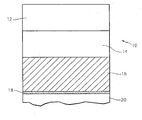
- the FIGURE illustrates a fully graded coating which can be formed using the process of the present invention.
- the coating 10 includes a layer 12 of porous 7 wt% yttria stabilized zirconia, a layer 14 of porous 7 wt% yttria stabilized zirconia and alumina, and a layer 16 of cobalt-alumina.
- the coating 10 may be deposited onto a bond layer 18, such as a MCrAlY layer where M is selected from the group consisting of nickel and cobalt, which has been deposited on the substrate 20.
- Grading is advantageous in that sharp changes in composition which may be related to stress concentrations are removed by maximizing the grading from one material to the next.
- Coatings formed by the process described herein are also different in that they are designed to be at neutral stress conditions, or as close as possible, at operating temperatures and thermal gradients. This may be achieved by maximizing the compositional gradation of the coating and customizing the temperature profile throughout the spray process.
- the coatings described herein have improved durability due to both a reduced sintering shrinkage and the reduced stress at component operating conditions provided by the gradual gradation of substrate temperature and composition during coating deposition.
Landscapes
- Chemical & Material Sciences (AREA)
- Engineering & Computer Science (AREA)
- Physics & Mathematics (AREA)
- Plasma & Fusion (AREA)
- Chemical Kinetics & Catalysis (AREA)
- Materials Engineering (AREA)
- Mechanical Engineering (AREA)
- Metallurgy (AREA)
- Organic Chemistry (AREA)
- Coating By Spraying Or Casting (AREA)
- Other Surface Treatments For Metallic Materials (AREA)
Applications Claiming Priority (1)
| Application Number | Priority Date | Filing Date | Title |
|---|---|---|---|
| US12/112,328 US9725797B2 (en) | 2008-04-30 | 2008-04-30 | Process for forming an improved durability thick ceramic coating |
Publications (3)
| Publication Number | Publication Date |
|---|---|
| EP2113582A2 true EP2113582A2 (de) | 2009-11-04 |
| EP2113582A3 EP2113582A3 (de) | 2010-04-14 |
| EP2113582B1 EP2113582B1 (de) | 2021-10-20 |
Family
ID=40845928
Family Applications (1)
| Application Number | Title | Priority Date | Filing Date |
|---|---|---|---|
| EP09250902.5A Active EP2113582B1 (de) | 2008-04-30 | 2009-03-27 | Verfahren zum Formen einer dicken keramischen Beschichtung mit verbesserter Beständigkeit |
Country Status (2)
| Country | Link |
|---|---|
| US (1) | US9725797B2 (de) |
| EP (1) | EP2113582B1 (de) |
Cited By (2)
| Publication number | Priority date | Publication date | Assignee | Title |
|---|---|---|---|---|
| CN106947932A (zh) * | 2017-04-18 | 2017-07-14 | 东莞华晶粉末冶金有限公司 | 一种氧化锆陶瓷板表面砂孔的修复方法与修复设备 |
| EP3492622A1 (de) * | 2017-12-04 | 2019-06-05 | General Electric Company | Verfahren zur formung einer porösen wärmebarrierenbeschichtung |
Families Citing this family (7)
| Publication number | Priority date | Publication date | Assignee | Title |
|---|---|---|---|---|
| CN106688125A (zh) * | 2013-10-16 | 2017-05-17 | 通用汽车环球科技运作有限责任公司 | 利用大气等离子体制造锂二级电池电极 |
| US10280765B2 (en) * | 2013-11-11 | 2019-05-07 | United Technologies Corporation | Article with coated substrate |
| US10196728B2 (en) * | 2014-05-16 | 2019-02-05 | Applied Materials, Inc. | Plasma spray coating design using phase and stress control |
| US20190186281A1 (en) * | 2017-12-20 | 2019-06-20 | United Technologies Corporation | Compressor abradable seal with improved solid lubricant retention |
| FR3082765B1 (fr) | 2018-06-25 | 2021-04-30 | Safran Aircraft Engines | Procede de fabrication d'une couche abradable |
| US20220380269A1 (en) * | 2021-05-26 | 2022-12-01 | General Electric Company | Suspension plasma spray composition and process for deposition of rare earth hafnium tantalate based coatings |
| CN115896705B (zh) * | 2022-12-28 | 2024-11-05 | 北京金轮坤天特种机械有限公司 | 多联体涡轮导向叶片等离子物理气相沉积涂层的喷涂方法 |
Citations (5)
| Publication number | Priority date | Publication date | Assignee | Title |
|---|---|---|---|---|
| US3493415A (en) | 1967-11-16 | 1970-02-03 | Nasa | Method of making a diffusion bonded refractory coating |
| EP0816526A2 (de) | 1996-06-27 | 1998-01-07 | United Technologies Corporation | Isolierendes, wärmedämmendes Beschichtungssystem |
| EP0937787A1 (de) | 1998-02-19 | 1999-08-25 | United Technologies Corporation | Verfahren zur Beschichtung eines thermischen Sperrschichtsystems, sowie beschichteter Gegenstand |
| EP1621647A2 (de) | 2004-07-30 | 2006-02-01 | United Technologies Corporation | Dispersiongehärtetes seltenerdenes stabilisiertes Zirkonoxid |
| DE102004044597B3 (de) | 2004-09-13 | 2006-02-02 | Forschungszentrum Jülich GmbH | Verfahren zur Herstellung dünner, dichter Keramikschichten |
Family Cites Families (5)
| Publication number | Priority date | Publication date | Assignee | Title |
|---|---|---|---|---|
| DE2538967C2 (de) * | 1975-09-02 | 1985-10-31 | Philipp Holzmann Ag, 6000 Frankfurt | Klemmverankerung für Spannstähle |
| DE69717805T2 (de) * | 1997-07-18 | 2003-09-04 | Ansaldo Ricerche S.R.L., Genua/Genova | Verfahren und Vorrichtung zur Herstellung von porösen keramischen Beschichtungen, insbesondere wärmedämmende Beschichtungen, auf metallische Substrate |
| US6071628A (en) * | 1999-03-31 | 2000-06-06 | Lockheed Martin Energy Systems, Inc. | Thermal barrier coating for alloy systems |
| US6893994B2 (en) * | 2002-08-13 | 2005-05-17 | Saint-Gobain Ceramics & Plastics, Inc. | Plasma spheroidized ceramic powder |
| JP4645030B2 (ja) * | 2003-12-18 | 2011-03-09 | 株式会社日立製作所 | 遮熱被膜を有する耐熱部材 |
-
2008
- 2008-04-30 US US12/112,328 patent/US9725797B2/en active Active
-
2009
- 2009-03-27 EP EP09250902.5A patent/EP2113582B1/de active Active
Patent Citations (5)
| Publication number | Priority date | Publication date | Assignee | Title |
|---|---|---|---|---|
| US3493415A (en) | 1967-11-16 | 1970-02-03 | Nasa | Method of making a diffusion bonded refractory coating |
| EP0816526A2 (de) | 1996-06-27 | 1998-01-07 | United Technologies Corporation | Isolierendes, wärmedämmendes Beschichtungssystem |
| EP0937787A1 (de) | 1998-02-19 | 1999-08-25 | United Technologies Corporation | Verfahren zur Beschichtung eines thermischen Sperrschichtsystems, sowie beschichteter Gegenstand |
| EP1621647A2 (de) | 2004-07-30 | 2006-02-01 | United Technologies Corporation | Dispersiongehärtetes seltenerdenes stabilisiertes Zirkonoxid |
| DE102004044597B3 (de) | 2004-09-13 | 2006-02-02 | Forschungszentrum Jülich GmbH | Verfahren zur Herstellung dünner, dichter Keramikschichten |
Cited By (3)
| Publication number | Priority date | Publication date | Assignee | Title |
|---|---|---|---|---|
| CN106947932A (zh) * | 2017-04-18 | 2017-07-14 | 东莞华晶粉末冶金有限公司 | 一种氧化锆陶瓷板表面砂孔的修复方法与修复设备 |
| EP3492622A1 (de) * | 2017-12-04 | 2019-06-05 | General Electric Company | Verfahren zur formung einer porösen wärmebarrierenbeschichtung |
| CN109865645A (zh) * | 2017-12-04 | 2019-06-11 | 通用电气公司 | 形成多孔热屏障涂层的方法 |
Also Published As
| Publication number | Publication date |
|---|---|
| EP2113582B1 (de) | 2021-10-20 |
| EP2113582A3 (de) | 2010-04-14 |
| US9725797B2 (en) | 2017-08-08 |
| US20120177840A1 (en) | 2012-07-12 |
Similar Documents
| Publication | Publication Date | Title |
|---|---|---|
| EP2113582B1 (de) | Verfahren zum Formen einer dicken keramischen Beschichtung mit verbesserter Beständigkeit | |
| US6875464B2 (en) | In-situ method and composition for repairing a thermal barrier coating | |
| US7846561B2 (en) | Engine portions with functional ceramic coatings and methods of making same | |
| CN109874330B (zh) | 含陶瓷化合物的层涂覆固体基材表面的方法及所获得的涂覆的基材 | |
| CN102127738B (zh) | 一种多层热障涂层及其制备方法 | |
| US8283048B2 (en) | Thermal barrier coatings and articles made therefrom | |
| US20110171488A1 (en) | Thermal barrier coating systems | |
| EP0897019B1 (de) | Verfahren und Vorrichtung zur Herstellung von porösen keramischen Beschichtungen, insbesondere wärmedämmende Beschichtungen, auf metallische Substrate | |
| EP2322686B1 (de) | Wärmesprühverfahren zur Herstellung von vertikal segmentierten Wärmedämmbeschichtungen | |
| EP1522533A1 (de) | Target für Elektronstrahlverdampfung, Verfahren zur dessen Herstellung, Wärmedämmschicht und Gegenstand enhaltend einen solche Schicht. | |
| CA2576319C (en) | Partially-alloyed zirconia powder | |
| Djendel et al. | Characterization of alumina-titania coatings produced by atmospheric plasma spraying on 304 SS steel | |
| US20120308836A1 (en) | Composite article having silicate barrier layer and method therefor | |
| KR101769750B1 (ko) | 경사기공 구조와 경사화 특성을 갖는 열차폐 코팅층의 동시제조 방법 | |
| CN114752881B (zh) | 一种抗cmas腐蚀热障涂层的制备方法以及由此得到的热障涂层 | |
| JP2008512566A (ja) | 薄く高密度のセラミック層の製造方法 | |
| KR101598858B1 (ko) | Ni-YSZ 복합재료 분말의 제조방법, 이에 의해 제조된 Ni-YSZ 복합재료 분말 및 상기 Ni-YSZ 복합재료 분말을 사용한 경사기능 열 차폐 코팅 방법 | |
| Wang et al. | Mullite coatings produced by APS and SPS: Effect of powder morphology and spray processing on the microstructure, crystallinity and mechanical properties | |
| CN120026270A (zh) | 一种具有热障涂层的合金材料及其制备方法 | |
| CN119020718A (zh) | 一种可重复超高温热防护涂层 | |
| Ahn et al. | Design and Experiments of Graded Thermal Barrier Coatings by Plasma Sprayings | |
| Il'yushchenko et al. | Optimisation of the technology of production of multilayered thermal barrier coatings | |
| CN121046768A (zh) | 一种高致密、强耐蚀环境障涂层及其轴向送粉高能等离子喷涂方法 |
Legal Events
| Date | Code | Title | Description |
|---|---|---|---|
| PUAI | Public reference made under article 153(3) epc to a published international application that has entered the european phase |
Free format text: ORIGINAL CODE: 0009012 |
|
| AK | Designated contracting states |
Kind code of ref document: A2 Designated state(s): AT BE BG CH CY CZ DE DK EE ES FI FR GB GR HR HU IE IS IT LI LT LU LV MC MK MT NL NO PL PT RO SE SI SK TR |
|
| AX | Request for extension of the european patent |
Extension state: AL BA RS |
|
| PUAL | Search report despatched |
Free format text: ORIGINAL CODE: 0009013 |
|
| AK | Designated contracting states |
Kind code of ref document: A3 Designated state(s): AT BE BG CH CY CZ DE DK EE ES FI FR GB GR HR HU IE IS IT LI LT LU LV MC MK MT NL NO PL PT RO SE SI SK TR |
|
| AX | Request for extension of the european patent |
Extension state: AL BA RS |
|
| 17P | Request for examination filed |
Effective date: 20100910 |
|
| AKX | Designation fees paid |
Designated state(s): DE GB |
|
| 17Q | First examination report despatched |
Effective date: 20110119 |
|
| RAP1 | Party data changed (applicant data changed or rights of an application transferred) |
Owner name: UNITED TECHNOLOGIES CORPORATION |
|
| STAA | Information on the status of an ep patent application or granted ep patent |
Free format text: STATUS: EXAMINATION IS IN PROGRESS |
|
| RAP1 | Party data changed (applicant data changed or rights of an application transferred) |
Owner name: RAYTHEON TECHNOLOGIES CORPORATION |
|
| GRAP | Despatch of communication of intention to grant a patent |
Free format text: ORIGINAL CODE: EPIDOSNIGR1 |
|
| STAA | Information on the status of an ep patent application or granted ep patent |
Free format text: STATUS: GRANT OF PATENT IS INTENDED |
|
| RIC1 | Information provided on ipc code assigned before grant |
Ipc: C23C 4/134 20160101ALI20210419BHEP Ipc: C23C 4/11 20160101ALI20210419BHEP Ipc: C23C 4/10 20160101ALI20210419BHEP Ipc: C23C 4/02 20060101AFI20210419BHEP |
|
| INTG | Intention to grant announced |
Effective date: 20210510 |
|
| GRAS | Grant fee paid |
Free format text: ORIGINAL CODE: EPIDOSNIGR3 |
|
| GRAA | (expected) grant |
Free format text: ORIGINAL CODE: 0009210 |
|
| STAA | Information on the status of an ep patent application or granted ep patent |
Free format text: STATUS: THE PATENT HAS BEEN GRANTED |
|
| AK | Designated contracting states |
Kind code of ref document: B1 Designated state(s): DE GB |
|
| REG | Reference to a national code |
Ref country code: GB Ref legal event code: FG4D |
|
| REG | Reference to a national code |
Ref country code: DE Ref legal event code: R096 Ref document number: 602009064104 Country of ref document: DE |
|
| REG | Reference to a national code |
Ref country code: DE Ref legal event code: R097 Ref document number: 602009064104 Country of ref document: DE |
|
| PLBE | No opposition filed within time limit |
Free format text: ORIGINAL CODE: 0009261 |
|
| STAA | Information on the status of an ep patent application or granted ep patent |
Free format text: STATUS: NO OPPOSITION FILED WITHIN TIME LIMIT |
|
| 26N | No opposition filed |
Effective date: 20220721 |
|
| P01 | Opt-out of the competence of the unified patent court (upc) registered |
Effective date: 20230519 |
|
| REG | Reference to a national code |
Ref country code: DE Ref legal event code: R081 Ref document number: 602009064104 Country of ref document: DE Owner name: RTX CORPORATION (N.D.GES.D. STAATES DELAWARE),, US Free format text: FORMER OWNER: RAYTHEON TECHNOLOGIES CORPORATION, FARMINGTON, CT, US |
|
| PGFP | Annual fee paid to national office [announced via postgrant information from national office to epo] |
Ref country code: GB Payment date: 20260220 Year of fee payment: 18 |
|
| PGFP | Annual fee paid to national office [announced via postgrant information from national office to epo] |
Ref country code: DE Payment date: 20260219 Year of fee payment: 18 |