EP2115741B1 - Fortgeschrittene kodierung/dekodierung von digitalen tonsignalen - Google Patents
Fortgeschrittene kodierung/dekodierung von digitalen tonsignalen Download PDFInfo
- Publication number
- EP2115741B1 EP2115741B1 EP08762010A EP08762010A EP2115741B1 EP 2115741 B1 EP2115741 B1 EP 2115741B1 EP 08762010 A EP08762010 A EP 08762010A EP 08762010 A EP08762010 A EP 08762010A EP 2115741 B1 EP2115741 B1 EP 2115741B1
- Authority
- EP
- European Patent Office
- Prior art keywords
- subband
- signal
- band
- coding
- masking threshold
- Prior art date
- Legal status (The legal status is an assumption and is not a legal conclusion. Google has not performed a legal analysis and makes no representation as to the accuracy of the status listed.)
- Active
Links
Images




Classifications
-
- G—PHYSICS
- G10—MUSICAL INSTRUMENTS; ACOUSTICS
- G10L—SPEECH ANALYSIS TECHNIQUES OR SPEECH SYNTHESIS; SPEECH RECOGNITION; SPEECH OR VOICE PROCESSING TECHNIQUES; SPEECH OR AUDIO CODING OR DECODING
- G10L19/00—Speech or audio signals analysis-synthesis techniques for redundancy reduction, e.g. in vocoders; Coding or decoding of speech or audio signals, using source filter models or psychoacoustic analysis
- G10L19/04—Speech or audio signals analysis-synthesis techniques for redundancy reduction, e.g. in vocoders; Coding or decoding of speech or audio signals, using source filter models or psychoacoustic analysis using predictive techniques
- G10L19/08—Determination or coding of the excitation function; Determination or coding of the long-term prediction parameters
- G10L19/12—Determination or coding of the excitation function; Determination or coding of the long-term prediction parameters the excitation function being a code excitation, e.g. in code excited linear prediction [CELP] vocoders
-
- G—PHYSICS
- G10—MUSICAL INSTRUMENTS; ACOUSTICS
- G10L—SPEECH ANALYSIS TECHNIQUES OR SPEECH SYNTHESIS; SPEECH RECOGNITION; SPEECH OR VOICE PROCESSING TECHNIQUES; SPEECH OR AUDIO CODING OR DECODING
- G10L19/00—Speech or audio signals analysis-synthesis techniques for redundancy reduction, e.g. in vocoders; Coding or decoding of speech or audio signals, using source filter models or psychoacoustic analysis
- G10L19/02—Speech or audio signals analysis-synthesis techniques for redundancy reduction, e.g. in vocoders; Coding or decoding of speech or audio signals, using source filter models or psychoacoustic analysis using spectral analysis, e.g. transform vocoders or subband vocoders
- G10L19/0204—Speech or audio signals analysis-synthesis techniques for redundancy reduction, e.g. in vocoders; Coding or decoding of speech or audio signals, using source filter models or psychoacoustic analysis using spectral analysis, e.g. transform vocoders or subband vocoders using subband decomposition
-
- G—PHYSICS
- G10—MUSICAL INSTRUMENTS; ACOUSTICS
- G10L—SPEECH ANALYSIS TECHNIQUES OR SPEECH SYNTHESIS; SPEECH RECOGNITION; SPEECH OR VOICE PROCESSING TECHNIQUES; SPEECH OR AUDIO CODING OR DECODING
- G10L19/00—Speech or audio signals analysis-synthesis techniques for redundancy reduction, e.g. in vocoders; Coding or decoding of speech or audio signals, using source filter models or psychoacoustic analysis
- G10L19/02—Speech or audio signals analysis-synthesis techniques for redundancy reduction, e.g. in vocoders; Coding or decoding of speech or audio signals, using source filter models or psychoacoustic analysis using spectral analysis, e.g. transform vocoders or subband vocoders
-
- G—PHYSICS
- G10—MUSICAL INSTRUMENTS; ACOUSTICS
- G10L—SPEECH ANALYSIS TECHNIQUES OR SPEECH SYNTHESIS; SPEECH RECOGNITION; SPEECH OR VOICE PROCESSING TECHNIQUES; SPEECH OR AUDIO CODING OR DECODING
- G10L19/00—Speech or audio signals analysis-synthesis techniques for redundancy reduction, e.g. in vocoders; Coding or decoding of speech or audio signals, using source filter models or psychoacoustic analysis
- G10L19/002—Dynamic bit allocation
-
- G—PHYSICS
- G10—MUSICAL INSTRUMENTS; ACOUSTICS
- G10L—SPEECH ANALYSIS TECHNIQUES OR SPEECH SYNTHESIS; SPEECH RECOGNITION; SPEECH OR VOICE PROCESSING TECHNIQUES; SPEECH OR AUDIO CODING OR DECODING
- G10L19/00—Speech or audio signals analysis-synthesis techniques for redundancy reduction, e.g. in vocoders; Coding or decoding of speech or audio signals, using source filter models or psychoacoustic analysis
- G10L19/02—Speech or audio signals analysis-synthesis techniques for redundancy reduction, e.g. in vocoders; Coding or decoding of speech or audio signals, using source filter models or psychoacoustic analysis using spectral analysis, e.g. transform vocoders or subband vocoders
- G10L19/0212—Speech or audio signals analysis-synthesis techniques for redundancy reduction, e.g. in vocoders; Coding or decoding of speech or audio signals, using source filter models or psychoacoustic analysis using spectral analysis, e.g. transform vocoders or subband vocoders using orthogonal transformation
-
- G—PHYSICS
- G10—MUSICAL INSTRUMENTS; ACOUSTICS
- G10L—SPEECH ANALYSIS TECHNIQUES OR SPEECH SYNTHESIS; SPEECH RECOGNITION; SPEECH OR VOICE PROCESSING TECHNIQUES; SPEECH OR AUDIO CODING OR DECODING
- G10L19/00—Speech or audio signals analysis-synthesis techniques for redundancy reduction, e.g. in vocoders; Coding or decoding of speech or audio signals, using source filter models or psychoacoustic analysis
- G10L19/02—Speech or audio signals analysis-synthesis techniques for redundancy reduction, e.g. in vocoders; Coding or decoding of speech or audio signals, using source filter models or psychoacoustic analysis using spectral analysis, e.g. transform vocoders or subband vocoders
- G10L19/032—Quantisation or dequantisation of spectral components
- G10L19/038—Vector quantisation, e.g. TwinVQ audio
-
- G—PHYSICS
- G10—MUSICAL INSTRUMENTS; ACOUSTICS
- G10L—SPEECH ANALYSIS TECHNIQUES OR SPEECH SYNTHESIS; SPEECH RECOGNITION; SPEECH OR VOICE PROCESSING TECHNIQUES; SPEECH OR AUDIO CODING OR DECODING
- G10L19/00—Speech or audio signals analysis-synthesis techniques for redundancy reduction, e.g. in vocoders; Coding or decoding of speech or audio signals, using source filter models or psychoacoustic analysis
- G10L19/04—Speech or audio signals analysis-synthesis techniques for redundancy reduction, e.g. in vocoders; Coding or decoding of speech or audio signals, using source filter models or psychoacoustic analysis using predictive techniques
- G10L19/16—Vocoder architecture
- G10L19/18—Vocoders using multiple modes
- G10L19/24—Variable rate codecs, e.g. for generating different qualities using a scalable representation such as hierarchical encoding or layered encoding
Definitions
- the present invention relates to a sound data processing.
- This processing is adapted in particular to the transmission and / or storage of digital signals such as audio-frequency signals (speech, music, or other).
- the LTP long-term prediction parameters including the pitch period, represent the fundamental vibration of the speech signal (when it is voiced), while the LPC short-term prediction parameters represent the spectral envelope. of this signal.
- all of these LPC and LTP parameters thus resulting from a speech coding, can be transmitted in blocks to a peer decoder, via one or more telecommunication networks, to then restore the initial speech signal.
- the encoder In conventional speech coding, the encoder generates a fixed rate bit stream. This flow constraint simplifies the implementation and use of the encoder and the decoder. Examples of such systems are the ITU-T G.711 64 kbit / s standard coding, the 8 kbit / s ITU-T G.729 coding or the 12.2 kbit / s GSM-EFR coding.
- variable rate bit stream In some applications (such as mobile telephony or VoIP for "Internet Protocol"), it is best to generate a variable rate bit stream. Flow values are taken in a predefined set. Such a coding technique, called “multi-rate” is therefore more flexible than a fixed rate coding technique.
- Hierarchical coding having the capacity to provide varied bit rates, is described below by distributing the information relating to an audio signal to be coded in hierarchical subsets, so that this information can be used in order of importance. in terms of audio rendering quality.
- the criterion taken into account for determining the order is a criterion for optimizing (or rather reducing) the quality of the coded audio signal.
- Hierarchical coding is particularly suited to transmission over heterogeneous networks or having variable available rates over time, or to transmission to terminals with varying capacities.
- Hierarchical audio coding (or " scalable ) can be described as follows.
- the bit stream includes a base layer and one or more enhancement layers.
- the base layer is generated by a low-bandwidth codec (fixed), called a "codec heart", guaranteeing the minimum coding quality.
- This layer must be received by the decoder to maintain an acceptable level of quality. Improvement layers are used to improve quality. However, they may not all be received by the decoder.
- the main advantage of hierarchical coding is that it allows an adaptation of the bit rate simply by " truncation of the bit stream ".
- the number of layers i.e., the number of possible truncations of the bitstream
- the number of layers defines the granularity of the coding.
- scalable scalability and bandwidth encoding techniques with a CELP heart-coder, a telephone band, and one or more broadband enhancement layer (s).
- An example of such systems is given in the ITU-T G.729.1 8-32 kbit / s fine grain standard.
- the G.729.1 coding / decoding algorithm is summarized below.
- the G.729.1 encoder is an extension of the ITU-T G.729 coder. It is a modified G.729 heart-coded core encoder producing a bandwidth ranging from narrowband (50-4000 Hz) to wideband (50-7000 Hz) at a rate of 8 to 32 kbit / s for conversational services. This codec is compatible with existing VoIP devices (most of which are equipped according to G.729). Finally, it should be noted that G.729.1 was approved in May 2006.
- the G.729.1 coder is schematized on the figure 1 .
- the broadband input signal s wb sampled at 16 kHz, is first decomposed into two subbands by QMF (for "Quadrature Mirror Filter") filtering.
- the low band (0-4000 Hz) is obtained by LP low-pass filtering (block 100) and decimation (block 101), and the high band (4000-8000 Hz) by HP high-pass filtering (block 102) and decimation (block 103).
- the LP and HP filters are of length 64.
- the low band is pretreated with a high-pass filter eliminating the components below 50 Hz (block 104), to obtain the signal S LB , before CELP coding in narrow band (block 105) at 8 and 12 kbit / s.
- This high-pass filtering takes into account that the Useful band is defined as covering the range 50-7000 Hz.
- the narrow-band CELP coding is a cascaded CELP coding comprising as a first stage a modified G.729 coding without pre-processing filter and as a second stage an additional fixed CELP dictionary.
- the high band is first pretreated (block 106) to compensate for the folding due to the high-pass filter (block 102) combined with the decimation (block 103).
- the high band is then filtered by a low pass filter (block 107) eliminating the components between 3000 and 4000 Hz from the high band (that is, the components between 7000 and 8000 Hz in the original signal) to obtain the signal S HB .
- a band extension (block 108) is then performed.
- the error signal d LB of the low band is calculated (block 109) from the output of the CELP coder (block 105) and a predictive coding by transform (for example of the TDAC type for "Time Domain Aliasing Cancellation" in the G.729.1) is carried out at block 110.
- a predictive coding by transform for example of the TDAC type for "Time Domain Aliasing Cancellation" in the G.729.1
- Additional parameters can be transmitted by the block 111 to a homologous decoder, this block 111 performing a so-called “FEC” treatment for "Frame Erasure Concealment", in order to reconstitute possible erased frames.
- the different bitstreams generated by the coding blocks 105, 108, 110 and 111 are finally multiplexed and structured into a hierarchical bit stream in the multiplexing block 112.
- the coding is performed by 20 ms sample blocks (or frames). 320 samples per frame.
- the G.729.1 homologous decoder is illustrated on the figure 2 .
- the bits describing each frame of 20 ms are demultiplexed in block 200.
- the bit stream of the 8 and 12 kbit / s layers is used by the CELP decoder (block 201) to generate the narrow-band synthesis (0-4000 Hz).
- the portion of the bit stream associated with the 14 kbit / s layer is decoded by the tape extension module (block 202).
- the portion of the bit stream associated with data rates greater than 14 kbit / s is decoded by the TDAC module (block 203).
- Pre-echo and post-echo processing is performed by blocks 204 and 207 as well as enrichment (block 205) and aftertreatment of the low band (block 206).
- the broadband output signal ⁇ wb sampled at 16 kHz, is obtained via the QMF synthesis filter bank (blocks 209, 210, 211, 212 and 213) incorporating the inverse folding (block 208).
- the TDAC type transform coding in the G.729.1 encoder is illustrated on the figure 3 .
- This spectrum is divided into eighteen sub-bands, a sub-band j being assigned a number of coefficients noted nb_coef ( j ).
- the subband splitting is specified in Table 1 below.
- a subband j comprises the coefficients Y ( k ) with sb_bound ( j ) ⁇ k ⁇ sb_bound ( j + 1).
- Table 1 TDAC Encoding Boundary Limits and Size J sb_bound ( j ) nb_coef ( j ) 0 0 16 1 16 16 2 32 16 3 48 16 4 64 16 5 80 16 6 96 16 7 112 16 8 128 16 9 144 16 10 160 16 11 176 16 12 192 16 13 208 16 14 224 16 15 240 16 16 256 16 17 272 8 18 280 -
- the spectral envelope is coded at a variable rate in block 305.
- This quantized value rms _index ( j ) is transmitted to the bit allocation block 306.
- the number of bits allocated to each sub-band for its quantization is determined in block 306 from the quantized spectral envelope from block 305.
- the allocation of the bits performed minimizes the squared error while respecting the constraint of a number of integer bits allocated per subband and a maximum number of bits not to be exceeded.
- the spectral content of the subbands is then encoded by spherical vector quantization (block 307).
- the different bit streams generated by the blocks 305 and 307 are then multiplexed and structured into a hierarchical bit stream at the multiplexing block 308.
- the TDAC type transform decoding step in the G.729.1 decoder is illustrated on the figure 4 .
- the decoded spectral envelope (block 401) makes it possible to find the allocation of the bits (block 402).
- each of the subbands is found by inverse spherical vector quantization (block 403).
- the sub-bands not transmitted, due to a lack of "budget" of bits, are extrapolated (block 404) from the MDCT transform of the signal at the output of the band extension block (block 202 of FIG. figure 2 ).
- IMDCT inverse MDCT transform
- W LB inverse perceptual weighting
- the subbands bit allocation (block 306 of FIG. figure 3 or block 402 of the figure 4 ).
- nbit ( j ) arg min r ⁇ R nb_coef j ⁇ nb_coef j ⁇ ip j - ⁇ Opt - r where ⁇ opt is a parameter optimized by dichotomy.
- the TDAC coding uses the perceptual weighting W LB ( z ) filter in the low band (block 300), as indicated above.
- perceptual weighting filtering allows you to format the coding noise.
- the principle of this filtering is to exploit the fact that it is possible to inject more noise in the frequency zones where the original signal has a high energy.
- the most common perceptual weighting filters used in narrow-band CELP coding are of the form ⁇ (z / ⁇ 1) / ⁇ (z / ⁇ 2) where 0 ⁇ ⁇ 2 ⁇ ⁇ 1 ⁇ 1 and ⁇ (z) represents a prediction spectrum linear (LPC).
- LPC prediction spectrum linear
- the fac factor makes it possible to ensure at the junction of the low and high bands (4 kHz) a gain of the filter at 1 to 4 kHz. It is important to note that in the G.729.1 TDAC coding, the coding is based on an energetic criterion only.
- the joint coding of these two signals is carried out in the MDCT domain according to the criterion of the quadratic error.
- the high band is coded according to energy criteria, which is suboptimal (in the "perceptual" sense of the term).
- multi-band coding may be considered, a perceptual weighting filter being applied to the signal of at least one band in the time domain, and the set of subbands being coded together. by transform coding. If we want to apply the perceptual weighting in the frequency domain, then there is the problem of continuity and homogeneity of the spectra between subbands.
- the present invention improves the situation.
- the present invention therefore proposes to calculate a frequency perceptual weighting, using a masking threshold, on only a part of the frequency band (at least on the "second subband” mentioned above) and to ensure spectral continuity with at least another frequency band (at least the aforementioned "first sub-band”) by normalizing the masking threshold on the spectrum covering these two frequency bands.
- the allocation of the bits for the second sub-band at least is determined furthermore according to a standardized masking curve calculation, applied at least to the second sub-band.
- the application of the invention makes it possible to transmit the bits to the sub-bands that require the most bits according to a perceptual criterion.
- perceptual frequency weighting is then applied by masking a part of the audio band, so as to improve the audio quality by optimizing in particular the distribution of bits between subbands according to criteria. perceptual.
- the transformed signal in the second subband is weighted by a factor proportional to the square root of the normalized masking threshold for the second subband.
- the normalized masking threshold is not used for the allocation of the bits to the subbands as in the first application mode above, but it can advantageously be used to directly weight the signal of the second sub-band at least in the transformed domain.
- the present invention is advantageously, but not exclusively, applied to a TDAC-type transform coding in a global encoder according to the G.729.1 standard, the first subband being included in a low frequency band, whereas the second subband is included in a low frequency band, while the second subband is included in a low frequency band.
- -band is included in a high frequency band that can extend up to 7000 Hz, or even more (typically up to 14 kHz) in band extension.
- the application of the invention may then consist in providing a perceptual weighting for the high band while ensuring spectral continuity with the low band.
- the signal from the core coding can be perceptually weighted and the implementation of the invention is advantageous in the sense that the entire spectral band can finally be perceptually weighted.
- the signal from the core coding may be a signal representative of a difference between an original signal and a synthesis of this original signal (called “difference signal” or "error signal”).
- difference signal or "error signal”
- a first decoding application mode homologous to the first application mode of the coding defined above, aims at the allocation of bits to the decoding and a number of bits to be allocated to each subband is determined from a decoding spectral envelope.
- the bit allocation for the at least second subband is further determined according to a normalized masking curve calculation applied at least to the second subband.
- a second method of applying decoding within the meaning of the invention consists in weighting the transformed signal in the second subband by the square root of the normalized masking threshold. This embodiment will be described in detail with reference to the figure 10B .
- the invention provides an improvement to the perceptual weighting performed in the transform coder by exploiting the masking effect known as "simultaneous masking" or "frequency masking".
- This property corresponds to the modification of the hearing threshold in the presence of a so-called “masking” sound. This phenomenon is observed typically when, for example, one tries to hold a discussion with ambient noise, for example in the street and that the noise of a vehicle comes to "hide” the voice of a speaker.
- an approximate masking threshold is calculated for each spectrum line. This threshold is the one above which the line concerned is supposed to be audible.
- the masking threshold is calculated from the convolution of the signal spectrum with a spreading function B ( v ) modeling the masking effect of a sound (sinusoid or filtered white noise) by another sound (sinusoid or noise filtered white).
- the spreading function may be a function of the level of the line and / or the frequency of the masking line. A detection of "peaks" can also be implemented.
- An application of the invention described hereinafter makes it possible to improve the TDAC coding of the encoder according to the G.729.1 standard, in particular by applying a perceptual weighting of the high band (4 to 7 kHz) while ensuring the continuity spectral between low and high bands for a satisfactory and joint coding of these two bands.
- the input signal is sampled at 16 kHz, bandwidth 50 Hz to 7 kHz.
- the encoder always operates at the maximum rate of 32 kbit / s, while the decoder can receive the core (8 kbit / s), as well as one or more enhancement layers (12 to 32 kbit / s per step). 2 kbit / s), as in G.729.1. Coding and decoding have the same architecture as that presented to figures 1 and 2 .
- blocks 110 and 203 are modified as described in figures 6 and 7 .
- the modified TDAC coder is identical to that of the figure 3 , except that the allocation of the bits following the squared error (block 306) is now replaced by a masking curve calculation and a modified bit allocation (blocks 606 and 607), the invention forming part of the calculation of the masking curve (block 606) and its use in the allocation of bits (block 607).
- the modified TDAC decoder is presented on the figure 7 in this first embodiment.
- This decoder is identical to that of the figure 4 , except that the allocation of the bits following the squared error (block 402) is replaced by a masking curve calculation and a modified bit allocation (blocks 702 and 703).
- the invention relates to blocks 702 and 703.
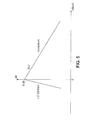
- An advantageous spreading function is that presented to the figure 5 . It is a triangular function whose first slope is + 27dB / Bark and -10dB / Bark for the second.
- ⁇ 1 ( j ) and ⁇ 2 ( j ) can be pre-calculated and stored.
- a first embodiment of the invention is described below for the allocation of bits in a hierarchical coder such as the G.729.1 encoder.
- bit allocation criterion is based here on the signal-to-mask ratio given by: 1 2 ⁇ log 2 ⁇ ⁇ 2 j M j
- the masking threshold is normalized by its value on the last subband of the low band.
- the definition of the term ip ( j ) , j 10, ..., 17, is changed.
- FIG 8 An illustration of the standardization of the masking threshold is given in figure 8 , showing the connection of the high band on which the masking (4-7 kHz) is applied to the low band (0-4 kHz).
- the standardization of the masking threshold can be rather carried out from the value of the band.
- these relations giving the normalization factor normfac or the masking threshold M ( j ) can be generalized to any number of sub-bands (different, in total, from eighteen) in high band (with a different number of eight), as in low band (with a different number of ten).
- the normalized masking threshold is not used to weight the energy in the definition of the perceptual importance, as in the first embodiment described above, but it serves to directly weight the high band signal before TDAC coding.
- This second embodiment is illustrated on the Figures 9A (for encoding) and 10A (for decoding).
- a variant of this second mode, which is the object of the present invention, in particular for the decoding performed, is illustrated on the Figures 9B (for encoding) and 10B (for decoding).
- the masking threshold is calculated (block 905 of the Figure 9A and block 906b of the Figure 9B ) from the unquantized spectral envelope.
- the peer decoder is shown in the figure 10A .
- the block 1002 is then performed as described in Ragot et al. supra.
- Block 1004 also performs a function similar to that of block 405 of the figure 4 .
- This second embodiment may be particularly advantageous, particularly in an implementation according to the 3GPP-AMR-WB + standard, which is the preferred context of the document Ragot et al. supra.
- the coded information remains the envelope of energy (rather than the masking threshold itself as on the Figures 9A and 10A ).
- the masking threshold is calculated and normalized (block 906b of the Figure 9B ) from the coded spectral envelope (block 905b).
- the masking threshold is calculated and standardized (block 1011b of the figure 10B ) from the decoded spectral envelope (block 1001b), the decoding of the envelope making it possible to perform a level adjustment (block 1010b of the figure 10B ) from the quantized values rms_q ( j ).
- a masking threshold is calculated for each sub-band, at least for the sub-bands of the high frequency band, this masking threshold being normalized to ensure spectral continuity between the subbands concerned.
- the calculation of the masking threshold is particularly advantageous when the signal to be coded is not tonal, in the first mode, as in the second embodiment, described above.
- the application of the spreading function B (v) results in a masking threshold very close to a tone a little more spread out in frequencies.
- the allocation criterion minimizing the masked coding noise ratio then gives a bit of bit allocation.
- the same is true for the direct weighting of the high band signal according to the second embodiment. It is therefore preferred, for a tonal signal, to use a bit allocation according to energy criteria.
- the invention is applied only if the signal to be encoded is not tonal.
- the bit relating to the mode of the coding of the spectral envelope indicates a "differential Huffman" mode or a "natural direct binary” mode.
- This mode bit can be interpreted as a tone detection, since, in general, a tonal signal leads to envelope coding by the "natural direct binary” mode, while most non-tonal signals, having a spectral dynamic more limited, lead to envelope coding by the "Differential Huffman" mode.
- the module 904 of the Figure 9A can, by calculating the spectral envelope, determine whether the signal is tonal or not and so Block 905 is bypassed if yes.
- the module 904 can make it possible to determine whether the signal is tonal or not and so bypass the block 907 in the affirmative.
- the figure 11 generalize the normalization of the masking curve (described in figure 8 ) in the case of super wide band coding.
- the signals in this embodiment are sampled at a frequency of 32 kHz (instead of 16 kHz) for a useful band of 50 Hz - 14 kHz.
- the masking curve log 2 [ M ( j )] is then defined at least for the sub-bands ranging from 7 to 14 kHz.
- the spectrum covering the band 50 Hz - 14 kHz is coded by subbands and the allocation of bits to each subband is made from the spectral envelope as in the G.729.1 encoder.
- a partial masking threshold can be calculated as previously described.
- the standardization of the masking threshold as illustrated on the figure 11 , so also generalizes to the case where the high band has more subbands or covers a wider frequency area than in G.729.1.
- a first T1 transform is applied to the time weighted difference signal.
- a second transform T2 is applied to the signal on the first high band between 4 and 7 kHz and a third transform T3 is applied to the signal on the second high band between 7 and 14 kHz.
- the invention is not limited to signals sampled at 16kHz. Its implementation is particularly advantageous also for signals sampled at higher frequencies, such as for the extension of the G.729.1 encoder to signals sampled not at 16 kHz but at 32 kHz, as described above. If the TDAC coding is generalized to such a frequency band (50 Hz - 14 kHz instead of 50 Hz - 7 kHz currently), the advantage provided by the invention will be really major.
- the invention also aims to improve the TDAC coding, in particular by applying a perceptual weighting of the high-bandwidth (4-14 kHz) while ensuring the spectral continuity between bands, this criterion being important for a joint coding of the band.
- first low band and the second high and extended band up to 14 kHz.
- the perceptual weighting in the low band is not necessary for the application of the invention.
- the present invention also relates to a first computer program, stored in a memory of an encoder of a telecommunication terminal and / or stored on a memory medium intended to cooperate with a reader of said encoder.
- This first program then comprises instructions for implementing the coding method defined above, when these instructions are executed by an encoder processor.
- the present invention also relates to an encoder comprising at least one memory storing this first computer program.
- FIGS. 6 , 9A and 9B may constitute flowcharts of this first computer program, or further illustrate the structure of such an encoder, according to different embodiments and variants.
- the present invention also relates to a second computer program, stored in a memory of a decoder of a telecommunication terminal and / or stored on a storage medium intended to cooperate with a reader of said decoder.
- This second program then comprises instructions for implementing the decoding method defined above, when these instructions are executed by a processor of the decoder.
- the present invention also relates to a decoder comprising at least one memory storing this second computer program.
- FIG. 7 , 10A , 10B may constitute flowcharts of this second computer program, or further illustrate the structure of such a decoder, according to different embodiments and variants.
Landscapes
- Engineering & Computer Science (AREA)
- Physics & Mathematics (AREA)
- Computational Linguistics (AREA)
- Signal Processing (AREA)
- Health & Medical Sciences (AREA)
- Audiology, Speech & Language Pathology (AREA)
- Human Computer Interaction (AREA)
- Acoustics & Sound (AREA)
- Multimedia (AREA)
- Spectroscopy & Molecular Physics (AREA)
- Compression, Expansion, Code Conversion, And Decoders (AREA)
Claims (19)
- Verfahren zum Codieren eines Tonsignals in mehreren Unterbändern, bei dem mindestens ein erstes und ein zweites benachbartes Unterband transformationscodiert werden (601, 602; 901, 902), dadurch gekennzeichnet, dass das Verfahren zur Anwendung einer perzeptuellen Gewichtung im transformierten Bereich auf mindestens das zweite Unterband aufweist:- eine Bestimmung mindestens einer Frequenzmaskierungsschwelle (606; 905; 906b), die an das zweite Unterband anzuwenden ist, und- eine Normalisierung der Maskierungsschwelle, um eine spektrale Kontinuität zwischen dem ersten und dem zweiten Unterband zu gewährleisten.
- Verfahren nach Anspruch 1, bei dem eine Anzahl von jedem Unterband zuzuweisenden Bits ausgehend von einer spektral Hüllkurve bestimmt wird,
dadurch gekennzeichnet, dass die Zuweisung der Bits (607) für mindestens das zweite Unterband außerdem in Abhängigkeit von einer Berechung einer normalisierten Maskierungskurve bestimmt wird, die mindestens an das zweite Unterband (606) angewendet wird. - Verfahren nach Anspruch 2, bei dem die Codierung an mehr als zwei Unterbändern durchgeführt wird, wobei das erste Unterband in einem ersten Spektralband und das zweite Unterband in einem zweiten Spektralband enthalten ist, dadurch gekennzeichnet, dass die Anzahl von Bits pro Unterband nbit(j) für jedes Unterband mit dem Index j sich in Abhängigkeit von einer perzeptuellen Größe (ip(j) ergibt, die ausgehend von einer Beziehung des folgenden Typs berechnet wird:-
 -
- - rms_index(j) aus der Codierung der Hüllkurve stammende quantisierte Werte für das Unterband j sind,- M(j) die Maskierungsschwelle für das Unterband mit dem Index j ist, und- normfac ein bestimmter Normalisierungsfaktor ist, um die spektrale Kontinuität zwischen dem ersten und dem zweiten Unterband zu gewährleisten.
 - Verfahren nach Anspruch 1, dadurch gekennzeichnet, dass das transformierte Signal im zweiten Unterband mit einem Faktor proportional zur Quadratwurzel der normalisierten Maskierungsschwelle für das zweite Unterband gewichtet wird (905).
- Verfahren nach Anspruch 4, bei dem die Codierung an mehr als zwei Unterbändern durchgeführt wird, wobei das erste Unterband in einem ersten Spektralband und das zweite Unterband in einem zweiten Spektralband enthalten ist, dadurch gekennzeichnet, dass Gewichtungswerte von

- Verfahren nach einem der vorhergehenden Ansprüche, dadurch gekennzeichnet, dass die Transformationscodierung in einer oberen Schicht (110) eines hierarchischen Codierers stattfindet,- wobei das erste Unterband ein Signal
 - und das zweite Unterband ein originales Signal (SHB) aufweist.
 - Verfahren nach Anspruch 6, dadurch gekennzeichnet, dass das von der Kerncodierung stammende Signal

- Verfahren nach einem der Ansprüche 6 und 7, dadurch gekennzeichnet, dass das von der Kerncodierung stammende Signal

- Verfahren nach einem der Ansprüche 6 bis 8, dadurch gekennzeichnet, dass die Transformationscodierung vom Typ TDAC in einem globalen Codierer gemäß der Norm G.729.1 ist, und dass das erste Unterband in einem Band niederer Frequenzen (T1) enthalten ist, während das zweite Unterband in einem Band hoher Frequenzen enthalten ist.
- Verfahren nach Anspruch 9, dadurch gekennzeichnet, dass das Band hoher Frequenzen sich bis 7000 Hz (T2) erstreckt, mindestens (T3).
- Verfahren nach einem der vorhergehenden Ansprüche, bei dem eine spektrale Hüllkurve berechnet wird (604; 904), dadurch gekennzeichnet, dass die Maskierungsschwelle für ein Unterband definiert wird durch eine Faltung zwischen:- einem Ausdruck der spektralen Hüllkurve und- einer Spreizfunktion, die eine zentrale Frequenz des Unterbands benutzt.
- Verfahren nach einem der vorhergehenden Ansprüche, bei dem eine Information (305) erhalten wird, gemäß der das zu codierende Signal ein tonales Signal ist oder nicht, dadurch gekennzeichnet, dass die perzeptuelle Gewichtung des zweiten Unterbands mit der Bestimmung der Maskierungsschwelle und der Normalisierung nur durchgeführt werden, wenn das Signal nicht tonal ist.
- Verfahren zur Decodierung eines Tonsignals in mehreren Unterbändern, bei dem mindestens ein erstes und ein zweites benachbartes Unterband transformationsdecodiert werden (709, 711; 1007, 1009), dadurch gekennzeichnet, dass das Verfahren zur Anwendung einer perzeptuellen Gewichtung im transformierten Bereich auf mindestens das zweite Unterband aufweist:- eine Bestimmung mindestens einer Frequenzmaskierungsschwelle (702; 1001; 1011b), die ausgehend von einer decodierten spektralen Hüllkurve an das zweite Unterband anzuwenden ist, und- eine Normalisierung der Maskierungsschwelle, um eine spektrale Kontinuität zwischen dem ersten und dem zweiten Unterband zu gewährleisten.
- Verfahren nach Anspruch 13, bei dem eine Anzahl von jedem Unterband (703) zuzuweisenden Bits ausgehend von einer Decodierung der spektralen Hüllkurve (701) bestimmt wird,
dadurch gekennzeichnet, dass die Zuweisung der Bits (703) für mindestens das zweite Unterband außerdem in Abhängigkeit von einer Berechung einer normalisierten Maskierungskurve (702) bestimmt wird, die mindestens an das zweite Unterband angewendet wird. - Verfahren nach Anspruch 13, dadurch gekennzeichnet, dass das transformierte Signal im zweiten Unterband mit einem Faktor proportional zur Quadratwurzel der normalisierten Maskierungsschwelle für das zweite Unterband gewichtet wird (1004).
- EDV-Programm, das in einem Speicher eines Codierers eines Telekommunikations-Endgeräts gespeichert ist und/oder auf einem Speicherträger gespeichert ist, der dazu bestimmt ist, mit einem Lesegerät des Codierers zusammenzuwirken,
dadurch gekennzeichnet, dass es Anweisungen zur Durchführung des Codierverfahrens nach einem der Ansprüche 1 bis 12 aufweist, wenn die Anweisungen von einem Prozessor des Codierers ausgeführt werden. - Codierer, dadurch gekennzeichnet, dass er mindestens einen Speicher aufweist, der ein EDV-Programm nach Anspruch 16 speichert.
- EDV-Programm, das in einem Speicher eines Decodierers eines Telekommunikations-Endgeräts gespeichert ist und/oder auf einem Speicherträger gespeichert ist, der dazu bestimmt ist, mit einem Lesegerät des Decodierers zusammenzuwirken,
dadurch gekennzeichnet, dass es Anweisungen zur Durchführung des Decodierverfahrens nach einem der Ansprüche 13 bis 15 aufweist, wenn die Anweisungen von einem Prozessor des Decodierers ausgeführt werden. - Decodierer, dadurch gekennzeichnet, dass er mindestens einen Speicher aufweist, der ein EDV-Programm nach Anspruch 18 speichert.
Applications Claiming Priority (2)
| Application Number | Priority Date | Filing Date | Title |
|---|---|---|---|
| FR0700747A FR2912249A1 (fr) | 2007-02-02 | 2007-02-02 | Codage/decodage perfectionnes de signaux audionumeriques. |
| PCT/FR2008/050150 WO2008104663A1 (fr) | 2007-02-02 | 2008-01-30 | Codage/decodage perfectionnes de signaux audionumeriques |
Publications (2)
| Publication Number | Publication Date |
|---|---|
| EP2115741A1 EP2115741A1 (de) | 2009-11-11 |
| EP2115741B1 true EP2115741B1 (de) | 2010-07-07 |
Family
ID=38477199
Family Applications (1)
| Application Number | Title | Priority Date | Filing Date |
|---|---|---|---|
| EP08762010A Active EP2115741B1 (de) | 2007-02-02 | 2008-01-30 | Fortgeschrittene kodierung/dekodierung von digitalen tonsignalen |
Country Status (10)
| Country | Link |
|---|---|
| US (1) | US8543389B2 (de) |
| EP (1) | EP2115741B1 (de) |
| JP (1) | JP5357055B2 (de) |
| KR (1) | KR101425944B1 (de) |
| CN (1) | CN101622661B (de) |
| AT (1) | ATE473504T1 (de) |
| DE (1) | DE602008001718D1 (de) |
| ES (1) | ES2347850T3 (de) |
| FR (1) | FR2912249A1 (de) |
| WO (1) | WO2008104663A1 (de) |
Families Citing this family (46)
| Publication number | Priority date | Publication date | Assignee | Title |
|---|---|---|---|---|
| US8024192B2 (en) * | 2006-08-15 | 2011-09-20 | Broadcom Corporation | Time-warping of decoded audio signal after packet loss |
| RU2494477C2 (ru) * | 2008-07-11 | 2013-09-27 | Фраунхофер-Гезелльшафт цур Фёрдерунг дер ангевандтен Форшунг Е.Ф. | Устройство и способ генерирования выходных данных расширения полосы пропускания |
| PL2352147T3 (pl) * | 2008-07-11 | 2014-02-28 | Fraunhofer Ges Forschung | Urządzenie i sposób kodowania sygnału audio |
| US8532998B2 (en) * | 2008-09-06 | 2013-09-10 | Huawei Technologies Co., Ltd. | Selective bandwidth extension for encoding/decoding audio/speech signal |
| WO2010028301A1 (en) * | 2008-09-06 | 2010-03-11 | GH Innovation, Inc. | Spectrum harmonic/noise sharpness control |
| WO2010028292A1 (en) * | 2008-09-06 | 2010-03-11 | Huawei Technologies Co., Ltd. | Adaptive frequency prediction |
| US8577673B2 (en) * | 2008-09-15 | 2013-11-05 | Huawei Technologies Co., Ltd. | CELP post-processing for music signals |
| WO2010031003A1 (en) | 2008-09-15 | 2010-03-18 | Huawei Technologies Co., Ltd. | Adding second enhancement layer to celp based core layer |
| EP2645367B1 (de) * | 2009-02-16 | 2019-11-20 | Electronics and Telecommunications Research Institute | Kodier-/Dekodierverfahren für Tonsignale mit adaptiver sinusoidaler Kodierung und Vorrichtung dafür |
| FR2947944A1 (fr) * | 2009-07-07 | 2011-01-14 | France Telecom | Codage/decodage perfectionne de signaux audionumeriques |
| ES2441069T3 (es) * | 2009-10-08 | 2014-01-31 | Fraunhofer-Gesellschaft zur Förderung der angewandten Forschung e.V. | Decodificador multimodo para señal de audio, codificador multimodo para señal de audio, procedimiento y programa de computación que usan un modelado de ruido en base a linealidad-predicción-codificación |
| WO2011048820A1 (ja) * | 2009-10-23 | 2011-04-28 | パナソニック株式会社 | 符号化装置、復号装置およびこれらの方法 |
| WO2011121782A1 (ja) * | 2010-03-31 | 2011-10-06 | 富士通株式会社 | 帯域拡張装置および帯域拡張方法 |
| US9443534B2 (en) * | 2010-04-14 | 2016-09-13 | Huawei Technologies Co., Ltd. | Bandwidth extension system and approach |
| WO2011132368A1 (ja) * | 2010-04-19 | 2011-10-27 | パナソニック株式会社 | 符号化装置、復号装置、符号化方法及び復号方法 |
| US8600737B2 (en) | 2010-06-01 | 2013-12-03 | Qualcomm Incorporated | Systems, methods, apparatus, and computer program products for wideband speech coding |
| KR101696632B1 (ko) | 2010-07-02 | 2017-01-16 | 돌비 인터네셔널 에이비 | 선택적인 베이스 포스트 필터 |
| US8924222B2 (en) | 2010-07-30 | 2014-12-30 | Qualcomm Incorporated | Systems, methods, apparatus, and computer-readable media for coding of harmonic signals |
| US9208792B2 (en) * | 2010-08-17 | 2015-12-08 | Qualcomm Incorporated | Systems, methods, apparatus, and computer-readable media for noise injection |
| KR101826331B1 (ko) * | 2010-09-15 | 2018-03-22 | 삼성전자주식회사 | 고주파수 대역폭 확장을 위한 부호화/복호화 장치 및 방법 |
| CA2981539C (en) * | 2010-12-29 | 2020-08-25 | Samsung Electronics Co., Ltd. | Apparatus and method for encoding/decoding for high-frequency bandwidth extension |
| WO2012144128A1 (ja) * | 2011-04-20 | 2012-10-26 | パナソニック株式会社 | 音声音響符号化装置、音声音響復号装置、およびこれらの方法 |
| US9173025B2 (en) | 2012-02-08 | 2015-10-27 | Dolby Laboratories Licensing Corporation | Combined suppression of noise, echo, and out-of-location signals |
| US8712076B2 (en) | 2012-02-08 | 2014-04-29 | Dolby Laboratories Licensing Corporation | Post-processing including median filtering of noise suppression gains |
| EP2849180B1 (de) * | 2012-05-11 | 2020-01-01 | Panasonic Corporation | Kodierer für hybride audiosignale, dekodierer für hybride audiosignale, verfahren zur kodierung von audiosignalen und verfahren zur dekodierung von audiosignalen |
| HUE032831T2 (en) | 2013-01-08 | 2017-11-28 | Dolby Int Ab | Model-based prediction in a critically sampled filter block |
| EP3671738B1 (de) | 2013-04-05 | 2024-06-05 | Dolby International AB | Audiokodierer und audiodekodierer |
| CN104217727B (zh) * | 2013-05-31 | 2017-07-21 | 华为技术有限公司 | 信号解码方法及设备 |
| US9418671B2 (en) * | 2013-08-15 | 2016-08-16 | Huawei Technologies Co., Ltd. | Adaptive high-pass post-filter |
| US10580417B2 (en) * | 2013-10-22 | 2020-03-03 | Industry-Academic Cooperation Foundation, Yonsei University | Method and apparatus for binaural rendering audio signal using variable order filtering in frequency domain |
| KR101498113B1 (ko) * | 2013-10-23 | 2015-03-04 | 광주과학기술원 | 사운드 신호의 대역폭 확장 장치 및 방법 |
| KR102653849B1 (ko) | 2014-03-24 | 2024-04-02 | 삼성전자주식회사 | 고대역 부호화방법 및 장치와 고대역 복호화 방법 및 장치 |
| KR101883817B1 (ko) * | 2014-05-01 | 2018-07-31 | 니폰 덴신 덴와 가부시끼가이샤 | 부호화 장치, 복호 장치 및 그 방법, 프로그램, 기록 매체 |
| KR20170037970A (ko) | 2014-07-28 | 2017-04-05 | 삼성전자주식회사 | 신호 부호화방법 및 장치와 신호 복호화방법 및 장치 |
| WO2017033113A1 (en) | 2015-08-21 | 2017-03-02 | Acerta Pharma B.V. | Therapeutic combinations of a mek inhibitor and a btk inhibitor |
| US10628165B2 (en) * | 2017-08-17 | 2020-04-21 | Agora Lab, Inc. | Gain control for multiple description coding |
| EP3483883A1 (de) | 2017-11-10 | 2019-05-15 | Fraunhofer-Gesellschaft zur Förderung der angewandten Forschung e.V. | Audiokodierung und -dekodierung mit selektiver nachfilterung |
| EP3483886A1 (de) | 2017-11-10 | 2019-05-15 | Fraunhofer-Gesellschaft zur Förderung der angewandten Forschung e.V. | Auswahl einer grundfrequenz |
| EP3483882A1 (de) | 2017-11-10 | 2019-05-15 | Fraunhofer-Gesellschaft zur Förderung der angewandten Forschung e.V. | Steuerung der bandbreite in codierern und/oder decodierern |
| WO2019091576A1 (en) | 2017-11-10 | 2019-05-16 | Fraunhofer-Gesellschaft zur Förderung der angewandten Forschung e.V. | Audio encoders, audio decoders, methods and computer programs adapting an encoding and decoding of least significant bits |
| EP3483880A1 (de) | 2017-11-10 | 2019-05-15 | Fraunhofer-Gesellschaft zur Förderung der angewandten Forschung e.V. | Zeitliche rauschformung |
| EP3483878A1 (de) | 2017-11-10 | 2019-05-15 | Fraunhofer-Gesellschaft zur Förderung der angewandten Forschung e.V. | Audiodecoder mit auswahlfunktion für unterschiedliche verlustmaskierungswerkzeuge |
| EP3483879A1 (de) | 2017-11-10 | 2019-05-15 | Fraunhofer-Gesellschaft zur Förderung der angewandten Forschung e.V. | Analyse-/synthese-fensterfunktion für modulierte geläppte transformation |
| EP3483884A1 (de) | 2017-11-10 | 2019-05-15 | Fraunhofer-Gesellschaft zur Förderung der angewandten Forschung e.V. | Signalfiltrierung |
| KR102189733B1 (ko) * | 2019-06-12 | 2020-12-11 | 주식회사 에이치알지 | 대동물의 섭취량을 측정하는 전자 장치 및 그 동작 방법 |
| WO2024034389A1 (ja) * | 2022-08-09 | 2024-02-15 | ソニーグループ株式会社 | 信号処理装置、信号処理方法、およびプログラム |
Family Cites Families (16)
| Publication number | Priority date | Publication date | Assignee | Title |
|---|---|---|---|---|
| JPH0695700A (ja) * | 1992-09-09 | 1994-04-08 | Toshiba Corp | 音声符号化方法及びその装置 |
| US5623577A (en) * | 1993-07-16 | 1997-04-22 | Dolby Laboratories Licensing Corporation | Computationally efficient adaptive bit allocation for encoding method and apparatus with allowance for decoder spectral distortions |
| US5632003A (en) * | 1993-07-16 | 1997-05-20 | Dolby Laboratories Licensing Corporation | Computationally efficient adaptive bit allocation for coding method and apparatus |
| US5625743A (en) * | 1994-10-07 | 1997-04-29 | Motorola, Inc. | Determining a masking level for a subband in a subband audio encoder |
| US5790759A (en) * | 1995-09-19 | 1998-08-04 | Lucent Technologies Inc. | Perceptual noise masking measure based on synthesis filter frequency response |
| DE69620967T2 (de) * | 1995-09-19 | 2002-11-07 | At & T Corp., New York | Synthese von Sprachsignalen in Abwesenheit kodierter Parameter |
| CN1146130C (zh) * | 1998-05-27 | 2004-04-14 | 微软公司 | 输入信号处理系统的编码器和屏蔽频信号量化噪声方法 |
| JP3515903B2 (ja) * | 1998-06-16 | 2004-04-05 | 松下電器産業株式会社 | オーディオ符号化のための動的ビット割り当て方法及び装置 |
| US6363338B1 (en) * | 1999-04-12 | 2002-03-26 | Dolby Laboratories Licensing Corporation | Quantization in perceptual audio coders with compensation for synthesis filter noise spreading |
| JP2003280697A (ja) * | 2002-03-22 | 2003-10-02 | Sanyo Electric Co Ltd | 音声圧縮方法および音声圧縮装置 |
| US7752052B2 (en) * | 2002-04-26 | 2010-07-06 | Panasonic Corporation | Scalable coder and decoder performing amplitude flattening for error spectrum estimation |
| FR2850781B1 (fr) * | 2003-01-30 | 2005-05-06 | Jean Luc Crebouw | Procede pour le traitement numerique differencie de la voix et de la musique, le filtrage du bruit, la creation d'effets speciaux et dispositif pour la mise en oeuvre dudit procede |
| US7333930B2 (en) * | 2003-03-14 | 2008-02-19 | Agere Systems Inc. | Tonal analysis for perceptual audio coding using a compressed spectral representation |
| US7983904B2 (en) * | 2004-11-05 | 2011-07-19 | Panasonic Corporation | Scalable decoding apparatus and scalable encoding apparatus |
| US7562021B2 (en) * | 2005-07-15 | 2009-07-14 | Microsoft Corporation | Modification of codewords in dictionary used for efficient coding of digital media spectral data |
| ATE518224T1 (de) * | 2008-01-04 | 2011-08-15 | Dolby Int Ab | Audiokodierer und -dekodierer |
-
2007
- 2007-02-02 FR FR0700747A patent/FR2912249A1/fr not_active Withdrawn
-
2008
- 2008-01-30 JP JP2009547737A patent/JP5357055B2/ja active Active
- 2008-01-30 ES ES08762010T patent/ES2347850T3/es active Active
- 2008-01-30 AT AT08762010T patent/ATE473504T1/de not_active IP Right Cessation
- 2008-01-30 DE DE602008001718T patent/DE602008001718D1/de active Active
- 2008-01-30 KR KR1020097016113A patent/KR101425944B1/ko active Active
- 2008-01-30 US US12/524,774 patent/US8543389B2/en active Active
- 2008-01-30 EP EP08762010A patent/EP2115741B1/de active Active
- 2008-01-30 WO PCT/FR2008/050150 patent/WO2008104663A1/fr not_active Ceased
- 2008-01-30 CN CN2008800066533A patent/CN101622661B/zh active Active
Also Published As
| Publication number | Publication date |
|---|---|
| EP2115741A1 (de) | 2009-11-11 |
| KR20090104846A (ko) | 2009-10-06 |
| CN101622661B (zh) | 2012-05-23 |
| KR101425944B1 (ko) | 2014-08-06 |
| ATE473504T1 (de) | 2010-07-15 |
| ES2347850T3 (es) | 2010-11-04 |
| US20100121646A1 (en) | 2010-05-13 |
| FR2912249A1 (fr) | 2008-08-08 |
| WO2008104663A1 (fr) | 2008-09-04 |
| DE602008001718D1 (de) | 2010-08-19 |
| US8543389B2 (en) | 2013-09-24 |
| JP5357055B2 (ja) | 2013-12-04 |
| JP2010518422A (ja) | 2010-05-27 |
| CN101622661A (zh) | 2010-01-06 |
Similar Documents
| Publication | Publication Date | Title |
|---|---|---|
| EP2115741B1 (de) | Fortgeschrittene kodierung/dekodierung von digitalen tonsignalen | |
| EP2452337B1 (de) | Zuweisung von bits bei einer verstärkten codierung/decodierung zur verbesserung einer hierarchischen codierung/decodierung digitaler tonsignale | |
| EP2452336B1 (de) | Verbesserte codierung/decodierung digitaler audiosignale | |
| EP1989706B1 (de) | Vorrichtung für wahrnehmungsgewichtung bei der tonkodierung/-dekodierung | |
| JP5161069B2 (ja) | 広帯域音声符号化のためのシステム、方法、及び装置 | |
| US20100268531A1 (en) | Method and device for DTX decision | |
| CN101405792B (zh) | 用于在音频解码器中对信号进行后处理的方法 | |
| Berisha et al. | Bandwidth extension of speech using perceptual criteria |
Legal Events
| Date | Code | Title | Description |
|---|---|---|---|
| PUAI | Public reference made under article 153(3) epc to a published international application that has entered the european phase |
Free format text: ORIGINAL CODE: 0009012 |
|
| 17P | Request for examination filed |
Effective date: 20090728 |
|
| AK | Designated contracting states |
Kind code of ref document: A1 Designated state(s): AT BE BG CH CY CZ DE DK EE ES FI FR GB GR HR HU IE IS IT LI LT LU LV MC MT NL NO PL PT RO SE SI SK TR |
|
| GRAP | Despatch of communication of intention to grant a patent |
Free format text: ORIGINAL CODE: EPIDOSNIGR1 |
|
| GRAS | Grant fee paid |
Free format text: ORIGINAL CODE: EPIDOSNIGR3 |
|
| DAX | Request for extension of the european patent (deleted) | ||
| GRAA | (expected) grant |
Free format text: ORIGINAL CODE: 0009210 |
|
| RIN1 | Information on inventor provided before grant (corrected) |
Inventor name: GUILLAUME, CYRIL Inventor name: RAGOT, STEPHANE |
|
| AK | Designated contracting states |
Kind code of ref document: B1 Designated state(s): AT BE BG CH CY CZ DE DK EE ES FI FR GB GR HR HU IE IS IT LI LT LU LV MC MT NL NO PL PT RO SE SI SK TR |
|
| REG | Reference to a national code |
Ref country code: GB Ref legal event code: FG4D Free format text: NOT ENGLISH |
|
| REG | Reference to a national code |
Ref country code: CH Ref legal event code: EP |
|
| REG | Reference to a national code |
Ref country code: IE Ref legal event code: FG4D |
|
| REF | Corresponds to: |
Ref document number: 602008001718 Country of ref document: DE Date of ref document: 20100819 Kind code of ref document: P |
|
| REG | Reference to a national code |
Ref country code: NL Ref legal event code: VDEP Effective date: 20100707 |
|
| REG | Reference to a national code |
Ref country code: ES Ref legal event code: FG2A Ref document number: 2347850 Country of ref document: ES Kind code of ref document: T3 |
|
| PG25 | Lapsed in a contracting state [announced via postgrant information from national office to epo] |
Ref country code: SI Free format text: LAPSE BECAUSE OF FAILURE TO SUBMIT A TRANSLATION OF THE DESCRIPTION OR TO PAY THE FEE WITHIN THE PRESCRIBED TIME-LIMIT Effective date: 20100707 |
|
| LTIE | Lt: invalidation of european patent or patent extension |
Effective date: 20100707 |
|
| PG25 | Lapsed in a contracting state [announced via postgrant information from national office to epo] |
Ref country code: NO Free format text: LAPSE BECAUSE OF FAILURE TO SUBMIT A TRANSLATION OF THE DESCRIPTION OR TO PAY THE FEE WITHIN THE PRESCRIBED TIME-LIMIT Effective date: 20101007 Ref country code: FI Free format text: LAPSE BECAUSE OF FAILURE TO SUBMIT A TRANSLATION OF THE DESCRIPTION OR TO PAY THE FEE WITHIN THE PRESCRIBED TIME-LIMIT Effective date: 20100707 Ref country code: AT Free format text: LAPSE BECAUSE OF FAILURE TO SUBMIT A TRANSLATION OF THE DESCRIPTION OR TO PAY THE FEE WITHIN THE PRESCRIBED TIME-LIMIT Effective date: 20100707 Ref country code: LT Free format text: LAPSE BECAUSE OF FAILURE TO SUBMIT A TRANSLATION OF THE DESCRIPTION OR TO PAY THE FEE WITHIN THE PRESCRIBED TIME-LIMIT Effective date: 20100707 Ref country code: NL Free format text: LAPSE BECAUSE OF FAILURE TO SUBMIT A TRANSLATION OF THE DESCRIPTION OR TO PAY THE FEE WITHIN THE PRESCRIBED TIME-LIMIT Effective date: 20100707 |
|
| REG | Reference to a national code |
Ref country code: IE Ref legal event code: FD4D |
|
| PG25 | Lapsed in a contracting state [announced via postgrant information from national office to epo] |
Ref country code: PL Free format text: LAPSE BECAUSE OF FAILURE TO SUBMIT A TRANSLATION OF THE DESCRIPTION OR TO PAY THE FEE WITHIN THE PRESCRIBED TIME-LIMIT Effective date: 20100707 Ref country code: HR Free format text: LAPSE BECAUSE OF FAILURE TO SUBMIT A TRANSLATION OF THE DESCRIPTION OR TO PAY THE FEE WITHIN THE PRESCRIBED TIME-LIMIT Effective date: 20100707 Ref country code: BG Free format text: LAPSE BECAUSE OF FAILURE TO SUBMIT A TRANSLATION OF THE DESCRIPTION OR TO PAY THE FEE WITHIN THE PRESCRIBED TIME-LIMIT Effective date: 20101007 Ref country code: CY Free format text: LAPSE BECAUSE OF FAILURE TO SUBMIT A TRANSLATION OF THE DESCRIPTION OR TO PAY THE FEE WITHIN THE PRESCRIBED TIME-LIMIT Effective date: 20100707 Ref country code: IS Free format text: LAPSE BECAUSE OF FAILURE TO SUBMIT A TRANSLATION OF THE DESCRIPTION OR TO PAY THE FEE WITHIN THE PRESCRIBED TIME-LIMIT Effective date: 20101107 |
|
| PG25 | Lapsed in a contracting state [announced via postgrant information from national office to epo] |
Ref country code: SE Free format text: LAPSE BECAUSE OF FAILURE TO SUBMIT A TRANSLATION OF THE DESCRIPTION OR TO PAY THE FEE WITHIN THE PRESCRIBED TIME-LIMIT Effective date: 20100707 Ref country code: LV Free format text: LAPSE BECAUSE OF FAILURE TO SUBMIT A TRANSLATION OF THE DESCRIPTION OR TO PAY THE FEE WITHIN THE PRESCRIBED TIME-LIMIT Effective date: 20100707 Ref country code: GR Free format text: LAPSE BECAUSE OF FAILURE TO SUBMIT A TRANSLATION OF THE DESCRIPTION OR TO PAY THE FEE WITHIN THE PRESCRIBED TIME-LIMIT Effective date: 20101008 |
|
| PG25 | Lapsed in a contracting state [announced via postgrant information from national office to epo] |
Ref country code: DK Free format text: LAPSE BECAUSE OF FAILURE TO SUBMIT A TRANSLATION OF THE DESCRIPTION OR TO PAY THE FEE WITHIN THE PRESCRIBED TIME-LIMIT Effective date: 20100707 Ref country code: IE Free format text: LAPSE BECAUSE OF FAILURE TO SUBMIT A TRANSLATION OF THE DESCRIPTION OR TO PAY THE FEE WITHIN THE PRESCRIBED TIME-LIMIT Effective date: 20100707 |
|
| PLBE | No opposition filed within time limit |
Free format text: ORIGINAL CODE: 0009261 |
|
| STAA | Information on the status of an ep patent application or granted ep patent |
Free format text: STATUS: NO OPPOSITION FILED WITHIN TIME LIMIT |
|
| PG25 | Lapsed in a contracting state [announced via postgrant information from national office to epo] |
Ref country code: EE Free format text: LAPSE BECAUSE OF FAILURE TO SUBMIT A TRANSLATION OF THE DESCRIPTION OR TO PAY THE FEE WITHIN THE PRESCRIBED TIME-LIMIT Effective date: 20100707 Ref country code: CZ Free format text: LAPSE BECAUSE OF FAILURE TO SUBMIT A TRANSLATION OF THE DESCRIPTION OR TO PAY THE FEE WITHIN THE PRESCRIBED TIME-LIMIT Effective date: 20100707 Ref country code: RO Free format text: LAPSE BECAUSE OF FAILURE TO SUBMIT A TRANSLATION OF THE DESCRIPTION OR TO PAY THE FEE WITHIN THE PRESCRIBED TIME-LIMIT Effective date: 20100707 Ref country code: SK Free format text: LAPSE BECAUSE OF FAILURE TO SUBMIT A TRANSLATION OF THE DESCRIPTION OR TO PAY THE FEE WITHIN THE PRESCRIBED TIME-LIMIT Effective date: 20100707 |
|
| 26N | No opposition filed |
Effective date: 20110408 |
|
| REG | Reference to a national code |
Ref country code: DE Ref legal event code: R097 Ref document number: 602008001718 Country of ref document: DE Effective date: 20110408 |
|
| BERE | Be: lapsed |
Owner name: FRANCE TELECOM Effective date: 20110131 |
|
| PG25 | Lapsed in a contracting state [announced via postgrant information from national office to epo] |
Ref country code: MC Free format text: LAPSE BECAUSE OF NON-PAYMENT OF DUE FEES Effective date: 20110131 |
|
| PG25 | Lapsed in a contracting state [announced via postgrant information from national office to epo] |
Ref country code: BE Free format text: LAPSE BECAUSE OF NON-PAYMENT OF DUE FEES Effective date: 20110131 |
|
| PG25 | Lapsed in a contracting state [announced via postgrant information from national office to epo] |
Ref country code: MT Free format text: LAPSE BECAUSE OF FAILURE TO SUBMIT A TRANSLATION OF THE DESCRIPTION OR TO PAY THE FEE WITHIN THE PRESCRIBED TIME-LIMIT Effective date: 20100707 |
|
| REG | Reference to a national code |
Ref country code: CH Ref legal event code: PL |
|
| PG25 | Lapsed in a contracting state [announced via postgrant information from national office to epo] |
Ref country code: CH Free format text: LAPSE BECAUSE OF NON-PAYMENT OF DUE FEES Effective date: 20120131 Ref country code: LI Free format text: LAPSE BECAUSE OF NON-PAYMENT OF DUE FEES Effective date: 20120131 |
|
| PG25 | Lapsed in a contracting state [announced via postgrant information from national office to epo] |
Ref country code: LU Free format text: LAPSE BECAUSE OF NON-PAYMENT OF DUE FEES Effective date: 20110130 |
|
| PG25 | Lapsed in a contracting state [announced via postgrant information from national office to epo] |
Ref country code: PT Free format text: LAPSE BECAUSE OF NON-PAYMENT OF DUE FEES Effective date: 20100707 |
|
| PG25 | Lapsed in a contracting state [announced via postgrant information from national office to epo] |
Ref country code: TR Free format text: LAPSE BECAUSE OF FAILURE TO SUBMIT A TRANSLATION OF THE DESCRIPTION OR TO PAY THE FEE WITHIN THE PRESCRIBED TIME-LIMIT Effective date: 20100707 |
|
| PG25 | Lapsed in a contracting state [announced via postgrant information from national office to epo] |
Ref country code: HU Free format text: LAPSE BECAUSE OF FAILURE TO SUBMIT A TRANSLATION OF THE DESCRIPTION OR TO PAY THE FEE WITHIN THE PRESCRIBED TIME-LIMIT Effective date: 20100707 |
|
| REG | Reference to a national code |
Ref country code: FR Ref legal event code: PLFP Year of fee payment: 8 |
|
| REG | Reference to a national code |
Ref country code: FR Ref legal event code: PLFP Year of fee payment: 9 |
|
| REG | Reference to a national code |
Ref country code: FR Ref legal event code: PLFP Year of fee payment: 10 |
|
| REG | Reference to a national code |
Ref country code: FR Ref legal event code: PLFP Year of fee payment: 11 |
|
| PGFP | Annual fee paid to national office [announced via postgrant information from national office to epo] |
Ref country code: GB Payment date: 20251219 Year of fee payment: 19 |
|
| PGFP | Annual fee paid to national office [announced via postgrant information from national office to epo] |
Ref country code: FR Payment date: 20251217 Year of fee payment: 19 |
|
| PGFP | Annual fee paid to national office [announced via postgrant information from national office to epo] |
Ref country code: ES Payment date: 20260202 Year of fee payment: 19 |
|
| PGFP | Annual fee paid to national office [announced via postgrant information from national office to epo] |
Ref country code: DE Payment date: 20251217 Year of fee payment: 19 |
|
| PGFP | Annual fee paid to national office [announced via postgrant information from national office to epo] |
Ref country code: IT Payment date: 20260107 Year of fee payment: 19 |