EP2119664A1 - Verfahren zur Druckzufuhr in PET-Flaschen - Google Patents
Verfahren zur Druckzufuhr in PET-Flaschen Download PDFInfo
- Publication number
- EP2119664A1 EP2119664A1 EP08156071A EP08156071A EP2119664A1 EP 2119664 A1 EP2119664 A1 EP 2119664A1 EP 08156071 A EP08156071 A EP 08156071A EP 08156071 A EP08156071 A EP 08156071A EP 2119664 A1 EP2119664 A1 EP 2119664A1
- Authority
- EP
- European Patent Office
- Prior art keywords
- package
- bottle
- heat source
- packaging
- wall
- Prior art date
- Legal status (The legal status is an assumption and is not a legal conclusion. Google has not performed a legal analysis and makes no representation as to the accuracy of the status listed.)
- Withdrawn
Links
Images
Classifications
-
- B—PERFORMING OPERATIONS; TRANSPORTING
- B67—OPENING, CLOSING OR CLEANING BOTTLES, JARS OR SIMILAR CONTAINERS; LIQUID HANDLING
- B67C—CLEANING, FILLING WITH LIQUIDS OR SEMILIQUIDS, OR EMPTYING, OF BOTTLES, JARS, CANS, CASKS, BARRELS, OR SIMILAR CONTAINERS, NOT OTHERWISE PROVIDED FOR; FUNNELS
- B67C3/00—Bottling liquids or semiliquids; Filling jars or cans with liquids or semiliquids using bottling or like apparatus; Filling casks or barrels with liquids or semiliquids
- B67C3/02—Bottling liquids or semiliquids; Filling jars or cans with liquids or semiliquids using bottling or like apparatus
- B67C3/04—Bottling liquids or semiliquids; Filling jars or cans with liquids or semiliquids using bottling or like apparatus without applying pressure
- B67C3/045—Apparatus specially adapted for filling bottles with hot liquids
-
- B—PERFORMING OPERATIONS; TRANSPORTING
- B67—OPENING, CLOSING OR CLEANING BOTTLES, JARS OR SIMILAR CONTAINERS; LIQUID HANDLING
- B67C—CLEANING, FILLING WITH LIQUIDS OR SEMILIQUIDS, OR EMPTYING, OF BOTTLES, JARS, CANS, CASKS, BARRELS, OR SIMILAR CONTAINERS, NOT OTHERWISE PROVIDED FOR; FUNNELS
- B67C3/00—Bottling liquids or semiliquids; Filling jars or cans with liquids or semiliquids using bottling or like apparatus; Filling casks or barrels with liquids or semiliquids
- B67C3/02—Bottling liquids or semiliquids; Filling jars or cans with liquids or semiliquids using bottling or like apparatus
- B67C3/22—Details
- B67C2003/226—Additional process steps or apparatuses related to filling with hot liquids, e.g. after-treatment
Definitions
- the present invention relates to a method of pressurizing a plastic bottle having a high molecular orientation such as a polyethylene terephthalate (PET) bottle.
- the method applies in particular to pressurizing hot filled PET bottles.
- PET Polyethylene terephthalate
- the pressurizing process is also of great interest for packaging a hot liquid in a PET bottle.
- Many products require hot filling, that is to say at a temperature above 60 ° C and generally between 85 ° C and 95 ° C.
- the hot liquid introduced into the bottle cools and therefore its volume decreases.
- the plastic bottle is not able to resist the depression resulting from the contraction of the liquid without deforming. Therefore, hot fill PET bottles have compensation panels that deform and absorb the decrease in liquid volume and headspace.
- these plastic bottles have several drawbacks, mainly a high weight, a limited design and a high manufacturing cost.
- the patent application WO 2006/079754 proposes to overcome these disadvantages by proposing a packaging process comprising an addition of liquid nitrogen in the bottle.
- the proposed method is difficult to use because it requires a high accuracy of liquid nitrogen dosing as well as packaging particularly resistant to pressure. Indeed, a high pressure is generated in the bottle immediately after sealing, when the nitrogen passes from the liquid state to the gaseous state. Nitrogen having a volume expansion of a factor 600 during the change of state, it turns out that a very small variation in the quantity of nitrogen dosed in the bottle generates a very large pressure variation in the bottle. The bottle is thus subjected to a high pressure after closing while the temperature of the liquid is still high.
- the bottle must therefore withstand the combined action of the mechanical stresses exerted by the pressure inside the bottle and thermal stresses related to the high temperature of the liquid. In practice, this process is very difficult to control and requires packaging very resistant to pressure and especially at the bottom. For these reasons, the method of conditioning proposed in the application WO 2006/079754 is difficult to exploit and economically unattractive.
- the present invention overcomes the aforementioned difficulties through a simple and inexpensive method to pressurize the packaging after filling.
- the process according to the invention can be applied to a wide variety of packaging, and its use is particularly advantageous for PET packaging having a strong molecular orientation and containing liquid products.
- the invention consists in pressurizing filled and sealed plastic bottles by exposing the bottles to a temperature of between 700 ° C. and 1500 ° C. for a few seconds; the heat transferred to the package having the effect of causing a molecular retraction and therefore a decrease in volume of said package.
- the method which is the subject of the invention makes it possible to pressurize the packaging by means of an intense heat input of short duration, the effect of which on the temperature of the contained product is negligible.
- the bottles used in the context of the present invention are generally composed of one or more thermoplastic resins having a melting temperature generally below 300 ° C.
- the bottles because of their manufacturing process, have a significant molecular orientation which relaxes under the effect of a high temperature.
- the bottles, hermetically sealed and containing a liquid or viscous product are presented in front of a source of intense heat, eg a flame, for a short time, typically of the order of a few seconds. Under these conditions, there is an almost instantaneous retraction of the part of the bottle exposed to the heat source and therefore a decrease in the volume of the bottle causing a pressurized volume of gas trapped in the bottle.
- the package In order to cause homogeneous and controlled shrinkage, the package is preferably rotated around itself in front of the heat source.
- the package is a PET bottle manufactured by bi-stretch blow molding of a preform in a mold.
- the process is particularly advantageous for pressurizing PET packaging of reduced thickness.
- the process is particularly advantageous for pressurizing hot filled PET packages.
- a variant of the invention consists in exposing a package in front of a flame in order to modify its shape.
- the invention is particularly applicable to plastic packaging of thin thickness having a high molecular orientation, hermetically sealed and containing a liquid or viscous product.
- the bottles according to the invention can be exposed at least partially to a temperature source of between 700 ° C. and 1500 ° C. for a short period of time. without destruction of the packaging.
- the exposure of filled and sealed bottles for a controlled period of time has the effect of changing the orientation of the polymer chains and creating the retraction of the heated zone.
- the decrease in the volume of the packaging resulting from the retraction causes an increase in the pressure inside the package.
- the volume of gas trapped in the packaging at the time of packaging of the product is compressed under the effect of pressure.
- the temperature variation of the product is negligible. It is furthermore noted that the exposure of the packaging to a lower temperature, eg with hot air or radiation heating, leads to much longer heating times, typically several minutes. This results in a significant increase in the temperature of the product and a duration of the pressurizing process often incompatible with the production constraints.
- the invention is particularly advantageous for pressurizing PET packaging of very small thickness. Pressurizing improves the handling of the packaging, its grip and its vertical stability.
- the invention is of great interest for pressurizing hot-filled PET bottles.
- a depression is created in the bottle when the product cools, which has the effect of deforming the walls of the bottle.
- the invention makes it possible to use hot-filled bottles that do not include compensation panels.
- Bottles of a wide variety of shapes and lighter can be used. The exposure of the bottle to the flame is carried out when the product contained in the bottle is at least partially cooled.
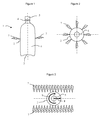
- a first example of a method according to the invention is described on the figure 1 .
- a PET bottle 1 having at least one side wall 2, a bottom 3, and a neck 4 sealed with a plug 5 contains a liquid or viscous product 6.
- the side wall 2 of the bottle 1 is brought into contact during a few seconds with a flame 7 whose temperature is between 700 and 1500 ° C.
- the heated zone of the bottle 1 is below the level of filling, that is to say in an area where the inner surface of the wall 2 of the bottle 1 is in contact with the product 6.
- the bottle 1 is heated by two heat sources arranged symmetrically with respect to the bottle 1. A symmetrical heating is advantageous to avoid a loss of perpendicularity between the bottom 3 and the axis of the bottle 1.
- the bottle 1 is rotated so to obtain a homogeneous heating on its circumference.
- the heating has the effect of the local retraction of the wall 2 and the increase of the pressure inside the bottle 1. Precise control of the heating time, the heating power, and the speed of rotation of the Bottle 1 is necessary to ensure the retraction and the reproducible pressurization of the bottles.
- the figure 2 illustrates in top view a process which avoids the retraction of the bottle 1 during heating. Flames 7 heat the side wall 2 of the bottle 1 over the entire circumference simultaneously. This axisymmetric heating promotes a homogeneous shrinkage of the bottle 1.
- the figure 3 represents in top view the bottle 1 during a process of pressurizing by flaming.
- the bottle 1 is driven by a translational movement 8 and a rotational movement 9. In its movement, the bottle 1 passes between two ramps of flame 7 arranged symmetrically with respect to the axis of the bottle 1.
- the time The heating of the bottle 1 is determined by the speed of translation and the length of the heating ramps.
- the rotational speed ensures homogeneous heating around the circumference. This device is particularly advantageous because it can be inserted easily on the filling lines.
- the flame pressurizing process is based on shrinkage of the package under the effect of a high temperature. Depending on the intensity of the retraction, the change in the geometry of the packaging is more or less noticeable.
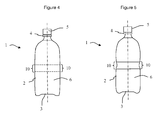
- the Figures 4 and 5 illustrate an example of modification of bottle geometry following pressurization by flaming.
- the figure 4 shows the bottle 1 before the flaming pressurization step.
- the bottle is filled with a liquid 6 and sealed with a cap 5.
- This bottle has an area 10 of the side wall 2 to be heated in contact with a flame. Zone 10 extends around the circumference of the bottle.
- the figure 5 illustrates the bottle 1 following the process of pressurizing flame zone 10 according to one of the methods described above.
- the pressurizing operation has modified the geometry of the bottle 1 only at the level of the flame zone 10.
- the method allows a controlled and repetitive retraction of the bottles as long as the bottles are of identical initial geometry, and filled so similar.
- the flaming process is precise; it may be local or on the contrary affect a large surface of the bottle.
- the flame pressurizing process facilitates the handling of liquid products in very thin PET packages.
- the vertical pressure resistance of these packages is substantially increased, which improves their storage by stacking and stability. These packages have a better grip and consequently their opening is facilitated.
- the method of retraction by flaming allows a large energy input over a very short time which causes a rapid and reproducible retraction of the necking area. Contrary to what could have been anticipated by those skilled in the art, the contact of the flame does not damage the packaging.
- the bottle must be symmetrically heated, otherwise the bottle loses its verticality and the final geometry is not reproducible.
- the bottle is rotated in front of two heat sources arranged symmetrically with respect to the axis of rotation.
- the distance between the wall of the bottle and the heat source is constant.
- the invention is not limited to the use of a flame to heat the bottles. Any other source of identical intense heat may be used.
- the invention is not limited to PET bottles but more generally covers any packaging geometry and any material whose properties are similar to PET.
Landscapes
- Containers Having Bodies Formed In One Piece (AREA)
Priority Applications (2)
| Application Number | Priority Date | Filing Date | Title |
|---|---|---|---|
| EP08156071A EP2119664A1 (de) | 2008-05-13 | 2008-05-13 | Verfahren zur Druckzufuhr in PET-Flaschen |
| PCT/IB2009/051984 WO2009138958A1 (fr) | 2008-05-13 | 2009-05-13 | Procédé de mise en pression d'un emballage fermé |
Applications Claiming Priority (1)
| Application Number | Priority Date | Filing Date | Title |
|---|---|---|---|
| EP08156071A EP2119664A1 (de) | 2008-05-13 | 2008-05-13 | Verfahren zur Druckzufuhr in PET-Flaschen |
Publications (1)
| Publication Number | Publication Date |
|---|---|
| EP2119664A1 true EP2119664A1 (de) | 2009-11-18 |
Family
ID=39816402
Family Applications (1)
| Application Number | Title | Priority Date | Filing Date |
|---|---|---|---|
| EP08156071A Withdrawn EP2119664A1 (de) | 2008-05-13 | 2008-05-13 | Verfahren zur Druckzufuhr in PET-Flaschen |
Country Status (2)
| Country | Link |
|---|---|
| EP (1) | EP2119664A1 (de) |
| WO (1) | WO2009138958A1 (de) |
Cited By (2)
| Publication number | Priority date | Publication date | Assignee | Title |
|---|---|---|---|---|
| EP2639197A1 (de) * | 2012-03-12 | 2013-09-18 | Sogepi | Wärmebehandlungsverfahren eines Behälters, der für die Heißbefüllung und zur Langzeitlagerung vorgesehen ist, und so erhaltener Behälter |
| WO2016162159A1 (de) * | 2015-04-09 | 2016-10-13 | Krones Ag | Vorrichtung zum überdruckstabilisieren von gefüllten und verschlossenen pet-behältern und verfahren zum überdruckstabilisieren von gefüllten pet-behältern |
Families Citing this family (1)
| Publication number | Priority date | Publication date | Assignee | Title |
|---|---|---|---|---|
| DE102013007411A1 (de) * | 2013-03-29 | 2014-10-02 | Khs Corpoplast Gmbh | Verfahren und Vorrichtung zur Herstellung von gefüllten Behältern |
Citations (3)
| Publication number | Priority date | Publication date | Assignee | Title |
|---|---|---|---|---|
| US3347970A (en) * | 1964-08-19 | 1967-10-17 | Hercules Inc | Method of forming duplicate bottles by heat shrinking |
| WO2006079754A2 (fr) | 2005-01-27 | 2006-08-03 | Olivier Bedin | Procede de remplissage avec compensation du volume reduit par d ' azote et procede de fabrication d ' un contenant en pet |
| FR2887238A1 (fr) * | 2005-06-21 | 2006-12-22 | Jean Tristan Outreman | Procede de remplissage a chaud d'un contenant a paroi mince et contenant rempli ainsi obtenu |
-
2008
- 2008-05-13 EP EP08156071A patent/EP2119664A1/de not_active Withdrawn
-
2009
- 2009-05-13 WO PCT/IB2009/051984 patent/WO2009138958A1/fr not_active Ceased
Patent Citations (3)
| Publication number | Priority date | Publication date | Assignee | Title |
|---|---|---|---|---|
| US3347970A (en) * | 1964-08-19 | 1967-10-17 | Hercules Inc | Method of forming duplicate bottles by heat shrinking |
| WO2006079754A2 (fr) | 2005-01-27 | 2006-08-03 | Olivier Bedin | Procede de remplissage avec compensation du volume reduit par d ' azote et procede de fabrication d ' un contenant en pet |
| FR2887238A1 (fr) * | 2005-06-21 | 2006-12-22 | Jean Tristan Outreman | Procede de remplissage a chaud d'un contenant a paroi mince et contenant rempli ainsi obtenu |
Cited By (3)
| Publication number | Priority date | Publication date | Assignee | Title |
|---|---|---|---|---|
| EP2639197A1 (de) * | 2012-03-12 | 2013-09-18 | Sogepi | Wärmebehandlungsverfahren eines Behälters, der für die Heißbefüllung und zur Langzeitlagerung vorgesehen ist, und so erhaltener Behälter |
| WO2016162159A1 (de) * | 2015-04-09 | 2016-10-13 | Krones Ag | Vorrichtung zum überdruckstabilisieren von gefüllten und verschlossenen pet-behältern und verfahren zum überdruckstabilisieren von gefüllten pet-behältern |
| DE102015206359A1 (de) * | 2015-04-09 | 2016-10-13 | Krones Ag | Vorrichtung zum Überdruckstabilisieren von gefüllten und verschlossenen PET-Behältern und Verfahren zum Überdruckstabilisieren von gefüllten PET-Behältern |
Also Published As
| Publication number | Publication date |
|---|---|
| WO2009138958A1 (fr) | 2009-11-19 |
Similar Documents
| Publication | Publication Date | Title |
|---|---|---|
| EP2167390B1 (de) | Verfahren zur Heißabfüllung von Kunststoffbehälter | |
| CA2679801C (fr) | Procede de remplissage d'un emballage retractable | |
| EP2595792B1 (de) | Vefahren zur herstellung eines behälters mittes blasen und befüllen | |
| WO2008012708A2 (fr) | Preforme pour recipient realise par etirage soufflage | |
| WO2004065105A1 (fr) | Procede et installation de fabrication d'un recipient en matiere plastique | |
| EP1975116A1 (de) | Verfahren zum Füllen einer Schrumpfverpackung | |
| EP2230065B1 (de) | Formwerkzeug zum Warmformen mit Wärmedämmung, und entsprechendes Verfahren | |
| WO2016177987A1 (fr) | Procede de maitrise de la pression dans un contenant avec son contenu apres remplissage et bouchage et dispositif associe | |
| FR2938789A1 (fr) | Procede et dispositif de chauffage par infrarouge de preformes plastiques. | |
| FR2619048A1 (fr) | Dispositif pour le traitement thermique du col de preformes | |
| EP3535190B1 (de) | Vorrichtung und verfahren zur druckverpackung eines zu verarbeitenden behälters und zugehörige druckverpackungsmaschine | |
| FR2879494A1 (fr) | Procede pour la fabrication d'un corps creux multicouche comprenant au moins une soudure | |
| WO2009138958A1 (fr) | Procédé de mise en pression d'un emballage fermé | |
| EP3535189B1 (de) | Verfahren und vorrichtung zur druckverpackung eines aufzubereitenden behälters und zugehörige druckverpackungsmaschine | |
| FR2467790A2 (fr) | Obturateur et emballage inviolables | |
| WO2016097543A1 (fr) | Récipient à large col à manchon fileté rapporté | |
| FR2767123A1 (fr) | Nouvelle structure de recipient et procede de conditionnement d'un produit au moyen de ce recipient | |
| EP2639197A1 (de) | Wärmebehandlungsverfahren eines Behälters, der für die Heißbefüllung und zur Langzeitlagerung vorgesehen ist, und so erhaltener Behälter | |
| FR2851227A1 (fr) | Procede et installation de thermoformage destine a la realisation, au remplissage et au scellement de bouteilles en materiau plastique | |
| FR3097155A1 (fr) | Procédé de fabrication d’un article injecté, notamment une préforme de flacon | |
| FR3151577A1 (fr) | Récipient, notamment bouteille, en matière thermoplastique à résistance à la charge verticale améliorée | |
| FR2861328A1 (fr) | Procede de fabrication d'un tube de conditionnement, tube de conditionnement et dispositif de mise en oeuvre dudit procede. | |
| FR2881107A1 (fr) | Procede de remplissage d'un contenant en matiere plastique avec un liquide chaud et fond de contenant adapte | |
| FR2950282A1 (fr) | Procede de fabrication par soufflage d'un contenant avec une poignee integree, contenant obtenu | |
| FR3080847A1 (fr) | Flacon aerosol |
Legal Events
| Date | Code | Title | Description |
|---|---|---|---|
| PUAI | Public reference made under article 153(3) epc to a published international application that has entered the european phase |
Free format text: ORIGINAL CODE: 0009012 |
|
| AK | Designated contracting states |
Kind code of ref document: A1 Designated state(s): AT BE BG CH CY CZ DE DK EE ES FI FR GB GR HR HU IE IS IT LI LT LU LV MC MT NL NO PL PT RO SE SI SK TR |
|
| AX | Request for extension of the european patent |
Extension state: AL BA MK RS |
|
| AKX | Designation fees paid | ||
| REG | Reference to a national code |
Ref country code: DE Ref legal event code: 8566 |
|
| STAA | Information on the status of an ep patent application or granted ep patent |
Free format text: STATUS: THE APPLICATION IS DEEMED TO BE WITHDRAWN |
|
| 18D | Application deemed to be withdrawn |
Effective date: 20100519 |