EP2124142A1 - Générateur d'interface utilisateur, terminal d'information, programme de commande de génération d'interface utilisateur, support d'enregistrement et procédé de génération d'interface utilisateur - Google Patents
Générateur d'interface utilisateur, terminal d'information, programme de commande de génération d'interface utilisateur, support d'enregistrement et procédé de génération d'interface utilisateur Download PDFInfo
- Publication number
- EP2124142A1 EP2124142A1 EP08710993A EP08710993A EP2124142A1 EP 2124142 A1 EP2124142 A1 EP 2124142A1 EP 08710993 A EP08710993 A EP 08710993A EP 08710993 A EP08710993 A EP 08710993A EP 2124142 A1 EP2124142 A1 EP 2124142A1
- Authority
- EP
- European Patent Office
- Prior art keywords
- user interface
- piece
- data
- service
- service description
- Prior art date
- Legal status (The legal status is an assumption and is not a legal conclusion. Google has not performed a legal analysis and makes no representation as to the accuracy of the status listed.)
- Withdrawn
Links
Images





Classifications
-
- G—PHYSICS
- G06—COMPUTING OR CALCULATING; COUNTING
- G06F—ELECTRIC DIGITAL DATA PROCESSING
- G06F8/00—Arrangements for software engineering
- G06F8/30—Creation or generation of source code
- G06F8/38—Creation or generation of source code for implementing user interfaces
-
- G—PHYSICS
- G06—COMPUTING OR CALCULATING; COUNTING
- G06F—ELECTRIC DIGITAL DATA PROCESSING
- G06F16/00—Information retrieval; Database structures therefor; File system structures therefor
- G06F16/20—Information retrieval; Database structures therefor; File system structures therefor of structured data, e.g. relational data
- G06F16/24—Querying
- G06F16/242—Query formulation
- G06F16/2428—Query predicate definition using graphical user interfaces, including menus and forms
-
- G—PHYSICS
- G06—COMPUTING OR CALCULATING; COUNTING
- G06F—ELECTRIC DIGITAL DATA PROCESSING
- G06F9/00—Arrangements for program control, e.g. control units
- G06F9/06—Arrangements for program control, e.g. control units using stored programs, i.e. using an internal store of processing equipment to receive or retain programs
- G06F9/44—Arrangements for executing specific programs
- G06F9/451—Execution arrangements for user interfaces
Definitions
- the present invention relates to a technique for generating a user interface that a user utilizes for using functions of an appliance or services provided via the Internet. More specifically, the present invention relates to a technique for generating a user interface from a template.
- a user interface which is an information presentation scheme and a data input scheme, is utilized by a user for using functions of information appliances such as a mobile phone, a mobile terminal (e.g., PDA [Personal Digital Assistant]), a digital television receiver, and a hard disc recorder, and the user interface has been conventionally realized by special software.
- UI User interface description
- Patent Literature 1 discloses a technique for generating a user interface by use of a template of UI description.
- Patent Literature 1 is for adding a title(s) to an image(s) captured by a digital camera, generating a slide show of the image(s), laying out the image(s), and the like.
- a mode is changed into an album generation mode by a mode change switch.
- the user selects a desired template from templates that are stored in a recoding medium in advance, and selects images to be inserted into the template from images stored in a storage section.
- the template thus selected is described in SVG and includes ⁇ image> elements, the number of which corresponds to the number of the images to be inserted into the template.
- File names of pieces of image data selected by a control section are inserted into the ⁇ image> elements and then inserted into the storage medium.
- the layout can be carried out.
- the slide show generation and the title addition can be also carried out by the camera itself in such a manner that a SVG template is prepared and file names of pieces of image data are embedded into the template.
- Patent Literature 1 has such a problem that the maximum number of images to be embedded into a template is limited to the number of ⁇ image> elements included in the template.
- Patent Literature 2 discloses a technique in which a region to be repeatedly used is provided in a part of a template, and the number of repeated use of the region is changed depending on the number of specified user images. The technique allows the same template to be used even if the number of images is different from that of the template.
- a data structure of the album template that designates a multiple-page layout includes: a plurality of page template regions in each of which a page template that specifies a one-page layout having at least one insertion region is recorded; a link-specifying region in which link information that comprehensively specifies a plurality of user images to be inserted, in a predetermined order, into insertion regions of a plurality of page templates is recorded; and a repeat-specifying region in which repeat information that specifies a page template repeatedly used during displaying in accordance with the number of the user images comprehensively specified by the link information, is recorded.
- the data structure of the album template it is possible to comprehensively specify, by the link information, a plurality of user images to be inserted into the insertion regions of the plurality of page templates, without specifying user images with respect to each page.
- “to comprehensively specify” means to specify a plurality of user images with respect to a section containing a plurality of page templates, not with respect to individual page templates.
- the number of repeated use of a page template is determined according to the number of user images specified when the user images are to be displayed. For this reason, it is not necessary to respecify the user images with respect to the page templates.
- the data structure of the album template disclosed in Patent Literature 2 can reduce processes required for generating an album with the use of the album template.
- comprehensively specified link information is caused to correlate to a section including page templates one-on-one so that the link information is set as a link-specifying region.
- An output section repeatedly uses the page templates contained in the section in accordance with the number of the user images of the comprehensively specified link information, so as to reproduce a plurality of page templates each designating a specific one-page layout.
- a completed album template is generated. This arrangement allows generating an album template including the number of pages corresponding to the number of the user images.
- the template to be used cannot be changed depending on the number of the user images. For example, in a case where 13 images are displayed by use of a page template into which 12 images are to be embedded per page, just one image among the 13 images is inserted into a second page of the user interface, with the result in that remaining 11 parts out of 12 image-insertion parts on the second page are blank. In this case, it is difficult to generate a preferable user interface by additionally inserting other images into the blank parts or replacing the page template with a page template into which 8 images are embedded per page so as to decrease the blank parts on the second page to make a good appearance.
- Patent Literature 2 it is necessary for the user to expressly select which template is to be used. For example, it is difficult to automatically select a template suited to a vertical or horizontal layout in accordance with whether a layout to be outputted on a user interface is portrait or landscape.
- An object of the present invention is to provide (i) a method for flexibly generating a user interface by use of a template and (ii) a user interface generator employing the method.
- To flexibly generate a user interface indicates (i) to change a template to be used, in accordance with a situation of an apparatus used by a user, (ii) to change a template to be used, in accordance with the number of pieces of data to be embedded into the template, or (iii) to obtain second data to be embedded into a template, in accordance with the number of the pieces of data to be embedded into the template.
- the user interface generator of the present invention further includes package acquisition means for (i) receiving package data via the communication means, the package data containing a piece of user interface template data and a piece(s) of icon data referred from the piece of user interface template data, and for (ii) extracting the piece of user interface template data and the piece(s) of icon data from the package data.
- a piece of user interface template data and a piece(s) of icon data can be dealt with as a package, thereby resulting in that the piece of user interface template data and the piece(s) of icon data are easily dealt with in a server side that provides the package and a user interface generator side.
- a user interface generation method of the present invention is a method for generating a user interface from a piece of user interface template data and for executing the user interface thus generated, and the method includes: selecting means selecting a piece of user interface template data based on a piece of service description data describing a service(s) to be utilized by a user and terminal data indicative of a state of a terminal device that the user utilizes; and user interface generating means generating a user interface based on the piece of service description data and the piece of user interface template data selected in the step of selecting.
- the selecting means determines which piece of user interface template data allows generating an optimal user interface, based on content of a piece of service description data, which content is to be presented as a user interface, and terminal data indicative of a state of the terminal device at the time when the user interface is to be presented. Then, the user interface generating means generates a user interface based on a piece of user interface template data that is determined optimal.
- the user interface generator may be realized by hardware or by causing a computer to execute a program. More specifically, a user interface generation control program of the present invention is for causing a computer to function as at least the aforementioned selecting means and user interface generating means, and a storage medium of the present invention is one in which the user interface generation control program is stored.
- the computer When a computer executes the user interface generation control program, the computer works as the user interface generator. As a result, similarly to the aforementioned user interface generator, a corresponding piece of user interface template data is selected based on content of a piece of service description data and a state of a terminal device. Consequently, it is advantageously possible to generate a user interface most suited to the content of the piece of service description data and the state of the terminal device.
- the input means may include text input means and a corresponding piece of user interface template data may be selected based on whether or not the text input means is usable.
- the user interface generator of the present invention may includes: service data acquisition means; terminal data acquisition means; user interface template data acquisition means (a user interface template accumulating section); selecting means for selecting a piece of user interface template data based on a piece of service description data and terminal data; and user interface generating means for generating a user interface based on the piece of user interface template data thus selected by the selecting means and the piece of service description data.
- the user interface generator of the present invention may further includes communication means to acquire data via the Internet, and the service description data acquisition means may acquire a piece of service description data via the communication means.
- the user interface generator of the present invention may further include communication means to acquire data via the Internet, and the user interface generating means may acquire a piece of user interface template data that is selected via the Internet.
- the selecting means may select a corresponding piece of user interface template data based on the number of services described in the piece of service description data.
- the user interface generator of the present invention may further include display means for displaying a user interface, the terminal data may contains screen display mode information indicative of a screen display state, and the selecting means may select a corresponding piece of user interface template data based on the screen display mode information.
- the user interface generator of the present invention may be arranged such that the screen display mode further contains information on an orientation of a screen display.
- the user interface generator of the present invention may further include input means and the terminal data may contain input mode information of the input means so that the selecting means may select a corresponding piece of user interface template data, based on the piece of input mode information.
- the user interface generator of the present invention may include text input means so that a corresponding piece of user interface template data may be selected based on whether the text input means is usable or not.
- the selecting means may select a corresponding piece of user interface template data that presents a focus frame that allows the user to select a service and a function by manipulating the text input means.
- a piece of service description data may further contain descriptions about types of a series of services and functions, and the selecting means may select a corresponding piece of user interface template data based on the types contained in the piece of service description data.
- the user interface generator of the present invention may be arranged such that a piece of user interface template data generates a user interface that presents information to the user by a page unit that is a presentation unit of information and the selecting means selects a corresponding piece of user interface template data that generates a user interface having sufficient pages to present all the series of services and functions contained in the piece of service description data.
- the user interface generator of the present invention may be arranged such that a piece of user interface template data generates a user interface in which presentation positions of the services and functions are sequentially changed in response to a selecting operation of the user and the selecting means selects a corresponding piece of user interface template data that generates a user interface that presents the services and functions at respective appropriate presentation positions which accord with the number of the series of the services and functions contained in the piece of service description data.
- the user interface generator of the present invention may be arranged such that the piece of service description data further contains explanation descriptions about a series of services and functions to be available and in a case where the number of the series of services and functions contained in the piece of service description data is not more than a predetermined number, the selecting means selects a corresponding piece of user interface template data that generates a user interface that presents the explanation descriptions.
- the user interface generator of the present invention may be arranged such that, in a case where the number of a series of services and functions contained in a first piece of service description data is not more than a predetermined number, the selecting means acquires a second piece of service description data via the service description data acquisition means, and the selecting means selects a corresponding piece of user interface template data that generates a user interface that presents the series of services and functions contained in the first piece of service description data and a series of services and functions contained in the second piece of service description data.
- the user interface generator of the present invention may further include package-managing means for receiving, via the communication means, package data containing a piece of user interface template data and icon data referred from the piece of user interface template data, and for uncompressing the package data.
- An information terminal of the present invention may include the aforementioned user interface generator.
- the present embodiment describes one embodiment of a user interface generator, taking, as an example, a mobile terminal in which a template for generating a user interface is changed in accordance with a state of the terminal, the number of terminal functions described in service description data (explained later), and the like.
- UI template data indicates data for generating UI description according to a standard data format such as SVG or HTML, by embedding a still image or a text string in part of the data.
- Service indicates a processing result to be provided from a mobile terminal when a user carries out an operation with respect to a user interface.
- Examples of the service encompass various functions included in the mobile terminal and a processing result with respect to a process requested to a server or the like on the Internet via a network.
- Service description data indicates data in which a list of services to be utilized by a user by operating a mobile terminal is stored.
- Functions to be utilized by the user include functions of the mobile terminal itself and functions realized by a service provided via the Internet.
- the service description data not only a service identifier that identifies a service, but also an icon image identifier that identifies an icon image to be displayed on a user interface screen so that the user can designate the service, a title text string for the service, a text string for a detailed explanation of the service, and the like are stored.
- Terminal data indicates data indicative of a current state of a mobile terminal that the user utilizes.
- the terminal data includes an input mode, a screen display mode, a volume level of a speaker, and the like in the mobile terminal. More specifically, the terminal data includes: a usage state of a hardware keyboard contained in the mobile terminal (for example, whether or not a keyboard is housed); an orientation of a screen display (for example, whether a usage mode is a portrait mode or a landscape mode); information on whether a speaker volume is muted or not, and the like information.
- Fig. 1 is a functional block diagram of a mobile terminal 1a according to the present embodiment.
- the mobile terminal 1a is arranged so as not to carry out data acquisition from an outside via a network.
- the mobile terminal 1a includes: a service description data accumulating section 10; a UI template selecting section 20 (selecting means); a terminal data acquisition section 30; a UI template data accumulating section 40; a UI description generating section 50 (user interface generating means); a UI description executing section 60; an icon image accumulating section 70; an input section 80 (input means); and an output section 90.
- the service description data accumulating section 10 accumulates pieces of service description data in advance, each describing a service(s) provided by the mobile terminal 1a, and supplies a piece of service description data to the UI template selecting section 20 and the UI description generating section 50.
- the UI template selecting section 20 analyzes the piece of service description data received from the service description data accumulating section 10 and terminal data received from the terminal data acquisition section 30, and selects a most suitable UI template to be presented to a user, based on a type(s) of the service(s), the number of the service(s) contained in the piece of service description data, and a state of the mobile terminal 1a at the time. Then, the UI template selecting section 20 acquires a corresponding piece of UI template data of the UI template thus selected, from the UI template data accumulating section 40 and supplies the corresponding piece of UI template data to the UI description generating section 50.
- the terminal data acquisition section 30 acquires a state of the mobile terminal 1a occasionally, and supplies the state to the UI template selecting section 20.
- the UI template data accumulating section 40 accumulates pieces of UI template data in advance and supplies a piece of UI template data of a UI template selected by the UI template selecting section 20, to the UI template selecting section 20.
- the UI description generating section 50 generates a UI description by embedding, in the piece of UI template data received from the UI template selecting section 20, a text string(s) and an icon image identifier(s) included in the piece of service description data received from the service description data accumulating section 10, and supplies the UI description to the UI description executing section 60.
- the UI description executing section 60 interprets the UI description received from the UI description generating section 50 and presents a designated text string(s) and graphic(s), and an icon image(s) acquired from the icon image accumulating section 70 to the user via the output section 90. Further, the UI description executing section 60 receives a service selection instruction from the user via the input section 80, and executes a selected service. In this way, the UI description executing section 60 realizes a user interface.
- the icon image accumulating section 70 preliminarily accumulates images of icons to be displayed on a screen as part of the user interface.
- the icon image accumulating section 70 supplies, to the UI description executing section 60, an icon image requested from the UI description executing section 60.
- the input section 80 supplies an input as the user interface, received from the user, to the UI description executing section 60.
- the input section 80 is realized by, for example, a keyboard, a cursor key, a touch screen, or the like.
- the output section 90 presents, to the user, an output as the user interface, received from the UI description executing section 60.
- the output section 90 is realized by, for example, a liquid crystal display.
- Fig. 2 is a functional block diagram of a mobile terminal 1b according to the present embodiment.
- the mobile terminal 1b is arranged so as to carry out data acquisition from an outside via a network.
- the mobile terminal 1b includes, in addition to the arrangement of the mobile terminal 1a: a service description data acquisition section 11 (service description data acquisition means); a UI template data acquisition section 41 (user interface template data acquisition means); an icon image acquisition section 71; and a communication section 100 (communication means).
- a service description data acquisition section 11 service description data acquisition means
- a UI template data acquisition section 41 user interface template data acquisition means
- an icon image acquisition section 71 an icon image acquisition section 71
- a communication section 100 communication means
- the service description data acquisition section 11 acquires a piece of service description data from a service description data server (not shown) via the communication section 100, and supplies the piece of service description data to the service description data accumulating section 10b.
- the UI template data acquisition section 41 acquires a piece of UI template data from a UI template data server (not shown) via the communication section 100, and supplies the piece of UI template data to the UI template data accumulating section 40b.
- the icon image acquisition section 71 acquires an icon image from an icon image server (not shown) via the communication section 100, and supplies the icon image to the icon image accumulating section 70b.
- the communication section 100 communicates with the UI template data server that supplies UI template data, the service description data server that supplies service description data, and the icon image server that supplies an icon image, so as to receive UI template data, service description data, and an icon image from the respective servers.
- Fig. 3 schematically illustrates an exemplary appearance of a mobile terminal.
- Fig. 4 is a flowchart of a process procedure of the mobile terminal until the mobile terminal selects UI template data, generates a UI description, and executes the UI description thus generated.
- the UI template selecting section 20 acquires a piece of service description data related to a service(s) to be utilized by the user, from the service description data accumulating section 10 (Step S1, hereinafter just referred to S1).
- the service description data accumulating section 10 may supply a piece of service description data that has been accumulated therein in advance or a piece of service description data that is acquired from the service description data server via the service description data acquisition section 11.
- the UI template selecting section 20 analyzes thus acquired piece of service description data so as to figure out the number of the service(s) contained in the piece of service description data and a type(s) of the service(s) contained in the piece of service description data (S2).
- the UI template selecting section 20 then acquires terminal data in which a state of the mobile terminal at the time is stored, from the terminal data acquisition section 30 (S3).
- the UI template selecting section 20 selects an optimal UI template as a user interface, based on the number and type(s) of the service(s) and the terminal data, (ii) acquires a corresponding piece of UI template data of the UI template thus selected, from the UI template data accumulating section 40, and (iii) supplies the corresponding piece of UI template data thus acquired, to the UI description generating section 50 (S4).
- the UI template data accumulating section 40 may supply a piece of UI template data that has been accumulated in advance or a piece of UI template data that is acquired from the UI template data server via the UI template data acquisition section 41.
- the UI description generating section 50 (i) embeds, in the piece of UI template data thus acquired from the UI template selecting section 20, a text string(s) and an icon image identifier(s) each indicative of a place from which an icon image is to be acquired, each specified by the piece of service description data thus acquired from the service description data accumulating section 10, so as to generate a UI description, and (ii) supplies the UI description thus generated to the UI description executing section 60 (S5).
- the UI description executing section 60 interprets and executes thus received UI description, (ii) acquires a necessary icon image(s) from the icon image accumulating section 70, based on the icon image identifier(s), and (iii) embeds the icon image(s) into a user interface, thereby realizing the user interface (S6).
- the aforementioned explanation deals with how to generate a UI description when the user is to utilize a service(s).
- the arrangement may be such that the UI description generated when the user firstly utilized the service(s) is stored, and thus stored UI description is reused when the user utilizes the service(s) again.
- the aforementioned explanation deals with the arrangement in which the UI template data acquisition section 41 and the icon image acquisition section 71 acquire a piece of UI template data and an icon image(s), respectively, from the UI template data server and the icon image server.
- the mobile terminal 1b includes a package acquisition section (package acquisition means, not shown) that (i) acquires, via the communication section 100, the package from a package server (not shown) that supplies a package, (ii) extracts the piece of UI template data and the icon image(s) from the package, and (iii) supplies the piece of UI template data and the icon image(s) to the UI template data accumulating section 40b and the icon image accumulating section 70, respectively.
- package acquisition section package acquisition means, not shown
- the mobile terminal 1b includes a package acquisition section (package acquisition means, not shown) that (i) acquires, via the communication section 100, the package from a package server (not shown) that supplies a package, (ii) extracts the piece of UI template data and the icon image(s) from the package, and (iii) supplies the piece of UI template data and the icon image(s) to the UI template data accumulating section 40b and the icon image accumulating section 70, respectively.
- the package is a single piece of archive data including a piece of UI template data and a piece(s) of icon image data.
- the package acquisition section decompresses the archive data to extract the piece of UI template data and the icon image(s), and supplies the piece of UI template data to the UI template data accumulating section 40b and the icon image(s) to the icon image accumulating section 70b.
- Fig. 5 schematically illustrates an exemplary package of a piece of UI template data 501 and pieces of icon image data 502.
- the following deals with a user interface, as an example, in which icons indicative of applications as services are aligned in a grid pattern.
- the number of pages of the user interface is adjusted in accordance with the number of services described in service description data.
- Fig. 6 illustrates an exemplary screen display of a grid type interface.
- a piece of UI template data that generates the user interface illustrated in Fig. 6 is selected in a case where a keyboard is housed and a landscape screen display is carried out.
- Each icon 6 is an icon for activating an application related to the icon. The user can activate an intended application by touching a corresponding icon 6.
- the exemplary display illustrated in (c) of Fig. 6 is a second page in the 3 pages.
- icons 601 and 603 for page migration and a page number 602 are displayed.
- a corresponding piece of UI template data is selected in accordance with the number of services described in a piece of service description data, and respective pieces of UI template data are different from each other in display of a total page number, a page number, and an icon for page migration.
- a corresponding piece of UI template data is selected in accordance with the number of services described in a piece of service description data, and respective pieces of UI template data are different from each other in display of a total page number, a page number, and an icon for page migration.
- a piece of user interface template data in which a presentation position(s), on the screen, of a service(s) to be presented is/are appropriately adjusted is selected in accordance with the number of services.
- the user can change icons to be displayed, e.g., scroll the icons, by means of pressing a cursor key or the like user input, so that the icons are displayed at suitable positions on the screen.
- a piece of UI template data having icon animations suited to the number of services described in a piece of service description data is selected.
- the following deals with an example in which a layout of a user interface is adjusted in accordance with an aspect ratio of a screen indicated by terminal data.
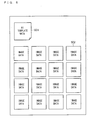
- Fig. 7 illustrates an exemplary screen display of a grid type interface.
- a piece of UI template data that generates the user interface illustrated in Fig. 7 is selected in a case where a keyboard is housed and the number of services described in service description data is 10.
- icons 6 are embedded in UI template data in a 3x4 grid (3 icons across, 4 icons going down) so as to display a user interface.
- a corresponding piece of UI template data is selected in accordance with the aspect ratio of the screen 4 on which the user interface is to be displayed, and respective pieces of UI template data have a different layout of icons from each other.
- the user interface template data may be selected, for example, in such a manner that (i) a screen mode is determined such that the screen is identified as a landscape screen when the aspect ratio of the screen is 9:16, 3:4, or 3:5 and the screen is identified as a portrait screen when the aspect ratio of the screen is 16:9, 4:3, or 5:3, (ii) a downward orientation of the screen is also determined by detecting inclination of the screen, and (iii) a piece of user interface template data that exhibits an optimal layout for the screen is selected in accordance with the identified screen mode and the downward orientation of the screen.
- a corresponding piece of user interface template data is selected based on the aspect ratio and the orientation of the screen, thereby making it possible to generate a user interface most suited to the aspect ratio and the orientation of the screen.
- the following deals with, as an example, a scroll type user interface in which icons indicative of applications are sequentially scrolled in accordance with user instruction.
- the example explained here is one in which it is changed whether a user interface uses a keyboard input or not, in accordance with a housed/unfolded state of the keyboard.
- Fig. 8 illustrates an exemplary screen display of a scroll type interface.
- a piece of UI template data that generates the user interface illustrated in Fig. 8 is selected in a case where a keyboard is unfolded and a landscape screen display is carried out.
- Each icon 6 is an icon for activating an application related to the icon.
- a service name 8 is a name of an application related to an icon displayed in the center of a screen 4, that is, an icon placed in a focus frame.
- the icon 6 is scrolled in an up-and-down direction in response to a user operation with respect to up and down cursor keys of a keyboard 2.
- an enter key an application related to an icon placed in the focus frame at the time is activated.
- the 15 icons scroll up and down accordingly in such a manner that 7 icons are displayed in total such that one icon is positioned in the center focus frame and 3 icons are positioned on either of upper and down sides of the icon in the center focus frame. More specifically, when the icons scroll down, an icon that has not been displayed is displayed as an uppermost icon on the screen whereas a lowermost icon that has been displayed on the screen becomes non-displayed.
- icons scroll up icons to be displayed on the screen are changed in a reverse manner to the case of down-scroll of the icons.
- icons that have not been displayed are sequentially displayed, so that an icon related to an intended application can be displayed on the screen and the intended application can be activated.
- a piece of UI template data to which a keyboard input is usable is selected, thereby resulting in that an easier-to-use user interface can be generated in accordance with whether the keyboard is housed or unfolded.
- the following deals with an example in which a user interface is changed over from a state in which additional information is displayed to a state in which no additional information is displayed, or vice versa, in accordance with whether or not additional information is described in a piece of service description data.
- Fig. 9 illustrates an exemplary screen display of a grid type interface on which additional information is displayed.
- a piece of UI template data that generates the user interface illustrated in Fig. 9 is selected in a case where a keyboard is unfolded, a landscape screen display is carried out, and the number of services described in a piece of service description data is 1.
- An icon 6 is an icon for activating an application related to the icon. The user can activate an intended application by touching the icon 6.
- an additional information display region 7 is a region into which a text string that is a detailed explanation of the service described in the piece of service description data is to be embedded.
- a piece of UI template data that allows additional information to be displayed in a blank region on the screen 4 is selected so that an easier-to-use user interface can be generated.
- the present embodiment dealt with the arrangement in which the UI template selecting section 20 selects a piece of UI template data in accordance with predetermined rules.
- the UI template selecting section 20 additionally obtains a selection rule script in which rules about selecting UI template data are described and the UI template selecting section 20 selects a piece of UI template data in accordance with the selection rules described in the selection rule script.
- the present embodiment dealt with the arrangement in which a piece of UI template data is selected in accordance with the number of services described in a single piece of service description data.
- the present embodiment is not limited to the arrangement.
- Such an arrangement may be also possible that a piece of UI template data is selected in accordance with the number of services described in each of plural pieces of service description data.
- the present embodiment dealt with the arrangement in which a piece of UI template data is selected in accordance with the number of services described in a piece of service description data.
- the UI template selecting section 20 selects a piece of UI template data in accordance with a size of an icon image to be displayed, which icon image is obtained in accordance with an icon image identifier specified by a piece of service description data.
- a piece of service description data may further include a reference to icon image data related to a service so that the UI template selecting section 20 selects a corresponding piece of UI template data in accordance with a width and a height of the icon image data referred by the piece of service description data.
- the mobile terminal 1a can generate a user interface on which an icon image is displayed with an appropriate size.
- the UI template selecting section 20 selects a piece of UI template data based on a length of a text string specified by a piece of service description data.
- the mobile terminal 1a can generate a user interface on which the text string contained in the piece of service description data is displayed in an optimal form.
- the present embodiment describes, as one exemplary embodiment of a user interface generator, a mobile terminal that obtains a second piece of service description data in a case where the number of services described in a piece of service description data is not less than a predetermined number.
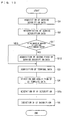
- Fig. 10 is a flowchart of a process procedure of the mobile terminal until the mobile terminal selects UI template data, generates a UI description, and executes the UI description thus generated.
- a UI template selecting section 20 acquires a piece of service description data related to a service(s) to be utilized by a user, from a service description data accumulating section 10 (S1).
- the UI template selecting section 20 analyzes the piece of service description data thus acquired so as to figure out the number services contained in the piece of service description data and a type(s) of the service(s) contained in the piece of service description data (S2).
- the UI template selecting section 20 determines whether or not the number of services is more than a predetermined number (S11).
- the UI template selecting section 20 acquires a second piece of service description data from the service description data accumulating section 10 (S12).
- the UI template selecting section 20 acquires terminal data in which a state of the mobile terminal at the time is stored, from a terminal data acquisition section 30 (S3).
- the UI template selecting section 20 selects an optimal UI template as a user interface, based on the number and type(s) of the service(s) in the piece(s) of service description data and the terminal data, (ii) acquires a corresponding piece of UI template data of the UI template thus selected, and (iii) supplies the piece of UI template data to a UI description generating section 50 (S4).
- the UI description generating section 50 embeds, into the piece of UI template data received from the UI template selecting section 20, (a) a text string(s) and an icon image identifier(s) each indicative of a destination from which an icon image is to be acquired, each specified by the piece of service description data obtained from the service description data accumulating section 10, and (b) a text string(s) and an icon image identifier(s), each specified by the second piece of service description data, so as to generate a UI description, and supplies the UI description to a UI description executing section 60 (S5b).
- the UI description executing section 60 interprets and executes the UI description thus received, (ii) acquires necessary icon images from an icon image accumulating section 70, based on the icon image identifiers, and (iii) embeds the icon images in a user interface, thereby realizing the user interface (S6).
- the following deals with a user interface, as an example, in which icons are aligned in a grid pattern.
- a user interface as an example, in which icons are aligned in a grid pattern.
- information described in a second piece of service description data is displayed on the user interface.
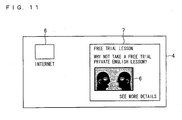
- Fig. 11 illustrates an exemplary screen display of a grid type interface on which information described in the second piece of service description data is displayed.
- a piece of UI template data that generates the user interface illustrated in Fig. 11 is selected in a case where a keyboard is unfolded, a landscape screen display is carried out, and only one service is described in the piece of service description data.
- An icon 6 is an icon for activating an application related to the icon. The user can activate an intended application by touching the icon 6.
- a region 7 in which information described in the second piece of service description data is to be displayed is a region into which a text string for detailed explanation about a service described in the second piece of service description data and an icon referred from the icon image identifier of the second piece of service description data are to be embedded.
- the second piece of service description data is additionally acquired because only one service is described in the piece of service description data.
- a piece of UI template data that allows the information described in the second piece of service description data to be additionally displayed in a blank region on the screen is selected, thereby generating a user interface that can exhibit additional information.
- the present embodiment deals with the example in which the user interface generator is realized as the mobile terminal.
- the user interface generator may be realized, for example, as a digital appliance such as a television receiver.
- the user interface generator may not be necessarily included in a terminal device itself that the user utilizes.
- a user interface generator that generates an interface of a mobile terminal that the user utilizes is provided, as a server on a network, separately from the mobile terminal and works in that state.
- a mobile terminal 120 in Fig. 12 is provided in a mobile phone network (not shown), and acquires various pieces of data from a user interface generation server 124 via the Internet 128.
- the user interface generation server 124 includes a service description data accumulating section 10, a UI template selecting section 20 (selecting means), a terminal data acquisition section 30, a UI template data accumulating section 40, a UI description generating section 50 (user interface generating means), an icon image accumulating section 70, and a communication section 126.
- the mobile terminal 120 includes a UI description executing section 60, an input section 80 (input means), an output section 90, and a communication section 122.
- the communication section 122 of the mobile terminal 120 transmits terminal data to the user interface generation server 124 via the Internet 128.
- the communication section 126 receives the terminal data and sends the terminal data to the terminal data acquisition section 30.
- the terminal data acquisition section 30 acquires the terminal data from the mobile terminal 120.
- the communication section 126 of the user interface generation server 124 acquires icon data from the icon image accumulating section 70 and also acquires a UI description from the UI description generating section 50.
- the icon data and UI description thus acquired are transmitted to the mobile terminal 120 via the Internet 128.
- the communication section 122 receives the icon data and UI description thus transmitted and sends them to the UI description executing section 60.
- the present invention is similar to the conventional technique in that part of the template data is replaced with input data to generate a description defining the user interface.
- the present invention is clearly different from the conventional technique in that a template optimal for generating the user interface is automatically selected in accordance with various conditions such as the number of pieces of input data, an aspect ratio of a screen of the terminal, an input mode of the terminal, and the like. The difference allows the present invention to cause a more advantageous effect than the conventional technique.
- the blocks of the user interface generator may be realized by way of hardware or software as executed by a CPU as follows.
- the user interface generator includes a CPU (central processing unit) and memory devices (memory media).
- the CPU central processing unit
- the memory devices include a ROM (read only memory) which contains programs, a RAM (random access memory) to which the programs are loaded, and a memory containing the programs and various data.
- the objective of the present invention can also be achieved by mounting, to the user interface generator, a computer-readable storage medium containing control program code (executable program, intermediate code program, or source program) for the user interface generator, which is software realizing the aforementioned functions, in order for the computer (or CPU, MPU) to retrieve and execute the program code contained in the storage medium.
- the storage medium may be, for example, a tape, such as a magnetic tape or a cassette tape; a magnetic disk, such as a floppy (Registered Trademark) disk or a hard disk, or an optical disk, such as CD-ROM/MO/MD/DVD/CD-R; a card, such as an IC card (memory card) or an optical card; or a semiconductor memory, such as a mask ROM/EPROM/EEPROM/flash ROM.
- a tape such as a magnetic tape or a cassette tape
- a magnetic disk such as a floppy (Registered Trademark) disk or a hard disk
- an optical disk such as CD-ROM/MO/MD/DVD/CD-R
- a card such as an IC card (memory card) or an optical card
- semiconductor memory such as a mask ROM/EPROM/EEPROM/flash ROM.
- the user interface generator may be arranged to be connectable to a communications network so that the program code may be delivered over the communications network.
- the communications network is not limited in any particular manner, and may be, for example, the Internet, an intranet, extranet, LAN, ISDN, VAN, CATV communications network, virtual dedicated network (virtual private network), telephone line network, mobile communications network, or satellite communications network.
- the transfer medium which makes up the communications network is not limited in any particular manner, and may be, for example, wired line, such as IEEE 1394, USB, electric power line, cable TV line, telephone line, or ADSL line; or wireless, such as infrared radiation (IrDA, remote control), Bluetooth (Registered Trademark), 802.11 wireless, HDR, mobile telephone network, satellite line, or terrestrial digital network.
- the present invention encompasses a carrier wave or data signal transmission in which the program code is embodied electronically.
- a user interface generator of the present invention includes: selecting means for selecting a piece of user interface template data based on a piece of service description data describing a service(s) to be utilized by a user and terminal data indicative of a state of a terminal device that the user utilizes; and user interface generating means for generating a user interface based on the piece of service description data and the piece of user interface template data thus selected by the selecting means.
- a user interface generation method includes: selecting means selecting a piece of user interface template data based on a piece of service description data describing a service(s) to be utilized by a user and terminal data indicative of a state of a terminal device that the user utilizes; and user interface generating means generating a user interface based on the piece of service description data and the piece of user interface template data selected in the step of selecting.
- the user interface template data is selected based on content of the piece of service description data and the state of the terminal device, thereby successfully making it possible to generate a user interface most suited to the content of the piece of service description data and the state of the terminal device.
- the user interface generator according to the present invention is such that a piece of user interface template data is selected based on content of a piece of service description data and a state of a terminal device so that a user interface most suited to the content of the piece of service description data and the state of the terminal device can be generated.
- the user interface generator of the present invention is applicable to information appliances such as a mobile terminal and a television receiver.
Landscapes
- Engineering & Computer Science (AREA)
- Theoretical Computer Science (AREA)
- Software Systems (AREA)
- General Engineering & Computer Science (AREA)
- Physics & Mathematics (AREA)
- General Physics & Mathematics (AREA)
- Human Computer Interaction (AREA)
- Mathematical Physics (AREA)
- Computational Linguistics (AREA)
- Data Mining & Analysis (AREA)
- Databases & Information Systems (AREA)
- User Interface Of Digital Computer (AREA)
- Stored Programmes (AREA)
Applications Claiming Priority (2)
| Application Number | Priority Date | Filing Date | Title |
|---|---|---|---|
| JP2007037174 | 2007-02-16 | ||
| PCT/JP2008/052114 WO2008099776A1 (fr) | 2007-02-16 | 2008-02-08 | Générateur d'interface utilisateur, terminal d'information, programme de commande de génération d'interface utilisateur, support d'enregistrement et procédé de génération d'interface utilisateur |
Publications (2)
| Publication Number | Publication Date |
|---|---|
| EP2124142A1 true EP2124142A1 (fr) | 2009-11-25 |
| EP2124142A4 EP2124142A4 (fr) | 2010-08-04 |
Family
ID=39690009
Family Applications (1)
| Application Number | Title | Priority Date | Filing Date |
|---|---|---|---|
| EP08710993A Withdrawn EP2124142A4 (fr) | 2007-02-16 | 2008-02-08 | Générateur d'interface utilisateur, terminal d'information, programme de commande de génération d'interface utilisateur, support d'enregistrement et procédé de génération d'interface utilisateur |
Country Status (6)
| Country | Link |
|---|---|
| US (1) | US20100115434A1 (fr) |
| EP (1) | EP2124142A4 (fr) |
| JP (1) | JP5254812B2 (fr) |
| KR (1) | KR101129087B1 (fr) |
| CN (1) | CN101606125A (fr) |
| WO (1) | WO2008099776A1 (fr) |
Cited By (2)
| Publication number | Priority date | Publication date | Assignee | Title |
|---|---|---|---|---|
| EP2557490A4 (fr) * | 2010-04-28 | 2014-01-08 | Huawei Device Co Ltd | Procédé et dispositif d'ajout d'icône dans une interface d'un système androïde et terminal mobile |
| EP3910459A1 (fr) * | 2020-05-13 | 2021-11-17 | CBS Interactive Inc. | Systèmes et procédés de génération d'interfaces utilisateur cohérentes sur de multiples plateformes de calcul |
Families Citing this family (59)
| Publication number | Priority date | Publication date | Assignee | Title |
|---|---|---|---|---|
| KR101531164B1 (ko) * | 2008-08-12 | 2015-06-25 | 삼성전자주식회사 | 사용자 인터페이스 디렉터리를 이용한 사용자 인터페이스 제공/수신하는 방법 및 장치 |
| JP2010061296A (ja) * | 2008-09-02 | 2010-03-18 | Sharp Corp | データ作成装置、データ処理装置、データ供給システム、データ作成方法、データ処理方法、制御プログラムおよび記録媒体 |
| CN101876895A (zh) * | 2009-04-28 | 2010-11-03 | 中国科学院计算技术研究所 | 网格计算环境下应用软件的封装集成方法 |
| KR20110068550A (ko) * | 2009-12-16 | 2011-06-22 | 삼성전자주식회사 | 화상형성장치 및 그 로컬 유저 인터페이스 제공방법 |
| CN104536651B (zh) * | 2010-04-28 | 2019-01-11 | 华为终端有限公司 | 一种在界面中添加图标的方法、装置及移动终端 |
| US8730269B2 (en) * | 2010-05-14 | 2014-05-20 | Citrix Systems, Inc. | Interpreting a gesture-based instruction to selectively display a frame of an application user interface on a mobile computing device |
| US20110302516A1 (en) * | 2010-06-02 | 2011-12-08 | Oracle International Corporation | Mobile design patterns |
| US10445113B2 (en) * | 2011-03-01 | 2019-10-15 | International Business Machines Corporation | Method and system for setting the user interface to suit the display screen of an electronic device |
| USD817979S1 (en) * | 2011-04-25 | 2018-05-15 | Sony Corporation | Display panel or screen with graphical user interface |
| US9104441B2 (en) * | 2011-09-30 | 2015-08-11 | Avaya Inc. | Context and application aware selectors |
| JP2013114424A (ja) * | 2011-11-28 | 2013-06-10 | Sony Computer Entertainment Inc | 画面設定ファイル生成装置、情報処理装置、画面設定ファイル生成方法、画面表示方法、および画面設定ファイルのデータ構造 |
| USD711401S1 (en) * | 2012-03-30 | 2014-08-19 | Microsoft Corporation | Display screen with graphical user interface |
| USD700205S1 (en) * | 2012-03-30 | 2014-02-25 | Microsoft Corporation | Display screen with graphical user interface |
| USD689067S1 (en) * | 2012-05-29 | 2013-09-03 | Microsoft Corporation | Display screen with user interface |
| USD689069S1 (en) * | 2012-05-29 | 2013-09-03 | Microsoft Corporation | Display screen with user interface |
| USD689068S1 (en) * | 2012-05-29 | 2013-09-03 | Microsoft Corporation | Display screen with user interface |
| USD687454S1 (en) * | 2012-05-29 | 2013-08-06 | Microsoft Corporation | Display screen with user interface |
| USD693360S1 (en) * | 2012-06-04 | 2013-11-12 | Microsoft Corporation | Display screen with graphical user interface |
| USD689073S1 (en) * | 2012-06-06 | 2013-09-03 | Microsoft Corporation | Display screen with user interface |
| USD689072S1 (en) * | 2012-06-06 | 2013-09-03 | Microsoft Corporation | Display screen with user interface |
| USD708205S1 (en) * | 2012-06-14 | 2014-07-01 | Microsoft Corporation | Display screen with graphical user interface |
| USD689078S1 (en) * | 2012-06-14 | 2013-09-03 | Microsoft Corporation | Display screen with user interface |
| USD687850S1 (en) * | 2012-06-14 | 2013-08-13 | Microsoft Corporation | Display screen with user interface |
| USD689081S1 (en) * | 2012-06-14 | 2013-09-03 | Microsoft Corporation | Display screen with user interface |
| USD687457S1 (en) * | 2012-06-18 | 2013-08-06 | Microsoft Corporation | Display screen with user interface |
| USD711417S1 (en) * | 2012-08-03 | 2014-08-19 | Microsoft Corporation | Display screen with graphical user interface |
| USD711903S1 (en) * | 2012-08-21 | 2014-08-26 | Eharmony, Inc. | Display screen with transitional graphical user interface |
| USD712918S1 (en) | 2012-09-11 | 2014-09-09 | Apple Inc. | Display screen or portion thereof with graphical user interface |
| US9772682B1 (en) * | 2012-11-21 | 2017-09-26 | Open Text Corporation | Method and system for dynamic selection of application dialog layout design |
| TWI501137B (zh) * | 2012-12-11 | 2015-09-21 | Inst Information Industry | 互動頁面樣版的編輯系統、方法及其記錄媒體 |
| AU349995S (en) | 2013-01-09 | 2013-07-31 | Samsung Electronics Co Ltd | Display screen for an electronic device |
| USD772253S1 (en) * | 2013-02-19 | 2016-11-22 | Sony Computer Entertainment Inc. | Display panel or screen with an animated graphical user interface |
| USD820860S1 (en) * | 2013-02-22 | 2018-06-19 | Samsung Electronics Co., Ltd. | Display screen or a portion thereof with graphical user interface |
| US20140325400A1 (en) * | 2013-04-30 | 2014-10-30 | Hewlett-Packard Development Company, L.P. | Multi-panel view interface for a browser operating on a computing device |
| TWD166922S (zh) * | 2013-08-14 | 2015-04-01 | 新力電腦娛樂股份有限公司 | 顯示面板之圖形化使用者介面 |
| USD752079S1 (en) * | 2013-10-15 | 2016-03-22 | Deere & Company | Display screen with graphical user interface |
| USD751593S1 (en) * | 2013-10-25 | 2016-03-15 | Microsoft Corporation | Display screen with graphical user interface |
| CN104679410A (zh) * | 2013-12-03 | 2015-06-03 | 航天信息股份有限公司 | 一种对用户事件的响应方法 |
| CN104142787B (zh) * | 2014-08-08 | 2017-08-25 | 广州三星通信技术研究有限公司 | 在终端中生成和使用向导界面的设备和方法 |
| CN105629908B (zh) * | 2014-10-31 | 2019-02-01 | 腾讯科技(深圳)有限公司 | 物联网设备控制方法和装置 |
| CN104572084B (zh) * | 2014-12-22 | 2018-01-12 | 百度在线网络技术(北京)有限公司 | 卡片业务中用户界面生成及数据下发方法、装置 |
| JP6263282B2 (ja) * | 2015-01-16 | 2018-01-17 | 株式会社野村総合研究所 | 開発支援システム |
| KR101622872B1 (ko) * | 2015-02-11 | 2016-05-19 | 라인 가부시키가이샤 | 인스턴트 메시징 서비스에서 공식계정의 리치 메뉴를 제공하는 방법과 시스템 및 기록 매체 |
| USD771072S1 (en) * | 2015-04-27 | 2016-11-08 | Lutron Electronics Co., Inc. | Display screen or portion thereof with graphical user interface |
| USD776151S1 (en) * | 2015-04-27 | 2017-01-10 | Lutron Electronics Co., Inc. | Display screen or portion thereof with graphical user interfaces |
| CN106815007A (zh) * | 2015-12-02 | 2017-06-09 | 阿里巴巴集团控股有限公司 | 应用程序的处理方法和装置 |
| CN105867931B (zh) * | 2016-04-07 | 2019-05-07 | 北京橙鑫数据科技有限公司 | 信息展示界面的变更方法和装置 |
| US11816459B2 (en) * | 2016-11-16 | 2023-11-14 | Native Ui, Inc. | Graphical user interface programming system |
| US10838699B2 (en) | 2017-01-18 | 2020-11-17 | Oracle International Corporation | Generating data mappings for user interface screens and screen components for an application |
| US10733754B2 (en) | 2017-01-18 | 2020-08-04 | Oracle International Corporation | Generating a graphical user interface model from an image |
| CN110785740B (zh) * | 2017-06-16 | 2024-06-11 | 微软技术许可有限责任公司 | 基于规则的用户界面生成 |
| GB2568586B (en) * | 2017-10-02 | 2022-11-23 | Fisher Rosemount Systems Inc | Systems and methods for configuring and presenting a display navigation hierachy in a process plant |
| US10788972B2 (en) | 2017-10-02 | 2020-09-29 | Fisher-Rosemount Systems, Inc. | Systems and methods for automatically populating a display area with historized process parameters |
| US10489126B2 (en) | 2018-02-12 | 2019-11-26 | Oracle International Corporation | Automated code generation |
| CN108551556A (zh) * | 2018-03-20 | 2018-09-18 | 厦门星罗网络科技有限公司 | 视频相册的图像复用方法及装置 |
| US10901593B2 (en) * | 2018-09-21 | 2021-01-26 | Salesforce.Com, Inc. | Configuring components in a display template based on a user interface type |
| JP7541816B2 (ja) * | 2019-08-08 | 2024-08-29 | キヤノン株式会社 | 画像処理装置、制御方法及びプログラム |
| US12625682B2 (en) * | 2023-06-26 | 2026-05-12 | Lemon Inc. | Methods and systems for automated generation of a user interface |
| KR102681226B1 (ko) * | 2023-07-10 | 2024-07-04 | 쿠팡 주식회사 | 전자 장치 및 그의 정보 제공 방법 |
Family Cites Families (40)
| Publication number | Priority date | Publication date | Assignee | Title |
|---|---|---|---|---|
| JPH064277A (ja) * | 1992-06-23 | 1994-01-14 | Hitachi Ltd | Gui制御プログラム自動生成方法および装置 |
| JPH08101759A (ja) * | 1994-09-30 | 1996-04-16 | Ricoh Co Ltd | 複数種類の入力手段を有する電子機器 |
| US6029182A (en) * | 1996-10-04 | 2000-02-22 | Canon Information Systems, Inc. | System for generating a custom formatted hypertext document by using a personal profile to retrieve hierarchical documents |
| US6185587B1 (en) * | 1997-06-19 | 2001-02-06 | International Business Machines Corporation | System and method for building a web site with automated help |
| JP3657424B2 (ja) * | 1998-03-20 | 2005-06-08 | 松下電器産業株式会社 | 番組情報を放送するセンター装置と端末装置 |
| US6597384B1 (en) * | 1999-12-22 | 2003-07-22 | Intel Corporation | Automatic reorienting of screen orientation using touch sensitive system |
| JP3879350B2 (ja) * | 2000-01-25 | 2007-02-14 | 富士ゼロックス株式会社 | 構造化文書処理システム及び構造化文書処理方法 |
| US7190976B2 (en) * | 2000-10-02 | 2007-03-13 | Microsoft Corporation | Customizing the display of a mobile computing device |
| US7263668B1 (en) * | 2000-11-09 | 2007-08-28 | International Business Machines Corporation | Display interface to a computer controlled display system with variable comprehensiveness levels of menu items dependent upon size of variable display screen available for menu item display |
| US20030037311A1 (en) * | 2001-08-09 | 2003-02-20 | Busfield John David | Method and apparatus utilizing computer scripting languages in multimedia deployment platforms |
| KR20030031202A (ko) * | 2001-10-12 | 2003-04-21 | 주식회사 엘지이아이 | 컴퓨터를 통한 사용자 인터페이스 방법 |
| US20030128239A1 (en) * | 2001-12-27 | 2003-07-10 | Full Degree, Inc. | Method and apparatus for XML schema publishing into a user interface |
| US20030156132A1 (en) * | 2002-02-21 | 2003-08-21 | Nandakumar Gn | Method and apparatus for generating a graphical interface to enable local or remote access to an application having a command line interface |
| US20030172193A1 (en) * | 2002-03-07 | 2003-09-11 | Olsen Jesse Dale | User interface generator and method of automatically generating a user interface |
| US11275405B2 (en) * | 2005-03-04 | 2022-03-15 | Apple Inc. | Multi-functional hand-held device |
| US7148990B2 (en) * | 2002-08-15 | 2006-12-12 | Hewlett-Packard Development Company, L.P. | System and method for producing a photobook |
| JP4039191B2 (ja) * | 2002-09-20 | 2008-01-30 | 富士ゼロックス株式会社 | 操作画面表示装置、操作画面表示方法及びプログラム |
| US7412658B2 (en) * | 2002-11-14 | 2008-08-12 | Sap Ag | Modeling system for graphic user interface |
| JP4079087B2 (ja) * | 2003-03-12 | 2008-04-23 | セイコーエプソン株式会社 | レイアウトシステム |
| US20040243973A1 (en) * | 2003-06-02 | 2004-12-02 | Kwong Man K. | Method and apparatus for generating a graphical user interface |
| US20040249849A1 (en) * | 2003-06-05 | 2004-12-09 | Michael Mordkovich | Conversion system |
| US7339598B2 (en) * | 2003-07-11 | 2008-03-04 | Vistaprint Technologies Limited | System and method for automated product design |
| JP2005086382A (ja) * | 2003-09-08 | 2005-03-31 | Seiko Epson Corp | 画像のレイアウトに用いるテンプレートの選択処理 |
| DE10351351B4 (de) * | 2003-11-04 | 2007-03-22 | Siemens Ag | Verfahren und System zur dynamischen Generierung von User Interfaces |
| JP4235541B2 (ja) * | 2003-12-15 | 2009-03-11 | キヤノン株式会社 | デジタルカメラおよびデジタルカメラの制御方法およびプログラム |
| JP4232652B2 (ja) | 2004-02-27 | 2009-03-04 | セイコーエプソン株式会社 | 画像処理装置 |
| JP4334426B2 (ja) * | 2004-07-09 | 2009-09-30 | シャープ株式会社 | Uiコンテンツ生成方法、uiコンテンツ生成装置及びuiコンテンツ生成システム |
| US7721219B2 (en) * | 2004-08-02 | 2010-05-18 | Microsoft Corporation | Explicitly defining user interface through class definition |
| US8799800B2 (en) * | 2005-05-13 | 2014-08-05 | Rockwell Automation Technologies, Inc. | Automatic user interface generation |
| US7392473B2 (en) * | 2005-05-26 | 2008-06-24 | Xerox Corporation | Method and apparatus for determining logical document structure |
| US8072427B2 (en) * | 2006-05-31 | 2011-12-06 | Research In Motion Limited | Pivoting, multi-configuration mobile device |
| JP4800104B2 (ja) * | 2005-06-13 | 2011-10-26 | 富士フイルム株式会社 | アルバム作成装置、アルバム作成方法、及びプログラム |
| JP2007036966A (ja) * | 2005-07-29 | 2007-02-08 | Seiko Epson Corp | 電子番組情報受信装置、電子番組表生成方法、電子番組表生成プログラム、電子番組表生成プログラムが記録されたコンピュータ読取可能な記録媒体、および、テレビジョン装置 |
| JP4658128B2 (ja) * | 2005-08-31 | 2011-03-23 | シャープ株式会社 | データ生成装置、データ生成方法、およびシステム |
| JP4555197B2 (ja) * | 2005-09-16 | 2010-09-29 | 富士フイルム株式会社 | 画像レイアウト装置および方法並びにプログラム |
| US7730422B2 (en) * | 2006-01-25 | 2010-06-01 | Microsoft Corporation | Smart icon placement across desktop size changes |
| CN101336448B (zh) * | 2006-01-30 | 2011-05-11 | 松下电器产业株式会社 | 成像装置,显示控制装置,图像显示系统,以及成像系统 |
| JP4102847B2 (ja) * | 2006-06-30 | 2008-06-18 | シャープ株式会社 | 画像データ提供装置、画像表示装置、画像表示システム、画像データ提供装置の制御方法、画像表示装置の制御方法、制御プログラム、および、記録媒体 |
| US8139026B2 (en) * | 2006-08-02 | 2012-03-20 | Research In Motion Limited | System and method for adjusting presentation of text and images on an electronic device according to an orientation of the device |
| US9001047B2 (en) * | 2007-01-07 | 2015-04-07 | Apple Inc. | Modal change based on orientation of a portable multifunction device |
-
2008
- 2008-02-08 JP JP2008558070A patent/JP5254812B2/ja not_active Expired - Fee Related
- 2008-02-08 KR KR1020097019231A patent/KR101129087B1/ko not_active Expired - Fee Related
- 2008-02-08 EP EP08710993A patent/EP2124142A4/fr not_active Withdrawn
- 2008-02-08 US US12/527,114 patent/US20100115434A1/en not_active Abandoned
- 2008-02-08 CN CNA2008800045414A patent/CN101606125A/zh active Pending
- 2008-02-08 WO PCT/JP2008/052114 patent/WO2008099776A1/fr not_active Ceased
Cited By (6)
| Publication number | Priority date | Publication date | Assignee | Title |
|---|---|---|---|---|
| EP2557490A4 (fr) * | 2010-04-28 | 2014-01-08 | Huawei Device Co Ltd | Procédé et dispositif d'ajout d'icône dans une interface d'un système androïde et terminal mobile |
| US9372594B2 (en) | 2010-04-28 | 2016-06-21 | Huawei Device Co., Ltd. | Method and apparatus for adding icon to interface of system, and mobile terminal |
| US10649631B2 (en) | 2010-04-28 | 2020-05-12 | Huawei Device Co., Ltd. | Method and apparatus for adding icon to interface of android system, and mobile terminal |
| US11079908B2 (en) | 2010-04-28 | 2021-08-03 | Huawei Device Co., Ltd. | Method and apparatus for adding icon to interface of android system, and mobile terminal |
| US11561680B2 (en) | 2010-04-28 | 2023-01-24 | Huawei Device Co., Ltd. | Method and apparatus for adding icon to interface of android system, and mobile terminal |
| EP3910459A1 (fr) * | 2020-05-13 | 2021-11-17 | CBS Interactive Inc. | Systèmes et procédés de génération d'interfaces utilisateur cohérentes sur de multiples plateformes de calcul |
Also Published As
| Publication number | Publication date |
|---|---|
| KR20090111351A (ko) | 2009-10-26 |
| KR101129087B1 (ko) | 2012-03-23 |
| CN101606125A (zh) | 2009-12-16 |
| WO2008099776A1 (fr) | 2008-08-21 |
| EP2124142A4 (fr) | 2010-08-04 |
| JPWO2008099776A1 (ja) | 2010-05-27 |
| JP5254812B2 (ja) | 2013-08-07 |
| US20100115434A1 (en) | 2010-05-06 |
Similar Documents
| Publication | Publication Date | Title |
|---|---|---|
| US20100115434A1 (en) | User interface generator, information terminal, user interface generation control program, storage medium, and user interface generation method | |
| US8347224B2 (en) | Content viewing method, content viewing apparatus, and storage medium in which a content viewing program is stored | |
| EP2824564B1 (fr) | Dispositif, procédé et programme de traitement d'informations | |
| US20070279437A1 (en) | Method and apparatus for displaying document image, and information processing device | |
| EP2043086A1 (fr) | Dispositif de fourniture de données d'image, dispositif d'affichage d'image, système d'affichage d'image, procédé de commande pour dispositif de fourniture de données d'image, procédé de commande pour dispositif d'affichage d'image, programme de commande et support d'enregistrement | |
| JP2010061296A (ja) | データ作成装置、データ処理装置、データ供給システム、データ作成方法、データ処理方法、制御プログラムおよび記録媒体 | |
| WO2008001879A1 (fr) | Dispositif fournissant des données d'image, dispositif d'affichage d'images, système d'affichage d'images, procédé de commande de dispositif fournissant des données d'image, procédé de commande de dispositif d'affichage d'images, programme de commande et support d'enregistrement | |
| KR101746052B1 (ko) | 휴대단말에서 전자책 서비스 제공 방법 및 장치 | |
| US10410606B2 (en) | Rendering graphical assets on electronic devices | |
| US8150472B2 (en) | Mobile terminal, display method, display mode determining program, and computer-readable storage medium | |
| RU2603278C2 (ru) | Передающее устройство, устройство управления отображением, способ передачи контента и носитель записи | |
| CN109840315A (zh) | 一种详情信息查看方法及装置 | |
| US20120089895A1 (en) | Mobile terminal device and recording medium | |
| JP4757785B2 (ja) | 選択装置、制御方法、選択装置制御プログラム、および記録媒体 | |
| KR20070036719A (ko) | 콘텐츠 편집 장치 및 이것을 이용한 콘텐츠 편집 방법 및프로그램 제품 | |
| US20060092140A1 (en) | Apparatus and method for user interfacing | |
| US20080301223A1 (en) | Mobile Apparatus Including Template Based Flash Image Generation Function and Method For Generating Flash Image Using the Same | |
| JP2006209177A (ja) | 画面表示プログラム及びその提供方法並びにその提供サーバ | |
| US20100174990A1 (en) | Method of presenting digital content | |
| JP2007114402A (ja) | 表示処理装置 | |
| US20080244469A1 (en) | Method of optimizing the displaying of image media on a wireless communications device | |
| JP2011128710A (ja) | 表示装置、表示システム、表示制御方法および表示制御プログラム | |
| US8045243B2 (en) | Method, apparatus, and program for generating synthesized images | |
| JP4907132B2 (ja) | 表示制御装置、携帯端末装置、表示制御方法、表示制御プログラム、およびコンピュータ読み取り可能な記録媒体 | |
| KR20170093466A (ko) | 컨텐츠 제공 방법을 실행하기 위하여 기록 매체에 저장된 컴퓨터 프로그램, 방법 및 장치 |
Legal Events
| Date | Code | Title | Description |
|---|---|---|---|
| PUAI | Public reference made under article 153(3) epc to a published international application that has entered the european phase |
Free format text: ORIGINAL CODE: 0009012 |
|
| 17P | Request for examination filed |
Effective date: 20090826 |
|
| AK | Designated contracting states |
Kind code of ref document: A1 Designated state(s): AT BE BG CH CY CZ DE DK EE ES FI FR GB GR HR HU IE IS IT LI LT LU LV MC MT NL NO PL PT RO SE SI SK TR |
|
| DAX | Request for extension of the european patent (deleted) | ||
| A4 | Supplementary search report drawn up and despatched |
Effective date: 20100702 |
|
| 17Q | First examination report despatched |
Effective date: 20151109 |
|
| STAA | Information on the status of an ep patent application or granted ep patent |
Free format text: STATUS: THE APPLICATION IS DEEMED TO BE WITHDRAWN |
|
| 18D | Application deemed to be withdrawn |
Effective date: 20160322 |