EP2129637B1 - Verfahren zur herstellung von keramikmaterialplatten - Google Patents
Verfahren zur herstellung von keramikmaterialplatten Download PDFInfo
- Publication number
- EP2129637B1 EP2129637B1 EP08719702A EP08719702A EP2129637B1 EP 2129637 B1 EP2129637 B1 EP 2129637B1 EP 08719702 A EP08719702 A EP 08719702A EP 08719702 A EP08719702 A EP 08719702A EP 2129637 B1 EP2129637 B1 EP 2129637B1
- Authority
- EP
- European Patent Office
- Prior art keywords
- mix
- slab
- sheet
- firing
- porous material
- Prior art date
- Legal status (The legal status is an assumption and is not a legal conclusion. Google has not performed a legal analysis and makes no representation as to the accuracy of the status listed.)
- Active
Links
Images


Classifications
-
- C—CHEMISTRY; METALLURGY
- C04—CEMENTS; CONCRETE; ARTIFICIAL STONE; CERAMICS; REFRACTORIES
- C04B—LIME, MAGNESIA; SLAG; CEMENTS; COMPOSITIONS THEREOF, e.g. MORTARS, CONCRETE OR LIKE BUILDING MATERIALS; ARTIFICIAL STONE; CERAMICS; REFRACTORIES; TREATMENT OF NATURAL STONE
- C04B35/00—Shaped ceramic products characterised by their composition; Ceramics compositions; Processing powders of inorganic compounds preparatory to the manufacturing of ceramic products
- C04B35/622—Forming processes; Processing powders of inorganic compounds preparatory to the manufacturing of ceramic products
- C04B35/626—Preparing or treating the powders individually or as batches ; preparing or treating macroscopic reinforcing agents for ceramic products, e.g. fibres; mechanical aspects section B
- C04B35/63—Preparing or treating the powders individually or as batches ; preparing or treating macroscopic reinforcing agents for ceramic products, e.g. fibres; mechanical aspects section B using additives specially adapted for forming the products, e.g.. binder binders
-
- C—CHEMISTRY; METALLURGY
- C04—CEMENTS; CONCRETE; ARTIFICIAL STONE; CERAMICS; REFRACTORIES
- C04B—LIME, MAGNESIA; SLAG; CEMENTS; COMPOSITIONS THEREOF, e.g. MORTARS, CONCRETE OR LIKE BUILDING MATERIALS; ARTIFICIAL STONE; CERAMICS; REFRACTORIES; TREATMENT OF NATURAL STONE
- C04B35/00—Shaped ceramic products characterised by their composition; Ceramics compositions; Processing powders of inorganic compounds preparatory to the manufacturing of ceramic products
- C04B35/01—Shaped ceramic products characterised by their composition; Ceramics compositions; Processing powders of inorganic compounds preparatory to the manufacturing of ceramic products based on oxide ceramics
- C04B35/16—Shaped ceramic products characterised by their composition; Ceramics compositions; Processing powders of inorganic compounds preparatory to the manufacturing of ceramic products based on oxide ceramics based on silicates other than clay
- C04B35/18—Shaped ceramic products characterised by their composition; Ceramics compositions; Processing powders of inorganic compounds preparatory to the manufacturing of ceramic products based on oxide ceramics based on silicates other than clay rich in aluminium oxide
-
- B—PERFORMING OPERATIONS; TRANSPORTING
- B28—WORKING CEMENT, CLAY, OR STONE
- B28B—SHAPING CLAY OR OTHER CERAMIC COMPOSITIONS; SHAPING SLAG; SHAPING MIXTURES CONTAINING CEMENTITIOUS MATERIAL, e.g. PLASTER
- B28B1/00—Producing shaped prefabricated articles from the material
- B28B1/008—Producing shaped prefabricated articles from the material made from two or more materials having different characteristics or properties
-
- B—PERFORMING OPERATIONS; TRANSPORTING
- B28—WORKING CEMENT, CLAY, OR STONE
- B28B—SHAPING CLAY OR OTHER CERAMIC COMPOSITIONS; SHAPING SLAG; SHAPING MIXTURES CONTAINING CEMENTITIOUS MATERIAL, e.g. PLASTER
- B28B3/00—Producing shaped articles from the material by using presses; Presses specially adapted therefor
- B28B3/02—Producing shaped articles from the material by using presses; Presses specially adapted therefor wherein a ram exerts pressure on the material in a moulding space; Ram heads of special form
- B28B3/022—Producing shaped articles from the material by using presses; Presses specially adapted therefor wherein a ram exerts pressure on the material in a moulding space; Ram heads of special form combined with vibrating or jolting
-
- B—PERFORMING OPERATIONS; TRANSPORTING
- B28—WORKING CEMENT, CLAY, OR STONE
- B28B—SHAPING CLAY OR OTHER CERAMIC COMPOSITIONS; SHAPING SLAG; SHAPING MIXTURES CONTAINING CEMENTITIOUS MATERIAL, e.g. PLASTER
- B28B7/00—Moulds; Cores; Mandrels
- B28B7/34—Moulds, cores, or mandrels of special material, e.g. destructible materials
- B28B7/342—Moulds, cores, or mandrels of special material, e.g. destructible materials which are at least partially destroyed, e.g. broken, molten, before demoulding; Moulding surfaces or spaces shaped by, or in, the ground, or sand or soil, whether bound or not; Cores consisting at least mainly of sand or soil, whether bound or not
-
- B—PERFORMING OPERATIONS; TRANSPORTING
- B28—WORKING CEMENT, CLAY, OR STONE
- B28B—SHAPING CLAY OR OTHER CERAMIC COMPOSITIONS; SHAPING SLAG; SHAPING MIXTURES CONTAINING CEMENTITIOUS MATERIAL, e.g. PLASTER
- B28B7/00—Moulds; Cores; Mandrels
- B28B7/36—Linings or coatings, e.g. removable, absorbent linings, permanent anti-stick coatings; Linings becoming a non-permanent layer of the moulded article
- B28B7/368—Absorbent linings
-
- C—CHEMISTRY; METALLURGY
- C04—CEMENTS; CONCRETE; ARTIFICIAL STONE; CERAMICS; REFRACTORIES
- C04B—LIME, MAGNESIA; SLAG; CEMENTS; COMPOSITIONS THEREOF, e.g. MORTARS, CONCRETE OR LIKE BUILDING MATERIALS; ARTIFICIAL STONE; CERAMICS; REFRACTORIES; TREATMENT OF NATURAL STONE
- C04B28/00—Compositions of mortars, concrete or artificial stone, containing inorganic binders or the reaction product of an inorganic and an organic binder, e.g. polycarboxylate cements
- C04B28/24—Compositions of mortars, concrete or artificial stone, containing inorganic binders or the reaction product of an inorganic and an organic binder, e.g. polycarboxylate cements containing alkyl, ammonium or metal silicates; containing silica sols
- C04B28/26—Silicates of the alkali metals
-
- C—CHEMISTRY; METALLURGY
- C04—CEMENTS; CONCRETE; ARTIFICIAL STONE; CERAMICS; REFRACTORIES
- C04B—LIME, MAGNESIA; SLAG; CEMENTS; COMPOSITIONS THEREOF, e.g. MORTARS, CONCRETE OR LIKE BUILDING MATERIALS; ARTIFICIAL STONE; CERAMICS; REFRACTORIES; TREATMENT OF NATURAL STONE
- C04B33/00—Clay-wares
- C04B33/02—Preparing or treating the raw materials individually or as batches
- C04B33/04—Clay; Kaolin
-
- C—CHEMISTRY; METALLURGY
- C04—CEMENTS; CONCRETE; ARTIFICIAL STONE; CERAMICS; REFRACTORIES
- C04B—LIME, MAGNESIA; SLAG; CEMENTS; COMPOSITIONS THEREOF, e.g. MORTARS, CONCRETE OR LIKE BUILDING MATERIALS; ARTIFICIAL STONE; CERAMICS; REFRACTORIES; TREATMENT OF NATURAL STONE
- C04B33/00—Clay-wares
- C04B33/02—Preparing or treating the raw materials individually or as batches
- C04B33/13—Compounding ingredients
- C04B33/1305—Organic additives
-
- C—CHEMISTRY; METALLURGY
- C04—CEMENTS; CONCRETE; ARTIFICIAL STONE; CERAMICS; REFRACTORIES
- C04B—LIME, MAGNESIA; SLAG; CEMENTS; COMPOSITIONS THEREOF, e.g. MORTARS, CONCRETE OR LIKE BUILDING MATERIALS; ARTIFICIAL STONE; CERAMICS; REFRACTORIES; TREATMENT OF NATURAL STONE
- C04B33/00—Clay-wares
- C04B33/02—Preparing or treating the raw materials individually or as batches
- C04B33/13—Compounding ingredients
- C04B33/131—Inorganic additives
-
- C—CHEMISTRY; METALLURGY
- C04—CEMENTS; CONCRETE; ARTIFICIAL STONE; CERAMICS; REFRACTORIES
- C04B—LIME, MAGNESIA; SLAG; CEMENTS; COMPOSITIONS THEREOF, e.g. MORTARS, CONCRETE OR LIKE BUILDING MATERIALS; ARTIFICIAL STONE; CERAMICS; REFRACTORIES; TREATMENT OF NATURAL STONE
- C04B33/00—Clay-wares
- C04B33/30—Drying methods
-
- C—CHEMISTRY; METALLURGY
- C04—CEMENTS; CONCRETE; ARTIFICIAL STONE; CERAMICS; REFRACTORIES
- C04B—LIME, MAGNESIA; SLAG; CEMENTS; COMPOSITIONS THEREOF, e.g. MORTARS, CONCRETE OR LIKE BUILDING MATERIALS; ARTIFICIAL STONE; CERAMICS; REFRACTORIES; TREATMENT OF NATURAL STONE
- C04B35/00—Shaped ceramic products characterised by their composition; Ceramics compositions; Processing powders of inorganic compounds preparatory to the manufacturing of ceramic products
- C04B35/622—Forming processes; Processing powders of inorganic compounds preparatory to the manufacturing of ceramic products
-
- C—CHEMISTRY; METALLURGY
- C04—CEMENTS; CONCRETE; ARTIFICIAL STONE; CERAMICS; REFRACTORIES
- C04B—LIME, MAGNESIA; SLAG; CEMENTS; COMPOSITIONS THEREOF, e.g. MORTARS, CONCRETE OR LIKE BUILDING MATERIALS; ARTIFICIAL STONE; CERAMICS; REFRACTORIES; TREATMENT OF NATURAL STONE
- C04B35/00—Shaped ceramic products characterised by their composition; Ceramics compositions; Processing powders of inorganic compounds preparatory to the manufacturing of ceramic products
- C04B35/622—Forming processes; Processing powders of inorganic compounds preparatory to the manufacturing of ceramic products
- C04B35/626—Preparing or treating the powders individually or as batches ; preparing or treating macroscopic reinforcing agents for ceramic products, e.g. fibres; mechanical aspects section B
- C04B35/63—Preparing or treating the powders individually or as batches ; preparing or treating macroscopic reinforcing agents for ceramic products, e.g. fibres; mechanical aspects section B using additives specially adapted for forming the products, e.g.. binder binders
- C04B35/6303—Inorganic additives
- C04B35/6316—Binders based on silicon compounds
-
- C—CHEMISTRY; METALLURGY
- C04—CEMENTS; CONCRETE; ARTIFICIAL STONE; CERAMICS; REFRACTORIES
- C04B—LIME, MAGNESIA; SLAG; CEMENTS; COMPOSITIONS THEREOF, e.g. MORTARS, CONCRETE OR LIKE BUILDING MATERIALS; ARTIFICIAL STONE; CERAMICS; REFRACTORIES; TREATMENT OF NATURAL STONE
- C04B35/00—Shaped ceramic products characterised by their composition; Ceramics compositions; Processing powders of inorganic compounds preparatory to the manufacturing of ceramic products
- C04B35/622—Forming processes; Processing powders of inorganic compounds preparatory to the manufacturing of ceramic products
- C04B35/626—Preparing or treating the powders individually or as batches ; preparing or treating macroscopic reinforcing agents for ceramic products, e.g. fibres; mechanical aspects section B
- C04B35/63—Preparing or treating the powders individually or as batches ; preparing or treating macroscopic reinforcing agents for ceramic products, e.g. fibres; mechanical aspects section B using additives specially adapted for forming the products, e.g.. binder binders
- C04B35/632—Organic additives
- C04B35/634—Polymers
- C04B35/63404—Polymers obtained by reactions only involving carbon-to-carbon unsaturated bonds
- C04B35/63416—Polyvinylalcohols [PVA]; Polyvinylacetates
-
- C—CHEMISTRY; METALLURGY
- C04—CEMENTS; CONCRETE; ARTIFICIAL STONE; CERAMICS; REFRACTORIES
- C04B—LIME, MAGNESIA; SLAG; CEMENTS; COMPOSITIONS THEREOF, e.g. MORTARS, CONCRETE OR LIKE BUILDING MATERIALS; ARTIFICIAL STONE; CERAMICS; REFRACTORIES; TREATMENT OF NATURAL STONE
- C04B35/00—Shaped ceramic products characterised by their composition; Ceramics compositions; Processing powders of inorganic compounds preparatory to the manufacturing of ceramic products
- C04B35/622—Forming processes; Processing powders of inorganic compounds preparatory to the manufacturing of ceramic products
- C04B35/626—Preparing or treating the powders individually or as batches ; preparing or treating macroscopic reinforcing agents for ceramic products, e.g. fibres; mechanical aspects section B
- C04B35/63—Preparing or treating the powders individually or as batches ; preparing or treating macroscopic reinforcing agents for ceramic products, e.g. fibres; mechanical aspects section B using additives specially adapted for forming the products, e.g.. binder binders
- C04B35/632—Organic additives
- C04B35/636—Polysaccharides or derivatives thereof
-
- C—CHEMISTRY; METALLURGY
- C04—CEMENTS; CONCRETE; ARTIFICIAL STONE; CERAMICS; REFRACTORIES
- C04B—LIME, MAGNESIA; SLAG; CEMENTS; COMPOSITIONS THEREOF, e.g. MORTARS, CONCRETE OR LIKE BUILDING MATERIALS; ARTIFICIAL STONE; CERAMICS; REFRACTORIES; TREATMENT OF NATURAL STONE
- C04B35/00—Shaped ceramic products characterised by their composition; Ceramics compositions; Processing powders of inorganic compounds preparatory to the manufacturing of ceramic products
- C04B35/622—Forming processes; Processing powders of inorganic compounds preparatory to the manufacturing of ceramic products
- C04B35/626—Preparing or treating the powders individually or as batches ; preparing or treating macroscopic reinforcing agents for ceramic products, e.g. fibres; mechanical aspects section B
- C04B35/63—Preparing or treating the powders individually or as batches ; preparing or treating macroscopic reinforcing agents for ceramic products, e.g. fibres; mechanical aspects section B using additives specially adapted for forming the products, e.g.. binder binders
- C04B35/632—Organic additives
- C04B35/636—Polysaccharides or derivatives thereof
- C04B35/6365—Cellulose or derivatives thereof
-
- C—CHEMISTRY; METALLURGY
- C04—CEMENTS; CONCRETE; ARTIFICIAL STONE; CERAMICS; REFRACTORIES
- C04B—LIME, MAGNESIA; SLAG; CEMENTS; COMPOSITIONS THEREOF, e.g. MORTARS, CONCRETE OR LIKE BUILDING MATERIALS; ARTIFICIAL STONE; CERAMICS; REFRACTORIES; TREATMENT OF NATURAL STONE
- C04B38/00—Porous mortars, concrete, artificial stone or ceramic ware; Preparation thereof
- C04B38/06—Porous mortars, concrete, artificial stone or ceramic ware; Preparation thereof by burning-out added substances by burning natural expanding materials or by sublimating or melting out added substances
- C04B38/0615—Porous mortars, concrete, artificial stone or ceramic ware; Preparation thereof by burning-out added substances by burning natural expanding materials or by sublimating or melting out added substances the burned-out substance being a monolitic element having approximately the same dimensions as the final article, e.g. a porous polyurethane sheet or a prepreg obtained by bonding together resin particles
-
- C—CHEMISTRY; METALLURGY
- C04—CEMENTS; CONCRETE; ARTIFICIAL STONE; CERAMICS; REFRACTORIES
- C04B—LIME, MAGNESIA; SLAG; CEMENTS; COMPOSITIONS THEREOF, e.g. MORTARS, CONCRETE OR LIKE BUILDING MATERIALS; ARTIFICIAL STONE; CERAMICS; REFRACTORIES; TREATMENT OF NATURAL STONE
- C04B2111/00—Mortars, concrete or artificial stone or mixtures to prepare them, characterised by specific function, property or use
- C04B2111/00474—Uses not provided for elsewhere in C04B2111/00
- C04B2111/00612—Uses not provided for elsewhere in C04B2111/00 as one or more layers of a layered structure
-
- C—CHEMISTRY; METALLURGY
- C04—CEMENTS; CONCRETE; ARTIFICIAL STONE; CERAMICS; REFRACTORIES
- C04B—LIME, MAGNESIA; SLAG; CEMENTS; COMPOSITIONS THEREOF, e.g. MORTARS, CONCRETE OR LIKE BUILDING MATERIALS; ARTIFICIAL STONE; CERAMICS; REFRACTORIES; TREATMENT OF NATURAL STONE
- C04B2111/00—Mortars, concrete or artificial stone or mixtures to prepare them, characterised by specific function, property or use
- C04B2111/20—Resistance against chemical, physical or biological attack
- C04B2111/28—Fire resistance, i.e. materials resistant to accidental fires or high temperatures
-
- C—CHEMISTRY; METALLURGY
- C04—CEMENTS; CONCRETE; ARTIFICIAL STONE; CERAMICS; REFRACTORIES
- C04B—LIME, MAGNESIA; SLAG; CEMENTS; COMPOSITIONS THEREOF, e.g. MORTARS, CONCRETE OR LIKE BUILDING MATERIALS; ARTIFICIAL STONE; CERAMICS; REFRACTORIES; TREATMENT OF NATURAL STONE
- C04B2235/00—Aspects relating to ceramic starting mixtures or sintered ceramic products
- C04B2235/02—Composition of constituents of the starting material or of secondary phases of the final product
- C04B2235/30—Constituents and secondary phases not being of a fibrous nature
- C04B2235/34—Non-metal oxides, non-metal mixed oxides, or salts thereof that form the non-metal oxides upon heating, e.g. carbonates, nitrates, (oxy)hydroxides, chlorides
- C04B2235/3418—Silicon oxide, silicic acids or oxide forming salts thereof, e.g. silica sol, fused silica, silica fume, cristobalite, quartz or flint
-
- C—CHEMISTRY; METALLURGY
- C04—CEMENTS; CONCRETE; ARTIFICIAL STONE; CERAMICS; REFRACTORIES
- C04B—LIME, MAGNESIA; SLAG; CEMENTS; COMPOSITIONS THEREOF, e.g. MORTARS, CONCRETE OR LIKE BUILDING MATERIALS; ARTIFICIAL STONE; CERAMICS; REFRACTORIES; TREATMENT OF NATURAL STONE
- C04B2235/00—Aspects relating to ceramic starting mixtures or sintered ceramic products
- C04B2235/02—Composition of constituents of the starting material or of secondary phases of the final product
- C04B2235/50—Constituents or additives of the starting mixture chosen for their shape or used because of their shape or their physical appearance
- C04B2235/54—Particle size related information
- C04B2235/5418—Particle size related information expressed by the size of the particles or aggregates thereof
- C04B2235/5427—Particle size related information expressed by the size of the particles or aggregates thereof millimeter or submillimeter sized, i.e. larger than 0,1 mm
-
- C—CHEMISTRY; METALLURGY
- C04—CEMENTS; CONCRETE; ARTIFICIAL STONE; CERAMICS; REFRACTORIES
- C04B—LIME, MAGNESIA; SLAG; CEMENTS; COMPOSITIONS THEREOF, e.g. MORTARS, CONCRETE OR LIKE BUILDING MATERIALS; ARTIFICIAL STONE; CERAMICS; REFRACTORIES; TREATMENT OF NATURAL STONE
- C04B2235/00—Aspects relating to ceramic starting mixtures or sintered ceramic products
- C04B2235/60—Aspects relating to the preparation, properties or mechanical treatment of green bodies or pre-forms
- C04B2235/604—Pressing at temperatures other than sintering temperatures
Definitions
- the present invention relates to the manufacture of slabs of ceramic material and more specifically to a method for the production of these slabs as well as to the slabs themselves.
- the technology relating to these slabs has been gradually developed from the basic process described in European Patent No. 378 275 dated 17.04.1996 , to which reference should be made for a detailed description.
- a stone or stone-like material in granular or powder form, is mixed with a ceramic bonding matrix (this term being understood as referring to a mixture of powders suitable for the production of ceramic materials by means of hot-sintering) and with an inorganic binder in an aqueous solution, for example sodium silicate, following which it is deposited in the form of a thin layer onto a temporary support or inside a mould.
- a ceramic bonding matrix this term being understood as referring to a mixture of powders suitable for the production of ceramic materials by means of hot-sintering
- an inorganic binder in an aqueous solution, for example sodium silicate
- a vacuum vibrocompression step is then performed, namely the application of pressure by means of a pressure plate, applying at the same time a vibratory motion of predetermined frequency, while the material to be compacted is kept under a vacuum.
- the compaction step is followed by a drying step and a firing step at a temperature which is adequate or in any case high enough to convert by means of sintering the bonding matrix into a ceramic phase which envelops and binds together the particles of stone or stone-like material.
- the layer of mix is then covered with a sheet of rubber, which is useful during the vacuum vibrocompression step, and the resultant rough-formed slab, freed from the rubber sheet, is transferred by gripper means onto a metallic grate or support and is introduced, on the latter, into the drying oven where, under the action of the heat (preferably in the form of forced circulation of hot air), it acquires a consistency sufficient for the subsequent handling operations.
- a sheet of rubber which is useful during the vacuum vibrocompression step, and the resultant rough-formed slab, freed from the rubber sheet, is transferred by gripper means onto a metallic grate or support and is introduced, on the latter, into the drying oven where, under the action of the heat (preferably in the form of forced circulation of hot air), it acquires a consistency sufficient for the subsequent handling operations.
- die rough-formed slab is transferred to the firing section, after removal of the felt on which die slab was rested and after applying onto the sheet of paper, which is still in contact with the surface of the rough-formed slab, a layer of refractory material for protecting die slab during the firing step.
- the two sheets of paperboard are removed before drying, with overturning of the compacted slab, so that during this step the rough-formed slab rests solely on the layer of fabric or porous felt.
- the slab rests solely on the surface of the oven by means of a refractory layer having a temporary protective function.
- sodium silicate deposits remain on the surface of the slab and during the subsequent firing step produce vitreous surface depositions which result in the need for specific machining in addition to the normal finishing operations.
- the difficulty in drying also results in the presence, on the surface of the slabs, after firing, of imperfections in the form of bumps which may be avoided only with the use of ceramic sand with a particularly large grain size.
- a second problem relates to the non-uniform distribution of the high-melting fibres which, in some areas of the initial mix and therefore of the layer deposited in the mould, remain in the form of tufts.
- the present invention aimes to solve these problems and drawbacks while maintaining the advantages already achieved with the process improvements mentioned above.
- the object of the invention is achieved in an industrially advantageous manner if, in the initial mix, in place of the sodium silicate, a dispersion in aqueous phase of colloidal silica particles of nanometric size is used as binder and liquid component of the mixture of ceramic sands and ceramic matrix in powder form, and an organic binder is used in place of the high-melting fibres.
- the first characteristic feature of the method according to the present invention namely the use, as binder, of an aqueous dispersion of colloidal silica (also known as silicasol), this consists of an ecologically compatible binder, already used in other sectors such as sand moulds for foundries.
- colloidal silica also known as silicasol
- silicasol it is possible to avoid the use of reinforcing fibres since, unlike sodium silicate, it is not a compound characterized by a high degree of alkalinity and therefore allows the additional use of an organic binder, such as an aqueous solution of polyvinyl alcohol or a water-soluble cellulose or a sugar.
- the present invention envisages performing preferably deposition of the layer of starting mix on a temporary support consisting of a gas and vapour-permeable material which is substantially inextensible and is recovered and reused for subsequent slab manufacturing cycles.
- inextensible or “substantially inextensible” is understood as referring to a material which undergoes only a minimum amount of elongation when it is subject to a tensile stress applied along an edge thereof parallel to its plane of lie, such as that which is applied for example by gripping means in order to transport the temporary support with the layer of mix deposited on it.
- the yarns which may be used to manufacture the industrial fabrics in question may be synthetic (such as those made of polyester, polyamide and aramide fibres) or metallic, in particular made of steel.
- the substantially inextensible structure of the support allows the support with the compacted slab to be transported on a grate-like, preferably metallic surface, without being subject to any impacts which could give rise to the formation of flaws which would become apparent later during drying. Owing to the gas and vapour-permeable structure of the temporary support, evaporation of the water in the mix is obviously possible in order to perform drying of the compacted slab.
- a porous sheet for example of cardboard or paperboard, is placed onto the transpirant bottom of the tray, before spreading of the mix, and a similar sheet of cardboard or paperboard is arranged on top of the mix, so that the mix to be compacted in the form of a slab is practically enclosed in a paper or paperboard casing which, being porous and gas-permeable, allows evaporation of the mix water in order to perform drying of the compacted slab.
- the two sheets of paper or paperboard are then eliminated by means of combustion during the step involving high-temperature firing of the slab.
- silicasol as a binder, envisaged by the present invention, avoids the formation of a vitreous layer on the surface of the dried slab so that it is possible to apply beforehand onto one or the two sheets of paper or paperboard a thin refractory layer engobe which may consist of a dispersion of high-melting powders in water which is applied for example by means of spraying and then dried. It has been established that the refractory layer during the vibrocompression step adheres to the surface of the slab with which it is in contact and subsequently, after drying of the slab and combustion of the paper, adheres to said surface, thus forming a protective layer which prevents adhesion of the slab to the rollers of the drying oven in the high-temperature zones.
- the method according to the present invention envisages the preparation of an initial mix (comprising ceramic sands with a grain size of less than 2 mm and preferably less than 1.2 mm, mineral powders chosen from feldspars, nephelines, sienites, mixed with clays and/or kaolinites, which powders after firing form a continuous ceramic matrix, and a binder), the deposition of the initial mix on a temporary support for the compaction step by means of vacuum vibrocompression, drying and firing, which method is characterized in that the said binder consists of silicasol which may be mixed with an organic binder, preferably an aqueous solution of polyvinyl alcohol.
- the present invention is characterized in that the deposition of the layer of initial mix is preferably performed on a temporary support which is substantially inextensible and gas and vapour-permeable and on which, prior to the deposition of the initial mix, a protective porous layer, consisting for example of a sheet of paper or paperboard, is arranged.
- a second protective porous film such as a sheet of paper or paperboard, is deposited on the upper surface of the layer of mix, following which the tray is transferred to the vacuum vibrocompression station.
- a film of refractory material in an aqueous suspension or engobe is applied beforehand and dried on the surface of one of the two paperboards intended to make contact with the mix, said film, during drying, adhering to the mix so as to form a protective layer for the slab during firing, with the function of preventing bonding between the slab and the conveying rollers of the firing oven.
- the compacted slab is then placed on top of a grate-like - preferably metallic - surface, for drying, for example by means of transportation of the inextensible support on which the slab may be vibrocompacted.
- the slab After drying, the slab is transferred to the firing oven.
- 10 denotes overall an aggregating ring which receives the mixes prepared in a plurality of mixers - situated upstream and not shown - which prepare single mixes using the methods indicated below and discharge them onto a conveyor belt which in turn supplies the aforementioned accumulator.
- Each mixer is supplied with a metered mixture of sand consisting of sands with different grain sizes (up to 0.1 mm, from 0.1 to 0.3 mm, from 0.3 to 0.6 mm and from 0.6 to 1.2 mm) in the quantities calculated using a formula, such as Bolomy's formula for example.
- the desired quantity of the filler mentioned above preferably a mixture of nepheline/feldspar and kaolin/kaolinite
- a mixture consisting of the inorganic binder consisting of the already mentioned silicasol and organic binder preferably an aqueous solution of polyvinyl alcohol
- the aggregating ring has the function of forming a single mix comprising the individual mixes which nevertheless maintain their individual character.
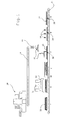
- the loader/distributor 16 performs deposition of a layer of mix 22 of the desired thickness onto a temporary inextensible and gas and vapour-permeable support 20 placed on a conveying system such as a motor-driven conveyor belt 21 so as to perform intermittent feeding in order to bring each mould into a plurality of successive operating positions, identified by A, B, etc.
- the surface of the temporary support 20 is covered (position A) with a porous sheet of paper or paperboard 24.
- a second sheet of paper or paperboard 30 is placed on the mix distributed in the successive position D.
- a layer of refractory material 23 is applied beforehand (position B) and dried on the surface of one of the two paperboards making contact with the mix, and the layer of mix 22 is then deposited (position C) on it.
- the position F shows the compacted rough-formed slab resting on the transpirant support, denoted overall by the reference number 32, and ready for the subsequent drying and firing steps shown in Fig. 2 .
- F1 denotes the position where the slab with the transpirant support is placed on the metallic grate 33 on which it will be subsequently dried.
- the rough-formed slabs are conveyed into the drying oven (position G), denoted generally by the reference number 34, and are kept for a few hours at a suitable temperature in order to eliminate the water present and acquire a mechanical strength sufficient for the subsequent handling operations.
- the grille 33 with the transpirant support and dried slab is brought into the position I where it is acted on by a suction pick-up device 36 (of the type normally used during the machining of slab-like materials for handling and movement thereof).
- This pick-up device removes the dried slab from the support and then transfers it into the drying oven 38.
- Cooling stations are envisaged downstream of the firing oven and from here the slabs then pass to the surface machining and finishing lines.
- Slabs manufactured with the method described above have at the end a density of about 2.4 kg/dm 3 and a flexural strength of about 400 kg/cm 2 .
- the first slab an aqueous solution of sodium silicate at 36 Baumè was used, while in the second slab a mixture containing 70% silicasol and 30% polyvinyl alcohol in an aqueous solution was used as binder.
- the two slabs, after compaction were both dried at a temperature of 90°C: the first slab reached the dried condition in 36 hours, while the second slab reached the dried state in 24 hours.
- the two slabs were fired at a temperature of 1,200°C. After firing, the first slab had bumps on the surface, while the second slab had a perfectly flat and smooth surface.
Landscapes
- Chemical & Material Sciences (AREA)
- Engineering & Computer Science (AREA)
- Ceramic Engineering (AREA)
- Manufacturing & Machinery (AREA)
- Materials Engineering (AREA)
- Structural Engineering (AREA)
- Organic Chemistry (AREA)
- Inorganic Chemistry (AREA)
- Dispersion Chemistry (AREA)
- Mechanical Engineering (AREA)
- Chemical Kinetics & Catalysis (AREA)
- Producing Shaped Articles From Materials (AREA)
- Compositions Of Oxide Ceramics (AREA)
- Paper (AREA)
- Devices For Post-Treatments, Processing, Supply, Discharge, And Other Processes (AREA)
- Laminated Bodies (AREA)
- Press-Shaping Or Shaping Using Conveyers (AREA)
Claims (12)
- Verfahren zur Herstellung von Platten aus keramischem Material, das ein Präparieren eines anfänglichen Gemischs, das keramische Sände mit einer Korngröße von weniger als 2 mm, vorzugsweise weniger als 1,2 mm, ein Bindemittel und aus Feldspäten, Nephelinen, Syeniten ausgewählte mineralische Pulver umfasst, die mit Tonen und/oder Kaoliniten gemischt sind, wobei die Pulver nach Brennen eine kontinuierliche keramische Matrix bilden, ein Deponieren des anfänglichen Gemischs auf einer Zwischenunterlage für den Verdichtungsschritt mittels Vakuumvibrationsverdichtung, eine Trocknung und ein Brennen vorsieht, wobei das Verfahren dadurch gekennzeichnet ist, dass das Bindemittel aus einer wässrigen Dispersion von kolloidalem Siliziumdioxid, genannt Silikasol, besteht.
- Verfahren gemäß Anspruch 1, dadurch gekennzeichnet, dass ein organisches Bindemittel mit dem Silikasol gemischt wird.
- Verfahren gemäß Anspruch 2, dadurch gekennzeichnet, dass das organische Bindemittel in der Mischung mit einem Prozentsatz, der von 20 bis 60% des Gesamtvolumens reicht, vorliegt.
- Verfahren gemäß Anspruch 2, dadurch gekennzeichnet, dass das organische Bindemittel aus einer wässrigen Lösung von Polyvinylalkohol, einer wasserlöslichen Cellulose oder einem Zucker ausgewählt wird.
- Verfahren gemäß Anspruch 1, dadurch gekennzeichnet, dass das anfängliche Gemisch auf einer Lage aus porösem Material deponiert wird.
- Verfahren gemäß Anspruch 5, dadurch gekennzeichnet, dass das poröse Material Papier oder Pappe ist.
- Verfahren gemäß Anspruch 5, dadurch gekennzeichnet, dass das poröse Material auf der Seite, die mit dem Gemisch in Kontakt steht, mit einer feuerfesten Schutzschicht oder Engobe überzogen wird.
- Verfahren gemäß Anspruch 1, dadurch gekennzeichnet, dass die Zwischenunterlage starr sowie gas- und dampfdurchlässig ist und geeignet ist zusammen mit dem Material, das darauf liegt, transportiert zu werden.
- Verfahren gemäß Anspruch 5, dadurch gekennzeichnet, dass die poröse Lage an Material wiederum auf die starre sowie gas- und dampfdurchlässige Unterlage gelegt wird.
- Verfahren gemäß Anspruch 5, dadurch gekennzeichnet, dass nach dem Deponieren der Schicht des anfänglichen Gemischs eine zweite Lage des porösen Materials auf deren oberen Oberfläche gelegt wird.
- Verfahren gemäß Anspruch 10, dadurch gekennzeichnet, dass die zweite Lage porösen Materials Papier oder Pappe ist.
- Verfahren gemäß Anspruch 11, dadurch gekennzeichnet, dass die zweite Lage porösen Materials auf der Seite, die in Kontakt mit dem Gemisch steht, mit einer feuerfesten Schutzschicht überzogen wird.
Priority Applications (1)
| Application Number | Priority Date | Filing Date | Title |
|---|---|---|---|
| PL08719702T PL2129637T3 (pl) | 2007-03-28 | 2008-03-14 | Sposób wytwarzania płyt z materiału ceramicznego |
Applications Claiming Priority (2)
| Application Number | Priority Date | Filing Date | Title |
|---|---|---|---|
| IT000054A ITTV20070054A1 (it) | 2007-03-28 | 2007-03-28 | Procedimento per la fabbricazione di lastre in materiale ceramico |
| PCT/IB2008/050966 WO2008117193A2 (en) | 2007-03-28 | 2008-03-14 | Method for manufacturing slabs of ceramic material |
Publications (2)
| Publication Number | Publication Date |
|---|---|
| EP2129637A2 EP2129637A2 (de) | 2009-12-09 |
| EP2129637B1 true EP2129637B1 (de) | 2010-11-17 |
Family
ID=39720627
Family Applications (1)
| Application Number | Title | Priority Date | Filing Date |
|---|---|---|---|
| EP08719702A Active EP2129637B1 (de) | 2007-03-28 | 2008-03-14 | Verfahren zur herstellung von keramikmaterialplatten |
Country Status (14)
| Country | Link |
|---|---|
| US (1) | US8940223B2 (de) |
| EP (1) | EP2129637B1 (de) |
| KR (1) | KR101455430B1 (de) |
| CN (1) | CN101646636B (de) |
| AT (1) | ATE488482T1 (de) |
| BR (1) | BRPI0809230B1 (de) |
| CA (1) | CA2682485C (de) |
| DE (1) | DE602008003547D1 (de) |
| ES (1) | ES2354134T3 (de) |
| IT (1) | ITTV20070054A1 (de) |
| PL (1) | PL2129637T3 (de) |
| PT (1) | PT2129637E (de) |
| RU (1) | RU2469007C2 (de) |
| WO (1) | WO2008117193A2 (de) |
Cited By (4)
| Publication number | Priority date | Publication date | Assignee | Title |
|---|---|---|---|---|
| RU2459778C1 (ru) * | 2011-04-29 | 2012-08-27 | Юлия Алексеевна Щепочкина | Керамическая масса |
| RU2469008C1 (ru) * | 2011-07-29 | 2012-12-10 | Эдуард Григорьевич Кокая | Способ изготовления пористых строительных изделий из способного вспучиваться природного глинистого сырья |
| RU2469983C1 (ru) * | 2011-07-26 | 2012-12-20 | Юлия Алексеевна Щепочкина | Керамическая масса |
| RU2472738C1 (ru) * | 2011-08-31 | 2013-01-20 | Юлия Алексеевна Щепочкина | Керамическая масса для изготовления облицовочной плитки |
Families Citing this family (16)
| Publication number | Priority date | Publication date | Assignee | Title |
|---|---|---|---|---|
| ITTV20070126A1 (it) | 2007-07-16 | 2009-01-17 | Luca Toncelli | Procedimento ed apparecchiatura per la fabbricazione di lastre ad effet-to venato |
| IT1393456B1 (it) | 2009-03-10 | 2012-04-20 | Toncelli | Apparecchiatura e metodo per la fabbricazione di lastre ad effetto venato |
| US9186819B1 (en) | 2014-08-19 | 2015-11-17 | Cambria Company Llc | Synthetic molded slabs, and systems and methods related thereto |
| CN104230387B (zh) * | 2014-09-23 | 2016-06-29 | 佛山市禾才科技服务有限公司 | 一种图案釉面陶瓷砖的生产方法 |
| CN104230394B (zh) * | 2014-09-23 | 2016-03-23 | 佛山市禾才科技服务有限公司 | 一种微晶玻璃陶瓷复合板生产工艺 |
| US9289923B1 (en) | 2015-01-30 | 2016-03-22 | Cambria Company Llc | Synthetic molded slabs, and systems and methods related thereto |
| KR101728491B1 (ko) * | 2016-06-20 | 2017-04-20 | 삼영기계 (주) | 샌드 기반 복합 소재 및 이의 제조방법 |
| EP3687751A4 (de) * | 2017-09-26 | 2021-08-04 | Delta Faucet Company | Wässriges gelgiessverfahren für keramische produkte |
| DE202017106696U1 (de) * | 2017-11-06 | 2019-02-07 | Fliesenmarkt Herberhold Gmbh | Steinzeugfliese |
| IT201800010813A1 (it) | 2018-12-05 | 2020-06-05 | Luca Toncelli | Metodo, isola robotizzata ed impianto per la produzione di lastre in conglomerato di materiale lapideo e/o ceramico con effetto venato |
| IT201800020920A1 (it) | 2018-12-21 | 2020-06-21 | Luca Toncelli | Metodo per la produzione di manufatti in lastra a partire da un impasto base, fritta vetrosa per la realizzazione dellimpasto base e manufatto in lastra così ottenuto |
| IT201800020944A1 (it) | 2018-12-21 | 2020-06-21 | Luca Toncelli | Metodo per la produzione di manufatti colorati in lastra vetroceramica a partire da un impasto base, fritta vetrosa per la realizzazione dellimpasto base e manufatto colorato in lastra vetroceramica così ottenuto |
| IT201900008238A1 (it) | 2019-06-06 | 2020-12-06 | System Ceramics S P A | Metodo per la realizzazione di lastre o piastrelle ceramiche |
| CA3174163A1 (en) | 2021-05-13 | 2022-11-13 | Cambria Company Llc | Metallic stone slabs, systems, and methods |
| WO2022241275A1 (en) | 2021-05-13 | 2022-11-17 | Cambria Company Llc | Textured stone slabs, systems, and methods |
| US12594689B2 (en) | 2022-11-16 | 2026-04-07 | Cambria Company Llc | Metallic stone slabs, systems, and methods |
Family Cites Families (61)
| Publication number | Priority date | Publication date | Assignee | Title |
|---|---|---|---|---|
| US2098246A (en) * | 1931-04-04 | 1937-11-09 | Bartlett Arkell | Automatic bag-filling and weighing machine |
| US2200773A (en) * | 1936-10-28 | 1940-05-14 | Int Harvester Co | Fertilizer distributor |
| US2323864A (en) * | 1939-05-01 | 1943-07-06 | Carl S Weyandt | Vibratory feeder |
| GB1043989A (en) * | 1964-09-28 | 1966-09-28 | Head Wrightson & Co Ltd | Improvements in and relating to powdered coatings |
| GB1239420A (de) * | 1968-09-12 | 1971-07-14 | ||
| US3663137A (en) * | 1969-06-30 | 1972-05-16 | Werzalit Pressholzwerk J F Wer | Apparatus for molding articles of uneven thickness |
| US3953623A (en) * | 1971-12-10 | 1976-04-27 | Johannes Cornelis Das | Process of selectively coating earthenware articles |
| JPS57194034A (en) | 1981-05-21 | 1982-11-29 | Nippon Steel Weld Prod & Eng Co Ltd | Uniform dispersing device for powder and granule |
| WO1985000035A1 (en) * | 1983-06-17 | 1985-01-03 | Monier Limited | Ceramic material |
| US4569920A (en) * | 1983-09-06 | 1986-02-11 | Blasch Precision Ceramics, Inc. | Preparation of inorganic particle slurries |
| US4783435A (en) * | 1984-04-23 | 1988-11-08 | Mallinckrodt, Inc. | Silica catalyst supports |
| US4617060A (en) * | 1984-04-23 | 1986-10-14 | Mallinckrodt, Inc. | Silica catalyst supports |
| US4937394A (en) * | 1984-04-23 | 1990-06-26 | Mallinckrodt, Inc. | Silica catalyst supports for hydration of ethylene to ethanol |
| IT1181570B (it) * | 1984-09-14 | 1987-09-30 | Marcello Toncelli | Procedimento per la formazione di blocchi di materiali qualsiasi mediante l'azione contemporanea di vibrapioni,compressione e vuoto destinati al taglio in lastre ed apparecchiature adatte a realizzare il procedimento stesso |
| JPS6443336A (en) | 1987-08-11 | 1989-02-15 | Zenitaka Corp | Continuous mixing method for powdery or granular substance |
| US5264168A (en) * | 1989-01-13 | 1993-11-23 | Marcello Toncelli | Plate product of ceramic material and process for the manufacturing thereof |
| IT1234012B (it) * | 1989-01-13 | 1992-04-23 | Marcello Toncelli | Procedimento con azione combinata di vibrazione e pressione in ambiente privo d'aria per la formazione di lastre di materiale ceramico anche di grandi dimensioni con elevate caratteristiche meccaniche. |
| US5031546A (en) * | 1989-02-28 | 1991-07-16 | The Dow Chemical Company | Hopper car discharge system |
| US5013523A (en) * | 1989-04-21 | 1991-05-07 | Agency Of Industrial Science & Technology | Metal-based composite material and process for preparation thereof |
| IT223042Z2 (it) * | 1990-05-16 | 1995-06-09 | Dario Toncelli | Dispositivo per controllare le aggregazioni di un impasto di lapidei eleganti per la produzione di pietra agglomerata |
| IT1242777B (it) | 1990-12-04 | 1994-05-17 | Luca Toncelli | Metodo ed apparecchiatura per la preparazione di impasti di aggregati di materiale lapideo o ceramico |
| US5469971A (en) * | 1992-02-26 | 1995-11-28 | Estee Lauder Inc. | Method and apparatus for deagglomerating powder |
| US5314090A (en) * | 1992-03-23 | 1994-05-24 | Terronics Development Corporation | Material feeder |
| GB2277707B (en) * | 1993-04-29 | 1996-07-03 | Redland Technology Ltd | Improvements in a roof tile making machine |
| US5514399A (en) * | 1994-06-27 | 1996-05-07 | Nabisco, Inc. | Method of applying particulates to baked goods and snacks |
| IT1273903B (it) | 1994-07-22 | 1997-07-11 | Luca Toncelli | Procedimento ed impianto per la fabbricazione di manufatti in lastre e blocchi con effetto venato. |
| US5477307A (en) * | 1994-09-14 | 1995-12-19 | Xerox Corporation | Apparatus for dispersing and/or transporting particulates |
| IT1269274B (it) | 1994-11-22 | 1997-03-26 | Carlo Antonio Camorani | Metodo per la formatura di piastrelle ceramiche ed impianto relativo |
| EP0776998A4 (de) * | 1995-06-14 | 1998-09-02 | Otsuka Kagaku Kk | Titanat-whisker und verfahren zu seiner herstellung |
| US5914187A (en) * | 1996-01-12 | 1999-06-22 | Ibiden Co., Ltd. | Ceramic structural body |
| GB9606482D0 (en) | 1996-03-27 | 1996-06-05 | Forticrete Ltd | Process,equipment and method required to produce colour blended tiles such as two-colour blended tiles,in particular roofing and cladding tiles |
| EP0800901B1 (de) * | 1996-04-10 | 2003-07-02 | Dieffenbacher Schenck Panel GmbH | Verfahren zur Herstellung eines Vlieses und Vorrichtung |
| IT1293176B1 (it) | 1997-04-15 | 1999-02-12 | Marcello Toncelli | Procedimento ed impianto per la fabbricazione di lastre in materiale ceramico. |
| IT1306079B1 (it) | 1998-06-02 | 2001-05-29 | Ariostea S P A | Dispositivo di alimentazione delle polveri alla pressa di formatura di piastrelle ceramiche |
| DE19827104C2 (de) * | 1998-06-18 | 2001-12-06 | Geiger Peter | Verfahren zum Herstellen von Betonsteinen, insbesondere Pflastersteinen |
| IT1302213B1 (it) * | 1998-09-16 | 2000-09-05 | Siti | Dispositivo per alimentare un apparato di pressatura, apparato dipressatura e procedimento di pressatura. |
| IT1311858B1 (it) | 1999-09-03 | 2002-03-19 | Marcello Toncelli | Procedimento perfezionato per la produzione di lastre in materialeceramico |
| JP2002348722A (ja) | 2001-05-28 | 2002-12-04 | Yokoi Sangyo Kk | 各種流体用ノズルの製法 |
| ITTV20010130A1 (it) * | 2001-09-24 | 2003-03-24 | Luca Toncelli | Procedimento per la fabbricazione di manufatti lapidei in particolarelastre ad effetto venato |
| AU2003213529B2 (en) * | 2002-07-19 | 2005-01-20 | Panasonic Healthcare Holdings Co., Ltd. | ZrO2-AI2O3 composite ceramic material and production method thereof |
| WO2004022295A1 (en) | 2002-09-04 | 2004-03-18 | Toncelli, Luca | Process for the manufacture of slabs and panels of ceramic material and product obtained therefrom |
| US7550106B2 (en) * | 2002-09-04 | 2009-06-23 | Luca Toncelli, legal representative | Process for the manufacture of slabs and panels of ceramic material |
| ITTV20020131A1 (it) | 2002-10-31 | 2004-05-01 | Luca Toncelli | Distributore di impasti di materiale lapideo o ceramico agglomerato per il riempimento di uno stampo |
| CN1522987A (zh) * | 2003-02-17 | 2004-08-25 | 西北工业大学 | 一种大型陶瓷板材溶胶注模成型方法 |
| DE10339143B4 (de) | 2003-08-26 | 2005-10-13 | Hess Maschinenfabrik Gmbh & Co. Kg | Verfahren und Vorrichtung zum Herstellen mehrfarbiger Betonsteine |
| ITTV20040118A1 (it) * | 2004-10-20 | 2005-01-20 | Luca Toncelli | Apparecchiatura per la distribuzione in strato sottile di un impasto a base di materiale lapideo o ceramico agglomerato. |
| ITPN20040080A1 (it) | 2004-11-08 | 2005-02-08 | R G R Di Altinier G E C S N C | Dispositivo per il reciproco posizionamento e fissaggio dei montanti di un serramento, e relativo procedimento. |
| CN2784164Y (zh) | 2004-11-12 | 2006-05-31 | 杨晓东 | 一种用于陶瓷墙地砖生产的填料装置 |
| RU2283818C1 (ru) | 2005-01-24 | 2006-09-20 | Александр Николаевич Кондратенко | Способ изготовления изделий на основе кремнеземсодержащего связующего |
| WO2006117828A2 (en) * | 2005-05-03 | 2006-11-09 | Luca Toncelli | Article of lightweight inorganic agglomerate in form of slab, process of manufacturing the same and resulting panel |
| ITTV20050068A1 (it) | 2005-05-19 | 2006-11-20 | Luca Toncelli | Procedimento ed impianto per la fabbricazione di blocchi di conglomerato in materiale lapideo o ceramico. |
| ITTV20050106A1 (it) | 2005-07-18 | 2007-01-19 | Luca Toncelli | Procedimento ed impianto per la fabbricazione di manufatti in lastre o blocchi di conglomerato di materiale lapideo o litoide. |
| WO2007037222A1 (ja) * | 2005-09-28 | 2007-04-05 | Ibiden Co., Ltd. | ハニカムフィルタ |
| US7487892B1 (en) * | 2005-10-03 | 2009-02-10 | Gary Wayne Hirsch | Powdered seed treatment applicator |
| US8790913B2 (en) * | 2005-10-26 | 2014-07-29 | Pbs Biotech, Inc. | Methods of using pneumatic bioreactors |
| ITRE20050130A1 (it) | 2005-11-16 | 2007-05-17 | Sacmi Scrl | Metodo per la formatura di piastrelle o lastre ceramiche riproducenti le caratteristiche delle pietre naturali e relativo apparato |
| MX2007011554A (es) * | 2006-09-22 | 2008-10-28 | Scg Building Materials Co Ltd | Aparato y metodo para formar un patron en azulejo o losa de ceramica con un grosor prescrito. |
| TW200843840A (en) * | 2007-05-09 | 2008-11-16 | Pao-Chu Liu | Catalysts for treating acid and halogen gases and production methods thereof |
| ITTV20070126A1 (it) * | 2007-07-16 | 2009-01-17 | Luca Toncelli | Procedimento ed apparecchiatura per la fabbricazione di lastre ad effet-to venato |
| US7819346B2 (en) * | 2008-01-07 | 2010-10-26 | Rex W Perkes | Process for accelerating the wetting of and the application of salt to surfaces |
| IT1393456B1 (it) * | 2009-03-10 | 2012-04-20 | Toncelli | Apparecchiatura e metodo per la fabbricazione di lastre ad effetto venato |
-
2007
- 2007-03-28 IT IT000054A patent/ITTV20070054A1/it unknown
-
2008
- 2008-03-14 WO PCT/IB2008/050966 patent/WO2008117193A2/en not_active Ceased
- 2008-03-14 DE DE602008003547T patent/DE602008003547D1/de active Active
- 2008-03-14 KR KR1020097019949A patent/KR101455430B1/ko active Active
- 2008-03-14 PL PL08719702T patent/PL2129637T3/pl unknown
- 2008-03-14 US US12/532,699 patent/US8940223B2/en active Active
- 2008-03-14 PT PT08719702T patent/PT2129637E/pt unknown
- 2008-03-14 CA CA2682485A patent/CA2682485C/en active Active
- 2008-03-14 BR BRPI0809230A patent/BRPI0809230B1/pt active IP Right Grant
- 2008-03-14 ES ES08719702T patent/ES2354134T3/es active Active
- 2008-03-14 RU RU2009139778/03A patent/RU2469007C2/ru not_active IP Right Cessation
- 2008-03-14 EP EP08719702A patent/EP2129637B1/de active Active
- 2008-03-14 AT AT08719702T patent/ATE488482T1/de not_active IP Right Cessation
- 2008-03-14 CN CN2008800103072A patent/CN101646636B/zh active Active
Cited By (4)
| Publication number | Priority date | Publication date | Assignee | Title |
|---|---|---|---|---|
| RU2459778C1 (ru) * | 2011-04-29 | 2012-08-27 | Юлия Алексеевна Щепочкина | Керамическая масса |
| RU2469983C1 (ru) * | 2011-07-26 | 2012-12-20 | Юлия Алексеевна Щепочкина | Керамическая масса |
| RU2469008C1 (ru) * | 2011-07-29 | 2012-12-10 | Эдуард Григорьевич Кокая | Способ изготовления пористых строительных изделий из способного вспучиваться природного глинистого сырья |
| RU2472738C1 (ru) * | 2011-08-31 | 2013-01-20 | Юлия Алексеевна Щепочкина | Керамическая масса для изготовления облицовочной плитки |
Also Published As
| Publication number | Publication date |
|---|---|
| ES2354134T3 (es) | 2011-03-10 |
| PL2129637T3 (pl) | 2011-04-29 |
| CN101646636A (zh) | 2010-02-10 |
| CN101646636B (zh) | 2013-03-20 |
| ITTV20070054A1 (it) | 2008-09-29 |
| CA2682485A1 (en) | 2008-10-02 |
| EP2129637A2 (de) | 2009-12-09 |
| ATE488482T1 (de) | 2010-12-15 |
| RU2009139778A (ru) | 2011-05-10 |
| WO2008117193A3 (en) | 2009-05-07 |
| KR101455430B1 (ko) | 2014-10-31 |
| DE602008003547D1 (de) | 2010-12-30 |
| BRPI0809230B1 (pt) | 2018-10-16 |
| RU2469007C2 (ru) | 2012-12-10 |
| KR20090129442A (ko) | 2009-12-16 |
| US20100052225A1 (en) | 2010-03-04 |
| US8940223B2 (en) | 2015-01-27 |
| CA2682485C (en) | 2015-06-02 |
| WO2008117193A2 (en) | 2008-10-02 |
| PT2129637E (pt) | 2011-01-10 |
| BRPI0809230A2 (pt) | 2014-09-02 |
Similar Documents
| Publication | Publication Date | Title |
|---|---|---|
| EP2129637B1 (de) | Verfahren zur herstellung von keramikmaterialplatten | |
| EP2699397B1 (de) | Vorrichtungen, system und verfahren zur formung von presslingen und dadurch hergestellte presslinge | |
| CN101743105A (zh) | 具有显现纹理的效果的平板的制造方法和设备 | |
| IL188482A (en) | Method and plant for manufacturing articles in the form of sheets or blocks of conglomerate stone or stone-like material | |
| EP1934028A1 (de) | Anlage zur herstellung von platten aus konglomeratsteinmaterial | |
| US20080199707A1 (en) | Method and apparatus for producing an inorganic calcined substance | |
| EP1207986B1 (de) | Verbessertes verfahren zur herstellung von scheiben aus keramischem material | |
| CN110936466A (zh) | 一种用于无机胶凝材料制品增材制造的成形装置与方法 | |
| CA2287283A1 (en) | Method and apparatus for the manufacture of slabs of ceramic material | |
| CN117550907B (zh) | 一种超高强度刚性陶瓷隔热瓦的制备方法 | |
| EP4142996B1 (de) | Verfahren und vorrichtung zur oberflächenbehandlung eines keramischen grundgegenstandes | |
| JPH0818297B2 (ja) | 積層模様を有するセラミック材料の製造方法 | |
| RU2385849C1 (ru) | Способ получения керамических изделий на основе волластонита | |
| RU2079406C1 (ru) | Линия для изготовления облицовочных вермикулитовых плит | |
| CN121916654A (zh) | 一种非晶纳米晶软磁材料熔炼用陶瓷坩埚及其制备方法 | |
| CN118952702A (zh) | 人造石制备方法 | |
| JPH0971484A (ja) | 窯業製品製造用の硬化装置 | |
| HK1102805A (en) | Support for decorating means |
Legal Events
| Date | Code | Title | Description |
|---|---|---|---|
| PUAI | Public reference made under article 153(3) epc to a published international application that has entered the european phase |
Free format text: ORIGINAL CODE: 0009012 |
|
| 17P | Request for examination filed |
Effective date: 20090925 |
|
| AK | Designated contracting states |
Kind code of ref document: A2 Designated state(s): AT BE BG CH CY CZ DE DK EE ES FI FR GB GR HR HU IE IS IT LI LT LU LV MC MT NL NO PL PT RO SE SI SK TR |
|
| GRAP | Despatch of communication of intention to grant a patent |
Free format text: ORIGINAL CODE: EPIDOSNIGR1 |
|
| GRAS | Grant fee paid |
Free format text: ORIGINAL CODE: EPIDOSNIGR3 |
|
| GRAA | (expected) grant |
Free format text: ORIGINAL CODE: 0009210 |
|
| AK | Designated contracting states |
Kind code of ref document: B1 Designated state(s): AT BE BG CH CY CZ DE DK EE ES FI FR GB GR HR HU IE IS IT LI LT LU LV MC MT NL NO PL PT RO SE SI SK TR |
|
| REG | Reference to a national code |
Ref country code: GB Ref legal event code: FG4D |
|
| REG | Reference to a national code |
Ref country code: CH Ref legal event code: EP |
|
| REG | Reference to a national code |
Ref country code: IE Ref legal event code: FG4D |
|
| REF | Corresponds to: |
Ref document number: 602008003547 Country of ref document: DE Date of ref document: 20101230 Kind code of ref document: P |
|
| REG | Reference to a national code |
Ref country code: PT Ref legal event code: SC4A Free format text: AVAILABILITY OF NATIONAL TRANSLATION Effective date: 20110103 |
|
| REG | Reference to a national code |
Ref country code: NL Ref legal event code: VDEP Effective date: 20101117 |
|
| REG | Reference to a national code |
Ref country code: ES Ref legal event code: FG2A Effective date: 20110228 |
|
| LTIE | Lt: invalidation of european patent or patent extension |
Effective date: 20101117 |
|
| PG25 | Lapsed in a contracting state [announced via postgrant information from national office to epo] |
Ref country code: NO Free format text: LAPSE BECAUSE OF FAILURE TO SUBMIT A TRANSLATION OF THE DESCRIPTION OR TO PAY THE FEE WITHIN THE PRESCRIBED TIME-LIMIT Effective date: 20110217 Ref country code: LT Free format text: LAPSE BECAUSE OF FAILURE TO SUBMIT A TRANSLATION OF THE DESCRIPTION OR TO PAY THE FEE WITHIN THE PRESCRIBED TIME-LIMIT Effective date: 20101117 |
|
| REG | Reference to a national code |
Ref country code: PL Ref legal event code: T3 |
|
| PG25 | Lapsed in a contracting state [announced via postgrant information from national office to epo] |
Ref country code: NL Free format text: LAPSE BECAUSE OF FAILURE TO SUBMIT A TRANSLATION OF THE DESCRIPTION OR TO PAY THE FEE WITHIN THE PRESCRIBED TIME-LIMIT Effective date: 20101117 Ref country code: SI Free format text: LAPSE BECAUSE OF FAILURE TO SUBMIT A TRANSLATION OF THE DESCRIPTION OR TO PAY THE FEE WITHIN THE PRESCRIBED TIME-LIMIT Effective date: 20101117 Ref country code: HR Free format text: LAPSE BECAUSE OF FAILURE TO SUBMIT A TRANSLATION OF THE DESCRIPTION OR TO PAY THE FEE WITHIN THE PRESCRIBED TIME-LIMIT Effective date: 20101117 Ref country code: IS Free format text: LAPSE BECAUSE OF FAILURE TO SUBMIT A TRANSLATION OF THE DESCRIPTION OR TO PAY THE FEE WITHIN THE PRESCRIBED TIME-LIMIT Effective date: 20110317 Ref country code: FI Free format text: LAPSE BECAUSE OF FAILURE TO SUBMIT A TRANSLATION OF THE DESCRIPTION OR TO PAY THE FEE WITHIN THE PRESCRIBED TIME-LIMIT Effective date: 20101117 Ref country code: BG Free format text: LAPSE BECAUSE OF FAILURE TO SUBMIT A TRANSLATION OF THE DESCRIPTION OR TO PAY THE FEE WITHIN THE PRESCRIBED TIME-LIMIT Effective date: 20110217 Ref country code: AT Free format text: LAPSE BECAUSE OF FAILURE TO SUBMIT A TRANSLATION OF THE DESCRIPTION OR TO PAY THE FEE WITHIN THE PRESCRIBED TIME-LIMIT Effective date: 20101117 Ref country code: LV Free format text: LAPSE BECAUSE OF FAILURE TO SUBMIT A TRANSLATION OF THE DESCRIPTION OR TO PAY THE FEE WITHIN THE PRESCRIBED TIME-LIMIT Effective date: 20101117 Ref country code: SE Free format text: LAPSE BECAUSE OF FAILURE TO SUBMIT A TRANSLATION OF THE DESCRIPTION OR TO PAY THE FEE WITHIN THE PRESCRIBED TIME-LIMIT Effective date: 20101117 Ref country code: CY Free format text: LAPSE BECAUSE OF FAILURE TO SUBMIT A TRANSLATION OF THE DESCRIPTION OR TO PAY THE FEE WITHIN THE PRESCRIBED TIME-LIMIT Effective date: 20101117 |
|
| PG25 | Lapsed in a contracting state [announced via postgrant information from national office to epo] |
Ref country code: GR Free format text: LAPSE BECAUSE OF FAILURE TO SUBMIT A TRANSLATION OF THE DESCRIPTION OR TO PAY THE FEE WITHIN THE PRESCRIBED TIME-LIMIT Effective date: 20110218 |
|
| PG25 | Lapsed in a contracting state [announced via postgrant information from national office to epo] |
Ref country code: CZ Free format text: LAPSE BECAUSE OF FAILURE TO SUBMIT A TRANSLATION OF THE DESCRIPTION OR TO PAY THE FEE WITHIN THE PRESCRIBED TIME-LIMIT Effective date: 20101117 Ref country code: BE Free format text: LAPSE BECAUSE OF FAILURE TO SUBMIT A TRANSLATION OF THE DESCRIPTION OR TO PAY THE FEE WITHIN THE PRESCRIBED TIME-LIMIT Effective date: 20101117 Ref country code: EE Free format text: LAPSE BECAUSE OF FAILURE TO SUBMIT A TRANSLATION OF THE DESCRIPTION OR TO PAY THE FEE WITHIN THE PRESCRIBED TIME-LIMIT Effective date: 20101117 |
|
| PG25 | Lapsed in a contracting state [announced via postgrant information from national office to epo] |
Ref country code: RO Free format text: LAPSE BECAUSE OF FAILURE TO SUBMIT A TRANSLATION OF THE DESCRIPTION OR TO PAY THE FEE WITHIN THE PRESCRIBED TIME-LIMIT Effective date: 20101117 Ref country code: SK Free format text: LAPSE BECAUSE OF FAILURE TO SUBMIT A TRANSLATION OF THE DESCRIPTION OR TO PAY THE FEE WITHIN THE PRESCRIBED TIME-LIMIT Effective date: 20101117 Ref country code: DK Free format text: LAPSE BECAUSE OF FAILURE TO SUBMIT A TRANSLATION OF THE DESCRIPTION OR TO PAY THE FEE WITHIN THE PRESCRIBED TIME-LIMIT Effective date: 20101117 |
|
| PLBE | No opposition filed within time limit |
Free format text: ORIGINAL CODE: 0009261 |
|
| STAA | Information on the status of an ep patent application or granted ep patent |
Free format text: STATUS: NO OPPOSITION FILED WITHIN TIME LIMIT |
|
| 26N | No opposition filed |
Effective date: 20110818 |
|
| PG25 | Lapsed in a contracting state [announced via postgrant information from national office to epo] |
Ref country code: MC Free format text: LAPSE BECAUSE OF NON-PAYMENT OF DUE FEES Effective date: 20110331 |
|
| REG | Reference to a national code |
Ref country code: DE Ref legal event code: R097 Ref document number: 602008003547 Country of ref document: DE Effective date: 20110818 |
|
| PG25 | Lapsed in a contracting state [announced via postgrant information from national office to epo] |
Ref country code: MT Free format text: LAPSE BECAUSE OF FAILURE TO SUBMIT A TRANSLATION OF THE DESCRIPTION OR TO PAY THE FEE WITHIN THE PRESCRIBED TIME-LIMIT Effective date: 20101117 |
|
| PGFP | Annual fee paid to national office [announced via postgrant information from national office to epo] |
Ref country code: IT Payment date: 20110331 Year of fee payment: 4 |
|
| REG | Reference to a national code |
Ref country code: IE Ref legal event code: MM4A |
|
| PG25 | Lapsed in a contracting state [announced via postgrant information from national office to epo] |
Ref country code: IE Free format text: LAPSE BECAUSE OF NON-PAYMENT OF DUE FEES Effective date: 20110314 |
|
| REG | Reference to a national code |
Ref country code: CH Ref legal event code: PL |
|
| GBPC | Gb: european patent ceased through non-payment of renewal fee |
Effective date: 20120314 |
|
| PG25 | Lapsed in a contracting state [announced via postgrant information from national office to epo] |
Ref country code: GB Free format text: LAPSE BECAUSE OF NON-PAYMENT OF DUE FEES Effective date: 20120314 Ref country code: CH Free format text: LAPSE BECAUSE OF NON-PAYMENT OF DUE FEES Effective date: 20120331 Ref country code: LI Free format text: LAPSE BECAUSE OF NON-PAYMENT OF DUE FEES Effective date: 20120331 |
|
| PG25 | Lapsed in a contracting state [announced via postgrant information from national office to epo] |
Ref country code: IT Free format text: LAPSE BECAUSE OF NON-PAYMENT OF DUE FEES Effective date: 20120314 |
|
| PG25 | Lapsed in a contracting state [announced via postgrant information from national office to epo] |
Ref country code: LU Free format text: LAPSE BECAUSE OF NON-PAYMENT OF DUE FEES Effective date: 20110314 |
|
| PG25 | Lapsed in a contracting state [announced via postgrant information from national office to epo] |
Ref country code: HU Free format text: LAPSE BECAUSE OF FAILURE TO SUBMIT A TRANSLATION OF THE DESCRIPTION OR TO PAY THE FEE WITHIN THE PRESCRIBED TIME-LIMIT Effective date: 20101117 |
|
| REG | Reference to a national code |
Ref country code: FR Ref legal event code: PLFP Year of fee payment: 9 |
|
| REG | Reference to a national code |
Ref country code: FR Ref legal event code: PLFP Year of fee payment: 10 |
|
| REG | Reference to a national code |
Ref country code: FR Ref legal event code: PLFP Year of fee payment: 11 |
|
| PGFP | Annual fee paid to national office [announced via postgrant information from national office to epo] |
Ref country code: PL Payment date: 20200220 Year of fee payment: 13 |
|
| PGFP | Annual fee paid to national office [announced via postgrant information from national office to epo] |
Ref country code: FR Payment date: 20200220 Year of fee payment: 13 |
|
| PG25 | Lapsed in a contracting state [announced via postgrant information from national office to epo] |
Ref country code: FR Free format text: LAPSE BECAUSE OF NON-PAYMENT OF DUE FEES Effective date: 20210331 |
|
| PG25 | Lapsed in a contracting state [announced via postgrant information from national office to epo] |
Ref country code: PL Free format text: LAPSE BECAUSE OF NON-PAYMENT OF DUE FEES Effective date: 20210314 |
|
| P01 | Opt-out of the competence of the unified patent court (upc) registered |
Effective date: 20230624 |
|
| PGFP | Annual fee paid to national office [announced via postgrant information from national office to epo] |
Ref country code: ES Payment date: 20250401 Year of fee payment: 18 |
|
| PGFP | Annual fee paid to national office [announced via postgrant information from national office to epo] |
Ref country code: DE Payment date: 20260219 Year of fee payment: 19 |
|
| PGFP | Annual fee paid to national office [announced via postgrant information from national office to epo] |
Ref country code: TR Payment date: 20260302 Year of fee payment: 19 |
|
| PGFP | Annual fee paid to national office [announced via postgrant information from national office to epo] |
Ref country code: PT Payment date: 20260220 Year of fee payment: 19 |