EP2133192A2 - Dispositif d'exposition au gaz - Google Patents
Dispositif d'exposition au gaz Download PDFInfo
- Publication number
- EP2133192A2 EP2133192A2 EP09158342A EP09158342A EP2133192A2 EP 2133192 A2 EP2133192 A2 EP 2133192A2 EP 09158342 A EP09158342 A EP 09158342A EP 09158342 A EP09158342 A EP 09158342A EP 2133192 A2 EP2133192 A2 EP 2133192A2
- Authority
- EP
- European Patent Office
- Prior art keywords
- gas
- reaction space
- siphon
- liquid
- strand
- Prior art date
- Legal status (The legal status is an assumption and is not a legal conclusion. Google has not performed a legal analysis and makes no representation as to the accuracy of the status listed.)
- Granted
Links
- 238000006243 chemical reaction Methods 0.000 claims abstract description 124
- 239000000203 mixture Substances 0.000 claims abstract description 41
- 229920001971 elastomer Polymers 0.000 claims abstract description 31
- 239000000806 elastomer Substances 0.000 claims abstract description 29
- 230000026030 halogenation Effects 0.000 claims abstract description 16
- 238000005658 halogenation reaction Methods 0.000 claims abstract description 16
- 238000000034 method Methods 0.000 claims abstract description 8
- XLYOFNOQVPJJNP-UHFFFAOYSA-N water Substances O XLYOFNOQVPJJNP-UHFFFAOYSA-N 0.000 claims abstract description 5
- 239000007789 gas Substances 0.000 claims description 194
- 239000007788 liquid Substances 0.000 claims description 77
- 229910052736 halogen Inorganic materials 0.000 claims description 40
- 150000002367 halogens Chemical class 0.000 claims description 40
- 238000001704 evaporation Methods 0.000 claims description 10
- ZAMOUSCENKQFHK-UHFFFAOYSA-N Chlorine atom Chemical compound [Cl] ZAMOUSCENKQFHK-UHFFFAOYSA-N 0.000 claims description 7
- 239000000460 chlorine Substances 0.000 claims description 7
- 229910052801 chlorine Inorganic materials 0.000 claims description 7
- IJGRMHOSHXDMSA-UHFFFAOYSA-N Atomic nitrogen Chemical compound N#N IJGRMHOSHXDMSA-UHFFFAOYSA-N 0.000 claims description 6
- WKBOTKDWSSQWDR-UHFFFAOYSA-N Bromine atom Chemical compound [Br] WKBOTKDWSSQWDR-UHFFFAOYSA-N 0.000 claims description 4
- PXGOKWXKJXAPGV-UHFFFAOYSA-N Fluorine Chemical compound FF PXGOKWXKJXAPGV-UHFFFAOYSA-N 0.000 claims description 4
- GDTBXPJZTBHREO-UHFFFAOYSA-N bromine Substances BrBr GDTBXPJZTBHREO-UHFFFAOYSA-N 0.000 claims description 4
- 229910052794 bromium Inorganic materials 0.000 claims description 4
- 229910052731 fluorine Inorganic materials 0.000 claims description 4
- 239000011737 fluorine Substances 0.000 claims description 4
- 229910052757 nitrogen Inorganic materials 0.000 claims description 3
- 239000012530 fluid Substances 0.000 abstract description 6
- 238000001035 drying Methods 0.000 description 9
- 230000008020 evaporation Effects 0.000 description 6
- 238000000746 purification Methods 0.000 description 5
- 229920002943 EPDM rubber Polymers 0.000 description 3
- 244000043261 Hevea brasiliensis Species 0.000 description 3
- 230000007423 decrease Effects 0.000 description 3
- 229920003052 natural elastomer Polymers 0.000 description 3
- 229920001194 natural rubber Polymers 0.000 description 3
- 229920000459 Nitrile rubber Polymers 0.000 description 2
- 239000005062 Polybutadiene Substances 0.000 description 2
- 238000001069 Raman spectroscopy Methods 0.000 description 2
- 238000004458 analytical method Methods 0.000 description 2
- 238000007664 blowing Methods 0.000 description 2
- 230000005495 cold plasma Effects 0.000 description 2
- 238000010494 dissociation reaction Methods 0.000 description 2
- 230000005593 dissociations Effects 0.000 description 2
- 239000013536 elastomeric material Substances 0.000 description 2
- 238000010438 heat treatment Methods 0.000 description 2
- 229920006168 hydrated nitrile rubber Polymers 0.000 description 2
- 239000000463 material Substances 0.000 description 2
- 229920001200 poly(ethylene-vinyl acetate) Polymers 0.000 description 2
- 229920002857 polybutadiene Polymers 0.000 description 2
- 229920003225 polyurethane elastomer Polymers 0.000 description 2
- 239000005060 rubber Substances 0.000 description 2
- 238000001179 sorption measurement Methods 0.000 description 2
- 238000000870 ultraviolet spectroscopy Methods 0.000 description 2
- 238000004073 vulcanization Methods 0.000 description 2
- 238000010521 absorption reaction Methods 0.000 description 1
- 230000003750 conditioning effect Effects 0.000 description 1
- 239000000470 constituent Substances 0.000 description 1
- 238000010924 continuous production Methods 0.000 description 1
- 229920001577 copolymer Polymers 0.000 description 1
- 230000002349 favourable effect Effects 0.000 description 1
- 239000011261 inert gas Substances 0.000 description 1
- 230000001050 lubricating effect Effects 0.000 description 1
- 238000005259 measurement Methods 0.000 description 1
- 238000012544 monitoring process Methods 0.000 description 1
- 229920001084 poly(chloroprene) Polymers 0.000 description 1
- 239000004814 polyurethane Substances 0.000 description 1
- 230000008092 positive effect Effects 0.000 description 1
- 238000005201 scrubbing Methods 0.000 description 1
- 229920003048 styrene butadiene rubber Polymers 0.000 description 1
- 239000002341 toxic gas Substances 0.000 description 1
Images
Classifications
-
- B—PERFORMING OPERATIONS; TRANSPORTING
- B29—WORKING OF PLASTICS; WORKING OF SUBSTANCES IN A PLASTIC STATE IN GENERAL
- B29C—SHAPING OR JOINING OF PLASTICS; SHAPING OF MATERIAL IN A PLASTIC STATE, NOT OTHERWISE PROVIDED FOR; AFTER-TREATMENT OF THE SHAPED PRODUCTS, e.g. REPAIRING
- B29C71/00—After-treatment of articles without altering their shape; Apparatus therefor
- B29C71/009—After-treatment of articles without altering their shape; Apparatus therefor using gases without chemical reaction
-
- C—CHEMISTRY; METALLURGY
- C08—ORGANIC MACROMOLECULAR COMPOUNDS; THEIR PREPARATION OR CHEMICAL WORKING-UP; COMPOSITIONS BASED THEREON
- C08J—WORKING-UP; GENERAL PROCESSES OF COMPOUNDING; AFTER-TREATMENT NOT COVERED BY SUBCLASSES C08B, C08C, C08F, C08G or C08H
- C08J7/00—Chemical treatment or coating of shaped articles made of macromolecular substances
- C08J7/12—Chemical modification
- C08J7/126—Halogenation
-
- C—CHEMISTRY; METALLURGY
- C08—ORGANIC MACROMOLECULAR COMPOUNDS; THEIR PREPARATION OR CHEMICAL WORKING-UP; COMPOSITIONS BASED THEREON
- C08J—WORKING-UP; GENERAL PROCESSES OF COMPOUNDING; AFTER-TREATMENT NOT COVERED BY SUBCLASSES C08B, C08C, C08F, C08G or C08H
- C08J2321/00—Characterised by the use of unspecified rubbers
-
- D—TEXTILES; PAPER
- D06—TREATMENT OF TEXTILES OR THE LIKE; LAUNDERING; FLEXIBLE MATERIALS NOT OTHERWISE PROVIDED FOR
- D06B—TREATING TEXTILE MATERIALS USING LIQUIDS, GASES OR VAPOURS
- D06B23/00—Component parts, details, or accessories of apparatus or machines, specially adapted for the treating of textile materials, not restricted to a particular kind of apparatus, provided for in groups D06B1/00 - D06B21/00
- D06B23/14—Containers, e.g. vats
- D06B23/18—Sealing arrangements
Definitions
- the invention relates to a device for exposing a strand-shaped product to a gas according to the preamble of claim 1. Furthermore, the invention relates to a method for the halogenation of strand-like elastomer profiles in such a device.
- Products that are exposed to a gas treatment are, for example, strand-shaped elastomer profiles, as used for example as wiper blades for windshield wipers. These are generally halogenated.
- a halogen generally chlorine
- Such a reactor is eg off JP 61 042 506 known. However, this does not allow the continuous treatment of the wiper blade by halogenation.
- a filled with a liquid siphon is formed, through which the strand-shaped product is guided.
- the siphon filled with a liquid seals the interior of the reaction space in the region of the inlet and outlet of the rope-shaped product against the environment. This avoids that gas can escape from the reaction space. At the same time the siphon allows a continuous passage of the strand-like product through the reaction space.
- a liquid in a siphon has a free surface towards the environment. At the free surface liquid can evaporate until reaching the saturation limit of the liquid in the gas atmosphere. For this reason, liquid can also accumulate in the reaction space until the saturation limit of the liquid has been reached.
- the reaction space is connected to a gas circulation, through which the gas contained in the reaction space is circulated.
- Advantage of the gas circulation is that a uniform mixing of the gas takes place and the atmosphere in the entire reaction chamber has a substantially constant composition.
- the device for analyzing the gas composition is preferably arranged in the gas circulation.
- the gas dryer in which moisture can be removed from the gas is preferably arranged in the gas circulation. In this way, a conditioning of the gas supplied to the reaction space takes place in the gas circulation.
- a device for metering in gas is furthermore included.
- spent gas can be supplied to the reaction space or else a gas mixture which contains two or more components of the gas contained in the reaction space.
- a gas mixture it is preferred that the at least one component, e.g. is consumed by the chemical reaction, contained in a higher concentration than the concentration of this gas in the reaction space. In this way, the concentration of the gas in the reaction space can be increased.
- the device for metering in gas may be connected either to the reaction space or alternatively to the gas circulation.
- the device for metering gas is connected to the gas circulation.
- the amount of gas to be supplied may e.g. be determined by analysis of the gas composition.
- gas can dissolve out of the reaction space in the liquid contained in the siphon. As a result, gas accumulates in the liquid. Since the liquid also has a free surface on the side facing away from the reaction space, with which it is in contact with the environment, liquid can also evaporate from the siphon on the side remote from the reaction space. When gas has dissolved in the liquid, gas also passes to the atmosphere with the evaporating liquid. In order to avoid that this gas enters the environment, it is preferred to arrange on the side facing away from the reaction chamber side of the siphons at the inlet and at the outlet in each case an exhaust to suck evaporating gas-containing liquid from the siphon.
- the gas containing aspirated suction may be e.g. be fed to a treatment device.
- the gas e.g. a gas scrubbing in which unwanted components are removed from the gas before it is discharged as exhaust air to the environment.
- gas purification e.g. Scrubber, filter or any other device for exhaust gas purification, which is known in the art, can be used.
- the liquid contained in the siphons is preferably selected so that it is inert to the gas contained in the reaction space.
- a suitable liquid contained in the siphons is, for example, water.
- Liquids which can bind the gas contained in the reaction space, which dissolves in the liquid, to prevent the gas from the liquid to escape to the environment by evaporating liquid.
- the liquid level in the siphons may e.g. by evaporation of liquid into the reaction space or to the environment and by entrainment of liquid with the strand-shaped product which is passed through the liquid decrease.
- a device with which the liquid contained in the siphon can be supplemented it is e.g. possible to provide a reservoir which is connected to the respective siphons.
- For supplying liquid e.g. be provided in the connection from the reservoir into the siphon a pump.
- it is also possible to select the liquid level in the reservoir so that automatically liquid is tracked to a predetermined level of fluid in the siphon. In this way, the liquid level in the siphon is kept substantially constant.
- the invention further relates to a process for the halogenation of strand-shaped elastomer profiles in the device according to the invention.
- the strand-shaped elastomer profile is supplied through the liquid in the siphon at the inlet to the reaction space and withdrawn from the reaction space by the liquid in the siphon at the outlet.
- the reaction space contains a halogen-containing gas.
- the strand-like elastomeric profile is e.g. a profile as used for wiper blades of windshield wipers.
- the reaction with a halogen hardens the elastomer of the elastomer profile.
- elastomers are e.g.
- Natural rubber (NR), chloropenic rubber (CR), butadiene rubber (BR), styrene-butadiene rubber (SBR), ethylene-propylene copolymer (EPM), ethylene-propylene-diene terpolymer (EPDM), ethylene Vinyl acetate copolymers (EVM), acrylonitrile-butadiene rubber (NBR), hydrogenated acrylonitrile-butadiene rubber (HNBR), polyurethane elastomers (PUR) and blends of these materials.
- NR Natural rubber
- CR chloropenic rubber
- BR butadiene rubber
- SBR styrene-butadiene rubber
- EPM ethylene-propylene copolymer
- EPDM ethylene-propylene-diene terpolymer
- EVM ethylene Vinyl acetate copolymers
- NBR acrylonitrile-butadiene rubber
- HNBR hydrogenated acrylonitrile-butadiene rubber
- the elastomer material is particularly preferably selected from ethylene-propylene-diene terpolymer, natural rubber, chloroprene rubber or a mixture thereof.
- the halogen-containing gas contained in the reaction space contains, for example, chlorine, fluorine or bromine. Possibly. Nitrogen is still included.
- the proportion of halogen in the gas is preferably in the range of 10 to 100% by volume.
- the content of chlorine is preferably in the range of 5 to 50% by volume
- the content of fluorine in the range of 1 to 10% by volume
- the content of bromine in the range from 5 to 50% by volume.
- the halogen content of the gas is continuously measured and consumed halogen supplemented by the addition of a halogen-containing gas.
- the composition of the gas mixture can be kept substantially constant.
- a halogen-rich gas that is supplied, it is also possible to supply pure halogen. If a halogen-rich gas is added, this contains only components which are also contained in the gas mixture contained in the reaction space.
- the reaction space is preferably flowed through by the halogen-containing gas.
- a gas circulation through which the halogen-containing gas is passed.
- a fan is preferably provided in the gas circulation.
- the gas circulation opens, for example with a nozzle in the reaction space.
- the strand-shaped product can be blown directly with the gas.
- the gas circulation ends at an arbitrary position in the reaction space and the gas enters the reaction space at this point.
- the composition of the gas is preferably detected continuously with a device for analyzing the gas composition.
- a device for analyzing the gas composition Any suitable apparatus known to the expert for analyzing the gas composition is suitable here.
- Suitable devices for analyzing the composition of the gas are e.g. UV / Vis spectroscopy or Raman spectroscopy.
- the halogen-containing gas is preferably dried. This is done e.g. by a gas dryer contained in the gas circulation.
- the drying can be carried out by any method known to the person skilled in the art. Thus, e.g. an adsorption dryer can be used.
- the drying of the halogen-containing gas is required to remove the entrained by the elastomer profile in the reaction space liquid.
- the removal of the liquid takes place, for example, by evaporation in the reaction space.
- a quick drying will achieved by the elastomer profile is blown after passing through the arranged at the inlet siphon of the dried halogen-containing gas.
- the metered addition or subsequent metering of the gas can be controlled.
- the difference between the liquid level of the side of the siphon facing the environment and the side of the siphon facing the reaction space corresponds in each case to the difference between the pressure in the reaction space and the external atmospheric pressure.
- halogenation of strand-like elastomer profiles as used for example for wiper blades of windshield wipers, it is preferred to achieve a rapid reaction of the halogen with the elastomer and thus to keep the reaction space as short and compact as possible.
- the elastomer profile is cooled when passing through the siphon. The temperature of the elastomeric profile in the reaction space is thus lower than the temperature before entry into the liquid of the siphon on the inlet side.
- a heated gas mixture can be warmed up in the gas circulation, for example.
- a heat exchanger can be used for this purpose.
- the gas in the device for drying the gas it is also possible, for example, for the gas in the device for drying the gas to be heated.
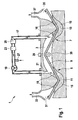
- the single figure shows a schematic representation of the device according to the invention.
- An inventive device 1 as in FIG. 1 comprises a reaction space 3, in which a different gas or gas mixture is contained from the surrounding atmosphere. In order to obtain a uniform atmosphere in the entire reaction space 3, the reaction chamber 3 is flowed through by the gas or gas mixture.
- the reaction space 3 comprises an inlet 5 and an outlet 7.
- a strand-shaped product 9 is fed to the reaction space 3 via the inlet 5.
- the strand-shaped product 9 is exposed to the gas or gas mixture contained in the reaction space 3.
- the rope-shaped product 9 is e.g. a profile of an elastomeric material, such as is used for wiper rubbers of windshield wipers. This is halogenated to harden the elastomeric material in the reaction space 3.
- the gas contained in the reaction space 3 is preferably a gas mixture of at least one halogen and optionally nitrogen.
- the halogens used are usually chlorine, fluorine or bromine or mixtures thereof.
- a first siphon 11 is formed in the region of the inlet 5 and a second siphon 13 is formed in the region of the outlet 7.
- the first siphon 11 and the second siphon 13 are preferably in the form of a substantially U-shaped tube.
- any other geometric shape is also conceivable which makes it possible to fill the first siphon 11 and the second siphon 13 with a liquid 15 such that at least a portion of the tubular siphon 11, 13 is completely filled with the liquid 15 without there being a gas layer above the liquid 15.
- any liquid 15 is suitable, which is inert to both the environment and the gas contained in the reaction space 3.
- water is used as the liquid 15 in the first siphon 11 and in the second siphon 13.
- the gas circulation 17 preferably branches off from the reaction space 3 at a position in the vicinity of the outlet 7. At this position, gas is sucked from the reaction space 3 into the gas circulation 17.
- a fan 19 is contained in the gas circulation 17, through which the gas flow in the gas circulation 17 is maintained.
- the gas circulation 17 opens in the reaction chamber 3.
- the mouth region 21 of the gas circulation 17 is formed for example in the form of a nozzle. Any nozzle known to a person skilled in the art is suitable here. But it is also possible to make the mouth region 21 as a pipe end of the gas circulation 17.
- the training as a nozzle is not essential. The advantage of a nozzle, however, is that a higher gas velocity is achieved and thus a better blowing of the rope-shaped product 9 is made possible.
- a device for gas drying 23 is preferably included in the gas circulation 17.
- a device for gas drying 23 any, known in the art device is suitable.
- a device for gas drying 23 e.g. an adsorption dryer or an absorption dryer can be used.
- halogen is consumed from the gas contained in the reaction space 3.
- a device 25 for analyzing the gas composition is contained in the gas circulation 17.
- analysis of the gas composition e.g. UV / Vis spectroscopy or Raman spectroscopy.
- the apparatus 25 for analyzing the gas composition preferably carries out a continuous measurement of the composition of the gas flowing through the gas circulation 17 in the reaction space 3 or the gas.
- fresh gas is supplied to the gas circulation 17 or the reaction space 3.
- a halogen-rich gas mixture is supplied as fresh gas.
- the halogen-rich gas mixture contains only the constituents which are also contained in the gas mixture in the reaction space 3.
- the proportion of the consumed halogen in the supplied fresh gas is higher than the proportion of halogen in the reaction space 3.
- the amount of fresh gas supplied is chosen so that a constant composition of the gas is achieved in the reaction space.
- the supply of the fresh gas takes place e.g. via an inlet 27 in the gas circulation 17 or alternatively via an inlet not shown in the figure directly into the reaction space 3.
- the inlet 27 is arranged on the gas circulation 17.
- the pressure in the reaction space 3 preferably corresponds to atmospheric pressure.
- a pressure control is provided on the reaction space 3. This includes, for example, a pressure relief valve 29, which opens as soon as the pressure in the reaction chamber 3 the predetermined Pressure exceeds. But it is also any other, known in the art pressure control possible, with which the pressure in the reaction chamber 3 can be kept constant.
- the liquid level in the siphons 11, 13 In order to avoid that gas can escape from the reaction chamber 3 to the environment, it is also necessary to keep the liquid level in the siphons 11, 13 substantially constant. In particular, care must be taken to ensure that a subregion of the siphon 11, 13 is always completely filled with liquid, without a gas layer forming above the liquid. A constant loss of fluid in the siphons 11, 13 is caused on the one hand by evaporation at the liquid surfaces 16 as well as by entrainment of liquid with the rope-shaped product 9. This loss of fluid must be compensated. This can e.g. be effected in that the siphons 11, 13 are connected to a reservoir, is kept in the liquid. About the reservoir, the fluid level in the siphons 11, 13 can be controlled automatically. Thus, the siphons 11, 13, e.g. Liquid level monitoring and as soon as a minimum liquid level is reached, liquid is tracked.
- a first trigger 33 and in the region of the outlet 35 from the second siphon 13 are preferably arranged in the region of the inlet 31 to the first siphon 11.
- the first trigger 33 and the second trigger 37 are preferably connected to an exhaust gas purification system.
- the entrained gas can be removed in a manner known to those skilled in the art.
- Scrubbers are used for exhaust gas purification.
- the strand-shaped product 9 runs in the region of the first siphon 11 and the second siphon 13 along the wall thereof.
- a deflection roller 39 is accommodated, over which the strand-shaped product 9 is guided.
- the reaction space 3 can be kept short and compact. Rapid halogenation is achieved by using, for example, still existing heat in the elastomer profile by the halogenation takes place immediately after the vulcanization of the elastomer profile. Even when passing the elastomer profile through the liquid 15 in the first siphon 11, only part of the heat is released, so that a still warm elastomer profile enters the reaction space 3.
Landscapes
- Chemical & Material Sciences (AREA)
- Chemical Kinetics & Catalysis (AREA)
- Health & Medical Sciences (AREA)
- Engineering & Computer Science (AREA)
- Plasma & Fusion (AREA)
- General Chemical & Material Sciences (AREA)
- Physics & Mathematics (AREA)
- Medicinal Chemistry (AREA)
- Polymers & Plastics (AREA)
- Organic Chemistry (AREA)
- Addition Polymer Or Copolymer, Post-Treatments, Or Chemical Modifications (AREA)
- Organic Low-Molecular-Weight Compounds And Preparation Thereof (AREA)
- Processing And Handling Of Plastics And Other Materials For Molding In General (AREA)
Applications Claiming Priority (1)
| Application Number | Priority Date | Filing Date | Title |
|---|---|---|---|
| DE102008002393A DE102008002393A1 (de) | 2008-06-12 | 2008-06-12 | Vorrichtung zur Gasexposition |
Related Child Applications (1)
| Application Number | Title | Priority Date | Filing Date |
|---|---|---|---|
| EP14178747 Division-Into | 2014-07-28 |
Publications (3)
| Publication Number | Publication Date |
|---|---|
| EP2133192A2 true EP2133192A2 (fr) | 2009-12-16 |
| EP2133192A3 EP2133192A3 (fr) | 2009-12-23 |
| EP2133192B1 EP2133192B1 (fr) | 2016-03-23 |
Family
ID=41130355
Family Applications (1)
| Application Number | Title | Priority Date | Filing Date |
|---|---|---|---|
| EP09158342.7A Not-in-force EP2133192B1 (fr) | 2008-06-12 | 2009-04-21 | Dispositif d'exposition au gaz |
Country Status (2)
| Country | Link |
|---|---|
| EP (1) | EP2133192B1 (fr) |
| DE (1) | DE102008002393A1 (fr) |
Families Citing this family (1)
| Publication number | Priority date | Publication date | Assignee | Title |
|---|---|---|---|---|
| DE102017112161A1 (de) | 2017-06-01 | 2018-12-06 | Fluor Technik System Gmbh | Anlage zur kontinuierlichen Behandlung eines Strangprofils |
Citations (1)
| Publication number | Priority date | Publication date | Assignee | Title |
|---|---|---|---|---|
| JPS6142506A (ja) | 1984-08-06 | 1986-03-01 | Mitsui Petrochem Ind Ltd | ハロゲン化反応装置 |
Family Cites Families (14)
| Publication number | Priority date | Publication date | Assignee | Title |
|---|---|---|---|---|
| US2660512A (en) * | 1948-02-06 | 1953-11-24 | R W Webster And Company Ltd | Method and apparatus for controlling the liquid seals on steam sterilizers |
| BE524672A (fr) * | 1952-11-29 | 1900-01-01 | ||
| GB898710A (en) * | 1957-10-31 | 1962-06-14 | Polyplastic Sa | Apparatus for preparation of grafted copolymers |
| BE661512A (fr) * | 1964-03-25 | 1965-07-16 | ||
| DE2910572A1 (de) * | 1979-03-17 | 1980-09-25 | Kleinewefers Gmbh | Vorrichtung zum fortlaufenden behandeln einer oberflaechenempfindlichen textilbahn, insbesondere zum fixieren von der textilbahn aufgenommenen farbstoffes |
| FR2463833A1 (fr) * | 1979-08-24 | 1981-02-27 | Ivanovsky Inst Khlopchato | Installation pour le traitement thermique continu des materiaux textiles |
| CA1169305A (fr) * | 1982-03-03 | 1984-06-19 | Gordon A.D. Reed | Methode de cure catalytique pour enduits |
| FR2537014B1 (fr) * | 1982-12-06 | 1987-06-05 | Marchal Equip Auto | Reacteur pour la fixation d'un gaz sur un solide, utilisable notamment pour la chloration de lames racleuses d'essuie-glaces |
| DE3532086A1 (de) * | 1985-09-09 | 1987-03-12 | Lohmann Gmbh & Co Kg | Verfahren zur oberflaechenbehandlung von flaechigem kunststoffmaterial |
| IT233890Y1 (it) * | 1994-05-27 | 2000-02-16 | Attilio Bertoldi | Dispositivo per il trattamento ad umido di tessuti in largo |
| DE19525529C1 (de) * | 1995-07-13 | 1996-06-05 | Koenig & Bauer Albert Ag | Verfahren zur Montage einer Dosiereinrichtung in einer Rotationsdruckmaschine |
| FR2806931B1 (fr) * | 2000-03-30 | 2002-11-15 | Commerciale Prouvost & Lefebvr | Installation et reacteur pour le traitement d'une matiere solide par un gaz ou un melange gazeux nocif |
| ITFI20010188A1 (it) * | 2001-10-10 | 2003-04-10 | C M T S R L Costruzione Macchi | Dispositivo di tenuta in apparecchi a pressione attraversati dal materiale da trattare |
| EP2118395B1 (fr) * | 2007-03-01 | 2016-08-17 | Dow Global Technologies LLC | Système polymère fluoré |
-
2008
- 2008-06-12 DE DE102008002393A patent/DE102008002393A1/de not_active Ceased
-
2009
- 2009-04-21 EP EP09158342.7A patent/EP2133192B1/fr not_active Not-in-force
Patent Citations (1)
| Publication number | Priority date | Publication date | Assignee | Title |
|---|---|---|---|---|
| JPS6142506A (ja) | 1984-08-06 | 1986-03-01 | Mitsui Petrochem Ind Ltd | ハロゲン化反応装置 |
Also Published As
| Publication number | Publication date |
|---|---|
| DE102008002393A1 (de) | 2009-12-17 |
| EP2133192B1 (fr) | 2016-03-23 |
| EP2133192A3 (fr) | 2009-12-23 |
Similar Documents
| Publication | Publication Date | Title |
|---|---|---|
| DE60300820T2 (de) | Vorrichtung zur erzeugung von wasserstoffperoxiddampf mit austauschbarer trockenmittelpatrone | |
| DE1992767U (de) | Vorrichtung zum feinstdosieren und einbringen von fluessigkeitsmengen zu analytischen oder behandlungszwecken in ein anderes medium. | |
| DE69311582T2 (de) | Vorrichtung zur herstellung von knochenzement | |
| EP2133192B1 (fr) | Dispositif d'exposition au gaz | |
| DE29506246U1 (de) | Vorrichtung zum Eindämmen und Waschen von toxischem Gas aus einer Leckstelle | |
| DE3344080C2 (fr) | ||
| DE2723222C2 (de) | Vorrichtung zum Trocknen von Gegenständen | |
| DE2413537C2 (de) | Vorrichtung zum Herstellen von Kernen für Gießereizwecke | |
| DE2543405A1 (de) | Spuelvorrichtung | |
| DE2534620A1 (de) | Verfahren und vorrichtung zur bestimmung des anorganischen kohlenstoffgehaltes einer fluessigkeit | |
| EP3823819A1 (fr) | Dispositif destiné à étanchéifier des pneumatiques | |
| EP0405060A2 (fr) | Procédé de fabrication d'une mousse thermoplastique | |
| EP2444242A1 (fr) | Procédé et dispositif destinés à la vulcanisation de pneus | |
| EP2078947A2 (fr) | Dispositif de mesure et procédé de mesure destinés à la mesure automatique des propriétés de la boue de curages présentes dans une installation de biogaz | |
| DE102004038607B4 (de) | Verfahren zur Bestimmung des organisch gebundenen Kohlenstoffs (TOC) und Testkit zur Durchführung des Verfahrens | |
| DE19939032A1 (de) | Verfahren und Anlage zur Oberflächenbehandlung von Teilen mit einem Lösungsmittel | |
| DE4441199A1 (de) | Vorrichtung und Verfahren zum Reinigen von in eine Laserkammer einzuleitenden Gasen | |
| DE4323790A1 (de) | Verfahren und Vorrichtung zur kontinuierlichen Fluorierung von Kunststoffbahnen | |
| DE10256651B4 (de) | Verfahren zur Vakuumdestillation und Kondensationseinrichtung | |
| DE2649585A1 (de) | Verfahren und vorrichtung zum herauswaschen von schaedlichen bestandteilen aus einem gasstrom | |
| DE1492369A1 (de) | Verfahren und Vorrichtung zur Desodorierung von Transport- und Lagerbehaeltnissen | |
| DE102018124657A1 (de) | FLÜSSIGKEITSAUSSTOßVORRICHTUNG FÜR EINE FAHRZEUGWASCHANLAGE UND VERFAHREN ZU IHREM BETRIEB | |
| DE159613C (fr) | ||
| AT392356B (de) | Referenzelektrode fuer eine ph-wert messeinrichtung | |
| DE102022125722A1 (de) | Reinigungsverfahren und Reinheitsnachweis mittels Gasspülung |
Legal Events
| Date | Code | Title | Description |
|---|---|---|---|
| PUAI | Public reference made under article 153(3) epc to a published international application that has entered the european phase |
Free format text: ORIGINAL CODE: 0009012 |
|
| PUAL | Search report despatched |
Free format text: ORIGINAL CODE: 0009013 |
|
| AK | Designated contracting states |
Kind code of ref document: A2 Designated state(s): AT BE BG CH CY CZ DE DK EE ES FI FR GB GR HR HU IE IS IT LI LT LU LV MC MK MT NL NO PL PT RO SE SI SK TR |
|
| AK | Designated contracting states |
Kind code of ref document: A3 Designated state(s): AT BE BG CH CY CZ DE DK EE ES FI FR GB GR HR HU IE IS IT LI LT LU LV MC MK MT NL NO PL PT RO SE SI SK TR |
|
| 17P | Request for examination filed |
Effective date: 20100623 |
|
| 17Q | First examination report despatched |
Effective date: 20100726 |
|
| APBK | Appeal reference recorded |
Free format text: ORIGINAL CODE: EPIDOSNREFNE |
|
| APBN | Date of receipt of notice of appeal recorded |
Free format text: ORIGINAL CODE: EPIDOSNNOA2E |
|
| APBR | Date of receipt of statement of grounds of appeal recorded |
Free format text: ORIGINAL CODE: EPIDOSNNOA3E |
|
| APAV | Appeal reference deleted |
Free format text: ORIGINAL CODE: EPIDOSDREFNE |
|
| APBT | Appeal procedure closed |
Free format text: ORIGINAL CODE: EPIDOSNNOA9E |
|
| GRAP | Despatch of communication of intention to grant a patent |
Free format text: ORIGINAL CODE: EPIDOSNIGR1 |
|
| INTG | Intention to grant announced |
Effective date: 20151207 |
|
| GRAS | Grant fee paid |
Free format text: ORIGINAL CODE: EPIDOSNIGR3 |
|
| GRAA | (expected) grant |
Free format text: ORIGINAL CODE: 0009210 |
|
| AK | Designated contracting states |
Kind code of ref document: B1 Designated state(s): AT BE BG CH CY CZ DE DK EE ES FI FR GB GR HR HU IE IS IT LI LT LU LV MC MK MT NL NO PL PT RO SE SI SK TR |
|
| REG | Reference to a national code |
Ref country code: GB Ref legal event code: FG4D Free format text: NOT ENGLISH |
|
| REG | Reference to a national code |
Ref country code: CH Ref legal event code: EP |
|
| REG | Reference to a national code |
Ref country code: AT Ref legal event code: REF Ref document number: 782704 Country of ref document: AT Kind code of ref document: T Effective date: 20160415 |
|
| REG | Reference to a national code |
Ref country code: IE Ref legal event code: FG4D Free format text: LANGUAGE OF EP DOCUMENT: GERMAN |
|
| REG | Reference to a national code |
Ref country code: FR Ref legal event code: PLFP Year of fee payment: 8 |
|
| REG | Reference to a national code |
Ref country code: DE Ref legal event code: R096 Ref document number: 502009012280 Country of ref document: DE |
|
| REG | Reference to a national code |
Ref country code: LT Ref legal event code: MG4D |
|
| REG | Reference to a national code |
Ref country code: NL Ref legal event code: MP Effective date: 20160323 |
|
| PG25 | Lapsed in a contracting state [announced via postgrant information from national office to epo] |
Ref country code: FI Free format text: LAPSE BECAUSE OF FAILURE TO SUBMIT A TRANSLATION OF THE DESCRIPTION OR TO PAY THE FEE WITHIN THE PRESCRIBED TIME-LIMIT Effective date: 20160323 Ref country code: GR Free format text: LAPSE BECAUSE OF FAILURE TO SUBMIT A TRANSLATION OF THE DESCRIPTION OR TO PAY THE FEE WITHIN THE PRESCRIBED TIME-LIMIT Effective date: 20160624 Ref country code: NO Free format text: LAPSE BECAUSE OF FAILURE TO SUBMIT A TRANSLATION OF THE DESCRIPTION OR TO PAY THE FEE WITHIN THE PRESCRIBED TIME-LIMIT Effective date: 20160623 |
|
| PG25 | Lapsed in a contracting state [announced via postgrant information from national office to epo] |
Ref country code: LV Free format text: LAPSE BECAUSE OF FAILURE TO SUBMIT A TRANSLATION OF THE DESCRIPTION OR TO PAY THE FEE WITHIN THE PRESCRIBED TIME-LIMIT Effective date: 20160323 Ref country code: SE Free format text: LAPSE BECAUSE OF FAILURE TO SUBMIT A TRANSLATION OF THE DESCRIPTION OR TO PAY THE FEE WITHIN THE PRESCRIBED TIME-LIMIT Effective date: 20160323 Ref country code: LT Free format text: LAPSE BECAUSE OF FAILURE TO SUBMIT A TRANSLATION OF THE DESCRIPTION OR TO PAY THE FEE WITHIN THE PRESCRIBED TIME-LIMIT Effective date: 20160323 Ref country code: NL Free format text: LAPSE BECAUSE OF FAILURE TO SUBMIT A TRANSLATION OF THE DESCRIPTION OR TO PAY THE FEE WITHIN THE PRESCRIBED TIME-LIMIT Effective date: 20160323 |
|
| PG25 | Lapsed in a contracting state [announced via postgrant information from national office to epo] |
Ref country code: IS Free format text: LAPSE BECAUSE OF FAILURE TO SUBMIT A TRANSLATION OF THE DESCRIPTION OR TO PAY THE FEE WITHIN THE PRESCRIBED TIME-LIMIT Effective date: 20160723 Ref country code: PL Free format text: LAPSE BECAUSE OF FAILURE TO SUBMIT A TRANSLATION OF THE DESCRIPTION OR TO PAY THE FEE WITHIN THE PRESCRIBED TIME-LIMIT Effective date: 20160323 Ref country code: EE Free format text: LAPSE BECAUSE OF FAILURE TO SUBMIT A TRANSLATION OF THE DESCRIPTION OR TO PAY THE FEE WITHIN THE PRESCRIBED TIME-LIMIT Effective date: 20160323 |
|
| PG25 | Lapsed in a contracting state [announced via postgrant information from national office to epo] |
Ref country code: ES Free format text: LAPSE BECAUSE OF FAILURE TO SUBMIT A TRANSLATION OF THE DESCRIPTION OR TO PAY THE FEE WITHIN THE PRESCRIBED TIME-LIMIT Effective date: 20160323 Ref country code: CZ Free format text: LAPSE BECAUSE OF FAILURE TO SUBMIT A TRANSLATION OF THE DESCRIPTION OR TO PAY THE FEE WITHIN THE PRESCRIBED TIME-LIMIT Effective date: 20160323 Ref country code: SK Free format text: LAPSE BECAUSE OF FAILURE TO SUBMIT A TRANSLATION OF THE DESCRIPTION OR TO PAY THE FEE WITHIN THE PRESCRIBED TIME-LIMIT Effective date: 20160323 Ref country code: PT Free format text: LAPSE BECAUSE OF FAILURE TO SUBMIT A TRANSLATION OF THE DESCRIPTION OR TO PAY THE FEE WITHIN THE PRESCRIBED TIME-LIMIT Effective date: 20160725 Ref country code: RO Free format text: LAPSE BECAUSE OF FAILURE TO SUBMIT A TRANSLATION OF THE DESCRIPTION OR TO PAY THE FEE WITHIN THE PRESCRIBED TIME-LIMIT Effective date: 20160323 |
|
| REG | Reference to a national code |
Ref country code: CH Ref legal event code: PL |
|
| PG25 | Lapsed in a contracting state [announced via postgrant information from national office to epo] |
Ref country code: IT Free format text: LAPSE BECAUSE OF FAILURE TO SUBMIT A TRANSLATION OF THE DESCRIPTION OR TO PAY THE FEE WITHIN THE PRESCRIBED TIME-LIMIT Effective date: 20160323 |
|
| REG | Reference to a national code |
Ref country code: DE Ref legal event code: R097 Ref document number: 502009012280 Country of ref document: DE |
|
| REG | Reference to a national code |
Ref country code: IE Ref legal event code: MM4A |
|
| PLBE | No opposition filed within time limit |
Free format text: ORIGINAL CODE: 0009261 |
|
| STAA | Information on the status of an ep patent application or granted ep patent |
Free format text: STATUS: NO OPPOSITION FILED WITHIN TIME LIMIT |
|
| PG25 | Lapsed in a contracting state [announced via postgrant information from national office to epo] |
Ref country code: LI Free format text: LAPSE BECAUSE OF NON-PAYMENT OF DUE FEES Effective date: 20160430 Ref country code: CH Free format text: LAPSE BECAUSE OF NON-PAYMENT OF DUE FEES Effective date: 20160430 Ref country code: DK Free format text: LAPSE BECAUSE OF FAILURE TO SUBMIT A TRANSLATION OF THE DESCRIPTION OR TO PAY THE FEE WITHIN THE PRESCRIBED TIME-LIMIT Effective date: 20160323 |
|
| PG25 | Lapsed in a contracting state [announced via postgrant information from national office to epo] |
Ref country code: BG Free format text: LAPSE BECAUSE OF FAILURE TO SUBMIT A TRANSLATION OF THE DESCRIPTION OR TO PAY THE FEE WITHIN THE PRESCRIBED TIME-LIMIT Effective date: 20160623 |
|
| 26N | No opposition filed |
Effective date: 20170102 |
|
| GBPC | Gb: european patent ceased through non-payment of renewal fee |
Effective date: 20160623 |
|
| REG | Reference to a national code |
Ref country code: FR Ref legal event code: PLFP Year of fee payment: 9 |
|
| PG25 | Lapsed in a contracting state [announced via postgrant information from national office to epo] |
Ref country code: GB Free format text: LAPSE BECAUSE OF NON-PAYMENT OF DUE FEES Effective date: 20160623 Ref country code: SI Free format text: LAPSE BECAUSE OF FAILURE TO SUBMIT A TRANSLATION OF THE DESCRIPTION OR TO PAY THE FEE WITHIN THE PRESCRIBED TIME-LIMIT Effective date: 20160323 Ref country code: IE Free format text: LAPSE BECAUSE OF NON-PAYMENT OF DUE FEES Effective date: 20160421 |
|
| REG | Reference to a national code |
Ref country code: AT Ref legal event code: MM01 Ref document number: 782704 Country of ref document: AT Kind code of ref document: T Effective date: 20160421 |
|
| PG25 | Lapsed in a contracting state [announced via postgrant information from national office to epo] |
Ref country code: AT Free format text: LAPSE BECAUSE OF NON-PAYMENT OF DUE FEES Effective date: 20160421 |
|
| REG | Reference to a national code |
Ref country code: FR Ref legal event code: PLFP Year of fee payment: 10 |
|
| PG25 | Lapsed in a contracting state [announced via postgrant information from national office to epo] |
Ref country code: CY Free format text: LAPSE BECAUSE OF FAILURE TO SUBMIT A TRANSLATION OF THE DESCRIPTION OR TO PAY THE FEE WITHIN THE PRESCRIBED TIME-LIMIT Effective date: 20160323 Ref country code: HU Free format text: LAPSE BECAUSE OF FAILURE TO SUBMIT A TRANSLATION OF THE DESCRIPTION OR TO PAY THE FEE WITHIN THE PRESCRIBED TIME-LIMIT; INVALID AB INITIO Effective date: 20090421 |
|
| PG25 | Lapsed in a contracting state [announced via postgrant information from national office to epo] |
Ref country code: HR Free format text: LAPSE BECAUSE OF FAILURE TO SUBMIT A TRANSLATION OF THE DESCRIPTION OR TO PAY THE FEE WITHIN THE PRESCRIBED TIME-LIMIT Effective date: 20160323 Ref country code: LU Free format text: LAPSE BECAUSE OF NON-PAYMENT OF DUE FEES Effective date: 20160421 Ref country code: MC Free format text: LAPSE BECAUSE OF FAILURE TO SUBMIT A TRANSLATION OF THE DESCRIPTION OR TO PAY THE FEE WITHIN THE PRESCRIBED TIME-LIMIT Effective date: 20160323 Ref country code: MT Free format text: LAPSE BECAUSE OF FAILURE TO SUBMIT A TRANSLATION OF THE DESCRIPTION OR TO PAY THE FEE WITHIN THE PRESCRIBED TIME-LIMIT Effective date: 20160323 Ref country code: TR Free format text: LAPSE BECAUSE OF FAILURE TO SUBMIT A TRANSLATION OF THE DESCRIPTION OR TO PAY THE FEE WITHIN THE PRESCRIBED TIME-LIMIT Effective date: 20160323 Ref country code: MK Free format text: LAPSE BECAUSE OF FAILURE TO SUBMIT A TRANSLATION OF THE DESCRIPTION OR TO PAY THE FEE WITHIN THE PRESCRIBED TIME-LIMIT Effective date: 20160323 |
|
| PGFP | Annual fee paid to national office [announced via postgrant information from national office to epo] |
Ref country code: FR Payment date: 20230417 Year of fee payment: 15 Ref country code: DE Payment date: 20230627 Year of fee payment: 15 |
|
| PGFP | Annual fee paid to national office [announced via postgrant information from national office to epo] |
Ref country code: BE Payment date: 20230417 Year of fee payment: 15 |
|
| REG | Reference to a national code |
Ref country code: DE Ref legal event code: R119 Ref document number: 502009012280 Country of ref document: DE |
|
| REG | Reference to a national code |
Ref country code: BE Ref legal event code: MM Effective date: 20240430 |
|
| PG25 | Lapsed in a contracting state [announced via postgrant information from national office to epo] |
Ref country code: DE Free format text: LAPSE BECAUSE OF NON-PAYMENT OF DUE FEES Effective date: 20241105 |
|
| PG25 | Lapsed in a contracting state [announced via postgrant information from national office to epo] |
Ref country code: BE Free format text: LAPSE BECAUSE OF NON-PAYMENT OF DUE FEES Effective date: 20240430 |
|
| PG25 | Lapsed in a contracting state [announced via postgrant information from national office to epo] |
Ref country code: FR Free format text: LAPSE BECAUSE OF NON-PAYMENT OF DUE FEES Effective date: 20240430 |
|
| PG25 | Lapsed in a contracting state [announced via postgrant information from national office to epo] |
Ref country code: FR Free format text: LAPSE BECAUSE OF NON-PAYMENT OF DUE FEES Effective date: 20240430 Ref country code: DE Free format text: LAPSE BECAUSE OF NON-PAYMENT OF DUE FEES Effective date: 20241105 Ref country code: BE Free format text: LAPSE BECAUSE OF NON-PAYMENT OF DUE FEES Effective date: 20240430 |