EP2134263B1 - Dispositif d'occlusion pour réaliser l'occlusion d'un auricule cardiaque - Google Patents
Dispositif d'occlusion pour réaliser l'occlusion d'un auricule cardiaque Download PDFInfo
- Publication number
- EP2134263B1 EP2134263B1 EP20080736295 EP08736295A EP2134263B1 EP 2134263 B1 EP2134263 B1 EP 2134263B1 EP 20080736295 EP20080736295 EP 20080736295 EP 08736295 A EP08736295 A EP 08736295A EP 2134263 B1 EP2134263 B1 EP 2134263B1
- Authority
- EP
- European Patent Office
- Prior art keywords
- occlusion device
- atrial appendage
- braiding
- mesh
- region
- Prior art date
- Legal status (The legal status is an assumption and is not a legal conclusion. Google has not performed a legal analysis and makes no representation as to the accuracy of the status listed.)
- Not-in-force
Links
Images






Classifications
-
- A—HUMAN NECESSITIES
- A61—MEDICAL OR VETERINARY SCIENCE; HYGIENE
- A61B—DIAGNOSIS; SURGERY; IDENTIFICATION
- A61B17/00—Surgical instruments, devices or methods
- A61B17/12—Surgical instruments, devices or methods for ligaturing or otherwise compressing tubular parts of the body, e.g. blood vessels or umbilical cord
- A61B17/12022—Occluding by internal devices, e.g. balloons or releasable wires
- A61B17/12099—Occluding by internal devices, e.g. balloons or releasable wires characterised by the location of the occluder
- A61B17/12122—Occluding by internal devices, e.g. balloons or releasable wires characterised by the location of the occluder within the heart
-
- A—HUMAN NECESSITIES
- A61—MEDICAL OR VETERINARY SCIENCE; HYGIENE
- A61B—DIAGNOSIS; SURGERY; IDENTIFICATION
- A61B17/00—Surgical instruments, devices or methods
- A61B17/0057—Implements for plugging an opening in the wall of a hollow or tubular organ, e.g. for sealing a vessel puncture or closing a cardiac septal defect
-
- A—HUMAN NECESSITIES
- A61—MEDICAL OR VETERINARY SCIENCE; HYGIENE
- A61B—DIAGNOSIS; SURGERY; IDENTIFICATION
- A61B17/00—Surgical instruments, devices or methods
- A61B17/12—Surgical instruments, devices or methods for ligaturing or otherwise compressing tubular parts of the body, e.g. blood vessels or umbilical cord
- A61B17/12022—Occluding by internal devices, e.g. balloons or releasable wires
-
- A—HUMAN NECESSITIES
- A61—MEDICAL OR VETERINARY SCIENCE; HYGIENE
- A61B—DIAGNOSIS; SURGERY; IDENTIFICATION
- A61B17/00—Surgical instruments, devices or methods
- A61B17/12—Surgical instruments, devices or methods for ligaturing or otherwise compressing tubular parts of the body, e.g. blood vessels or umbilical cord
- A61B17/12022—Occluding by internal devices, e.g. balloons or releasable wires
- A61B17/12027—Type of occlusion
- A61B17/12031—Type of occlusion complete occlusion
-
- A—HUMAN NECESSITIES
- A61—MEDICAL OR VETERINARY SCIENCE; HYGIENE
- A61B—DIAGNOSIS; SURGERY; IDENTIFICATION
- A61B17/00—Surgical instruments, devices or methods
- A61B17/12—Surgical instruments, devices or methods for ligaturing or otherwise compressing tubular parts of the body, e.g. blood vessels or umbilical cord
- A61B17/12022—Occluding by internal devices, e.g. balloons or releasable wires
- A61B17/12131—Occluding by internal devices, e.g. balloons or releasable wires characterised by the type of occluding device
- A61B17/12168—Occluding by internal devices, e.g. balloons or releasable wires characterised by the type of occluding device having a mesh structure
-
- A—HUMAN NECESSITIES
- A61—MEDICAL OR VETERINARY SCIENCE; HYGIENE
- A61B—DIAGNOSIS; SURGERY; IDENTIFICATION
- A61B17/00—Surgical instruments, devices or methods
- A61B17/12—Surgical instruments, devices or methods for ligaturing or otherwise compressing tubular parts of the body, e.g. blood vessels or umbilical cord
- A61B17/12022—Occluding by internal devices, e.g. balloons or releasable wires
- A61B17/12131—Occluding by internal devices, e.g. balloons or releasable wires characterised by the type of occluding device
- A61B17/12168—Occluding by internal devices, e.g. balloons or releasable wires characterised by the type of occluding device having a mesh structure
- A61B17/12172—Occluding by internal devices, e.g. balloons or releasable wires characterised by the type of occluding device having a mesh structure having a pre-set deployed three-dimensional shape
-
- A—HUMAN NECESSITIES
- A61—MEDICAL OR VETERINARY SCIENCE; HYGIENE
- A61B—DIAGNOSIS; SURGERY; IDENTIFICATION
- A61B17/00—Surgical instruments, devices or methods
- A61B17/0057—Implements for plugging an opening in the wall of a hollow or tubular organ, e.g. for sealing a vessel puncture or closing a cardiac septal defect
- A61B2017/00575—Implements for plugging an opening in the wall of a hollow or tubular organ, e.g. for sealing a vessel puncture or closing a cardiac septal defect for closure at remote site, e.g. closing atrial septum defects
-
- A—HUMAN NECESSITIES
- A61—MEDICAL OR VETERINARY SCIENCE; HYGIENE
- A61B—DIAGNOSIS; SURGERY; IDENTIFICATION
- A61B17/00—Surgical instruments, devices or methods
- A61B17/0057—Implements for plugging an opening in the wall of a hollow or tubular organ, e.g. for sealing a vessel puncture or closing a cardiac septal defect
- A61B2017/00575—Implements for plugging an opening in the wall of a hollow or tubular organ, e.g. for sealing a vessel puncture or closing a cardiac septal defect for closure at remote site, e.g. closing atrial septum defects
- A61B2017/00592—Elastic or resilient implements
-
- A—HUMAN NECESSITIES
- A61—MEDICAL OR VETERINARY SCIENCE; HYGIENE
- A61B—DIAGNOSIS; SURGERY; IDENTIFICATION
- A61B17/00—Surgical instruments, devices or methods
- A61B17/0057—Implements for plugging an opening in the wall of a hollow or tubular organ, e.g. for sealing a vessel puncture or closing a cardiac septal defect
- A61B2017/00575—Implements for plugging an opening in the wall of a hollow or tubular organ, e.g. for sealing a vessel puncture or closing a cardiac septal defect for closure at remote site, e.g. closing atrial septum defects
- A61B2017/00597—Implements comprising a membrane
-
- A—HUMAN NECESSITIES
- A61—MEDICAL OR VETERINARY SCIENCE; HYGIENE
- A61B—DIAGNOSIS; SURGERY; IDENTIFICATION
- A61B17/00—Surgical instruments, devices or methods
- A61B17/0057—Implements for plugging an opening in the wall of a hollow or tubular organ, e.g. for sealing a vessel puncture or closing a cardiac septal defect
- A61B2017/00575—Implements for plugging an opening in the wall of a hollow or tubular organ, e.g. for sealing a vessel puncture or closing a cardiac septal defect for closure at remote site, e.g. closing atrial septum defects
- A61B2017/00606—Implements H-shaped in cross-section, i.e. with occluders on both sides of the opening
-
- A—HUMAN NECESSITIES
- A61—MEDICAL OR VETERINARY SCIENCE; HYGIENE
- A61B—DIAGNOSIS; SURGERY; IDENTIFICATION
- A61B17/00—Surgical instruments, devices or methods
- A61B17/0057—Implements for plugging an opening in the wall of a hollow or tubular organ, e.g. for sealing a vessel puncture or closing a cardiac septal defect
- A61B2017/00575—Implements for plugging an opening in the wall of a hollow or tubular organ, e.g. for sealing a vessel puncture or closing a cardiac septal defect for closure at remote site, e.g. closing atrial septum defects
- A61B2017/00615—Implements with an occluder on one side of the opening and holding means therefor on the other
-
- A—HUMAN NECESSITIES
- A61—MEDICAL OR VETERINARY SCIENCE; HYGIENE
- A61B—DIAGNOSIS; SURGERY; IDENTIFICATION
- A61B17/00—Surgical instruments, devices or methods
- A61B2017/00831—Material properties
- A61B2017/00867—Material properties shape memory effect
-
- A—HUMAN NECESSITIES
- A61—MEDICAL OR VETERINARY SCIENCE; HYGIENE
- A61B—DIAGNOSIS; SURGERY; IDENTIFICATION
- A61B17/00—Surgical instruments, devices or methods
- A61B17/12—Surgical instruments, devices or methods for ligaturing or otherwise compressing tubular parts of the body, e.g. blood vessels or umbilical cord
- A61B17/12022—Occluding by internal devices, e.g. balloons or releasable wires
- A61B2017/1205—Introduction devices
- A61B2017/12054—Details concerning the detachment of the occluding device from the introduction device
Definitions
- the present invention relates to a self-expandable occlusion device for occluding an atrial appendage, consisting of a network or braid of thin wires, or threads, which is given a suitable design by means of a shaping, reshaping and/or heat treatment process, the occlusion device having a front proximal retention region and a back distal retention region, and the ends of the wires or threads meeting in a holder in the proximal retention region but also meeting in a hub without a holder in a second solution.
- the occlusion device has a central region between the proximal and the distal retention region.
- the occlusion device is here designed such that it is insertable into the body of a patient in a minimally invasive manner in a folded up or collapsed state by means of a delivery catheter and is positionable in a atrial appendage of the patient.
- an occlusion device for the treatment of septum defects is disclosed, which comprises of a network or braid of thin wires or threads and is given a suitable design by means of a reshaping and heat treatment process.
- the known occlusion device has a distal retention region, which is distinctively particularly flat, a proximal retention region, and a cylindrical web between the proximal and the distal retention region. On the proximal retention region, the ends of the wires forming the network meet in a hub.
- the two retention regions of the known occlusion device to fit tightly in a septal wall on both sides of a shunt to be occluded by means of a usually intravascular surgical intervention, while the web runs through the shunt.
- the occlusion device is suited in order to permanently occlude an opening having a dynamic blood flow, and to this end has a special construction and is not suitable for atrial appendage occlusions.
- results of this embolization are in particular strokes, which occur to approximately 5% per year in patients with atrial fibrillation if anticoagulation of the blood is not carried out by chronic treatment with dicoumarol.
- bringing about the anticoagulation of the blood with dicoumarol is likewise not without risk.
- Side effects of the treatment with dicoumarol are increased hemorrhages, so that contraindications exist for this treatment in about 20% of patients with atrial fibrillation and patients thus accept the risk of a stroke based on hemorrhage/stroke risk assessment.
- Thrombi in the atrium of the heart develop in a vast majority in the "atrial appendages".
- the atrial appendages are protrusions on the atria of the human heart, hanging over from each atrium as projections like a small ear, more marked on the left, each with a cavity of its own.
- the right atrial appendage lies beside the ascending aorta, and the left atrial appendage beside the large pulmonary artery.
- the left atrial appendage in patients with atrial fibrillation is the frequent site of formation for blood clots, which can induce stroke when carried along with the blood flow.
- the present invention is based on the object of specifying an improved occlusion device by which the atrial appendage of the left atrium can be occluded in order to considerably reduce thrombus formation with the risk of a stroke.
- an occlusion device is to be specified with which the risk of stroke can be reduced even in those patients in which anticoagulation with dicoumarols is contraindicated on account of hypocoagulability.
- the occlusion device provided is securely anchorable in the atrial appendage, without detaching itself, which is particular of advantage when anticoagulation agents and/or blood thinner agents have been administered to the patient. Patients suffering from atrial fibrillation are usually prescribed a powerful blood thinner, such as Coumadin.
- PLAATO Percutaneus Left Atrial Appendage Transcatheter
- Watchman occluder do not cope with the correct specified positioning.
- PLAATO system the danger of perforation with the pericardium exists, moreover, PLAATO was likewise implanted using a 14F lock.
- a further application of the same applicant as the present application relates to a single hub atrial appendage occluder using a fixing agent for the formation of a force-fit connection between the network of an occlusion body and the atrial appendage wall, published as WO 2007/140797 .
- the fixing agent is designed, after application, to harden so giving a flexible insoluble product, in particular, in a controlled manner, in order thus to produce a permanent and fixed anchoring between the network of the occlusion body and the atrial appendage wall.
- the distal retention region to have a spherical region, which in the expanded state of the occlusion device fits tightly to the internal walls of the atrial appendage in the atrial appendage to be occluded and forms a force-fit connection with internal walls of the atrial appendage, so holding the implanted and expanded occlusion device in the atrial appendage, the proximal retention region of the occlusion device occluding the opening of the atrial appendage.
- WO 02/071977 discloses Implant devices for filtering blood flowing through atrial appendage ostiums, which have elastic cover and anchoring substructures. Filter elements in the covers block emboli from escaping through the ostiums.
- Devices with tine substructures may have H-shaped cross sections, which devices seal the appendages by pinching an annular region of ostium tissue between the cover and the anchoring substructures. The shallow deployment depth of these H-shaped devices allows use of a universal device size for atrial appendages of varying lengths.
- the device may be made of braided elastic wire.
- a distinct proximal cover substructure 1120 is attached to a cylinder shaped wire braid device structure 1200.
- these devices lack flexibility due to the necessary attachment of the cover to the cylinder.
- US 6,168,622 discloses an aneurysm occlusion device that has a bulbous body portion and an anchor.
- the body portion is sized to be received within an aneurysm and the anchor is sized and shaped to engage an interior surface of the vessel's wall.
- the body portion and the anchor are integrally formed of a resilient fabric permitting the occlusion device to be collapsed for deployment and resiliently self-expanded to include the aneurysm.
- the devices disclosed in US 6,168,622 are anchored in the aneurysm by having the bulbous body portion and the anchor larger than a central portion inbetween, wherein the central portion is approximately of the size of an opening or neck N of the aneurysm in the blood vessel wall tissue.
- the anchor of the aneurysm occlusion device is sized to engage the vessel wall outside the opening to the aneurysm, and the bulbous portion has approximately the same volume as the volume of the aneurysm so as to substantially fill the aneurysm and secure the bulbous portion, having a larger dimension than the neck, therein.
- the central portion is centered in the neck.
- the purpose of the device is to prevent the aneurysm to become larger by providing a filling material secured therein.
- clamps hold both ends of a cut braid together, which clamps may protrude from the device, lead to undesired side effects, such as thromboembolic complications.
- an aneurysm is substantially different from an atrial appendage and the aneurysm occlusion device is not suited for occluding an atrial appendage.
- the ostium of the atrial appendage is not in all anatomical cases a neck portion, but rather an opening of substantially the same dimension than the cross section of the atrial appendage. Therefore the anchoring of the aneurysm occlusion device of US 6,168,622 would not be sufficient to fulfill the requirements of an atrial appendage occlusion device.
- an improved atrial appendage occlusion device would be advantageous and in particular an atrial appendage occlusion device allowing for increased flexibility, cost-effectiveness, patient friendliness and/or patient safety would be advantageous.
- embodiments of the present invention preferably seek to mitigate, alleviate or eliminate one or more deficiencies, disadvantages or issues in the art, such as the above-identified, singly or in any combination by providing an atrial appendage occlusion device and a method of production therefor, according to the appended independent patent claims.
- the above-mentioned object is achieved using a self-expandable occlusion device for the occlusion of an atrial appendage, the occlusion device consisting of a network of thin wires, strands or threads which has been given a suitable design by means of a process based on shaping, reshaping and/or heat treatment.
- the occlusion device prefferably has a front proximal retention region and a back distal retention region and a central region arranged between the proximal and the distal retention region, and wherein the occlusion device is insertable into the body of a patient in a minimally invasive manner in a folded up state by means of a catheter and is positionable in the atrial appendage of the patient.
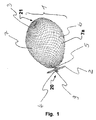
- Fig. 1 shows a side view of an example of a self-expandable atrial appendage occlusion device.
- Fig. 2 we see a sectional representation, in the region of the left atrium/left atrial appendage, having an implanted atrial appendage occluder with a proximal hub.
- the occlusion device 1 according to the examples shown in Figs. 1 and 2 comprises a mesh or braiding of thin wires or threads, which is given a suitable design using a reshaping and/or heat-treatment process.
- appropriate spherical wire networks having a proximal hub are used.
- a hubless proximal end may be provided, as described further below.
- Figs. 5 and 6 show an example of a self-expandable occlusion device without a hub, comprising a network, mesh or braiding of wires or threads, as described above, of a piece of wire woven or braided to give a spherical container according to Fig. 7 and brought to the desired final shape using a reshaping and/or heat-treatment process.
- the occlusion device 1 is an atrial appendage occluder device having a design comprising a front proximal retention region 2, a central region 5 and a distal rear, spherical distal retention region 3.
- proximal retention region 2 the ends of the wires or threads of the network, mesh or braiding 7 meet in a hub or holder 4.
- the distal retention region 3, on the other hand, has a closed end without a hub or holder in the preferred form.
- the flexible and yet at the same time force-fit positioning of the spherical region in combination with a proximal waist region being a central region 5 towards further anchoring elements provides an advantageous anchoring in atrial appendages.
- the anatomical shape of the appendage is substantially not influenced, now being able to occlude distal portions of the appendages for anchoring. Still, thanks to the flexibility provided by the connection of reduced diameter central region 5, heart movements will not lead to fatigue in the wires.
- a delivery connection unit e.g. for threaded, gripping, or wired engagement of a delivery device, such as a pusher or delivery catheter, may be provided at the proximal end 20.
- the occlusion device On account of the shape of the device shown in Fig. 1 , which is similar to a strawberry, the occlusion device is also called a "strawberry occluder".
- a hollow portion of the network, mesh or braiding has a substantially circular cross section that gradually tapers towards an end region thereof.
- the network, mesh or braiding 7 is formed from wires or threads, which preferably are made of a material comprising Nitinol or of another material having a shape memory or memory effect, and/or sufficient resiliency for returning from a collapsed shape to an expanded shape.
- wires or threads which preferably are made of a material comprising Nitinol or of another material having a shape memory or memory effect, and/or sufficient resiliency for returning from a collapsed shape to an expanded shape.
- a polymeric synthetic material which has the shape memory property and/or resiliency.
- biodegradable shape memory material It is essential that the network 7 has adequate flexibility, so that the occlusion device 1 can be reduced to the diameter of a catheter (not explicitly shown) used in a minimally invasive, in particular intravascular, surgical intervention.
- the occlusion device 1 reduced in this way has a shape memory function, so that the device 1 expands independently after leaving the catheter and again takes up a predetermined shape corresponding to the use. Customarily, this takes place after the occlusion device 1 initially arranged in the catheter has been placed in the site to be treated, in particular in the atrial appendage of the heart of a patient.
- the predetermined shape of the occlusion device may also be a bell-like shape, the tapering end of the bell-like shape forming the distal retention region 3, as shown in Fig. 18 .
- Figs. 8 and 9 and 10-17 show various variants of the atrial appendage occluding device in the variant according to Figs. 1 and 2 and can certainly find their use based on their high variation width and specific characteristics of atrial appendages as shown in the example in Fig. 24 .
- the device may comprise a combination of several of such shapes, as e.g. shown in Figs. 8-18 , providing an advantageous retention in specific atrial appendages, even under the prevailing conditions of the heart muscle movements and when e.g. anticoagulants and/or blood thinner agents are used by the patient, which influence tissue of the atrial appendage and retention of devices therein. Dislodgement and/or migration of the atrial appendage occlusion device are advantageously prevented, by ensuring that the device is properly seated and engages with the interior tissue of the appendage to the largest extent possible.
- the appendage When the body has formed tissue over the atrial appendage occlusion device, the appendage is permanently closed off and eliminates the risk of forming blood clots there.
- the patient may gradually be taken off administration of anticoagulants and/or blood thinner agents upon implantation of atrial appendage occlusion devices described herein.
- an atrial appendage occlusion device 1 is shown in its expanded state.
- the occlusion device 1 has a proximal retention region 2, a distal retention region 3 and a waisted, cylindrical central region 5.
- the atrial appendage occluder has a proximal end 20 and a distal end 21.
- the distal retention region 3 having the elongate spherical region 6 formed thereon serves in the first instance for the fixing and retention of the implanted and expanded occlusion device 1 in the atrial appendage of a patient.
- the spherical region 6 fits tightly to the internal walls of the atrial appendage in the atrial appendage to be occluded and forms a force-fit connection engaging with the internal walls of the atrial appendage and thus retains the implanted and expanded occlusion device 1 in the atrial appendage. It would be conceivable, for example, for the distal retention region 3 or the spherical region 6 to be under a radial pretension, such that the secure retention of the expanded occlusion device 1 can be guaranteed therewith for a relatively wide variation of atrial appendage openings.
- the proximal retention region 2 may be omitted in atrial appendage occlusion devices, as e.g. described with reference to Figs. 8, 9 , 10, 11 , 12, 13 , and 14 .
- the proximal region 2 serves to occlude the opening of the atrial appendage as optimally as possible.
- the region 2 is not present in certain examples and thus not essential for retaining function of the device. The details of the mode of operation of the individual retention regions are described in more detail below with reference to Figs. 2 and 6 .
- the construction of the occlusion device 1 is based on the principle that the occlusion device 1 reduces to the size of a catheter. After emergence from the catheter, the retention regions 3, 2 unfold independently and lay beside the internal walls of the atrial appendage.
- the construction of embodiments is thus, to a certain extent, a self-positioning and self-centering system.
- the central region 5 here has a length fixed in advance for use, in order to guarantee the occlusion of the atrial appendage opening.
- the device 1 is reversibly designed to be collapsible and expandable, such that an already expanded occlusion device 1 is collapsible, for example, with the aid of an explantation catheter; where the force-fit connection between the spherical region 6 and the internal walls of the atrial appendage 10 is then released.
- Figs. 2 and 6 show an example of the occlusion device 1 in the implanted state.
- the occlusion device is employed in the left atrial appendage 10 of the heart of a patient and serves for the occlusion of the atrial appendage.
- the spherical region 6 of the distal retention region 3 lays beside the internal walls of the atrial appendage 10 and serves for the positioning and fixation of the implanted occlusion device 1.
- the proximal retention region 2 additionally seals off the opening of the atrial appendage 10, the periphery of the distal retention region fitting tightly to the wall 12 of the atrial appendage opening, while the central region 5 passes through the opening 11.
- the occlusion device 1 is hence an occlusion system that may be fed into the body of a patient by means of minimally invasive processes, i.e., for example, by means of a catheter and guide wires, and is positioned in the site intended therefor.
- the proximal retention region 2 of the device 1 in particular, is designed such that substantially no material, of the implanted occlusion device 1, can reach the bloodstream of the patient through the atrial appendage wall.
- the edge of the proximal retention region 2 here closes flush with the atrial appendage wall 13. This takes place over a relatively wide region independently of the atrial appendage diameter and the thickness of the atrial appendage wall 12 at the atrial appendage opening 11. It can thereby be achieved that, after the implantation of the occlusion device 1, complete endothelialization occurs relatively rapidly and possible defense reactions of the body of the patient do not occur, since contact of blood with the material of the implant 1 is effectively prevented.
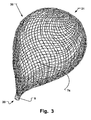
- Fig. 3 shows a spherical hollow spherical network 30 of threads 7a, for the production of an atrial appendage occluder.
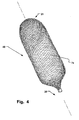
- Fig. 4 shows a balloon-shaped hollow spherical network 40 of threads 7a, for the production of an atrial appendage occluder.
- the networks may be braided from a single wire avoiding variations within the braid and dispensing with a hub if desired, see e.g. Fig. 7 .
- FIG. 5 an example of an atrial appendage occluder 50 without a holder is shown in a side view.
- the atrial appendage occluder 50 has no holder at the proximal end.
- Fig. 6 the atrial appendage occluder 50 according to Fig. 5 is shown following implantation in the left atrial appendage 10 of the left atrium.
- Fig. 7 illustrates a spherical network 70 of a piece of wire without a holder, made of a single wire.
- Fig. 8 shows in a side view of a variant an embodiment of an atrial appendage occluder 80 having a hub.
- Fig. 9 shows the embodiment according to Fig. 8 after implantation in the left atrial appendage 10.
- a distal region of the atrial appendage occlusion device 80 comprises further anchoring elements, here in the form of distal retention flanges engaging a tissue wall of the atrial appendage at a perimeter thereof providing a secure anchoring therein. Thanks to the intermediate regions between the flanges and the spherical anchoring element at the distal end 20, and thanks to the fact that the device 80 is made from a single network or braid, the device 80 has high flexibility while providing a secure anchoring and ingrowth.
- the distal anchoring elements are shielded off the blood flow in the atrium, which has several advantages, as described below.
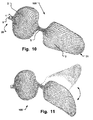
- Fig. 10 illustrates an example of the atrial appendage occluder 100 in a side view.
- Fig. 11 is a representation of a flexible handling of the atrial appendage occluder 100 according to Fig. 10 . Thanks to the waisted central portion 5, a movement and adaptation to the atrial appendage and its movements is provided, as illustrated in Fig. 11 .
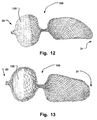
- Fig. 12 is a representation of an atrial appendage occluder 100 according to Fig. 10 having a sewn-on patch 120 at the proximal end.
- Fig. 13 is a representation of an atrial appendage occluder having a sewn-on patch 130 in the hollow proximal anchoring element at the proximal end 20.
- the occlusion device may in certain examples additionally have textile inserts 120 and 130, wherein these may be made of and comprise, for example, the material Dacron (polyethylene terephthalate). It is conceivable here to incorporate the textile inserts in the interior or on the proximal retention region 2 in order to be able to completely occlude the atrial appendage opening.
- the intercalation of the textile inserts can be carried out, for example, by bracing of these in the occlusion device 1.
- the implant employed in the body is then completely surrounded by endogenous tissue even after a few weeks or months. An advantageous occlusion of the atrial appendage 10 thus takes place.
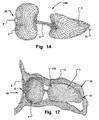
- Fig. 14 is a representation of an example of an atrial appendage occluder 140 having a long web between the proximal end 20 and distal end 21.
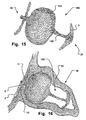
- Fig. 15 shows an example of an atrial appendage occluder 150 having a flat double disk at the proximal end 20 and an intermediate retention region 153.
- Fig. 16 the example according to Fig. 15 is shown following implantation in the left atrial appendage 10.
- Fig. 17 shows an example of an atrial appendage occluder 170 after implantation in the left atrial appendage 10.
- the proximal retention region 2 for the example according to Fig. 17 additionally has a hollow 8, in which is arranged the hub 4, in which the ends of the wires or threads of the network 7 meet, where they may be fixated by welding, soldering, etc. It can thus be achieved that preferably no material of the implanted occlusion device 1 at all can project through the atrial appendage plane into the bloodstream of the patient in the implanted state.
- a connecting element 9 can additionally be arranged on the proximal retention region 2, without a possible defense reaction of the body of the patient occurring, since contact of blood with the connecting element 9 arranged in the hollow 8 is effectively prevented.
- the connecting element 9 can be designed to the effect that it can be brought into engagement with a catheter.
- Fig. 18 illustrates an example of an atrial appendage occluder 180, produced from a funnel braiding without a holder, sleeve or clamp at the distal end 21. Even at the proximal end 20 the holder may be omitted as describe above as the atrial appendage occluder 180 may be produced from a single wire.
- the distal retention region is flared back on itself, thus providing an easy insertion into an atrial appendage and an improved engagement with the atrial appendage tissue wall and thus an improved retention therein.
- the proximal retention flange 2 shown in Fig. 18 may be omitted.
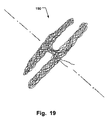
- Fig. 19 presents the representation of a side view of a PFO occluder 190 without a holder, produced from a spherical network according to Fig. 7 .
- the PFO occluder 190 may be produced from a single wire.
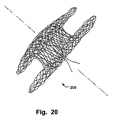
- Fig. 20 shows a representation of a side view of an ASD occluder 200 without a holder, produced according to a spherical network according to Fig. 7 .
- the ASD occluder 200 may be produced from a single wire.
- a funnel network 210 produced from a wire according to the 2-D weaving process or weaving process according to Occlutech, is illustrated in Fig. 21 .
- the funnel network 210 can be produced from a single wire.
- FIG. 22 In a side view is a representation of a PFO occluder 220 without a holder, shown in Fig. 22 , produced from a wire according to the funnel network as in Fig. 21 .
- Fig. 23 is a side view of an ASD occluder 230 without a holder, produced from a wire according to the funnel network as in Fig. 21 .
- a distal retention region having a spherical or elongate spherical shape is designed in such a way that it curves outwardly on expansion of the occlusion device, in order in this way to fit tightly in the implanted state with the internal walls of the atrial appendage.
- the self-expandable occlusion device can be advanced particularly deep into the atrial appendage to be occluded by means of an insertion catheter system.
- the proximal retention region which is advantageously formed, for example, as a distal umbrella ( Figs.
- the occlusion device in use can so be completely surrounded by endogenous tissue obviously faster compared to in case of the prior art occlusion systems.
- Engagement of the wire network with the inner wall of the atrial appendage moreover enables the inserted occlusion device to be fully ingrown by the body's own tissue considerably faster than is the case with the known prior art systems.
- the further advantage is derived from the fact that it has long-term mechanical stability. As already indicated, the occurrence of breaks in the structure or material weakness of a different kind of the used implant can basically be prevented. In addition, the network has adequate stiffness.
- any holders to be dispensed with this relates both to the proximal and distal end of the occlusion device.
- a particular spherical network was used which is produced from only one wire.
- the basis is the process of 2D and 3D-weaving known in the literature, where the weaving spindles here are arranged on a plane surface in the manner of a chess-board and network structures of this type can be produced one below the other with any desired direction changes.
- a further possibility for production of spherical networks of this type has already been described in German patent application with publication No. DE102006013770A.1 .
- Spherical occluder of the same applicant as the present application Using this production method, it is possible to weave individual sections of wire such that spherical occluders result.
- spherical networks of the present type without a hub may be produced.
- the two other remaining ends of the wire are connected to each other, for example welded, such that a closed spherical network results.
- a holder can at last be dispensed with both distally and proximally in a corresponding occlusion device.
- the great advantage with an atrial appendage occluder of this type is, for example, that the proximal end of the occluder, which is placed in the left atrial appendage, carries no holder element, so the formation of possible formation of thrombi can be extremely reduced.
- the ends of the wire of the one wire can here be brought together at the proximal end of the atrial appendage occluder, or in another position.
- the network of the occlusion device can be given its suitable design by means of a reshaping and heat-treatment process, it is provided in a particularly embodiment for the network to be formed on a shape memory material, in particular Nitinol or polymer.
- a shape memory material in particular Nitinol or polymer.
- Nitinol in occlusion devices is known.
- Shape memory polymers belong to the group consisting of the intelligent polymers and are polymers which show a shape memory effect, i.e. under the action of an external stimulus, e.g. a temperature change, their external shape can change.
- the polymer is first brought to its permanent shape by conventional processing methods, such as for e.g. injection molding or extrusion. Subsequently, the plastic is deformed and fixed in the desired temporary shape, which is also called "programming". When so, the process is performed with polymers on the one hand in such a way that the sample is warmed, deformed and then cooled. On the other hand, the polymer or the plastic may then be deformed at low temperature, i.e. "cold stretching". The permanent shape is thus stored, while the temporary shape is present. If the shaped polymer article is now warmed to a temperature higher than the switching temperature, the triggering of the shape memory effect and thus the restoration of the stored permanent shape occurs. By cooling the sample, the temporary shape is not reformed reversibly, which is why a "one-way shape memory effect" is spoken of.
- shape memory polymers with their memory powers are superior by a large amount.
- a small effort warming or cooling
- the maximum deformation between the permanent and temporary shape is only 8%.
- Shape memory polymers have significantly higher deformability of up to 1100%. All aforementioned shape memory polymers and materials can be used for the biomedical application of the occlusion device according to embodiments.
- the material contains a biodegradable shape memory polymer material.
- biodegradable implant materials are suitable in particular. Such degradable materials or polymers contain bonds cleavable under physiological conditions.
- biodegradability is spoken of if the material is degraded by or in a biological system with loss of the mechanical property. The external shape and the composition of the implant are retained under certain circumstances during the degradation. If a degradation period without additional quantifying details is spoken of, the period in which the complete loss of the mechanical property occurs is meant.
- Biostable materials are understood as meaning those which are stable in biological systems and are degraded at least only partially in the long term.
- hydrolytic degradation has the advantage that the degradation rate is independent of the site of implantation, since water is present everywhere. In contrast, the concentration of enzymes is locally very different.
- biodegradable polymers or materials accordingly the degradation can be carried out by pure hydrolysis, enzymatically induced reactions or by combination thereof.
- Typical hydrolyzable chemical bonds are amide-, ester- or acetal bonds.
- polymer degradation takes place faster than water diffusion into the interior of the material as observed in especially in case of either poly(anhydride)s or poly(orthoester)s.
- poly(hydroxycarboxylic acids) which are especially important for the shape memory effect, such as poly(lactic acid) or poly(glycosidic acid) and corresponding copolymers
- the polymer degradation takes place in the total volume.
- the rate-determining step here is the hydrolytic bond cleavage, since the diffusion of water into the rather hydrophilic polymer matrix takes place relatively rapidly, i.e. the surface degradation is slow.
- biodegradable polymers it is crucial that on one hand they degrade at a controllable- or adjustable rate and on the other the degradation products are not toxic.
- biodegradable shape memory polymers are implementable in further applications, including those described in the German Patent application "medical self-expanding occlusion device" with publication No. 10 2005 053 958. A1 of 11.11.2005 , as PCT application PCT/EP2005/012 131 of 11.11.2005 and as US application US 2007-0167980-A1 of 12.13.2005 with its application to the heart occluder variant described in this Patent including the derived variants shown, DE10 2005 053 958A1 , PCT/EP2005/012 131 and US-2007-0167980-A1 .
- the single thread or plurality of threads 7a of the network 7 at least partly consist of a shape memory polymer composition, so that the network 7 deforms from a temporary shape to a permanent shape under the action of an external stimulus, the temporary shape being present in the first design of the network 7 and the permanent shape being present in the second design of the network 7.
- the external stimulus can be a fixable switching temperature, for example in the range between room temperature and the body temperature of a patient.
- the polymer composition of certain embodiments has polymeric switching elements, the temporary shape of the network 7 being stabilized below the fixable switching temperature with the aid of characteristic phase transitions of the polymeric switching elements.
- the polymer composition contains a crystalline or partly crystalline polymer network having crystalline switching segments, the temporary shape of the network 7 being fixed and stabilized by freezing of the crystalline switching segments during the crystallization transition, where the switching temperature is determined by the crystallization temperature or switching temperature of the crystalline switching segments.
- the polymer composition contains an amorphous polymer network having amorphous switching segments, the temporary shape of the network 7 being fixed and stabilized by freezing of the amorphous switching segments during glass transition of the switching segments, where the switching temperature is determined by the glass transition temperature of the amorphous switching segments.
- the polymer composition contains a linear, phase-segregated multiblock copolymer network, which can be present in at least two different phases, the first phase being a hard segment-forming phase in which a multiplicity of hard segment-forming blocks are formed in the polymer, which serve for the physical crosslinking of the polymer structure and determine and stabilize the permanent shape of the network 7, and the second phase being a switching segment-forming phase in which a multiplicity of switching segment-forming blocks are formed in the polymer, which serve for the fixing of the temporary shape of the network 7, where the transition temperature of the switching segment-forming phase to the hard segment-forming phase is the switching temperature, and where above the transition temperature of the hard segment-forming phase the design of the network 7 can be adjusted by conventional processes, in particular by injection molding or extrusion processes.
- the polymer composition can contain thermoplastic polyurethane elastomers having a multiblock structure, the hard segment-forming phase being formed by reaction of diisocyanates, in particular methylene bis(4-phenylisocyanate) or hexamethylene diisocyanate, with diols, in particular 1,4-butanediol, and the switching segment-forming phase resulting from oligomeric polyether or polyester diols, in particular starting from OH-terminated poly(tetrahydrofuran), poly( ⁇ -caprolactone), poly(ethylene adipate), poly(ethylene glycol) or poly(propylene glycol).
- diisocyanates in particular methylene bis(4-phenylisocyanate) or hexamethylene diisocyanate
- diols in particular 1,4-butanediol
- switching segment-forming phase resulting from oligomeric polyether or polyester diols, in particular starting from OH-terminated poly(tetrahydr
- the polymer composition can also contain phase-segregated diblock copolymers having an amorphous A block and a partly crystalline B block, the glass transition of the amorphous A block forming the hard segment-forming phase, and the melting temperature of the partly crystalline B block serving as a switching temperature for the thermal shape memory effect.
- the polymer composition can contain polystyrene as the amorphous A block and poly(1,4-butadiene) as the partly crystalline B block.
- the polymer composition contains a phase-segregated triblock copolymer having a partly crystalline central B block and having two amorphous terminal A blocks, where the A blocks construct the hard segment, and where the B block determines the switching temperature.
- the polymer composition can contain, for example, partly crystalline poly(tetrahydrofuran) as the central B block and amorphous poly(2-methyloxazoline) as the terminal A blocks.
- the polymer composition contains polynorbornene, polyethylene-nylon 6 graft copolymers and/or crosslinked poly(ethylene-co-vinyl acetate) copolymers.
- the polymer composition contains a covalent crosslinked polymer network, which is constructed by polymerization, polycondensation and/or polyaddition of difunctional monomers or macromers with addition of tri- or higher functional crosslinkers, where the chemical, thermal and mechanical properties of the polymer network formed are selectively adjustable by means of a suitable choice of the monomers, their functionality and the proportion in the crosslinker.
- the polymer composition here can be, for example, a covalent polymer network which is constructed by crosslinking copolymerization of stearyl acrylate and methacrylic acid with N,N'-methylenebisacrylamide as the crosslinker, the shape memory effect of the polymer composition being based on crystallizing stearyl side chains.
- the polymer composition contains a covalently crosslinked polymer network which is formed by subsequent crosslinkage of linear or branched polymers.
- the crosslinkage can be induced by ionizing radiation or by thermal cleavage of free radical-forming groups.
- the polymer composition contains at least one biodegradable material.
- the polymer composition here can contain, for example, a hydrolytically degradable polymer, in particular poly(hydroxycarboxylic acids) or corresponding copolymers.
- the polymer composition contains, for example, enzymatically degradable polymers.
- the polymer composition contains a biodegradable thermoplastic amorphous polyurethane-copolyester polymer network.
- the polymer composition can contain a biodegradable elastic polymer network which is obtained by crosslinkage of oligomeric diols with diisocyanate.
- the polymer composition can be formed here based on covalent networks starting from oligo( ⁇ -caprolactone) dimethacrylate and butyl acrylate.
- the network of embodiments of the occlusion device is reduced to the diameter of a catheter used in the minimally invasive surgical intervention.
- the advantage of this embodiment can be seen in that the catheter systems to be used for the implantation and explantation can have a markedly reduced internal diameter, which markedly increases the maneuverability of the occlusion device to be implanted. Therefore the positioning accuracy of the device in the atrial appendage can be improved.
- the internal diameter of the catheter used for the implantation or explantation is between 2,7 and 3,3 mm (8 and 10 French), whereas when using occlusion devices of polymeric synthetic material the internal diameter only has to be between 2 and 2,7 mm (6 and 8 French).
- the occlusion device to have at least one textile insert 120, 130, which is arranged for the complete occlusion of the atrial appendage in the or on the proximal retention region.
- This textile insert serves for the purpose of occluding the interspaces remaining in the expanding diameters of the occlusion device after the insertion and expansion of the device in the atrial appendage.
- the textile insert is fixed, for example, to the distal retention region on the network of the occlusion device in such a way that it can be stretched like a fabric over the distal retention region.
- the advantage of this construction lies in the fact that the edge seam of the distal retention region lies flush to the atrial appendage opening and little foreign material is incorporated in the body of the patient.
- the textile inserts can be produced, for example, from Dacron (polyethylene terephthalate).
- Dacron polyethylene terephthalate
- other materials and other positions of the textile insert in the or on the occlusion device are also conceivable including biodegradable materials which were described above.
- the occluding device is a self-expandable device, which is implantable in a particularly simple manner using, for example, a suitable insertion catheter.
- a vein in the region of the groin of the patient is punctured and the insertion catheter system is advanced up to the septum of the right atrium.
- the septum of the right atrium By means of a puncture of the septum of the atrium, which can be, for example, a known transseptal puncture, the left atrium of the heart is reached, such that subsequently the insertion catheter system can be introduced from the groin vein into the left atrial appendage.
- the self-expandable occlusion device for the occlusion of the atrial appendage can be introduced; the corresponding locks have a comparatively small cross-section, at most 9 to 10 F.
- the occlusion device which is present during the implantation in the collapsed state, preferably has a diameter of 6 to 10 French, such that the intervention for the occlusion of the atrial appendage is minimally invasive.
- the occlusion device After the collapsed occlusion device is positioned in the atrial appendage to be occluded with the aid, for example, of the insertion catheter, the occlusion device is released from the catheter, whereupon this, as a result of its self-expandable nature, unfolds and assumes the distinctive design by means of the reshaping and heat-treatment process used during production.
- the back distal retention region with the spherical region formed thereon is completely unfolded and fits tightly to the internal walls of the atrial appendage to be occluded.
- the distal retention region having the spherical region formed thereon serves for the fixing and positioning of the expanded occlusion device in the atrial appendage.
- the central region extending from the distal retention region in the atrial appendage opening direction and the proximal retention region provided at the proximal end of the central region here fill out the opening region of the atrial appendage almost completely, so that the entire expanded occlusion device in the employed state serves as an occlusion plug for the occlusion of the atrial appendage. In this manner, thrombus formation with the risk of a stroke can be considerably reduced in a particularly simple and minimally invasive manner.
- fixing hooks or other anchoring means on the occlusion device which are customarily used in such occlusion devices for the fixing and positioning of the device in the tissue, can be dispensed with.
- the fixing hooks customarily employed cannot provide any permanent fixing and positioning of the occlusion device.
- a spherical hollow network is formed by means of, for example, a circular weaving machine.
- a technique can be used here in which the network formed is bunched at the end of the woven length, i.e. at the later distal end of the occlusion device, and remains closed at the start of the woven length, i.e. at the later distal end of the occlusion device. It is thus possible to produce a spherical hollow network whose bunched end corresponds to the proximal end of the finished occlusion device and whose opposite closed end corresponds to the distal end of the finished occlusion device.
- the finished occlusion device has mechanical properties with respect to, for example, stretching, stability, strength etc., which can be suited individually to the later use of the occlusion device.
- metallic wires, but also organic threads can be processed to give the network.
- spherical networks as described without a holder, are used. Because a holder on the proximal retention area for bundling or gathering the braiding together can be dispensed with, no components of the occlusion device protrude any farther into the atrial appendage so that neither is there any threat of the body mounting defense mechanism reactions or of there being any other conceivable complications.
- the entire atrial appendage occlusion device is formed from one integral braiding such that, on the one hand, no mechanic connective element is needed between different portions of the device, and on the other hand, the dimensions to the occlusion device in its collapsed state can be even further reduced.
- no components of the occlusion device protrude beyond the atrial appendage wall, thus preventing components of the implant from being in constant contact with the blood. This yields the advantage of there being no threat that the body will mount defense mechanism reactions or of there being thrombembolic complications.
- the occlusion device can be used for a wide range of atrial appendages and openings into the latter of various different sizes.
- the process step of the shaping of the retention regions and of the central region to contain a reshaping and/or heat-treatment step.
- the spherical hollow network formed consists of Nitinol or of another material, in particular a polymer, having a shape memory or memory effect.
- the network is provided for the network to be formed from a shape memory polymer which is based, for example, on polyanhydrides as a matrix or on polyhydroxycarboxylic acid. In this connection, these are synthetic degradable materials which have a thermally induced shape memory effect.
- shape memory polymers such as, for example, block polymers such as are described, for example, in the offprint angewandte Chemie 2002, 114, pages 2138 to 2162 of A. Lendlein and S. Kelch would also be conceivable.
- Such materials can be brought to an appropriate final shape by a combination of reshaping and heat-treatment steps.
- a finished shaped occluder can then be reduced, for example, to the size of a catheter.
- the occlusion device After emergence from the catheter, the occlusion device then unfolds independently and by means of the reshaping and/or heat-treatment step again assumes the shape which was distinctive to the spherical or infundibular hollow network of the occlusion device in the production process.
- the spherical hollow network is produced in such a way that thin wires or threads which constitute the finished network are interwoven with the formation of the spherical hollow network at the distal end of the network.
- This is a mode which is possible and can be realized particularly simply for producing an atrial appendage occlusion device, whose distal retention region has a closed shape to the distal end.
- other examples of production processes are, however, also conceivable.
Landscapes
- Health & Medical Sciences (AREA)
- Surgery (AREA)
- Life Sciences & Earth Sciences (AREA)
- Medical Informatics (AREA)
- Animal Behavior & Ethology (AREA)
- Engineering & Computer Science (AREA)
- Biomedical Technology (AREA)
- Heart & Thoracic Surgery (AREA)
- Veterinary Medicine (AREA)
- Molecular Biology (AREA)
- Nuclear Medicine, Radiotherapy & Molecular Imaging (AREA)
- General Health & Medical Sciences (AREA)
- Public Health (AREA)
- Reproductive Health (AREA)
- Vascular Medicine (AREA)
- Cardiology (AREA)
- Surgical Instruments (AREA)
- Prostheses (AREA)
Claims (12)
- Dispositif d'occlusion d'auricule cardiaque (80) comprenant un maillage ou tressage (7) d'au moins un câble ou fil (7a), où le dispositif d'occlusion (1) s'est vu donner une forme en utilisant un procédé de remise en forme et/ou de traitement thermique, et peut s'auto-déployer, et est configuré pour un ancrage sûr dans une auricule cardiaque (10) de l'oreillette gauche ou droite d'un coeur, comprenant
une région de retenue proximale (2) au niveau d'une extrémité proximale (20) du dispositif d'occlusion (1) ; une région de retenue distale (3) ; et une région centrale (5) entre ladite région de retenue proximale (2) et ladite région de retenue distale (3) ;
où le dispositif d'occlusion (1) présente une extrémité distale fermée (21) sans garde pour ledit câble ou fil, et où ladite région de retenue proximale (2) dudit dispositif d'occlusion (1) est de forme sphérique allongée et est au moins partiellement creuse, et où ladite région de retenue distale comprend un élément d'ancrage distal intégralement constitué du même maillage ou tressage (7) que la région de retenue proximale sphérique allongée creuse (2), et
où ladite région de retenue distale comprend au moins un autre élément d'ancrage distal intégralement constitué du même maillage ou tressage (7) que la région de retenue sphérique allongée creuse. - Dispositif d'occlusion selon la revendication 1, dans lequel ledit élément d'ancrage distal est un disque double ou présente une forme de parapluie.
- Dispositif d'occlusion selon la revendication 1, dans lequel ladite région de retenue proximale du dispositif présente une section transversale globalement circulaire qui s'effile progressivement en direction de la région d'extrémité de ladite région d'ancrage.
- Dispositif d'occlusion selon les revendications 1 à 3, où ledit dispositif est conçu pour être en dessous d'une précontrainte radiale, de telle sorte que la retenue fixée du dispositif d'occlusion déployé permet une variation des dimensions d'auricule cardiaque et/ou où le dispositif d'occlusion est mis en forme pour s'auto-positionner et s'auto-centrer dans ladite auricule cardiaque de l'oreillette gauche ou droite lors du déploiement à partir d'un dispositif de mise en place.
- Dispositif d'occlusion (1) selon la revendication 1, dans lequel ladite région centrale (5) présente une longueur fixée préalablement à l'utilisation, de manière à garantir que la retenue distale du dispositif plonge dans l'auricule cardiaque.
- Dispositif d'occlusion (1) selon l'une des revendications précédentes 1 à 5, dans lequel la région de retenue proximale (2) est adaptée pour occlure l'orifice d'auricule cardiaque (11) de l'auricule cardiaque (10) de manière aussi optimale que possible dans l'état déployé et implanté.
- Dispositif d'occlusion (1) selon la revendication 5, dans lequel la région de retenue proximale (2) présente un creux (8), dans lequel est disposé un élément de maintien (4), dans lequel les extrémités des câbles ou fils du maillage ou tressage (7) se rencontrent.
- Dispositif d'occlusion (1) selon l'une quelconque des revendications précédentes 1 à 7, où le dispositif d'occlusion est conçu de manière réversible pour être rétractable et déployable, de sorte qu'un dispositif d'occlusion déjà déployé (1) est rétractable, par exemple, à l'aide d'un cathéter d'explantation, où une liaison ajustée serrée entre le dispositif d'occlusion et les parois internes de l'auricule cardiaque (10) peut être libérée.
- Dispositif d'occlusion (1) selon l'une quelconque des revendications précédentes, dans lequel le maillage ou tressage (7) est constitué d'un seul câble et les extrémités du câble sont reliées ensemble sans garde et/ou où le dispositif d'occlusion dans l'état déployé avec la région de retenue distale (3) présentant formée sur celle-ci une région sphérique qui est complètement dépliée s'ajuste de manière serrée sur les parois internes de l'auricule cardiaque (10) devant faire l'objet d'une occlusion, à une certaine distance de la région de retenue proximale (2) séparée par une partie galbée fournissant une certaine souplesse des régions l'une par rapport à l'autre.
- Dispositif d'occlusion (1) selon les revendications 1 à 9, dans lequel les fils du maillage ou tressage (7) sont constitués d'une composition polymère à mémoire de forme, qui contient des éléments de transformation polymères, la forme temporaire du maillage ou tressage (7) étant stabilisée en dessous d'une température de transformation pouvant être fixée à l'aide des transitions de phase caractéristiques des éléments de transformation polymères.
- Dispositif d'occlusion selon la revendication 10, dans lequel la composition polymère contient un maillage ou tressage de polymère cristallin ou partiellement cristallin comportant des segments de transformation cristallins, la forme temporaire du maillage ou tressage (7) étant fixée et stabilisée par congélation des segments de transformation cristallins au cours d'une transition de cristallisation, où la température de transformation est déterminée par la température de cristallisation ou la température de transformation des segments de transformation cristallins ou dans lequel la composition polymère contient un maillage ou tressage de polymère amorphe comportant des segments de transformation amorphes, la forme temporaire du maillage ou tressage (7) étant fixée et stabilisée par congélation des segments de transformation amorphes au cours d'une transition vitreuse des segments de transformation, où la température de transformation est déterminée par la température de transition vitreuse des segments de transformation amorphes.
- Dispositif d'occlusion selon l'une des revendications précédentes 10 et 11, dans lequel la composition polymère contient un maillage ou tressage de copolymère à unités monomères multiples, séparé en phases, linéaire, qui peut se présenter selon au moins deux phases différentes, la première phase étant une phase de formation de segments durs dans laquelle une multitude d'unités monomères de formation de segments durs sont formées dans le polymère, lesquelles servent à la réticulation physique de la structure polymère et déterminent et stabilisent la forme permanente du maillage ou tressage (7), et la deuxième phase étant une phase de formation de segments de transformation, dans laquelle une multitude d'unités monomères de formation de segments de transformation sont formées dans le polymère, lesquelles servent à fixer la forme temporaire du maillage ou tressage (7), où la température de transition de la phase de formation de segments de transformation en la phase de formation de segments durs est la température de transformation, et où au-dessus de la température de transition de la phase de formation de segments durs la conception du maillage ou tressage (7) peut être ajustée par l'intermédiaire de procédés classiques, en particulier par des procédés de moulage par injection ou d'extrusion.
Priority Applications (6)
| Application Number | Priority Date | Filing Date | Title |
|---|---|---|---|
| EP20120170902 EP2532309A2 (fr) | 2007-04-16 | 2008-04-16 | Procédé pour diagnostiquer des troubles psychiatriques chez un sujet humain évaluant la concentration de protéines SP1, SP3, SP4 dans un échantillon biologique |
| EP12170629.5A EP2581045B1 (fr) | 2007-04-16 | 2008-04-16 | Obturateur |
| EP12169727.0A EP2526875A3 (fr) | 2007-04-16 | 2008-04-16 | Dispositif d'occlusion pour auricule cardiaque |
| EP20100180813 EP2258275A1 (fr) | 2007-04-16 | 2008-04-16 | Dispositif d'occlusion d'une oreillette cardiaque et sa méthode de manufacture |
| EP20120171115 EP2626011A2 (fr) | 2007-04-16 | 2008-04-16 | Obturateur et processus de production associé |
| EP20080736295 EP2134263B1 (fr) | 2007-04-16 | 2008-04-16 | Dispositif d'occlusion pour réaliser l'occlusion d'un auricule cardiaque |
Applications Claiming Priority (4)
| Application Number | Priority Date | Filing Date | Title |
|---|---|---|---|
| EP07106278.0A EP1982655B2 (fr) | 2007-04-16 | 2007-04-16 | Dispositif d'occlusion d'une oreillette cardiaque et sa méthode de manufacture |
| US91323607P | 2007-04-20 | 2007-04-20 | |
| PCT/EP2008/054622 WO2008125689A1 (fr) | 2007-04-16 | 2008-04-16 | Dispositif d'occlusion pour réaliser l'occlusion d'un auricule cardiaque et son procédé de fabrication |
| EP20080736295 EP2134263B1 (fr) | 2007-04-16 | 2008-04-16 | Dispositif d'occlusion pour réaliser l'occlusion d'un auricule cardiaque |
Related Child Applications (7)
| Application Number | Title | Priority Date | Filing Date |
|---|---|---|---|
| EP12170629.5A Division EP2581045B1 (fr) | 2007-04-16 | 2008-04-16 | Obturateur |
| EP12169727.0A Division EP2526875A3 (fr) | 2007-04-16 | 2008-04-16 | Dispositif d'occlusion pour auricule cardiaque |
| EP10180813.7 Division-Into | 2010-09-28 | ||
| EP12169727.0 Division-Into | 2012-05-29 | ||
| EP12170629.5 Division-Into | 2012-06-01 | ||
| EP12170902.6 Division-Into | 2012-06-05 | ||
| EP12171115.4 Division-Into | 2012-06-06 |
Publications (2)
| Publication Number | Publication Date |
|---|---|
| EP2134263A1 EP2134263A1 (fr) | 2009-12-23 |
| EP2134263B1 true EP2134263B1 (fr) | 2012-12-05 |
Family
ID=38480670
Family Applications (8)
| Application Number | Title | Priority Date | Filing Date |
|---|---|---|---|
| EP11191896.7A Active EP2460476B1 (fr) | 2007-04-16 | 2007-04-16 | Dispositif d'occlusion destiné à fermer une oreillette cardiaque et son procédé de fabrication |
| EP07106278.0A Not-in-force EP1982655B2 (fr) | 2006-11-10 | 2007-04-16 | Dispositif d'occlusion d'une oreillette cardiaque et sa méthode de manufacture |
| EP20100180813 Withdrawn EP2258275A1 (fr) | 2007-04-16 | 2008-04-16 | Dispositif d'occlusion d'une oreillette cardiaque et sa méthode de manufacture |
| EP20120171115 Withdrawn EP2626011A2 (fr) | 2007-04-16 | 2008-04-16 | Obturateur et processus de production associé |
| EP20080736295 Not-in-force EP2134263B1 (fr) | 2007-04-16 | 2008-04-16 | Dispositif d'occlusion pour réaliser l'occlusion d'un auricule cardiaque |
| EP12169727.0A Withdrawn EP2526875A3 (fr) | 2007-04-16 | 2008-04-16 | Dispositif d'occlusion pour auricule cardiaque |
| EP20120170902 Withdrawn EP2532309A2 (fr) | 2007-04-16 | 2008-04-16 | Procédé pour diagnostiquer des troubles psychiatriques chez un sujet humain évaluant la concentration de protéines SP1, SP3, SP4 dans un échantillon biologique |
| EP12170629.5A Active EP2581045B1 (fr) | 2007-04-16 | 2008-04-16 | Obturateur |
Family Applications Before (4)
| Application Number | Title | Priority Date | Filing Date |
|---|---|---|---|
| EP11191896.7A Active EP2460476B1 (fr) | 2007-04-16 | 2007-04-16 | Dispositif d'occlusion destiné à fermer une oreillette cardiaque et son procédé de fabrication |
| EP07106278.0A Not-in-force EP1982655B2 (fr) | 2006-11-10 | 2007-04-16 | Dispositif d'occlusion d'une oreillette cardiaque et sa méthode de manufacture |
| EP20100180813 Withdrawn EP2258275A1 (fr) | 2007-04-16 | 2008-04-16 | Dispositif d'occlusion d'une oreillette cardiaque et sa méthode de manufacture |
| EP20120171115 Withdrawn EP2626011A2 (fr) | 2007-04-16 | 2008-04-16 | Obturateur et processus de production associé |
Family Applications After (3)
| Application Number | Title | Priority Date | Filing Date |
|---|---|---|---|
| EP12169727.0A Withdrawn EP2526875A3 (fr) | 2007-04-16 | 2008-04-16 | Dispositif d'occlusion pour auricule cardiaque |
| EP20120170902 Withdrawn EP2532309A2 (fr) | 2007-04-16 | 2008-04-16 | Procédé pour diagnostiquer des troubles psychiatriques chez un sujet humain évaluant la concentration de protéines SP1, SP3, SP4 dans un échantillon biologique |
| EP12170629.5A Active EP2581045B1 (fr) | 2007-04-16 | 2008-04-16 | Obturateur |
Country Status (4)
| Country | Link |
|---|---|
| US (3) | US9161758B2 (fr) |
| EP (8) | EP2460476B1 (fr) |
| ES (4) | ES2426348T3 (fr) |
| WO (1) | WO2008125689A1 (fr) |
Cited By (24)
| Publication number | Priority date | Publication date | Assignee | Title |
|---|---|---|---|---|
| US10130372B2 (en) | 2014-04-30 | 2018-11-20 | Cerus Endovascular Limited | Occlusion Device |
| US10905430B2 (en) | 2018-01-24 | 2021-02-02 | DePuy Synthes Products, Inc. | Aneurysm device and delivery system |
| US10939915B2 (en) | 2018-05-31 | 2021-03-09 | DePuy Synthes Products, Inc. | Aneurysm device and delivery system |
| US11058430B2 (en) | 2018-05-25 | 2021-07-13 | DePuy Synthes Products, Inc. | Aneurysm device and delivery system |
| US11076861B2 (en) | 2018-10-12 | 2021-08-03 | DePuy Synthes Products, Inc. | Folded aneurysm treatment device and delivery method |
| US11076860B2 (en) | 2014-03-31 | 2021-08-03 | DePuy Synthes Products, Inc. | Aneurysm occlusion device |
| US11123077B2 (en) | 2018-09-25 | 2021-09-21 | DePuy Synthes Products, Inc. | Intrasaccular device positioning and deployment system |
| US11134953B2 (en) | 2019-02-06 | 2021-10-05 | DePuy Synthes Products, Inc. | Adhesive cover occluding device for aneurysm treatment |
| US11154302B2 (en) | 2014-03-31 | 2021-10-26 | DePuy Synthes Products, Inc. | Aneurysm occlusion device |
| US11272939B2 (en) | 2018-12-18 | 2022-03-15 | DePuy Synthes Products, Inc. | Intrasaccular flow diverter for treating cerebral aneurysms |
| US11278292B2 (en) | 2019-05-21 | 2022-03-22 | DePuy Synthes Products, Inc. | Inverting braided aneurysm treatment system and method |
| US11337706B2 (en) | 2019-03-27 | 2022-05-24 | DePuy Synthes Products, Inc. | Aneurysm treatment device |
| US11406392B2 (en) | 2018-12-12 | 2022-08-09 | DePuy Synthes Products, Inc. | Aneurysm occluding device for use with coagulating agents |
| US11413046B2 (en) | 2019-05-21 | 2022-08-16 | DePuy Synthes Products, Inc. | Layered braided aneurysm treatment device |
| US11457926B2 (en) | 2019-12-18 | 2022-10-04 | DePuy Synthes Products, Inc. | Implant having an intrasaccular section and intravascular section |
| US11497504B2 (en) | 2019-05-21 | 2022-11-15 | DePuy Synthes Products, Inc. | Aneurysm treatment with pushable implanted braid |
| US11583282B2 (en) | 2019-05-21 | 2023-02-21 | DePuy Synthes Products, Inc. | Layered braided aneurysm treatment device |
| US11583288B2 (en) | 2018-08-08 | 2023-02-21 | DePuy Synthes Products, Inc. | Delivery of embolic braid |
| US11596412B2 (en) | 2018-05-25 | 2023-03-07 | DePuy Synthes Products, Inc. | Aneurysm device and delivery system |
| US11602350B2 (en) | 2019-12-05 | 2023-03-14 | DePuy Synthes Products, Inc. | Intrasaccular inverting braid with highly flexible fill material |
| US11607226B2 (en) | 2019-05-21 | 2023-03-21 | DePuy Synthes Products, Inc. | Layered braided aneurysm treatment device with corrugations |
| US11672543B2 (en) | 2017-02-23 | 2023-06-13 | DePuy Synthes Products, Inc. | Aneurysm method and system |
| US11672542B2 (en) | 2019-05-21 | 2023-06-13 | DePuy Synthes Products, Inc. | Aneurysm treatment with pushable ball segment |
| US12446886B2 (en) | 2019-05-21 | 2025-10-21 | DePuy Synthes Products, Inc. | Semispherical braided aneurysm treatment system and method |
Families Citing this family (145)
| Publication number | Priority date | Publication date | Assignee | Title |
|---|---|---|---|---|
| US9861346B2 (en) | 2003-07-14 | 2018-01-09 | W. L. Gore & Associates, Inc. | Patent foramen ovale (PFO) closure device with linearly elongating petals |
| DE102006013770A1 (de) * | 2006-03-24 | 2007-09-27 | Occlutech Gmbh | Occlusionsinstrument und Verfahren zu dessen Herstellung |
| EP2015681B1 (fr) | 2006-05-03 | 2018-03-28 | Datascope Corp. | Dispositif de fermeture de tissu |
| US8529597B2 (en) | 2006-08-09 | 2013-09-10 | Coherex Medical, Inc. | Devices for reducing the size of an internal tissue opening |
| US8167894B2 (en) | 2006-08-09 | 2012-05-01 | Coherex Medical, Inc. | Methods, systems and devices for reducing the size of an internal tissue opening |
| US9220487B2 (en) | 2006-08-09 | 2015-12-29 | Coherex Medical, Inc. | Devices for reducing the size of an internal tissue opening |
| US9005242B2 (en) | 2007-04-05 | 2015-04-14 | W.L. Gore & Associates, Inc. | Septal closure device with centering mechanism |
| EP2460476B1 (fr) * | 2007-04-16 | 2020-11-25 | Occlutech Holding AG | Dispositif d'occlusion destiné à fermer une oreillette cardiaque et son procédé de fabrication |
| WO2008151204A1 (fr) | 2007-06-04 | 2008-12-11 | Sequent Medical Inc. | Procédés et dispositifs pour le traitement de défauts vasculaires |
| US20090112251A1 (en) * | 2007-07-25 | 2009-04-30 | Aga Medical Corporation | Braided occlusion device having repeating expanded volume segments separated by articulation segments |
| US9034007B2 (en) | 2007-09-21 | 2015-05-19 | Insera Therapeutics, Inc. | Distal embolic protection devices with a variable thickness microguidewire and methods for their use |
| US20090171386A1 (en) † | 2007-12-28 | 2009-07-02 | Aga Medical Corporation | Percutaneous catheter directed intravascular occlusion devices |
| US20130165967A1 (en) | 2008-03-07 | 2013-06-27 | W.L. Gore & Associates, Inc. | Heart occlusion devices |
| WO2009135166A2 (fr) | 2008-05-02 | 2009-11-05 | Sequent Medical Inc. | Dispositifs filamentaires pour le traitement de défauts vasculaires |
| US9402707B2 (en) | 2008-07-22 | 2016-08-02 | Neuravi Limited | Clot capture systems and associated methods |
| US20120029556A1 (en) | 2009-06-22 | 2012-02-02 | Masters Steven J | Sealing device and delivery system |
| US9636094B2 (en) | 2009-06-22 | 2017-05-02 | W. L. Gore & Associates, Inc. | Sealing device and delivery system |
| DE102009036818A1 (de) | 2009-08-10 | 2011-02-17 | Acoredis Gmbh | LAA-Occlusionsinstrument und Verfahren zu seiner Herstellung |
| CA2778639A1 (fr) | 2009-11-05 | 2011-05-12 | Sequent Medical Inc. | Dispositifs filamentaires multicouches pour le traitement d'anomalies vasculaires |
| DE102010021345A1 (de) | 2010-05-22 | 2011-11-24 | Acoredis Gmbh | Occlusionsinstrument zum Verschließen des linken Herzohrs |
| ES2403009T3 (es) * | 2010-05-23 | 2013-05-13 | Occlutech Holding Ag | Dispositivo médico trenzado y método para su fabricación |
| EP2387950A1 (fr) | 2010-05-23 | 2011-11-23 | Occlutech Holding AG | Implant médical et son procédé de fabrication |
| US8828051B2 (en) | 2010-07-02 | 2014-09-09 | Pfm Medical Ag | Left atrial appendage occlusion device |
| EP2629684B1 (fr) | 2010-10-22 | 2018-07-25 | Neuravi Limited | Système de mise en prise et de retrait de caillot |
| DE202011001366U1 (de) * | 2011-01-12 | 2011-03-24 | Osypka, Peter, Dr.-Ing. | Verschluss von ungewollten Öffnungen im Herzen |
| AU2012207387B2 (en) | 2011-01-17 | 2017-02-16 | Artio Medical, Inc. | Ballstent device and methods of use |
| US11484318B2 (en) | 2011-01-17 | 2022-11-01 | Artio Medical, Inc. | Expandable body device and method of use |
| DE102012003021A1 (de) | 2011-02-15 | 2012-10-11 | Acoredis Gmbh | Membrangesteuertes Occlusionsinstrument zum Verschluss des linken Herzohrs |
| US11259824B2 (en) | 2011-03-09 | 2022-03-01 | Neuravi Limited | Clot retrieval device for removing occlusive clot from a blood vessel |
| US12076037B2 (en) | 2011-03-09 | 2024-09-03 | Neuravi Limited | Systems and methods to restore perfusion to a vessel |
| ES3029850T3 (en) | 2011-03-09 | 2025-06-25 | Neuravi Ltd | A clot retrieval device for removing occlusive clot from a blood vessel |
| US8764787B2 (en) * | 2011-06-17 | 2014-07-01 | Aga Medical Corporation | Occlusion device and associated deployment method |
| US9770232B2 (en) * | 2011-08-12 | 2017-09-26 | W. L. Gore & Associates, Inc. | Heart occlusion devices |
| EP2567663A1 (fr) * | 2011-09-09 | 2013-03-13 | Occlutech Holding AG | Dispositif de fermeture médicale démontable, procédé et système médical pour fournir un objet |
| EP2572644A1 (fr) * | 2011-09-22 | 2013-03-27 | Occlutech Holding AG | Dispositif médical d'occlusion implantable |
| WO2013070686A1 (fr) | 2011-11-08 | 2013-05-16 | Boston Scientific Scimed, Inc. | Ensemble poignée pour dispositif d'occlusion de l'appendice de l'oreillette gauche |
| US10219931B2 (en) * | 2011-11-09 | 2019-03-05 | Easynotes Ltd. | Obstruction device |
| RU2626885C2 (ru) * | 2011-12-19 | 2017-08-02 | Колопласт А/С | Внутрипросветный протез и желудочно-кишечный имплантат |
| US20160081825A1 (en) * | 2012-01-04 | 2016-03-24 | Rapid Medical Ltd. | Heat-treated braided intravascular devices and methods |
| JP6356612B2 (ja) | 2012-01-17 | 2018-07-11 | メタクティブ・メディカル・インコーポレイテッドMetactive Medical, Inc. | 拡張式本体デバイスおよび使用方法 |
| WO2014018907A1 (fr) | 2012-07-26 | 2014-01-30 | University Of Louisville Research Foundation, Inc. | Dispositif de fermeture d'appendice auriculaire et procédés associés |
| US10828019B2 (en) | 2013-01-18 | 2020-11-10 | W.L. Gore & Associates, Inc. | Sealing device and delivery system |
| EP3536252B1 (fr) | 2013-03-14 | 2023-09-13 | Neuravi Limited | Dispositif de récupération de caillot pour éliminer un caillot d'occlusion d'un vaisseau sanguin |
| US9433429B2 (en) | 2013-03-14 | 2016-09-06 | Neuravi Limited | Clot retrieval devices |
| TR201901830T4 (tr) | 2013-03-14 | 2019-03-21 | Neuravi Ltd | Kan damarlarından akut tıkanıkların giderilmesine yönelik cihazlar ve metotlar. |
| WO2014144980A1 (fr) * | 2013-03-15 | 2014-09-18 | Covidien Lp | Dispositif occlusif |
| US8679150B1 (en) | 2013-03-15 | 2014-03-25 | Insera Therapeutics, Inc. | Shape-set textile structure based mechanical thrombectomy methods |
| AU2014232323B2 (en) * | 2013-03-15 | 2019-02-14 | Artio Medical, Inc. | Expandable body device and method of use |
| CA2901443A1 (fr) | 2013-03-15 | 2014-09-25 | Insera Therapeutics, Inc. | Dispositifs et procedes de traitement vasculaire |
| US8690907B1 (en) | 2013-03-15 | 2014-04-08 | Insera Therapeutics, Inc. | Vascular treatment methods |
| US8715314B1 (en) | 2013-03-15 | 2014-05-06 | Insera Therapeutics, Inc. | Vascular treatment measurement methods |
| US20160089151A1 (en) * | 2013-05-24 | 2016-03-31 | Cedars-Sinai Medical Center | Left atrial appendage occlusion devices and methods |
| WO2015002625A1 (fr) * | 2013-07-02 | 2015-01-08 | Bulent Oran | Dispositif d'obturateur pour système cardiovasculaire |
| US9078658B2 (en) | 2013-08-16 | 2015-07-14 | Sequent Medical, Inc. | Filamentary devices for treatment of vascular defects |
| US9955976B2 (en) | 2013-08-16 | 2018-05-01 | Sequent Medical, Inc. | Filamentary devices for treatment of vascular defects |
| WO2015077356A1 (fr) | 2013-11-19 | 2015-05-28 | Wheeler William K | Applicateur d'attache présentant un verrouillage |
| US9629635B2 (en) | 2014-04-14 | 2017-04-25 | Sequent Medical, Inc. | Devices for therapeutic vascular procedures |
| US9808230B2 (en) | 2014-06-06 | 2017-11-07 | W. L. Gore & Associates, Inc. | Sealing device and delivery system |
| CN106413589A (zh) * | 2014-06-11 | 2017-02-15 | 奥特鲁泰克控股有限公司 | 左心耳封堵器 |
| EP3928743B1 (fr) | 2014-06-26 | 2025-10-08 | Boston Scientific Scimed Inc. | Dispositifs médicaux pour prévenir le reflux biliaire après une chirurgie bariatrique |
| RU2721288C2 (ru) | 2014-09-17 | 2020-05-18 | Метэктив Медикал, Инк. | Медицинское устройство для лечения мешотчатых аневризм |
| HK1247066A1 (zh) | 2014-11-26 | 2018-09-21 | Neuravi Limited | 从血管除去阻塞性血栓的取血栓装置 |
| US10617435B2 (en) | 2014-11-26 | 2020-04-14 | Neuravi Limited | Clot retrieval device for removing clot from a blood vessel |
| US11253278B2 (en) | 2014-11-26 | 2022-02-22 | Neuravi Limited | Clot retrieval system for removing occlusive clot from a blood vessel |
| CN105796148B (zh) * | 2014-12-31 | 2018-06-05 | 先健科技(深圳)有限公司 | 左心耳封堵器 |
| DE102015104785A1 (de) | 2015-03-27 | 2016-09-29 | Pfm Medical Ag | Vorrichtung zum Verschließen eines Herzohrs |
| DE102015004535A1 (de) | 2015-04-02 | 2016-10-20 | Acoredis Gmbh | Modulare Occlusionsvorrichtung Zum Verschluss des linken Herzrohrs (left atrial appendage, LAA) und dessen Herstellung |
| WO2017011170A1 (fr) * | 2015-07-13 | 2017-01-19 | Marvel Medical Technologies LLC | Procédé et dispositif de fermeture de l'appendice auriculaire gauche |
| CN104958087B (zh) * | 2015-07-28 | 2018-09-25 | 杭州诺茂医疗科技有限公司 | 一种左心耳封堵器 |
| CN106491167B (zh) * | 2015-09-07 | 2019-09-17 | 先健科技(深圳)有限公司 | 可吸收封堵器 |
| EP3373829B1 (fr) | 2015-11-13 | 2025-08-06 | Cardiac Pacemakers, Inc. | Fermeture d'appendice bioabsorbable atrial gauche à surface favorisant l'endothélialisation |
| US10285711B2 (en) | 2015-12-07 | 2019-05-14 | Cerus Endovascular Limited | Occlusion device |
| CN106923886B (zh) * | 2015-12-31 | 2022-04-22 | 先健科技(深圳)有限公司 | 左心耳封堵器 |
| EP3416568A4 (fr) | 2016-02-16 | 2019-10-16 | Insera Therapeutics, Inc. | Dispositifs d'aspiration et dispositifs de déviation de flux ancrés |
| EP3782576B1 (fr) | 2016-03-11 | 2025-07-16 | Stryker Ireland Technology Ltd. | Dispositif d'occlusion |
| EP3429479A4 (fr) | 2016-03-17 | 2019-10-23 | Swaminathan Jayaraman | Structures anatomiques bloquantes |
| US12232737B2 (en) | 2016-03-17 | 2025-02-25 | Eclipse Medical Limited | Occluding anatomical structures |
| EP4129210B1 (fr) | 2016-07-22 | 2025-09-03 | Cornell University | Méthode pour obtenir un dispositif d'occlusion d'un appendice de l'auricule gauche |
| JP7177061B2 (ja) | 2016-09-01 | 2022-11-22 | マイクロベンション インコーポレイテッド | 一時大動脈遮断デバイス |
| US11389169B2 (en) | 2016-09-01 | 2022-07-19 | Microvention, Inc. | Temporary aortic occlusion device |
| CN109906058B (zh) | 2016-09-06 | 2022-06-07 | 尼尔拉维有限公司 | 用于从血管移除闭塞凝块的凝块取回装置 |
| DE102016012395A1 (de) * | 2016-10-13 | 2018-05-03 | Cormos Medical Gmbh | LAA-Occluder zum Verschluß des linken Herzohrs |
| WO2018089311A1 (fr) | 2016-11-08 | 2018-05-17 | Cardiac Pacemakers, Inc | Dispositif médical implantable pour déploiement auriculaire |
| WO2018176064A2 (fr) | 2017-03-24 | 2018-09-27 | Metactive Medical, Inc. | Dispositifs médicaux comprenant des ballonnets détachables et procédés de fabrication et d'utilisation |
| CN110944587A (zh) * | 2017-03-24 | 2020-03-31 | 后续医疗股份有限公司 | 用于身体结构的栓塞的系统和方法 |
| CA3073232C (fr) | 2017-08-21 | 2023-08-29 | Cerus Endovascular Limited | Dispositif d'occlusion |
| US12402885B2 (en) | 2017-09-23 | 2025-09-02 | Universität Zürich | Medical occlusion device |
| EP3459469A1 (fr) | 2017-09-23 | 2019-03-27 | Universität Zürich | Dispositif occlusif médical |
| US20210251618A1 (en) * | 2017-10-13 | 2021-08-19 | Sree Chitra Tirunal Institute For Medical Sciences And Technology | Implantable atrial septal defect occlusion device with woven central section on left atrial flange |
| US11191547B2 (en) | 2018-01-26 | 2021-12-07 | Syntheon 2.0, LLC | Left atrial appendage clipping device and methods for clipping the LAA |
| WO2019161072A1 (fr) | 2018-02-14 | 2019-08-22 | Boston Scientific Scimed, Inc. | Dispositif médical occlusif |
| CN108451570A (zh) * | 2018-02-23 | 2018-08-28 | 上海形状记忆合金材料有限公司 | 辅助完全可降解封堵器体内成型的装置及方法 |
| CN112074240B (zh) | 2018-03-28 | 2025-01-10 | 数据显示器公司 | 心耳排除装置 |
| US10842498B2 (en) | 2018-09-13 | 2020-11-24 | Neuravi Limited | Systems and methods of restoring perfusion to a vessel |
| WO2020056058A1 (fr) | 2018-09-13 | 2020-03-19 | Ozgur Kocaturk | Dispositifs et procédés de fermeture d'ouvertures dans des structures tissulaires |
| US11406416B2 (en) | 2018-10-02 | 2022-08-09 | Neuravi Limited | Joint assembly for vasculature obstruction capture device |
| WO2020190630A1 (fr) | 2019-03-15 | 2020-09-24 | Sequent Medical, Inc. | Dispositifs filamenteux munis d'une articulation flexible pour le traitement d'anomalies vasculaires |
| EP3908354B1 (fr) | 2019-03-15 | 2026-01-28 | Microvention, Inc. | Dispositifs filamenteux pour le traitement de défauts vasculaires |
| CN119214724A (zh) | 2019-03-15 | 2024-12-31 | 美科微先股份有限公司 | 用于治疗血管缺陷的丝装置 |
| WO2020198259A1 (fr) * | 2019-03-25 | 2020-10-01 | Laminar, Inc. | Dispositifs et systèmes pour le traitement de l'appendice auriculaire gauche |
| EP3959086B2 (fr) * | 2019-04-25 | 2025-10-22 | Compagnie Generale Des Etablissements Michelin | Composition de caoutchouc |
| US10925615B2 (en) | 2019-05-03 | 2021-02-23 | Syntheon 2.0, LLC | Recapturable left atrial appendage clipping device and methods for recapturing a left atrial appendage clip |
| US11832828B2 (en) | 2019-05-24 | 2023-12-05 | Medtronic, Inc. | Left atrial appendage occlusion device |
| EP4403118B1 (fr) | 2019-07-17 | 2026-02-11 | Boston Scientific Scimed, Inc. | Implant d'appendice auriculaire gauche à revêtement continu |
| CN114340516B (zh) | 2019-08-30 | 2025-03-14 | 波士顿科学医学有限公司 | 带密封盘的左心房附件植入物 |
| CN114641242B (zh) | 2019-09-26 | 2025-11-18 | 苏黎世大学 | 左心耳闭塞装置 |
| CN110720961B (zh) * | 2019-10-28 | 2021-01-22 | 西安交通大学医学院第一附属医院 | 一种左心耳封堵器 |
| US11712231B2 (en) | 2019-10-29 | 2023-08-01 | Neuravi Limited | Proximal locking assembly design for dual stent mechanical thrombectomy device |
| US11517340B2 (en) | 2019-12-03 | 2022-12-06 | Neuravi Limited | Stentriever devices for removing an occlusive clot from a vessel and methods thereof |
| DE102020003145A1 (de) * | 2019-12-31 | 2021-07-01 | Cormos Medical Gmbh | Hybrid Herzohr-Occluder zum Verschluss des linken Herzohres und Vorrichtung zur Herstellung |
| US11406404B2 (en) | 2020-02-20 | 2022-08-09 | Cerus Endovascular Limited | Clot removal distal protection methods |
| WO2021183793A2 (fr) | 2020-03-11 | 2021-09-16 | Microvention, Inc. | Dispositifs pour le traitement de défauts vasculaires |
| US20210282789A1 (en) | 2020-03-11 | 2021-09-16 | Microvention, Inc. | Multiple layer devices for treatment of vascular defects |
| US12070220B2 (en) | 2020-03-11 | 2024-08-27 | Microvention, Inc. | Devices having multiple permeable shells for treatment of vascular defects |
| JP7758265B2 (ja) | 2020-03-24 | 2025-10-22 | ラミナー インコーポレイテッド | 体内の空洞を塞ぐためのデバイス、システム、および方法 |
| WO2021195085A1 (fr) | 2020-03-24 | 2021-09-30 | Boston Scientific Scimed, Inc. | Système médical pour le traitement d'un appendice auriculaire gauche |
| US12564408B2 (en) | 2020-03-25 | 2026-03-03 | Universitat Zurich | Medical occluder delivery systems |
| US11871946B2 (en) | 2020-04-17 | 2024-01-16 | Neuravi Limited | Clot retrieval device for removing clot from a blood vessel |
| US11717308B2 (en) | 2020-04-17 | 2023-08-08 | Neuravi Limited | Clot retrieval device for removing heterogeneous clots from a blood vessel |
| US11730501B2 (en) | 2020-04-17 | 2023-08-22 | Neuravi Limited | Floating clot retrieval device for removing clots from a blood vessel |
| US11737771B2 (en) | 2020-06-18 | 2023-08-29 | Neuravi Limited | Dual channel thrombectomy device |
| US11937836B2 (en) | 2020-06-22 | 2024-03-26 | Neuravi Limited | Clot retrieval system with expandable clot engaging framework |
| US11395669B2 (en) | 2020-06-23 | 2022-07-26 | Neuravi Limited | Clot retrieval device with flexible collapsible frame |
| US11439418B2 (en) | 2020-06-23 | 2022-09-13 | Neuravi Limited | Clot retrieval device for removing clot from a blood vessel |
| EP4420618A3 (fr) * | 2020-08-03 | 2024-09-25 | St. Jude Medical, Cardiology Division, Inc. | Dispositifs pour le traitement d'anomalies vasculaires |
| US12127743B2 (en) | 2020-09-23 | 2024-10-29 | DePuy Synthes Products, Inc. | Inverting braided aneurysm implant with dome feature |
| US11864781B2 (en) | 2020-09-23 | 2024-01-09 | Neuravi Limited | Rotating frame thrombectomy device |
| US11191531B1 (en) * | 2020-10-02 | 2021-12-07 | Ruben Quintero | Amnio opening occlusion device with removal element |
| DE102020006473A1 (de) | 2020-10-21 | 2022-04-21 | Peter Osypka Stiftung Grenzach-Wyhlen, Stiftung des bürgerlichen Rechts | Verfahren zur Herstellung von Geflecht-Schmuck |
| US12426886B2 (en) | 2020-11-23 | 2025-09-30 | Eric William Schneeberger | Atrial appendage excluder |
| JP7627761B2 (ja) | 2020-11-30 | 2025-02-06 | ボストン サイエンティフィック サイムド,インコーポレイテッド | 植込型受動式平均圧センサ |
| US11937837B2 (en) | 2020-12-29 | 2024-03-26 | Neuravi Limited | Fibrin rich / soft clot mechanical thrombectomy device |
| WO2022155344A1 (fr) | 2021-01-14 | 2022-07-21 | Boston Scientific Scimed, Inc. | Système médical destiné au traitement d'un appendice auriculaire gauche |
| US12029442B2 (en) | 2021-01-14 | 2024-07-09 | Neuravi Limited | Systems and methods for a dual elongated member clot retrieval apparatus |
| EP4284262A1 (fr) * | 2021-01-29 | 2023-12-06 | St. Jude Medical, Cardiology Division, Inc. | Dispositifs et méthodes pour le traitement d'anomalies vasculaires |
| US12383201B2 (en) | 2021-02-03 | 2025-08-12 | Boston Scientific Scimed, Inc. | Medical system for treating a left atrial appendage |
| US12064130B2 (en) | 2021-03-18 | 2024-08-20 | Neuravi Limited | Vascular obstruction retrieval device having sliding cages pinch mechanism |
| US11974764B2 (en) | 2021-06-04 | 2024-05-07 | Neuravi Limited | Self-orienting rotating stentriever pinching cells |
| JP7686094B2 (ja) | 2021-06-22 | 2025-05-30 | ボストン サイエンティフィック サイムド,インコーポレイテッド | 左心耳インプラント |
| JP7690067B2 (ja) | 2021-07-08 | 2025-06-09 | ボストン サイエンティフィック サイムド,インコーポレイテッド | 左心耳閉鎖デバイス |
| WO2023024221A1 (fr) * | 2021-08-24 | 2023-03-02 | 上海形状记忆合金材料有限公司 | Instrument d'implant dégradable à rivet unique tissé |
| US12446891B2 (en) | 2021-08-30 | 2025-10-21 | Microvention, Inc. | Devices for treatment of vascular defects |
| WO2023038929A1 (fr) | 2021-09-08 | 2023-03-16 | Boston Scientific Scimed, Inc. | Implant occlusif ayant des ancrages de tissu mou à pointe fendue multi-tranchant |
| CN118973500A (zh) | 2022-03-28 | 2024-11-15 | 拉米纳公司 | 用于经中隔穿刺的装置、系统和方法 |
| WO2024039643A1 (fr) | 2022-08-16 | 2024-02-22 | Boston Scientific Scimed, Inc. | Dispositif médical pour occlusion d'un appendice auriculaire gauche |
Family Cites Families (68)
| Publication number | Priority date | Publication date | Assignee | Title |
|---|---|---|---|---|
| US5506204A (en) | 1991-11-19 | 1996-04-09 | Peptech (Uk) Limited | Muramyl compounds for treatment of septic shock |
| US6123715A (en) * | 1994-07-08 | 2000-09-26 | Amplatz; Curtis | Method of forming medical devices; intravascular occlusion devices |
| US5846261A (en) * | 1994-07-08 | 1998-12-08 | Aga Medical Corp. | Percutaneous catheter directed occlusion devices |
| US5725552A (en) | 1994-07-08 | 1998-03-10 | Aga Medical Corporation | Percutaneous catheter directed intravascular occlusion devices |
| US6168622B1 (en) * | 1996-01-24 | 2001-01-02 | Microvena Corporation | Method and apparatus for occluding aneurysms |
| US5868708A (en) * | 1997-05-07 | 1999-02-09 | Applied Medical Resources Corporation | Balloon catheter apparatus and method |
| US5944738A (en) † | 1998-02-06 | 1999-08-31 | Aga Medical Corporation | Percutaneous catheter directed constricting occlusion device |
| US6152144A (en) | 1998-11-06 | 2000-11-28 | Appriva Medical, Inc. | Method and device for left atrial appendage occlusion |
| US7044134B2 (en) * | 1999-11-08 | 2006-05-16 | Ev3 Sunnyvale, Inc | Method of implanting a device in the left atrial appendage |
| US6375668B1 (en) * | 1999-06-02 | 2002-04-23 | Hanson S. Gifford | Devices and methods for treating vascular malformations |
| US6689150B1 (en) | 1999-10-27 | 2004-02-10 | Atritech, Inc. | Filter apparatus for ostium of left atrial appendage |
| DE60138319D1 (de) * | 2000-05-03 | 2009-05-20 | Bard Inc C R | Gerät zur Darstellung und Ablation bei elektrophysiologischen Verfahren |
| IL154433A0 (en) * | 2000-08-18 | 2003-09-17 | Atritech Inc | Expandable implant devices for filtering blood flow from atrial appendages |
| IL155015A0 (en) | 2000-09-21 | 2003-10-31 | Atritech Inc | Apparatus for implanting devices in atrial appendages |
| EP1365702A2 (fr) * | 2001-03-08 | 2003-12-03 | Atritech, Inc. | Implants filtrants auriculaires |
| US20030023266A1 (en) * | 2001-07-19 | 2003-01-30 | Borillo Thomas E. | Individually customized atrial appendage implant device |
| US20030028209A1 (en) * | 2001-07-31 | 2003-02-06 | Clifford Teoh | Expandable body cavity liner device |
| CN2524710Y (zh) | 2001-12-27 | 2002-12-11 | 龚善石 | 新型心脏房间隔缺损封堵器 |
| US20030195553A1 (en) * | 2002-04-12 | 2003-10-16 | Scimed Life Systems, Inc. | System and method for retaining vaso-occlusive devices within an aneurysm |
| EP1417933A1 (fr) | 2002-11-11 | 2004-05-12 | Sergio Callegari | Dispositif d'occlusion pour l'auricule cardiaque gauche à mettre en place par l'intermédiaire d'un cathéter |
| DE10302447B4 (de) * | 2003-01-21 | 2007-12-06 | pfm Produkte für die Medizin AG | Okklusionseinrichtung, Platziersystem, Set aus einem derartigen Platziersystem und einer derartigen Okklusionseinrichtung sowie Verfahren zur Herstellung einer Okklusionseinrichtung |
| WO2004103209A2 (fr) * | 2003-05-19 | 2004-12-02 | Secant Medical Llc | Dispositif de distension tissulaire et procedes associes d'intervention therapeutique |
| DE10338702B9 (de) | 2003-08-22 | 2007-04-26 | Occlutech Gmbh | Occlusioninstrument |
| CA2538480A1 (fr) * | 2003-09-12 | 2005-04-21 | Nmt Medical, Inc. | Dispositif et procedes permettant d'eviter la formation de thrombi dans l'appendice auriculaire gauche |
| US7566336B2 (en) * | 2003-11-25 | 2009-07-28 | Cardia, Inc. | Left atrial appendage closure device |
| US8398670B2 (en) * | 2004-03-19 | 2013-03-19 | Aga Medical Corporation | Multi-layer braided structures for occluding vascular defects and for occluding fluid flow through portions of the vasculature of the body |
| US8313505B2 (en) * | 2004-03-19 | 2012-11-20 | Aga Medical Corporation | Device for occluding vascular defects |
| US8777974B2 (en) * | 2004-03-19 | 2014-07-15 | Aga Medical Corporation | Multi-layer braided structures for occluding vascular defects |
| US20050228434A1 (en) * | 2004-03-19 | 2005-10-13 | Aga Medical Corporation | Multi-layer braided structures for occluding vascular defects |
| US9039724B2 (en) * | 2004-03-19 | 2015-05-26 | Aga Medical Corporation | Device for occluding vascular defects |
| US20050234543A1 (en) | 2004-03-30 | 2005-10-20 | Nmt Medical, Inc. | Plug for use in left atrial appendage |
| EP1761296B1 (fr) † | 2004-04-08 | 2014-11-19 | Aga Medical Corporation | Dispositifs d'occlusion a brides |
| BE1016067A3 (fr) * | 2004-06-03 | 2006-02-07 | Frid Noureddine | Endoprothese luminale pour occlusion d'anevrisme et procede de fabrication d'une telle endoprothese. |
| WO2005123171A2 (fr) * | 2004-06-09 | 2005-12-29 | Stout Medical Group Lp | Spirales tridimensionnelles pour le traitement d'anevrysmes vasculaires |
| US20060052816A1 (en) * | 2004-08-31 | 2006-03-09 | Cook Incorporated | Device for treating an aneurysm |
| US20060116713A1 (en) * | 2004-11-26 | 2006-06-01 | Ivan Sepetka | Aneurysm treatment devices and methods |
| US20060116709A1 (en) * | 2004-11-26 | 2006-06-01 | Ivan Sepetka | Aneurysm treatment devices and methods |
| US8771294B2 (en) * | 2004-11-26 | 2014-07-08 | Biomerix Corporation | Aneurysm treatment devices and methods |
| JP2009514624A (ja) | 2005-11-11 | 2009-04-09 | オクルテク ゲーエムベーハー | 心耳を閉塞するための閉塞装置及びそのような閉塞装置を製造する方法 |
| DE102005053957A1 (de) | 2005-11-11 | 2007-05-16 | Occlutech Gmbh | Occlusionsinstrument zum Verschließen eines Herzohres und Verfahren zur Herstellung eines solchen Occlusionsinstruments |
| US8100938B2 (en) * | 2005-11-14 | 2012-01-24 | Occlutech Holding Ag | Occlusion device for occluding an atrial auricula and method for producing same |
| US7665466B2 (en) * | 2005-11-14 | 2010-02-23 | Occlutech Gmbh | Self-expanding medical occlusion device |
| US7955354B2 (en) * | 2005-11-14 | 2011-06-07 | Occlutech Gmbh | Occlusion device and surgical instrument and method for its implantation/explantation |
| DE102006013770A1 (de) | 2006-03-24 | 2007-09-27 | Occlutech Gmbh | Occlusionsinstrument und Verfahren zu dessen Herstellung |
| CN101049267B (zh) * | 2006-04-03 | 2010-12-22 | 孟坚 | 医疗用闭塞器械 |
| US20080033241A1 (en) * | 2006-08-01 | 2008-02-07 | Ruey-Feng Peh | Left atrial appendage closure |
| DE102006040415B3 (de) * | 2006-08-29 | 2008-01-24 | Peter Osypka Stiftung Stiftung des bürgerlichen Rechts | Verschlusselement für ungewollte Öffnungen im Herzen, insbesondere Verschlusselement für Vorhofseptum-Defekt (ASD) oder Occlusionsinstrument |
| DE102006045545A1 (de) * | 2006-09-25 | 2008-04-03 | Peter Osypka Stiftung Stiftung des bürgerlichen Rechts | Medizinische Vorrichtung |
| EP2460476B1 (fr) | 2007-04-16 | 2020-11-25 | Occlutech Holding AG | Dispositif d'occlusion destiné à fermer une oreillette cardiaque et son procédé de fabrication |
| EP1992371A1 (fr) * | 2007-05-15 | 2008-11-19 | Occlutech GmbH | Matériaux en polymère radio-opaques biorésorbables et instrument d'occlusion ainsi fabriqué |
| US20090112251A1 (en) * | 2007-07-25 | 2009-04-30 | Aga Medical Corporation | Braided occlusion device having repeating expanded volume segments separated by articulation segments |
| US9084589B2 (en) * | 2007-08-02 | 2015-07-21 | Occlutech Holding Ag | Method of producing a medical implantable device and medical implantable device |
| US20090082803A1 (en) * | 2007-09-26 | 2009-03-26 | Aga Medical Corporation | Braided vascular devices having no end clamps |
| US9414842B2 (en) * | 2007-10-12 | 2016-08-16 | St. Jude Medical, Cardiology Division, Inc. | Multi-component vascular device |
| US9743918B2 (en) * | 2008-01-18 | 2017-08-29 | St. Jude Medical, Cardiology Division, Inc. | Percutaneous catheter directed intravascular occlusion device |
| JP5610542B2 (ja) * | 2008-04-21 | 2014-10-22 | コヴィディエン リミテッド パートナーシップ | ブレードボール塞栓装置および送達システム |
| US9351715B2 (en) * | 2008-07-24 | 2016-05-31 | St. Jude Medical, Cardiology Division, Inc. | Multi-layered medical device for treating a target site and associated method |
| WO2010028300A1 (fr) * | 2008-09-04 | 2010-03-11 | Curaseal Inc. | Dispositif gonflable pour le traitement d'une fistule entérique |
| CA2778639A1 (fr) * | 2009-11-05 | 2011-05-12 | Sequent Medical Inc. | Dispositifs filamentaires multicouches pour le traitement d'anomalies vasculaires |
| US8906057B2 (en) * | 2010-01-04 | 2014-12-09 | Aneuclose Llc | Aneurysm embolization by rotational accumulation of mass |
| US8419767B2 (en) * | 2010-05-04 | 2013-04-16 | Mustafa H. Al-Qbandi | Steerable atrial septal occluder implantation device with flexible neck |
| EP2387950A1 (fr) * | 2010-05-23 | 2011-11-23 | Occlutech Holding AG | Implant médical et son procédé de fabrication |
| US8828051B2 (en) * | 2010-07-02 | 2014-09-09 | Pfm Medical Ag | Left atrial appendage occlusion device |
| US8864840B2 (en) * | 2010-10-19 | 2014-10-21 | Apollo Endosurgery, Inc. | Intragastric implants with collapsible frames |
| DE202011001366U1 (de) * | 2011-01-12 | 2011-03-24 | Osypka, Peter, Dr.-Ing. | Verschluss von ungewollten Öffnungen im Herzen |
| CN102805654B (zh) * | 2011-06-01 | 2014-04-02 | 先健科技(深圳)有限公司 | 左心耳封堵器 |
| US8764787B2 (en) * | 2011-06-17 | 2014-07-01 | Aga Medical Corporation | Occlusion device and associated deployment method |
| US20130165965A1 (en) * | 2011-12-21 | 2013-06-27 | Pacesetter, Inc. | Pressure transducer equipped cardiac plug |
-
2007
- 2007-04-16 EP EP11191896.7A patent/EP2460476B1/fr active Active
- 2007-04-16 EP EP07106278.0A patent/EP1982655B2/fr not_active Not-in-force
- 2007-04-16 ES ES07106278T patent/ES2426348T3/es active Active
- 2007-04-16 ES ES11191896T patent/ES2856081T3/es active Active
-
2008
- 2008-04-16 EP EP20100180813 patent/EP2258275A1/fr not_active Withdrawn
- 2008-04-16 ES ES08736295T patent/ES2400596T3/es active Active
- 2008-04-16 EP EP20120171115 patent/EP2626011A2/fr not_active Withdrawn
- 2008-04-16 EP EP20080736295 patent/EP2134263B1/fr not_active Not-in-force
- 2008-04-16 EP EP12169727.0A patent/EP2526875A3/fr not_active Withdrawn
- 2008-04-16 ES ES12170629T patent/ES2954674T3/es active Active
- 2008-04-16 WO PCT/EP2008/054622 patent/WO2008125689A1/fr not_active Ceased
- 2008-04-16 EP EP20120170902 patent/EP2532309A2/fr not_active Withdrawn
- 2008-04-16 EP EP12170629.5A patent/EP2581045B1/fr active Active
-
2012
- 2012-04-23 US US13/453,950 patent/US9161758B2/en active Active
-
2015
- 2015-09-28 US US14/868,214 patent/US9826980B2/en active Active
-
2017
- 2017-11-09 US US15/808,780 patent/US20180064446A1/en not_active Abandoned
Cited By (28)
| Publication number | Priority date | Publication date | Assignee | Title |
|---|---|---|---|---|
| US11076860B2 (en) | 2014-03-31 | 2021-08-03 | DePuy Synthes Products, Inc. | Aneurysm occlusion device |
| US11154302B2 (en) | 2014-03-31 | 2021-10-26 | DePuy Synthes Products, Inc. | Aneurysm occlusion device |
| US10130372B2 (en) | 2014-04-30 | 2018-11-20 | Cerus Endovascular Limited | Occlusion Device |
| US11672543B2 (en) | 2017-02-23 | 2023-06-13 | DePuy Synthes Products, Inc. | Aneurysm method and system |
| US11890020B2 (en) | 2017-02-23 | 2024-02-06 | DePuy Synthes Products, Inc. | Intrasaccular aneurysm treatment device with varying coatings |
| US10905430B2 (en) | 2018-01-24 | 2021-02-02 | DePuy Synthes Products, Inc. | Aneurysm device and delivery system |
| US11672540B2 (en) | 2018-01-24 | 2023-06-13 | DePuy Synthes Products, Inc. | Aneurysm device and delivery system |
| US11596412B2 (en) | 2018-05-25 | 2023-03-07 | DePuy Synthes Products, Inc. | Aneurysm device and delivery system |
| US11058430B2 (en) | 2018-05-25 | 2021-07-13 | DePuy Synthes Products, Inc. | Aneurysm device and delivery system |
| US10939915B2 (en) | 2018-05-31 | 2021-03-09 | DePuy Synthes Products, Inc. | Aneurysm device and delivery system |
| US11583288B2 (en) | 2018-08-08 | 2023-02-21 | DePuy Synthes Products, Inc. | Delivery of embolic braid |
| US12150650B2 (en) | 2018-08-08 | 2024-11-26 | DePuy Synthes Products, Inc. | Delivery of embolic braid |
| US11123077B2 (en) | 2018-09-25 | 2021-09-21 | DePuy Synthes Products, Inc. | Intrasaccular device positioning and deployment system |
| US11076861B2 (en) | 2018-10-12 | 2021-08-03 | DePuy Synthes Products, Inc. | Folded aneurysm treatment device and delivery method |
| US11633191B2 (en) | 2018-10-12 | 2023-04-25 | DePuy Synthes Products, Inc. | Folded aneurysm treatment device and delivery method |
| US11406392B2 (en) | 2018-12-12 | 2022-08-09 | DePuy Synthes Products, Inc. | Aneurysm occluding device for use with coagulating agents |
| US11272939B2 (en) | 2018-12-18 | 2022-03-15 | DePuy Synthes Products, Inc. | Intrasaccular flow diverter for treating cerebral aneurysms |
| US11134953B2 (en) | 2019-02-06 | 2021-10-05 | DePuy Synthes Products, Inc. | Adhesive cover occluding device for aneurysm treatment |
| US11337706B2 (en) | 2019-03-27 | 2022-05-24 | DePuy Synthes Products, Inc. | Aneurysm treatment device |
| US11583282B2 (en) | 2019-05-21 | 2023-02-21 | DePuy Synthes Products, Inc. | Layered braided aneurysm treatment device |
| US11607226B2 (en) | 2019-05-21 | 2023-03-21 | DePuy Synthes Products, Inc. | Layered braided aneurysm treatment device with corrugations |
| US11497504B2 (en) | 2019-05-21 | 2022-11-15 | DePuy Synthes Products, Inc. | Aneurysm treatment with pushable implanted braid |
| US11672542B2 (en) | 2019-05-21 | 2023-06-13 | DePuy Synthes Products, Inc. | Aneurysm treatment with pushable ball segment |
| US11413046B2 (en) | 2019-05-21 | 2022-08-16 | DePuy Synthes Products, Inc. | Layered braided aneurysm treatment device |
| US11278292B2 (en) | 2019-05-21 | 2022-03-22 | DePuy Synthes Products, Inc. | Inverting braided aneurysm treatment system and method |
| US12446886B2 (en) | 2019-05-21 | 2025-10-21 | DePuy Synthes Products, Inc. | Semispherical braided aneurysm treatment system and method |
| US11602350B2 (en) | 2019-12-05 | 2023-03-14 | DePuy Synthes Products, Inc. | Intrasaccular inverting braid with highly flexible fill material |
| US11457926B2 (en) | 2019-12-18 | 2022-10-04 | DePuy Synthes Products, Inc. | Implant having an intrasaccular section and intravascular section |
Also Published As
| Publication number | Publication date |
|---|---|
| EP2460476B1 (fr) | 2020-11-25 |
| EP1982655B2 (fr) | 2022-12-07 |
| EP2526875A2 (fr) | 2012-11-28 |
| US20160015397A1 (en) | 2016-01-21 |
| EP2581045B1 (fr) | 2023-06-07 |
| ES2856081T3 (es) | 2021-09-27 |
| EP2134263A1 (fr) | 2009-12-23 |
| US9161758B2 (en) | 2015-10-20 |
| EP2581045A2 (fr) | 2013-04-17 |
| EP2460476A2 (fr) | 2012-06-06 |
| US20180064446A1 (en) | 2018-03-08 |
| EP1982655A1 (fr) | 2008-10-22 |
| US9826980B2 (en) | 2017-11-28 |
| EP2526875A3 (fr) | 2015-06-10 |
| ES2426348T3 (es) | 2013-10-22 |
| EP2532309A2 (fr) | 2012-12-12 |
| ES2954674T3 (es) | 2023-11-23 |
| ES2400596T3 (es) | 2013-04-11 |
| EP2460476A3 (fr) | 2015-06-10 |
| EP1982655B1 (fr) | 2013-06-05 |
| EP2626011A2 (fr) | 2013-08-14 |
| US20120271337A1 (en) | 2012-10-25 |
| EP2258275A1 (fr) | 2010-12-08 |
| EP2581045A3 (fr) | 2015-06-10 |
| WO2008125689A1 (fr) | 2008-10-23 |
Similar Documents
| Publication | Publication Date | Title |
|---|---|---|
| EP2134263B1 (fr) | Dispositif d'occlusion pour réaliser l'occlusion d'un auricule cardiaque | |
| US12357287B2 (en) | Occlusion device and method for its manufacture | |
| US7665466B2 (en) | Self-expanding medical occlusion device | |
| USRE46705E1 (en) | Occlusion device for occluding an atrial auricula and method for producing same | |
| CA2302164C (fr) | Dispositifs d'occlusion guides par un catheter percutane | |
| EP2068721B1 (fr) | Appareil d'occlusion | |
| CA2627408A1 (fr) | Instrument d'occlusion pour la fermeture d'une oreillette cardiaque et procede de fabrication de cet instrument d'occlusion | |
| CA2627196A1 (fr) | Instrument d'occlusion medical auto-expansible | |
| HK1129557B (en) | Occlusion instrument and method for its production | |
| HK1161535A (en) | Occlusion instrument and method for its production |
Legal Events
| Date | Code | Title | Description |
|---|---|---|---|
| PUAI | Public reference made under article 153(3) epc to a published international application that has entered the european phase |
Free format text: ORIGINAL CODE: 0009012 |
|
| 17P | Request for examination filed |
Effective date: 20091002 |
|
| AK | Designated contracting states |
Kind code of ref document: A1 Designated state(s): AT BE BG CH CY CZ DE DK EE ES FI FR GB GR HR HU IE IS IT LI LT LU LV MC MT NL NO PL PT RO SE SI SK TR |
|
| RIN1 | Information on inventor provided before grant (corrected) |
Inventor name: SCHMIDT, KATHRIN Inventor name: SCHRAEDER, R. Inventor name: OTTMA, RUEDIGER Inventor name: MOSZNER, ROBERT |
|
| DAX | Request for extension of the european patent (deleted) | ||
| RAP1 | Party data changed (applicant data changed or rights of an application transferred) |
Owner name: OCCLUTECH HOLDING AG |
|
| RTI1 | Title (correction) |
Free format text: OCCLUDER FOR OCCLUDING AN ATRIAL APPENDAGE |
|
| GRAP | Despatch of communication of intention to grant a patent |
Free format text: ORIGINAL CODE: EPIDOSNIGR1 |
|
| GRAS | Grant fee paid |
Free format text: ORIGINAL CODE: EPIDOSNIGR3 |
|
| GRAA | (expected) grant |
Free format text: ORIGINAL CODE: 0009210 |
|
| AK | Designated contracting states |
Kind code of ref document: B1 Designated state(s): AT BE BG CH CY CZ DE DK EE ES FI FR GB GR HR HU IE IS IT LI LT LU LV MC MT NL NO PL PT RO SE SI SK TR |
|
| REG | Reference to a national code |
Ref country code: GB Ref legal event code: FG4D |
|
| REG | Reference to a national code |
Ref country code: CH Ref legal event code: EP |
|
| REG | Reference to a national code |
Ref country code: AT Ref legal event code: REF Ref document number: 586832 Country of ref document: AT Kind code of ref document: T Effective date: 20121215 |
|
| REG | Reference to a national code |
Ref country code: IE Ref legal event code: FG4D |
|
| REG | Reference to a national code |
Ref country code: DE Ref legal event code: R096 Ref document number: 602008020604 Country of ref document: DE Effective date: 20130131 |
|
| REG | Reference to a national code |
Ref country code: ES Ref legal event code: FG2A Ref document number: 2400596 Country of ref document: ES Kind code of ref document: T3 Effective date: 20130411 |
|
| REG | Reference to a national code |
Ref country code: AT Ref legal event code: MK05 Ref document number: 586832 Country of ref document: AT Kind code of ref document: T Effective date: 20121205 |
|
| REG | Reference to a national code |
Ref country code: NL Ref legal event code: T3 |
|
| PG25 | Lapsed in a contracting state [announced via postgrant information from national office to epo] |
Ref country code: FI Free format text: LAPSE BECAUSE OF FAILURE TO SUBMIT A TRANSLATION OF THE DESCRIPTION OR TO PAY THE FEE WITHIN THE PRESCRIBED TIME-LIMIT Effective date: 20121205 Ref country code: LT Free format text: LAPSE BECAUSE OF FAILURE TO SUBMIT A TRANSLATION OF THE DESCRIPTION OR TO PAY THE FEE WITHIN THE PRESCRIBED TIME-LIMIT Effective date: 20121205 Ref country code: SE Free format text: LAPSE BECAUSE OF FAILURE TO SUBMIT A TRANSLATION OF THE DESCRIPTION OR TO PAY THE FEE WITHIN THE PRESCRIBED TIME-LIMIT Effective date: 20121205 Ref country code: NO Free format text: LAPSE BECAUSE OF FAILURE TO SUBMIT A TRANSLATION OF THE DESCRIPTION OR TO PAY THE FEE WITHIN THE PRESCRIBED TIME-LIMIT Effective date: 20130305 Ref country code: HR Free format text: LAPSE BECAUSE OF FAILURE TO SUBMIT A TRANSLATION OF THE DESCRIPTION OR TO PAY THE FEE WITHIN THE PRESCRIBED TIME-LIMIT Effective date: 20121205 |
|
| REG | Reference to a national code |
Ref country code: LT Ref legal event code: MG4D |
|
| PG25 | Lapsed in a contracting state [announced via postgrant information from national office to epo] |
Ref country code: GR Free format text: LAPSE BECAUSE OF FAILURE TO SUBMIT A TRANSLATION OF THE DESCRIPTION OR TO PAY THE FEE WITHIN THE PRESCRIBED TIME-LIMIT Effective date: 20130306 Ref country code: PL Free format text: LAPSE BECAUSE OF FAILURE TO SUBMIT A TRANSLATION OF THE DESCRIPTION OR TO PAY THE FEE WITHIN THE PRESCRIBED TIME-LIMIT Effective date: 20121205 Ref country code: CY Free format text: LAPSE BECAUSE OF FAILURE TO SUBMIT A TRANSLATION OF THE DESCRIPTION OR TO PAY THE FEE WITHIN THE PRESCRIBED TIME-LIMIT Effective date: 20121205 Ref country code: LV Free format text: LAPSE BECAUSE OF FAILURE TO SUBMIT A TRANSLATION OF THE DESCRIPTION OR TO PAY THE FEE WITHIN THE PRESCRIBED TIME-LIMIT Effective date: 20121205 Ref country code: SI Free format text: LAPSE BECAUSE OF FAILURE TO SUBMIT A TRANSLATION OF THE DESCRIPTION OR TO PAY THE FEE WITHIN THE PRESCRIBED TIME-LIMIT Effective date: 20121205 |
|
| PG25 | Lapsed in a contracting state [announced via postgrant information from national office to epo] |
Ref country code: AT Free format text: LAPSE BECAUSE OF FAILURE TO SUBMIT A TRANSLATION OF THE DESCRIPTION OR TO PAY THE FEE WITHIN THE PRESCRIBED TIME-LIMIT Effective date: 20121205 |
|
| PG25 | Lapsed in a contracting state [announced via postgrant information from national office to epo] |
Ref country code: EE Free format text: LAPSE BECAUSE OF FAILURE TO SUBMIT A TRANSLATION OF THE DESCRIPTION OR TO PAY THE FEE WITHIN THE PRESCRIBED TIME-LIMIT Effective date: 20121205 Ref country code: SK Free format text: LAPSE BECAUSE OF FAILURE TO SUBMIT A TRANSLATION OF THE DESCRIPTION OR TO PAY THE FEE WITHIN THE PRESCRIBED TIME-LIMIT Effective date: 20121205 Ref country code: CZ Free format text: LAPSE BECAUSE OF FAILURE TO SUBMIT A TRANSLATION OF THE DESCRIPTION OR TO PAY THE FEE WITHIN THE PRESCRIBED TIME-LIMIT Effective date: 20121205 Ref country code: IS Free format text: LAPSE BECAUSE OF FAILURE TO SUBMIT A TRANSLATION OF THE DESCRIPTION OR TO PAY THE FEE WITHIN THE PRESCRIBED TIME-LIMIT Effective date: 20130405 Ref country code: BG Free format text: LAPSE BECAUSE OF FAILURE TO SUBMIT A TRANSLATION OF THE DESCRIPTION OR TO PAY THE FEE WITHIN THE PRESCRIBED TIME-LIMIT Effective date: 20130305 Ref country code: BE Free format text: LAPSE BECAUSE OF FAILURE TO SUBMIT A TRANSLATION OF THE DESCRIPTION OR TO PAY THE FEE WITHIN THE PRESCRIBED TIME-LIMIT Effective date: 20121205 |
|
| PG25 | Lapsed in a contracting state [announced via postgrant information from national office to epo] |
Ref country code: PT Free format text: LAPSE BECAUSE OF FAILURE TO SUBMIT A TRANSLATION OF THE DESCRIPTION OR TO PAY THE FEE WITHIN THE PRESCRIBED TIME-LIMIT Effective date: 20130405 Ref country code: RO Free format text: LAPSE BECAUSE OF FAILURE TO SUBMIT A TRANSLATION OF THE DESCRIPTION OR TO PAY THE FEE WITHIN THE PRESCRIBED TIME-LIMIT Effective date: 20121205 |
|
| PLBI | Opposition filed |
Free format text: ORIGINAL CODE: 0009260 |
|
| 26 | Opposition filed |
Opponent name: AGA MEDICAL CORPORATION Effective date: 20130829 |
|
| PLAX | Notice of opposition and request to file observation + time limit sent |
Free format text: ORIGINAL CODE: EPIDOSNOBS2 |
|
| PG25 | Lapsed in a contracting state [announced via postgrant information from national office to epo] |
Ref country code: DK Free format text: LAPSE BECAUSE OF FAILURE TO SUBMIT A TRANSLATION OF THE DESCRIPTION OR TO PAY THE FEE WITHIN THE PRESCRIBED TIME-LIMIT Effective date: 20121205 |
|
| REG | Reference to a national code |
Ref country code: DE Ref legal event code: R026 Ref document number: 602008020604 Country of ref document: DE Effective date: 20130829 |
|
| PG25 | Lapsed in a contracting state [announced via postgrant information from national office to epo] |
Ref country code: MC Free format text: LAPSE BECAUSE OF FAILURE TO SUBMIT A TRANSLATION OF THE DESCRIPTION OR TO PAY THE FEE WITHIN THE PRESCRIBED TIME-LIMIT Effective date: 20121205 |
|
| REG | Reference to a national code |
Ref country code: CH Ref legal event code: PL |
|
| PG25 | Lapsed in a contracting state [announced via postgrant information from national office to epo] |
Ref country code: CH Free format text: LAPSE BECAUSE OF NON-PAYMENT OF DUE FEES Effective date: 20130430 Ref country code: LI Free format text: LAPSE BECAUSE OF NON-PAYMENT OF DUE FEES Effective date: 20130430 |
|
| PLAF | Information modified related to communication of a notice of opposition and request to file observations + time limit |
Free format text: ORIGINAL CODE: EPIDOSCOBS2 |
|
| PLBB | Reply of patent proprietor to notice(s) of opposition received |
Free format text: ORIGINAL CODE: EPIDOSNOBS3 |
|
| PGFP | Annual fee paid to national office [announced via postgrant information from national office to epo] |
Ref country code: TR Payment date: 20140328 Year of fee payment: 7 |
|
| PG25 | Lapsed in a contracting state [announced via postgrant information from national office to epo] |
Ref country code: MT Free format text: LAPSE BECAUSE OF FAILURE TO SUBMIT A TRANSLATION OF THE DESCRIPTION OR TO PAY THE FEE WITHIN THE PRESCRIBED TIME-LIMIT Effective date: 20121205 |
|
| PG25 | Lapsed in a contracting state [announced via postgrant information from national office to epo] |
Ref country code: LU Free format text: LAPSE BECAUSE OF NON-PAYMENT OF DUE FEES Effective date: 20130416 Ref country code: HU Free format text: LAPSE BECAUSE OF FAILURE TO SUBMIT A TRANSLATION OF THE DESCRIPTION OR TO PAY THE FEE WITHIN THE PRESCRIBED TIME-LIMIT; INVALID AB INITIO Effective date: 20080416 |
|
| REG | Reference to a national code |
Ref country code: FR Ref legal event code: PLFP Year of fee payment: 8 |
|
| PGFP | Annual fee paid to national office [announced via postgrant information from national office to epo] |
Ref country code: IE Payment date: 20151030 Year of fee payment: 8 |
|
| PGFP | Annual fee paid to national office [announced via postgrant information from national office to epo] |
Ref country code: FR Payment date: 20151028 Year of fee payment: 8 Ref country code: ES Payment date: 20151023 Year of fee payment: 8 |
|
| PLCK | Communication despatched that opposition was rejected |
Free format text: ORIGINAL CODE: EPIDOSNREJ1 |
|
| APBM | Appeal reference recorded |
Free format text: ORIGINAL CODE: EPIDOSNREFNO |
|
| APBP | Date of receipt of notice of appeal recorded |
Free format text: ORIGINAL CODE: EPIDOSNNOA2O |
|
| APAH | Appeal reference modified |
Free format text: ORIGINAL CODE: EPIDOSCREFNO |
|
| REG | Reference to a national code |
Ref country code: IE Ref legal event code: MM4A |
|
| REG | Reference to a national code |
Ref country code: FR Ref legal event code: ST Effective date: 20161230 |
|
| PG25 | Lapsed in a contracting state [announced via postgrant information from national office to epo] |
Ref country code: FR Free format text: LAPSE BECAUSE OF NON-PAYMENT OF DUE FEES Effective date: 20160502 |
|
| APBQ | Date of receipt of statement of grounds of appeal recorded |
Free format text: ORIGINAL CODE: EPIDOSNNOA3O |
|
| PG25 | Lapsed in a contracting state [announced via postgrant information from national office to epo] |
Ref country code: IE Free format text: LAPSE BECAUSE OF NON-PAYMENT OF DUE FEES Effective date: 20160416 |
|
| PG25 | Lapsed in a contracting state [announced via postgrant information from national office to epo] |
Ref country code: TR Free format text: LAPSE BECAUSE OF NON-PAYMENT OF DUE FEES Effective date: 20150416 |
|
| PG25 | Lapsed in a contracting state [announced via postgrant information from national office to epo] |
Ref country code: ES Free format text: LAPSE BECAUSE OF NON-PAYMENT OF DUE FEES Effective date: 20160417 |
|
| REG | Reference to a national code |
Ref country code: ES Ref legal event code: FD2A Effective date: 20181204 |
|
| RAP4 | Party data changed (patent owner data changed or rights of a patent transferred) |
Owner name: OCCLUTECH HOLDING AG |
|
| REG | Reference to a national code |
Ref country code: DE Ref legal event code: R100 Ref document number: 602008020604 Country of ref document: DE |
|
| APBU | Appeal procedure closed |
Free format text: ORIGINAL CODE: EPIDOSNNOA9O |
|
| PLBN | Opposition rejected |
Free format text: ORIGINAL CODE: 0009273 |
|
| STAA | Information on the status of an ep patent application or granted ep patent |
Free format text: STATUS: OPPOSITION REJECTED |
|
| 27O | Opposition rejected |
Effective date: 20220518 |
|
| P01 | Opt-out of the competence of the unified patent court (upc) registered |
Effective date: 20230527 |
|
| REG | Reference to a national code |
Ref country code: GB Ref legal event code: 732E Free format text: REGISTERED BETWEEN 20230629 AND 20230705 |
|
| REG | Reference to a national code |
Ref country code: DE Ref legal event code: R081 Ref document number: 602008020604 Country of ref document: DE Owner name: OCCLUTECH GMBH, DE Free format text: FORMER OWNER: OCCLUTECH HOLDING AG, SCHAFFHAUSEN, CH Ref country code: DE Ref legal event code: R082 Ref document number: 602008020604 Country of ref document: DE |
|
| PGFP | Annual fee paid to national office [announced via postgrant information from national office to epo] |
Ref country code: GB Payment date: 20240311 Year of fee payment: 17 |
|
| PGFP | Annual fee paid to national office [announced via postgrant information from national office to epo] |
Ref country code: NL Payment date: 20240424 Year of fee payment: 17 |
|
| REG | Reference to a national code |
Ref country code: NL Ref legal event code: PD Owner name: OCCLUTECH GMBH; DE Free format text: DETAILS ASSIGNMENT: CHANGE OF OWNER(S), ASSIGNMENT; FORMER OWNER NAME: OCCLUTECH HOLDING AG Effective date: 20240515 |
|
| PGFP | Annual fee paid to national office [announced via postgrant information from national office to epo] |
Ref country code: DE Payment date: 20240424 Year of fee payment: 17 |
|
| PGFP | Annual fee paid to national office [announced via postgrant information from national office to epo] |
Ref country code: IT Payment date: 20240424 Year of fee payment: 17 |
|
| REG | Reference to a national code |
Ref country code: DE Ref legal event code: R119 Ref document number: 602008020604 Country of ref document: DE |
|
| REG | Reference to a national code |
Ref country code: NL Ref legal event code: MM Effective date: 20250501 |
|
| GBPC | Gb: european patent ceased through non-payment of renewal fee |
Effective date: 20250416 |
|
| PG25 | Lapsed in a contracting state [announced via postgrant information from national office to epo] |
Ref country code: DE Free format text: LAPSE BECAUSE OF NON-PAYMENT OF DUE FEES Effective date: 20251104 |
|
| PG25 | Lapsed in a contracting state [announced via postgrant information from national office to epo] |
Ref country code: GB Free format text: LAPSE BECAUSE OF NON-PAYMENT OF DUE FEES Effective date: 20250416 |
|
| PG25 | Lapsed in a contracting state [announced via postgrant information from national office to epo] |
Ref country code: NL Free format text: LAPSE BECAUSE OF NON-PAYMENT OF DUE FEES Effective date: 20250501 |
|
| PG25 | Lapsed in a contracting state [announced via postgrant information from national office to epo] |
Ref country code: IT Free format text: LAPSE BECAUSE OF NON-PAYMENT OF DUE FEES Effective date: 20250416 |