EP2134657B1 - Preventing and reducing biofilm formation and planktonic proliferation - Google Patents
Preventing and reducing biofilm formation and planktonic proliferation Download PDFInfo
- Publication number
- EP2134657B1 EP2134657B1 EP08732576.7A EP08732576A EP2134657B1 EP 2134657 B1 EP2134657 B1 EP 2134657B1 EP 08732576 A EP08732576 A EP 08732576A EP 2134657 B1 EP2134657 B1 EP 2134657B1
- Authority
- EP
- European Patent Office
- Prior art keywords
- strain
- pta
- accession number
- bacillus
- deposit accession
- Prior art date
- Legal status (The legal status is an assumption and is not a legal conclusion. Google has not performed a legal analysis and makes no representation as to the accuracy of the status listed.)
- Active
Links
Images
Classifications
-
- A—HUMAN NECESSITIES
- A01—AGRICULTURE; FORESTRY; ANIMAL HUSBANDRY; HUNTING; TRAPPING; FISHING
- A01N—PRESERVATION OF BODIES OF HUMANS OR ANIMALS OR PLANTS OR PARTS THEREOF; BIOCIDES, e.g. AS DISINFECTANTS, AS PESTICIDES OR AS HERBICIDES; PEST REPELLANTS OR ATTRACTANTS; PLANT GROWTH REGULATORS
- A01N63/00—Biocides, pest repellants or attractants, or plant growth regulators containing microorganisms, viruses, microbial fungi, animals or substances produced by, or obtained from, microorganisms, viruses, microbial fungi or animals, e.g. enzymes or fermentates
- A01N63/20—Bacteria; Substances produced thereby or obtained therefrom
- A01N63/22—Bacillus
-
- C—CHEMISTRY; METALLURGY
- C02—TREATMENT OF WATER, WASTE WATER, SEWAGE, OR SLUDGE
- C02F—TREATMENT OF WATER, WASTE WATER, SEWAGE, OR SLUDGE
- C02F3/00—Biological treatment of water, waste water, or sewage
- C02F3/34—Biological treatment of water, waste water, or sewage characterised by the microorganisms used
-
- C—CHEMISTRY; METALLURGY
- C02—TREATMENT OF WATER, WASTE WATER, SEWAGE, OR SLUDGE
- C02F—TREATMENT OF WATER, WASTE WATER, SEWAGE, OR SLUDGE
- C02F3/00—Biological treatment of water, waste water, or sewage
- C02F3/34—Biological treatment of water, waste water, or sewage characterised by the microorganisms used
- C02F3/341—Consortia of bacteria
-
- C—CHEMISTRY; METALLURGY
- C02—TREATMENT OF WATER, WASTE WATER, SEWAGE, OR SLUDGE
- C02F—TREATMENT OF WATER, WASTE WATER, SEWAGE, OR SLUDGE
- C02F2303/00—Specific treatment goals
- C02F2303/04—Disinfection
-
- C—CHEMISTRY; METALLURGY
- C02—TREATMENT OF WATER, WASTE WATER, SEWAGE, OR SLUDGE
- C02F—TREATMENT OF WATER, WASTE WATER, SEWAGE, OR SLUDGE
- C02F2303/00—Specific treatment goals
- C02F2303/20—Prevention of biofouling
Definitions
- the present invention provides methods and compositions for preventing and/or reducing biofilm formation on surfaces and/or planktonic proliferation in aqueous environments, especially in domestic/household and industrial settings.
- Biofilm formation and planktonic proliferation by undesired microorganisms are well known phenomena in domestic as well as industrial settings. For instance, toilet bowls harbor undesirable bacteria on surfaces and in solution that can contribute to a noticeably fouled appearance of the bowl. Further, the presence of undesired microorganisms in the bowl may cause dispersion of aerosols when flushing. Massive biofilm formation and planktonic proliferation in water systems, e.g ., pipes, pumps and vessels, are known to cause health care risks, corrosion, and aesthetic problems.
- Preventing or reducing biofilm formation and/or planktonic proliferation by undesirable microorganisms traditionally requires the use of dispersants, surfactants, enzymes, microbes, antimicrobial agents, biocides, boil-out procedures, and/or chemicals.
- U.S. Patent No. 5,171,591 concerns controlling or eliminating undesired bacteria in or on certain food or food contact surfaces using parasitic bacteria of the genus Bdellovibrio.
- U.S. Patent No. 5,242,593 concerns a method for reducing the buildup of slime and/or film in water circulation systems by adding non-sessile microbes in single form to the circulating water.
- U.S. Patent No. 5,360,517 discloses a process of regulating the growth of the microbial/bacterial flora existing in an aqueous papermaking circuit/process stream comprising introducing an effective disinfectant amount of bacteria of the species Staphylococcus carnosus.
- U.S. Patent No. 5,863,882 concerns liquid cleaning and sanitizing formulations comprising a sanitizing composition, viable Bacillus spores, and surfactants capable of reducing four pathogenic microorganisms.
- AU Patent No. 719544 concerns a method of controlling the number of pathogenic bacteria in a body of water by adding non-pathogenic gram positive bacteria.
- WO 2006/031554 disclose a method of preventing, removing, reducing or disrupting biofilms on surfaces by contacting said surface with an alpha-amylase derived from a bacterium.
- EP-A-2066785 (published as WO 2008/021761 ) and its priority documents disclose compositions comprising some of the bacterial cultures of the instant application - except for the newly isolated bacterial strain deposited as NRRL B-50017. It also discloses that the bacterial strains identified therein may be used for washing, especially laundry and newly manufactured fabrics and cleaning surfaces.
- this publication is not concerned at all with preventing or reducing biofilm formation caused by undesired microorganisms on a surface.
- the word biofilm is not found anywhere in WO 2008/021761 . Cleaning a surface is something you want to do after a biofilm has formed on said surface, whereas the instant application relates to the earlier stage, where you might prevent or reduce the formation of a biofilm on a surface.
- the present invention relates to methods and compositions for reducing or preventing biofilm formation.
- the inventors have isolated and tested a significant number of bacteria strains for their ability to reduce or prevent biofilm formation in aqueous environments. They found that a small number of the tested strains of the genus Bacillus can reduce and/or prevent biofilm formation and/or planktonic proliferation when co-cultured with undesirable microorganisms including Pseudomonas aeruginosa, Pseudomonas montelli, Pseudomonas putida, Vibrio harveyi, Vibrio alginolyticus, Vibrio fischerii, and/or Escherichia coli. This is described in detail in the Examples.
- the invention relates to methods for preventing or reducing biofilm formation caused by undesired microorganisms on a surface comprising subjecting said surface to one or more bacteria strains selected from the group consisting of:
- the invention relates to methods for preventing or reducing biofilm formation on a surface comprising subjecting said surface to the strain having the deposit accession number NRRL B-50017. In an embodiment the invention relates to methods for preventing or reducing biofilm formation on a surface comprising subjecting said surface to the strain having the deposit accession number PTA-7541. In an embodiment the invention relates to methods for preventing or reducing biofilm formation on a surface comprising subjecting said surface to the strain having the deposit accession number PTA-7542. In an embodiment the invention relates to methods for preventing or reducing biofilm formation on a surface comprising subjecting said surface to the strain having the deposit accession number PTA-7543.
- the invention relates to methods for preventing or reducing biofilm formation on a surface comprising subjecting said surface to the strain having the deposit accession number PTA-7544. In an embodiment the invention relates to methods for preventing or reducing biofilm formation on a surface comprising subjecting said surface to the strain having the deposit accession number PTA-7545. In an embodiment the invention relates to methods for preventing or reducing biofilm formation on a surface comprising subjecting said surface to the strain having the deposit accession number PTA-7546. In an embodiment the invention relates to methods for preventing or reducing biofilm formation on a surface comprising subjecting said surface to the strain having the deposit accession number PTA-7549.
- the invention relates to methods for preventing or reducing biofilm formation on a surface comprising subjecting said surface to the strain having the deposit accession number PTA-7550. In an embodiment the invention relates to methods for preventing or reducing biofilm formation on a surface comprising subjecting said surface to the strain having the deposit accession number PTA-7789. In an embodiment the invention relates to methods for preventing or reducing biofilm formation on a surface comprising subjecting said surface to the strain having the deposit accession number PTA-7791. In an embodiment the invention relates to methods for preventing or reducing biofilm formation on a surface comprising subjecting said surface to the strain having the deposit accession number PTA-7792. In an embodiment the invention relates to methods for preventing or reducing biofilm formation on a surface comprising subjecting said surface to the strain having the deposit accession number PTA-7793.
- a blend of bacteria may be used according to the method of the invention.
- Examples of blends can be found below in the section "Bacteria strains and Blends of Bacteria strains”.
- biofilm formation means the formation of a slime layer or film by undesired microorganisms on a surface. Biofilm formation is a consequence of growth of undesired microorganisms which attach singly or in colonies to a surface.
- surface refers to any surface, preferably hard surfaces, which may be prone to biofilm formation and adhesion of microorganisms.
- contemplated surfaces include hard surfaces made from one or more of the following materials: metal, plastic, rubber, board, glass, wood, paper, concrete, rock, marble, gypsum and ceramic materials, such as porcelain, which optionally are coated, for example, with paint or enamel.
- soft surfaces include surfaces made of fibers of any kind ( e.g ., yarns, textiles, vegetable fibers, rock wool, and hair); or any porous surface; skin (human or animal); keratinous materials ( e.g ., nails); and internal organs ( e.g ., lungs).
- Hard surfaces are, for instance, found in bathrooms, e.g ., fixtures, sinks, bathtubs, toilet bowls, and rinse water reservoirs; in cooling towers; water treatment plants; water tanks; dairy, food processing plants etc.; chemical or pharmaceutical process plants; or medical devices ( e.g ., catheters, orthopedic devices, and implants).
- Biofilm prone surfaces may also be porous surfaces. Porous surfaces can, for instance, be present in filters, e.g ., membrane filters.
- Bacteria strains and Blends of Bacteria strains are Bacteria strains and Blends of Bacteria strains
- a bacteria strain used in accordance with methods of the invention may be a culture of one of the above mentioned deposited strains.
- the strain is one of the deposited strains or a progeny thereof.
- the bacteria strain(s) may be (an) active ingredient(s) in compositions also comprising other active and/or inactive ingredients.
- effective amount is defined herein as the amount, concentration or dosage of one or more bacteria strains that can reduce and/or prevent biofilm formation caused by undesired microorganisms on a surface and/or reduce and/or prevent planktonic proliferation of undesired microorganisms in an aqueous environment.
- the actual effective dosage in absolute numbers depends on factors including: the undesired microorganism(s) in question; whether the aim is prevention or reduction; the contact time between the strain(s) or composition comprising said strain(s); other ingredients present, and also the surface or aqueous environment in question.
- an effective dosage of bacteria e.g ., of the six strains Bacillus blends mentioned below, would be in the range from 1 to 1x10 8 cfu/ml, preferably 50 to 1x10 7 cfu/ml.
- the ratio between the bacteria strain or blends concerned herein and the undesired microorganism(s) in question may be between 1:100,000 and 100,000:1 (strain/blend:undesired microorganism), preferably 1:10,000 to 10,000:1, more preferably 1:1,000 to 1,000:1, more preferably 1:100 to 100:1, even more preferably 1:10 to 10:1.
- environments that receive high loads of undesirable microorganisms and nutrients require high doses of mitigating bacteria strains, while environments with low loads of undesirable organisms require lower doses of mitigating bacteria strains.
- preventing biofilm formation on surfaces or preventing planktonic formation in aqueous environments in general, require lower doses of the concerned bacteria strain(s) than reducing biofilm formation on corresponding surfaces or reducing the number of already existing undesired microorganism(s) in corresponding aqueous environments.
- a method of the invention can be used for inhibiting growth (i.e., leading to reduced biofilm formation) of one or more undesired microorganisms, preferably bacteria already present on a surface or already present in an aqueous environment.
- the invention relates to preventing and/or significantly retarding biofilm formation on an essentially clean surface (i.e ., surface with essentially no undesired microorganisms) and/or planktonic proliferation in essentially clean water ( i.e ., aqueous environment containing essentially no undesired microorganisms).
- the concerned bacteria strain(s) protect(s) the surface and/or aqueous environment against future growth of one or more undesired microorganisms.
- a method of the invention may result in reduction or even elimination/removal of already existing undesired microorganisms.
- the concerned bacteria strain(s) may in a preferred embodiment be applied to the surface in question and/or or added to the aqueous environment in question periodically. Periodically means that the method of the invention may be reiterated or repeated over a period of time, e.g ., every minute, hour, day, week, month, etc. As mentioned above, the effect may not last for a long period of time. It may require redosing of bacteria strains.
- redosing may take place (periodically), e.g ., with every flushing.
- the concerned bacteria strain(s) may, for instance, be incorporated into a rim block.
- a method of the invention may also be carried out by manually and/or mechanically subjecting ( i.e ., applying or contacting) the bacteria strain(s) or composition comprising one or more bacteria strains ( i.e ., blends) to the surface in question.
- the bacteria that may be used alone or in combination with other bacteria, is NRRL B-50017.
- a blend of the invention may or may not comprise other strains besides the ones deposited in connection with the present invention. It is to be understood that a blend of the invention may beside a strains deposited in connection with the invention also comprise other strains.
- Bacillus megaterium SB-3112 ATCC deposit number PTA-3142 disclosed in US 2005/0036990 .
- the blends comprises NRRL B-50014, NRRL B-50015, NRRL B-50016, NRRL B-50017, NRRL B-50018 and PTA-3142.
- undesired microorganisms means microorganisms that may result in an effect considered to be negative on the surface in question and/or in the aqueous environment in question, especially in domestic or industrial settings. Examples of such negative effects include odor, corrosion, pitting, or other degradation of material; infection; staining or otherwise making a surface appear aesthetically unpleasing. Undesired microorganisms also include pathogenic microorganisms, especially pathogenic bacteria.
- biofilm formation on surfaces and/or planktonic proliferation in aqueous environments can be reduced and/or prevented.
- the surface in question prone to biofilm formation may be subjected to one or more of the bacteria strains as a preventative measure prior to any biofilm formation/buildup. This results in that significantly less biofilm is formed.
- a method of the invention may be used to reduce further biofilm formation. A method of the invention may even result in partly or complete removal of the biofilm.
- Examples of undesired microorganisms include those disclosed below.
- Undesired microorganisms include, but are not limited to, aerobic bacteria or anaerobic bacteria, Gram positive and Gram negative, fungi (yeast or filamentous fungus), algae, and/or protozoa.
- Contemplated bacteria include bacteria selected from the group consisting of. Pseudomonas spp.
- Pseudomonas aeruginosa including Pseudomonas aeruginosa, Azotobacter vinelandii, Escherichia coli, Corynebacterium diphteriae, Clostridium botulinum, Streptococcus spp., Acetobacter, Leuconostoc, Betabacterium, Pneumococcus, Mycobacterium tuberculosis, Aeromonas, Burkholderia, Flavobacterium, Salmonella, Staphylococcus, Vibrio spp., Listeria spp., and Legionella spp.
- the undesired microorganism is an aerobic bacterium.
- the aerobic bacterium is an Aeromonas strain.
- the aerobic bacterium is a Burkholderia strain.
- the aerobic bacterium is a Flavobacterium strain.
- the aerobic bacterium is a Microbacterium strain.
- the aerobic bacterium is a Pseudomonas strain.
- the aerobic bacterium is a Salmonella strain.
- the aerobic bacterium is a Staphylococcus strain.
- the aerobic bacterium is from the family Enterobacteriaceae (including e.g., Escherichia coli ).
- the aerobic bacterium is Burkholderia cepacia. In another most preferred embodiment, the aerobic bacterium is a Microbacterium imperiale or Mycobacterium tuberculosis. In another most preferred embodiment, the aerobic bacterium is Pseudomonas aeruginosa. In another most preferred embodiment, the aerobic bacterium is Pseudomonas fluorescens. In another most preferred embodiment, the aerobic bacterium is Pseudomonas oleovorans. In another most preferred embodiment, the aerobic bacterium is Pseudomonas pseudoalcaligenes. In another most preferred embodiment, the aerobic bacterium is Salmonella enteritidis. In another most preferred embodiment, the aerobic bacterium is Staphylococcus aureus. In another most preferred embodiment, the aerobic bacterium is Staphylococcus epidermidis.
- the bacterium is Listeria monocytogenes.
- the bacteria is Legionella adelaidensis. In another most preferred embodiment the bacteria is Legionella pneumophila. In another most preferred embodiment the bacteria is Legionella feeleii. In another most preferred embodiment the bacteria is Legionella moravica.
- the bacteria is Vibrio harveyi, Vibrio fischerii, and/or Vibrio alginolyticus.
- the microorganism is an anaerobic bacterium.
- the anaerobic bacterium is a Desulfovibrio strain.
- the anaerobic bacterium is Desulfovibrio desulfuricans.
- the undesired microorganism is a fungus such as a yeast or filamentous fungus.
- the yeast is a Candida strain.
- the yeast is Candida albicans.
- the invention also relates to a composition comprising one or more of the deposited bacteria strains as described herein. It is to be understood that a composition of the invention may comprise one or more of the bacterial strains concerned herein as single strains or blends of two or more strains, but may also include other bacteria strains and/or active ingredients. In an embodiment the composition further comprises a surfactant or one or more other ingredients mentioned below.
- the surfactants may be non-ionic including semi-polar and/or anionic and/or cationic and/or zwitterionic.
- the surfactant(s) should cause as little harm to the bacteria culture's activity as possible.
- the surfactants may be present in the composition at a level of from 0.01% to 60% by weight.
- the composition When included therein the composition usually contains from about 0 to about 40% of an anionic surfactant such as linear alkylbenzenesulfonate, alpha-olefinsulfonate, alkyl sulfate (fatty alcohol sulfate), alcohol ethoxysulfate, secondary alkanesulfonate, alpha-sulfo fatty acid methyl ester, alkyl- or alkenylsuccinic acid or soap.
- an anionic surfactant such as linear alkylbenzenesulfonate, alpha-olefinsulfonate, alkyl sulfate (fatty alcohol sulfate), alcohol ethoxysulfate, secondary alkanesulfonate, alpha-sulfo fatty acid methyl ester, alkyl- or alkenylsuccinic acid or soap.
- the composition When included therein the composition usually contains from about 0 to about 40% of a non-ionic surfactant such as alcohol ethoxylate, nonylphenol ethoxylate, alkylpolyglycoside, alkyldimethylamineoxide, ethoxylated fatty acid monoethanolamide, fatty acid monoethanolamide, polyhydroxy alkyl fatty acid amide, or N-acyl N-alkyl derivatives of glucosamine (“glucamides”).
- a non-ionic surfactant such as alcohol ethoxylate, nonylphenol ethoxylate, alkylpolyglycoside, alkyldimethylamineoxide, ethoxylated fatty acid monoethanolamide, fatty acid monoethanolamide, polyhydroxy alkyl fatty acid amide, or N-acyl N-alkyl derivatives of glucosamine (“glucamides”).
- glucamides N-acyl N-alkyl derivatives of glucosamine
- the composition may comprise one or more enzymes. Examples of contemplated enzymes are mentioned in the "Enzymes"-section.
- ingredients include, but are not limited to, dispersants, stabilizers, anti-microbial agents, fragrances, dyes, and biocides.
- One or more enzymes may be present in a composition of the invention.
- Especially contemplated enzymes include proteases, alpha-amylases, cellulases, lipases, peroxidases/oxidases, pectate lyases, and mannanases, or mixtures thereof.
- proteases include those of animal, vegetable or microbial origin. Microbial origin is preferred. Chemically modified or protein engineered mutants are included.
- the protease may be a serine protease or a metallo protease, preferably an alkaline microbial protease or a trypsin-like protease.
- alkaline proteases are subtilisins, especially those derived from Bacillus, e.g., subtilisin Novo, subtilisin Carlsberg, subtilisin 309, subtilisin 147 and subtilisin 168 (described in WO 89/06279 ).
- trypsin-like proteases are trypsin ( e.g ., of porcine or bovine origin) and the Fusarium protease described in WO 89/06270 and WO 94/25583 .
- Examples of useful proteases are the variants described in WO 92/19729 , WO 98/20115 , WO 98/20116 , and WO 98/34946 , especially the variants with substitutions in one or more of the following positions: 27, 36, 57, 76, 87, 97, 101, 104, 120, 123, 167, 170, 194, 206, 218, 222, 224, 235 and 274.
- Preferred commercially available protease enzymes include ALCALASETM, SAVINASETM, PRIMASETM, DURALASETM, DYRAZYMTM, ESPERASETM, EVERLASETM, POLARZYMETM and KANNASETM, LIQUANASETM (Novozymes A/S), MAXATASETM, MAXACALTM, MAXAPEMTM, PROPERASETM, PURAFECTTM, PURAFECT OxPTM, FN2TM, and FN3TM (Genencor International Inc.).
- Suitable lipases include those of bacterial or fungal origin. Chemically modified or protein engineered mutants are included. Examples of useful lipases include lipases from Humicola (synonym Thermomyces ), e.g., from H. lanuginosa ( T. lanuginosus ) as described in EP 258 068 and EP 305 216 or from H. insolens as described in WO 96/13580 , a Pseudomonas lipase, e.g ., from P. alcaligenes or P. pseudoalcaligenes ( EP 218 272 ), P. cepacia ( EP 331 376 ), P.
- lipase variants such as those described in WO 92/05249 , WO 94/01541 , EP 407 225 , EP 260 105 , WO 95/35381 , WO 96/00292 , WO 95/30744 , WO 94/25578 , WO 95/14783 , WO 95/22615 , WO 97/04079 and WO 97/07202 .
- Preferred commercially available lipase enzymes include LIPOLASETM and LIPOLASE ULTRATM, LIPOZYMETM, and LIPEXTM (Novozymes A/S).
- Cutinase The method of the invention may be carried out in the presence of cutinase classified in EC 3.1.1.74.
- cutinase used according to the invention may be of any origin.
- cutinases are of microbial origin, in particular of bacterial, of fungal or of yeast origin.
- Cutinases are enzymes which are able to degrade cutin.
- the cutinase is derived from a strain of Aspergillus, in particular Aspergillus oryzae, a strain of Alternaria, in particular Alternaria brassiciola, a strain of Fusarium, in particular Fusarium solani, Fusarium solani pisi, Fusarium roseum culmorum, or Fusarium roseum sambucium, a strain of Helminthosporum, in particular Helminthosporum sativum, a strain of Humicola, in particular Humicola insolens, a strain of Pseudomonas, in particular Pseudomonas mendocina, or Pseudomonas putida, a strain of Rhizoctonia, in particular Rhizoctonia solani, a strain of Streptomyces, in particular Streptomyces scabies, or a strain of
- the cutinase is derived from a strain of Humicola insolens, in particular the strain Humicola insolens DSM 1800.
- Humicola insolens cutinase is described in WO 96/13580 .
- the cutinase may be a variant, such as one of the variants disclosed in WO 00/34450 and WO 01/92502 .
- Preferred cutinase variants include variants listed in Example 2 of WO 01/92502 .
- Preferred commercial cutinases include NOVOZYMTM 51032 (available from Novozymes A/S, Denmark).
- phospholipase classified as EC 3.1.1.4 and/or EC 3.1.1.32.
- phospholipase is an enzyme which has activity towards phospholipids.
- Phospholipids such as lecithin or phosphatidylcholine, consist of glycerol esterified with two fatty acids in an outer (sn-1) and the middle (sn-2) positions and esterified with phosphoric acid in the third position; the phosphoric acid, in turn, may be esterified to an amino-alcohol.
- Phospholipases are enzymes which participate in the hydrolysis of phospholipids.
- phospholipases A 1 and A 2 which hydrolyze one fatty acyl group (in the sn-1 and sn-2 position, respectively) to form lysophospholipid
- lysophospholipase or phospholipase B
- Phospholipase C and phospholipase D release diacyl glycerol or phosphatidic acid respectively.
- phospholipase includes enzymes with phospholipase activity, e.g ., phospholipase A (A 1 or A 2 ), phospholipase B activity, phospholipase C activity or phospholipase D activity.
- phospholipase A used herein in connection with an enzyme of the invention is intended to cover an enzyme with Phospholipase A 1 and/or Phospholipase A 2 activity.
- the phospholipase activity may be provided by enzymes having other activities as well, such as, e.g ., a lipase with phospholipase activity.
- the phospholipase activity may, e.g ., be from a lipase with phospholipase side activity.
- the phospholipase enzyme activity is provided by an enzyme having essentially only phospholipase activity and wherein the phospholipase enzyme activity is not a side activity.
- the phospholipase may be of any origin, e.g ., of animal origin (such as, e.g ., mammalian), e.g ., from pancreas ( e.g ., bovine or porcine pancreas), or snake venom or bee venom.
- animal origin such as, e.g ., mammalian
- pancreas e.g ., bovine or porcine pancreas
- snake venom or bee venom e.g ., from pancreas ( e.g ., bovine or porcine pancreas), or snake venom or bee venom.
- the phospholipase may be of microbial origin, e.g ., from filamentous fungi, yeast or bacteria, such as the genus or species Aspergillus, e.g., A. niger, Dictyostelium, e.g., D. disc
- subtilissimus Neurospora, e.g., N. crassa; Rhizomucor, e.g., R. pusillus; Rhizopus, e.g., R. arrhizus, R. japonicus, R. stolonifer, Sclerotinia, e.g., S. libertiana; Trichophyton, e.g., T. rubrum; Whetzelinia, e.g., W. sclerotiorum; Bacillus, e.g., B . megaterium, B . subtilis; Citrobacter, e.g., C . freundii; Enterobacter, e.g., E.
- aerogenes E. cloacae; Edwardsiella, E. tarda; Erwinia, e.g., E. herbicola; Escherichia, e.g., E. coli; Klebsiella, e.g., K . pneumoniae; Proteus, e.g., P . vulgaris; Providencia, e.g., P. stuartii; Salmonella, e.g., S . typhimurium; Serratia, e.g., S . liquefasciens, S . marcescens ; Shigella, e.g., S . flexneri; Streptomyces, e.g., S .
- the phospholipase may be fungal, e.g ., from the class Pyrenomycetes, such as the genus Fusarium, such as a strain of F . culmorum, F. heterosporum, F. solani, or a strain of F . oxysporum.
- the phospholipase may also be from a filamentous fungus strain within the genus Aspergillus, such as a strain of Aspergillus awamori, Aspergillus foetidus, Aspergillus japonicus, Aspergillus niger or Aspergillus oryzae.
- Preferred phospholipases are derived from a strain of Humicola, especially Humicola lanuginosa.
- the phospholipase may be a variant, such as one of the variants disclosed in WO 00/32758 .
- Preferred phospholipase variants include variants listed in Example 5 of WO 00/32758 .
- the phospholipase is one described in WO 04/111216 , especially the variants listed in the table in Example 1.
- the phospholipase is derived from a strain of Fusarium, especially Fusarium oxysporum.
- the phospholipase may be the one concerned in WO 98/026057 displayed in SEQ ID NO: 2 derived from Fusarium oxysporum DSM 2672, or variants thereof.
- the phospholipase is a phospholipase A 1 (EC. 3.1.1.32). In another preferred embodiment of the invention the phospholipase is a phospholipase A 2 (EC.3.1.1.4.).
- Examples of commercial phospholipases include LECITASETM and LECITASETM ULTRA, YIELSMAX, or LIPOPAN F (available from Novozymes A/S, Denmark).
- Amylases include those of bacterial or fungal origin. Chemically modified or protein engineered mutants are included. Amylases include, for example, alpha-amylases obtained from Bacillus, e.g., a special strain of B. licheniformis, described in more detail in GB 1,296,839 , or the Bacillus sp. strains disclosed in WO 95/026397 or WO 00/060060 .
- Examples of useful amylases are the variants described in WO 94/02597 , WO 94/18314 , WO 96/23873 , WO 97/43424 , WO 01/066712 , WO 02/010355 , WO 02/031124 and WO 2006/002643 .
- amylases are DURAMYLTM, TERMAMYLTM, TERMAMYL ULTRATM, NATALASETM, STAINZYMETM, STAINZYME ULTRATM, FUNGAMYLTM and BANTM (Novozymes A/S), RAPIDASETM and PURASTARTM (from Genencor International Inc.).
- Suitable cellulases include those of bacterial or fungal origin. Chemically modified or protein engineered mutants are included. Suitable cellulases include cellulases from the genera Bacillus, Pseudomonas, Humicola, Fusarium, Thielavia, Acremonium, e.g., the fungal cellulases produced from Humicola insolens, Thielavia terrestris, Myceliophthora thermophila, and Fusarium oxysporum disclosed in US 4,435,307 , US 5,648,263 , US 5,691,178 , US 5,776,757 , WO 89/09259 , WO 96/029397 , and WO 98/012307 .
- cellulases are the alkaline or neutral cellulases having color care benefits.
- Examples of such cellulases are cellulases described in EP 0 495 257 , EP 0 531 372 , WO 96/11262 , WO 96/29397 , WO 98/08940 .
- Other examples are cellulase variants such as those described in WO 94/07998 , EP 0 531 315 , US 5,457,046 , US 5,686,593 , US 5,763,254 , WO 95/24471 , WO 98/12307 and WO 1999/001544 .
- cellulases include CELLUZYMETM, CELLUCLASTTM, CAREZYMETM, ENDOLASETM, RENOZYMETM (Novozymes A/S), CLAZINASETM and PURADAX HATM, ACCELERASETM 1000 (Genencor International Inc.), and KAC-500(B)TM (Kao Corporation).
- Peroxidases/Oxidases include those of plant, bacterial or fungal origin. Chemically modified or protein engineered mutants are included. Examples of useful peroxidases include peroxidases from Coprinus, e.g., from C. cinereus, and variants thereof as those described in WO 93/24618 , WO 95/10602 , and WO 98/15257 .
- peroxidases include GuardzymeTM and NovozymTM 51004 (Novozymes A/S).
- Pectate lyases also called polygalacturonate lyases
- pectate lyases include pectate lyases that have been cloned from different bacterial genera such as Erwinia, Pseudomonas, Klebsiella and Xanthomonas, as well as from Bacillus subtilis ( Nasser et al., 1993, FEBS Letts. 335:319-326 ) and Bacillus sp. YA-14 ( Kim et al., 1994, Biosci. Biotech. Biochem. 58: 947-949 ).
- pectate lyase comprises the amino acid sequence of a pectate lyase disclosed in Heffron et al., 1995, Mol. Plant-Microbe Interact. 8: 331-334 and Henrissat et al., 1995, Plant Physiol. 107: 963-976 .
- pectate lyases are disclosed in WO 99/27083 and WO 99/27084 .
- pectate lyases derived from Bacillus licheniformis is disclosed as SEQ ID NO: 2 in U.S. Patent No. 6,284,524 (which document is hereby incorporated by reference).
- pectate lyase variants are disclosed in WO 02/006442 , especially the variants disclosed in the Examples in WO 02/006442 .
- alkaline pectate lyases examples include BIOPREPTM and SCOURZYMETM L from Novozymes A/S, Denmark.
- Mannanase examples include mannanases of bacterial and fungal origin.
- the mannanase is derived from a strain of the filamentous fungus genus Aspergillus, preferably Aspergillus niger or Aspergillus aculeatus ( WO 94/25576 ).
- WO 93/24622 discloses a mannanase isolated from Trichoderma reesei. Mannanases have also been isolated from several bacteria, including Bacillus organisms. For example, Talbot et al., 1990, Appl. Environ. Microbiol.
- JP-A-03047076 discloses a beta-mannanase derived from Bacillus sp.
- JP-A-63056289 describes the production of an alkaline, thermostable beta-mannanase.
- JP-A-63036775 relates to the Bacillus microorganism FERM P-8856 which produces beta-mannanase and beta-mannosidase.
- JP-A-08051975 discloses alkaline beta-mannanases from alkalophilic Bacillus sp. AM-001.
- a purified mannanase from Bacillus amyloliquefaciens is disclosed in WO 97/11164 .
- WO 91/18974 describes a hemicellulase such as a glucanase, xylanase or mannanase active.
- mannanases derived from Bacillus agaradhaerens, Bacillus licheniformis, Bacillus halodurans, Bacillus clausii, Bacillus sp., and Humicola insolens disclosed in WO 99/64619 .
- Bacillus sp. mannanases concerned in the Examples in WO 99/64619 .
- mannanases examples include MANNAWAYTM available from Novozymes A/S Denmark.
- Bacteria strains are Bacteria strains:
- the bacteria strains deposited at ATTC are derived from isolated naturally occurring bacteria strains. All strains were collected in the United States in 2005.
- the strains may consist of dormant bacteria spores and/or viable bacteria.
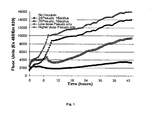
- Wells of a 96-microtiter plate were filled with 200 microL of Plate Count Broth (Difco DF0751-17-2) and inoculated with a Pseudomonas aeruginosa strain equipped with a plasmid expressing green fluorescent protein constitutively.
- a blend of six Bacillus spp. (6BB) was added to the wells.
- Initial dose of Pseudomonas was either 2.4x10 8 or 4.8x10 8 cfu/mL while Bacillus spp. dose was 6.8x10 6 to 1.0x10 7 cfu/mL resulting in Pseudomonas:Bacillus ratios of 24:1 and 70:1.
- Microtiter plates were tracked with a fluorescent kinetic microtiter plate reader (BioTek Synergy HT-I) with incubation at 21°C and fluorescent reads at 485/20 nm excitation, 528/20 nm emission, every 20 minutes for 43 hours. Resulting fluorescence kinetic curves showed Bacillus-dose dependent suppression of gfp fluorescence (i.e., Pseudomonas population suppression) ( Fig. 1 ).
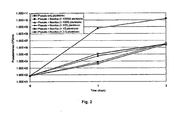
- a polycarbonate holder (Biosurfaces Technology) with three porcelain coupons (Tyler Research Instruments Corp., Edmonton, Alberta) was inserted into a wide-mouth test tube (Fisher cat#NC9421998) and 50 mL Plate Count Broth (Difco DF0751-17-2) made according to label instructions was added and autoclaved. Tubes were inoculated with a blend of Bacillus spores and incubated at 28°C with mild shaking overnight thereby allowing germination. Initial dose of Bacillus spores ranged from 2.6x10 2 to 7.8x10 5 cfu/mL.
- a Pseudomonas aeruginosa strain with gfp expression was added to the tubes at a concentration of 70 cfu/ml resulting in Pseudomonas:Bacillus initial inoculum ratios ranging from 1:3.5 to 1:10,000.
- the tubes were destructively sampled by scraping each coupon (biofilm cells) into phosphate buffered saline, homogenizing the suspension, then diluting and plating on MacConkey agar (Difco DF0075-17-1) to enumerate only Pseudomonas cells.
- the broth in the tubes (planktonic cells) was also sampled, diluted and plated.
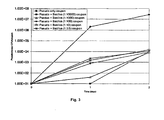
- a polycarbonate holder (Biosurfaces Technology) with three porcelain coupons (Tyler Research Instruments Corp., Edmonton, Alberta) was inserted into a wide-mouth test tube (Fisher cat#NC9421998) and 50 mL Plate Count Broth (Difco DF0751-17-2) made according to label instructions was added and autoclaved.
- Each tube was inoculated with an overnight vegetative cell culture of an individual Bacillus candidate and an overnight culture of Pseudomonas aeruginosa equipped with a gfp plasmid. The tubes were incubated at 28°C with mild shaking.
- Initial dose of Bacillus cells was in the range of 1.0x10 3 to 8.2x10 5 cfu/mL and initial dose of Pseudomonas was approximately 1x10 3 to 1x10 5 .
- the Pseudomonas to Bacillus ratios ranged from 1: 2 to 1:147.
- the tubes were destructively sampled by scraping each coupon (biofilm cells) into phosphate buffered saline, homogenizing the suspension, then diluting and plating on MacConkey agar (Difco DF0075-17-1) to enumerate only Pseudomonas cells.
- the broth in the tubes (planktonic cells) was also sampled, diluted and plated.
- Pseudomonas counts in the presence of Bacillus spp. were compared to negative controls with no Bacillus spp. present and log control of Pseudomonas for each Bacillus candidate was calculated at time 24 and 48 hours for planktonic and attached cells.
- a polycarbonate holder (Biosurfaces Technology) with three porcelain coupons was inserted into a wide-mouth test tube (Fisher cat#NC9421998) and 50 mL plate count broth (Difco DF0751-17-2) made according to label instructions was added and autoclaved.
- Each tube was inoculated with an overnight vegetative cell culture of an individual Bacillus candidate and an overnight culture of E. coli.
- the tubes were incubated at 28°C with mild shaking.
- Initial dose of Bacillus cells was in the range of 1.0x10 3 to 8.2x10 5 cfu/mL and initial dose of E. coli was in the range of 1x10 3 to 1x10 5 .
- the E. coli to Bacillus ratios ranged from 1: 0.6 to 1:32.
- the tubes were destructively sampled by scraping each coupon (biofilm cells) into phosphate buffered saline, homogenizing the suspension, then diluting and plating on MacConkey agar (Difco DF0075-17-1) to enumerate only E. coli cells.
- the broth in the tubes (planktonic cells) was also sampled, diluted and plated.
- E. coli counts in the presence of Bacillus spp. were compared to negative controls with no Bacillus spp. present and log control of E. coli for each Bacillus candidate was calculated at time 24 and 48 hours for planktonic and attached cells.
- Bacillus candidates were grown in Plate Count broth for 18 to 24 hours resulting in appx 10 7 to 10 8 cfu/mL.
- E. coli grown 18 to 24 hours (appx 10 8 to 10 10 cfu.mL) was streaked to form a lawn on the surface of Standard Methods agar plates (SMA plates) Smith River Biologicals, Ferrum, VA) and four 5 mm holes were bored into the agar with a sterile stainless steel tube. 50 microL of each Bacillus liquid culture was delivered into the holes (1 strain per hole) and the plate was incubated for 18 to 48 hours at 35°C, agar side down. Inhibited E. coli lawn in proximity to a hole was scored as positive biocontrol for the Bacillus candidate.
- SMA plates Standard Methods agar plates
- VA Standard Methods agar plates
- 50 microL of each Bacillus liquid culture was delivered into the holes (1 strain per hole) and the plate was incubated for 18 to 48 hours at 35°C, agar
- Bacillus candidates were grown in Plate Count broth for 18 to 24 hours resulting in appx 10 7 to 10 8 cfu/mL culture.
- Pseudomonas aeruginosa was grown 18 to 24 hours (appx 10 8 to 10 10 cfu/mL) and streaked to form a lawn on the surface of Standard Methods agar plates (Smith River Biologicals, Ferrum, VA) and four 5 mm holes were bored into the agar with a sterile stainless steel tube. 50 microL of each Bacillus liquid culture were delivered into the holes (1 strain per hole) and the plate was incubated for 18 to 48 hours at 35°C, agar side down.
- Bacillus candidate NRRL B-50014 was grown in Plate Count broth for 18 to 24 hours resulting in appx 10 7 to 10 8 cfu/mL culture.
- Pseudomonas montelli (ATCC 700412) and Ps . putida (ATCC 49451) grown 18 to 24 hours (appx 10 8 to 10 10 cfu/ml culture) were streaked to form a lawn on the surface of Standard Methods agar plates and four 5 mm holes were bored into the agar with a sterile stainless steel tube. 50 microL of Bacillus liquid culture were delivered into the holes and the plate was incubated for 18 to 48 hours at 35°C, agar side down. Inhibited Pseudomonas lawn in proximity to a hole was scored as positive biocontrol for the Bacillus candidate. The zone of inhibition was also measured in millimeters (mm) to allow semi-quantitative assessment of control.
- Serratia rubidaea was used as the indicator bacterium as its pigmentation is dependent on in tact quorum sensing pathway. Quorum sensing compounds allow bacteria to "communicate” and affect phenotypes such as pigmentation, motility, pathogenicity and biofilm formation, thus Quorum Sensing Inhibition is a mode of action for biofilm control.
- Bacillus candidates were grown in plate count broth, 18 to 24 hours, 35°C, to a density of appx. 10 7 cfu/mL.
- the Bacilli were spotted (10 microL) onto a Standard Methods agar plate (Smith River Biologicals, Ferrum, VA) and incubated for 18 to 24 hours at 26°C, after which time, colonies were visible.
- the Serratia culture (5 microL) (Luria broth, 18 to 24 hours, 26°C, appx. 10 7 cfu/ml) was added to 5 mL of 0.5% molten LB agar (Luria broth 30.5 g/L and 0.5% noble agar), mixed well, and poured over the plates with mature Bacillus candidate colonies.
- Pseudomonas aeruginosa was grown overnight in plate count broth and 20 microL of a 1:100 dilution of Pseudomonas culture was then added to all four reactors (3590 cfu/mL) and the resulting co-culture ratio was 1 Pseudomonas :127 Bacilli. After 24 hours of growth, media redosing began at a rate of 3 mL/min dilute plate count broth (1 g/L concentration). Stirring was set to 60 rpm.
- Treated reactor B Average treated reactors ⁇ Untreated reactor A ⁇ Untreated reactor B ⁇ Average untreated reactors ⁇ Average log control ⁇ Biofilm (scraped from coupons) 2.6 ⁇ 10 2 5.7 ⁇ 10 2 4.2 ⁇ 10 2 6.7 ⁇ 10 6 1.4 ⁇ 10 6 4.1 ⁇ 10 6 3.9 Planktonic (liquid) samples 1.4 ⁇ 10 4 1.1 ⁇ 10 4 1.3 ⁇ 10 4 2.1 ⁇ 10 7 6.4 ⁇ 10 7 4.3 ⁇ 10 7 3.5 ⁇ count cfu/mL or cfu/coupon
- CDC Biofilm reactors Biosurfaces Technologies, Bozeman, MT, Cat#CBR90-2) with porcelain coupons (Tyler Research Instruments Corp., Edmonton, Alberta) were filled with 400 mL plate count broth (full strength) and autoclaved.
- Pseudomonas aeruginosa was grown overnight in plate count broth and 20 microL of a 1:100 dilution of Pseudomonas culture was added to all four reactors (127 cfu/ml trial 1, 1x10 5 cfu/ml trial 2) and the resulting co-culture ratio was 1 Pseudomonas :104 Bacilli for trial 1 and 1:0.1 for trial 2. After 24 hours of growth, media redosing began at a rate of 90 ml/15 min dilute plate count broth (1 g/L concentration) for 15 min every hour.
- Bacillus spores were dosed at a rate of 1.5 ml spore concentrate over the course of 2.7 hours for a final concentration of 1.1x10 8 cfu Bacillus spores/day for trial 1 and 1.8x10 7 cfu Bacillus spores/day for trial 2. Stirring was set to 60 rpm.
- Bacillus candidates were grown in nutrient broth (3 g/L beef extract, 5 g/L peptone) at 35°C for 18-24 hours.
- V. harveyi ATCC 25919 was grown in nutrient broth with 1.5% added NaCl at 28°C for 18-24 hours.
- Nutrient agar (1.5% agar) with 1.5% NaCl was autoclaved in 25 mL aliquots and 250 microL overnight Vibrio culture was added to each aliquot of molten agar resulting in approximately 1x10 6 cfu/mL Vibrio in agar. After agar solidified, 4 holes were bored in each plate using a piece of sterilized stainless steel tubing.
- Bacillus candidates were grown in nutrient broth (3 g/L beef extract, 5 g/L peptone) at 35°C for 18-24 hours.
- V. alginolyticus ATCC 17749 was grown in nutrient broth with 1.5% added NaCl at 28°C for 18-24 hours.
- Nutrient agar (1.5% agar) with 1.5% NaCl was autoclaved in 25 mL aliquots and 250 microL overnight Vibrio culture was added to each aliquot of molten agar resulting in approximately 1x10 6 cfu/ml Vibrio in agar. After agar solidified, 4 holes were bored in each plate using a piece of sterilized stainless steel tubing.
- Bacillus candidates were grown in nutrient broth (3 g/L beef extract, 5 g/L peptone) at 35°C for 18-24 hours.
- V. fisherii was grown in nutrient broth with 1.5% added NaCl at 28°C for 18-24 hours.
- Nutrient agar (1.5% agar) with 1.5% NaCl was autoclaved in 25 mL aliquots and 250 microL overnight Vibrio culture was added to each aliquot of molten agar resulting in approximately 1x10 6 cfu/ml Vibrio in agar. After agar solidified, 4 holes were bored in each plate using a piece of sterilized stainless steel tubing. 50 microL of each overnight Bacillus culture was transferred to each well.
Landscapes
- Life Sciences & Earth Sciences (AREA)
- Microbiology (AREA)
- Engineering & Computer Science (AREA)
- Health & Medical Sciences (AREA)
- Zoology (AREA)
- General Health & Medical Sciences (AREA)
- Chemical & Material Sciences (AREA)
- Organic Chemistry (AREA)
- Water Supply & Treatment (AREA)
- Environmental & Geological Engineering (AREA)
- Hydrology & Water Resources (AREA)
- Biodiversity & Conservation Biology (AREA)
- Wood Science & Technology (AREA)
- Environmental Sciences (AREA)
- Dentistry (AREA)
- Biotechnology (AREA)
- Virology (AREA)
- Plant Pathology (AREA)
- Agronomy & Crop Science (AREA)
- Pest Control & Pesticides (AREA)
- Micro-Organisms Or Cultivation Processes Thereof (AREA)
- Agricultural Chemicals And Associated Chemicals (AREA)
- Apparatus For Disinfection Or Sterilisation (AREA)
- Detergent Compositions (AREA)
Priority Applications (2)
| Application Number | Priority Date | Filing Date | Title |
|---|---|---|---|
| EP12172287.0A EP2500325B1 (en) | 2007-03-23 | 2008-03-20 | Preventing and reducing biofilm formation and planktonic proliferation |
| DK12172287.0T DK2500325T3 (da) | 2007-03-23 | 2008-03-20 | Forebyggelse og reducering af biofilmdannelse og planktonformering |
Applications Claiming Priority (2)
| Application Number | Priority Date | Filing Date | Title |
|---|---|---|---|
| US89669307P | 2007-03-23 | 2007-03-23 | |
| PCT/US2008/057670 WO2008118749A2 (en) | 2007-03-23 | 2008-03-20 | Preventing and reducing biofilm formation and planktonic proliferation |
Related Child Applications (2)
| Application Number | Title | Priority Date | Filing Date |
|---|---|---|---|
| EP12172287.0A Division EP2500325B1 (en) | 2007-03-23 | 2008-03-20 | Preventing and reducing biofilm formation and planktonic proliferation |
| EP12172287.0 Division-Into | 2012-06-15 |
Publications (2)
| Publication Number | Publication Date |
|---|---|
| EP2134657A2 EP2134657A2 (en) | 2009-12-23 |
| EP2134657B1 true EP2134657B1 (en) | 2013-10-16 |
Family
ID=39535187
Family Applications (2)
| Application Number | Title | Priority Date | Filing Date |
|---|---|---|---|
| EP12172287.0A Active EP2500325B1 (en) | 2007-03-23 | 2008-03-20 | Preventing and reducing biofilm formation and planktonic proliferation |
| EP08732576.7A Active EP2134657B1 (en) | 2007-03-23 | 2008-03-20 | Preventing and reducing biofilm formation and planktonic proliferation |
Family Applications Before (1)
| Application Number | Title | Priority Date | Filing Date |
|---|---|---|---|
| EP12172287.0A Active EP2500325B1 (en) | 2007-03-23 | 2008-03-20 | Preventing and reducing biofilm formation and planktonic proliferation |
Country Status (9)
| Country | Link |
|---|---|
| US (2) | US20080233093A1 (da) |
| EP (2) | EP2500325B1 (da) |
| JP (3) | JP5427041B2 (da) |
| CN (1) | CN101679087B (da) |
| AU (1) | AU2008231038B2 (da) |
| CA (1) | CA2680370C (da) |
| DK (2) | DK2134657T3 (da) |
| ES (2) | ES2440741T3 (da) |
| WO (1) | WO2008118749A2 (da) |
Families Citing this family (21)
| Publication number | Priority date | Publication date | Assignee | Title |
|---|---|---|---|---|
| AU2007284126B2 (en) | 2006-08-11 | 2013-12-19 | Novozymes Biologicals, Inc. | Bacteria cultures and compositions comprising bacteria cultures |
| CN101903511B (zh) * | 2007-12-20 | 2013-01-30 | 丹尼斯科美国公司 | 生物膜的酶促防止和控制 |
| US20120100589A1 (en) * | 2009-03-09 | 2012-04-26 | Xergi A/S | Method for methane generation |
| CN102421456A (zh) * | 2009-04-22 | 2012-04-18 | 诺维信公司 | 用于杀伤或抑制分枝杆菌属生长的方法 |
| US20110110894A1 (en) * | 2009-11-10 | 2011-05-12 | Novozymes Biologicals, Inc. | Methods, compositions and systems for controlling fouling of a membrane |
| WO2012050392A2 (ko) * | 2010-10-15 | 2012-04-19 | 서울대학교산학협력단 | 생물막 형성 억제 미생물 고정화 용기 및 이를 이용한 분리막 수처리 장치 |
| FR2969173B1 (fr) * | 2010-12-21 | 2016-03-25 | Agronomique Inst Nat Rech | Procede d'elimination d'un biofilm de microorganismes |
| WO2012112718A1 (en) | 2011-02-15 | 2012-08-23 | Novozymes Biologicals, Inc. | Mitigation of odor in cleaning machines and cleaning processes |
| US20140342038A1 (en) * | 2011-12-19 | 2014-11-20 | Novozymes A/S | Processes and Compositions For Increasing The Digestibility of Cellulosic Materials |
| CN103320336A (zh) * | 2012-03-23 | 2013-09-25 | 中国科学院城市环境研究所 | 一株具有广谱性生物膜抑制能力的细菌 |
| US11883443B2 (en) | 2013-04-09 | 2024-01-30 | Novozymes A/S | Compositions and methods for improving the health of aquatic animals |
| AU2016344406B2 (en) * | 2015-10-30 | 2021-09-09 | Z Probiotics Inc. Dba Z Bioscience Inc. | Probiotic compositions and uses thereof |
| CN107636880B (zh) | 2015-10-30 | 2020-07-10 | 株式会社Lg化学 | 具有多层结构的聚合物电解质及包含其的全固体电池 |
| CN105733828B (zh) * | 2016-03-07 | 2018-04-27 | 浙江工商大学 | 一种减缓市政污水管道堵塞的药剂及其应用 |
| WO2017157772A1 (en) * | 2016-03-14 | 2017-09-21 | Henkel Ag & Co. Kgaa | Method for controlling malodors with regard to sanitary applications, using bacterial spores capable of inhibiting or preventing the production of malodor |
| BE1025305B1 (fr) * | 2017-12-08 | 2019-01-11 | Ets Pollet Sa | Composition détergente |
| CN109694134A (zh) * | 2019-01-24 | 2019-04-30 | 张庆堂 | 一种多孔性污水净化竹球及其加工方法 |
| CN110452848B (zh) * | 2019-08-20 | 2022-04-15 | 昆明理工大学 | 一株贝莱斯芽孢杆菌及其应用 |
| JP7111396B2 (ja) * | 2020-12-28 | 2022-08-02 | 株式会社カイコーポレーション | 除菌剤及び除菌方法 |
| EP4482934A1 (en) * | 2022-02-25 | 2025-01-01 | Unilever IP Holdings B.V. | A hygiene composition |
| CN120005757A (zh) * | 2025-02-12 | 2025-05-16 | 宁波市海洋与渔业研究院 | 一种南美白对虾源蛭弧菌及其应用 |
Family Cites Families (111)
| Publication number | Priority date | Publication date | Assignee | Title |
|---|---|---|---|---|
| GB1296839A (da) | 1969-05-29 | 1972-11-22 | ||
| GB1372034A (en) | 1970-12-31 | 1974-10-30 | Unilever Ltd | Detergent compositions |
| DK187280A (da) | 1980-04-30 | 1981-10-31 | Novo Industri As | Ruhedsreducerende middel til et fuldvaskemiddel fuldvaskemiddel og fuldvaskemetode |
| JPH0697997B2 (ja) | 1985-08-09 | 1994-12-07 | ギスト ブロカデス ナ−ムロ−ゼ フエンノ−トチヤツプ | 新規の酵素的洗浄剤添加物 |
| US4655794A (en) * | 1986-03-20 | 1987-04-07 | Sybron Chemicals Holdings Inc. | Liquid cleaner containing viable microorganisms |
| JPS6356289A (ja) | 1986-07-30 | 1988-03-10 | Res Dev Corp Of Japan | β−マンナナ−ゼおよびその製法 |
| JPS6336775A (ja) | 1986-07-31 | 1988-02-17 | Res Dev Corp Of Japan | β―マンナナーゼおよびβ―マンノシダーゼ生産能を有するアルカリ性バチルス属新菌株 |
| ATE110768T1 (de) | 1986-08-29 | 1994-09-15 | Novo Nordisk As | Enzymhaltiger reinigungsmittelzusatz. |
| NZ221627A (en) | 1986-09-09 | 1993-04-28 | Genencor Inc | Preparation of enzymes, modifications, catalytic triads to alter ratios or transesterification/hydrolysis ratios |
| DE3854249T2 (de) | 1987-08-28 | 1996-02-29 | Novonordisk As | Rekombinante Humicola-Lipase und Verfahren zur Herstellung von rekombinanten Humicola-Lipasen. |
| JPS6474992A (en) | 1987-09-16 | 1989-03-20 | Fuji Oil Co Ltd | Dna sequence, plasmid and production of lipase |
| EP0471265B1 (en) | 1988-01-07 | 1995-10-25 | Novo Nordisk A/S | Specific protease |
| DK6488D0 (da) | 1988-01-07 | 1988-01-07 | Novo Industri As | Enzymer |
| JP3079276B2 (ja) | 1988-02-28 | 2000-08-21 | 天野製薬株式会社 | 組換え体dna、それを含むシュードモナス属菌及びそれを用いたリパーゼの製造法 |
| WO1989009259A1 (en) | 1988-03-24 | 1989-10-05 | Novo-Nordisk A/S | A cellulase preparation |
| US5776757A (en) | 1988-03-24 | 1998-07-07 | Novo Nordisk A/S | Fungal cellulase composition containing alkaline CMC-endoglucanase and essentially no cellobiohydrolase and method of making thereof |
| DE3841596A1 (de) * | 1988-12-09 | 1990-06-13 | Joerg Dr Oberkofler | Verfahren zur herabsetzung der schleim- und belagbildung in anlagen |
| US5242593A (en) | 1988-12-09 | 1993-09-07 | Oberkofler Joerg | Method for reducing the build-up of slime and/or film in water circulation systems |
| GB8915658D0 (en) | 1989-07-07 | 1989-08-23 | Unilever Plc | Enzymes,their production and use |
| JPH0347076A (ja) | 1989-08-25 | 1991-02-28 | Res Dev Corp Of Japan | β―マンナナーゼおよびその製法 |
| EP0528828B2 (de) | 1990-04-14 | 1997-12-03 | Genencor International GmbH | Alkalische bacillus-lipasen, hierfür codierende dna-sequenzen sowie bacilli, die diese lipasen produzieren |
| US5171591A (en) | 1990-05-03 | 1992-12-15 | The United States Of America As Represented By The Secretary Of Agriculture | Control or elimination of undesirable bacteria using parasitic Bdellovibrio bacteria |
| DK115890D0 (da) | 1990-05-09 | 1990-05-09 | Novo Nordisk As | Enzym |
| CA2082279C (en) | 1990-05-09 | 2007-09-04 | Grethe Rasmussen | Cellulase preparation comprising an endoglucanase enzyme |
| WO1991018974A1 (en) | 1990-05-29 | 1991-12-12 | Chemgen Corporation | HEMICELLULASE ACTIVE AT EXTREMES OF pH AND TEMPERATURE AND THE MEANS FOR THE PRODUCTION THEREOF |
| DE69129988T2 (de) | 1990-09-13 | 1999-03-18 | Novo Nordisk A/S, Bagsvaerd | Lipase-varianten |
| DE69133035T2 (de) | 1991-01-16 | 2003-02-13 | The Procter & Gamble Company, Cincinnati | Kompakte Waschmittelzusammensetzungen mit hochaktiven Cellulasen |
| KR100258460B1 (ko) | 1991-05-01 | 2000-06-01 | 한센 핀 베네드 | 안정화 효소 및 세제 조성물 |
| JP2626662B2 (ja) | 1991-10-09 | 1997-07-02 | 科学技術振興事業団 | 新規なβ−マンナナーゼとその製造方法 |
| FR2687659B1 (fr) | 1992-02-24 | 1994-08-26 | Texel | Procede de traitement de la flore contaminant les circuits papetiers mettant en óoeuvre des bacteries. |
| FI931193A0 (fi) | 1992-05-22 | 1993-03-17 | Valtion Teknillinen | Mannanasenzymer, gener som kodar foer dem och foerfaranden foer isoleringav generna samt foerfarande foer blekning av lignocellulosahaltig massa |
| DK72992D0 (da) | 1992-06-01 | 1992-06-01 | Novo Nordisk As | Enzym |
| DK88892D0 (da) | 1992-07-06 | 1992-07-06 | Novo Nordisk As | Forbindelse |
| EP0651794B1 (en) | 1992-07-23 | 2009-09-30 | Novozymes A/S | MUTANT $g(a)-AMYLASE, DETERGENT AND DISH WASHING AGENT |
| EP1431389A3 (en) | 1992-10-06 | 2004-06-30 | Novozymes A/S | Cellulase variants |
| CZ293163B6 (cs) | 1993-02-11 | 2004-02-18 | Genencor International, Inc. | Mutanta alfa-amylázy, její použití, kódová DNA pro tuto mutantu, vektor pro expresi, hostitelské buňky, čisticí prostředek a prostředek pro zkapalnění škrobu |
| ATE287946T1 (de) | 1993-04-27 | 2005-02-15 | Genencor Int | Neuartige lipasevarianten zur verwendung in reinigungsmitteln |
| DK48693D0 (da) | 1993-04-30 | 1993-04-30 | Novo Nordisk As | Enzym |
| DK52393D0 (da) | 1993-05-05 | 1993-05-05 | Novo Nordisk As | |
| JP2859520B2 (ja) | 1993-08-30 | 1999-02-17 | ノボ ノルディスク アクティーゼルスカブ | リパーゼ及びそれを生産する微生物及びリパーゼ製造方法及びリパーゼ含有洗剤組成物 |
| EP0724631A1 (en) | 1993-10-13 | 1996-08-07 | Novo Nordisk A/S | H 2?o 2?-stable peroxidase variants |
| JPH07143883A (ja) | 1993-11-24 | 1995-06-06 | Showa Denko Kk | リパーゼ遺伝子及び変異体リパーゼ |
| EP0746618B1 (en) | 1994-02-22 | 2002-08-21 | Novozymes A/S | A method of preparing a variant of a lipolytic enzyme |
| WO1995024471A1 (en) | 1994-03-08 | 1995-09-14 | Novo Nordisk A/S | Novel alkaline cellulases |
| DK0753057T3 (da) | 1994-03-29 | 2006-01-30 | Novozymes As | Alkalisk Bacillus-amylase |
| JP3851656B2 (ja) | 1994-05-04 | 2006-11-29 | ジェネンコア インターナショナル インコーポレーテッド | 改善された界面活性剤耐性を有するリパーゼ |
| WO1995035381A1 (en) | 1994-06-20 | 1995-12-28 | Unilever N.V. | Modified pseudomonas lipases and their use |
| WO1996000292A1 (en) | 1994-06-23 | 1996-01-04 | Unilever N.V. | Modified pseudomonas lipases and their use |
| DE69535733T2 (de) | 1994-10-06 | 2009-04-23 | Novozymes A/S | Ein enzympräparat mit endoglucanase aktivität |
| BE1008998A3 (fr) | 1994-10-14 | 1996-10-01 | Solvay | Lipase, microorganisme la produisant, procede de preparation de cette lipase et utilisations de celle-ci. |
| BR9509525A (pt) | 1994-10-26 | 1995-10-26 | Novo Nordisk As | Construção de dna vetor de expressão recombinante célula processo para produzir a enzima que exibe atividade lipolítica enzima que exibe atividade lipolítica preparação de enzima aditivo de detergente e composição de detergente |
| AR000862A1 (es) | 1995-02-03 | 1997-08-06 | Novozymes As | Variantes de una ó-amilasa madre, un metodo para producir la misma, una estructura de adn y un vector de expresion, una celula transformada por dichaestructura de adn y vector, un aditivo para detergente, composicion detergente, una composicion para lavado de ropa y una composicion para la eliminacion del |
| JPH08228778A (ja) | 1995-02-27 | 1996-09-10 | Showa Denko Kk | 新規なリパーゼ遺伝子及びそれを用いたリパーゼの製造方法 |
| EP0815209B2 (en) | 1995-03-17 | 2015-02-25 | Novozymes A/S | Novel endoglucanases |
| AU6414196A (en) | 1995-07-14 | 1997-02-18 | Novo Nordisk A/S | A modified enzyme with lipolytic activity |
| WO1997007202A1 (en) | 1995-08-11 | 1997-02-27 | Novo Nordisk A/S | Novel lipolytic enzymes |
| AU719544B2 (en) | 1995-09-18 | 2000-05-11 | Biomanagement Systems Pty Ltd | A method of controlling a pathogenic bacterial population |
| JPH11514856A (ja) | 1995-09-20 | 1999-12-21 | ジェネンコア インターナショナル インコーポレーテッド | バチルスアミロリケファシエンスからの精製マンナーゼおよびその調製方法 |
| WO1997025865A1 (en) | 1996-01-16 | 1997-07-24 | Sybron Chemical Holdings, Inc. | Cleaner and sanitizer formulation |
| US5763385A (en) | 1996-05-14 | 1998-06-09 | Genencor International, Inc. | Modified α-amylases having altered calcium binding properties |
| AU3938997A (en) | 1996-08-26 | 1998-03-19 | Novo Nordisk A/S | A novel endoglucanase |
| BR9711479B1 (pt) | 1996-09-17 | 2009-08-11 | variante de celulase tendo uma resistência aumentada a tensìdeo de ánion. | |
| CA2265734A1 (en) | 1996-10-08 | 1998-04-16 | Novo Nordisk A/S | Diaminobenzoic acid derivatives as dye precursors |
| US6300116B1 (en) | 1996-11-04 | 2001-10-09 | Novozymes A/S | Modified protease having improved autoproteolytic stability |
| BR9712473B1 (pt) | 1996-11-04 | 2009-08-11 | variantes de subtilase e composições. | |
| AU5187898A (en) | 1996-12-09 | 1998-07-03 | Novo Nordisk A/S | Reduction of phosphorus containing components in edible oils comprising a high amount of non-hydratable phosphorus by use of a phospholipase, a phospholipase from a filamentous fungus having phospholipase a and/or b activity |
| US6100080A (en) * | 1996-12-18 | 2000-08-08 | Novo Nordisk A/S | Method for enzymatic treatment of biofilm |
| WO1998034946A1 (en) | 1997-02-12 | 1998-08-13 | Massachusetts Institute Of Technology | Daxx, a novel fas-binding protein that activates jnk and apoptosis |
| GB9705001D0 (en) | 1997-03-11 | 1997-04-30 | Biofil Ltd | Hydroponic plant culture systems |
| JPH10249388A (ja) * | 1997-03-13 | 1998-09-22 | Washi Kosan Kk | 抗菌性微生物を用いた風呂 |
| FR2762593B1 (fr) * | 1997-04-25 | 1999-07-30 | Rhodia Chimie Sa | Procede de reduction ou de suppression des depots d'origine bacterienne dans les installations d'eaux en circuit ferme |
| AU7908898A (en) | 1997-07-04 | 1999-01-25 | Novo Nordisk A/S | Family 6 endo-1,4-beta-glucanase variants and cleaning composit ions containing them |
| EP1010754A4 (en) | 1997-09-03 | 2000-12-06 | Washi Kosan Kk | New microorganism |
| EP1032658B1 (en) | 1997-11-24 | 2012-06-27 | Novozymes A/S | Pectate lyases |
| WO1999027083A1 (en) | 1997-11-24 | 1999-06-03 | Novo Nordisk A/S | PECTIN DEGRADING ENZYMES FROM $i(BACILLUS LICHENIFORMIS) |
| US6124127A (en) | 1997-11-24 | 2000-09-26 | Novo Nordisk A/S | Pectate lyase |
| EP2261359B1 (en) | 1998-06-10 | 2014-08-20 | Novozymes A/S | Mannanases |
| EP1131416B1 (en) | 1998-11-27 | 2009-09-02 | Novozymes A/S | Lipolytic enzyme variants |
| JP4615723B2 (ja) | 1998-12-04 | 2011-01-19 | ノボザイムス アクティーゼルスカブ | クチナーゼ変異体 |
| JP4745503B2 (ja) | 1999-03-31 | 2011-08-10 | ノボザイムス アクティーゼルスカブ | アルカリα−アミラーゼ活性を有するポリペプチド及びそれらをコードする核酸 |
| US6140106A (en) * | 1999-04-14 | 2000-10-31 | Roebic Laboratories, Inc. | Enzyme-producing strain of Bacillus subtilis |
| US6165965A (en) * | 1999-04-16 | 2000-12-26 | Spartan Chemical Company, Inc. | Aqueous disinfectant and hard surface cleaning composition and method of use |
| AU2001240473A1 (en) | 2000-03-08 | 2001-09-17 | Novozymes A/S | Variants with altered properties |
| JP2001299328A (ja) * | 2000-04-27 | 2001-10-30 | Sanyo Chem Ind Ltd | 粉末状微生物含有組成物 |
| JP4988124B2 (ja) | 2000-06-02 | 2012-08-01 | ノボザイムス アクティーゼルスカブ | クチナーゼ変異体 |
| AU2001269939A1 (en) * | 2000-06-19 | 2002-01-02 | Novozymes Biotech, Inc. | Methods for eliminating the formation of biofilm |
| MXPA03000435A (es) | 2000-07-19 | 2004-04-02 | Novozymes As | Variantes de enzimas que degradan la pared celular. |
| EP1370648A2 (en) | 2000-08-01 | 2003-12-17 | Novozymes A/S | Alpha-amylase mutants with altered properties |
| JP2002060307A (ja) * | 2000-08-18 | 2002-02-26 | Japan Science & Technology Corp | 赤潮防除剤 |
| EP1358479A4 (en) * | 2000-09-25 | 2006-05-10 | Acuabiotec Llc | METHOD, SYSTEM AND COMPUTER PROGRAM PRODUCT FOR THE TECHNICAL MANAGEMENT AND BIO CONTROL OF DISEASES IN ANIMAL PRODUCTION SYSTEMS |
| JP2002121593A (ja) * | 2000-09-26 | 2002-04-26 | Spartan Chemical Co Inc | 硬質表面洗浄用殺菌性水系組成物および使用方法 |
| EP1326965A2 (en) | 2000-10-13 | 2003-07-16 | Novozymes A/S | Alpha-amylase variant with altered properties |
| CA2426080A1 (en) * | 2000-10-20 | 2002-04-25 | Innu-Science Canada Inc. | Hard surface cleaning composition |
| US6376451B1 (en) * | 2000-10-20 | 2002-04-23 | Innu-Science 2000 Inc. | Hard surface cleaning composition |
| US6743361B1 (en) * | 2000-11-27 | 2004-06-01 | Biological Systems, Inc. | Method for bacterially treating tank toilet systems and apparatus for using same |
| JP2002226893A (ja) * | 2001-01-31 | 2002-08-14 | Sekisui Chem Co Ltd | 洗浄剤用組成物及び固形洗浄剤 |
| US6649401B2 (en) | 2001-05-18 | 2003-11-18 | Jessi Lind Tisinger | Gram-positive fatty acid degrader |
| US6498137B1 (en) * | 2001-06-27 | 2002-12-24 | Spartan Chemical Company, Inc. | Aerosol cleaning composition containing an organic acid and a spore forming microbial composition |
| FR2828407B1 (fr) * | 2001-08-10 | 2005-06-24 | Cobiotex | Compositions a base de complexes bacteriens et leurs applications pour la prevention des infections nosocomiales |
| US7183248B2 (en) * | 2001-08-23 | 2007-02-27 | Treyco Supply Co. | Enzymatic cleaner having high pH stability |
| JP2003253299A (ja) * | 2002-02-27 | 2003-09-10 | Sekisui Chem Co Ltd | 洗浄剤用組成物及び固形洗浄剤 |
| JP2004231671A (ja) * | 2002-12-03 | 2004-08-19 | Lion Corp | 洗浄剤組成物及び除菌・洗浄力評価方法 |
| JP2004300032A (ja) * | 2003-03-28 | 2004-10-28 | Sds Biotech:Kk | 有害プランクトン防除製剤、その製造方法および用途 |
| US20060251763A1 (en) | 2003-06-19 | 2006-11-09 | Patkar Shamkant A | Phospholipase variants |
| JP2005232920A (ja) * | 2004-02-23 | 2005-09-02 | Matsushita Electric Works Ltd | ぬめり除去浄化装置およびこれを設置した流し台、浴室 |
| JP3776919B2 (ja) * | 2004-02-27 | 2006-05-24 | 株式会社 イツキ | バチルス属細菌を用いた植物病害の防除方法および防除剤 |
| CN107151662B (zh) | 2004-07-05 | 2021-06-29 | 诺维信公司 | 具有改变特性的α-淀粉酶变异体 |
| EP2258837A1 (en) | 2004-09-10 | 2010-12-08 | Novozymes North America, Inc. | Methods for preventing, removing, reducing, or disrupting biofilm |
| BE1016597A6 (nl) * | 2005-05-25 | 2007-02-06 | Gielen Cornelis | Werkwijze voor het pathogeen vrij houden van een oppervlak, voorwerp en/of inrichting. |
| JP2007055982A (ja) * | 2005-08-26 | 2007-03-08 | Itsuki Co Ltd | バチルス属細菌の栄養細胞を有効成分とする植物病害の防除方法および防除剤 |
| AU2007284126B2 (en) | 2006-08-11 | 2013-12-19 | Novozymes Biologicals, Inc. | Bacteria cultures and compositions comprising bacteria cultures |
-
2008
- 2008-03-20 US US12/052,283 patent/US20080233093A1/en not_active Abandoned
- 2008-03-20 EP EP12172287.0A patent/EP2500325B1/en active Active
- 2008-03-20 AU AU2008231038A patent/AU2008231038B2/en not_active Ceased
- 2008-03-20 DK DK08732576.7T patent/DK2134657T3/da active
- 2008-03-20 EP EP08732576.7A patent/EP2134657B1/en active Active
- 2008-03-20 DK DK12172287.0T patent/DK2500325T3/da active
- 2008-03-20 ES ES08732576.7T patent/ES2440741T3/es active Active
- 2008-03-20 CN CN2008800095964A patent/CN101679087B/zh active Active
- 2008-03-20 JP JP2009554741A patent/JP5427041B2/ja not_active Expired - Fee Related
- 2008-03-20 WO PCT/US2008/057670 patent/WO2008118749A2/en not_active Ceased
- 2008-03-20 ES ES12172287.0T patent/ES2503619T3/es active Active
- 2008-03-20 CA CA2680370A patent/CA2680370C/en active Active
-
2013
- 2013-11-29 JP JP2013247623A patent/JP2014043467A/ja active Pending
-
2015
- 2015-04-27 US US14/696,710 patent/US9809477B2/en not_active Expired - Fee Related
-
2016
- 2016-05-12 JP JP2016095875A patent/JP6243473B2/ja not_active Expired - Fee Related
Also Published As
| Publication number | Publication date |
|---|---|
| EP2134657A2 (en) | 2009-12-23 |
| JP6243473B2 (ja) | 2017-12-06 |
| JP2016147904A (ja) | 2016-08-18 |
| JP5427041B2 (ja) | 2014-02-26 |
| DK2500325T3 (da) | 2014-10-06 |
| WO2008118749A3 (en) | 2008-12-11 |
| US20080233093A1 (en) | 2008-09-25 |
| EP2500325B1 (en) | 2014-07-16 |
| CN101679087B (zh) | 2012-08-15 |
| JP2014043467A (ja) | 2014-03-13 |
| US20150225272A1 (en) | 2015-08-13 |
| DK2134657T3 (da) | 2014-01-20 |
| CN101679087A (zh) | 2010-03-24 |
| CA2680370C (en) | 2017-03-14 |
| ES2440741T3 (es) | 2014-01-30 |
| JP2010522205A (ja) | 2010-07-01 |
| AU2008231038A1 (en) | 2008-10-02 |
| US9809477B2 (en) | 2017-11-07 |
| WO2008118749A2 (en) | 2008-10-02 |
| CA2680370A1 (en) | 2008-10-02 |
| AU2008231038B2 (en) | 2013-07-11 |
| EP2500325A1 (en) | 2012-09-19 |
| ES2503619T3 (es) | 2014-10-07 |
Similar Documents
| Publication | Publication Date | Title |
|---|---|---|
| EP2134657B1 (en) | Preventing and reducing biofilm formation and planktonic proliferation | |
| US20100008893A1 (en) | Bacillus velezensis strain | |
| US20100028314A1 (en) | Bacillus Amyloliquefaciens Strain | |
| US10968556B2 (en) | Mitigation of odor in cleaning machines and cleaning processes | |
| EP2066785B1 (en) | Bacteria cultures and compositions comprising bacteria cultures | |
| EP0590746B1 (en) | Proteases to inhibit and remove biofilm |
Legal Events
| Date | Code | Title | Description |
|---|---|---|---|
| PUAI | Public reference made under article 153(3) epc to a published international application that has entered the european phase |
Free format text: ORIGINAL CODE: 0009012 |
|
| 17P | Request for examination filed |
Effective date: 20091023 |
|
| AK | Designated contracting states |
Kind code of ref document: A2 Designated state(s): AT BE BG CH CY CZ DE DK EE ES FI FR GB GR HR HU IE IS IT LI LT LU LV MC MT NL NO PL PT RO SE SI SK TR |
|
| 17Q | First examination report despatched |
Effective date: 20100618 |
|
| DAX | Request for extension of the european patent (deleted) | ||
| GRAP | Despatch of communication of intention to grant a patent |
Free format text: ORIGINAL CODE: EPIDOSNIGR1 |
|
| INTG | Intention to grant announced |
Effective date: 20130506 |
|
| GRAS | Grant fee paid |
Free format text: ORIGINAL CODE: EPIDOSNIGR3 |
|
| GRAA | (expected) grant |
Free format text: ORIGINAL CODE: 0009210 |
|
| AK | Designated contracting states |
Kind code of ref document: B1 Designated state(s): AT BE BG CH CY CZ DE DK EE ES FI FR GB GR HR HU IE IS IT LI LT LU LV MC MT NL NO PL PT RO SE SI SK TR |
|
| REG | Reference to a national code |
Ref country code: GB Ref legal event code: FG4D |
|
| REG | Reference to a national code |
Ref country code: CH Ref legal event code: EP |
|
| REG | Reference to a national code |
Ref country code: IE Ref legal event code: FG4D |
|
| REG | Reference to a national code |
Ref country code: AT Ref legal event code: REF Ref document number: 636408 Country of ref document: AT Kind code of ref document: T Effective date: 20131115 |
|
| REG | Reference to a national code |
Ref country code: DE Ref legal event code: R096 Ref document number: 602008028132 Country of ref document: DE Effective date: 20131212 |
|
| REG | Reference to a national code |
Ref country code: DK Ref legal event code: T3 Effective date: 20140116 |
|
| REG | Reference to a national code |
Ref country code: NL Ref legal event code: T3 |
|
| REG | Reference to a national code |
Ref country code: ES Ref legal event code: FG2A Ref document number: 2440741 Country of ref document: ES Kind code of ref document: T3 Effective date: 20140130 |
|
| REG | Reference to a national code |
Ref country code: LT Ref legal event code: MG4D |
|
| PG25 | Lapsed in a contracting state [announced via postgrant information from national office to epo] |
Ref country code: HR Free format text: LAPSE BECAUSE OF FAILURE TO SUBMIT A TRANSLATION OF THE DESCRIPTION OR TO PAY THE FEE WITHIN THE PRESCRIBED TIME-LIMIT Effective date: 20131016 Ref country code: LT Free format text: LAPSE BECAUSE OF FAILURE TO SUBMIT A TRANSLATION OF THE DESCRIPTION OR TO PAY THE FEE WITHIN THE PRESCRIBED TIME-LIMIT Effective date: 20131016 Ref country code: SE Free format text: LAPSE BECAUSE OF FAILURE TO SUBMIT A TRANSLATION OF THE DESCRIPTION OR TO PAY THE FEE WITHIN THE PRESCRIBED TIME-LIMIT Effective date: 20131016 Ref country code: IS Free format text: LAPSE BECAUSE OF FAILURE TO SUBMIT A TRANSLATION OF THE DESCRIPTION OR TO PAY THE FEE WITHIN THE PRESCRIBED TIME-LIMIT Effective date: 20140216 Ref country code: NO Free format text: LAPSE BECAUSE OF FAILURE TO SUBMIT A TRANSLATION OF THE DESCRIPTION OR TO PAY THE FEE WITHIN THE PRESCRIBED TIME-LIMIT Effective date: 20140116 |
|
| PG25 | Lapsed in a contracting state [announced via postgrant information from national office to epo] |
Ref country code: LV Free format text: LAPSE BECAUSE OF FAILURE TO SUBMIT A TRANSLATION OF THE DESCRIPTION OR TO PAY THE FEE WITHIN THE PRESCRIBED TIME-LIMIT Effective date: 20131016 Ref country code: CY Free format text: LAPSE BECAUSE OF FAILURE TO SUBMIT A TRANSLATION OF THE DESCRIPTION OR TO PAY THE FEE WITHIN THE PRESCRIBED TIME-LIMIT Effective date: 20131016 |
|
| PG25 | Lapsed in a contracting state [announced via postgrant information from national office to epo] |
Ref country code: PT Free format text: LAPSE BECAUSE OF FAILURE TO SUBMIT A TRANSLATION OF THE DESCRIPTION OR TO PAY THE FEE WITHIN THE PRESCRIBED TIME-LIMIT Effective date: 20140217 |
|
| REG | Reference to a national code |
Ref country code: DE Ref legal event code: R097 Ref document number: 602008028132 Country of ref document: DE |
|
| PG25 | Lapsed in a contracting state [announced via postgrant information from national office to epo] |
Ref country code: EE Free format text: LAPSE BECAUSE OF FAILURE TO SUBMIT A TRANSLATION OF THE DESCRIPTION OR TO PAY THE FEE WITHIN THE PRESCRIBED TIME-LIMIT Effective date: 20131016 |
|
| PLBE | No opposition filed within time limit |
Free format text: ORIGINAL CODE: 0009261 |
|
| STAA | Information on the status of an ep patent application or granted ep patent |
Free format text: STATUS: NO OPPOSITION FILED WITHIN TIME LIMIT |
|
| PG25 | Lapsed in a contracting state [announced via postgrant information from national office to epo] |
Ref country code: PL Free format text: LAPSE BECAUSE OF FAILURE TO SUBMIT A TRANSLATION OF THE DESCRIPTION OR TO PAY THE FEE WITHIN THE PRESCRIBED TIME-LIMIT Effective date: 20131016 Ref country code: SK Free format text: LAPSE BECAUSE OF FAILURE TO SUBMIT A TRANSLATION OF THE DESCRIPTION OR TO PAY THE FEE WITHIN THE PRESCRIBED TIME-LIMIT Effective date: 20131016 Ref country code: RO Free format text: LAPSE BECAUSE OF FAILURE TO SUBMIT A TRANSLATION OF THE DESCRIPTION OR TO PAY THE FEE WITHIN THE PRESCRIBED TIME-LIMIT Effective date: 20131016 Ref country code: CZ Free format text: LAPSE BECAUSE OF FAILURE TO SUBMIT A TRANSLATION OF THE DESCRIPTION OR TO PAY THE FEE WITHIN THE PRESCRIBED TIME-LIMIT Effective date: 20131016 |
|
| 26N | No opposition filed |
Effective date: 20140717 |
|
| REG | Reference to a national code |
Ref country code: DE Ref legal event code: R097 Ref document number: 602008028132 Country of ref document: DE Effective date: 20140717 |
|
| PG25 | Lapsed in a contracting state [announced via postgrant information from national office to epo] |
Ref country code: SI Free format text: LAPSE BECAUSE OF FAILURE TO SUBMIT A TRANSLATION OF THE DESCRIPTION OR TO PAY THE FEE WITHIN THE PRESCRIBED TIME-LIMIT Effective date: 20131016 |
|
| REG | Reference to a national code |
Ref country code: FR Ref legal event code: PLFP Year of fee payment: 9 |
|
| PG25 | Lapsed in a contracting state [announced via postgrant information from national office to epo] |
Ref country code: MT Free format text: LAPSE BECAUSE OF FAILURE TO SUBMIT A TRANSLATION OF THE DESCRIPTION OR TO PAY THE FEE WITHIN THE PRESCRIBED TIME-LIMIT Effective date: 20131016 |
|
| PG25 | Lapsed in a contracting state [announced via postgrant information from national office to epo] |
Ref country code: BG Free format text: LAPSE BECAUSE OF FAILURE TO SUBMIT A TRANSLATION OF THE DESCRIPTION OR TO PAY THE FEE WITHIN THE PRESCRIBED TIME-LIMIT Effective date: 20131016 Ref country code: MC Free format text: LAPSE BECAUSE OF FAILURE TO SUBMIT A TRANSLATION OF THE DESCRIPTION OR TO PAY THE FEE WITHIN THE PRESCRIBED TIME-LIMIT Effective date: 20131016 |
|
| PG25 | Lapsed in a contracting state [announced via postgrant information from national office to epo] |
Ref country code: GR Free format text: LAPSE BECAUSE OF FAILURE TO SUBMIT A TRANSLATION OF THE DESCRIPTION OR TO PAY THE FEE WITHIN THE PRESCRIBED TIME-LIMIT Effective date: 20140117 |
|
| PG25 | Lapsed in a contracting state [announced via postgrant information from national office to epo] |
Ref country code: HU Free format text: LAPSE BECAUSE OF FAILURE TO SUBMIT A TRANSLATION OF THE DESCRIPTION OR TO PAY THE FEE WITHIN THE PRESCRIBED TIME-LIMIT; INVALID AB INITIO Effective date: 20080320 Ref country code: TR Free format text: LAPSE BECAUSE OF FAILURE TO SUBMIT A TRANSLATION OF THE DESCRIPTION OR TO PAY THE FEE WITHIN THE PRESCRIBED TIME-LIMIT Effective date: 20131016 |
|
| REG | Reference to a national code |
Ref country code: FR Ref legal event code: PLFP Year of fee payment: 10 |
|
| REG | Reference to a national code |
Ref country code: FR Ref legal event code: PLFP Year of fee payment: 11 |
|
| PGFP | Annual fee paid to national office [announced via postgrant information from national office to epo] |
Ref country code: FI Payment date: 20210329 Year of fee payment: 14 Ref country code: LU Payment date: 20210329 Year of fee payment: 14 Ref country code: IT Payment date: 20210323 Year of fee payment: 14 |
|
| PGFP | Annual fee paid to national office [announced via postgrant information from national office to epo] |
Ref country code: DK Payment date: 20210329 Year of fee payment: 14 Ref country code: AT Payment date: 20210303 Year of fee payment: 14 |
|
| PGFP | Annual fee paid to national office [announced via postgrant information from national office to epo] |
Ref country code: ES Payment date: 20210405 Year of fee payment: 14 |
|
| PGFP | Annual fee paid to national office [announced via postgrant information from national office to epo] |
Ref country code: IE Payment date: 20220223 Year of fee payment: 15 Ref country code: CH Payment date: 20220301 Year of fee payment: 15 |
|
| REG | Reference to a national code |
Ref country code: FI Ref legal event code: MAE |
|
| REG | Reference to a national code |
Ref country code: DK Ref legal event code: EBP Effective date: 20220331 |
|
| PG25 | Lapsed in a contracting state [announced via postgrant information from national office to epo] |
Ref country code: FI Free format text: LAPSE BECAUSE OF NON-PAYMENT OF DUE FEES Effective date: 20220320 |
|
| REG | Reference to a national code |
Ref country code: AT Ref legal event code: MM01 Ref document number: 636408 Country of ref document: AT Kind code of ref document: T Effective date: 20220320 |
|
| PG25 | Lapsed in a contracting state [announced via postgrant information from national office to epo] |
Ref country code: LU Free format text: LAPSE BECAUSE OF NON-PAYMENT OF DUE FEES Effective date: 20220320 Ref country code: AT Free format text: LAPSE BECAUSE OF NON-PAYMENT OF DUE FEES Effective date: 20220320 |
|
| PG25 | Lapsed in a contracting state [announced via postgrant information from national office to epo] |
Ref country code: DK Free format text: LAPSE BECAUSE OF NON-PAYMENT OF DUE FEES Effective date: 20220331 |
|
| REG | Reference to a national code |
Ref country code: ES Ref legal event code: FD2A Effective date: 20230503 |
|
| PG25 | Lapsed in a contracting state [announced via postgrant information from national office to epo] |
Ref country code: IT Free format text: LAPSE BECAUSE OF NON-PAYMENT OF DUE FEES Effective date: 20220320 |
|
| PG25 | Lapsed in a contracting state [announced via postgrant information from national office to epo] |
Ref country code: ES Free format text: LAPSE BECAUSE OF NON-PAYMENT OF DUE FEES Effective date: 20220321 |
|
| REG | Reference to a national code |
Ref country code: CH Ref legal event code: PL |
|
| REG | Reference to a national code |
Ref country code: IE Ref legal event code: MM4A |
|
| PG25 | Lapsed in a contracting state [announced via postgrant information from national office to epo] |
Ref country code: LI Free format text: LAPSE BECAUSE OF NON-PAYMENT OF DUE FEES Effective date: 20230331 Ref country code: IE Free format text: LAPSE BECAUSE OF NON-PAYMENT OF DUE FEES Effective date: 20230320 Ref country code: CH Free format text: LAPSE BECAUSE OF NON-PAYMENT OF DUE FEES Effective date: 20230331 |
|
| PGFP | Annual fee paid to national office [announced via postgrant information from national office to epo] |
Ref country code: NL Payment date: 20260227 Year of fee payment: 19 |
|
| PGFP | Annual fee paid to national office [announced via postgrant information from national office to epo] |
Ref country code: GB Payment date: 20260223 Year of fee payment: 19 |
|
| PGFP | Annual fee paid to national office [announced via postgrant information from national office to epo] |
Ref country code: DE Payment date: 20260218 Year of fee payment: 19 |
|
| PGFP | Annual fee paid to national office [announced via postgrant information from national office to epo] |
Ref country code: BE Payment date: 20260227 Year of fee payment: 19 |
|
| PGFP | Annual fee paid to national office [announced via postgrant information from national office to epo] |
Ref country code: FR Payment date: 20260223 Year of fee payment: 19 |