EP2149386A1 - Führung für Einsatz von Kathetern - Google Patents
Führung für Einsatz von Kathetern Download PDFInfo
- Publication number
- EP2149386A1 EP2149386A1 EP08161434A EP08161434A EP2149386A1 EP 2149386 A1 EP2149386 A1 EP 2149386A1 EP 08161434 A EP08161434 A EP 08161434A EP 08161434 A EP08161434 A EP 08161434A EP 2149386 A1 EP2149386 A1 EP 2149386A1
- Authority
- EP
- European Patent Office
- Prior art keywords
- guide
- protrusion
- tip
- dimension
- diameter
- Prior art date
- Legal status (The legal status is an assumption and is not a legal conclusion. Google has not performed a legal analysis and makes no representation as to the accuracy of the status listed.)
- Withdrawn
Links
- 230000007704 transition Effects 0.000 claims description 2
- 206010030113 Oedema Diseases 0.000 description 5
- 239000000463 material Substances 0.000 description 5
- 210000004400 mucous membrane Anatomy 0.000 description 5
- 210000000013 bile duct Anatomy 0.000 description 4
- 230000012010 growth Effects 0.000 description 4
- 210000000496 pancreas Anatomy 0.000 description 4
- 210000003484 anatomy Anatomy 0.000 description 3
- 208000014674 injury Diseases 0.000 description 3
- 210000004877 mucosa Anatomy 0.000 description 3
- 208000027418 Wounds and injury Diseases 0.000 description 2
- 238000010171 animal model Methods 0.000 description 2
- 239000012530 fluid Substances 0.000 description 2
- 210000004379 membrane Anatomy 0.000 description 2
- 239000012528 membrane Substances 0.000 description 2
- 238000000034 method Methods 0.000 description 2
- 239000000243 solution Substances 0.000 description 2
- 210000004514 sphincter of oddi Anatomy 0.000 description 2
- 230000001225 therapeutic effect Effects 0.000 description 2
- 230000008733 trauma Effects 0.000 description 2
- 208000034656 Contusions Diseases 0.000 description 1
- 244000043261 Hevea brasiliensis Species 0.000 description 1
- 241001465754 Metazoa Species 0.000 description 1
- 206010028980 Neoplasm Diseases 0.000 description 1
- 206010052428 Wound Diseases 0.000 description 1
- 230000036760 body temperature Effects 0.000 description 1
- 210000000748 cardiovascular system Anatomy 0.000 description 1
- 239000000919 ceramic Substances 0.000 description 1
- 239000002131 composite material Substances 0.000 description 1
- 230000006378 damage Effects 0.000 description 1
- 230000006866 deterioration Effects 0.000 description 1
- 230000001079 digestive effect Effects 0.000 description 1
- 229920001971 elastomer Polymers 0.000 description 1
- 239000000806 elastomer Substances 0.000 description 1
- 230000003511 endothelial effect Effects 0.000 description 1
- 238000002347 injection Methods 0.000 description 1
- 239000007924 injection Substances 0.000 description 1
- 239000007769 metal material Substances 0.000 description 1
- 229920003052 natural elastomer Polymers 0.000 description 1
- 229920001194 natural rubber Polymers 0.000 description 1
- 229920000642 polymer Polymers 0.000 description 1
- 210000004994 reproductive system Anatomy 0.000 description 1
- 230000000241 respiratory effect Effects 0.000 description 1
- 210000002345 respiratory system Anatomy 0.000 description 1
- 238000000926 separation method Methods 0.000 description 1
- 239000012781 shape memory material Substances 0.000 description 1
- 229920000431 shape-memory polymer Polymers 0.000 description 1
- 229910001220 stainless steel Inorganic materials 0.000 description 1
- 239000010935 stainless steel Substances 0.000 description 1
- 230000000472 traumatic effect Effects 0.000 description 1
- 230000002485 urinary effect Effects 0.000 description 1
Images



Classifications
-
- A—HUMAN NECESSITIES
- A61—MEDICAL OR VETERINARY SCIENCE; HYGIENE
- A61M—DEVICES FOR INTRODUCING MEDIA INTO, OR ONTO, THE BODY; DEVICES FOR TRANSDUCING BODY MEDIA OR FOR TAKING MEDIA FROM THE BODY; DEVICES FOR PRODUCING OR ENDING SLEEP OR STUPOR
- A61M25/00—Catheters; Hollow probes
- A61M25/01—Introducing, guiding, advancing, emplacing or holding catheters
- A61M25/09—Guide wires
-
- A—HUMAN NECESSITIES
- A61—MEDICAL OR VETERINARY SCIENCE; HYGIENE
- A61M—DEVICES FOR INTRODUCING MEDIA INTO, OR ONTO, THE BODY; DEVICES FOR TRANSDUCING BODY MEDIA OR FOR TAKING MEDIA FROM THE BODY; DEVICES FOR PRODUCING OR ENDING SLEEP OR STUPOR
- A61M25/00—Catheters; Hollow probes
- A61M25/01—Introducing, guiding, advancing, emplacing or holding catheters
- A61M25/09—Guide wires
- A61M2025/09175—Guide wires having specific characteristics at the distal tip
Definitions
- the present invention relates to the use of a guide for the selective catheterization of anatomical structures and the placement of therapeutic instruments.
- guide wire in the various natural conduits of the human body such as those present in the digestive, hepato-pancreatic, urinary, genital, respiratory, and cardiovascular systems is generally necessary to introduce therapeutic instruments (" medical devices ") to the site to be treated.
- the guide must therefore cross the various conduits to the site to be treated.
- obstacles may be present preventing good navigation of the guide and not allowing easy access to the site to be treated.
- the obstacles can be of different natures, natural or not, as constituted by foreign bodies, stones, folds of the mucosa, tumors or even because of the sinuous anatomy of the conduit.
- the current guides are provided with a flexible end.
- the present invention makes it possible to avoid wounds or bruises due to the sharp end of the guide and therefore to the mucous membranes and the endothelial walls, and makes it easier to navigate the guide thanks to the particular shape of its end.
- the guide for catheterization is provided at its distal end with a protrusion or tip having a three-dimensional shape, preferably axisymmetric, around the axis of revolution of said guide.
- This three-dimensional shape may for example be ovoid, spheroidal, ellipsoid.
- this form has no sharp edge or angle or has a profile perpendicular to the longitudinal axis which has a radius of curvature almost constant.
- quasi constant is meant a variation of 50 to 200%.
- the guide is characterized in that the protrusion or tip has in the plane perpendicular to the longitudinal axis of said guide at least one dimension greater than the diameter of said guide.
- at least one dimension and preferably one dimension in a plane perpendicular to the longitudinal axis and in particular the width of the protrusion is significantly greater than the diameter of the body of the guide.
- the protrusion has significantly larger dimensions than the body of the guide both radially and axially.
- the protrusion or tip of the guide can be permanently secured to the body of said guide.
- the protuberance or tip of the guide may be detachable from the body of said guide.
- the separation can advantageously occur within the body itself.
- the outgrowth can be detachable or not from the guide within the body itself. This excrescence can of course also be detachable outside the human body. For example, the release of the protrusion of the guide can be done by the action of a medical device already present on the guide.
- the material of the protuberance or tip of the guide is advantageously deformable or expandable by deployment.
- the material of the protuberance or tip of the guide may not be deformable.
- this protrusion may be made of metallic material, organic (for example polymer, elastomer), ceramic or composite.
- the outgrowth should preferably be biocompatible (as for example described in the standard EN ISO 10993-1) and unalterable by the surrounding medium.
- This excrescence may be full, hollow or traversed by one or more orifices.
- Its outer surface will preferably be treated to obtain a higher coefficient of friction. weaker than the anatomical environment and therefore have improved roughness so as to allow and facilitate navigation.
- the protrusion can be made in the same materials as those used for the realization of the guide or be part of the guide directly.
- the present invention advantageously allows a single use of the catheter guide.
- the protuberance is not present on the guide before it is introduced into the human body, it only appears in the human body, for example by the action an inflatable membrane.
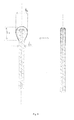
- the figures 1 , 2 , 3 and 4 each represent a preferred form of the protrusion present at the end of the guide. These growths have a three-dimensional shape and preferably axisymmetric around the axis of revolution of the body of the guide. At least one dimension and preferably one dimension in a plane perpendicular to the longitudinal axis and in particular the width of the protrusion is significantly greater than the diameter of the body of the guide.
- the protrusion significantly exceeds the body of the guide both in the axial direction and radial.
- the width of the protrusion significantly exceeds the body of the guide in the radial direction.
- the guide is curved
- the axis of revolution of the protrusion is preferably the axis of the guide when the latter is straightened (that is to say in the non-curved position).
- the outgrowth is deformable or expandable allowing a change of shape and / or volume, allowing a transition from a deployed state to a non-deployed state or vice versa, the deployed state being defined by the fact that at least one dimension and in particular a dimension perpendicular to the longitudinal axis and preferably the width of the protrusion is significantly greater than the diameter of the body of the guide while the non-deployed position corresponds to a state where the protrusion does not have greater dimensions in the plane perpendicular to the longitudinal axis, to the diameter of the body of the guide.
- the protrusion is preferably constituted by an expandable or inflatable element such as a membrane or a balloon that can be inflated by a gas or a fluid.
- the protrusion is obtained for example by simple injection under pressure of a fluid through a channel internal to the guide. Other execution modes make it possible to obtain this same result.
- the non-deployed position provides access to natural or operative ducts where the protrusion would prevent the passage of the guide provided with an expanded protrusion and because of its size.
- the maximum width of the protrusion may be preferentially adapted according to the patient's anatomy and thus allow optimal navigation.
- the protrusion may be preferentially used to clear the ducts.
- the growth is extensible or deformable.
- Extensible means a change in the volume of the outgrowth while deformable means a change in its shape.
- the outgrowth can move from a deployed state to an unexpanded state by modifying its shape and / or its volume.
- the deployed state being defined by the fact that at least one dimension and in particular a dimension perpendicular to the longitudinal axis and preferably the width of the protrusion is significantly greater than the diameter of the guide body while the non-deployed position corresponds to a state where the protuberance does not have dimensions greater than the diameter of the body of the guide.
- the protrusion may be made of a shape memory material such as "Shape Memory Polymers” which will change their state or shape by raising the temperature of the ambient environment. This rise in temperature can simply occur through the application of external means such as electrical current or simply by the influence of body temperature.
- shape Memory Polymers such as "Shape Memory Polymers” which will change their state or shape by raising the temperature of the ambient environment. This rise in temperature can simply occur through the application of external means such as electrical current or simply by the influence of body temperature.
- the selective catheterization of the bile duct through Vater's papilla is technically difficult and can be done either directly with a catheter or with a guide.
- the sphincter of Oddi is covered with a mucous membrane and, when the catheterization is not successful during the first maneuvers, the repeated manipulation of catheters or guide which impacts in the mucous membrane, create a edema, making the procedure more difficult.
- the type of guide described above provided with a rounded end atraumatic and having no angulation, reduces the trauma of the mucosa and the resulting edema. Similarly, it helps the flexible end of the guide to adapt to the S shape of the disc, to find its way to the bile duct.
- Modified guides according to the present invention have been tested in animal models. These tests have revealed that this particular embodiment of the present invention can significantly reduce the impaction tendency of the distal end of the guide in complex structures.
- the protrusion is voluntarily detached from the guide, inside the animals, by the action of the catheter on the guide.
- Modified guides according to the present invention have been tested in animal models. These tests revealed that this particular embodiment of the present invention makes it possible to reduce significantly the tendency to impaction of the distal end of the guide in complex structures.
Landscapes
- Health & Medical Sciences (AREA)
- Life Sciences & Earth Sciences (AREA)
- Biophysics (AREA)
- Pulmonology (AREA)
- Engineering & Computer Science (AREA)
- Anesthesiology (AREA)
- Biomedical Technology (AREA)
- Heart & Thoracic Surgery (AREA)
- Hematology (AREA)
- Animal Behavior & Ethology (AREA)
- General Health & Medical Sciences (AREA)
- Public Health (AREA)
- Veterinary Medicine (AREA)
- Media Introduction/Drainage Providing Device (AREA)
Priority Applications (9)
| Application Number | Priority Date | Filing Date | Title |
|---|---|---|---|
| EP08161434A EP2149386A1 (de) | 2008-07-30 | 2008-07-30 | Führung für Einsatz von Kathetern |
| AU2009211261A AU2009211261B2 (en) | 2008-02-07 | 2009-02-09 | Guide for catheterism |
| JP2010545497A JP5647008B2 (ja) | 2008-02-07 | 2009-02-09 | カテーテル挿入法のためのガイド |
| US12/866,862 US9642990B2 (en) | 2008-02-07 | 2009-02-09 | Guide for catheterism |
| CA2714176A CA2714176C (en) | 2008-02-07 | 2009-02-09 | Guide for catheterism |
| PCT/EP2009/051465 WO2009098322A1 (fr) | 2008-02-07 | 2009-02-09 | Guide pour catheterisme |
| EP09707495A EP2257329A1 (de) | 2008-02-07 | 2009-02-09 | Katheterismus-führung |
| JP2014146402A JP2014198263A (ja) | 2008-02-07 | 2014-07-17 | カテーテル挿入法のためのガイド |
| US15/589,704 US10010702B2 (en) | 2008-02-07 | 2017-05-08 | Method of selective catheterism of an anatomical structure using a guide |
Applications Claiming Priority (1)
| Application Number | Priority Date | Filing Date | Title |
|---|---|---|---|
| EP08161434A EP2149386A1 (de) | 2008-07-30 | 2008-07-30 | Führung für Einsatz von Kathetern |
Publications (1)
| Publication Number | Publication Date |
|---|---|
| EP2149386A1 true EP2149386A1 (de) | 2010-02-03 |
Family
ID=39941536
Family Applications (1)
| Application Number | Title | Priority Date | Filing Date |
|---|---|---|---|
| EP08161434A Withdrawn EP2149386A1 (de) | 2008-02-07 | 2008-07-30 | Führung für Einsatz von Kathetern |
Country Status (1)
| Country | Link |
|---|---|
| EP (1) | EP2149386A1 (de) |
Citations (12)
| Publication number | Priority date | Publication date | Assignee | Title |
|---|---|---|---|---|
| EP0410557A2 (de) * | 1989-07-26 | 1991-01-30 | Interventional Technologies Inc | Führungsdraht |
| US4991602A (en) * | 1989-06-27 | 1991-02-12 | Flexmedics Corporation | Flexible guide wire with safety tip |
| EP0515201A1 (de) * | 1991-05-21 | 1992-11-25 | C.R. Bard, Inc. | Superelastischer formbarer Führungsdraht |
| WO1994013350A1 (en) * | 1992-12-14 | 1994-06-23 | Schneider (Usa) Inc. | Tracking guidewire |
| EP0778042A2 (de) * | 1995-12-04 | 1997-06-11 | Target Therapeutics, Inc. | Aus Nickel-Titan bestehender gleitfähiger Katheterdraht |
| EP1092449A1 (de) * | 1999-04-30 | 2001-04-18 | Usaminanotechnology, Inc. | Katheter und führungsdraht |
| US20030163064A1 (en) * | 2002-02-26 | 2003-08-28 | Scimed Life Systems, Inc. | Articulating guide wire for embolic protection and methods of use |
| WO2004093659A2 (en) * | 2003-04-23 | 2004-11-04 | Atricure, Inc. | Method and apparatus for ablating cardiac tissue with guide facility |
| US20050273147A1 (en) * | 2004-06-02 | 2005-12-08 | Israel Henry M | Expandable and contractible guidewire |
| WO2006039217A1 (en) | 2004-09-30 | 2006-04-13 | Wilson-Cook Medical Inc. | Loop tip wire guide |
| EP1803484A2 (de) * | 2005-12-27 | 2007-07-04 | Cordis Corporation | Leitdraht mit variabler Steifheit |
| US20080051721A1 (en) * | 2006-08-25 | 2008-02-28 | Wilson-Cook Medical Inc. | Loop Tip Wire Guide |
-
2008
- 2008-07-30 EP EP08161434A patent/EP2149386A1/de not_active Withdrawn
Patent Citations (12)
| Publication number | Priority date | Publication date | Assignee | Title |
|---|---|---|---|---|
| US4991602A (en) * | 1989-06-27 | 1991-02-12 | Flexmedics Corporation | Flexible guide wire with safety tip |
| EP0410557A2 (de) * | 1989-07-26 | 1991-01-30 | Interventional Technologies Inc | Führungsdraht |
| EP0515201A1 (de) * | 1991-05-21 | 1992-11-25 | C.R. Bard, Inc. | Superelastischer formbarer Führungsdraht |
| WO1994013350A1 (en) * | 1992-12-14 | 1994-06-23 | Schneider (Usa) Inc. | Tracking guidewire |
| EP0778042A2 (de) * | 1995-12-04 | 1997-06-11 | Target Therapeutics, Inc. | Aus Nickel-Titan bestehender gleitfähiger Katheterdraht |
| EP1092449A1 (de) * | 1999-04-30 | 2001-04-18 | Usaminanotechnology, Inc. | Katheter und führungsdraht |
| US20030163064A1 (en) * | 2002-02-26 | 2003-08-28 | Scimed Life Systems, Inc. | Articulating guide wire for embolic protection and methods of use |
| WO2004093659A2 (en) * | 2003-04-23 | 2004-11-04 | Atricure, Inc. | Method and apparatus for ablating cardiac tissue with guide facility |
| US20050273147A1 (en) * | 2004-06-02 | 2005-12-08 | Israel Henry M | Expandable and contractible guidewire |
| WO2006039217A1 (en) | 2004-09-30 | 2006-04-13 | Wilson-Cook Medical Inc. | Loop tip wire guide |
| EP1803484A2 (de) * | 2005-12-27 | 2007-07-04 | Cordis Corporation | Leitdraht mit variabler Steifheit |
| US20080051721A1 (en) * | 2006-08-25 | 2008-02-28 | Wilson-Cook Medical Inc. | Loop Tip Wire Guide |
Similar Documents
| Publication | Publication Date | Title |
|---|---|---|
| EP0621793B1 (de) | Dilatationskatheter | |
| EP2585006B1 (de) | Orogastrischer katheter zur längsgastrektomie | |
| FR2573986A1 (fr) | Dispositif et procede d'implantation transluminale | |
| US20140236275A1 (en) | Catheter system with spacer member | |
| FR2696098A1 (fr) | Cathéter à ballonnet. | |
| FR2633835A1 (fr) | Systeme de sonde de transfusion | |
| FR2932979A1 (fr) | Dispositif introducteur s'etendant entre un point proximal et un point distal et necessaire de traitement associe. | |
| EP2365836B1 (de) | Angioplastie-vorrichtung | |
| FR2498454A1 (fr) | Catheter a membrane en forme de disque | |
| WO2017013933A1 (ja) | 内視鏡処置具 | |
| EP0452219B1 (de) | Endoprothese-Katheter | |
| FR3052671A1 (fr) | Ensemble pour la realisation d'une sonde ureterale personnalisee | |
| EP3361962B1 (de) | Aufblasbarer ballon für medizinische zwecke | |
| EP3787732A1 (de) | Katheter, aufblasbarer ballon für einen katheter | |
| EP1565114B1 (de) | Endovaskuläre chirurgische vorrichtung | |
| EP2257329A1 (de) | Katheterismus-führung | |
| EP0974375B1 (de) | Vorrichung mit einem Ballon mit nominal einstellbarem Durchmesser | |
| WO2012153007A1 (fr) | Dispositif médical pour l'extraction de fragments de calculs urinaires dans l'uretère et procédé d'utilisation d'un tel dispositif | |
| WO2018020150A1 (fr) | Stent intra-osseux | |
| FR2798838A1 (fr) | Structure de contention d'un canal anatomique, notamment d'un vaisseau | |
| EP1684664B1 (de) | Endoprothese mit verjüngten enden | |
| WO2021160966A1 (fr) | Dispositif pour exercer une traction sur la tubulure d'un cathéter pour l'hémostase de la cavité prostatique après chirurgie de l'hypertrophie bénigne de la prostate | |
| FR2856602A1 (fr) | Protection vulvaire de sondage | |
| WO2017191419A1 (fr) | Système d'injection dirigée intra-osseuse de ciment chirugical | |
| FR2952802A1 (fr) | Dispositif medical pour l'extraction de fragments de calculs urinaires dans l'uretere et procede d'utilisation d'un tel dispositif |
Legal Events
| Date | Code | Title | Description |
|---|---|---|---|
| PUAI | Public reference made under article 153(3) epc to a published international application that has entered the european phase |
Free format text: ORIGINAL CODE: 0009012 |
|
| AK | Designated contracting states |
Kind code of ref document: A1 Designated state(s): AT BE BG CH CY CZ DE DK EE ES FI FR GB GR HR HU IE IS IT LI LT LU LV MC MT NL NO PL PT RO SE SI SK TR |
|
| AX | Request for extension of the european patent |
Extension state: AL BA MK RS |
|
| AKY | No designation fees paid | ||
| REG | Reference to a national code |
Ref country code: DE Ref legal event code: 8566 |
|
| STAA | Information on the status of an ep patent application or granted ep patent |
Free format text: STATUS: THE APPLICATION IS DEEMED TO BE WITHDRAWN |
|
| 18D | Application deemed to be withdrawn |
Effective date: 20100804 |