EP2149806A1 - Connecteur optique et son procédé d'assemblage - Google Patents
Connecteur optique et son procédé d'assemblage Download PDFInfo
- Publication number
- EP2149806A1 EP2149806A1 EP08752564A EP08752564A EP2149806A1 EP 2149806 A1 EP2149806 A1 EP 2149806A1 EP 08752564 A EP08752564 A EP 08752564A EP 08752564 A EP08752564 A EP 08752564A EP 2149806 A1 EP2149806 A1 EP 2149806A1
- Authority
- EP
- European Patent Office
- Prior art keywords
- optical fiber
- positioning mechanism
- ferrule
- short
- optical connector
- Prior art date
- Legal status (The legal status is an assumption and is not a legal conclusion. Google has not performed a legal analysis and makes no representation as to the accuracy of the status listed.)
- Withdrawn
Links
Images



Classifications
-
- G—PHYSICS
- G02—OPTICS
- G02B—OPTICAL ELEMENTS, SYSTEMS OR APPARATUS
- G02B6/00—Light guides; Structural details of arrangements comprising light guides and other optical elements, e.g. couplings
- G02B6/24—Coupling light guides
- G02B6/36—Mechanical coupling means
- G02B6/38—Mechanical coupling means having fibre to fibre mating means
- G02B6/3807—Dismountable connectors, i.e. comprising plugs
- G02B6/3833—Details of mounting fibres in ferrules; Assembly methods; Manufacture
- G02B6/3846—Details of mounting fibres in ferrules; Assembly methods; Manufacture with fibre stubs
-
- G—PHYSICS
- G02—OPTICS
- G02B—OPTICAL ELEMENTS, SYSTEMS OR APPARATUS
- G02B6/00—Light guides; Structural details of arrangements comprising light guides and other optical elements, e.g. couplings
- G02B6/24—Coupling light guides
- G02B6/36—Mechanical coupling means
- G02B6/38—Mechanical coupling means having fibre to fibre mating means
- G02B6/3801—Permanent connections, i.e. wherein fibres are kept aligned by mechanical means
- G02B6/3806—Semi-permanent connections, i.e. wherein the mechanical means keeping the fibres aligned allow for removal of the fibres
-
- G—PHYSICS
- G02—OPTICS
- G02B—OPTICAL ELEMENTS, SYSTEMS OR APPARATUS
- G02B6/00—Light guides; Structural details of arrangements comprising light guides and other optical elements, e.g. couplings
- G02B6/24—Coupling light guides
- G02B6/36—Mechanical coupling means
- G02B6/38—Mechanical coupling means having fibre to fibre mating means
- G02B6/3807—Dismountable connectors, i.e. comprising plugs
- G02B6/381—Dismountable connectors, i.e. comprising plugs of the ferrule type, e.g. fibre ends embedded in ferrules, connecting a pair of fibres
- G02B6/3818—Dismountable connectors, i.e. comprising plugs of the ferrule type, e.g. fibre ends embedded in ferrules, connecting a pair of fibres of a low-reflection-loss type
- G02B6/382—Dismountable connectors, i.e. comprising plugs of the ferrule type, e.g. fibre ends embedded in ferrules, connecting a pair of fibres of a low-reflection-loss type with index-matching medium between light guides
-
- G—PHYSICS
- G02—OPTICS
- G02B—OPTICAL ELEMENTS, SYSTEMS OR APPARATUS
- G02B6/00—Light guides; Structural details of arrangements comprising light guides and other optical elements, e.g. couplings
- G02B6/24—Coupling light guides
- G02B6/36—Mechanical coupling means
- G02B6/38—Mechanical coupling means having fibre to fibre mating means
- G02B6/3807—Dismountable connectors, i.e. comprising plugs
- G02B6/381—Dismountable connectors, i.e. comprising plugs of the ferrule type, e.g. fibre ends embedded in ferrules, connecting a pair of fibres
- G02B6/3818—Dismountable connectors, i.e. comprising plugs of the ferrule type, e.g. fibre ends embedded in ferrules, connecting a pair of fibres of a low-reflection-loss type
- G02B6/3821—Dismountable connectors, i.e. comprising plugs of the ferrule type, e.g. fibre ends embedded in ferrules, connecting a pair of fibres of a low-reflection-loss type with axial spring biasing or loading means
-
- G—PHYSICS
- G02—OPTICS
- G02B—OPTICAL ELEMENTS, SYSTEMS OR APPARATUS
- G02B6/00—Light guides; Structural details of arrangements comprising light guides and other optical elements, e.g. couplings
- G02B6/24—Coupling light guides
- G02B6/36—Mechanical coupling means
- G02B6/38—Mechanical coupling means having fibre to fibre mating means
- G02B6/3807—Dismountable connectors, i.e. comprising plugs
- G02B6/381—Dismountable connectors, i.e. comprising plugs of the ferrule type, e.g. fibre ends embedded in ferrules, connecting a pair of fibres
- G02B6/3823—Dismountable connectors, i.e. comprising plugs of the ferrule type, e.g. fibre ends embedded in ferrules, connecting a pair of fibres containing surplus lengths, internal fibre loops
-
- Y—GENERAL TAGGING OF NEW TECHNOLOGICAL DEVELOPMENTS; GENERAL TAGGING OF CROSS-SECTIONAL TECHNOLOGIES SPANNING OVER SEVERAL SECTIONS OF THE IPC; TECHNICAL SUBJECTS COVERED BY FORMER USPC CROSS-REFERENCE ART COLLECTIONS [XRACs] AND DIGESTS
- Y10—TECHNICAL SUBJECTS COVERED BY FORMER USPC
- Y10T—TECHNICAL SUBJECTS COVERED BY FORMER US CLASSIFICATION
- Y10T29/00—Metal working
- Y10T29/49—Method of mechanical manufacture
- Y10T29/49002—Electrical device making
- Y10T29/49117—Conductor or circuit manufacturing
- Y10T29/49204—Contact or terminal manufacturing
Definitions
- the present invention relates to an optical connector and a method of assembling the same.
- An optical connector 100 shown herein has been disclosed in the hollowing Patent Document 1 and serves to match a site optical fiber 104 maintained in a coated state with an end of a short optical fiber 102 provided in a ferrule 101 and to thus couple them to a rear end of the ferrule 101, and furthermore, to interpose and fix the site optical fiber 104 by means of a positioning mechanism 105 covering a periphery of a matched part.
- the positioning mechanism 105 is a so-called splice member and includes a base member 111 provided with V grooves 111a and 111b for positioning the respective optical fibers 102 and 104 in such a manner that a center of the coated optical fiber 104 is coincident with that of the short optical fiber 102, a cover member 112 superposed on the base member 111 to press each of the optical fibers 102 and 104 against each of the V grooves 111a and 111b, and a clamp member 114 for energizing the base member 111 and the cover member 112 in bonding direction.
- a wedge is inserted in a joining surface of both the base member 111 and the cover member 112 and can be thus opened against an energizing force of the clamp member 114, and the optical fiber 104 is inserted in the V groove 111b and the wedge is then pulled out so that the optical fiber 104 is interposed and positioned between the base member 111 and the cover member 112 by the energizing force of the clamp member 114, which is not shown.
- a plug housing 121 is put on and attached to the positioning mechanism 105.
- the plug housing 121 is constituted by a front housing 125 having a step-like positioning portion 123 for positioning front end portions of the base member 111 and the cover member 112 which form the positioning mechanism 105 through a collision, and a rear housing 127 which accommodates the positioning mechanism 105 from a rear end side thereof and is thus coupled to a rear end of the front housing 125.
- the rear housing 127 is coupled to and integrated with the front housing 125 by engaging an engaging projection 127b of an engaging portion 127a extended forward with an engaging portion 125a provided on the front housing 125.
- the rear housing 127 includes a spring member 129 for energizing the positioning mechanism 105 forward to elastically position the front end portions of the base member 111 and the cover member 112 in an abutting state on the positioning portion 123 of the front housing 125.
- a boot 131 for protecting the optical fiber 104 extended from the positioning mechanism 105 is put on and attached to a rear part of the rear housing 127. Moreover, a connector knob for offering an appearance is put on and attached to an outer periphery of the plug housing 121, which is not shown.
- the positioning mechanism 105 and the ferrule 101 are elastically supported by the spring member 129 accommodated in the rear housing 127. In a connection to a partner optical connector, therefore, the ferrule 101 abutting on the partner optical connector can be moved backward by an elastic force to relieve a shock.
- the optical connector 100 moreover, it is possible to finish a connector assembling work by simply matching the site optical fiber 104 with the end of the short optical fiber 102 in the positioning mechanism 105 without peeling the coating. In the assembling work on the site, therefore, peeling of the coating of the site optical fiber 104 to expose a core wire, and furthermore, a time and labor for cleaning the exposed core wire are not required. Consequently, it is possible to simplify a processing on the site, thereby enhancing a workability.
- Patent Document 1 Japanese Laid-Open Patent Publication No. 2005-345753
- PROBLEMS THAI THE INVENTION IS TO SOLVE
- the end face of the short optical fiber 102 provided in the ferrule 101 directly collides with the end face of the site optical fiber 104 in the positioning mechanism 105. Therefore, there is a possibility that a problem might be caused, for example, the end face of the short optical fiber 102 might be broken depending on a colliding state in an insertion of the site optical fiber 104 into the positioning mechanism 105.
- an optical connector having a ferrule including a short optical fiber and a positioning mechanism provided behind the ferrule, and serving to place and fix an optical fiber to be connected to the short optical fiber in a predetermined position, wherein an end face of the short optical fiber and an end face of the optical fiber are matched with each other through a protecting member for transmitting a light in a predetermined refractive index and the optical fiber is positioned on the short optical fiber side with an elastic force,
- the tip surface of the site optical fiber is matched with the end face of the short optical fiber provided in the ferrule through the protecting member when the site optical fiber is to be assembled. Therefore, the end face of the optical fiber and that of the short optical fiber do not directly collide with each other so that a shock in the matching operation is relieved by the protecting ember. Consequently, there is not a problem, for example, a breakage of the end face of the short optical fiber. Accordingly, it is possible to connect the site optical fiber to the short optical fiber provided in the ferrule safely and easily, thereby enhancing an assembling workability on the site.
- the protecting member may have a refractive index which is equal to a refractive index of a core of the optical fiber. Consequently, it is possible to reduce a light transmission loss as greatly as possible, and furthermore, to obtain a high return loss.
- the protecting member may take a shape of a sheet having a thickness of 5 to 30 ⁇ m. By setting the film thickness of the protecting member to be small, thus, it is possible to reduce the light transmission loss as greatly as possible.
- a flexure space for accommodating the optical fiber in a flexing state may be provided between a portion for fixing the optical fiber in the positioning mechanism and the protecting member provided on a rear end of the short optical fiber. Consequently, it is possible to obtain a state in which the tip of the site optical fiber abuts on the protecting member by a predetermined elastic force through a simple insertion of the optical fiber to generate a flexure in the flexure space. Accordingly, it is possible to maintain a stable connecting state in which the tip surface of the optical fiber always abuts on the protecting member even if the optical connector having a different coefficient of linear expansion from that of the optical fiber is extended in an axial direction depending on an ambient environment,
- the ferrule and the positioning mechanism may be fabricated by integral molding. Consequently, it is possible to reduce the number of the components constituting the optical connector, thereby promoting an enhancement in an assembling property and a reduction in a cost.
- a method of assembling an optical connector according to the invention is a method of assembling the optical connector according to any of claims 1 to 5, wherein an end of an optical fiber is subjected to a cut processing, the optical fiber subjected to the cut processing is inserted through a positioning mechanism coupled to a rear end of the ferrule, and the optical fiber is fixed by the positioning mechanism in a state in which a tip of the optical fiber is caused to come in elastic contact with a protecting member stuck to an end face of the short optical fiber.
- the site optical fiber is inserted through the ferrule by simply cutting the end without peeling the coating. Consequently, it is possible to save a time and labor required for peeling the coating, thereby easing a work for assembling a connector on the site.
- the tip surface of the site optical fiber is matched with the end face of the short optical fiber provided in the ferrule through the protecting member when the site optical fiber is to be assembled. Therefore, the end face of the optical fiber and that of the short optical fiber do not directly collide with each other so that a shock in the matching operation is relieved by the protecting member. Consequently, there is not a problem, for example, a breakage of the end face of the short optical fiber which is caused by the shock in the matching operation.
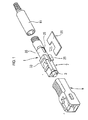
- Fig. 1 is an exploded perspective view showing a schematic structure according to an embodiment of the optical connector in accordance with the invention
- Fig. 2 is a cross-sectional view showing an operation for opening/closing a positioning mechanism of the optical connector illustrated in Fig. 1 by inserting a wedge
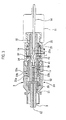
- Fig. 3 is a longitudinal sectional view showing a connector plug assembly illustrated in Fig. 1
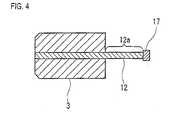
- Fig. 4 is an enlarged view showing an A portion in Fig. 3
- Fig. 5 is an explanatory view showing a procedure for a method of assembling a site optical fiber into the optical connector illustrated in Fig. 1 .
- An optical connector 1 is an SC connector to be assembled into a site optical fiber and is constituted by a plug housing 7 for accommodating a ferrule 3 and a positioning mechanism 5 to be coupled to a rear end of the ferrule 3, thereby forming a connector plug assembly, a connector knob 9 put on and attached to the plug housing 7 from a forward part, and a boot 11 put on and attached to a rear end of the plug housing 7 as shown in Figs. 1 to 3 .
- the ferrule 3 includes a short optical fiber 12 on a central axis thereof as shown in Fig. 4 .
- the short optical fiber 12 is protruded in a certain length rearward from the ferrule 3, and a protruded portion 12a is inserted through an inside of the positioning mechanism 5.
- An almost sheet-like protecting member 17 for transmitting a light in a predetermined refractive index is stuck to a rear end face of the short optical fiber 12 to be inserted through the inside of the positioning mechanism 5.
- the protecting member 17 has a refractive index which is equal to that of a core of a site optical fiber 14 to be connected.
- the protecting member 17 takes a shape of a sheet having a thickness of 5 to 30 ⁇ m, and an adhesive material is properly applied to both surfaces at the short optical fiber 12 side and the optical fiber 14 side to give an adhesiveness for sticking an end face of each of the optical fibers.
- the positioning mechanism 5 is a so-called splice member and includes a base member 21 provided with a V groove 21 for positioning the optical fiber 14 in such a manner that a center of the optical fiber 14 having a coating is coincident with that of the short optical fiber 12, a cover member 22 superposed on the base member 21 to press the optical fiber 14 against the V groove 21a, a clamp member 24 for energizing the base member 21 and the cover member 22 in a bonding direction, and a ferrule fitting member 29 for positioning the rear end of the ferrule 3 on a tip of the base member 21 as shown in Fig. 2 .
- the V groove 21a provided on the base member 21 is formed in a predetermined length L close to a rear end of the base member 21.
- a range of the thickness L serves as a portion 23 for interposing the optical fiber 14 in cooperation with the cover member 22 and thus fixing the optical fiber 14.
- a built-in fiber inserting groove 21b (see Fig. 3 ) for inserting the short optical fiber 12 therethrough is formed on a front end side of the base member 21 from the portion 23 for fixing the optical fiber 14 in such a manner that a central axis is coincident with the optical fiber 14 in the V groove 21a.
- a positioning groove 18 for positioning the protecting member 17 stuck to the rear end of the short optical fiber 12 is formed on a terminal of the built-in fiber inserting groove 21b.
- the base member 21 and the cover member 22 in the positioning mechanism 5 can be opened against an energizing force of the clamp member 24 through an insertion of a wedge 26 into a wedge inserting portion 25 formed on a joining surface of both of them as shown in Fig. 2(a) , and the short optical fiber 12 and the optical fiber 14 are inserted into the V groove 21a and the built-in fiber inserting groove 21b and the wedge 26 is then pulled out as shown in Fig. 2(b) so that the optical fiber 14 is interposed and positioned between the base member 21 and the cover member 22 by the energizing force of the clamp member 24.
- a flexure space 41 for causing the optical fiber 14 to have an elastic force toward the protecting member 17 side by accommodating the optical fiber 14 in a flexing state is provided between the portion 23 of the positioning mechanism 5 which fixes the optical fiber 14 and the protecting member 17 provided at the rear end of the short optical fiber 12.
- the flexure space 41 is formed by hollowing an intermediate portion between the base member 21 and the cover member 22 which form the positioning mechanism 5.
- the optical fiber 14 inserted through the V groove 21a of the positioning mechanism 5 is interposed and fixed by the positioning mechanism 5 after an amount of the insertion of the optical fiber 14 into the positioning mechanism 5 is regulated to generate a flexure 43 in the flexure space 41.
- a. tip surface of the optical fiber 14 which is positioned is maintained in an abutting state on the protecting member 17 provided on the rear end of the short optical fiber 12 with an elastic force,
- the plug housing 7 is constituted by a front housing 33 having a step-like positioning portion 31 for positioning, through a collision, the ferrule fitting member 29 provided on the front ends of the base member 21 and the cover member 22 which form the positioning mechanism 5, and a rear housing 35 which accommodates the positioning mechanism 5 from a rear end side thereof and is thus coupled to a rear end of the front housing 33.
- the rear housing 35 is coupled to and integrated with the front housing 33 by engaging an engaging projection 35b of an engaging portion 35a extended forward with an engaging portion 33a provided on the front housing 33,
- the rear housing 35 includes a spring member 37 for energizing the positioning mechanism 35 forward to elastically position the front end portions of the base member 21 and the cover member 22 through the ferrule fitting member 29 in an abutting state on the positioning portion 31 of the front housing 33.
- the boot 11 put on and attached to the rear part of the rear housing 35 covers a periphery of the optical fiber 14 extended from the positioning mechanism 5 and protects the optical fiber 14 to prevent bending from being suddenly applied to the optical fiber 14.
- the positioning mechanism 5 and the ferrule 3 are elastically supported movably in a rearward direction by means of the spring member 37 accommodated in the rear housing 35.
- the ferrule 3 abutting on the partner optical connector can be moved rearward by an elastic force to relieve a shock
- the optical connector 1 is assembled in a procedure shown in Figs. 5(a) to 5(d) .
- the positioning mechanism 5 coupled to the rear end of the ferrule 3 is prepared in a state in which it is opened by the insertion of the wedge 26, and the end of the site optical fiber 14 is subjected to a cut processing.
- the optical fiber 14 subjected to the cut processing is inserted through the V groove 21a of the positioning mechanism 5 and the tip of the optical fiber 14 is thus caused to abut on the protecting member 17, As shown in Fig.
- the amount of the insertion of the optical fiber 14 is regulated in such a manner that the optical fiber 14 having the tip abutting on the protecting member 17 generates the flexure 43 in a proper amount within the flexure space 41, and the wedge 26 is then pulled out of the positioning mechanism 5. Consequently, the optical fiber 14 inserted in the ferrule 3 is fixed by the positioning mechanism 5 with the tip coming in elastic contact with the protecting member 17.
- the front housing 33 and the rear housing 35 in the plug housing 7 are put on and attached to the positioning mechanism 5.
- the boot 11 is attached to the rear end of the plug housing 7 and the connector knob 9 is attached to the outer periphery of the plug housing 7, which is not shown.
- the optical connector 1 is completely assembled.
- the site optical fiber 14 is subjected to an end face processing and is then inserted through the positioning mechanism 5 until the end face abuts on the protecting member 17 with an elastic force, and furthermore, the optical fiber 14 is caused to have a flexure in the flexure space 41 and is thereafter positioned and fixed by the positioning mechanism 5.
- the assembly is completed.
- the tip surface of the site optical fiber 14 is matched with the end face of the short optical fiber 12 provided in the ferrule 3 through the protecting member 17. Therefore, the end face of the optical fiber 14 is prevented from directly colliding with that of the short optical fiber 12 and a shock in the matching operation is relieved by the protecting member 17.
- the protecting member 17 has an adhesiveness given to both surfaces thereof as described in the embodiment, Consequently, it is possible to produce an advantage for preventing a mutual shaft misalignment of the optical fibers which are matched. Thus, it is possible to contain a connection having no shaft misalignment with high precision for a long period of time.
- the protecting member 17 has a refractive index which is equal to that of the core of the site optical fiber 14. Therefore, it is possible to reduce a light transmission loss as greatly as possible and to obtain a high return loss.
- the protecting member 17 takes a shape of a sheet having a thickness of 5 to 30 ⁇ m.
- the film thickness of the protecting member 17 is small, thus, it is possible to reduce the light transmission loss as greatly as possible.
- the flexure space 41 for accommodating the optical fiber 14 in a flexing state to cause the optical fiber 14 to have an elastic force turned toward the protecting member 17 side is provided between the portion 23 for fixing the optical fiber 14 in the positioning mechanism 5 and the protecting member 17 provided on the rear end of the short optical fiber 12.
- the end of the site optical fiber 14 is subjected to the cut processing, the optical fiber 14 subjected to the cut processing is exactly inserted through the positioning mechanism 5 coupled to the rear end of ⁇ the ferrule 3 without the coating peeled and the tip of the optical fiber 14 is caused to come in elastic contact with the protecting member 17 stuck to the end face of the short optical fiber 12, and the optical fiber 14 is fixed by the positioning mechanism 5 in this state.
- optical connector 1 it is possible to bring a state in which the optical connector 1 is assembled into the optical fiber 14, In other words, referring to the assembling method according to the embodiment by simply cutting the end of the site optical fiber 4 without peeling the coating and thus inserting the site optical fiber 14 through the ferrule 3, it is possible to save a time and labor required for peeling the coating, thereby easing the connector assembling work on the site.
- the optical connector 1 according to the embodiment is also suitable for the case in which the coating of the site optical fiber 14 is peeled to expose a core wire.
- the ferrule 3 and the positioning mechanism 5 are separate members. However, it is also possible to employ a structure in which the ferrule 3 and the positioning mechanism 5 are fabricated by integral molding. With the integral structure, thus, it is possible to reduce the number of the components constituting the optical connector 1, thereby promoting an enhancement in an assembling property and a reduction in a cost.
Landscapes
- Physics & Mathematics (AREA)
- General Physics & Mathematics (AREA)
- Optics & Photonics (AREA)
- Mechanical Coupling Of Light Guides (AREA)
Applications Claiming Priority (2)
| Application Number | Priority Date | Filing Date | Title |
|---|---|---|---|
| JP2007137199A JP2008292708A (ja) | 2007-05-23 | 2007-05-23 | 光コネクタ及びその組立方法 |
| PCT/JP2008/058681 WO2008143039A1 (fr) | 2007-05-23 | 2008-05-09 | Connecteur optique et son procédé d'assemblage |
Publications (2)
| Publication Number | Publication Date |
|---|---|
| EP2149806A1 true EP2149806A1 (fr) | 2010-02-03 |
| EP2149806A4 EP2149806A4 (fr) | 2013-05-01 |
Family
ID=40031749
Family Applications (1)
| Application Number | Title | Priority Date | Filing Date |
|---|---|---|---|
| EP08752564.8A Withdrawn EP2149806A4 (fr) | 2007-05-23 | 2008-05-09 | Connecteur optique et son procédé d'assemblage |
Country Status (6)
| Country | Link |
|---|---|
| US (1) | US20100247039A1 (fr) |
| EP (1) | EP2149806A4 (fr) |
| JP (1) | JP2008292708A (fr) |
| CN (1) | CN101681001A (fr) |
| TW (1) | TW200916865A (fr) |
| WO (1) | WO2008143039A1 (fr) |
Families Citing this family (6)
| Publication number | Priority date | Publication date | Assignee | Title |
|---|---|---|---|---|
| JP2008292710A (ja) * | 2007-05-23 | 2008-12-04 | Sumitomo Electric Ind Ltd | 光コネクタ及びその組立方法 |
| CN102472872B (zh) | 2009-08-10 | 2014-08-27 | 日本电信电话株式会社 | 光连接器及其组装方法 |
| JP2014038303A (ja) * | 2012-07-19 | 2014-02-27 | Yazaki Corp | 光コネクタ、及び嵌合ユニット |
| WO2019231450A1 (fr) * | 2018-05-31 | 2019-12-05 | Corning Optical Communications LLC | Connecteur de fibre optique ayant un corps compressible et un réceptacle complémentaire, et procédés de fabrication associés |
| JP7213369B2 (ja) | 2019-03-26 | 2023-01-26 | スリーエム イノベイティブ プロパティズ カンパニー | 光コネクタアセンブリ |
| WO2025137144A1 (fr) * | 2023-12-19 | 2025-06-26 | Smiths Interconnect Canada Inc. | Systèmes et procédés d'amortissement des vibrations dans des connecteurs multifibres |
Family Cites Families (13)
| Publication number | Priority date | Publication date | Assignee | Title |
|---|---|---|---|---|
| JPS61207463A (ja) * | 1985-03-12 | 1986-09-13 | Toray Silicone Co Ltd | 光通信フアイバ接合部の屈折率整合用弾性体組成物 |
| JP2676705B2 (ja) * | 1989-12-05 | 1997-11-17 | 株式会社フジクラ | 光ファイバコネクタ |
| JPH0534532A (ja) * | 1991-07-31 | 1993-02-12 | Hitachi Ltd | 光フアイバの接続器 |
| US6120193A (en) * | 1997-12-22 | 2000-09-19 | Siecor Corporation | Splice house subassembly and associated connector |
| JP4014776B2 (ja) * | 2000-01-06 | 2007-11-28 | 株式会社フジクラ | 光コネクタ |
| JP2002031745A (ja) * | 2000-07-19 | 2002-01-31 | Nippon Telegr & Teleph Corp <Ntt> | 光コネクタプラグ及びこれを備えた装置の光接続部構造 |
| US6722790B2 (en) * | 2002-01-04 | 2004-04-20 | Panduit Corp. | Contoured internal stub crimp backbone |
| US7204644B2 (en) * | 2004-03-24 | 2007-04-17 | Corning Cable Systems Llc | Field installable optical fiber connector |
| JP2005345753A (ja) * | 2004-06-03 | 2005-12-15 | Sumitomo Electric Ind Ltd | 光コネクタ及びその組み立て方法 |
| US20060002662A1 (en) * | 2004-06-30 | 2006-01-05 | Tyco Electronics Corporation | Small form factor, field-installable connector |
| JP4689415B2 (ja) * | 2005-01-18 | 2011-05-25 | 株式会社フジクラ | 光コネクタ用工具、工具付き光コネクタ |
| JP4821209B2 (ja) * | 2005-04-14 | 2011-11-24 | 住友電気工業株式会社 | 光コネクタ及び光コネクタの組立方法 |
| JP2007137199A (ja) | 2005-11-16 | 2007-06-07 | Bridgestone Corp | 空気入りラジアルタイヤ |
-
2007
- 2007-05-23 JP JP2007137199A patent/JP2008292708A/ja active Pending
-
2008
- 2008-05-09 US US12/601,383 patent/US20100247039A1/en not_active Abandoned
- 2008-05-09 EP EP08752564.8A patent/EP2149806A4/fr not_active Withdrawn
- 2008-05-09 CN CN200880017112A patent/CN101681001A/zh active Pending
- 2008-05-09 WO PCT/JP2008/058681 patent/WO2008143039A1/fr not_active Ceased
- 2008-05-22 TW TW097118946A patent/TW200916865A/zh unknown
Also Published As
| Publication number | Publication date |
|---|---|
| EP2149806A4 (fr) | 2013-05-01 |
| TW200916865A (en) | 2009-04-16 |
| WO2008143039A1 (fr) | 2008-11-27 |
| JP2008292708A (ja) | 2008-12-04 |
| US20100247039A1 (en) | 2010-09-30 |
| CN101681001A (zh) | 2010-03-24 |
Similar Documents
| Publication | Publication Date | Title |
|---|---|---|
| EP2149805A1 (fr) | Connecteur optique et son procédé d'assemblage | |
| JP4942327B2 (ja) | 光コネクタ | |
| EP2149806A1 (fr) | Connecteur optique et son procédé d'assemblage | |
| US20090214165A1 (en) | Optical Fiber Connector With Lens | |
| WO2006019161A1 (fr) | Connecteur optique et procédé d'assemblage de connecteur optique | |
| JP4933691B2 (ja) | マルチファイバ型フェルール、マルチファイバ型コネクタ及びその予備組立て方法 | |
| JPH1172655A (ja) | 光コネクタ | |
| KR100713430B1 (ko) | 광커넥터 플러그, 그 제조방법 및 조립공구 | |
| US20150268422A1 (en) | Optical connector and method of preventing protection tube from coming off from optical connector | |
| EP1813976B1 (fr) | Cartouche de fibre optique avec corps à installation facile | |
| JP6018841B2 (ja) | フェルール及び光コネクタ | |
| JP4192751B2 (ja) | 光ファイバ接続器及び光ファイバ接続方法 | |
| JP2010026475A (ja) | 光コネクタプラグ | |
| JP3306410B2 (ja) | 光コネクタプラグ、その製造方法および組立工具 | |
| WO2025053091A1 (fr) | Connecteur optique | |
| JP4477409B2 (ja) | メカニカル接続型光コネクタ。 | |
| JP4799375B2 (ja) | 多心用光コネクタ | |
| JP2011027856A (ja) | 光コネクタ、光コネクタの組立方法 | |
| JP3501440B2 (ja) | 光コネクタ | |
| JP4192749B2 (ja) | 光ファイバ接続器、光ファイバ接続方法及び光モジュール | |
| JP3485465B2 (ja) | 光コネクタ | |
| JP4481234B2 (ja) | 光コネクタ | |
| WO2025158970A1 (fr) | Élément de maintien de câble optique et connecteur optique | |
| JP2015034938A (ja) | 光ファイバの端末構造 | |
| JP2000338367A (ja) | 光コネクタおよび光コネクタ接続方式 |
Legal Events
| Date | Code | Title | Description |
|---|---|---|---|
| PUAI | Public reference made under article 153(3) epc to a published international application that has entered the european phase |
Free format text: ORIGINAL CODE: 0009012 |
|
| 17P | Request for examination filed |
Effective date: 20091123 |
|
| AK | Designated contracting states |
Kind code of ref document: A1 Designated state(s): AT BE BG CH CY CZ DE DK EE ES FI FR GB GR HR HU IE IS IT LI LT LU LV MC MT NL NO PL PT RO SE SI SK TR |
|
| AX | Request for extension of the european patent |
Extension state: AL BA MK RS |
|
| DAX | Request for extension of the european patent (deleted) | ||
| A4 | Supplementary search report drawn up and despatched |
Effective date: 20130402 |
|
| RIC1 | Information provided on ipc code assigned before grant |
Ipc: G02B 6/38 20060101AFI20130325BHEP |
|
| 17Q | First examination report despatched |
Effective date: 20131010 |
|
| STAA | Information on the status of an ep patent application or granted ep patent |
Free format text: STATUS: THE APPLICATION IS DEEMED TO BE WITHDRAWN |
|
| 18D | Application deemed to be withdrawn |
Effective date: 20140221 |