EP2153699B1 - Durch einen elastomeren laminierungshaftstoff geschützte organische elektronische bauelemente - Google Patents
Durch einen elastomeren laminierungshaftstoff geschützte organische elektronische bauelemente Download PDFInfo
- Publication number
- EP2153699B1 EP2153699B1 EP08728221.6A EP08728221A EP2153699B1 EP 2153699 B1 EP2153699 B1 EP 2153699B1 EP 08728221 A EP08728221 A EP 08728221A EP 2153699 B1 EP2153699 B1 EP 2153699B1
- Authority
- EP
- European Patent Office
- Prior art keywords
- meth
- acrylate
- acrylated
- substrate
- laminating adhesive
- Prior art date
- Legal status (The legal status is an assumption and is not a legal conclusion. Google has not performed a legal analysis and makes no representation as to the accuracy of the status listed.)
- Not-in-force
Links
Images



Classifications
-
- H—ELECTRICITY
- H10—SEMICONDUCTOR DEVICES; ELECTRIC SOLID-STATE DEVICES NOT OTHERWISE PROVIDED FOR
- H10K—ORGANIC ELECTRIC SOLID-STATE DEVICES
- H10K59/00—Integrated devices, or assemblies of multiple devices, comprising at least one organic light-emitting element covered by group H10K50/00
- H10K59/80—Constructional details
- H10K59/87—Passivation; Containers; Encapsulations
- H10K59/871—Self-supporting sealing arrangements
- H10K59/8722—Peripheral sealing arrangements, e.g. adhesives, sealants
-
- H—ELECTRICITY
- H01—ELECTRIC ELEMENTS
- H01B—CABLES; CONDUCTORS; INSULATORS; SELECTION OF MATERIALS FOR THEIR CONDUCTIVE, INSULATING OR DIELECTRIC PROPERTIES
- H01B3/00—Insulators or insulating bodies characterised by the insulating materials; Selection of materials for their insulating or dielectric properties
- H01B3/18—Insulators or insulating bodies characterised by the insulating materials; Selection of materials for their insulating or dielectric properties mainly consisting of organic substances
- H01B3/30—Insulators or insulating bodies characterised by the insulating materials; Selection of materials for their insulating or dielectric properties mainly consisting of organic substances plastics; resins; waxes
- H01B3/44—Insulators or insulating bodies characterised by the insulating materials; Selection of materials for their insulating or dielectric properties mainly consisting of organic substances plastics; resins; waxes vinyl resins; acrylic resins
- H01B3/447—Insulators or insulating bodies characterised by the insulating materials; Selection of materials for their insulating or dielectric properties mainly consisting of organic substances plastics; resins; waxes vinyl resins; acrylic resins from acrylic compounds
-
- H—ELECTRICITY
- H10—SEMICONDUCTOR DEVICES; ELECTRIC SOLID-STATE DEVICES NOT OTHERWISE PROVIDED FOR
- H10K—ORGANIC ELECTRIC SOLID-STATE DEVICES
- H10K50/00—Organic light-emitting devices
- H10K50/80—Constructional details
- H10K50/84—Passivation; Containers; Encapsulations
- H10K50/842—Containers
- H10K50/8426—Peripheral sealing arrangements, e.g. adhesives, sealants
-
- H—ELECTRICITY
- H10—SEMICONDUCTOR DEVICES; ELECTRIC SOLID-STATE DEVICES NOT OTHERWISE PROVIDED FOR
- H10K—ORGANIC ELECTRIC SOLID-STATE DEVICES
- H10K59/00—Integrated devices, or assemblies of multiple devices, comprising at least one organic light-emitting element covered by group H10K50/00
- H10K59/80—Constructional details
- H10K59/87—Passivation; Containers; Encapsulations
- H10K59/874—Passivation; Containers; Encapsulations including getter material or desiccant
Definitions
- This invention relates to active organic components within an organic electronic device, the components protected from environmental elements by an elastomeric laminating adhesive.
- Organic electronic devices and circuits such as, organic light emitting diodes, organic electrophoretic displays, organic electrochromic displays, and organic photovoltaic devices, are becoming increasingly prevalent in social and commercial uses.
- Organic light emitting devices for example, have utility in virtual- and direct-view displays, such as, lap-top computers, televisions, digital watches, telephones, pagers, cellular telephones, calculators, large-area devices, and the like.
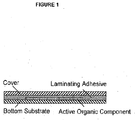
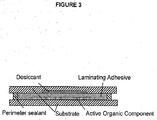
- Various package geometries are known in the art for organic electronic devices and circuits, and in general, these geometries consist of an active organic component, such as, a light emitting diode, disposed between a substrate and a cover, the substrate and cover adhered together with an adhesive that encloses the active organic component.
- an active organic component such as, a light emitting diode
- the cover and substrate are made of a transparent material, for example, transparent glass or plastic.
- the substrate and cover are sometimes flexible, and in addition to glass or plastic, one or the other may be composed of steel.
- the active organic component is attached to the substrate, and in some embodiments is covered with an inorganic barrier coating, or a coating composed of a combination or inorganic and organic layers, that seals the surface and perimeter of the contact area between the component and the substrate.
- An adhesive is applied over the active component, and over the inorganic barrier coating or the coating composed of a combination of inorganic and organic layers, when present.
- This adhesive fills the space between the substrate and the cover, enclosing the active organic component and adheres the substrate to the cover.
- a desiccant package in the form of a pouch, or a thin or thick film, is attached to the cover, usually in an indentation or cavity in the cover, or alternatively, the desiccant is provided in grooves within the cover.
- an OLED simply described, consists of an anode, a light emitting layer, and a cathode.
- a layer of low work function metal is typically utilized as the cathode to ensure efficient electron injection and low operating voltages.
- Low work function metals are chemically reactive with oxygen and moisture, and such reactions will limit the lifetime of the devices. Oxygen and moisture will also react with the light emitting organic materials and inhibit light emission. Therefore, the package surrounding the active organic component is designed to restrict transmission of oxygen and water vapor from the environment to the active organic component.
- UV-curable pressure sensitive adhesives can be used for this purpose and typically are provided between two carrier films. Upon removal of one of the carrier films, the exposed adhesive, being pressure sensitive, is attached to either the cover or the substrate by simple contact and the application of pressure. Subsequently, the second carrier film is removed, allowing the cover and the substrate to be attached to one another. If needed, curing is completed by the application of ultraviolet-radiation or heat.
- These compounds are improvements over epoxies with regard to flexibility, but pressure sensitive adhesives tend to creep upon long term exposure to strain, and this can manifest itself as delamination failure of the display when it is bent (flexible & conformable displays) or held vertical (rigid displays) for long periods. Moreover, manufacturing throughput would be facilitated if the adhesive were in liquid form rather than film form as film adhesives require the use, removal, and disposal of liners.
- WO2007/111607 relates to a radiation curable adhesive sealant composition
- a radiation curable adhesive sealant composition comprising a radiation curable rubber resin not containing siloxane functionality, a radiation curable resin diluent, a photoinitiating system comprising one or more photoinitiators or photosensitizers and optionally one or more inorganic or organic fillers.
- Adhesive sealants of '607 are suitable for electronic and optoelectronic devices, such as organic light emitting diodes.
- WO2007/087157 relates to a method of encapsulating an OLED device.
- Adhesive material used in the method of '157 may be UV or heat cured epoxy resin, acrylates or pressure sensitive adhesives.
- US2007/0013292 relates to a method of fabricating an organic electroluminescent apparatus.
- Sealing material used in the method of '292 may be UV cured epoxy resin.
- US2005/0227114 relates to a water-absorbing agent for an organic EL device comprising an UV rays-curing agent and water-absorbing substance.
- US2003/0203210 relates to a multi-layer barrier coating a flexible substrate, wherein said multi-layer barrier coating comprises alternating polymer and inorganic layers.
- WO2006/107748 relates to a radiation-curable dessicant-filled adhesive/sealant composition
- a radiation curable resin comprising a radiation curable resin, one or more desiccant filler, one or more photoinitiators or photosensitizers and optionally one or more inorganic or organic fillers.
- pressure sensitive adhesives typically have higher viscosity at room temperature than liquid adhesives.
- Upon the application of a pressure sensitive adhesive to a substrate at room temperature only poor wet out of the substrate is achieved, which in turn can cause air to be trapped between the adhesive and the substrate.
- hot lamination is used with pressure sensitive adhesives. Sometimes, the heated temperatures exceed 100°C and special equipment is required.
- This invention is an organic electronic device in which an elastomeric laminating adhesive is used to adhere the substrate and cover of an electronic device and enclose and protect the active organic component within the device. Specifically, this invention relates to an organic electronic device as set out in claim 1.
- US 2005/0093439 relates to an organic electroluminescent device comprising an adhesive layer composed of a resin adhesive that is used to real off the electroluminescent units.
- a solution extracted from the resin adhesive has a pH of not less than four.
- the elastomeric laminating adhesive is prepared from a reactive liquid oligomer or polymer, a liquid monomer reactive with the liquid oligomer or polymer.
- the laminating adhesive may be thermally curable or curable by actinic radiation, and will contain an appropriate initiator for the method of cure.
- Liquid laminating adhesives that cure to become elastomeric are advantageously used in these applications as they can be designed to be liquid before cure, which allows them to easily wet out the substrate and to be processed at room temperature without the addition of any heat.
- the use of a liquid adhesive and the processing at room temperature permits devices to be assembled with low cost equipment, with minimal pressure and stress placed on the optoelectronic device, and with high throughput.
- the laminating adhesives form elastomeric networks, which maintain good adhesion, do not exhibit creep/flow, and absorb stress. These adhesives are particularly suitable for application over the whole active organic component and substrate area.
- cured elastomeric laminating adhesives can be transparent and suitable for top-emission organic electronic devices.
- this invention is a method for making an organic electronic device as set out in claim 4.
- the active organic component may be an organic light emitter or an organic photovoltaic, or some other type of organic electronic material.
- the embodiments of the present invention are thus applicable to any organic electronic device having an elastomeric laminating adhesive disposed between the substrate and cover of the device and enclosing an active organic component.
- the laminating adhesive is a neat liquid, 100% solids, and is applied by coating or printing, for example, by curtain coating, spray coating, roll coating, stencil printing, screen printing, and other such coating and printing methods known in the art.
- the laminating adhesive comprises a reactive liquid oligomer and/or polymer, a liquid monomer reactive with the liquid oligomer or polymer, and an initiator, which laminating adhesive cures to become elastomeric.
- the initiator can be either a free-radical thermal initiator or photoinitiator. Reactive in this sense means the compounds react to form a covalent bond.
- the laminating adhesive may further comprise an antioxidant and/or other additives commonly added to adhesive compositions.
- Exemplary reactive liquid oligomers and/or polymers include (meth)acrylated-polybutadienes, (meth)acrylated-polyisoprenes, (meth)acrylated-polyurethanes, (meth)acrylated urethane oligomers, and (meth)acrylated-polyesters, all of which are available from Sartomer and Kuraray.
- “(Meth)acrylated” means functionalized with either acrylate or methacrylate.
- the reactive liquid oligomers and/or polymers that are (meth)acrylated may include, but are not limited to, (meth)acrylated styrene-butadiene copolymer, (meth)acrylated acrylonitrile-butadiene copolymer, (meth)acrylated polyisobutylene, (meth)acrylated polysiloxanes, (meth)acrylated EPDM rubber (ethylene propylene diene copolymer), (meth)acrylated butyl rubber, (meth)acrylated bromobutyl rubber (bromoisobutylene-isoprene copolymer), (meth)acrylated chlorobutyl rubber (chloroisobutylene-isoprene copolymer.
- These resins are commercially available without the (meth)acrylate functionality and can be functionalized without undue experimentation by those skilled in the art.
- the liquid monomer reactive with the liquid polymer and/or oligomer is an acrylate or methacrylate, and is not particularly limited as long as it is curable by the radical polymerization initiator.
- Exemplary liquid monomers include butyl (meth)acrylate, cyclohexanedimethylol di(meth)acrylate, dicyclopentenyl (meth)acrylate, dicyclopentadienedimethylol di(meth)acrylate, 2-ethylhexyl (meth)acrylate, hexanediol di(meth)acrylate, 2-hydroxypropyl (meth)acrylate, isobornyl (meth)acrylate, isostearyl acrylate, morpholine (meth)acrylate, nonanediol di(meth)acrylate, phenoxyethyl acrylate, tricyclodecanedimethanol di(meth)acrylate, trimethylolpropane tri(meth)acrylate
- the radical polymerization initiator for the curable composition is a radical photopolymerization initiator that generates radicals by being decomposed by electromagnetic energy rays such as UV rays, or a thermally decomposable radical polymerization initiator that generates radicals by being thermally decomposed.
- the radical photopolymerization initiators include Type I alpha cleavage initiators such as acetophenone derivatives such as 2-hydroxy-2-methylpropiophenone and 1-hydroxycyclohexyl phenyl ketone; acylphosphine oxide derivatives such as bis(2,4,6-trimethylbenzoyl) phenylphosphine oxide; and benzoin ether derivatives such as benzoin methyl ether and benzoin ethyl ether.
- Representative commercially available radical photoinitiators are exemplified by compounds such as IRGACURE 651, IRGACURE 184, IRGACURE 907, DAROCUR 1173 and IRGACURE 819 from Ciba Speciality Chemical.
- Type II photointiators are also useable, and are exemplified by compounds such as benzophenone, isopropylthioxanthone, and anthroquinone. Many substituted derivatives of these base compounds may also be used.
- the thermally decomposable radical polymerization initiators include peroxides, such as, 1,1,3,3-tetramethylbutyl peroxy-2-ethyl-hexanoate, 1,1-bis (t-butylperoxy) cyclohexane, 1,1-bis(t-butylperoxy)cyclo-dodecane, di-t-butyl peroxyisophthalate, t-butyl peroxybenzoate, dicumyl peroxide, t-butyl cumyl peroxide, 2,5-dimethyl-2,5-di(t-butylperoxy) hexane, 2,5-dimethyl-2,5-di(t-butylperoxy)-3-hex
- the mixing ratio by mass of the (meth)acrylate monomer to the (meth)acrylated oligomer or polymer (which cures to an elastomer) is in the range of 2.5/97.5 to 10/90; in another embodiment the ratio is in the range of 2.5/97.5 to 30/70. In one embodiment the ratio is 2.5/97.5.
- the curable composition according to the invention may contain tackifiers, adhesion promoters, thixotropic agents, plasticizers, antioxidants, ultraviolet light absorbers, softening agents, anti-foaming agents, pigments, dyes, organic fillers and perfumes, while still satisfying its properties.
- the components may be mixed at room temperature using conventional mixing means such as a stirring machine or a kneader.
- mixing means such as a stirring machine or a kneader.
- These compositions are coatable by various means known in the art for dispensing liquid adhesives and coatings onto a substrate, such as curtain coating, spray coating, roll coating, stencil printing or screen printing.
- the curable composition may be cured by irradiation with electromagnetic energy rays, with application of heat during or after the curing, as required.
- the activation energy rays include corpuscular beams, electromagnetic waves, and combinations thereof.
- the corpuscular beams include electron beams (EB) and .alpha. rays.
- the electromagnetic waves include ultraviolet (UV) rays, visible rays, infrared rays, .gamma. rays and X rays.
- UV ultraviolet
- EB visible wavelengths
- UV ultraviolet
- the activation energy rays may be radiated using a known apparatus.
- the electron beams (EB) the accelerating voltage and the irradiation dose are suitably in the range of 0.1 to 10 MeV and 1 to 500 kGy, respectively.
- a 200-450 nm wavelength lamp can be suitably used as an ultraviolet (UV) radiation source.
- the electron beam (EB) sources include tungsten filaments, and the ultraviolet (UV) sources include low-pressure mercury lamps, high-pressure mercury lamps, ultrahigh-pressure mercury lamps, halogen lamps, excimer lamps, carbon arc lamps, xenon lamps, zirconium lamps, fluorescent lamps and sun's ultraviolet rays.
- the curable composition is generally irradiated with the activation energy rays for 0.5 to 300 seconds, although variable depending on the magnitude of the energy.
- curable laminating adhesive compositions show good rubber elasticity in a cured state and the additional properties of compatibility, transparency, waterproofness and flexibility, so that cracks and separation of cured products are reduced.
- a getter material is associated with the cover.
- associated is meant that a package containing a getter material can be attached to a cavity or indentation in the cover, or that the getter can be provided as a sheet of getter material or provided in grooves or channels in the cover.
- the getter can be any getter material that reacts readily with active gases (including water and oxygen) so as to render them harmless to the device. Desiccants, a class of getter material that removes water, are useful for the practice of the present invention.
- Suitable getter materials include Group IIA metals and metal oxides, such as calcium metal (Ca), barium metal (Ba), calcium oxide (CaO) and barium oxide (BaO).
- Certainrically available products include HICAP2000, a calcium oxide paste obtainable from Cookson SPM (Alpha Metals), CaO GDO getter packets from SAES Getters, and Q-Getter, a getter film obtainable from Frontech, Inc., Los Angeles, Calif., USA.
- Metal getter layers can also be applied to the cover using a number of vacuum deposition techniques such as thermal evaporation, sputtering, and electron-beam techniques.
- the substrate and cover of the organic electronic device are selected to prevent or restrict transmission of oxygen and water from the outside environment to the active organic component.
- the substrate and cover can be opaque or transparent.
- transparent is meant that attenuation of radiation as it passes through the region of interest is low, with transmissivities typically greater than 50%, more typically greater than 80%, at the wavelength of interest.
- the materials selected for the substrate and cover will depend upon the end use application, and include inorganic materials, metals including metal alloys, ceramics, polymers and composite layers.
- Inorganic materials such as silicon or glass offer good barrier properties to water, oxygen and other harmful species and also provide a substrate upon which electronic circuitry can be built.
- Metals also offer excellent barrier properties.
- Preferred materials include aluminum, stainless steel, gold, nickel, nickel alloys and indium, as well as other metals known in the art. Where flexibility is desired and transparency is not needed, metal foils can be used. Ceramics also offer low permeability, and they provide transparency as well in some cases. Polymers are often preferred where optical transparency is desired and flexibility is desired.
- Preferred low permeability polymers include polyesters, such as polyethylene terephthalate and polyethylenenapthalate, polyethersulfones, polyimides, polycarbonates and fluorocarbons, with such layers commonly being used in connection with composite substrates or covers. Such polymers may also be coated with inorganic and/or organic barrier coatings and/or various scratch resistant "hardcoats" as needed for a specific device geometry and application.
- formulations were prepared by mixing all the components using a speed-mixer at approximately 2000 rpm for 30 seconds to five minutes until a homogenous mixture was obtained.
- the formulations were degassed in a vacuum chamber to allow air bubbles to be released from the mixtures. Viscosity was measured using a Brookfield viscometer with a CP51 cone at 50°C and 1 rpm.
- Adhesion was evaluated by a T-peel test according to the following protocol: formulation samples A through F were coated on a 100 ⁇ m acrylic coated PET (polyethylene terephthalate) substrate at room temperature using a hand-held draw-down coater; a second (non-acrylic coated) PET substrate was joined to the laminating adhesive and the two PET substrates laminated together using a lab laminator at room temperature.
- Formulation samples A through E (not being part of the present invention) were UV cured with 2.0 J/cm 2 of UV-A energy.
- Formulation F (according to the present invention) was cured at 100°C for one hour.
- a comparative example using a pressure sensitive adhesive also was prepared (results shown in Figure 4 ).
- the pressure sensitive adhesive was a commercial solvent-borne product, DURO-TAK ® 87-608A from National Adhesives (ICI).
- the formulation was coated on a 100 ⁇ m acrylic coated PET (polyethylene terephthalate) substrate at room temperature using a hand-held draw-down coater followed by a solvent removal step using a conventional oven at 120°C for 30 minutes.
- a second (non-acrylic coated) PET substrate was joined to the laminating adhesive and the two PET substrates laminated together using a lab laminator at room temperature.
- T-peel strength was recorded with an Instron 5543 using a peel rate of 305 mm/min.
- compositions of the Formulation Samples in parts by weight, and the results of the viscosity measurements and adhesion strength tests are set out in Table 1.
- the adhesion strength tests show that the combination of the oligomer (and/or polymeric) material in combination with the reactive monome and initiator provides a laminating adhesive that has both good adhesion and good elastomeric properties to resist delamination. These compositions all exhibit good coatability at room temperature and good wet out of the 100% solids, liquid uncured adhesive.
- this invention is an organic electronic evice according to claim 1.
- a barrier coating is disposed over the active organic component.
- the barrier coating is an inorganic barrier coating or a coating composed of a combination of inorganic and organic layers.
- a getter is associated with the cover.
- the cured elastomeric laminating adhesive is prepared from a reactive liquid oligomer or polymer and a liquid monomer reactive with the liquid oligomer or polymer, and an initiator for either thermal and/or radiation cure.
- the reactive liquid oligomer or polymer is selected from the group consisting of (meth)acrylated-polybutadienes, (meth)acrylated-polyisoprenes, (meth)acrylated-polyurethanes, and (meth)acrylated-polyesters, (meth)acrylated styrene-butadiene copolymer, (meth)acrylated acrylonitrile-butadiene copolymer, (meth)acrylated polyisobutylene, (meth)acrylated polysiloxanes, (meth)acrylated EPDM rubber (ethylene propylene diene copolymer), (meth)acrylated butyl rubber, (meth)acrylated bromobutyl rubber (bromoisobutylene-isoprene copolymer), (meth)acrylated chlorobutyl rubber (chloroisobutylene-isoprene copolymer), singly or in combination.
- the reactive liquid oligomer or polymer is selected from the group consisting of (meth)acrylated-polybutadienes, (meth)acrylated-polyisoprenes, (meth)acrylated-polyurethanes, (meth)acrylated urethane oligomers, and (meth)acrylated-polyesters, singly or in combination.
- the liquid monomer reactive with the liquid oligomer or polymer is selected from the group consisting of butyl (meth)acrylate, cyclohexanedimethylol di(meth)acrylate, dicyclopentenyl (meth)acrylate, dicyclopentadienedimethylol di(meth)acrylate, 2-ethylhexyl (meth)acrylate, hexanediol di(meth)acrylate, 2-hydroxypropyl (meth)acrylate, isobornyl (meth)acrylate, isostearyl acrylate, morpholine (meth)acrylate, nonanediol di(meth)acrylate, phenoxyethyl acrylate, tricyclodecanedimethanol di(meth)acrylate, trimethylolpropane tri(meth)acrylate, tris(2-hydroxyethyl)isocyanurate tri(meth)acrylate, singly or in combination.
- the laminating adhesive may be thermally curable or curable by actinic radiation.
- This invention is a method for making an organic electronic device according to claim 4.
Landscapes
- Physics & Mathematics (AREA)
- Spectroscopy & Molecular Physics (AREA)
- Optics & Photonics (AREA)
- Adhesives Or Adhesive Processes (AREA)
- Laminated Bodies (AREA)
- Electroluminescent Light Sources (AREA)
Claims (6)
- Organische elektronische Vorrichtung mit einer Anordnung, Folgendes enthaltend:(a) ein Substrat;(b) einen auf dem Substrat angeordneten aktiven organischen Bestandteil;(c) eine Abdeckung;(d) einen wärmegehärteten elastomeren Kaschierklebstoff, in der Fläche zwischen dem Substrat und der Abdeckung angeordnet und den aktiven organischen Bestandteil umschließend, wobei der elastomere Kaschierklebstoff ein reaktives flüssiges Oligomer und/oder Polymer und ein mit dem flüssigen Oligomer und/oder Polymer reaktives flüssiges Monomer und einen Initiator umfasst und wobei das Mischungsverhältnis nach Masse des Monomers zu dem Oligomer oder Polymer im Bereich von 2,5/97,5 bis 10/90 liegt,wobei die reaktiven flüssigen Oligomere und/oder Polymere ausgewählt sind aus der Gruppe bestehend aus (meth)acrylierten Polybutadienen, (meth)acrylierten Polyisoprenen, (meth)acrylierten Polyurethanen, (meth)acrylierten Urethanoligomeren, (meth)acrylierten Polyestern, (meth)acrylierten Styrol-Butadien-Copolymeren, (meth)acryliertem Acrylnitril-Butadien-Copolymer, (meth)acryliertem Polyisobutylen, (meth)acrylierten Polysiloxanen, (meth)acryliertem (Ethylen-Propylen-Dien-Copolymer), (meth)acryliertem Butylkautschuk, (meth)acryliertem Bromisobutylen-Isopren-Copolymer, (meth)acryliertem Chlorisobutylen-Isopren-Copolymer und Kombinationen daraus, und
wobei das mit dem flüssigen Oligomer und/oder Polymer reaktive flüssige Monomer ausgewählt ist aus der Gruppe bestehend aus Butyl(meth)acrylat, Cyclohexandimethylol-di(meth)acrylat, Dicyclopentenyl(meth)acrylat, Dicyclopentadiendimethylol-di(meth)acrylat, 2-Ethylhexyl(meth)acrylat, Hexandiol-di(meth)acrylat, 2-Hydroxypropyl(meth)acrylat, Isobornyl(meth)acrylat, Isostearylacrylat, Morpholin(meth)acrylat, Nonandiol-di(meth)acrylat, Phenoxyethyl-Acrylat, Tricyclodekandimethanol-di-(meth)acrylat, Trimethylolpropan-tri(meth)acrylat, Tris(2-hydroxyethyl)isocyanurat-tri(meth)acrylat und Kombinationen daraus. - Organische elektronische Vorrichtung nach Anspruch 1, wobei eine Barrierebeschichtung über dem aktiven organischen Bestandteil (b) und über einem Teil oder das gesamte Substrat (a) angeordnet ist.
- Organische elektronische Vorrichtung nach Anspruch 1 oder 2, wobei ein Getter mit der Abdeckung (c) verbunden ist.
- Verfahren zum Herstellen einer organischen elektronischen Vorrichtung, Folgendes umfassend:(a) Bereitstellen eines Substrats;(b) Anordnen eines aktiven organischen Bestandteils auf dem Substrat;(c) optionales Platzieren einer Barrierebeschichtung über dem aktiven organischen Bestandteil und über einem Teil oder das gesamte Substrat;(d) Auftragen eines flüssigen wärmehärtbaren Kaschierklebstoffs, der gehärtet wird, um elastomer zu werden, auf die Fläche zwischen dem Substrat und der Abdeckung, dadurch Umschließen des aktiven organischen Bestandteils in dem Kaschierklebstoff;(e) Anbringen einer Abdeckung, die optional Gettermaterial enthält, über den Kaschierklebstoff; und(f) Aussetzen des Kaschierklebstoffs Wärme- oder aktinischer Strahlung, dadurch Aushärten des Kaschierklebstoffs zum Ausbilden eines Elastomers;wobei der elastomere Kaschierklebstoff ein reaktiv flüssiges Oligomer und/oder Polymer und ein mit dem flüssigen Oligomer und/oder Polymer reaktives flüssiges Monomer und einen Initiator umfasst, und wobei das Mischungsverhältnis nach Masse des Monomers zu dem Oligomer oder dem Polymer im Bereich von 2,5/97,5 bis 10/90 liegt,
wobei die reaktiven flüssigen Oligomere und/oder Polymere ausgewählt sind aus der Gruppe bestehend aus (meth)acrylierten Polybutadienen, (meth)acrylierten Polyisoprenen, (meth)acrylierten Polyurethanen, (meth)acrylierten Urethanoligomeren, (meth)acrylierten Polyestern, (meth)acrylierten Styrol-Butadien-Copolymeren, (meth)acryliertem Acrylnitril-Butadien-Copolymer, (meth)acryliertem Polyisobutylen, (meth)acrylierten Polysiloxanen, (meth)acryliertem (Ethylen-Propylen-Dien-Copolymer), (meth)acryliertem Butylkautschuk, (meth)acryliertem Bromisobutylen-Isopren-Copolymer, (meth)acryliertem Chlorisobutylen-Isopren-Copolymer und Kombinationen daraus, und
wobei das mit dem flüssigen Oligomer und/oder Polymer reaktive flüssige Monomer ausgewählt ist aus der Gruppe bestehend aus Butyl(meth)acrylat, Cyclohexandimethylol-di(meth)acrylat, Dicyclopentenyl(meth)acrylat, Dicyclopentadiendimethylol-di(meth)acrylat, 2-Ethylhexyl(meth)acrylat, Hexandiol-di(meth)acrylat, 2-Hydroxypropyl(meth)acrylat, Isobornyl(meth)acrylat, Isostearylacrylat, Morpholin(meth)acrylat, Nonandiol-di(meth)acrylat, Phenoxyethyl-Acrylat, Tricyclodekandimethanol-di-(meth)acrylat, Trimethylolpropan-tri(meth)acrylat, Tris(2-hydroxyethyl)isocyanurat-tri(meth)acrylat und Kombinationen daraus. - Verfahren nach Anspruch 4, wobei eine Barrierebeschichtung über dem aktiven organischen Bestandteil (b) und über einem Teil oder das gesamte Substrat (a) angeordnet wird.
- Verfahren nach Anspruch 4 oder 5, wobei ein Getter mit der Abdeckung (c) verbunden ist.
Applications Claiming Priority (2)
| Application Number | Priority Date | Filing Date | Title |
|---|---|---|---|
| US93884107P | 2007-05-18 | 2007-05-18 | |
| PCT/US2008/051921 WO2008144080A1 (en) | 2007-05-18 | 2008-01-24 | Organic electronic devices protected by elastomeric laminating adhesive |
Publications (3)
| Publication Number | Publication Date |
|---|---|
| EP2153699A1 EP2153699A1 (de) | 2010-02-17 |
| EP2153699A4 EP2153699A4 (de) | 2011-12-07 |
| EP2153699B1 true EP2153699B1 (de) | 2016-07-13 |
Family
ID=40122086
Family Applications (1)
| Application Number | Title | Priority Date | Filing Date |
|---|---|---|---|
| EP08728221.6A Not-in-force EP2153699B1 (de) | 2007-05-18 | 2008-01-24 | Durch einen elastomeren laminierungshaftstoff geschützte organische elektronische bauelemente |
Country Status (7)
| Country | Link |
|---|---|
| US (1) | US20100148160A1 (de) |
| EP (1) | EP2153699B1 (de) |
| JP (1) | JP5469059B2 (de) |
| KR (1) | KR101433778B1 (de) |
| CN (1) | CN101743779B (de) |
| TW (1) | TWI501437B (de) |
| WO (1) | WO2008144080A1 (de) |
Families Citing this family (42)
| Publication number | Priority date | Publication date | Assignee | Title |
|---|---|---|---|---|
| US20100330748A1 (en) | 1999-10-25 | 2010-12-30 | Xi Chu | Method of encapsulating an environmentally sensitive device |
| US6866901B2 (en) | 1999-10-25 | 2005-03-15 | Vitex Systems, Inc. | Method for edge sealing barrier films |
| US7198832B2 (en) | 1999-10-25 | 2007-04-03 | Vitex Systems, Inc. | Method for edge sealing barrier films |
| US8808457B2 (en) | 2002-04-15 | 2014-08-19 | Samsung Display Co., Ltd. | Apparatus for depositing a multilayer coating on discrete sheets |
| US7767498B2 (en) | 2005-08-25 | 2010-08-03 | Vitex Systems, Inc. | Encapsulated devices and method of making |
| WO2010005898A1 (en) | 2008-07-07 | 2010-01-14 | Universal Display Corporation | Oleds and other electronic devices using desiccants |
| US9337446B2 (en) | 2008-12-22 | 2016-05-10 | Samsung Display Co., Ltd. | Encapsulated RGB OLEDs having enhanced optical output |
| US9184410B2 (en) | 2008-12-22 | 2015-11-10 | Samsung Display Co., Ltd. | Encapsulated white OLEDs having enhanced optical output |
| US20100167002A1 (en) | 2008-12-30 | 2010-07-01 | Vitex Systems, Inc. | Method for encapsulating environmentally sensitive devices |
| CN102484079B (zh) * | 2009-06-01 | 2015-09-23 | 住友化学株式会社 | 电子器件的封装工艺及结构 |
| US8590338B2 (en) | 2009-12-31 | 2013-11-26 | Samsung Mobile Display Co., Ltd. | Evaporator with internal restriction |
| TWI405020B (zh) * | 2010-05-26 | 2013-08-11 | Au Optronics Corp | 電泳顯示裝置 |
| EP2586077B1 (de) | 2010-06-22 | 2016-12-14 | Koninklijke Philips N.V. | Organisches elektrolumineszenzbauelement mit trennfolie |
| SG179299A1 (en) * | 2010-09-13 | 2012-04-27 | Trimech Technology Pte Ltd | A display panel substrate assembly, an apparatus and a method for forming a display panel substrate assembly |
| CN103270448B (zh) * | 2010-12-21 | 2016-10-19 | 3M创新有限公司 | 具有光学粘合剂的制品及其制造方法 |
| JP5566935B2 (ja) | 2011-03-25 | 2014-08-06 | 株式会社東芝 | 発光装置 |
| DE102011079012A1 (de) * | 2011-07-12 | 2013-01-17 | Ledon Oled Lighting Gmbh & Co. Kg | Leuchtmodul mit steuerbarer Lichtlenkung |
| CN102898956A (zh) * | 2011-07-25 | 2013-01-30 | 汉高股份有限公司 | 光固化的粘合剂组合物及其用途 |
| CN102898959B (zh) | 2011-07-25 | 2016-07-06 | 汉高股份有限及两合公司 | 一种可光固化的粘合剂组合物及其用途 |
| DE102012202377A1 (de) | 2011-10-21 | 2013-04-25 | Tesa Se | Klebemasse insbesondere zur Kapselung einer elektronischen Anordnung |
| DE102011085034A1 (de) | 2011-10-21 | 2013-04-25 | Tesa Se | Klebemasse insbesondere zur Kapselung einer elektronischen Anordnung |
| CN103946998B (zh) | 2011-11-18 | 2017-03-29 | Lg化学株式会社 | 用于封装有机电子器件的光可固化压敏粘合剂膜,有机电子器件及其封装方法 |
| KR20130055541A (ko) | 2011-11-18 | 2013-05-28 | 주식회사 엘지화학 | 유기전자장치 봉지용 광경화형 점접착 필름, 유기전자장치 및 그의 봉지 방법 |
| TWI528608B (zh) | 2011-11-21 | 2016-04-01 | 財團法人工業技術研究院 | 環境敏感電子元件之封裝體 |
| JP2013218796A (ja) * | 2012-04-04 | 2013-10-24 | Sumitomo Chemical Co Ltd | 電子デバイス |
| US8795774B2 (en) * | 2012-09-23 | 2014-08-05 | Rohm And Haas Electronic Materials Llc | Hardmask |
| JP6011392B2 (ja) * | 2013-02-28 | 2016-10-19 | 富士通株式会社 | 防水筺体及び防水筺体の製造方法 |
| KR20150016876A (ko) * | 2013-08-05 | 2015-02-13 | 주식회사 엘지화학 | 점착제 조성물, 점착 필름 및 이를 이용한 유기전자장치의 봉지방법 |
| DE102014208111A1 (de) | 2014-04-29 | 2015-10-29 | Tesa Se | Verfahren zur Herstellung einer Verklebung auf Permeat sensiblen Oberflächen |
| DE102014208109A1 (de) | 2014-04-29 | 2015-10-29 | Tesa Se | Spaltbares Klebend mit dosierfähigen spaltbaren Flüssigklebstoff |
| JP5901808B2 (ja) | 2014-08-05 | 2016-04-13 | 古河電気工業株式会社 | 電子デバイス封止用硬化性吸湿性樹脂組成物、封止樹脂および電子デバイス |
| KR102353034B1 (ko) * | 2014-08-11 | 2022-01-19 | 삼성디스플레이 주식회사 | 플렉서블 유기 발광 표시 장치 |
| JP2017004642A (ja) | 2015-06-05 | 2017-01-05 | 双葉電子工業株式会社 | 可撓性有機elディバイス |
| DE102015212058A1 (de) | 2015-06-29 | 2016-12-29 | Tesa Se | Klebemasse insbesondere zur Kapselung einer elektronischen Anordnung |
| CN106558653A (zh) * | 2015-09-29 | 2017-04-05 | 曜凌光电股份有限公司 | 有机发光二极管及其封装方法 |
| JP6326113B2 (ja) * | 2016-10-28 | 2018-05-16 | 住友化学株式会社 | 電子デバイスの製造方法 |
| CN107068901B (zh) * | 2017-03-02 | 2018-10-02 | 京东方科技集团股份有限公司 | 一种封装膜、制作方法、oled器件的封装结构及显示装置 |
| EP3730525A4 (de) * | 2017-12-18 | 2021-09-08 | ThreeBond Co., Ltd. | Härtbare harzzusammensetzung und brennstoffzelle und dichtungsverfahren damit |
| DE102018202545A1 (de) | 2018-02-20 | 2019-08-22 | Tesa Se | Zusammensetzung zur Erzeugung einer Klebemasse insbesondere zur Kapselung einer elektronischen Anordnung |
| US12339331B2 (en) * | 2022-03-01 | 2025-06-24 | Guvernment Of The United States Of America, As Represented By The Secretary Of Commerce | Thin film magnetic field vector sensor |
| US12339330B2 (en) * | 2022-03-01 | 2025-06-24 | Government Of The United States Of America, As Represented By The Secretary Of Commerce | Thin film magnetic field magnitude sensor |
| CN115433145B (zh) * | 2022-09-16 | 2024-05-28 | 西安思摩威新材料有限公司 | 封装薄膜用化合物、有机薄膜封装组合物、封装膜及应用 |
Citations (1)
| Publication number | Priority date | Publication date | Assignee | Title |
|---|---|---|---|---|
| WO2006107748A1 (en) * | 2005-04-04 | 2006-10-12 | National Starch And Chemical Investment Holding Corporation | Radiation-curable desiccant-filled adhesive/sealant |
Family Cites Families (17)
| Publication number | Priority date | Publication date | Assignee | Title |
|---|---|---|---|---|
| EP0353471B1 (de) * | 1988-08-05 | 1994-01-05 | Edison Polymer Innovation Corporation ( Epic) | UV-härtbare Polymerzusammensetzung |
| JPH05182759A (ja) * | 1991-12-26 | 1993-07-23 | Pioneer Video Corp | 有機el素子 |
| JP3334408B2 (ja) * | 1995-03-01 | 2002-10-15 | 三菱化学株式会社 | 有機電界発光素子及びその製造方法 |
| US5856030A (en) * | 1996-12-30 | 1999-01-05 | E.L. Specialists, Inc. | Elastomeric electroluminescent lamp |
| JP2001068266A (ja) * | 1999-08-24 | 2001-03-16 | Toyota Motor Corp | 有機el素子及びその製造方法 |
| JP2002151270A (ja) * | 2000-11-07 | 2002-05-24 | Matsushita Electric Ind Co Ltd | Elランプ |
| JP3903204B2 (ja) * | 2001-01-24 | 2007-04-11 | ソニー株式会社 | 表示装置の製造方法 |
| US6936131B2 (en) * | 2002-01-31 | 2005-08-30 | 3M Innovative Properties Company | Encapsulation of organic electronic devices using adsorbent loaded adhesives |
| US20030203210A1 (en) * | 2002-04-30 | 2003-10-30 | Vitex Systems, Inc. | Barrier coatings and methods of making same |
| JP3650101B2 (ja) * | 2003-02-04 | 2005-05-18 | 三洋電機株式会社 | 有機エレクトロルミネッセンス装置およびその製造方法 |
| JP2004265776A (ja) * | 2003-03-03 | 2004-09-24 | Hitachi Ltd | 有機elディスプレイ装置 |
| JP4036854B2 (ja) | 2003-09-30 | 2008-01-23 | 三洋電機株式会社 | 有機電界発光装置およびその製造方法 |
| JP2005190703A (ja) * | 2003-12-24 | 2005-07-14 | Tohoku Pioneer Corp | 有機elパネル及びその製造方法 |
| JP5062648B2 (ja) * | 2004-04-08 | 2012-10-31 | 双葉電子工業株式会社 | 有機el素子用水分吸収剤 |
| US20070172971A1 (en) | 2006-01-20 | 2007-07-26 | Eastman Kodak Company | Desiccant sealing arrangement for OLED devices |
| CN101415769A (zh) * | 2006-03-29 | 2009-04-22 | 国家淀粉及化学投资控股公司 | 辐射固化橡胶粘合剂/密封剂 |
| DE102006037627A1 (de) * | 2006-08-10 | 2008-02-14 | Tesa Ag | Selbstklebemasse aus hydrierten Blockcopolymeren und daraus hergestellte Schutzfolie für glatte und raue Oberflächen |
-
2008
- 2008-01-24 EP EP08728221.6A patent/EP2153699B1/de not_active Not-in-force
- 2008-01-24 WO PCT/US2008/051921 patent/WO2008144080A1/en not_active Ceased
- 2008-01-24 JP JP2010508462A patent/JP5469059B2/ja not_active Expired - Fee Related
- 2008-01-24 US US12/600,610 patent/US20100148160A1/en not_active Abandoned
- 2008-01-24 CN CN2008800243557A patent/CN101743779B/zh not_active Expired - Fee Related
- 2008-01-24 KR KR1020097026493A patent/KR101433778B1/ko not_active Expired - Fee Related
- 2008-05-16 TW TW097117929A patent/TWI501437B/zh not_active IP Right Cessation
Patent Citations (1)
| Publication number | Priority date | Publication date | Assignee | Title |
|---|---|---|---|---|
| WO2006107748A1 (en) * | 2005-04-04 | 2006-10-12 | National Starch And Chemical Investment Holding Corporation | Radiation-curable desiccant-filled adhesive/sealant |
Also Published As
| Publication number | Publication date |
|---|---|
| EP2153699A1 (de) | 2010-02-17 |
| EP2153699A4 (de) | 2011-12-07 |
| US20100148160A1 (en) | 2010-06-17 |
| KR20100037042A (ko) | 2010-04-08 |
| TW200905940A (en) | 2009-02-01 |
| WO2008144080A1 (en) | 2008-11-27 |
| CN101743779B (zh) | 2012-07-11 |
| JP5469059B2 (ja) | 2014-04-09 |
| KR101433778B1 (ko) | 2014-08-27 |
| JP2010528407A (ja) | 2010-08-19 |
| TWI501437B (zh) | 2015-09-21 |
| CN101743779A (zh) | 2010-06-16 |
Similar Documents
| Publication | Publication Date | Title |
|---|---|---|
| EP2153699B1 (de) | Durch einen elastomeren laminierungshaftstoff geschützte organische elektronische bauelemente | |
| EP2949717B1 (de) | Haftzusammensetzung, haftfolie und verfahren zur herstellung einer organischen elektronischen vorrichtung damit | |
| KR101424346B1 (ko) | 유기전자장치 봉지용 광경화형 점접착 필름, 유기전자장치 및 그의 봉지 방법 | |
| JP6814158B2 (ja) | 接着剤組成物、封止シート、及び封止体 | |
| CN104797669B (zh) | 粘接剂组合物、粘接片和电子设备 | |
| JP5778304B2 (ja) | 電子デバイス封止用樹脂組成物および電子デバイス | |
| US20160068717A1 (en) | Multi-Layer Barrier Adhesive Film | |
| JP5778303B2 (ja) | 電子デバイス封止用樹脂組成物および電子デバイス | |
| US20060100299A1 (en) | Transformable pressure sensitive adhesive tape and use thereof in display screens | |
| US10910594B2 (en) | Encapsulation film | |
| CN108778715A (zh) | 封装膜 | |
| TWI747950B (zh) | 黏著劑組合物、密封片及密封體 | |
| CN1646637A (zh) | 硬涂剂和硬涂膜 | |
| CN1894047A (zh) | 聚(环氧烷)聚合物基压敏粘合剂和由其形成的胶带 | |
| KR20200100128A (ko) | 이형 필름을 갖는 점착 시트 및 그 제조 방법 | |
| TW201816047A (zh) | 接著劑組成物、密封薄片以及密封體 | |
| JP7158377B2 (ja) | ガスバリア性フィルム、及び封止体 | |
| CN110157343A (zh) | 遮蔽材料 | |
| CN111094429A (zh) | 封装组合物 | |
| JP4419012B2 (ja) | 有機el素子用封止材及び有機el素子の封止方法 | |
| TWI762750B (zh) | 封裝膜 | |
| JP7188669B2 (ja) | 封止体の製造方法 | |
| KR20170037071A (ko) | 점착제 조성물 | |
| JP7138406B2 (ja) | 接着剤組成物、接着シート、及び封止体 |
Legal Events
| Date | Code | Title | Description |
|---|---|---|---|
| PUAI | Public reference made under article 153(3) epc to a published international application that has entered the european phase |
Free format text: ORIGINAL CODE: 0009012 |
|
| 17P | Request for examination filed |
Effective date: 20091202 |
|
| AK | Designated contracting states |
Kind code of ref document: A1 Designated state(s): AT BE BG CH CY CZ DE DK EE ES FI FR GB GR HR HU IE IS IT LI LT LU LV MC MT NL NO PL PT RO SE SI SK TR |
|
| AX | Request for extension of the european patent |
Extension state: AL BA MK RS |
|
| DAX | Request for extension of the european patent (deleted) | ||
| REG | Reference to a national code |
Ref country code: DE Ref legal event code: R079 Ref document number: 602008045076 Country of ref document: DE Free format text: PREVIOUS MAIN CLASS: H05B0033020000 Ipc: H01L0051520000 |
|
| A4 | Supplementary search report drawn up and despatched |
Effective date: 20111107 |
|
| RIC1 | Information provided on ipc code assigned before grant |
Ipc: H05B 33/02 20060101ALI20111031BHEP Ipc: H01L 51/52 20060101AFI20111031BHEP Ipc: H05B 33/10 20060101ALI20111031BHEP |
|
| 17Q | First examination report despatched |
Effective date: 20111128 |
|
| GRAP | Despatch of communication of intention to grant a patent |
Free format text: ORIGINAL CODE: EPIDOSNIGR1 |
|
| INTG | Intention to grant announced |
Effective date: 20160229 |
|
| RAP1 | Party data changed (applicant data changed or rights of an application transferred) |
Owner name: HENKEL AG & CO. KGAA |
|
| GRAS | Grant fee paid |
Free format text: ORIGINAL CODE: EPIDOSNIGR3 |
|
| GRAA | (expected) grant |
Free format text: ORIGINAL CODE: 0009210 |
|
| AK | Designated contracting states |
Kind code of ref document: B1 Designated state(s): AT BE BG CH CY CZ DE DK EE ES FI FR GB GR HR HU IE IS IT LI LT LU LV MC MT NL NO PL PT RO SE SI SK TR |
|
| REG | Reference to a national code |
Ref country code: GB Ref legal event code: FG4D |
|
| REG | Reference to a national code |
Ref country code: AT Ref legal event code: REF Ref document number: 812941 Country of ref document: AT Kind code of ref document: T Effective date: 20160715 Ref country code: CH Ref legal event code: EP |
|
| REG | Reference to a national code |
Ref country code: IE Ref legal event code: FG4D |
|
| REG | Reference to a national code |
Ref country code: DE Ref legal event code: R096 Ref document number: 602008045076 Country of ref document: DE |
|
| REG | Reference to a national code |
Ref country code: NL Ref legal event code: FP |
|
| REG | Reference to a national code |
Ref country code: LT Ref legal event code: MG4D |
|
| REG | Reference to a national code |
Ref country code: AT Ref legal event code: MK05 Ref document number: 812941 Country of ref document: AT Kind code of ref document: T Effective date: 20160713 |
|
| PG25 | Lapsed in a contracting state [announced via postgrant information from national office to epo] |
Ref country code: FI Free format text: LAPSE BECAUSE OF FAILURE TO SUBMIT A TRANSLATION OF THE DESCRIPTION OR TO PAY THE FEE WITHIN THE PRESCRIBED TIME-LIMIT Effective date: 20160713 Ref country code: IT Free format text: LAPSE BECAUSE OF FAILURE TO SUBMIT A TRANSLATION OF THE DESCRIPTION OR TO PAY THE FEE WITHIN THE PRESCRIBED TIME-LIMIT Effective date: 20160713 Ref country code: HR Free format text: LAPSE BECAUSE OF FAILURE TO SUBMIT A TRANSLATION OF THE DESCRIPTION OR TO PAY THE FEE WITHIN THE PRESCRIBED TIME-LIMIT Effective date: 20160713 Ref country code: IS Free format text: LAPSE BECAUSE OF FAILURE TO SUBMIT A TRANSLATION OF THE DESCRIPTION OR TO PAY THE FEE WITHIN THE PRESCRIBED TIME-LIMIT Effective date: 20161113 Ref country code: NO Free format text: LAPSE BECAUSE OF FAILURE TO SUBMIT A TRANSLATION OF THE DESCRIPTION OR TO PAY THE FEE WITHIN THE PRESCRIBED TIME-LIMIT Effective date: 20161013 Ref country code: LT Free format text: LAPSE BECAUSE OF FAILURE TO SUBMIT A TRANSLATION OF THE DESCRIPTION OR TO PAY THE FEE WITHIN THE PRESCRIBED TIME-LIMIT Effective date: 20160713 |
|
| PG25 | Lapsed in a contracting state [announced via postgrant information from national office to epo] |
Ref country code: GR Free format text: LAPSE BECAUSE OF FAILURE TO SUBMIT A TRANSLATION OF THE DESCRIPTION OR TO PAY THE FEE WITHIN THE PRESCRIBED TIME-LIMIT Effective date: 20161014 Ref country code: AT Free format text: LAPSE BECAUSE OF FAILURE TO SUBMIT A TRANSLATION OF THE DESCRIPTION OR TO PAY THE FEE WITHIN THE PRESCRIBED TIME-LIMIT Effective date: 20160713 Ref country code: ES Free format text: LAPSE BECAUSE OF FAILURE TO SUBMIT A TRANSLATION OF THE DESCRIPTION OR TO PAY THE FEE WITHIN THE PRESCRIBED TIME-LIMIT Effective date: 20160713 Ref country code: PL Free format text: LAPSE BECAUSE OF FAILURE TO SUBMIT A TRANSLATION OF THE DESCRIPTION OR TO PAY THE FEE WITHIN THE PRESCRIBED TIME-LIMIT Effective date: 20160713 Ref country code: BE Free format text: LAPSE BECAUSE OF FAILURE TO SUBMIT A TRANSLATION OF THE DESCRIPTION OR TO PAY THE FEE WITHIN THE PRESCRIBED TIME-LIMIT Effective date: 20160713 Ref country code: SE Free format text: LAPSE BECAUSE OF FAILURE TO SUBMIT A TRANSLATION OF THE DESCRIPTION OR TO PAY THE FEE WITHIN THE PRESCRIBED TIME-LIMIT Effective date: 20160713 Ref country code: LV Free format text: LAPSE BECAUSE OF FAILURE TO SUBMIT A TRANSLATION OF THE DESCRIPTION OR TO PAY THE FEE WITHIN THE PRESCRIBED TIME-LIMIT Effective date: 20160713 Ref country code: PT Free format text: LAPSE BECAUSE OF FAILURE TO SUBMIT A TRANSLATION OF THE DESCRIPTION OR TO PAY THE FEE WITHIN THE PRESCRIBED TIME-LIMIT Effective date: 20161114 |
|
| REG | Reference to a national code |
Ref country code: DE Ref legal event code: R097 Ref document number: 602008045076 Country of ref document: DE |
|
| PG25 | Lapsed in a contracting state [announced via postgrant information from national office to epo] |
Ref country code: RO Free format text: LAPSE BECAUSE OF FAILURE TO SUBMIT A TRANSLATION OF THE DESCRIPTION OR TO PAY THE FEE WITHIN THE PRESCRIBED TIME-LIMIT Effective date: 20160713 Ref country code: EE Free format text: LAPSE BECAUSE OF FAILURE TO SUBMIT A TRANSLATION OF THE DESCRIPTION OR TO PAY THE FEE WITHIN THE PRESCRIBED TIME-LIMIT Effective date: 20160713 |
|
| PLBE | No opposition filed within time limit |
Free format text: ORIGINAL CODE: 0009261 |
|
| STAA | Information on the status of an ep patent application or granted ep patent |
Free format text: STATUS: NO OPPOSITION FILED WITHIN TIME LIMIT |
|
| PG25 | Lapsed in a contracting state [announced via postgrant information from national office to epo] |
Ref country code: DK Free format text: LAPSE BECAUSE OF FAILURE TO SUBMIT A TRANSLATION OF THE DESCRIPTION OR TO PAY THE FEE WITHIN THE PRESCRIBED TIME-LIMIT Effective date: 20160713 Ref country code: CZ Free format text: LAPSE BECAUSE OF FAILURE TO SUBMIT A TRANSLATION OF THE DESCRIPTION OR TO PAY THE FEE WITHIN THE PRESCRIBED TIME-LIMIT Effective date: 20160713 Ref country code: SK Free format text: LAPSE BECAUSE OF FAILURE TO SUBMIT A TRANSLATION OF THE DESCRIPTION OR TO PAY THE FEE WITHIN THE PRESCRIBED TIME-LIMIT Effective date: 20160713 Ref country code: BG Free format text: LAPSE BECAUSE OF FAILURE TO SUBMIT A TRANSLATION OF THE DESCRIPTION OR TO PAY THE FEE WITHIN THE PRESCRIBED TIME-LIMIT Effective date: 20161013 |
|
| 26N | No opposition filed |
Effective date: 20170418 |
|
| PG25 | Lapsed in a contracting state [announced via postgrant information from national office to epo] |
Ref country code: SI Free format text: LAPSE BECAUSE OF FAILURE TO SUBMIT A TRANSLATION OF THE DESCRIPTION OR TO PAY THE FEE WITHIN THE PRESCRIBED TIME-LIMIT Effective date: 20160713 |
|
| REG | Reference to a national code |
Ref country code: CH Ref legal event code: PL |
|
| GBPC | Gb: european patent ceased through non-payment of renewal fee |
Effective date: 20170124 |
|
| PG25 | Lapsed in a contracting state [announced via postgrant information from national office to epo] |
Ref country code: MC Free format text: LAPSE BECAUSE OF FAILURE TO SUBMIT A TRANSLATION OF THE DESCRIPTION OR TO PAY THE FEE WITHIN THE PRESCRIBED TIME-LIMIT Effective date: 20160713 |
|
| REG | Reference to a national code |
Ref country code: FR Ref legal event code: ST Effective date: 20170929 |
|
| PG25 | Lapsed in a contracting state [announced via postgrant information from national office to epo] |
Ref country code: LI Free format text: LAPSE BECAUSE OF NON-PAYMENT OF DUE FEES Effective date: 20170131 Ref country code: CH Free format text: LAPSE BECAUSE OF NON-PAYMENT OF DUE FEES Effective date: 20170131 Ref country code: FR Free format text: LAPSE BECAUSE OF NON-PAYMENT OF DUE FEES Effective date: 20170131 |
|
| REG | Reference to a national code |
Ref country code: IE Ref legal event code: MM4A |
|
| PG25 | Lapsed in a contracting state [announced via postgrant information from national office to epo] |
Ref country code: GB Free format text: LAPSE BECAUSE OF NON-PAYMENT OF DUE FEES Effective date: 20170124 Ref country code: LU Free format text: LAPSE BECAUSE OF NON-PAYMENT OF DUE FEES Effective date: 20170124 |
|
| PG25 | Lapsed in a contracting state [announced via postgrant information from national office to epo] |
Ref country code: IE Free format text: LAPSE BECAUSE OF NON-PAYMENT OF DUE FEES Effective date: 20170124 |
|
| PG25 | Lapsed in a contracting state [announced via postgrant information from national office to epo] |
Ref country code: MT Free format text: LAPSE BECAUSE OF NON-PAYMENT OF DUE FEES Effective date: 20170124 |
|
| PG25 | Lapsed in a contracting state [announced via postgrant information from national office to epo] |
Ref country code: HU Free format text: LAPSE BECAUSE OF FAILURE TO SUBMIT A TRANSLATION OF THE DESCRIPTION OR TO PAY THE FEE WITHIN THE PRESCRIBED TIME-LIMIT; INVALID AB INITIO Effective date: 20080124 |
|
| PG25 | Lapsed in a contracting state [announced via postgrant information from national office to epo] |
Ref country code: CY Free format text: LAPSE BECAUSE OF NON-PAYMENT OF DUE FEES Effective date: 20160713 |
|
| PG25 | Lapsed in a contracting state [announced via postgrant information from national office to epo] |
Ref country code: TR Free format text: LAPSE BECAUSE OF FAILURE TO SUBMIT A TRANSLATION OF THE DESCRIPTION OR TO PAY THE FEE WITHIN THE PRESCRIBED TIME-LIMIT Effective date: 20160713 |
|
| REG | Reference to a national code |
Ref country code: DE Ref legal event code: R079 Ref document number: 602008045076 Country of ref document: DE Free format text: PREVIOUS MAIN CLASS: H01L0051520000 Ipc: H10K0050800000 |
|
| PGFP | Annual fee paid to national office [announced via postgrant information from national office to epo] |
Ref country code: DE Payment date: 20220620 Year of fee payment: 16 |
|
| PGFP | Annual fee paid to national office [announced via postgrant information from national office to epo] |
Ref country code: NL Payment date: 20230119 Year of fee payment: 16 |
|
| REG | Reference to a national code |
Ref country code: DE Ref legal event code: R119 Ref document number: 602008045076 Country of ref document: DE |
|
| REG | Reference to a national code |
Ref country code: NL Ref legal event code: MM Effective date: 20240201 |
|
| PG25 | Lapsed in a contracting state [announced via postgrant information from national office to epo] |
Ref country code: DE Free format text: LAPSE BECAUSE OF NON-PAYMENT OF DUE FEES Effective date: 20240801 |
|
| PG25 | Lapsed in a contracting state [announced via postgrant information from national office to epo] |
Ref country code: NL Free format text: LAPSE BECAUSE OF NON-PAYMENT OF DUE FEES Effective date: 20240201 |
|
| PG25 | Lapsed in a contracting state [announced via postgrant information from national office to epo] |
Ref country code: NL Free format text: LAPSE BECAUSE OF NON-PAYMENT OF DUE FEES Effective date: 20240201 Ref country code: DE Free format text: LAPSE BECAUSE OF NON-PAYMENT OF DUE FEES Effective date: 20240801 |