EP2154254A2 - Verfahren zur Vorraussage der Veränderungen chemischer Ölzusammensetzungen in einem Behälter infolge einer Biodegradation - Google Patents
Verfahren zur Vorraussage der Veränderungen chemischer Ölzusammensetzungen in einem Behälter infolge einer Biodegradation Download PDFInfo
- Publication number
- EP2154254A2 EP2154254A2 EP09290583A EP09290583A EP2154254A2 EP 2154254 A2 EP2154254 A2 EP 2154254A2 EP 09290583 A EP09290583 A EP 09290583A EP 09290583 A EP09290583 A EP 09290583A EP 2154254 A2 EP2154254 A2 EP 2154254A2
- Authority
- EP
- European Patent Office
- Prior art keywords
- biodegradation
- max
- classes
- saturated
- medium
- Prior art date
- Legal status (The legal status is an assumption and is not a legal conclusion. Google has not performed a legal analysis and makes no representation as to the accuracy of the status listed.)
- Granted
Links
- 238000006065 biodegradation reaction Methods 0.000 title claims abstract description 88
- 239000000126 substance Substances 0.000 title claims abstract description 43
- 238000000034 method Methods 0.000 title claims abstract description 34
- 239000000370 acceptor Substances 0.000 claims abstract description 40
- 238000006243 chemical reaction Methods 0.000 claims abstract description 38
- 239000012530 fluid Substances 0.000 claims abstract description 19
- VNWKTOKETHGBQD-UHFFFAOYSA-N methane Chemical compound C VNWKTOKETHGBQD-UHFFFAOYSA-N 0.000 claims abstract description 15
- 239000002253 acid Substances 0.000 claims abstract description 6
- 229920006395 saturated elastomer Polymers 0.000 claims description 17
- XLYOFNOQVPJJNP-UHFFFAOYSA-N water Substances O XLYOFNOQVPJJNP-UHFFFAOYSA-N 0.000 claims description 15
- 239000003208 petroleum Substances 0.000 claims description 14
- 230000000694 effects Effects 0.000 claims description 13
- 125000003118 aryl group Chemical group 0.000 claims description 7
- 229910052799 carbon Inorganic materials 0.000 claims description 5
- 229910052717 sulfur Inorganic materials 0.000 claims description 5
- 230000009257 reactivity Effects 0.000 claims description 2
- 229930195733 hydrocarbon Natural products 0.000 abstract description 47
- 150000002430 hydrocarbons Chemical class 0.000 abstract description 47
- 239000007789 gas Substances 0.000 abstract description 13
- 239000003921 oil Substances 0.000 description 35
- 239000004215 Carbon black (E152) Substances 0.000 description 13
- 230000006870 function Effects 0.000 description 13
- 241000894006 Bacteria Species 0.000 description 12
- 150000001875 compounds Chemical class 0.000 description 12
- 239000008186 active pharmaceutical agent Substances 0.000 description 8
- IJGRMHOSHXDMSA-UHFFFAOYSA-N Atomic nitrogen Chemical compound N#N IJGRMHOSHXDMSA-UHFFFAOYSA-N 0.000 description 7
- 239000002028 Biomass Substances 0.000 description 6
- 238000004519 manufacturing process Methods 0.000 description 6
- 239000002207 metabolite Substances 0.000 description 6
- 229910052760 oxygen Chemical group 0.000 description 6
- QAOWNCQODCNURD-UHFFFAOYSA-L Sulfate Chemical compound [O-]S([O-])(=O)=O QAOWNCQODCNURD-UHFFFAOYSA-L 0.000 description 5
- 125000004429 atom Chemical group 0.000 description 5
- 125000004432 carbon atom Chemical group C* 0.000 description 5
- 230000007423 decrease Effects 0.000 description 5
- 229910052757 nitrogen Inorganic materials 0.000 description 5
- 229910002651 NO3 Inorganic materials 0.000 description 4
- NHNBFGGVMKEFGY-UHFFFAOYSA-N Nitrate Chemical compound [O-][N+]([O-])=O NHNBFGGVMKEFGY-UHFFFAOYSA-N 0.000 description 4
- QVGXLLKOCUKJST-UHFFFAOYSA-N atomic oxygen Chemical group [O] QVGXLLKOCUKJST-UHFFFAOYSA-N 0.000 description 4
- 238000005553 drilling Methods 0.000 description 4
- 230000033116 oxidation-reduction process Effects 0.000 description 4
- 239000001301 oxygen Chemical group 0.000 description 4
- 229930195734 saturated hydrocarbon Natural products 0.000 description 4
- 229910021653 sulphate ion Inorganic materials 0.000 description 4
- OAICVXFJPJFONN-UHFFFAOYSA-N Phosphorus Chemical compound [P] OAICVXFJPJFONN-UHFFFAOYSA-N 0.000 description 3
- 230000004075 alteration Effects 0.000 description 3
- 230000001580 bacterial effect Effects 0.000 description 3
- 238000011156 evaluation Methods 0.000 description 3
- 230000007246 mechanism Effects 0.000 description 3
- 244000005700 microbiome Species 0.000 description 3
- 235000015097 nutrients Nutrition 0.000 description 3
- 229910052698 phosphorus Inorganic materials 0.000 description 3
- OKTJSMMVPCPJKN-UHFFFAOYSA-N Carbon Chemical compound [C] OKTJSMMVPCPJKN-UHFFFAOYSA-N 0.000 description 2
- MQJKPEGWNLWLTK-UHFFFAOYSA-N Dapsone Chemical compound C1=CC(N)=CC=C1S(=O)(=O)C1=CC=C(N)C=C1 MQJKPEGWNLWLTK-UHFFFAOYSA-N 0.000 description 2
- NINIDFKCEFEMDL-UHFFFAOYSA-N Sulfur Chemical compound [S] NINIDFKCEFEMDL-UHFFFAOYSA-N 0.000 description 2
- 240000008042 Zea mays Species 0.000 description 2
- 238000009825 accumulation Methods 0.000 description 2
- 230000009471 action Effects 0.000 description 2
- 230000008901 benefit Effects 0.000 description 2
- 230000033558 biomineral tissue development Effects 0.000 description 2
- 230000015572 biosynthetic process Effects 0.000 description 2
- 238000006731 degradation reaction Methods 0.000 description 2
- 238000009792 diffusion process Methods 0.000 description 2
- 229910052751 metal Inorganic materials 0.000 description 2
- 239000002184 metal Substances 0.000 description 2
- 150000002739 metals Chemical class 0.000 description 2
- 230000005012 migration Effects 0.000 description 2
- 238000013508 migration Methods 0.000 description 2
- 239000011574 phosphorus Substances 0.000 description 2
- 229920005989 resin Polymers 0.000 description 2
- 239000011347 resin Substances 0.000 description 2
- 239000011593 sulfur Substances 0.000 description 2
- 235000013619 trace mineral Nutrition 0.000 description 2
- 239000011573 trace mineral Substances 0.000 description 2
- 101100536354 Drosophila melanogaster tant gene Proteins 0.000 description 1
- 241000861223 Issus Species 0.000 description 1
- 150000007513 acids Chemical class 0.000 description 1
- 238000013459 approach Methods 0.000 description 1
- 239000000090 biomarker Substances 0.000 description 1
- 238000004364 calculation method Methods 0.000 description 1
- 150000001721 carbon Chemical group 0.000 description 1
- 150000001735 carboxylic acids Chemical class 0.000 description 1
- 230000015556 catabolic process Effects 0.000 description 1
- 230000008859 change Effects 0.000 description 1
- 239000000470 constituent Substances 0.000 description 1
- 238000005336 cracking Methods 0.000 description 1
- 239000010779 crude oil Substances 0.000 description 1
- 230000006378 damage Effects 0.000 description 1
- 230000006866 deterioration Effects 0.000 description 1
- 238000011161 development Methods 0.000 description 1
- 230000018109 developmental process Effects 0.000 description 1
- 230000008034 disappearance Effects 0.000 description 1
- 238000006073 displacement reaction Methods 0.000 description 1
- 238000011234 economic evaluation Methods 0.000 description 1
- 230000014509 gene expression Effects 0.000 description 1
- 229910052739 hydrogen Inorganic materials 0.000 description 1
- 239000004615 ingredient Substances 0.000 description 1
- 239000000543 intermediate Substances 0.000 description 1
- 238000011835 investigation Methods 0.000 description 1
- 238000012423 maintenance Methods 0.000 description 1
- 230000035800 maturation Effects 0.000 description 1
- 230000002503 metabolic effect Effects 0.000 description 1
- 230000004060 metabolic process Effects 0.000 description 1
- 230000000696 methanogenic effect Effects 0.000 description 1
- 230000000813 microbial effect Effects 0.000 description 1
- 229910017464 nitrogen compound Inorganic materials 0.000 description 1
- 150000002830 nitrogen compounds Chemical class 0.000 description 1
- 150000007524 organic acids Chemical class 0.000 description 1
- 230000037361 pathway Effects 0.000 description 1
- 239000003209 petroleum derivative Substances 0.000 description 1
- 229910052700 potassium Inorganic materials 0.000 description 1
- 230000008569 process Effects 0.000 description 1
- 230000036632 reaction speed Effects 0.000 description 1
- 230000009467 reduction Effects 0.000 description 1
- 238000011160 research Methods 0.000 description 1
- 239000013049 sediment Substances 0.000 description 1
- 239000010802 sludge Substances 0.000 description 1
- 241000894007 species Species 0.000 description 1
- 238000007619 statistical method Methods 0.000 description 1
- 239000000758 substrate Substances 0.000 description 1
- 238000003786 synthesis reaction Methods 0.000 description 1
- 238000004227 thermal cracking Methods 0.000 description 1
Images
Classifications
-
- C—CHEMISTRY; METALLURGY
- C12—BIOCHEMISTRY; BEER; SPIRITS; WINE; VINEGAR; MICROBIOLOGY; ENZYMOLOGY; MUTATION OR GENETIC ENGINEERING
- C12Q—MEASURING OR TESTING PROCESSES INVOLVING ENZYMES, NUCLEIC ACIDS OR MICROORGANISMS; COMPOSITIONS OR TEST PAPERS THEREFOR; PROCESSES OF PREPARING SUCH COMPOSITIONS; CONDITION-RESPONSIVE CONTROL IN MICROBIOLOGICAL OR ENZYMOLOGICAL PROCESSES
- C12Q1/00—Measuring or testing processes involving enzymes, nucleic acids or microorganisms; Compositions therefor; Processes of preparing such compositions
- C12Q1/64—Geomicrobiological testing, e.g. for petroleum
Definitions
- the present invention relates to the field of the petroleum industry. It relates to a method for evaluating the biodegradation of hydrocarbons present in a geological structure, such as a petroleum deposit, following the action of a bacterial population.
- the method according to the invention provides a very useful evaluation tool particularly to geologists anxious to guide investigations out of areas at risk.
- it can be used in the technical field of pond modeling to predict the quantity and quality of the oil that can be expected to be found in relation to the biological alteration that may occur in such environments.
- biodegradation defined as the selective destruction of a portion of the molecules of a crude oil by bacteria, can develop up to temperatures of up to 70 to 80 ° C. Such temperatures are common especially in marine sediments which are areas where oil research is most active at present.
- This biodegradation has the effect of modifying the quality of the oil.
- This quality is measured by the viscosity and the degree API which is inversely proportional to the density. It is a function of the composition of the oil (the scale of degrees API is between 0 and 40).
- a high content of light hydrocarbons increases the degree API, while a high proportion of resins and asphaltenes (NSO) decreases the degree API.
- NSO resins and asphaltenes
- Biodegradation is a biological phenomenon that can affect the amount and chemical composition of reservoir oils.
- the bacteria responsible for these reactions are present in the porous medium and live in the water circulating in the porous medium. These bacteria use hydrocarbons as a source of carbon and energy for ensure their development and maintenance. By doing this, on the one hand, it selectively degrades certain hydrocarbons and thus modifies both the quantity and the composition of the oil in place and, on the other hand, they generate metabolites such as gaseous species (CH 4 , H 2 S and CO 2 ) and new chemical structures such as carboxylic acids. Nevertheless, the acids generated are in turn degraded and only represent a small amount in the residual biodegradable oils.
- CH 4 , H 2 S and CO 2 gaseous species
- new chemical structures such as carboxylic acids. Nevertheless, the acids generated are in turn degraded and only represent a small amount in the residual biodegradable oils.
- biodegradation represents a major risk for oil companies whose deep-sea drilling represents a significant financial investment. Any method to reduce this risk is therefore of major interest to these companies. To achieve this, a method is needed to estimate the effect of biodegradation on the quantity and quality of the oil.
- the known methods aim either to describe the biodegradation and not to predict it, or to predict biodegradation by taking into account the water / oil contact plane to control the biodegradation rates.
- These types of methods do not take into account factors limiting the activity of microorganisms: electron acceptors. Thus, these methods are not really predictive and require calibration with well data.
- the subject of the invention relates to an alternative method for evaluating the compositional evolution of hydrocarbons trapped in a porous medium following biodegradation.
- the electron acceptors may be chosen from the following acceptors: O 2 , NO 3 , SO 4 and H 2 O.
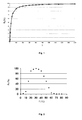
- the reaction rates can be defined by a product of a first term (R t ) which makes it possible to take into account an effect of the residence time in the porous medium, a second term (R T ) to take into account has an effect of temperature, and a third term (V C ) to take into account the accessibility and intrinsic biodegradability of each of the chemical classes.
- the first term R t may represent a biodegradation yield and may be determined by means of a first yield evolution curve R t as a function of the residence time in the medium. This curve can be an exponential function of time, where the yield R t is greater than 95% beyond about 2000 years.
- the second term R T can represent a biodegradation yield and can be determined by means of a Gaussian curve of evolution of the yield R T as a function of the temperature in the medium. This Gaussian curve is advantageously centered on a temperature of about 30 ° C. and vanishes for 0 ° C. and about 70 ° C.
- V C The third term (V C ) can be determined by considering that the rate of intrinsic biodegradability of saturated C 6 -C 14 is greater than that of the others. classes, and considering that the maximum accessibility speed of aromatic C 6 -C 14 is greater than that of other classes.
- the medium may be a petroleum reservoir, and a quantity of acid gas produced during the biodegradation is deduced from the composition of the fluids, in order to determine operating conditions of the petroleum reservoir.
- the medium may be a petroleum reservoir and a quantity of methane produced during the biodegradation is deduced from the composition of the fluids, to determine operating conditions of the petroleum reservoir.
- the figure 1 illustrates the evolution, as a function of time t, of the term R t , a term making it possible to take into account in the overall rate of biodegradation the effect of the residence time in the porous medium.
- the figure 2 illustrates the change, depending on the temperature T, the term T R, term to be considered in the overall rate of biodegradation the effect of temperature.
- the method according to the invention makes it possible to evaluate the biodegradation of hydrocarbons present in a geological structure such as a petroleum reservoir. It is a question of evaluating the evolution of the quantity of chemical components contained in these hydrocarbons, during the migration of the hydrocarbons and the filling of the structure (called trap). This evaluation makes it possible, for example, to determine the opportunity of operating an oil reservoir, and the operating conditions of this reservoir.
- Classes 3 to 12 describe hydrocarbons before and after biodegradation. Classes 1 and 2 take into account the generation of non-hydrocarbon gas during biodegradation, which is important for determining the operating conditions of a field.
- the energy that bacteria can assimilate from the metabolism of their substrate depends on the redox potential of the electron acceptor.
- a high oxidation-reduction potential oxygen and, to a lesser extent, nitrate
- a low oxidation-reduction potential sulphate and water
- lipid-soluble metabolites accumulate when the redox potential of electron acceptors decreases. This phenomenon is related to limited energy efficiency.
- the biodegradation reaction scheme may comprise a set of sequential reactions for each compound contained in the hydrocarbon biodegraded. These are sequential stoichiometric reactions, which have the advantage of revealing a metabolite C x H (y-2) O 2 with a velocity v1 and then making it disappear at a velocity v2.
- the absolute value of v1 with respect to that of v2 makes it possible to determine the accumulation of the metabolite C x H (y-2) O 2 . This accumulation also depends on the overall yield of reactions that, depending on certain conditions, may be incomplete.
- the speed V corresponds to the overall reaction.
- This speed V i is, among other things, a function of the electron acceptor, the biomass, the compound i, the temperature T, the hydrodynamics of the fluids and the diffusion.
- the electron acceptors are: O 2 , NO 3 , SO 4 , H 2 O.
- This parameter depends on the type of tank.
- Biomass concerns nutrients (N, P, K) and trace elements (Fe, Mg, Co ).
- This parameter also depends on the type of tank.
- Compound i is one of the chemical classes defined in the compositional scheme of step 1.
- the temperature T occurs at a given instant (temperature at the moment of the reaction), but also as a function of the thermal history (palaeosterilization).
- Hydrodynamics concerns the displacement of the oil in the tank and / or the migration paths, as well as the evolution of the oil / water contact, and the flow of water.
- the global reactions are preferably used. Each one is assigned a speed, according to the chemical class and the electron acceptor. These reaction speeds are called overall speeds.
- the overall speeds of each of the chemical classes of the compositional scheme are determined, as a function, on the one hand, of the accessibility of the hydrocarbons to the bacteria, ie their concentration potentially soluble in water, and on the other hand , their intrinsic biodegradability (ability of microorganisms to degrade).
- the first term (R t ) for taking into account the effect of the residence time in the porous medium represents a biodegradation yield. It can be determined from the curve represented on the figure 1 , which illustrates the evolution of the biodegradation yield R t (%) as a function of time t (in years). In this figure we define a plateau time (here of 2,000 years) beyond which the yield is greater than 95% and from which the yield will be lower as the time decreases.
- the second term (R T ) for taking into account the effect of temperature represents an overall biodegradation yield. It can be determined by considering that the global efficiency R T evolves according to the temperature along a curve Gaussian. In one example, illustrated on the figure 2 this Gaussian curve is centered on a temperature of about 30 ° C and vanishes for 0 ° C and about 70 ° C.
- V C The third term (V C ) to take into account the specificities of each of the chemical classes is composed of two terms.
- V C accounts for the accessibility of hydrocarbons in the porous medium, that is to say their ability to be accessible to bacteria (for example C 6 -C 14 aromatics are the most soluble hydrocarbons in water, so they will have the maximum accessibility).
- V max (V bio ) max x (V access ) max
- the API degree and the viscosity of the hydrocarbons thus degraded are determined by means of correlations between the API degree and the decrease in saturated hydrocarbons or as a function of the concentration of NSO compounds.
- the production of the associated biological gases (CH 4 , CO 2 and H 2 S) and ultimately the acidity of the crude are determined.
- the method thus contributes to a better economic evaluation of the oil reservoir, and thus makes it possible to decide the drilling.
- compositional and reaction schemes can also be applied to the estimation of the biodegradation of an oil during production (scale of the tank).
- compositional and reaction schemes can also be applied to the evaluation of the biodegradation of hydrocarbons in the polluted sites.
- the method makes it possible to determine the composition of fluids present in a porous medium following biodegradation.
- These fluids correspond on the one hand to biodegraded hydrocarbons, and on the other hand to the metabolites produced during this biodegradation, and in particular the associated biological gases: CH 4 , CO 2 and H 2 S.
Landscapes
- Chemical & Material Sciences (AREA)
- Life Sciences & Earth Sciences (AREA)
- Organic Chemistry (AREA)
- Engineering & Computer Science (AREA)
- Zoology (AREA)
- Wood Science & Technology (AREA)
- Biotechnology (AREA)
- Health & Medical Sciences (AREA)
- Proteomics, Peptides & Aminoacids (AREA)
- Microbiology (AREA)
- Chemical Kinetics & Catalysis (AREA)
- Physics & Mathematics (AREA)
- Molecular Biology (AREA)
- Biophysics (AREA)
- Geology (AREA)
- General Life Sciences & Earth Sciences (AREA)
- Immunology (AREA)
- Paleontology (AREA)
- Oil, Petroleum & Natural Gas (AREA)
- Analytical Chemistry (AREA)
- Environmental & Geological Engineering (AREA)
- General Chemical & Material Sciences (AREA)
- Biochemistry (AREA)
- Bioinformatics & Cheminformatics (AREA)
- General Engineering & Computer Science (AREA)
- General Health & Medical Sciences (AREA)
- Genetics & Genomics (AREA)
- Measuring Or Testing Involving Enzymes Or Micro-Organisms (AREA)
Applications Claiming Priority (1)
| Application Number | Priority Date | Filing Date | Title |
|---|---|---|---|
| FR0804435A FR2934605B1 (fr) | 2008-08-01 | 2008-08-01 | Procede pour predire les changements de composition chimique d'huile d'un reservoir suite a une biodegradation |
Publications (3)
| Publication Number | Publication Date |
|---|---|
| EP2154254A2 true EP2154254A2 (de) | 2010-02-17 |
| EP2154254A3 EP2154254A3 (de) | 2011-03-16 |
| EP2154254B1 EP2154254B1 (de) | 2012-09-12 |
Family
ID=40344616
Family Applications (1)
| Application Number | Title | Priority Date | Filing Date |
|---|---|---|---|
| EP09290583A Not-in-force EP2154254B1 (de) | 2008-08-01 | 2009-07-23 | Verfahren zur Vorraussage der Veränderungen chemischer Ölzusammensetzungen in einem Behälter infolge einer Biodegradation |
Country Status (3)
| Country | Link |
|---|---|
| US (1) | US8112259B2 (de) |
| EP (1) | EP2154254B1 (de) |
| FR (1) | FR2934605B1 (de) |
Cited By (1)
| Publication number | Priority date | Publication date | Assignee | Title |
|---|---|---|---|---|
| EP2520631A1 (de) | 2011-05-06 | 2012-11-07 | IFP Energies Nouvelles | Verfahren zum Vorhersagen der biogenen Gasmengen, die durch biologische Umwandlung von organischer Materie erzeugt werden |
Citations (2)
| Publication number | Priority date | Publication date | Assignee | Title |
|---|---|---|---|---|
| EP1436412A2 (de) | 2001-10-05 | 2004-07-14 | Institut Francais Du Petrole | Verfahren zur modellierung den bioabbau der kohlenwasserstoffen in eines ölfeld |
| FR2906482A1 (fr) | 2006-10-03 | 2008-04-04 | Inst Francais Du Petrole | Methode de modelisation du craquage thermique du kerogene et des produits petroliers associes |
Family Cites Families (1)
| Publication number | Priority date | Publication date | Assignee | Title |
|---|---|---|---|---|
| FR2888251B1 (fr) * | 2005-07-08 | 2012-10-19 | Inst Francais Du Petrole | Methode pour evaluer la biodegradation d'hydrocarbures pieges dans une structure geologique |
-
2008
- 2008-08-01 FR FR0804435A patent/FR2934605B1/fr not_active Expired - Fee Related
-
2009
- 2009-07-23 EP EP09290583A patent/EP2154254B1/de not_active Not-in-force
- 2009-07-31 US US12/533,079 patent/US8112259B2/en not_active Expired - Fee Related
Patent Citations (2)
| Publication number | Priority date | Publication date | Assignee | Title |
|---|---|---|---|---|
| EP1436412A2 (de) | 2001-10-05 | 2004-07-14 | Institut Francais Du Petrole | Verfahren zur modellierung den bioabbau der kohlenwasserstoffen in eines ölfeld |
| FR2906482A1 (fr) | 2006-10-03 | 2008-04-04 | Inst Francais Du Petrole | Methode de modelisation du craquage thermique du kerogene et des produits petroliers associes |
Non-Patent Citations (5)
| Title |
|---|
| BEHAR ET AL., ORGANIC GEOCHEMISTRY, vol. 37, 2006, pages 1042 - 1051 |
| CONAN ET AL.: "Advances in Organic Geochemistry", 1979, PEGAMON PRESS OXFORD, pages: 1 - 17 |
| DE BARROS PENTEADO ET AL., ORGANIC GEOCHEMISTRY, vol. 38, 2007, pages 1197 - 1211 |
| LARTER ET AL., ORGANIC GEOCHEMISTRY, vol. 4, 2003, pages 6001 - 613 |
| PETERS; MOLDOWAN: "The biomarker guide", 1993, PRENTICE HALL |
Cited By (2)
| Publication number | Priority date | Publication date | Assignee | Title |
|---|---|---|---|---|
| EP2520631A1 (de) | 2011-05-06 | 2012-11-07 | IFP Energies Nouvelles | Verfahren zum Vorhersagen der biogenen Gasmengen, die durch biologische Umwandlung von organischer Materie erzeugt werden |
| FR2974905A1 (fr) * | 2011-05-06 | 2012-11-09 | IFP Energies Nouvelles | Procede pour predire les quantites de gaz biogenique generees par transformation biologique de la matiere organique |
Also Published As
| Publication number | Publication date |
|---|---|
| US8112259B2 (en) | 2012-02-07 |
| EP2154254A3 (de) | 2011-03-16 |
| FR2934605B1 (fr) | 2010-08-13 |
| FR2934605A1 (fr) | 2010-02-05 |
| EP2154254B1 (de) | 2012-09-12 |
| US20100076735A1 (en) | 2010-03-25 |
Similar Documents
| Publication | Publication Date | Title |
|---|---|---|
| Nabbefeld et al. | An integrated biomarker, isotopic and palaeoenvironmental study through the Late Permian event at Lusitaniadalen, Spitsbergen | |
| Reeburgh | Oceanic methane biogeochemistry | |
| Cloern | Patterns, pace, and processes of water‐quality variability in a long‐studied estuary | |
| Sturman et al. | Control of hydrogen sulfide in oil and gas wells with nitrite injection | |
| Jahanbani Veshareh et al. | A sulfur and nitrogen cycle informed model to simulate nitrate treatment of reservoir souring | |
| Moore et al. | SGD-OD: investigating the potential oxygen demand of submarine groundwater discharge in coastal systems | |
| EP3179279A1 (de) | Verfahren zur ausbeutung eines sedimentbeckens mithilfe von karten mit einem gehalt an organisch gebundenem kohlenstoff, und wasserstoffindex | |
| Lapham et al. | Methane leakage through the sulfate–methane transition zone of the Baltic seabed | |
| EP3075947A1 (de) | Verfahren zur kohlenwasserstoffgewinnung in einem sedimentbecken mithilfe einer simulation des beckens | |
| EP1436412B1 (de) | Verfahren zur modellierung den bioabbau der kohlenwasserstoffen in eines ölfeld | |
| Wilson et al. | Nitrate reduction across soils transitioning from coastal forest to wetland are hotspots for denitrification | |
| EP2154254B1 (de) | Verfahren zur Vorraussage der Veränderungen chemischer Ölzusammensetzungen in einem Behälter infolge einer Biodegradation | |
| Li et al. | Sedimentation supports life-cycle CH4 production and accumulation in a river valley reservoir: A hierarchical Bayesian modeling approach | |
| Shoemaker et al. | Subsurface characterization of methane production and oxidation from a New Hampshire wetland | |
| Kuijvenhoven et al. | Use of nitrate to mitigate reservoir souring in Bonga deepwater development, offshore Nigeria | |
| McLeod et al. | Anaerobic biodegradation of dissolved ethanol in a pilot-scale sand aquifer: Variability in plume (redox) biogeochemistry | |
| EP2161342A2 (de) | Beckenmodell zur Vorraussage der Veränderungen chemischer Ölzusammensetzungen in einem Behälter infolge einer Biodegradation | |
| Cheng et al. | Characterizing the marine iodine cycle and its relationship to ocean deoxygenation in an Earth system model | |
| Natori et al. | Exploration of the nitrification process in surface sediment of a hypereutrophic intertidal zone via hydroxylamine monitoring | |
| Salimi et al. | A Quantitative and Predictive Reservoir-Souring Approach to Assess Reservoir-Souring Risk During Waterflood Development | |
| Slater et al. | Commonly used biodegradation techniques for drilling fluid chemicals, are they appropriate? | |
| Yao et al. | Zonations and oscillations via heterotrophic processes in tidal unvegetated aquifers | |
| EP2520631A1 (de) | Verfahren zum Vorhersagen der biogenen Gasmengen, die durch biologische Umwandlung von organischer Materie erzeugt werden | |
| Moreno et al. | Coastal nitrogen drives respiration quotient in the Southern California Bight | |
| Candler et al. | Predicting the potential impact of synthetic-based muds with the use of biodegradation studies |
Legal Events
| Date | Code | Title | Description |
|---|---|---|---|
| PUAI | Public reference made under article 153(3) epc to a published international application that has entered the european phase |
Free format text: ORIGINAL CODE: 0009012 |
|
| AK | Designated contracting states |
Kind code of ref document: A2 Designated state(s): AT BE BG CH CY CZ DE DK EE ES FI FR GB GR HR HU IE IS IT LI LT LU LV MC MK MT NL NO PL PT RO SE SI SK SM TR |
|
| AX | Request for extension of the european patent |
Extension state: AL BA RS |
|
| RAP1 | Party data changed (applicant data changed or rights of an application transferred) |
Owner name: IFP ENERGIES NOUVELLES |
|
| PUAL | Search report despatched |
Free format text: ORIGINAL CODE: 0009013 |
|
| AK | Designated contracting states |
Kind code of ref document: A3 Designated state(s): AT BE BG CH CY CZ DE DK EE ES FI FR GB GR HR HU IE IS IT LI LT LU LV MC MK MT NL NO PL PT RO SE SI SK SM TR |
|
| AX | Request for extension of the european patent |
Extension state: AL BA RS |
|
| 17P | Request for examination filed |
Effective date: 20110916 |
|
| GRAP | Despatch of communication of intention to grant a patent |
Free format text: ORIGINAL CODE: EPIDOSNIGR1 |
|
| GRAS | Grant fee paid |
Free format text: ORIGINAL CODE: EPIDOSNIGR3 |
|
| GRAA | (expected) grant |
Free format text: ORIGINAL CODE: 0009210 |
|
| AK | Designated contracting states |
Kind code of ref document: B1 Designated state(s): AT BE BG CH CY CZ DE DK EE ES FI FR GB GR HR HU IE IS IT LI LT LU LV MC MK MT NL NO PL PT RO SE SI SK SM TR |
|
| REG | Reference to a national code |
Ref country code: GB Ref legal event code: FG4D Free format text: NOT ENGLISH |
|
| REG | Reference to a national code |
Ref country code: CH Ref legal event code: EP |
|
| REG | Reference to a national code |
Ref country code: AT Ref legal event code: REF Ref document number: 575127 Country of ref document: AT Kind code of ref document: T Effective date: 20120915 |
|
| REG | Reference to a national code |
Ref country code: IE Ref legal event code: FG4D Free format text: LANGUAGE OF EP DOCUMENT: FRENCH |
|
| REG | Reference to a national code |
Ref country code: DE Ref legal event code: R096 Ref document number: 602009009682 Country of ref document: DE Effective date: 20121108 |
|
| PG25 | Lapsed in a contracting state [announced via postgrant information from national office to epo] |
Ref country code: LT Free format text: LAPSE BECAUSE OF FAILURE TO SUBMIT A TRANSLATION OF THE DESCRIPTION OR TO PAY THE FEE WITHIN THE PRESCRIBED TIME-LIMIT Effective date: 20120912 Ref country code: FI Free format text: LAPSE BECAUSE OF FAILURE TO SUBMIT A TRANSLATION OF THE DESCRIPTION OR TO PAY THE FEE WITHIN THE PRESCRIBED TIME-LIMIT Effective date: 20120912 Ref country code: NO Free format text: LAPSE BECAUSE OF FAILURE TO SUBMIT A TRANSLATION OF THE DESCRIPTION OR TO PAY THE FEE WITHIN THE PRESCRIBED TIME-LIMIT Effective date: 20121212 Ref country code: HR Free format text: LAPSE BECAUSE OF FAILURE TO SUBMIT A TRANSLATION OF THE DESCRIPTION OR TO PAY THE FEE WITHIN THE PRESCRIBED TIME-LIMIT Effective date: 20120912 Ref country code: CY Free format text: LAPSE BECAUSE OF FAILURE TO SUBMIT A TRANSLATION OF THE DESCRIPTION OR TO PAY THE FEE WITHIN THE PRESCRIBED TIME-LIMIT Effective date: 20120912 |
|
| REG | Reference to a national code |
Ref country code: NL Ref legal event code: VDEP Effective date: 20120912 |
|
| REG | Reference to a national code |
Ref country code: AT Ref legal event code: MK05 Ref document number: 575127 Country of ref document: AT Kind code of ref document: T Effective date: 20120912 |
|
| REG | Reference to a national code |
Ref country code: LT Ref legal event code: MG4D Effective date: 20120926 |
|
| PG25 | Lapsed in a contracting state [announced via postgrant information from national office to epo] |
Ref country code: SE Free format text: LAPSE BECAUSE OF FAILURE TO SUBMIT A TRANSLATION OF THE DESCRIPTION OR TO PAY THE FEE WITHIN THE PRESCRIBED TIME-LIMIT Effective date: 20120912 Ref country code: GR Free format text: LAPSE BECAUSE OF FAILURE TO SUBMIT A TRANSLATION OF THE DESCRIPTION OR TO PAY THE FEE WITHIN THE PRESCRIBED TIME-LIMIT Effective date: 20121213 Ref country code: LV Free format text: LAPSE BECAUSE OF FAILURE TO SUBMIT A TRANSLATION OF THE DESCRIPTION OR TO PAY THE FEE WITHIN THE PRESCRIBED TIME-LIMIT Effective date: 20120912 Ref country code: SI Free format text: LAPSE BECAUSE OF FAILURE TO SUBMIT A TRANSLATION OF THE DESCRIPTION OR TO PAY THE FEE WITHIN THE PRESCRIBED TIME-LIMIT Effective date: 20120912 |
|
| PG25 | Lapsed in a contracting state [announced via postgrant information from national office to epo] |
Ref country code: ES Free format text: LAPSE BECAUSE OF FAILURE TO SUBMIT A TRANSLATION OF THE DESCRIPTION OR TO PAY THE FEE WITHIN THE PRESCRIBED TIME-LIMIT Effective date: 20121223 Ref country code: RO Free format text: LAPSE BECAUSE OF FAILURE TO SUBMIT A TRANSLATION OF THE DESCRIPTION OR TO PAY THE FEE WITHIN THE PRESCRIBED TIME-LIMIT Effective date: 20120912 Ref country code: NL Free format text: LAPSE BECAUSE OF FAILURE TO SUBMIT A TRANSLATION OF THE DESCRIPTION OR TO PAY THE FEE WITHIN THE PRESCRIBED TIME-LIMIT Effective date: 20120912 Ref country code: IS Free format text: LAPSE BECAUSE OF FAILURE TO SUBMIT A TRANSLATION OF THE DESCRIPTION OR TO PAY THE FEE WITHIN THE PRESCRIBED TIME-LIMIT Effective date: 20130112 Ref country code: EE Free format text: LAPSE BECAUSE OF FAILURE TO SUBMIT A TRANSLATION OF THE DESCRIPTION OR TO PAY THE FEE WITHIN THE PRESCRIBED TIME-LIMIT Effective date: 20120912 Ref country code: CZ Free format text: LAPSE BECAUSE OF FAILURE TO SUBMIT A TRANSLATION OF THE DESCRIPTION OR TO PAY THE FEE WITHIN THE PRESCRIBED TIME-LIMIT Effective date: 20120912 |
|
| PG25 | Lapsed in a contracting state [announced via postgrant information from national office to epo] |
Ref country code: SK Free format text: LAPSE BECAUSE OF FAILURE TO SUBMIT A TRANSLATION OF THE DESCRIPTION OR TO PAY THE FEE WITHIN THE PRESCRIBED TIME-LIMIT Effective date: 20120912 Ref country code: PT Free format text: LAPSE BECAUSE OF FAILURE TO SUBMIT A TRANSLATION OF THE DESCRIPTION OR TO PAY THE FEE WITHIN THE PRESCRIBED TIME-LIMIT Effective date: 20130114 Ref country code: PL Free format text: LAPSE BECAUSE OF FAILURE TO SUBMIT A TRANSLATION OF THE DESCRIPTION OR TO PAY THE FEE WITHIN THE PRESCRIBED TIME-LIMIT Effective date: 20120912 |
|
| PG25 | Lapsed in a contracting state [announced via postgrant information from national office to epo] |
Ref country code: AT Free format text: LAPSE BECAUSE OF FAILURE TO SUBMIT A TRANSLATION OF THE DESCRIPTION OR TO PAY THE FEE WITHIN THE PRESCRIBED TIME-LIMIT Effective date: 20120912 |
|
| PLBE | No opposition filed within time limit |
Free format text: ORIGINAL CODE: 0009261 |
|
| STAA | Information on the status of an ep patent application or granted ep patent |
Free format text: STATUS: NO OPPOSITION FILED WITHIN TIME LIMIT |
|
| PG25 | Lapsed in a contracting state [announced via postgrant information from national office to epo] |
Ref country code: BG Free format text: LAPSE BECAUSE OF FAILURE TO SUBMIT A TRANSLATION OF THE DESCRIPTION OR TO PAY THE FEE WITHIN THE PRESCRIBED TIME-LIMIT Effective date: 20121212 Ref country code: DK Free format text: LAPSE BECAUSE OF FAILURE TO SUBMIT A TRANSLATION OF THE DESCRIPTION OR TO PAY THE FEE WITHIN THE PRESCRIBED TIME-LIMIT Effective date: 20120912 |
|
| 26N | No opposition filed |
Effective date: 20130613 |
|
| PG25 | Lapsed in a contracting state [announced via postgrant information from national office to epo] |
Ref country code: IT Free format text: LAPSE BECAUSE OF FAILURE TO SUBMIT A TRANSLATION OF THE DESCRIPTION OR TO PAY THE FEE WITHIN THE PRESCRIBED TIME-LIMIT Effective date: 20120912 |
|
| REG | Reference to a national code |
Ref country code: DE Ref legal event code: R097 Ref document number: 602009009682 Country of ref document: DE Effective date: 20130613 |
|
| BERE | Be: lapsed |
Owner name: IFP ENERGIES NOUVELLES Effective date: 20130731 |
|
| PG25 | Lapsed in a contracting state [announced via postgrant information from national office to epo] |
Ref country code: MC Free format text: LAPSE BECAUSE OF FAILURE TO SUBMIT A TRANSLATION OF THE DESCRIPTION OR TO PAY THE FEE WITHIN THE PRESCRIBED TIME-LIMIT Effective date: 20120912 |
|
| REG | Reference to a national code |
Ref country code: CH Ref legal event code: PL |
|
| REG | Reference to a national code |
Ref country code: IE Ref legal event code: MM4A |
|
| PG25 | Lapsed in a contracting state [announced via postgrant information from national office to epo] |
Ref country code: BE Free format text: LAPSE BECAUSE OF NON-PAYMENT OF DUE FEES Effective date: 20130731 Ref country code: LI Free format text: LAPSE BECAUSE OF NON-PAYMENT OF DUE FEES Effective date: 20130731 Ref country code: CH Free format text: LAPSE BECAUSE OF NON-PAYMENT OF DUE FEES Effective date: 20130731 |
|
| PG25 | Lapsed in a contracting state [announced via postgrant information from national office to epo] |
Ref country code: IE Free format text: LAPSE BECAUSE OF NON-PAYMENT OF DUE FEES Effective date: 20130723 |
|
| PG25 | Lapsed in a contracting state [announced via postgrant information from national office to epo] |
Ref country code: SM Free format text: LAPSE BECAUSE OF FAILURE TO SUBMIT A TRANSLATION OF THE DESCRIPTION OR TO PAY THE FEE WITHIN THE PRESCRIBED TIME-LIMIT Effective date: 20120912 |
|
| PG25 | Lapsed in a contracting state [announced via postgrant information from national office to epo] |
Ref country code: TR Free format text: LAPSE BECAUSE OF FAILURE TO SUBMIT A TRANSLATION OF THE DESCRIPTION OR TO PAY THE FEE WITHIN THE PRESCRIBED TIME-LIMIT Effective date: 20120912 Ref country code: MT Free format text: LAPSE BECAUSE OF FAILURE TO SUBMIT A TRANSLATION OF THE DESCRIPTION OR TO PAY THE FEE WITHIN THE PRESCRIBED TIME-LIMIT Effective date: 20120912 |
|
| PG25 | Lapsed in a contracting state [announced via postgrant information from national office to epo] |
Ref country code: MK Free format text: LAPSE BECAUSE OF FAILURE TO SUBMIT A TRANSLATION OF THE DESCRIPTION OR TO PAY THE FEE WITHIN THE PRESCRIBED TIME-LIMIT Effective date: 20120912 Ref country code: LU Free format text: LAPSE BECAUSE OF NON-PAYMENT OF DUE FEES Effective date: 20130723 Ref country code: HU Free format text: LAPSE BECAUSE OF FAILURE TO SUBMIT A TRANSLATION OF THE DESCRIPTION OR TO PAY THE FEE WITHIN THE PRESCRIBED TIME-LIMIT; INVALID AB INITIO Effective date: 20090723 |
|
| PGFP | Annual fee paid to national office [announced via postgrant information from national office to epo] |
Ref country code: GB Payment date: 20150723 Year of fee payment: 7 Ref country code: DE Payment date: 20150803 Year of fee payment: 7 |
|
| REG | Reference to a national code |
Ref country code: FR Ref legal event code: PLFP Year of fee payment: 8 |
|
| PGFP | Annual fee paid to national office [announced via postgrant information from national office to epo] |
Ref country code: FR Payment date: 20160719 Year of fee payment: 8 |
|
| REG | Reference to a national code |
Ref country code: DE Ref legal event code: R119 Ref document number: 602009009682 Country of ref document: DE |
|
| GBPC | Gb: european patent ceased through non-payment of renewal fee |
Effective date: 20160723 |
|
| PG25 | Lapsed in a contracting state [announced via postgrant information from national office to epo] |
Ref country code: DE Free format text: LAPSE BECAUSE OF NON-PAYMENT OF DUE FEES Effective date: 20170201 |
|
| PG25 | Lapsed in a contracting state [announced via postgrant information from national office to epo] |
Ref country code: GB Free format text: LAPSE BECAUSE OF NON-PAYMENT OF DUE FEES Effective date: 20160723 |
|
| REG | Reference to a national code |
Ref country code: FR Ref legal event code: ST Effective date: 20180330 |
|
| PG25 | Lapsed in a contracting state [announced via postgrant information from national office to epo] |
Ref country code: FR Free format text: LAPSE BECAUSE OF NON-PAYMENT OF DUE FEES Effective date: 20170731 |