EP2154579B1 - Entwicklungsrolle, elektrofotografische prozesskartusche und elektrofotografische vorrichtung zur bildformung - Google Patents
Entwicklungsrolle, elektrofotografische prozesskartusche und elektrofotografische vorrichtung zur bildformung Download PDFInfo
- Publication number
- EP2154579B1 EP2154579B1 EP08740694.8A EP08740694A EP2154579B1 EP 2154579 B1 EP2154579 B1 EP 2154579B1 EP 08740694 A EP08740694 A EP 08740694A EP 2154579 B1 EP2154579 B1 EP 2154579B1
- Authority
- EP
- European Patent Office
- Prior art keywords
- developing roller
- surface layer
- toner
- abundance ratio
- less
- Prior art date
- Legal status (The legal status is an assumption and is not a legal conclusion. Google has not performed a legal analysis and makes no representation as to the accuracy of the status listed.)
- Not-in-force
Links
- 238000000034 method Methods 0.000 title claims description 38
- 230000008569 process Effects 0.000 title claims description 16
- 230000015572 biosynthetic process Effects 0.000 title description 14
- 239000002344 surface layer Substances 0.000 claims description 64
- 239000010410 layer Substances 0.000 claims description 55
- VYPSYNLAJGMNEJ-UHFFFAOYSA-N Silicium dioxide Chemical compound O=[Si]=O VYPSYNLAJGMNEJ-UHFFFAOYSA-N 0.000 claims description 37
- 229910052814 silicon oxide Inorganic materials 0.000 claims description 29
- XUIMIQQOPSSXEZ-UHFFFAOYSA-N Silicon Chemical group [Si] XUIMIQQOPSSXEZ-UHFFFAOYSA-N 0.000 claims description 17
- 239000000126 substance Substances 0.000 claims description 16
- 229910052760 oxygen Inorganic materials 0.000 claims description 13
- 229910052799 carbon Inorganic materials 0.000 claims description 12
- 229910052710 silicon Inorganic materials 0.000 claims description 9
- 125000004432 carbon atom Chemical group C* 0.000 claims description 8
- 230000002093 peripheral effect Effects 0.000 claims description 8
- 125000004429 atom Chemical group 0.000 claims description 4
- 125000004430 oxygen atom Chemical group O* 0.000 claims description 4
- 239000007789 gas Substances 0.000 description 36
- 239000010408 film Substances 0.000 description 33
- 239000002994 raw material Substances 0.000 description 29
- 238000004458 analytical method Methods 0.000 description 24
- -1 polypropylene Polymers 0.000 description 22
- 238000011156 evaluation Methods 0.000 description 21
- 238000005268 plasma chemical vapour deposition Methods 0.000 description 20
- 229920005989 resin Polymers 0.000 description 18
- 239000011347 resin Substances 0.000 description 18
- 238000004519 manufacturing process Methods 0.000 description 17
- XKRFYHLGVUSROY-UHFFFAOYSA-N Argon Chemical compound [Ar] XKRFYHLGVUSROY-UHFFFAOYSA-N 0.000 description 16
- 239000000203 mixture Substances 0.000 description 16
- 229920001971 elastomer Polymers 0.000 description 14
- 239000000463 material Substances 0.000 description 13
- 239000005060 rubber Substances 0.000 description 13
- 239000007787 solid Substances 0.000 description 13
- 239000000243 solution Substances 0.000 description 12
- 238000005259 measurement Methods 0.000 description 11
- 230000007547 defect Effects 0.000 description 10
- UQEAIHBTYFGYIE-UHFFFAOYSA-N hexamethyldisiloxane Chemical compound C[Si](C)(C)O[Si](C)(C)C UQEAIHBTYFGYIE-UHFFFAOYSA-N 0.000 description 10
- YXFVVABEGXRONW-UHFFFAOYSA-N Toluene Chemical compound CC1=CC=CC=C1 YXFVVABEGXRONW-UHFFFAOYSA-N 0.000 description 9
- QVGXLLKOCUKJST-UHFFFAOYSA-N atomic oxygen Chemical compound [O] QVGXLLKOCUKJST-UHFFFAOYSA-N 0.000 description 9
- 150000003961 organosilicon compounds Chemical class 0.000 description 9
- 239000001301 oxygen Substances 0.000 description 9
- 229910052786 argon Inorganic materials 0.000 description 8
- 239000006258 conductive agent Substances 0.000 description 8
- 239000000843 powder Substances 0.000 description 8
- 239000003963 antioxidant agent Substances 0.000 description 7
- 239000006229 carbon black Substances 0.000 description 7
- 238000000576 coating method Methods 0.000 description 7
- 238000010586 diagram Methods 0.000 description 7
- 229920000642 polymer Polymers 0.000 description 7
- 230000001105 regulatory effect Effects 0.000 description 7
- XEEYBQQBJWHFJM-UHFFFAOYSA-N Iron Chemical compound [Fe] XEEYBQQBJWHFJM-UHFFFAOYSA-N 0.000 description 6
- 239000011248 coating agent Substances 0.000 description 6
- 230000000052 comparative effect Effects 0.000 description 6
- 238000011161 development Methods 0.000 description 6
- 229920003031 santoprene Polymers 0.000 description 6
- OKTJSMMVPCPJKN-UHFFFAOYSA-N Carbon Chemical compound [C] OKTJSMMVPCPJKN-UHFFFAOYSA-N 0.000 description 5
- 239000003795 chemical substances by application Substances 0.000 description 5
- 238000004140 cleaning Methods 0.000 description 5
- 150000001875 compounds Chemical class 0.000 description 5
- 239000011261 inert gas Substances 0.000 description 5
- 229920006124 polyolefin elastomer Polymers 0.000 description 5
- IJGRMHOSHXDMSA-UHFFFAOYSA-N Atomic nitrogen Chemical compound N#N IJGRMHOSHXDMSA-UHFFFAOYSA-N 0.000 description 4
- 229910018540 Si C Inorganic materials 0.000 description 4
- XLOMVQKBTHCTTD-UHFFFAOYSA-N Zinc monoxide Chemical compound [Zn]=O XLOMVQKBTHCTTD-UHFFFAOYSA-N 0.000 description 4
- 210000000416 exudates and transudate Anatomy 0.000 description 4
- 239000000945 filler Substances 0.000 description 4
- 150000002430 hydrocarbons Chemical class 0.000 description 4
- 150000002500 ions Chemical class 0.000 description 4
- 229920001684 low density polyethylene Polymers 0.000 description 4
- 239000004702 low-density polyethylene Substances 0.000 description 4
- 230000007246 mechanism Effects 0.000 description 4
- 229910052751 metal Inorganic materials 0.000 description 4
- 239000002184 metal Substances 0.000 description 4
- BASFCYQUMIYNBI-UHFFFAOYSA-N platinum Chemical compound [Pt] BASFCYQUMIYNBI-UHFFFAOYSA-N 0.000 description 4
- 229920002379 silicone rubber Polymers 0.000 description 4
- 238000012360 testing method Methods 0.000 description 4
- CZDYPVPMEAXLPK-UHFFFAOYSA-N tetramethylsilane Chemical compound C[Si](C)(C)C CZDYPVPMEAXLPK-UHFFFAOYSA-N 0.000 description 4
- KWEKXPWNFQBJAY-UHFFFAOYSA-N (dimethyl-$l^{3}-silanyl)oxy-dimethylsilicon Chemical compound C[Si](C)O[Si](C)C KWEKXPWNFQBJAY-UHFFFAOYSA-N 0.000 description 3
- ZWEHNKRNPOVVGH-UHFFFAOYSA-N 2-Butanone Chemical compound CCC(C)=O ZWEHNKRNPOVVGH-UHFFFAOYSA-N 0.000 description 3
- MYMOFIZGZYHOMD-UHFFFAOYSA-N Dioxygen Chemical compound O=O MYMOFIZGZYHOMD-UHFFFAOYSA-N 0.000 description 3
- LYCAIKOWRPUZTN-UHFFFAOYSA-N Ethylene glycol Chemical compound OCCO LYCAIKOWRPUZTN-UHFFFAOYSA-N 0.000 description 3
- 229920000459 Nitrile rubber Polymers 0.000 description 3
- 239000002202 Polyethylene glycol Substances 0.000 description 3
- DNIAPMSPPWPWGF-UHFFFAOYSA-N Propylene glycol Chemical compound CC(O)CO DNIAPMSPPWPWGF-UHFFFAOYSA-N 0.000 description 3
- 229910018557 Si O Inorganic materials 0.000 description 3
- GWEVSGVZZGPLCZ-UHFFFAOYSA-N Titan oxide Chemical compound O=[Ti]=O GWEVSGVZZGPLCZ-UHFFFAOYSA-N 0.000 description 3
- 229910052783 alkali metal Inorganic materials 0.000 description 3
- HSFWRNGVRCDJHI-UHFFFAOYSA-N alpha-acetylene Natural products C#C HSFWRNGVRCDJHI-UHFFFAOYSA-N 0.000 description 3
- 229910052782 aluminium Inorganic materials 0.000 description 3
- 239000002585 base Substances 0.000 description 3
- 239000003054 catalyst Substances 0.000 description 3
- 238000005229 chemical vapour deposition Methods 0.000 description 3
- 229910052804 chromium Inorganic materials 0.000 description 3
- 239000011651 chromium Substances 0.000 description 3
- 239000004020 conductor Substances 0.000 description 3
- 229910001882 dioxygen Inorganic materials 0.000 description 3
- 239000005038 ethylene vinyl acetate Substances 0.000 description 3
- 239000010954 inorganic particle Substances 0.000 description 3
- 229910052742 iron Inorganic materials 0.000 description 3
- 229920003049 isoprene rubber Polymers 0.000 description 3
- 239000011259 mixed solution Substances 0.000 description 3
- 230000001590 oxidative effect Effects 0.000 description 3
- 229920001200 poly(ethylene-vinyl acetate) Polymers 0.000 description 3
- 229920001223 polyethylene glycol Polymers 0.000 description 3
- 150000003839 salts Chemical class 0.000 description 3
- 229910010271 silicon carbide Inorganic materials 0.000 description 3
- LIVNPJMFVYWSIS-UHFFFAOYSA-N silicon monoxide Inorganic materials [Si-]#[O+] LIVNPJMFVYWSIS-UHFFFAOYSA-N 0.000 description 3
- 239000010409 thin film Substances 0.000 description 3
- 238000012546 transfer Methods 0.000 description 3
- 239000002699 waste material Substances 0.000 description 3
- XNWFRZJHXBZDAG-UHFFFAOYSA-N 2-METHOXYETHANOL Chemical compound COCCO XNWFRZJHXBZDAG-UHFFFAOYSA-N 0.000 description 2
- ZNQVEEAIQZEUHB-UHFFFAOYSA-N 2-ethoxyethanol Chemical compound CCOCCO ZNQVEEAIQZEUHB-UHFFFAOYSA-N 0.000 description 2
- VTYYLEPIZMXCLO-UHFFFAOYSA-L Calcium carbonate Chemical compound [Ca+2].[O-]C([O-])=O VTYYLEPIZMXCLO-UHFFFAOYSA-L 0.000 description 2
- RYGMFSIKBFXOCR-UHFFFAOYSA-N Copper Chemical compound [Cu] RYGMFSIKBFXOCR-UHFFFAOYSA-N 0.000 description 2
- 238000005033 Fourier transform infrared spectroscopy Methods 0.000 description 2
- 244000043261 Hevea brasiliensis Species 0.000 description 2
- WOBHKFSMXKNTIM-UHFFFAOYSA-N Hydroxyethyl methacrylate Chemical compound CC(=C)C(=O)OCCO WOBHKFSMXKNTIM-UHFFFAOYSA-N 0.000 description 2
- 239000004944 Liquid Silicone Rubber Substances 0.000 description 2
- 229920003355 Novatec® Polymers 0.000 description 2
- KDLHZDBZIXYQEI-UHFFFAOYSA-N Palladium Chemical compound [Pd] KDLHZDBZIXYQEI-UHFFFAOYSA-N 0.000 description 2
- ISWSIDIOOBJBQZ-UHFFFAOYSA-N Phenol Chemical compound OC1=CC=CC=C1 ISWSIDIOOBJBQZ-UHFFFAOYSA-N 0.000 description 2
- 239000004698 Polyethylene Substances 0.000 description 2
- ATUOYWHBWRKTHZ-UHFFFAOYSA-N Propane Chemical compound CCC ATUOYWHBWRKTHZ-UHFFFAOYSA-N 0.000 description 2
- BLRPTPMANUNPDV-UHFFFAOYSA-N Silane Chemical compound [SiH4] BLRPTPMANUNPDV-UHFFFAOYSA-N 0.000 description 2
- BQCADISMDOOEFD-UHFFFAOYSA-N Silver Chemical compound [Ag] BQCADISMDOOEFD-UHFFFAOYSA-N 0.000 description 2
- FAPWRFPIFSIZLT-UHFFFAOYSA-M Sodium chloride Chemical compound [Na+].[Cl-] FAPWRFPIFSIZLT-UHFFFAOYSA-M 0.000 description 2
- 239000000654 additive Substances 0.000 description 2
- 230000000996 additive effect Effects 0.000 description 2
- 229910052784 alkaline earth metal Inorganic materials 0.000 description 2
- XAGFODPZIPBFFR-UHFFFAOYSA-N aluminium Chemical compound [Al] XAGFODPZIPBFFR-UHFFFAOYSA-N 0.000 description 2
- VSCWAEJMTAWNJL-UHFFFAOYSA-K aluminium trichloride Chemical compound Cl[Al](Cl)Cl VSCWAEJMTAWNJL-UHFFFAOYSA-K 0.000 description 2
- TZCXTZWJZNENPQ-UHFFFAOYSA-L barium sulfate Chemical compound [Ba+2].[O-]S([O-])(=O)=O TZCXTZWJZNENPQ-UHFFFAOYSA-L 0.000 description 2
- WERYXYBDKMZEQL-UHFFFAOYSA-N butane-1,4-diol Chemical compound OCCCCO WERYXYBDKMZEQL-UHFFFAOYSA-N 0.000 description 2
- 239000011575 calcium Substances 0.000 description 2
- OSGAYBCDTDRGGQ-UHFFFAOYSA-L calcium sulfate Chemical compound [Ca+2].[O-]S([O-])(=O)=O OSGAYBCDTDRGGQ-UHFFFAOYSA-L 0.000 description 2
- 229910001914 chlorine tetroxide Inorganic materials 0.000 description 2
- 239000011247 coating layer Substances 0.000 description 2
- 238000013329 compounding Methods 0.000 description 2
- 229920001940 conductive polymer Polymers 0.000 description 2
- 229910052802 copper Inorganic materials 0.000 description 2
- 239000010949 copper Substances 0.000 description 2
- 230000003247 decreasing effect Effects 0.000 description 2
- 235000014113 dietary fatty acids Nutrition 0.000 description 2
- 239000002019 doping agent Substances 0.000 description 2
- BXKDSDJJOVIHMX-UHFFFAOYSA-N edrophonium chloride Chemical compound [Cl-].CC[N+](C)(C)C1=CC=CC(O)=C1 BXKDSDJJOVIHMX-UHFFFAOYSA-N 0.000 description 2
- 230000000694 effects Effects 0.000 description 2
- 239000000194 fatty acid Substances 0.000 description 2
- 229930195729 fatty acid Natural products 0.000 description 2
- 150000004665 fatty acids Chemical class 0.000 description 2
- 239000000835 fiber Substances 0.000 description 2
- KWIUHFFTVRNATP-UHFFFAOYSA-N glycine betaine Chemical compound C[N+](C)(C)CC([O-])=O KWIUHFFTVRNATP-UHFFFAOYSA-N 0.000 description 2
- 238000010438 heat treatment Methods 0.000 description 2
- 229920001903 high density polyethylene Polymers 0.000 description 2
- 239000004700 high-density polyethylene Substances 0.000 description 2
- 229920000592 inorganic polymer Polymers 0.000 description 2
- 239000007788 liquid Substances 0.000 description 2
- RLAWWYSOJDYHDC-BZSNNMDCSA-N lisinopril Chemical compound C([C@H](N[C@@H](CCCCN)C(=O)N1[C@@H](CCC1)C(O)=O)C(O)=O)CC1=CC=CC=C1 RLAWWYSOJDYHDC-BZSNNMDCSA-N 0.000 description 2
- VNWKTOKETHGBQD-UHFFFAOYSA-N methane Chemical compound C VNWKTOKETHGBQD-UHFFFAOYSA-N 0.000 description 2
- 229920003052 natural elastomer Polymers 0.000 description 2
- 229920001194 natural rubber Polymers 0.000 description 2
- 229910052759 nickel Inorganic materials 0.000 description 2
- 229910052757 nitrogen Inorganic materials 0.000 description 2
- 239000002245 particle Substances 0.000 description 2
- VLTRZXGMWDSKGL-UHFFFAOYSA-M perchlorate Chemical compound [O-]Cl(=O)(=O)=O VLTRZXGMWDSKGL-UHFFFAOYSA-M 0.000 description 2
- 238000005240 physical vapour deposition Methods 0.000 description 2
- 238000009832 plasma treatment Methods 0.000 description 2
- 238000007747 plating Methods 0.000 description 2
- 229910052697 platinum Inorganic materials 0.000 description 2
- 229920002863 poly(1,4-phenylene oxide) polymer Polymers 0.000 description 2
- 229920001084 poly(chloroprene) Polymers 0.000 description 2
- 229920001197 polyacetylene Polymers 0.000 description 2
- 229920000573 polyethylene Polymers 0.000 description 2
- 239000002243 precursor Substances 0.000 description 2
- 238000012545 processing Methods 0.000 description 2
- 239000010453 quartz Substances 0.000 description 2
- 229910000077 silane Inorganic materials 0.000 description 2
- 239000000377 silicon dioxide Substances 0.000 description 2
- 229910052709 silver Inorganic materials 0.000 description 2
- 239000004332 silver Substances 0.000 description 2
- 238000005507 spraying Methods 0.000 description 2
- 229920003048 styrene butadiene rubber Polymers 0.000 description 2
- XOLBLPGZBRYERU-UHFFFAOYSA-N tin dioxide Chemical compound O=[Sn]=O XOLBLPGZBRYERU-UHFFFAOYSA-N 0.000 description 2
- 229910001887 tin oxide Inorganic materials 0.000 description 2
- 125000000391 vinyl group Chemical group [H]C([*])=C([H])[H] 0.000 description 2
- 239000011787 zinc oxide Substances 0.000 description 2
- WRIDQFICGBMAFQ-UHFFFAOYSA-N (E)-8-Octadecenoic acid Natural products CCCCCCCCCC=CCCCCCCC(O)=O WRIDQFICGBMAFQ-UHFFFAOYSA-N 0.000 description 1
- LQJBNNIYVWPHFW-UHFFFAOYSA-N 20:1omega9c fatty acid Natural products CCCCCCCCCCC=CCCCCCCCC(O)=O LQJBNNIYVWPHFW-UHFFFAOYSA-N 0.000 description 1
- JAJIPIAHCFBEPI-UHFFFAOYSA-N 9,10-dioxoanthracene-1-sulfonic acid Chemical compound O=C1C2=CC=CC=C2C(=O)C2=C1C=CC=C2S(=O)(=O)O JAJIPIAHCFBEPI-UHFFFAOYSA-N 0.000 description 1
- QSBYPNXLFMSGKH-UHFFFAOYSA-N 9-Heptadecensaeure Natural products CCCCCCCC=CCCCCCCCC(O)=O QSBYPNXLFMSGKH-UHFFFAOYSA-N 0.000 description 1
- NLXLAEXVIDQMFP-UHFFFAOYSA-N Ammonia chloride Chemical compound [NH4+].[Cl-] NLXLAEXVIDQMFP-UHFFFAOYSA-N 0.000 description 1
- 229910021630 Antimony pentafluoride Inorganic materials 0.000 description 1
- 229910017049 AsF5 Inorganic materials 0.000 description 1
- VYZAMTAEIAYCRO-UHFFFAOYSA-N Chromium Chemical compound [Cr] VYZAMTAEIAYCRO-UHFFFAOYSA-N 0.000 description 1
- 229910021592 Copper(II) chloride Inorganic materials 0.000 description 1
- 229910000881 Cu alloy Inorganic materials 0.000 description 1
- OTMSDBZUPAUEDD-UHFFFAOYSA-N Ethane Chemical compound CC OTMSDBZUPAUEDD-UHFFFAOYSA-N 0.000 description 1
- 239000004606 Fillers/Extenders Substances 0.000 description 1
- 101000576320 Homo sapiens Max-binding protein MNT Proteins 0.000 description 1
- 229910021578 Iron(III) chloride Inorganic materials 0.000 description 1
- 239000005909 Kieselgur Substances 0.000 description 1
- 239000002841 Lewis acid Substances 0.000 description 1
- 229910000552 LiCF3SO3 Inorganic materials 0.000 description 1
- 229920010126 Linear Low Density Polyethylene (LLDPE) Polymers 0.000 description 1
- 239000006057 Non-nutritive feed additive Substances 0.000 description 1
- 229920002292 Nylon 6 Polymers 0.000 description 1
- 229920002302 Nylon 6,6 Polymers 0.000 description 1
- CTQNGGLPUBDAKN-UHFFFAOYSA-N O-Xylene Chemical compound CC1=CC=CC=C1C CTQNGGLPUBDAKN-UHFFFAOYSA-N 0.000 description 1
- 239000005642 Oleic acid Substances 0.000 description 1
- ZQPPMHVWECSIRJ-UHFFFAOYSA-N Oleic acid Natural products CCCCCCCCC=CCCCCCCCC(O)=O ZQPPMHVWECSIRJ-UHFFFAOYSA-N 0.000 description 1
- 229910021174 PF5 Inorganic materials 0.000 description 1
- 229910019142 PO4 Inorganic materials 0.000 description 1
- OAICVXFJPJFONN-UHFFFAOYSA-N Phosphorus Chemical compound [P] OAICVXFJPJFONN-UHFFFAOYSA-N 0.000 description 1
- 239000004952 Polyamide Substances 0.000 description 1
- 239000004642 Polyimide Substances 0.000 description 1
- 229920000265 Polyparaphenylene Polymers 0.000 description 1
- 239000004721 Polyphenylene oxide Substances 0.000 description 1
- 239000004743 Polypropylene Substances 0.000 description 1
- 229920000292 Polyquinoline Polymers 0.000 description 1
- 229920005830 Polyurethane Foam Polymers 0.000 description 1
- 229920006121 Polyxylylene adipamide Polymers 0.000 description 1
- 229920000297 Rayon Polymers 0.000 description 1
- 235000021355 Stearic acid Nutrition 0.000 description 1
- 239000002174 Styrene-butadiene Substances 0.000 description 1
- NINIDFKCEFEMDL-UHFFFAOYSA-N Sulfur Chemical compound [S] NINIDFKCEFEMDL-UHFFFAOYSA-N 0.000 description 1
- BOTDANWDWHJENH-UHFFFAOYSA-N Tetraethyl orthosilicate Chemical compound CCO[Si](OCC)(OCC)OCC BOTDANWDWHJENH-UHFFFAOYSA-N 0.000 description 1
- 229920006311 Urethane elastomer Polymers 0.000 description 1
- HCHKCACWOHOZIP-UHFFFAOYSA-N Zinc Chemical compound [Zn] HCHKCACWOHOZIP-UHFFFAOYSA-N 0.000 description 1
- 239000005083 Zinc sulfide Substances 0.000 description 1
- YKTSYUJCYHOUJP-UHFFFAOYSA-N [O--].[Al+3].[Al+3].[O-][Si]([O-])([O-])[O-] Chemical compound [O--].[Al+3].[Al+3].[O-][Si]([O-])([O-])[O-] YKTSYUJCYHOUJP-UHFFFAOYSA-N 0.000 description 1
- 239000006230 acetylene black Substances 0.000 description 1
- 239000002253 acid Substances 0.000 description 1
- 229920000122 acrylonitrile butadiene styrene Polymers 0.000 description 1
- 230000004913 activation Effects 0.000 description 1
- 238000007605 air drying Methods 0.000 description 1
- 125000001931 aliphatic group Chemical group 0.000 description 1
- 150000001340 alkali metals Chemical class 0.000 description 1
- 150000001342 alkaline earth metals Chemical class 0.000 description 1
- 150000001336 alkenes Chemical class 0.000 description 1
- 150000008051 alkyl sulfates Chemical class 0.000 description 1
- 239000000956 alloy Substances 0.000 description 1
- 229910045601 alloy Inorganic materials 0.000 description 1
- DIZPMCHEQGEION-UHFFFAOYSA-H aluminium sulfate (anhydrous) Chemical compound [Al+3].[Al+3].[O-]S([O-])(=O)=O.[O-]S([O-])(=O)=O.[O-]S([O-])(=O)=O DIZPMCHEQGEION-UHFFFAOYSA-H 0.000 description 1
- 150000001412 amines Chemical class 0.000 description 1
- 150000003863 ammonium salts Chemical class 0.000 description 1
- 239000002280 amphoteric surfactant Substances 0.000 description 1
- 239000003945 anionic surfactant Substances 0.000 description 1
- 229910000410 antimony oxide Inorganic materials 0.000 description 1
- VBVBHWZYQGJZLR-UHFFFAOYSA-I antimony pentafluoride Chemical compound F[Sb](F)(F)(F)F VBVBHWZYQGJZLR-UHFFFAOYSA-I 0.000 description 1
- 230000003078 antioxidant effect Effects 0.000 description 1
- YBGKQGSCGDNZIB-UHFFFAOYSA-N arsenic pentafluoride Chemical compound F[As](F)(F)(F)F YBGKQGSCGDNZIB-UHFFFAOYSA-N 0.000 description 1
- 239000012298 atmosphere Substances 0.000 description 1
- 229910052788 barium Inorganic materials 0.000 description 1
- SRSXLGNVWSONIS-UHFFFAOYSA-N benzenesulfonic acid Chemical compound OS(=O)(=O)C1=CC=CC=C1 SRSXLGNVWSONIS-UHFFFAOYSA-N 0.000 description 1
- 229940092714 benzenesulfonic acid Drugs 0.000 description 1
- 229910052790 beryllium Inorganic materials 0.000 description 1
- 229960003237 betaine Drugs 0.000 description 1
- FSIJKGMIQTVTNP-UHFFFAOYSA-N bis(ethenyl)-methyl-trimethylsilyloxysilane Chemical compound C[Si](C)(C)O[Si](C)(C=C)C=C FSIJKGMIQTVTNP-UHFFFAOYSA-N 0.000 description 1
- 229910052792 caesium Inorganic materials 0.000 description 1
- 229910052791 calcium Inorganic materials 0.000 description 1
- 229910000019 calcium carbonate Inorganic materials 0.000 description 1
- 239000002041 carbon nanotube Substances 0.000 description 1
- 229910021393 carbon nanotube Inorganic materials 0.000 description 1
- 239000003093 cationic surfactant Substances 0.000 description 1
- 230000008859 change Effects 0.000 description 1
- 239000003153 chemical reaction reagent Substances 0.000 description 1
- 229910017052 cobalt Inorganic materials 0.000 description 1
- 239000010941 cobalt Substances 0.000 description 1
- GUTLYIVDDKVIGB-UHFFFAOYSA-N cobalt atom Chemical compound [Co] GUTLYIVDDKVIGB-UHFFFAOYSA-N 0.000 description 1
- 229910052681 coesite Inorganic materials 0.000 description 1
- 239000000356 contaminant Substances 0.000 description 1
- 238000011109 contamination Methods 0.000 description 1
- 230000001276 controlling effect Effects 0.000 description 1
- 229920001577 copolymer Polymers 0.000 description 1
- ORTQZVOHEJQUHG-UHFFFAOYSA-L copper(II) chloride Chemical compound Cl[Cu]Cl ORTQZVOHEJQUHG-UHFFFAOYSA-L 0.000 description 1
- OMZSGWSJDCOLKM-UHFFFAOYSA-N copper(II) sulfide Chemical compound [S-2].[Cu+2] OMZSGWSJDCOLKM-UHFFFAOYSA-N 0.000 description 1
- 229910052906 cristobalite Inorganic materials 0.000 description 1
- 238000004132 cross linking Methods 0.000 description 1
- 239000003431 cross linking reagent Substances 0.000 description 1
- 238000001723 curing Methods 0.000 description 1
- 230000007423 decrease Effects 0.000 description 1
- UCXUKTLCVSGCNR-UHFFFAOYSA-N diethylsilane Chemical compound CC[SiH2]CC UCXUKTLCVSGCNR-UHFFFAOYSA-N 0.000 description 1
- 239000004205 dimethyl polysiloxane Substances 0.000 description 1
- 235000013870 dimethyl polysiloxane Nutrition 0.000 description 1
- UBHZUDXTHNMNLD-UHFFFAOYSA-N dimethylsilane Chemical compound C[SiH2]C UBHZUDXTHNMNLD-UHFFFAOYSA-N 0.000 description 1
- 238000003618 dip coating Methods 0.000 description 1
- 238000007598 dipping method Methods 0.000 description 1
- 238000007599 discharging Methods 0.000 description 1
- KPUWHANPEXNPJT-UHFFFAOYSA-N disiloxane Chemical class [SiH3]O[SiH3] KPUWHANPEXNPJT-UHFFFAOYSA-N 0.000 description 1
- 239000002270 dispersing agent Substances 0.000 description 1
- 239000000806 elastomer Substances 0.000 description 1
- 230000005684 electric field Effects 0.000 description 1
- 238000005868 electrolysis reaction Methods 0.000 description 1
- 238000010894 electron beam technology Methods 0.000 description 1
- 239000012776 electronic material Substances 0.000 description 1
- 229920005558 epichlorohydrin rubber Polymers 0.000 description 1
- 150000002148 esters Chemical class 0.000 description 1
- FWDBOZPQNFPOLF-UHFFFAOYSA-N ethenyl(triethoxy)silane Chemical compound CCO[Si](OCC)(OCC)C=C FWDBOZPQNFPOLF-UHFFFAOYSA-N 0.000 description 1
- NKSJNEHGWDZZQF-UHFFFAOYSA-N ethenyl(trimethoxy)silane Chemical compound CO[Si](OC)(OC)C=C NKSJNEHGWDZZQF-UHFFFAOYSA-N 0.000 description 1
- GCSJLQSCSDMKTP-UHFFFAOYSA-N ethenyl(trimethyl)silane Chemical compound C[Si](C)(C)C=C GCSJLQSCSDMKTP-UHFFFAOYSA-N 0.000 description 1
- 125000005678 ethenylene group Chemical group [H]C([*:1])=C([H])[*:2] 0.000 description 1
- 125000002534 ethynyl group Chemical group [H]C#C* 0.000 description 1
- 238000001125 extrusion Methods 0.000 description 1
- 229920001973 fluoroelastomer Polymers 0.000 description 1
- 239000006260 foam Substances 0.000 description 1
- 239000003365 glass fiber Substances 0.000 description 1
- PCHJSUWPFVWCPO-UHFFFAOYSA-N gold Chemical compound [Au] PCHJSUWPFVWCPO-UHFFFAOYSA-N 0.000 description 1
- 229910052737 gold Inorganic materials 0.000 description 1
- 239000010931 gold Substances 0.000 description 1
- 229910052736 halogen Inorganic materials 0.000 description 1
- 150000002367 halogens Chemical class 0.000 description 1
- 238000013007 heat curing Methods 0.000 description 1
- 229910052734 helium Inorganic materials 0.000 description 1
- 239000001307 helium Substances 0.000 description 1
- SWQJXJOGLNCZEY-UHFFFAOYSA-N helium atom Chemical compound [He] SWQJXJOGLNCZEY-UHFFFAOYSA-N 0.000 description 1
- NEXSMEBSBIABKL-UHFFFAOYSA-N hexamethyldisilane Chemical compound C[Si](C)(C)[Si](C)(C)C NEXSMEBSBIABKL-UHFFFAOYSA-N 0.000 description 1
- 150000004678 hydrides Chemical class 0.000 description 1
- 125000002887 hydroxy group Chemical group [H]O* 0.000 description 1
- 230000001771 impaired effect Effects 0.000 description 1
- 230000006872 improvement Effects 0.000 description 1
- 229910003437 indium oxide Inorganic materials 0.000 description 1
- PJXISJQVUVHSOJ-UHFFFAOYSA-N indium(iii) oxide Chemical compound [O-2].[O-2].[O-2].[In+3].[In+3] PJXISJQVUVHSOJ-UHFFFAOYSA-N 0.000 description 1
- 238000001746 injection moulding Methods 0.000 description 1
- 238000007733 ion plating Methods 0.000 description 1
- RBTARNINKXHZNM-UHFFFAOYSA-K iron trichloride Chemical compound Cl[Fe](Cl)Cl RBTARNINKXHZNM-UHFFFAOYSA-K 0.000 description 1
- 230000001678 irradiating effect Effects 0.000 description 1
- QXJSBBXBKPUZAA-UHFFFAOYSA-N isooleic acid Natural products CCCCCCCC=CCCCCCCCCC(O)=O QXJSBBXBKPUZAA-UHFFFAOYSA-N 0.000 description 1
- 239000003273 ketjen black Substances 0.000 description 1
- 238000001182 laser chemical vapour deposition Methods 0.000 description 1
- 239000011133 lead Substances 0.000 description 1
- 150000007517 lewis acids Chemical class 0.000 description 1
- 229910052744 lithium Inorganic materials 0.000 description 1
- 229910001540 lithium hexafluoroarsenate(V) Inorganic materials 0.000 description 1
- MHCFAGZWMAWTNR-UHFFFAOYSA-M lithium perchlorate Chemical compound [Li+].[O-]Cl(=O)(=O)=O MHCFAGZWMAWTNR-UHFFFAOYSA-M 0.000 description 1
- 229910001486 lithium perchlorate Inorganic materials 0.000 description 1
- 229910001496 lithium tetrafluoroborate Inorganic materials 0.000 description 1
- 230000007774 longterm Effects 0.000 description 1
- 229910052749 magnesium Inorganic materials 0.000 description 1
- 239000011777 magnesium Substances 0.000 description 1
- ZLNQQNXFFQJAID-UHFFFAOYSA-L magnesium carbonate Chemical compound [Mg+2].[O-]C([O-])=O ZLNQQNXFFQJAID-UHFFFAOYSA-L 0.000 description 1
- 239000001095 magnesium carbonate Substances 0.000 description 1
- 229910000021 magnesium carbonate Inorganic materials 0.000 description 1
- HCWCAKKEBCNQJP-UHFFFAOYSA-N magnesium orthosilicate Chemical compound [Mg+2].[Mg+2].[O-][Si]([O-])([O-])[O-] HCWCAKKEBCNQJP-UHFFFAOYSA-N 0.000 description 1
- 239000000391 magnesium silicate Substances 0.000 description 1
- 229910052919 magnesium silicate Inorganic materials 0.000 description 1
- 235000019792 magnesium silicate Nutrition 0.000 description 1
- 150000002736 metal compounds Chemical class 0.000 description 1
- 229910044991 metal oxide Inorganic materials 0.000 description 1
- 150000004706 metal oxides Chemical class 0.000 description 1
- 150000002739 metals Chemical class 0.000 description 1
- UIUXUFNYAYAMOE-UHFFFAOYSA-N methylsilane Chemical compound [SiH3]C UIUXUFNYAYAMOE-UHFFFAOYSA-N 0.000 description 1
- BFXIKLCIZHOAAZ-UHFFFAOYSA-N methyltrimethoxysilane Chemical compound CO[Si](C)(OC)OC BFXIKLCIZHOAAZ-UHFFFAOYSA-N 0.000 description 1
- 239000010445 mica Substances 0.000 description 1
- 229910052618 mica group Inorganic materials 0.000 description 1
- 238000002156 mixing Methods 0.000 description 1
- 229910000476 molybdenum oxide Inorganic materials 0.000 description 1
- 238000000465 moulding Methods 0.000 description 1
- GPUMPJNVOBTUFM-UHFFFAOYSA-N naphthalene-1,2,3-trisulfonic acid Chemical compound C1=CC=C2C(S(O)(=O)=O)=C(S(O)(=O)=O)C(S(=O)(=O)O)=CC2=C1 GPUMPJNVOBTUFM-UHFFFAOYSA-N 0.000 description 1
- YZMHQCWXYHARLS-UHFFFAOYSA-N naphthalene-1,2-disulfonic acid Chemical compound C1=CC=CC2=C(S(O)(=O)=O)C(S(=O)(=O)O)=CC=C21 YZMHQCWXYHARLS-UHFFFAOYSA-N 0.000 description 1
- PSZYNBSKGUBXEH-UHFFFAOYSA-N naphthalene-1-sulfonic acid Chemical compound C1=CC=C2C(S(=O)(=O)O)=CC=CC2=C1 PSZYNBSKGUBXEH-UHFFFAOYSA-N 0.000 description 1
- QIQXTHQIDYTFRH-UHFFFAOYSA-N octadecanoic acid Chemical compound CCCCCCCCCCCCCCCCCC(O)=O QIQXTHQIDYTFRH-UHFFFAOYSA-N 0.000 description 1
- OQCDKBAXFALNLD-UHFFFAOYSA-N octadecanoic acid Natural products CCCCCCCC(C)CCCCCCCCC(O)=O OQCDKBAXFALNLD-UHFFFAOYSA-N 0.000 description 1
- HMMGMWAXVFQUOA-UHFFFAOYSA-N octamethylcyclotetrasiloxane Chemical compound C[Si]1(C)O[Si](C)(C)O[Si](C)(C)O[Si](C)(C)O1 HMMGMWAXVFQUOA-UHFFFAOYSA-N 0.000 description 1
- JRZJOMJEPLMPRA-UHFFFAOYSA-N olefin Natural products CCCCCCCC=C JRZJOMJEPLMPRA-UHFFFAOYSA-N 0.000 description 1
- ZQPPMHVWECSIRJ-KTKRTIGZSA-N oleic acid Chemical compound CCCCCCCC\C=C/CCCCCCCC(O)=O ZQPPMHVWECSIRJ-KTKRTIGZSA-N 0.000 description 1
- 239000012766 organic filler Substances 0.000 description 1
- VTRUBDSFZJNXHI-UHFFFAOYSA-N oxoantimony Chemical compound [Sb]=O VTRUBDSFZJNXHI-UHFFFAOYSA-N 0.000 description 1
- PQQKPALAQIIWST-UHFFFAOYSA-N oxomolybdenum Chemical compound [Mo]=O PQQKPALAQIIWST-UHFFFAOYSA-N 0.000 description 1
- 239000003973 paint Substances 0.000 description 1
- 229910052763 palladium Inorganic materials 0.000 description 1
- 239000008188 pellet Substances 0.000 description 1
- 230000035515 penetration Effects 0.000 description 1
- 239000013500 performance material Substances 0.000 description 1
- PARWUHTVGZSQPD-UHFFFAOYSA-N phenylsilane Chemical compound [SiH3]C1=CC=CC=C1 PARWUHTVGZSQPD-UHFFFAOYSA-N 0.000 description 1
- 239000010452 phosphate Substances 0.000 description 1
- 229910052698 phosphorus Inorganic materials 0.000 description 1
- 239000011574 phosphorus Substances 0.000 description 1
- OBCUTHMOOONNBS-UHFFFAOYSA-N phosphorus pentafluoride Chemical compound FP(F)(F)(F)F OBCUTHMOOONNBS-UHFFFAOYSA-N 0.000 description 1
- 229920003227 poly(N-vinyl carbazole) Polymers 0.000 description 1
- 229920000435 poly(dimethylsiloxane) Polymers 0.000 description 1
- 229920002647 polyamide Polymers 0.000 description 1
- 229920006122 polyamide resin Polymers 0.000 description 1
- 229920000767 polyaniline Polymers 0.000 description 1
- 229920001707 polybutylene terephthalate Polymers 0.000 description 1
- 229920005668 polycarbonate resin Polymers 0.000 description 1
- 239000004431 polycarbonate resin Substances 0.000 description 1
- 229920000015 polydiacetylene Polymers 0.000 description 1
- 229920001225 polyester resin Polymers 0.000 description 1
- 239000004645 polyester resin Substances 0.000 description 1
- 229920013716 polyethylene resin Polymers 0.000 description 1
- 229920000139 polyethylene terephthalate Polymers 0.000 description 1
- 239000005020 polyethylene terephthalate Substances 0.000 description 1
- 229920001721 polyimide Polymers 0.000 description 1
- 229920001843 polymethylhydrosiloxane Polymers 0.000 description 1
- 229920000069 polyphenylene sulfide Polymers 0.000 description 1
- 229920001155 polypropylene Polymers 0.000 description 1
- 229920000379 polypropylene carbonate Polymers 0.000 description 1
- 229920001451 polypropylene glycol Polymers 0.000 description 1
- 229920000128 polypyrrole Polymers 0.000 description 1
- 229920005990 polystyrene resin Polymers 0.000 description 1
- 229920001021 polysulfide Polymers 0.000 description 1
- 239000005077 polysulfide Substances 0.000 description 1
- 150000008117 polysulfides Polymers 0.000 description 1
- 239000011496 polyurethane foam Substances 0.000 description 1
- ZNNZYHKDIALBAK-UHFFFAOYSA-M potassium thiocyanate Chemical compound [K+].[S-]C#N ZNNZYHKDIALBAK-UHFFFAOYSA-M 0.000 description 1
- 239000001294 propane Substances 0.000 description 1
- UIDUKLCLJMXFEO-UHFFFAOYSA-N propylsilane Chemical compound CCC[SiH3] UIDUKLCLJMXFEO-UHFFFAOYSA-N 0.000 description 1
- 150000003242 quaternary ammonium salts Chemical class 0.000 description 1
- 239000002964 rayon Substances 0.000 description 1
- 239000012744 reinforcing agent Substances 0.000 description 1
- 229910052703 rhodium Inorganic materials 0.000 description 1
- 239000010948 rhodium Substances 0.000 description 1
- MHOVAHRLVXNVSD-UHFFFAOYSA-N rhodium atom Chemical compound [Rh] MHOVAHRLVXNVSD-UHFFFAOYSA-N 0.000 description 1
- 229910052701 rubidium Inorganic materials 0.000 description 1
- 239000004576 sand Substances 0.000 description 1
- 229910052706 scandium Inorganic materials 0.000 description 1
- 238000007789 sealing Methods 0.000 description 1
- FZHAPNGMFPVSLP-UHFFFAOYSA-N silanamine Chemical compound [SiH3]N FZHAPNGMFPVSLP-UHFFFAOYSA-N 0.000 description 1
- 239000013464 silicone adhesive Substances 0.000 description 1
- 239000004945 silicone rubber Substances 0.000 description 1
- 229910052708 sodium Inorganic materials 0.000 description 1
- 239000011780 sodium chloride Substances 0.000 description 1
- BAZAXWOYCMUHIX-UHFFFAOYSA-M sodium perchlorate Chemical compound [Na+].[O-]Cl(=O)(=O)=O BAZAXWOYCMUHIX-UHFFFAOYSA-M 0.000 description 1
- 229910001488 sodium perchlorate Inorganic materials 0.000 description 1
- VGTPCRGMBIAPIM-UHFFFAOYSA-M sodium thiocyanate Chemical compound [Na+].[S-]C#N VGTPCRGMBIAPIM-UHFFFAOYSA-M 0.000 description 1
- 239000002904 solvent Substances 0.000 description 1
- 238000001179 sorption measurement Methods 0.000 description 1
- 238000004544 sputter deposition Methods 0.000 description 1
- 230000000087 stabilizing effect Effects 0.000 description 1
- 239000008117 stearic acid Substances 0.000 description 1
- 229910052682 stishovite Inorganic materials 0.000 description 1
- 150000005846 sugar alcohols Polymers 0.000 description 1
- BDHFUVZGWQCTTF-UHFFFAOYSA-M sulfonate Chemical compound [O-]S(=O)=O BDHFUVZGWQCTTF-UHFFFAOYSA-M 0.000 description 1
- 229910052717 sulfur Inorganic materials 0.000 description 1
- 239000011593 sulfur Substances 0.000 description 1
- 229920003002 synthetic resin Polymers 0.000 description 1
- 239000000057 synthetic resin Substances 0.000 description 1
- 239000000454 talc Substances 0.000 description 1
- 229910052623 talc Inorganic materials 0.000 description 1
- LFQCEHFDDXELDD-UHFFFAOYSA-N tetramethyl orthosilicate Chemical compound CO[Si](OC)(OC)OC LFQCEHFDDXELDD-UHFFFAOYSA-N 0.000 description 1
- 238000002230 thermal chemical vapour deposition Methods 0.000 description 1
- 229920005992 thermoplastic resin Polymers 0.000 description 1
- 239000004408 titanium dioxide Substances 0.000 description 1
- OGIDPMRJRNCKJF-UHFFFAOYSA-N titanium oxide Inorganic materials [Ti]=O OGIDPMRJRNCKJF-UHFFFAOYSA-N 0.000 description 1
- JOXIMZWYDAKGHI-UHFFFAOYSA-N toluene-4-sulfonic acid Chemical compound CC1=CC=C(S(O)(=O)=O)C=C1 JOXIMZWYDAKGHI-UHFFFAOYSA-N 0.000 description 1
- 229910052905 tridymite Inorganic materials 0.000 description 1
- CPUDPFPXCZDNGI-UHFFFAOYSA-N triethoxy(methyl)silane Chemical compound CCO[Si](C)(OCC)OCC CPUDPFPXCZDNGI-UHFFFAOYSA-N 0.000 description 1
- ZNOCGWVLWPVKAO-UHFFFAOYSA-N trimethoxy(phenyl)silane Chemical compound CO[Si](OC)(OC)C1=CC=CC=C1 ZNOCGWVLWPVKAO-UHFFFAOYSA-N 0.000 description 1
- PQDJYEQOELDLCP-UHFFFAOYSA-N trimethylsilane Chemical compound C[SiH](C)C PQDJYEQOELDLCP-UHFFFAOYSA-N 0.000 description 1
- 238000001771 vacuum deposition Methods 0.000 description 1
- 238000009834 vaporization Methods 0.000 description 1
- 230000008016 vaporization Effects 0.000 description 1
- 239000008096 xylene Substances 0.000 description 1
- 229910052725 zinc Inorganic materials 0.000 description 1
- 239000011701 zinc Substances 0.000 description 1
- 229910052984 zinc sulfide Inorganic materials 0.000 description 1
- DRDVZXDWVBGGMH-UHFFFAOYSA-N zinc;sulfide Chemical compound [S-2].[Zn+2] DRDVZXDWVBGGMH-UHFFFAOYSA-N 0.000 description 1
Images


Classifications
-
- G—PHYSICS
- G03—PHOTOGRAPHY; CINEMATOGRAPHY; ANALOGOUS TECHNIQUES USING WAVES OTHER THAN OPTICAL WAVES; ELECTROGRAPHY; HOLOGRAPHY
- G03G—ELECTROGRAPHY; ELECTROPHOTOGRAPHY; MAGNETOGRAPHY
- G03G15/00—Apparatus for electrographic processes using a charge pattern
- G03G15/06—Apparatus for electrographic processes using a charge pattern for developing
- G03G15/08—Apparatus for electrographic processes using a charge pattern for developing using a solid developer, e.g. powder developer
- G03G15/0806—Apparatus for electrographic processes using a charge pattern for developing using a solid developer, e.g. powder developer on a donor element, e.g. belt, roller
- G03G15/0818—Apparatus for electrographic processes using a charge pattern for developing using a solid developer, e.g. powder developer on a donor element, e.g. belt, roller characterised by the structure of the donor member, e.g. surface properties
-
- G—PHYSICS
- G03—PHOTOGRAPHY; CINEMATOGRAPHY; ANALOGOUS TECHNIQUES USING WAVES OTHER THAN OPTICAL WAVES; ELECTROGRAPHY; HOLOGRAPHY
- G03G—ELECTROGRAPHY; ELECTROPHOTOGRAPHY; MAGNETOGRAPHY
- G03G21/00—Arrangements not provided for by groups G03G13/00 - G03G19/00, e.g. cleaning, elimination of residual charge
- G03G21/16—Mechanical means for facilitating the maintenance of the apparatus, e.g. modular arrangements
- G03G21/18—Mechanical means for facilitating the maintenance of the apparatus, e.g. modular arrangements using a processing cartridge, whereby the process cartridge comprises at least two image processing means in a single unit
- G03G21/1839—Means for handling the process cartridge in the apparatus body
- G03G21/1857—Means for handling the process cartridge in the apparatus body for transmitting mechanical drive power to the process cartridge, drive mechanisms, gears, couplings, braking mechanisms
- G03G21/186—Axial couplings
-
- G—PHYSICS
- G03—PHOTOGRAPHY; CINEMATOGRAPHY; ANALOGOUS TECHNIQUES USING WAVES OTHER THAN OPTICAL WAVES; ELECTROGRAPHY; HOLOGRAPHY
- G03G—ELECTROGRAPHY; ELECTROPHOTOGRAPHY; MAGNETOGRAPHY
- G03G2215/00—Apparatus for electrophotographic processes
- G03G2215/08—Details of powder developing device not concerning the development directly
- G03G2215/0855—Materials and manufacturing of the developing device
- G03G2215/0858—Donor member
- G03G2215/0861—Particular composition or materials
-
- G—PHYSICS
- G03—PHOTOGRAPHY; CINEMATOGRAPHY; ANALOGOUS TECHNIQUES USING WAVES OTHER THAN OPTICAL WAVES; ELECTROGRAPHY; HOLOGRAPHY
- G03G—ELECTROGRAPHY; ELECTROPHOTOGRAPHY; MAGNETOGRAPHY
- G03G2215/00—Apparatus for electrophotographic processes
- G03G2215/08—Details of powder developing device not concerning the development directly
- G03G2215/0855—Materials and manufacturing of the developing device
- G03G2215/0858—Donor member
- G03G2215/0863—Manufacturing
Definitions
- the present invention relates to a developing roller used in an electrophotographic image forming apparatus, such as a copying machine and a laser printer, and an electrophotographic process cartridge and electrophotographic image forming apparatus which are provided with the developing roller.
- a contact development method in which a developing roller having an elastic layer is brought into contact with a photosensitive drum for development is proposed as a development method in which an electrostatic latent image on a photosensitive drum is visualized with a toner.
- the developing roller used for contact development is brought into contact with a contact member while conveying a toner. Therefore, when the surface of the developing roller has strong tackiness, the conveyed toner may remain attached on the developing roller.
- the toner attached to the developing roller surface in this manner may degrade gradually by subsequent repeated contact of the developing roller and the photosensitive drum, and finally melted and adhered to the developing roller surface, causing filming.
- Patent Document 1 proposes a developing roller with an elastic layer that has good charging properties for toner and suppresses filming by sprinkling and attaching inorganic particles having release properties for toner onto the surface of the elastic layer.
- the above-described inorganic particles were attached lightly to the surface, so that the inorganic particles were easily detached during use, and it was difficult to sustain the effect of suppressing filming for a long period.
- the developing roller having the elastic layer may affect image quality and the lifetime of the photosensitive drum.
- a developing roller of a type in which the surface of the elastic layer is coated with at least one resin is mentioned as a conventional measure against toner filming in the specification of the above Patent Document 1. It is described that in such a developing roller, there was a problem in reliability because the coating layer was insufficient in flexibility and adhesiveness to the elastic body.
- EP 1 286 225 A2 discloses a developer-carrying member comprising a mandrel, an elastic layer and an inorganic fine powder of SiO 2 which sticks to the elastic layer.
- the present inventors arrived at recognition that it is important to develop a developing roller having a surface layer that can effectively suppress the exudation of low molecular weight components from the elastic layer, has a surface excellent in toner release properties, and has sufficient flexibility, and does not easily cause cracks even when repeatedly subjected to image formation.
- the subject of the present invention is to provide a developing roller having a surface layer that satisfies the above requirements 1 to 3.
- the present invention is directed to a developing roller for carrying and conveying toner to develop an electrostatic latent image on a photosensitive drum with the toner, the developing roller including in this order a mandrel, an elastic layer and a silicon oxide film as a surface layer, wherein the silicon oxide film contains carbon atoms, the silicon oxide film containing carbon atoms having an abundance ratio of oxygen atoms forming chemical bonds with silicon atoms to silicon atoms (O/Si) of 0.65 or more and 1.95 or less, and an abundance ratio of carbon atoms forming chemical bonds with silicon atoms to silicon atoms (C/Si) of 0.05 or more and 1.65 or less.
- the present invention is directed to an electrophotographic process cartridge that is detachably mountable on an electrophotographic image forming apparatus body, wherein a developing roller set in the cartridge is the above developing roller.
- the present invention is directed to an electrophotographic image forming apparatus including a photosensitive drum and a developing roller placed in contact with the photosensitive drum, wherein the developing roller is the above developing roller.
- the developing roller of the present invention the exudation of low molecular weight substances from the elastic layer can be effectively suppressed.
- the attachment of low molecular weight substances exuding from the elastic layer to the surface of the electrophotographic photosensitive body is effectively suppressed.
- high-quality electrophotographic images can be stably provided.
- the developing roller of the present invention filming on the surface of the developing roller is inhibited from occurring, so that images can be stably formed. Moreover, according to the developing roller of the present invention, peeling of the surface layer of the developing roller associated with use can be effectively suppressed. Therefore, a further improvement in the durability of the developing roller can be achieved.
- FIG. 1 A cross-sectional view of one example of the developing roller of the present invention is shown in FIG. 1 .
- the developing roller 1 of the present invention usually has a mandrel 11 formed of conductive material, such as metal. At least one elastic layer 12 is on the outer peripheral surface of the mandrel 11, and at least one surface layer 13 is further superposed on the outer peripheral surface.
- the mandrel 11 is columnar in this figure, but may be hollow cylindrical.
- the mandrel 11 is a support member, and preferably, is made of a conductive material so that at least the surface of the mandrel 11 can be conductive. Therefore, in the mandrel 11, at least the outer peripheral surface is made of conductive material that is sufficient to apply a predetermined voltage to the elastic layer 12 formed on the outer peripheral surface.
- the following may be exemplified as the configurations of specific mandrels:
- the mandrel 11 has an outer diameter in a range of 4 mm to 10 mm.
- the elastic layer 12 is formed using one of rubbers and resins as the main component of the raw material.
- Various rubbers conventionally used for a developing roller may be used as the rubber that is the main component of the raw material.
- EPDM ethylene-propylene-diene copolymer rubbers
- NBR acrylonitrile-butadiene rubbers
- CR chloroprene rubbers
- NR natural rubbers
- IR isoprene rubbers
- SBR styrene-butadiene rubbers
- fluororubbers silicone rubbers, epichlorohydrin rubbers, NBR hydrides, polysulfide rubbers, and urethane rubbers.
- the resin which is the main component of the raw material, is mainly a thermoplastic resin, and includes the following: polyethylene resins, such as low-density polyethylene (LDPE), high-density polyethylene (HDPE), linear low-density polyethylene (LLDPE), and ethylenevinyl acetate copolymer resins (EVA); polypropylene resins; polycarbonate resins; polystyrene resins; ABS resins; polyimide; polyester resins, such as polyethylene terephthalate and polybutylene terephthalate; fluororesins; polyamide resins, such as polyamide 6, polyamide 66, and MXD6.
- polyethylene resins such as low-density polyethylene (LDPE), high-density polyethylene (HDPE), linear low-density polyethylene (LLDPE), and ethylenevinyl acetate copolymer resins (EVA)
- polypropylene resins polycarbonate resins; polystyrene resins; ABS
- Rubbers and resins may be used singly or in a mixture of two or more of them.
- the rubber material which is the main component
- the rubber material may be appropriately blended with components necessary for the functions required for the elastic layer itself, such as a conductive agent and a nonconductive filler, and various additive components used for forming a rubber and resin molded body, for example, a crosslinking agent, a catalyst, and a dispersing agent.
- the conductive agent includes an ion conductive substance based on an ion conducting mechanism, and a conductivity providing agent based on an electron conducting mechanism, and either or both the ion conductive substance and the conductivity providing agent may be used.
- the conductive agent based on an electron conducting mechanism includes the following: powders and fibers of metal, such as aluminum, palladium, iron, copper, and silver; metal oxides, such as titanium oxide, tin oxide, and zinc oxide; powders of metal compounds, such as copper sulfide and zinc sulfide; powders composed of suitable particles whose surfaces tin oxide, antimony oxide, indium oxide, molybdenum oxide, zinc, aluminum, gold, silver, copper, chromium, cobalt, iron, lead, platinum, or rhodium is attached to by electrolysis processing, spray coating, or mixing and shaking; carbon black type conductive agents, such as acetylene black, Ketjen Black (trade name), PAN carbon black, pitch carbon black, and carbon nanotubes.
- metal oxides such as titanium oxide, tin oxide, and zinc oxide
- powders of metal compounds such as copper sulfide and zinc sulfide
- powders composed of suitable particles whose surfaces tin oxide, antimony oxide,
- the conductivity providing agent based on an ion conducting mechanism includes the following: alkali metal salts, such as LiCF 3 SO 3 , NaClO 4 , LiClO 4 , LiAsF 6 , LiBF 4 , NaSCN, KSCN, and NaCl; ammonium salts, such as NH 4 Cl, NH 4 SO 4 , and NH 4 NO 3 ; alkaline earth metal salts, such as Ca(ClO 4 ) 2 and Ba(ClO 4 ) 2 ; complexes of these salts and polyalcohols, such as 1,4-butanediol, ethylene glycol, polyethylene glycol, propylene glycol, and polypropylene glycol, and their derivatives; complexes of these salts and monools, such as ethylene glycol monomethyl ether, ethylene glycol monoethyl ether, polyethylene glycol monomethyl ether, and polyethylene glycol monoethyl ether; cationic surfactants, such
- These conductive agents can be used singly or in a mixture of two or more of them.
- a method of adding a conductive polymer compound instead of, or along with, the conductive agent may also be used as a means for imparting conductivity to the elastic layer.
- a conductive polymer compound refers to a polymer compound including a polymer having a conjugated system, such as polyacetylene, as a host polymer, which is doped with a dopant, such as I 2 , for conductivity.
- the host polymer includes, for example, the following: polyacetylene, poly(p-phenylene), polypyrrole, polythiophenine, poly(p-phenylene oxide), poly(p-phenylene sulfide), poly(p-phelene vinylene), poly(2,6-dimethylphenylene oxide), poly(bisphenol A carbonate), polyvinylcarbazole, polydiacetylene, poly(N-methyl-4-vinylpyridine), polyaniline, polyquinoline, and poly(phenylene ether sulfone).
- the dopant includes, in addition to I 2 , the following: halogens, such as Cl 2 , Br 2 , ICl, ICl 3 , IBr, and IF 3 ; Lewis acids, such as PF 5 , AsF 5 , SbF 5 , FeCl 3 , AlCl 3 , and CuCl 2 ; alkali metals, such as Li, Na, Rb, and Cs; alkaline earth metals, such as Be, Mg, Ca, Sc, and Ba; aromatic sulfonic acids, such as paratoluenesulfonic acid, benzenesulfonic acid, anthraquinonesulfonic acid, naphthalenesulfonic acid, naphthalenedisulfonic acid, and naphthalenetrisulfonic acid, or their alkali metal salts.
- halogens such as Cl 2 , Br 2 , ICl, ICl 3 , IBr, and IF 3
- the carbon black type conductive agents are easily available at relatively low costs and can also provide good conductivity without depending on the types of rubber and resin materials which are the main component, and hence, are preferable.
- the following means conventionally used may be appropriately used, according to the rubber and resin materials that are the main component, as means for dispersing a fine powder conductive agent into the rubber and resin materials that are the main component.
- roll kneaders, Banbury mixers, ball mills, sand grinders, and paint shakers may be cited.
- a filler and an extender include the following: silica, quartz fine powder, diatomaceous earth, zinc oxide, basic magnesium carbonate, active calcium carbonate, magnesium silicate, aluminum silicate, titanium dioxide, talc, mica powder, aluminum sulfate, calcium sulfate, barium sulfate, glass fiber, organic reinforcing agents, and organic fillers.
- the surfaces of these filler particles may be treated with an organosilicon compound for hydrophobicity.
- antioxidants used for a polymer compound such as hindered phenol antioxidants, phenol antioxidants, phosphorus antioxidants, amine antioxidants, and sulfur antioxidants, may be appropriately selected and used as an antioxidant.
- fatty acids such as stearic acid and oleic acid
- metal salts and esters of fatty acids may be used.
- liquid silicone rubber as a main agent liquid silicone rubber as a main agent
- polyorganohydrogen siloxane as a crosslinking component and a platinum catalyst are used to crosslink the rubber components with each other.
- the thickness of the elastic layer is preferably 0.5 mm or more and more preferably 1.0 mm or more.
- the thickness of the elastic layer can be 6.0 mm or less and particularly 5.0 mm or less.
- the thickness of the elastic layer is appropriately determined according to the hardness of the elastic layer to achieve the intended nip width.
- the molding of this elastic layer may be performed by conventionally known extrusion molding methods, injection molding methods, and the like, but is not particularly limited.
- the layer configuration is not limited as long as having the features described in the present invention, and may include two or more layers.
- the tensile modulus of the elastic layer having a surface layer is not particularly limited, but is preferably 1.0 MPa or more and 100.0 MPa or less, and more preferably 1.0 MPa or more and 30.0 MPa or less.
- a contact member such as an electrophotographic photosensitive member
- the pressure applied to the toner passing between the contact member and the developing roller is not too large, so that the detachment and embedment of the external additive of the toner, and the exudation of wax and the like in the toner can be effectively suppressed.
- the tensile modulus in the present invention is measured according to the method described in JIS-K7113 (1995).
- a sample is cut out of the developing roller 1 in a length of 100 mm corresponding to half the circumference of the roller to provide a test piece 40 for tensile modulus measurement.
- the universal tensile tester "Tensilon RTC-1250A" (trade name, manufactured by ORIENTEC CO., LTD.) is used for measurement.
- the measurement environment is set at a temperature of 20°C and a humidity of 60% RH. Measurement is performed attaching 10 mm of each end of the test piece to a chuck, at a chuck-to-chuck length of 80 mm and a measurement speed of 20 mm/min.
- the average value of the obtained tensile modulus of five specimens is calculated and defined as the tensile modulus of the elastic layer having a surface layer in the developing roller.
- the developing roller of the present invention has the surface layer 13 covering the surface of the elastic layer 12, as illustrated in FIG. 1 .
- the surface layer is a silicon oxide film (hereinafter referred to also as a "SiOx film”) containing carbon atoms chemically bonded to silicon atoms.
- SiOx film as the surface layer 13 has chemical bonds of Si-O and Si-C.
- the abundance ratio of oxygen atoms chemically bonded to silicon atoms to silicon atoms (O/Si) is 0.65 or more and 1.95 or less.
- the abundance ratio of carbon atoms forming chemical bonds with silicon atoms to silicon atoms (C/Si) is 0.05 or more and 1.65 or less.
- the abundance ratio O/Si is more preferably 1.30 or more and 1.80 or less. If the abundance ratio O/Si is less than 0.65, it is difficult to inhibit contaminants from exuding from the elastic layer, so that a problem is raised in contamination of the photosensitive drum in some case when the surface layer is used for the developing roller. If the abundance ratio is more than 1.95, the SiOx film itself is hard, and is liable to crack, so that streaks are likely to occur in the resulting images due to cracks when the surface layer is used for the developing roller.
- the abundance ratio C/Si is more preferably 0.10 or more and 0.70 or less. If the abundance ratio C/Si is less than 0.05, the adhesion of the silicon oxide film and the elastic layer surface decreases, so that it is difficult to obtain a uniform and suitable surface layer. If the abundance ratio C/Si is more than 1.65, the surface of the film is liable to become tacky (sticky), and when the surface layer is used for the developing roller, release properties for toner is lowered, so that filming is apt to occurs.
- the abundance ratio of each element in the surface layer is obtained as follows.
- the chemical bonds of SiOx are confirmed by IR measurement of the surface of the SiOx film constituting the surface layer 13 of the developing roller by the Fourier transform infrared spectrometer (FT-IR) "SpectrumOne” (trade name, manufactured by PerkinElmer Japan Co., Ltd.).
- FT-IR Fourier transform infrared spectrometer
- Si-O vibration peak 450 cm -1
- Si-C stretching peak 800 to 820 cm -1
- a method for forming the SiOx film according to the present invention on the elastic layer includes the following: wet coating methods, such as dip coating, spray coating, roll coating, and ring coating; physical vapor deposition (PVD) methods, such as vacuum deposition, sputtering, and ion plating; chemical vapor deposition (CVD) methods, such as plasma CVD, thermal CVD, and laser CVD.
- wet coating methods such as dip coating, spray coating, roll coating, and ring coating
- PVD physical vapor deposition
- CVD chemical vapor deposition
- the plasma CVD method is preferable, considering the adhesion of the elastic layer and the surface layer (the SiOx film), processing time and temperature, the convenience of the apparatus, and the uniformity of the resulting surface layer.
- FIG. 3 is a schematic diagram of an apparatus for forming a SiOx film by this plasma CVD method.
- the apparatus includes a vacuum chamber 41, plate electrodes 42 placed in parallel, raw material gas cylinders and raw material liquid tanks 43, a raw material supply unit 44, a unit 45 for exhausting the gas in the chamber, a high frequency supply power source 46 for supplying high frequency, and motor 47 for rotating an elastic roller 48.
- a developing roller having a SiOx film as a surface layer can be produced by the following procedures (1) to (4), using the apparatus illustrated in FIG. 3 .
- Procedure (2) The inside of the vacuum chamber 41 is evacuated by the exhaust unit.
- Procedure (3) A raw material gas is introduced from a raw material gas introduction port, and high-frequency power is supplied to the plate electrodes 42 by the high frequency supply power source 46 to generate plasma to form a film.
- Procedure (4) After a predetermined time passes, raw material gas and high-frequency power supply are stopped, and air or nitrogen is introduced (leaked) into the vacuum chamber 41 to atmospheric pressure, and then, the elastic roller 48 is removed.
- a gaseous or gasified organosilicon compound for a raw material gas is usually introduced, together with a hydrocarbon compound as required, in the coexistence of or in the absence of gas, such as an inert gas and an oxidizing gas.
- a hydrocarbon compound include, for example, toluene, xylene, methane, ethane, propane, and acetylene.
- the organosilicon compound includes the following: 1,1,3,3-tetramethyldisiloxane, hexamethyldisiloxane, vinyltrimethylsilane, methyltrimethoxysilane, hexamethyldisilane, methylsilane, dimethylsilane, trimethylsilane, tetramethylsilane, diethylsilane, propylsilane, phenylsilane, vinyltriethoxysilane, vinyltrimethoxysilane, tetramethoxysilane, tetraethoxysilane, phenyltrimethoxysilane, methyltriethoxysilane, and octamethylcyclotetrasiloxane. 1,1,3,3-tetramethyldisiloxane, hexamethyldisiloxane, and tetramethylsilane are preferable in terms of safety in handling.
- a silane source is not limited to the organosilicon compound, and silane, aminosilane and silazane can also be used.
- organosilicon compound and the like When the organosilicon compound and the like are gaseous, they are used as they are. When the organosilicon compound and the like are liquid at room temperature, they are heated, vaporized, and conveyed by an inert gas, or bubbled by an inert gas and conveyed for use. Further, an organosilicon compound and the like that are solid at room temperature are heated, vaporized, and conveyed by an inert gas for use. Vaporization of the raw material substances may be accelerated at reduced pressure.
- an oxidizing gas such as oxygen and an oxidative gas (N 2 O, CO 2 , etc.) is introduced into the vacuum chamber, along with the above raw material gas, or in addition to the raw material gas.
- an oxidizing gas such as oxygen and an oxidative gas (N 2 O, CO 2 , etc.)
- nitrogen is introduced into the vacuum chamber, along with the above raw material gas, or in addition to the raw material gas.
- the inert gas that can be used in the above, helium, argon and nitrogen may be cited.
- the abundance ratio of silicon atoms, oxygen atoms chemically bonded to silicon atoms, and carbon atoms chemically bonded to silicon atoms in the SiOx film can be controlled by the compounding ratio of the raw material gases to be introduced, the high-frequency power to be supplied, and the like.
- the value of O/Si can be increased by increasing the ratio of oxygen gas in the compounding ratio of the above described organosilicon compound and oxygen gas.
- the value of C/Si can be increased by decreasing the ratio of oxygen gas.
- the values of O/Si and C/Si can be decreased by increasing high-frequency power. Further, when using the above described hydrocarbon compound together, the values of O/Si and C/Si can be increased according to the amount of the hydrocarbon compound used.
- the following method is shown as a method for producing a SiOx film by a wet method.
- an inorganic polymer precursor solution for example, a perhydropolysilazane solution
- a solution of a polymer having a hydroxyl group for example, 2-hydroxyethyl methacrylate
- the values of O/Si and C/Si can be controlled by changing the molar ratio of the above inorganic polymer precursor solution and the above polymer solution.
- the surface of the elastic layer Before the raw material mixture for a SiOx film is applied on the elastic layer, the surface of the elastic layer may be subjected to activation treatment, such as irradiation with ultraviolet light or electron beams, or plasma treatment, so that the mixture can be well applied.
- activation treatment such as irradiation with ultraviolet light or electron beams, or plasma treatment
- the thickness of the SiOx film formed in this manner is preferably 15 nm or more and 5000 nm or less, and more preferably 300 nm or more and 3000 nm or less.
- the SiOx film is also practically sufficient for wear associated with long-term use. Also, even if the SiOx film is manufactured by the above described CVD method, the temperature of the elastic layer can be effectively inhibited from being excessively raised so that the properties of the elastic layer change.
- the film thickness of the formed SiOx film is defined as an average value of measurements for 3 spots equally spaced in the peripheral direction of the developing roller for each of 3 spots equally spaced in the lengthwise direction from the end portion, 9 spots in total, measured with a thin film measuring device (trade name: F20-EXR, manufactured by FILMETRICS).
- the current value measured when DC 50 V is applied to the developing roller that is rotating, as in FIG. 4 is preferably 5 ⁇ A or more and 5000 ⁇ A or less, and more preferably 100 ⁇ A or more and 500 ⁇ A or less. If the current value is set to be in the above numerical value range, a developing bias sufficient for development can be easily obtained when an electrostatic latent image formed on an electrophotographic photosensitive drum is developed with toner. Therefore, an electrophotographic image having sufficient density can be obtained. Even though pinholes occur on the surface of the electrophotographic photosensitive drum, bias leak is difficult to bring about, so that transverse streaks caused by the pinholes can be effectively inhibited from occurring in the electrophotographic image.
- a load of 500 g is applied to each of the exposed portions of the mandrel of developing roller 1 to bring the outer peripheral surface of the developing roller 1 with a cylindrical electrode 51 made of SUS and having a diameter of 40 mm.
- the cylindrical electrode 51 is rotated in this state, and the developing roller 1 is rotated in the circumferential direction at a speed of 24 rpm by associated rotation.
- voltage is applied to the mandrel by a direct current power source 52, and a voltage of 50 V is applied between the mandrel and the cylindrical electrode.
- the environment at this time is 20°C and 50% RH, where current values are measured for one rotation of the developing roller 1 with an ammeter 53, and the average value of the current values is defined as the current value.
- the current value measured in this manner is referred to as "the current value of the developing roller". Controlling this current value of the developing roller properly and uniformly is important in terms of keeping electric field strength for toner movement proper and uniform.
- the above developing roller of the present invention is useful as the developing roller of an image forming apparatus, such as a copying machine, a facsimile and a printer, and also as the developing roller of a process cartridge in a process cartridge type image forming apparatus.
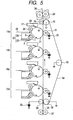
- FIG. 5 A schematic diagram of one example of a color electrophotographic image forming apparatus in which the developing roller of the present invention is set is illustrated in FIG. 5 . Description will be given below with reference to FIG. 5 .
- the color electrophotographic image forming apparatus illustrated in the schematic diagram of FIG. 5 has image forming portions 10 (10a to 10d), which are provided for each of color toners of yellow Y, magenta M, cyan C, and black BK, in a tandem form.
- the image forming portions 10 are slightly different in specifications according to respective color toner properties, but are the same in basic configuration.
- the image forming portion 10 is provided with the photosensitive drum 21 as a latent image bearing member that rotates in the arrow direction.
- a charging member 26 for uniformly charging the photosensitive drum 21, an exposure unit 21 for irradiating the uniformly charged photosensitive drum 21 with laser light 25 to form an electrostatic latent image, and the developing apparatus 22 for supplying toner to the photosensitive drum 21 on which the electrostatic latent image is formed and developing the electrostatic latent image are placed around photosensitive drum 21.
- a transfer member is provided having a transfer roller 31 for transferring the toner image on photosensitive drum 21 onto recording medium 36, such as paper, which is fed by a pair of paper feed rollers 37 and conveyed by a conveying belt 34, by applying a bias power source 32 from the back surface of a recording medium 36.
- the conveying belt 34 is fitted over and around a driving roller 30, a driven roller 35 and a tension roller 33, and is so controlled as to move in synchronization with the image forming portions and convey the recording medium 36 so that the toner images formed in the respective image forming portions are sequentially superposed and transferred on the recording medium 36.
- the recording medium 36 is electrostatically adsorbed to the conveying belt 34 by operation of an adsorption roller 38 placed immediately before the conveying belt 34 and is conveyed.
- the color electrophotographic image forming apparatus is provided with a fixing apparatus 29 for fixing the toner images superposed and transferred on the recording medium 36 by heating or the like, and a conveying apparatus (not illustrated) for discharging the recording medium on which the image is formed, out of the color electrophotographic image forming apparatus.
- the recording medium 36 is peeled from the conveying belt 34 by operation of a peeling apparatus 39 and sent to the fixing apparatus 29.
- the image forming portion 10 is provided with a cleaning member having a cleaning blade 28 for removing the transfer residual toner that is not transferred to the recording medium and remains on photosensitive drum 21 and remains, and cleaning the surface, and a waste toner container 27 for storing the toner scraped off from the photosensitive drum.
- the cleaned photosensitive drum 21 is made capable of forming an image and stands ready.
- the photosensitive drum 21, charging member 26, developing apparatus 22, cleaning blade 28, and waste toner container 27 can also be integrated into a process cartridge.
- the developing apparatus 22 placed in the above image forming portion 10 is provided with the toner container 24 containing toner 23, and the developing roller 1 that is placed to block the opening of the toner container and is opposed to the photosensitive drum in the portion exposed from the toner container.
- the toner container 24 is provided with a roller-shaped toner applying member 7 that comes in contact with the developing roller 1 and supplies the toner to the developing roller 1, and a toner amount regulating blade 9 that forms the toner supplied to developing roller 1 into a thin film and performs frictional charging.
- the toner applying member 7 for example, one in which a foam sponge or polyurethane foam is formed on a shaft and one having a fur brush structure in which fibers of rayon, polyamide, or the like are implanted, are preferable in terms of removing the residual toner on the developing roller 1. It is preferable that the toner applying member 7 can be placed having a suitable contact width with the developing roller 1, and can be rotated in the direction counter to the developing roller 1 in the abutting portion.
- the process cartridge of the present invention is detachable from the electrophotographic image forming apparatus body and includes the above developing roller, as described above.
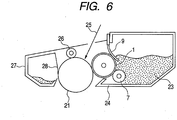
- a schematic diagram of an example of a process cartridge for a monochrome image forming apparatus is illustrated in FIG. 6 .
- the developing roller 1 is placed in contact with the photosensitive drum 21 and the toner applying member 7.
- Toner 23 placed in the toner container 24 can be supplied to the developing roller 1 by the toner applying member 7.
- the amount of the toner is adjusted by the toner amount regulating blade 9.
- An electrostatic latent image is formed by laser light 25 on the photosensitive drum 21 charged by the charging member 26, and the electrostatic latent image is visualized by the toner carried and conveyed on the developing roller 1, to be a toner image.
- This toner image on the photosensitive drum 21 is transferred onto a recording medium, such as paper. Then, the toner remaining on the photosensitive drum 21 is scraped off by the cleaning blade 28 into the waste toner container 27.
- the reagents used herein have a purity of 99.5% or more unless otherwise specified.
- the following materials were melted and kneaded, and extruded using a twin screw extruder having a diameter of 30 mm and an L/D of 32 to prepare a resin mixture.
- a polyolefin elastomer (trade name: Santoprene 8211-25, manufactured by AES Japan), and 40 parts by mass of MT carbon black (trade name: Thermax Floform N990, manufactured by CANCARB).
- a resin layer was formed from these pellets on an mandrel (diameter: 6 mm, and length: 250 mm), using a crosshead extruder. The ends of this resin layer were cut, and further, the resin layer portion was ground by a grindstone to produce an elastic roller 2 with an elastic layer having a thickness of 3 mm.
- An elastic roller 3 was produced in the same manner as in the above Manufacturing Example 2, except that the polyolefin elastomer (Santoprene 8211-25, manufactured by AES Japan) was changed to an olefin elastomer (trade name: Santoprene 8211-45, manufactured by AES Japan).
- An elastic roller 4 was produced in the same manner as in the above Manufacturing Example 2, except that the polyolefin elastomer (trade name: Santoprene 8211-25, manufactured by AES Japan) was changed to LDPE (trade name: Novatec LD LJ902, manufactured by Japan Polyethylene Corporation).
- polyolefin elastomer trade name: Santoprene 8211-25, manufactured by AES Japan
- LDPE trade name: Novatec LD LJ902, manufactured by Japan Polyethylene Corporation
- Elastic roller 5 was produced in the same manner as in the above Manufacturing Example 2, except that the polyolefin elastomer (trade name: Santoprene 8211-25, manufactured by AES Japan) was changed to LDPE (trade name: Novatec LD LJ802, manufactured by Japan polyethylene Corporation).
- polyolefin elastomer trade name: Santoprene 8211-25, manufactured by AES Japan
- LDPE trade name: Novatec LD LJ802, manufactured by Japan polyethylene Corporation
- Elastic roller 6 was produced in the same manner as in the above Manufacturing Example 2, except that the polyolefin elastomer (trade name: Santoprene 8211-25, manufactured by AES Japan) was changed to EVA (trade name: EVAFLEX EV45LX, manufactured by DuPont-Mitsui Polychemicals Co., Ltd.).
- the polyolefin elastomer trade name: Santoprene 8211-25, manufactured by AES Japan
- EVA trade name: EVAFLEX EV45LX, manufactured by DuPont-Mitsui Polychemicals Co., Ltd.
- Elastic roller 1 was installed in the plasma CVD apparatus illustrated in FIG. 3 . Subsequently, the pressure in the vacuum chamber was reduced to 1 Pa, using a vacuum pump. Subsequently, a mixed gas of 1.0 sccm of hexamethyldisiloxane vapor, 1.5 sccm of oxygen and 22.5 sccm of argon gas, as a raw material gas, was introduced into the vacuum chamber, and the pressure in the vacuum chamber was set to be 25.3 Pa. After the pressure became constant, power of 120 W at a frequency of 13.56 MHz was supplied to plate electrodes from a high-frequency power source to generate plasma between the electrodes. The elastic roller 1 installed in the vacuum chamber was rotated at 24 rpm and treated for 3 minutes. After the treatment was finished, power supply was stopped, the raw material gas remaining in the vacuum chamber was evacuated, and air was introduced into the vacuum chamber to atmospheric pressure. Subsequently, the developing roller on which a surface layer was formed was taken out.
- the abundance ratio of O/Si and the abundance ratio of C/Si on the surface of the obtained developing roller were determined using an X-ray photoelectron spectrometer to be 1.56 and 0.32, respectively.
- the film thickness of the surface layer of the developing roller was measured using a thin film measuring apparatus (trade name: F20-EXR, manufactured by FILMETRICS), and found to be 1530 nm. The measurement was performed at three spots equally divided in the peripheral direction of the developing roller for each of three spots equally divided in the lengthwise direction, nine spots in total, and the average value of the obtained values was determined as the film thickness.
- the current value of the developing roller was measured with a voltage of 50 V applied and the developing roller rotated at a speed of 24 rpm in an environment of a temperature of 20°C and a humidity of 50% RH, and found to be 270 ⁇ A.
- the tensile modulus of the elastic layer having the surface layer was measured using a test piece 100 mm in length corresponding to half the circumference of the roller, prepared from the developing roller according to FIG. 2 , and found to be 1.0 MPa.
- the tensile modulus was an average value of the values measured for five specimens by a universal tensile tester (trade name: Tensilon RTC-1250A, manufactured by ORIENTEC CO., LTD.) in a measurement environment of a temperature of 20°C and a humidity of 60% RH.
- a developing roller was prepared in the same manner as in Example 1 except that the elastic roller 2 was used, and the time for which plasma CVD treatment was performed to form a surface layer was 4 minutes.
- a developing roller was obtained in the same manner as in Example 2 except that the time taken for plasma CVD treatment was 10 seconds.
- the analysis results of this developing roller are shown in Table 1.
- a developing roller was obtained in the same manner as in Example 2 except that the time taken for plasma CVD treatment was 8 seconds.
- the analysis results of this developing roller are shown in Table 1.
- a developing roller was obtained in the same manner as in Example 2 except that the time of plasma CVD treatment was 10 minutes.
- the analysis results of this developing roller are shown in Table 1.
- a developing roller was obtained in the same manner as in Example 2, except that the time taken for plasma CVD treatment was 11 minutes.
- the analysis results of this developing roller are shown in Table 1.
- a developing roller was obtained in the same manner as in Example 2 except that in the formation of a surface layer, the composition of the raw material gas was 1.0 sccm of hexamethyldisiloxane vapor, 2.5 sccm of oxygen, and 21.5 sccm of argon gas, and the time taken for plasma CVD treatment was 30 seconds.
- the analysis results of this developing roller are shown in Table 1.
- a developing roller was obtained in the same manner as in Example 2 except that in the formation of a surface layer, the composition of the raw material gas was 1.0 sccm of hexamethyldisiloxane vapor, 0.5 sccm of oxygen, and 23.5 sccm of argon gas, and the time taken for plasma CVD treatment was 6 minutes.
- the analysis results of this developing roller are shown in Table 1.
- a developing roller was obtained in the same manner as in Example 8 except that the time take for plasma CVD treatment was 3 minutes in the formation of a surface layer.
- the analysis results of this developing roller are shown in Table 1.
- a developing roller was obtained in the same manner as in Example 8 except that the time taken for plasma CVD treatment was 1 minute in the formation of a surface layer.
- the analysis results of this developing roller are shown in Table 1.
- a developing roller was obtained in the same manner as in Example 2 except that elastic roller 3 was used.
- the analysis results of this developing roller are shown in Table 1.
- a developing roller was obtained in the same manner as in Example 2 except that the elastic roller 4 was used.
- the analysis results of this developing roller are shown in Table 1.
- a developing roller was obtained in the same manner as in Example 1 except that the elastic roller 5 was used.
- the analysis results of this developing roller are shown in Table 1.
- a developing roller was obtained in the same manner as in Example 1 except that the elastic roller 6 was used.
- the analysis results of this developing roller are shown in Table 1.
- a developing roller was obtained in the same manner as in Example 2 except that the conditions for forming the surface layer were changed so that the raw material gas composition was 1.0 sccm of 1,1,3,3-tetramethyldisiloxane vapor, 2.5 sccm of oxygen, and 22.5 sccm of argon gas, the pressure in the chamber was 50.6 Pa, the high-frequency power source was 200 W at 13.56 MHz, and the time taken for plasma CVD treatment was 1 minute.
- the analysis results of this developing roller are shown in Table 1.
- a developing roller was obtained in the same manner as in Example 2 except that the raw material gas composition was changed to 1.0 sccm of tetramethylsilane vapor, 0.5 sccm of oxygen, and 22.5 sccm of argon gas, and the time taken for plasma CVD treatment was 10 minutes.
- the analysis results of this developing roller are shown in Table 1.
- the surface of the elastic layer of elastic roller 2 was surface treated with excimer light, and then, was coated with a mixed solution of 250 g of a perhydropolysilazane solution (trade name: AQUAMICA NP110-5, manufactured by AZ Electronic Materials) and 3 g of 2-hydroxyethyl methacrylate by a dipping method. Subsequently, air drying was performed for one whole day and night to produce a developing roller in which a surface layer was formed. The analysis results of this developing roller are shown in Table 1.
- a developing roller was obtained in the same manner as in Example 1 except that the time taken for plasma treatment was 6 minutes in the formation of a surface layer.
- the analysis results of this developing roller are shown in Table 1.
- a developing roller was obtained in the same manner as in Example 1 except that the raw material gas composition was changed to 1.0 sccm of hexamethyldisiloxane vapor and 21.5 sccm of argon gas and the time taken for plasma CVD treatment was 3 minutes in the formation of a surface layer.
- the analysis results of this developing roller are shown in Table 1.
- a developing roller was obtained in the same manner as in Example 1 except that in the formation of the surface layer of Example 1, 20 sccm of hexamethyldisiloxane vapor as a raw material gas composition was introduced into the vacuum chamber, the pressure in the vacuum chamber was set to be 6 Pa, and a power of 150 W was supplied to the parallel plate electrodes from the high-frequency power source to perform treatment for 5 minutes.
- the analysis results of this developing roller are shown in Table 1.
- a developing roller was obtained in the same manner as in Example 20 except that in the formation of the surface layer of Example 20, a mixed gas of 10 sccm of hexamethyldisiloxane vapor and 10 sccm of toluene vapor as a raw material gas was introduced into the vacuum chamber, and the pressure in the vacuum chamber was set to be 6 Pa.
- the analysis results of this developing roller are shown in Table 1.
- a developing roller was obtained in the same manner as in Example 21 except that in the formation of the surface layer, 3 sccm of hexamethylsiloxane vapor as a raw material gas was introduced into the vacuum chamber, the pressure in the vacuum chamber was set to be 2 Pa, and a power of 200 W was supplied to the parallel plate electrodes from the high-frequency power source.
- the analysis results of this developing roller are shown in Table 1.
- a developing roller was obtained in the same manner as in Example 22 except that in the formation of the surface layer, a mixed gas of 10 sccm of hexamethyldisiloxane vapor and 20 sccm of toluene vapor as a raw material gas was introduced into the vacuum chamber, the pressure in the vacuum chamber was set to be 8 Pa, and a power of 30 W was supplied to the parallel plate electrodes from the high-frequency power source.
- Table 1 The analysis results of this developing roller are shown in Table 1.
- a developing roller was obtained in the same manner as in Example 1 except that in the formation of the surface layer, the raw material gas composition was changed to 1.0 sccm of tetramethylsilane vapor, 2.5 sccm of oxygen, and 21.5 sccm of argon gas, and the time taken for plasma CVD treatment was 2 minutes.
- the analysis results of this developing roller are shown in Table 1.
- a developing roller was obtained in the same manner as in Example 20 except that in the formation of the surface layer, 30 sccm of hexamethyldisiloxane vapor as a raw material gas was introduced into the vacuum chamber, the pressure in the vacuum chamber was set to be 6 Pa, and a power of 200 W was supplied from the high-frequency power source.
- the analysis results of this developing roller are shown in Table 1.
- a mixed solution containing methyl ethyl ketone as a main solvent was prepared in which the concentration of a heat curing silicone adhesive sealing agent (trade name: TSE3251-C, manufactured by Momentive Performance Materials) was adjusted to 5% in terms of solid content. 21 parts by weight (based on the resin component) of carbon black (trade name: DENKA BLACK, manufactured by DENKI KAGAKU KOGYO KABUSHIKI KAISHA, powdered product) was added to this mixed solution, and was sufficiently stirred to prepare a coating solution for forming a surface layer.
- a heat curing silicone adhesive sealing agent trade name: TSE3251-C, manufactured by Momentive Performance Materials
- the elastic roller 1 in which the surface of the elastic layer was surface treated with excimer light was dipped in the above coating solution, pulled up, dried, and further heat treated at 140°C for 2 hours to produce a developing roller.
- Table 1 Abundance ratio Abundance ratio Surface layer film thickness Current value Tensile modulus O/Si C/Si (nm) ( ⁇ A) (MPa) Ex. 1 1.56 0.32 1530 270 1.0 Ex. 2 1.53 0.36 1940 252 10.0 Ex. 3 1.5 0.41 18 550 10.0 Ex. 4 1. 52 0.33 12 1260 10.0 Ex. 5 1.53 0.37 4895 8 10.0 Ex. 6 1.58 0.33 5030 4 10.0 Ex. 7 1.78 0.12 313 15 10.0 Ex.
- the laser printer used for evaluation (trade name: LASER SHOT LBP-1310, manufactured by Canon) is a machine in which A4 paper is discharged in its longitudinal direction, the recording medium output speed is 16 ppm, and the image resolution is 1200 dpi.
- the contact pressure and the penetration level of the toner amount regulating blade to the developing roller were set so that the amount of the toner carried on the developing roller was 0.35 mg/cm 2 .
- Each of the developing rollers in each of Examples and Comparative Examples was set in a cartridge of an electrophotographic laser printer (trade name: LASER SHOT LBP-1310, manufactured by Canon Inc.) as a developing roller.
- This cartridge was installed in the above electrophotographic laser printer, and electrophotographic images were output in an environment of a temperature of 25°C and a humidity of 50% RH.
- a black toner 10,000 sheets of 1% printed matter were output, and then, a solid black image and a halftone image were output one by one in turn.
- a halftone image has a density of 0.7 as measured using a densitometer (trade name: Macbeth Color Checker RD-1255, manufactured by Macbeth). Image defects resulting from cracks in the surface layer were evaluated for the solid black image and the halftone image according to the following criteria.
- a new developing roller in each of the Examples and Comparative Examples was set in a process cartridge, and the process cartridge was left standing in an environment of 40°C and 95% RH for 30 days, with the developing roller being kept in contact with the toner amount regulating blade and the photosensitive drum. Subsequently, the process cartridge after being left standing was installed in a laser printer, and a solid black image and a halftone image were output. The images were visually observed, and the presence or absence and extent of the occurrence of defects in the electrophotographic images due to exudates from the elastic layer being attached to the photosensitive drum were evaluated according to the following criteria.
- Reflection density was measured by a photovoltaic reflection densitometer (trade name: TC-6DS/A, manufactured by Tokyo Denshoku Cc., Ltd.) for the solid white image output in the evaluation item (1).
- the difference in reflection density between the solid white image and an unprinted portion was defined as fogging (%), and the fogging was evaluated according to the following criteria.
- the solid black image output in the above evaluation item (1) was measured using a densitometer (trade name: Macbeth Color Checker RD-1255, manufactured by Macbeth), and evaluated according to the following criteria.
- Density unevenness was visually observed for the solid black image and halftone image output in the above evaluation item (1) and evaluated by the following criteria. Density unevenness generally appears most easily in a halftone image and appears relatively easily in a solid black image.
- the surface of the developing roller after the images used for the evaluation of the above evaluation item (1) were output, was observed by a digital microscope (trade name: VH-8000, manufactured by KEYENCE CORPORATION). The presence or absence and extent of the peeling of the surface layer were observed, and evaluated by the following criteria.
- a brand new developing roller in each of the Examples was set in a process cartridge, and the process cartridge was left standing in an environment of 40°C and 95% RH for 30 days, with the developing roller being brought into contact with the toner amount regulating blade. Subsequently, the process cartridge after being left standing was installed in the laser printer, and a solid black image and a halftone image were output. The images were visually observed, and the presence or absence and extent of the occurrence of transverse streaks due to impression caused by contact with the toner amount regulating blade were evaluated according to the following criteria.
Landscapes
- Physics & Mathematics (AREA)
- General Physics & Mathematics (AREA)
- Engineering & Computer Science (AREA)
- Computer Vision & Pattern Recognition (AREA)
- Dry Development In Electrophotography (AREA)
- Developing For Electrophotography (AREA)
- Compositions Of Macromolecular Compounds (AREA)
Claims (8)
- Entwicklungswalze (1) zum Tragen und Fördern von Toner, um ein elektrostatisches latentes Bild auf einer photosensitiven Trommel mit dem Toner zu entwickeln, dadurch gekennzeichnet, dass die Entwicklungswalze (1) in dieser Reihenfolge eine Spindel (11), eine elastische Schicht (12) und einen Siliciumoxidfilm als Oberflächenschicht (13) umfasst, wobei der Siliciumoxidfilm an Siliciumatome chemisch gebundene Kohlenstoffatome enthält,wobei der Siliciumoxidfilm aufweistein Häufigkeitsverhältnis von Sauerstoffatomen, die chemische Bindungen mit Siliciumatomen bilden, zu Siliciumatomen (O/Si) von 0,65 oder mehr und 1,95 oder weniger, undein Häufigkeitsverhältnis von Kohlenstoffatomen, die chemische Bindungen mit Siliciumatomen bilden, zu Siliciumatomen (C/Si) von 0,05 oder mehr und 1,65 oder weniger,wobei das Häufigkeitsverhältnis O/Si und C/Si erhalten werden durch Messen von Peaks, die durch eine Bindungsenergie eines 2p-Orbitals von Si und eines 1s-Orbitals von O und C an einer Oberfläche der Oberflächenschicht (13) der Entwicklungswalze (1) verursacht werden, unter Verwendung eines Röntgenphotoelektronenspektrometers unter Verwendung von AlKa als eine Röntgenquelle,Berechnen eines Häufigkeitsverhältnisses jedes Atoms von Si, O, und C von jedem der Peaks, undAuffinden des Häufigkeitsverhältnisses O/Si und C/Si aus dem Häufigkeitsverhältnisses jedes Atoms von Si, O, und C.
- Entwicklungswalze (1) nach Anspruch 1, wobei eine Filmdicke der Oberflächenschicht (13) 15 nm oder mehr und 5000 nm oder weniger ist.
- Entwicklungswalze (1) nach Anspruch 2, wobei die Filmdicke der Oberflächenschicht (13) 300 nm oder mehr und 3000 nm oder weniger ist.
- Entwicklungswalze (1) nach einem der Ansprüche 1 bis 3, wobei ein Zugmodul der elastischen Schicht (12) mit der Oberflächenschicht (13) 1,0 MPa oder mehr und 100,0 MPa oder weniger ist.
- Entwicklungswalze (1) nach einem der Ansprüche 1 bis 4, wobei ein Stromwert, der gemessen wird, wenn eine Spannung von 50 V an der Spindel (11) der Entwicklungswalze (1) angelegt wird, deren äußere periphere Oberfläche mit einer zylindrischen Elektrode in Kontakt gebracht wird, und die in einer Umgebung von 20°C und 50 % RH rotiert wird, 5 µA oder mehr und 5000 µA oder weniger ist.
- Entwicklungswalze (1) nach einem der Ansprüche 1 bis 5, wobei eine Oberfläche der elastischen Schicht (12) mit der Oberflächenschicht (13) bedeckt ist.
- Elektrophotographische Prozesskartusche, die an einem Körper eines elektrophotographischen Bilderzeugungsgeräts abnehmbar anbringbar ist, wobei eine in der Kartusche umfasste Entwicklungswalze die Entwicklungswalze (1) nach einem der Ansprüche 1 bis 6 ist.
- Elektrophotographisches Bilderzeugungsgerät umfassend eine photosensitive Trommel (21) und eine in Kontakt mit der photosensitiven Trommel platzierte Entwicklungswalze (1), wobei die Entwicklungswalze (1) die Entwicklungswalze (1) nach einem der Ansprüche 1 bis 6 ist.
Applications Claiming Priority (2)
| Application Number | Priority Date | Filing Date | Title |
|---|---|---|---|
| JP2007118781 | 2007-04-27 | ||
| PCT/JP2008/057649 WO2008136291A1 (ja) | 2007-04-27 | 2008-04-15 | 現像ローラ、電子写真プロセスカートリッジ及び電子写真画像形成装置 |
Publications (3)
| Publication Number | Publication Date |
|---|---|
| EP2154579A1 EP2154579A1 (de) | 2010-02-17 |
| EP2154579A4 EP2154579A4 (de) | 2011-09-28 |
| EP2154579B1 true EP2154579B1 (de) | 2018-08-08 |
Family
ID=39916238
Family Applications (1)
| Application Number | Title | Priority Date | Filing Date |
|---|---|---|---|
| EP08740694.8A Not-in-force EP2154579B1 (de) | 2007-04-27 | 2008-04-15 | Entwicklungsrolle, elektrofotografische prozesskartusche und elektrofotografische vorrichtung zur bildformung |
Country Status (6)
| Country | Link |
|---|---|
| US (1) | US7627276B2 (de) |
| EP (1) | EP2154579B1 (de) |
| JP (1) | JP4165901B1 (de) |
| KR (1) | KR101033723B1 (de) |
| CN (1) | CN101632047B (de) |
| WO (1) | WO2008136291A1 (de) |
Families Citing this family (14)
| Publication number | Priority date | Publication date | Assignee | Title |
|---|---|---|---|---|
| KR100683180B1 (ko) * | 2005-06-23 | 2007-02-15 | 삼성전자주식회사 | 탄소나노튜브를 포함하는 전자사진장치용 현상 롤러 및 그제조 방법 |
| JP5517522B2 (ja) * | 2008-09-12 | 2014-06-11 | キヤノン株式会社 | 現像ローラ、電子写真プロセスカートリッジ及び電子写真画像形成装置 |
| JP5328287B2 (ja) * | 2008-10-17 | 2013-10-30 | キヤノン株式会社 | 電子写真画像形成装置 |
| JP5247515B2 (ja) * | 2009-02-13 | 2013-07-24 | キヤノン株式会社 | 現像ローラ、現像方法、電子写真プロセスカートリッジ及び電子写真画像形成装置 |
| WO2011033759A1 (ja) * | 2009-09-16 | 2011-03-24 | キヤノン株式会社 | 現像ローラ、プロセスカートリッジ及び電子写真画像形成装置 |
| US20110275502A1 (en) * | 2010-05-10 | 2011-11-10 | 7-Sigma, Inc. | Electrically conductive member for electrophotographic printer applications |
| JP5236757B2 (ja) * | 2011-02-07 | 2013-07-17 | 住友ゴム工業株式会社 | 半導電性ローラ |
| JP5253550B2 (ja) * | 2011-08-25 | 2013-07-31 | キヤノン株式会社 | 現像部材とその製造方法、および、電子写真画像形成装置 |
| JP2014085479A (ja) * | 2012-10-23 | 2014-05-12 | Sumitomo Rubber Ind Ltd | 半導電性ローラ |
| JP6164974B2 (ja) * | 2013-08-08 | 2017-07-19 | 住友ゴム工業株式会社 | 導電性ゴム組成物および転写ローラの製造方法 |
| CN104693808A (zh) * | 2015-03-16 | 2015-06-10 | 珠海天威飞马打印耗材有限公司 | 显影辊及其制造方法 |
| US20160363881A1 (en) * | 2015-06-12 | 2016-12-15 | Canon Kabushiki Kaisha | Electro-conductive member, process cartridge and electrophotographic apparatus |
| US10331054B2 (en) | 2016-05-11 | 2019-06-25 | Canon Kabushiki Kaisha | Electrophotographic member, process cartridge and electrophotographic image forming apparatus |
| JP7098388B2 (ja) * | 2017-04-28 | 2022-07-11 | キヤノン株式会社 | 液状シリコーンゴム混合物、及び電子写真用部材の製造方法 |
Family Cites Families (14)
| Publication number | Priority date | Publication date | Assignee | Title |
|---|---|---|---|---|
| DE3807112C2 (de) | 1987-03-05 | 1995-02-02 | Minolta Camera Kk | Entwickler-Zuführelement |
| JPS63217379A (ja) | 1987-03-05 | 1988-09-09 | Minolta Camera Co Ltd | 現像剤供与部材およびその製造方法 |
| JPH03100680A (ja) | 1989-09-14 | 1991-04-25 | Toshiba Corp | 現像装置 |
| JPH03233580A (ja) | 1990-02-09 | 1991-10-17 | Toshiba Corp | 現像ローラ |
| JPH0813713B2 (ja) * | 1990-10-11 | 1996-02-14 | 東芝セラミックス株式会社 | SiC被覆C/C複合材 |
| JPH0962086A (ja) * | 1995-08-29 | 1997-03-07 | Ricoh Co Ltd | 現像ローラ |
| US6068884A (en) * | 1998-04-28 | 2000-05-30 | Silcon Valley Group Thermal Systems, Llc | Method of making low κ dielectric inorganic/organic hybrid films |
| US6924076B2 (en) * | 2001-08-20 | 2005-08-02 | Canon Kabushiki Kaisha | Developing assembly, process cartridge and image-forming method |
| KR100491607B1 (ko) * | 2002-02-18 | 2005-05-27 | 삼성전자주식회사 | 정전잠상 현상용 비접촉 비자성 1성분계 토너 및 그것을사용하는 현상장치 |
| EP1361483B1 (de) * | 2002-05-07 | 2005-07-27 | Canon Kabushiki Kaisha | Entwicklerträger, Entwicklungsapparatur worin dieser Entwicklerträger eingesetzt ist und Verfahrenskassette worin dieser Entwicklerträger eingesetzt ist |
| JP2006227447A (ja) | 2005-02-18 | 2006-08-31 | Bridgestone Corp | 現像ローラの製造方法および現像ローラ |
| JP2006337622A (ja) | 2005-06-01 | 2006-12-14 | Shin Etsu Polymer Co Ltd | 半導電性ローラの製造方法及び電子写真装置 |
| JP2007101768A (ja) | 2005-10-03 | 2007-04-19 | Seiko Epson Corp | 画像形成用現像装置 |
| JP2007118781A (ja) | 2005-10-28 | 2007-05-17 | Toyota Motor Corp | 上り坂での一時停止時に後滑りを抑止される車輌 |
-
2008
- 2008-03-27 JP JP2008083725A patent/JP4165901B1/ja not_active Expired - Fee Related
- 2008-04-15 WO PCT/JP2008/057649 patent/WO2008136291A1/ja not_active Ceased
- 2008-04-15 KR KR1020097024084A patent/KR101033723B1/ko not_active Expired - Fee Related
- 2008-04-15 CN CN2008800078846A patent/CN101632047B/zh not_active Expired - Fee Related
- 2008-04-15 EP EP08740694.8A patent/EP2154579B1/de not_active Not-in-force
- 2008-08-28 US US12/200,174 patent/US7627276B2/en active Active
Non-Patent Citations (1)
| Title |
|---|
| None * |
Also Published As
| Publication number | Publication date |
|---|---|
| CN101632047B (zh) | 2011-10-05 |
| US20080317515A1 (en) | 2008-12-25 |
| US7627276B2 (en) | 2009-12-01 |
| CN101632047A (zh) | 2010-01-20 |
| JP2008292986A (ja) | 2008-12-04 |
| WO2008136291A1 (ja) | 2008-11-13 |
| JP4165901B1 (ja) | 2008-10-15 |
| KR101033723B1 (ko) | 2011-05-09 |
| KR20100006571A (ko) | 2010-01-19 |
| EP2154579A4 (de) | 2011-09-28 |
| EP2154579A1 (de) | 2010-02-17 |
Similar Documents
| Publication | Publication Date | Title |
|---|---|---|
| EP2154579B1 (de) | Entwicklungsrolle, elektrofotografische prozesskartusche und elektrofotografische vorrichtung zur bildformung | |
| EP2453312B1 (de) | Entwicklungswalze, prozesskartusche und elektrofotografische bilderzeugungsvorrichtung | |
| EP3239781B1 (de) | Entwicklungselement, prozesskartusche und vorrichtung zur elektrofotografischen bilderzeugung | |
| EP2146253B1 (de) | Entwicklungswalze, entwicklungsvorrichtung, prozesskartusche und elektrofotografische bilderzeugungsvorrichtung | |
| JP5147510B2 (ja) | 電子写真用ローラ部材の製造方法 | |
| JP5451254B2 (ja) | 現像ローラ、該現像ローラを備える電子写真プロセスカートリッジ及び電子写真画像形成装置 | |
| JP5538702B2 (ja) | 帯電部材、電子写真画像形成装置 | |
| US8309287B2 (en) | Developing roller, electrophotographic process cartridge and electrophotographic image-forming apparatus | |
| JP5311926B2 (ja) | 電子写真画像形成装置 | |
| JP5328287B2 (ja) | 電子写真画像形成装置 | |
| JP5311940B2 (ja) | 帯電装置 | |
| JP2010060892A (ja) | 電子写真画像形成装置 | |
| JP5328270B2 (ja) | 帯電部材 |
Legal Events
| Date | Code | Title | Description |
|---|---|---|---|
| PUAI | Public reference made under article 153(3) epc to a published international application that has entered the european phase |
Free format text: ORIGINAL CODE: 0009012 |
|
| 17P | Request for examination filed |
Effective date: 20091127 |
|
| AK | Designated contracting states |
Kind code of ref document: A1 Designated state(s): AT BE BG CH CY CZ DE DK EE ES FI FR GB GR HR HU IE IS IT LI LT LU LV MC MT NL NO PL PT RO SE SI SK TR |
|
| AX | Request for extension of the european patent |
Extension state: AL BA MK RS |
|
| DAX | Request for extension of the european patent (deleted) | ||
| A4 | Supplementary search report drawn up and despatched |
Effective date: 20110826 |
|
| RIC1 | Information provided on ipc code assigned before grant |
Ipc: G03G 15/08 20060101AFI20110822BHEP |
|
| 17Q | First examination report despatched |
Effective date: 20130820 |
|
| GRAP | Despatch of communication of intention to grant a patent |
Free format text: ORIGINAL CODE: EPIDOSNIGR1 |
|
| STAA | Information on the status of an ep patent application or granted ep patent |
Free format text: STATUS: GRANT OF PATENT IS INTENDED |
|
| INTG | Intention to grant announced |
Effective date: 20180219 |
|
| RIN1 | Information on inventor provided before grant (corrected) |
Inventor name: ANAN, GENYA Inventor name: YAMAUCHI, KENICHI Inventor name: SATOH, HIDENORI |
|
| GRAS | Grant fee paid |
Free format text: ORIGINAL CODE: EPIDOSNIGR3 |
|
| GRAA | (expected) grant |
Free format text: ORIGINAL CODE: 0009210 |
|
| STAA | Information on the status of an ep patent application or granted ep patent |
Free format text: STATUS: THE PATENT HAS BEEN GRANTED |
|
| AK | Designated contracting states |
Kind code of ref document: B1 Designated state(s): AT BE BG CH CY CZ DE DK EE ES FI FR GB GR HR HU IE IS IT LI LT LU LV MC MT NL NO PL PT RO SE SI SK TR |
|
| REG | Reference to a national code |
Ref country code: GB Ref legal event code: FG4D |
|
| REG | Reference to a national code |
Ref country code: CH Ref legal event code: EP Ref country code: AT Ref legal event code: REF Ref document number: 1027697 Country of ref document: AT Kind code of ref document: T Effective date: 20180815 |
|
| REG | Reference to a national code |
Ref country code: IE Ref legal event code: FG4D |
|
| REG | Reference to a national code |
Ref country code: DE Ref legal event code: R096 Ref document number: 602008056376 Country of ref document: DE |
|
| REG | Reference to a national code |
Ref country code: NL Ref legal event code: MP Effective date: 20180808 |
|
| REG | Reference to a national code |
Ref country code: LT Ref legal event code: MG4D |
|
| REG | Reference to a national code |
Ref country code: AT Ref legal event code: MK05 Ref document number: 1027697 Country of ref document: AT Kind code of ref document: T Effective date: 20180808 |
|
| PG25 | Lapsed in a contracting state [announced via postgrant information from national office to epo] |
Ref country code: LT Free format text: LAPSE BECAUSE OF FAILURE TO SUBMIT A TRANSLATION OF THE DESCRIPTION OR TO PAY THE FEE WITHIN THE PRESCRIBED TIME-LIMIT Effective date: 20180808 Ref country code: IS Free format text: LAPSE BECAUSE OF FAILURE TO SUBMIT A TRANSLATION OF THE DESCRIPTION OR TO PAY THE FEE WITHIN THE PRESCRIBED TIME-LIMIT Effective date: 20181208 Ref country code: PL Free format text: LAPSE BECAUSE OF FAILURE TO SUBMIT A TRANSLATION OF THE DESCRIPTION OR TO PAY THE FEE WITHIN THE PRESCRIBED TIME-LIMIT Effective date: 20180808 Ref country code: AT Free format text: LAPSE BECAUSE OF FAILURE TO SUBMIT A TRANSLATION OF THE DESCRIPTION OR TO PAY THE FEE WITHIN THE PRESCRIBED TIME-LIMIT Effective date: 20180808 Ref country code: NO Free format text: LAPSE BECAUSE OF FAILURE TO SUBMIT A TRANSLATION OF THE DESCRIPTION OR TO PAY THE FEE WITHIN THE PRESCRIBED TIME-LIMIT Effective date: 20181108 Ref country code: SE Free format text: LAPSE BECAUSE OF FAILURE TO SUBMIT A TRANSLATION OF THE DESCRIPTION OR TO PAY THE FEE WITHIN THE PRESCRIBED TIME-LIMIT Effective date: 20180808 Ref country code: GR Free format text: LAPSE BECAUSE OF FAILURE TO SUBMIT A TRANSLATION OF THE DESCRIPTION OR TO PAY THE FEE WITHIN THE PRESCRIBED TIME-LIMIT Effective date: 20181109 Ref country code: FI Free format text: LAPSE BECAUSE OF FAILURE TO SUBMIT A TRANSLATION OF THE DESCRIPTION OR TO PAY THE FEE WITHIN THE PRESCRIBED TIME-LIMIT Effective date: 20180808 Ref country code: BG Free format text: LAPSE BECAUSE OF FAILURE TO SUBMIT A TRANSLATION OF THE DESCRIPTION OR TO PAY THE FEE WITHIN THE PRESCRIBED TIME-LIMIT Effective date: 20181108 Ref country code: NL Free format text: LAPSE BECAUSE OF FAILURE TO SUBMIT A TRANSLATION OF THE DESCRIPTION OR TO PAY THE FEE WITHIN THE PRESCRIBED TIME-LIMIT Effective date: 20180808 |
|
| PG25 | Lapsed in a contracting state [announced via postgrant information from national office to epo] |
Ref country code: HR Free format text: LAPSE BECAUSE OF FAILURE TO SUBMIT A TRANSLATION OF THE DESCRIPTION OR TO PAY THE FEE WITHIN THE PRESCRIBED TIME-LIMIT Effective date: 20180808 Ref country code: LV Free format text: LAPSE BECAUSE OF FAILURE TO SUBMIT A TRANSLATION OF THE DESCRIPTION OR TO PAY THE FEE WITHIN THE PRESCRIBED TIME-LIMIT Effective date: 20180808 Ref country code: ES Free format text: LAPSE BECAUSE OF FAILURE TO SUBMIT A TRANSLATION OF THE DESCRIPTION OR TO PAY THE FEE WITHIN THE PRESCRIBED TIME-LIMIT Effective date: 20180808 |
|
| PG25 | Lapsed in a contracting state [announced via postgrant information from national office to epo] |
Ref country code: CZ Free format text: LAPSE BECAUSE OF FAILURE TO SUBMIT A TRANSLATION OF THE DESCRIPTION OR TO PAY THE FEE WITHIN THE PRESCRIBED TIME-LIMIT Effective date: 20180808 Ref country code: IT Free format text: LAPSE BECAUSE OF FAILURE TO SUBMIT A TRANSLATION OF THE DESCRIPTION OR TO PAY THE FEE WITHIN THE PRESCRIBED TIME-LIMIT Effective date: 20180808 Ref country code: RO Free format text: LAPSE BECAUSE OF FAILURE TO SUBMIT A TRANSLATION OF THE DESCRIPTION OR TO PAY THE FEE WITHIN THE PRESCRIBED TIME-LIMIT Effective date: 20180808 Ref country code: EE Free format text: LAPSE BECAUSE OF FAILURE TO SUBMIT A TRANSLATION OF THE DESCRIPTION OR TO PAY THE FEE WITHIN THE PRESCRIBED TIME-LIMIT Effective date: 20180808 |
|
| REG | Reference to a national code |
Ref country code: DE Ref legal event code: R097 Ref document number: 602008056376 Country of ref document: DE |
|
| PG25 | Lapsed in a contracting state [announced via postgrant information from national office to epo] |
Ref country code: DK Free format text: LAPSE BECAUSE OF FAILURE TO SUBMIT A TRANSLATION OF THE DESCRIPTION OR TO PAY THE FEE WITHIN THE PRESCRIBED TIME-LIMIT Effective date: 20180808 Ref country code: SK Free format text: LAPSE BECAUSE OF FAILURE TO SUBMIT A TRANSLATION OF THE DESCRIPTION OR TO PAY THE FEE WITHIN THE PRESCRIBED TIME-LIMIT Effective date: 20180808 |
|
| PLBE | No opposition filed within time limit |
Free format text: ORIGINAL CODE: 0009261 |
|
| STAA | Information on the status of an ep patent application or granted ep patent |
Free format text: STATUS: NO OPPOSITION FILED WITHIN TIME LIMIT |
|
| 26N | No opposition filed |
Effective date: 20190509 |
|
| PG25 | Lapsed in a contracting state [announced via postgrant information from national office to epo] |
Ref country code: SI Free format text: LAPSE BECAUSE OF FAILURE TO SUBMIT A TRANSLATION OF THE DESCRIPTION OR TO PAY THE FEE WITHIN THE PRESCRIBED TIME-LIMIT Effective date: 20180808 |
|
| REG | Reference to a national code |
Ref country code: CH Ref legal event code: PL |
|
| REG | Reference to a national code |
Ref country code: BE Ref legal event code: MM Effective date: 20190430 |
|
| GBPC | Gb: european patent ceased through non-payment of renewal fee |
Effective date: 20190415 |
|
| PG25 | Lapsed in a contracting state [announced via postgrant information from national office to epo] |
Ref country code: LU Free format text: LAPSE BECAUSE OF NON-PAYMENT OF DUE FEES Effective date: 20190415 Ref country code: MC Free format text: LAPSE BECAUSE OF FAILURE TO SUBMIT A TRANSLATION OF THE DESCRIPTION OR TO PAY THE FEE WITHIN THE PRESCRIBED TIME-LIMIT Effective date: 20180808 |
|
| PG25 | Lapsed in a contracting state [announced via postgrant information from national office to epo] |
Ref country code: CH Free format text: LAPSE BECAUSE OF NON-PAYMENT OF DUE FEES Effective date: 20190430 Ref country code: GB Free format text: LAPSE BECAUSE OF NON-PAYMENT OF DUE FEES Effective date: 20190415 Ref country code: LI Free format text: LAPSE BECAUSE OF NON-PAYMENT OF DUE FEES Effective date: 20190430 |
|
| PG25 | Lapsed in a contracting state [announced via postgrant information from national office to epo] |
Ref country code: BE Free format text: LAPSE BECAUSE OF NON-PAYMENT OF DUE FEES Effective date: 20190430 Ref country code: FR Free format text: LAPSE BECAUSE OF NON-PAYMENT OF DUE FEES Effective date: 20190430 |
|
| PG25 | Lapsed in a contracting state [announced via postgrant information from national office to epo] |
Ref country code: TR Free format text: LAPSE BECAUSE OF FAILURE TO SUBMIT A TRANSLATION OF THE DESCRIPTION OR TO PAY THE FEE WITHIN THE PRESCRIBED TIME-LIMIT Effective date: 20180808 |
|
| PG25 | Lapsed in a contracting state [announced via postgrant information from national office to epo] |
Ref country code: IE Free format text: LAPSE BECAUSE OF NON-PAYMENT OF DUE FEES Effective date: 20190415 |
|
| PG25 | Lapsed in a contracting state [announced via postgrant information from national office to epo] |
Ref country code: PT Free format text: LAPSE BECAUSE OF FAILURE TO SUBMIT A TRANSLATION OF THE DESCRIPTION OR TO PAY THE FEE WITHIN THE PRESCRIBED TIME-LIMIT Effective date: 20181208 |
|
| PG25 | Lapsed in a contracting state [announced via postgrant information from national office to epo] |
Ref country code: CY Free format text: LAPSE BECAUSE OF FAILURE TO SUBMIT A TRANSLATION OF THE DESCRIPTION OR TO PAY THE FEE WITHIN THE PRESCRIBED TIME-LIMIT Effective date: 20180808 |
|
| PG25 | Lapsed in a contracting state [announced via postgrant information from national office to epo] |
Ref country code: HU Free format text: LAPSE BECAUSE OF FAILURE TO SUBMIT A TRANSLATION OF THE DESCRIPTION OR TO PAY THE FEE WITHIN THE PRESCRIBED TIME-LIMIT; INVALID AB INITIO Effective date: 20080415 Ref country code: MT Free format text: LAPSE BECAUSE OF FAILURE TO SUBMIT A TRANSLATION OF THE DESCRIPTION OR TO PAY THE FEE WITHIN THE PRESCRIBED TIME-LIMIT Effective date: 20180808 |
|
| PGFP | Annual fee paid to national office [announced via postgrant information from national office to epo] |
Ref country code: DE Payment date: 20230321 Year of fee payment: 16 |
|
| REG | Reference to a national code |
Ref country code: DE Ref legal event code: R119 Ref document number: 602008056376 Country of ref document: DE |
|
| PG25 | Lapsed in a contracting state [announced via postgrant information from national office to epo] |
Ref country code: DE Free format text: LAPSE BECAUSE OF NON-PAYMENT OF DUE FEES Effective date: 20241105 |
|
| PG25 | Lapsed in a contracting state [announced via postgrant information from national office to epo] |
Ref country code: DE Free format text: LAPSE BECAUSE OF NON-PAYMENT OF DUE FEES Effective date: 20241105 |