EP2158952A2 - Computerendgerät und Synchronisationssteuerverfahren - Google Patents
Computerendgerät und Synchronisationssteuerverfahren Download PDFInfo
- Publication number
- EP2158952A2 EP2158952A2 EP20090166632 EP09166632A EP2158952A2 EP 2158952 A2 EP2158952 A2 EP 2158952A2 EP 20090166632 EP20090166632 EP 20090166632 EP 09166632 A EP09166632 A EP 09166632A EP 2158952 A2 EP2158952 A2 EP 2158952A2
- Authority
- EP
- European Patent Office
- Prior art keywords
- data
- delay time
- computer terminal
- input
- game
- Prior art date
- Legal status (The legal status is an assumption and is not a legal conclusion. Google has not performed a legal analysis and makes no representation as to the accuracy of the status listed.)
- Granted
Links
Images






Classifications
-
- A63F13/12—
-
- A—HUMAN NECESSITIES
- A63—SPORTS; GAMES; AMUSEMENTS
- A63F—CARD, BOARD, OR ROULETTE GAMES; INDOOR GAMES USING SMALL MOVING PLAYING BODIES; VIDEO GAMES; GAMES NOT OTHERWISE PROVIDED FOR
- A63F13/00—Video games, i.e. games using an electronically generated display having two or more dimensions
- A63F13/30—Interconnection arrangements between game servers and game devices; Interconnection arrangements between game devices; Interconnection arrangements between game servers
- A63F13/35—Details of game servers
- A63F13/358—Adapting the game course according to the network or server load, e.g. for reducing latency due to different connection speeds between clients
-
- A—HUMAN NECESSITIES
- A63—SPORTS; GAMES; AMUSEMENTS
- A63F—CARD, BOARD, OR ROULETTE GAMES; INDOOR GAMES USING SMALL MOVING PLAYING BODIES; VIDEO GAMES; GAMES NOT OTHERWISE PROVIDED FOR
- A63F13/00—Video games, i.e. games using an electronically generated display having two or more dimensions
- A63F13/30—Interconnection arrangements between game servers and game devices; Interconnection arrangements between game devices; Interconnection arrangements between game servers
-
- H—ELECTRICITY
- H04—ELECTRIC COMMUNICATION TECHNIQUE
- H04J—MULTIPLEX COMMUNICATION
- H04J3/00—Time-division multiplex systems
- H04J3/02—Details
- H04J3/06—Synchronising arrangements
- H04J3/0635—Clock or time synchronisation in a network
- H04J3/0682—Clock or time synchronisation in a network by delay compensation, e.g. by compensation of propagation delay or variations thereof, by ranging
-
- A—HUMAN NECESSITIES
- A63—SPORTS; GAMES; AMUSEMENTS
- A63F—CARD, BOARD, OR ROULETTE GAMES; INDOOR GAMES USING SMALL MOVING PLAYING BODIES; VIDEO GAMES; GAMES NOT OTHERWISE PROVIDED FOR
- A63F13/00—Video games, i.e. games using an electronically generated display having two or more dimensions
- A63F13/30—Interconnection arrangements between game servers and game devices; Interconnection arrangements between game devices; Interconnection arrangements between game servers
- A63F13/33—Interconnection arrangements between game servers and game devices; Interconnection arrangements between game devices; Interconnection arrangements between game servers using wide area network [WAN] connections
- A63F13/335—Interconnection arrangements between game servers and game devices; Interconnection arrangements between game devices; Interconnection arrangements between game servers using wide area network [WAN] connections using Internet
-
- A—HUMAN NECESSITIES
- A63—SPORTS; GAMES; AMUSEMENTS
- A63F—CARD, BOARD, OR ROULETTE GAMES; INDOOR GAMES USING SMALL MOVING PLAYING BODIES; VIDEO GAMES; GAMES NOT OTHERWISE PROVIDED FOR
- A63F2300/00—Features of games using an electronically generated display having two or more dimensions, e.g. on a television screen, showing representations related to the game
- A63F2300/50—Features of games using an electronically generated display having two or more dimensions, e.g. on a television screen, showing representations related to the game characterized by details of game servers
- A63F2300/53—Features of games using an electronically generated display having two or more dimensions, e.g. on a television screen, showing representations related to the game characterized by details of game servers details of basic data processing
- A63F2300/534—Features of games using an electronically generated display having two or more dimensions, e.g. on a television screen, showing representations related to the game characterized by details of game servers details of basic data processing for network load management, e.g. bandwidth optimization, latency reduction
-
- A—HUMAN NECESSITIES
- A63—SPORTS; GAMES; AMUSEMENTS
- A63F—CARD, BOARD, OR ROULETTE GAMES; INDOOR GAMES USING SMALL MOVING PLAYING BODIES; VIDEO GAMES; GAMES NOT OTHERWISE PROVIDED FOR
- A63F2300/00—Features of games using an electronically generated display having two or more dimensions, e.g. on a television screen, showing representations related to the game
- A63F2300/60—Methods for processing data by generating or executing the game program
- A63F2300/63—Methods for processing data by generating or executing the game program for controlling the execution of the game in time
-
- H—ELECTRICITY
- H04—ELECTRIC COMMUNICATION TECHNIQUE
- H04L—TRANSMISSION OF DIGITAL INFORMATION, e.g. TELEGRAPHIC COMMUNICATION
- H04L67/00—Network arrangements or protocols for supporting network services or applications
- H04L67/01—Protocols
- H04L67/131—Protocols for games, networked simulations or virtual reality
Definitions
- the present invention relates to a computer terminal and a synchronization control method.
- JP-A-2001-17735 , JP-A-2002-186785 , and JP-A-2005-6913 disclose technology that proceeds with a game while achieving synchronization between game devices.
- JP-A-2006-32502 discloses a method that implements a quick-response game by predicting the movement of another player's character operated by another player based on the communication delay time of data received from another game device so that the player's character and the other player's character maintain consistency.
- a method that predicts the movement of another character is not suitable for a game in which the operation timing is important (e.g., fighting game). For example, when executing a fighting game, game calculations are sequentially performed when input information has been input by each player so that each character makes a motion. Therefore, it is difficult to employ a method that predicts the motion of each character.
- a computer terminal that transmits data to or receives data from another computer terminal through a network and performs calculations based on data input from an operation section and data received from the other computer terminal through the network, the computer terminal comprising:
- a computer terminal that transmits data to or receives data from another computer terminal through a network and performs calculations based on data input from an operation section and data received from the other computer terminal through the network, the computer terminal comprising:
- a synchronization control method implemented by a computer terminal that transmits data to and receives data from another computer terminal through a network and performs calculations based on data input from an operation section and data received from the other computer terminal through the network, the method comprising:
- a synchronization control method implemented by a computer terminal that transmits data to and receives data from another computer terminal through a network and performs calculations based on data input from an operation section and data received from the other computer terminal through the network, the method comprising:
- the invention may provide a computer terminal and a synchronization control method that can implement a network process that can efficiently reflect the operation of the player by appropriately setting a delay depending on the communication environment.
- the invention may also provide a computer terminal and a synchronization control method that can implement a network process that achieves display synchronization by setting an optimum delay depending on the display environment.
- FIG. 1 is a functional block diagram illustrating a game device according to one embodiment of the invention. Note that the game device according to this embodiment may have a configuration in which some of the elements in FIG. 1 are omitted.
- An operation section 160 allows the player to input operation information for operating a player's character (including a player's character, a moving object, a player's object, and a game character operated by the player).
- the function of the operation section 160 may be implemented by a lever, a button, a steering wheel, a microphone, a touch panel display, a casing, or the like.
- a storage section 170 serves as a work area for a processing section 100, a communication section 196, and the like.
- the function of the storage section 170 may be implemented by a RAM (VRAM) or the like.
- the storage section 170 according to this embodiment includes a main storage section 172, an image buffer 174, a first buffer 176, a second buffer 178, and a control information storage section 179.
- the first buffer 176 stores game data generated based on input information input to the game device.
- the second buffer 178 stores game data received from another game device.
- the first buffer is a storage area in which the game data of the game device is stored
- the second buffer is a storage area in which the game data received from another game device is stored.
- the first buffer and the second buffer may be provided in the main storage section, and may be read/write-controlled by means of software.
- the control information storage section 179 optionally stores an input delay time of the game device or another game device, input operation definition information about the game device or another game device, or display delay information about the game device or another game device.
- An information storage medium 180 stores a program, data, and the like.
- the function of the information storage medium 180 may be implemented by an optical disk (CD or DVD), a magneto-optical disk (MO), a magnetic disk, a hard disk, a magnetic tape, a memory (ROM), a memory card, or the like.
- the processing section 100 performs various processes according to this embodiment based on a program (data) stored in the information storage medium 180.
- a program that causes a computer to function as each section according to this embodiment i.e., a program that causes a computer to execute the process of each section
- a display section 190 outputs an image generated according to this embodiment.
- the function of the display section 190 may be implemented by a CRT, an LCD, a touch panel display, a head mount display (HMD), or the like.
- a sound output section 192 outputs sound generated according to this embodiment.
- the function of the sound output section 192 may be implemented by a speaker, a headphone, or the like.
- the communication section 196 performs various types of control for communicating with the outside (e.g., another game device, a server, or another game system).
- the function of the communication section 196 may be implemented by hardware such as a processor or a communication ASIC, a program, or the like.
- the game device may download a program (data) that causes a computer to function as each section according to this embodiment from a server through a network, and may store the program (data) in the information storage medium 180.
- a program (data) that causes a computer to function as each section according to this embodiment
- the program (data) may be stored in the information storage medium 180.
- Use of the program stored in the server is also included within the scope of the invention.
- the processing section 100 performs a game calculation process, an image generation process, a sound generation process, and the like based on operation information (i.e., input information) from the operation section 160, a program, and the like.
- the processing section 100 performs various processes using the main storage section 172 of the storage section 170 as a work area.
- the function of the processing section 100 may be implemented by hardware such as a processor (e.g., CPU or DSP) or an ASIC (e.g., gate array), or a program.
- the processing section 100 includes a game calculation section 110, an object space setting section 111, a virtual camera control section 112, a movement/motion processing section 113, a network setting section 114, a communication control section 115, a synchronization control section 116, a game data generation section 117, a communication delay time determination section 118, an input delay time setting section 119, a display delay time setting section 120, an input operation definition information generation section 121, a drawing section 130, and a sound generation section 140.
- the processing section 100 may have a configuration in which some of these sections are omitted.
- the game calculation section 110 starts the game when game start conditions have been satisfied, proceeds with the game, disposes an object such as a character or a map, displays an object, calculates the game result, and finishes the game when game finish conditions have been satisfied, for example.
- the game calculation section 110 may set the strength value of each player's character at the initial value (e.g., 100) when the game starts, may perform a hit determination process every frame based on input information input by each player during a game period (e.g., 90 seconds) (during the game), may reduce the strength value of each player's character based on the hit determination result, and may determine the game result (victory, defeat, or draw) based on whether or not the strength value of each player's character has reached zero.
- the game calculation section 110 may determine that the player's character having a strength value larger than that of the other player has won the game.
- the game calculation section 110 may determine that the game has ended in a draw.
- the game calculation section 110 performs game calculations every frame based on the game data extracted from the first buffer 176 and the game data extracted from the second buffer 178.
- the game calculation section 110 may perform game calculations that cause a first player's character operated by the player who uses the game device and a second player's character operated by the player who uses another game device to make motions based on the game data extracted from the first buffer 176 and the game data extracted from the second buffer 178.
- the object space setting section 111 disposes an object (i.e., an object formed by a primitive such as a polygon, a free-form surface, or a subdivision surface) that represents a display object (e.g., player's character, moving object, building, stadium, car, tree, pillar, wall, or map (topography) in an object space.
- the object space setting section 111 determines the position and the rotational angle (synonymous with orientation or direction) of the object in a world coordinate system, and disposes the object at the determined position (X, Y, Z) and the determined rotational angle (rotational angles around X, Y, and Z-axes).
- the virtual camera control section 112 controls a virtual camera for generating an image viewed from a given (arbitrary) virtual camera (viewpoint) in the object space. Specifically, the virtual camera control section 112 controls the position (X, Y, Z) or the rotational angle (rotational angles around X, Y, and Z-axes) of the virtual camera (i.e., controls the viewpoint position, the line-of-sight direction, or the angle of view). The virtual camera control section 112 may control the angle of view.
- the virtual camera control section 112 controls the position or the rotational angle (direction) of the virtual camera so that the virtual camera follows a change in position or rotation of the object.
- the virtual camera control section 112 may control the virtual camera based on information such as the position, the rotational angle, or the speed of the object obtained by the movement/motion processing section.
- the virtual camera control section 112 may rotate the virtual camera by a predetermined rotational angle, or may move the virtual camera along a predetermined path.
- the virtual camera control section 112 controls the virtual camera based on virtual camera data that specifies the position (moving path) or the rotational angle of the virtual camera.
- virtual camera data that specifies the position (moving path) or the rotational angle of the virtual camera.
- the movement/motion processing section 113 calculates the movement/motion (movement/motion simulation) of a model (e.g., character, car, train, or airplane). Specifically, the movement/motion processing section 113 causes the model to move in the object space or causes the object to make a motion (animation) based on operation data input by the player using the operation section 160, a program (movement/motion algorithm), various types of data (motion data), and the like. Specifically, the movement/motion processing section 113 performs a simulation process that sequentially calculates movement information (position, rotational angle, speed, or acceleration) and motion information (i.e., the position or the rotational angle of each part that forms the object) of the object every frame (1/60th of a second). Note that the term "frame” refers to a time unit when performing an object movement/motion process (simulation process) or an image generation process.
- the movement/motion processing section 113 causes the player's character operated by the player to move or make a motion based on input information input by the player.
- the movement/motion processing section 113 causes a second player's character operated by a second player who uses another game device to move or make a motion in the same object space as the first player's character operated by the player who uses the game device based on game data contained in a packet transmitted from the other game device by the communication control section 115 (described later).
- the movement/motion processing section 113 performs calculations for causing the first player's character operated by the player who uses the game device to make a motion based on the game data output from the first buffer 176, and performs calculations for causing the second player's character operated by the player who uses another game device to make a motion based on the game data output from the second buffer 178.
- the network setting section 114 acquires and manages network information necessary for the game system.
- the network setting section 114 acquires and manages game device identification information given to each game device (i.e., data given to identify each game device that can participate in an online game) and packet destination information associated with the game device identification information.
- the destination information may be the IP address or the port number of each game device that forms the game system.
- the IP address may be a global IP address that specifies a specific game device in a WAN or the Internet, or may be a private IP address that specifies a specific game device in a LAN.
- the communication control section 115 generates a packet transmitted to another game device (second game device), designates the IP address or the port number of the packet destination game device, stores data contained in a received packet in the storage section 170, analyzes a received packet, and controls packet transmission/reception, for example.
- second game device designates the IP address or the port number of the packet destination game device
- stores data contained in a received packet in the storage section 170 analyzes a received packet, and controls packet transmission/reception, for example.
- the packet is a data unit transmitted through a network, and includes a header necessary for the network including a sender IP address and a destination IP address, and a payload that is data written by the sender.
- a packet that designates a port number that specifies the type of application according to the TCP or UDP protocol used is generated.
- the TCP protocol ensures high data transmission/reception reliability, and utilizes an acknowledgment and retransmission, for example.
- the TCP protocol allows lost data retransmission, and enables a packet to be transmitted to the destination game device while maintaining the data transmission order.
- the UDP protocol data lost during transmission is not retransmitted so that data may be transmitted in a different order.
- the UDP protocol since the UDP protocol has no overhead, differing from the TCP protocol, the UDP protocol may be suitable for an online game that transmits data in real time.
- game data is input to the buffer in the order of the identification number (ascending order).
- the game device may request another game device to transmit the game data. This embodiment can deal with each protocol.
- game data may be input to the buffer in ascending order of the identification information (or identification number).
- the communication control section 115 generates a packet according to the drawing frame rate, and transmits the generated packet to the second game device (connection destination). Specifically, when the frame rate is 60 fps, for example, the communication control section 115 generates a packet every 1/60th of a second, and transmits the generated packet to the second game device, the IP address and the port number of the second game device being designated as the destination IP address and the destination port number in the header of the packet, the IP address and the port number of the first game device being designated as the sender IP address and the sender port number in the header, and data including game data being contained in the payload of the packet.
- the game data transmitted by the communication control section 115 is input to the first buffer 176 by the synchronization control section 116 (described later) under a given condition.
- game data refers to frame-unit data including the input information (including the operation information) input by the player who operates the game device.
- the game data may indicate the presence or absence of the input information and the details of the input information when the input information is present.
- the game data when the game data is indicated by a numerical value, the game data may be set at "0" when the input information is absent, may be set at "1" when the input information is present and indicates that a button A has been pressed, may be set at "2" when the input information is present and indicates that a button B has been pressed, and may be set at "3" when the input information is present and indicates that the button A and the button B have been pressed.
- identification information refers to data that is given every frame and is in common to a plurality of game devices (first and second game devices).
- the identification information may be information that is given every frame depending on the time that has elapsed after connection between the first game device and the second game device has been established.
- the identification information may be a sequential identification number (a positive integer starting from one) associated with game data acquired according to the frame rate.
- the identification information is associated with game data acquired every 1/60th of a second.
- the identification number "1" is associated with game data acquired by each of the first game device and the second game device when connection between the first game device and the second game device has been established
- the identification number "2" is associated with game data acquired when 1/60th of a second has elapsed after connection between the first game device and the second game device has been established
- the identification number "3" is associated with game data acquired when 2/60th of a second has elapsed after connection between the first game device and the second game device has been established.
- the communication control section 115 receives a packet transmitted from the second game device.
- the communication control section 115 analyzes the received packet, and acquires data including game data contained in the payload of the packet.
- the received game data is input to the second buffer 178 by the synchronization control section 116 (described later).
- the communication control section 115 transmits and receives game data after connection between a plurality of game devices (connection between the first game device and the second game device) has been established until the game devices are disconnected.
- one of a plurality of game devices that belong to a communication group that participates in the game may be designated as a host.
- the host may be a game device that has generated the game space.
- the host may be a game device of the winner.
- the communication control section 115 functions as a game data communication control section that transmits the generated game data to another game device through a network at predetermined intervals, and receives game data transmitted from another game device through the network.
- the communication control section 115 may transmits transmission game data generated by the game device to another game device through the network at predetermined intervals, and may receive game data transmitted from another game device through a network.
- the communication control section 115 also functions as a display delay time information communication control section that transmits display delay time information about the game device to another game device through a network, and receives display delay time information transmitted from another game device through the network.
- the communication control section 115 may transmit input operation definition information generated by the game device to another game device through the network, and may receive input operation definition information transmitted from another game device through the network.
- the synchronization control section 116 stores the game data of the game device in the first buffer based on the identification number associated with the game data of the game device, and stores the game data of another game device in the second buffer based on the identification number associated with the game data of the other game device.
- the synchronization control section 116 extracts the game data stored in the first buffer and the game data stored in the second buffer in synchronization based on the identification number associated with the game data.
- the synchronization control section 116 extracts the game data having an elapsed time after input of the data that has exceeded the input delay time based on the input delay time and the identification number associated with the game data stored in the first buffer and the second buffer.
- the synchronization control section 116 controls input and output of the game data to and from the first buffer 176 and the second buffer 178.
- the process of inputting the game data to the buffer refers to a process of storing the game data in a storage area allocated in the buffer
- the process of outputting the game data from the buffer refers to a process of reading the game data stored in a storage area allocated in the buffer and deleting the game data from the storage area.
- the synchronization control section 116 inputs the game data of the game device to the first buffer 176, and inputs the game data of another game device to the second buffer 178.
- the synchronization control section 116 extracts the game data (sequentially from the oldest game data) for which the in-game elapsed time that has elapsed after the input information corresponding to the game data stored in the first buffer 176 and the game data stored in the second buffer 178 is input has reached the input delay time.
- the synchronization control section 116 may extract the game data for which a scheduled calculation frame has been reached based on the identification number.
- the synchronization control section 116 may store the game data of the game device in the first buffer based on the identification number associated with the game data of the game device, and may store the game data of another game device in the second buffer based on the identification number associated with the game data of the other game device.
- the synchronization control section 116 may store the game data in the given frame included in a packet transmitted from the other game device according to a second protocol in the second buffer.
- the synchronization control section 116 may output the game data having the identification number corresponding to the scheduled calculation time (frame) from the first buffer 176 and the second buffer 178.
- the synchronization control section 116 outputs the game data stored in the first buffer 176 and the game data stored in the second buffer 178 in an ascending order of the identification number on condition that the identification information associated with the game data stored in the first buffer 176 coincides with the identification information associated with the game data stored in the second buffer 178 and the identification number has reached the scheduled calculation time.
- the game data generation section 117 generates the game data of the game device for each frame based on input information input to the game device, the game data being associated with the identification number corresponding to each frame.
- the game data generation section 117 may generate the game data of the game device based on the input delay time and the frame in which input information has been input to the game device, the game data being associated with the identification number corresponding to the scheduled calculation frame that reflects the input delay time.
- the game data generation section 117 may generate the game data of the game device based on the input delay time of the game device and the frame in which input information has been input to the game device, the game data being associated with the identification number corresponding to the scheduled calculation frame that reflects the input delay time, and may generate the transmission game data of the game device based on the input delay time of another game device and the frame in which input information has been input to the game device, the transmission game data being associated with the identification number corresponding to the scheduled calculation frame that reflects the input delay time of the other game device.
- the game data generation section 117 may convert an input operation that has been performed by the game device and is indicated by the input information into the corresponding movement information, based on the input operation definition information, and may generate the game data including the movement information.
- the game data generation section 117 may generate the game data including information that indicates an input operation that has been performed by the game device and is indicated by the input information.
- the communication delay time determination section 118 performs a test communication between the game device and another game device, and determines the communication delay time based on the result of the test communication.
- the communication delay time determination section 118 may sequentially perform a test communication that transmits and receives a packet between the game device and another game device (opposing game device) a plurality of times, and may determine the communication delay time based on the results of the test communication.
- the communication delay time determination section 118 may determine the communication delay time based on the test communication state within a predetermined period after starting the test communication.
- the input delay time setting section 119 sets an input delay time that is longer than the determined communication delay time, and transmits the input delay time to another game device through the network.
- the input delay time setting section 119 may calculate the difference in display delay time between the game device and another game device based on display delay time information about the game device and the other game device, may set the input delay time of the game device and the input delay time of the other game device so that the input delay time of one of the game device and the other game device having a shorter display delay is longer than that of the other by the difference in display delay time, and may transmit the input delay time information about the other game device to the other game device through the network.
- the input delay time setting section 119 may calculate the difference in display delay time between the game device and another game device based on the display delay time information about the game device and the display delay time information about the other game device received from the other game device.
- the display delay time setting section 120 sets the display delay time information about the game device based on input information input by the user.
- the input operation definition information generation section 121 generates the input operation definition information that defines the relationship between the input operation performed using the game device and the movement information based on a setting input that sets the relationship between the input operation performed using the game device and the movement information used in common in each game device.
- the drawing section 130 performs a drawing process based on the results of various processes (game process) performed by the processing section 100 to generate an image, and outputs the generated image to the display section 190.
- the drawing section 130 receives object data (model data) including vertex data (e.g., vertex position coordinates, texture coordinates, color data, normal vector, or alpha value) of each vertex of the object (model), and performs a vertex process (shading using a vertex shader) based on the vertex data included in the received object data (model data).
- vertex data e.g., vertex position coordinates, texture coordinates, color data, normal vector, or alpha value
- the drawing section 130 may perform a vertex generation process (tessellation, surface division, or polygon division) for dividing the polygon, if necessary.
- the drawing section 130 performs a vertex movement process and a geometric process such as coordinate transformation (world coordinate transformation or camera coordinate transformation), clipping, or perspective transformation based on a vertex processing program (vertex shader program or first shader program), and changes (updates or adjusts) the vertex data of each vertex that forms the object based on the processing results.
- the drawing section 130 then performs a rasterization process (scan conversion) based on the vertex data changed by the vertex process so that the surface of the polygon (primitive) is associated with pixels.
- the drawing section 130 then performs a pixel process (shading using a pixel shader or a fragment process) that draws the pixels that form the image (fragments that form the display screen).
- the drawing section 130 determines the drawing color of each pixel that forms the image by performing various processes such as a texture reading (texture mapping) process, a color data setting/change process, a translucent blending process, and an anti-aliasing process based on a pixel processing program (pixel shader program or second shader program), and outputs (draws) the drawing color of the object subjected to perspective transformation to the image buffer 174 (i.e., a buffer that can store image information in pixel unit; VRAM or rendering target).
- the pixel process includes a per-pixel process that sets or changes the image information (e.g., color, normal, luminance, and alpha value) in pixel unit.
- the drawing section 130 thus generates an image viewed from the virtual camera (given viewpoint) in the object space.
- the drawing section 130 may generate an image so that images (divided images) viewed from the respective virtual cameras are displayed on one screen.
- the vertex process and the pixel process are implemented by hardware that enables a programmable polygon (primitive) drawing process (i.e., a programmable shader (vertex shader and pixel shader)) based on a shader program written in shading language.
- a programmable shader i.e., a programmable shader (vertex shader and pixel shader)
- the programmable shader enables a programmable per-vertex process and a per-pixel process to increase the degree of freedom of the drawing process so that the representation capability can be significantly improved as compared with a fixed drawing process using hardware.
- the drawing section 130 performs a geometric process, texture mapping, hidden surface removal, alpha blending, and the like when drawing the object.
- the drawing section 130 subjects the object to coordinate transformation, clipping, perspective projection transformation, light source calculation, and the like.
- the object data e.g., object's vertex position coordinates, texture coordinates, color data (luminance data), normal vector, or alpha value
- subjected to the geometric process is stored in an object data storage section (not shown).
- Texture mapping refers to a process that maps a texture (texel value) stored in a texture storage section of the storage section 170 onto the object.
- the drawing section 130 reads a texture (surface properties such as color (RGB) and alpha value) from the texture storage section of the storage section 170 using the texture coordinates set (given) to the vertices of the object and the like.
- the drawing section 130 maps the texture (two-dimensional image) onto the object.
- the drawing section 130 performs a pixel-texel association process, a bilinear interpolation process (texel interpolation process), and the like.
- the drawing section 130 may perform a hidden surface removal process by a Z-buffer method (depth comparison method or Z-test) using a Z-buffer (depth buffer) that stores the Z-value (depth information) of the drawing pixel.
- the drawing section 130 refers to the Z-value stored in the Z-buffer when drawing the drawing pixel corresponding to the primitive of the object.
- the drawing section 130 compares the Z-value stored in the Z-buffer with the Z-value of the drawing pixel of the primitive.
- the drawing section 120 draws the drawing pixel and updates the Z-value stored in the Z-buffer with a new Z-value.
- alpha blending refers to a translucent blending process (e.g., normal alpha blending, additive alpha blending, or subtractive alpha blending) based on the alpha value (A value).
- the alpha value is information that can be stored in association with each pixel (texel or dot), such as additional information other than the color information.
- the alpha value may be output as mask information, translucency (equivalent to transparency or opacity), bump information, or the like.
- the sound generation section 140 performs a sound process based on the results of various processes performed by the processing section 100 to generate game sound such as background music (BGM), effect sound, or voice, and outputs the generated game sound to the sound output section 192.
- game sound such as background music (BGM), effect sound, or voice
- a game system is a game system that implements an online fighting game. Specifically, the game system according to this embodiment reduces the strength value of an opposing player's character when a player's character operated by the player has attacked and damaged the opposing player's character operated by another player, and determines victory or defeat based on the strength value of each player's character.
- FIG. 2 illustrates an example of the game system according to this embodiment.
- the game system according to this embodiment is a peer-to-peer game system that allows each game device that participates in the online game to directly communicate and share data via the Internet.
- the players who participate in the online game play the game in a state in which the player's characters operated by the players are present in a single game space (object space).
- a first game device and a second game device transmit and receive game data including the detection result of information (input information) input by the player who operates each game device, and perform game calculations.
- the game data also includes key input information (e.g., a detection signal detected every frame based on an input using a direction key, a button A, a button B, or the like), information obtained by converting the key input detection result to a specific command (movement information), and information that indicates the absence of the input information (e.g., no-key-input information).
- key input information e.g., a detection signal detected every frame based on an input using a direction key, a button A, a button B, or the like
- movement information information obtained by converting the key input detection result to a specific command
- information that indicates the absence of the input information e.g., no-key-input information
- the first game device performs game calculations such as calculations of the movement/motion of a first player's character (i.e., a player's character operated by a first player who uses the first game device) based on game data of the first game device, and transmits the game data of the first game device to the second game device through the network.
- the first game device performs game calculations such as calculations of the movement/motion of a second player's character (i.e., a player's character operated by a second player who uses the second game device) based on game data of the second game device received through the network.
- the second game device performs game calculations in the same manner as the first game device.
- the first game device and the second game device exchange game data using a common identification number that is associated with the game data every frame in order to implement a synchronization process.
- each game device acquires game data in the same cycle with the drawing frame rate.
- the identification number is then associated with the acquired game data.
- the drawing frame rate is 60 fps
- the identification number that is a positive integer i.e., "1", "2", “3”, "4" ...) is sequentially associated with game data acquired every 1/60th of a second after connection between the first game device and the second game device has been established.
- the first game device and the second game device use an identical drawing frame rate (e.g., 60 fps) in order to accurately perform the synchronization process using game data acquired at an identical timing.
- an identical drawing frame rate e.g. 60 fps
- the following description is given on the assumption that the drawing frame rate of the first game device and the second game device is 60 fps.
- connection between the first game device and the second game device has been established refers to the time when the first game device has received an acknowledgment of a connection request transmitted to the second game device and the second game device has received an acknowledgment of a connection request transmitted to the first game device.
- the time when connection between the first game device and the second game device has been established may differ to some extent between the first game device and the second game device with respect to the absolute time axis.
- the first buffer 176 that sequentially stores and temporarily holds the game data of the game device and the second buffer 178 that sequentially stores and temporarily holds the game data of another game device are provided in the storage section.
- the game device stores the game data of the game device associated which the identification number in the first buffer 176, and stores the game data of another game device associated with the identification number in the second buffer 178.
- the game device transmits the game data of the game device associated with the identification number to the other game device.
- the game device outputs the game data stored in the first buffer 176 and the game data stored in the second buffer 178 on condition that the identification number associated with the game data stored in the first buffer 176 and having an elapsed time after input that has exceeded the input delay time (i.e., the scheduled calculation time coincides with the game time) coincides with the identification number associated with the game data stored in the second buffer 178 and having an elapsed time after input that has exceeded the input delay time (i.e., the scheduled calculation time coincides with the game time).
- the game device sequentially outputs the game data for which the scheduled calculation time has been reached from the first buffer 176, performs game calculations such as calculations of the movement/motion of the first player's character based on the game data output from the first buffer 176, sequentially outputs the game data for which the scheduled calculation time has been reached from the second buffer 178, and performs game calculations such as calculations (motion calculations) of the movement/motion of the second player's character based on the game data output from the second buffer 178.
- the first buffer 176 and the second buffer 178 may be configured so that the game data is input and output by a first-in, first-out (FIFO) method.
- the first buffer 176 and the second buffer 178 may be FIFO-controlled by means of software.
- a process in which the first game device inputs and outputs the game data of the first game device to and from the first buffer 176 and inputs and outputs the game data of the second game device to and from the second buffer 178 is described in detail below with reference to FIG. 3 .
- the first game device inputs game data of the first game device having an identification number "1" to the first buffer 176 at a time T1 when connection between the first game device and the second game device has been established. Since the first game device has not received game data from the second game device at the time T1, the second buffer 178 is empty.
- the first game device When the first game device has received game data having an identification number "1" from the second game device at a time T11, the first game device inputs game data having an identification number "11" to the first buffer 176, and inputs the game data having the identification number "1" that has been received from the second game device to the second buffer 178.
- the identification information associated with the first game data stored in the first buffer 176 coincides with the identification information associated with the first game data stored in the second buffer 178 (i.e., the identification number is "1").
- the input delay time is set in order to absorb a communication delay (described later). For example, when the input delay time is x (frames), the input information that is input in the nth frame is calculated in the (n+x)th frame. For example, when the input delay time is 1/60th of a second x 11 (11 frames), the input delay time for the game data having an identification number "1" stored in the first buffer and the second buffer has elapsed at a time T12. Therefore, the game data is output from the first buffer 176 and the second buffer 178, and game calculations are performed based on the game data output from the first buffer 176 and the second buffer 178.
- each of the first game device and the second game device since each of the first game device and the second game device transmits and receives the game data using a common identification number that is given every frame and performs game calculations based on the game data of the first game device and the game data of the second game device corresponding to the identification number for which the scheduled calculation time has been reached, each of the first game device and the second game device can perform game calculations while absorbing a communication delay so that an identical game result is obtained even when executing an online fighting game.
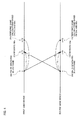
- FIG. 4 is a diagram illustrating an input delay time setting method.
- the first game device In the nth frame, the first game device generates game data DAn based on input information (see 200), and the second game device generates game data DBn based on input information (see 200').
- the nth frame refers to an in-game time that is used in common in the first game device and the second game device, and may be a frame sequence number that is used in common in the first game device and the second game device after synchronization between the first game device and the second game device has been established.
- the game data DAn generated by the first game device in the nth frame is transmitted to the second game device.
- the game data transmitted from the first game device reaches the second game device after a given time T1 has elapsed (see 210').
- the game data DBn generated by the second game device in the nth frame is transmitted to the first game device.
- the game data transmitted from the second game device reaches the first game device after the given time T1 has elapsed (see 210).
- the given time T1 is a time required for communication, and is hereinafter referred to as a communication delay time.
- the communication delay time changes due to the state of the network and the state of each game device.
- An input delay time T2 is set in order to absorb such a communication delay.
- the input delay time T2 is a value that indicates the number of frames (or seconds) that have elapsed before game calculations are performed after the game data has been input.
- the first game device and the second game device perform game calculations in the (n+T2)th frame based on the input information input in the nth frame (i.e., the game data DAn generated by the first game device and the game data DBn generated by the second game device) (see 220 and 220').
- the game device performs a test communication between the game device and another game device (opponent) at a predetermined timing (e.g., before the game starts or when the opponent has been determined) to measure the communication delay time between the game device and the other game device.
- the game device sets an input delay time that is longer than the measured communication delay time, and transmits the input delay time to the other game device through the network.
- one of the game devices sets the input delay time and transmits the input delay time to the other game device.
- the first game device may set the input delay time and transmit the input delay time to the second game device.
- a communication delay can be absorbed by setting the input delay time T2 to be longer than the measured communication delay time T1.
- a communication delay can be absorbed when the input delay time T2 is equal to or longer than the communication delay time T1 (input delay time T2 ⁇ communication delay time T1).
- the input delay time of the first game device is the same as the input delay time of the second game device.
- the input delay time of the first game device may differ from the input delay time of the second game device, as described later.
- FIG. 13 is a diagram illustrating the game data generated based on the input information.
- game data of the game device associated with the identification number (sequence data) corresponding to each frame is generated every frame (or in a predetermined drawing unit) based on input information input to the game device.
- game data 300 includes an identification number 310 and input information.
- the identification number may be a number corresponding to the frame when the input information is input.
- the synchronization control section subtracts the input delay time from the current in-game time to determine the identification number corresponding to the calculation target frame, and extracts the game data having the identification number corresponding to the calculation target frame. In this way, the synchronization control section extracts the game data (sequentially from the oldest in-game elapsed time) for which the in-game elapsed time that has elapsed after the input information corresponding to the game data has been input has reached the input delay time.
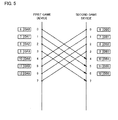
- FIG. 5 is a diagram illustrating an example of generating the game data that reflects the input delay time.
- the game data generation section may generate the game data of the game device based on the input delay time and the in-game time when the input information is input to the game device, the identification number corresponding to the frame at the scheduled calculation time that reflects the input delay time being given to the game data.
- each game device generates game data irrespective of the presence or absence of input information (game data including input information is generated when input information has been input, and game data that indicates "no input” is generated when input information has not been input) and transmits the generated game data to the other game device at predetermined intervals is described below.
- the data transmission interval may be n frames, for example.
- game data corresponding to the n frames is collectively transmitted.
- the following description illustrates an example in which game data corresponding to one frame is transmitted every frame for convenience.
- the input delay time is six frames, for example.
- the first game device adds the frame number (0th frame) when the input information has been input to the input delay time (six frames) to calculate the scheduled calculation time "6" (sixth frame), and generates the game data having an identification number "6".
- the first game device generates game data DA1 associated with an identification number "7" in the first frame, generates game data DA2 associated with an identification number "8” in the second frame, and generates game data DAn associated with an identification number "n+6" in the nth frame.
- the second game device When the second game device generates game data DB0 in the 0th frame, the second game device adds the frame number (0th frame) when the input information has been input to the input delay time (six frames) to calculate the scheduled calculation time "6" (sixth frame), and generates the game data DB0 associated with an identification number "6".
- the second game device generates game data DB1 associated with an identification number "7" in the first frame, generates game data DB2 associated with an identification number "8” in the second frame, and generates game data DBn associated with an identification number "n+6" in the nth frame.
- FIG. 6 is a diagram schematically illustrating a state in which the game data is stored in the first buffer and the second buffer of the first game device.
- the first buffer and the second buffer are provided with an area corresponding to the identification number. Each area can be used when data stored in each area has been output.
- the identification number is sequentially associated with each area that can be used.
- the input delay time is six frames
- data that indicates "no input” is stored in the areas corresponding to the identification numbers 0 to 5.
- the game data is stored in the first buffer within that frame.
- the game data is stored in the area corresponding to the scheduled calculation time.
- the game data generated by the first game device in the 0th frame is used for game calculations in the sixth frame, the game data is stored in the area corresponding to the identification number "6".
- the game data subsequently generated in each frame is stored in the area corresponding to the scheduled calculation time within each frame.
- the game data DB0 generated by the second game device in the 0th frame is received by the first game device in the fourth frame, the game data DB0 is stored in the second buffer in the fourth frame.
- the game data DB0 is stored in the area corresponding to the scheduled calculation time.
- the game data DA0 generated by the second game device in the 0th frame is used for game calculations in the sixth frame, the game data is stored in the area corresponding to the identification number "6".
- the game data subsequently generated by the second game device in each frame is sequentially received by the first game device, and is stored in the area of the second buffer corresponding to the scheduled calculation time within each frame.
- FIG. 7 is a diagram illustrating another example of the input delay time setting method.
- the same input delay time is set for the first game device and the second game device based on the communication delay time.
- different input delay times are set for the first game device and the second game device based on the communication delay time and the display delay time of each game device.
- nth frame game data DAn is generated by the first game device based on the input information (see 300), and game data DBn is generated by the second game device based on the input information (see 300').
- the nth frame refers to an in-game time that is used in common in the first game device and the second game device, and may be a frame sequence number that is used in common in the first game device and the second game device after synchronization between the first game device and the second game device has been established.
- the game data DAn generated by the first game device in the nth frame is transmitted to the second game device.
- the game data transmitted from the first game device reaches the second game device after the communication delay time T1 has elapsed (see 310').
- the game data DBn generated by the second game device in the nth frame is transmitted to the first game device.
- the game data transmitted from the second game device reaches the first game device after the communication delay time T1 has elapsed (see 310).
- the display time of the first game device is referred to as TA, and the display time of the second game device is referred to as TB.
- the term “display time” refers to the time required to perform game calculations to generate an image that reflects the game calculation results and display the image on the display section (hereinafter referred to as "display delay time").
- the display delay time TA of the first game device is one frame and the display delay time TB of the second game device is two frames
- an image that reflects the calculation results is displayed on the first game device after one frame has elapsed and an image that reflects the calculation results is displayed on the second game device after two frames have elapsed when the first game device and the second game device have started game calculations at the same timing.
- the input delay time of the game device having a shorter display delay time is set to be longer than the input delay time of the game device having a longer display delay time (second game device in this example) by the difference alpha in display delay time, so that an image that reflects the calculation results can be displayed on the first game device and the second game device at the same timing.
- the input delay time of the game device having a shorter display delay time is set to be a value obtained by adding the difference alpha in display delay time to the input delay time T2 set based on the communication delay time. Therefore, the first game device starts game calculations in the (n+T2+alpha)th frame based on the game data DAn and the game data DBn (see 320), and displays a game image generated based on the game data DAn and the game data DBn in the (n+T2+alpha+TA)th frame (see 330).
- each game device has information about the display delay time according to type information (e.g., manufacturer or serial number information) about the display device of each game device
- type information e.g., manufacturer or serial number information
- the type information about each game device may be acquired, and the display delay times of the first game device and the second game device may be determined based on the information about the display delay time according to the type information.
- the game device may be configured so that the user can input the display delay time of the game device, and the display delay times of the first game device and the second game device may be determined based on the display delay time input by the user.
- the game device may be configured so that the game device automatically determines the display delay time of the game device based on test input information input by the user, and a difference in the display delay time between the first game device and the second game device may be determined based on the display delay time that has been automatically determined.
- a test image may be displayed as a test input screen every predetermined number of frames.
- the user presses a button at the test image display timing, and the display delay time may be determined based on the button press timing.
- the display delay time is referred to as TA (frames)
- the test image generation process starts in the mth frame
- the test image is displayed in the (m+TA)th frame.
- the display delay time is determined based on the difference between the button input timing and the test image generation process start timing.
- the game device transmits the display delay time information about the game device to another game device through the network, and receives the display delay time information transmitted from the other game device through the network.
- FIG. 8 is a diagram illustrating an example of generating the game data that reflects the input delay time that differs between the game devices.
- FIG. 8 illustrates an example of generating the game data when the input delay time of the first game device is "6" (see 450) and the input delay time of the second game device is "7" (see 452) (i.e., the input delay time of the first game device differs from the input delay time of the second game device).
- the game data generation section of the first game device generates game data 430 to which an identification number 432-1, 432-2, or 432-3 corresponding to the frame at the scheduled calculation time that reflects the input delay time 450 of the first game device is given, based on an in-game time 410 when input information is input to the first game device and the input delay time 450 of the first game device.
- the identification number 432-1 of game data DA0 generated in the 0th frame (in-game time) is "6" that is obtained by adding "6" (sixth frame) (i.e., the input delay time 450 of the first game device) to the in-game time "0" (0th frame).
- the game data 430 of the first game device is stored in the first buffer of the first game device.
- the game data generation section of the first game device generates game data 420 to which an identification number 422-1, 422-2, or 422-3 corresponding to the frame at the scheduled calculation time that reflects the input delay time 452 of the second game device is given, based on the in-game time 410 when input information is input to the first game device and the input delay time 452 of the second game device.
- the identification number 422-1 of game data DA0 generated in the 0th frame (in-game time) is "7" that is obtained by adding "7" (seventh frame) (i.e., the input delay time 452 of the second game device) to the in-game time "0" (0th frame).
- the transmission game data 420 is transmitted to the second game device, and stored in the second buffer of the second game device.
- the game data generation section of the second game device generates game data 470 to which an identification number 472-1, 472-2, or 472-3 corresponding to the frame at the scheduled calculation time that reflects the input delay time 452 of the second game device is given, based on an in-game time 460 when input information is input to the second game device and the input delay time 452 of the second game device.
- the identification number 472-1 of game data DB0 generated in the 0th frame (in-game time) is "7" that is obtained by adding "7" (seventh frame) (i.e., the input delay time 452 of the second game device) to the in-game time "0" (0th frame).
- the game data 470 of the second game device is stored in the first buffer of the second game device.
- the game data generation section of the second game device generates game data 480 to which an identification number 482-1, 482-2, or 482-3 corresponding to the frame at the scheduled calculation time that reflects the input delay time 450 of the first game device is given, based on an in-game time 610 when input information is input to the second game device and the input delay time 450 of the first game device.
- the identification number 482-1 of game data DB0 generated in the 0th frame (in-game time) is "6" that is obtained by adding "6" (sixth frame) (i.e., the input delay time 450 of the first game device) to the in-game time "0" (0th frame).
- the transmission game data 480 is transmitted to the first game device, and stored in the second buffer of the first game device.
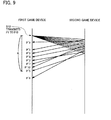
- FIG. 9 is a diagram illustrating a communication delay time determination process according to this embodiment.
- the communication delay time determination section 118 sequentially performs a test communication that transmits and receives a packet between the game device and another game device a plurality of times at a predetermined timing (before the game starts or when the opponent has been determined), and determines the communication delay time based on the results of the test communication.
- the communication delay time determination section 118 may determine the communication delay time based on the test communication state (reception timing of a reply packet received within a predetermined period) within a predetermined period after starting the test communication.
- the term "test communication state within a predetermined period" refers to the time that has elapsed until a reply packet is received within a predetermined period, for example.
- a test communication T includes transmitting a reply request packet P from the game device to another game device and receiving a reply packet P' transmitted to the game device from the other game device that has received the packet P.
- FIG. 9 illustrates an example in which a test communication T1 (transmission of packet P1 and reception of a reply packet P'1) to a test communication T10 (transmission of a packet P10 and reception of a reply packet P'10) are performed.
- a plurality of packets P1 to PN may be collectively transmitted, or a subsequent packet Pn+1 may be transmitted without waiting for reception of the reply packet P'n in response to the transmitted packet Pn, for example.
- the communication delay time may be determined based on the time required for the test communication (i.e., the time that has elapsed until the packet P' is received after transmitting the packet P), or may be determined based on the time that has elapsed from the first communication timing (communication start timing 510) to the reception timing of the reply packet P' received within a predetermined period K, for example.
- the communication delay time may be determined based on the time (elapsed time) required for the test communication that satisfies a predetermined condition.
- FIG. 9 illustrates a communication state when ten packets P1 to P10 are transmitted from the first game device to the second game device at the test communication start timing 510.
- the second game device receives the packets P1 to P10 transmitted from the first game device and transmits the reply packets P'1 to P'10 corresponding to the packets P1 to P10, and the first game device receives the reply packets P'1 to P'10.
- the first game device has not received the reply packet P'9 corresponding to the packet P9 (including a case where the second game device has not received the packet P9 and a case where the first game device has not received the reply packet P'9 although the second game device has received the packet P9 and transmitted the reply packet P'9).
- the reply packet P'6 received after the predetermined period has elapsed is not used to calculate the average value. This also applies to the reply packet P'9 (test communication T9) that has not been received.
- the communication delay time can be calculated using the communication results of the test communication for which a reply has been received within the predetermined period K from the first communication timing 510, the communication delay can be efficiently measured even when the communication state is poor.
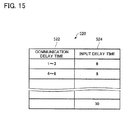
- FIG. 15 is a diagram illustrating an example of setting the input delay time based on the communication delay time.
- the input delay time is set to be longer than the measured communication delay time.
- the offset beta may not be a constant value (i.e., may change depending on the communication delay time T1).
- the range of the communication delay time may be divided into a plurality of ranges, and the relationship between each range 522 and an input delay time 524 may be defined in advance and stored as a table or incorporated in an algorithm.
- the input delay time may be set based on the input delay time 524 defined corresponding to the range 522 to which the measured communication delay time belongs (the defined input delay time 524 may be directly used as the input delay time when the display delay time is not taken into account).
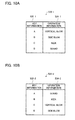
- FIGS. 10A and 10B are views illustrating the input operation definition information.
- the game device allows the player to allocate a desired movement command to an input operation using a predetermined key (e.g., button A, button B, button C, or button D).
- a predetermined key e.g., button A, button B, button C, or button D.
- the term "movement command" refers to movement information used in common in each game.
- the input operation definition information generation section may display a key customization screen or the like for receiving a setting input from the player.
- the input operation definition information generation section generates the input operation definition information that defines the relationship between the input operation and the movement information (movement command) based on the setting input information from the player.
- FIG. 10A illustrates an example of the input operation definition information of the first game device
- FIG. 10B illustrates an example of the input operation definition information of the second game device
- Input operation definition information 530-1 or 530-2 may be set as a table or an algorithm that indicates the relationship between key information 532-1 or 532-2 (information that indicates the type of button pressed by the player) and movement information 534-1 or 534-2 corresponding to the type of button.
- the movement information “vertical blow”, “side blow”, “kick”, and “guard” may indicate common movement commands similarly interpreted and executed in the first game device and the second game device.
- the movement information "vertical blow” is assigned to the button A
- the movement information “side blow” is assigned to the button B
- the movement information “kick” is assigned to the button C
- the movement information "guard” is assigned to the button D.
- the movement information "guard” is assigned to the button A
- the movement information “kick” is assigned to the button B
- the movement information “vertical blow” is assigned to the button C
- the movement information "side blow” is assigned to the button D.
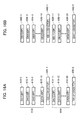
- the game data generation section may convert the input operation that has been performed using the game device and is indicated by the input information into the corresponding movement information based on the input operation definition information, and may generate game data 300 including movement information 322 as the input information (see FIG. 14A ).
- the first game device generates game data including the movement information "vertical blow” when the button A has been pressed
- the second game device generates game data including the movement information "guard” when the button A has been pressed.
- the game device can receive the game data of another game device as the movement information, the game device can perform game calculations without taking account of the input operation definition information of the other game device (i.e., without receiving the input operation definition information).
- the game data generation section may generate game data 300 including input operation information (key information) 324 indicated by the input information (see FIG. 14B ).
- the first game device generates game data including the key information "A” when the button A has been pressed
- the second game device generates game data including the key information "A” when the button A has been pressed.
- the game calculation section converts the input operation information included in the game data extracted from the first buffer into the movement information of the game device corresponding to the input operation based on the input operation definition information of the game device (530-1 in FIG. 10A when the game device is the first game device), converts the input operation information included in the game data extracted from the second buffer into the movement information of the game device corresponding to the input operation based on the input operation definition information of the other game device (530-2 in FIG. 10B when the game device is the first game device), and performs game calculations in each frame based on the movement information of the game device and the movement information of the other game device.
- the game calculation section converts the key information "A” included in the game data extracted from the first buffer into the movement information "vertical blow”, converts the key information "A” included in the game data extracted from the second buffer into the movement information "guard”, and performs game calculations.
- the game device transmits and receives the game data 300 including the input operation information (key information) 324 indicated by the input information
- the game device can convert the game data of the other game device into the movement information and perform game calculations by receiving the input operation definition information of the other game device in advance.
- the game calculation section may stop game calculations when the extraction target game data of another game device has not been received (has not been stored in the second buffer), and display the same image as the image in the preceding frame.
- the scheduled calculation frame (identification number) is "12"
- the area of the second buffer of the first game device corresponding to the identification number "12” is empty (see 550).
- the area of the second buffer corresponding to a given identification number is empty unless the game device receives the game data associated with the given identification number from the other game device.
- the game calculation section determines that the extraction target game data of the other game device has not been received when the area of the second buffer corresponding to the scheduled calculation frame (identification number) "12" is empty. In this case, the game calculation section stops game calculations and displays the same image as the image in the preceding frame. In this case, the in-game elapsed frame is not updated.
- the game calculation section resumes game calculations when the extraction target game data of the other game device has been received (has been stored in the second buffer). In this case, the in-game elapsed frame is updated.
- game data may be transmitted and received according to a first protocol (e.g., UDP) in which game data that has been lost during transmission is not retransmitted.
- a first protocol e.g., UDP
- the game device transmits a game data retransmission request while adding the identification number associated with the extraction target game data as retransmission data identification information.
- the game device transmits the game data associated with the identification number corresponding to the retransmission data identification information to the other game device.
- the case where the extraction target game data of the other game device has not been received refers to a case where the game data of the other game device has not been received (has not been stored in the second buffer) even when the scheduled calculation time has been reached after the communication delay time has elapsed.
- FIGS. 16A and 16B are views illustrating a second game data communication configuration according to this embodiment.
- FIG. 16A illustrates a packet transmitted by the first game device
- FIG. 16B illustrates a packet received by the first game device.
- the first game device transmits n packets (e.g., 610-1 to 610-10 or 610-11 to 610-20) according to the first protocol (UDP) in which game data that has been lost during transmission is not retransmitted, the first game device transmits a packet 620-1 or 620-2 including the game data (e.g., DA1 to DA10 or DA11 to DA20) included in the n packets to the second game device according to the second protocol, as illustrated in FIG. 16A .
- the first game device normally receives packets transmitted from the second game device according to the first protocol and the second protocol, as illustrated in FIG. 16B .
- the synchronization control section stores the game data in the given frame included in the packet transmitted from the second game device according to the second protocol in the second buffer. For example, when the first game device has not received a packet 630-3 corresponding to game data DB3 from the second game device according to the first protocol (UDP) in FIG. 16B , the synchronization control section stores the game data DB3 included in a packet 640-1 transmitted from the second game device according to the second protocol (TCP) in the second buffer.
- UDP first protocol
- TCP second protocol
- FIG. 11 illustrates an example of a timing chart of the input delay setting process.
- the first game device performs the following process at a predetermined timing 280 (e.g., after the opponent has been determined before the game starts).
- the first game device transmits and receives the setting information (see 282).
- the term "setting information" refers to the input operation definition information of each game device described with reference to FIGS. 10A and 10B and the display delay time information of each game device described with reference to FIG. 7 .
- the first game device determines the delay time using the method described with reference to FIG. 9 , for example (see 284).
- the first game device sets the input delay time of the first game device and the input delay time of the second game device based on the determined delay time using the method described with reference to FIG. 9 , for example (see 286).
- the first game device then transmits the input delay time of the second game device (see 288). Specifically, the first game device transmits the input delay time of the second game device, and the second game device receives the input delay time of the second game device.
- the first game device and the second game device start game calculations while the game start timing 250 of the first game device is synchronized with the game start timing 250' of the second game device.
- Each game device receives input information and generates game data based on the input information in the frame 250 or 250'.
- Each game device transmits the game data to the other game device while storing the game data in the first buffer.
- the communication delay time T1
- the game data transmitted from the other game device in the frame 250 or 250' is received in a frame 260 or 260', and stored in the second buffer.
- the input delay time is T2
- the game data generated in the frame 250 or 250' is extracted from the first buffer and the second buffer in a frame 270 or 270' after the input delay time has elapsed, and game calculations are then performed.
- the invention includes various other configurations substantially the same as the configurations described in the embodiments (in function, method and result, or in objective and result, for example).
- the invention also includes a configuration in which an unsubstantial portion in the described embodiments is replaced.
- the invention also includes a configuration having the same effects as the configurations described in the embodiments, or a configuration able to achieve the same objective.
- the invention includes a configuration in which a publicly known technique is added to the configurations in the embodiments.
- a packet including the game data corresponding to n frames may be transmitted every n frames.
Landscapes
- Engineering & Computer Science (AREA)
- Multimedia (AREA)
- Computer Networks & Wireless Communication (AREA)
- Signal Processing (AREA)
- Data Exchanges In Wide-Area Networks (AREA)
- Synchronisation In Digital Transmission Systems (AREA)
- Mobile Radio Communication Systems (AREA)
Applications Claiming Priority (1)
| Application Number | Priority Date | Filing Date | Title |
|---|---|---|---|
| JP2008194209A JP5745204B2 (ja) | 2008-07-28 | 2008-07-28 | プログラム、情報記憶媒体及びゲーム機 |
Publications (3)
| Publication Number | Publication Date |
|---|---|
| EP2158952A2 true EP2158952A2 (de) | 2010-03-03 |
| EP2158952A3 EP2158952A3 (de) | 2015-05-20 |
| EP2158952B1 EP2158952B1 (de) | 2019-06-19 |
Family
ID=41569127
Family Applications (1)
| Application Number | Title | Priority Date | Filing Date |
|---|---|---|---|
| EP09166632.1A Active EP2158952B1 (de) | 2008-07-28 | 2009-07-28 | Computerendgerät und Synchronisationssteuerverfahren |
Country Status (3)
| Country | Link |
|---|---|
| US (1) | US8734246B2 (de) |
| EP (1) | EP2158952B1 (de) |
| JP (1) | JP5745204B2 (de) |
Cited By (1)
| Publication number | Priority date | Publication date | Assignee | Title |
|---|---|---|---|---|
| EP2301634A1 (de) * | 2009-08-26 | 2011-03-30 | Namco Bandai Games Inc. | Spielvorrichtung und Steuerverfahren |
Families Citing this family (35)
| Publication number | Priority date | Publication date | Assignee | Title |
|---|---|---|---|---|
| JP5745204B2 (ja) * | 2008-07-28 | 2015-07-08 | 株式会社バンダイナムコエンターテインメント | プログラム、情報記憶媒体及びゲーム機 |
| JP4871373B2 (ja) | 2009-06-19 | 2012-02-08 | 任天堂株式会社 | 情報処理システムおよび情報処理装置 |
| JP2011250874A (ja) | 2010-05-31 | 2011-12-15 | Nintendo Co Ltd | 情報処理プログラム、情報処理装置、情報処理システム及び情報処理方法 |
| JP2012018657A (ja) | 2010-06-11 | 2012-01-26 | Nintendo Co Ltd | 情報処理端末、情報処理システム、情報処理プログラム |
| JP5677811B2 (ja) | 2010-06-11 | 2015-02-25 | 任天堂株式会社 | 携帯型情報端末、携帯情報システム、携帯型情報端末制御プログラム |
| JP5672840B2 (ja) * | 2010-08-12 | 2015-02-18 | ソニー株式会社 | 情報処理装置および方法、並びにプログラム |
| JP4999213B2 (ja) * | 2010-09-17 | 2012-08-15 | 任天堂株式会社 | 情報処理プログラム、携帯端末装置、システム、情報処理方法及び通信システム |
| JP5774314B2 (ja) * | 2011-01-05 | 2015-09-09 | 任天堂株式会社 | 遅延測定システムおよび遅延測定方法 |
| US9782670B2 (en) | 2014-04-25 | 2017-10-10 | Ubisoft Entertainment | Computer program, method, and system for enabling an interactive event among a plurality of persons |
| US9205333B2 (en) * | 2013-06-07 | 2015-12-08 | Ubisoft Entertainment | Massively multiplayer gaming |
| JP5602963B1 (ja) * | 2014-01-30 | 2014-10-08 | グリー株式会社 | ゲーム管理プログラム、ゲーム管理方法及びゲーム管理システム |
| US9912562B2 (en) | 2014-03-31 | 2018-03-06 | Microsoft Technology Licensing, Llc | Measuring latency in an interactive application |
| US10255083B2 (en) * | 2014-09-12 | 2019-04-09 | Ubisoft Entertainment | Method and system for unified input in cross-platform streaming applications in cloud computing environments |
| US10158700B1 (en) * | 2014-11-14 | 2018-12-18 | Amazon Technologies, Inc. | Coordination of content presentation operations |
| US9839843B1 (en) | 2014-11-14 | 2017-12-12 | Amazon Technologies, Inc. | Coordination of content presentation operations |
| US9821222B1 (en) | 2014-11-14 | 2017-11-21 | Amazon Technologies, Inc. | Coordination of content presentation operations |
| JP5815901B2 (ja) * | 2015-03-19 | 2015-11-17 | グリー株式会社 | ゲーム管理方法及びゲーム管理システム |
| CN104915564B (zh) * | 2015-06-16 | 2017-03-22 | 深圳市腾讯计算机系统有限公司 | 实现虚拟角色转弯的方法和装置 |
| KR101810537B1 (ko) * | 2015-11-12 | 2017-12-19 | 주식회사 넥슨코리아 | 랙 발생을 감지하는 방법 및 장치 |
| US10965570B2 (en) * | 2016-08-17 | 2021-03-30 | Nec Corporation | Remote control device, system, method, and recording medium for determining a delay setting value |
| JP6549176B2 (ja) * | 2017-03-30 | 2019-07-24 | 株式会社バンダイナムコエンターテインメント | プログラム及び電子機器 |
| JP6944812B2 (ja) * | 2017-05-24 | 2021-10-06 | 任天堂株式会社 | 情報処理システム、情報処理装置、情報処理プログラム、および、ゲーム処理方法 |
| US10471347B2 (en) | 2017-05-24 | 2019-11-12 | Nintendo Co., Ltd. | Information processing system, information processing apparatus, storage medium storing information processing program, and information processing method |
| JP6229092B1 (ja) * | 2017-06-22 | 2017-11-08 | 株式会社 ディー・エヌ・エー | 通信ゲームシステム及び通信ゲーム処理方法 |
| JP6979292B2 (ja) * | 2017-06-28 | 2021-12-08 | 株式会社タイトー | ゲーム機 |
| US10726765B2 (en) * | 2018-02-15 | 2020-07-28 | Valve Corporation | Using tracking of display device to control image display |
| US11077364B2 (en) * | 2018-04-02 | 2021-08-03 | Google Llc | Resolution-based scaling of real-time interactive graphics |
| CN109040208B (zh) * | 2018-07-18 | 2021-06-01 | 广州多益网络股份有限公司 | 基于多客户端交互的数据同步方法、服务器、系统及介质 |
| US10924525B2 (en) * | 2018-10-01 | 2021-02-16 | Microsoft Technology Licensing, Llc | Inducing higher input latency in multiplayer programs |
| FR3100459B1 (fr) | 2019-09-05 | 2021-11-05 | Blade | Procédé de capture et de diffusion pour coordonner des commandes produites par deux clients distants associés à une même session informatique |
| CN111467798B (zh) | 2020-04-01 | 2021-09-21 | 腾讯科技(深圳)有限公司 | 游戏应用程序中的帧显示方法、装置、终端和存储介质 |
| CN112843677B (zh) * | 2021-02-08 | 2023-07-11 | 脸萌有限公司 | 一种系统延时确定方法、装置、设备和存储介质 |
| CN114904265B (zh) * | 2022-04-20 | 2024-12-17 | 西安万像电子科技有限公司 | 数据处理方法、装置、存储介质及电子设备 |
| WO2025048444A1 (ko) * | 2023-08-28 | 2025-03-06 | 윤지현 | Cpt(charge, parity, time) 속성을 이용한 시공간 시뮬레이션 장치 및 그에 이용되는 순서 있는 데이터의 반복 측정을 통한 애플리케이션간 시간 동기화 장치 |
| KR102878185B1 (ko) * | 2023-08-28 | 2025-10-30 | 윤지현 | 순서 있는 데이터의 반복 측정을 통한 애플리케이션간 시간 동기화 장치 |
Citations (4)
| Publication number | Priority date | Publication date | Assignee | Title |
|---|---|---|---|---|
| JP2001017735A (ja) | 1999-07-05 | 2001-01-23 | Namco Ltd | ゲーム演算集中処理装置及び情報記憶媒体 |
| JP2002186785A (ja) | 2000-12-20 | 2002-07-02 | Intelligent Systems Co Ltd | 通信ゲームシステム |
| JP2005006913A (ja) | 2003-06-19 | 2005-01-13 | Namco Ltd | ゲーム装置、ゲーム制御プログラムおよびそのプログラムが記録された記録媒体 |
| JP2006032502A (ja) | 2004-07-14 | 2006-02-02 | Nidec Tosok Corp | ダイボンディング装置 |
Family Cites Families (14)
| Publication number | Priority date | Publication date | Assignee | Title |
|---|---|---|---|---|
| US5538255A (en) * | 1992-02-18 | 1996-07-23 | Barker; Bruce J. | Remote controlled multiplayer video game |
| AU4804097A (en) * | 1996-09-30 | 1998-04-24 | Sandcastle, Inc. | Synchronization of events occurring over a network in the presence of latency |
| JPH11347254A (ja) * | 1998-06-12 | 1999-12-21 | Sega Enterp Ltd | 通信ゲームシステム及びそれにおけるゲーム実行方法 |
| JP2001198363A (ja) * | 1999-09-14 | 2001-07-24 | Sega Corp | データ処理方法 |
| JP3815278B2 (ja) * | 2001-08-30 | 2006-08-30 | ソニー株式会社 | ネットワークゲームシステム、ネットワークゲームサーバ装置、ネットワークゲーム端末装置、情報処理方法、及び情報処理プログラム |
| JP5059263B2 (ja) * | 2001-09-03 | 2012-10-24 | 任天堂株式会社 | 通信ゲームシステム |
| JP2004049922A (ja) * | 2002-07-19 | 2004-02-19 | Sega Corp | クライアントサーバシステム |
| JP4554949B2 (ja) * | 2004-01-23 | 2010-09-29 | 株式会社日立製作所 | 管理計算機および記憶装置の管理方法 |
| JP4758122B2 (ja) * | 2005-03-31 | 2011-08-24 | 株式会社バンダイナムコゲームス | プログラム、情報記憶媒体及び画像生成装置 |
| JP3995257B2 (ja) * | 2005-10-04 | 2007-10-24 | 任天堂株式会社 | 通信ゲームプログラムおよび通信ゲームシステム |
| JP5268246B2 (ja) * | 2006-11-17 | 2013-08-21 | 任天堂株式会社 | ゲームシステム |
| JP5745204B2 (ja) * | 2008-07-28 | 2015-07-08 | 株式会社バンダイナムコエンターテインメント | プログラム、情報記憶媒体及びゲーム機 |
| WO2010113454A1 (ja) * | 2009-03-31 | 2010-10-07 | パナソニック株式会社 | 記録媒体、再生装置、及び集積回路 |
| US20130070928A1 (en) * | 2011-09-21 | 2013-03-21 | Daniel P. W. Ellis | Methods, systems, and media for mobile audio event recognition |
-
2008
- 2008-07-28 JP JP2008194209A patent/JP5745204B2/ja active Active
-
2009
- 2009-07-24 US US12/509,143 patent/US8734246B2/en active Active
- 2009-07-28 EP EP09166632.1A patent/EP2158952B1/de active Active
Patent Citations (4)
| Publication number | Priority date | Publication date | Assignee | Title |
|---|---|---|---|---|
| JP2001017735A (ja) | 1999-07-05 | 2001-01-23 | Namco Ltd | ゲーム演算集中処理装置及び情報記憶媒体 |
| JP2002186785A (ja) | 2000-12-20 | 2002-07-02 | Intelligent Systems Co Ltd | 通信ゲームシステム |
| JP2005006913A (ja) | 2003-06-19 | 2005-01-13 | Namco Ltd | ゲーム装置、ゲーム制御プログラムおよびそのプログラムが記録された記録媒体 |
| JP2006032502A (ja) | 2004-07-14 | 2006-02-02 | Nidec Tosok Corp | ダイボンディング装置 |
Cited By (2)
| Publication number | Priority date | Publication date | Assignee | Title |
|---|---|---|---|---|
| EP2301634A1 (de) * | 2009-08-26 | 2011-03-30 | Namco Bandai Games Inc. | Spielvorrichtung und Steuerverfahren |
| US8651955B2 (en) | 2009-08-26 | 2014-02-18 | Namco Bandai Games Inc. | Game device, control method, and computer program product |
Also Published As
| Publication number | Publication date |
|---|---|
| EP2158952B1 (de) | 2019-06-19 |
| US8734246B2 (en) | 2014-05-27 |
| EP2158952A3 (de) | 2015-05-20 |
| JP5745204B2 (ja) | 2015-07-08 |
| US20100022302A1 (en) | 2010-01-28 |
| JP2010029393A (ja) | 2010-02-12 |
Similar Documents
| Publication | Publication Date | Title |
|---|---|---|
| EP2158952B1 (de) | Computerendgerät und Synchronisationssteuerverfahren | |
| JP5614956B2 (ja) | プログラム、画像生成システム | |
| US8484280B2 (en) | Program, computer terminal, and command execution method | |
| US8514255B2 (en) | Information storage medium, image control device, and image control method | |
| JP2008245987A (ja) | プログラム、情報記憶媒体、ゲーム機、サーバ、及びゲームシステム | |
| WO2007129666A1 (ja) | プログラム、情報記憶媒体及び画像生成システム | |
| JP5443129B2 (ja) | プログラム及びネットワークシステム | |
| JP2013063296A (ja) | プログラム及びゲームシステム | |
| JP5474391B2 (ja) | プログラム、情報記憶媒体、ゲーム機、及びゲームシステム | |
| JP2011053838A (ja) | プログラム、情報記憶媒体、及び、画像生成装置 | |
| JP2012120755A (ja) | プログラム、情報記憶媒体、及びゲーム機 | |
| US9744443B2 (en) | Server, terminal, network system, program and information storage medium | |
| JP2012215934A (ja) | プログラム、情報記憶媒体、端末、及びサーバ | |
| JP2009075739A (ja) | プログラム、情報記憶媒体、および画像生成システム | |
| JP2011096017A (ja) | プログラム、情報記憶媒体、及び端末 | |
| JP5259118B2 (ja) | プログラム、情報記憶媒体、ゲーム機及びゲームシステム | |
| JP2011160870A (ja) | プログラム、情報記憶媒体及びゲーム装置 | |
| JP5111951B2 (ja) | プログラム、情報記憶媒体、ゲーム機及びゲームシステム | |
| JP2010231364A (ja) | 画像生成システム、プログラム及び情報記憶媒体 | |
| JP5260122B2 (ja) | ゲームシステム | |
| JP5111950B2 (ja) | プログラム、情報記憶媒体、ゲーム機及びゲームシステム | |
| JP5558008B2 (ja) | プログラム、情報記憶媒体及びゲームシステム | |
| JP5252676B2 (ja) | プログラム、情報記憶媒体、ゲーム機及びネットワークシステム | |
| JP2017140156A (ja) | ゲームシステム | |
| JP2003099810A (ja) | ゲーム装置、ゲーム画面表示方法及びプログラム |
Legal Events
| Date | Code | Title | Description |
|---|---|---|---|
| PUAI | Public reference made under article 153(3) epc to a published international application that has entered the european phase |
Free format text: ORIGINAL CODE: 0009012 |
|
| AK | Designated contracting states |
Kind code of ref document: A2 Designated state(s): AT BE BG CH CY CZ DE DK EE ES FI FR GB GR HR HU IE IS IT LI LT LU LV MC MK MT NL NO PL PT RO SE SI SK SM TR |
|
| AX | Request for extension of the european patent |
Extension state: AL BA RS |
|
| RAP1 | Party data changed (applicant data changed or rights of an application transferred) |
Owner name: BANDAI NAMCO GAMES INC. |
|
| PUAL | Search report despatched |
Free format text: ORIGINAL CODE: 0009013 |
|
| AK | Designated contracting states |
Kind code of ref document: A3 Designated state(s): AT BE BG CH CY CZ DE DK EE ES FI FR GB GR HR HU IE IS IT LI LT LU LV MC MK MT NL NO PL PT RO SE SI SK SM TR |
|
| AX | Request for extension of the european patent |
Extension state: AL BA RS |
|
| RIC1 | Information provided on ipc code assigned before grant |
Ipc: H04J 3/06 20060101ALN20150415BHEP Ipc: A63F 13/12 00000000AFI20150415BHEP Ipc: H04L 29/06 20060101ALN20150415BHEP |
|
| 17P | Request for examination filed |
Effective date: 20151120 |
|
| RBV | Designated contracting states (corrected) |
Designated state(s): AT BE BG CH CY CZ DE DK EE ES FI FR GB GR HR HU IE IS IT LI LT LU LV MC MK MT NL NO PL PT RO SE SI SK SM TR |
|
| RAP1 | Party data changed (applicant data changed or rights of an application transferred) |
Owner name: BANDAI NAMCO ENTERTAINMENT INC. |
|
| STAA | Information on the status of an ep patent application or granted ep patent |
Free format text: STATUS: EXAMINATION IS IN PROGRESS |
|
| 17Q | First examination report despatched |
Effective date: 20180626 |
|
| REG | Reference to a national code |
Ref country code: DE Ref legal event code: R079 Ref document number: 602009058770 Country of ref document: DE Free format text: PREVIOUS MAIN CLASS: A63F0013120000 Ipc: A63F0013300000 |
|
| GRAP | Despatch of communication of intention to grant a patent |
Free format text: ORIGINAL CODE: EPIDOSNIGR1 |
|
| STAA | Information on the status of an ep patent application or granted ep patent |
Free format text: STATUS: GRANT OF PATENT IS INTENDED |
|
| RIC1 | Information provided on ipc code assigned before grant |
Ipc: A63F 13/30 20140101AFI20181129BHEP Ipc: H04J 3/06 20060101ALN20181129BHEP Ipc: H04J 3/00 20060101ALI20181129BHEP Ipc: H04L 29/06 20060101ALN20181129BHEP |
|
| INTG | Intention to grant announced |
Effective date: 20190102 |
|
| RIC1 | Information provided on ipc code assigned before grant |
Ipc: H04J 3/00 20060101ALI20181129BHEP Ipc: H04J 3/06 20060101ALN20181129BHEP Ipc: A63F 13/30 20140101AFI20181129BHEP Ipc: H04L 29/06 20060101ALN20181129BHEP |
|
| GRAS | Grant fee paid |
Free format text: ORIGINAL CODE: EPIDOSNIGR3 |
|
| GRAA | (expected) grant |
Free format text: ORIGINAL CODE: 0009210 |
|
| STAA | Information on the status of an ep patent application or granted ep patent |
Free format text: STATUS: THE PATENT HAS BEEN GRANTED |
|
| AK | Designated contracting states |
Kind code of ref document: B1 Designated state(s): AT BE BG CH CY CZ DE DK EE ES FI FR GB GR HR HU IE IS IT LI LT LU LV MC MK MT NL NO PL PT RO SE SI SK SM TR |
|
| REG | Reference to a national code |
Ref country code: GB Ref legal event code: FG4D |
|
| RIN1 | Information on inventor provided before grant (corrected) |
Inventor name: IWAKIRI, HIDENORI Inventor name: HANNYA, TETSUO |
|
| REG | Reference to a national code |
Ref country code: CH Ref legal event code: EP |
|
| REG | Reference to a national code |
Ref country code: IE Ref legal event code: FG4D |
|
| RIN2 | Information on inventor provided after grant (corrected) |
Inventor name: HANNYA, TETSUO Inventor name: IWAKIRI, HIDENORI |
|
| REG | Reference to a national code |
Ref country code: DE Ref legal event code: R096 Ref document number: 602009058770 Country of ref document: DE |
|
| REG | Reference to a national code |
Ref country code: AT Ref legal event code: REF Ref document number: 1144748 Country of ref document: AT Kind code of ref document: T Effective date: 20190715 |
|
| REG | Reference to a national code |
Ref country code: NL Ref legal event code: MP Effective date: 20190619 |
|
| PG25 | Lapsed in a contracting state [announced via postgrant information from national office to epo] |
Ref country code: HR Free format text: LAPSE BECAUSE OF FAILURE TO SUBMIT A TRANSLATION OF THE DESCRIPTION OR TO PAY THE FEE WITHIN THE PRESCRIBED TIME-LIMIT Effective date: 20190619 Ref country code: LT Free format text: LAPSE BECAUSE OF FAILURE TO SUBMIT A TRANSLATION OF THE DESCRIPTION OR TO PAY THE FEE WITHIN THE PRESCRIBED TIME-LIMIT Effective date: 20190619 Ref country code: FI Free format text: LAPSE BECAUSE OF FAILURE TO SUBMIT A TRANSLATION OF THE DESCRIPTION OR TO PAY THE FEE WITHIN THE PRESCRIBED TIME-LIMIT Effective date: 20190619 Ref country code: NO Free format text: LAPSE BECAUSE OF FAILURE TO SUBMIT A TRANSLATION OF THE DESCRIPTION OR TO PAY THE FEE WITHIN THE PRESCRIBED TIME-LIMIT Effective date: 20190919 Ref country code: SE Free format text: LAPSE BECAUSE OF FAILURE TO SUBMIT A TRANSLATION OF THE DESCRIPTION OR TO PAY THE FEE WITHIN THE PRESCRIBED TIME-LIMIT Effective date: 20190619 |
|
| REG | Reference to a national code |
Ref country code: LT Ref legal event code: MG4D |
|
| PG25 | Lapsed in a contracting state [announced via postgrant information from national office to epo] |
Ref country code: LV Free format text: LAPSE BECAUSE OF FAILURE TO SUBMIT A TRANSLATION OF THE DESCRIPTION OR TO PAY THE FEE WITHIN THE PRESCRIBED TIME-LIMIT Effective date: 20190619 Ref country code: GR Free format text: LAPSE BECAUSE OF FAILURE TO SUBMIT A TRANSLATION OF THE DESCRIPTION OR TO PAY THE FEE WITHIN THE PRESCRIBED TIME-LIMIT Effective date: 20190920 Ref country code: BG Free format text: LAPSE BECAUSE OF FAILURE TO SUBMIT A TRANSLATION OF THE DESCRIPTION OR TO PAY THE FEE WITHIN THE PRESCRIBED TIME-LIMIT Effective date: 20190919 |
|
| REG | Reference to a national code |
Ref country code: AT Ref legal event code: MK05 Ref document number: 1144748 Country of ref document: AT Kind code of ref document: T Effective date: 20190619 |
|
| PG25 | Lapsed in a contracting state [announced via postgrant information from national office to epo] |
Ref country code: EE Free format text: LAPSE BECAUSE OF FAILURE TO SUBMIT A TRANSLATION OF THE DESCRIPTION OR TO PAY THE FEE WITHIN THE PRESCRIBED TIME-LIMIT Effective date: 20190619 Ref country code: NL Free format text: LAPSE BECAUSE OF FAILURE TO SUBMIT A TRANSLATION OF THE DESCRIPTION OR TO PAY THE FEE WITHIN THE PRESCRIBED TIME-LIMIT Effective date: 20190619 Ref country code: AT Free format text: LAPSE BECAUSE OF FAILURE TO SUBMIT A TRANSLATION OF THE DESCRIPTION OR TO PAY THE FEE WITHIN THE PRESCRIBED TIME-LIMIT Effective date: 20190619 Ref country code: CZ Free format text: LAPSE BECAUSE OF FAILURE TO SUBMIT A TRANSLATION OF THE DESCRIPTION OR TO PAY THE FEE WITHIN THE PRESCRIBED TIME-LIMIT Effective date: 20190619 Ref country code: RO Free format text: LAPSE BECAUSE OF FAILURE TO SUBMIT A TRANSLATION OF THE DESCRIPTION OR TO PAY THE FEE WITHIN THE PRESCRIBED TIME-LIMIT Effective date: 20190619 Ref country code: SK Free format text: LAPSE BECAUSE OF FAILURE TO SUBMIT A TRANSLATION OF THE DESCRIPTION OR TO PAY THE FEE WITHIN THE PRESCRIBED TIME-LIMIT Effective date: 20190619 Ref country code: PT Free format text: LAPSE BECAUSE OF FAILURE TO SUBMIT A TRANSLATION OF THE DESCRIPTION OR TO PAY THE FEE WITHIN THE PRESCRIBED TIME-LIMIT Effective date: 20191021 |
|
| REG | Reference to a national code |
Ref country code: DE Ref legal event code: R119 Ref document number: 602009058770 Country of ref document: DE |
|
| PG25 | Lapsed in a contracting state [announced via postgrant information from national office to epo] |
Ref country code: IS Free format text: LAPSE BECAUSE OF FAILURE TO SUBMIT A TRANSLATION OF THE DESCRIPTION OR TO PAY THE FEE WITHIN THE PRESCRIBED TIME-LIMIT Effective date: 20191019 Ref country code: SM Free format text: LAPSE BECAUSE OF FAILURE TO SUBMIT A TRANSLATION OF THE DESCRIPTION OR TO PAY THE FEE WITHIN THE PRESCRIBED TIME-LIMIT Effective date: 20190619 Ref country code: ES Free format text: LAPSE BECAUSE OF FAILURE TO SUBMIT A TRANSLATION OF THE DESCRIPTION OR TO PAY THE FEE WITHIN THE PRESCRIBED TIME-LIMIT Effective date: 20190619 Ref country code: IT Free format text: LAPSE BECAUSE OF FAILURE TO SUBMIT A TRANSLATION OF THE DESCRIPTION OR TO PAY THE FEE WITHIN THE PRESCRIBED TIME-LIMIT Effective date: 20190619 |
|
| REG | Reference to a national code |
Ref country code: CH Ref legal event code: PL |
|
| PG25 | Lapsed in a contracting state [announced via postgrant information from national office to epo] |
Ref country code: MC Free format text: LAPSE BECAUSE OF FAILURE TO SUBMIT A TRANSLATION OF THE DESCRIPTION OR TO PAY THE FEE WITHIN THE PRESCRIBED TIME-LIMIT Effective date: 20190619 Ref country code: TR Free format text: LAPSE BECAUSE OF FAILURE TO SUBMIT A TRANSLATION OF THE DESCRIPTION OR TO PAY THE FEE WITHIN THE PRESCRIBED TIME-LIMIT Effective date: 20190619 |
|
| REG | Reference to a national code |
Ref country code: BE Ref legal event code: MM Effective date: 20190731 |
|
| PG25 | Lapsed in a contracting state [announced via postgrant information from national office to epo] |
Ref country code: DK Free format text: LAPSE BECAUSE OF FAILURE TO SUBMIT A TRANSLATION OF THE DESCRIPTION OR TO PAY THE FEE WITHIN THE PRESCRIBED TIME-LIMIT Effective date: 20190619 Ref country code: DE Free format text: LAPSE BECAUSE OF NON-PAYMENT OF DUE FEES Effective date: 20200201 Ref country code: PL Free format text: LAPSE BECAUSE OF FAILURE TO SUBMIT A TRANSLATION OF THE DESCRIPTION OR TO PAY THE FEE WITHIN THE PRESCRIBED TIME-LIMIT Effective date: 20190619 |
|
| PG25 | Lapsed in a contracting state [announced via postgrant information from national office to epo] |
Ref country code: IS Free format text: LAPSE BECAUSE OF FAILURE TO SUBMIT A TRANSLATION OF THE DESCRIPTION OR TO PAY THE FEE WITHIN THE PRESCRIBED TIME-LIMIT Effective date: 20200224 Ref country code: BE Free format text: LAPSE BECAUSE OF NON-PAYMENT OF DUE FEES Effective date: 20190731 Ref country code: LI Free format text: LAPSE BECAUSE OF NON-PAYMENT OF DUE FEES Effective date: 20190731 Ref country code: CH Free format text: LAPSE BECAUSE OF NON-PAYMENT OF DUE FEES Effective date: 20190731 Ref country code: LU Free format text: LAPSE BECAUSE OF NON-PAYMENT OF DUE FEES Effective date: 20190728 |
|
| PLBE | No opposition filed within time limit |
Free format text: ORIGINAL CODE: 0009261 |
|
| STAA | Information on the status of an ep patent application or granted ep patent |
Free format text: STATUS: NO OPPOSITION FILED WITHIN TIME LIMIT |
|
| PG2D | Information on lapse in contracting state deleted |
Ref country code: IS |
|
| PG25 | Lapsed in a contracting state [announced via postgrant information from national office to epo] |
Ref country code: IE Free format text: LAPSE BECAUSE OF NON-PAYMENT OF DUE FEES Effective date: 20190728 Ref country code: FR Free format text: LAPSE BECAUSE OF NON-PAYMENT OF DUE FEES Effective date: 20190819 |
|
| 26N | No opposition filed |
Effective date: 20200603 |
|
| PG25 | Lapsed in a contracting state [announced via postgrant information from national office to epo] |
Ref country code: SI Free format text: LAPSE BECAUSE OF FAILURE TO SUBMIT A TRANSLATION OF THE DESCRIPTION OR TO PAY THE FEE WITHIN THE PRESCRIBED TIME-LIMIT Effective date: 20190619 |
|
| PG25 | Lapsed in a contracting state [announced via postgrant information from national office to epo] |
Ref country code: CY Free format text: LAPSE BECAUSE OF FAILURE TO SUBMIT A TRANSLATION OF THE DESCRIPTION OR TO PAY THE FEE WITHIN THE PRESCRIBED TIME-LIMIT Effective date: 20190619 |
|
| PG25 | Lapsed in a contracting state [announced via postgrant information from national office to epo] |
Ref country code: HU Free format text: LAPSE BECAUSE OF FAILURE TO SUBMIT A TRANSLATION OF THE DESCRIPTION OR TO PAY THE FEE WITHIN THE PRESCRIBED TIME-LIMIT; INVALID AB INITIO Effective date: 20090728 Ref country code: MT Free format text: LAPSE BECAUSE OF FAILURE TO SUBMIT A TRANSLATION OF THE DESCRIPTION OR TO PAY THE FEE WITHIN THE PRESCRIBED TIME-LIMIT Effective date: 20190619 |
|
| PG25 | Lapsed in a contracting state [announced via postgrant information from national office to epo] |
Ref country code: MK Free format text: LAPSE BECAUSE OF FAILURE TO SUBMIT A TRANSLATION OF THE DESCRIPTION OR TO PAY THE FEE WITHIN THE PRESCRIBED TIME-LIMIT Effective date: 20190619 |
|
| PGFP | Annual fee paid to national office [announced via postgrant information from national office to epo] |
Ref country code: GB Payment date: 20250605 Year of fee payment: 17 |