EP2159644B1 - Compositions de toner - Google Patents
Compositions de toner Download PDFInfo
- Publication number
- EP2159644B1 EP2159644B1 EP09167309.5A EP09167309A EP2159644B1 EP 2159644 B1 EP2159644 B1 EP 2159644B1 EP 09167309 A EP09167309 A EP 09167309A EP 2159644 B1 EP2159644 B1 EP 2159644B1
- Authority
- EP
- European Patent Office
- Prior art keywords
- poly
- copoly
- adipate
- sulfo
- isophthaloyl
- Prior art date
- Legal status (The legal status is an assumption and is not a legal conclusion. Google has not performed a legal analysis and makes no representation as to the accuracy of the status listed.)
- Not-in-force
Links
Images
Classifications
-
- G—PHYSICS
- G03—PHOTOGRAPHY; CINEMATOGRAPHY; ANALOGOUS TECHNIQUES USING WAVES OTHER THAN OPTICAL WAVES; ELECTROGRAPHY; HOLOGRAPHY
- G03G—ELECTROGRAPHY; ELECTROPHOTOGRAPHY; MAGNETOGRAPHY
- G03G9/00—Developers
- G03G9/08—Developers with toner particles
- G03G9/0825—Developers with toner particles characterised by their structure; characterised by non-homogenuous distribution of components
-
- G—PHYSICS
- G03—PHOTOGRAPHY; CINEMATOGRAPHY; ANALOGOUS TECHNIQUES USING WAVES OTHER THAN OPTICAL WAVES; ELECTROGRAPHY; HOLOGRAPHY
- G03G—ELECTROGRAPHY; ELECTROPHOTOGRAPHY; MAGNETOGRAPHY
- G03G9/00—Developers
- G03G9/08—Developers with toner particles
- G03G9/087—Binders for toner particles
- G03G9/08784—Macromolecular material not specially provided for in a single one of groups G03G9/08702 - G03G9/08775
- G03G9/08793—Crosslinked polymers
-
- G—PHYSICS
- G03—PHOTOGRAPHY; CINEMATOGRAPHY; ANALOGOUS TECHNIQUES USING WAVES OTHER THAN OPTICAL WAVES; ELECTROGRAPHY; HOLOGRAPHY
- G03G—ELECTROGRAPHY; ELECTROPHOTOGRAPHY; MAGNETOGRAPHY
- G03G9/00—Developers
- G03G9/08—Developers with toner particles
- G03G9/093—Encapsulated toner particles
- G03G9/09307—Encapsulated toner particles specified by the shell material
- G03G9/09314—Macromolecular compounds
- G03G9/09328—Macromolecular compounds obtained otherwise than by reactions only involving carbon-to-carbon unsaturated bonds
-
- G—PHYSICS
- G03—PHOTOGRAPHY; CINEMATOGRAPHY; ANALOGOUS TECHNIQUES USING WAVES OTHER THAN OPTICAL WAVES; ELECTROGRAPHY; HOLOGRAPHY
- G03G—ELECTROGRAPHY; ELECTROPHOTOGRAPHY; MAGNETOGRAPHY
- G03G9/00—Developers
- G03G9/08—Developers with toner particles
- G03G9/093—Encapsulated toner particles
- G03G9/0935—Encapsulated toner particles specified by the core material
- G03G9/09357—Macromolecular compounds
- G03G9/09371—Macromolecular compounds obtained otherwise than by reactions only involving carbon-to-carbon unsaturated bonds
-
- G—PHYSICS
- G03—PHOTOGRAPHY; CINEMATOGRAPHY; ANALOGOUS TECHNIQUES USING WAVES OTHER THAN OPTICAL WAVES; ELECTROGRAPHY; HOLOGRAPHY
- G03G—ELECTROGRAPHY; ELECTROPHOTOGRAPHY; MAGNETOGRAPHY
- G03G9/00—Developers
- G03G9/08—Developers with toner particles
- G03G9/093—Encapsulated toner particles
- G03G9/09392—Preparation thereof
Definitions
- the present disclosure relates to toners suitable for electrophotographic apparatuses.
- Emulsion aggregation is one such method.
- These toners may be formed by aggregating a colorant with a latex polymer formed by emulsion polymerization.
- U.S. Patent No. 5,853,943 is directed to a semi-continuous emulsion polymerization process for preparing a latex by first forming a seed polymer.
- Other examples of emulsion/aggregation/coalescing processes for the preparation of toners are illustrated in U.S. Patent Nos. 5,403,693 , 5,418,108 , 5,364,729 , and 5,346,797 .
- Polyester EA ultra low melt (ULM) toners have been prepared utilizing amorphous and crystalline polyester resins. While these toners may exhibit excellent fusing properties including crease minimum fixing temperature (MFT) and fusing latitude, peak gloss of these toners may be unacceptably high. Improved toners thus remain desirable.
- EP-A-1772778 discloses a toner comprised of a sulfonated polyester resin and at least one colorant, said toner containing specific amounts of lithium, sodium, zinc and calcium.
- the sulfonated polyester resin may be an amorphous resin, a crystalline resin or a combination thereof.
- the toner particles may be comprised of a core-shell composite structure with a core encapsulated or surrounded by a shell.
- the present invention provides a toner comprising:
- the present invention further provides a toner comprising:
- the present invention provides a process comprising:
- the present disclosure provides toner particles having desirable charging and gloss properties.
- the toner particles possess a core-shell configuration, with a polyester gel or partially crosslinked polyester in the core, the shell, or both.
- the gloss of the resulting toner may be reduced by the presence of the cross-linked polyester in the core and/or shell.
- Any latex resin may be utilized in forming a toner core.
- Such resins may be made of any suitable monomer.
- any crosslinkable latex resin may be utilized.
- Suitable monomers useful in forming the resin include styrenes, acrylates, methacrylates, butadienes, isoprenes, acrylic acids, methacrylic acids, acrylonitriles, diol, diacid, diamine, diester, and mixtures thereof. Any monomer employed may be selected depending upon the particular polymer to be utilized.
- the polymer utilized to form the resin core may be a polyester resin, including the resins described in U.S. Patent Nos. 6,593,049 and 6,756,176 .
- Suitable resins may also include a mixture of an amorphous polyester resin and a crystalline polyester resin as described in U.S. Patent No. 6,830,860 .
- the resin may be a polyester resin formed by reacting a diol with a diacid in the presence of an optional catalyst.
- suitable organic diols include aliphatic diols with from about 2 to about 36 carbon atoms, such as 1,2-ethanediol, 1,3-propanediol, 1,4-butanediol, 1,5-pentanediol, 1,6-hexanediol, 1,7-heptanediol, 1,8-octanediol, 1,9-nonanediol, 1,10-decanediol, 1,12-dodecanediol and the like; alkali sulfo-aliphatic diols such as sodio 2-sulfo-1,2-ethanediol, lithio 2-sulfo-1,2-ethanediol, potassio 2-s
- the aliphatic diol may be, for example, selected in an amount of from about 40 to about 60 mole percent, in embodiments from about 42 to about 55 mole percent, in embodiments from about 45 to about 53 mole percent, and the alkali sulfo-aliphatic diol can be selected in an amount of from about 0 to about 10 mole percent, in embodiments from about I to about 4 mole percent of the resin.
- organic diacids or diesters including vinyl diacids or vinyl diesters selected for the preparation of the crystalline resins
- examples of organic diacids or diesters including vinyl diacids or vinyl diesters selected for the preparation of the crystalline resins include oxalic acid, succinic acid, glutaric acid, adipic acid, suberic acid, azelaic acid, sebacic acid, fumaric acid, dimethyl fumarate, dimethyl itaconate, cis, 1,4-diacetoxy-2-butene, diethyl fumarate, diethyl maleate, phthalic acid, isophthalic acid, terephthalic acid, naphthalene-2,6-dicarboxylic acid, naphthalene-2,7-dicarboxylic acid, cyclohexane dicarboxylic acid, malonic acid and mesaconic acid, a diester or anhydride thereof; and an alkali sulfo-
- the organic diacid may be selected in an amount of, for example, in embodiments from about 40 to about 60 mole percent, in embodiments from about 42 to about 52 mole percent, in embodiments from about 45 to about 50 mole percent, and the alkali sulfo-aliphatic diacid can be selected in an amount of from about 1 to about 10 mole percent of the resin.
- crystalline resins include polyesters, polyamides, polyimides, polyolefins, polyethylene, polybutylene, polyisobutyrate, ethylene-propylene copolymers, ethylene-vinyl acetate copolymers, polypropylene, and mixtures thereof.
- Specific crystalline resins may be polyester based, such as poly(ethylene-adipate), poly(propylene-adipate), poly(butylene-adipate), poly(pentylene-adipate), poly(hexylene-adipate), poly(octylene-adipate), poly(ethylene-succinate), poly(propylene-succinate), poly(butylene-succinate), poly(pentylene-succinate), poly(hexylene-succinate), poly(octylene-succinate), poly(ethylene-sebacate), poly(propylene-sebacate), poly(butylene-sebacate), poly(pentylene-sebacate), poly(hexylene-sebacate), poly(octylene-sebacate), alkali copoly(5-sulfoisophthaloyl)-copoly(ethylene-adipate), alkali copoly(5-sulfoisophthaloy
- polyamides examples include poly(ethylene-adipamide), poly(propylene-adipamide), poly(butylenes-adipamide), poly(pentylene-adipamide), poly(hexylene-adipamide), poly(octylene-adipamide), poly(ethylene-succinamide), and poly(propylene-sebecamide).
- polyimides examples include poly(ethylene-adipimide), poly(propylene-adipimide), poly(butylene-adipimide), poly(pentylene-adipimide), poly(hexylene-adipimide), poly(octylene-adipimide), poly(ethylene-succinimide), poly(propylene-succinimide), and poly(butylene-succinimide).
- the crystalline resin may be present, for example, in an amount of from about 5 to about 50 percent by weight of the toner components, in embodiments from about 5 to about 35 percent by weight of the toner components.
- the crystalline resin can possess various melting points of, for example, from about 30° C to about 120° C, in embodiments from about 50° C to about 90° C.
- the crystalline resin may have a number average molecular weight (M n ), as measured by gel permeation chromatography (GPC) of, for example, from about 1,000 to about 50,000, in embodiments from about 2,000 to about 25,000, and a weight average molecular weight (M w ) of, for example, from about 2,000 to about 100,000, in embodiments from about 3,000 to about 80,000, as determined by Gel Permeation Chromatography using polystyrene standards.
- M w /M n ) of the crystalline resin may be, for example, from about 2 to about 6, in embodiments from about 2 to about 4.
- diacid or diesters including vinyl diacids or vinyl diesters selected for the preparation of amorphous polyesters
- dicarboxylic acids or diesters such as terephthalic acid, phthalic acid, isophthalic acid, fumaric acid, dimethyl fumarate, dimethyl itaconate, cis, 1,4-diacetoxy-2-butene, diethyl fumarate, diethyl maleate, maleic acid, succinic acid, itaconic acid, succinic acid, succinic anhydride, dodecylsuccinic acid, dodecylsuccinic anhydride, glutaric acid, glutaric anhydride, adipic acid, pimelic acid, suberic acid, azelaic acid, dodecanediacid, dimethyl terephthalate, diethyl terephthalate, dimethylisophthalate, diethylisophthalate, dimethylphthalate, phthalic anhydride, diethyl
- diols utilized in generating the amorphous polyester include 1,2-propanediol, 1,3-propanediol, 1,2-butanediol, 1,3-butanediol, 1,4-butanediol, pentanediol, hexanediol, 2,2-dimethylpropanediol, 2,2,3-trimethylhexanediol, heptanediol, dodecanediol, bis(hydroxyethyl)-bisphenol A, bis(2-hydroxypropyl)-bisphenol A, 1,4-cyclohexanedimethanol, 1,3-cyclohexanedimethanol, xylenedimethanol, cyclohexanediol, diethylene glycol, bis(2-hydroxyethyl) oxide, dipropylene glycol, dibutylene, and combinations thereof.
- the amount of organic diol selected can vary, and may be present, for example, in an amount from about 40 to about 60 mole percent of the resin, in embodiments from about 42 to about 55 mole percent of the resin, in embodiments from about 45 to about 53 mole percent of the resin.
- Polycondensation catalysts which may be utilized for either the crystalline or amorphous polyesters include tetraalkyl titanates, dialkyltin oxides such as dibutyltin oxide, tetraalkyltins such as dibutyltin dilaurate, and dialkyltin oxide hydroxides such as butyltin oxide hydroxide, aluminum alkoxides, alkyl zinc, dialkyl zinc, zinc oxide, stannous oxide, or combinations thereof.
- Such catalysts may be utilized in amounts of, for example, from about 0.01 mole percent to about 5 mole percent based on the starting diacid or diester used to generate the polyester resin.
- suitable amorphous resins include polyesters, polyamides, polyimides, polyolefins, polyethylene, polybutylene, polyisobutyrate, ethylene-propylene copolymers, ethylene-vinyl acetate copolymers, polypropylene, and combinations thereof.
- amorphous resins which may be utilized include poly(styrene-acrylate) resins, crosslinked, for example, from about 10 percent to about 70 percent, poly(styrene-acrylate) resins, poly(styrene-methacrylate) resins, crosslinked poly(styrene-methacrylate) resins, poly(styrene-butadiene) resins, crosslinked poly(styrene-butadiene) resins, alkali sulfonated-polyester resins, branched alkali sulfonated-polyester resins, alkali sulfonated-polyimide resins, branched alkali sulfonated-polyimide resins, alkali sulfonated poly(styrene-acrylate) resins, crosslinked alkali sulfonated poly(styrene-acrylate) resins, poly(styrene-methacrylate
- Alkali sulfonated polyester resins may be useful in embodiments, such as the metal or alkali salts of copoly(ethylene-terephthalate)-copoly(ethylene-5-sulfo-isophthalate), copoly(propylene-terephthalate)-copoly(propylene-5-sulfo-isophthalate), copoly(diethylene-terephthalate)-copoly(diethylene-5-sulfo-isophthalate), copoly(propylene-diethylene-terephthalate)-copoly(propylene-diethylene-5-sulfoisophthalate), copoly(propylene-butylene-terephthalate)-copoly(propylene-butylene-5-sulfo -isophthalate), copoly(propoxylated bisphenol-A-fumarate)-copoly(propoxylated bisphenol A-5-sulfo-isophthalate), copoly(e
- latex resins or polymers examples include, poly(styrene-butadiene), poly(methylstyrene-butadiene), poly(methyl methacrylate-butadiene), poly(ethyl methacrylate-butadiene), poly(propyl methacrylate-butadiene), poly(butyl methacrylate-butadiene), poly(methyl acrylate-butadiene), poly(ethyl acrylate-butadiene), poly(propyl acrylate-butadiene), poly(butyl acrylate-butadiene), poly(styrene-isoprene), poly(methylstyrene-isoprene), poly(methyl methacrylate-isoprene), poly(ethyl methacrylate-isoprene), poly(propyl methacrylate-isoprene), poly(butyl methacrylate-isoprene), poly(methyl acrylate-isopren
- an unsaturated polyester resin may be utilized as a latex resin.
- examples of such resins include those disclosed in U.S. Patent No. 6,063,827 .
- Exemplary unsaturated polyester resins include poly(propoxylated bisphenol co-fumarate), poly(ethoxylated bisphenol co-fumarate), poly(butyloxylated bisphenol co-fumarate), poly(co-propoxylated bisphenol co-ethoxylated bisphenol co-fumarate), poly(1,2-propylene fumarate), poly(propoxylated bisphenol co-maleate), poly(ethoxylated bisphenol co-maleate), poly(butyloxylated bisphenol co-maleate), poly(co-propoxylated bisphenol co-ethoxylated bisphenol co-maleate), poly(1,2-propylene maleate), poly(propoxylated bisphenol co-itaconate), poly(ethoxylated bisphenol co-itaconate), poly(butyloxylated bisphenol
- a suitable polyester resin may be an amorphous polyester such as a poly(propoxylated bisphenol A co-fumarate) resin having the following formula (I): wherein m may be from about 5 to about 1000.
- Suitable crystalline resins include those disclosed in U.S. Patent Application Publication No. 2006/0222991 .
- a suitable crystalline resin may include a resin composed of ethylene glycol and a mixture of dodecanedioic acid and fumaric acid co-monomers with the following formula: wherein b is from 5 to 2000 and d is from 5 to 2000.
- a poly(propoxylated bisphenol A co-fumarate) resin of formula I as described above may be combined with a crystalline resin of formula II to form a core.
- a resin utilized for forming the core may be partially crosslinked, which may be referred to, in embodiments, as a "partially crosslinked polyester resin” or a "polyester gel".
- a resin utilized for forming the core may be partially crosslinked, which may be referred to, in embodiments, as a "partially crosslinked polyester resin” or a "polyester gel".
- from about 1 % by weight to about 50% by weight of the polyester gel may be crosslinked, in embodiments from about 5% by weight to about 35% by weight of the polyester gel may be crosslinked.
- the amorphous resins described above may be partially crosslinked to form a core.
- an amorphous resin which may be crosslinked and used in forming a toner particle may include a crosslinked amorphous polyester of formula I above.
- Methods for forming the polyester gel include those within the purview of those skilled in the art.
- crosslinking may be achieved by combining an amorphous resin with a crosslinker, sometimes referred to herein, in embodiments, as an initiator.
- suitable crosslinkers include free radical or thermal initiators such as organic peroxides and azo compounds.
- organic peroxides examples include diacyl peroxides such as, for example, decanoyl peroxide, lauroyl peroxide and benzoyl peroxide, ketone peroxides such as, for example, cyclohexanone peroxide and methyl ethyl ketone, alkyl peroxyesters such as, for example, t-butyl peroxy neodecanoate, 2,5-dimethyl 2,5-di (2-ethyl hexanoyl peroxy) hexane, t-amyl peroxy 2-ethyl hexanoate, t-butyl peroxy 2-ethyl hexanoate, t-butyl peroxy acetate, t-amyl peroxy acetate, t-butyl peroxy benzoate, t-amyl peroxy benzoate, oo-t-butyl o-isopropyl mono peroxy carbonate
- Suitable azo compounds include 2,2,'-azobis(2,4-dimethylpentane nitrile), azobis-isobutyronitrile, 2,2'-azobis (isobutyronitrile), 2,2'-azobis (2,4-dimethyl valeronitrile), 2,2'-azobis (methyl butyronitrile), 1,1'-azobis (cyano cyclohexane), and combinations thereof.
- the initiator may be an organic initiator that is soluble in any solvent present, but not soluble in water.
- VAZO® 52 (2,2,'-azobis(2,4-dimethylpentane nitrile), commercially available from E.I. du Pont de Nemours and Company, USA) shows a half-life greater than about 90 minutes at about 65°C and less than about 20 minutes at about 80°C.
- the crosslinker may be present in an amount of from about 0.5 % by weight to about 20 % by weight of the resin, in embodiments from about 1 % by weight to about 10 % by weight of the resin.
- the crosslinker and amorphous resin may be combined for a sufficient time and at a sufficient temperature to form the crosslinked polyester gel.
- the crosslinker and amorphous resin may be heated to a temperature of from about 25°C to about 99°C, in embodiments from about 40°C to about 95°C, for a period of time of from about 1 minute to about 10 hours, in embodiments from about 5 minutes to about 5 hours, to form a crosslinked polyester resin or polyester gel suitable for use in forming toner particles.
- the combined amorphous resins utilized in the core may have a glass transition temperature of from about 30°C to about 80°C, in embodiments from about 35°C to about 70°C. In further embodiments, the combined resins utilized in the core may have a melt viscosity of from about 10 to about 1,000,000 Pa*S at about 130°C, in embodiments from about 20 to about 100,000 Pa*S.
- One, two, or more toner resins may be used.
- the toner resins may be in any suitable ratio (e.g., weight ratio) such as for instance about 10% (first resin)/90% (second resin) to about 90% (first resin)/10% (second resin).
- the resin may be formed by emulsion polymerization methods.
- toner compositions may include optional colorants, waxes, and other additives. Toners may be formed utilizing any method within the purview of those skilled in the art.
- colorants, waxes, and other additives utilized to form toner compositions may be in dispersions including surfactants.
- toner particles may be formed by emulsion aggregation methods where the resin and other components of the toner are placed in one or more surfactants, an emulsion is formed, toner particles are aggregated, coalesced, optionally washed and dried, and recovered.
- the surfactants may be selected from ionic surfactants and nonionic surfactants.
- Anionic surfactants and cationic surfactants are encompassed by the term "ionic surfactants.”
- the surfactant may be utilized so that it is present in an amount of from about 0.01% to about 5% by weight of the toner composition, for example from about 0.75% to about 4% by weight of the toner composition, in embodiments from about 1% to about 3% by weight of the toner composition.
- Anionic surfactants which may be utilized include sulfates and sulfonates, sodium dodecylsulfate (SDS), sodium dodecylbenzene sulfonate, sodium dodecylnaphthalene sulfate, dialkyl benzenealkyl sulfates and sulfonates, acids such as abitic acid available from Aldrich, NEOGEN RTM, NEOGEN SCTM obtained from Daiichi Kogyo Seiyaku, and combinations thereof.
- SDS sodium dodecylsulfate
- sodium dodecylbenzene sulfonate sodium dodecylnaphthalene sulfate
- dialkyl benzenealkyl sulfates and sulfonates acids such as abitic acid available from Aldrich, NEOGEN RTM, NEOGEN SCTM obtained from Daiichi Kogyo Seiyaku, and combinations thereof.
- anionic surfactants include, in embodiments, DOWFAXTM 2A1, an alkyldiphenyloxide disulfonate from The Dow Chemical Company, and/or TAYCA POWER BN2060 from Tayca Corporation (Japan), which are branched sodium dodecyl benzene sulfonates. Combinations of these surfactants and any of the foregoing anionic surfactants may be utilized in embodiments.
- colorant to be added various known suitable colorants, such as dyes, pigments, mixtures of dyes, mixtures of pigments, mixtures of dyes and pigments, may be included in the toner.
- the colorant may be included in the toner in an amount of, for example, about 0.1 to about 35 percent by weight of the toner, or from about 1 to about 15 weight percent of the toner, or from about 3 to about 10 percent by weight of the toner.
- a wax may also be combined with the resin and optional colorant in forming toner particles.
- the wax may be present in an amount of, for example, from about 1 weight percent to about 25 weight percent of the toner particles, in embodiments from about 5 weight percent to about 20 weight percent of the toner particles.
- Waxes that may be selected include waxes having, for example, a weight average molecular weight of from about 500 to about 20,000, in embodiments from about 1,000 to about 10,000.
- Waxes that may be used include, for example, polyolefins such as polyethylene, polypropylene, and polybutene waxes such as commercially available from Allied Chemical and Petrolite Corporation, for example POLYWAXTM polyethylene waxes from Baker Petrolite, wax emulsions available from Michaelman, Inc. and the Daniels Products Company, EPOLENE N-15TM commercially available from Eastman Chemical Products, Inc., and VISCOL 550-PTM, a low weight average molecular weight polypropylene available from Sanyo Kasei K.
- plant-based waxes such as carnauba wax, rice wax, candelilla wax, sumacs wax, and jojoba oil
- animal-based waxes such as beeswax
- mineral-based waxes and petroleum-based waxes such as montan wax, ozokerite, ceresin, paraffin wax, microcrystalline wax, and Fischer-Tropsch wax
- ester waxes obtained from higher fatty acid and higher alcohol such as stearyl stearate and behenyl behenate
- ester waxes obtained from higher fatty acid and monovalent or multivalent lower alcohol such as butyl stearate, propyl oleate, glyceride monostearate, glyceride distearate, and pentaerythritol tetra behenate
- ester waxes obtained from higher fatty acid and multivalent alcohol multimers such as diethyleneglycol monostearate, dipropyleneglycol distearate, digly
- the toner Particles are prepared by aggregation and coalescence processes in which small-size resin particles are aggregated to the appropriate toner particle size and then coalesced to achieve the final toner particle shape and morphology.
- Toner compositions may be prepared by emulsion-aggregation processes, such as a process that includes aggregating a mixture of an optional colorant, an optional wax and any other desired or required additives, and emulsions including the resins described above, optionally in surfactants as described above, and then coalescing the aggregate mixture.
- a mixture may be prepared by adding a colorant and optionally a wax or other materials, which may also be optionally in a dispersion(s) including a surfactant, to the emulsion, which may be a mixture of two or more emulsions containing the resin.
- the pH of the resulting mixture may be adjusted by an acid such as, for example, acetic acid, or nitric acid.
- the pH of the mixture may be adjusted to from about 4 to about 5. Additionally, in embodiments, the mixture may be homogenized. If the mixture is homogenized, homogenization may be accomplished by mixing at about 600 to about 4,000 revolutions per minute. Homogenization may be accomplished by any suitable means, including, for example, an IKA ULTRA TURRAX T50 probe homogenizer.
- an aggregating agent may be added to the mixture.
- Any suitable aggregating agent may be utilized to form a toner.
- Suitable aggregating agents include, for example, aqueous solutions of a divalent cation or a multivalent cation material.
- the aggregating agent may be added to the mixture at a temperature that is below the glass transition temperature (Tg) of the resin.
- the aggregating agent may be added to the mixture utilized to form a toner in an amount of, for example, from about 0.1% to about 8% by weight, in embodiments from about 0.2% to about 5% by weight, in other embodiments from about 0.5% to about 5% by weight, of the resin in the mixture. This provides a sufficient amount of agent for aggregation.
- the aggregating agent may be metered into the mixture over time.
- the agent may be metered into the mixture over a period of from about 5 to about 240 minutes, in embodiments from about 30 to about 200 minutes, although more or less time may be used as desired or required.
- the addition of the agent may also be done while the mixture is maintained under stirred conditions, in embodiments from about 50 rpm to about 1,000 rpm, in other embodiments from about 100 rpm to about 500 rpm, and at a temperature that is below the glass transition temperature of the resin as discussed above, in embodiments from about 30 °C to about 90 °C, in embodiments from about 35°C to about 70 °C.
- the particles may be permitted to aggregate until a predetermined desired particle size is obtained.
- a predetermined desired size refers to the desired particle size to be obtained as determined prior to formation, and the particle size being monitored during the growth process until such particle size is reached. Samples may be taken during the growth process and analyzed, for example with a Coulter Counter, for average particle size.
- the aggregation thus may proceed by maintaining the elevated temperature, or slowly raising the temperature to, for example, from about 30°C to about 99°C, and holding the mixture at this temperature for a time from about 0.5 hours to about 10 hours, in embodiments from about hour 1 to about 5 hours, while maintaining stirring, to provide the aggregated particles.
- the predetermined desired particle size is within the toner particle size ranges mentioned above.
- the growth and shaping of the particles following addition of the aggregation agent may be accomplished under any suitable conditions.
- the growth and shaping may be conducted under conditions in which aggregation occurs separate from coalescence.
- the aggregation process may be conducted under shearing conditions at an elevated temperature, for example of from about 40°C to about 90°C, in embodiments from about 45°C to about 80°C, which may be below the glass transition temperature of the resin as discussed above.
- the pH of the mixture may be adjusted with a base to a value of from about 3 to about 10, and in embodiments from about 5 to about 9.
- the adjustment of the pH may be utilized to freeze, that is to stop, toner growth.
- the base utilized to stop toner growth may include any suitable base such as, for example, alkali metal hydroxides such as, for example, sodium hydroxide, potassium hydroxide, ammonium hydroxide, combinations thereof, and the like.
- ethylene diamine tetraacetic acid (EDTA) may be added to help adjust the pH to the desired values noted above.
- a shell is applied to the aggregated particles.
- a resin utilized for forming the shell may be partially crosslinked, which may be referred to, in embodiments, as a "partially crosslinked polyester resin” or a "polyester gel".
- the crosslinked portion of the gel can be determined by any suitable method within the purview of those skilled in the art, for example, the gel can be dissolved in a suitable solvent, such as, toluene, then the weight of the insolubles may be measured.
- from about 1% by weight to about 50 % by weight of the shell resin may be crosslinked, in embodiments from about 5 % by weight to about 35 % by weight of the shell resin may be crosslinked.
- Resins which may be utilized to form a polyester gel as a shell include the amorphous resins described above for use in the core.
- an amorphous resin which may be crosslinked and used as a polyester gel to form a shell may include a crosslinked amorphous polyester of formula I above.
- Methods for forming the polyester gel include those within the purview of those skilled in the art. For example, crosslinking may be achieved by combining an amorphous resin with a crosslinker, sometimes referred to herein, in embodiments, as an initiator.
- the initiator may be an organic initiator that is soluble in any solvent present, but not soluble in water.
- VAZO® 52 (2,2,'-azobis(2,4-dimethylpentane nitrile), commercially available from E. I. du Pont de Nemours and Company, USA) shows a half-life greater than about 90 minutes at about 65°C and less than about 20 minutes at about 80°C.
- the crosslinker may be present in an amount of from about 0.5 % by weight to about 20 % by weight of the resin, in embodiments from about 1 % by weight to about 10 % by weight of the resin.
- the crosslinker and amorphous resin may be combined for a sufficient time and at a sufficient temperature to form the crosslinked polyester gel.
- the crosslinker and amorphous resin may be heated to a temperature of from about 25°C to about 99°C, in embodiments from about 30°C to about 95°C, for a period of time of from about 1 minute to about 10 hours, in embodiments from about 5 minutes to about 5 hours, to form a crosslinked polyester resin or polyester gel suitable for use as a shell.
- a single crosslinked polyester resin may be utilized as the shell or, in embodiments, a first crosslinked polyester resin may be combined with other resins to form a shell. Multiple resins may be utilized in any suitable amounts.
- a first crosslinked amorphous polyester resin for example a crosslinked amorphous resin of formula I above, may be present in an amount of from about 20 percent by weight to about 100 percent by weight of the total shell resin, in embodiments from about 30 percent by weight to about 90 percent by weight of the total shell resin.
- a second resin may be present in the shell resin in an amount of from about 0 percent by weight to about 80 percent by weight of the total shell resin, in embodiments from about 10 percent by weight to about 70 percent by weight of the shell resin.
- the crosslinked polyester resin utilized to form the shell may be combined with a surfactant described above to form an emulsion.
- the emulsion possessing the crosslinked polyester resin may be combined with the aggregated particles described above so that the shell forms over the aggregated particles.
- the gel emulsion may possess from about 1 percent solids by weight of the emulsion to about 80 percent solids by weight of the emulsion, in embodiments from about 5 percent solids by weight of the emulsion to about 60 percent solids by weight of the emulsion.
- the formation of the shell over the aggregated particles may occur while heating to an elevated temperature in embodiments from about 35°C to about 99°C, in embodiments from about 40°C to about 80°C.
- the formation of the shell may take place for a period of time of from about 1 minute to about 5 hours, in embodiments from about 5 minutes to about 3 hours.
- Utilizing the polyester gel to form a shell permits the use of high temperatures in formation of the shell and the subsequent coalescence of the toner particles, thereby expanding the process latitude while preventing the crystalline polyester from migrating to the surface of the toner particles.
- the particles may then be coalesced to the desired final shape, the coalescence being achieved by, for example, heating the mixture to a suitable temperature.
- This temperature may, in embodiments, be from about 0°C to about 50°C higher than the onset melting point of the crystalline polyester resin utilized in the core, in other embodiments from about 5°C to about 30°C higher than the onset melting point of the crystalline polyester resin utilized in the core.
- the temperature for coalescence may be from about 40°C to about 99°C, in embodiments from about 50°C to about 95°C. Higher or lower temperatures may be used, it being understood that the temperature is a function of the resins used.
- Coalescence may also be carried out with stirring, for example at a speed of from about 50 rpm to about 1,000 rpm, in embodiments from about 100 rpm to about 600 rpm. Coalescence may be accomplished over a period of from about 1 minute to about 24 hours, in embodiments from about 5 minutes to about 10 hours.
- the mixture may be cooled to room temperature, such as from about 20°C to about 25°C.
- the cooling may be rapid or slow, as desired.
- a suitable cooling method may include introducing cold water to a jacket around the reactor. After cooling, the toner particles may be optionally washed with water, and then dried. Drying may be accomplished by any suitable method for drying including, for example, freeze-drying.
- the shell resin may be able to prevent any crystalline resin in the core from migrating to the toner surface.
- the shell resin may be less compatible with the crystalline resin utilized in forming the core, which may result in a higher toner glass transition temperature (Tg).
- Tg toner glass transition temperature
- toner particles having a shell of the present disclosure may have a glass transition temperature of from about 30°C to about 80°C, in embodiments from about 35°C to about 70°C. This higher Tg may, in embodiments, improve blocking and charging characteristics of the toner particles, including A-zone charging.
- the gel utilized to form the shell may also have a high viscosity of from about 10,000,000 Poise to about 50,000,000 Poise, at coalescence temperature, for example from about 60°C to about 90°C, in embodiments from about 65°C to about 80°C, which may also play a role in preventing crystalline resin in the core from migrating to the toner surface, and thus improving A-zone charging.
- the polyester resin utilized to form the shell is crosslinked and in the form of a gel, the shell resin may be able to prevent any crystalline resin in the core from migrating to the toner surface.
- toners of the present disclosure having a gel in the shell may exhibit excellent document offset performance characteristics, as well as reduced peak gloss, in embodiments from about 20 Gardner gloss units (ggu) to about 100 ggu, in other embodiments from about 40 ggu to about 80 ggu, which may be desirable for reproduction of text and images, as some users object to high gloss and the differential which may occur between low gloss and high gloss.
- the reduction in peak gloss may be due to the higher viscosity of the toner compositions, which as noted above, may be due to the higher viscosity of the gel utilized in forming the shell.
- Toners of the present disclosure also have excellent crease MFT properties.
- the polyester gel utilized to form the shell may be present in an amount of from about 2 percent by weight to about 40 percent by weight of the dry toner particles, in embodiments from about 5 percent by weight to about 35 percent by weight of the dry toner particles.
- the toner particles may also contain other optional additives, as desired or required.
- additives can also be blended with the toner particles external additive particles including flow aid additives, which additives may be present on the surface of the toner particles.
- these additives include metal oxides such as titanium oxide, silicon oxide, tin oxide, mixtures thereof, and the like; colloidal and amorphous silicas, such as AEROSIL®, metal salts and metal salts of fatty acids inclusive of zinc stearate, aluminum oxides, cerium oxides, and mixtures thereof.
- Each of these external additives may be present in an amount of from about 0.1 percent by weight to about 5 percent by weight of the toner, in embodiments of from about 0.25 percent by weight to about 3 percent by weight of the toner.
- Suitable additives include those disclosed in U.S. Patent Nos. 3,590,000 , 3,800,588 , and 6,214,507 . Again, these additives may be applied simultaneously with the shell resin described above or after application of the shell resin.
- toners of the present disclosure may be utilized as ultra low melt (ULM) toners.
- the dry toner particles having a shell of the present disclosure may, exclusive of external surface additives, have the following characteristics:
- the characteristics of the toner particles may be determined by any suitable technique and apparatus. Volume average particle diameter D 50v , GSDv, and GSDn may be measured by means of a measuring instrument such as a Beckman Coulter Multisizer 3, operated in accordance with the manufacturer's instructions. Representative sampling may occur as follows: a small amount of toner sample, about 1 gram, may be obtained and filtered through a 25 micrometer screen, then put in isotonic solution to obtain a concentration of about 10%, with the sample then run in a Beckman Coulter Multisizer 3.
- Toners produced in accordance with the present disclosure may possess excellent charging characteristics when exposed to extreme relative humidity (RH) conditions.
- the low-humidity zone (C zone) may be about 10°C/15% RH, while the high humidity zone (A zone) may be about 28°C/85% RH.
- Toners of the present disclosure may possess A zone charging of from about -3 ⁇ C/g to about -35 ⁇ C/g, in embodiments from about -4 ⁇ C/g to about -30 ⁇ C/g, a parent toner charge per mass ratio (Q/M) of from about -3 ⁇ C/g to about -35 ⁇ C/g, in embodiments from about -4 ⁇ C/g to about -30 ⁇ C/g, and a final triboelectric charge of from -10 ⁇ C/g to about -45 ⁇ C/g, in embodiments from about -12 ⁇ C/g to about -40 ⁇ C/g.
- Q/M parent toner charge per mass ratio
- the charging of the toner particles may be enhanced, so less surface additives may be required, and the final toner charging may thus be higher to meet machine charging requirements.
- the toner particles thus obtained may be formulated into a developer composition.
- the toner particles may be mixed with carrier particles to achieve a two-component developer composition.
- the toner concentration in the developer may be from about 1 % to about 25% by,weight of the total weight of the developer, in embodiments from about 2% to about 15% by weight of the total weight of the developer.
- suitable carrier particles include granular zircon, granular silicon, glass, steel, nickel, ferrites, iron ferrites, silicon dioxide, and the like.
- the selected carrier particles can be used with or without a coating.
- the carrier particles may include a core with a coating thereover which may be formed from a mixture of polymers that are not in close proximity thereto in the triboelectric series.
- the coating may include fluoropolymers, such as polyvinylidene fluoride resins, terpolymers of styrene, methyl methacrylate, and/or silanes, such as triethoxy silane, and tetrafluoroethylenes.
- coatings containing polyvinylidenefluoride, available, for example, as KYNAR 301FTM, and/or polymethylmethacrylate, for example having a weight average molecular weight of about 300,000 to about 350,000, such as commercially available from Soken may be used.
- polyvinylidenefluoride and polymethylmethacrylate (PMMA) may be mixed in proportions of from about 30 to about 70 weight % to about 70 to about 30 weight %, in embodiments from about 40 to about 60 weight % to about 60 to about 40 weight %.
- the coating may have a coating weight of, for example, from about 0.1 to about 5% by weight of the carrier, in embodiments from about 0.5 to about 2% by weight of the carrier.
- PMMA may optionally be copolymerized with any desired comonomer, so long as the resulting copolymer retains a suitable particle size.
- Suitable comonomers can include monoalkyl, or dialkyl amines, such as a dimethylaminoethyl methacrylate, diethylaminoethyl methacrylate, diisopropylaminoethyl methacrylate, or t-butylaminoethyl methacrylate.
- the carrier particles may be prepared by mixing the carrier core with polymer in an amount from about 0.05 to about 10 percent by weight, in embodiments from about 0.01 percent to about 3 percent by weight, based on the weight of the coated carrier particles, until adherence thereof to the carrier core by mechanical impaction and/or electrostatic attraction.
- Various effective suitable means can be used to apply the polymer to the surface of the carrier core particles, for example, cascade roll mixing, tumbling, milling, shaking, electrostatic powder cloud spraying, fluidized bed, electrostatic disc processing, electrostatic curtain, and combinations thereof.
- the mixture of carrier core particles and polymer may then be heated to enable the polymer to melt and fuse to the carrier core particles.
- the coated carrier particles may then be cooled and thereafter classified to a desired particle size.
- suitable carriers may include a steel core, for example of from about 25 to about 100 ⁇ m in size, in embodiments from about 50 to about 75 ⁇ m in size, coated with about 0.5% to about 10% by weight, in embodiments from about 0.7% to about 5% by weight, of a conductive polymer mixture including, for example, methylacrylate and carbon black using the process described in U.S. Patent Nos. 5,236,629 and 5,330,874 .
- the carrier particles can be mixed with the toner particles in various suitable combinations.
- concentrations are may be from about 1% to about 20% by weight of the toner composition. However, different toner and carrier percentages may be used to achieve a developer composition with desired characteristics.
- the toners can be utilized for electrostatographic or xerographic processes, including those disclosed in U.S. Patent No. 4,295,990 .
- any known type of image development system may be used in an image developing device, including, for example, magnetic brush development, jumping single-component development, or hybrid scavengeless development (HSD). These and similar development systems are within the purview of those skilled in the art.
- Imaging processes include, for example, preparing an image with a xerographic device including a charging component, an imaging component, a photoconductive component, a developing component, a transfer component, and a fusing component.
- the development component may include a developer prepared by mixing a carrier with a toner composition described herein.
- the xerographic device may include a high speed printer, a black and white high speed printer, or a color printer.
- the image may then be transferred to an image receiving medium such as paper.
- the toners may be used in developing an image in an image-developing device utilizing a fuser roll member.
- Fuser roll members are contact fusing devices that are within the purview of those skilled in the art, in which heat and pressure from the roll may be used to fuse the toner to the image-receiving medium.
- the fuser member may be heated to a temperature above the fusing temperature of the toner, for example to temperatures of from about 70°C to about 160°C, in embodiments from about 80°C to about 150°C, in other embodiments from about 90°C to about 140°C, after or during melting onto the image receiving substrate.
- the toner resin is crosslinkable
- such crosslinking may be accomplished in any suitable manner.
- the toner resin may be crosslinked during fusing of the toner to the substrate where the toner resin is crosslinkable at the fusing temperature.
- Crosslinking also may be effected by heating the fused image to a temperature at which the toner resin will be crosslinked, for example in a post-fusing operation.
- crosslinking may be effected at temperatures of from about 160°C or less, in embodiments from about 70°C to about 160°C, in other embodiments from about 80°C to about 140°C.
- room temperature refers to a temperature of from about 20 ° C to about 25° C.
- a linear amorphous resin in an emulsion (about 17.03 weight % resin) was added to a 2 liter beaker.
- the linear amorphous resin was of the following formula: : wherein m was from about 5 to about 1000 and was produced following the procedures described in U.S. Patent No. 6,063,827 .
- UCPE unsaturated crystalline polyester
- Patent Application Publication No. 2006/0222991 and about 29.24 grams of a cyan pigment, Pigment Blue 15:3, (about 17 weight %) was added to the beaker. About 36 grams of Al 2 (SO 4 ) 3 (about 1 weight %) was added as flocculent under homogenization by mixing the mixture at about 3000 to 4000 rpm.
- the mixture was subsequently transferred to a 2 liter Buchi reactor, and heated to about 45.9° C for aggregation and mixed at a speed of about 750 rpm.
- the particle size was monitored with a Coulter Counter until the size of the particles reached an average volume particle size of about 6.83 ⁇ m with a Geometric Size Distribution ("GSD”) of about 1.21.
- GSD Geometric Size Distribution
- the pH of the reaction slurry was increased to about 6.7 by adding NaOH followed by the addition of about 0.45 pph EDTA (based on dry toner) to freeze, that is stop, the toner growth. After stopping the toner growth, the reaction mixture was heated to about 69° C and kept at that temperature for about 1 hour for coalescence.
- the resulting toner particles had a final average volume particle size of about 8.07, a GSD of about 1.22, and a circularity of about 0.976.
- the toner scurry was then cooled to room temperature, separated by sieving (utilizing a 25 ⁇ m sieve) and filtered, followed by washing and freeze drying.
- a gel latex was prepared as follows. About 125 grams of the amorphous propoxylated bisphenol A fumarate resin of formula I as described in Comparative Example 1 above, with an acid number of about 17 as measured by titration with KOH, was combined with about 3.75 grams of VAZO® 52 free radical thermal initiator (E. I. du Pont de Nemours and Company, USA) in a 2 liter beaker containing about 919 grams of ethyl acetate. The mixture was stirred at about 250 revolutions per minute (rpm) and heated to about 67°C to dissolve the resin and initiator in the ethyl acetate.
- VAZO® 52 free radical thermal initiator E. I. du Pont de Nemours and Company, USA
- the glass flask reactor and its contents were placed in a heating mantle and connected to a distillation device.
- the mixture was stirred at about 400 revolutions per minute and the temperature of the mixture was increased to about 80°C at about 1°C per minute to distill off the ethyl acetate from the mixture. Stirring continued at about 80°C for about 120 minutes followed by cooling at a rate of about 2°C per minute until the mixture was at room temperature.
- the amount of crosslinked portion of the gel was measured by a toluene solubility method, which was as follows. Approximately 40 mg of the above gel emulsion, which was first dried, was weighed out into a glass scintillation vial to which about 20 ml of toluene was added. The sample was shaken for about four hours on the low setting in a box shaker. The dissolution of the sample in toluene was followed by a vacuum filtration. The collecting membrane was dried under vacuum at about 65°C for about four hours and weighed for % gel retained. About 6 % of the gel produced above in Example 1 was determined to be crosslinked.
- the product was screened through a 20 micron sieve and the pH was adjusted to about 7 with the addition of about 1 N sodium hydroxide.
- the resulting gel emulsion included about 32.72 per cent by weight solids in water, and had a volume average diameter of about 153 nanometers as measured with a HONEYWELL M1CROTRAC® UPA 150 particle size analyzer.
- the onset glass transition temperature was about 61.9°C as measured by DSC.
- This Example produced toner particles possessing a core/shell configuration, with about 28% by weight of a polyester gel from Example 1 in the shell.
- the mixture was subsequently transferred to a 2 liter Buchi reactor, and heated to about 40° C for aggregation and mixed at a speed of about 750 rpm.
- the particle size was monitored with a Coulter Counter until the size of the particles reached an average volume particle size of about of 7.42 ⁇ m with a Geometric Size Distribution ("GSD”) of about 1.23.
- GSD Geometric Size Distribution
- the pH of the reaction slurry was increased to about 6.13 using NaOH followed by addition of 0.45 pph EDTA (based on dry toner) to freeze, that is stop, the toner growth. After stopping the toner growth, the reaction mixture was heated to about 90°C and kept at that temperature for about 0.5 hours for coalescence.
- the resulting toner particles had a final particle size of about 8.24 microns and a GSD of about 1.29 and a circularity of about 0.953.
- the toner slurry was then cooled to room temperature, separated by sieving (utilizing a 25 ⁇ m sieve) and filtered, followed by washing and freeze drying.
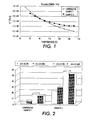
- the rheology of the toners of this Example and the control toner of Comparative Example 1 above was determined by dynamic temperature step method using a Dynamic Stress Rheometer SR 5000, made by Maple Instruments Inc., following the manufacturer's instructions. The results are set forth in Figure 1 .
- the viscosity of the toner of the present disclosure possessing a polyester gel in the shell, was much higher than that of the toner of Comparative Example 1 (which had a polyester, but not a polyester gel in the shell), at higher temperatures (from about 130°C to about 160°C).
- the increased viscosity at this temperature range enabled reduction of peak gloss during fusing.
- Fusing characteristics of the toners produced in Comparative Example 1 and the Examples were also determined by crease area, minimum fixing temperature, gloss, document offset, and vinyl offset testing.
- the toner image displays mechanical properties such as crease, as determined by creasing a section of the substrate such as paper with a toned image thereon and quantifying the degree to which the toner in the crease separates from the paper.
- a good crease resistance may be considered a value of less than 1 mm, where the average width of the creased image is measured by printing an image on paper, followed by (a) folding inwards the printed area of the image, (b) passing over the folded image a standard TEFLON coated copper roll weighing about 860 grams, (c) unfolding the paper and wiping the loose ink from the creased imaged surface with a cotton swab, and (d) measuring the average width of the ink free creased area with an image analyzer.
- the crease value can also be reported in terms of area, especially when the image is sufficiently hard to break unevenly on creasing; measured in terms of area, crease values of 100 millimeters correspond to about 1 mm in width. Further, the images exhibit fracture coefficients, for example of greater than unity. From the image analysis of the creased area, it is possible to determine whether the image shows a small single crack line or is more brittle and easily cracked. A single crack line in the creased area provides a fracture coefficient of unity while a highly cracked crease exhibits a fracture coefficient of greater than unity. The greater the cracking, the greater the fracture coefficient. Toners exhibiting acceptable mechanical properties, which are suitable for office documents, may be obtained by utilizing the aforementioned thermoplastic resins.
- the Minimum Fixing Temperature (MFT) measurement involves folding an image on paper fused at a specific temperature, and rolling a standard weight across the fold.
- the print can also be folded using a commercially available folder such as the Duplo D-590 paper folder.
- the folded image is then unfolded and analyzed under the microscope and assessed a numerical grade based on the amount of crease showing in the fold. This procedure is repeated at various temperatures until the minimum fusing temperature (showing very little crease) is obtained.
- Print gloss (Gardner gloss units or "ggu") was measured using a 75° BYK Gardner gloss meter for toner images that had been fused at a fuser roll temperature range of about 120°C to about 210°C (sample gloss was dependent on the toner, the toner mass per unit area, the paper substrate, the fuser roll, and fuser roll temperature).
- a standard document offset mapping procedure was performed as follows. Five centimeter (cm) by five cm test samples were cut from the prints taking care that when the sheets are placed face to face, they provide both toner to toner and toner to paper contact. A sandwich of toner to toner and toner to paper was placed on a clean glass plate. A glass slide was placed on the top of the samples and then a weight comprising a 2000 gram mass was placed on top of the glass slide. The glass plate was then inserted into an environmental chamber at a temperature of 60°C where the relative humidity was kept constant at 50%. After 7 days, the samples were removed from the chamber and allowed to cool to room temperature before the weight was removed. The removed samples were then carefully peeled apart.
- the peeled samples were mounted onto a sample sheet and then visually rated with a Document Offset Grade from 5.0 to 1.0, wherein a lower grade indicates progressively more toner offset, ranging from none (5.0) to severe (1.0).
- Grade 5.0 indicates no toner offset and no adhesion of one sheet to the other.
- Grade 4.5 indicates noticeable adhesion, but no toner offset.
- Grade 4 indicates that a very small amount of toner offsets to the other sheet.
- Grade 3 indicates that less than 1 /3 of the toner image offsets to the other sheet, while Grade 1.0 indicates that more than 1/2 of the toner image offsets to the other sheet.
- an evaluation of greater than or equal to 3.0 is considered the minimum acceptable offset, and an evaluation of greater than or equal to 4.0 is desirable.
- Vinyl offset was evaluated as follows. Toner images were covered with a piece of standard vinyl (32% dioctyl phthalate Plasticizer), placed between glass plates, loaded with a 250 gram weight, and placed in an environmental oven at a pressure of 10 g/cm 2 , 50°C and 50% relative humidity (RH). After about 24 hours, the samples were removed from the oven and allowed to cool to room temperature. The vinyl and toner image were carefully peeled apart, and evaluated with reference to a vinyl offset evaluation rating procedure as described above for document offset wherein Grades 5.0 to 1.0 indicate progressively higher amounts of toner offset onto the vinyl, from none (5.0) to severe (1.0). Grade 5.0 indicates no visible toner offset onto the vinyl and no disruption of the image gloss. Grade 4.5 indicates no toner offset, but some disruption of image gloss. An evaluation of greater than or equal to 4.0 is considered an acceptable grade.
- SEM images were obtained.
- the SEM images of the toner containing polyester gel in shell produced in this Example 2 which was coalesced at 90°C, showed that the high viscosity shell prevented the crystalline polyester in the core from migrating to the surface of the toner particles, even though the coalescence temperature was much higher than the melting point of crystalline polyester (about 81°C).
- SEM images of the control toner of Comparative Example 1, which had a polyester in its shell that was not cross-linked demonstrated that coalescence had to be conducted at a temperature much lower than the melting point of the crystalline polyester, to prevent the crystalline polyester from melting or coming to the toner surface.
Landscapes
- Physics & Mathematics (AREA)
- General Physics & Mathematics (AREA)
- Spectroscopy & Molecular Physics (AREA)
- Chemical & Material Sciences (AREA)
- Chemical Kinetics & Catalysis (AREA)
- Developing Agents For Electrophotography (AREA)
Claims (15)
- Toner comprenant :un noyau comprenant au moins une résine amorphe, au moins une résine cristalline, et un ou plusieurs ingrédients optionnels choisis dans le groupe constitué par des colorants optionnels, des cires optionnelles et des combinaisons de ceux-ci; etune coque comprenant au moins une résine amorphe choisie dans le groupe constitué par le poly(co-fumatate de bisphénol propoxylé), le poly(co-fumarate de bisphénol éthoxylé), le poly(co-fumarate de bisphénol butoxylé), le poly (co-fumarate de bisphénol co-propoxylé bisphénol co-éthoxylé), le poly(fumarate de 1,2-propylène), le poly(co-maléate de bisphénol propoxylé), le poly(co-maléate de bisphénol éthoxylé), le poly(co-maléate de bisphénol butoxylé), le poly(co-maléate de bisphénol co-propoxylé bisphénol co-éthoxylé), le poly(maléate de 1,2-propylène), le poly(co-itaconate de bisphénol propoxylé), le poly(co-itaconate de bisphénol éthoxylé), le poly(co-itaconate de bisphénol butoxylé), le poly(co-itaconate de bisphénol co-propoxylé bisphénol co-éthoxylé), le poly(itaconate de 1,2-propylène) et les combinaisons de ceux-ci,dans lequel la résine amorphe dans le noyau, la résine amorphe dans le noyau, ou les deux, comprend un gel de polyester.
- Toner selon la revendication 1, dans lequel la au moins une résine amorphe du noyau comprend un polyester choisi dans le groupe constitué par le poly(co-fumarate de bisphénol propoxylé), le poly(co-fumarate de bisphénol éthoxylé), le poly(co-fumarate de bisphénol butoxylé), le poly (co-fumarate de bisphénol co-propoxylé bisphénol co-éthoxylé), le poly(fumarate de 1,2-propylène), le poly(co-maléate de bisphénol propoxylé), le poly(co-maléate de bisphénol éthoxylé), le poly(co-maléate de bisphénol butoxylé), le poly(co-maléate de bisphénol co-propoxylé bisphénol co-éthoxylé), le poly(maléate de 1,2-propylène), le poly(co-itaconate de bisphénol propoxylé), le poly(co-itaconate de bisphénol éthoxylé), le poly(co-itaconate de bisphénol butoxylé), le poly(co-itaconate de bisphénol co-propoxylé bisphénol co-éthoxylé), le poly(itaconate de 1,2-propylène) et les combinaisons de ceux-ci, et dans lequel la résine amorphe du noyau et la résine amorphe de la coque peuvent être identiques ou différentes.
- Toner selon la revendication 1, dans lequel la au moins une résine cristalline comprend un polyester choisi dans le groupe constitué par le poly(éthylène-adipate), le poly(propylène-adipate), le poly(butylène-adipate), le poly(pentylène-adipate), le poly(hexylène-adipate), le poly(octylène-adipate), le poly(éthylène-succinate), le poly(propylène-succinate), le poly(butylène-succinate), le poly(pentylène-succinate), le poly(hexylène-succinate), le poly(octylène-succinate), le poly(éthylène-sébacate), le poly(propylène-sébacate),le poly(butylène-sébacate), le poly(pentylène-sébacate), le poly(hexylène-sébacate), le poly(octylène-sébacate), le copoly(5-sulfo-isophtaloyl)-copoly(éthylène-adipate) alcalin, le copoly(5-sulfo-isophtaloyl)-copoly(propylène-adipate) alcalin, le copoly(5-sulfo-isophtaloyl)-copoly(butylène-adipate) alcalin, le copoly(5-sulfo-isophtaloyl)-copoly(pentylène-adipate) alcalin, le copoly(5-sulfo-isophtaloyl)-copoly(hexylène-adipate) alcalin, le copoly(5-sulfo-isophtaloyl)-copoly(octylène-adipate) alcalin, le copoly(5-sulfo-isophtaloyl)-copoly(éthylène-adipate) alcalin le copoly(5-sulfo-isophtaloyl)-copoly(propylène-adipate) alcalin, le copoly(5-sulfo-isophtaloyl)-copoly(butylène-adipate) alcalin, le copoly(5-sulfo-isophtaloyl)-copoly(pentylène-adipate) alcalin, le copoly(5-sulfo-isophtaloyl)-copoly(hexylène-adipate) alcalin, le copoly(5-sulfo-isophtaloyl)-copoly(octylène-adipate) alcalin, le copoly(5-sulfo-isophtaloyl)-copoly(éthylène-succinate) alcalin, le copoly(5-sulfo-isophtaloyl)-copoly(propylène-succinate) alcalin, le copoly(5-sulfo-isophtaloyl)-copoly(butylène-succinate) alcalin, le copoly(5-sulfo-isophtaloyl)-copoly(pentylène-succinate) alcalin, le copoly(5-sulfo-isophtaloyl)-copoly(hexylène-succinate) alcalin, le copoly(5-sulfo-isophtaloyl)-copoly(octylène-succinate) alcalin, le copoly(5-sulfo-isophtaloyl)-copoly(éthylène-sébacate) alcalin, le copoly(5-sulfo-isophtaloyl)-copoly(propylène-sébacate) alcalin, le copoly(5-sulfo-isophtaloyl)-copoly(butylène-sébacate) alcalin, le copoly(5-sulfo-isophtaloyl)-copoly(pentylène-sébacate) alcalin, le copoly(5-sulfo-isophtaloyl)-copoly(hexylène-sébacate) alcalin, le copoly(5-sulfo-isophtaloyl)-copoly(octylène-sébacate) alcalin, le copoly(5-sulfo-isophtaloyl)-copoly(éthylène-adipate) alcalin, le copoly(5-sulfo-isophtaloy!)-copoly(propylène-adipate) alcalin, le copoly(5-sulfo-isophtaloyl)-copoly(butylène-adipate) alcalin, le copoly(5-sulfo-isophtaloyl)-copoly(pentylène-adipate) alcalin, le copoly(5-sulfo-isophtaloyl)-copoly(hexylène-adipate) alcalin et le poly(octylène-adipate),
dans lequel l'alcali comprend un métal choisi dans le groupe constitué par le sodium, le lithium et le potassium. - Toner selon la revendication 1, dans lequel la au moins une résine amorphe de la coque comprend une résine de poly(co-fumarate de bisphénol A propoxylé) de formule :

- Toner selon la revendication 1, dans lequel environ 1 % en poids à environ 50 % en poids du gel de polyester est réticulé.
- Toner selon la revendication 1, dans lequel la au moins une résine cristalline est de formule :

- Toner selon la revendication 1, dans lequel le colorant comprend des teintures, des pigments, des combinaisons de teintures, des combinaisons de pigments et des combinaisons de teintures et de pigments, en une quantité d'environ 0,1 à environ 35 pour cent en poids du toner, et dans lequel la cire est choisie dans le groupe constitué par les polyoléfines, la cire de carnauba, la cire de riz, la cire de candelilla, la cire de sumac, l'huile de jojoba, la cire d'abeilles, la cire de lignite, l'ozokérite, la cérésine, la cire de paraffine, la cire microcristalline, la cire de Fischer-Tropsch, le stéarate de stéaryle, le béhénate de béhényle, le stéarate de butyle, l'oléate de propyle, le monostéarate de glycéride, le distéarate de glycéride, le tétra béhénate de pentaérythritol, le monostéarate de diéthylèneglycol, le distéarate de dipropylèneglycol, le distéarate de diglycéryle, le tétrastéarate de triglycéryle, le monostéarate de sorbitan, le stéarate de cholestéryle, et les combinaisons de ceux-ci, présents en une quantité d'environ 1 pour cent en poids à environ 25 pour cent en poids du toner.
- Toner comprenant :un noyau comprenant au moins une résine amorphe, au moins une résine cristalline et au moins un ou plusieurs ingrédients optionnels choisis dans le groupe constitué par les colorants optionnels, les cires optionnelles et les combinaisons de ceux-ci ; etune coque comprenant un gel de polyester comprenant au moins une résine amorphe choisie dans le groupe constitué par le poly(co-fumarate de bisphénol propoxylé), le poly(co-fumarate de bisphénol éthoxylé), le poly(co-fumarate de bisphénol butoxylé), le poly (co-fumarate de bisphénol co-propoxylé bisphénol co-éthoxylé), le poly(fumarate de 1,2-propylène), le poly(co-maléate de bisphénol propoxylé), le poly(co-maléate de bisphénol éthoxylé), le poly(co-maléate de bisphénol butoxylé), le poly(co-maléate de bisphénol co-propoxylé bisphénol co-éthoxylé), le poly(maléate de 1,2-propylène), le poly(co-itaconate de bisphénol propoxylé), le poly(co-itaconate de bisphénol éthoxylé), le poly(co-itaconate de bisphénol butoxylé), le poly(co-itaconate de bisphénol co-propoxylé bisphénol co-éthoxylé), le poly(itaconate de 1,2-propylène) et les combinaisons de ceux-ci,dans lequel d'environ 1 % en poids à environ 50 % en poids du gel de polyester est réticulé.
- Toner selon la revendication 8, dans lequel la au moins une résine cristalline comprend un polyester choisi dans le groupe constitué par le poly(éthylène-adipate), le poly(propylène-adipate), le poly(butylène-adipate), le poly(pentylène-adipate), le poly(hexylène-adipate), le poly(octylène-adipate), le poly(éthylène-succinate), le poly(propylène-succinate), le poly(butylène-succinate), le poly(pentylène-succinate), le poly(hexylène-succinate), le poly(octylène-succinate), le poly(éthylène-sébacate), le poly(propylène-sébacate), le poly(butylène-sébacate), le poly(pentylène-sébacate), le poly(hexylène-sébacate), le poly(octylène-sébacate), le copoly(5-sulfo-isophtaloyl)-copoly(éthylène-adipate) alcalin, le copoly(5-sulfo-isophtaloyl)-copoly(propylène-adipate) alcalin, le copoly(5-sulfo-isophtaloyl)-copoly(butylène-adipate) alcalin, le copoly(5-sulfo-isophtaloyl)-copoly(pentylène-adipate) alcalin, le copoly(5-sulfo-isophtaloyl)-copoly(hexylène-adipate) alcalin, le copoly(5-sulfo-isophtaloyl)-copoly(octylène-adipate) alcalin, le copoly(5-sulfo-isophtaloyl)-copoly(éthylène-adipate) alcalin le copoly(5-sulfo-isophtaloyl)-copoly(propylène-adipate) alcalin, le copoly(5-sulfo-isophtaloyl)-copoly(butylène-adipate) alcalin, le copoly(5-sulfo-isophtaloyl)-copoly(pentylène-adipate) alcalin, le copoly(5-sulfo-isophtaloyl)-copoly(hexylène-adipate) alcalin, le copoly(5-sulfo-isophtaloyl)-copoly(octylène-adipate) alcalin, le copoly(5-sulfo-isophtaloyl)-copoly(éthylène-succinate) alcalin, le copoly(5-sulfo-isophtaloyl)-copoly(propylène-succinate) alcalin, le copoly(5-sulfo-isophtaloyl)-copoly(butylène-succinate) alcalin, le copoly(5-sulfo-isophtaloyl)-copoly(pentylène-succinate) alcalin, le copoly(5-sulfo-isophtaloyl)-copoly(hexylène-succinate) alcalin, le copoly(5-sulfo-isophtaloyl)-copoly(octylène-succinate) alcalin, le copoly(5-sulfo-isophtaloyl)-copoly(éthylène-sébacate) alcalin, le copoly(5-sulfo-isophtaloyl)-copoly(propylène-sébacate) alcalin,le copoly(5-sulfo-isophtaloyl)-copoly(butylène-sébacate) alcalin, le copoly(5-sulfo-isophtaloyl)-copoly(pentylène-sébacate) alcalin, le copoly(5-sulfo-isophtaloyl)-copoly(hexylène-sébacate) alcalin, le copoly(5-sulfo-isophtaloyl)-copoly(octylène-sébacate) alcalin, le copoly(5-sulfo-isophtaloyl)-copoly(éthylène-adipate) alcalin, le copoly(5-sulfo-isophtaloyl)-copoly(propylène-adipate) alcalin, le copoly(5-sulfo-isophtaloyl)-copoly(butylène-adipate) alcalin, le copoly(5-sulfo-isophtaloyl)-copoly(pentylène-adipate) alcalin, le copoly(5-sulfo-isophtaloyl)-copoly(hexylène-adipate) alcalin et le poly(octylène-adipate),
dans lequel l'alcali comprend un métal choisi dans le groupe constitué par le sodium, le lithium et le potassium, et
dans lequel la au moins une résine amorphe de la coque comprend une résine de poly(co-fumarate de bisphénol A propoxylé) de formule :
- Toner selon la revendication 8, dans lequel le colorant comprend des teintures, des pigments, des combinaisons de teintures, des combinaisons de pigments et des combinaisons de teintures et de pigments, en une quantité d'environ 0,1 à environ 35 pour cent en poids du toner, et dans lequel la cire est choisie dans le groupe constitué par les polyoléfines, la cire de carnauba, la cire de riz, la cire de candelilla, la cire de sumac, l'huile de jojoba, la cire d'abeilles, la cire de lignite, l'ozokérite, la cérésine, la cire de paraffine, la cire microcristalline, la cire de Fischer-Tropsch, le stéarate de stéaryle, le béhénate de béhényle, le stéarate de butyle, l'oléate de propyle, le monostéarate de glycéride, le distéarate de glycéride, le tétra béhénate de pentaérythritol, le monostéarate de diéthylèneglycol, le distéarate de dipropylèneglycol, le distéarate de diglycéryle, le tétrastéarate de triglycéryle, le monostéarate de sorbitan, le stéarate de cholestéryle, et les combinaisons de ceux-ci, présents en une quantité d'environ 1 pour cent en poids à environ 25 pour cent en poids du toner.
- Toner selon la revendication 8, dans lequel la au moins une résine amorphe dans le noyau comprend un gel de polyester.
- Procédé comprenant :la mise en contact d'au moins une résine amorphe avec au moins une résine cristalline dans une dispersion comprenant au moins un tensioactif ;la mise en contact de la dispersion avec un colorant optionnel, au moins un tensioactif et une cire optionnelle pour former de petites particules;l'agrégation des petites particules ;la mise en contact des petites particules avec un latex de gel de polyester comprenant au moins une résine amorphe choisie dans le groupe constitué par le poly(co-fumarate de bisphénol propoxylé), le poly(co-fumarate de bisphénol éthoxylé), le poly(co-fumarate de bisphénol butoxylé), le poly (co-fumarate de bisphénol co-propoxylé bisphénol co-éthoxylé), le poly(fumarate de 1,2-propylène), le poly(co-maléate de bisphénol propoxylé), le poly(co-maléate de bisphénol éthoxylé), le poly(co-maléate de bisphénol butoxylé), le poly(co-maléate de bisphénol co-propoxylé bisphénol co-éthoxylé), le poly(maléate de 1,2-propylène), le poly(co-itaconate de bisphénol propoxylé), le poly(co-itaconate de bisphénol éthoxylé), le poly(co-itaconate de bisphénol butoxylé), le poly(co-itaconate de bisphénol co-propoxylé bisphénol co-éthoxylé), le poly(itaconate de 1,2-propylène) et les combinaisons de ceux-ci, pour former une coque sur les petites particules ;le fusionnement des petites particules possédant les coques pour former des particules de toner ;
etla récupération des particules de toner. - Procédé selon la revendication 12, dans lequel la résine amorphe du noyau est choisie dans le groupe constitué par le poly(co-fumarate de bisphénol propoxylé), le poly(co-fumarate de bisphénol éthoxylé), le poly(co-fumarate de bisphénol butoxylé), le poly (co-fumarate de bisphénol co-propoxylé bisphénol co-éthoxylé), le poly(fumarate de 1,2-propylène), le poly(co-maléate de bisphénol propoxylé), le poly(co-maléate de bisphénol éthoxylé), le poly(co-maléate de bisphénol butoxylé), le poly(co-maléate de bisphénol co-propoxylé bisphénol co-éthoxylé), le poly(maléate de 1,2-propylène), le poly(co-itaconate de bisphénol propoxylé), le poly(co-itaconate de bisphénol éthoxylé), le poly(co-itaconate de bisphénol butoxylé), le poly(co-itaconate de bisphénol co-propoxylé bisphénol co-éthoxylé), le poly(itaconate de 1,2-propylène) et les combinaisons de ceux-ci, dans lequel la résine amorphe des petites particules et la résine amorphe de la coque peuvent être identiques ou différentes, et
dans lequel la au moins une résine cristalline comprend un polyester choisi dans le groupe constitué par le poly(éthylène-adipate), le poly(propylène-adipate), le poly(butylène-adipate), le poly(pentylène-adipate), le poly(hexylène-adipate), le poly(octylène-adipate), le poly(éthylène-succinate), le poly(propylène-succinate), le poly(butylène-succinate), le poly(pentylène-succinate), le poly(hexylène-succinate), le poly(octylène-succinate), le poly(éthylène-sébacate), le poly(propylène-sébacate), le poly(pentylène-sébacate), le poly(hexylène-sébacate), le poly(octylène-sébacate), le copoly(5-sulfo-isophtaloyl)-copoly(éthylène-adipate) alcalin, le copoly(5-sulfo-isophtaloyl)-copoly(propylène-adipate) alcalin, le copoly(5-sulfo-isophtaloyl)-copoly(butylène-adipate) alcalin, le copoly(5-sulfo-isophtaloyl)-copoly(pentylène-adipate) alcalin, le copoly(5-sulfo-isophtaloyl)-copoly(hexylène-adipate) alcalin, le copoly(5-sulfo-isophtaloyl)-copoly(octylène-adipate) alcalin, le copoty(5-sulfo-isophtaloyl)-copoly(éthylène-adipate) alcalin le copoly(5-sulfo-isophtaloyl)-copoly(propylène-adipate) alcalin, le copoly(5-sulfo-isophtaloyl)-copoly(butylène-adipate) alcalin, le copoly(5-sulfo-isophtaloyl)-copoly(pentylène-adipate) alcalin, le copoly(5-sulfo-isophtaloyl)-copoly(hexylène-adipate) alcalin, le copoly(5-sulfo-isophtaloyl)-copoly(octylène-adipate) alcalin, le copoly(5-sulfo-isophtaloyl)-copoly(éthylène-succinate) alcalin, le copoly(5-sulfo-isophtaloyl)-copoly(propylène-succinate) alcalin, le copoly(5-sulfo-isophtaloyl)-copoly(butylène-succinate) alcalin, le copoly(5-sulfo-isophtaloyl)-copoly(pentylène-succinate) alcalin, le copoly(5-sulfo-isophtaloyl)-copoly(hexylène-succinate) alcalin, le copoly(5-sulfo-isophtaloyl)-copoly(octylène-succinate) alcalin, le copoly(5-sulfo-isophtaloyl)-copoly(éthylène-sébacate) alcalin, le copoly(5-sulfo-isophtaloyl)-copoly(propylène-sébacate) alcalin, le copoly(5-sulfo-isophtaloyl)-copoly(butylène-sébacate) alcalin, le copoly(5-sulfo-isophtaloyl)-copoly(pentylène-sébacate) alcalin, le copoly(5-sulfo-isophtaloyl)-copoly(hexylène-sébacate) alcalin, le copoly(5-sulfo-isophtaloyl)-copoly(octylène-sébacate) alcalin, le copoly(5-sulfo-isophtaloyl)-copoly(éthylène-adipate) alcalin, le copoly(5-sulfo-isophtaloyl)-copoly(propylène-adipate) alcalin,le copoly(5-sulfo-isophtaloyl)-copoly(butylène-adipate) alcalin, le copoly(5-sulfo-isophtaloyl)-copoly(pentylène-adipate) alcalin, le copoly(5-sulfo-isophtaloyl)-copoly(hexylène-adipate) alcalin et le poly(octylène-adipate),
dans lequel l'alcali comprend un métal choisi dans le groupe constitué par le sodium, le lithium et le potassium. - Procédé selon la revendication 12, dans lequel d'environ 1 % en poids à environ 50 % en poids du gel de polyester de la coque est réticulé et comprend d'environ 2 pour cent en poids à environ 40 pour cent en poids du toner.
- Procédé selon la revendication 12, dans lequel le colorant optionnel comprend des teintures, des pigments, des combinaisons de teintures, des combinaisons de pigments et des combinaisons de teintures et de pigments, en une quantité d'environ 0,1 à environ 35 pour cent en poids du toner, et dans lequel la cire est choisie dans le groupe constitué par les polyoléfines, la cire de carnauba, la cire de riz, la cire de candelilla, la cire de sumac, l'huile de jojoba, la cire d'abeilles, la cire de lignite, l'ozokérite, la cérésine, la cire de paraffine, la cire microcristalline, la cire de Fischer-Tropsch, le stéarate de stéaryle, le béhénate de béhényle, le stéarate de butyle, l'oléate de propyle, le monostéarate de glycéride, le distéarate de glycéride, le tétra béhénate de pentaérythritol, le monostéarate de diéthylèneglycol, le distéarate de dipropylèneglycol, le distéarate de diglycéryle, le tétrastéarate de triglycéryle, le monostéarate de sorbitan, le stéarate de cholestéryle, et les combinaisons de ceux-ci, présents en une quantité d'environ 1 pour cent en poids à environ 25 pour cent en poids du toner.
Applications Claiming Priority (1)
| Application Number | Priority Date | Filing Date | Title |
|---|---|---|---|
| US12/199,115 US8530131B2 (en) | 2008-08-27 | 2008-08-27 | Toner compositions |
Publications (2)
| Publication Number | Publication Date |
|---|---|
| EP2159644A1 EP2159644A1 (fr) | 2010-03-03 |
| EP2159644B1 true EP2159644B1 (fr) | 2013-07-31 |
Family
ID=41347794
Family Applications (1)
| Application Number | Title | Priority Date | Filing Date |
|---|---|---|---|
| EP09167309.5A Not-in-force EP2159644B1 (fr) | 2008-08-27 | 2009-08-06 | Compositions de toner |
Country Status (5)
| Country | Link |
|---|---|
| US (2) | US8530131B2 (fr) |
| EP (1) | EP2159644B1 (fr) |
| JP (1) | JP5580560B2 (fr) |
| BR (1) | BRPI0902784B1 (fr) |
| CA (1) | CA2675917C (fr) |
Families Citing this family (17)
| Publication number | Priority date | Publication date | Assignee | Title |
|---|---|---|---|---|
| US8197998B2 (en) * | 2009-05-20 | 2012-06-12 | Xerox Corporation | Toner compositions |
| US20100330486A1 (en) * | 2009-06-24 | 2010-12-30 | Xerox Corporation | Toner Compositions |
| US8722299B2 (en) * | 2009-09-15 | 2014-05-13 | Xerox Corporation | Curable toner compositions and processes |
| US8257895B2 (en) * | 2009-10-09 | 2012-09-04 | Xerox Corporation | Toner compositions and processes |
| US8431318B2 (en) | 2010-04-09 | 2013-04-30 | Xerox Corporation | Toner compositions and processes |
| JP5633299B2 (ja) * | 2010-10-21 | 2014-12-03 | コニカミノルタ株式会社 | 静電荷像現像用トナーおよびその製造方法 |
| JP5545173B2 (ja) * | 2010-11-01 | 2014-07-09 | コニカミノルタ株式会社 | 静電荷像現像用トナーおよびその製造方法 |
| US9029059B2 (en) * | 2011-04-08 | 2015-05-12 | Xerox Corporation | Co-emulsification of insoluble compounds with toner resins |
| JP5836888B2 (ja) * | 2011-06-03 | 2015-12-24 | キヤノン株式会社 | トナー |
| JP6000660B2 (ja) | 2011-06-03 | 2016-10-05 | キヤノン株式会社 | トナーおよび該トナーの製造方法 |
| DE112012006443B4 (de) * | 2012-06-01 | 2020-04-23 | Canon Kabushiki Kaisha | Toner und Verfahren zur Herstellung eines Toners |
| JP5994552B2 (ja) * | 2012-10-10 | 2016-09-21 | 富士ゼロックス株式会社 | 静電荷像現像用トナー、静電荷像現像剤、トナーカートリッジ、プロセスカートリッジ、画像形成装置、及び、画像形成方法 |
| KR102170307B1 (ko) * | 2012-11-15 | 2020-10-26 | 주식회사 알엔에스 | 탈모방지 및 모발성장 촉진제 조성물 |
| JP6107535B2 (ja) * | 2013-08-23 | 2017-04-05 | 富士ゼロックス株式会社 | 静電荷像現像用トナー、静電荷像現像剤、トナーカートリッジ、プロセスカートリッジ、画像形成装置及び画像形成方法 |
| JP6471047B2 (ja) * | 2015-06-12 | 2019-02-13 | 花王株式会社 | 電子写真用トナー |
| US9738759B1 (en) * | 2016-03-14 | 2017-08-22 | Xerox Corporation | Cold pressure fix toners comprising crystalline co-polyester-co-poly(alkylsiloxane) |
| US11130880B2 (en) * | 2018-03-07 | 2021-09-28 | Xerox Corporation | Low melt particles for surface finishing of 3D printed objects |
Family Cites Families (50)
| Publication number | Priority date | Publication date | Assignee | Title |
|---|---|---|---|---|
| US3590000A (en) | 1967-06-05 | 1971-06-29 | Xerox Corp | Solid developer for latent electrostatic images |
| US3800588A (en) | 1971-04-30 | 1974-04-02 | Mts System Corp | Multiple axis control system for vibration test apparatus |
| US3847604A (en) | 1971-06-10 | 1974-11-12 | Xerox Corp | Electrostatic imaging process using nodular carriers |
| US3893932A (en) * | 1972-07-13 | 1975-07-08 | Xerox Corp | Pressure fixable toner |
| US4298672A (en) | 1978-06-01 | 1981-11-03 | Xerox Corporation | Toners containing alkyl pyridinium compounds and their hydrates |
| DE2966986D1 (en) | 1979-07-26 | 1984-06-20 | Baker Chem Co J T | Reagent for the quantitative determination of water, and its use |
| US4338390A (en) | 1980-12-04 | 1982-07-06 | Xerox Corporation | Quarternary ammonium sulfate or sulfonate charge control agents for electrophotographic developers compatible with viton fuser |
| US4935326A (en) | 1985-10-30 | 1990-06-19 | Xerox Corporation | Electrophotographic carrier particles coated with polymer mixture |
| US4937166A (en) | 1985-10-30 | 1990-06-26 | Xerox Corporation | Polymer coated carrier particles for electrophotographic developers |
| US5236629A (en) | 1991-11-15 | 1993-08-17 | Xerox Corporation | Conductive composite particles and processes for the preparation thereof |
| US5302486A (en) | 1992-04-17 | 1994-04-12 | Xerox Corporation | Encapsulated toner process utilizing phase separation |
| US5290654A (en) | 1992-07-29 | 1994-03-01 | Xerox Corporation | Microsuspension processes for toner compositions |
| US5395723A (en) | 1992-09-30 | 1995-03-07 | Xerox Corporation | Low gloss, low melt cross-linked toner resins |
| US5330874A (en) | 1992-09-30 | 1994-07-19 | Xerox Corporation | Dry carrier coating and processes |
| US5346797A (en) | 1993-02-25 | 1994-09-13 | Xerox Corporation | Toner processes |
| US5364729A (en) | 1993-06-25 | 1994-11-15 | Xerox Corporation | Toner aggregation processes |
| US5418108A (en) | 1993-06-25 | 1995-05-23 | Xerox Corporation | Toner emulsion aggregation process |
| US5403693A (en) | 1993-06-25 | 1995-04-04 | Xerox Corporation | Toner aggregation and coalescence processes |
| US5501935A (en) | 1995-01-17 | 1996-03-26 | Xerox Corporation | Toner aggregation processes |
| US5527658A (en) | 1995-03-13 | 1996-06-18 | Xerox Corporation | Toner aggregation processes using water insoluble transition metal containing powder |
| JP3308812B2 (ja) | 1995-05-31 | 2002-07-29 | キヤノン株式会社 | 静電荷像現像用トナー及びその製造方法 |
| US5585215A (en) | 1996-06-13 | 1996-12-17 | Xerox Corporation | Toner compositions |
| US5650255A (en) | 1996-09-03 | 1997-07-22 | Xerox Corporation | Low shear toner aggregation processes |
| US5650256A (en) | 1996-10-02 | 1997-07-22 | Xerox Corporation | Toner processes |
| US5853943A (en) | 1998-01-09 | 1998-12-29 | Xerox Corporation | Toner processes |
| US6063827A (en) * | 1998-07-22 | 2000-05-16 | Xerox Corporation | Polyester process |
| US6214507B1 (en) | 1998-08-11 | 2001-04-10 | Xerox Corporation | Toner compositions |
| US6395442B1 (en) | 1999-07-30 | 2002-05-28 | Konica Corporation | Toner and production method of the same |
| US6359105B1 (en) | 2000-10-26 | 2002-03-19 | Xerox Corporation | Cross-linked polyester toners and process of making such toners |
| US6593049B1 (en) | 2001-03-26 | 2003-07-15 | Xerox Corporation | Toner and developer compositions |
| US6756176B2 (en) | 2002-09-27 | 2004-06-29 | Xerox Corporation | Toner processes |
| US7217486B2 (en) * | 2003-01-17 | 2007-05-15 | Seiko Epson Corporation | Toner and image-forming apparatus using the toner |
| US6830860B2 (en) | 2003-01-22 | 2004-12-14 | Xerox Corporation | Toner compositions and processes thereof |
| US7179575B2 (en) | 2004-06-28 | 2007-02-20 | Xerox Corporation | Emulsion aggregation toner having gloss enhancement and toner release |
| US7307111B2 (en) | 2004-12-16 | 2007-12-11 | Xerox Corporation | Polymer particles containing a cross-linked polymer core and a linear non-cross-linked polymer shell, and toner formed therefrom |
| US7312011B2 (en) * | 2005-01-19 | 2007-12-25 | Xerox Corporation | Super low melt and ultra low melt toners containing crystalline sulfonated polyester |
| US7214463B2 (en) | 2005-01-27 | 2007-05-08 | Xerox Corporation | Toner processes |
| US7455944B2 (en) | 2005-03-25 | 2008-11-25 | Fuji Xerox Co., Ltd. | Toner for developing electrostatic latent images and manufacturing method thereof, developer for developing electrostatic latent images, image forming method, and method for manufacturing dispersion of resin particles |
| US7494757B2 (en) * | 2005-03-25 | 2009-02-24 | Xerox Corporation | Ultra low melt toners comprised of crystalline resins |
| US7329476B2 (en) | 2005-03-31 | 2008-02-12 | Xerox Corporation | Toner compositions and process thereof |
| US20060269858A1 (en) | 2005-05-31 | 2006-11-30 | Xerox Corporation | Toner compositions including styrene containing external additives |
| JP2006337751A (ja) * | 2005-06-02 | 2006-12-14 | Fuji Xerox Co Ltd | カラー画像形成方法、及びカラートナー製造方法 |
| US20070037086A1 (en) | 2005-08-11 | 2007-02-15 | Xerox Corporation | Toner composition |
| US7425398B2 (en) | 2005-09-30 | 2008-09-16 | Xerox Corporation | Sulfonated polyester toner |
| JP2007121404A (ja) * | 2005-10-25 | 2007-05-17 | Fuji Xerox Co Ltd | 静電荷像現像用トナー、並びに、これを用いた静電荷像現像剤および画像形成方法 |
| CN101017336B (zh) | 2005-12-15 | 2012-02-29 | 株式会社理光 | 调色剂及制备方法和显影剂、成像方法和装置、处理盒 |
| US20070207400A1 (en) | 2006-03-06 | 2007-09-06 | Xerox Corporation | Toner composition and methods |
| US7622233B2 (en) | 2006-04-28 | 2009-11-24 | Xerox Corporation | Styrene-based toner compositions with multiple waxes |
| JP4858165B2 (ja) * | 2006-12-28 | 2012-01-18 | 富士ゼロックス株式会社 | 静電荷像現像用トナー、静電荷像現像剤、トナーカートリッジ、プロセスカートリッジ及び画像形成装置 |
| JP2008170627A (ja) * | 2007-01-10 | 2008-07-24 | Fuji Xerox Co Ltd | 静電荷像現像用トナー、静電荷像現像剤、トナーカートリッジ、プロセスカートリッジ及び画像形成装置 |
-
2008
- 2008-08-27 US US12/199,115 patent/US8530131B2/en active Active
-
2009
- 2009-08-06 EP EP09167309.5A patent/EP2159644B1/fr not_active Not-in-force
- 2009-08-20 CA CA2675917A patent/CA2675917C/fr not_active Expired - Fee Related
- 2009-08-26 BR BRPI0902784A patent/BRPI0902784B1/pt active IP Right Grant
- 2009-08-27 JP JP2009196627A patent/JP5580560B2/ja active Active
-
2013
- 2013-09-07 US US14/020,808 patent/US8828637B2/en active Active
Also Published As
| Publication number | Publication date |
|---|---|
| CA2675917C (fr) | 2012-07-10 |
| US8828637B2 (en) | 2014-09-09 |
| JP2010055094A (ja) | 2010-03-11 |
| BRPI0902784B1 (pt) | 2018-10-16 |
| US20100055593A1 (en) | 2010-03-04 |
| JP5580560B2 (ja) | 2014-08-27 |
| CA2675917A1 (fr) | 2010-02-27 |
| EP2159644A1 (fr) | 2010-03-03 |
| US8530131B2 (en) | 2013-09-10 |
| US20140011131A1 (en) | 2014-01-09 |
| BRPI0902784A2 (pt) | 2010-07-13 |
Similar Documents
| Publication | Publication Date | Title |
|---|---|---|
| EP2159644B1 (fr) | Compositions de toner | |
| EP2131246B1 (fr) | Compositions de toner | |
| US8617780B2 (en) | Toner having titania and processes thereof | |
| CA2675911C (fr) | Compositions de toner | |
| EP2253999B1 (fr) | Compositions de toner | |
| EP2096500B1 (fr) | Compositions de toner | |
| CA2675918C (fr) | Compositions de toner | |
| EP2280311A1 (fr) | Compositions de toner | |
| CA2773805A1 (fr) | Resine de polyester comprenant un biopolyol | |
| CA2777848C (fr) | Toner hyperpigmente noir a faible point de fusion | |
| US20110300480A1 (en) | Toner Compositions | |
| US8691488B2 (en) | Toner process | |
| CA2832637C (fr) | Encre seche hyperpigmentee | |
| CA2838611C (fr) | Toner a niveaux de brillance ajustables a stabilisateurs biosources | |
| US9316936B2 (en) | Colored toners | |
| US20110091805A1 (en) | Toner compositions | |
| US8741532B2 (en) | Toner with improved charging |
Legal Events
| Date | Code | Title | Description |
|---|---|---|---|
| PUAI | Public reference made under article 153(3) epc to a published international application that has entered the european phase |
Free format text: ORIGINAL CODE: 0009012 |
|
| AK | Designated contracting states |
Kind code of ref document: A1 Designated state(s): AT BE BG CH CY CZ DE DK EE ES FI FR GB GR HR HU IE IS IT LI LT LU LV MC MK MT NL NO PL PT RO SE SI SK SM TR |
|
| 17P | Request for examination filed |
Effective date: 20100903 |
|
| 17Q | First examination report despatched |
Effective date: 20101102 |
|
| GRAP | Despatch of communication of intention to grant a patent |
Free format text: ORIGINAL CODE: EPIDOSNIGR1 |
|
| GRAS | Grant fee paid |
Free format text: ORIGINAL CODE: EPIDOSNIGR3 |
|
| GRAA | (expected) grant |
Free format text: ORIGINAL CODE: 0009210 |
|
| AK | Designated contracting states |
Kind code of ref document: B1 Designated state(s): AT BE BG CH CY CZ DE DK EE ES FI FR GB GR HR HU IE IS IT LI LT LU LV MC MK MT NL NO PL PT RO SE SI SK SM TR |
|
| REG | Reference to a national code |
Ref country code: GB Ref legal event code: FG4D Ref country code: CH Ref legal event code: EP |
|
| REG | Reference to a national code |
Ref country code: AT Ref legal event code: REF Ref document number: 624974 Country of ref document: AT Kind code of ref document: T Effective date: 20130815 |
|
| REG | Reference to a national code |
Ref country code: IE Ref legal event code: FG4D |
|
| REG | Reference to a national code |
Ref country code: DE Ref legal event code: R096 Ref document number: 602009017562 Country of ref document: DE Effective date: 20130926 |
|
| REG | Reference to a national code |
Ref country code: AT Ref legal event code: MK05 Ref document number: 624974 Country of ref document: AT Kind code of ref document: T Effective date: 20130731 |
|
| REG | Reference to a national code |
Ref country code: NL Ref legal event code: VDEP Effective date: 20130731 |
|
| REG | Reference to a national code |
Ref country code: LT Ref legal event code: MG4D |
|
| PG25 | Lapsed in a contracting state [announced via postgrant information from national office to epo] |
Ref country code: NO Free format text: LAPSE BECAUSE OF FAILURE TO SUBMIT A TRANSLATION OF THE DESCRIPTION OR TO PAY THE FEE WITHIN THE PRESCRIBED TIME-LIMIT Effective date: 20131031 Ref country code: IS Free format text: LAPSE BECAUSE OF FAILURE TO SUBMIT A TRANSLATION OF THE DESCRIPTION OR TO PAY THE FEE WITHIN THE PRESCRIBED TIME-LIMIT Effective date: 20131130 Ref country code: SE Free format text: LAPSE BECAUSE OF FAILURE TO SUBMIT A TRANSLATION OF THE DESCRIPTION OR TO PAY THE FEE WITHIN THE PRESCRIBED TIME-LIMIT Effective date: 20130731 Ref country code: LT Free format text: LAPSE BECAUSE OF FAILURE TO SUBMIT A TRANSLATION OF THE DESCRIPTION OR TO PAY THE FEE WITHIN THE PRESCRIBED TIME-LIMIT Effective date: 20130731 Ref country code: HR Free format text: LAPSE BECAUSE OF FAILURE TO SUBMIT A TRANSLATION OF THE DESCRIPTION OR TO PAY THE FEE WITHIN THE PRESCRIBED TIME-LIMIT Effective date: 20130731 Ref country code: PT Free format text: LAPSE BECAUSE OF FAILURE TO SUBMIT A TRANSLATION OF THE DESCRIPTION OR TO PAY THE FEE WITHIN THE PRESCRIBED TIME-LIMIT Effective date: 20131202 Ref country code: AT Free format text: LAPSE BECAUSE OF FAILURE TO SUBMIT A TRANSLATION OF THE DESCRIPTION OR TO PAY THE FEE WITHIN THE PRESCRIBED TIME-LIMIT Effective date: 20130731 Ref country code: BE Free format text: LAPSE BECAUSE OF FAILURE TO SUBMIT A TRANSLATION OF THE DESCRIPTION OR TO PAY THE FEE WITHIN THE PRESCRIBED TIME-LIMIT Effective date: 20130731 Ref country code: CY Free format text: LAPSE BECAUSE OF FAILURE TO SUBMIT A TRANSLATION OF THE DESCRIPTION OR TO PAY THE FEE WITHIN THE PRESCRIBED TIME-LIMIT Effective date: 20130821 |
|
| PG25 | Lapsed in a contracting state [announced via postgrant information from national office to epo] |
Ref country code: SI Free format text: LAPSE BECAUSE OF FAILURE TO SUBMIT A TRANSLATION OF THE DESCRIPTION OR TO PAY THE FEE WITHIN THE PRESCRIBED TIME-LIMIT Effective date: 20130731 Ref country code: GR Free format text: LAPSE BECAUSE OF FAILURE TO SUBMIT A TRANSLATION OF THE DESCRIPTION OR TO PAY THE FEE WITHIN THE PRESCRIBED TIME-LIMIT Effective date: 20131101 Ref country code: NL Free format text: LAPSE BECAUSE OF FAILURE TO SUBMIT A TRANSLATION OF THE DESCRIPTION OR TO PAY THE FEE WITHIN THE PRESCRIBED TIME-LIMIT Effective date: 20130731 Ref country code: PL Free format text: LAPSE BECAUSE OF FAILURE TO SUBMIT A TRANSLATION OF THE DESCRIPTION OR TO PAY THE FEE WITHIN THE PRESCRIBED TIME-LIMIT Effective date: 20130731 Ref country code: LV Free format text: LAPSE BECAUSE OF FAILURE TO SUBMIT A TRANSLATION OF THE DESCRIPTION OR TO PAY THE FEE WITHIN THE PRESCRIBED TIME-LIMIT Effective date: 20130731 Ref country code: FI Free format text: LAPSE BECAUSE OF FAILURE TO SUBMIT A TRANSLATION OF THE DESCRIPTION OR TO PAY THE FEE WITHIN THE PRESCRIBED TIME-LIMIT Effective date: 20130731 |
|
| PG25 | Lapsed in a contracting state [announced via postgrant information from national office to epo] |
Ref country code: CY Free format text: LAPSE BECAUSE OF FAILURE TO SUBMIT A TRANSLATION OF THE DESCRIPTION OR TO PAY THE FEE WITHIN THE PRESCRIBED TIME-LIMIT Effective date: 20130731 |
|
| REG | Reference to a national code |
Ref country code: CH Ref legal event code: PL |
|
| PG25 | Lapsed in a contracting state [announced via postgrant information from national office to epo] |
Ref country code: CZ Free format text: LAPSE BECAUSE OF FAILURE TO SUBMIT A TRANSLATION OF THE DESCRIPTION OR TO PAY THE FEE WITHIN THE PRESCRIBED TIME-LIMIT Effective date: 20130731 Ref country code: SK Free format text: LAPSE BECAUSE OF FAILURE TO SUBMIT A TRANSLATION OF THE DESCRIPTION OR TO PAY THE FEE WITHIN THE PRESCRIBED TIME-LIMIT Effective date: 20130731 Ref country code: EE Free format text: LAPSE BECAUSE OF FAILURE TO SUBMIT A TRANSLATION OF THE DESCRIPTION OR TO PAY THE FEE WITHIN THE PRESCRIBED TIME-LIMIT Effective date: 20130731 Ref country code: CH Free format text: LAPSE BECAUSE OF NON-PAYMENT OF DUE FEES Effective date: 20130831 Ref country code: MC Free format text: LAPSE BECAUSE OF FAILURE TO SUBMIT A TRANSLATION OF THE DESCRIPTION OR TO PAY THE FEE WITHIN THE PRESCRIBED TIME-LIMIT Effective date: 20130731 Ref country code: RO Free format text: LAPSE BECAUSE OF FAILURE TO SUBMIT A TRANSLATION OF THE DESCRIPTION OR TO PAY THE FEE WITHIN THE PRESCRIBED TIME-LIMIT Effective date: 20130731 Ref country code: DK Free format text: LAPSE BECAUSE OF FAILURE TO SUBMIT A TRANSLATION OF THE DESCRIPTION OR TO PAY THE FEE WITHIN THE PRESCRIBED TIME-LIMIT Effective date: 20130731 Ref country code: LI Free format text: LAPSE BECAUSE OF NON-PAYMENT OF DUE FEES Effective date: 20130831 |
|
| REG | Reference to a national code |
Ref country code: IE Ref legal event code: MM4A |
|
| PG25 | Lapsed in a contracting state [announced via postgrant information from national office to epo] |
Ref country code: ES Free format text: LAPSE BECAUSE OF FAILURE TO SUBMIT A TRANSLATION OF THE DESCRIPTION OR TO PAY THE FEE WITHIN THE PRESCRIBED TIME-LIMIT Effective date: 20130731 Ref country code: IT Free format text: LAPSE BECAUSE OF FAILURE TO SUBMIT A TRANSLATION OF THE DESCRIPTION OR TO PAY THE FEE WITHIN THE PRESCRIBED TIME-LIMIT Effective date: 20130731 |
|
| PLBE | No opposition filed within time limit |
Free format text: ORIGINAL CODE: 0009261 |
|
| STAA | Information on the status of an ep patent application or granted ep patent |
Free format text: STATUS: NO OPPOSITION FILED WITHIN TIME LIMIT |
|
| 26N | No opposition filed |
Effective date: 20140502 |
|
| PG25 | Lapsed in a contracting state [announced via postgrant information from national office to epo] |
Ref country code: IE Free format text: LAPSE BECAUSE OF NON-PAYMENT OF DUE FEES Effective date: 20130806 |
|
| REG | Reference to a national code |
Ref country code: DE Ref legal event code: R097 Ref document number: 602009017562 Country of ref document: DE Effective date: 20140502 |
|
| PG25 | Lapsed in a contracting state [announced via postgrant information from national office to epo] |
Ref country code: SM Free format text: LAPSE BECAUSE OF FAILURE TO SUBMIT A TRANSLATION OF THE DESCRIPTION OR TO PAY THE FEE WITHIN THE PRESCRIBED TIME-LIMIT Effective date: 20130731 |
|
| PG25 | Lapsed in a contracting state [announced via postgrant information from national office to epo] |
Ref country code: TR Free format text: LAPSE BECAUSE OF FAILURE TO SUBMIT A TRANSLATION OF THE DESCRIPTION OR TO PAY THE FEE WITHIN THE PRESCRIBED TIME-LIMIT Effective date: 20130731 Ref country code: MT Free format text: LAPSE BECAUSE OF FAILURE TO SUBMIT A TRANSLATION OF THE DESCRIPTION OR TO PAY THE FEE WITHIN THE PRESCRIBED TIME-LIMIT Effective date: 20130731 |
|
| PG25 | Lapsed in a contracting state [announced via postgrant information from national office to epo] |
Ref country code: MK Free format text: LAPSE BECAUSE OF FAILURE TO SUBMIT A TRANSLATION OF THE DESCRIPTION OR TO PAY THE FEE WITHIN THE PRESCRIBED TIME-LIMIT Effective date: 20130731 Ref country code: BG Free format text: LAPSE BECAUSE OF FAILURE TO SUBMIT A TRANSLATION OF THE DESCRIPTION OR TO PAY THE FEE WITHIN THE PRESCRIBED TIME-LIMIT Effective date: 20130731 Ref country code: LU Free format text: LAPSE BECAUSE OF NON-PAYMENT OF DUE FEES Effective date: 20130806 Ref country code: HU Free format text: LAPSE BECAUSE OF FAILURE TO SUBMIT A TRANSLATION OF THE DESCRIPTION OR TO PAY THE FEE WITHIN THE PRESCRIBED TIME-LIMIT; INVALID AB INITIO Effective date: 20090806 |
|
| REG | Reference to a national code |
Ref country code: FR Ref legal event code: PLFP Year of fee payment: 8 |
|
| REG | Reference to a national code |
Ref country code: FR Ref legal event code: PLFP Year of fee payment: 9 |
|
| REG | Reference to a national code |
Ref country code: FR Ref legal event code: PLFP Year of fee payment: 10 |
|
| PGFP | Annual fee paid to national office [announced via postgrant information from national office to epo] |
Ref country code: GB Payment date: 20200722 Year of fee payment: 12 Ref country code: FR Payment date: 20200721 Year of fee payment: 12 |
|
| GBPC | Gb: european patent ceased through non-payment of renewal fee |
Effective date: 20210806 |
|
| PG25 | Lapsed in a contracting state [announced via postgrant information from national office to epo] |
Ref country code: GB Free format text: LAPSE BECAUSE OF NON-PAYMENT OF DUE FEES Effective date: 20210806 Ref country code: FR Free format text: LAPSE BECAUSE OF NON-PAYMENT OF DUE FEES Effective date: 20210831 |
|
| PGFP | Annual fee paid to national office [announced via postgrant information from national office to epo] |
Ref country code: DE Payment date: 20230720 Year of fee payment: 15 |
|
| REG | Reference to a national code |
Ref country code: DE Ref legal event code: R119 Ref document number: 602009017562 Country of ref document: DE |
|
| PG25 | Lapsed in a contracting state [announced via postgrant information from national office to epo] |
Ref country code: DE Free format text: LAPSE BECAUSE OF NON-PAYMENT OF DUE FEES Effective date: 20250301 |