EP2163902A1 - Procédé et dispositif de dosage destinés au dosage d'un liquide dans un canal de réception d'un élément test pour l'analyse de liquides corporels - Google Patents
Procédé et dispositif de dosage destinés au dosage d'un liquide dans un canal de réception d'un élément test pour l'analyse de liquides corporels Download PDFInfo
- Publication number
- EP2163902A1 EP2163902A1 EP09010480A EP09010480A EP2163902A1 EP 2163902 A1 EP2163902 A1 EP 2163902A1 EP 09010480 A EP09010480 A EP 09010480A EP 09010480 A EP09010480 A EP 09010480A EP 2163902 A1 EP2163902 A1 EP 2163902A1
- Authority
- EP
- European Patent Office
- Prior art keywords
- metering
- dosing
- liquid
- receiving channel
- tube
- Prior art date
- Legal status (The legal status is an assumption and is not a legal conclusion. Google has not performed a legal analysis and makes no representation as to the accuracy of the status listed.)
- Granted
Links
Images



Classifications
-
- B—PERFORMING OPERATIONS; TRANSPORTING
- B01—PHYSICAL OR CHEMICAL PROCESSES OR APPARATUS IN GENERAL
- B01L—CHEMICAL OR PHYSICAL LABORATORY APPARATUS FOR GENERAL USE
- B01L3/00—Containers or dishes for laboratory use, e.g. laboratory glassware; Droppers
- B01L3/02—Burettes; Pipettes
- B01L3/0241—Drop counters; Drop formers
- B01L3/0262—Drop counters; Drop formers using touch-off at substrate or container
-
- G—PHYSICS
- G01—MEASURING; TESTING
- G01N—INVESTIGATING OR ANALYSING MATERIALS BY DETERMINING THEIR CHEMICAL OR PHYSICAL PROPERTIES
- G01N35/00—Automatic analysis not limited to methods or materials provided for in any single one of groups G01N1/00 - G01N33/00; Handling materials therefor
- G01N35/10—Devices for transferring samples or any liquids to, in, or from, the analysis apparatus, e.g. suction devices, injection devices
- G01N35/1009—Characterised by arrangements for controlling the aspiration or dispense of liquids
- G01N35/1011—Control of the position or alignment of the transfer device
-
- B—PERFORMING OPERATIONS; TRANSPORTING
- B01—PHYSICAL OR CHEMICAL PROCESSES OR APPARATUS IN GENERAL
- B01L—CHEMICAL OR PHYSICAL LABORATORY APPARATUS FOR GENERAL USE
- B01L2200/00—Solutions for specific problems relating to chemical or physical laboratory apparatus
- B01L2200/02—Adapting objects or devices to another
- B01L2200/026—Fluid interfacing between devices or objects, e.g. connectors, inlet details
- B01L2200/027—Fluid interfacing between devices or objects, e.g. connectors, inlet details for microfluidic devices
-
- B—PERFORMING OPERATIONS; TRANSPORTING
- B01—PHYSICAL OR CHEMICAL PROCESSES OR APPARATUS IN GENERAL
- B01L—CHEMICAL OR PHYSICAL LABORATORY APPARATUS FOR GENERAL USE
- B01L2200/00—Solutions for specific problems relating to chemical or physical laboratory apparatus
- B01L2200/06—Fluid handling related problems
- B01L2200/0605—Metering of fluids
-
- B—PERFORMING OPERATIONS; TRANSPORTING
- B01—PHYSICAL OR CHEMICAL PROCESSES OR APPARATUS IN GENERAL
- B01L—CHEMICAL OR PHYSICAL LABORATORY APPARATUS FOR GENERAL USE
- B01L2400/00—Moving or stopping fluids
- B01L2400/04—Moving fluids with specific forces or mechanical means
- B01L2400/0403—Moving fluids with specific forces or mechanical means specific forces
- B01L2400/0406—Moving fluids with specific forces or mechanical means specific forces capillary forces
-
- B—PERFORMING OPERATIONS; TRANSPORTING
- B01—PHYSICAL OR CHEMICAL PROCESSES OR APPARATUS IN GENERAL
- B01L—CHEMICAL OR PHYSICAL LABORATORY APPARATUS FOR GENERAL USE
- B01L2400/00—Moving or stopping fluids
- B01L2400/04—Moving fluids with specific forces or mechanical means
- B01L2400/0475—Moving fluids with specific forces or mechanical means specific mechanical means and fluid pressure
- B01L2400/0487—Moving fluids with specific forces or mechanical means specific mechanical means and fluid pressure fluid pressure, pneumatics
-
- B—PERFORMING OPERATIONS; TRANSPORTING
- B01—PHYSICAL OR CHEMICAL PROCESSES OR APPARATUS IN GENERAL
- B01L—CHEMICAL OR PHYSICAL LABORATORY APPARATUS FOR GENERAL USE
- B01L3/00—Containers or dishes for laboratory use, e.g. laboratory glassware; Droppers
- B01L3/50—Containers for the purpose of retaining a material to be analysed, e.g. test tubes
- B01L3/502—Containers for the purpose of retaining a material to be analysed, e.g. test tubes with fluid transport, e.g. in multi-compartment structures
- B01L3/5027—Containers for the purpose of retaining a material to be analysed, e.g. test tubes with fluid transport, e.g. in multi-compartment structures by integrated microfluidic structures, i.e. dimensions of channels and chambers are such that surface tension forces are important, e.g. lab-on-a-chip
- B01L3/502715—Containers for the purpose of retaining a material to be analysed, e.g. test tubes with fluid transport, e.g. in multi-compartment structures by integrated microfluidic structures, i.e. dimensions of channels and chambers are such that surface tension forces are important, e.g. lab-on-a-chip characterised by interfacing components, e.g. fluidic, electrical, optical or mechanical interfaces
-
- Y—GENERAL TAGGING OF NEW TECHNOLOGICAL DEVELOPMENTS; GENERAL TAGGING OF CROSS-SECTIONAL TECHNOLOGIES SPANNING OVER SEVERAL SECTIONS OF THE IPC; TECHNICAL SUBJECTS COVERED BY FORMER USPC CROSS-REFERENCE ART COLLECTIONS [XRACs] AND DIGESTS
- Y10—TECHNICAL SUBJECTS COVERED BY FORMER USPC
- Y10T—TECHNICAL SUBJECTS COVERED BY FORMER US CLASSIFICATION
- Y10T436/00—Chemistry: analytical and immunological testing
- Y10T436/25—Chemistry: analytical and immunological testing including sample preparation
- Y10T436/2575—Volumetric liquid transfer
Definitions
- the present invention relates to a method for metering a liquid into a receiving channel of a test element by means of a metering device.
- the test element is for analyzing body fluids for an analyte contained therein.
- the invention also relates to a metering device for metering a body fluid into the receiving channel of a test element, as well as a disposable cartridge for metering a liquid into such a receiving channel.
- Analyzing systems that use dry reagents usually have test elements in which the reagents are integrated. Such test elements are typically test strips in which a liquid sample solubilizes the reagents in the test strip and their reaction becomes measurable Change of a measured variable leads. The measured quantity is measured on the test element by optical or electrochemical methods. Such test systems are inexpensive and easy to handle. However, a controlled and multi-step reaction procedure is not possible with test strips and similar analysis elements. In particular, no control of a time sequence of individual reaction steps can be undertaken.
- test protocols can be realized with wet analysis systems.
- the powerful devices allow, for example, a multi-step reaction sequence, as required in immunochemical analyzes, and often includes the separation of a bound and a free phase, a so-called Bound / Free separation.
- Bound / Free separation With wet analysis systems, a multitude of test protocols for the determination of numerous analytes can be carried out, which differ in many ways, but all require complex handling with several reaction stages.
- the devices used in this case are too large for many applications, too expensive and too expensive to handle.
- Analysis systems with controllable test elements combine the advantages of both analysis systems. They allow an externally controlled liquid transport, ie a transport, which is controlled by means of an element outside the test element. This control can also be based on the application of pressure differences or the change of force effects. Often, external control is provided by centrifugal forces acting on a rotating test element. Nevertheless, these analysis systems are compact and easy to use.
- Controllable test elements usually have a housing which consists of a dimensionally stable plastic material and at least one analysis function channel enclosed by the housing.
- the analysis function channel often consists of a succession of several channel sections and extended chambers located in between.
- the structures and dimensions of the analysis function channel are achieved by profiling the plastic parts made by injection molding or other known methods.
- Analysis systems with controllable test elements enable the miniaturization of test protocols that were previously only feasible on large laboratory systems.
- relatively small amounts of a body fluid sample can be analyzed. These quantities are usually introduced via a dosing station in an analysis function channel, which may also be a sample analysis channel.
- Other analysis function channels serve, for example, for receiving washing liquid or washing buffers, which are necessary for carrying out the reaction sequences.
- Other liquids to be applied may, for example, also be a reaction solution, a washing solution or a dilution buffer.
- the liquids, as well as the body fluid sample, are usually supplied by means of a dosing station comprising a dosing pump, for example a piston pump, and a tube for injecting the liquid, also referred to as dosing needle.
- a dosing pump for example a piston pump
- a tube for injecting the liquid also referred to as dosing needle.
- dosing devices are known in the prior art comprising a replaceable dosing cartridge, which includes a reservoir, a dosing with dosing and a dispensing needle.
- a replaceable dosing cartridge which includes a reservoir, a dosing with dosing and a dispensing needle.
- Such a system is for example from the US 2005/0035156 A1 and from the US 2007/0272710 A1 known.
- the present object is achieved by a method having the features of claim 1, a metering system having the features of claim 4, a metering device having the features of claim 5 and by a disposable cartridge having the features of claim 16.
- the back-related dependent claims have advantageous embodiments of the individual items.
- the metering system comprises a metering device and a test element.
- the system may include other components. It can also be part of an analysis system which, in addition to the dosing system with dosing device and test element, may comprise, for example, a measuring and analyzing device and optionally an evaluation device as well as other devices and devices.
- an inventive Dosing used.
- the liquid to be dosed can either be a sample liquid or another liquid necessary for the analysis and the required reaction sequences, eg. As a wash buffer, be.
- the receiving channel is for example part of an analysis function channel and preferably has a receiving opening.
- a washing channel or the like can serve in addition to the sample analysis channel.
- metering is understood to mean the addition or delivery of a metered, ie metered quantity.
- the metering device includes a metering chamber and a metering tube in fluid communication with the metering chamber in order to transfer a liquid from the metering chamber into the receiving channel of the test element.
- the metering device also comprises a fluid control device for the metered control of the liquid flow from the metering chamber through the metering tube into the receiving channel and a movement device, by means of which a relative movement between the metering tube and the test element can be effected.
- the movement path of the relative movement includes a rest position and a working position of the metering tube relative to the receiving channel of the test element, wherein a metering tip of the metering tube in the working position is closer to the receiving channel, as in the rest position.
- the movement means thus causes an approach and removal between the metering tube and the test element. It does not matter whether the dosing tube or the test element are moved or whether both are moved relative to each other. Consequently, it is also possible, with a fixed metering tube, to approach the test element to the metering tube in such a way that the metering tube reaches its working position.
- the tip of the metering tube is in the working position of the receiving channel of the test element approximated that during the metered delivery of the liquid from the metering a liquid bridge between the metering tip of the metering tube and the receiving channel of the test element is formed, and that at the end of the metered liquid delivery at least parts of the Suction of liquid through suction into the receiving channel.
- the dispensing tip is so free of liquid that no or only a negligible amount of liquid adheres to the tip. In this way, a dosing accuracy can be achieved, which ensures a deviation of the dosed amounts of at most ⁇ 2.5 ul. As a rule, the deviation is at most ⁇ 1.5 ⁇ l, in most cases at most ⁇ 0.5 ⁇ l
- a metering device which comprises the features already described above is also suitable for achieving the object.
- the metering device according to the invention has a metering element which extends at least partially into the metering chamber. The reaching into the metering chamber part of the metering element is enclosed by the liquid in the metering chamber, preferably completely.
- the metering element is movable on a path of movement between a start position and an end position. In the start position, a smaller part of the metering element is arranged in the chamber; in the end position, a larger part of the metering element extends into the chamber.
- the part of the dosing element which additionally extends into the chamber between the start position and the end position displaces the desired volume from the dosing chamber, which corresponds to the quantity of liquid to be dispensed. Since the dosing element does not touch the side walls of the chamber, similar to a syringe, the displaced volume is independent of the dosing chamber. The displaced volume depends only on the shape of the metering element. Therefore, only the metering element must be made accurately and precisely. By contrast, the metering chamber itself does not have to be a precision part. As a result, the metering chamber and the total metering device is very inexpensive to produce.
- the method comprises the following steps:
- a further method step comprises actuating the liquid control device such that a defined amount of liquid is dispensed from the metering chamber through the metering tube into the receiving channel of the test element. This is usually done by a movement of a piston in the metering chamber.
- the tip of the metering tube in the working position is approximated to the test element such that during metered delivery, an amount of liquid between the metering tip of the metering tube and the receiving channel of the analysis element is formed and at the end of the metered liquid delivery parts of the liquid by suction get into the receiving channel. At the end of the liquid delivery are then all emerging from the dosing tip parts of the liquid in the receiving channel passes.
- the movements of the metering tube and the metering element are coupled together, in particular such that both movements can be effected by a (common) actuator or drive element.
- the movements are coupled such that they preferably take place at least partially at the same time. They can be synchronous, asynchronous or time-shifted, with or without time overlap.
- the metering tip of the metering tube is arranged in the working position during the metered delivery of liquid into the receiving channel of the test element.
- the tip of the metering tube is already in the working position before the liquid is dispensed.
- the coupling of the movement of the metering tube and the movement of the metering element has the advantage that both components can be moved with only one actuator.
- this coupling can be done by a lever assembly with one or more levers, by a gear-linkage arrangement with gear or by a spring arrangement with one or more springs.
- the metering tip of the metering tube is approximated in the working position of the receiving channel such that they are in the receiving channel located.
- the metering tube, but at least the metering tip, then extends through the receiving opening into the receiving channel.
- the shortest distance between the metering tip and a wall of the receiving channel opposite the metering tip in the direction of movement is at most 1 mm, preferably at most 0.8 mm, particularly preferably at most 0.7 mm, and very preferably 0.5 mm at the most.
- the shortest distance (distance) between the dosing tip and a wall or the bottom is the (shortest) distance to the dosing tip formed perpendicular to the wall or to the bottom. If the distance between the dosing tip and the edge of the receiving opening of the receiving channel is considered, the shortest distance is meant.
- the metering device includes a movable metering element that extends at least partially into the metering chamber.
- the metering member is movable relative to the metering chamber on a path of travel between a start position in which a smaller portion of the metering member extends into the metering chamber and an end position wherein a major portion of the metering member extends.
- the movement of the metering element from the start position to the end position displaces a volume of liquid from the metering chamber which corresponds to the quantity of liquid to be dispensed.
- the volume of the metering element is less than the volume of the metering chamber, for example by a factor of 10.
- the metering element or the metering piston are designed such that the metering element or the piston has no contact with at least one side wall of the metering chamber. In the case of a cuboid metering element, preferably four sides are at least partially in contact with a liquid.
- the jacket surface is at least partially in contact with liquid. There is preferably no contact between the lateral surface and the inner walls of the metering chamber.
- This has the advantage that the metering chamber does not have to be particularly accurate in its dimensions.
- the volume of the metering element In order to deliver an exact amount of liquid, it is sufficient that the volume of the metering element, at least the volume of the additional volume extending between the starting position and the end position in the metering chamber of the metering element is highly accurate. Thus, it is sufficient if the metering element is a precision part.
- the metering device is very cost-effective overall, since in the manufacture of the metering no high tolerances must be met.
- end of the dispensed liquid dispensing describes a situation which is reached when the dispensing element is in its final position, ie at an end point of the movement path of the dispensing element when it comes to a standstill.
- the displaced (desired) amount of liquid has been dispensed.
- the last subset of the liquid dispensed from the dosing tip must also form a liquid bridge to the receiving channel and be sucked into the channel by suction in such a way that no residues remain hanging on the outside of the dosing tip.
- the stated object of accurately metering a liquid into a receiving channel of a test element is also achieved by a disposable cartridge, which can be a component of a (in particular the above-described) metering device.
- the cartridge according to the invention comprises a metering module with a metering chamber and a metering tube in fluid communication with the metering chamber for transferring the liquid into the receiving channel of the test element, a reservoir for liquid and a connecting tube for fluid communication between the reservoir and the metering chamber.
- the dosing tube of the dosing module is movable on a path of movement (as described above) Rest position and a working position.
- the dosing tip is approximated to the receiving channel such that during metered delivery a liquid bridge between the dosing tip and the receiving channel is formed, which also at the end of dispensing, and at the end of the metered liquid delivery at least parts of the liquid amount by suction into the receiving channel reach.
- the last emerging from the dosing tip subsets of liquid are completely sucked into the receiving channel, so that no or only a negligible amount of liquid remains at the dosing of the disposable and thus replaceable cartridge.
- no liquid is sucked out of the interior of the dosing tip with it. This is important to be able to dose the liquid very accurately.
- the disposable cartridge thus includes all parts and components that come into contact with the liquid to be dispensed. As soon as the reservoir of the cartridge is empty, the time-limited durability of the dosing liquid has expired or a defect in one of the liquid-carrying parts, for example sticking, takes place, the cartridge is discarded. This ensures that all fluid-carrying parts are replaced regularly. An expensive and time-consuming maintenance, as is the case with large dosing systems, is eliminated.
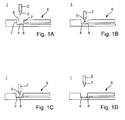
- a dosing device 1 Based on Figure 1a-d the basic method for dosing a liquid into a receiving channel of a movable, preferably rotatable test element is described.
- a dosing device 1 For reasons of clarity, only one dosing tube 2 with a dosing tip 3 is outlined by a dosing device 1.
- the metering tube 2 is in fluid communication with a metering chamber, not shown here, from which a liquid is discharged through the tube 2 into a receiving channel 4 of a stationary, non-moving test element 6.
- the receiving channel 4 has a receiving opening 5 on its upper side.
- the preferred disc-like test element 6 is formed as a disc, similar to a compact disc for data or music, which can rotate horizontally about a rotation axis.
- FIG. 1a In a first step, in FIG. 1a is shown, a relative movement between the metering tube 2 and the test element 6 is performed.
- the test element 6 In the example shown here, the test element 6 is fixed in its vertical position.
- the dosing tube 2 is moved downwards in the direction of the test element 6 until it reaches a working position. In the working position, the dosing tip 3 is approximated to the receiving channel 4 in such a way that it extends into the tip 3 through the receiving opening 5 into the receiving channel 4.
- the metering tip 3 reaches the working position in any case before the end of the liquid delivery, preferably before the start of the liquid delivery.
- the dosing tip 3 In the working position, the dosing tip 3 is approximated to the walls 7 and the bottom 8 of the receiving channel 4 such that a liquid bridge to the bottom 8 of the receiving channel 4 is formed.
- the liquid bridge also remains at the end of the metered delivery of the liquid; Parts of the liquid pass through suction into the receiving channel 4, which in Figure 1c is clarified.
- the drop of liquid now moves into the receiving channel 4 and is transported there by capillary action, Figure 1d ,
- the dosing tube 2 is moved upwards away from the test element 6 until it reaches its rest position. Since the suction of the liquid, including the last remainder, happens very quickly (less than 1 second), the dosing tip 3 can be lifted after one second, preferably already after 0.5 seconds after the end of the dosing process.
- FIG. 1 Like the pictures of the principles FIG. 1 can be seen, a very precise positioning of the dosing tip 2 is necessary.
- the metering tip 3 is approximated to the test element 6 such that the smallest distance between its metering tip 3 and the bottom 8 of the receiving channel 4 is at most 1 mm. In this way, it is possible to achieve even small amounts of liquid, for example, 13 .mu.l with an accuracy of ⁇ 20%.
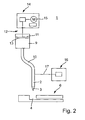
- FIG. 2 shows a schematic view of a metering device 1 and a test element 6, in the receiving channel 4, a liquid is discharged.
- the metering device 1 comprises, in addition to the metering tube 2 with the metering tip 3, a metering chamber 9 which is in fluid contact with the metering tip 2 via a flexible delivery tube 10.
- the metering chamber 9 includes a metering element 11, which is designed as a piston 13.
- the piston 13, which is part of a piston pump 12, extends into the metering chamber 9 and is moved down to release liquid.
- the piston pump 12 is actuated via a fluid control device 14, which includes, for example, a motor 15 and a drive to drive the piston 13.
- the fluid control device 14 also includes other components, in particular an electronic control, in order to realize a targeted fluid delivery.
- a movement device 16 comprises a drive for moving a lowering arm 17, which is connected to the metering tube 2, so that a movement of the lowering arm 17 leads to a movement of the metering tube 2.
- the hoses, pipes and pumps of the metering device 1 must be cleaned and maintained at regular intervals. Since all components are permanently installed and filled with the liquid to be dosed, cleaning and maintenance is very complex. For this reason, dosing devices are used which comprise a replaceable cartridge.
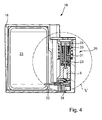
- a disposable cartridge 19 of a metering device according to the invention is shown in FIG FIG. 3 (without housing) and in FIG. 4 shown.
- the cartridge 19 comprises a metering module 20, a reservoir 21, in which the liquid to be metered is stored in a larger amount, and a connecting tube 22 for fluid communication between the reservoir 21 and the metering module 20.
- the metering module 20 of the cartridge 19 preferably comprises the metering chamber 9 and the metering tube 2 with the metering tip 3.
- the metering tube 2 and the metering chamber 9 are fixed relative to one another as a component of the metering module 20 such that they can be moved together from the rest position into the working position , Consequently, a movement of the metering tube 2 also leads to a movement of the metering module 20 and the metering chamber 9.
- the connecting tube 22 is preferably designed to be flexible, for example as a bendable hose. The movement of the metering tube 2 is thus realized by a movement of the metering module 20 relative to the housing 18 of the cartridge.
- the cartridge 19 For the integration of the cartridge 19 in a metering device 1, it is used in a designated, not shown here recording. Since the complete dosing technique (including reservoir, dosing chamber, dosing) is contained in the cartridge 19, only the (electric) drive via a mechanical interface, namely an actuator, must be coupled. The drives themselves are not part of the disposable cartridge 19 but remain when changing the cartridge 19 in the metering device 1. Since the metering chamber 9 is firmly connected to the reservoir 21, eliminates a susceptible fluid coupling between the metering module 20 and the reservoir 21, as they is often required in the prior art.
- the metering module 20 also includes a metering element 23, which is a pin-like metering piston 24.
- the metering element 23 extends partially into the metering chamber 9. A movement of the metering element 23 from a starting position, which in FIG. 5 is shown and in which only a small part of the metering element 23 extends into the metering chamber 9, in an end position in which a larger part of the metering element 23 extends into the metering chamber 9, displaces a desired amount of liquid from the metering chamber 9.
- the volume fraction of Metering element 23, which extends in the end position in the metering chamber, is significantly smaller than the volume of the metering chamber. In order to deliver the most accurate amount of liquid, only the metering piston 24 must be made very accurate. Therefore, it is preferably a precision part made of metal, alternatively of other materials, in particular plastics.
- An actuator contact element 25 is part of the dosing module 20 and preferably acts on the dosing element 23 such that a lowering of the actuator contact element 25 preferably causes a simultaneous lowering of the dosing element 23.
- the actuator contact element 25 is designed as a cylindrical head part 26 into which the upper end of the metering piston 24 extends.
- the head part 26 and the metering piston 24 are permanently connected to each other, for example, glued together, welded or the like.
- the actuator contact element 25 is actuated by an actuator 27 of the metering device 1.
- the actuator 27 may be part of a movement device or a liquid control device or a combined device. It may, for example, be a plunger 28, which couples to the actuator contact element 25 and moves it from top to bottom. In the embodiment shown, a contact of the actuator 27 with the contact element 25 and a downward pressure suffice as a coupling.
- a film 29 is pierced, which covers a housing opening 30 of the cartridge housing 18 above the head portion 26.
- the plunger 28 executes a linear (one-dimensional) movement. It is preferably driven by a linear drive of the metering device 1.
- the metering module 20 is configured such that with the one-dimensional movement of the actuator 27 acting on the actuator contact element 25 both a movement of the metering 20 between the rest position and the working position as well as a movement of the metering element 23 between its starting position and causes its final position.
- This has the advantage that both an approximation of the dosing tip 3 to the receiving channel 4 as well as the desired liquid delivery can be effected with only one (linear) drive.
- the metering device 1 can therefore be constructively very simple and thus constructed inexpensively. Since only one drive and only one actuator 27 are present, such a metering device is also very robust.
- a coupling can for example by a lever assembly, a one or more parts Linkage arrangement, a clutch, z.
- a coupling can for example by a lever assembly, a one or more parts Linkage arrangement, a clutch, z.
- a slip clutch, a gear-like arrangement or a spring arrangement can bring about both the movement of the metering module 20 and the movement of the metering element 23 by a one-dimensional movement of an actuator 27. Both movements can take place synchronously or asynchronously, with the same or different speeds, simultaneously or with a time delay, or in a combination of these (not conclusively mentioned) possibilities.
- the metering module 20 preferably includes a metering spring 31, which acts between the metering chamber 9 and the actuator contact element 25.
- the spring force and spring action direction of the metering spring 31 are dimensioned such that a pressure force exerted on the actuator contact element 25 (downwards) initially drives the movement of the metering module 20 and then the movement of the metering element 23.
- the metering element 23 is only driven when the movement of the metering module 20 has been stopped, particularly preferably by a stop 34.
- FIG. 5 shows that the metering spring 31 between the head portion 26 and a spring system 32 of the metering chamber 9, through which the metering element 23 extends, is supported.
- the metering spring 31 is designed as a spiral spring, which is compressed in the example shown by the head part 26. Of course, it is also possible to form the spring so that it is tensioned by a movement of the head part 26 down from its rest position.
- the metering spring 31 shown here encloses the metering piston 25 such that it extends along the longitudinal axis of the spiral spring.
- the metering module 20 comprises a lowering spring 33 which acts between the metering chamber 9 and the stop 34.
- the stop 34 is arranged on the housing 18 of the cartridge 19.
- the effective direction of the lowering spring 33 coincides with the effective direction of the metering spring 31.
- the spring action direction is directed from top to bottom.
- the spring force of the Absenkfeder 33 is less than the spring force of the metering spring 31.
- the metering spring 31 and the Absenkfeder 33 are selected such that the spring constant of the Absenkfeder 33 is less than the spring constant of the metering spring 31.
- a stronger spring force of the springs over the other by a bias of the spring can be achieved for example, with the same spring constants.
- the metering chamber 9 is spring-loaded connected to the housing 18 of the cartridge 19 via the Absenkfeder 33.
- the lowering spring 33 is arranged between an upper collar 35 of the metering module 20 and a lower, flange-like annular retaining web 36. It is also compressed upon movement of the Aktuatortrustelements 25.
- the sequence of movements in the case of a metered dispensing of the liquid is described below:
- the plunger 28 pierces the film 29 and presses from above onto the head part 26 of the actuator contact element 25, ie. H. he generates a compressive force acting on the head part 26.
- the spring force of the Absenkfeder 33 is less than the spring force of the metering spring 31
- the dosing module 20 is first moved together with the metering chamber 9 down until the metering tip 3 reaches its working position. The movement of the dosing 20 from the rest position to the working position takes place from top to bottom. In this position, the metering module 20 abuts against the stop 34.
- the stop 34 thus limits the path of movement of the metering module 20. It ensures a defined working position of the metering tip 3.
- the stop 34 could also be part of the metering device 1 and thus independent of the cartridge 19.
- the plunger 28 is moved upward.
- the metering element 23 and the metering module 20 is also moved upward so that the metering element 23 again reaches its start position and the metering module 20 again its rest position.
- the movement of the metering element 23 and the metering module 20 depends on the spring forces of the springs 31, 33. Their movements can take place successively, simultaneously or with a time offset. Due to the upwardly directed spring force of the two springs 31, 33, it is sufficient that the plunger 28 only abuts against the actuator contact element 25. An interlocking coupling is not necessary because the plunger 28 only has to transmit forces down.
- FIG. 6 shows a further sectional view of the cartridge 19 according to the invention, with the dosing module 20 in its working position.
- the dosing tip 3 is approximated to the corresponding receiving channel 4 of the test element 6 such that it passes through the receiving opening 5 in the receiving channel 4.
- the lowering spring 33 and the metering spring 31 are completely compressed, so that the metering piston 24 is in its end position. The desired amount of liquid has therefore already flowed out of the metering tip 3.
- the arrangement of the metering tip 3 in the receiving channel 4 is in FIG. 7 shown in detail. It can be clearly seen that no liquid residue gets caught on the dosing tip 3. The entire amount of liquid leaked out of the dosing tip 3 is sucked into the receiving channel 4 by suction. The outside of the dosing tip 3 is liquid-free, at least in the sense that at most one more negligible amount of liquid sticks to it.
- the suction is caused by a combination of the cohesive force of the liquid, the adhesion between the liquid and the bottom 8 of the test element 6 and by capillary forces of the receiving channel 4.
- this suction effect is assisted by the fact that the receiving channel 4 of the test element 6 is made hydrophilic.
- the dosing tip 3 of the dosing unit 1 is preferably hydrophobic or hydrophobic. In this way, the transfer of liquid from the metering tip 3 is supported on the receiving channel 4.
- the distance between the dosing tip and the bottom 8 of the test element 6 may be at most 1 mm.
- the metering tip 3 has an inner diameter of 0.5 mm and an outer diameter of 1.5 mm.
- the distance of the metering tip 3 from the bottom 8 of the total 3 mm high test element 6 (plastic injection layer with a thickness of 2.7 mm and arranged below (self-adhesive) bottom foil with a thickness of 0.3 mm) is 0.8 mm to 0 , 6 mm.
- the dosing tip 3 reaches approximately 1.9 - 2.1 mm into the receiving opening 5 of the test element.
- the metering chamber 9 has a liquid inlet 37, through which liquid from the reservoir 21 and the connecting pipe 22 can enter the metering chamber 9, and a liquid outlet 38, through which an amount of liquid from the metering chamber 9 into the metering tube 2 can escape.
- an inlet valve 39 and an outlet valve 40 are advantageously provided.
- the inlet valve 39 can open and close the liquid inlet 37; the outlet valve 40 serves to close and open the liquid outlet 38 from the metering chamber 9.
- FIG. 8 shows a further section through the cartridge according to the invention 19.
- the inlet valve 39 and the outlet valve 40 are part of a rocker valve 41.
- the rocker valve 41 is formed such that the inlet valve 39 and the outlet valve 40 have compellingly different switching states. If one valve is open, the other valve is closed.
- FIG. 9 shows the rocker valve 41 in detail.
- a rocker spring 42 acts on a valve rocker 43 of the rocker valve 41 such that the outlet valve 40 is closed in the rest position of the rocker valve 41 and thus no liquid can escape into the metering pipe 2.
- the valve spring 42 is formed as a leaf spring; other springs are also possible.
- the valve spring 42 causes an automatic reset of the rocker valve 41 from the switched (opened) state of the exhaust valve 40 in the closed state.
- the valve rocker 43 has two round sealing elements 44 which reliably close the inlet 37 and the outlet 38.
- the sealing elements 44 are injected; they exist z. B. TPE.
- they are slightly larger than the inlet 37 and outlet 38, respectively.
- a valve lever 45 is formed, so that the rocker valve 41 can be actuated via a (not shown) Ventilaktuator.
- an electric drive is preferably provided, which moves the rocker valve 41 from its rest position into an open position of the liquid outlet 38.
- the valve actuator is controlled by an external controller.
- the rocker valve 41 is thus externally controllable. It can be ensured both electronically and mechanically that an actuation of the valve lever 45 is only possible if the metering tube 2 and thus the metering module 20 are arranged in the working position. Thus, a metering of a liquid from the metering chamber 9 is only possible when the metering module 20 is in the working position.
- valve rocker 43 rotates about 10 ° (in FIG. 8 counterclockwise) about a valve shaft 46, which forms the axis of rotation and extending in extension of the Valve lever extends, thereby closing the liquid inlet 37 and thus the reservoir 21. At the same time, the liquid outlet 38 and thus the access to the dosing tip 3 opens.
- the external control of the rocker valve 41 the reliability is improved, for example, over a check valve. This improvement is achieved by an increase in the (external) pressure forces, which thus better seal the valve. Furthermore, in the case of an externally controlled and switched rocker valve 41, it is possible to integrate a sensor unit for monitoring the valve position into the metering device 1 in order to detect a malposition of the rocker valve 41 and contamination of the metering device 1 or of the test element 6 by the fluid contained in the reservoir 21 Liquid, e.g. As a wash buffer to prevent, as well as an underdose. The precise switching of the rocker valve 41 by the external control also has the advantage that the dosing accuracy can be increased again.
Landscapes
- Chemical & Material Sciences (AREA)
- Health & Medical Sciences (AREA)
- General Health & Medical Sciences (AREA)
- Life Sciences & Earth Sciences (AREA)
- Analytical Chemistry (AREA)
- Biochemistry (AREA)
- Physics & Mathematics (AREA)
- General Physics & Mathematics (AREA)
- Immunology (AREA)
- Pathology (AREA)
- Clinical Laboratory Science (AREA)
- Chemical Kinetics & Catalysis (AREA)
- Automatic Analysis And Handling Materials Therefor (AREA)
- Sampling And Sample Adjustment (AREA)
- Feeding, Discharge, Calcimining, Fusing, And Gas-Generation Devices (AREA)
Priority Applications (1)
| Application Number | Priority Date | Filing Date | Title |
|---|---|---|---|
| EP09010480A EP2163902B1 (fr) | 2008-09-10 | 2009-08-14 | Procédé et dispositif de dosage destinés au dosage d'un liquide dans un canal de réception d'un élément test pour l'analyse de liquides corporels |
Applications Claiming Priority (2)
| Application Number | Priority Date | Filing Date | Title |
|---|---|---|---|
| EP08015977A EP2163901A1 (fr) | 2008-09-10 | 2008-09-10 | Procédé et dispositif de dosage destinés au dosage d'un liquide dans un canal de réception d'un élément test pour l'analyse de liquides corporels |
| EP09010480A EP2163902B1 (fr) | 2008-09-10 | 2009-08-14 | Procédé et dispositif de dosage destinés au dosage d'un liquide dans un canal de réception d'un élément test pour l'analyse de liquides corporels |
Publications (2)
| Publication Number | Publication Date |
|---|---|
| EP2163902A1 true EP2163902A1 (fr) | 2010-03-17 |
| EP2163902B1 EP2163902B1 (fr) | 2012-12-26 |
Family
ID=40349941
Family Applications (2)
| Application Number | Title | Priority Date | Filing Date |
|---|---|---|---|
| EP08015977A Withdrawn EP2163901A1 (fr) | 2008-09-10 | 2008-09-10 | Procédé et dispositif de dosage destinés au dosage d'un liquide dans un canal de réception d'un élément test pour l'analyse de liquides corporels |
| EP09010480A Active EP2163902B1 (fr) | 2008-09-10 | 2009-08-14 | Procédé et dispositif de dosage destinés au dosage d'un liquide dans un canal de réception d'un élément test pour l'analyse de liquides corporels |
Family Applications Before (1)
| Application Number | Title | Priority Date | Filing Date |
|---|---|---|---|
| EP08015977A Withdrawn EP2163901A1 (fr) | 2008-09-10 | 2008-09-10 | Procédé et dispositif de dosage destinés au dosage d'un liquide dans un canal de réception d'un élément test pour l'analyse de liquides corporels |
Country Status (5)
| Country | Link |
|---|---|
| US (1) | US8043582B2 (fr) |
| EP (2) | EP2163901A1 (fr) |
| JP (1) | JP5377180B2 (fr) |
| CN (1) | CN101672844B (fr) |
| CA (1) | CA2676751A1 (fr) |
Cited By (1)
| Publication number | Priority date | Publication date | Assignee | Title |
|---|---|---|---|---|
| DE102012112916A1 (de) * | 2012-12-21 | 2014-06-26 | Endress + Hauser Conducta Gesellschaft für Mess- und Regeltechnik mbH + Co. KG | Dosiermodul |
Families Citing this family (6)
| Publication number | Priority date | Publication date | Assignee | Title |
|---|---|---|---|---|
| EP2374541A1 (fr) * | 2010-04-06 | 2011-10-12 | Symbion Medical Systems Sàrl | Cartouche de distribution jetable pour instrument d'analyse médicale |
| WO2013128502A1 (fr) * | 2012-03-01 | 2013-09-06 | パナソニック株式会社 | Procédé de recueillement de gouttelettes adhérant à la paroi périphérique extérieure d'une aiguille dans un tube capillaire |
| US9121551B2 (en) | 2012-03-01 | 2015-09-01 | Panasonic Intellectual Property Management Co., Ltd. | Method for collecting droplet attached on external surface of needle into capillary tube |
| DE102012108196A1 (de) * | 2012-09-04 | 2014-03-06 | Windmöller & Hölscher Kg | Vorrichtung zum Absaugen von Abfallprodukten einer Produktionsmaschine |
| JP6385800B2 (ja) * | 2014-11-11 | 2018-09-05 | 日本電子株式会社 | 液体吸引具、液体供給ユニット及び自動分析装置 |
| CA2980481A1 (fr) * | 2015-04-02 | 2016-10-06 | Cepheid | Dispositif de pont fluidique et procedes de traitement d'echantillon |
Citations (5)
| Publication number | Priority date | Publication date | Assignee | Title |
|---|---|---|---|---|
| WO2002089982A2 (fr) | 2001-05-07 | 2002-11-14 | Massachusetts Institute Of Technology | Procedes de criblage de substances dans un reseau de micro-puits |
| US20050035156A1 (en) | 2003-08-11 | 2005-02-17 | Michael Hersch | Fluid dispensing apparatus |
| US6921514B1 (en) | 1998-06-23 | 2005-07-26 | Graffinity Pharmaceutical Design Gmbh | Device for carrying out an almost simultaneous synthesis of a plurality of samples |
| US20070272710A1 (en) | 2006-05-25 | 2007-11-29 | Sakura Finetek, U.S.A., Inc. | Fluid dispensing apparatus |
| EP1895308A1 (fr) * | 2006-09-01 | 2008-03-05 | Agilent Technologies, Inc. | Couplage fluidique à base de gouttelettes |
Family Cites Families (19)
| Publication number | Priority date | Publication date | Assignee | Title |
|---|---|---|---|---|
| JPH01304357A (ja) * | 1988-06-02 | 1989-12-07 | Fuji Photo Film Co Ltd | 被検査液の点着方法および装置 |
| JPH11337557A (ja) * | 1998-05-25 | 1999-12-10 | Nippon Laser Denshi Kk | 微量分注装置 |
| DE19835833A1 (de) * | 1998-08-07 | 2000-02-17 | Max Planck Gesellschaft | Dosierkopf zur parallelen Bearbeitung einer Vielzahl von Fluidproben |
| US6296702B1 (en) * | 1999-03-15 | 2001-10-02 | Pe Corporation (Ny) | Apparatus and method for spotting a substrate |
| JP4365947B2 (ja) * | 1999-08-09 | 2009-11-18 | Thk株式会社 | マイクロアレイ作製装置 |
| JP3647370B2 (ja) * | 1999-10-22 | 2005-05-11 | 日本碍子株式会社 | 分注装置及びdnaチップの製造方法 |
| JP2003149093A (ja) * | 2001-11-15 | 2003-05-21 | Olympus Optical Co Ltd | 液体分注装置および液体分注方法 |
| JP3732457B2 (ja) * | 2002-05-20 | 2006-01-05 | 日立ソフトウエアエンジニアリング株式会社 | スポットピン |
| JP3878667B2 (ja) * | 2002-09-17 | 2007-02-07 | シーケーディ株式会社 | 分注システム |
| JP2004325422A (ja) * | 2003-04-30 | 2004-11-18 | Institute Of Physical & Chemical Research | マイクロアレイ作製方法、マイクロアレイ作製用ヘッドおよび装置 |
| WO2004111610A2 (fr) * | 2003-06-12 | 2004-12-23 | Accupath Diagnostic Laboratories, Inc. | Procede et systeme pour l'analyse d'echantillons de cellules de forte densite |
| CN100466988C (zh) * | 2003-08-25 | 2009-03-11 | 香港澳维有限公司 | 生物样本收集和分析系统 |
| JP4547301B2 (ja) * | 2005-05-13 | 2010-09-22 | 株式会社日立ハイテクノロジーズ | 液体搬送デバイス及び分析システム |
| US7618590B2 (en) * | 2005-06-29 | 2009-11-17 | Cascade Microtech, Inc. | Fluid dispensing system |
| JP2007097444A (ja) * | 2005-09-30 | 2007-04-19 | Bussan Nanotech Research Institute Inc | 検査用チップ |
| CN1828307B (zh) * | 2005-11-30 | 2011-02-02 | 因韦尔尼斯医药瑞士股份有限公司 | 用于检测流体样品中的分析物的装置和方法 |
| JP2007198752A (ja) * | 2006-01-23 | 2007-08-09 | Olympus Corp | 分注装置、分析装置および分注方法 |
| CN101400432B (zh) * | 2006-03-09 | 2012-02-15 | 积水化学工业株式会社 | 微量流体设备及微量液体稀释方法 |
| ATE541639T1 (de) * | 2007-11-24 | 2012-02-15 | Hoffmann La Roche | Analysesystem und verfahren zur analyse einer körperflüssigkeitsprobe auf einen darin enthaltenen analyten |
-
2008
- 2008-09-10 EP EP08015977A patent/EP2163901A1/fr not_active Withdrawn
-
2009
- 2009-08-14 EP EP09010480A patent/EP2163902B1/fr active Active
- 2009-08-26 CA CA002676751A patent/CA2676751A1/fr not_active Abandoned
- 2009-09-09 JP JP2009208117A patent/JP5377180B2/ja active Active
- 2009-09-09 US US12/556,216 patent/US8043582B2/en active Active
- 2009-09-10 CN CN200910176352.1A patent/CN101672844B/zh active Active
Patent Citations (5)
| Publication number | Priority date | Publication date | Assignee | Title |
|---|---|---|---|---|
| US6921514B1 (en) | 1998-06-23 | 2005-07-26 | Graffinity Pharmaceutical Design Gmbh | Device for carrying out an almost simultaneous synthesis of a plurality of samples |
| WO2002089982A2 (fr) | 2001-05-07 | 2002-11-14 | Massachusetts Institute Of Technology | Procedes de criblage de substances dans un reseau de micro-puits |
| US20050035156A1 (en) | 2003-08-11 | 2005-02-17 | Michael Hersch | Fluid dispensing apparatus |
| US20070272710A1 (en) | 2006-05-25 | 2007-11-29 | Sakura Finetek, U.S.A., Inc. | Fluid dispensing apparatus |
| EP1895308A1 (fr) * | 2006-09-01 | 2008-03-05 | Agilent Technologies, Inc. | Couplage fluidique à base de gouttelettes |
Cited By (2)
| Publication number | Priority date | Publication date | Assignee | Title |
|---|---|---|---|---|
| DE102012112916A1 (de) * | 2012-12-21 | 2014-06-26 | Endress + Hauser Conducta Gesellschaft für Mess- und Regeltechnik mbH + Co. KG | Dosiermodul |
| DE102012112916A8 (de) | 2012-12-21 | 2014-08-14 | Endress + Hauser Conducta Gesellschaft für Mess- und Regeltechnik mbH + Co. KG | Dosiermodul |
Also Published As
| Publication number | Publication date |
|---|---|
| JP2010066265A (ja) | 2010-03-25 |
| JP5377180B2 (ja) | 2013-12-25 |
| US20100151586A1 (en) | 2010-06-17 |
| CN101672844A (zh) | 2010-03-17 |
| EP2163901A1 (fr) | 2010-03-17 |
| CA2676751A1 (fr) | 2010-03-10 |
| EP2163902B1 (fr) | 2012-12-26 |
| CN101672844B (zh) | 2014-05-07 |
| US8043582B2 (en) | 2011-10-25 |
Similar Documents
| Publication | Publication Date | Title |
|---|---|---|
| EP2163902B1 (fr) | Procédé et dispositif de dosage destinés au dosage d'un liquide dans un canal de réception d'un élément test pour l'analyse de liquides corporels | |
| DE69226367T2 (de) | Flüssigkeitsspender | |
| EP1825915B1 (fr) | Système et procédé de titrage de liquides | |
| EP2437890A1 (fr) | Dispositif pour transporter un fluide dans un canal d'élément microfluidique | |
| DE7925075U1 (de) | Pipettier- und dosiervorrichtung | |
| EP0725267A2 (fr) | Micro-pipette actionnée électriquement | |
| DE10010208C2 (de) | Mikrodosiervorrichtung zur definierten Abgabe kleiner in sich geschlossener Flüssigkeitsvolumina | |
| DE102013106534B4 (de) | Chromatographiepipettenspitze | |
| EP3108962B1 (fr) | Porte échantillons | |
| DE112015006171T5 (de) | Elektrophoresevorrichtung und Elektrophoreseverfahren | |
| EP1173279B1 (fr) | Procede et dispositif permettant de deposer de petits volumes de liquide | |
| EP1424130B1 (fr) | Distributeur à canaux multiples avec calibrage automatique | |
| DE3803366A1 (de) | Vorrichtung zum ausgeben einer dosierten menge von fliessfaehigem gut aus einem behaelter, insbesondere fluessigem medikament aus einer arzneimittelflasche | |
| DE3217591A1 (de) | Analysengeraet, insbesondere zur untersuchung von fluessigkeitsproben | |
| EP3680017B1 (fr) | Pipette destinée à une utilisation avec une pointe de pipette | |
| EP3972736A1 (fr) | Ensemble de tamisage de liquide avec déclenchement mécanique de très petites quantités de liquide | |
| WO2014177331A1 (fr) | Distributeur d'échantillon pour un dispositif d'analyse | |
| EP3244214B1 (fr) | Dispositif pour échantillons liquides avec haute précision dans un analyseur d'échantillon automatisé | |
| EP3485974B1 (fr) | Dispositif de microdosage permettant le dosage de plus petits échantillons de fluide | |
| WO2020114954A2 (fr) | Dispositif de dosage de liquides pour l'émission ballistique de quantités de dosage dans la plage de nanolitres, procédé de dosage de liquides et pointe de pipette pour celui-ci | |
| DE2132066A1 (de) | Pipettiervorrichtung, zugehoerige pipetten und verfahren zum pipettieren | |
| EP3450020B1 (fr) | Dispositif de microdosage permettant le dosage de plus petits échantillons de fluide | |
| WO2005075985A1 (fr) | Dispositif de passage destine a la mesure de la fonction plaquettaire de l'hemostase primaire, de l'agregation et/ou de la coagulation et/ou de la viscosite du sang | |
| DE102021109076A1 (de) | Dosiervorrichtung und Verfahren zum Dosieren von flüssigen Medien | |
| DE4227323A1 (de) | Halbautomatisches Verfahren und Durchflußmeßanordnung zur Analyse von Flüssigkeiten |
Legal Events
| Date | Code | Title | Description |
|---|---|---|---|
| PUAI | Public reference made under article 153(3) epc to a published international application that has entered the european phase |
Free format text: ORIGINAL CODE: 0009012 |
|
| AK | Designated contracting states |
Kind code of ref document: A1 Designated state(s): AT BE BG CH CY CZ DE DK EE ES FI FR GB GR HR HU IE IS IT LI LT LU LV MC MK MT NL NO PL PT RO SE SI SK SM TR |
|
| AX | Request for extension of the european patent |
Extension state: AL BA RS |
|
| 17P | Request for examination filed |
Effective date: 20100305 |
|
| 17Q | First examination report despatched |
Effective date: 20100428 |
|
| GRAP | Despatch of communication of intention to grant a patent |
Free format text: ORIGINAL CODE: EPIDOSNIGR1 |
|
| RIC1 | Information provided on ipc code assigned before grant |
Ipc: G01N 35/10 20060101AFI20120618BHEP Ipc: B01L 3/02 20060101ALI20120618BHEP |
|
| GRAS | Grant fee paid |
Free format text: ORIGINAL CODE: EPIDOSNIGR3 |
|
| GRAA | (expected) grant |
Free format text: ORIGINAL CODE: 0009210 |
|
| AK | Designated contracting states |
Kind code of ref document: B1 Designated state(s): AT BE BG CH CY CZ DE DK EE ES FI FR GB GR HR HU IE IS IT LI LT LU LV MC MK MT NL NO PL PT RO SE SI SK SM TR |
|
| REG | Reference to a national code |
Ref country code: GB Ref legal event code: FG4D Free format text: NOT ENGLISH |
|
| REG | Reference to a national code |
Ref country code: CH Ref legal event code: EP |
|
| REG | Reference to a national code |
Ref country code: AT Ref legal event code: REF Ref document number: 590746 Country of ref document: AT Kind code of ref document: T Effective date: 20130115 |
|
| REG | Reference to a national code |
Ref country code: DE Ref legal event code: R096 Ref document number: 502009005769 Country of ref document: DE Effective date: 20130228 |
|
| PG25 | Lapsed in a contracting state [announced via postgrant information from national office to epo] |
Ref country code: NO Free format text: LAPSE BECAUSE OF FAILURE TO SUBMIT A TRANSLATION OF THE DESCRIPTION OR TO PAY THE FEE WITHIN THE PRESCRIBED TIME-LIMIT Effective date: 20130326 Ref country code: FI Free format text: LAPSE BECAUSE OF FAILURE TO SUBMIT A TRANSLATION OF THE DESCRIPTION OR TO PAY THE FEE WITHIN THE PRESCRIBED TIME-LIMIT Effective date: 20121226 Ref country code: SE Free format text: LAPSE BECAUSE OF FAILURE TO SUBMIT A TRANSLATION OF THE DESCRIPTION OR TO PAY THE FEE WITHIN THE PRESCRIBED TIME-LIMIT Effective date: 20121226 Ref country code: HR Free format text: LAPSE BECAUSE OF FAILURE TO SUBMIT A TRANSLATION OF THE DESCRIPTION OR TO PAY THE FEE WITHIN THE PRESCRIBED TIME-LIMIT Effective date: 20121226 Ref country code: LT Free format text: LAPSE BECAUSE OF FAILURE TO SUBMIT A TRANSLATION OF THE DESCRIPTION OR TO PAY THE FEE WITHIN THE PRESCRIBED TIME-LIMIT Effective date: 20121226 |
|
| REG | Reference to a national code |
Ref country code: LT Ref legal event code: MG4D |
|
| REG | Reference to a national code |
Ref country code: NL Ref legal event code: VDEP Effective date: 20121226 |
|
| PG25 | Lapsed in a contracting state [announced via postgrant information from national office to epo] |
Ref country code: LV Free format text: LAPSE BECAUSE OF FAILURE TO SUBMIT A TRANSLATION OF THE DESCRIPTION OR TO PAY THE FEE WITHIN THE PRESCRIBED TIME-LIMIT Effective date: 20121226 Ref country code: GR Free format text: LAPSE BECAUSE OF FAILURE TO SUBMIT A TRANSLATION OF THE DESCRIPTION OR TO PAY THE FEE WITHIN THE PRESCRIBED TIME-LIMIT Effective date: 20130327 Ref country code: SI Free format text: LAPSE BECAUSE OF FAILURE TO SUBMIT A TRANSLATION OF THE DESCRIPTION OR TO PAY THE FEE WITHIN THE PRESCRIBED TIME-LIMIT Effective date: 20121226 |
|
| PG25 | Lapsed in a contracting state [announced via postgrant information from national office to epo] |
Ref country code: IS Free format text: LAPSE BECAUSE OF FAILURE TO SUBMIT A TRANSLATION OF THE DESCRIPTION OR TO PAY THE FEE WITHIN THE PRESCRIBED TIME-LIMIT Effective date: 20130426 Ref country code: CZ Free format text: LAPSE BECAUSE OF FAILURE TO SUBMIT A TRANSLATION OF THE DESCRIPTION OR TO PAY THE FEE WITHIN THE PRESCRIBED TIME-LIMIT Effective date: 20121226 Ref country code: SK Free format text: LAPSE BECAUSE OF FAILURE TO SUBMIT A TRANSLATION OF THE DESCRIPTION OR TO PAY THE FEE WITHIN THE PRESCRIBED TIME-LIMIT Effective date: 20121226 Ref country code: EE Free format text: LAPSE BECAUSE OF FAILURE TO SUBMIT A TRANSLATION OF THE DESCRIPTION OR TO PAY THE FEE WITHIN THE PRESCRIBED TIME-LIMIT Effective date: 20121226 Ref country code: ES Free format text: LAPSE BECAUSE OF FAILURE TO SUBMIT A TRANSLATION OF THE DESCRIPTION OR TO PAY THE FEE WITHIN THE PRESCRIBED TIME-LIMIT Effective date: 20130406 Ref country code: BG Free format text: LAPSE BECAUSE OF FAILURE TO SUBMIT A TRANSLATION OF THE DESCRIPTION OR TO PAY THE FEE WITHIN THE PRESCRIBED TIME-LIMIT Effective date: 20130326 |
|
| PG25 | Lapsed in a contracting state [announced via postgrant information from national office to epo] |
Ref country code: RO Free format text: LAPSE BECAUSE OF FAILURE TO SUBMIT A TRANSLATION OF THE DESCRIPTION OR TO PAY THE FEE WITHIN THE PRESCRIBED TIME-LIMIT Effective date: 20121226 Ref country code: PT Free format text: LAPSE BECAUSE OF FAILURE TO SUBMIT A TRANSLATION OF THE DESCRIPTION OR TO PAY THE FEE WITHIN THE PRESCRIBED TIME-LIMIT Effective date: 20130426 Ref country code: NL Free format text: LAPSE BECAUSE OF FAILURE TO SUBMIT A TRANSLATION OF THE DESCRIPTION OR TO PAY THE FEE WITHIN THE PRESCRIBED TIME-LIMIT Effective date: 20121226 Ref country code: PL Free format text: LAPSE BECAUSE OF FAILURE TO SUBMIT A TRANSLATION OF THE DESCRIPTION OR TO PAY THE FEE WITHIN THE PRESCRIBED TIME-LIMIT Effective date: 20121226 |
|
| PG25 | Lapsed in a contracting state [announced via postgrant information from national office to epo] |
Ref country code: DK Free format text: LAPSE BECAUSE OF FAILURE TO SUBMIT A TRANSLATION OF THE DESCRIPTION OR TO PAY THE FEE WITHIN THE PRESCRIBED TIME-LIMIT Effective date: 20121226 |
|
| PLBE | No opposition filed within time limit |
Free format text: ORIGINAL CODE: 0009261 |
|
| STAA | Information on the status of an ep patent application or granted ep patent |
Free format text: STATUS: NO OPPOSITION FILED WITHIN TIME LIMIT |
|
| PG25 | Lapsed in a contracting state [announced via postgrant information from national office to epo] |
Ref country code: CY Free format text: LAPSE BECAUSE OF FAILURE TO SUBMIT A TRANSLATION OF THE DESCRIPTION OR TO PAY THE FEE WITHIN THE PRESCRIBED TIME-LIMIT Effective date: 20121226 |
|
| 26N | No opposition filed |
Effective date: 20130927 |
|
| PG25 | Lapsed in a contracting state [announced via postgrant information from national office to epo] |
Ref country code: IT Free format text: LAPSE BECAUSE OF FAILURE TO SUBMIT A TRANSLATION OF THE DESCRIPTION OR TO PAY THE FEE WITHIN THE PRESCRIBED TIME-LIMIT Effective date: 20121226 |
|
| REG | Reference to a national code |
Ref country code: DE Ref legal event code: R097 Ref document number: 502009005769 Country of ref document: DE Effective date: 20130927 |
|
| BERE | Be: lapsed |
Owner name: ROCHE DIAGNOSTICS G.M.B.H. Effective date: 20130831 Owner name: F.HOFFMANN-LA ROCHE A.G. Effective date: 20130831 |
|
| REG | Reference to a national code |
Ref country code: CH Ref legal event code: PL |
|
| PG25 | Lapsed in a contracting state [announced via postgrant information from national office to epo] |
Ref country code: LI Free format text: LAPSE BECAUSE OF NON-PAYMENT OF DUE FEES Effective date: 20130831 Ref country code: CH Free format text: LAPSE BECAUSE OF NON-PAYMENT OF DUE FEES Effective date: 20130831 Ref country code: MC Free format text: LAPSE BECAUSE OF FAILURE TO SUBMIT A TRANSLATION OF THE DESCRIPTION OR TO PAY THE FEE WITHIN THE PRESCRIBED TIME-LIMIT Effective date: 20121226 |
|
| REG | Reference to a national code |
Ref country code: IE Ref legal event code: MM4A |
|
| PG25 | Lapsed in a contracting state [announced via postgrant information from national office to epo] |
Ref country code: BE Free format text: LAPSE BECAUSE OF NON-PAYMENT OF DUE FEES Effective date: 20130831 |
|
| PG25 | Lapsed in a contracting state [announced via postgrant information from national office to epo] |
Ref country code: IE Free format text: LAPSE BECAUSE OF NON-PAYMENT OF DUE FEES Effective date: 20130814 |
|
| PG25 | Lapsed in a contracting state [announced via postgrant information from national office to epo] |
Ref country code: SM Free format text: LAPSE BECAUSE OF FAILURE TO SUBMIT A TRANSLATION OF THE DESCRIPTION OR TO PAY THE FEE WITHIN THE PRESCRIBED TIME-LIMIT Effective date: 20121226 |
|
| PG25 | Lapsed in a contracting state [announced via postgrant information from national office to epo] |
Ref country code: MT Free format text: LAPSE BECAUSE OF FAILURE TO SUBMIT A TRANSLATION OF THE DESCRIPTION OR TO PAY THE FEE WITHIN THE PRESCRIBED TIME-LIMIT Effective date: 20121226 Ref country code: TR Free format text: LAPSE BECAUSE OF FAILURE TO SUBMIT A TRANSLATION OF THE DESCRIPTION OR TO PAY THE FEE WITHIN THE PRESCRIBED TIME-LIMIT Effective date: 20121226 |
|
| PG25 | Lapsed in a contracting state [announced via postgrant information from national office to epo] |
Ref country code: MK Free format text: LAPSE BECAUSE OF FAILURE TO SUBMIT A TRANSLATION OF THE DESCRIPTION OR TO PAY THE FEE WITHIN THE PRESCRIBED TIME-LIMIT Effective date: 20121226 Ref country code: HU Free format text: LAPSE BECAUSE OF FAILURE TO SUBMIT A TRANSLATION OF THE DESCRIPTION OR TO PAY THE FEE WITHIN THE PRESCRIBED TIME-LIMIT; INVALID AB INITIO Effective date: 20090814 Ref country code: LU Free format text: LAPSE BECAUSE OF NON-PAYMENT OF DUE FEES Effective date: 20130814 |
|
| REG | Reference to a national code |
Ref country code: AT Ref legal event code: MM01 Ref document number: 590746 Country of ref document: AT Kind code of ref document: T Effective date: 20140814 |
|
| PG25 | Lapsed in a contracting state [announced via postgrant information from national office to epo] |
Ref country code: AT Free format text: LAPSE BECAUSE OF NON-PAYMENT OF DUE FEES Effective date: 20140814 |
|
| REG | Reference to a national code |
Ref country code: FR Ref legal event code: PLFP Year of fee payment: 8 |
|
| REG | Reference to a national code |
Ref country code: FR Ref legal event code: PLFP Year of fee payment: 9 |
|
| REG | Reference to a national code |
Ref country code: FR Ref legal event code: PLFP Year of fee payment: 10 |
|
| PGFP | Annual fee paid to national office [announced via postgrant information from national office to epo] |
Ref country code: GB Payment date: 20180726 Year of fee payment: 10 |
|
| GBPC | Gb: european patent ceased through non-payment of renewal fee |
Effective date: 20190814 |
|
| PG25 | Lapsed in a contracting state [announced via postgrant information from national office to epo] |
Ref country code: FR Free format text: LAPSE BECAUSE OF NON-PAYMENT OF DUE FEES Effective date: 20190831 |
|
| PG25 | Lapsed in a contracting state [announced via postgrant information from national office to epo] |
Ref country code: GB Free format text: LAPSE BECAUSE OF NON-PAYMENT OF DUE FEES Effective date: 20190814 |
|
| PGFP | Annual fee paid to national office [announced via postgrant information from national office to epo] |
Ref country code: DE Payment date: 20250724 Year of fee payment: 17 |