EP2173337B1 - Phosphaplatine und ihre verwendung bei der behandlung von gegen cisplantin und carboplatin resistenten krebserkrankungen - Google Patents
Phosphaplatine und ihre verwendung bei der behandlung von gegen cisplantin und carboplatin resistenten krebserkrankungen Download PDFInfo
- Publication number
- EP2173337B1 EP2173337B1 EP08797320.2A EP08797320A EP2173337B1 EP 2173337 B1 EP2173337 B1 EP 2173337B1 EP 08797320 A EP08797320 A EP 08797320A EP 2173337 B1 EP2173337 B1 EP 2173337B1
- Authority
- EP
- European Patent Office
- Prior art keywords
- platinum
- trans
- composition
- treating cancer
- complexes
- Prior art date
- Legal status (The legal status is an assumption and is not a legal conclusion. Google has not performed a legal analysis and makes no representation as to the accuracy of the status listed.)
- Active
Links
Images


Classifications
-
- A—HUMAN NECESSITIES
- A61—MEDICAL OR VETERINARY SCIENCE; HYGIENE
- A61K—PREPARATIONS FOR MEDICAL, DENTAL OR TOILETRY PURPOSES
- A61K33/00—Medicinal preparations containing inorganic active ingredients
- A61K33/24—Heavy metals; Compounds thereof
- A61K33/243—Platinum; Compounds thereof
-
- C—CHEMISTRY; METALLURGY
- C07—ORGANIC CHEMISTRY
- C07F—ACYCLIC, CARBOCYCLIC OR HETEROCYCLIC COMPOUNDS CONTAINING ELEMENTS OTHER THAN CARBON, HYDROGEN, HALOGEN, OXYGEN, NITROGEN, SULFUR, SELENIUM OR TELLURIUM
- C07F15/00—Compounds containing elements of Groups 8, 9, 10 or 18 of the Periodic Table
- C07F15/0006—Compounds containing elements of Groups 8, 9, 10 or 18 of the Periodic Table compounds of the platinum group
- C07F15/0086—Platinum compounds
-
- A—HUMAN NECESSITIES
- A61—MEDICAL OR VETERINARY SCIENCE; HYGIENE
- A61K—PREPARATIONS FOR MEDICAL, DENTAL OR TOILETRY PURPOSES
- A61K31/00—Medicinal preparations containing organic active ingredients
- A61K31/66—Phosphorus compounds
- A61K31/661—Phosphorus acids or esters thereof not having P—C bonds, e.g. fosfosal, dichlorvos, malathion or mevinphos
- A61K31/6615—Compounds having two or more esterified phosphorus acid groups, e.g. inositol triphosphate, phytic acid
-
- A—HUMAN NECESSITIES
- A61—MEDICAL OR VETERINARY SCIENCE; HYGIENE
- A61K—PREPARATIONS FOR MEDICAL, DENTAL OR TOILETRY PURPOSES
- A61K31/00—Medicinal preparations containing organic active ingredients
- A61K31/66—Phosphorus compounds
- A61K31/662—Phosphorus acids or esters thereof having P—C bonds, e.g. foscarnet, trichlorfon
- A61K31/663—Compounds having two or more phosphorus acid groups or esters thereof, e.g. clodronic acid, pamidronic acid
-
- A—HUMAN NECESSITIES
- A61—MEDICAL OR VETERINARY SCIENCE; HYGIENE
- A61K—PREPARATIONS FOR MEDICAL, DENTAL OR TOILETRY PURPOSES
- A61K31/00—Medicinal preparations containing organic active ingredients
- A61K31/66—Phosphorus compounds
- A61K31/665—Phosphorus compounds having oxygen as a ring hetero atom, e.g. fosfomycin
-
- A—HUMAN NECESSITIES
- A61—MEDICAL OR VETERINARY SCIENCE; HYGIENE
- A61P—SPECIFIC THERAPEUTIC ACTIVITY OF CHEMICAL COMPOUNDS OR MEDICINAL PREPARATIONS
- A61P35/00—Antineoplastic agents
-
- A—HUMAN NECESSITIES
- A61—MEDICAL OR VETERINARY SCIENCE; HYGIENE
- A61P—SPECIFIC THERAPEUTIC ACTIVITY OF CHEMICAL COMPOUNDS OR MEDICINAL PREPARATIONS
- A61P43/00—Drugs for specific purposes, not provided for in groups A61P1/00-A61P41/00
Definitions
- Platinum diamine complexes are well known in the art because of the tremendous success of cisdiamminedichloroplatinum(II) (cisplatin) for the treatment of ovarian, testicular, head and neck, and other forms of cancer.
- cisplatin is used in conjunction with other therapeutic regimens including radiation therapy.
- This platinum chemotherapeutic mediates apoptosis at the G2 phase of the cell cycle predominantly through transcription inhibition and through replication inhibition processes, especially at high doses.
- Covalent bonding to DNA through the N7 sites of guanine and adenine bases, both by intra- and inter-strand modes, is generally believed to be the key molecular event in transducing a cascade of cellular responses leading to apoptosis.
- cisplatin Although cisplatin is highly effective, it exhibits renal, nephro-, and neurotoxicities. Moreover, many patients develop resistance to cisplatin treatment over time and are therefore not cured by cisplatin treatment.
- Two other FDA-approved platinum drugs, carboplatin (diammine-1,1-dicarcarboxylatocyclobutane-platinum(II)) and oxaliplatin (diammine-oxalatoplatinum(II)) are also believed to function in a similar manner to that of cisplatin.
- Carboplatin is especially effective towards cisplatin-resistant tumor cells, but relatively high doses are required to effectively treat patients who are resistant to cisplatin. Such high doses also have associated toxicities.
- PtI 4 2- can also be used to ensure high yield and purity of the cis isomer, followed by conversion of PtI 4 2- to PtI 2 (amine/diamine) and then into PtCl 2 (amine/diamine).
- the di-iodo complex is converted to diaqua complex by treating the former with two equivalents of silver nitrate or other soluble silver salts at low pH.
- the resulting diaqua complex readily reacts with potassium chloride or hydrochloric acid to yield the dichloro complex of interest.
- the platinum complexes of interest are synthesized from the corresponding diaqua complex at a low pH to introduce the replaceable ligands since dimerization or polymerization of the diaqua complex takes place rapidly at higher pH, yielding undesirable products.
- platinum amine complexes in the art also have nitrogen, sulfur, carboxylate, and phosphonate as replaceable ligands.
- one characteristic of those complexes showing the most promise for treating cancer is a replaceable hard base ligand coordinated to platinum (a soft acid). Examples of such hard-soft combinations that have displayed excellent anticancer properties are carboxylato, carbonato, phosphonato platinum complexes.
- platinum (II) and platinum(IV) complexes with phosphates as the replaceable ligands have remained largely unexplored. This is primarily due to the fact that early work on platinum(II) phosphato complexes usually resulted in phosphate-bridged dinuclear complexes. Despite reports of excellent anticancer properties of some dinuclear phosphatoplatinum(II) complexes, further exploration of their applications were limited because of the poor solubility of these complexes in aqueous solutions.
- compositions comprising phosphaplatins, stable monomeric phosphato complexes of platinum (II) and (IV), for use in a method of treating cancer, as defined in the claims.
- Methods are disclosed for treating cancers, including cisplatin- and/or carboplatin-resistant cancers, by administering an effective amount of phosphaplatins, either alone or in combination, with a pharmaceutically acceptable carrier, to a subject in need of such treatment.
- phosphaplatins stable, monomeric platinum (II) and (IV) pyrophosphate complexes (termed phosphaplatins) for cancer treatment, including treatment of cisplatin- and/or carboplatin-resistant cancers.
- phosphaplatins do not readily undergo hydrolysis, are soluble in aqueous solution at neutral pH, and are stable in aqueous solution at neutral pH.
- phosphaplatins show general cytotoxicity in cancer cell lines, and are effective in cell lines that are resistant to one or both cisplatin and carboplatin.
- the phosphaplatins are effective, and in some cases more effective, in inducing cancer cell death as compared to known platin cancer drugs, and exhibit desirable stability and solubility in solutions that are suitable for administration to patients.
- stable refers to the resistance of the complexes to hydrolysis when maintained in aqueous solution at a pH in the range from 6-8 for a period of time from between 2 and six days.
- phosphaplatins unlike cisplatin, carboplatin, and related platinum-based anti-cancer agents, do not covalently bind DNA. Since cisplatin resistance is believed to originate from the efficient repair of DNA damage by a variety of enzymes including nuclear excision repair enzymes, and since phosphaplatins to do not covalently bind DNA, resistance towards phosphaplatins due to the DNA repair mechanism is unlikely. Data suggests that phosphaplatins trigger overexpression of fas and fas-related transcription factors and some proapoptotic genes such as Bak and Bax.
- the present invention provides effective platinum anticancer agents that have a different molecular target than those in the art.
- the complexes have the general formulas shown in Figure 1 wherein R1, R2, R3 and S are as defined in the claims.
- R1 and R2 are selected from amine, methyl amine, ethyl amine, propyl amine, isopropyl amine, butyl amine, cyclohexane amine, aniline, pyridine, and substituted pyridine.
- R3 is selected from ethylenediamine and cyclohexanediamine.
- the anticancer agents of the present invention include, in certain embodiments, the complexes in Figure 2 .
- the method includes forming complexes having the formula of Figure 1 (I) and (III) by maintaining an aqueous reaction mixture comprising excess pyrophosphate and a platinum complex of the formulas shown in Figure 15 wherein R 1 , R 2 , R 3 and X are as defined in the claims; at a temperature of about 30 to about 60 degrees Celsius for a period of about 12 to about 18 hours at a pH from about 7 to about 9.
- cis- (amine/diamine)dichloroplatinum(II) complexes can be prepared by converting K 2 PtCl 4 to K 2 PtI 4 by the addition of potassium iodide. This is then reacted with the desired amine ligands. The resulting cis -(amine/diamine)diiodoplatinum(II) complexes are then transformed to the corresponding cis- (amine/diamine)diaquaplatinum(II) complexes in situ by adding two equivalents of silver nitrate. The cis -diaqua species [Pt(amine/diamine) 2 (H 2 O) 2 2+ ] are then converted to the cis -dichloro complexes by addition of potassium chloride.
- the temperature may be from about 35 to about 45 degrees C.
- the reaction temperature can be from about 30-31, 31-32, 32-33, 33-34, 34-35, 35-36, 36-37, 37-38, 38-39, 39-40, 40-41, 41-42, 42-43, 43-44, 44-45, 45-46, 46-47, 47-48, 48-49, 49-50, 50-51, 51-52, 52-53, 53-54, 54-55, 55-56, 56-57, 57-58, 58-59, 59-60 degrees C, and increments therebetween. Good results have been obtained at 40 degrees C.
- the reaction is allowed to proceed from about 13 to about 16 hours.
- the reaction time can be from about 12-13, 13-14, 14-15, 15-16, 16-17, and 17-18 hours and increments therebetween.
- Good results have been obtained at reaction times of 15 hours.
- the pH can be from about 6-7, 7-8, and 8-9 and increments therebetween. Good results have been obtained at pH of about 8.
- the method further includes subsequently concentrating the aqueous reaction mixture such that precipitates of pyrophosphate do not form.
- the aqueous reaction mixture may be concentrated in any suitable manner.
- the aqueous reaction mixture may be concentrated by rotary evaporation.
- the method further includes rapidly lowering the pH of the reaction mixture to a pH of less than 2 by addition of a suitable acid.
- a suitable acid may be used to lower the pH.
- the pH is in the range between about 1 to less than 2. Good results have been obtained at pH 1
- the method also includes the reaction mixture to a temperature of between 5 degrees Celsius and ambient temperature after concentrating the reaction mixture. In other examples, the method also includes cooling the reaction mixture to a temperature of between 5 degrees Celsius and ambient temperature after lowering the pH of the reaction mixture.
- methods of forming complexes according to Figure 1 (II) and (IV) are provided.
- the methods are as described above, but further comprise adding to the reaction mixture hydrogen peroxide, and optionally a reagent selected from the group acetate salts, butyrate salts, and salts of alpha-hydroxy acids after maintaining the reaction mixture at at a temperature of about 30 to about 60 degrees Celsius for a period of about 12 to about 18 hours at a pH from about 7 to about 9.
- the optional reagent added together with hydrogen peroxide prior to concentration of the reaction mixture is selected from sodium acetate, sodium butyrate, and sodium salts of alpha-hydroxy acids. In other examples, the optional reagent added together with hydrogen peroxide prior to concentration of the reaction mixture is selected from potassium acetate, potassium butyrate, and potassium salts of alpha-hydroxy acids.
- Bose 1985 which involves isolation of Pt(NH 3 ) 2 (H 2 P 2 O 7 ) (am-2) from the reaction mixture by absorbing the anionic pyrophosphato complex on an anion-exchange resin at neutral pH and eluting it with a lower pH eluant, was not useful for the synthesis and isolation of am-4, en-2, en-4, dach-2, and dach-4.
- the final concentrations were between 0.05M to 0.08M since further reduction in volume resulted in coprecipitation of the unreacted pyrophosphate that must be present in excess during the reaction.
- the reaction mixtures were cooled and the pH was rapidly lowered to 1.0 in order to induce precipitation by taking advantage of the differences in solubility between the protonated and deprotonated forms of the complexes.
- the isolated monomeric Pt(II) and Pt(IV) complexes of the present invention are stable.
- the complexes did not suffer any deligation due to the loss of either an amine or a pyrophosphate ligand over the time interval of six days at neutral pH in aqueous solution.
- slow deligation due to the release of the pyrophosphate ligand was evident at pH 4.2 by the appearance of the free pyrophosphate signal at -10.3 ppm.
- an insoluble pyrophosphato-bridged dinuclear platinum(II) product was formed.
- the complexes of the present invention are useful for treating various cancers. Cytotoxic assays in human ovarian cell lines (A2780) and Chinese Ovarian Cells (CHO) demonstrate that these complexes are effective as a first round of treatment, and assays with both cisplatin- and carboplatin resistant Ovarian cells (C30) (See Table 3) show that these complexes are a suitable second round of treatment for resistant cancers.
- the complexes of the present invention are particularly desirable because they may have reduced toxicity in vivo. These complexes are taken up by cells in reduced quantities, as compared with cisplatin, indicating that lower dosage may be needed as compared to dosages for cisplatin and other platinum cancer therapeutics.
- Cisplatin dach-2 Cisplatin dach-2 10 3.00 ⁇ 0.05 1.00 ⁇ 0.20 1.00 ⁇ 0.10 0.10 ⁇ 0.08 20 5.00 ⁇ 0.06 1.50 ⁇ 0.30 2.00 ⁇ 0.40 1.00 ⁇ 0.02 30 6.00 ⁇ 0.10 3.00 ⁇ 1.00 2.00 ⁇ 0.50 1.00 ⁇ 0.02 50 20.00 ⁇ 1.00 5.00 ⁇ 0.30 5.00 ⁇ 1.00 2.00 ⁇ 0.10
- the complexes of the present invention are as effective or more effective than commonly used cisplatin and carboplatin, thus providing a method of cancer treatment for patients who previously lacked effective alternatives to cisplatin and carboplatin treatment.
- a patient need not have previously been treated with cisplatin or carboplatin in order to be treated with the complexes described herein.
- Administration of the treatment can be performed in a hospital or other medical facility by medical personnel.
- the complexes of the present invention are administered and dosed in accordance with good medical practice, taking into account the clinical condition of the individual patient, the site and method of administration, scheduling of administration, patient age, sex, body weight and other factors known to medical practitioners.
- the pharmaceutically "effective amount" for purposes herein is thus determined by such considerations as are known in the art. The amount must be effective to achieve improvement including, but not limited to, improved survival rate or more rapid recovery, or improvement or elimination of symptoms and other indicators as are selected as appropriate measures by those skilled in the art.
- the complexes of the present invention can be administered to animals, including mammals.
- the complexes of the present invention can be administered in various ways. It should be noted that they can be administered as the complex and can be administered alone in aqueous solution taking advantage of the excellent solubility of these complexes, or as an active ingredient in combination with pharmaceutically acceptable carriers, diluents, adjuvants and vehicles.
- the complexes can be administered orally, subcutaneously or parenterally including intravenous, intraarterial, intramuscular, intraperitoneally, intratonsillar, and intranasal administration as well as intrathecal and infusion techniques. Implants of the complexes are also useful.
- the patient being treated is a warm-blooded animal and, in particular, mammals including man.
- the pharmaceutically acceptable carriers, diluents, adjuvants and vehicles as well as implant carriers generally refer to inert, non-toxic solid or liquid fillers, diluents or encapsulating material not reacting with the active ingredients of the invention.
- the doses can be single doses or multiple doses over a period of several days.
- the treatment generally has a length proportional to the length of the disease process and drug effectiveness and the patient species being treated.
- the pharmaceutical formulations suitable for injection include sterile aqueous solutions or dispersions and sterile powders for reconstitution into sterile injectable solutions or dispersions.
- the carrier can be a solvent or dispersing medium containing, for example, water, ethanol, polyol (for example, glycerol, propylene glycol, liquid polyethylene glycol, and the like), suitable mixtures thereof, and vegetable oils.
- Proper fluidity can be maintained, for example, by the use of a coating such as lecithin, by the maintenance of the required particle size in the case of dispersion and by the use of surfactants.
- Nonaqueous vehicles such as cottonseed oil, sesame oil, olive oil, soybean oil, corn oil, sunflower oil, or peanut oil and esters, such as isopropyl myristate, may also be used as solvent systems for the compositions.
- various additives which enhance the stability, sterility, and isotonicity of the compositions including antimicrobial preservatives, antioxidants, chelating agents, and buffers, can be added.
- antibacterial and antifungal agents for example, parabens, chlorobutanol, phenol, sorbic acid, and the like.
- isotonic agents for example, sugars, sodium chloride, and the like.
- Prolonged absorption of the injectable pharmaceutical form can be brought about by the use of agents delaying absorption, for example, aluminum monostearate and gelatin. According to the present invention, however, any vehicle, diluent, or additive used would have to be compatible with the complexes.
- Sterile injectable solutions can be prepared by incorporating the complexes utilized in practicing the present invention in the required amount of the appropriate solvent with various of the other ingredients, as desired.
- a pharmacological formulation of the present invention can be administered to the patient in an injectable formulation containing any compatible carrier, such as various vehicle, adjuvants, additives, and diluents; or the complexes utilized in the present invention can be administered parenterally to the patient in the form of slow-release subcutaneous implants or targeted delivery systems such as monoclonal antibodies, vectored delivery, iontophoretic, polymer matrices, liposomes, and microspheres. Many other such implants, delivery systems, and modules are well known to those skilled in the art.
- the above description and the examples that follow demonstrate synthesis of pyrophosphato platinum complexes in a manner different from previously disclosed methods of synthesis. These complexes have been shown to have anticancer activities, including in cisplatin- and carboplatin-resistant cancers. Unexpectedly, the anticancer activities shown are comparable to and active at relatively lower doses than some currently administered platinum complexes. Also unexpectedly, data suggests that the complexes of the present invention have a different mechanism of action than currently administered platinum complexes, namely that they do not bind DNA during treatment. Thus, the complexes of the present invention represent a novel class of platinum therapeutics useful for treating cancers, including cisplatin- and carboplatin-resistant cancers where effective treatment has previously been hard to obtain.
- Sodium pyrophosphate decahydrate (0.4 g) and 0.1 g of cisplatin were dissolved in 250 mL of distilled water, pH 8, and incubated at 40 degrees C for 15 hours. Following the incubation period, 1 mL 30% H 2 O 2 was added to the reaction mixture, and it was allowed to react for a further 3 hours. The solution was then concentrated to 5-10 mL by rotary evaporation and filtered to remove any unreacted starting material. Rapidly lowering the pH to approximately 1.0 by addition of 1 N HNO 3 precipitated the product as a light yellow powder. Precipitation was completed by cooling on ice, and the product was isolated by vacuum filtration and washed with cold water and acetone.
- Sodium pyrophosphate decahydrate (0.4 g) and 0.1 g of dichloro( trans -1,2-diaminocyclohexyl)platinum(II) were dissolved in 250 mL of distilled water, pH 8, and incubated at 40 degrees C for 15 hours. Following the incubation period, the solution was concentrated to 5-10 mL by rotary evaporation and filtered to remove any unreacted starting material. Rapidly lowering the pH to approximately 1.0 by addition of 1 N HNO 3 precipitated the product as a light yellow powder. Precipitation was completed by cooling on ice, and the product was isolated by vacuum filtration and washed with cold water and acetone.
- 31 P NMR spectroscopy can be used to confirm that the respective diamine(pyrophosphato)platinum(II) and diamine(dihydroxo)(pyrophosphato) platinum (IV) complexes shown in Figure 2 and described in Examples 1-6 were synthesized and isolated by the novel method described herein.
- Human ovarian cancer cells were obtained from Dr. Thomas Hamilton (Fox Chase Cancer Center, Philadelphia, PA). Cells were cultured on monolayer using RPMI 1640 supplemented with 10% fetal bovine serum, 2 mM glutamine, 0.25 units/mL insulin and penicillin/streptomycin in a 37 degrees C incubator continuously gassed with 5% CO 2 . Cells were subcultured using 0.0625% trypsin in HBSS to maintain cells in exponential growth.
- IC50 values were determined using a clonogenic assay. Briefly, 500 A2780 cells from a single cell suspension were plated onto 60mm Petri plates 24 hours before drug treatment to permit cell attachment. On the day of drug treatment, the medium was decanted and replaced with the drug and these treated cells were placed back into the 37 degrees C incubator for 1 hour. Triplicate plates were set up for each drug concentration. After the 1 hour drug treatment, the drug containing medium was decanted and replaced with fresh medium. These plates were returned to the 37 degrees C incubator for 1 week for colony formation. Colonies were fixed and stained using 2% crystal violet in absolute methanol. Colonies containing more than 50 cells were scored.
- the number of scored colonies from the triplicate plates was averaged and this number was divided by the number of cells plated to obtain a value for the fraction of cells forming colonies. These values for fraction of cells forming colonies were then corrected for plating efficiency by dividing it by the number of cells forming colonies in plates that were not treated with drug.
- Table 3 shows the anticancer activity of the complexes described herein, expressed as IC50 values, as compared to cisplatin and carboplatin.
- dach-2 exhibits better performance than both cisplatin and carboplatin in resistant cell lines.
- dach-4 shows much superior activity to carboplatin.
- Data also shows that dach-4 is equally or more effective towards cisplatin/carboplatin resistant cancer cells and cisplatin sensitive cells, further indicating that phosphaplatins may not develop resistance.
- the phosphato complexes of the present invention are predicted to exhibit less toxicity due to the presence of phosphato ligands which might help efficiently transport these complexes to the cell. Furthermore, unlike cisplatin, these phosphato complexes did not exhibit any measurable binding to DNA within 72 hours, as shown in Figure 12 . Cisplatin is believed to function by binding genomic DNA. Thus, the phosphato complexes of the present invention have different cellular targets.
- a cisplatin-resistant Ovarian cell line (C30) (Hamaguchi, et al., 1993), obtained from Dr. Thomas Hamilton (Fox Chase Cancer Center, Philadelphia, PA), was treated with the monomeric platinum complexes of the present invention (shown in Figure 2 ).
- This cell line is also cross resistant to carboplatin.
- Cells were cultured on monolayer using RPMI 1640 supplemented with 10% fetal bovine serum, 2mM glutamine, 0.25 units/mL insulin and penicillin/streptomycin in a 37 degrees C incubator continuously gassed with 5% CO 2 . Cells were subcultured using 0.025% trypsin in HBSS to maintain cells in exponential growth.
- IC50 values were determined using a clonogenic assay. Briefly, 500 C30 cells from a single cell suspension were plated onto 60mm Petri plates 24 hours before drug treatment to permit cell attachment. On the day of drug treatment, the medium was decanted and replaced with the drug and these treated cells were placed back into the 37 degrees C incubator for 1 hour. Triplicate plates were set up for each drug concentration. After the one hour drug treatment, the drug containing medium was decanted and replaced with fresh medium. These plates were returned to the 37 degrees C incubator for 1 week for colony formation. Colonies were fixed and stained using 2% crystal violet in absolute methanol. Colonies containing more than 50 cells were scored.
- the number of scored colonies from the triplicate plates was averaged and this number was divided by the number of cells plated to obtain a value for the fraction of cells forming colonies. These values for fraction of cells forming colonies were then corrected for plating efficiency by dividing them by the number of cells forming colonies in plates that were not treated with drug.
- the UMSCC10b (Cisplatin-sensitive) and UMSCC10b/15s (Cisplatin-resistant) cell lines derived from human head and neck squamous cell cancer were lines were obtained from Dr. Stephen B. Howell of the University of California, Dan Diego.
- Cells were cultured in 1640 RPMI with 10% fetal bovine serum, 100units/ml penicillin and 100 ⁇ g/ml of streptomycin.
- Cells were seeded into 24-well plates with approximately 20,000 cells/500 ⁇ l of media in each well plate.
- Cells were exposed to dach-2 with variable concentrations ranging from 1.12 ⁇ M to maximum of 72 ⁇ M.
- Stock solutions of dach-2 complex were prepared and aliquots of these solutions were added to make those effective concentrations. Cells were then allowed to grow for 72 hours. Twelve different concentrations were used in this study. Each concentration had one control for a total of 12 controls.
- the IC50 for UMSCC10b (Cisplatin-sensitive) can be estimated to be below 1.0 ⁇ M. In comparison, the IC50 value for cisplatin is 17 ⁇ M in the same line (See Zheng et al., Clinical Cancer Research, 1997, 3, 1157-1165 ). The IC50 for UMS.CC10b/15s (Cisplatin-resistant) was determined to be 5 ⁇ M.
- Figure 9 shows the cell survival curve for the cisplatin-sensitive and cisplatin-resistant cell lines.
- fas was over-expressed by 6-fold compared to the control, and TNFRS genes such as TNFRSF-10B was overexpressed by 2-3 folds over controls. These latter receptor factors belong to the fas superfamily. It is interesting to note that proapoptotic BCL2 members such as BAK1 and BAX were overexpressed about 2-3 folds by dach-2 while cisplatin did not make significant changes in their expression.
- EXAMPLE 12 Cellular accumulation of platinum and estimation of DNA-bound platinum
- Platinum content was quantitatively estimated on a Graphite Furnace Atomic Absorption Spectrometer (Perkin Elmer AA-600) from calibration curves established by using cisplatin or pyrodach-2 in water.
- Cells (5x10 6 ) were seeded in T75cm 2 flasks. After 24h, these cells were then treated with the different concentrations (0, 10, 20, 30 and 50 ⁇ M) of cisplatin and pyrodach-2. After 1 hr exposure with the platinum complexes, the drug-containing medium was removed and the cells were washed with ice-cold phosphate-buffered saline (PBS). The cells were then trypsinized and centrifuged into a pellet.
- PBS ice-cold phosphate-buffered saline
- 1.0x10 7 cells were seeded in T75cm 2 flasks. After 24hr, the platinum complexes were added at the different concentrations 0, 10, 20, 30 and 50 ⁇ M. Cells were treated with the platinum complexes for 24 hours. Following treatment, the medium was removed and cells were washed with ice-cold PBS. The cells were trypsinized and centrifuged into a pellet. DNA was extracted using a Wizard ® SV DNA purification kit (Promega). The DNA was quantitatively estimated from the absorption at 260 nm using a NanoDrop UV-Vis instrument.
- Reactions of cisplatin (0.25 mM) and pyrodach-2 (0.25 mM) with a synthetic 25-mer: 5'-ATGATTTAGGTGACACTATAGCAGT-3' (0.25mM) were also performed under identical conditions. Reactions were carried out up to 7 days, and 1 H and 31 P NMR spectra were recorded at regular time intervals. Usually, a pulse width of 5 ⁇ s with a 1.0 s repetition delay was used for the measurements. Typically, a sweepwidth of 10,000 Hz and 32 K data points were selected to collect the Free Induction Decays. A line broadening factor of 1 Hz was for applied Fourier transformation. The chemical shifts, with reference to H-O-D peak, are at 4.67 ppm.
Landscapes
- Health & Medical Sciences (AREA)
- Chemical & Material Sciences (AREA)
- Life Sciences & Earth Sciences (AREA)
- Public Health (AREA)
- Medicinal Chemistry (AREA)
- Veterinary Medicine (AREA)
- General Health & Medical Sciences (AREA)
- Pharmacology & Pharmacy (AREA)
- Animal Behavior & Ethology (AREA)
- Epidemiology (AREA)
- Organic Chemistry (AREA)
- Chemical Kinetics & Catalysis (AREA)
- General Chemical & Material Sciences (AREA)
- Nuclear Medicine, Radiotherapy & Molecular Imaging (AREA)
- Inorganic Chemistry (AREA)
- Engineering & Computer Science (AREA)
- Bioinformatics & Cheminformatics (AREA)
- Pharmaceuticals Containing Other Organic And Inorganic Compounds (AREA)
- Acyclic And Carbocyclic Compounds In Medicinal Compositions (AREA)
Claims (25)
- Zusammensetzung zur Verwendung in einem Verfahren zur Behandlung von Krebs, umfassend:einen oder mehrere isolierte monomere Platin(II)- oder -(IV)-Komplexe gemäß den Formeln I, II, III und IV:

 worin die R1 und R2 unabhängig voneinander aus NH3 und substituierten oder unsubstituierten aliphatischen Aminen ausgewählt sind;worin die R3 aus substituierten oder unsubstituierten aliphatischen Aminen ausgewählt sind;worin, wenn eines aus R1 und R2 NH3 ist, das andere aus R1 und R2 nicht NH3 ist; undworin die S unabhängig voneinander aus Hydroxid, Essigsäure, Buttersäure und α-Hydroxysäuren ausgewählt sind; oderisoliertes monomeres cis-Diammin-trans-dihydroxo(dihydrogenpyrophosphato)-platin(IV);oder pharmazeutisch annehmbare Salze davon.
 - Zusammensetzung zur Verwendung in einem Verfahren zur Behandlung von Krebs nach Anspruch 1, worin R1 und R2 jeweils unabhängig voneinander aus NH3, Methylamin, Ethylamin, Propylamin, Isopropylamin, Butylamin und Cyclohexanamin ausgewählt sind.
- Zusammensetzung zur Verwendung in einem Verfahren zur Behandlung von Krebs nach Anspruch 1, worin R3 aus Ethylendiamin und Cyclohexandiamin ausgewählt ist.
- Zusammensetzung zur Verwendung in einem Verfahren zur Behandlung von Krebs nach Anspruch 1, worin der isolierte monomere Platinkomplex
1,2-Ethandiamin(dihydrogenpyrophosphato)platin(II) oder
(trans-1,2-Cyclohexandiamin)(dihydrogenpyrophosphato)platin(II) oder
cis-Diammin-trans-dihydroxo(dihydrogenpyrophosphato)platin(IV) oder
1,2-Ethandiamin-trans-dihydroxo(dihydrogenpyrophosphato)platin(IV) oder
(trans-1,2-Cyclohexandiamin)-trans-dihydroxo(dihydrogenpyrophosphato)platin(IV) ist. - Zusammensetzung zur Verwendung in einem Verfahren zur Behandlung von Krebs nach Anspruch 1, worin der isolierte monomere Platinkomplex (trans-1,2-Cyclohexandiamin)(dihydrogenpyrophosphato)platin(II) ist.
- Zusammensetzung zur Verwendung in einem Verfahren zur Behandlung von Krebs nach Anspruch 1, worin der isolierte monomere Platinkomplex (trans-1,2-Cyclohexandiamin)-trans-dihydroxo(dihydrogenpyrophosphato)platin(IV) ist.
- Zusammensetzung zur Verwendung in einem Verfahren zur Behandlung von Krebs nach Anspruch 1, umfassend: einen oder mehrere isolierte monomere Platinkomplexe, die aus(i) cis-Diammin-trans-dihydroxo(dihydrogenpyrophosphato)platin(IV);(ii) 1,2-Ethandiamin(dihydrogenpyrophosphato)platin(II);(iii) 1,2-Ethandiamin-trans-dihydroxo(dihydrogenpyrophosphato)platin(IV);(iv) (trans-1,2-Cyclohexandiamin)(dihydrogenpyrophosphato)platin(II);(v) (trans-1,2-Cyclohexandiamin)-trans-dihydroxo(dihydrogenpyrophosphato)-platin(IV); und(vi) pharmazeutisch annehmbaren Salze davon ausgewählt sind.
- Zusammensetzung zur Verwendung in einem Verfahren zur Behandlung von Krebs nach Anspruch 7, worin der isolierte monomere Platinkomplex in einer wässrigen Lösung bei einem pH von etwa 6 bis etwa 8 stabil ist.
- Zusammensetzung zur Verwendung in einem Verfahren zur Behandlung von Krebs nach Anspruch 7, worin der isolierte monomere Platinkomplex keine DNA bindet.
- Zusammensetzung zur Verwendung in einem Verfahren zur Behandlung von Krebs nach Anspruch 7, worin der isolierte monomere Platinkomplex eine Überexpression von fas und fas-bezogenen Transkriptionsfaktoren oder von proapoptotischen Genen auslöst.
- Zusammensetzung zur Verwendung in einem Verfahren zur Behandlung von Krebs nach Anspruch 10, worin die proapoptotischen Gene Bak und Bax sind.
- Verfahren zur Herstellung eines isolierten monomeren Platin(II)-Komplexes, umfassend:(i) das Aufrechterhalten eines wässrigen Reaktionsgemischs, das überschüssiges Pyrophosphat und einen Platinkomplex gemäß Formel V oder VI umfasst:
 worin die R1 und R2 jeweils unabhängig voneinander aus NH3 und substituierten oder unsubstituierten aliphatischen Aminen ausgewählt sind,worin R3 aus substituierten oder unsubstituierten aliphatischen Aminen ausgewählt ist; undworin X unabhängig aus Halogenen ausgewählt ist;bei einer Temperatur von etwa 30 bis etwa 60 °C über einen Zeitraum von etwa 12 bis etwa 18 h bei einem pH von etwa 7 bis etwa 9;(ii) das anschließende Einengen des wässrigen Reaktionsgemischs, sodass sich keine Niederschläge von Pyrophosphaten bilden;(iii) das rasche Senken des pH des Reaktionsgemischs auf einen pH von weniger als 2 durch Zusatz einer Säure;worin der isolierte monomere Platin(II)-Komplex die Formel I oder III aufweist:
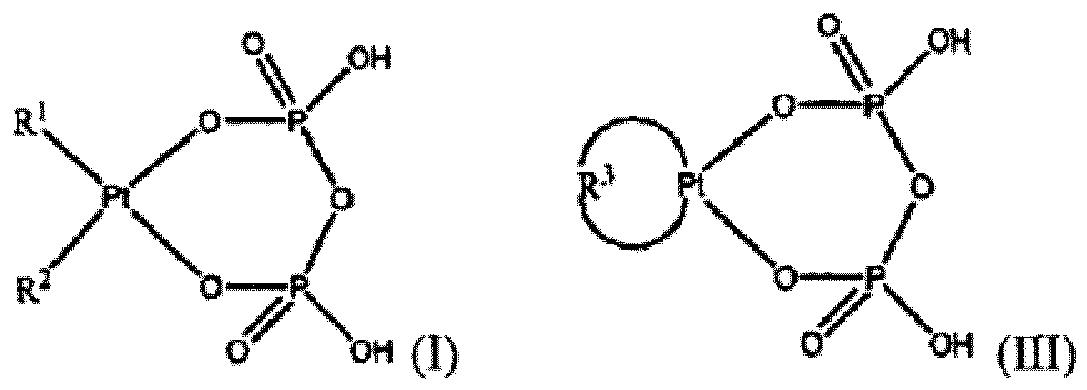 worin die R1 und R2 jeweils unabhängig voneinander aus NH3 und substituierten oder unsubstituierten aliphatischen Aminen ausgewählt sind;worin R3 aus substituierten oder unsubstituierten aliphatischen Diaminen ausgewählt ist; undworin der isolierte monomere Platinkomplex in einer wässrigen Lösung bei einem pH von etwa 6 bis etwa 9 stabil ist.
 - Verfahren nach Anspruch 12, worin der hergestellte isolierte monomere Platinkomplex (trans-1,2-Cyclohexandiamin)(dihydrogenpyrophosphato)platin(II) ist.
- Verfahren zur Herstellung eines isolierten monomeren Platin(IV)-Komplexes, umfassend:(i) das Aufrechterhalten eines wässrigen Reaktionsgemischs, das überschüssiges Pyrophosphat und einen Platinkomplex gemäß Formel V oder VI umfasst:
 worin die R1 und R2 jeweils unabhängig voneinander aus NH3 und substituierten oder unsubstituierten aliphatischen Aminen ausgewählt sind,worin R3 aus substituierten oder unsubstituierten aliphatischen Aminen ausgewählt ist; undworin X unabhängig aus Halogenen ausgewählt ist;bei einer Temperatur von etwa 30 bis etwa 60 °C über einen Zeitraum von etwa 12 bis etwa 18 h bei einem pH von etwa 7 bis etwa 9;(ii) das Zusetzen von Wasserstoffperoxid zum Reaktionsgemisch und gegebenenfalls eines Reagens, das aus der aus Acetatsalzen, Butyratsalzen und Salzen von α-Hydroxysäuren und Kombinationen daraus bestehenden Gruppe ausgewählt ist;(iii) das anschließende Einengen des wässrigen Reaktionsgemischs, sodass sich keine Niederschläge von Pyrophosphaten bilden;(iv) das rasche Senken des pH des Reaktionsgemischs auf einen pH von weniger als 2 durch Zusatz von Salpetersäure;worin der isolierte monomere Platin(IV)-Komplex die Formel II order IV aufweist:
 worin die R1 und R2 jeweils unabhängig voneinander aus NH3 und substituierten oder unsubstituierten aliphatischen Aminen ausgewählt sind;worin R3 aus substituierten oder unsubstituierten aliphatischen Aminen ausgewählt ist;worin die S jeweils unabhängig voneinander aus Hydroxid, Essigsäure, Buttersäure und α-Hydroxysäuren ausgewählt sind; undworin der isolierte monomere Platinkomplex in einer wässrigen Lösung bei einem pH von etwa 6 bis etwa 9 stabil ist.
 - Verfahren nach Anspruch 12 oder Anspruch 14, wobei die Temperatur 40 °C und die Reaktionszeit 15 Stunden beträgt und der pH zwischen 7 und 8 liegt.
- Verfahren nach Anspruch 12 oder Anspruch 14, das weiters das Abkühlen des Reaktionsgemischs auf eine Temperatur zwischen 5 °C und Umgebungstemperatur nach dem Einengen des Reaktionsgemischs oder nach dem Senken des pH des Reaktionsgemischs umfasst.
- Verfahren nach Anspruch 14, wobei das optionale Reagens, das zusammen mit dem Wasserstoffperoxid zugesetzt wird, bevor das Reaktionsgemisch eingeengt wird, aus Natriumacetat, Natriumbutyrat und Natriumsalzen von α-Hydroxysäuren oder aus Kaliumacetat, Kaliumbutyrat und Kaliumsalzen von α-Hydroxysäuren ausgewählt ist.
- Verfahren nach Anspruch 14, wobei das Wasserstoffperoxid in einer anfänglichen Konzentration von 30 Vol.-% vorliegt.
- Verfahren nach Anspruch 14, wobei der hergestellte isolierte monomere Platinkomplex
cis-Diammin-trans-dihydroxo(dihydrogenpyrophosphato)platin(IV) oder
1,2-Ethandiamin-trans-dihydroxo(dihydrogenpyrophosphato)platin(IV) oder
(trans-1,2-Cyclohexandiamin)-trans-dihydroxo(dihydrogenpyrophosphato)platin(IV) ist. - Zusammensetzung, die eine therapeutisch wirksame Menge zumindest eines isolierten monomeren Platinkomplexes, der aus Diammin(dihydrogenpyrophosphato)platin(II) und den Komplexen aus Anspruch 1 ausgewählt ist, und zumindest ein(en) pharmazeutisch annehmbaren/s Träger, Verdünner, Adjuvans oder Vehikel umfasst, zur Verwendung in einem Verfahren zur Behandlung von Krebs, der resistent gegenüber einem oder mehreren Antikrebsmitteln ist, die aus Cisplatin, Carboplatin und Oxaliplatin ausgewählt sind.
- Zusammensetzung zur Verwendung in einem Verfahren zur Behandlung von Krebs nach Anspruch 1 oder Anspruch 20, wobei der Krebs aus Hoden-, kleinzelligem Lungen- und Kopf- und Halskrebs ausgewählt ist.
- Zusammensetzung zur Verwendung in einem Verfahren zur Behandlung von Krebs nach Anspruch 1 oder Anspruch 20, wobei der Krebs Eierstockkrebs ist.
- Zusammensetzung zur Verwendung in einem Verfahren zur Behandlung von Krebs nach einem der Ansprüche 20 bis 22, wobei der isolierte monomere Platinkomplex wie in einem der Ansprüche 2 bis 4 definiert ist.
- Zusammensetzung zur Verwendung in einem Verfahren zur Behandlung von Krebs nach Anspruch 23, wobei der isolierte monomere Platinkomplex (trans-1,2-Cyclohexandiamin)(dihydrogenpyrophosphato)platin(II) ist.
- Zusammensetzung zur Verwendung in einem Verfahren zur Behandlung von Krebs nach Anspruch 23, wobei der isolierte monomere Platinkomplex (trans-1,2-Cyclohexandiamin)-trans-dihydroxo(dihydrogenpyrophosphato)platin(IV) ist.
Priority Applications (4)
| Application Number | Priority Date | Filing Date | Title |
|---|---|---|---|
| EP13182512.7A EP2668949A1 (de) | 2007-08-06 | 2008-08-06 | Phosphaplatine und deren Verwendung bei der Behandlung von gegen Cisplatin und Carboplatin resistenten Krebsen |
| SI200831280T SI2173337T1 (sl) | 2007-08-06 | 2008-08-06 | Fosfaplatini in njihova uporaba pri zdravljenju vrst raka, odpornih proti cisplatinu in karboplatinu |
| PL08797320T PL2173337T3 (pl) | 2007-08-06 | 2008-08-06 | Fosfaplatyny i ich zastosowanie w leczeniu raków opornych na cisplatynę i karboplatynę |
| CY20141100686T CY1115504T1 (el) | 2007-08-06 | 2014-08-27 | Φωσφαπλαντινες και η χρηση τους στη θεραπεια καρκινων ανθεκτικων στη σισπλαντινη και τη καρβοπλατινη |
Applications Claiming Priority (3)
| Application Number | Priority Date | Filing Date | Title |
|---|---|---|---|
| US95412607P | 2007-08-06 | 2007-08-06 | |
| US97392607P | 2007-09-20 | 2007-09-20 | |
| PCT/US2008/072398 WO2009021082A2 (en) | 2007-08-06 | 2008-08-06 | Phosphaplatins and their use in the treatment of cancers resistant to cisplantin and carboplatin |
Related Child Applications (1)
| Application Number | Title | Priority Date | Filing Date |
|---|---|---|---|
| EP13182512.7A Division-Into EP2668949A1 (de) | 2007-08-06 | 2008-08-06 | Phosphaplatine und deren Verwendung bei der Behandlung von gegen Cisplatin und Carboplatin resistenten Krebsen |
Publications (3)
| Publication Number | Publication Date |
|---|---|
| EP2173337A2 EP2173337A2 (de) | 2010-04-14 |
| EP2173337A4 EP2173337A4 (de) | 2010-10-27 |
| EP2173337B1 true EP2173337B1 (de) | 2014-07-30 |
Family
ID=40342030
Family Applications (2)
| Application Number | Title | Priority Date | Filing Date |
|---|---|---|---|
| EP13182512.7A Withdrawn EP2668949A1 (de) | 2007-08-06 | 2008-08-06 | Phosphaplatine und deren Verwendung bei der Behandlung von gegen Cisplatin und Carboplatin resistenten Krebsen |
| EP08797320.2A Active EP2173337B1 (de) | 2007-08-06 | 2008-08-06 | Phosphaplatine und ihre verwendung bei der behandlung von gegen cisplantin und carboplatin resistenten krebserkrankungen |
Family Applications Before (1)
| Application Number | Title | Priority Date | Filing Date |
|---|---|---|---|
| EP13182512.7A Withdrawn EP2668949A1 (de) | 2007-08-06 | 2008-08-06 | Phosphaplatine und deren Verwendung bei der Behandlung von gegen Cisplatin und Carboplatin resistenten Krebsen |
Country Status (12)
| Country | Link |
|---|---|
| US (4) | US7700649B2 (de) |
| EP (2) | EP2668949A1 (de) |
| JP (2) | JP5385274B2 (de) |
| CN (1) | CN101801369B (de) |
| CY (1) | CY1115504T1 (de) |
| DK (1) | DK2173337T3 (de) |
| ES (1) | ES2495743T3 (de) |
| HR (1) | HRP20140808T1 (de) |
| PL (1) | PL2173337T3 (de) |
| PT (1) | PT2173337E (de) |
| SI (1) | SI2173337T1 (de) |
| WO (2) | WO2009021081A2 (de) |
Families Citing this family (14)
| Publication number | Priority date | Publication date | Assignee | Title |
|---|---|---|---|---|
| ES2495743T3 (es) * | 2007-08-06 | 2014-09-17 | Ohio University | Fosfaplatinos y su uso en el tratamiento de cánceres resistentes a cisplatino y carboplatino |
| CN108210516A (zh) * | 2010-06-04 | 2018-06-29 | 俄亥俄大学 | 磷铂及其在治疗癌症中的用途 |
| US20130236568A1 (en) | 2011-01-12 | 2013-09-12 | Ohio University | Phosphaplatins having anti-angiogenic, anti-metastatic, and pro-apoptotic properties and uses thereof |
| EP2729526B1 (de) | 2011-07-08 | 2017-10-04 | Dow Global Technologies LLC | Polyethylenzusammensetzung für ein blasfolien verfahren und daraus hergestellte filme |
| JP6027619B2 (ja) | 2011-10-05 | 2016-11-16 | ラシンドラ・エヌ・ボーズ | ホスファプラチン系抗腫瘍剤の大規模調製のための効率的プロセス |
| WO2013052839A1 (en) | 2011-10-05 | 2013-04-11 | Bose Rathindra N | Efficient processes for large scale preparation of phosphaplatins antitumor agents |
| MX365635B (es) | 2011-10-20 | 2019-06-10 | Nerium Biotechnology Inc | Combinacion terapeutica para el tratamiento de cancer. |
| LT2855496T (lt) * | 2012-05-24 | 2017-04-10 | Phosplatin Therapeutics Llc | Fosfaplatinos junginių sintezės ir gryninimo būdai ir jų panaudojimas |
| EP2958568B1 (de) * | 2013-02-22 | 2020-03-04 | University Of Houston | Phosphaplatine als neuroprotektive wirkstoffe |
| WO2015127037A1 (en) * | 2014-02-19 | 2015-08-27 | University Of Houston System | Compositions and methods for the treatment of neurodegenerative diseases |
| MX370673B (es) | 2014-06-11 | 2019-12-19 | Univ Texas | Conjugados y composiciones de texafirina-pt (iv) para su uso para superar la resistencia del platino. |
| EP3397642A1 (de) | 2015-12-30 | 2018-11-07 | Atilim Universitesi | Dna-gerichtete mono- und heterodinukleare komplexe |
| TWI791008B (zh) | 2017-01-06 | 2023-02-01 | 美商弗斯普萊汀治療股份有限公司 | 作為供骨癌或血癌治療用之治療劑的磷酸鉑(phosphaplatin)化合物 |
| JP7381083B2 (ja) | 2017-09-08 | 2023-11-15 | フォスプラティン テラピューティクス インコーポレイテッド | 免疫調節剤としてのホスファプラチン化合物およびその治療的使用 |
Family Cites Families (6)
| Publication number | Priority date | Publication date | Assignee | Title |
|---|---|---|---|---|
| US4291027A (en) | 1979-03-07 | 1981-09-22 | Engelhard Minerals & Chemicals Corp. | Method for treating tumors with ethylenediamine platinum (II) and 1,2-diaminocyclohexane-platinum (II) pyrophosphate complexes |
| US4234500A (en) * | 1979-03-07 | 1980-11-18 | Engelhard Minerals & Chemicals Corporation | Ethylenediamine platinum(II) and 1,2-diamino-cyclohexane platinum(II) pyrophosphate complexes |
| CA2017739A1 (en) * | 1989-07-18 | 1991-01-18 | Engelhard Corporation | Cis-diamineplatinum complexes with methanediphosphonate and substituted methanediphosphonate ligands as antitumor agents |
| EP1644388A2 (de) * | 2003-06-27 | 2006-04-12 | ODANI, Akira | Bisphosphonatkomplexe |
| EP2177525A1 (de) * | 2007-07-06 | 2010-04-21 | TMRC Co., Ltd. | Metallkomplexverbindung, krebstherapiezusammensetzung mit der metallkomplexverbindung als wirkstoff sowie zwischenprodukt zur herstellung der metallkomplexverbindung |
| ES2495743T3 (es) * | 2007-08-06 | 2014-09-17 | Ohio University | Fosfaplatinos y su uso en el tratamiento de cánceres resistentes a cisplatino y carboplatino |
-
2008
- 2008-08-06 ES ES08797320.2T patent/ES2495743T3/es active Active
- 2008-08-06 WO PCT/US2008/072397 patent/WO2009021081A2/en not_active Ceased
- 2008-08-06 EP EP13182512.7A patent/EP2668949A1/de not_active Withdrawn
- 2008-08-06 JP JP2010520294A patent/JP5385274B2/ja active Active
- 2008-08-06 EP EP08797320.2A patent/EP2173337B1/de active Active
- 2008-08-06 WO PCT/US2008/072398 patent/WO2009021082A2/en not_active Ceased
- 2008-08-06 PT PT87973202T patent/PT2173337E/pt unknown
- 2008-08-06 SI SI200831280T patent/SI2173337T1/sl unknown
- 2008-08-06 CN CN2008801015774A patent/CN101801369B/zh active Active
- 2008-08-06 DK DK08797320.2T patent/DK2173337T3/da active
- 2008-08-06 HR HRP20140808AT patent/HRP20140808T1/hr unknown
- 2008-08-06 US US12/187,376 patent/US7700649B2/en active Active
- 2008-08-06 PL PL08797320T patent/PL2173337T3/pl unknown
-
2010
- 2010-03-11 US US12/722,189 patent/US8034964B2/en active Active
-
2011
- 2011-08-30 US US13/221,458 patent/US8445710B2/en active Active
-
2013
- 2013-03-15 US US13/842,885 patent/US8653132B2/en active Active
- 2013-06-07 JP JP2013120309A patent/JP5647300B2/ja active Active
-
2014
- 2014-08-27 CY CY20141100686T patent/CY1115504T1/el unknown
Also Published As
| Publication number | Publication date |
|---|---|
| SI2173337T1 (sl) | 2014-10-30 |
| US8034964B2 (en) | 2011-10-11 |
| CY1115504T1 (el) | 2017-01-04 |
| US20110313182A1 (en) | 2011-12-22 |
| WO2009021082A3 (en) | 2009-04-23 |
| US20090042838A1 (en) | 2009-02-12 |
| JP5385274B2 (ja) | 2014-01-08 |
| WO2009021081A3 (en) | 2009-05-07 |
| PL2173337T3 (pl) | 2014-11-28 |
| ES2495743T3 (es) | 2014-09-17 |
| WO2009021081A2 (en) | 2009-02-12 |
| HRP20140808T1 (hr) | 2014-10-24 |
| US20130237503A1 (en) | 2013-09-12 |
| CN101801369B (zh) | 2012-09-19 |
| HK1143551A1 (en) | 2011-01-07 |
| WO2009021082A2 (en) | 2009-02-12 |
| EP2173337A4 (de) | 2010-10-27 |
| EP2173337A2 (de) | 2010-04-14 |
| US20100233293A1 (en) | 2010-09-16 |
| JP2010535803A (ja) | 2010-11-25 |
| US7700649B2 (en) | 2010-04-20 |
| EP2668949A1 (de) | 2013-12-04 |
| CN101801369A (zh) | 2010-08-11 |
| US8653132B2 (en) | 2014-02-18 |
| JP5647300B2 (ja) | 2014-12-24 |
| JP2013227218A (ja) | 2013-11-07 |
| US8445710B2 (en) | 2013-05-21 |
| PT2173337E (pt) | 2014-09-03 |
| DK2173337T3 (da) | 2014-09-15 |
Similar Documents
| Publication | Publication Date | Title |
|---|---|---|
| EP2173337B1 (de) | Phosphaplatine und ihre verwendung bei der behandlung von gegen cisplantin und carboplatin resistenten krebserkrankungen | |
| US10759820B2 (en) | Proliferative disease treatment methods with phosphaplatin complexes | |
| JP3697210B2 (ja) | 二重ジカルボン酸ジアミノプラチン錯体の抗腫瘍誘導体、その調製方法、それを含む薬剤組成物及びその誘導体の適用方法 | |
| GB2077720A (en) | Organic complex of platinum | |
| KR20050053589A (ko) | 루테늄 항암 착체 | |
| HK1143551B (en) | Phosphaplatins and their use in the treatment of cancers resistant to cisplantin and carboplatin | |
| EP0214862B1 (de) | Antitumor-Platinkomplexe, deren Herstellung und Verwendung | |
| KR900004404B1 (ko) | 유기백금착물 및 이를 사용한 종양 치료방법 | |
| JPH01149723A (ja) | 骨芽細胞活性化剤 | |
| CN100349899C (zh) | 儿茶酚钠配合物及其制法和其在预防与治疗癌和肿瘤药物中的应用 | |
| HK1180605B (en) | Phosphaplatins and their use for treatment of cancers | |
| HK1180605A (en) | Phosphaplatins and their use for treatment of cancers | |
| JPS63174994A (ja) | 新規白金錯体および該化合物を有効成分とする抗腫瘍剤 |
Legal Events
| Date | Code | Title | Description |
|---|---|---|---|
| PUAI | Public reference made under article 153(3) epc to a published international application that has entered the european phase |
Free format text: ORIGINAL CODE: 0009012 |
|
| 17P | Request for examination filed |
Effective date: 20100202 |
|
| AK | Designated contracting states |
Kind code of ref document: A2 Designated state(s): AT BE BG CH CY CZ DE DK EE ES FI FR GB GR HR HU IE IS IT LI LT LU LV MC MT NL NO PL PT RO SE SI SK TR |
|
| AX | Request for extension of the european patent |
Extension state: AL BA MK RS |
|
| A4 | Supplementary search report drawn up and despatched |
Effective date: 20100928 |
|
| RIC1 | Information provided on ipc code assigned before grant |
Ipc: A61P 35/00 20060101ALI20100922BHEP Ipc: A61K 33/24 20060101ALI20100922BHEP Ipc: A61K 31/282 20060101AFI20090227BHEP |
|
| 17Q | First examination report despatched |
Effective date: 20110822 |
|
| DAX | Request for extension of the european patent (deleted) | ||
| GRAP | Despatch of communication of intention to grant a patent |
Free format text: ORIGINAL CODE: EPIDOSNIGR1 |
|
| INTG | Intention to grant announced |
Effective date: 20131009 |
|
| GRAP | Despatch of communication of intention to grant a patent |
Free format text: ORIGINAL CODE: EPIDOSNIGR1 |
|
| INTG | Intention to grant announced |
Effective date: 20140221 |
|
| GRAS | Grant fee paid |
Free format text: ORIGINAL CODE: EPIDOSNIGR3 |
|
| GRAA | (expected) grant |
Free format text: ORIGINAL CODE: 0009210 |
|
| AK | Designated contracting states |
Kind code of ref document: B1 Designated state(s): AT BE BG CH CY CZ DE DK EE ES FI FR GB GR HR HU IE IS IT LI LT LU LV MC MT NL NO PL PT RO SE SI SK TR |
|
| REG | Reference to a national code |
Ref country code: GB Ref legal event code: FG4D |
|
| REG | Reference to a national code |
Ref country code: CH Ref legal event code: EP |
|
| REG | Reference to a national code |
Ref country code: AT Ref legal event code: REF Ref document number: 679606 Country of ref document: AT Kind code of ref document: T Effective date: 20140815 |
|
| REG | Reference to a national code |
Ref country code: RO Ref legal event code: EPE |
|
| REG | Reference to a national code |
Ref country code: HR Ref legal event code: TUEP Ref document number: P20140808 Country of ref document: HR Ref country code: IE Ref legal event code: FG4D |
|
| REG | Reference to a national code |
Ref country code: PT Ref legal event code: SC4A Free format text: AVAILABILITY OF NATIONAL TRANSLATION Effective date: 20140825 |
|
| REG | Reference to a national code |
Ref country code: DE Ref legal event code: R096 Ref document number: 602008033608 Country of ref document: DE Effective date: 20140911 |
|
| REG | Reference to a national code |
Ref country code: DK Ref legal event code: T3 Effective date: 20140909 Ref country code: CH Ref legal event code: NV Representative=s name: RENTSCH PARTNER AG, CH |
|
| REG | Reference to a national code |
Ref country code: ES Ref legal event code: FG2A Ref document number: 2495743 Country of ref document: ES Kind code of ref document: T3 Effective date: 20140917 |
|
| REG | Reference to a national code |
Ref country code: SE Ref legal event code: TRGR |
|
| REG | Reference to a national code |
Ref country code: NL Ref legal event code: T3 Ref country code: EE Ref legal event code: FG4A Ref document number: E009419 Country of ref document: EE Effective date: 20140827 |
|
| REG | Reference to a national code |
Ref country code: HR Ref legal event code: T1PR Ref document number: P20140808 Country of ref document: HR |
|
| REG | Reference to a national code |
Ref country code: SK Ref legal event code: T3 Ref document number: E 16972 Country of ref document: SK |
|
| REG | Reference to a national code |
Ref country code: NO Ref legal event code: T2 Effective date: 20140730 |
|
| REG | Reference to a national code |
Ref country code: GR Ref legal event code: EP Ref document number: 20140401710 Country of ref document: GR Effective date: 20141017 |
|
| REG | Reference to a national code |
Ref country code: PL Ref legal event code: T3 |
|
| REG | Reference to a national code |
Ref country code: HU Ref legal event code: AG4A Ref document number: E021113 Country of ref document: HU |
|
| REG | Reference to a national code |
Ref country code: DE Ref legal event code: R097 Ref document number: 602008033608 Country of ref document: DE |
|
| PLBE | No opposition filed within time limit |
Free format text: ORIGINAL CODE: 0009261 |
|
| STAA | Information on the status of an ep patent application or granted ep patent |
Free format text: STATUS: NO OPPOSITION FILED WITHIN TIME LIMIT |
|
| 26N | No opposition filed |
Effective date: 20150504 |
|
| REG | Reference to a national code |
Ref country code: FR Ref legal event code: PLFP Year of fee payment: 9 |
|
| REG | Reference to a national code |
Ref country code: FR Ref legal event code: PLFP Year of fee payment: 10 |
|
| REG | Reference to a national code |
Ref country code: CH Ref legal event code: PCAR Free format text: NEW ADDRESS: BELLERIVESTRASSE 203 POSTFACH, 8034 ZUERICH (CH) |
|
| REG | Reference to a national code |
Ref country code: FR Ref legal event code: PLFP Year of fee payment: 11 |
|
| REG | Reference to a national code |
Ref country code: HR Ref legal event code: ODRP Ref document number: P20140808 Country of ref document: HR Payment date: 20190719 Year of fee payment: 12 |
|
| REG | Reference to a national code |
Ref country code: HR Ref legal event code: ODRP Ref document number: P20140808 Country of ref document: HR Payment date: 20200723 Year of fee payment: 13 |
|
| REG | Reference to a national code |
Ref country code: HR Ref legal event code: ODRP Ref document number: P20140808 Country of ref document: HR Payment date: 20210720 Year of fee payment: 14 |
|
| REG | Reference to a national code |
Ref country code: HR Ref legal event code: ODRP Ref document number: P20140808 Country of ref document: HR Payment date: 20220721 Year of fee payment: 15 |
|
| P01 | Opt-out of the competence of the unified patent court (upc) registered |
Effective date: 20230502 |
|
| REG | Reference to a national code |
Ref country code: HR Ref legal event code: ODRP Ref document number: P20140808 Country of ref document: HR Payment date: 20230718 Year of fee payment: 16 |
|
| REG | Reference to a national code |
Ref country code: HR Ref legal event code: ODRP Ref document number: P20140808 Country of ref document: HR Payment date: 20240718 Year of fee payment: 17 |
|
| PGFP | Annual fee paid to national office [announced via postgrant information from national office to epo] |
Ref country code: SI Payment date: 20250717 Year of fee payment: 18 |
|
| REG | Reference to a national code |
Ref country code: HR Ref legal event code: ODRP Ref document number: P20140808 Country of ref document: HR Payment date: 20250731 Year of fee payment: 18 |
|
| PGFP | Annual fee paid to national office [announced via postgrant information from national office to epo] |
Ref country code: NL Payment date: 20250826 Year of fee payment: 18 Ref country code: LU Payment date: 20250827 Year of fee payment: 18 |
|
| PGFP | Annual fee paid to national office [announced via postgrant information from national office to epo] |
Ref country code: HU Payment date: 20250730 Year of fee payment: 18 |
|
| PGFP | Annual fee paid to national office [announced via postgrant information from national office to epo] |
Ref country code: ES Payment date: 20250901 Year of fee payment: 18 Ref country code: PT Payment date: 20250722 Year of fee payment: 18 Ref country code: FI Payment date: 20250825 Year of fee payment: 18 |
|
| PGFP | Annual fee paid to national office [announced via postgrant information from national office to epo] |
Ref country code: DK Payment date: 20250825 Year of fee payment: 18 Ref country code: LT Payment date: 20250721 Year of fee payment: 18 Ref country code: DE Payment date: 20250827 Year of fee payment: 18 |
|
| PGFP | Annual fee paid to national office [announced via postgrant information from national office to epo] |
Ref country code: MC Payment date: 20250722 Year of fee payment: 18 Ref country code: GR Payment date: 20250826 Year of fee payment: 18 Ref country code: NO Payment date: 20250827 Year of fee payment: 18 |
|
| PGFP | Annual fee paid to national office [announced via postgrant information from national office to epo] |
Ref country code: PL Payment date: 20250723 Year of fee payment: 18 Ref country code: IT Payment date: 20250820 Year of fee payment: 18 Ref country code: TR Payment date: 20250721 Year of fee payment: 18 |
|
| PGFP | Annual fee paid to national office [announced via postgrant information from national office to epo] |
Ref country code: BG Payment date: 20250820 Year of fee payment: 18 Ref country code: BE Payment date: 20250827 Year of fee payment: 18 Ref country code: GB Payment date: 20250827 Year of fee payment: 18 |
|
| PGFP | Annual fee paid to national office [announced via postgrant information from national office to epo] |
Ref country code: HR Payment date: 20250731 Year of fee payment: 18 |
|
| PGFP | Annual fee paid to national office [announced via postgrant information from national office to epo] |
Ref country code: FR Payment date: 20250825 Year of fee payment: 18 Ref country code: AT Payment date: 20250827 Year of fee payment: 18 |
|
| PGFP | Annual fee paid to national office [announced via postgrant information from national office to epo] |
Ref country code: MT Payment date: 20250723 Year of fee payment: 18 Ref country code: CH Payment date: 20250901 Year of fee payment: 18 Ref country code: SE Payment date: 20250827 Year of fee payment: 18 |
|
| PGFP | Annual fee paid to national office [announced via postgrant information from national office to epo] |
Ref country code: CZ Payment date: 20250723 Year of fee payment: 18 Ref country code: EE Payment date: 20250721 Year of fee payment: 18 Ref country code: IE Payment date: 20250827 Year of fee payment: 18 |
|
| PGFP | Annual fee paid to national office [announced via postgrant information from national office to epo] |
Ref country code: RO Payment date: 20250725 Year of fee payment: 18 |
|
| PGFP | Annual fee paid to national office [announced via postgrant information from national office to epo] |
Ref country code: SK Payment date: 20250718 Year of fee payment: 18 |
|
| PGFP | Annual fee paid to national office [announced via postgrant information from national office to epo] |
Ref country code: IS Payment date: 20250805 Year of fee payment: 18 |
|
| PGFP | Annual fee paid to national office [announced via postgrant information from national office to epo] |
Ref country code: LV Payment date: 20250718 Year of fee payment: 18 |
|
| PGFP | Annual fee paid to national office [announced via postgrant information from national office to epo] |
Ref country code: CY Payment date: 20250724 Year of fee payment: 18 |