EP0214862B1 - Antitumor-Platinkomplexe, deren Herstellung und Verwendung - Google Patents
Antitumor-Platinkomplexe, deren Herstellung und Verwendung Download PDFInfo
- Publication number
- EP0214862B1 EP0214862B1 EP86306914A EP86306914A EP0214862B1 EP 0214862 B1 EP0214862 B1 EP 0214862B1 EP 86306914 A EP86306914 A EP 86306914A EP 86306914 A EP86306914 A EP 86306914A EP 0214862 B1 EP0214862 B1 EP 0214862B1
- Authority
- EP
- European Patent Office
- Prior art keywords
- ion
- nitrate
- platinum
- cis
- bis
- Prior art date
- Legal status (The legal status is an assumption and is not a legal conclusion. Google has not performed a legal analysis and makes no representation as to the accuracy of the status listed.)
- Expired - Lifetime
Links
- 0 OC1=NC*N1 Chemical compound OC1=NC*N1 0.000 description 1
Classifications
-
- C—CHEMISTRY; METALLURGY
- C07—ORGANIC CHEMISTRY
- C07F—ACYCLIC, CARBOCYCLIC OR HETEROCYCLIC COMPOUNDS CONTAINING ELEMENTS OTHER THAN CARBON, HYDROGEN, HALOGEN, OXYGEN, NITROGEN, SULFUR, SELENIUM OR TELLURIUM
- C07F17/00—Metallocenes
- C07F17/02—Metallocenes of metals of Groups 8, 9 or 10 of the Periodic Table
-
- C—CHEMISTRY; METALLURGY
- C07—ORGANIC CHEMISTRY
- C07F—ACYCLIC, CARBOCYCLIC OR HETEROCYCLIC COMPOUNDS CONTAINING ELEMENTS OTHER THAN CARBON, HYDROGEN, HALOGEN, OXYGEN, NITROGEN, SULFUR, SELENIUM OR TELLURIUM
- C07F15/00—Compounds containing elements of Groups 8, 9, 10 or 18 of the Periodic Table
- C07F15/0006—Compounds containing elements of Groups 8, 9, 10 or 18 of the Periodic Table compounds of the platinum group
- C07F15/0086—Platinum compounds
- C07F15/0093—Platinum compounds without a metal-carbon linkage
-
- A—HUMAN NECESSITIES
- A61—MEDICAL OR VETERINARY SCIENCE; HYGIENE
- A61P—SPECIFIC THERAPEUTIC ACTIVITY OF CHEMICAL COMPOUNDS OR MEDICINAL PREPARATIONS
- A61P35/00—Antineoplastic agents
Definitions
- the present invention relates to a series of novel complexes of quadricoordinate, divalent platinum with a cyclic urea derivative. Such complexes have valuable anti-tumour activity with better solubility than known anti-tumour platinum compounds and complexes.
- the invention also provides a process for preparing these complexes and methods and compositions using them.
- Cancerous disorders are a major medical problem but are often difficult to cure. The main reason for this is that the differences between tumour cells and normal cells are generally extremely small with the result that compounds which are toxic to tumour cells are also toxic to normal cells.
- the chemotherapy of cancerous disorders is generally dependent upon very limited differences between the susceptibilities of tumour cells and normal cells to anti-tumour agents.
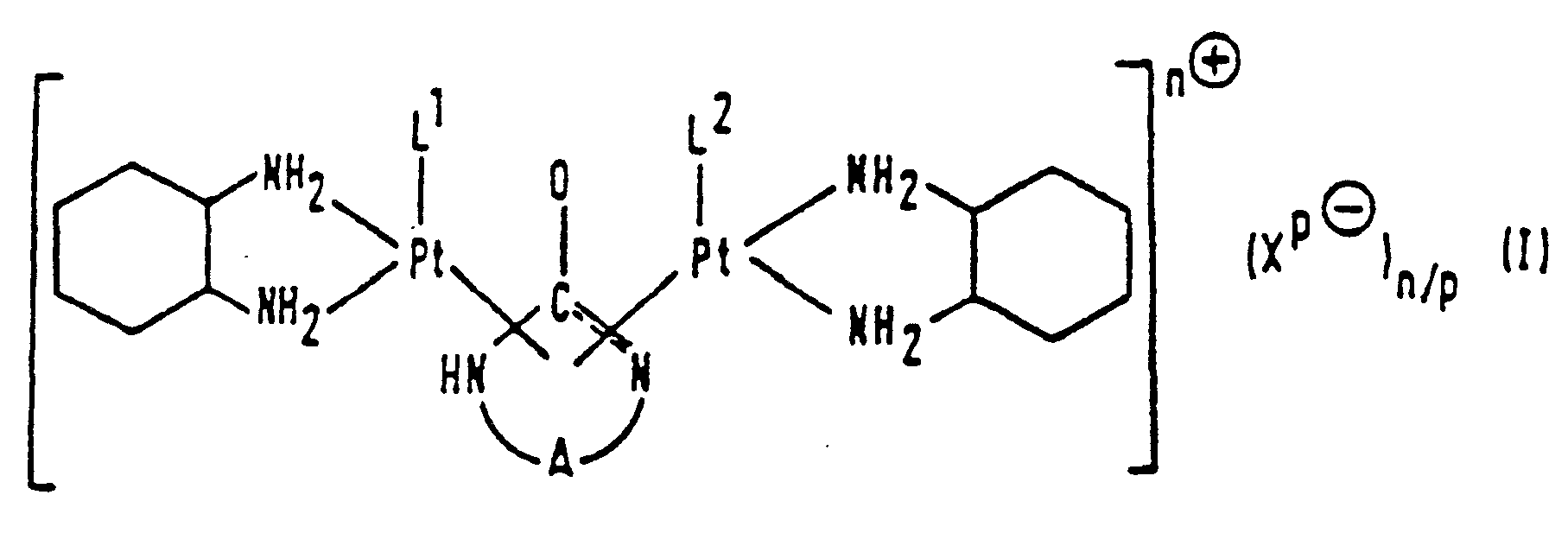
- the compounds of the present invention are quadricoordinate, divalent platinum complexes with cyclic urea derivatives, said complexes being represented by the formula (I) : wherein A represents an alkylene group having 2 or 3 carbon atoms ;
- L 1 and L 2 are as specified in detail hereinafter in general, L 1 and L 2 are the same or different and each represents a neutral ligand or a monovalent or divalent anion, or L 1 and L 2 are linked together to form a monovalent anion, a divalent anion or a group of formula (II) : where A is as defined above : X P - represents an anion of valency p being a nitrat ion, perchlorate ion, sulphate ion or car carbonate ion and n is 0, 1 or 2.
- the compounds of the invention may be prepared by reacting a platinum complex of formula (III) : in which Xp- is as defined above ; n' is 0, 1 or 2 ; and Y and Y' are the same or different and each represents water, a nitrate ion, a hydroxide ion or a perchlorate ion or Y and Y' are linked together to represent a sulphate or carbonate ion or a group of formula (IV) : with a compound of formula (V) : (in which A is as defined above).
- the invention still further provides a composition comprising an anti-tumour agent and a pharmaceutically acceptable carrier or diluent, wherein the anti-tumour agent is at least one compound of formula (I).
- the invention still further provides the use for the manufacture of a medicament for the treatment of an animal, preferably a mammal (including human beings) suffering from a tumour of a compound of formula (I).
- the compounds of the present invention have at least one ligand which is a cyclic urea derivative of formula (II) and may, depending upon the meanings ascribed to L l and L 2 have two such ligands.
- this ligand or these ligands it is believed that the attachment to one of the platinum atoms is through the nitrogen atom of the -NH- group and the attachment to the other platinum atom is through the oxygen atom of the group.
- A represents an alkylene group having 2 or 3 carbon atoms, which group may be a straight or branched chain group.
- the two "free" valencies of the alkylene group may be, and preferably are, attached to different carbon atoms, or they may be attached to the same carbon atom (in which case the group is sometimes referred to as an "alkylidene” group).
- L 1 or L 2 represents a neutral ligand, this is a water molecule, H 2 0.
- L 1 or L 2 each represents a monovalent or divalent anion.
- the resulting compound is pharmaceutically acceptable, that is to say it does not have reduced activity (or unacceptably reduced activity) or increased toxicity (or unacceptably increased toxicity) as compared to the parent compound with water as a ligand.
- L 1 and/or L 2 is an inorganic anion which is the nitrate, halide (e.g. chloride, bromide or iodide), perchlorate, sulphate, carbonate or hydroxide anion or an organic anion which is the methoxide or ethoxide anions.
- L 1 and L 2 which may be the same or different, should each represent a nitrate, chloride, hydroxide, methoxide or ethoxide anion or H 2 0.
- L 1 and L 2 may together represent a single one of the aforementioned anions.
- L 1 and L 2 together represent the nitrate, chloride, sulphate, hydroxide, methoxide, or ethoxide anions.
- the compound of the invention includes an anion Xp-, it is pharmaceutically acceptable and is the nitrate, perchlorate, sulphate or carbonate anion, preferably the nitrate or sulphate anion.
- n is wholly dependent upon the nature of the ligands L 1 and L 2 , since four positive charges are provided by the two divalent platinum atoms and a single negative charge is provided by the group of formula (11) shown in the formula (I), thus leaving a total of three positive charges to be balanced by L 1 , L 2 and X P -.
- L 1 and L 2 both represent monovalent anions, n is 1 ; when L 1 represents a neutral ligand and L 2 represents a monovalent anion, n is 2 ; and when one of L 1 and L 2 represents a divalent anion and the other represents a monovalent anion, n is 0.
- each cyclohexanediamine ligand may be the cis isomer, the trans isomer or a mixture of these and the two cyclohexanediamine ligands in the molecule may be the same isomer or different isomers.
- the trans isomers optical activity is possible and these may be the d-enantiomer, the f-enantiomer or a racemate.
- the compounds of the invention may be synthesized by reacting a compound of formula (III), that is to say a compound of formula (IIIa) : (in which n' and Xp- are as defined above and Z and Z' are the same or different and each represents a neutral ligand (for example water) or an anion (for example a nitrate, hydroxide or perchlorate anion) or Z and Z' are linked together to represent an anion (preferably a sulphate or carbonate anion)], or a compound of formula (Illb) : (in which X P - is as defined above) with the aforementioned compound of formula (V). 4 Preferred ways of carrying out these reactions are given below as Methods A, B and C.
- Cis-dichloro-(1,2-diaminocyclohexane)platinum (II) is reacted with 2 equivalents of silver nitrate or I equivalent of silver sulphate, to give a compound of formula (llla) in which Z and Z' both represent water molecules and Xr- represents a nitrate or sulphate anion, that is to say cis-diaquo-(1,2-diaminocyclohexane)platinum (II) nitrate or sulphate.
- Corresponding compounds of formula (Illa) in which XP- represents other anions can be produced by employing another corresponding silver salt.
- the reaction is preferably carried out in aqueous solution.
- the reaction temperature is not particularly critical and we therefore find it convenient to carry out the reaction at about room temperature.
- the resulting compound of formula (IIIa) is then reacted with the cyclic alkylene urea derivative of formula (V).
- the reaction is preferably effected at about neutrality and this may be achieved by adding a suitable alkali.
- the nature of the alkali is not critical, provided that it does not interfere with the reaction.
- a suitable alkali is an alkali metal hydroxide, for example sodium hydroxide, which is preferably employed as an approximately IN aqueous solution. The reaction will take place over a wide range of temperatures and the precise temperature chosen is not particularly critical.
- the reaction may be carried out at a temperature within the range from 0 to 100°C, more preterably from room temperature to 60°C, and preferably with stirring.
- the time required for the reaction may vary widely, depending upon many factors, notably the nature of the reagents and the reaction temperature. However, at a temperature within the wider range given above, a period of from 1 hour to 40 days will normally suffice, whereas, at a temperature in the more preferred range, a period of from 10 hours to 30 days will normally suffice.
- the resulting compound of formula (I) thus obtained may be separated from the reaction mixture by any suitable process.
- the reaction mixture may be concentrated by evaporation under reduced pressure and then an organic solvent may be added to precipitate the desired compound of formula (I).
- the nature of the organic solvent is not critical, although we prefer to use a water-miscible organic solvent, such as an alcohol (e.g. methanol, ethanol or isopropanol) or an ether (such as diethyl ether).
- the resulting precipitate may be collected, for example by filtration, to give the desired compound of formula (I). If required, this precipitate can be further purified by chromatography, for example using an ion-exchange resin, such as Diaion (trade mark) CHP 20P or Sephadex (trade mark).
- aqueous solution of cis-diaquo-(1,2-diaminocyclohexane)platinum (II) nitrate is prepared as described in Method A and then the water is evaporated off under reduced pressure to give cis-dinitrato-(1,2diaminocyclohexane)platinum (II), i.e. the compound of formula (Illa) where Z and Z' both represent nitrate anions.
- Compounds in which Z and Z' represent other anions may be prepared correspondingly from salts other than the nitrate.
- the resulting compound is suspended in water and then reacted with a cyclic alkylene urea (V) in the presence of an alkali (preferably sodium hydroxide) in the manner described in Method A.
- an alkali preferably sodium hydroxide
- the compound (V) is preferably employed in an amount of from 0.5 to 4 equivalents and the alkali is preferably employed in an amount of about 1 equivalent per equivalent of the cis-dinitrato-(1,2-diaminocyclohexane)platinum (II).
- An aqueous solution of cis-diaquo-(1,2-diaminocyclohexane)platinum (II) nitrate or sulphate is prepared as described in Method A.
- An alkaline hydroxide preferably an alkali metal hydroxide such as sodium hydroxide
- the resulting mixture is then allowed to react to give the corresponding compound of formula (IIIb), i.e. bis [hydroxo-cis-(1,2-diaminocyclohexane)platinum (II)] nitrate or sulphate.
- the reaction temperature is not particularly critical and we generally prefer to carry out the reaction at about room temperature.
- the time required for the reaction may vary widely, but a period of from 1 hour to 14 hours will normally suffice.
- the desired compound of formula (Illb) is then obtained by evaporating water from the reaction mixture.
- An aqueous solution of the product is obtained (either by incomplete removal of water of by adding water) and then this is reacted with a cyclic alkylene urea derivative offormula (V), preferably in an amount of from 0.5 to 4 equivalents per equivalent of platinum complex.
- the reaction will take place over a wide range of temperatures, but we generally find it convenient to employ a temperature within the range from room temperature to 50°C.
- the time required for the reaction may vary widely, depending u pon many factors, but notably the reaction temperature. A period of from 1 to 20 days will normally suffice. Thereafter, the reaction mixture may be treated as described in Method A, to give the desired compound.
- the compounds of the present invention have shown excellent anti-tumour activity which is comparable with or better than that of cisplatin and carboplatin. Moreover, quite unexpectedly, it has been found that the compounds of the invention are even effective against a cisplatin-resistant strain of mouse leukemia L1210. Moreover, the compounds of the invention appear to have surprisingly limited side-effects, such as renal toxicity and bone marrow suppression, and they have a very high solubility in water, which makes them very easy to administer.
- the platinum complexes of the present invention are preferably administered parenterally, for example as injections.
- the dosage may vary depending upon the age, body weight and condition of the patient, as well as the nature and severity of the tumour, but we generally prefer to administer the compound in an amount of from 10 mg to several grams per day for adult human patients, generally as divided doses.
- This complex is a mixture of the dl-compound corresponding to the compound of Example 1 and the de- compounds corresponding to the two isomers of the compound in Example 5.
- reaction mixture was concentrated by evaporation under reduced pressure, to give about 2 ml of a concentrated aqueous solution.
- 15m) of ethanol and 50 ml of diethyl ether were added to this concentrated solution, to form an oily precipitate.
- Isopropanol was added to the oily precipitate and then the resulting powdery precipitate was collected by filtration, to give 376 mg of the sulphate of an ethyleneurea-platinum complex, as a colourless powder.
- This complex is a mixture of the sulphates of the di-compound corresponding to the compound of Example 1 and of the dl-compounds corresponding to the two isomers of the compound of Example 5.
- test animals used were 8 to 9 week old female mice of the CDF 1 strain, each weighing 20-25 g.
- the standard L1210 leukemia cells were supplied by Dr. T. Yamamoto of the Institute of Medical Science, University of Tokyo, Japan, whilst the cisplatin-resistant L1210 cell line (L1210/CDDP) was supplied by Dr. T. Tashiro of the Cancer Chemotherapy Centre, Japanese Foundation for Cancer Research, Tokyo, Japan.
- the degree of cisplatin resistance of the cisplatin-resistant cell line in terms of in vitro sensitivity was 40-fold that of the parent L1210 cell line.
- CDF 1 mice were inoculated intraperitoneally with L1210 cells (10 5 cells/mouse).
- the compound of the present invention that prepared as described in Example 1
- carboplatin was each dissolved in 5% v/v aqueous mannitol, whilst cisplatin was dissolved in a 5% v/v solution of mannitol in physiological saline.
- Each drug was injected intraperitoneally on days 1 and 4 following tumour implantation. The number of mice in each test group was 6.
- the increase in life span was calculated as follows :
Landscapes
- Organic Chemistry (AREA)
- Chemical & Material Sciences (AREA)
- Health & Medical Sciences (AREA)
- Life Sciences & Earth Sciences (AREA)
- General Health & Medical Sciences (AREA)
- Nuclear Medicine, Radiotherapy & Molecular Imaging (AREA)
- General Chemical & Material Sciences (AREA)
- Pharmacology & Pharmacy (AREA)
- Chemical Kinetics & Catalysis (AREA)
- Animal Behavior & Ethology (AREA)
- Medicinal Chemistry (AREA)
- Public Health (AREA)
- Veterinary Medicine (AREA)
- Pharmaceuticals Containing Other Organic And Inorganic Compounds (AREA)
- Acyclic And Carbocyclic Compounds In Medicinal Compositions (AREA)
- Medicinal Preparation (AREA)
- Steroid Compounds (AREA)
- Medicines Containing Antibodies Or Antigens For Use As Internal Diagnostic Agents (AREA)
- Preparation Of Compounds By Using Micro-Organisms (AREA)
Claims (14)


Priority Applications (1)
| Application Number | Priority Date | Filing Date | Title |
|---|---|---|---|
| AT86306914T ATE61560T1 (de) | 1985-09-06 | 1986-09-08 | Antitumor-platinkomplexe, deren herstellung und verwendung. |
Applications Claiming Priority (2)
| Application Number | Priority Date | Filing Date | Title |
|---|---|---|---|
| JP19709785 | 1985-09-06 | ||
| JP197097/85 | 1985-09-06 |
Publications (3)
| Publication Number | Publication Date |
|---|---|
| EP0214862A2 EP0214862A2 (de) | 1987-03-18 |
| EP0214862A3 EP0214862A3 (en) | 1987-12-09 |
| EP0214862B1 true EP0214862B1 (de) | 1991-03-13 |
Family
ID=16368672
Family Applications (1)
| Application Number | Title | Priority Date | Filing Date |
|---|---|---|---|
| EP86306914A Expired - Lifetime EP0214862B1 (de) | 1985-09-06 | 1986-09-08 | Antitumor-Platinkomplexe, deren Herstellung und Verwendung |
Country Status (15)
| Country | Link |
|---|---|
| EP (1) | EP0214862B1 (de) |
| JP (1) | JPH0655752B2 (de) |
| KR (1) | KR890004351B1 (de) |
| CN (1) | CN1016345B (de) |
| AT (1) | ATE61560T1 (de) |
| AU (1) | AU581101B2 (de) |
| CA (1) | CA1281327C (de) |
| DE (1) | DE3678070D1 (de) |
| DK (1) | DK166825B1 (de) |
| ES (1) | ES2001669A6 (de) |
| FI (1) | FI83086C (de) |
| HU (1) | HU196606B (de) |
| NO (1) | NO172184C (de) |
| PH (1) | PH25038A (de) |
| SU (1) | SU1565347A3 (de) |
Families Citing this family (4)
| Publication number | Priority date | Publication date | Assignee | Title |
|---|---|---|---|---|
| JPH0665648B2 (ja) * | 1985-09-25 | 1994-08-24 | 塩野義製薬株式会社 | 白金系抗癌物質の安定な凍結真空乾燥製剤 |
| FI87572C (fi) * | 1987-05-08 | 1993-01-25 | Sankyo Co | Foerfarande foer framstaellning av platinakomplex med terapeutisk effekt |
| WO1997033894A1 (fr) * | 1996-03-11 | 1997-09-18 | Debiopharm Sa | Complexes de platine dinucleaires, procede pour leur preparation et compositions pharmaceutiques en contenant |
| ITMI991508A1 (it) * | 1999-07-09 | 2001-01-09 | Novuspharma Spa | Nitrati di bis-platino complessi con ligandi poliamminici |
Family Cites Families (3)
| Publication number | Priority date | Publication date | Assignee | Title |
|---|---|---|---|---|
| US4207416A (en) * | 1974-09-05 | 1980-06-10 | Engelhard Minerals & Chemicals Corporation | Ethylenediamineplatinum(II) 2,4-dioxopyrimidine complexes |
| CH617587A5 (de) * | 1974-09-05 | 1980-06-13 | Engelhard Min & Chem | |
| US4419351A (en) * | 1977-06-03 | 1983-12-06 | Research Corporation | Platinum-dioxopyrimidine complexes |
-
1986
- 1986-09-05 HU HU863866A patent/HU196606B/hu not_active IP Right Cessation
- 1986-09-05 FI FI863599A patent/FI83086C/fi not_active IP Right Cessation
- 1986-09-05 AU AU62415/86A patent/AU581101B2/en not_active Ceased
- 1986-09-05 JP JP61209014A patent/JPH0655752B2/ja not_active Expired - Fee Related
- 1986-09-05 PH PH34223A patent/PH25038A/en unknown
- 1986-09-05 NO NO863553A patent/NO172184C/no unknown
- 1986-09-05 DK DK426486A patent/DK166825B1/da not_active IP Right Cessation
- 1986-09-05 SU SU864028205A patent/SU1565347A3/ru active
- 1986-09-05 ES ES8601700A patent/ES2001669A6/es not_active Expired
- 1986-09-06 KR KR1019860007459A patent/KR890004351B1/ko not_active Expired
- 1986-09-06 CN CN86106751A patent/CN1016345B/zh not_active Expired
- 1986-09-08 EP EP86306914A patent/EP0214862B1/de not_active Expired - Lifetime
- 1986-09-08 DE DE8686306914T patent/DE3678070D1/de not_active Expired - Fee Related
- 1986-09-08 AT AT86306914T patent/ATE61560T1/de not_active IP Right Cessation
- 1986-09-08 CA CA000517690A patent/CA1281327C/en not_active Expired - Fee Related
Also Published As
| Publication number | Publication date |
|---|---|
| PH25038A (en) | 1991-01-28 |
| CN1016345B (zh) | 1992-04-22 |
| JPH0655752B2 (ja) | 1994-07-27 |
| FI863599L (fi) | 1987-03-07 |
| NO863553D0 (no) | 1986-09-05 |
| FI83086B (fi) | 1991-02-15 |
| ATE61560T1 (de) | 1991-03-15 |
| CA1281327C (en) | 1991-03-12 |
| AU6241586A (en) | 1987-03-12 |
| KR870003129A (ko) | 1987-04-15 |
| FI863599A0 (fi) | 1986-09-05 |
| EP0214862A3 (en) | 1987-12-09 |
| HU196606B (en) | 1988-12-28 |
| NO863553L (no) | 1987-03-09 |
| EP0214862A2 (de) | 1987-03-18 |
| KR890004351B1 (ko) | 1989-10-31 |
| SU1565347A3 (ru) | 1990-05-15 |
| DK166825B1 (da) | 1993-07-19 |
| HUT41808A (en) | 1987-05-28 |
| DE3678070D1 (de) | 1991-04-18 |
| NO172184C (no) | 1993-06-16 |
| DK426486A (da) | 1987-03-07 |
| JPS62149692A (ja) | 1987-07-03 |
| AU581101B2 (en) | 1989-02-09 |
| CN86106751A (zh) | 1987-03-25 |
| NO172184B (no) | 1993-03-08 |
| FI83086C (fi) | 1991-05-27 |
| ES2001669A6 (es) | 1988-06-01 |
| DK426486D0 (da) | 1986-09-05 |
Similar Documents
| Publication | Publication Date | Title |
|---|---|---|
| EP0155705B1 (de) | Antitumor-Platin-Komplexe | |
| EP0166366B1 (de) | Platinkomplexe | |
| EP0219936B1 (de) | Platinkomplexe | |
| US5041578A (en) | Water soluble 1,2-diaminocyclohexane platinum (IV) complexes as antitumor agents | |
| EP0273315B1 (de) | Ammine-N-heterocyclische Platinkomplexe und Antitumormittel | |
| RU2039064C1 (ru) | Четырехкоординационные комплексы двухвалентной платины | |
| KR900003513B1 (ko) | 유기 백금 착물 및 이를 사용한 종양 치료방법 | |
| EP0282672B1 (de) | Platinkomplexe | |
| NZ206018A (en) | Platinum-diamine complexes and compositions for treating cancer | |
| US4687780A (en) | Anti-tumor compounds of platinum | |
| EP0214862A2 (de) | Antitumor-Platinkomplexe, deren Herstellung und Verwendung | |
| EP0390138B1 (de) | Platinkomplexe und Antitumormittel, die diese als Wirkstoffe enthalten | |
| EP0376076A1 (de) | Platinkomplexe | |
| JPS61249993A (ja) | 新規有機白金錯体及びその製法 | |
| EP0261044B1 (de) | Platin-Riboflavin-Komplexe | |
| US5116831A (en) | Aminoalkyl-substituted cycloalkylamine platinum (II) complexes | |
| KR910009822B1 (ko) | 백금 착화합물의 제조방법 | |
| CA1274529A (en) | Platinum(ii) complexes of 1,1-cyclobutane- dicarboxylate and process for their production | |
| US4999444A (en) | Novel neutral mixed ligand platinum(II) and platinum(IV) complexes | |
| EP0228077A2 (de) | Aminoalkylsubstituierte Cycloalkylamin Platin(II)-Komplexe | |
| JPS6230792A (ja) | 新規白金錯体 |
Legal Events
| Date | Code | Title | Description |
|---|---|---|---|
| PUAI | Public reference made under article 153(3) epc to a published international application that has entered the european phase |
Free format text: ORIGINAL CODE: 0009012 |
|
| AK | Designated contracting states |
Kind code of ref document: A2 Designated state(s): AT BE CH DE FR GB IT LI LU NL SE |
|
| PUAL | Search report despatched |
Free format text: ORIGINAL CODE: 0009013 |
|
| AK | Designated contracting states |
Kind code of ref document: A3 Designated state(s): AT BE CH DE FR GB IT LI LU NL SE |
|
| 17P | Request for examination filed |
Effective date: 19880531 |
|
| 17Q | First examination report despatched |
Effective date: 19890208 |
|
| GRAA | (expected) grant |
Free format text: ORIGINAL CODE: 0009210 |
|
| AK | Designated contracting states |
Kind code of ref document: B1 Designated state(s): AT BE CH DE FR GB IT LI LU NL SE |
|
| REF | Corresponds to: |
Ref document number: 61560 Country of ref document: AT Date of ref document: 19910315 Kind code of ref document: T |
|
| REF | Corresponds to: |
Ref document number: 3678070 Country of ref document: DE Date of ref document: 19910418 |
|
| ET | Fr: translation filed | ||
| ITF | It: translation for a ep patent filed | ||
| PLBE | No opposition filed within time limit |
Free format text: ORIGINAL CODE: 0009261 |
|
| STAA | Information on the status of an ep patent application or granted ep patent |
Free format text: STATUS: NO OPPOSITION FILED WITHIN TIME LIMIT |
|
| 26N | No opposition filed | ||
| PGFP | Annual fee paid to national office [announced via postgrant information from national office to epo] |
Ref country code: GB Payment date: 19930901 Year of fee payment: 8 |
|
| PGFP | Annual fee paid to national office [announced via postgrant information from national office to epo] |
Ref country code: DE Payment date: 19930908 Year of fee payment: 8 |
|
| PGFP | Annual fee paid to national office [announced via postgrant information from national office to epo] |
Ref country code: FR Payment date: 19930909 Year of fee payment: 8 Ref country code: AT Payment date: 19930909 Year of fee payment: 8 |
|
| PGFP | Annual fee paid to national office [announced via postgrant information from national office to epo] |
Ref country code: CH Payment date: 19930915 Year of fee payment: 8 |
|
| PGFP | Annual fee paid to national office [announced via postgrant information from national office to epo] |
Ref country code: SE Payment date: 19930917 Year of fee payment: 8 |
|
| PGFP | Annual fee paid to national office [announced via postgrant information from national office to epo] |
Ref country code: NL Payment date: 19930930 Year of fee payment: 8 Ref country code: LU Payment date: 19930930 Year of fee payment: 8 |
|
| PGFP | Annual fee paid to national office [announced via postgrant information from national office to epo] |
Ref country code: BE Payment date: 19931012 Year of fee payment: 8 |
|
| EPTA | Lu: last paid annual fee | ||
| PG25 | Lapsed in a contracting state [announced via postgrant information from national office to epo] |
Ref country code: LU Free format text: LAPSE BECAUSE OF NON-PAYMENT OF DUE FEES Effective date: 19940908 Ref country code: GB Effective date: 19940908 Ref country code: AT Effective date: 19940908 |
|
| PG25 | Lapsed in a contracting state [announced via postgrant information from national office to epo] |
Ref country code: SE Effective date: 19940909 |
|
| PG25 | Lapsed in a contracting state [announced via postgrant information from national office to epo] |
Ref country code: LI Effective date: 19940930 Ref country code: CH Effective date: 19940930 Ref country code: BE Effective date: 19940930 |
|
| EAL | Se: european patent in force in sweden |
Ref document number: 86306914.2 |
|
| BERE | Be: lapsed |
Owner name: SANKYO CY LTD Effective date: 19940930 |
|
| PG25 | Lapsed in a contracting state [announced via postgrant information from national office to epo] |
Ref country code: NL Effective date: 19950401 |
|
| GBPC | Gb: european patent ceased through non-payment of renewal fee |
Effective date: 19940908 |
|
| NLV4 | Nl: lapsed or anulled due to non-payment of the annual fee | ||
| PG25 | Lapsed in a contracting state [announced via postgrant information from national office to epo] |
Ref country code: FR Effective date: 19950531 |
|
| REG | Reference to a national code |
Ref country code: CH Ref legal event code: PL |
|
| PG25 | Lapsed in a contracting state [announced via postgrant information from national office to epo] |
Ref country code: DE Effective date: 19950601 |
|
| EUG | Se: european patent has lapsed |
Ref document number: 86306914.2 |
|
| REG | Reference to a national code |
Ref country code: FR Ref legal event code: ST |
|
| PG25 | Lapsed in a contracting state [announced via postgrant information from national office to epo] |
Ref country code: IT Free format text: LAPSE BECAUSE OF NON-PAYMENT OF DUE FEES;WARNING: LAPSES OF ITALIAN PATENTS WITH EFFECTIVE DATE BEFORE 2007 MAY HAVE OCCURRED AT ANY TIME BEFORE 2007. THE CORRECT EFFECTIVE DATE MAY BE DIFFERENT FROM THE ONE RECORDED. Effective date: 20050908 |