EP2176277B1 - Nucléotides et aptamères contenant des groupes acide boronique ayant une liaison sollicitée à des protéines glycosylées et leurs utilisations - Google Patents
Nucléotides et aptamères contenant des groupes acide boronique ayant une liaison sollicitée à des protéines glycosylées et leurs utilisations Download PDFInfo
- Publication number
- EP2176277B1 EP2176277B1 EP08781954.6A EP08781954A EP2176277B1 EP 2176277 B1 EP2176277 B1 EP 2176277B1 EP 08781954 A EP08781954 A EP 08781954A EP 2176277 B1 EP2176277 B1 EP 2176277B1
- Authority
- EP
- European Patent Office
- Prior art keywords
- aptamer
- aptamers
- acid
- boronic acid
- polypeptide
- Prior art date
- Legal status (The legal status is an assumption and is not a legal conclusion. Google has not performed a legal analysis and makes no representation as to the accuracy of the status listed.)
- Not-in-force
Links
- 108091023037 Aptamer Proteins 0.000 title claims description 361
- 230000027455 binding Effects 0.000 title claims description 100
- 125000003729 nucleotide group Chemical group 0.000 title claims description 87
- 239000002773 nucleotide Substances 0.000 title claims description 79
- 125000005620 boronic acid group Chemical group 0.000 title claims description 72
- 102000035122 glycosylated proteins Human genes 0.000 title description 3
- 108091005608 glycosylated proteins Proteins 0.000 title description 3
- 108090000765 processed proteins & peptides Proteins 0.000 claims description 152
- 102000004196 processed proteins & peptides Human genes 0.000 claims description 150
- 229920001184 polypeptide Polymers 0.000 claims description 147
- ZADPBFCGQRWHPN-UHFFFAOYSA-N boronic acid Chemical compound OBO ZADPBFCGQRWHPN-UHFFFAOYSA-N 0.000 claims description 92
- -1 monophosphate ester Chemical class 0.000 claims description 91
- 108010049003 Fibrinogen Proteins 0.000 claims description 76
- 230000013595 glycosylation Effects 0.000 claims description 76
- 238000006206 glycosylation reaction Methods 0.000 claims description 76
- 108090000623 proteins and genes Proteins 0.000 claims description 76
- 102000008946 Fibrinogen Human genes 0.000 claims description 75
- 229940012952 fibrinogen Drugs 0.000 claims description 75
- 102000004169 proteins and genes Human genes 0.000 claims description 73
- 238000000034 method Methods 0.000 claims description 72
- 108091034117 Oligonucleotide Proteins 0.000 claims description 51
- 239000000178 monomer Substances 0.000 claims description 28
- 239000007787 solid Substances 0.000 claims description 28
- RWQNBRDOKXIBIV-UHFFFAOYSA-N thymine Chemical compound CC1=CNC(=O)NC1=O RWQNBRDOKXIBIV-UHFFFAOYSA-N 0.000 claims description 28
- JLCPHMBAVCMARE-UHFFFAOYSA-N [3-[[3-[[3-[[3-[[3-[[3-[[3-[[3-[[3-[[3-[[3-[[5-(2-amino-6-oxo-1H-purin-9-yl)-3-[[3-[[3-[[3-[[3-[[3-[[5-(2-amino-6-oxo-1H-purin-9-yl)-3-[[5-(2-amino-6-oxo-1H-purin-9-yl)-3-hydroxyoxolan-2-yl]methoxy-hydroxyphosphoryl]oxyoxolan-2-yl]methoxy-hydroxyphosphoryl]oxy-5-(5-methyl-2,4-dioxopyrimidin-1-yl)oxolan-2-yl]methoxy-hydroxyphosphoryl]oxy-5-(6-aminopurin-9-yl)oxolan-2-yl]methoxy-hydroxyphosphoryl]oxy-5-(6-aminopurin-9-yl)oxolan-2-yl]methoxy-hydroxyphosphoryl]oxy-5-(6-aminopurin-9-yl)oxolan-2-yl]methoxy-hydroxyphosphoryl]oxy-5-(6-aminopurin-9-yl)oxolan-2-yl]methoxy-hydroxyphosphoryl]oxyoxolan-2-yl]methoxy-hydroxyphosphoryl]oxy-5-(5-methyl-2,4-dioxopyrimidin-1-yl)oxolan-2-yl]methoxy-hydroxyphosphoryl]oxy-5-(4-amino-2-oxopyrimidin-1-yl)oxolan-2-yl]methoxy-hydroxyphosphoryl]oxy-5-(5-methyl-2,4-dioxopyrimidin-1-yl)oxolan-2-yl]methoxy-hydroxyphosphoryl]oxy-5-(5-methyl-2,4-dioxopyrimidin-1-yl)oxolan-2-yl]methoxy-hydroxyphosphoryl]oxy-5-(6-aminopurin-9-yl)oxolan-2-yl]methoxy-hydroxyphosphoryl]oxy-5-(6-aminopurin-9-yl)oxolan-2-yl]methoxy-hydroxyphosphoryl]oxy-5-(4-amino-2-oxopyrimidin-1-yl)oxolan-2-yl]methoxy-hydroxyphosphoryl]oxy-5-(4-amino-2-oxopyrimidin-1-yl)oxolan-2-yl]methoxy-hydroxyphosphoryl]oxy-5-(4-amino-2-oxopyrimidin-1-yl)oxolan-2-yl]methoxy-hydroxyphosphoryl]oxy-5-(6-aminopurin-9-yl)oxolan-2-yl]methoxy-hydroxyphosphoryl]oxy-5-(4-amino-2-oxopyrimidin-1-yl)oxolan-2-yl]methyl [5-(6-aminopurin-9-yl)-2-(hydroxymethyl)oxolan-3-yl] hydrogen phosphate Polymers Cc1cn(C2CC(OP(O)(=O)OCC3OC(CC3OP(O)(=O)OCC3OC(CC3O)n3cnc4c3nc(N)[nH]c4=O)n3cnc4c3nc(N)[nH]c4=O)C(COP(O)(=O)OC3CC(OC3COP(O)(=O)OC3CC(OC3COP(O)(=O)OC3CC(OC3COP(O)(=O)OC3CC(OC3COP(O)(=O)OC3CC(OC3COP(O)(=O)OC3CC(OC3COP(O)(=O)OC3CC(OC3COP(O)(=O)OC3CC(OC3COP(O)(=O)OC3CC(OC3COP(O)(=O)OC3CC(OC3COP(O)(=O)OC3CC(OC3COP(O)(=O)OC3CC(OC3COP(O)(=O)OC3CC(OC3COP(O)(=O)OC3CC(OC3COP(O)(=O)OC3CC(OC3COP(O)(=O)OC3CC(OC3COP(O)(=O)OC3CC(OC3CO)n3cnc4c(N)ncnc34)n3ccc(N)nc3=O)n3cnc4c(N)ncnc34)n3ccc(N)nc3=O)n3ccc(N)nc3=O)n3ccc(N)nc3=O)n3cnc4c(N)ncnc34)n3cnc4c(N)ncnc34)n3cc(C)c(=O)[nH]c3=O)n3cc(C)c(=O)[nH]c3=O)n3ccc(N)nc3=O)n3cc(C)c(=O)[nH]c3=O)n3cnc4c3nc(N)[nH]c4=O)n3cnc4c(N)ncnc34)n3cnc4c(N)ncnc34)n3cnc4c(N)ncnc34)n3cnc4c(N)ncnc34)O2)c(=O)[nH]c1=O JLCPHMBAVCMARE-UHFFFAOYSA-N 0.000 claims description 24
- HXITXNWTGFUOAU-UHFFFAOYSA-N phenylboronic acid Chemical class OB(O)C1=CC=CC=C1 HXITXNWTGFUOAU-UHFFFAOYSA-N 0.000 claims description 23
- 150000004676 glycans Chemical class 0.000 claims description 21
- 238000010494 dissociation reaction Methods 0.000 claims description 20
- 230000005593 dissociations Effects 0.000 claims description 20
- ISAKRJDGNUQOIC-UHFFFAOYSA-N Uracil Chemical compound O=C1C=CNC(=O)N1 ISAKRJDGNUQOIC-UHFFFAOYSA-N 0.000 claims description 18
- 210000004027 cell Anatomy 0.000 claims description 18
- OPTASPLRGRRNAP-UHFFFAOYSA-N cytosine Chemical compound NC=1C=CNC(=O)N=1 OPTASPLRGRRNAP-UHFFFAOYSA-N 0.000 claims description 18
- UYTPUPDQBNUYGX-UHFFFAOYSA-N guanine Chemical compound O=C1NC(N)=NC2=C1N=CN2 UYTPUPDQBNUYGX-UHFFFAOYSA-N 0.000 claims description 18
- FDGQSTZJBFJUBT-UHFFFAOYSA-N hypoxanthine Chemical compound O=C1NC=NC2=C1NC=N2 FDGQSTZJBFJUBT-UHFFFAOYSA-N 0.000 claims description 16
- DWHCQRBWSBKHMI-UHFFFAOYSA-N quinolin-2-ylboronic acid Chemical compound C1=CC=CC2=NC(B(O)O)=CC=C21 DWHCQRBWSBKHMI-UHFFFAOYSA-N 0.000 claims description 15
- PZJSZBJLOWMDRG-UHFFFAOYSA-N furan-2-ylboronic acid Chemical compound OB(O)C1=CC=CO1 PZJSZBJLOWMDRG-UHFFFAOYSA-N 0.000 claims description 14
- UMLDUMMLRZFROX-UHFFFAOYSA-N pyridin-2-ylboronic acid Chemical compound OB(O)C1=CC=CC=N1 UMLDUMMLRZFROX-UHFFFAOYSA-N 0.000 claims description 14
- 229940113082 thymine Drugs 0.000 claims description 14
- 241000894007 species Species 0.000 claims description 13
- ARYHTUPFQTUBBG-UHFFFAOYSA-N thiophen-2-ylboronic acid Chemical compound OB(O)C1=CC=CS1 ARYHTUPFQTUBBG-UHFFFAOYSA-N 0.000 claims description 13
- 239000002253 acid Substances 0.000 claims description 12
- XJHABGPPCLHLLV-UHFFFAOYSA-N benzo[de]isoquinoline-1,3-dione Chemical compound C1=CC(C(=O)NC2=O)=C3C2=CC=CC3=C1 XJHABGPPCLHLLV-UHFFFAOYSA-N 0.000 claims description 11
- 229930024421 Adenine Natural products 0.000 claims description 9
- GFFGJBXGBJISGV-UHFFFAOYSA-N Adenine Chemical compound NC1=NC=NC2=C1N=CN2 GFFGJBXGBJISGV-UHFFFAOYSA-N 0.000 claims description 9
- 229960000643 adenine Drugs 0.000 claims description 9
- 230000003321 amplification Effects 0.000 claims description 9
- 229940104302 cytosine Drugs 0.000 claims description 9
- HUMMCEUVDBVXTQ-UHFFFAOYSA-N naphthalen-1-ylboronic acid Chemical compound C1=CC=C2C(B(O)O)=CC=CC2=C1 HUMMCEUVDBVXTQ-UHFFFAOYSA-N 0.000 claims description 9
- 238000003199 nucleic acid amplification method Methods 0.000 claims description 9
- KXJJSKYICDAICD-UHFFFAOYSA-N quinolin-8-ylboronic acid Chemical compound C1=CN=C2C(B(O)O)=CC=CC2=C1 KXJJSKYICDAICD-UHFFFAOYSA-N 0.000 claims description 9
- 229940035893 uracil Drugs 0.000 claims description 9
- USASUEYARBQNBM-UHFFFAOYSA-N 1h-indol-2-ylboronic acid Chemical compound C1=CC=C2NC(B(O)O)=CC2=C1 USASUEYARBQNBM-UHFFFAOYSA-N 0.000 claims description 8
- UGQMRVRMYYASKQ-UHFFFAOYSA-N Hypoxanthine nucleoside Natural products OC1C(O)C(CO)OC1N1C(NC=NC2=O)=C2N=C1 UGQMRVRMYYASKQ-UHFFFAOYSA-N 0.000 claims description 8
- NWIJBOCPTGHGIK-UHFFFAOYSA-N quinolin-5-ylboronic acid Chemical compound C1=CC=C2C(B(O)O)=CC=CC2=N1 NWIJBOCPTGHGIK-UHFFFAOYSA-N 0.000 claims description 8
- KATIRQRAVXTBNY-UHFFFAOYSA-N quinolin-4-ylboronic acid Chemical compound C1=CC=C2C(B(O)O)=CC=NC2=C1 KATIRQRAVXTBNY-UHFFFAOYSA-N 0.000 claims description 7
- 210000001519 tissue Anatomy 0.000 claims description 7
- 239000001226 triphosphate Substances 0.000 claims description 7
- 235000011178 triphosphate Nutrition 0.000 claims description 7
- 241001465754 Metazoa Species 0.000 claims description 5
- 239000012634 fragment Substances 0.000 claims description 5
- 210000002966 serum Anatomy 0.000 claims description 5
- 239000000427 antigen Substances 0.000 claims description 4
- 108091007433 antigens Proteins 0.000 claims description 4
- 102000036639 antigens Human genes 0.000 claims description 4
- 210000004748 cultured cell Anatomy 0.000 claims description 4
- 210000002307 prostate Anatomy 0.000 claims description 3
- 239000001177 diphosphate Substances 0.000 claims description 2
- 235000011180 diphosphates Nutrition 0.000 claims description 2
- 108020004414 DNA Proteins 0.000 description 168
- 235000018102 proteins Nutrition 0.000 description 65
- 239000000203 mixture Substances 0.000 description 55
- 239000000243 solution Substances 0.000 description 54
- 239000013615 primer Substances 0.000 description 51
- OKKJLVBELUTLKV-UHFFFAOYSA-N Methanol Chemical compound OC OKKJLVBELUTLKV-UHFFFAOYSA-N 0.000 description 48
- YMWUJEATGCHHMB-UHFFFAOYSA-N Dichloromethane Chemical compound ClCCl YMWUJEATGCHHMB-UHFFFAOYSA-N 0.000 description 47
- 239000002585 base Substances 0.000 description 43
- 239000000047 product Substances 0.000 description 39
- 108010072866 Prostate-Specific Antigen Proteins 0.000 description 38
- 102100038358 Prostate-specific antigen Human genes 0.000 description 38
- HEDRZPFGACZZDS-MICDWDOJSA-N Trichloro(2H)methane Chemical compound [2H]C(Cl)(Cl)Cl HEDRZPFGACZZDS-MICDWDOJSA-N 0.000 description 36
- 150000001720 carbohydrates Chemical class 0.000 description 33
- XEKOWRVHYACXOJ-UHFFFAOYSA-N Ethyl acetate Chemical compound CCOC(C)=O XEKOWRVHYACXOJ-UHFFFAOYSA-N 0.000 description 32
- 102000003886 Glycoproteins Human genes 0.000 description 32
- 108090000288 Glycoproteins Proteins 0.000 description 32
- ZMXDDKWLCZADIW-UHFFFAOYSA-N N,N-Dimethylformamide Chemical compound CN(C)C=O ZMXDDKWLCZADIW-UHFFFAOYSA-N 0.000 description 32
- 238000006243 chemical reaction Methods 0.000 description 32
- XLYOFNOQVPJJNP-UHFFFAOYSA-N water Chemical compound O XLYOFNOQVPJJNP-UHFFFAOYSA-N 0.000 description 32
- ZMANZCXQSJIPKH-UHFFFAOYSA-N Triethylamine Chemical compound CCN(CC)CC ZMANZCXQSJIPKH-UHFFFAOYSA-N 0.000 description 31
- 150000001875 compounds Chemical class 0.000 description 30
- 150000007523 nucleic acids Chemical class 0.000 description 28
- 235000014633 carbohydrates Nutrition 0.000 description 27
- 125000003118 aryl group Chemical group 0.000 description 26
- 230000015572 biosynthetic process Effects 0.000 description 26
- IJGRMHOSHXDMSA-UHFFFAOYSA-N Atomic nitrogen Chemical compound N#N IJGRMHOSHXDMSA-UHFFFAOYSA-N 0.000 description 24
- WYURNTSHIVDZCO-UHFFFAOYSA-N Tetrahydrofuran Chemical compound C1CCOC1 WYURNTSHIVDZCO-UHFFFAOYSA-N 0.000 description 24
- 239000011324 bead Substances 0.000 description 24
- 238000010348 incorporation Methods 0.000 description 24
- 102000039446 nucleic acids Human genes 0.000 description 24
- 108020004707 nucleic acids Proteins 0.000 description 24
- 238000003786 synthesis reaction Methods 0.000 description 24
- 229910001868 water Inorganic materials 0.000 description 24
- 125000000217 alkyl group Chemical group 0.000 description 23
- 235000001014 amino acid Nutrition 0.000 description 23
- 235000000346 sugar Nutrition 0.000 description 23
- 150000001413 amino acids Chemical class 0.000 description 22
- 239000000126 substance Substances 0.000 description 22
- 229940024606 amino acid Drugs 0.000 description 21
- 125000001424 substituent group Chemical group 0.000 description 21
- 229910052757 nitrogen Inorganic materials 0.000 description 20
- 238000005160 1H NMR spectroscopy Methods 0.000 description 19
- IAZDPXIOMUYVGZ-UHFFFAOYSA-N Dimethylsulphoxide Chemical compound CS(C)=O IAZDPXIOMUYVGZ-UHFFFAOYSA-N 0.000 description 17
- LFQSCWFLJHTTHZ-UHFFFAOYSA-N Ethanol Chemical compound CCO LFQSCWFLJHTTHZ-UHFFFAOYSA-N 0.000 description 17
- 125000001072 heteroaryl group Chemical group 0.000 description 16
- 230000004048 modification Effects 0.000 description 16
- 238000012986 modification Methods 0.000 description 16
- 238000006467 substitution reaction Methods 0.000 description 16
- 238000001644 13C nuclear magnetic resonance spectroscopy Methods 0.000 description 15
- 102000040430 polynucleotide Human genes 0.000 description 15
- 108091033319 polynucleotide Proteins 0.000 description 15
- 102000053602 DNA Human genes 0.000 description 14
- 239000002157 polynucleotide Substances 0.000 description 14
- 239000002904 solvent Substances 0.000 description 14
- MTCFGRXMJLQNBG-REOHCLBHSA-N (2S)-2-Amino-3-hydroxypropansäure Chemical compound OC[C@H](N)C(O)=O MTCFGRXMJLQNBG-REOHCLBHSA-N 0.000 description 13
- CSNNHWWHGAXBCP-UHFFFAOYSA-L Magnesium sulfate Chemical compound [Mg+2].[O-][S+2]([O-])([O-])[O-] CSNNHWWHGAXBCP-UHFFFAOYSA-L 0.000 description 13
- 239000000499 gel Substances 0.000 description 13
- 229910052739 hydrogen Inorganic materials 0.000 description 13
- 239000001257 hydrogen Substances 0.000 description 13
- 108091032973 (ribonucleotides)n+m Proteins 0.000 description 12
- YCIMNLLNPGFGHC-UHFFFAOYSA-N catechol Chemical group OC1=CC=CC=C1O YCIMNLLNPGFGHC-UHFFFAOYSA-N 0.000 description 12
- 235000019439 ethyl acetate Nutrition 0.000 description 12
- 230000003993 interaction Effects 0.000 description 12
- 150000003833 nucleoside derivatives Chemical class 0.000 description 12
- 239000011541 reaction mixture Substances 0.000 description 12
- DHMQDGOQFOQNFH-UHFFFAOYSA-N Glycine Chemical compound NCC(O)=O DHMQDGOQFOQNFH-UHFFFAOYSA-N 0.000 description 11
- DCXYFEDJOCDNAF-REOHCLBHSA-N L-asparagine Chemical compound OC(=O)[C@@H](N)CC(N)=O DCXYFEDJOCDNAF-REOHCLBHSA-N 0.000 description 11
- 125000002355 alkine group Chemical group 0.000 description 11
- DTQVDTLACAAQTR-UHFFFAOYSA-N trifluoroacetic acid Substances OC(=O)C(F)(F)F DTQVDTLACAAQTR-UHFFFAOYSA-N 0.000 description 11
- ROHFNLRQFUQHCH-YFKPBYRVSA-N L-leucine Chemical compound CC(C)C[C@H](N)C(O)=O ROHFNLRQFUQHCH-YFKPBYRVSA-N 0.000 description 10
- IQFYYKKMVGJFEH-XLPZGREQSA-N Thymidine Chemical compound O=C1NC(=O)C(C)=CN1[C@@H]1O[C@H](CO)[C@@H](O)C1 IQFYYKKMVGJFEH-XLPZGREQSA-N 0.000 description 10
- 238000013459 approach Methods 0.000 description 10
- 125000000852 azido group Chemical group *N=[N+]=[N-] 0.000 description 10
- 125000004432 carbon atom Chemical group C* 0.000 description 10
- 239000003446 ligand Substances 0.000 description 10
- 125000002496 methyl group Chemical group [H]C([H])([H])* 0.000 description 10
- 239000000725 suspension Substances 0.000 description 10
- YLQBMQCUIZJEEH-UHFFFAOYSA-N tetrahydrofuran Natural products C=1C=COC=1 YLQBMQCUIZJEEH-UHFFFAOYSA-N 0.000 description 10
- RFSUNEUAIZKAJO-ARQDHWQXSA-N Fructose Chemical compound OC[C@H]1O[C@](O)(CO)[C@@H](O)[C@@H]1O RFSUNEUAIZKAJO-ARQDHWQXSA-N 0.000 description 9
- OUYCCCASQSFEME-QMMMGPOBSA-N L-tyrosine Chemical compound OC(=O)[C@@H](N)CC1=CC=C(O)C=C1 OUYCCCASQSFEME-QMMMGPOBSA-N 0.000 description 9
- 206010028980 Neoplasm Diseases 0.000 description 9
- 230000008859 change Effects 0.000 description 9
- 150000002009 diols Chemical class 0.000 description 9
- 230000006870 function Effects 0.000 description 9
- 125000005842 heteroatom Chemical group 0.000 description 9
- VLKZOEOYAKHREP-UHFFFAOYSA-N n-Hexane Chemical class CCCCCC VLKZOEOYAKHREP-UHFFFAOYSA-N 0.000 description 9
- KDCGOANMDULRCW-UHFFFAOYSA-N 7H-purine Chemical compound N1=CNC2=NC=NC2=C1 KDCGOANMDULRCW-UHFFFAOYSA-N 0.000 description 8
- HRPVXLWXLXDGHG-UHFFFAOYSA-N Acrylamide Chemical compound NC(=O)C=C HRPVXLWXLXDGHG-UHFFFAOYSA-N 0.000 description 8
- OKKJLVBELUTLKV-MZCSYVLQSA-N Deuterated methanol Chemical compound [2H]OC([2H])([2H])[2H] OKKJLVBELUTLKV-MZCSYVLQSA-N 0.000 description 8
- RTZKZFJDLAIYFH-UHFFFAOYSA-N Diethyl ether Chemical compound CCOCC RTZKZFJDLAIYFH-UHFFFAOYSA-N 0.000 description 8
- WHUUTDBJXJRKMK-VKHMYHEASA-N L-glutamic acid Chemical compound OC(=O)[C@@H](N)CCC(O)=O WHUUTDBJXJRKMK-VKHMYHEASA-N 0.000 description 8
- AGPKZVBTJJNPAG-WHFBIAKZSA-N L-isoleucine Chemical compound CC[C@H](C)[C@H](N)C(O)=O AGPKZVBTJJNPAG-WHFBIAKZSA-N 0.000 description 8
- KDXKERNSBIXSRK-UHFFFAOYSA-N Lysine Natural products NCCCCC(N)C(O)=O KDXKERNSBIXSRK-UHFFFAOYSA-N 0.000 description 8
- 206010060862 Prostate cancer Diseases 0.000 description 8
- FAPWRFPIFSIZLT-UHFFFAOYSA-M Sodium chloride Chemical compound [Na+].[Cl-] FAPWRFPIFSIZLT-UHFFFAOYSA-M 0.000 description 8
- 125000003277 amino group Chemical group 0.000 description 8
- 239000000872 buffer Substances 0.000 description 8
- 125000004404 heteroalkyl group Chemical group 0.000 description 8
- 125000005647 linker group Chemical group 0.000 description 8
- 239000002777 nucleoside Substances 0.000 description 8
- 150000002482 oligosaccharides Polymers 0.000 description 8
- 238000006116 polymerization reaction Methods 0.000 description 8
- 125000002924 primary amino group Chemical group [H]N([H])* 0.000 description 8
- 230000008569 process Effects 0.000 description 8
- 150000003254 radicals Chemical class 0.000 description 8
- 229910052717 sulfur Inorganic materials 0.000 description 8
- 0 CB(c1ccc(C(C(*)C=C2)=C)c2c1)O Chemical compound CB(c1ccc(C(C(*)C=C2)=C)c2c1)O 0.000 description 7
- 102000004190 Enzymes Human genes 0.000 description 7
- 108090000790 Enzymes Proteins 0.000 description 7
- MHAJPDPJQMAIIY-UHFFFAOYSA-N Hydrogen peroxide Chemical compound OO MHAJPDPJQMAIIY-UHFFFAOYSA-N 0.000 description 7
- CKLJMWTZIZZHCS-REOHCLBHSA-N L-aspartic acid Chemical compound OC(=O)[C@@H](N)CC(O)=O CKLJMWTZIZZHCS-REOHCLBHSA-N 0.000 description 7
- 208000000236 Prostatic Neoplasms Diseases 0.000 description 7
- CZPWVGJYEJSRLH-UHFFFAOYSA-N Pyrimidine Chemical compound C1=CN=CN=C1 CZPWVGJYEJSRLH-UHFFFAOYSA-N 0.000 description 7
- KZSNJWFQEVHDMF-UHFFFAOYSA-N Valine Natural products CC(C)C(N)C(O)=O KZSNJWFQEVHDMF-UHFFFAOYSA-N 0.000 description 7
- 238000007792 addition Methods 0.000 description 7
- 238000004458 analytical method Methods 0.000 description 7
- DYBXVITUBPGBBW-UHFFFAOYSA-N anthracen-1-ylboronic acid Chemical compound C1=CC=C2C=C3C(B(O)O)=CC=CC3=CC2=C1 DYBXVITUBPGBBW-UHFFFAOYSA-N 0.000 description 7
- 239000007864 aqueous solution Substances 0.000 description 7
- 125000003710 aryl alkyl group Chemical group 0.000 description 7
- 238000006352 cycloaddition reaction Methods 0.000 description 7
- 238000002330 electrospray ionisation mass spectrometry Methods 0.000 description 7
- XLYOFNOQVPJJNP-ZSJDYOACSA-N heavy water Substances [2H]O[2H] XLYOFNOQVPJJNP-ZSJDYOACSA-N 0.000 description 7
- 125000004435 hydrogen atom Chemical class [H]* 0.000 description 7
- XNBSIDRUUSNPGM-UHFFFAOYSA-N n-[2-(3,4-dihydroxyphenyl)ethyl]prop-2-enamide Chemical compound OC1=CC=C(CCNC(=O)C=C)C=C1O XNBSIDRUUSNPGM-UHFFFAOYSA-N 0.000 description 7
- 229920000642 polymer Polymers 0.000 description 7
- SCVFZCLFOSHCOH-UHFFFAOYSA-M potassium acetate Chemical compound [K+].CC([O-])=O SCVFZCLFOSHCOH-UHFFFAOYSA-M 0.000 description 7
- 238000002360 preparation method Methods 0.000 description 7
- 238000012360 testing method Methods 0.000 description 7
- OZAIFHULBGXAKX-UHFFFAOYSA-N 2-(2-cyanopropan-2-yldiazenyl)-2-methylpropanenitrile Chemical compound N#CC(C)(C)N=NC(C)(C)C#N OZAIFHULBGXAKX-UHFFFAOYSA-N 0.000 description 6
- PPXUUPXQWDQNGO-UHFFFAOYSA-N 2-azidoacetic acid Chemical compound OC(=O)CN=[N+]=[N-] PPXUUPXQWDQNGO-UHFFFAOYSA-N 0.000 description 6
- WHUUTDBJXJRKMK-UHFFFAOYSA-N Glutamic acid Natural products OC(=O)C(N)CCC(O)=O WHUUTDBJXJRKMK-UHFFFAOYSA-N 0.000 description 6
- 229930186217 Glycolipid Natural products 0.000 description 6
- VEXZGXHMUGYJMC-UHFFFAOYSA-N Hydrochloric acid Chemical compound Cl VEXZGXHMUGYJMC-UHFFFAOYSA-N 0.000 description 6
- XQFRJNBWHJMXHO-RRKCRQDMSA-N IDUR Chemical compound C1[C@H](O)[C@@H](CO)O[C@H]1N1C(=O)NC(=O)C(I)=C1 XQFRJNBWHJMXHO-RRKCRQDMSA-N 0.000 description 6
- KFZMGEQAYNKOFK-UHFFFAOYSA-N Isopropanol Chemical compound CC(C)O KFZMGEQAYNKOFK-UHFFFAOYSA-N 0.000 description 6
- COLNVLDHVKWLRT-QMMMGPOBSA-N L-phenylalanine Chemical compound OC(=O)[C@@H](N)CC1=CC=CC=C1 COLNVLDHVKWLRT-QMMMGPOBSA-N 0.000 description 6
- RZCIEJXAILMSQK-JXOAFFINSA-N TTP Chemical class O=C1NC(=O)C(C)=CN1[C@H]1[C@H](O)[C@H](O)[C@@H](COP(O)(=O)OP(O)(=O)OP(O)(O)=O)O1 RZCIEJXAILMSQK-JXOAFFINSA-N 0.000 description 6
- 125000003275 alpha amino acid group Chemical group 0.000 description 6
- 201000011510 cancer Diseases 0.000 description 6
- 238000001816 cooling Methods 0.000 description 6
- 238000001514 detection method Methods 0.000 description 6
- 125000002887 hydroxy group Chemical group [H]O* 0.000 description 6
- 229910052943 magnesium sulfate Inorganic materials 0.000 description 6
- 230000014759 maintenance of location Effects 0.000 description 6
- 239000000463 material Substances 0.000 description 6
- OKKJLVBELUTLKV-VMNATFBRSA-N methanol-d1 Chemical compound [2H]OC OKKJLVBELUTLKV-VMNATFBRSA-N 0.000 description 6
- 239000000843 powder Substances 0.000 description 6
- HCKMZBZCHQQZRJ-IVZWLZJFSA-N 2,2,2-trifluoro-n-[3-[1-[(2r,4s,5r)-4-hydroxy-5-(hydroxymethyl)oxolan-2-yl]-2,4-dioxopyrimidin-5-yl]prop-2-ynyl]acetamide Chemical compound C1[C@H](O)[C@@H](CO)O[C@H]1N1C(=O)NC(=O)C(C#CCNC(=O)C(F)(F)F)=C1 HCKMZBZCHQQZRJ-IVZWLZJFSA-N 0.000 description 5
- AOPBDRUWRLBSDB-UHFFFAOYSA-N 2-bromoaniline Chemical compound NC1=CC=CC=C1Br AOPBDRUWRLBSDB-UHFFFAOYSA-N 0.000 description 5
- RFSUNEUAIZKAJO-VRPWFDPXSA-N D-Fructose Natural products OC[C@H]1OC(O)(CO)[C@@H](O)[C@@H]1O RFSUNEUAIZKAJO-VRPWFDPXSA-N 0.000 description 5
- 108091008102 DNA aptamers Proteins 0.000 description 5
- 241000588724 Escherichia coli Species 0.000 description 5
- 238000006736 Huisgen cycloaddition reaction Methods 0.000 description 5
- UFHFLCQGNIYNRP-UHFFFAOYSA-N Hydrogen Chemical compound [H][H] UFHFLCQGNIYNRP-UHFFFAOYSA-N 0.000 description 5
- 108090001090 Lectins Proteins 0.000 description 5
- 102000004856 Lectins Human genes 0.000 description 5
- BAVYZALUXZFZLV-UHFFFAOYSA-N Methylamine Chemical compound NC BAVYZALUXZFZLV-UHFFFAOYSA-N 0.000 description 5
- 150000007513 acids Chemical class 0.000 description 5
- 102000013529 alpha-Fetoproteins Human genes 0.000 description 5
- 108010026331 alpha-Fetoproteins Proteins 0.000 description 5
- 150000001412 amines Chemical class 0.000 description 5
- 125000000539 amino acid group Chemical group 0.000 description 5
- SQVRNKJHWKZAKO-UHFFFAOYSA-N beta-N-Acetyl-D-neuraminic acid Natural products CC(=O)NC1C(O)CC(O)(C(O)=O)OC1C(O)C(O)CO SQVRNKJHWKZAKO-UHFFFAOYSA-N 0.000 description 5
- 238000004587 chromatography analysis Methods 0.000 description 5
- 230000009260 cross reactivity Effects 0.000 description 5
- 125000004122 cyclic group Chemical group 0.000 description 5
- 125000000753 cycloalkyl group Chemical group 0.000 description 5
- 238000011161 development Methods 0.000 description 5
- 230000000694 effects Effects 0.000 description 5
- 238000001962 electrophoresis Methods 0.000 description 5
- 238000000605 extraction Methods 0.000 description 5
- 239000000706 filtrate Substances 0.000 description 5
- 229910052736 halogen Inorganic materials 0.000 description 5
- 125000000623 heterocyclic group Chemical group 0.000 description 5
- 239000002523 lectin Substances 0.000 description 5
- 238000011068 loading method Methods 0.000 description 5
- 235000019341 magnesium sulphate Nutrition 0.000 description 5
- 238000004949 mass spectrometry Methods 0.000 description 5
- 229910052760 oxygen Inorganic materials 0.000 description 5
- KHIWWQKSHDUIBK-UHFFFAOYSA-N periodic acid Chemical compound OI(=O)(=O)=O KHIWWQKSHDUIBK-UHFFFAOYSA-N 0.000 description 5
- 238000000746 purification Methods 0.000 description 5
- 150000003212 purines Chemical class 0.000 description 5
- 238000010992 reflux Methods 0.000 description 5
- 239000011669 selenium Substances 0.000 description 5
- 102000040650 (ribonucleotides)n+m Human genes 0.000 description 4
- KZPYGQFFRCFCPP-UHFFFAOYSA-N 1,1'-bis(diphenylphosphino)ferrocene Chemical compound [Fe+2].C1=CC=C[C-]1P(C=1C=CC=CC=1)C1=CC=CC=C1.C1=CC=C[C-]1P(C=1C=CC=CC=1)C1=CC=CC=C1 KZPYGQFFRCFCPP-UHFFFAOYSA-N 0.000 description 4
- WWKPHNOGRRLNHZ-UHFFFAOYSA-N 1-(8-bromoquinolin-2-yl)-n-methylmethanamine Chemical compound C1=CC=C(Br)C2=NC(CNC)=CC=C21 WWKPHNOGRRLNHZ-UHFFFAOYSA-N 0.000 description 4
- LMDZBCPBFSXMTL-UHFFFAOYSA-N 1-Ethyl-3-(3-dimethylaminopropyl)carbodiimide Substances CCN=C=NCCCN(C)C LMDZBCPBFSXMTL-UHFFFAOYSA-N 0.000 description 4
- FPQQSJJWHUJYPU-UHFFFAOYSA-N 3-(dimethylamino)propyliminomethylidene-ethylazanium;chloride Chemical compound Cl.CCN=C=NCCCN(C)C FPQQSJJWHUJYPU-UHFFFAOYSA-N 0.000 description 4
- NNNBSPYJQKHCQL-UHFFFAOYSA-N 8-bromo-2-(bromomethyl)quinoline Chemical compound C1=CC=C(Br)C2=NC(CBr)=CC=C21 NNNBSPYJQKHCQL-UHFFFAOYSA-N 0.000 description 4
- GQPRZSFQSOEDNV-UHFFFAOYSA-N 8-bromo-2-methylquinoline Chemical compound C1=CC=C(Br)C2=NC(C)=CC=C21 GQPRZSFQSOEDNV-UHFFFAOYSA-N 0.000 description 4
- 102000011022 Chorionic Gonadotropin Human genes 0.000 description 4
- 108010062540 Chorionic Gonadotropin Proteins 0.000 description 4
- 108010014303 DNA-directed DNA polymerase Proteins 0.000 description 4
- 102000016928 DNA-directed DNA polymerase Human genes 0.000 description 4
- 229930091371 Fructose Natural products 0.000 description 4
- 239000005715 Fructose Substances 0.000 description 4
- ONIBWKKTOPOVIA-UHFFFAOYSA-N Proline Natural products OC(=O)C1CCCN1 ONIBWKKTOPOVIA-UHFFFAOYSA-N 0.000 description 4
- PYMYPHUHKUWMLA-LMVFSUKVSA-N Ribose Natural products OC[C@@H](O)[C@@H](O)[C@@H](O)C=O PYMYPHUHKUWMLA-LMVFSUKVSA-N 0.000 description 4
- 229920005654 Sephadex Polymers 0.000 description 4
- 239000012507 Sephadex™ Substances 0.000 description 4
- MTCFGRXMJLQNBG-UHFFFAOYSA-N Serine Natural products OCC(N)C(O)=O MTCFGRXMJLQNBG-UHFFFAOYSA-N 0.000 description 4
- VYPSYNLAJGMNEJ-UHFFFAOYSA-N Silicium dioxide Chemical compound O=[Si]=O VYPSYNLAJGMNEJ-UHFFFAOYSA-N 0.000 description 4
- WQDUMFSSJAZKTM-UHFFFAOYSA-N Sodium methoxide Chemical compound [Na+].[O-]C WQDUMFSSJAZKTM-UHFFFAOYSA-N 0.000 description 4
- DKGAVHZHDRPRBM-UHFFFAOYSA-N Tert-Butanol Chemical compound CC(C)(C)O DKGAVHZHDRPRBM-UHFFFAOYSA-N 0.000 description 4
- XSQUKJJJFZCRTK-UHFFFAOYSA-N Urea Chemical compound NC(N)=O XSQUKJJJFZCRTK-UHFFFAOYSA-N 0.000 description 4
- 125000003545 alkoxy group Chemical group 0.000 description 4
- 125000002947 alkylene group Chemical group 0.000 description 4
- 230000004075 alteration Effects 0.000 description 4
- 150000001543 aryl boronic acids Chemical class 0.000 description 4
- 125000004429 atom Chemical group 0.000 description 4
- 150000001540 azides Chemical class 0.000 description 4
- 230000000875 corresponding effect Effects 0.000 description 4
- 230000008878 coupling Effects 0.000 description 4
- 238000010168 coupling process Methods 0.000 description 4
- 238000005859 coupling reaction Methods 0.000 description 4
- 235000018417 cysteine Nutrition 0.000 description 4
- XUJNEKJLAYXESH-UHFFFAOYSA-N cysteine Natural products SCC(N)C(O)=O XUJNEKJLAYXESH-UHFFFAOYSA-N 0.000 description 4
- 239000000975 dye Substances 0.000 description 4
- 238000002474 experimental method Methods 0.000 description 4
- 238000001914 filtration Methods 0.000 description 4
- 125000000524 functional group Chemical group 0.000 description 4
- 125000004474 heteroalkylene group Chemical group 0.000 description 4
- 125000000592 heterocycloalkyl group Chemical group 0.000 description 4
- 229940084986 human chorionic gonadotropin Drugs 0.000 description 4
- 239000000543 intermediate Substances 0.000 description 4
- QJGQUHMNIGDVPM-UHFFFAOYSA-N nitrogen group Chemical group [N] QJGQUHMNIGDVPM-UHFFFAOYSA-N 0.000 description 4
- 102000044158 nucleic acid binding protein Human genes 0.000 description 4
- 108700020942 nucleic acid binding protein Proteins 0.000 description 4
- 229920001542 oligosaccharide Polymers 0.000 description 4
- KDLHZDBZIXYQEI-UHFFFAOYSA-N palladium Substances [Pd] KDLHZDBZIXYQEI-UHFFFAOYSA-N 0.000 description 4
- 229910052698 phosphorus Inorganic materials 0.000 description 4
- XHXFXVLFKHQFAL-UHFFFAOYSA-N phosphoryl trichloride Chemical compound ClP(Cl)(Cl)=O XHXFXVLFKHQFAL-UHFFFAOYSA-N 0.000 description 4
- 239000002244 precipitate Substances 0.000 description 4
- 125000006239 protecting group Chemical group 0.000 description 4
- SMUQFGGVLNAIOZ-UHFFFAOYSA-N quinaldine Chemical compound C1=CC=CC2=NC(C)=CC=C21 SMUQFGGVLNAIOZ-UHFFFAOYSA-N 0.000 description 4
- 238000010187 selection method Methods 0.000 description 4
- 229910052711 selenium Inorganic materials 0.000 description 4
- 238000000926 separation method Methods 0.000 description 4
- SQVRNKJHWKZAKO-OQPLDHBCSA-N sialic acid Chemical compound CC(=O)N[C@@H]1[C@@H](O)C[C@@](O)(C(O)=O)OC1[C@H](O)[C@H](O)CO SQVRNKJHWKZAKO-OQPLDHBCSA-N 0.000 description 4
- 239000000741 silica gel Substances 0.000 description 4
- 229910002027 silica gel Inorganic materials 0.000 description 4
- 239000011780 sodium chloride Substances 0.000 description 4
- 238000003756 stirring Methods 0.000 description 4
- 125000003107 substituted aryl group Chemical group 0.000 description 4
- SZXOOVMDMDHTIN-UHFFFAOYSA-N tert-butyl n-[(8-bromoquinolin-2-yl)methyl]-n-methylcarbamate Chemical compound C1=CC=C(Br)C2=NC(CN(C)C(=O)OC(C)(C)C)=CC=C21 SZXOOVMDMDHTIN-UHFFFAOYSA-N 0.000 description 4
- VZGDMQKNWNREIO-UHFFFAOYSA-N tetrachloromethane Chemical compound ClC(Cl)(Cl)Cl VZGDMQKNWNREIO-UHFFFAOYSA-N 0.000 description 4
- LZSYGJNFCREHMD-UHFFFAOYSA-N 1-bromo-2-(bromomethyl)benzene Chemical compound BrCC1=CC=CC=C1Br LZSYGJNFCREHMD-UHFFFAOYSA-N 0.000 description 3
- MXHRCPNRJAMMIM-SHYZEUOFSA-N 2'-deoxyuridine Chemical compound C1[C@H](O)[C@@H](CO)O[C@H]1N1C(=O)NC(=O)C=C1 MXHRCPNRJAMMIM-SHYZEUOFSA-N 0.000 description 3
- MDNDJMCSXOXBFZ-UHFFFAOYSA-N 2-(5,5-dimethyl-1,3,2-dioxaborinan-2-yl)-5,5-dimethyl-1,3,2-dioxaborinane Chemical compound O1CC(C)(C)COB1B1OCC(C)(C)CO1 MDNDJMCSXOXBFZ-UHFFFAOYSA-N 0.000 description 3
- 238000004679 31P NMR spectroscopy Methods 0.000 description 3
- VHUUQVKOLVNVRT-UHFFFAOYSA-N Ammonium hydroxide Chemical compound [NH4+].[OH-] VHUUQVKOLVNVRT-UHFFFAOYSA-N 0.000 description 3
- 239000004475 Arginine Substances 0.000 description 3
- DCXYFEDJOCDNAF-UHFFFAOYSA-N Asparagine Natural products OC(=O)C(N)CC(N)=O DCXYFEDJOCDNAF-UHFFFAOYSA-N 0.000 description 3
- DWRXFEITVBNRMK-UHFFFAOYSA-N Beta-D-1-Arabinofuranosylthymine Natural products O=C1NC(=O)C(C)=CN1C1C(O)C(O)C(CO)O1 DWRXFEITVBNRMK-UHFFFAOYSA-N 0.000 description 3
- SRBFZHDQGSBBOR-SOOFDHNKSA-N D-ribopyranose Chemical compound O[C@@H]1COC(O)[C@H](O)[C@@H]1O SRBFZHDQGSBBOR-SOOFDHNKSA-N 0.000 description 3
- PEDCQBHIVMGVHV-UHFFFAOYSA-N Glycerine Chemical compound OCC(O)CO PEDCQBHIVMGVHV-UHFFFAOYSA-N 0.000 description 3
- 239000004471 Glycine Substances 0.000 description 3
- 102000002068 Glycopeptides Human genes 0.000 description 3
- 108010015899 Glycopeptides Proteins 0.000 description 3
- 229930010555 Inosine Natural products 0.000 description 3
- UGQMRVRMYYASKQ-KQYNXXCUSA-N Inosine Chemical compound O[C@@H]1[C@H](O)[C@@H](CO)O[C@H]1N1C2=NC=NC(O)=C2N=C1 UGQMRVRMYYASKQ-KQYNXXCUSA-N 0.000 description 3
- QNAYBMKLOCPYGJ-REOHCLBHSA-N L-alanine Chemical compound C[C@H](N)C(O)=O QNAYBMKLOCPYGJ-REOHCLBHSA-N 0.000 description 3
- FFEARJCKVFRZRR-BYPYZUCNSA-N L-methionine Chemical compound CSCC[C@H](N)C(O)=O FFEARJCKVFRZRR-BYPYZUCNSA-N 0.000 description 3
- QIVBCDIJIAJPQS-VIFPVBQESA-N L-tryptophane Chemical compound C1=CC=C2C(C[C@H](N)C(O)=O)=CNC2=C1 QIVBCDIJIAJPQS-VIFPVBQESA-N 0.000 description 3
- KZSNJWFQEVHDMF-BYPYZUCNSA-N L-valine Chemical compound CC(C)[C@H](N)C(O)=O KZSNJWFQEVHDMF-BYPYZUCNSA-N 0.000 description 3
- ROHFNLRQFUQHCH-UHFFFAOYSA-N Leucine Natural products CC(C)CC(N)C(O)=O ROHFNLRQFUQHCH-UHFFFAOYSA-N 0.000 description 3
- 239000002879 Lewis base Substances 0.000 description 3
- 239000004472 Lysine Substances 0.000 description 3
- PCLIMKBDDGJMGD-UHFFFAOYSA-N N-bromosuccinimide Chemical compound BrN1C(=O)CCC1=O PCLIMKBDDGJMGD-UHFFFAOYSA-N 0.000 description 3
- 238000005481 NMR spectroscopy Methods 0.000 description 3
- 108091028043 Nucleic acid sequence Proteins 0.000 description 3
- 238000012408 PCR amplification Methods 0.000 description 3
- 229910019142 PO4 Inorganic materials 0.000 description 3
- NFHFRUOZVGFOOS-UHFFFAOYSA-N Pd(PPh3)4 Substances [Pd].C1=CC=CC=C1P(C=1C=CC=CC=1)C1=CC=CC=C1.C1=CC=CC=C1P(C=1C=CC=CC=1)C1=CC=CC=C1.C1=CC=CC=C1P(C=1C=CC=CC=1)C1=CC=CC=C1.C1=CC=CC=C1P(C=1C=CC=CC=1)C1=CC=CC=C1 NFHFRUOZVGFOOS-UHFFFAOYSA-N 0.000 description 3
- 108010021757 Polynucleotide 5'-Hydroxyl-Kinase Proteins 0.000 description 3
- 102000008422 Polynucleotide 5'-hydroxyl-kinase Human genes 0.000 description 3
- 108020004682 Single-Stranded DNA Proteins 0.000 description 3
- HEMHJVSKTPXQMS-UHFFFAOYSA-M Sodium hydroxide Chemical compound [OH-].[Na+] HEMHJVSKTPXQMS-UHFFFAOYSA-M 0.000 description 3
- NINIDFKCEFEMDL-UHFFFAOYSA-N Sulfur Chemical compound [S] NINIDFKCEFEMDL-UHFFFAOYSA-N 0.000 description 3
- AYFVYJQAPQTCCC-UHFFFAOYSA-N Threonine Natural products CC(O)C(N)C(O)=O AYFVYJQAPQTCCC-UHFFFAOYSA-N 0.000 description 3
- 239000004473 Threonine Substances 0.000 description 3
- QIVBCDIJIAJPQS-UHFFFAOYSA-N Tryptophan Natural products C1=CC=C2C(CC(N)C(O)=O)=CNC2=C1 QIVBCDIJIAJPQS-UHFFFAOYSA-N 0.000 description 3
- WMOUKOAUAFESMR-UHFFFAOYSA-N [4-(aminomethyl)phenyl]methanol Chemical compound NCC1=CC=C(CO)C=C1 WMOUKOAUAFESMR-UHFFFAOYSA-N 0.000 description 3
- 150000003926 acrylamides Chemical class 0.000 description 3
- 235000004279 alanine Nutrition 0.000 description 3
- 150000001345 alkine derivatives Chemical class 0.000 description 3
- 125000004448 alkyl carbonyl group Chemical group 0.000 description 3
- 125000000304 alkynyl group Chemical group 0.000 description 3
- 239000000908 ammonium hydroxide Substances 0.000 description 3
- 239000012491 analyte Substances 0.000 description 3
- ODKSFYDXXFIFQN-UHFFFAOYSA-N arginine Natural products OC(=O)C(N)CCCNC(N)=N ODKSFYDXXFIFQN-UHFFFAOYSA-N 0.000 description 3
- 125000004104 aryloxy group Chemical group 0.000 description 3
- 235000009582 asparagine Nutrition 0.000 description 3
- 229960001230 asparagine Drugs 0.000 description 3
- SRBFZHDQGSBBOR-UHFFFAOYSA-N beta-D-Pyranose-Lyxose Natural products OC1COC(O)C(O)C1O SRBFZHDQGSBBOR-UHFFFAOYSA-N 0.000 description 3
- IQFYYKKMVGJFEH-UHFFFAOYSA-N beta-L-thymidine Natural products O=C1NC(=O)C(C)=CN1C1OC(CO)C(O)C1 IQFYYKKMVGJFEH-UHFFFAOYSA-N 0.000 description 3
- 239000011230 binding agent Substances 0.000 description 3
- 239000012148 binding buffer Substances 0.000 description 3
- 210000004369 blood Anatomy 0.000 description 3
- 239000008280 blood Substances 0.000 description 3
- 239000012267 brine Substances 0.000 description 3
- 229910052799 carbon Inorganic materials 0.000 description 3
- PFKFTWBEEFSNDU-UHFFFAOYSA-N carbonyldiimidazole Chemical compound C1=CN=CN1C(=O)N1C=CN=C1 PFKFTWBEEFSNDU-UHFFFAOYSA-N 0.000 description 3
- 125000003178 carboxy group Chemical group [H]OC(*)=O 0.000 description 3
- 238000012512 characterization method Methods 0.000 description 3
- MLUCVPSAIODCQM-NSCUHMNNSA-N crotonaldehyde Chemical compound C\C=C\C=O MLUCVPSAIODCQM-NSCUHMNNSA-N 0.000 description 3
- MLUCVPSAIODCQM-UHFFFAOYSA-N crotonaldehyde Natural products CC=CC=O MLUCVPSAIODCQM-UHFFFAOYSA-N 0.000 description 3
- 125000004093 cyano group Chemical group *C#N 0.000 description 3
- SUYVUBYJARFZHO-RRKCRQDMSA-N dATP Chemical compound C1=NC=2C(N)=NC=NC=2N1[C@H]1C[C@H](O)[C@@H](COP(O)(=O)OP(O)(=O)OP(O)(O)=O)O1 SUYVUBYJARFZHO-RRKCRQDMSA-N 0.000 description 3
- SUYVUBYJARFZHO-UHFFFAOYSA-N dATP Natural products C1=NC=2C(N)=NC=NC=2N1C1CC(O)C(COP(O)(=O)OP(O)(=O)OP(O)(O)=O)O1 SUYVUBYJARFZHO-UHFFFAOYSA-N 0.000 description 3
- 239000008367 deionised water Substances 0.000 description 3
- 229910021641 deionized water Inorganic materials 0.000 description 3
- 239000003814 drug Substances 0.000 description 3
- 238000001035 drying Methods 0.000 description 3
- 239000012467 final product Substances 0.000 description 3
- 238000001502 gel electrophoresis Methods 0.000 description 3
- 150000002367 halogens Chemical class 0.000 description 3
- HNDVDQJCIGZPNO-UHFFFAOYSA-N histidine Natural products OC(=O)C(N)CC1=CN=CN1 HNDVDQJCIGZPNO-UHFFFAOYSA-N 0.000 description 3
- 229960003786 inosine Drugs 0.000 description 3
- 229960000310 isoleucine Drugs 0.000 description 3
- AGPKZVBTJJNPAG-UHFFFAOYSA-N isoleucine Natural products CCC(C)C(N)C(O)=O AGPKZVBTJJNPAG-UHFFFAOYSA-N 0.000 description 3
- 239000007788 liquid Substances 0.000 description 3
- 239000012528 membrane Substances 0.000 description 3
- 229930182817 methionine Natural products 0.000 description 3
- HYPMMIZBOPSABP-UHFFFAOYSA-N n,n-bis(2h-triazol-4-yl)-2h-triazol-4-amine Chemical compound N1N=NC(N(C=2N=NNC=2)C=2N=NNC=2)=C1 HYPMMIZBOPSABP-UHFFFAOYSA-N 0.000 description 3
- 125000000449 nitro group Chemical group [O-][N+](*)=O 0.000 description 3
- 125000004433 nitrogen atom Chemical group N* 0.000 description 3
- 239000012038 nucleophile Substances 0.000 description 3
- 239000003921 oil Substances 0.000 description 3
- COLNVLDHVKWLRT-UHFFFAOYSA-N phenylalanine Natural products OC(=O)C(N)CC1=CC=CC=C1 COLNVLDHVKWLRT-UHFFFAOYSA-N 0.000 description 3
- 239000010452 phosphate Substances 0.000 description 3
- XYFCBTPGUUZFHI-UHFFFAOYSA-N phosphine group Chemical group P XYFCBTPGUUZFHI-UHFFFAOYSA-N 0.000 description 3
- 235000011056 potassium acetate Nutrition 0.000 description 3
- 230000002035 prolonged effect Effects 0.000 description 3
- 150000003230 pyrimidines Chemical class 0.000 description 3
- 238000010791 quenching Methods 0.000 description 3
- 230000002285 radioactive effect Effects 0.000 description 3
- 238000011160 research Methods 0.000 description 3
- 230000000717 retained effect Effects 0.000 description 3
- 229910052710 silicon Inorganic materials 0.000 description 3
- HPALAKNZSZLMCH-UHFFFAOYSA-M sodium;chloride;hydrate Chemical compound O.[Na+].[Cl-] HPALAKNZSZLMCH-UHFFFAOYSA-M 0.000 description 3
- 239000012265 solid product Substances 0.000 description 3
- 230000009870 specific binding Effects 0.000 description 3
- 239000011593 sulfur Substances 0.000 description 3
- 229940104230 thymidine Drugs 0.000 description 3
- 230000036962 time dependent Effects 0.000 description 3
- ITMCEJHCFYSIIV-UHFFFAOYSA-N triflic acid Chemical compound OS(=O)(=O)C(F)(F)F ITMCEJHCFYSIIV-UHFFFAOYSA-N 0.000 description 3
- UNXRWKVEANCORM-UHFFFAOYSA-N triphosphoric acid Chemical compound OP(O)(=O)OP(O)(=O)OP(O)(O)=O UNXRWKVEANCORM-UHFFFAOYSA-N 0.000 description 3
- OUYCCCASQSFEME-UHFFFAOYSA-N tyrosine Natural products OC(=O)C(N)CC1=CC=C(O)C=C1 OUYCCCASQSFEME-UHFFFAOYSA-N 0.000 description 3
- 239000004474 valine Substances 0.000 description 3
- 238000005406 washing Methods 0.000 description 3
- YBJHBAHKTGYVGT-ZKWXMUAHSA-N (+)-Biotin Chemical group N1C(=O)N[C@@H]2[C@H](CCCCC(=O)O)SC[C@@H]21 YBJHBAHKTGYVGT-ZKWXMUAHSA-N 0.000 description 2
- WQZGKKKJIJFFOK-SVZMEOIVSA-N (+)-Galactose Chemical compound OC[C@H]1OC(O)[C@H](O)[C@@H](O)[C@H]1O WQZGKKKJIJFFOK-SVZMEOIVSA-N 0.000 description 2
- HPZMWTNATZPBIH-UHFFFAOYSA-N 1-methyladenine Chemical compound CN1C=NC2=NC=NC2=C1N HPZMWTNATZPBIH-UHFFFAOYSA-N 0.000 description 2
- RFLVMTUMFYRZCB-UHFFFAOYSA-N 1-methylguanine Chemical compound O=C1N(C)C(N)=NC2=C1N=CN2 RFLVMTUMFYRZCB-UHFFFAOYSA-N 0.000 description 2
- YQAMRGPPAKDUIK-UHFFFAOYSA-N 2,2,2-trifluoro-n-prop-1-ynylacetamide Chemical compound CC#CNC(=O)C(F)(F)F YQAMRGPPAKDUIK-UHFFFAOYSA-N 0.000 description 2
- MEKOFIRRDATTAG-UHFFFAOYSA-N 2,2,5,8-tetramethyl-3,4-dihydrochromen-6-ol Chemical compound C1CC(C)(C)OC2=C1C(C)=C(O)C=C2C MEKOFIRRDATTAG-UHFFFAOYSA-N 0.000 description 2
- FZWGECJQACGGTI-UHFFFAOYSA-N 2-amino-7-methyl-1,7-dihydro-6H-purin-6-one Chemical compound NC1=NC(O)=C2N(C)C=NC2=N1 FZWGECJQACGGTI-UHFFFAOYSA-N 0.000 description 2
- ASJSAQIRZKANQN-CRCLSJGQSA-N 2-deoxy-D-ribose Chemical compound OC[C@@H](O)[C@@H](O)CC=O ASJSAQIRZKANQN-CRCLSJGQSA-N 0.000 description 2
- MCSXGCZMEPXKIW-UHFFFAOYSA-N 3-hydroxy-4-[(4-methyl-2-nitrophenyl)diazenyl]-N-(3-nitrophenyl)naphthalene-2-carboxamide Chemical compound Cc1ccc(N=Nc2c(O)c(cc3ccccc23)C(=O)Nc2cccc(c2)[N+]([O-])=O)c(c1)[N+]([O-])=O MCSXGCZMEPXKIW-UHFFFAOYSA-N 0.000 description 2
- SSMIFVHARFVINF-UHFFFAOYSA-N 4-amino-1,8-naphthalimide Chemical compound O=C1NC(=O)C2=CC=CC3=C2C1=CC=C3N SSMIFVHARFVINF-UHFFFAOYSA-N 0.000 description 2
- XAASLEJRGFPHEV-UHFFFAOYSA-N 4-cyanobenzyl alcohol Chemical compound OCC1=CC=C(C#N)C=C1 XAASLEJRGFPHEV-UHFFFAOYSA-N 0.000 description 2
- LRFVTYWOQMYALW-UHFFFAOYSA-N 9H-xanthine Chemical compound O=C1NC(=O)NC2=C1NC=N2 LRFVTYWOQMYALW-UHFFFAOYSA-N 0.000 description 2
- WEVYAHXRMPXWCK-UHFFFAOYSA-N Acetonitrile Chemical compound CC#N WEVYAHXRMPXWCK-UHFFFAOYSA-N 0.000 description 2
- 229910021589 Copper(I) bromide Inorganic materials 0.000 description 2
- 229910021595 Copper(I) iodide Inorganic materials 0.000 description 2
- FBPFZTCFMRRESA-KVTDHHQDSA-N D-Mannitol Chemical compound OC[C@@H](O)[C@@H](O)[C@H](O)[C@H](O)CO FBPFZTCFMRRESA-KVTDHHQDSA-N 0.000 description 2
- WQZGKKKJIJFFOK-QTVWNMPRSA-N D-mannopyranose Chemical compound OC[C@H]1OC(O)[C@@H](O)[C@@H](O)[C@@H]1O WQZGKKKJIJFFOK-QTVWNMPRSA-N 0.000 description 2
- 108010017826 DNA Polymerase I Proteins 0.000 description 2
- 102000004594 DNA Polymerase I Human genes 0.000 description 2
- 108020001019 DNA Primers Proteins 0.000 description 2
- 239000003155 DNA primer Substances 0.000 description 2
- AHCYMLUZIRLXAA-SHYZEUOFSA-N Deoxyuridine 5'-triphosphate Chemical compound O1[C@H](COP(O)(=O)OP(O)(=O)OP(O)(O)=O)[C@@H](O)C[C@@H]1N1C(=O)NC(=O)C=C1 AHCYMLUZIRLXAA-SHYZEUOFSA-N 0.000 description 2
- WQZGKKKJIJFFOK-GASJEMHNSA-N Glucose Natural products OC[C@H]1OC(O)[C@H](O)[C@@H](O)[C@@H]1O WQZGKKKJIJFFOK-GASJEMHNSA-N 0.000 description 2
- 102000014702 Haptoglobin Human genes 0.000 description 2
- 108050005077 Haptoglobin Proteins 0.000 description 2
- 229910010084 LiAlH4 Inorganic materials 0.000 description 2
- TWRXJAOTZQYOKJ-UHFFFAOYSA-L Magnesium chloride Chemical compound [Mg+2].[Cl-].[Cl-] TWRXJAOTZQYOKJ-UHFFFAOYSA-L 0.000 description 2
- 108700018351 Major Histocompatibility Complex Proteins 0.000 description 2
- BVIAOQMSVZHOJM-UHFFFAOYSA-N N(6),N(6)-dimethyladenine Chemical compound CN(C)C1=NC=NC2=C1N=CN2 BVIAOQMSVZHOJM-UHFFFAOYSA-N 0.000 description 2
- 239000005104 Neeliglow 4-amino-1,8-naphthalimide Substances 0.000 description 2
- 229910019213 POCl3 Inorganic materials 0.000 description 2
- 108020002230 Pancreatic Ribonuclease Proteins 0.000 description 2
- 102000005891 Pancreatic ribonuclease Human genes 0.000 description 2
- 229910002666 PdCl2 Inorganic materials 0.000 description 2
- ISWSIDIOOBJBQZ-UHFFFAOYSA-N Phenol Chemical compound OC1=CC=CC=C1 ISWSIDIOOBJBQZ-UHFFFAOYSA-N 0.000 description 2
- NBIIXXVUZAFLBC-UHFFFAOYSA-N Phosphoric acid Chemical compound OP(O)(O)=O NBIIXXVUZAFLBC-UHFFFAOYSA-N 0.000 description 2
- OAICVXFJPJFONN-UHFFFAOYSA-N Phosphorus Chemical compound [P] OAICVXFJPJFONN-UHFFFAOYSA-N 0.000 description 2
- JUJWROOIHBZHMG-UHFFFAOYSA-N Pyridine Chemical compound C1=CC=NC=C1 JUJWROOIHBZHMG-UHFFFAOYSA-N 0.000 description 2
- 108091008103 RNA aptamers Proteins 0.000 description 2
- 238000012300 Sequence Analysis Methods 0.000 description 2
- PXIPVTKHYLBLMZ-UHFFFAOYSA-N Sodium azide Chemical compound [Na+].[N-]=[N+]=[N-] PXIPVTKHYLBLMZ-UHFFFAOYSA-N 0.000 description 2
- UIIMBOGNXHQVGW-UHFFFAOYSA-M Sodium bicarbonate Chemical class [Na+].OC([O-])=O UIIMBOGNXHQVGW-UHFFFAOYSA-M 0.000 description 2
- 239000007983 Tris buffer Substances 0.000 description 2
- 238000010958 [3+2] cycloaddition reaction Methods 0.000 description 2
- 230000002378 acidificating effect Effects 0.000 description 2
- HFBMWMNUJJDEQZ-UHFFFAOYSA-N acryloyl chloride Chemical compound ClC(=O)C=C HFBMWMNUJJDEQZ-UHFFFAOYSA-N 0.000 description 2
- 125000002252 acyl group Chemical group 0.000 description 2
- 230000010933 acylation Effects 0.000 description 2
- 238000005917 acylation reaction Methods 0.000 description 2
- 125000003282 alkyl amino group Chemical group 0.000 description 2
- 125000004414 alkyl thio group Chemical group 0.000 description 2
- 230000029936 alkylation Effects 0.000 description 2
- 238000005804 alkylation reaction Methods 0.000 description 2
- HMFHBZSHGGEWLO-UHFFFAOYSA-N alpha-D-Furanose-Ribose Natural products OCC1OC(O)C(O)C1O HMFHBZSHGGEWLO-UHFFFAOYSA-N 0.000 description 2
- XAGFODPZIPBFFR-UHFFFAOYSA-N aluminium Chemical compound [Al] XAGFODPZIPBFFR-UHFFFAOYSA-N 0.000 description 2
- 229910052782 aluminium Inorganic materials 0.000 description 2
- 230000009435 amidation Effects 0.000 description 2
- 238000007112 amidation reaction Methods 0.000 description 2
- ROOXNKNUYICQNP-UHFFFAOYSA-N ammonium peroxydisulfate Substances [NH4+].[NH4+].[O-]S(=O)(=O)OOS([O-])(=O)=O ROOXNKNUYICQNP-UHFFFAOYSA-N 0.000 description 2
- VAZSKTXWXKYQJF-UHFFFAOYSA-N ammonium persulfate Chemical compound [NH4+].[NH4+].[O-]S(=O)OOS([O-])=O VAZSKTXWXKYQJF-UHFFFAOYSA-N 0.000 description 2
- 229910001870 ammonium persulfate Inorganic materials 0.000 description 2
- 125000000129 anionic group Chemical group 0.000 description 2
- 229940009098 aspartate Drugs 0.000 description 2
- 238000000376 autoradiography Methods 0.000 description 2
- 230000004071 biological effect Effects 0.000 description 2
- 230000008827 biological function Effects 0.000 description 2
- 239000000090 biomarker Substances 0.000 description 2
- 239000004305 biphenyl Substances 0.000 description 2
- 150000001642 boronic acid derivatives Chemical class 0.000 description 2
- 238000006795 borylation reaction Methods 0.000 description 2
- 239000004202 carbamide Substances 0.000 description 2
- 150000001732 carboxylic acid derivatives Chemical class 0.000 description 2
- 230000015556 catabolic process Effects 0.000 description 2
- 239000003153 chemical reaction reagent Substances 0.000 description 2
- IJOOHPMOJXWVHK-UHFFFAOYSA-N chlorotrimethylsilane Chemical compound C[Si](C)(C)Cl IJOOHPMOJXWVHK-UHFFFAOYSA-N 0.000 description 2
- 238000010367 cloning Methods 0.000 description 2
- 238000004440 column chromatography Methods 0.000 description 2
- 230000000295 complement effect Effects 0.000 description 2
- 239000010949 copper Substances 0.000 description 2
- ARUVKPQLZAKDPS-UHFFFAOYSA-L copper(II) sulfate Chemical compound [Cu+2].[O-][S+2]([O-])([O-])[O-] ARUVKPQLZAKDPS-UHFFFAOYSA-L 0.000 description 2
- 239000012043 crude product Substances 0.000 description 2
- 125000000113 cyclohexyl group Chemical group [H]C1([H])C([H])([H])C([H])([H])C([H])(*)C([H])([H])C1([H])[H] 0.000 description 2
- 230000022811 deglycosylation Effects 0.000 description 2
- 238000006731 degradation reaction Methods 0.000 description 2
- 238000012217 deletion Methods 0.000 description 2
- 230000037430 deletion Effects 0.000 description 2
- 230000001419 dependent effect Effects 0.000 description 2
- 238000010511 deprotection reaction Methods 0.000 description 2
- 238000013461 design Methods 0.000 description 2
- MXHRCPNRJAMMIM-UHFFFAOYSA-N desoxyuridine Natural products C1C(O)C(CO)OC1N1C(=O)NC(=O)C=C1 MXHRCPNRJAMMIM-UHFFFAOYSA-N 0.000 description 2
- ZUOUZKKEUPVFJK-UHFFFAOYSA-N diphenyl Chemical compound C1=CC=CC=C1C1=CC=CC=C1 ZUOUZKKEUPVFJK-UHFFFAOYSA-N 0.000 description 2
- 238000002451 electron ionisation mass spectrometry Methods 0.000 description 2
- 238000010828 elution Methods 0.000 description 2
- 125000001495 ethyl group Chemical group [H]C([H])([H])C([H])([H])* 0.000 description 2
- 239000012530 fluid Substances 0.000 description 2
- 102000034287 fluorescent proteins Human genes 0.000 description 2
- 108091006047 fluorescent proteins Proteins 0.000 description 2
- 125000001153 fluoro group Chemical group F* 0.000 description 2
- 238000005187 foaming Methods 0.000 description 2
- 239000011888 foil Substances 0.000 description 2
- 238000004108 freeze drying Methods 0.000 description 2
- 230000005714 functional activity Effects 0.000 description 2
- 229930195712 glutamate Natural products 0.000 description 2
- ZDXPYRJPNDTMRX-UHFFFAOYSA-N glutamine Natural products OC(=O)C(N)CCC(N)=O ZDXPYRJPNDTMRX-UHFFFAOYSA-N 0.000 description 2
- 108700002565 glycosylated fibrinogen Proteins 0.000 description 2
- 125000005553 heteroaryloxy group Chemical group 0.000 description 2
- 238000004128 high performance liquid chromatography Methods 0.000 description 2
- 238000009396 hybridization Methods 0.000 description 2
- 150000002430 hydrocarbons Chemical group 0.000 description 2
- NPZTUJOABDZTLV-UHFFFAOYSA-N hydroxybenzotriazole Substances O=C1C=CC=C2NNN=C12 NPZTUJOABDZTLV-UHFFFAOYSA-N 0.000 description 2
- 125000005298 iminyl group Chemical group 0.000 description 2
- 230000005764 inhibitory process Effects 0.000 description 2
- 230000002452 interceptive effect Effects 0.000 description 2
- 150000007527 lewis bases Chemical class 0.000 description 2
- 150000002632 lipids Chemical class 0.000 description 2
- 239000012280 lithium aluminium hydride Substances 0.000 description 2
- 239000006148 magnetic separator Substances 0.000 description 2
- 238000000816 matrix-assisted laser desorption--ionisation Methods 0.000 description 2
- 238000005374 membrane filtration Methods 0.000 description 2
- QARBMVPHQWIHKH-UHFFFAOYSA-N methanesulfonyl chloride Chemical compound CS(Cl)(=O)=O QARBMVPHQWIHKH-UHFFFAOYSA-N 0.000 description 2
- 125000000956 methoxy group Chemical group [H]C([H])([H])O* 0.000 description 2
- 125000001570 methylene group Chemical group [H]C([H])([*:1])[*:2] 0.000 description 2
- 125000004573 morpholin-4-yl group Chemical group N1(CCOCC1)* 0.000 description 2
- 239000012074 organic phase Substances 0.000 description 2
- 125000004430 oxygen atom Chemical group O* 0.000 description 2
- PIBWKRNGBLPSSY-UHFFFAOYSA-L palladium(II) chloride Chemical compound Cl[Pd]Cl PIBWKRNGBLPSSY-UHFFFAOYSA-L 0.000 description 2
- 238000005192 partition Methods 0.000 description 2
- MINRDQDGBLQBGD-UHFFFAOYSA-N pent-2-ynoic acid Chemical compound CCC#CC(O)=O MINRDQDGBLQBGD-UHFFFAOYSA-N 0.000 description 2
- 150000002978 peroxides Chemical class 0.000 description 2
- 239000012071 phase Substances 0.000 description 2
- 125000001997 phenyl group Chemical group [H]C1=C([H])C([H])=C(*)C([H])=C1[H] 0.000 description 2
- WRMXOVHLRUVREB-UHFFFAOYSA-N phosphono phosphate;tributylazanium Chemical compound OP(O)(=O)OP([O-])([O-])=O.CCCC[NH+](CCCC)CCCC.CCCC[NH+](CCCC)CCCC WRMXOVHLRUVREB-UHFFFAOYSA-N 0.000 description 2
- 239000013612 plasmid Substances 0.000 description 2
- 229920002401 polyacrylamide Polymers 0.000 description 2
- 230000004481 post-translational protein modification Effects 0.000 description 2
- 230000035935 pregnancy Effects 0.000 description 2
- 238000000159 protein binding assay Methods 0.000 description 2
- IGFXRKMLLMBKSA-UHFFFAOYSA-N purine Chemical compound N1=C[N]C2=NC=NC2=C1 IGFXRKMLLMBKSA-UHFFFAOYSA-N 0.000 description 2
- 230000009467 reduction Effects 0.000 description 2
- 125000000467 secondary amino group Chemical group [H]N([*:1])[*:2] 0.000 description 2
- 125000003748 selenium group Chemical group *[Se]* 0.000 description 2
- 238000012163 sequencing technique Methods 0.000 description 2
- PPASLZSBLFJQEF-RKJRWTFHSA-M sodium ascorbate Substances [Na+].OC[C@@H](O)[C@H]1OC(=O)C(O)=C1[O-] PPASLZSBLFJQEF-RKJRWTFHSA-M 0.000 description 2
- 235000010378 sodium ascorbate Nutrition 0.000 description 2
- 229960005055 sodium ascorbate Drugs 0.000 description 2
- WBHQBSYUUJJSRZ-UHFFFAOYSA-M sodium bisulfate Chemical compound [Na+].OS([O-])(=O)=O WBHQBSYUUJJSRZ-UHFFFAOYSA-M 0.000 description 2
- 229910000342 sodium bisulfate Inorganic materials 0.000 description 2
- 229910000104 sodium hydride Inorganic materials 0.000 description 2
- JQWHASGSAFIOCM-UHFFFAOYSA-M sodium periodate Chemical compound [Na+].[O-]I(=O)(=O)=O JQWHASGSAFIOCM-UHFFFAOYSA-M 0.000 description 2
- PPASLZSBLFJQEF-RXSVEWSESA-M sodium-L-ascorbate Chemical compound [Na+].OC[C@H](O)[C@H]1OC(=O)C(O)=C1[O-] PPASLZSBLFJQEF-RXSVEWSESA-M 0.000 description 2
- 238000000638 solvent extraction Methods 0.000 description 2
- 125000000547 substituted alkyl group Chemical group 0.000 description 2
- 239000000758 substrate Substances 0.000 description 2
- ASWVTGNCAZCNNR-UHFFFAOYSA-N sulfamethazine Chemical compound CC1=CC(C)=NC(NS(=O)(=O)C=2C=CC(N)=CC=2)=N1 ASWVTGNCAZCNNR-UHFFFAOYSA-N 0.000 description 2
- 125000000020 sulfo group Chemical group O=S(=O)([*])O[H] 0.000 description 2
- 239000006228 supernatant Substances 0.000 description 2
- 230000020382 suppression by virus of host antigen processing and presentation of peptide antigen via MHC class I Effects 0.000 description 2
- 230000009897 systematic effect Effects 0.000 description 2
- DYHSDKLCOJIUFX-UHFFFAOYSA-N tert-butoxycarbonyl anhydride Chemical compound CC(C)(C)OC(=O)OC(=O)OC(C)(C)C DYHSDKLCOJIUFX-UHFFFAOYSA-N 0.000 description 2
- DWDZFRQQPPWMCW-UHFFFAOYSA-N tert-butyl 4-(2-amino-1-methylsulfonyloxyethyl)benzoate Chemical compound CS(=O)(=O)OC(C1=CC=C(C=C1)C(=O)OC(C)(C)C)CN DWDZFRQQPPWMCW-UHFFFAOYSA-N 0.000 description 2
- DLYUQMMRRRQYAE-UHFFFAOYSA-N tetraphosphorus decaoxide Chemical compound O1P(O2)(=O)OP3(=O)OP1(=O)OP2(=O)O3 DLYUQMMRRRQYAE-UHFFFAOYSA-N 0.000 description 2
- 125000005309 thioalkoxy group Chemical group 0.000 description 2
- RYYWUUFWQRZTIU-UHFFFAOYSA-K thiophosphate Chemical compound [O-]P([O-])([O-])=S RYYWUUFWQRZTIU-UHFFFAOYSA-K 0.000 description 2
- IMFACGCPASFAPR-UHFFFAOYSA-N tributylamine Chemical compound CCCCN(CCCC)CCCC IMFACGCPASFAPR-UHFFFAOYSA-N 0.000 description 2
- WVLBCYQITXONBZ-UHFFFAOYSA-N trimethyl phosphate Chemical compound COP(=O)(OC)OC WVLBCYQITXONBZ-UHFFFAOYSA-N 0.000 description 2
- LENZDBCJOHFCAS-UHFFFAOYSA-N tris Chemical compound OCC(N)(CO)CO LENZDBCJOHFCAS-UHFFFAOYSA-N 0.000 description 2
- 125000004417 unsaturated alkyl group Chemical group 0.000 description 2
- 239000011534 wash buffer Substances 0.000 description 2
- JIAARYAFYJHUJI-UHFFFAOYSA-L zinc dichloride Chemical compound [Cl-].[Cl-].[Zn+2] JIAARYAFYJHUJI-UHFFFAOYSA-L 0.000 description 2
- VCVOSERVUCJNPR-SYDPRGILSA-N (1r,2s)-cyclopentane-1,2-diol Chemical compound O[C@H]1CCC[C@H]1O VCVOSERVUCJNPR-SYDPRGILSA-N 0.000 description 1
- DQJCDTNMLBYVAY-ZXXIYAEKSA-N (2S,5R,10R,13R)-16-{[(2R,3S,4R,5R)-3-{[(2S,3R,4R,5S,6R)-3-acetamido-4,5-dihydroxy-6-(hydroxymethyl)oxan-2-yl]oxy}-5-(ethylamino)-6-hydroxy-2-(hydroxymethyl)oxan-4-yl]oxy}-5-(4-aminobutyl)-10-carbamoyl-2,13-dimethyl-4,7,12,15-tetraoxo-3,6,11,14-tetraazaheptadecan-1-oic acid Chemical compound NCCCC[C@H](C(=O)N[C@@H](C)C(O)=O)NC(=O)CC[C@H](C(N)=O)NC(=O)[C@@H](C)NC(=O)C(C)O[C@@H]1[C@@H](NCC)C(O)O[C@H](CO)[C@H]1O[C@H]1[C@H](NC(C)=O)[C@@H](O)[C@H](O)[C@@H](CO)O1 DQJCDTNMLBYVAY-ZXXIYAEKSA-N 0.000 description 1
- SSYDTHANSGMJTP-ZXZARUISSA-N (3s,4r)-oxolane-3,4-diol Chemical compound O[C@H]1COC[C@H]1O SSYDTHANSGMJTP-ZXZARUISSA-N 0.000 description 1
- 125000004178 (C1-C4) alkyl group Chemical group 0.000 description 1
- 125000000229 (C1-C4)alkoxy group Chemical group 0.000 description 1
- 125000004169 (C1-C6) alkyl group Chemical group 0.000 description 1
- NWUYHJFMYQTDRP-UHFFFAOYSA-N 1,2-bis(ethenyl)benzene;1-ethenyl-2-ethylbenzene;styrene Chemical compound C=CC1=CC=CC=C1.CCC1=CC=CC=C1C=C.C=CC1=CC=CC=C1C=C NWUYHJFMYQTDRP-UHFFFAOYSA-N 0.000 description 1
- WENXBAFANCRIGK-UHFFFAOYSA-N 1-bromonaphthalen-2-amine Chemical compound C1=CC=CC2=C(Br)C(N)=CC=C21 WENXBAFANCRIGK-UHFFFAOYSA-N 0.000 description 1
- SATCOUWSAZBIJO-UHFFFAOYSA-N 1-methyladenine Natural products N=C1N(C)C=NC2=C1NC=N2 SATCOUWSAZBIJO-UHFFFAOYSA-N 0.000 description 1
- WJNGQIYEQLPJMN-IOSLPCCCSA-N 1-methylinosine Chemical compound C1=NC=2C(=O)N(C)C=NC=2N1[C@@H]1O[C@H](CO)[C@@H](O)[C@H]1O WJNGQIYEQLPJMN-IOSLPCCCSA-N 0.000 description 1
- 125000001637 1-naphthyl group Chemical group [H]C1=C([H])C([H])=C2C(*)=C([H])C([H])=C([H])C2=C1[H] 0.000 description 1
- 125000004214 1-pyrrolidinyl group Chemical group [H]C1([H])N(*)C([H])([H])C([H])([H])C1([H])[H] 0.000 description 1
- 125000001462 1-pyrrolyl group Chemical group [*]N1C([H])=C([H])C([H])=C1[H] 0.000 description 1
- OWEGMIWEEQEYGQ-UHFFFAOYSA-N 100676-05-9 Natural products OC1C(O)C(O)C(CO)OC1OCC1C(O)C(O)C(O)C(OC2C(OC(O)C(O)C2O)CO)O1 OWEGMIWEEQEYGQ-UHFFFAOYSA-N 0.000 description 1
- 238000004607 11B NMR spectroscopy Methods 0.000 description 1
- OTTXCOAOKOEENK-UHFFFAOYSA-N 2,2-difluoroethenone Chemical group FC(F)=C=O OTTXCOAOKOEENK-UHFFFAOYSA-N 0.000 description 1
- WYDKPTZGVLTYPG-UHFFFAOYSA-N 2,8-diamino-3,7-dihydropurin-6-one Chemical compound N1C(N)=NC(=O)C2=C1N=C(N)N2 WYDKPTZGVLTYPG-UHFFFAOYSA-N 0.000 description 1
- HLYBTPMYFWWNJN-UHFFFAOYSA-N 2-(2,4-dioxo-1h-pyrimidin-5-yl)-2-hydroxyacetic acid Chemical compound OC(=O)C(O)C1=CNC(=O)NC1=O HLYBTPMYFWWNJN-UHFFFAOYSA-N 0.000 description 1
- SGAKLDIYNFXTCK-UHFFFAOYSA-N 2-[(2,4-dioxo-1h-pyrimidin-5-yl)methylamino]acetic acid Chemical compound OC(=O)CNCC1=CNC(=O)NC1=O SGAKLDIYNFXTCK-UHFFFAOYSA-N 0.000 description 1
- YSAJFXWTVFGPAX-UHFFFAOYSA-N 2-[(2,4-dioxo-1h-pyrimidin-5-yl)oxy]acetic acid Chemical compound OC(=O)COC1=CNC(=O)NC1=O YSAJFXWTVFGPAX-UHFFFAOYSA-N 0.000 description 1
- KDELTXNPUXUBMU-UHFFFAOYSA-N 2-[2-[bis(carboxymethyl)amino]ethyl-(carboxymethyl)amino]acetic acid boric acid Chemical compound OB(O)O.OB(O)O.OB(O)O.OC(=O)CN(CC(O)=O)CCN(CC(O)=O)CC(O)=O KDELTXNPUXUBMU-UHFFFAOYSA-N 0.000 description 1
- QKNYBSVHEMOAJP-UHFFFAOYSA-N 2-amino-2-(hydroxymethyl)propane-1,3-diol;hydron;chloride Chemical compound Cl.OCC(N)(CO)CO QKNYBSVHEMOAJP-UHFFFAOYSA-N 0.000 description 1
- CRYCZDRIXVHNQB-UHFFFAOYSA-N 2-amino-8-bromo-3,7-dihydropurin-6-one Chemical compound N1C(N)=NC(=O)C2=C1N=C(Br)N2 CRYCZDRIXVHNQB-UHFFFAOYSA-N 0.000 description 1
- YCFWZXAEOXKNHL-UHFFFAOYSA-N 2-amino-8-chloro-3,7-dihydropurin-6-one Chemical compound N1C(N)=NC(=O)C2=C1N=C(Cl)N2 YCFWZXAEOXKNHL-UHFFFAOYSA-N 0.000 description 1
- DJGMEMUXTWZGIC-UHFFFAOYSA-N 2-amino-8-methyl-3,7-dihydropurin-6-one Chemical compound N1C(N)=NC(=O)C2=C1N=C(C)N2 DJGMEMUXTWZGIC-UHFFFAOYSA-N 0.000 description 1
- MWBWWFOAEOYUST-UHFFFAOYSA-N 2-aminopurine Chemical compound NC1=NC=C2N=CNC2=N1 MWBWWFOAEOYUST-UHFFFAOYSA-N 0.000 description 1
- 125000004174 2-benzimidazolyl group Chemical group [H]N1C(*)=NC2=C([H])C([H])=C([H])C([H])=C12 0.000 description 1
- XMSMHKMPBNTBOD-UHFFFAOYSA-N 2-dimethylamino-6-hydroxypurine Chemical compound N1C(N(C)C)=NC(=O)C2=C1N=CN2 XMSMHKMPBNTBOD-UHFFFAOYSA-N 0.000 description 1
- 125000002941 2-furyl group Chemical group O1C([*])=C([H])C([H])=C1[H] 0.000 description 1
- SMADWRYCYBUIKH-UHFFFAOYSA-N 2-methyl-7h-purin-6-amine Chemical compound CC1=NC(N)=C2NC=NC2=N1 SMADWRYCYBUIKH-UHFFFAOYSA-N 0.000 description 1
- 125000001622 2-naphthyl group Chemical group [H]C1=C([H])C([H])=C2C([H])=C(*)C([H])=C([H])C2=C1[H] 0.000 description 1
- 125000000094 2-phenylethyl group Chemical group [H]C1=C([H])C([H])=C(C([H])=C1[H])C([H])([H])C([H])([H])* 0.000 description 1
- 125000003903 2-propenyl group Chemical group [H]C([*])([H])C([H])=C([H])[H] 0.000 description 1
- 125000004105 2-pyridyl group Chemical group N1=C([*])C([H])=C([H])C([H])=C1[H] 0.000 description 1
- 125000000389 2-pyrrolyl group Chemical group [H]N1C([*])=C([H])C([H])=C1[H] 0.000 description 1
- 125000000175 2-thienyl group Chemical group S1C([*])=C([H])C([H])=C1[H] 0.000 description 1
- JKYKXTRKURYNGW-UHFFFAOYSA-N 3,4-dihydroxy-9,10-dioxo-9,10-dihydroanthracene-2-sulfonic acid Chemical compound O=C1C2=CC=CC=C2C(=O)C2=C1C(O)=C(O)C(S(O)(=O)=O)=C2 JKYKXTRKURYNGW-UHFFFAOYSA-N 0.000 description 1
- HVCOBJNICQPDBP-UHFFFAOYSA-N 3-[3-[3,5-dihydroxy-6-methyl-4-(3,4,5-trihydroxy-6-methyloxan-2-yl)oxyoxan-2-yl]oxydecanoyloxy]decanoic acid;hydrate Chemical compound O.OC1C(OC(CC(=O)OC(CCCCCCC)CC(O)=O)CCCCCCC)OC(C)C(O)C1OC1C(O)C(O)C(O)C(C)O1 HVCOBJNICQPDBP-UHFFFAOYSA-N 0.000 description 1
- RPMGIMAQTRLVBI-UHFFFAOYSA-N 3-amino-2-[4-[(2-methylpropan-2-yl)oxycarbonyl]phenyl]propane-1-sulfonic acid Chemical compound CC(C)(C)OC(=O)C1=CC=C(C(CN)CS(O)(=O)=O)C=C1 RPMGIMAQTRLVBI-UHFFFAOYSA-N 0.000 description 1
- 125000000474 3-butynyl group Chemical group [H]C#CC([H])([H])C([H])([H])* 0.000 description 1
- 125000003682 3-furyl group Chemical group O1C([H])=C([*])C([H])=C1[H] 0.000 description 1
- KOLPWZCZXAMXKS-UHFFFAOYSA-N 3-methylcytosine Chemical compound CN1C(N)=CC=NC1=O KOLPWZCZXAMXKS-UHFFFAOYSA-N 0.000 description 1
- 125000003349 3-pyridyl group Chemical group N1=C([H])C([*])=C([H])C([H])=C1[H] 0.000 description 1
- 125000001397 3-pyrrolyl group Chemical group [H]N1C([H])=C([*])C([H])=C1[H] 0.000 description 1
- 125000001541 3-thienyl group Chemical group S1C([H])=C([*])C([H])=C1[H] 0.000 description 1
- GJAKJCICANKRFD-UHFFFAOYSA-N 4-acetyl-4-amino-1,3-dihydropyrimidin-2-one Chemical compound CC(=O)C1(N)NC(=O)NC=C1 GJAKJCICANKRFD-UHFFFAOYSA-N 0.000 description 1
- 125000000339 4-pyridyl group Chemical group N1=C([H])C([H])=C([*])C([H])=C1[H] 0.000 description 1
- KDDQRKBRJSGMQE-UHFFFAOYSA-N 4-thiazolyl Chemical group [C]1=CSC=N1 KDDQRKBRJSGMQE-UHFFFAOYSA-N 0.000 description 1
- NSPMIYGKQJPBQR-UHFFFAOYSA-N 4H-1,2,4-triazole Chemical compound C=1N=CNN=1 NSPMIYGKQJPBQR-UHFFFAOYSA-N 0.000 description 1
- BLXGZIDBSXVMLU-UHFFFAOYSA-N 5-(2-bromoethenyl)-1h-pyrimidine-2,4-dione Chemical compound BrC=CC1=CNC(=O)NC1=O BLXGZIDBSXVMLU-UHFFFAOYSA-N 0.000 description 1
- MQJSSLBGAQJNER-UHFFFAOYSA-N 5-(methylaminomethyl)-1h-pyrimidine-2,4-dione Chemical compound CNCC1=CNC(=O)NC1=O MQJSSLBGAQJNER-UHFFFAOYSA-N 0.000 description 1
- LQLQRFGHAALLLE-UHFFFAOYSA-N 5-bromouracil Chemical compound BrC1=CNC(=O)NC1=O LQLQRFGHAALLLE-UHFFFAOYSA-N 0.000 description 1
- ZFTBZKVVGZNMJR-UHFFFAOYSA-N 5-chlorouracil Chemical compound ClC1=CNC(=O)NC1=O ZFTBZKVVGZNMJR-UHFFFAOYSA-N 0.000 description 1
- RHIULBJJKFDJPR-UHFFFAOYSA-N 5-ethyl-1h-pyrimidine-2,4-dione Chemical compound CCC1=CNC(=O)NC1=O RHIULBJJKFDJPR-UHFFFAOYSA-N 0.000 description 1
- JDBGXEHEIRGOBU-UHFFFAOYSA-N 5-hydroxymethyluracil Chemical compound OCC1=CNC(=O)NC1=O JDBGXEHEIRGOBU-UHFFFAOYSA-N 0.000 description 1
- KSNXJLQDQOIRIP-UHFFFAOYSA-N 5-iodouracil Chemical compound IC1=CNC(=O)NC1=O KSNXJLQDQOIRIP-UHFFFAOYSA-N 0.000 description 1
- KELXHQACBIUYSE-UHFFFAOYSA-N 5-methoxy-1h-pyrimidine-2,4-dione Chemical compound COC1=CNC(=O)NC1=O KELXHQACBIUYSE-UHFFFAOYSA-N 0.000 description 1
- ZLAQATDNGLKIEV-UHFFFAOYSA-N 5-methyl-2-sulfanylidene-1h-pyrimidin-4-one Chemical compound CC1=CNC(=S)NC1=O ZLAQATDNGLKIEV-UHFFFAOYSA-N 0.000 description 1
- LRSASMSXMSNRBT-UHFFFAOYSA-N 5-methylcytosine Chemical compound CC1=CNC(=O)N=C1N LRSASMSXMSNRBT-UHFFFAOYSA-N 0.000 description 1
- JHEKLAXXCHLMNM-UHFFFAOYSA-N 5-propyl-1h-pyrimidine-2,4-dione Chemical compound CCCC1=CNC(=O)NC1=O JHEKLAXXCHLMNM-UHFFFAOYSA-N 0.000 description 1
- CWDWFSXUQODZGW-UHFFFAOYSA-N 5-thiazolyl Chemical group [C]1=CN=CS1 CWDWFSXUQODZGW-UHFFFAOYSA-N 0.000 description 1
- DCPSTSVLRXOYGS-UHFFFAOYSA-N 6-amino-1h-pyrimidine-2-thione Chemical compound NC1=CC=NC(S)=N1 DCPSTSVLRXOYGS-UHFFFAOYSA-N 0.000 description 1
- CZJGCEGNCSGRBI-UHFFFAOYSA-N 6-amino-5-ethyl-1h-pyrimidin-2-one Chemical compound CCC1=CNC(=O)N=C1N CZJGCEGNCSGRBI-UHFFFAOYSA-N 0.000 description 1
- CKOMXBHMKXXTNW-UHFFFAOYSA-N 6-methyladenine Chemical compound CNC1=NC=NC2=C1N=CN2 CKOMXBHMKXXTNW-UHFFFAOYSA-N 0.000 description 1
- VKKXEIQIGGPMHT-UHFFFAOYSA-N 7h-purine-2,8-diamine Chemical compound NC1=NC=C2NC(N)=NC2=N1 VKKXEIQIGGPMHT-UHFFFAOYSA-N 0.000 description 1
- FVXHPCVBOXMRJP-UHFFFAOYSA-N 8-bromo-7h-purin-6-amine Chemical compound NC1=NC=NC2=C1NC(Br)=N2 FVXHPCVBOXMRJP-UHFFFAOYSA-N 0.000 description 1
- MSSXOMSJDRHRMC-UHFFFAOYSA-N 9H-purine-2,6-diamine Chemical compound NC1=NC(N)=C2NC=NC2=N1 MSSXOMSJDRHRMC-UHFFFAOYSA-N 0.000 description 1
- 229920000936 Agarose Polymers 0.000 description 1
- ATRRKUHOCOJYRX-UHFFFAOYSA-N Ammonium bicarbonate Chemical compound [NH4+].OC([O-])=O ATRRKUHOCOJYRX-UHFFFAOYSA-N 0.000 description 1
- 229910000013 Ammonium bicarbonate Inorganic materials 0.000 description 1
- 241000894006 Bacteria Species 0.000 description 1
- ZOXJGFHDIHLPTG-UHFFFAOYSA-N Boron Chemical compound [B] ZOXJGFHDIHLPTG-UHFFFAOYSA-N 0.000 description 1
- CPELXLSAUQHCOX-UHFFFAOYSA-M Bromide Chemical compound [Br-] CPELXLSAUQHCOX-UHFFFAOYSA-M 0.000 description 1
- HMIKFGMBXVYONK-UHFFFAOYSA-N CC1(c2ccc(B(O)O)cc2)Nc(cccc2)c2C=C1 Chemical compound CC1(c2ccc(B(O)O)cc2)Nc(cccc2)c2C=C1 HMIKFGMBXVYONK-UHFFFAOYSA-N 0.000 description 1
- 102000049320 CD36 Human genes 0.000 description 1
- 108010045374 CD36 Antigens Proteins 0.000 description 1
- ZQBVQTPJEATZFR-UHFFFAOYSA-N CN(C)C1C=C2C=CC(B(O)O)CC2CC1 Chemical compound CN(C)C1C=C2C=CC(B(O)O)CC2CC1 ZQBVQTPJEATZFR-UHFFFAOYSA-N 0.000 description 1
- RHUZIBPKCWOINM-YZSQISJMSA-N C[O](B(C1=CCCC=C1C/N=C/c1c(cccc2)c2cc2c1cccc2)O)=C Chemical compound C[O](B(C1=CCCC=C1C/N=C/c1c(cccc2)c2cc2c1cccc2)O)=C RHUZIBPKCWOINM-YZSQISJMSA-N 0.000 description 1
- OKTJSMMVPCPJKN-UHFFFAOYSA-N Carbon Chemical compound [C] OKTJSMMVPCPJKN-UHFFFAOYSA-N 0.000 description 1
- 102000012406 Carcinoembryonic Antigen Human genes 0.000 description 1
- 108010022366 Carcinoembryonic Antigen Proteins 0.000 description 1
- KZBUYRJDOAKODT-UHFFFAOYSA-N Chlorine Chemical compound ClCl KZBUYRJDOAKODT-UHFFFAOYSA-N 0.000 description 1
- 206010053567 Coagulopathies Diseases 0.000 description 1
- 108091026890 Coding region Proteins 0.000 description 1
- FBPFZTCFMRRESA-FSIIMWSLSA-N D-Glucitol Natural products OC[C@H](O)[C@H](O)[C@@H](O)[C@H](O)CO FBPFZTCFMRRESA-FSIIMWSLSA-N 0.000 description 1
- FBPFZTCFMRRESA-JGWLITMVSA-N D-glucitol Chemical compound OC[C@H](O)[C@@H](O)[C@H](O)[C@H](O)CO FBPFZTCFMRRESA-JGWLITMVSA-N 0.000 description 1
- LKDRXBCSQODPBY-OEXCPVAWSA-N D-tagatose Chemical compound OCC1(O)OC[C@@H](O)[C@H](O)[C@@H]1O LKDRXBCSQODPBY-OEXCPVAWSA-N 0.000 description 1
- SRBFZHDQGSBBOR-IOVATXLUSA-N D-xylopyranose Chemical compound O[C@@H]1COC(O)[C@H](O)[C@H]1O SRBFZHDQGSBBOR-IOVATXLUSA-N 0.000 description 1
- 238000005698 Diels-Alder reaction Methods 0.000 description 1
- CTENFNNZBMHDDG-UHFFFAOYSA-N Dopamine hydrochloride Chemical compound Cl.NCCC1=CC=C(O)C(O)=C1 CTENFNNZBMHDDG-UHFFFAOYSA-N 0.000 description 1
- 201000010374 Down Syndrome Diseases 0.000 description 1
- KCXVZYZYPLLWCC-UHFFFAOYSA-N EDTA Chemical compound OC(=O)CN(CC(O)=O)CCN(CC(O)=O)CC(O)=O KCXVZYZYPLLWCC-UHFFFAOYSA-N 0.000 description 1
- GHASVSINZRGABV-UHFFFAOYSA-N Fluorouracil Chemical compound FC1=CNC(=O)NC1=O GHASVSINZRGABV-UHFFFAOYSA-N 0.000 description 1
- 101000588130 Homo sapiens Microsomal triglyceride transfer protein large subunit Proteins 0.000 description 1
- 101500025155 Homo sapiens Vasculostatin-40 Proteins 0.000 description 1
- PMMYEEVYMWASQN-DMTCNVIQSA-N Hydroxyproline Chemical compound O[C@H]1CN[C@H](C(O)=O)C1 PMMYEEVYMWASQN-DMTCNVIQSA-N 0.000 description 1
- 206010061218 Inflammation Diseases 0.000 description 1
- 102100034343 Integrase Human genes 0.000 description 1
- LKDRXBCSQODPBY-AMVSKUEXSA-N L-(-)-Sorbose Chemical compound OCC1(O)OC[C@H](O)[C@@H](O)[C@@H]1O LKDRXBCSQODPBY-AMVSKUEXSA-N 0.000 description 1
- 125000000393 L-methionino group Chemical group [H]OC(=O)[C@@]([H])(N([H])[*])C([H])([H])C(SC([H])([H])[H])([H])[H] 0.000 description 1
- GUBGYTABKSRVRQ-QKKXKWKRSA-N Lactose Natural products OC[C@H]1O[C@@H](O[C@H]2[C@H](O)[C@@H](O)C(O)O[C@@H]2CO)[C@H](O)[C@@H](O)[C@H]1O GUBGYTABKSRVRQ-QKKXKWKRSA-N 0.000 description 1
- GUBGYTABKSRVRQ-PICCSMPSSA-N Maltose Natural products O[C@@H]1[C@@H](O)[C@H](O)[C@@H](CO)O[C@@H]1O[C@@H]1[C@@H](CO)OC(O)[C@H](O)[C@H]1O GUBGYTABKSRVRQ-PICCSMPSSA-N 0.000 description 1
- 102000018697 Membrane Proteins Human genes 0.000 description 1
- 108010052285 Membrane Proteins Proteins 0.000 description 1
- 102100031545 Microsomal triglyceride transfer protein large subunit Human genes 0.000 description 1
- SGSSKEDGVONRGC-UHFFFAOYSA-N N(2)-methylguanine Chemical compound O=C1NC(NC)=NC2=C1N=CN2 SGSSKEDGVONRGC-UHFFFAOYSA-N 0.000 description 1
- CBCQWVQNMGNYEO-UHFFFAOYSA-N N(6)-hydroxyadenine Chemical compound ONC1=NC=NC2=C1NC=N2 CBCQWVQNMGNYEO-UHFFFAOYSA-N 0.000 description 1
- KWYHDKDOAIKMQN-UHFFFAOYSA-N N,N,N',N'-tetramethylethylenediamine Chemical compound CN(C)CCN(C)C KWYHDKDOAIKMQN-UHFFFAOYSA-N 0.000 description 1
- SQVRNKJHWKZAKO-PFQGKNLYSA-N N-acetyl-beta-neuraminic acid Chemical compound CC(=O)N[C@@H]1[C@@H](O)C[C@@](O)(C(O)=O)O[C@H]1[C@H](O)[C@H](O)CO SQVRNKJHWKZAKO-PFQGKNLYSA-N 0.000 description 1
- 229910003849 O-Si Inorganic materials 0.000 description 1
- USJUQEVUEBCLLR-UHFFFAOYSA-N OB(c1c(cc[nH]2)c2ccc1)O Chemical compound OB(c1c(cc[nH]2)c2ccc1)O USJUQEVUEBCLLR-UHFFFAOYSA-N 0.000 description 1
- YNCYPMUJDDXIRH-UHFFFAOYSA-N OB(c1cc2ccccc2[s]1)O Chemical compound OB(c1cc2ccccc2[s]1)O YNCYPMUJDDXIRH-UHFFFAOYSA-N 0.000 description 1
- XGAULTAWAXTATB-UHFFFAOYSA-N OB(c1cccc2c1CCC=N2)O Chemical compound OB(c1cccc2c1CCC=N2)O XGAULTAWAXTATB-UHFFFAOYSA-N 0.000 description 1
- ILKQGIXDKWCJDI-UHFFFAOYSA-N OBO.C1=CC=CC2=CC3=CC=CC=C3C=C21 Chemical class OBO.C1=CC=CC2=CC3=CC=CC=C3C=C21 ILKQGIXDKWCJDI-UHFFFAOYSA-N 0.000 description 1
- LTJHPKMDPLVYLW-UHFFFAOYSA-N OS(c1c(CCC=C2)c2cnc1)O Chemical compound OS(c1c(CCC=C2)c2cnc1)O LTJHPKMDPLVYLW-UHFFFAOYSA-N 0.000 description 1
- 229910003872 O—Si Inorganic materials 0.000 description 1
- 239000012807 PCR reagent Substances 0.000 description 1
- 206010061902 Pancreatic neoplasm Diseases 0.000 description 1
- 108010092799 RNA-directed DNA polymerase Proteins 0.000 description 1
- 102000040739 Secretory proteins Human genes 0.000 description 1
- 108091058545 Secretory proteins Proteins 0.000 description 1
- BUGBHKTXTAQXES-UHFFFAOYSA-N Selenium Chemical compound [Se] BUGBHKTXTAQXES-UHFFFAOYSA-N 0.000 description 1
- 102000012479 Serine Proteases Human genes 0.000 description 1
- 108010022999 Serine Proteases Proteins 0.000 description 1
- 229910007161 Si(CH3)3 Inorganic materials 0.000 description 1
- XUIMIQQOPSSXEZ-UHFFFAOYSA-N Silicon Chemical compound [Si] XUIMIQQOPSSXEZ-UHFFFAOYSA-N 0.000 description 1
- KEAYESYHFKHZAL-UHFFFAOYSA-N Sodium Chemical compound [Na] KEAYESYHFKHZAL-UHFFFAOYSA-N 0.000 description 1
- VMHLLURERBWHNL-UHFFFAOYSA-M Sodium acetate Chemical compound [Na+].CC([O-])=O VMHLLURERBWHNL-UHFFFAOYSA-M 0.000 description 1
- 108010090804 Streptavidin Proteins 0.000 description 1
- 229930006000 Sucrose Natural products 0.000 description 1
- CZMRCDWAGMRECN-UGDNZRGBSA-N Sucrose Chemical compound O[C@H]1[C@H](O)[C@@H](CO)O[C@@]1(CO)O[C@@H]1[C@H](O)[C@@H](O)[C@H](O)[C@@H](CO)O1 CZMRCDWAGMRECN-UGDNZRGBSA-N 0.000 description 1
- 108010006785 Taq Polymerase Proteins 0.000 description 1
- 102400000587 Vasculostatin-120 Human genes 0.000 description 1
- 101800000219 Vasculostatin-120 Proteins 0.000 description 1
- 102400000588 Vasculostatin-40 Human genes 0.000 description 1
- 241000700605 Viruses Species 0.000 description 1
- VARHCYCAOVDXOA-UHFFFAOYSA-N [4-(dimethylamino)naphthalen-1-yl]boronic acid Chemical compound C1=CC=C2C(N(C)C)=CC=C(B(O)O)C2=C1 VARHCYCAOVDXOA-UHFFFAOYSA-N 0.000 description 1
- SAYNXCVNUHTVEG-UHFFFAOYSA-N [5-(dimethylamino)naphthalen-1-yl]boronic acid Chemical compound C1=CC=C2C(N(C)C)=CC=CC2=C1B(O)O SAYNXCVNUHTVEG-UHFFFAOYSA-N 0.000 description 1
- PPWPWBNSKBDSPK-UHFFFAOYSA-N [B].[C] Chemical compound [B].[C] PPWPWBNSKBDSPK-UHFFFAOYSA-N 0.000 description 1
- 230000002159 abnormal effect Effects 0.000 description 1
- 238000002835 absorbance Methods 0.000 description 1
- 125000002777 acetyl group Chemical group [H]C([H])([H])C(*)=O 0.000 description 1
- 230000003213 activating effect Effects 0.000 description 1
- 230000004913 activation Effects 0.000 description 1
- 239000011543 agarose gel Substances 0.000 description 1
- 150000001299 aldehydes Chemical class 0.000 description 1
- 125000003342 alkenyl group Chemical group 0.000 description 1
- 125000004453 alkoxycarbonyl group Chemical group 0.000 description 1
- 125000004457 alkyl amino carbonyl group Chemical group 0.000 description 1
- 125000004390 alkyl sulfonyl group Chemical group 0.000 description 1
- 125000005237 alkyleneamino group Chemical group 0.000 description 1
- 125000005238 alkylenediamino group Chemical group 0.000 description 1
- 125000005530 alkylenedioxy group Chemical group 0.000 description 1
- 125000005529 alkyleneoxy group Chemical group 0.000 description 1
- HSFWRNGVRCDJHI-UHFFFAOYSA-N alpha-acetylene Natural products C#C HSFWRNGVRCDJHI-UHFFFAOYSA-N 0.000 description 1
- 238000010640 amide synthesis reaction Methods 0.000 description 1
- 229940126575 aminoglycoside Drugs 0.000 description 1
- 235000012538 ammonium bicarbonate Nutrition 0.000 description 1
- 239000001099 ammonium carbonate Substances 0.000 description 1
- AVKUERGKIZMTKX-NJBDSQKTSA-N ampicillin Chemical compound C1([C@@H](N)C(=O)N[C@H]2[C@H]3SC([C@@H](N3C2=O)C(O)=O)(C)C)=CC=CC=C1 AVKUERGKIZMTKX-NJBDSQKTSA-N 0.000 description 1
- 229960000723 ampicillin Drugs 0.000 description 1
- 125000002178 anthracenyl group Chemical group C1(=CC=CC2=CC3=CC=CC=C3C=C12)* 0.000 description 1
- PYMYPHUHKUWMLA-UHFFFAOYSA-N arabinose Natural products OCC(O)C(O)C(O)C=O PYMYPHUHKUWMLA-UHFFFAOYSA-N 0.000 description 1
- 125000005125 aryl alkyl amino carbonyl group Chemical group 0.000 description 1
- 125000001691 aryl alkyl amino group Chemical group 0.000 description 1
- 125000005100 aryl amino carbonyl group Chemical group 0.000 description 1
- 125000001769 aryl amino group Chemical group 0.000 description 1
- 125000005418 aryl aryl group Chemical group 0.000 description 1
- 125000005129 aryl carbonyl group Chemical group 0.000 description 1
- 125000005161 aryl oxy carbonyl group Chemical group 0.000 description 1
- 125000004391 aryl sulfonyl group Chemical group 0.000 description 1
- 125000005110 aryl thio group Chemical group 0.000 description 1
- 125000005165 aryl thioxy group Chemical group 0.000 description 1
- 125000000613 asparagine group Chemical group N[C@@H](CC(N)=O)C(=O)* 0.000 description 1
- 235000003704 aspartic acid Nutrition 0.000 description 1
- QVGXLLKOCUKJST-UHFFFAOYSA-N atomic oxygen Chemical compound [O] QVGXLLKOCUKJST-UHFFFAOYSA-N 0.000 description 1
- IVRMZWNICZWHMI-UHFFFAOYSA-N azide group Chemical group [N-]=[N+]=[N-] IVRMZWNICZWHMI-UHFFFAOYSA-N 0.000 description 1
- 125000003236 benzoyl group Chemical group [H]C1=C([H])C([H])=C(C([H])=C1[H])C(*)=O 0.000 description 1
- 125000001797 benzyl group Chemical group [H]C1=C([H])C([H])=C(C([H])=C1[H])C([H])([H])* 0.000 description 1
- OQFSQFPPLPISGP-UHFFFAOYSA-N beta-carboxyaspartic acid Natural products OC(=O)C(N)C(C(O)=O)C(O)=O OQFSQFPPLPISGP-UHFFFAOYSA-N 0.000 description 1
- 239000013060 biological fluid Substances 0.000 description 1
- 229960002685 biotin Drugs 0.000 description 1
- 235000020958 biotin Nutrition 0.000 description 1
- 239000011616 biotin Substances 0.000 description 1
- 235000010290 biphenyl Nutrition 0.000 description 1
- 125000000319 biphenyl-4-yl group Chemical group [H]C1=C([H])C([H])=C([H])C([H])=C1C1=C([H])C([H])=C([*])C([H])=C1[H] 0.000 description 1
- 230000023555 blood coagulation Effects 0.000 description 1
- 208000015294 blood coagulation disease Diseases 0.000 description 1
- KGBXLFKZBHKPEV-UHFFFAOYSA-N boric acid Chemical compound OB(O)O KGBXLFKZBHKPEV-UHFFFAOYSA-N 0.000 description 1
- 239000004327 boric acid Substances 0.000 description 1
- 229910052796 boron Inorganic materials 0.000 description 1
- 230000031709 bromination Effects 0.000 description 1
- 238000005893 bromination reaction Methods 0.000 description 1
- UDSAIICHUKSCKT-UHFFFAOYSA-N bromophenol blue Chemical compound C1=C(Br)C(O)=C(Br)C=C1C1(C=2C=C(Br)C(O)=C(Br)C=2)C2=CC=CC=C2S(=O)(=O)O1 UDSAIICHUKSCKT-UHFFFAOYSA-N 0.000 description 1
- 239000007853 buffer solution Substances 0.000 description 1
- 210000004899 c-terminal region Anatomy 0.000 description 1
- 238000004364 calculation method Methods 0.000 description 1
- 238000005251 capillar electrophoresis Methods 0.000 description 1
- 125000003917 carbamoyl group Chemical group [H]N([H])C(*)=O 0.000 description 1
- 230000021235 carbamoylation Effects 0.000 description 1
- 125000001589 carboacyl group Chemical group 0.000 description 1
- 150000001721 carbon Chemical group 0.000 description 1
- 125000004181 carboxyalkyl group Chemical group 0.000 description 1
- 238000006555 catalytic reaction Methods 0.000 description 1
- 238000004113 cell culture Methods 0.000 description 1
- 230000033077 cellular process Effects 0.000 description 1
- 210000001175 cerebrospinal fluid Anatomy 0.000 description 1
- 125000003636 chemical group Chemical group 0.000 description 1
- 238000007385 chemical modification Methods 0.000 description 1
- 230000035071 co-translational protein modification Effects 0.000 description 1
- 230000009852 coagulant defect Effects 0.000 description 1
- 239000012230 colorless oil Substances 0.000 description 1
- 230000009918 complex formation Effects 0.000 description 1
- 229940125773 compound 10 Drugs 0.000 description 1
- 238000012790 confirmation Methods 0.000 description 1
- 230000001268 conjugating effect Effects 0.000 description 1
- 230000021615 conjugation Effects 0.000 description 1
- 238000010276 construction Methods 0.000 description 1
- 229910000365 copper sulfate Inorganic materials 0.000 description 1
- 229910000366 copper(II) sulfate Inorganic materials 0.000 description 1
- LSXDOTMGLUJQCM-UHFFFAOYSA-M copper(i) iodide Chemical compound I[Cu] LSXDOTMGLUJQCM-UHFFFAOYSA-M 0.000 description 1
- 230000002596 correlated effect Effects 0.000 description 1
- 239000007822 coupling agent Substances 0.000 description 1
- 239000013078 crystal Substances 0.000 description 1
- 230000001351 cycling effect Effects 0.000 description 1
- 125000000392 cycloalkenyl group Chemical group 0.000 description 1
- 125000000582 cycloheptyl group Chemical group [H]C1([H])C([H])([H])C([H])([H])C([H])([H])C([H])(*)C([H])([H])C1([H])[H] 0.000 description 1
- NXQGGXCHGDYOHB-UHFFFAOYSA-L cyclopenta-1,4-dien-1-yl(diphenyl)phosphane;dichloropalladium;iron(2+) Chemical compound [Fe+2].Cl[Pd]Cl.[CH-]1C=CC(P(C=2C=CC=CC=2)C=2C=CC=CC=2)=C1.[CH-]1C=CC(P(C=2C=CC=CC=2)C=2C=CC=CC=2)=C1 NXQGGXCHGDYOHB-UHFFFAOYSA-L 0.000 description 1
- 125000001511 cyclopentyl group Chemical group [H]C1([H])C([H])([H])C([H])([H])C([H])(*)C1([H])[H] 0.000 description 1
- 125000004186 cyclopropylmethyl group Chemical group [H]C([H])(*)C1([H])C([H])([H])C1([H])[H] 0.000 description 1
- RGWHQCVHVJXOKC-SHYZEUOFSA-J dCTP(4-) Chemical compound O=C1N=C(N)C=CN1[C@@H]1O[C@H](COP([O-])(=O)OP([O-])(=O)OP([O-])([O-])=O)[C@@H](O)C1 RGWHQCVHVJXOKC-SHYZEUOFSA-J 0.000 description 1
- HAAZLUGHYHWQIW-KVQBGUIXSA-N dGTP Chemical compound C1=NC=2C(=O)NC(N)=NC=2N1[C@H]1C[C@H](O)[C@@H](COP(O)(=O)OP(O)(=O)OP(O)(O)=O)O1 HAAZLUGHYHWQIW-KVQBGUIXSA-N 0.000 description 1
- NHVNXKFIZYSCEB-XLPZGREQSA-N dTTP Chemical compound O=C1NC(=O)C(C)=CN1[C@@H]1O[C@H](COP(O)(=O)OP(O)(=O)OP(O)(O)=O)[C@@H](O)C1 NHVNXKFIZYSCEB-XLPZGREQSA-N 0.000 description 1
- 230000003247 decreasing effect Effects 0.000 description 1
- 239000003599 detergent Substances 0.000 description 1
- 239000011903 deuterated solvents Substances 0.000 description 1
- 238000003745 diagnosis Methods 0.000 description 1
- 125000004473 dialkylaminocarbonyl group Chemical group 0.000 description 1
- JOFBTOVNZIUWPX-UHFFFAOYSA-N dibenzofuran-1-ylboronic acid Chemical compound O1C2=CC=CC=C2C2=C1C=CC=C2B(O)O JOFBTOVNZIUWPX-UHFFFAOYSA-N 0.000 description 1
- YSAVZVORKRDODB-WDSKDSINSA-N diethyl tartrate Chemical compound CCOC(=O)[C@@H](O)[C@H](O)C(=O)OCC YSAVZVORKRDODB-WDSKDSINSA-N 0.000 description 1
- 230000004069 differentiation Effects 0.000 description 1
- 239000003085 diluting agent Substances 0.000 description 1
- 125000000118 dimethyl group Chemical group [H]C([H])([H])* 0.000 description 1
- ZPWVASYFFYYZEW-UHFFFAOYSA-L dipotassium hydrogen phosphate Chemical compound [K+].[K+].OP([O-])([O-])=O ZPWVASYFFYYZEW-UHFFFAOYSA-L 0.000 description 1
- 229910000396 dipotassium phosphate Inorganic materials 0.000 description 1
- 201000010099 disease Diseases 0.000 description 1
- 208000037265 diseases, disorders, signs and symptoms Diseases 0.000 description 1
- PMMYEEVYMWASQN-UHFFFAOYSA-N dl-hydroxyproline Natural products OC1C[NH2+]C(C([O-])=O)C1 PMMYEEVYMWASQN-UHFFFAOYSA-N 0.000 description 1
- 229960001149 dopamine hydrochloride Drugs 0.000 description 1
- 230000009977 dual effect Effects 0.000 description 1
- 239000012039 electrophile Substances 0.000 description 1
- 230000008030 elimination Effects 0.000 description 1
- 238000003379 elimination reaction Methods 0.000 description 1
- 238000006872 enzymatic polymerization reaction Methods 0.000 description 1
- SGMJBNSHAZVGMC-PWNYCUMCSA-N erythrono-1,4-lactone Chemical compound O[C@@H]1COC(=O)[C@@H]1O SGMJBNSHAZVGMC-PWNYCUMCSA-N 0.000 description 1
- 150000002148 esters Chemical class 0.000 description 1
- ZMMJGEGLRURXTF-UHFFFAOYSA-N ethidium bromide Chemical compound [Br-].C12=CC(N)=CC=C2C2=CC=C(N)C=C2[N+](CC)=C1C1=CC=CC=C1 ZMMJGEGLRURXTF-UHFFFAOYSA-N 0.000 description 1
- 229960005542 ethidium bromide Drugs 0.000 description 1
- 125000002534 ethynyl group Chemical group [H]C#C* 0.000 description 1
- 210000003527 eukaryotic cell Anatomy 0.000 description 1
- 238000011156 evaluation Methods 0.000 description 1
- 238000001704 evaporation Methods 0.000 description 1
- 230000008020 evaporation Effects 0.000 description 1
- 230000007717 exclusion Effects 0.000 description 1
- 238000004992 fast atom bombardment mass spectroscopy Methods 0.000 description 1
- 230000002349 favourable effect Effects 0.000 description 1
- 102000013361 fetuin Human genes 0.000 description 1
- 108060002885 fetuin Proteins 0.000 description 1
- 239000007850 fluorescent dye Substances 0.000 description 1
- OXZOLXJZTSUDOM-UHFFFAOYSA-N fluoro 2,2,2-trifluoroacetate Chemical compound FOC(=O)C(F)(F)F OXZOLXJZTSUDOM-UHFFFAOYSA-N 0.000 description 1
- 229960002949 fluorouracil Drugs 0.000 description 1
- UHBYWPGGCSDKFX-VKHMYHEASA-N gamma-carboxy-L-glutamic acid Chemical compound OC(=O)[C@@H](N)CC(C(O)=O)C(O)=O UHBYWPGGCSDKFX-VKHMYHEASA-N 0.000 description 1
- 230000002068 genetic effect Effects 0.000 description 1
- 239000008103 glucose Substances 0.000 description 1
- 235000013922 glutamic acid Nutrition 0.000 description 1
- 239000004220 glutamic acid Substances 0.000 description 1
- 230000001279 glycosylating effect Effects 0.000 description 1
- 125000001188 haloalkyl group Chemical group 0.000 description 1
- 238000010438 heat treatment Methods 0.000 description 1
- 125000004446 heteroarylalkyl group Chemical group 0.000 description 1
- 125000004366 heterocycloalkenyl group Chemical group 0.000 description 1
- 229940088597 hormone Drugs 0.000 description 1
- 239000005556 hormone Substances 0.000 description 1
- BHEPBYXIRTUNPN-UHFFFAOYSA-N hydridophosphorus(.) (triplet) Chemical compound [PH] BHEPBYXIRTUNPN-UHFFFAOYSA-N 0.000 description 1
- AFQIYTIJXGTIEY-UHFFFAOYSA-N hydrogen carbonate;triethylazanium Chemical compound OC(O)=O.CCN(CC)CC AFQIYTIJXGTIEY-UHFFFAOYSA-N 0.000 description 1
- 230000003301 hydrolyzing effect Effects 0.000 description 1
- 230000002209 hydrophobic effect Effects 0.000 description 1
- 229960002591 hydroxyproline Drugs 0.000 description 1
- 230000001900 immune effect Effects 0.000 description 1
- 230000005847 immunogenicity Effects 0.000 description 1
- 239000012535 impurity Substances 0.000 description 1
- 238000011534 incubation Methods 0.000 description 1
- 230000004054 inflammatory process Effects 0.000 description 1
- 238000003780 insertion Methods 0.000 description 1
- 230000037431 insertion Effects 0.000 description 1
- 230000009878 intermolecular interaction Effects 0.000 description 1
- 230000026045 iodination Effects 0.000 description 1
- 238000006192 iodination reaction Methods 0.000 description 1
- 239000003456 ion exchange resin Substances 0.000 description 1
- 229920003303 ion-exchange polymer Polymers 0.000 description 1
- 125000000959 isobutyl group Chemical group [H]C([H])([H])C([H])(C([H])([H])[H])C([H])([H])* 0.000 description 1
- 125000001449 isopropyl group Chemical group [H]C([H])([H])C([H])(*)C([H])([H])[H] 0.000 description 1
- RVUIQFODKHOTHQ-UHFFFAOYSA-N isoquinolin-1-ylboronic acid Chemical compound C1=CC=C2C(B(O)O)=NC=CC2=C1 RVUIQFODKHOTHQ-UHFFFAOYSA-N 0.000 description 1
- ZLVXBBHTMQJRSX-VMGNSXQWSA-N jdtic Chemical compound C1([C@]2(C)CCN(C[C@@H]2C)C[C@H](C(C)C)NC(=O)[C@@H]2NCC3=CC(O)=CC=C3C2)=CC=CC(O)=C1 ZLVXBBHTMQJRSX-VMGNSXQWSA-N 0.000 description 1
- 238000002372 labelling Methods 0.000 description 1
- 239000008101 lactose Substances 0.000 description 1
- 230000000670 limiting effect Effects 0.000 description 1
- 238000012417 linear regression Methods 0.000 description 1
- 239000011344 liquid material Substances 0.000 description 1
- 229910001629 magnesium chloride Inorganic materials 0.000 description 1
- 230000036210 malignancy Effects 0.000 description 1
- 235000010355 mannitol Nutrition 0.000 description 1
- 238000004519 manufacturing process Methods 0.000 description 1
- 239000003550 marker Substances 0.000 description 1
- 238000001819 mass spectrum Methods 0.000 description 1
- 239000011159 matrix material Substances 0.000 description 1
- 238000001840 matrix-assisted laser desorption--ionisation time-of-flight mass spectrometry Methods 0.000 description 1
- 230000007246 mechanism Effects 0.000 description 1
- 230000001404 mediated effect Effects 0.000 description 1
- GLVAUDGFNGKCSF-UHFFFAOYSA-N mercaptopurine Chemical compound S=C1NC=NC2=C1NC=N2 GLVAUDGFNGKCSF-UHFFFAOYSA-N 0.000 description 1
- 108020004999 messenger RNA Proteins 0.000 description 1
- 238000003328 mesylation reaction Methods 0.000 description 1
- HRDXJKGNWSUIBT-UHFFFAOYSA-N methoxybenzene Chemical group [CH2]OC1=CC=CC=C1 HRDXJKGNWSUIBT-UHFFFAOYSA-N 0.000 description 1
- IZAGSTRIDUNNOY-UHFFFAOYSA-N methyl 2-[(2,4-dioxo-1h-pyrimidin-5-yl)oxy]acetate Chemical compound COC(=O)COC1=CNC(=O)NC1=O IZAGSTRIDUNNOY-UHFFFAOYSA-N 0.000 description 1
- 230000011987 methylation Effects 0.000 description 1
- 238000007069 methylation reaction Methods 0.000 description 1
- 238000002493 microarray Methods 0.000 description 1
- 239000011325 microbead Substances 0.000 description 1
- 230000003278 mimic effect Effects 0.000 description 1
- 239000002480 mineral oil Substances 0.000 description 1
- 235000010446 mineral oil Nutrition 0.000 description 1
- 239000011259 mixed solution Substances 0.000 description 1
- 238000002156 mixing Methods 0.000 description 1
- 238000010369 molecular cloning Methods 0.000 description 1
- 238000012544 monitoring process Methods 0.000 description 1
- 125000004572 morpholin-3-yl group Chemical group N1C(COCC1)* 0.000 description 1
- 210000003097 mucus Anatomy 0.000 description 1
- DSWNRHCOGVRDOE-UHFFFAOYSA-N n,n-dimethylmethanimidamide Chemical compound CN(C)C=N DSWNRHCOGVRDOE-UHFFFAOYSA-N 0.000 description 1
- MYYQSUKBWORIIV-UHFFFAOYSA-N n-(3-methylbutyl)-2-methylsulfanyl-7h-purin-6-amine Chemical compound CSC1=NC(NCCC(C)C)=C2NC=NC2=N1 MYYQSUKBWORIIV-UHFFFAOYSA-N 0.000 description 1
- FZQMZXGTZAPBAK-UHFFFAOYSA-N n-(3-methylbutyl)-7h-purin-6-amine Chemical compound CC(C)CCNC1=NC=NC2=C1NC=N2 FZQMZXGTZAPBAK-UHFFFAOYSA-N 0.000 description 1
- SYSQUGFVNFXIIT-UHFFFAOYSA-N n-[4-(1,3-benzoxazol-2-yl)phenyl]-4-nitrobenzenesulfonamide Chemical class C1=CC([N+](=O)[O-])=CC=C1S(=O)(=O)NC1=CC=C(C=2OC3=CC=CC=C3N=2)C=C1 SYSQUGFVNFXIIT-UHFFFAOYSA-N 0.000 description 1
- 125000004108 n-butyl group Chemical group [H]C([H])([H])C([H])([H])C([H])([H])C([H])([H])* 0.000 description 1
- 125000003136 n-heptyl group Chemical group [H]C([H])([H])C([H])([H])C([H])([H])C([H])([H])C([H])([H])C([H])([H])C([H])([H])* 0.000 description 1
- 125000001280 n-hexyl group Chemical group C(CCCCC)* 0.000 description 1
- 125000000740 n-pentyl group Chemical group [H]C([H])([H])C([H])([H])C([H])([H])C([H])([H])C([H])([H])* 0.000 description 1
- 125000004123 n-propyl group Chemical group [H]C([H])([H])C([H])([H])C([H])([H])* 0.000 description 1
- 125000001624 naphthyl group Chemical group 0.000 description 1
- 125000001971 neopentyl group Chemical group [H]C([*])([H])C(C([H])([H])[H])(C([H])([H])[H])C([H])([H])[H] 0.000 description 1
- 210000002445 nipple Anatomy 0.000 description 1
- 239000012299 nitrogen atmosphere Substances 0.000 description 1
- 230000009871 nonspecific binding Effects 0.000 description 1
- 239000003960 organic solvent Substances 0.000 description 1
- 230000003647 oxidation Effects 0.000 description 1
- 238000007254 oxidation reaction Methods 0.000 description 1
- 239000001301 oxygen Substances 0.000 description 1
- 229910052763 palladium Inorganic materials 0.000 description 1
- 201000002528 pancreatic cancer Diseases 0.000 description 1
- 239000002245 particle Substances 0.000 description 1
- 231100000915 pathological change Toxicity 0.000 description 1
- 230000036285 pathological change Effects 0.000 description 1
- 230000001575 pathological effect Effects 0.000 description 1
- 239000008188 pellet Substances 0.000 description 1
- NBIIXXVUZAFLBC-UHFFFAOYSA-K phosphate Chemical compound [O-]P([O-])([O-])=O NBIIXXVUZAFLBC-UHFFFAOYSA-K 0.000 description 1
- 239000008363 phosphate buffer Substances 0.000 description 1
- 125000002467 phosphate group Chemical group [H]OP(=O)(O[H])O[*] 0.000 description 1
- 150000003003 phosphines Chemical class 0.000 description 1
- 239000011574 phosphorus Substances 0.000 description 1
- 229910000073 phosphorus hydride Inorganic materials 0.000 description 1
- 230000026731 phosphorylation Effects 0.000 description 1
- 238000006366 phosphorylation reaction Methods 0.000 description 1
- 230000000704 physical effect Effects 0.000 description 1
- 125000000587 piperidin-1-yl group Chemical group [H]C1([H])N(*)C([H])([H])C([H])([H])C([H])([H])C1([H])[H] 0.000 description 1
- 125000004483 piperidin-3-yl group Chemical group N1CC(CCC1)* 0.000 description 1
- 210000002381 plasma Anatomy 0.000 description 1
- 229920001282 polysaccharide Polymers 0.000 description 1
- 239000005017 polysaccharide Substances 0.000 description 1
- BWHMMNNQKKPAPP-UHFFFAOYSA-L potassium carbonate Chemical class [K+].[K+].[O-]C([O-])=O BWHMMNNQKKPAPP-UHFFFAOYSA-L 0.000 description 1
- 238000001556 precipitation Methods 0.000 description 1
- 201000001514 prostate carcinoma Diseases 0.000 description 1
- 210000000064 prostate epithelial cell Anatomy 0.000 description 1
- 230000004853 protein function Effects 0.000 description 1
- 125000000561 purinyl group Chemical group N1=C(N=C2N=CNC2=C1)* 0.000 description 1
- 125000003373 pyrazinyl group Chemical group 0.000 description 1
- UMJSCPRVCHMLSP-UHFFFAOYSA-N pyridine Natural products COC1=CC=CN=C1 UMJSCPRVCHMLSP-UHFFFAOYSA-N 0.000 description 1
- 125000005344 pyridylmethyl group Chemical group [H]C1=C([H])C([H])=C([H])C(=N1)C([H])([H])* 0.000 description 1
- 238000011002 quantification Methods 0.000 description 1
- 230000000171 quenching effect Effects 0.000 description 1
- 239000000700 radioactive tracer Substances 0.000 description 1
- 239000000376 reactant Substances 0.000 description 1
- 108020003175 receptors Proteins 0.000 description 1
- 102000005962 receptors Human genes 0.000 description 1
- 238000011084 recovery Methods 0.000 description 1
- 230000002829 reductive effect Effects 0.000 description 1
- 210000003296 saliva Anatomy 0.000 description 1
- 229920006395 saturated elastomer Polymers 0.000 description 1
- 229930195734 saturated hydrocarbon Natural products 0.000 description 1
- 238000012216 screening Methods 0.000 description 1
- 125000002914 sec-butyl group Chemical group [H]C([H])([H])C([H])([H])C([H])(*)C([H])([H])[H] 0.000 description 1
- 230000003248 secreting effect Effects 0.000 description 1
- 230000028327 secretion Effects 0.000 description 1
- 230000009450 sialylation Effects 0.000 description 1
- 238000010898 silica gel chromatography Methods 0.000 description 1
- 239000010703 silicon Substances 0.000 description 1
- 150000003384 small molecules Chemical class 0.000 description 1
- 239000001632 sodium acetate Substances 0.000 description 1
- 235000017281 sodium acetate Nutrition 0.000 description 1
- 239000012279 sodium borohydride Substances 0.000 description 1
- 229910000033 sodium borohydride Inorganic materials 0.000 description 1
- 239000012312 sodium hydride Substances 0.000 description 1
- 239000008279 sol Substances 0.000 description 1
- 229960002920 sorbitol Drugs 0.000 description 1
- 238000011895 specific detection Methods 0.000 description 1
- 230000006641 stabilisation Effects 0.000 description 1
- 238000011105 stabilization Methods 0.000 description 1
- 230000000707 stereoselective effect Effects 0.000 description 1
- 238000003860 storage Methods 0.000 description 1
- 230000004960 subcellular localization Effects 0.000 description 1
- 239000005720 sucrose Substances 0.000 description 1
- 150000008163 sugars Chemical class 0.000 description 1
- 125000000446 sulfanediyl group Chemical group *S* 0.000 description 1
- 125000004434 sulfur atom Chemical group 0.000 description 1
- 230000008685 targeting Effects 0.000 description 1
- 210000001138 tear Anatomy 0.000 description 1
- 125000000999 tert-butyl group Chemical group [H]C([H])([H])C(*)(C([H])([H])[H])C([H])([H])[H] 0.000 description 1
- 125000004192 tetrahydrofuran-2-yl group Chemical group [H]C1([H])OC([H])(*)C([H])([H])C1([H])[H] 0.000 description 1
- 125000001712 tetrahydronaphthyl group Chemical group C1(CCCC2=CC=CC=C12)* 0.000 description 1
- UEUXEKPTXMALOB-UHFFFAOYSA-J tetrasodium;2-[2-[bis(carboxylatomethyl)amino]ethyl-(carboxylatomethyl)amino]acetate Chemical compound [Na+].[Na+].[Na+].[Na+].[O-]C(=O)CN(CC([O-])=O)CCN(CC([O-])=O)CC([O-])=O UEUXEKPTXMALOB-UHFFFAOYSA-J 0.000 description 1
- 125000003831 tetrazolyl group Chemical group 0.000 description 1
- 238000002560 therapeutic procedure Methods 0.000 description 1
- 125000003396 thiol group Chemical class [H]S* 0.000 description 1
- ZEMGGZBWXRYJHK-UHFFFAOYSA-N thiouracil Chemical compound O=C1C=CNC(=S)N1 ZEMGGZBWXRYJHK-UHFFFAOYSA-N 0.000 description 1
- 125000000341 threoninyl group Chemical group [H]OC([H])(C([H])([H])[H])C([H])(N([H])[H])C(*)=O 0.000 description 1
- 230000036964 tight binding Effects 0.000 description 1
- 229960003087 tioguanine Drugs 0.000 description 1
- FGMPLJWBKKVCDB-UHFFFAOYSA-N trans-L-hydroxy-proline Natural products ON1CCCC1C(O)=O FGMPLJWBKKVCDB-UHFFFAOYSA-N 0.000 description 1
- 238000013518 transcription Methods 0.000 description 1
- 230000035897 transcription Effects 0.000 description 1
- 230000009466 transformation Effects 0.000 description 1
- 230000007704 transition Effects 0.000 description 1
- 238000013519 translation Methods 0.000 description 1
- 125000004044 trifluoroacetyl group Chemical group FC(C(=O)*)(F)F 0.000 description 1
- 239000005051 trimethylchlorosilane Substances 0.000 description 1
- PQDJYEQOELDLCP-UHFFFAOYSA-N trimethylsilane Chemical compound C[SiH](C)C PQDJYEQOELDLCP-UHFFFAOYSA-N 0.000 description 1
- 210000004881 tumor cell Anatomy 0.000 description 1
- 239000000439 tumor marker Substances 0.000 description 1
- 230000034512 ubiquitination Effects 0.000 description 1
- 238000010798 ubiquitination Methods 0.000 description 1
- 210000002700 urine Anatomy 0.000 description 1
- 125000000391 vinyl group Chemical group [H]C([*])=C([H])[H] 0.000 description 1
- 229920002554 vinyl polymer Polymers 0.000 description 1
- 239000003643 water by type Substances 0.000 description 1
- 229940075420 xanthine Drugs 0.000 description 1
- 239000011592 zinc chloride Substances 0.000 description 1
- 235000005074 zinc chloride Nutrition 0.000 description 1
Images

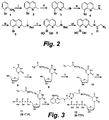
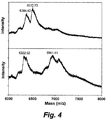
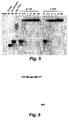
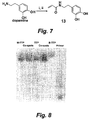

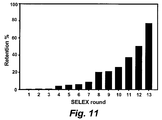


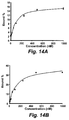
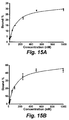

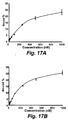
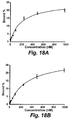
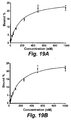
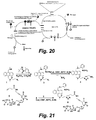
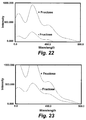
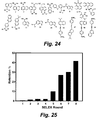
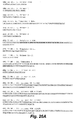
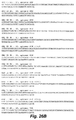
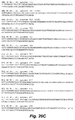
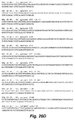
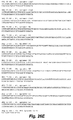
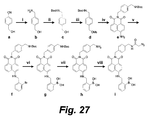
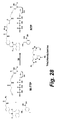
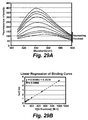
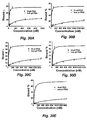
Classifications
-
- C—CHEMISTRY; METALLURGY
- C12—BIOCHEMISTRY; BEER; SPIRITS; WINE; VINEGAR; MICROBIOLOGY; ENZYMOLOGY; MUTATION OR GENETIC ENGINEERING
- C12N—MICROORGANISMS OR ENZYMES; COMPOSITIONS THEREOF; PROPAGATING, PRESERVING, OR MAINTAINING MICROORGANISMS; MUTATION OR GENETIC ENGINEERING; CULTURE MEDIA
- C12N15/00—Mutation or genetic engineering; DNA or RNA concerning genetic engineering, vectors, e.g. plasmids, or their isolation, preparation or purification; Use of hosts therefor
- C12N15/09—Recombinant DNA-technology
- C12N15/11—DNA or RNA fragments; Modified forms thereof; Non-coding nucleic acids having a biological activity
- C12N15/115—Aptamers, i.e. nucleic acids binding a target molecule specifically and with high affinity without hybridising therewith ; Nucleic acids binding to non-nucleic acids, e.g. aptamers
-
- C—CHEMISTRY; METALLURGY
- C07—ORGANIC CHEMISTRY
- C07H—SUGARS; DERIVATIVES THEREOF; NUCLEOSIDES; NUCLEOTIDES; NUCLEIC ACIDS
- C07H19/00—Compounds containing a hetero ring sharing one ring hetero atom with a saccharide radical; Nucleosides; Mononucleotides; Anhydro-derivatives thereof
- C07H19/02—Compounds containing a hetero ring sharing one ring hetero atom with a saccharide radical; Nucleosides; Mononucleotides; Anhydro-derivatives thereof sharing nitrogen
- C07H19/04—Heterocyclic radicals containing only nitrogen atoms as ring hetero atom
-
- C—CHEMISTRY; METALLURGY
- C07—ORGANIC CHEMISTRY
- C07H—SUGARS; DERIVATIVES THEREOF; NUCLEOSIDES; NUCLEOTIDES; NUCLEIC ACIDS
- C07H21/00—Compounds containing two or more mononucleotide units having separate phosphate or polyphosphate groups linked by saccharide radicals of nucleoside groups, e.g. nucleic acids
-
- C—CHEMISTRY; METALLURGY
- C07—ORGANIC CHEMISTRY
- C07H—SUGARS; DERIVATIVES THEREOF; NUCLEOSIDES; NUCLEOTIDES; NUCLEIC ACIDS
- C07H23/00—Compounds containing boron, silicon or a metal, e.g. chelates or vitamin B12
-
- C—CHEMISTRY; METALLURGY
- C12—BIOCHEMISTRY; BEER; SPIRITS; WINE; VINEGAR; MICROBIOLOGY; ENZYMOLOGY; MUTATION OR GENETIC ENGINEERING
- C12N—MICROORGANISMS OR ENZYMES; COMPOSITIONS THEREOF; PROPAGATING, PRESERVING, OR MAINTAINING MICROORGANISMS; MUTATION OR GENETIC ENGINEERING; CULTURE MEDIA
- C12N15/00—Mutation or genetic engineering; DNA or RNA concerning genetic engineering, vectors, e.g. plasmids, or their isolation, preparation or purification; Use of hosts therefor
- C12N15/09—Recombinant DNA-technology
- C12N15/10—Processes for the isolation, preparation or purification of DNA or RNA
- C12N15/1034—Isolating an individual clone by screening libraries
- C12N15/1048—SELEX
-
- G—PHYSICS
- G01—MEASURING; TESTING
- G01N—INVESTIGATING OR ANALYSING MATERIALS BY DETERMINING THEIR CHEMICAL OR PHYSICAL PROPERTIES
- G01N33/00—Investigating or analysing materials by specific methods not covered by groups G01N1/00 - G01N31/00
- G01N33/48—Biological material, e.g. blood, urine; Haemocytometers
- G01N33/50—Chemical analysis of biological material, e.g. blood, urine; Testing involving biospecific ligand binding methods; Immunological testing
- G01N33/68—Chemical analysis of biological material, e.g. blood, urine; Testing involving biospecific ligand binding methods; Immunological testing involving proteins, peptides or amino acids
-
- G—PHYSICS
- G01—MEASURING; TESTING
- G01N—INVESTIGATING OR ANALYSING MATERIALS BY DETERMINING THEIR CHEMICAL OR PHYSICAL PROPERTIES
- G01N33/00—Investigating or analysing materials by specific methods not covered by groups G01N1/00 - G01N31/00
- G01N33/48—Biological material, e.g. blood, urine; Haemocytometers
- G01N33/50—Chemical analysis of biological material, e.g. blood, urine; Testing involving biospecific ligand binding methods; Immunological testing
- G01N33/68—Chemical analysis of biological material, e.g. blood, urine; Testing involving biospecific ligand binding methods; Immunological testing involving proteins, peptides or amino acids
- G01N33/6893—Chemical analysis of biological material, e.g. blood, urine; Testing involving biospecific ligand binding methods; Immunological testing involving proteins, peptides or amino acids related to diseases not provided for elsewhere
-
- G—PHYSICS
- G01—MEASURING; TESTING
- G01N—INVESTIGATING OR ANALYSING MATERIALS BY DETERMINING THEIR CHEMICAL OR PHYSICAL PROPERTIES
- G01N33/00—Investigating or analysing materials by specific methods not covered by groups G01N1/00 - G01N31/00
- G01N33/48—Biological material, e.g. blood, urine; Haemocytometers
- G01N33/50—Chemical analysis of biological material, e.g. blood, urine; Testing involving biospecific ligand binding methods; Immunological testing
- G01N33/86—Chemical analysis of biological material, e.g. blood, urine; Testing involving biospecific ligand binding methods; Immunological testing involving blood coagulating time or factors, or their receptors
-
- C—CHEMISTRY; METALLURGY
- C12—BIOCHEMISTRY; BEER; SPIRITS; WINE; VINEGAR; MICROBIOLOGY; ENZYMOLOGY; MUTATION OR GENETIC ENGINEERING
- C12N—MICROORGANISMS OR ENZYMES; COMPOSITIONS THEREOF; PROPAGATING, PRESERVING, OR MAINTAINING MICROORGANISMS; MUTATION OR GENETIC ENGINEERING; CULTURE MEDIA
- C12N2310/00—Structure or type of the nucleic acid
- C12N2310/10—Type of nucleic acid
- C12N2310/16—Aptamers
-
- C—CHEMISTRY; METALLURGY
- C12—BIOCHEMISTRY; BEER; SPIRITS; WINE; VINEGAR; MICROBIOLOGY; ENZYMOLOGY; MUTATION OR GENETIC ENGINEERING
- C12N—MICROORGANISMS OR ENZYMES; COMPOSITIONS THEREOF; PROPAGATING, PRESERVING, OR MAINTAINING MICROORGANISMS; MUTATION OR GENETIC ENGINEERING; CULTURE MEDIA
- C12N2310/00—Structure or type of the nucleic acid
- C12N2310/30—Chemical structure
- C12N2310/33—Chemical structure of the base
Definitions
- the present disclosure relates to nucleotides, aptamers incorporating boronic acids, the manufacture of nucleotides and aptamers incorporating boronic acids, where the aptamers have enhanced affinity and specificity for glycosylated proteins.
- the disclosure further relates to methods of selectively detecting glycosylated species of proteins using aptamers incorporating boronic acids.
- PSA prostate specific antigen
- Pregnancy-related human chorionic gonadotropin can provide biomarkers for cancer, Down syndrome, and pregnancy failure depending on its glycosylation patterns ( Wang et al., Curr. Org. Chem., 2002. 6: 1285-1317 ; Gao et al., Org. Lett., 2003.
- Hp haptoglobin
- AFP alpha-fetoprotein
- glycosylation patterns in a given glycoprotein would be of value for the development of new diagnostics and biomedical research tools.
- analytical tools used for glycomics analysis include such as mass spectrometry, chromatography, especially capillary electrophoresis, antibody-based approaches, lectin profiling, and the like.
- mass spectrometry and chromatography methods are time-consuming. Lectin profiling is useful for broad category glycan characterizations, but it only focuses on the glycan portion and does not give any indication as to the identity of the protein in question.
- glycoproteins are usually needed for lectin-based characterizations in detail.
- cross-reactivity and low affinity are issues that may impede the application of lectins for highly specific characterizations.
- Molecules that can recognize a target glycoprotein with high affinity and specificity should preferably recognize both the glycan and the protein portions to be useful for glycoform-specific detection.
- antibodies and aptamer selection for the development of molecules of high specificity and affinity for glycoproteins do not have the intrinsic ability to specifically focus on the glycosylation sites in its native form, and allow for the ready differentiation of glycosylation variations.
- BTTP boronic-acid labelled thymidine 5' triphosphate nucleotide
- Aptamer selection is a very powerful method for the development of custom-made nucleic acid-based high affinity "binders” (aptamers) for molecules of interest. Since the beginning of this field, a large number of aptamers have been reported for various applications with some in clinical trials or approved for clinical use. As powerful as the method is, aptamer selection has limited intrinsic ability to selectively focus on certain substructures of a large biomacromolecule. Therefore, methods for selection of aptamers that can recognize a glycoprotein and be able to differentiate its glycosylation patterns will be advantageous for the development of novel types of diagnostics and therapeutics as well as analytical tools for biomedical research.
- the boronic acid moiety is a versatile functional group useful in carbohydrate recognition, glycoprotein pull-down, inhibition of hydrolytic enzymes, and boron neutron capture therapy.
- the incorporation of the boronic acid group into DNA as disclosed herein leads to molecules of various biological functions.
- boronic acid-label has been linked through a 14-atom tether to thymidine triphosphate (B-TTP) and the modified nucleotide was effectively incorporated into DNA by enzymatic polymerization.
- B-TTP thymidine triphosphate
- the synthesis of B-TTP was achieved using the Huisgen cycloaddition, although other conjugation methods are possible.
- DNA polymerase effectively recognizes the boronic acid-labeled DNA as the template for DNA polymerization, which allows PCR amplification of boronic acid-labeled DNA..
- boronic acid moiety into nucleic acid provides new aptamers directed against carbohydrates, glycoproteins, and glycolipids with specific focus on differentiating the carbohydrate portion.
- Boronic acid-aptamers with high specificity and affinity for certain carbohydrates and adjacent structures are suitable as tools for the rapid analysis of glycosylation patterns of proteins, peptides, and lipids.
- One aspect of the present disclosure encompasses modified mono-, di-, or triphosphorylated nucleotide monomers having a ribose or deoxyribose sugar moiety, and a nucleosidic base, where the base is modified by being linked, optionally through a tether, with a boronic acid.
- the boronic acid group may also be a fluorescent boronic acid that may also function as a label that allows detection of a modified nucleotide, or an oligonucleotide aptamer into which it has been incorporated.
- oligonucleotide aptamers comprising at least one modified nucleotide monomer having a ribose or deoxyribose sugar moiety, and a nucleosidic base (base) selected from adenine, cytosine, guanine, thymine, hypoxanthine, uracil, and the like, where the base is modified by being linked, optionally through a tether, with a boronic acid.
- the aptamers of the present disclosure are selected to have selective affinity for a target polypeptide or protein, and a glycosylation chain thereon. The aptamers of the present disclosure, therefore, selectively bind glycosylation sites of target polypeptides, where the glycosylation sites typically comprise a region of the polypeptide and a region of an attached glycan.
- Yet another aspect of the disclosure encompasses methods for isolating an aptamer having selective affinity for a target polypeptide and a glycan thereon, comprising: from a population of randomized oligonucleotides, where each oligonucleotide includes at least one nucleotide having a boronic acid label linked to a base thereon, selecting a first subpopulation of aptamers binding to a target glycosylated polypeptide or protein; amplifying the first subpopulation of aptamers without using boronic acid-modified TTP, and selecting from the amplification products thereof a second subpopulation of aptamers not binding to a glycosylated species of the target polypeptide or protein; amplifying the second subpopulation of aptamers using boronic acid-modified TTP, and thus providing a population of boronic acid-modified aptamers capable of selectively binding to a glycosylation site of a target polypeptide or protein.
- the counter-selection step of the aptamer selection methods of the disclosure by eliminating the boronic-acid modification to the thymidine bases that otherwise drives the binding of aptamers to the glycan, selects out those aptamers that can bind to the target polypeptide or protein, but not to the glycan. Additional counter-selection steps may also be used, such as selecting against blank beads, deglycosylated protein, or cross-reacting non-targeted (glyco)proteins.
- the aptamer selection methods may further comprise inserting a population of aptamers into a vector and isolating clones thereof; identifying a plurality of aptamer clones, where the aptamers have sequences differing from each other; determining the dissociation constants of the individual aptamers and the target glycosylated polypeptide or protein; comparing the dissociation constants of the aptamers to the dissociation constants of a control aptamer not having a boronic acid thereon; and selecting one or more aptamers having a lower dissociation constant than the control.
- the selected aptamers can have enhanced selective affinity for a glycosylated site of the target glycosylated polypeptide compared to control aptamers having identical nucleotide sequences to those of the selected aptamers, but not having a boronic acid group thereon.
- Another aspect of the disclosure provides methods of selectively detecting the glycosylation status of a target polypeptide, comprising: providing a subject target polypeptide or protein; contacting the target polypeptide with an aptamer population capable of selectively binding a glycosylation site of the target polypeptide or protein under conditions whereupon, if the glycosylation site is present on the target polypeptide the aptamer will bind thereto; isolating the bound aptamers from unbound aptamers; and detecting the population of bound aptamers, thereby detecting the presence of the glycosylation site on the target polypeptide.
- the subject target polypeptide is selected from the group consisting of an isolated polypeptide or a fragment thereof, a polypeptide of a cell or tissue of an animal or plant, and a cultured cell.
- Embodiments of the present disclosure will employ, unless otherwise indicated, techniques of medicine, organic chemistry, biochemistry, molecular biology, pharmacology, and the like, which are within the skill of the art. Such techniques are explained fully in the literature.
- compositions comprising, “comprising,” “containing” and “having” and the like can have the meaning ascribed to them in U.S. patent law and can mean “ includes,” “including,” and the like; “consisting essentially of” or “consists essentially” or the like, when applied to methods and compositions encompassed by the present disclosure refers to compositions like those disclosed herein, but which may contain additional structural groups, composition components or method steps (or analogs or derivatives thereof as discussed above).
- compositions or methods do not materially affect the basic and novel characteristic(s) of the compositions or methods, compared to those of the corresponding compositions or methods disclosed herein.
- Consisting essentially of or “consists essentially” or the like, when applied to methods and compositions encompassed by the present disclosure have the meaning ascribed in U.S. Patent law and the term is open-ended, allowing for the presence of more than that which is recited so long as basic or novel characteristics of that which is recited is not changed by the presence of more than that which is recited, but excludes prior art embodiments.
- aptamer refers to an isolated nucleic acid molecule that binds with high specificity and affinity to a target molecule, such as a protein, polypeptide, lipid, glycoprotein, glycolipid, glycopeptide, saccharide, or polysaccharide.
- a target molecule such as a protein, polypeptide, lipid, glycoprotein, glycolipid, glycopeptide, saccharide, or polysaccharide.
- An aptamer is a three-dimensional structure held in certain conformation(s) that provide intermolecular contacts to specifically bind its given target.
- aptamers are nucleic acid based molecules, there is a fundamental difference between aptamers and other nucleic acid molecules such as genes and mRNA. In the latter, the nucleic acid structure encodes information through its linear base sequence and thus this sequence is of importance to the function of information storage.
- aptamer function which is based upon the specific binding of a target molecule, is not entirely dependent on a linear base sequence (a non-coding sequence), but rather a particular secondary/tertiary/quaternary structure. Any coding potential that an aptamer may possess is generally entirely fortuitous and does not contribute to the binding of an aptamer to its cognate target.
- Aptamers must also be differentiated from the naturally occurring nucleic acid sequences that bind to certain proteins. These latter sequences generally are naturally occurring sequences embedded within the genome of the organism that bind to a specialized sub-group of proteins or polypeptides, or their derivatives, that are involved in the transcription, translation, and transportation of naturally occurring nucleic acids, i.e., protein-binding nucleic acids. Aptamers on the other hand are short, isolated, non-naturally occurring nucleic acid molecules. While aptamers can be identified that bind nucleic acid-binding proteins, in most cases such aptamers have little or no sequence identity to the sequences recognized by the nucleic acid-binding proteins in nature.
- aptamers can be selected to bind virtually any protein (not just nucleic acid-binding proteins) as well as almost any target of interest including small molecules, carbohydrates, peptides, etc.
- a naturally occurring nucleic acid sequence to which it binds does not exist.
- nucleic acid-binding proteins such sequences will differ from aptamers as a result of the relatively low binding affinity used in nature as compared to tightly binding aptamers.
- Aptamers are capable of specifically binding to selected targets and modulating the target's activity or binding interactions, e.g ., through binding, aptamers may block their target's ability to function.
- the functional property of specific binding to a target is an inherent property an aptamer.
- a typical aptamer is 6-35 kDa in size (20-100 nucleotides), binds its target with micromolar to sub-nanomolar affinity, and may discriminate against closely related targets (e.g., aptamers may selectively bind related proteins from the same gene family).
- Aptamers are capable of using intermolecular interactions such as hydrogen bonding, electrostatic complementarities, hydrophobic contacts, and steric exclusion to bind with a specific target.
- aptamers also employ boronic acid-Lewis base/nucleophile (such as hydroxyl groups, diols, and amino groups) interactions for binding. Aptamers have a number of desirable characteristics for use as therapeutics and diagnostics including high specificity and affinity, low immunogenicity, biological efficacy, and excellent pharmacokinetic properties.
- the compounds described herein may be prepared as a single isomer (e.g., enantiomer, cis-trans, positional, diastereomer) or as a mixture of isomers.
- the compounds are prepared as substantially a single isomer.
- Methods of preparing substantially isomerically pure compounds are known in the art.
- enantiomerically enriched mixtures and pure enantiomeric compounds can be prepared by using synthetic intermediates that are enantiomerically pure in combination with reactions that either leave the stereochemistry at a chiral center unchanged or result in its complete inversion.
- the final product or intermediates along the synthetic route can be resolved into a single stereoisomer.
- resonance stabilization may permit a formal electronic charge to be distributed over the entire molecule. While a particular charge may be depicted as localized on a particular ring system, or a particular heteroatom, it is commonly understood that a comparable resonance structure can be drawn in which the charge may be formally localized on an alternative portion of the compound.
- substituent groups are specified by their conventional chemical formulae, written from left to right, they equally encompass the chemically identical substituents, which would result from writing the structure from right to left, e.g., -CH 2 O- is intended to also recite -OCH 2 -.
- acyl or "alkanoyl” by itself or in combination with another term, means, unless otherwise stated, a stable straight or branched chain, or cyclic hydrocarbon radical, or combinations thereof, consisting of the stated number of carbon atoms and an acyl radical on at least one terminus of the alkane radical.
- the "acyl radical” is the group derived from a carboxylic acid by removing the -OH moiety therefrom.
- alkyl by itself or as part of another substituent means, unless otherwise stated, a straight or branched chain, or cyclic hydrocarbon radical, or combination thereof, which may be fully saturated, mono- or polyunsaturated and can include divalent (“alkylene”) and multivalent radicals, having the number of carbon atoms designated (i.e. C 1 -C 10 means one to ten carbons).
- saturated hydrocarbon radicals include, but are not limited to, groups such as methyl, ethyl, n-propyl, isopropyl, n-butyl, t-butyl, isobutyl, sec-butyl, cyclohexyl, (cyclohexyl)methyl, cyclopropylmethyl, homologs and isomers of, for example, n-pentyl, n-hexyl, n-heptyl, n-octyl, and the like.
- An unsaturated alkyl group is one having one or more double bonds or triple bonds.
- alkyl groups examples include, but are not limited to, vinyl, 2-propenyl, crotyl, 2-isopentenyl, 2-(butadienyl), 2,4-pentadienyl, 3-(1,4-pentadienyl), ethynyl, 1- and 3-propynyl, 3-butynyl, and the higher homologs and isomers.
- alkyl unless otherwise noted, is also meant to include those derivatives of alkyl defined in more detail below, such as “heteroalkyl.” Alkyl groups that are limited to hydrocarbon groups are termed "homoalkyl".
- alkyl groups of use in the present disclosure contain between about one and about twenty five carbon atoms (e.g., methyl, ethyl and the like). Straight, branched or cyclic hydrocarbon chains having eight or fewer carbon atoms will also be referred to herein as "lower alkyl”.
- alkyl as used herein further includes one or more substitutions at one or more carbon atoms of the hydrocarbon chain fragment.
- amino refers to the group -NR'R" (or NRR'R") where R, R' and R" are independently selected from the group consisting of hydrogen, alkyl, substituted alkyl, aryl, substituted aryl, aryl alkyl, substituted aryl alkyl, heteroaryl, and substituted heteroaryl.
- a substituted amine being an amine group wherein R' or R" is other than hydrogen. In a primary amino group, both R' and R" are hydrogen, whereas in a secondary amino group, either, but not both, R' or R” is hydrogen.
- the terms “amine” and “amino” can include protonated and quaternized versions of nitrogen, comprising the group -NRR'R" and its biologically compatible anionic counterions.
- aryl refers to cyclic aromatic carbon chain having twenty or fewer carbon atoms, e.g., phenyl, naphthyl, biphenyl, and anthracenyl.
- One or more carbon atoms of the aryl group may also be substituted with, e.g., alkyl; aryl; heteroaryl; a halogen; nitro; cyano; hydroxyl, alkoxyl or aryloxyl; thio or mercapto, alkyl-, or arylthio; amino, alkylamino, arylamino, dialkyl-, diaryl-, or arylalkylamino; aminocarbonyl, alkylaminocarbonyl, arylaminocarbonyl, dialkylaminocarbonyl, diarylaminocarbonyl, or arylalkylaminocarbonyl; carboxyl, or alkyl- or aryloxycarbonyl; aldehyde
- alkyl or heteroalkyl substituents of an aryl group may be combined to form fused aryl-alkyl or aryl-heteroalkyl ring systems (e.g., tetrahydronaphthyl).
- aryl-alkyl or aryl-heteroalkyl ring systems e.g., tetrahydronaphthyl.
- Substituents including heterocyclic groups e.g., heteroaryloxy, and heteroaralkylthio
- heterocyclic groups e.g., heteroaryloxy, and heteroaralkylthio
- alkoxy alkylamino
- alkylthio or thioalkoxy
- heteroalkyl by itself or in combination with another term, means, unless otherwise stated, a straight or branched chain, or cyclic carbon-containing radical, or combinations thereof, consisting of the stated number of carbon atoms and at least one heteroatom selected from the group consisting of O, N, Si, P, S, and Se, and wherein the nitrogen, phosphorous, sulfur, and selenium atoms are optionally oxidized, and the nitrogen heteroatom is optionally be quaternized.
- the heteroatom(s) O, N, P, S, Si, and Se may be placed at any interior position of the heteroalkyl group or at the position at which the alkyl group is attached to the remainder of the molecule.
- heteroalkylene by itself or as part of another substituent means a divalent radical derived from heteroalkyl, as exemplified, but not limited by, -CH 2 -CH 2 -S-CH 2 -CH 2 - and -CH 2 -S-CH 2 -CH 2 -NH-CH 2 -.
- heteroatoms can also occupy either or both of the chain termini (e.g., alkyleneoxy, alkylenedioxy, alkyleneamino, alkylenediamino, and the like). Still further, for alkylene and heteroalkylene linking groups, no orientation of the linking group is implied by the direction in which the formula of the linking group is written. For example, the formula -C(O) 2 R'-represents both -C(O) 2 R'- and -R'C(O) 2 -.
- cycloalkyl and “heterocycloalkyl”, by themselves or in combination with other terms, represent, unless otherwise stated, cyclic versions of “alkyl” and “heteroalkyl”, respectively. Additionally, for heterocycloalkyl, a heteroatom can occupy the position at which the heterocycle is attached to the remainder of the molecule. Examples of cycloalkyl include, but are not limited to, cyclopentyl, cyclohexyl, 1-cyclohexenyl, 3-cyclohexenyl, cycloheptyl, and the like.
- heterocycloalkyl examples include, but are not limited to, 1-(1,2,5,6-tetrahydropyridyl), 1-piperidinyl, 2-piperidinyl, 3-piperidinyl, 4-morpholinyl, 3-morpholinyl, tetrahydrofuran-2-yl, tetrahydrofuran-3-yl, tetrahydrothien-2-yl, tetrahydrothien-3-yl, 1-piperazinyl, 2-piperazinyl, and the like.
- aryl means, unless otherwise stated, a polyunsaturated, aromatic moiety that can be a single ring or multiple rings (preferably from 1 to 3 rings), which are fused together or linked covalently.
- heteroaryl refers to aryl groups (or rings) that contain from one to four heteroatoms selected from N, O, S, and Se, wherein the nitrogen, sulfur, and selenium atoms are optionally oxidized, and the nitrogen atom(s) are optionally quaternized.
- a heteroaryl group can be attached to the remainder of the molecule through a heteroatom.
- Non-limiting examples of aryl and heteroaryl groups include phenyl, 1-naphthyl, 2-naphthyl, 4-biphenyl, 1-pyrrolyl, 2-pyrrolyl, 3-pyrrolyl, 3-pyrazolyl, 2-imidazolyl, 4-imidazolyl, pyrazinyl, 2-oxazolyl, 4-oxazolyl, 2-phenyl-4-oxazolyl, 5-oxazolyl, 3-isoxazolyl, 4-isoxazolyl, 5-isoxazolyl, 2-thiazolyl, 4-thiazolyl, 5-thiazolyl, 2-furyl, 3-furyl, 2-thienyl, 3-thienyl, 2-pyridyl, 3-pyridyl, 4-pyridyl, 2-pyrimidyl, 4-pyrimidyl, 5-benzothiazolyl, purinyl, 2-benzimidazolyl, 5-indolyl, 1-isoquinoly
- aryl when used in combination with other terms (e.g., aryloxy, arylthioxy, arylalkyl) includes both aryl and heteroaryl rings as defined above.
- arylalkyl is meant to include those radicals in which an aryl group is attached to an alkyl group (e.g., benzyl, phenethyl, pyridylmethyl and the like) including those alkyl groups in which a carbon atom (e.g., a methylene group) has been replaced by, for example, an oxygen atom (e.g., phenoxymethyl, 2-pyridyloxymethyl, 3-(1-naphthyloxy)propyl, and the like).
- alkyl group e.g., benzyl, phenethyl, pyridylmethyl and the like
- an oxygen atom e.g., phenoxymethyl, 2-pyridyloxymethyl, 3-(1-naph
- R', R", R'" and R" each preferably independently refer to hydrogen, substituted or unsubstituted heteroalkyl, substituted or unsubstituted aryl, e.g., aryl substituted with 1-3 halogens, substituted or unsubstituted alkyl, alkoxy or thioalkoxy groups, or arylalkyl groups.
- each of the R groups is independently selected as are each R', R", R"' and R"" groups when more than one of these groups is present.
- R' and R" are attached to the same nitrogen atom, they can be combined with the nitrogen atom to form a 5-, 6-, or 7-membered ring.
- -NR'R is meant to include, but not be limited to, 1-pyrrolidinyl and 4-morpholinyl.
- alkyl is meant to include groups including carbon atoms bound to groups other than hydrogen groups, such as haloalkyl (e.g., -CF 3 and -CH 2 CF 3 ) and acyl (e.g., -C(O)CH 3 , -C(O)CF 3 , -C(O)CH 2 OCH 3 , and the like).
- substituents for the aryl and heteroaryl groups are generically referred to as "aryl group substituents.”
- each of the R groups is independently selected as are each R', R", R'" and R"" groups when more than one of these groups is present.
- the symbol X represents "R" as described above.
- Two of the substituents on adjacent atoms of the aryl or heteroaryl ring may optionally be replaced with a substituent of the formula -T-C(O)-(CRR')q-U-, wherein T and U are independently -NR-, -O-, -CRR'- or a single bond, and q is an integer of from 0 to 3.
- two of the substituents on adjacent atoms of the aryl or heteroaryl ring may optionally be replaced with a substituent of the formula -A-(CH 2 )r-B-, wherein A and B are independently -CRR'-, -O-, -NR-, -S-, -S(O)-, -S(O) 2 -, -S(O) 2 NR'- or a single bond, and r is an integer of from 1 to 4.
- One of the single bonds of the new ring so formed may optionally be replaced with a double bond.
- two of the substituents on adjacent atoms of the aryl or heteroaryl ring may optionally be replaced with a substituent of the formula-(CRR')s-X-(CR"R"')d-, where s and d are independently integers of from 0 to 3, and X is -O-, -NR'-, -S-, -S(O)-, -S(O) 2 -, or -S(O) 2 NR'-.
- the substituents R, R', R" and R"' are preferably independently selected from hydrogen or substituted or unsubstituted (C1-C6)alkyl.
- heteroatom includes oxygen (O), nitrogen (N), sulfur (S), phosphorus (P), silicon (Si), and selenium (Se).
- amino refers to the group -NR'R" (or N + RR'R") where R, R' and R" are independently selected from the group consisting of hydrogen, alkyl, substituted alkyl, aryl, substituted aryl, aryl alkyl, substituted aryl alkyl, heteroaryl, and substituted heteroaryl.
- a substituted amine being an amine group wherein R' or R" is other than hydrogen. In a primary amino group, both R' and R" are hydrogen, whereas in a secondary amino group, either, but not both, R' or R” is hydrogen.
- the terms “amine” and “amino” can include protonated and quaternized versions of nitrogen, comprising the group -N + RR'R" and its biologically compatible anionic counterions.
- aqueous solution refers to a solution that is predominantly water and retains the solution characteristics of water. Where the aqueous solution contains solvents in addition to water, water is typically the predominant solvent.
- Carboxyalkyl refers to a group having the general formula - (CH 2 ) n COOH, where n is 1-18.
- activated alkyne refers to a chemical moiety that selectively reacts with an alkyne reactive group, such as an azido moiety or an phosphine moiety, on another molecule to form a covalent chemical bond between the activated alkyne group and the alkyne reactive group.
- alkyne-reactive groups include azides.
- Alkyne-reactive can also refer to a molecule that contains a chemical moiety that selectively reacts with an alkyne group.
- activated alkyne encompasses any terminal alkynes or cyclooctynes (dipolarophiles) that will react with 1,3-dipoles such as azides in a facile fashion.
- azide reactive refers to a chemical moiety that selectively reacts with an azido modified group on another molecule to form a covalent chemical bond between the azido modified group and the azide reactive group.
- azide-reactive groups include alkynes and phosphines (e.g., triaryl phosphine).
- Azide-reactive can also refer to a molecule that contains a chemical moiety that selectively reacts with an azido group.
- click chemistry refers to the Huisgen cycloaddition or the 2,3-dipolar cycloaddition between an azide and a terminal alkyne to form a 1,2,4-triazole.
- Such chemical reactions can use, but are not limited to, simple heteroatomic organic reactants and are reliable, selective, stereospecific, and exothermic.
- cycloaddition refers to a chemical reaction in which two or more ⁇ -electron systems (e.g., unsaturated molecules or unsaturated parts of the same molecule) combine to form a cyclic product in which there is a net reduction of the bond multiplicity.
- ⁇ -electron systems e.g., unsaturated molecules or unsaturated parts of the same molecule
- the ⁇ -electrons are used to form new sigma bonds.
- the product of a cycloaddition is called an "adduct" or "cycloadduct”.
- Different types of cycloadditions are known in the art including, but not limited to, [3+2] cycloadditions and Diels-Alder reactions.
- [3+2] cycloadditions which are also called 2,3-dipolar cycloadditions, occur between a 1,3-dipole and a dipolarophile and are typically used for the construction of five-membered heterocyclic rings.
- isolated when used herein in reference to a nucleic acid polymer, means a nucleic acid polymer, which by virtue of its origin or manipulation is separated from at least some of the components with which it is naturally associated or with which it is associated when initially obtained.
- isolated it is alternatively or additionally meant that the nucleic acid polymer of interest is produced or synthesized by the hand of man.
- linker refers to a single covalent bond or a series of stable covalent bonds incorporating 1-30 nonhydrogen atoms selected from the group consisting of C, N, O, S and P.
- the linker may covalently attach a carrier molecule or solid support or a boronic acid moiety to the present azido or activated alkyne modified nucleotides or nucleic acid polymers.
- Exemplary linking members include a moiety that includes -C(O)NH-, -C(O)O-, -NH-, -S-, -O-, and the like.
- reactive group refers to a group that is capable of reacting with another chemical group to form a covalent bond, i.e., is covalently reactive under suitable reaction conditions, and generally represents a point of attachment for another substance.
- reactive groups refer to chemical moieties generally found in biological systems and that react under normal biological conditions, these are herein distinguished from the chemical handle, defined above, the azido and activated alkyne moieties of the present disclosure.
- the reactive group is a moiety, such as carboxylic acid or succinimidyl ester, that is capable of chemically reacting with a functional group on a different compound to form a covalent linkage.
- Reactive groups generally include nucleophiles, electrophiles and photoactivatable groups.
- reporter molecule refers to any moiety capable of being attached to a carrier molecule or solid support, such as a modified nucleotide or nucleic acid polymer, and detected either directly or indirectly.
- Reporter molecules include, without limitation, a chromophore, a fluorophore, a fluorescent protein, a phosphorescent dye, a tandem dye, a particle, a hapten, an enzyme and a radioisotope.
- Preferred reporter molecules include fluorophores, fluorescent proteins, haptens, and enzymes.
- sample refers to any material that may contain an analyte for detection or quantification or a modified nucleotide or nucleic acid polymer.
- the analyte may include a reactive group, e.g., a group through which a compound of the disclosure can be conjugated to the analyte.
- the sample may also include diluents, buffers, detergents, and contaminating species, debris and the like that are found mixed with the target.
- Illustrative examples include urine, sera, blood plasma, total blood, saliva, tear fluid, cerebrospinal fluid, secretory fluids from nipples and the like.
- the sample is a live cell, a biological fluid that comprises endogenous host cell proteins, nucleic acid polymers, nucleotides, oligonucleotides, peptides and buffer solutions.
- the sample may be in an aqueous solution, a viable cell culture or immobilized on a solid or semi solid surface such as a polyacrylamide gel, membrane blot or on a microarray.
- solid support refers to a material that is substantially insoluble in a selected solvent system, or which can be readily separated (e.g., by precipitation) from a selected solvent system in which it is soluble.
- Solid supports useful in practicing the present disclosure can include groups that are activated or capable of activation to allow selected one or more compounds described herein to be bound to the solid support.
- boronic acid refers to an alkyl or aryl substituted boronic acid containing a boron-carbon chemical bond.
- Boronic acid groups that may be used in the compositions of the present disclosure include, but are not limited to, arylboronic acids such as phenylboronic acids, naphthalenylboronic acids, quinolinylboronic acids, pyridinylboronic acids, furanylboronic acids, thiophenylboronic acids, indolylboronic acids, 1,8-naphthalimide-based boronic acids, and ⁇ -amidoalkylboronic acids.
- arylboronic acids such as phenylboronic acids, naphthalenylboronic acids, quinolinylboronic acids, pyridinylboronic acids, furanylboronic acids, thiophenylboronic acids, indolylboronic acids, 1,8-naphthalimide-based boronic acids, and ⁇ -a
- the boronic acid group can include, but is not limited to, fluorescent boronic acid groups as shown in Fig. 24 , for example.
- the boronic acid group can include phenylboronic acid, naphthalenylboronic acid, quinolin-4-ylboronic acid, quinolin-5-ylboronic acid, quinolin-8-ylboronic acid, pyridinylboronic acid, furan-2-ylboronic acid, and thiophen-2-ylboronic acid.
- glycosylation can dramatically affect the physical properties of proteins and can also be important in protein stability, secretion, and subcellular localization. Proper glycosylation can be essential for biological activity. In fact, some genes from eukaryotic organisms, when expressed in bacteria (e.g., E. coli ) which lack certain cellular processes for glycosylating proteins, yield proteins that are recovered with little or no activity by virtue of their lack of glycosylation.
- bacteria e.g., E. coli
- Glycosylation occurs at specific locations along the polypeptide backbone and is usually of two types: O -linked oligosaccharides are attached to serine or threonine residues while N -linked oligosaccharides are attached to asparagine residues when they are part of the sequence Asn-X-Ser/Thr, where X can be any amino acid except proline.
- the structures of N -linked and O -linked oligosaccharides and the sugar residues found in each type are different.
- One type of sugar that is commonly found on both is N -acetylneuraminic acid (hereafter referred to as sialic acid).
- sialic acid is usually the terminal residue of both N- linked and O -linked oligosaccharides and, by virtue of its negative charge, may confer acidic properties to the glycoprotein.
- glycosylation site refers to a location on a polypeptide that has a glycan chain attached thereto.
- the "site” may be an amino acid side-chain, or a plurality of side-chains (either contiguous in the amino acid sequence or in cooperative vicinity to one another to define a specific site associated with at least one glycosylation chain).
- glycosylation site as used herein further refers to a combination of a region of a polypeptide, and a region of a glycan chain attached to the polypeptide. Both regions may be recognized as binding, or affinity, sites by an aptamer having a specific affinity for the glycosylated species of the peptide.
- an aptamer having a boronic acid group(s) will have enhanced affinity for the glycosylation chain compared to an aptamer having the same nucleotide sequence but not having a boronic acid group thereon. Both aptamers will have affinity for the region of the polypeptide that is included in the glycosylation site.
- oligonucleotide and “polynucleotide” generally refer to any polyribonucleotide or polydeoxribonucleotide that may be unmodified RNA or DNA or modified RNA or DNA.
- polynucleotides as used herein refers to, among others, single-and double-stranded DNA, DNA that is a mixture of single-and double-stranded regions, single- and double-stranded RNA, and RNA that is mixture of single- and double-stranded regions, hybrid molecules comprising DNA and RNA that may be single-stranded or, more typically, double-stranded or a mixture of single- and double-stranded regions.
- nucleic acid also encompass a polynucleotide as defined above.
- aptamers are single-stranded oligonucleotides comprising between about 7 to about 100 nucleotides.
- polynucleotide includes DNAs or RNAs as described above that may contain one or more modified bases.
- DNAs or RNAs with backbones modified for stability or for other reasons are "polynucleotides" as that term is intended herein.
- DNAs or RNAs comprising unusual bases, such as inosine, or modified bases such as, but not limited to, thymidine or uracil having a boronic acid group thereon are polynucleotides as the term is used herein.
- vector means a DNA molecule serving as a vehicle capable of stably carrying exogeneous nucleic acid into host cells.
- a vector should be replicapable, have a system for introducing itself into a host cell, and possess selectable markers.
- polynucleotide as it is employed herein embraces such chemically, enzymatically, or metabolically modified forms of polynucleotides, as well as the chemical forms of DNA and RNA characteristic of viruses and cells, including simple and complex cells, inter alia.
- a polynucleotide sequence of the present disclosure may be identical to the reference sequence, that is be 100% identical, or it may include up to a certain integer number of nucleotide alterations as compared to the reference sequence.
- Such alterations are selected from the group including at least one nucleotide deletion, substitution, including transition and transversion, or insertion, and wherein said alterations may occur at the 5' or 3' terminus positions of the reference nucleotide sequence or anywhere between those terminus positions, interspersed either individually among the nucleotides in the reference sequence or in one or more contiguous groups within the reference sequence.
- the number of nucleotide alterations is determined by multiplying the total number of nucleotides in the reference nucleotide by the numerical percent of the respective percent identity (divided by 100) and subtracting that product from said total number of nucleotides in the reference nucleotide.
- nucleotide refers to a sub-unit of a nucleic acid (whether DNA or RNA, or an analogue thereof) which includes, but is not limited to, a phosphate ester group, a sugar group and a nitrogen-containing base (alternatively referred to as a nucleoside), as well as analogs of such sub-units.
- Other groups e.g., protecting groups
- can be attached to the sugar group and nitrogen containing base group including, but not limited to, a boronic acid group according to the present disclosure, a radioactive or fluorescent substituent, a dye and the like.
- nucleoside references a nucleic acid subunit including a sugar group and a nitrogen containing base.
- nucleotide is used herein to describe embodiments of the disclosure, but that one skilled in the art would understand that the term “nucleoside” and “nucleotide” are interchangeable in many instances. One skilled in the art would have the understanding that additional modifications to a nucleoside may be necessary, and one skilled in the art has such knowledge.
- nucleotide monomer refers to a molecule which is not incorporated in a larger oligo- or poly-nucleotide chain and which corresponds to a single nucleotide sub-unit; nucleotide monomers may also have activating or protecting groups, if such groups are necessary for the intended use of the nucleotide monomer.
- nucleotide and nucleoside will include those moieties which contain not only the naturally occurring purine and pyrimidine bases, e.g ., adenine (A), thymine (T), cytosine (C), guanine (G), or uracil (U), but also modified purine and pyrimidine bases and other heterocyclic bases which have been modified (these moieties are sometimes referred to herein, collectively, as “purine and pyrimidine bases and analogs thereof").
- purine and pyrimidine bases e.g adenine (A), thymine (T), cytosine (C), guanine (G), or uracil (U)
- purine and pyrimidine bases and other heterocyclic bases which have been modified
- Such modifications include, e.g ., diaminopurine and its derivatives, inosine and its derivatives, alkylated purines or pyrimidines, acylated purines or pyrimidines thiolated purines or pyrimidines, selenium-modified nucleosidic bases, and the like, or the addition of a protecting group such as acetyl, difluoroacetyl, trifluoroacetyl, isobutyryl, benzoyl, 9-fluorenylmethoxycarbonyl, phenoxyacetyl, dimethylformamidine, N,N-diphenyl carbamate, or the like.
- the purine or pyrimidine base may also be an analog of the foregoing; suitable analogs will be known to those skilled in the art and are described in the pertinent texts and literature.
- Common analogs include, but are not limited to, 1-methyladenine; 2-methyladenine; N6-methyladenine; N6-isopentyladenine; 2-methylthio-N6-isopentyladenine; N,N-dimethyladenine; 8-bromoadenine; 2-thiocytosine; 3-methylcytosine; 5-methylcytosine; 5-ethylcytosine; 4-acetylcytosine; 1-methylguanine; 2-methylguanine; 7-methylguanine; 2,2-dimethylguanine; 8-bromoguanine; 8-chloroguanine; 8-aminoguanine; 8-methylguanine; 8-thioguanine; 5-fluorouracil; 5-bromouracil; 5-chlorouracil; 5-iodouracil; 5-ethyluracil; 5-propyluracil; 5-methoxyuracil; 5-hydroxymethyluracil; 5-(carboxyhydroxymethyl)uracil
- randomized oligonucleotide aptamer refers to a population of oligonucleotides wherein, at the same nucleotide position in each sequence, the nucleotide is adenine, guanine, cytosine or thymine.
- hybridization refers to the process of association of two nucleic acid strands to form an antiparallel duplex stabilized by means of hydrogen bonding between residues of the opposite nucleic acid strands.
- Hybridizing and binding with respect to polynucleotides, are used interchangeably.
- the terms “hybridizing specifically to” and “specific hybridization” and “selectively hybridize to,” as used herein refer to the binding, duplexing, or hybridizing of a nucleic acid molecule preferentially to a particular nucleotide sequence under stringent conditions.
- target refers to a glycopolypeptide or glycoprotein, for which it is desired to detect or analyze the glycosylation status thereof.
- the target glycopolypeptide or protein for use in the methods herein disclosed may be an isolated glycopolypeptide or glycoprotein, a glycopolypeptide or protein immobilized on a solid support or in free solution.
- the target glycopolypeptide or protein may be on a cell surface, the cell being isolated from a plant or animal host, a cultured cell or a cell or population of cells in a tissue of a plant or animal.
- polypeptide includes proteins and fragments thereof. Polypeptides are disclosed herein as amino acid residue sequences. Those sequences are written left to right in the direction from the amino to the carboxy terminus. In accordance with standard nomenclature, amino acid residue sequences are denominated by either a three letter or a single letter code as indicated as follows: Alanine (Ala, A), Arginine (Arg, R), Asparagine (Asn, N), Aspartic Acid (Asp, D), Cysteine (Cys, C), Glutamine (Gln, Q), Glutamic Acid (Glu, E), Glycine (Gly, G), Histidine (His, H), Isoleucine (Ile, I), Leucine (Leu, L), Lysine (Lys, K), Methionine (Met, M), Phenylalanine (Phe, F), Proline (Pro, P), Serine (Ser, S), Threonine (Thr, T), Tryptophan (
- Variant refers to a polypeptide or polynucleotide that differs from a reference polypeptide or polynucleotide, but retains essential properties.
- a typical variant of a polypeptide differs in amino acid sequence from another, reference polypeptide. Generally, differences are limited so that the sequences of the reference polypeptide and the variant are closely similar overall and, in many regions, identical.
- a variant and reference polypeptide may differ in amino acid sequence by one or more modifications (e.g., substitutions, additions, and/or deletions).
- a variant of a polypeptide includes conservatively modified variants.
- a substituted or inserted amino acid residue may or may not be one encoded by the genetic code.
- a variant of a polypeptide may be naturally occurring, such as an allelic variant, or it may be a variant that is not known to occur naturally.
- conservative substitutions refers to modifications of a polypeptide that involve the substitution of one or more amino acids for amino acids having similar biochemical properties that do not result in change or loss of a biological or biochemical function of the polypeptide. These "conservative substitutions" are likely to have minimal impact on the activity of the resultant protein.
- Amino acids that may be substituted for an original amino acid in a protein and which are generally regarded as conservative substitutions are (original residue: conservative substitution): Ala: ser; Arg: lys; Asn: gin, his; Asp: glu; Cys: ser; Gin: asn; Glu: asp; Gly: pro; His: asn, gin; Ile: leu, val; Leu: ile, val; Lys: arg, gin; Met: leu, ile; Phe: met, leu, tyr; Ser: thr; Thr: ser; Trp: tyr; Tyr: trp, phe; Val: ile, leu.
- One or more conservative changes can be made in a polypeptide without changing a biochemical function of the polypeptide.
- one or more conservative changes can be made in a Vstat40 or Vstat120 polypeptide without changing its ability to bind to CD36.
- the hydropathic index of amino acids can be considered.
- the importance of the hydropathic amino acid index in conferring interactive biologic function on a polypeptide is generally understood in the art. It is known that certain amino acids can be substituted for other amino acids having a similar hydropathic index or score and still result in a polypeptide with similar biological activity. Each amino acid has been assigned a hydropathic index on the basis of its hydrophobicity and charge characteristics.
- Those indices are: isoleucine (+4.5); valine (+4.2); leucine (+3.8); phenylalanine (+2.8); cysteine/cysteine (+2.5); methionine (+1.9); alanine (+1.8); glycine (-0.4); threonine (-0.7); serine (-0.8); tryptophan (-0.9); tyrosine (-1.3); proline (-1.6); histidine (-3.2); glutamate (-3.5); glutamine (-3.5); aspartate (-3.5); asparagine (-3.5); lysine (-3.9); and arginine (-4.5).
- the relative hydropathic character of the amino acid determines the secondary structure of the resultant polypeptide, which in turn defines the interaction of the polypeptide with other molecules, such as enzymes, substrates, receptors, antibodies, antigens, and the like. It is known in the art that an amino acid can be substituted by another amino acid having a similar hydropathic index and still obtain a functionally equivalent polypeptide. In such changes, the substitution of amino acids whose hydropathic indices are within ⁇ 2 is preferred, those within ⁇ 1 are particularly preferred, and those within ⁇ 0.5 are even more particularly preferred.
- hydrophilicity can also be made on the basis of hydrophilicity, particularly, where the biological functional equivalent polypeptide or peptide thereby created is intended for use in immunological embodiments.
- the following hydrophilicity values have been assigned to amino acid residues: arginine (+3.0); lysine (+3.0); aspartate (+3.0 ⁇ 1); glutamate (+3.0 ⁇ 1); serine (+0.3); asparagine (+0.2); glutamnine (+0.2); glycine (0); proline (-0.5 ⁇ 1); threonine (-0.4); alanine (-0.5); histidine (-0.5); cysteine (-1.0); methionine (-1.3); valine (-1.5); leucine (-1.8); isoleucine (-1.8); tyrosine (-2.3); phenylalanine (-2.5); tryptophan (-3.4).
- an amino acid can be substituted for another having a similar hydrophilicity value and still obtain a biologically equivalent, and in particular, an immunologically equivalent polypeptide.
- substitution of amino acids whose hydrophilicity values are within ⁇ 2 is preferred, those within ⁇ 1 are particularly preferred, and those within ⁇ 0.5 are even more particularly preferred.
- amino acid substitutions are generally based on the relative similarity of the amino acid side-chain substituents, for example, their hydrophobicity, hydrophilicity, charge, size, and the like.
- Exemplary substitutions that take various of the foregoing characteristics into consideration are well known to those of skill in the art and include (original residue: exemplary substitution): (Ala: Gly, Ser), (Arg: Lys), (Asn: Gin, His), (Asp: Glu, Cys, Ser), (Gin: Asn), (Glu: Asp), (Gly: Ala), (His: Asn, Gin), (Ile: Leu, Val), (Leu: Ile, Val), (Lys: Arg), (Met: Leu, Tyr), (Ser: Thr), (Thr: Ser), (Tip: Tyr), (Tyr: Trp, Phe), and (Val: Ile, Leu).
- Embodiments of this disclosure thus contemplate functional or biological equivalents of a polypeptide as set forth above.
- embodiments of the polypeptides can include variants having about 50%, 60%, 70%, 80%, 90%, and 95% sequence identity to the polypeptide of interest.
- polypeptide when used herein is similarly intended to refer to derivatives, analogues and functional mimetics thereof.
- derivatives can include chemical modifications of the polypeptide such as alkylation, acylation, carbamylation, iodination, or any modification which derivatizes the polypeptide, including glycosylation and variations in the glycan chains thereof.
- Analogues can include modified amino acids, for example, hydroxyproline or carboxyglutamate, and can include amino acids that are not linked by peptide bonds.
- Mimetics encompass chemicals containing chemical moieties that mimic the function of the polypeptide. For example, if a polypeptide contains two charged chemical moieties having functional activity, a mimetic places two charged chemical moieties in a spatial orientation and constrained structure so that the charged chemical function is maintained in three-dimensional space.
- ratios, concentrations, amounts, and other numerical data may be expressed herein in a range format. It is to be understood that such a range format is used for convenience and brevity, and thus, should be interpreted in a flexible manner to include not only the numerical values explicitly recited as the limits of the range, but also to include all the individual numerical values or sub-ranges encompassed within that range as if each numerical value and sub-range is explicitly recited.
- a concentration range of "about 0.1 % to 5%” should be interpreted to include not only the explicitly recited concentration of about 0.1 wt% to about 5 wt%, but also include individual concentrations (e.g., 1%, 2%, 3%, and 4%) and the sub-ranges (e.g ., 0.5%, 1.1%, 2.2%, 3.3%, and 4.4%) within the indicated range.
- the term “about” can include ⁇ 1%, ⁇ 2%, ⁇ 3%, ⁇ 4%, ⁇ 5%, ⁇ 6%, ⁇ 7%, ⁇ 8%, ⁇ 9%, or ⁇ 10%, or more of the numerical value(s) being modified.
- the phrase "about 'x' to 'y'" includes “about 'x' to about 'y'".
- the embodiments of the present disclosure encompass nucleotide monomers, oligonucleotides, and aptamers incorporating nucleotides modified as disclosed herein.
- the present disclosure further encompasses methods of preparation of each, methods of preparing specific types of aptamers, methods of preparing and identifying and selecting aptamers that have specific affinity for a glycoprotein (although the compositions and methods of the disclosure may also be applied to other target glycosylated biomolecular species such as, but not limited to, glycolipids, carbohydrates, and other glycoproducts), methods of preparing and identifying aptamers that have specific affinity for glycosylation sites and glycosylation states of target polypeptides, methods of biasing the identification of aptamers toward carbohydrate recognition, and the like.
- Embodiments of the nucleotide monomers encompassed include a boronic acid group or moiety.
- Embodiments of oligonucleotides and aptamers may include one or more nucleotide monomers, where the nucleotide monomer includes a boronic acid group.
- a boronic acid moiety into one or more nucleotides of a polynucleotide (e.g ., a DNA, DNA aptamers, an RNA, RNA aptamers, oligonucleotides, and the like) allow the oligonucleotide to recognize and bind to glycan chains, glycosylation sites and/or changes in the glycosylation status of a target biomolecule (e.g ., carbohydrates, glycoproteins, glycopeptides, and glycolipids) by virtue of the strong binding between boronic acid and the glycans of the target biomolecule.
- a target biomolecule e.g ., carbohydrates, glycoproteins, glycopeptides, and glycolipids
- the aptamers encompassed by the present disclosure are able not only to selectively recognize a glycoprotein, but also to distinguish differences in the glycosylation status of the glycoprotein.
- a boronic acid moiety to a nucleotide monomer.
- “Click" chemistry which uses chemistry orthogonal to all the other functional groups present, is one such approach.
- the Huisgen cycloaddition may be used, which requires the presence of an azido group on one side and a terminal alkyne on the other (see, for example, Fig. 2 ).
- the azido group was put on the boronic acid side and the alkynyl group on the modified thymidine (or its triphosphate) (see, for example, Fig. 3 , compound 10 ).
- the azido group is placed on the modified thymidine and the alkynyl group is placed on the boronic acid side.
- the present disclosure provides methods for the preparation of aptamers that can recognize and/or be used to detect biomolecules having glycosylation sites, and/or recognize and/or detect changes in the glycosylation status of a biomolecule.
- fibrinogen a glycoprotein
- PSA prostate specific antigen
- a prostate cancer marker was used to develop aptamers that can recognize glycosylation differences in prostate specific antigen. Additional details are provided in the specific examples below.
- Embodiments of the present disclosure further encompass aptamers incorporating boronic acid groups, including boronic acids having fluorescent properties that may change upon binding.
- aptamers incorporating boronic acid groups including boronic acids having fluorescent properties that may change upon binding.
- the latter embodiments of the present disclosure provide for aptamers and methods of detecting when the aptamer interacts with a biomolecule having a sugar group or multiple hydroxyl groups.
- the nucleotide monomers of the present disclosure may each include a boronic acid group bonded (directly, or indirectly via a linking group) to the nucleosidic base (base) of the nucleotide monomer.
- the modified or labeled nucleotide monomers according to the present disclosure have an affinity for a glycan chain of a biomolecule due to the boronic acid affinity for the diol and/or hydroxyl group(s) of the oligosaccharide chain.
- the nucleotide monomers of the disclosure can include, but are not limited to, monomers such as those shown in Figs. 1A, 1B , 21 , and 27 .
- One embodiment of the boronic acid labeled nucleotide monomer according to the present disclosure is shown in Fig. 1B as structure B-TTP (12) .
- the boronic acid group that may be conjugated to a nucleosidic base according to the present disclosure may be, but is not limited to, arylboronic acids such as phenylboronic acids, naphthalenylboronic acids, quinolinylboronic acids, pyridinylboronic acids, furanylboronic acids, thiophenylboronic acids, indolylboronic acids, 1,8-naphthalimide-based boronic acids, and ⁇ -amidoalkylboronic acids.
- the boronic acid group can be a fluorescent boronic acid group such as, but not limited to, those structures illustrated in Fig. 24 .
- the boronic acid group can include phenylboronic acid, naphthalenylboronic acid, quinolin-4-ylboronic acid, quinolin-5-ylboronic acid, quinolin-8-ylboronic acid, pyridinylboronic acid, furan-2-ylboronic acid, and thiophen-2-ylboronic acid.
- the boronic acid attached to a nucleotide according to the present disclosure may be linked to the nucleosidic base (base) thereof by a linking group, or tether, selected from the group of, but not limited to, an alkyl group, an alkylene group, an aryl or heteroaryl group, a cycloalkyl group, an alkoxy group, an aryloxy or heteroaryloxy group, an arylalkyl or heteroarylalkyl group, an arylalkyloxyl or heteroarylalkyloxyl group, or a combination thereof.
- a linking group, or tether selected from the group of, but not limited to, an alkyl group, an alkylene group, an aryl or heteroaryl group, a cycloalkyl group, an alkoxy group, an aryloxy or heteroaryloxy group, an arylalkyl or heteroarylalkyl group, an arylalkyloxyl or heteroarylalkyloxy
- each of R 1 and R 2 may be, but is not limited to, a phosphate ester group (e.g ., mono-, di-, or triphosphate ester group), thiophosphate (phosphorothioate), boranophosphate, and boranothophorothioate. Only one of R 1 and R 2 can be a phosphate group.
- R 3 can be, but is not limited to, H, and OH.
- one or more of R 1 , R 2 , and R 3 can be a protecting group or other group used to enhance the preparation of the oligonucleotide.
- R 2 and R 3 are HO- and H-, respectively.
- the base R 5 can be a naturally occurring purine or pyrimidine base, e.g ., adenine (A), thymine (T), cytosine (C), guanine (G), hypoxanthine, or uracil (U), but also modified purine and pyrimidine bases and other heterocyclic bases which have been modified (these moieties are sometimes referred to herein, collectively, as "purine and pyrimidine bases and analogs thereof").
- the base is thymine (see Examples 1 and 2).
- the modified nucleotides according to the present disclosure may be incorporated into oligonucleotides to generate libraries of randomized sequences. It is necessary, therefore, to select from such heterogeneous libraries the oligonucleotides or aptamers with the desired specific affinities for a target glycosylated polypeptide or protein. Accordingly, the Systematic Evolution of Ligands by Exponential Enrichment (SELEX) approach for aptamer selection ( Science 1990, 249: 505 ; J. Mol. Biol. 1991, 222: 739 , U.S. Patent 5,270,163 ) was used, as shown schematically in Fig.
- SELEX Systematic Evolution of Ligands by Exponential Enrichment
- the desired aptamers having biased affinity for glycan, and most preferably for distinct glycosylation sites of a target polypeptide or protein.
- the aptamers manufactured and selected according to the disclosure therefore, have selective affinity to a region of the target glycopolypeptide, thereby conferring on the aptamer specificity for the glycopolypeptide itself, and to a region of the glycan attached to the polypeptide.
- the isolated aptamer(s) will specifically recognize a glycosylated form of the target glycopolypeptide, and not just the polypeptide itself, or a glycan chain alone.
- the SELEX method includes contacting a mixture of oligonucleotides, each oligonucleotide preferably including a segment of randomized sequence, with the target polypeptide (e.g., PSA or fibrinogen) under conditions favorable for binding, partitioning unbound oligonucleotides from those oligonucleotides that have bound to target molecules, dissociating the oligonucleotide-target pairs.
- the target polypeptide e.g., PSA or fibrinogen
- the oligonucleotides dissociated from the oligonucleotides-target pairs may be amplified to yield a ligand-enriched mixture of oligonucleotides, then repeating the steps of binding, partitioning, dissociating and amplifying through as many cycles as desired ( e.g ., 2 to 20, 4 to 20, or 13 to 14).
- the aptamers are amplified using dTTP so that the amplified products do not include a boronic acid label. These unlabeled aptamers are then counter-selected using glycosylated target polypeptide or protein, such as fibrinogen. Consequently, the unbound aptamers from this third counter-selection step are those that have biased affinity for the glycan of the target polypeptide or protein only when they include a boronic acid label. Counter-selection, using a deglycosylated target polypeptide will eliminate those aptamers selectively binding to sites on the polypeptide alone. Counter-selection, using micro-beads alone will partition out those aptamers binding to the beads themselves.
- the selection process of the present disclosure is not limited in the nature of the target polypeptide or protein. It is contemplated that the selection methods herein disclosed may also be applied to glycoprotein targets including, but not limited to, prostate specific antigen (PSA), mucin, human carcinoembryonic antigen, human pancreatic RNase 1, tumor-associated glycoproteins (TAG-72), CA 125, major histocompatibility complex (MHC), human chorionic gonadotropin (hCG), alpha-fetoprotein (AFP), haptoglobin (Hp), antibodies, hormones, and human glycoproteins 96 (a tumor-rejection protein) and the like.
- PSA prostate specific antigen
- mucin human carcinoembryonic antigen
- human pancreatic RNase 1 tumor-associated glycoproteins
- CA 125 CA 125
- MHC major histocompatibility complex
- hCG human chorionic gonadotropin
- AFP alpha-fetoprotein
- Hp haptoglobin
- antibodies
- boronic acids are known to interact strongly with diol-containing compounds and simple Lewis bases and nucleophiles such as a hydroxyl group. These are commonly found on carbohydrates. Such interactions can be used for carbohydrate recognition. While not wishing to be limited to any one theory, the incorporation of a boronic acid moiety into an oligonucleotide aptamer, on account of the significant affinity of the boronic acid for saccharides, and in particular diol and hydroxyl groups thereof, enables the selection process to isolate those aptamers binding to a carbohydrate sub-structure. This therefore allows for recognition of the glycoprotein and the ability to recognize differences in glycosylation states of the polypeptide.
- Example 1 describes the chemistry, and the methods thereof, whereby a boronic acid moiety was linked to the 5'-position of thymidine-5'-triphosphate resulting in B-TTP (12) , as shown in Fig. 1B . Modification at this position is known to have minimal effect on polymerase-catalyzed incorporation.
- the 5-position boronic acid-labeled thymidine-5'-triphosphate (B-TTP) can be successfully incorporated into DNA using DNA polymerases and the synthesized boronic acid-modified DNA (B-DNA) can serve as templates for further amplification, as described in Example 6.
- the target polypeptide or protein may be bound to any suitable solid support that will allow separation of the target and bound aptamer from the remaining unbound aptamer pool.
- the target polypeptide or protein may be conjugated to a group that allows for the separation of bound and unbound aptamer.
- the target protein could be conjugated to a biotin group, and the polypeptide could then be isolated from the unbound, non-specific aptamer using streptavidin bound to magnetic beads.
- the target polypeptide could be precipitated with a specific antibody, leaving unbound aptamer in suspension.
- a library of DNA oligonucleotides each containing 50 randomized positions was first amplified by PCR.
- the incorporation of boronic acid-modified nucleotide (B-TTP) was performed in the last round of polymerase reaction using a single primer. Accordingly, there was minimal exposure of the boronic acid moiety to the high temperature cycles necessary for PCR, even though the boronic acid moiety is stable under PCR conditions.
- the boronic acid labeled single stranded DNA library was exposed to fibrinogen-immobilized beads. Aptamers bound to immobilized fibrinogen were recovered and re-amplified.
- the fibrinogen-specific enriched DNA library was cloned into E. coli using the TOPO TA CLONING TM Kit for sequencing (Sigma, St. Louis, MO). Colonies were randomly selected for sequence analysis, and several of the aptamers were selected for further analysis. The selection could be based, at least in part, upon the appearance of the sequences in both pre-counter-selection and post-counter-selection pools.
- Dissociation constants of the aptamers which can be determined using equilibrium filtration, provided the degree to which the aptamers bind specifically to fibrinogen.
- the dissociation constants obtained for the aptamers could then be compared to one or more controls to determine the strength of the association.
- the aptamers may have a K d at the nanomolar level ( e.g ., about 6 nanomolar).
- a boronic acid moiety can be covalently linked to a nucleoside triphosphate that is then used in DNA polymerization and amplification reactions.
- the 5'-position modification of deoxyuridine can be tolerated by polymerases and reverse transcriptases, although whether the attachment of a boronic acid moiety interfered with these reactions was not apparent.
- the strong Lewis acidity of the boronic acid moiety can lead to tight interactions with Lewis bases commonly found on nucleic acids and enzymes. These interactions are, therefore, distinguishable from the attachments of other organic functional groups at the 5'-position of deoxyuridine, by possibly including impeded incorporation and amplification, added secondary structures in the DNA products, enzyme binding and inhibition, and even inter-strand interactions.
- the boronic acid was attached to nucleoside (10) after preparing the triphosphate (11).
- the subsequent Huisgen cycloaddition allowed for the tethering the quinoline boronic acid moiety to give (12).
- the final product was purified by a DEAE-Sephadex A-25 followed by reversed-phase C18 HPLC. Thermal stability studies using NMR under PCR conditions demonstrated that the boronic acid moiety did not present additional stability problems.
- a primer extension reaction using B-TTP (12) was conducted using oligonucleotide Template 21-nt (SEQ ID NO.: 8) and Primer 14-nt (SEQ ID NO.: 9), as described in Example 5. More detailed examination of the ability of B-TTP to be incorporated was conducted through the extension of a Primer 1 (SEQ ID NO.: 2) on the oligonucleotide Template 1 (SEQ ID NO.: 4). This longer template had three adjacent A's in the sequence allowing for the incorporation of three T's, or labeled T's bearing a boronic acid group.
- a gel-shift method was also developed by using a low percentage of acrylamide (1%) modified with catechol, which was synthesized as shown in Scheme 3, Fig. 7 and described in Example 4. Because catechol is known to form a tight complex with a boronic acid moiety, such gels were expected to exert extra retention power for boronic acid-containing DNA and, therefore, allow their separation from natural DNA of the same length and composition.
- Fig. 8 illustrates the successful application of such a catechol-embedded acrylamide gel and its ability to differentiate the boronic acid-labeled DNA from that of the natural one.
- Boronic acid-labeled DNA can serve as a template for further polymerization and amplification.
- two 20-nucleotide primers (Primers 2 and 3, SEQ ID NOs.: 3 and 5 respectively) were synthesized and analyzed in Fig. 9 .
- the full-length DNA obtained was purified by membrane filtration to remove the labeled and non-labeled dNTPs. Then further polymerization was conducted using natural dNTPs and 5'- 32 P-labeled Primer 3 (SEQ ID NO.: 5). Gel electrophoresis of the DNA products showed no noticeable differences between using natural and labeled full-length DNA as templates, as shown in Fig. 9 , indicating that all full-length DNA templates generated using M-TTP, TTP and B-TTP in the first primer extension were efficiently recognized with a similar efficiency by the polymerase.
- Carbohydrate substructure-specific DNA aptamer selection allows the recognition of a glycoprotein and differences in its glycosylation state. It is also contemplated that the methods and compositions of the present disclosure are applicable in the selection of RNA aptamers and for the recognition of other glycosylated products such as glycolipids.
- the Systematic Evolution of Ligands by Exponential Enrichment (SELEX) approach for aptamer selection was used.
- the SELEX approach to aptamer selection according to the present disclosure is shown in Fig. 20 . It involves the synthesis of a DNA oligonucleotide library where the oligonucleotides have invariant sequences at each end. The sequence of the middle portion of each oligonucleotide is randomized to create the combinatorial library.
- the theoretical number of 40-mer combinations is about 1.2 ⁇ 10 24 , although in the Examples of the present disclosure a library of about 10 14 unique sequences was used.
- the library after PCR amplification, can be exposed to target polypeptides or proteins immobilized on beads. Those oligonucleotides that have affinity for the target ligand will remain bound to the bead and get enriched. Non-binding oligonucleotides are partitioned and washed away with buffer. Release of the bound DNAs using strong eluting conditions will separate the beads from the aptamers, which can be PCR amplified. This process constitutes one round of selection. Repetition of this procedure allows for the enrichment of aptamers that have high affinities for the target ligand. When necessary, counter selection can be used to eliminate unwanted cross-reactivity.
- the counter selection ligand can be immobilized to the beads so as to remove those aptamers with cross-reactivity with the counter selection ligand.
- the result of the selection procedures of the present disclosure are aptamers biased to an affinity for a glycan chain of a specific target polypeptide.
- K d values for aptamer-target binding in some cases it is the IC 50 ) in the concentration range of low nM to pM are achievable.
- fibrinogen was immobilized to magnetic beads using amidation chemistry.
- a library of aptamer oligonucleotides containing 50 randomized positions was then amplified by PCR.
- B-TTP boronic acid-modified nucleotide
- This single stranded DNA library was then exposed to fibrinogen-immobilized beads.
- DNA bound to immobilized fibrinogen was isolated and re-amplified.
- Radioactive dATP was used to incorporate a radio-tracer for binding detection.
- the percentage of radioactivity retained by immobilized fibrinogen was monitored as shown in Fig. 11 .
- the 4 th round of selection there was significant enrichment of radioactivity in the fibrinogen-bound fraction, as shown in Fig. 11 .
- the 8 th round there was over 20% of radioactivity retention by the immobilized fibrinogen.
- the 13 th round nearly 80% of the radioactivity was retained by immobilized fibrinogen, indicating a high percentage of specific binders for the target glycoprotein.
- the library was amplified using all natural dNTPs (without B-TTP) and the amplification products were incubated with immobilized fibrinogen. In this step, the only material collected was whatever remained unbound to the immobilized fibrinogen. Aptamers that could bind to fibrinogen without involving boronic acid interactions, and therefore did not have an intrinsic preference for carbohydrates, were eliminated. Such a counter selection step also allowed elimination of those aptamers that may have boronic acid incorporated, but do not depend on them for binding. Such aptamers probably would not have an intrinsic preference for carbohydrates either.
- the aptamer sequences of which were selected against glycosylated fibrinogen three sequences, 85A (SEQ ID NO.: 13), 85B (SEQ ID NO.: 14), and 85C (SEQ ID NO.: 15), appeared in both pre-counter-selection and post-counter-selection pools, and were selected for further analysis.
- the involvement of the boronic acid functional group in binding indicates that the aptamer binds to fibrinogen through at least some interactions with the carbohydrate sub-structure.
- deglycosylated fibrinogen was prepared according to the protocol of Weber (Anal. Biochem. 1981, 118, 131 ; Biochem. J. 2003, 376, 339 ).
- fibrinogen was treated with periodate, which cleaves diol structures on carbohydrates and therefore, changes the structural features of the carbohydrate portion of the glycoprotein. As shown, for example, in Figs. 14A-15B and 17A-18B , significantly reduced binding affinity for these aptamers was observed with deglycosylated and periodate-treated fibrinogen.
- B-TTP aptamer 85A showed a 60-fold lower affinity with a K d of 390 nM.
- the TTP aptamer of 85A showed a K d of 60 nM and the M-TTP aptamer 148 nM.
- the B-TTP aptamer 85A aptamer showed about 10-fold lower affinity than their binding with unmodified fibrinogen with K d of 70 nM.
- the aptamer binds to fibrinogen even after sugar modification. This indicates that the aptamers also recognize the protein portion of fibrinogen, which is very much desirable since aptamers that only bind to the sugar portion would not have limited diagnostic value for the specific recognition of an intact glycoprotein due to possible interference by other carbohydrates.
- the pool was counter selected against immobilized deglycosylated fibrinogen in one more round.
- the solution portion which should have aptamers that rely on recognition of the carbohydrate portion for tight binding was collected. Twenty colonies were picked after cloning the pool into E coli. Out of these 20, 16 sequences also appeared in the previous batch selected without this last counter selection step.
- the aptamers from both selections are SEQ ID NOs.: 13-58, shown in Fig. 26 .
- TTP aptamers do not have the boronic acid functional group to provide strong interactions with the carbohydrate moiety. Therefore, changes in carbohydrate structures, whether it is their removal or oxidation, are not expected to significantly affect TTP aptamer binding. Such results indicate that the structure of the non-carbohydrate portion did not change much to affect TTP aptamer binding.
- the present disclosure further encompasses incorporating fluorescent boronic acids that change fluorescent properties upon sugar binding.
- boronic acid-nucleotide conjugates are useful for the preparation of boronic acid-modified aptamers for detection and/or recognition of carbohydrate-containing molecules such as glycoproteins, glycolipids, glycopeptides, aminoglycosides, and carbohydrates.
- boronic acids that show significant changes in fluorescent properties upon binding to saccharides are illustrated in Fig. 24 , including 8-quinolineboronic acid ( 6 ), 5-quinolineboronic acid ( 7 ), isoquinolineboronic acid ( 8 ), 4-dimethylaminonaphthaleneboronic acid ( 9 ), 5-dimethylaminonaphthaleneboronic acid ( 10 ), 2-thiopheneboronic acid ( 11 ), dibenzofuran-boronic acid, indoleboronic acids (e.g., 12 ), amidoboronic acids (e.g. 13 ) naphthalimide-based boronic acid ( 14 ).
- Figs. 22 and 23 show two typical examples of such fluorescent property changes by these reporter compounds.
- N-TTP Naphthalimide-based Long-wavelength Boronic Acid Modified TTP
- the long-wavelength fluorescent N -TTP resembles B-TTP with the exception that group R 5 is napthalimide-based boronic acid (as shown in Fig. 28 ).
- group R 5 is napthalimide-based boronic acid (as shown in Fig. 28 ).
- Synthesis of the boronic acid moiety starts from NaBH 4 reduction of 4-(hydroxymethyl)benzonitrile into 4-aminomethylbenzyl alcohol ( b of Fig. 27 ) followed by Boc- protection of the -NH 2 group and mesylation of the -OH group.
- Tethering of the synthesized naphthalimide-based boronic acid with M-TTP was accomplished using the click chemistry as described in the synthesis of B-TTP.
- click chemistry Cu(I)-catalyzed alkyne-azide cycloaddition developed by Sharpless ( Kolb et al. Angew. Chem., Int. Ed. 2001, 40: 2004 ; Wang, et al.; J. Am. Chem. Soc., 2003, 125: 3192-3193 ) has been proven to be a very efficient way of linking a large fluorophore group to biomolecules.
- Fig. 28 tris(triazolyl)amine was added as a Cu ligand to accelerate the reaction rate and also to protect the boronic acid unit from metal-catalyzed degradation.
- FIG. 21 A specific example of the preparation of one such fluorescent compound is shown in Schematic 5 shown in Fig. 21 .
- Anthracene boronic acid compounds such as (3) shown in Fig. 21 change fluorescent properties upon sugar binding.
- Such results confirmed the suitability of similar fluorescent boronic acids for incorporation into DNA for the development of boronic acid-modified DNA aptamer, which would change fluorescent properties upon sugar binding.
- PSA is a glycoprotein secreted by prostate epithelial cells, and belongs to the family of serine proteases. It has a molecular weight of about 28.4 kDa with 237 amino acid residues and five interchain disulphide bonds. PSA contains approximately 8% carbohydrate in the form of an N -linked oligosaccharide side chain attached at residue Asn 45. It is a well recognized biomarker for prostate carcinoma.
- the embodiments of the present disclosure therefore, encompass boronic acid modified aptamers that can both recognize PSA and differentiate its various glycosylation patterns, thereby providing an accurate and reliable method of prostate cancer diagnosis.
- the degree of selectivity of the boronic acid-containing aptamers, as reflected in the aptamer's K d avoids cross-reactivity and false positive problems.
- the normal PSA serum range is between about 2.5-25 ng/mL, and the commonly accepted threshold for recommending further evaluation is 4 ng/mL.
- a five-fold selectivity should be the lower limit for an aptamer to give useful results.
- PSA level can rise to over 50 ng/mL in prostate cancer patients (an extremely abnormal high number), which increases the selectivity need by another 2-fold (raising this need to 10-fold). For added confidence, an additional five-fold over the lower limit, which would give a 50-fold selectivity, may be used.
- a 50-fold selectivity of the aptamer for two different glycoforms of PSA would be sufficient to give a low percentage of false negative due to cross reactivity.
- a 50-fold selectivity that takes into consideration having 50 ng/mL of entirely non-target PSA glycoforms as the upper limit would be desirable.
- nucleotide monomer having the formula shown in Fig. 1A , where R 1 is a monophosphate ester, a diphosphate ester, or a triphosphate ester; R 2 and R 3 are individually H-, or OH-; R 4 is a base selected from the group consisting of adenine, cytosine, guanine, thymine, hypoxanthine, and uracil; and R 5 is a boronic acid wherein R 5 is a boronic acid other than unsubstituted phenylboronic acid having the structure:
- the nucleotide monomer may further comprise a tether linking R 4 and R 5 .
- R 4 is thymine
- R 2 is OH-
- R 3 is H-.
- R 5 is a boronic acid that may be selected from the group consisting of, but not limited to, a phenylboronic acid, a naphthalenylboronic acid, a quinolinylboronic acid, a pyridinylboronic acid, a furanylboronic acid, a thiophenylboronic acid, an indolylboronic acid, a 1,8-naphthalimide-based boronic acid, an ⁇ -acetaminoalkylboronic acid, a quinolin-4-ylboronic acid, a quinolin-5-ylboronic acid, a quinolin-8-ylboronic acid, a pyridinylboronic acid, a furan-2-ylboronic acid, and a thiophen-2-ylboronic acid.
- a phenylboronic acid a naphthalenylboronic acid, a quinolinylboronic acid, a pyridin
- the nucleotide monomer has the formula shown in Fig. 3 (compound (12) ).
- R 5 may be a fluorescent boronic acid that may be one of, but not limited to, the structures illustrated in Fig. 24 .
- Another aspect of the present disclosure encompasses an aptamer having selective affinity for a glycosylated polypeptide, the aptamers comprising at least one nucleotide monomer having the formula shown in Fig. 1A , where R 1 is a monophosphate ester; R 2 and R 3 are individually H-, or OH-; R 4 is a base selected from the group consisting of adenine, cytosine, guanine, thymine, hypoxanthine, and uracil; R 5 is a boronic acid, and the aptamer has selective affinity for a target polypeptide and a glycosylation chain thereon.
- the aptamer may selectively bind to a glycosylation site of the target polypeptide or protein.
- the glycosylation site comprises a region of a glycan chain and a region of the polypeptide.
- the aptamer may have enhanced selective affinity for a glycosylated site of the target polypeptide compared to a second aptamer that has an identical nucleotide sequence to that of the first aptamer, but does not have a boronic acid group thereon.
- the nucleotide monomer may further comprise a tether linking R 4 and R 5 .
- R 4 is thymine
- R 2 is OH
- R 3 is H.
- R 5 is a boronic acid that may be selected from the group consisting of: a phenylboronic acid, a naphthalenylboronic acid, a quinolinylboronic acid, a pyridinylboronic acid, a furanylboronic acid, a thiophenylboronic acid, an indolylboronic acid, a 1,8-naphthalimide-based boronic acid, an ⁇ -acetaminoalkylboronic acid, a quinolin-4-ylboronic acid, a quinolin-5-ylboronic acid, a quinolin-8-ylboronic acid, a pyridinylboronic acid, a furan-2-ylboronic acid, and a thiophen-2-ylboronic acid.
- a boronic acid that may be selected from the group consisting of: a phenylboronic acid, a naphthalenylboronic acid, a quin
- the nucleotide monomer may have the formula shown in Fig. 3 (compound (12) ).
- the boronic acid may be a fluorescent boronic acid, where the fluorescent boronic acid may be selected from the group consisting of, but not limited to, the structures illustrated in Fig. 24 .
- Yet another aspect of the present disclosure encompasses methods of isolating an aptamer, where the aptamer can selectively bind to a glycosylation site of a target polypeptide or protein, comprising: from a population of randomized oligonucleotides, wherein each oligonucleotide includes at least one nucleotide having a boronic acid label linked to a base thereon, selecting a first subpopulation of aptamers binding to a target glyocsylated polypeptide or protein; amplifying the first subpopulation of aptamers without using boronic acid-modified TTP, and selecting from the amplification products thereof a second subpopulation of aptamers not binding to a glycosylated species of the target polypeptide or protein; and amplifying the second subpopulation of aptamers using boronic acid-modified TTP, thereby providing a population of boronic acid-modified aptamers capable of selectively binding to a
- the method may further comprise a counter-selection step, wherein the counter-selection step comprises identifying aptamers capable of selectively binding to a solid support not having a target polypeptide bound thereto, a deglycosylated target polypeptide or protein, or a cross-reacting non-targeted polypeptide or proteins.
- step (a) may further comprise: (a) amplifying a library of randomized oligonucleotides, where each oligonucleotide includes at least one nucleotide having a boronic acid label linked to a base thereon; (b) contacting the library with a glycosylated target polypeptide or protein under conditions whereby a subpopulation of the library of aptamers selectively binds to a glycosylation site of the target polypeptide; (c) isolating target polypeptides or proteins having the subpopulation of aptamers bound thereto, and eluting the subpopulation of aptamers from the target polypeptide; (d) amplifying the eluted subpopulation of aptamers; and (e) repeating steps (b)-(d), thereby isolating a population of aptamers from the amplified library from step (a), wherein the aptamers are capable of binding a glycos
- the method may further comprise: (i) inserting a population of aptamers isolated in step (e) into a vector, and isolating clones thereof; (ii) identifying a plurality of aptamer clones, wherein the aptamers have sequences differing from each other; (iii) determining the dissociation constants of the individual aptamers and the target glycosylated polypeptide; (iv) comparing the dissociation constants of the aptamer sequences to the dissociation constants of a control aptamer not having a boronic acid thereon; and (v) selecting one or more aptamers having a lower dissociation constant than the control, whereby the selected aptamers have enhanced selective affinity for a glycosylated site of the target polypeptide compared to control aptamers having an identical nucleotide sequence to that of the selected aptamers but not having a boronic acid group thereon.
- the target polypeptide can be immobilized on a solid support.
- the at least one nucleotide may have a boronic acid label modified base thereon having the formula shown in Fig. 1A , where R 1 is a monobasic ester; R 2 and R 3 are individually H, or OH; wherein R 4 is a base selected from the group consisting of: adenine, cytosine, guanine, thymine, hypoxanthine and uracil; R 5 is a boronic acid, and the aptamer can selectively bind a glycosylated species of a target polypeptide.
- R 1 is -PO 4 -
- R 4 is thymine
- R 2 is OH
- R 3 is H
- R 5 is a boronic acid
- the at least one nucleotide may have a boronic acid label modified base thereon further comprises a tether linking R 4 and R 5 .
- R 5 may be a boronic acid such as, but not limited to, a phenylboronic acid, a naphthalenylboronic acid, a quinolinylboronic acid, a pyridinylboronic acid, a furanylboronic acid, a thiophenylboronic acid, an indolylboronic acid, a 1,8-naphthalimide-based boronic acid, an ⁇ -acetaminoalkylboronic acid, a quinolin-4-ylboronic acid, a quinolin-5-ylboronic acid, a quinolin-8-ylboronic acid, a pyridinylboronic acid, a furan-2-ylboronic acid, and a thiophen-2-ylboronic acid.
- a boronic acid such as, but not limited to, a phenylboronic acid, a naphthalenylboronic acid, a quinolinylboronic
- the at least one nucleotide having a boronic acid label modified base thereon has the formula shown in Fig. 3 (compound (12) ).
- the at least one nucleotide may have a boronic acid label modified base thereon comprising a fluorescent boronic acid selected from, but not limited to, the group illustrated in Fig. 24 .
- Still yet another aspect of the present disclosure encompasses methods of detecting a glycosylated species of a target polypeptide or protein, comprising: providing a target polypeptide; contacting the target polypeptide or protein with a first aptamer comprising at least one nucleotide having a boronic acid label linked to a base thereon, wherein the first aptamer has enhanced selective affinity for a glycosylated site of the target polypeptide compared to a second aptamer having an identical nucleotide sequence to that of the first aptamer but not having a boronic acid group thereon; providing conditions suitable for selective binding of the first aptamer to the glycosylated site of the target polypeptide; and detecting a population of bound first aptamers, thereby indicating the presence of the glycosylation site of the target polypeptide.
- the first aptamer may comprise at least one nucleotide monomer having the formula shown in Fig. 1A , where R 1 is a monophosphate ester; R 2 and R 3 are individually H, or OH; R 4 is a base selected from the group consisting of: adenine, cytosine, guanine, thymine, hypoxanthine, and uracil; R 5 is a boronic acid, and where the aptamer has selective affinity for a target polypeptide and a glycosylation chain thereon.
- the glycosylation site of the target polypeptide may comprise a region of a glycosylation chain and a region of the polypeptide.
- the nucleotide monomer may further comprise a tether linking R 4 and R 5 .
- R 4 is thymine
- R 2 is OH
- R 3 is H.
- R 5 is a boronic acid such as, but not limited to, a phenylboronic acid, a naphthalenylboronic acid, a quinolinylboronic acid, a pyridinylboronic acid, a furanylboronic acid, a thiophenylboronic acid, an indolylboronic acid, a 1,8-naphthalimide-based boronic acid, an ⁇ -acetaminoalkylboronic acid, a quinolin-4-ylboronic acid, a quinolin-5-ylboronic acid, a quinolin-8-ylboronic acid, a pyridinylboronic acid, a furan-2-ylboronic acid, and a thiophen-2-ylboronic acid.
- a boronic acid such as, but not limited to, a phenylboronic acid,
- the nucleotide monomer may have the formula shown in Fig. 3 (compound (12) ).
- the boronic acid may be a fluorescent boronic acid
- the fluorescent boronic acid may be one of, but not limited to, the structures illustrated in Fig. 24 .
- the target polypeptide or protein may be selected from the group consisting of: an isolated polypeptide or protein, or a fragment thereof, a polypeptide in or on a cell, a tissue of an animal or plant, or a cultured cell.
- the target polypeptide or protein can be Prostate Serum Antigen (PSA), or fibrinogen.
- PSA Prostate Serum Antigen
- the first aptamer may selectively bind to high pI PSA, low pI PSA, or both high and low pI PSA.
- the first aptamer may have, but is not limited to, a nucleotide sequence selected from SEQ ID NOS.: 59-68.
- the first aptamer can selectively bind to a glycosylated species of fibrinogen, and may have, but is not limited to, a sequence selected from SEQ ID NOs.: 13-58.
- the solid was filtered and washed with 2-propanol until the washing became colorless, and then washed with 20 mL of ether and dried with air.
- the solid was suspended in 15 mL of cold water followed by the addition of 5 mL of concentrated ammonium hydroxide. The mixture was vigorously shaken and then extracted with ether (3 ⁇ 20 mL).
- NBS n-bromosuccinimide
- AIBN azobisisobutyronitrile
- 5-Iodo-2'-deoxyuridine (8) (0.35 g, 1.0 mmol) was dissolved in degassed anhydrous dimethylformamide (10 mL). Copper (I) iodide (0.038 g, 0.2 mmol) was added and the reaction mixture was stirred under nitrogen in the dark by wrapping the reaction flask with aluminum foil for 30 min. Triethylamine (0.3 mL, 2.0 mmol) was added to the reaction mixture, followed by N -propynyltrifluoroacetamide (0.45 g, 2.97 mmol) and tetrakis(triphenylphosphine) palladium (0) (0.11 g, 0.10 mmol).
- reaction mixture was stirred on ice for 2 h and then a mixture of 0.98 g of bis-tri-n-butylammonium pyrophosphate (dissolved in dimethylformamide 1.6 mL) and 0.6 mL tri-n-butylamine was added in one portion.
- the mixture was stirred at room temperature for 10 min and then triethylammonium bicarbonate solution (0.1 M, pH 8, 10 mL) was added.
- the reaction mixture was stirred at room temperature for an additional hour and purified with a DEAE-Sephadex A-25 column using a linear gradient of ammonium bicarbonate (0-0.6 M) followed by freeze drying to give the final product as a white powder (84 mg, 35%).
- the azide compound (7) (0.014 g, 0.046 mmol) and triphosphate compound (11) (0.009 g, 0.015 mmol) were suspended in 150 ⁇ l of a mixture of ethanol/water/ t -butyl alcohol (3:2:5). To this mixture were added 5 ⁇ L of 1.12 M sodium ascorbate aqueous solution and 5 ⁇ L of 0.54 M copper sulfate aqueous solution. The mixture was stirred at room temperature overnight and then filtered to remove the unreacted azide compound. The filtrate was purified by a DEAE-Sephadex A-25 column. Fractions were collected by monitoring the UV absorbance at 289 nm.
- the stability of the boronic acid-modified-TTP has been studied at 94 °C for 2 hr. No degradation was observed based on NMR and MS.
- the mixture was chilled at -20 °C for 15 min and centrifuged at 14,000 rpm for 15 min. The supernatant was discarded and the pellet was re-dissolved in 8 ⁇ L of water (to obtain approximately 100 ⁇ M DNA solution, assuming an 80% recovery yield), and stored at - 20 °C.
- Primer extensions were performed with 5'- 32 P-labeled Primer 21-nt (SEQ ID NO.: 1, shown in Fig. 26 ) (5 ⁇ M), and the oligonucleotide Template 1 (SEQ ID NO.: 4) (5 ⁇ M), Klenow (0.04 units/ ⁇ L); and dNTPs (0.4 mM each).
- the reaction mixture was incubated at 37°C. Aliquots (5 ⁇ L) of the solution were taken at 0.5 min, 2 min, 5 min, 15 min and 60 min and were put into an ice-bath to stop the reaction following the addition of 5 ⁇ L of denaturing dye solution (8 M urea) into each aliquot. These samples were analyzed later by electrophoresis and autoradiography, the results of which are illustrated in Fig. 5 .
- Primer 1 (SEQ ID NO.: 2) and oligonucleotide Template 1 (SEQ ID NO.: 4) (5 ⁇ M), Klenow (0.04 units/ ⁇ L), TTP (0.4 mM), B-TTP (0.4 mM) or M-TTP (0.4 mM), and three other dNTPs (0.4 mM each) were incubated at 37° C for an hour.
- the prepared DNAs were purified by membrane filtration for 15 min at 14,000 rpm, using Microcon centrifugal filter YM-3 from Millipore Corporation, to remove the labeled and non-labeled dNTPs and other low molecular weigh molecules.
- 5'- 32 P-labeled Primer 2 (SEQ ID NO.: 3) was then added to the DNAs prepared using Primer 1, individually, and the mixtures were heated for 2 min at 95 °C. The mixtures were cooled to room temperature over 10 min. The second run of the polymerizations on the labeled and non-labeled DNA templates was performed under the conditions of four dNTPs (0.4 mM each) and Klenow (0.04 units/ ⁇ L) at 37° C for an hour. The resulted samples were analyzed by electrophoresis and autoradiography.
- the primer extension reaction using natural TTP yielded a DNA product with molecular weight of about 6512 Da as determined using MALDI mass spectrometry (calculated molecular weight: 6518.2 Da) (see Fig. 4 ).
- the same reaction using B-TTP yielded a DNA product with a molecular weight of about 6941 Da (calculated molecular weight: 6930.2 Da).
- Such results demonstrated the successful incorporation of the boronic acid-labeled thymidine unit.
- Each 50 ⁇ l reaction was performed with 1.2 ⁇ M of Primer 3 (SEQ ID NO: 5) and Primer 4 (SEQ ID NO.: 6), and oligonucleotide Template 2 (SEQ ID NO.: 7), 0.25 mM of each dNTPs, 0.25mM of labeled-TTP (B-TTP), and 3.5 units of High Fidelity DNA polymerase (Roche, Indianapolis, Ind.) under conditions of 1 cycle at 94 °C for 2 min, 30 cycles at 94 °C for 20 s, 59 °C for 30 s, 72 °C for 1 min, and 1 cycle at 72 °C for 7 min.
- Ten microliters of each amplification product was separated by gel electrophoresis on 1.5% agarose, stained with ethidium bromide, and visualized under UV light.
- BioMag Carboxyl beads (Bangs Laboratories, Inc. Fishers, IN) were washed four times with 0.5 mL of coupling buffer (0.01 M K 2 HPO 4 , 0.15 M NaCl at pH 5.5). The supernatant was aspirated to leave the beads as a wet cake on the container wall.
- 0.5 mL of coupling agent (20 mg EDCI in 20 mL of water) was added to beads and the mixture was shaken briefly for 30 min. Fifty mg of fibrinogen in 22 mL of coupling buffer was added and the mixture was shaken overnight.
- the beads were separated by magnetic separator and washed by 5 mL of wash buffer (0.01 M Tris, 0.15 M NaCl, 0.1% w/v BSA, 0.1% NaN 3 and 0.001 EDTA at pH 7.4) three times.
- the immobilized beads were stored at 2-8°C as a suspension in wash buffer. During this phase, the immobilization efficiency was monitored by the Kaiser test ( Kaiser et al., Anal. Biochem. 1970, 34, 595-598 ).
- TFMS trifluoromethanesulfonic acid
- Oligonucleotide Template 5 (SEQ ID NO.: 10) containing 50 randomized positions and complementary at its ends to Primer 20.227 (SEQ ID NO.: 11) and Primer 20.226 (SEQ ID NO.: 12) were synthesized.
- the starting dsDNA library was constructed by a 25-round PCR amplification using Taq polymerase from DNA template in the presence of four standard nucleotides (dNTPs) by Effendorf thermal cycler. The PCR product was then concentrated by a YM-30 spin column (Millipore).
- the ssDNA pool was then prepared by one-round PCR using the above dsDNA product using [ ⁇ - 32 P] dATP, dATP, dCTP, dGTP and B-TTP.
- the DNA pool was incubated with the fribrinogen-immobilized BioMag carboxyl beads for one hour in binding buffer (300 mM NaCl, 5 mM MgCl 2 , 20 mM Tris-HCl at pH 7.6).
- the incubated beads were then separated by using a magnetic separator and washed by buffer for six times and then fribrinogen-containing (10 ⁇ g/mL) binding buffer for three times.
- Clones of the ssDNA pool were prepared after 13 rounds of SELEX selection as described in Example 10. An aliquot of the ssDNA solution was PCR amplified. The PCR reagent mix and cycling conditions were similar to those described above and only 20 PCR cycles were performed. Final extension was carried out for 15 min at 72 °C.
- the PCR product was ligated into the pCR4-TOPO vector (Sigma, St. Louis, MO) at room temperature for 30 min. This ligation product was transformed into One Shot TOP10 Chemically Competent E. coli on ice for 30 min and heat-shocked at 42 °C for 30 sec and the transformation liquid was spread on a pre-warmed LB plate and incubated overnight at 37 °C. Hundreds of colonies were raised.
- Plasmids from these colonies were isolated and purified using the PURELINK TM HQ Mini Plasmid Purification Kit (Sigma, St. Louis, MO), and sequenced using the T3 promoter primer.
- Dissociation constants in solution were determined by equilibrium filtration ( Jenison et al., Science 1994, 263, 1425-1429 ; Huang & Szostak, RNA 2003, 9: 1456-1463 ).
- DNA bound and unbound ligand partition between the two portions separated by a membrane.
- DNA was first amplified into dsDNA using two primers by PCR (25 cycles of 0.5 min at 94°C, 0.5 min at 46 °C, and 0.5 min at 72 °C, followed by 5 min at 72 °C).
- the dsDNA product was then split into ssDNA using one primer and ⁇ - 32 P-dATP by one-round PCR.
- the 32 P-labeled ssDNA ligand (10 nM) and the protein (1-1000 nM) in the 100 ⁇ L of binding buffer were incubated for 15 min at 25 °C prior to loading into the Microcon YM-100 unit (Millipore, Billerica, MA).
- the solution was centrifuged at 13,000 g for 10 sec to saturate the membrane, and the filtrate was transferred back to the unit.
- the solution was centrifuged for another 20 sec, and the filtrate (about 10 ⁇ L) was collected. Aliquots (10 ⁇ L) were taken from both the remaining solution and the filtrate, and radioactivity in each aliquot was determined by Beckman LS 6500 liquid scintillation counter. All binding assays were duplicated.
- aptamers 85A SEQ ID NO.: 13
- 85B SEQ ID NO.: 14
- 85C SEQ ID NO.: 15
- Figs 12A-12C The binding curves for aptamer 85A (SEQ ID NO.: 13) incorporating TTP, B-TTP, or M-TTP are shown in Figs 12A-12C .
- the target substrate to which the aptamer was binding was fibrinogen ( Fig. 12A ), deglycosylated fibrinogen ( Fig. 12B ) and periodated fibrinogen ( Fig. 12C ).
- All boronic acid-labeled aptamers (B-TTP aptamers) bind fibrinogen with K d values in the low nM range. In contrast, the DNA pool after the 13 th round of selection showed an average K d of about 5 ⁇ M.
- the same aptamers prepared using all natural dNTPs (TTP aptamers) were also tested. These TTP aptamers showed K d values that were 10-20 fold higher than that of B-TTP aptamers.
- the binding constants of a phenylboronic acid against a variety of diol sugars both shows the selective binding of a boronic acid to diols, and that binding is minimal to glucose itself, as shown in Table 5.
- Table 5 Apparent binding constants of phenyboronic acid at pH 7.4, 0.10 M phosphate Diol K eq Diol K eq Alizarin Red S.
- PSA aptamers specific for the high ⁇ l fraction of PSA were selected.
- Fig. 26 shows the sequences of 10 selected aptamers (SEQ ID NO.: 62-71). There is a sequence, 5'-TATCGGTTTGCCATCG-3' (SEQ ID NO.: 71, shown in Fig. 26 ) common to all the aptamers specific for the high PI PSA. However, the position of the common sequence SEQ ID NO.: 72) within each aptamer varied.
- Figs. 30A-30E show the binding curves for five such aptamers (aptamers 5A-5E, SEQ ID NOs.: 59-68) with high and low PI PSA.
- Table 6 presents the numerical binding (dissociation constants) results.
- PSA aptamer binding and selectivity results Aptamer K d (nM) Selectivity High-pl PSA Low-pl PSA 5A 7 ⁇ 1 190 ⁇ 50 27 5B 8 ⁇ 1 830 ⁇ 240 100 5C 16 ⁇ 2 670 ⁇ 210 42 5D 19 ⁇ 2 750 ⁇ 250 40 5E 34 ⁇ 2 820 ⁇ 250 24
- aptamers had K d values in the range of 7-35 nM, comparable to that of antibodies to their respective antigens.
- the aptamers showed high selectivity, between about 24 to 100 fold, for the high pl fraction versus the low pl fraction, showing that the selected aptamers can distinguish between two glycoforms of a glycoprotein.
- N-TTP (1X10 -6 M) and N-TTP (1X10 - 6 M) with D-fructose were prepared in 0.1 M phosphate buffer at pH 7.4, respectively. These two solutions were mixed in a ration of D-fructose concentration increasing from 10 -3 to 0.1 M. 3ml of each mixed solution was used to test the fluorescence intensity several minutes after mixing. Eight points were collected for the calculation of apparent binding constant Ka assuming a 1:1 complex formation mechanism. The test has been repeated three times.
- the fluorescence intensity of N-TTP increased upon D-fructose addition in a concentration dependent fashion.
- the binding constant K a is intercept/slope, as shown in Fig. 29B .
- the binding constant (Ka) was determined to be 84 ⁇ 9 M -1 from triplicate experiments.
Landscapes
- Life Sciences & Earth Sciences (AREA)
- Health & Medical Sciences (AREA)
- Chemical & Material Sciences (AREA)
- Engineering & Computer Science (AREA)
- Molecular Biology (AREA)
- Genetics & Genomics (AREA)
- Organic Chemistry (AREA)
- Biomedical Technology (AREA)
- Biotechnology (AREA)
- Biochemistry (AREA)
- General Health & Medical Sciences (AREA)
- Hematology (AREA)
- Zoology (AREA)
- Bioinformatics & Cheminformatics (AREA)
- Wood Science & Technology (AREA)
- General Engineering & Computer Science (AREA)
- Physics & Mathematics (AREA)
- Microbiology (AREA)
- Immunology (AREA)
- Urology & Nephrology (AREA)
- Biophysics (AREA)
- Plant Pathology (AREA)
- Medicinal Chemistry (AREA)
- Analytical Chemistry (AREA)
- General Physics & Mathematics (AREA)
- Food Science & Technology (AREA)
- Pathology (AREA)
- Cell Biology (AREA)
- Proteomics, Peptides & Aminoacids (AREA)
- Crystallography & Structural Chemistry (AREA)
- Bioinformatics & Computational Biology (AREA)
- Measuring Or Testing Involving Enzymes Or Micro-Organisms (AREA)
Claims (14)
- Aptamère présentant une affinité sélective pour un polypeptide glycosylé, où l'aptamère présente une affinité sélective pour un polypeptide cible et une chaîne de glycosylation sur ce dernier, et où l'aptamère peut se lier sélectivement à un site de glycosylation du polypeptide cible avec une constante de dissociation Kd comprise entre 7 et 35 nM, ledit aptamère comprenant un monomère nucléotidique ayant la formule :

dans laquelle R2 et R3 sont choisis chacun individuellement parmi H, ou OH ;
dans laquelle R4 est une base choisie dans le groupe constitué de : l'adénosine, la cytosine, la guanine, la thymine, l'hypoxanthine et l'uracile ;
dans laquelle R5 représente un acide boronique autre qu'un acide phénylboronique non substitué ayant la structure :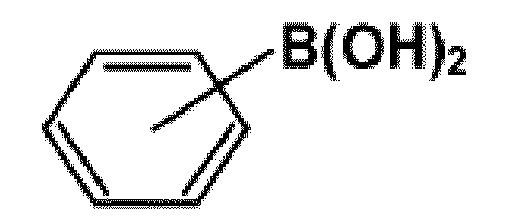

- Aptamère selon la revendication 1, où le site de glycosylation comprend une région d'une chaîne de glycosylation et une région du polypeptide.
- Procédé d'isolement d'un aptamère présentant une affinité sélective pour un polypeptide cible et un glycane sur ce dernier, comprenant :(a) à partir d'une population d'oligonucléotides randomisés, où chaque oligonucléotide comprend au moins un nucléotide selon la revendication 1, la sélection d'une première sous-population d'aptamères se liant à un polypeptide ou une protéine glycosylé cible, où le polypeptide cible est éventuellement immobilisé sur un support solide, et où l'étape (a) comprend les étapes suivantes :(a1) l'amplification d'une banque d'oligonucléotides randomisés, où chaque oligonucléotide comprend au moins un nucléotide comportant un marqueur d'acide boronique lié à une base sur ce dernier ;(a2) la mise en contact de la banque avec un polypeptide ou une protéine cible glycosylé dans des conditions par lesquelles une sous-population de la banque d'aptamères se lie sélectivement à un site de glycosylation du polypeptide cible ;(a3) l'isolement des polypeptides ou des protéines cibles ayant la sous-population d'aptamères qui y est liée, et l'élution de la sous-population d'aptamères à partir du polypeptide cible ;(a4) l'amplification de la sous-population d'aptamères éluée ; et(a5) la répétition des étapes (a2) à (a4), isolant de cette façon une population d'aptamères à partir de la banque amplifiée issue de l'étape (a), où les aptamères sont capables de lier un site de glycosylation du polypeptide cible ;(b) l'amplification de la première sous-population d'aptamères sans utiliser de TTP modifiée par un acide boronique, et la sélection à partir de ses produits amplifiés d'une seconde sous-population d'aptamères ne se liant pas à une espèce glycosylée du polypeptide ou de la protéine cible ; et(c) l'amplification de la seconde sous-population d'aptamères en utilisant de la TTP modifiée par un acide boronique, fournissant de cette façon une population d'aptamères modifiés par un acide boronique capables de se lier à un site de glycosylation d'un polypeptide ou d'une protéine cible.
- Procédé selon la revendication 3, comprenant en outre une étape de contre-sélection, où l'étape de contre-sélection comprend l'identification des aptamères capables de se lier sélectivement à un support solide n'ayant pas un polypeptide cible lié dessus, un polypeptide ou une protéine cible déglycosylé, ou un polypeptide ou une protéine non ciblé présentant une réactivité croisée.
- Procédé selon la revendication 3, comprenant en outre :a. l'insertion d'une population d'aptamères isolée dans l'étape (c) dans un vecteur, et l'isolement de ses clones ;b. l'identification d'une pluralité de clones d'aptamères, où chaque aptamère a une séquence nucléotidique différant des séquences des autres aptamères ;c. la détermination des constantes de dissociation des aptamères individuels sélectionnés et du polypeptide glycosylé cible ;d. la comparaison des constantes de dissociation des séquences des aptamères aux constantes de dissociation d'un aptamère témoin ne comportant pas un acide boronique dessus ; ete. la sélection d'un ou de plusieurs aptamères ayant une constante de dissociation inférieure par rapport au témoin, grâce à quoi les aptamères sélectionnés présentent une affinité sélective amplifiée pour un site glycosylé du polypeptide cible comparativement aux aptamères témoins ayant une séquence nucléotidique identique à celle des aptamères sélectionnés mais ne comportant pas un groupe acide boronique dessus.
- Procédé de détection d'une espèce glycosylée d'un polypeptide cible, comprenant :(a) la fourniture d'un polypeptide cible ;(b) la mise en contact du polypeptide cible avec un premier aptamère comprenant au moins un nucléotide selon la revendication 1, où le premier aptamère présente une affinité sélective amplifiée pour un site glycosylé du polypeptide cible comparativement à un second aptamère ayant une séquence nucléotidique identique à celle du premier aptamère mais ne comportant pas un groupe acide boronique dessus ;(c) la fourniture de conditions appropriées pour la liaison sélective du premier aptamère au site glycosylé du polypeptide cible ; et(d) la détection d'une population de premiers aptamères liés, indiquant de cette façon la présence du site de glycosylation du polypeptide cible.
- Procédé selon la revendication 6, dans lequel le site de glycosylation du polypeptide cible comprend une région d'une chaîne de glycosylation et une région du polypeptide.
- Procédé selon la revendication 6, dans lequel le polypeptide cible est choisi dans le groupe constitué de : un polypeptide isolé ou l'un de ses fragments, un polypeptide dans une cellule ou un tissu d'un animal ou d'une plante, ou d'une cellule cultivée.
- Procédé selon la revendication 6, dans lequel le polypeptide cible est l'antigène sérique de la prostate (PSA) ou le fibrinogène.
- Procédé selon la revendication 9, dans lequel le premier aptamère se lie sélectivement au PSA pl élevé, au PSA pl bas, ou au PSA pl à la fois élevé et bas.
- Procédé selon la revendication 9, dans lequel la séquence nucléotidique du premier aptamère est l'une de SEQ ID NO : 59 à 68.
- Procédé selon la revendication 9, dans lequel le premier aptamère comprend la séquence nucléotidique 5'-TATCGGTTTGCCATCG-3' (SEQ ID NO : 69).
- Procédé selon la revendication 9, dans lequel le premier aptamère se lie sélectivement à une espèce glycosylée du fibrinogène.
- Procédé selon la revendication 13, dans lequel la séquence nucléotidique du premier aptamère est l'une de SEQ ID NO : 13 à 58.
Applications Claiming Priority (2)
| Application Number | Priority Date | Filing Date | Title |
|---|---|---|---|
| US95068107P | 2007-07-19 | 2007-07-19 | |
| PCT/US2008/070288 WO2009012363A2 (fr) | 2007-07-19 | 2008-07-17 | Nucléotides et aptamères contenant des groupes acide boronique ayant une liaison sollicitée à des protéines glycosylées et leurs utilisations |
Publications (3)
| Publication Number | Publication Date |
|---|---|
| EP2176277A2 EP2176277A2 (fr) | 2010-04-21 |
| EP2176277A4 EP2176277A4 (fr) | 2013-07-17 |
| EP2176277B1 true EP2176277B1 (fr) | 2016-02-24 |
Family
ID=40260372
Family Applications (1)
| Application Number | Title | Priority Date | Filing Date |
|---|---|---|---|
| EP08781954.6A Not-in-force EP2176277B1 (fr) | 2007-07-19 | 2008-07-17 | Nucléotides et aptamères contenant des groupes acide boronique ayant une liaison sollicitée à des protéines glycosylées et leurs utilisations |
Country Status (3)
| Country | Link |
|---|---|
| US (1) | US9096856B2 (fr) |
| EP (1) | EP2176277B1 (fr) |
| WO (1) | WO2009012363A2 (fr) |
Families Citing this family (13)
| Publication number | Priority date | Publication date | Assignee | Title |
|---|---|---|---|---|
| WO2010019847A2 (fr) * | 2008-08-15 | 2010-02-18 | Georgia State University Research Foundation, Inc. | Inhibition d'aptamère de formation de thrombus |
| KR20150108493A (ko) * | 2014-03-17 | 2015-09-30 | 충북대학교 산학협력단 | 바이러스 인코딩된 마이크로 RNA hsv1-miR-H18 및 hsv2-miR-H9-5p의 전립선암에 대한 진단 용도 |
| US10415034B2 (en) * | 2015-09-04 | 2019-09-17 | Neoventures Biotechnology Inc. | Method for the selection of aptamers for unbound targets |
| PL239946B1 (pl) * | 2015-09-17 | 2022-01-31 | Pure Biologics Spolka Z Ograniczona Odpowiedzialnoscia | Sposób syntezy i oczyszczania nukleotydu, zmodyfikowany nukleotyd, cząsteczka DNA i biblioteka oligonukleotydów zawierające zmodyfikowany nukleotyd oraz zastosowanie biblioteki oligonukleotydów |
| WO2017127357A1 (fr) * | 2016-01-18 | 2017-07-27 | The Penn State Research Foundation | Aptamères d'adn ciblant le récepteur de la cholécystokinine b et leurs méthodes d'utilisation |
| CN118697858A (zh) | 2016-07-06 | 2024-09-27 | 法国血液分割暨生化制品实验室 | 稳定的液体纤维蛋白原 |
| CA3031386A1 (fr) * | 2016-07-28 | 2018-02-01 | Laboratoire Francais Du Fractionnement Et Des Biotechnologies | Procede d'obtention d'aptameres |
| JP2022537069A (ja) | 2019-06-21 | 2022-08-23 | サーモ フィッシャー サイエンティフィック バルティックス ユーエービー | 次世代配列決定ライブラリを調製するための核酸の標識化に有用なオリゴヌクレオチドが連結された三リン酸ヌクレオチド |
| JP7727628B2 (ja) | 2019-12-03 | 2025-08-21 | アラマー バイオサイエンシーズ, インク. | 核酸結合免疫サンドイッチアッセイ(nulisa) |
| KR102510170B1 (ko) * | 2020-10-07 | 2023-03-14 | 포항공과대학교 산학협력단 | 활성산소종 감응성을 가지는, 고분자가 코팅된 금 나노입자-압타머 나노구조체의 개발 및 응용 |
| CN113151283B (zh) * | 2021-02-24 | 2023-02-28 | 江南大学 | 特异性识别N-乙酰神经氨酸的ssDNA适配体及其应用 |
| US12704508B2 (en) | 2021-06-02 | 2026-08-11 | Alamar Biosciences, Inc. | Nucleic acid linked immune-sandwich assay (NULISA) |
| CN114989204A (zh) * | 2022-06-16 | 2022-09-02 | 西北工业大学 | 一种葡萄糖响应自修复凝胶用的二苯乙炔类液晶态交联剂的制备方法 |
Family Cites Families (4)
| Publication number | Priority date | Publication date | Assignee | Title |
|---|---|---|---|---|
| US4269605A (en) * | 1978-06-28 | 1981-05-26 | Amicon Corporation | Method and kit for separation of glycoproteins |
| US5047519A (en) * | 1986-07-02 | 1991-09-10 | E. I. Du Pont De Nemours And Company | Alkynylamino-nucleotides |
| US5270163A (en) | 1990-06-11 | 1993-12-14 | University Research Corporation | Methods for identifying nucleic acid ligands |
| US5831046A (en) * | 1996-08-05 | 1998-11-03 | Prolinx, Incorporated | Boronic acid-contaning nucleic acid monomers |
-
2008
- 2008-07-17 EP EP08781954.6A patent/EP2176277B1/fr not_active Not-in-force
- 2008-07-17 US US12/669,593 patent/US9096856B2/en active Active
- 2008-07-17 WO PCT/US2008/070288 patent/WO2009012363A2/fr not_active Ceased
Also Published As
| Publication number | Publication date |
|---|---|
| US9096856B2 (en) | 2015-08-04 |
| WO2009012363A2 (fr) | 2009-01-22 |
| EP2176277A4 (fr) | 2013-07-17 |
| US20130184160A1 (en) | 2013-07-18 |
| EP2176277A2 (fr) | 2010-04-21 |
| WO2009012363A3 (fr) | 2009-03-19 |
Similar Documents
| Publication | Publication Date | Title |
|---|---|---|
| US9096856B2 (en) | Nucleotides and aptamers containing boronic acid groups having biased binding to glycosylated proteins, and uses thereof | |
| US20110144187A1 (en) | Aptamer inhibition of thrombus formation | |
| JP5520818B2 (ja) | Rna合成のためのチオ炭素保護基 | |
| CN102282155B (zh) | 磷原子修饰的核酸的合成方法 | |
| US7034133B2 (en) | Oligonucleotide analogues | |
| CN1273476C (zh) | 寡核苷酸类似物 | |
| US7572582B2 (en) | Oligonucleotide analogues | |
| JP2021046396A (ja) | ホスホルアミダイト化学を使用する骨格修飾モルホリノオリゴヌクレオチド及びキメラの合成 | |
| JP2021523720A (ja) | オフターゲット効果が低下した修飾rna剤 | |
| US20130337581A1 (en) | Nucleobase-functionalized conformationally restricted nucleotides and oligonucleotides for targeting nucleic acids | |
| CN117881783A (zh) | 一种用于抑制细胞程序性死亡-配体1基因表达的siRNA、其缀合物和药物组合物及用途 | |
| JP2002525288A (ja) | 2重末端選択を用いるオリゴマーの精製 | |
| Kiviniemi et al. | Solid-supported synthesis and click conjugation of 4′-C-alkyne functionalized oligodeoxyribonucleotides | |
| CN116789725A (zh) | 6’-氰基修饰的锁核苷、核苷酸和核酸聚合物及其制备方法和应用 | |
| US8026348B2 (en) | Nucleoside derivative, modified oligonucleotide, method for their synthesis and applications thereof | |
| AU2024351425C1 (en) | Mrna cap analog and use thereof | |
| EP0681586A1 (fr) | Oligodesoxynucleotides renfermant des 5-alkyl-, 5-(1-alcenyl)- et 5-(1-alcynyl)pyrimidines, et compositions pharmaceutiques contenant ces composes | |
| JP2016135748A (ja) | トリアゾール連結型オリゴリボヌクレオチドを含むオリゴリボヌクレオチド類縁体を用いるポリペプチドの製造方法 | |
| CN121758533A (zh) | 用于递送的整合素αvβ6蛋白受体的配体、其缀合物及其应用 | |
| EP4711457A1 (fr) | Molécules d'arn double brin pour réguler l'activité du gène masp2 | |
| WO2025261379A1 (fr) | Composé de nucléoside modifié et son utilisation dans des oligonucléotides | |
| US20130158248A1 (en) | Maleimide-furanyl compounds that can be used in a general method for preparing maleimide-oligonucleotide derivatives | |
| HK1033946B (en) | Oligonucleotide analogues |
Legal Events
| Date | Code | Title | Description |
|---|---|---|---|
| PUAI | Public reference made under article 153(3) epc to a published international application that has entered the european phase |
Free format text: ORIGINAL CODE: 0009012 |
|
| 17P | Request for examination filed |
Effective date: 20100209 |
|
| AK | Designated contracting states |
Kind code of ref document: A2 Designated state(s): AT BE BG CH CY CZ DE DK EE ES FI FR GB GR HR HU IE IS IT LI LT LU LV MC MT NL NO PL PT RO SE SI SK TR |
|
| AX | Request for extension of the european patent |
Extension state: AL BA MK RS |
|
| DAX | Request for extension of the european patent (deleted) | ||
| A4 | Supplementary search report drawn up and despatched |
Effective date: 20130614 |
|
| RIC1 | Information provided on ipc code assigned before grant |
Ipc: C07H 21/00 20060101ALI20130610BHEP Ipc: C07H 19/00 20060101AFI20130610BHEP Ipc: A61K 48/00 20060101ALI20130610BHEP Ipc: C12Q 1/68 20060101ALI20130610BHEP Ipc: C07H 19/04 20060101ALI20130610BHEP |
|
| 17Q | First examination report despatched |
Effective date: 20140701 |
|
| GRAP | Despatch of communication of intention to grant a patent |
Free format text: ORIGINAL CODE: EPIDOSNIGR1 |
|
| INTG | Intention to grant announced |
Effective date: 20150618 |
|
| GRAP | Despatch of communication of intention to grant a patent |
Free format text: ORIGINAL CODE: EPIDOSNIGR1 |
|
| INTG | Intention to grant announced |
Effective date: 20150915 |
|
| GRAS | Grant fee paid |
Free format text: ORIGINAL CODE: EPIDOSNIGR3 |
|
| GRAA | (expected) grant |
Free format text: ORIGINAL CODE: 0009210 |
|
| AK | Designated contracting states |
Kind code of ref document: B1 Designated state(s): AT BE BG CH CY CZ DE DK EE ES FI FR GB GR HR HU IE IS IT LI LT LU LV MC MT NL NO PL PT RO SE SI SK TR |
|
| REG | Reference to a national code |
Ref country code: GB Ref legal event code: FG4D |
|
| REG | Reference to a national code |
Ref country code: CH Ref legal event code: EP |
|
| REG | Reference to a national code |
Ref country code: AT Ref legal event code: REF Ref document number: 776682 Country of ref document: AT Kind code of ref document: T Effective date: 20160315 |
|
| REG | Reference to a national code |
Ref country code: IE Ref legal event code: FG4D |
|
| REG | Reference to a national code |
Ref country code: DE Ref legal event code: R096 Ref document number: 602008042516 Country of ref document: DE |
|
| REG | Reference to a national code |
Ref country code: LT Ref legal event code: MG4D |
|
| REG | Reference to a national code |
Ref country code: NL Ref legal event code: MP Effective date: 20160224 |
|
| REG | Reference to a national code |
Ref country code: AT Ref legal event code: MK05 Ref document number: 776682 Country of ref document: AT Kind code of ref document: T Effective date: 20160224 |
|
| REG | Reference to a national code |
Ref country code: FR Ref legal event code: PLFP Year of fee payment: 9 |
|
| PG25 | Lapsed in a contracting state [announced via postgrant information from national office to epo] |
Ref country code: NO Free format text: LAPSE BECAUSE OF FAILURE TO SUBMIT A TRANSLATION OF THE DESCRIPTION OR TO PAY THE FEE WITHIN THE PRESCRIBED TIME-LIMIT Effective date: 20160524 Ref country code: FI Free format text: LAPSE BECAUSE OF FAILURE TO SUBMIT A TRANSLATION OF THE DESCRIPTION OR TO PAY THE FEE WITHIN THE PRESCRIBED TIME-LIMIT Effective date: 20160224 Ref country code: GR Free format text: LAPSE BECAUSE OF FAILURE TO SUBMIT A TRANSLATION OF THE DESCRIPTION OR TO PAY THE FEE WITHIN THE PRESCRIBED TIME-LIMIT Effective date: 20160525 Ref country code: ES Free format text: LAPSE BECAUSE OF FAILURE TO SUBMIT A TRANSLATION OF THE DESCRIPTION OR TO PAY THE FEE WITHIN THE PRESCRIBED TIME-LIMIT Effective date: 20160224 Ref country code: HR Free format text: LAPSE BECAUSE OF FAILURE TO SUBMIT A TRANSLATION OF THE DESCRIPTION OR TO PAY THE FEE WITHIN THE PRESCRIBED TIME-LIMIT Effective date: 20160224 Ref country code: IT Free format text: LAPSE BECAUSE OF FAILURE TO SUBMIT A TRANSLATION OF THE DESCRIPTION OR TO PAY THE FEE WITHIN THE PRESCRIBED TIME-LIMIT Effective date: 20160224 |
|
| PG25 | Lapsed in a contracting state [announced via postgrant information from national office to epo] |
Ref country code: NL Free format text: LAPSE BECAUSE OF FAILURE TO SUBMIT A TRANSLATION OF THE DESCRIPTION OR TO PAY THE FEE WITHIN THE PRESCRIBED TIME-LIMIT Effective date: 20160224 Ref country code: LV Free format text: LAPSE BECAUSE OF FAILURE TO SUBMIT A TRANSLATION OF THE DESCRIPTION OR TO PAY THE FEE WITHIN THE PRESCRIBED TIME-LIMIT Effective date: 20160224 Ref country code: AT Free format text: LAPSE BECAUSE OF FAILURE TO SUBMIT A TRANSLATION OF THE DESCRIPTION OR TO PAY THE FEE WITHIN THE PRESCRIBED TIME-LIMIT Effective date: 20160224 Ref country code: PT Free format text: LAPSE BECAUSE OF FAILURE TO SUBMIT A TRANSLATION OF THE DESCRIPTION OR TO PAY THE FEE WITHIN THE PRESCRIBED TIME-LIMIT Effective date: 20160624 Ref country code: SE Free format text: LAPSE BECAUSE OF FAILURE TO SUBMIT A TRANSLATION OF THE DESCRIPTION OR TO PAY THE FEE WITHIN THE PRESCRIBED TIME-LIMIT Effective date: 20160224 Ref country code: PL Free format text: LAPSE BECAUSE OF FAILURE TO SUBMIT A TRANSLATION OF THE DESCRIPTION OR TO PAY THE FEE WITHIN THE PRESCRIBED TIME-LIMIT Effective date: 20160224 Ref country code: LT Free format text: LAPSE BECAUSE OF FAILURE TO SUBMIT A TRANSLATION OF THE DESCRIPTION OR TO PAY THE FEE WITHIN THE PRESCRIBED TIME-LIMIT Effective date: 20160224 |
|
| PG25 | Lapsed in a contracting state [announced via postgrant information from national office to epo] |
Ref country code: DK Free format text: LAPSE BECAUSE OF FAILURE TO SUBMIT A TRANSLATION OF THE DESCRIPTION OR TO PAY THE FEE WITHIN THE PRESCRIBED TIME-LIMIT Effective date: 20160224 Ref country code: EE Free format text: LAPSE BECAUSE OF FAILURE TO SUBMIT A TRANSLATION OF THE DESCRIPTION OR TO PAY THE FEE WITHIN THE PRESCRIBED TIME-LIMIT Effective date: 20160224 |
|
| REG | Reference to a national code |
Ref country code: DE Ref legal event code: R097 Ref document number: 602008042516 Country of ref document: DE |
|
| PG25 | Lapsed in a contracting state [announced via postgrant information from national office to epo] |
Ref country code: CZ Free format text: LAPSE BECAUSE OF FAILURE TO SUBMIT A TRANSLATION OF THE DESCRIPTION OR TO PAY THE FEE WITHIN THE PRESCRIBED TIME-LIMIT Effective date: 20160224 Ref country code: RO Free format text: LAPSE BECAUSE OF FAILURE TO SUBMIT A TRANSLATION OF THE DESCRIPTION OR TO PAY THE FEE WITHIN THE PRESCRIBED TIME-LIMIT Effective date: 20160224 Ref country code: SK Free format text: LAPSE BECAUSE OF FAILURE TO SUBMIT A TRANSLATION OF THE DESCRIPTION OR TO PAY THE FEE WITHIN THE PRESCRIBED TIME-LIMIT Effective date: 20160224 |
|
| PG25 | Lapsed in a contracting state [announced via postgrant information from national office to epo] |
Ref country code: BE Free format text: LAPSE BECAUSE OF FAILURE TO SUBMIT A TRANSLATION OF THE DESCRIPTION OR TO PAY THE FEE WITHIN THE PRESCRIBED TIME-LIMIT Effective date: 20160224 |
|
| PLBE | No opposition filed within time limit |
Free format text: ORIGINAL CODE: 0009261 |
|
| STAA | Information on the status of an ep patent application or granted ep patent |
Free format text: STATUS: NO OPPOSITION FILED WITHIN TIME LIMIT |
|
| 26N | No opposition filed |
Effective date: 20161125 |
|
| PG25 | Lapsed in a contracting state [announced via postgrant information from national office to epo] |
Ref country code: SI Free format text: LAPSE BECAUSE OF FAILURE TO SUBMIT A TRANSLATION OF THE DESCRIPTION OR TO PAY THE FEE WITHIN THE PRESCRIBED TIME-LIMIT Effective date: 20160224 Ref country code: BG Free format text: LAPSE BECAUSE OF FAILURE TO SUBMIT A TRANSLATION OF THE DESCRIPTION OR TO PAY THE FEE WITHIN THE PRESCRIBED TIME-LIMIT Effective date: 20160524 |
|
| REG | Reference to a national code |
Ref country code: CH Ref legal event code: PL |
|
| PG25 | Lapsed in a contracting state [announced via postgrant information from national office to epo] |
Ref country code: MC Free format text: LAPSE BECAUSE OF FAILURE TO SUBMIT A TRANSLATION OF THE DESCRIPTION OR TO PAY THE FEE WITHIN THE PRESCRIBED TIME-LIMIT Effective date: 20160224 |
|
| PG25 | Lapsed in a contracting state [announced via postgrant information from national office to epo] |
Ref country code: LI Free format text: LAPSE BECAUSE OF NON-PAYMENT OF DUE FEES Effective date: 20160731 Ref country code: CH Free format text: LAPSE BECAUSE OF NON-PAYMENT OF DUE FEES Effective date: 20160731 |
|
| REG | Reference to a national code |
Ref country code: IE Ref legal event code: MM4A |
|
| REG | Reference to a national code |
Ref country code: FR Ref legal event code: PLFP Year of fee payment: 10 |
|
| PG25 | Lapsed in a contracting state [announced via postgrant information from national office to epo] |
Ref country code: IE Free format text: LAPSE BECAUSE OF NON-PAYMENT OF DUE FEES Effective date: 20160717 |
|
| PG25 | Lapsed in a contracting state [announced via postgrant information from national office to epo] |
Ref country code: LU Free format text: LAPSE BECAUSE OF NON-PAYMENT OF DUE FEES Effective date: 20160717 |
|
| PG25 | Lapsed in a contracting state [announced via postgrant information from national office to epo] |
Ref country code: HU Free format text: LAPSE BECAUSE OF FAILURE TO SUBMIT A TRANSLATION OF THE DESCRIPTION OR TO PAY THE FEE WITHIN THE PRESCRIBED TIME-LIMIT; INVALID AB INITIO Effective date: 20080717 Ref country code: CY Free format text: LAPSE BECAUSE OF FAILURE TO SUBMIT A TRANSLATION OF THE DESCRIPTION OR TO PAY THE FEE WITHIN THE PRESCRIBED TIME-LIMIT Effective date: 20160224 |
|
| PG25 | Lapsed in a contracting state [announced via postgrant information from national office to epo] |
Ref country code: TR Free format text: LAPSE BECAUSE OF FAILURE TO SUBMIT A TRANSLATION OF THE DESCRIPTION OR TO PAY THE FEE WITHIN THE PRESCRIBED TIME-LIMIT Effective date: 20160224 Ref country code: IS Free format text: LAPSE BECAUSE OF FAILURE TO SUBMIT A TRANSLATION OF THE DESCRIPTION OR TO PAY THE FEE WITHIN THE PRESCRIBED TIME-LIMIT Effective date: 20160224 Ref country code: MT Free format text: LAPSE BECAUSE OF NON-PAYMENT OF DUE FEES Effective date: 20160731 |
|
| REG | Reference to a national code |
Ref country code: FR Ref legal event code: PLFP Year of fee payment: 11 |
|
| PGFP | Annual fee paid to national office [announced via postgrant information from national office to epo] |
Ref country code: DE Payment date: 20180727 Year of fee payment: 11 Ref country code: FR Payment date: 20180726 Year of fee payment: 11 |
|
| PGFP | Annual fee paid to national office [announced via postgrant information from national office to epo] |
Ref country code: GB Payment date: 20180727 Year of fee payment: 11 |
|
| REG | Reference to a national code |
Ref country code: DE Ref legal event code: R119 Ref document number: 602008042516 Country of ref document: DE |
|
| GBPC | Gb: european patent ceased through non-payment of renewal fee |
Effective date: 20190717 |
|
| PG25 | Lapsed in a contracting state [announced via postgrant information from national office to epo] |
Ref country code: DE Free format text: LAPSE BECAUSE OF NON-PAYMENT OF DUE FEES Effective date: 20200201 Ref country code: GB Free format text: LAPSE BECAUSE OF NON-PAYMENT OF DUE FEES Effective date: 20190717 |
|
| PG25 | Lapsed in a contracting state [announced via postgrant information from national office to epo] |
Ref country code: FR Free format text: LAPSE BECAUSE OF NON-PAYMENT OF DUE FEES Effective date: 20190731 |