EP2177403A2 - Procédé de détection de déformations sur un composant de véhicule automobile et sur le dit véhicule - Google Patents
Procédé de détection de déformations sur un composant de véhicule automobile et sur le dit véhicule Download PDFInfo
- Publication number
- EP2177403A2 EP2177403A2 EP09012843A EP09012843A EP2177403A2 EP 2177403 A2 EP2177403 A2 EP 2177403A2 EP 09012843 A EP09012843 A EP 09012843A EP 09012843 A EP09012843 A EP 09012843A EP 2177403 A2 EP2177403 A2 EP 2177403A2
- Authority
- EP
- European Patent Office
- Prior art keywords
- component
- light
- grid
- motor vehicle
- detector
- Prior art date
- Legal status (The legal status is an assumption and is not a legal conclusion. Google has not performed a legal analysis and makes no representation as to the accuracy of the status listed.)
- Granted
Links
- 238000000034 method Methods 0.000 title claims abstract description 15
- 238000011156 evaluation Methods 0.000 claims abstract description 40
- 239000000463 material Substances 0.000 claims description 5
- 230000001133 acceleration Effects 0.000 description 6
- 238000001514 detection method Methods 0.000 description 4
- 239000013307 optical fiber Substances 0.000 description 4
- 239000011248 coating agent Substances 0.000 description 3
- 238000000576 coating method Methods 0.000 description 3
- 230000003287 optical effect Effects 0.000 description 3
- 239000004033 plastic Substances 0.000 description 3
- 229920003023 plastic Polymers 0.000 description 3
- 230000001419 dependent effect Effects 0.000 description 2
- 238000006073 displacement reaction Methods 0.000 description 2
- 239000011521 glass Substances 0.000 description 2
- 230000003993 interaction Effects 0.000 description 2
- 230000035484 reaction time Effects 0.000 description 2
- 206010039203 Road traffic accident Diseases 0.000 description 1
- 238000010521 absorption reaction Methods 0.000 description 1
- 230000004913 activation Effects 0.000 description 1
- 230000005540 biological transmission Effects 0.000 description 1
- 238000006243 chemical reaction Methods 0.000 description 1
- 230000001934 delay Effects 0.000 description 1
- 238000011161 development Methods 0.000 description 1
- 230000018109 developmental process Effects 0.000 description 1
- 239000000835 fiber Substances 0.000 description 1
- 230000035939 shock Effects 0.000 description 1
- 230000005236 sound signal Effects 0.000 description 1
- 238000004544 sputter deposition Methods 0.000 description 1
- 230000002123 temporal effect Effects 0.000 description 1
- 239000012780 transparent material Substances 0.000 description 1
- 238000007740 vapor deposition Methods 0.000 description 1
Images

Classifications
-
- B—PERFORMING OPERATIONS; TRANSPORTING
- B60—VEHICLES IN GENERAL
- B60R—VEHICLES, VEHICLE FITTINGS, OR VEHICLE PARTS, NOT OTHERWISE PROVIDED FOR
- B60R21/00—Arrangements or fittings on vehicles for protecting or preventing injuries to occupants or pedestrians in case of accidents or other traffic risks
- B60R21/01—Electrical circuits for triggering passive safety arrangements, e.g. airbags, safety belt tighteners, in case of vehicle accidents or impending vehicle accidents
- B60R21/013—Electrical circuits for triggering passive safety arrangements, e.g. airbags, safety belt tighteners, in case of vehicle accidents or impending vehicle accidents including means for detecting collisions, impending collisions or roll-over
- B60R21/0136—Electrical circuits for triggering passive safety arrangements, e.g. airbags, safety belt tighteners, in case of vehicle accidents or impending vehicle accidents including means for detecting collisions, impending collisions or roll-over responsive to actual contact with an obstacle, e.g. to vehicle deformation, bumper displacement or bumper velocity relative to the vehicle
Definitions
- the invention relates to a motor vehicle and to a method for detecting deformations of vehicle components.
- the detection of an accident is of fundamental importance in motor vehicles with regard to occupant protection in order to initiate relevant safety measures, such as, for example, the triggering of an airbag.
- the prior art for the detection of motor vehicle accidents is the use of acceleration sensors, as described for example in the DE 10 2004 029 816 A1 to be discribed.
- the acceleration sensor reacts purely mechanically to delays of a vehicle, whereby, for example, a seismic mass of the sensor is deflected. This results in a change in the electrical properties between the movable and the rigid webs of the sensor, which is a measure of the size of the acceleration / deceleration.
- CISS Crash Impact Sound Sensing
- the object of the present invention is to provide a method with which clear statements regarding the position of the deformation of a vehicle component and the temporal progress of the deformation can be made and with which the severity of the accident can be better determined.
- the evaluation should be without major Computing effort in a very short time, especially less than 10 ms, done after the crash.
- a motor vehicle with a device for detecting deformations of vehicle components, in particular body components is to be shown.
- the method with the measures of claim 1 solves the procedural part of the task.
- the inventive method is based on the interaction of an evaluation unit with at least one, preferably a plurality of sensor units.
- the sensor unit comprises a grid component arranged on a vehicle component, for example the body, with a grid which is displaced relative to a light emitter of an emitter component when the vehicle body is deformed.
- a beam path of a light beam which strikes a detector from the light emitter is interrupted in an alternating manner.
- the detector detects the individual light pulses and, based on the light pulses, transmits a time-modulated signal to the evaluation unit, which evaluates the signals received by one or more such sensor units.
- the beam path denotes the path on which a light beam emitted by the light emitter moves to a detector.
- the light emitter can be designed as a light emitting diode (LED) his or he emits a light signal, which he receives via an optical fiber from a more distant light-emitting system, such as the evaluation unit.
- LED light emitting diode
- the beam path of the light beam in the sense of a first embodiment of the invention is straight when the detector faces the light emitter and the grid is arranged between the light emitter and the detector.
- the grid of the grid component consists of areas which are transparent and of areas which interrupt the beam path, so are opaque.
- the translucent areas may be configured in the form of continuous openings, for example circular or rectangular. It is also possible to produce the transparent areas of transparent material, for example glass or plastic, while all other areas are made of opaque material. It is also conceivable to produce the complete grid from a translucent material, wherein those areas which are intended to interrupt the beam path are made opaque, for example by a coating or cover.
- the beam path is no longer straight, but it is deflected.
- the grid is not necessarily openings, but areas that reflect the incident light beam in the direction of the detector and areas that do not reflect the light beam.
- the non-reflection can be done for example by scattering, absorption or transmission.
- the areas interrupting the beam path are either provided with a rough surface which scatters the incident light beam or have a surface which absorbs the light beam or the areas are transparent to light.
- areas which are intended to deflect the beam path may be provided with a reflective coating.
- This coating can be metallic and applied for example by sputtering or vapor deposition.
- the areas of the grid which do not interrupt the beam path preferably have a constant width measured in the direction of movement of the grid and a constant distance from each other.
- the mutual distance preferably corresponds to the width of the beam path interrupting areas. This facilitates the signal evaluation.
- the grid component can be arranged, for example on a bumper.
- the emitter component is in this case to be arranged on a component of the vehicle body, which does not immediately shift as much in an accident as the bumper. It can e.g. be arranged on a longitudinal member of the motor vehicle.
- the raster component is arranged so as to be displaceable relative to the emitter component.
- the raster component can be guided in a guide of the emitter component.
- the light emitter is arranged on the emitter component such that the emitted light beam is at a right angle to a movement axis, i. to the longitudinal axis of the raster component meets the grid. It is also possible to arrange the emitter component on a bumper so as to be relatively displaceable relative to the grid component.
- the angle may vary depending on the component geometry.
- the detector With a straight beam path, it is absolutely necessary to arrange the detector opposite the light emitter.
- the detector can be fixed to the emitter component. It is also conceivable to fix the detector on a separate component which is not directly connected to the emitter component. Decisive is the interaction between the emitter component and the detector component.
- the light emitter and the detector When deflected beam path are light emitter and detector with respect to the grid component on the same side.
- the light emitter and the detector preferably form a unit. It is possible to arrange light emitter and detector directly next to each other. It is also conceivable that the detector surrounds the light emitter. Essential for a reliable detection of the light beam is that it is scattered as little as possible when reflected on the raster component. It is desirable to have a complete reflection of the light beam.
- a deflection of the light beam in the region of the areas reflecting the light beam can also be provided within the scope of the invention. For example, the light beam can be selectively redirected in a certain direction.
- the grid component arranged in the deforming region of the vehicle component is displaced relative to the emitter component and also relative to the detector.
- the emitter component and the detector are displaced relative to the raster component during a deformation.
- the beam path of the light beam emitted by the light emitter is interrupted by the raster component alternately. This alternation produces time-modulated light pulses.
- the pulse width is directly dependent on the deformation speed.
- the number of individual pulses are also a measure of the intrusion depth, ie the deformation path of the vehicle component in the region of the sensor unit.
- the position of the grid to the light emitter can be selected in an undeformed vehicle component so that a tolerance range is provided up to a first alternation. This prevents safety systems from being activated, for example, in the event of shocks.
- the light pulses detected by the detector are forwarded as such directly to the evaluation unit, without first converting them into another signal form.
- the time modulated light signal is converted into electronic pulses, before this is transmitted to the evaluation unit.
- optical fibers are preferably provided which transmit the detected signals from the detector to the evaluation unit without changing the signal form.
- the evaluation unit After one to two pulses, the evaluation unit has information about a deformation of a vehicle component, its speed and its position, since the detector signal received by the evaluation unit can be uniquely assigned.
- the more pulses that can be used for the evaluation the more accurate the information about the deformation.
- time constants of less than 1 ms are easily achievable.
- the frequency and the number of light pulses can be calculated very quickly and without much computational effort, the deformation rate and thus the severity of the accident.
- safety systems in particular occupant protection systems, can be activated with a time buffer in a targeted and accident-adapted manner.
- the evaluation unit can be embodied as a central node at which the signals from sensor units arranged on different vehicle components converge.
- the evaluation of the signals of all sensor units can be done centrally in the evaluation unit.
- all sensor units can be connected to a central light emitter, which is mounted in or on the evaluation unit.
- Deadlocks can be avoided, for example, by point contacts, or linear contacts between the grid component and a guide of the emitter component. It is also conceivable that limited yielding materials, especially plastics are used to avoid jamming.
- An essential advantage of the invention is that the optical signal received by the evaluation unit of the sensor unit can be evaluated directly without it being necessary to filter out disturbance variables.
- the sensor units can be mounted on and in the motor vehicle wherever it is deemed necessary.
- the motor vehicle can be provided with a type of optical network whose signals converge in the central evaluation unit.
- the reaction time of the system is composed of the computing time and the time constant between two pulses or the width of a light pulse.
- the time between the beginning of the deformation and the presence of the calculated result, which leads to the deformation-adapted triggering of, for example, occupant protection systems, can be in the range of 1 ms to 2 ms. Since the time constant depends on the deformation rate, the reaction time is shortened as the deformation rate increases. This ensures maximum occupant protection in the event of an accident.
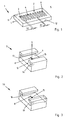
- FIG. 1 shows a schematic representation of a grid component 1.
- This has a grid 2, which consists of light-transmissive areas 3 and 4 opaque areas.
- the light-transmissive regions 3 are here designed as elongated holes 5 and extend transversely to the longitudinal axis L of the first sensor component 1.
- the opaque regions 4 between the oblong holes 5 of the grid 2 are in the form of webs 6. All elongated holes 5 have the same width B1. They are spaced apart from each other by the webs 6 with likewise equal width B2.
- the translucent areas 3 are configured in the illustrated embodiment as continuous openings. But it is also possible to provide these translucent areas 3 with translucent material, such as plastic or glass.
- the light-permeable areas 3 can also be designed in the form of, for example, circular or rectangular openings.
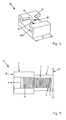
- FIG. 2 shows a schematic representation of an emitter component 7 with a light emitter 8.
- the light emitter 8 is located on the surface 9 of the emitter component 7, which is aligned parallel to the grid 2 of the grid component 1. In this case, the light emitter 8 is at most so wide that it can just be covered by a web 6 of the grid 2.
- the light emitter 8 emits a constant light signal S and can, for example, in the form of a LED 15 be executed.
- the emitter component 7 has a guide region 10 for the raster component 1.
- the guide 10 is designed as a linear guide.
- longitudinal sides 11, 12 of the raster component 1 are surrounded by side walls 13, 14 of the emitter component 7.
- the light emitter 8 opposite area remains free. This area is provided for arranging a detector which detects the light beam S emanating from the light emitter 8 or its interruption.
- FIG. 3 represents an alternative to the guide 10 described above.
- the long sides 11, 12 of the grid component 1 facing surfaces 16, 17 of the emitter member 7 are not straight, but slightly bent outwards, ie convex. This curvature of the surfaces 16, 17 reduces the risk that the grid member 1 canted in a displacement relative to the emitter member 7 in this.
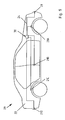
- FIG. 4 schematically shows a further embodiment of an emitter component 7B.
- a detector 18 is arranged in a web 19 opposite the light emitter 8. Emitter and detector component are combined into one component. The detector 18 is arranged facing the light emitter 8. On the other, the light emitter 8 side facing away from the detector 18 is a port 20, via which the detected signals are forwarded to an evaluation.
- the web 19 may extend over the entire length M of the guide 10A.
- FIG. 5 schematically shows a sensor unit 21 in plan view.
- the grid component 1 is guided here by the guide 10 of the emitter component 7.
- the grid component 1 is connected to a vehicle component 22 or a bumper and is displaced in the longitudinal direction L in the case of a deformation of the vehicle component 22 relative to the emitter component 7.
- the grid 2 of the grid component 1 passes through the light emitter 8, namely alternately with the light-permeable areas 3 and the opaque 4 areas.
- the light beam S is interrupted by a web 6 and the light emitter 8 is covered by a web 6.
- FIG. 6 shows a further schematic illustration of the sensor unit 21, with the difference from the FIG. 5 in that the grid component 1 has been displaced a distance in the direction of its longitudinal axis L relative to the emitter component 7 by indicated deformation of the vehicle component 22.
- the beam path is not interrupted and outgoing of the LED 15 light beam S can be detected unhindered.
- the detector not shown here, is arranged opposite the light emitter 8 on the observer side of the grid 2.
- the detector is not part of the emitter component 7, but is arranged on a detector component 23. This is based on a longitudinal section through the representation of FIG. 7 in figure clearly. It can be seen that the beam path is not interrupted and the light beam S passes through the slot 5 of the grid 2. Thereafter, the light beam S impinges on the opposite to the light emitter 8 arranged detector 18. If the raster component 1 is further displaced in its longitudinal direction L, the beam path is interrupted by the web 6. The interruption results in temporally modulated light pulses.
- the detector 18 connected to an evaluation unit forwards the light pulses, for example via an optical fiber 24, to the evaluation unit. Based on the time intervals, ie the frequency and the number of individual pulses, this can calculate all necessary statements with regard to the deformation speed and the progress of the deformation of the vehicle component 22.
- FIG. 8 schematically another embodiment of a sensor unit 25 is shown.
- the emitter component 26 with the light emitter 27 is arranged on a vehicle component 22.
- the emitter component 26 with the light emitter 27 is displaced relative to a grid 2.
- the light beam S which from the light emitter 27th going through the grid 2 alternately interrupted and released.
- the resulting light pulses are picked up by a detector 28 and forwarded to an evaluation unit.
- the grid 2 and the detector 28 may be designed as one or two components.
- FIG. 9 schematically shows a motor vehicle 29 with a device for detecting deformation of its vehicle components 22.
- sensor units 21, 21A, 21B, 21C, 21D are arranged at different areas of the vehicle components 22, in particular the body. All sensor units 21, 21A, 21B, 21C, 21D are connected to a central evaluation unit 30.
- the detected light pulses are transmitted via light guide fibers 24 to the evaluation unit 30.
- the activation of corresponding safety systems can take place via this central evaluation unit 30.
Landscapes
- Engineering & Computer Science (AREA)
- Mechanical Engineering (AREA)
- Length Measuring Devices By Optical Means (AREA)
- Force Measurement Appropriate To Specific Purposes (AREA)
Applications Claiming Priority (1)
| Application Number | Priority Date | Filing Date | Title |
|---|---|---|---|
| DE102008051796A DE102008051796B4 (de) | 2008-10-17 | 2008-10-17 | Verfahren zur Detektion von Verformungen an einem Fahrzeugbauteil und Kraftfahrzeug |
Publications (3)
| Publication Number | Publication Date |
|---|---|
| EP2177403A2 true EP2177403A2 (fr) | 2010-04-21 |
| EP2177403A3 EP2177403A3 (fr) | 2011-04-27 |
| EP2177403B1 EP2177403B1 (fr) | 2012-07-11 |
Family
ID=41429325
Family Applications (1)
| Application Number | Title | Priority Date | Filing Date |
|---|---|---|---|
| EP09012843A Not-in-force EP2177403B1 (fr) | 2008-10-17 | 2009-10-10 | Procédé de détection de déformations sur un composant de véhicule automobile et sur le dit véhicule |
Country Status (3)
| Country | Link |
|---|---|
| US (1) | US8239089B2 (fr) |
| EP (1) | EP2177403B1 (fr) |
| DE (1) | DE102008051796B4 (fr) |
Families Citing this family (7)
| Publication number | Priority date | Publication date | Assignee | Title |
|---|---|---|---|---|
| DE102009052500A1 (de) * | 2009-11-11 | 2011-05-12 | Benteler Automobiltechnik Gmbh | Verfahren zur Detektion von Verformungen an einem Energieabsorptionselement und Kraftfahrzeug |
| US9551620B2 (en) | 2011-05-16 | 2017-01-24 | General Electric Company | Method and system for multi-functional embedded sensors |
| DE112012002257B4 (de) * | 2011-05-26 | 2015-07-30 | KONUX Inc. | Sensor oder Sensor-Messeinheit mit einem mechanisch-elektrischen Wandler |
| JP5613117B2 (ja) * | 2011-07-20 | 2014-10-22 | 本田技研工業株式会社 | 弾性部材の変形速度演算装置および変形速度演算方法ならびに駆動装置 |
| CN102322813B (zh) * | 2011-09-07 | 2014-01-29 | 西安交通大学 | 三维网格应变测量方法 |
| DE102013001331A1 (de) | 2013-01-26 | 2014-07-31 | Audi Ag | Verfahren zum Betreiben einer Vorrichtung, insbesondere eines Kraftwagens oder eines mobilen Endgeräts, mittels Gestensteuerung und Spracheingabe sowie Vorrichtung |
| DE102016118291B3 (de) * | 2016-09-28 | 2017-09-07 | mg-sensor GmbH | Verfahren zur erfassung von relativbewegungen |
Citations (2)
| Publication number | Priority date | Publication date | Assignee | Title |
|---|---|---|---|---|
| DE102004029816A1 (de) | 2004-06-19 | 2006-01-05 | Robert Bosch Gmbh | Vorrichtung und Verfahren zur Erkennung eines Unfalls im Kraftfahrzeugbereich |
| DE102005046928A1 (de) | 2005-09-30 | 2007-04-12 | Siemens Ag | Vorrichtung und Verfahren zur Lokalisierung einer Kollision eines Objektes an einem Kraftfahrzeug |
Family Cites Families (13)
| Publication number | Priority date | Publication date | Assignee | Title |
|---|---|---|---|---|
| DE3231800A1 (de) * | 1982-08-26 | 1984-03-01 | Robert Bosch Gmbh, 7000 Stuttgart | Sensor |
| US4629319A (en) * | 1984-02-14 | 1986-12-16 | Diffracto Ltd. | Panel surface flaw inspection |
| DE3834005A1 (de) * | 1988-10-06 | 1990-04-19 | Schwant Wilfried Dipl Ing | Sensor zur messung von geschwindigkeitsaenderungen eines fahrzeuges, insbesondere kraftfahrzeuges, bei einem aufprall |
| US5251013A (en) * | 1989-03-27 | 1993-10-05 | Danielson Glen C | Vehicle straightener measuring unit, measuring apparatus reliant on reflected beam(s), and source, targets and method |
| DE3941725A1 (de) * | 1989-12-18 | 1991-06-20 | Krupp Atlas Elektronik Gmbh | Vorrichtung zum erkennen von deformationen auf pressteilen |
| DE4015668A1 (de) * | 1990-05-16 | 1991-11-21 | Schwant Wilfried Dipl Ing | Sensor zur messung von geschwindigkeitsaenderungen eines fahrzeuges, insbesondere kraftfahrzeuges, bei einem aufprall |
| DE4224166C2 (de) * | 1991-08-01 | 1994-10-06 | Dynamit Nobel Ag | Passive Sicherheitseinrichtung, insbesondere Gassacksystem, zum Schutz der Insassen eines Fahrzeuges vor Verletzungen bei Unfällen |
| DE4136510A1 (de) * | 1991-11-06 | 1993-05-13 | Battelle Institut E V | Beschleunigungssensor |
| US5818593A (en) * | 1994-05-23 | 1998-10-06 | It's Dents Or Us, Inc. | Flaw highlighting light panel lens |
| US5572324A (en) * | 1994-05-23 | 1996-11-05 | It's Dents Or Us, Inc. | Portable dent highlighting unit |
| US20020063008A1 (en) * | 1997-10-14 | 2002-05-30 | Hans Spies | Accident sensor |
| US6644688B1 (en) * | 1999-11-04 | 2003-11-11 | Automotive Systems Labortory, Inc. | Crash sensing system |
| US20020088933A1 (en) * | 2001-01-11 | 2002-07-11 | Meng-Chi Yu | Device displacement measuring apparatus |
-
2008
- 2008-10-17 DE DE102008051796A patent/DE102008051796B4/de not_active Expired - Fee Related
-
2009
- 2009-10-10 EP EP09012843A patent/EP2177403B1/fr not_active Not-in-force
- 2009-10-16 US US12/580,620 patent/US8239089B2/en not_active Expired - Fee Related
Patent Citations (2)
| Publication number | Priority date | Publication date | Assignee | Title |
|---|---|---|---|---|
| DE102004029816A1 (de) | 2004-06-19 | 2006-01-05 | Robert Bosch Gmbh | Vorrichtung und Verfahren zur Erkennung eines Unfalls im Kraftfahrzeugbereich |
| DE102005046928A1 (de) | 2005-09-30 | 2007-04-12 | Siemens Ag | Vorrichtung und Verfahren zur Lokalisierung einer Kollision eines Objektes an einem Kraftfahrzeug |
Also Published As
| Publication number | Publication date |
|---|---|
| EP2177403A3 (fr) | 2011-04-27 |
| US8239089B2 (en) | 2012-08-07 |
| US20100217473A1 (en) | 2010-08-26 |
| DE102008051796B4 (de) | 2010-10-07 |
| DE102008051796A1 (de) | 2010-04-29 |
| EP2177403B1 (fr) | 2012-07-11 |
Similar Documents
| Publication | Publication Date | Title |
|---|---|---|
| EP2177403B1 (fr) | Procédé de détection de déformations sur un composant de véhicule automobile et sur le dit véhicule | |
| EP1556255B1 (fr) | Dispositif detecteur et procede de detection d'une charge externe due aux chocs sur un vehicule automobile | |
| EP1646534B1 (fr) | Systeme de fixation d'un dispositif detecteur dans un pare-chocs de vehicules automobiles | |
| EP2667218B1 (fr) | Capteur 3D à économie d'énergie | |
| EP1651473B1 (fr) | Dispositif de detection pour dispositif de securite dans un vehicule | |
| EP2990836B1 (fr) | Dispositif de surveillance d'un mouvement de machine et procédé de surveillance d'un mouvement de machine | |
| DE102008051794B3 (de) | Verfahren zur Detektion von Verformungen an einem Fahrzeugbauteil | |
| DE19537383B4 (de) | Sicherheitseinrichtung für Fahrzeuginsassen | |
| EP1933172A2 (fr) | Agencement de barrière lumineuse | |
| EP1845334A1 (fr) | Capteur optique | |
| EP2053428B1 (fr) | Capteur optoélectronique | |
| DE102016103028A1 (de) | Vorrichtung zum Überwachen eines Überwachungsbereichs | |
| DE102009015238B4 (de) | Verfahren zur Detektion von Verformungen an einem Fahrzeugbauteil und Kraftfahrzeug | |
| DE102009052500A1 (de) | Verfahren zur Detektion von Verformungen an einem Energieabsorptionselement und Kraftfahrzeug | |
| DE202008016946U1 (de) | Lichtgitter oder Lichtschranke | |
| EP3324218B1 (fr) | Cellule de détection à multifaisceau | |
| EP1780559B1 (fr) | Capteur optique | |
| EP1510750B1 (fr) | Dispositif optique de détection de position | |
| WO2003054578A1 (fr) | Ensemble capteur pour la mesure de la distance ou de la vitesse | |
| EP3872526B1 (fr) | Dispositif de surveillance d'une zone protégée | |
| DE10031406B4 (de) | Optoelektronisches System in Fahrzeugen | |
| EP3187906B1 (fr) | Barriere lumineuse | |
| EP4465096B1 (fr) | Rideau de lumière | |
| DE102004007801A1 (de) | Aufprallsensor | |
| DE202016106394U1 (de) | Mehrstrahllichtschranke |
Legal Events
| Date | Code | Title | Description |
|---|---|---|---|
| PUAI | Public reference made under article 153(3) epc to a published international application that has entered the european phase |
Free format text: ORIGINAL CODE: 0009012 |
|
| AK | Designated contracting states |
Kind code of ref document: A2 Designated state(s): AT BE BG CH CY CZ DE DK EE ES FI FR GB GR HR HU IE IS IT LI LT LU LV MC MK MT NL NO PL PT RO SE SI SK SM TR |
|
| AX | Request for extension of the european patent |
Extension state: AL BA RS |
|
| PUAL | Search report despatched |
Free format text: ORIGINAL CODE: 0009013 |
|
| AK | Designated contracting states |
Kind code of ref document: A3 Designated state(s): AT BE BG CH CY CZ DE DK EE ES FI FR GB GR HR HU IE IS IT LI LT LU LV MC MK MT NL NO PL PT RO SE SI SK SM TR |
|
| AX | Request for extension of the european patent |
Extension state: AL BA RS |
|
| 17P | Request for examination filed |
Effective date: 20111020 |
|
| GRAP | Despatch of communication of intention to grant a patent |
Free format text: ORIGINAL CODE: EPIDOSNIGR1 |
|
| GRAS | Grant fee paid |
Free format text: ORIGINAL CODE: EPIDOSNIGR3 |
|
| RBV | Designated contracting states (corrected) |
Designated state(s): AT BE BG CH CY CZ DK EE ES FI FR GB GR HR HU IE IS IT LI LT LU LV MC MK MT NL NO PL PT RO SE SI SK SM TR |
|
| REG | Reference to a national code |
Ref country code: DE Ref legal event code: R108 |
|
| GRAA | (expected) grant |
Free format text: ORIGINAL CODE: 0009210 |
|
| AK | Designated contracting states |
Kind code of ref document: B1 Designated state(s): AT BE BG CH CY CZ DK EE ES FI FR GB GR HR HU IE IS IT LI LT LU LV MC MK MT NL NO PL PT RO SE SI SK SM TR |
|
| REG | Reference to a national code |
Ref country code: GB Ref legal event code: FG4D Free format text: NOT ENGLISH |
|
| REG | Reference to a national code |
Ref country code: CH Ref legal event code: EP |
|
| REG | Reference to a national code |
Ref country code: AT Ref legal event code: REF Ref document number: 565932 Country of ref document: AT Kind code of ref document: T Effective date: 20120715 |
|
| REG | Reference to a national code |
Ref country code: DE Ref legal event code: R108 Effective date: 20120530 |
|
| REG | Reference to a national code |
Ref country code: IE Ref legal event code: FG4D Free format text: LANGUAGE OF EP DOCUMENT: GERMAN |
|
| REG | Reference to a national code |
Ref country code: NL Ref legal event code: VDEP Effective date: 20120711 |
|
| REG | Reference to a national code |
Ref country code: LT Ref legal event code: MG4D Effective date: 20120711 |
|
| PG25 | Lapsed in a contracting state [announced via postgrant information from national office to epo] |
Ref country code: FI Free format text: LAPSE BECAUSE OF FAILURE TO SUBMIT A TRANSLATION OF THE DESCRIPTION OR TO PAY THE FEE WITHIN THE PRESCRIBED TIME-LIMIT Effective date: 20120711 Ref country code: IS Free format text: LAPSE BECAUSE OF FAILURE TO SUBMIT A TRANSLATION OF THE DESCRIPTION OR TO PAY THE FEE WITHIN THE PRESCRIBED TIME-LIMIT Effective date: 20121111 Ref country code: HR Free format text: LAPSE BECAUSE OF FAILURE TO SUBMIT A TRANSLATION OF THE DESCRIPTION OR TO PAY THE FEE WITHIN THE PRESCRIBED TIME-LIMIT Effective date: 20120711 Ref country code: NO Free format text: LAPSE BECAUSE OF FAILURE TO SUBMIT A TRANSLATION OF THE DESCRIPTION OR TO PAY THE FEE WITHIN THE PRESCRIBED TIME-LIMIT Effective date: 20121011 Ref country code: LT Free format text: LAPSE BECAUSE OF FAILURE TO SUBMIT A TRANSLATION OF THE DESCRIPTION OR TO PAY THE FEE WITHIN THE PRESCRIBED TIME-LIMIT Effective date: 20120711 Ref country code: CY Free format text: LAPSE BECAUSE OF FAILURE TO SUBMIT A TRANSLATION OF THE DESCRIPTION OR TO PAY THE FEE WITHIN THE PRESCRIBED TIME-LIMIT Effective date: 20120711 |
|
| PG25 | Lapsed in a contracting state [announced via postgrant information from national office to epo] |
Ref country code: PL Free format text: LAPSE BECAUSE OF FAILURE TO SUBMIT A TRANSLATION OF THE DESCRIPTION OR TO PAY THE FEE WITHIN THE PRESCRIBED TIME-LIMIT Effective date: 20120711 Ref country code: SE Free format text: LAPSE BECAUSE OF FAILURE TO SUBMIT A TRANSLATION OF THE DESCRIPTION OR TO PAY THE FEE WITHIN THE PRESCRIBED TIME-LIMIT Effective date: 20120711 Ref country code: GR Free format text: LAPSE BECAUSE OF FAILURE TO SUBMIT A TRANSLATION OF THE DESCRIPTION OR TO PAY THE FEE WITHIN THE PRESCRIBED TIME-LIMIT Effective date: 20121012 Ref country code: SI Free format text: LAPSE BECAUSE OF FAILURE TO SUBMIT A TRANSLATION OF THE DESCRIPTION OR TO PAY THE FEE WITHIN THE PRESCRIBED TIME-LIMIT Effective date: 20120711 Ref country code: LV Free format text: LAPSE BECAUSE OF FAILURE TO SUBMIT A TRANSLATION OF THE DESCRIPTION OR TO PAY THE FEE WITHIN THE PRESCRIBED TIME-LIMIT Effective date: 20120711 Ref country code: PT Free format text: LAPSE BECAUSE OF FAILURE TO SUBMIT A TRANSLATION OF THE DESCRIPTION OR TO PAY THE FEE WITHIN THE PRESCRIBED TIME-LIMIT Effective date: 20121112 |
|
| PG25 | Lapsed in a contracting state [announced via postgrant information from national office to epo] |
Ref country code: NL Free format text: LAPSE BECAUSE OF FAILURE TO SUBMIT A TRANSLATION OF THE DESCRIPTION OR TO PAY THE FEE WITHIN THE PRESCRIBED TIME-LIMIT Effective date: 20120711 |
|
| BERE | Be: lapsed |
Owner name: BENTELER AUTOMOBILTECHNIK G.M.B.H. Effective date: 20121031 |
|
| PG25 | Lapsed in a contracting state [announced via postgrant information from national office to epo] |
Ref country code: RO Free format text: LAPSE BECAUSE OF FAILURE TO SUBMIT A TRANSLATION OF THE DESCRIPTION OR TO PAY THE FEE WITHIN THE PRESCRIBED TIME-LIMIT Effective date: 20120711 Ref country code: CZ Free format text: LAPSE BECAUSE OF FAILURE TO SUBMIT A TRANSLATION OF THE DESCRIPTION OR TO PAY THE FEE WITHIN THE PRESCRIBED TIME-LIMIT Effective date: 20120711 Ref country code: ES Free format text: LAPSE BECAUSE OF FAILURE TO SUBMIT A TRANSLATION OF THE DESCRIPTION OR TO PAY THE FEE WITHIN THE PRESCRIBED TIME-LIMIT Effective date: 20121022 Ref country code: DK Free format text: LAPSE BECAUSE OF FAILURE TO SUBMIT A TRANSLATION OF THE DESCRIPTION OR TO PAY THE FEE WITHIN THE PRESCRIBED TIME-LIMIT Effective date: 20120711 Ref country code: EE Free format text: LAPSE BECAUSE OF FAILURE TO SUBMIT A TRANSLATION OF THE DESCRIPTION OR TO PAY THE FEE WITHIN THE PRESCRIBED TIME-LIMIT Effective date: 20120711 |
|
| PLBE | No opposition filed within time limit |
Free format text: ORIGINAL CODE: 0009261 |
|
| STAA | Information on the status of an ep patent application or granted ep patent |
Free format text: STATUS: NO OPPOSITION FILED WITHIN TIME LIMIT |
|
| PG25 | Lapsed in a contracting state [announced via postgrant information from national office to epo] |
Ref country code: SK Free format text: LAPSE BECAUSE OF FAILURE TO SUBMIT A TRANSLATION OF THE DESCRIPTION OR TO PAY THE FEE WITHIN THE PRESCRIBED TIME-LIMIT Effective date: 20120711 Ref country code: IT Free format text: LAPSE BECAUSE OF FAILURE TO SUBMIT A TRANSLATION OF THE DESCRIPTION OR TO PAY THE FEE WITHIN THE PRESCRIBED TIME-LIMIT Effective date: 20120711 Ref country code: MC Free format text: LAPSE BECAUSE OF NON-PAYMENT OF DUE FEES Effective date: 20121031 |
|
| 26N | No opposition filed |
Effective date: 20130412 |
|
| REG | Reference to a national code |
Ref country code: IE Ref legal event code: MM4A |
|
| PG25 | Lapsed in a contracting state [announced via postgrant information from national office to epo] |
Ref country code: BE Free format text: LAPSE BECAUSE OF NON-PAYMENT OF DUE FEES Effective date: 20121031 Ref country code: IE Free format text: LAPSE BECAUSE OF NON-PAYMENT OF DUE FEES Effective date: 20121010 Ref country code: BG Free format text: LAPSE BECAUSE OF FAILURE TO SUBMIT A TRANSLATION OF THE DESCRIPTION OR TO PAY THE FEE WITHIN THE PRESCRIBED TIME-LIMIT Effective date: 20121011 |
|
| PG25 | Lapsed in a contracting state [announced via postgrant information from national office to epo] |
Ref country code: MT Free format text: LAPSE BECAUSE OF FAILURE TO SUBMIT A TRANSLATION OF THE DESCRIPTION OR TO PAY THE FEE WITHIN THE PRESCRIBED TIME-LIMIT Effective date: 20120711 |
|
| PG25 | Lapsed in a contracting state [announced via postgrant information from national office to epo] |
Ref country code: TR Free format text: LAPSE BECAUSE OF FAILURE TO SUBMIT A TRANSLATION OF THE DESCRIPTION OR TO PAY THE FEE WITHIN THE PRESCRIBED TIME-LIMIT Effective date: 20120711 |
|
| PG25 | Lapsed in a contracting state [announced via postgrant information from national office to epo] |
Ref country code: LU Free format text: LAPSE BECAUSE OF NON-PAYMENT OF DUE FEES Effective date: 20121010 Ref country code: SM Free format text: LAPSE BECAUSE OF FAILURE TO SUBMIT A TRANSLATION OF THE DESCRIPTION OR TO PAY THE FEE WITHIN THE PRESCRIBED TIME-LIMIT Effective date: 20120711 |
|
| REG | Reference to a national code |
Ref country code: CH Ref legal event code: PL |
|
| GBPC | Gb: european patent ceased through non-payment of renewal fee |
Effective date: 20131010 |
|
| PG25 | Lapsed in a contracting state [announced via postgrant information from national office to epo] |
Ref country code: LI Free format text: LAPSE BECAUSE OF NON-PAYMENT OF DUE FEES Effective date: 20131031 Ref country code: HU Free format text: LAPSE BECAUSE OF FAILURE TO SUBMIT A TRANSLATION OF THE DESCRIPTION OR TO PAY THE FEE WITHIN THE PRESCRIBED TIME-LIMIT Effective date: 20091010 Ref country code: CH Free format text: LAPSE BECAUSE OF NON-PAYMENT OF DUE FEES Effective date: 20131031 Ref country code: GB Free format text: LAPSE BECAUSE OF NON-PAYMENT OF DUE FEES Effective date: 20131010 |
|
| PGFP | Annual fee paid to national office [announced via postgrant information from national office to epo] |
Ref country code: FR Payment date: 20141022 Year of fee payment: 6 |
|
| PG25 | Lapsed in a contracting state [announced via postgrant information from national office to epo] |
Ref country code: MK Free format text: LAPSE BECAUSE OF FAILURE TO SUBMIT A TRANSLATION OF THE DESCRIPTION OR TO PAY THE FEE WITHIN THE PRESCRIBED TIME-LIMIT Effective date: 20120711 |
|
| REG | Reference to a national code |
Ref country code: AT Ref legal event code: MM01 Ref document number: 565932 Country of ref document: AT Kind code of ref document: T Effective date: 20141010 |
|
| PG25 | Lapsed in a contracting state [announced via postgrant information from national office to epo] |
Ref country code: AT Free format text: LAPSE BECAUSE OF NON-PAYMENT OF DUE FEES Effective date: 20141010 |
|
| REG | Reference to a national code |
Ref country code: FR Ref legal event code: ST Effective date: 20160630 |
|
| PG25 | Lapsed in a contracting state [announced via postgrant information from national office to epo] |
Ref country code: FR Free format text: LAPSE BECAUSE OF NON-PAYMENT OF DUE FEES Effective date: 20151102 |