EP2178662B1 - Herstellung von metallischen nanoteilchen - Google Patents
Herstellung von metallischen nanoteilchen Download PDFInfo
- Publication number
- EP2178662B1 EP2178662B1 EP08769922A EP08769922A EP2178662B1 EP 2178662 B1 EP2178662 B1 EP 2178662B1 EP 08769922 A EP08769922 A EP 08769922A EP 08769922 A EP08769922 A EP 08769922A EP 2178662 B1 EP2178662 B1 EP 2178662B1
- Authority
- EP
- European Patent Office
- Prior art keywords
- solution
- polymer
- metal
- vinylpyrrolidone
- nanoparticles
- Prior art date
- Legal status (The legal status is an assumption and is not a legal conclusion. Google has not performed a legal analysis and makes no representation as to the accuracy of the status listed.)
- Not-in-force
Links
Images

Classifications
-
- B—PERFORMING OPERATIONS; TRANSPORTING
- B22—CASTING; POWDER METALLURGY
- B22F—WORKING METALLIC POWDER; MANUFACTURE OF ARTICLES FROM METALLIC POWDER; MAKING METALLIC POWDER; APPARATUS OR DEVICES SPECIALLY ADAPTED FOR METALLIC POWDER
- B22F9/00—Making metallic powder or suspensions thereof
- B22F9/16—Making metallic powder or suspensions thereof using chemical processes
- B22F9/18—Making metallic powder or suspensions thereof using chemical processes with reduction of metal compounds
- B22F9/24—Making metallic powder or suspensions thereof using chemical processes with reduction of metal compounds starting from liquid metal compounds, e.g. solutions
-
- B—PERFORMING OPERATIONS; TRANSPORTING
- B22—CASTING; POWDER METALLURGY
- B22F—WORKING METALLIC POWDER; MANUFACTURE OF ARTICLES FROM METALLIC POWDER; MAKING METALLIC POWDER; APPARATUS OR DEVICES SPECIALLY ADAPTED FOR METALLIC POWDER
- B22F1/00—Metallic powder; Treatment of metallic powder, e.g. to facilitate working or to improve properties
- B22F1/05—Metallic powder characterised by the size or surface area of the particles
- B22F1/054—Nanosized particles
- B22F1/0545—Dispersions or suspensions of nanosized particles
-
- B—PERFORMING OPERATIONS; TRANSPORTING
- B82—NANOTECHNOLOGY
- B82Y—SPECIFIC USES OR APPLICATIONS OF NANOSTRUCTURES; MEASUREMENT OR ANALYSIS OF NANOSTRUCTURES; MANUFACTURE OR TREATMENT OF NANOSTRUCTURES
- B82Y30/00—Nanotechnology for materials or surface science, e.g. nanocomposites
-
- C—CHEMISTRY; METALLURGY
- C09—DYES; PAINTS; POLISHES; NATURAL RESINS; ADHESIVES; COMPOSITIONS NOT OTHERWISE PROVIDED FOR; APPLICATIONS OF MATERIALS NOT OTHERWISE PROVIDED FOR
- C09D—COATING COMPOSITIONS, e.g. PAINTS, VARNISHES OR LACQUERS; FILLING PASTES; CHEMICAL PAINT OR INK REMOVERS; INKS; CORRECTING FLUIDS; WOODSTAINS; PASTES OR SOLIDS FOR COLOURING OR PRINTING; USE OF MATERIALS THEREFOR
- C09D11/00—Inks
- C09D11/02—Printing inks
- C09D11/03—Printing inks characterised by features other than the chemical nature of the binder
-
- C—CHEMISTRY; METALLURGY
- C09—DYES; PAINTS; POLISHES; NATURAL RESINS; ADHESIVES; COMPOSITIONS NOT OTHERWISE PROVIDED FOR; APPLICATIONS OF MATERIALS NOT OTHERWISE PROVIDED FOR
- C09D—COATING COMPOSITIONS, e.g. PAINTS, VARNISHES OR LACQUERS; FILLING PASTES; CHEMICAL PAINT OR INK REMOVERS; INKS; CORRECTING FLUIDS; WOODSTAINS; PASTES OR SOLIDS FOR COLOURING OR PRINTING; USE OF MATERIALS THEREFOR
- C09D11/00—Inks
- C09D11/30—Inkjet printing inks
-
- C—CHEMISTRY; METALLURGY
- C09—DYES; PAINTS; POLISHES; NATURAL RESINS; ADHESIVES; COMPOSITIONS NOT OTHERWISE PROVIDED FOR; APPLICATIONS OF MATERIALS NOT OTHERWISE PROVIDED FOR
- C09D—COATING COMPOSITIONS, e.g. PAINTS, VARNISHES OR LACQUERS; FILLING PASTES; CHEMICAL PAINT OR INK REMOVERS; INKS; CORRECTING FLUIDS; WOODSTAINS; PASTES OR SOLIDS FOR COLOURING OR PRINTING; USE OF MATERIALS THEREFOR
- C09D11/00—Inks
- C09D11/52—Electrically conductive inks
-
- B—PERFORMING OPERATIONS; TRANSPORTING
- B22—CASTING; POWDER METALLURGY
- B22F—WORKING METALLIC POWDER; MANUFACTURE OF ARTICLES FROM METALLIC POWDER; MAKING METALLIC POWDER; APPARATUS OR DEVICES SPECIALLY ADAPTED FOR METALLIC POWDER
- B22F2998/00—Supplementary information concerning processes or compositions relating to powder metallurgy
- B22F2998/10—Processes characterised by the sequence of their steps
-
- Y—GENERAL TAGGING OF NEW TECHNOLOGICAL DEVELOPMENTS; GENERAL TAGGING OF CROSS-SECTIONAL TECHNOLOGIES SPANNING OVER SEVERAL SECTIONS OF THE IPC; TECHNICAL SUBJECTS COVERED BY FORMER USPC CROSS-REFERENCE ART COLLECTIONS [XRACs] AND DIGESTS
- Y10—TECHNICAL SUBJECTS COVERED BY FORMER USPC
- Y10S—TECHNICAL SUBJECTS COVERED BY FORMER USPC CROSS-REFERENCE ART COLLECTIONS [XRACs] AND DIGESTS
- Y10S977/00—Nanotechnology
- Y10S977/84—Manufacture, treatment, or detection of nanostructure
- Y10S977/895—Manufacture, treatment, or detection of nanostructure having step or means utilizing chemical property
- Y10S977/896—Chemical synthesis, e.g. chemical bonding or breaking
Definitions
- the present invention relates to processes for producing metal nanoparticles.
- the invention relates to processes for forming metal nanoparticles, which processes afford excellent control of the size, size distribution and/or shape of the metal nanoparticles.
- metal particles by the so-called polyol process
- a metal precursor is reduced preferably at an elevated temperature by a polyol to afford the corresponding metal in the form of particles (usually in the micron and nanometer size range).
- a number of metal precursors and in particular, a number of transition metal precursors can be converted to metal particles by this process.
- a metal precursor is dissolved in a polyol and the suspension is heated until the reduction of the metal precursor is substantially complete. Thereafter, the formed particles are isolated by separating them from the liquid phase, e.g., by centrifugation.
- US 2007/0056402 discloses a process for producing metal nanoparticles.
- Examples 1 and 2 disclose to heat a first solution (a) consisting of PVP, athylene glycol and glucose up to 120°C, where after a second solution (b) consisting of ethylene glycol and silver nitrate is added.
- Example 1 discloses a process for producing metal nanoparticles.
- Example 1 discloses to mix a first solution (a) consisting of PVP and ethylene glycol with a second solution (b) consisting of ethylene glycol and silver nitrate.
- Another problem associated with the modified polyol process is that, from batch to batch, the process may yield metal nanoparticles having inconsistent properties such as particle size, shape and particle size distribution, depending on the specific composition and quality of the commercial polymer (e.g ., PVP) employed.
- PVP commercial polymer
- water and/or other contaminants may be present in the polymer in amounts sufficient to undesirably modify the properties of the metal nanoparticles formed.
- the invention is directed to a process for the production of metal nanoparticles, wherein the process comprises: (a) beating a powder of a polymer of vinylpyrrolidone to a temperature from 70°C to 120°C; (b) forming a heated first solution comprising the powder and a polyol; and (c) mixing the heated first solution with a second solution comprising a metal precursor that capable of being reduced to a metal.
- the powder optionally is sustained at the temperature for from about 12 hours to about 150 hours.
- nanoparticles formed from the metal precursor desirably may be influenced by the presence of a reducing agent, e.g., a non-polyol reducing agent, and/or a base in the first solution. Further, it has been found that the reaction that produces the metal nanoparticles proceeds faster when a reducing agent, e.g. a non-polyol reducing agent, and/or a base is/are present in the first solution.
- a reducing agent e.g. a non-polyol reducing agent
- a reducing agent e.g ., a non-polyol reducing agent
- additional metal precursor is reduced by an alcohol (preferably a polyol) in a growth step or phase.
- additional metal is deposited on the metal nuclei to form metal nanoparticles having the desired physical characteristics, e.g., particle size, particle size distribution, morphology, etc.
- alcohol groups terminating the polymer of vinyl pyrrolidone may also be responsible, possibly in part, for reducing the metal precursor to the metal in the growth step.
- the polymer of vinyl pyrrolidone present in the reaction mixture ceases the growth phase of the reaction process by capping the metal nanoparticles to form metal nanoparticles that are coated or "capped” with the polymer of vinylpyrrolidone.
- a base is included in the first solution.
- the presence of base in the reaction mixture surprisingly and unexpectedly has been shown to significantly increase the rate of formation of the metal nanoparticles in some aspects of the present invention.
- the heating of the polymer is believed to liberate water and alter the polymer capping characteristics in a way that leads to improved association of polymer with the metal particle and therefore substantially reduce agglomeration and/or excessive growth. This, in turn, leads to better control of particle size, shape and particle size distribution.
- the metal precursor also should be able to be reduced by the non-polyol reducing agent, preferably more readily than by the polyol employed.
- Non-limiting examples of such metals include main group metals such as, e.g., lead, tin, antimony and indium, and transition metals, e.g., a transition metal selected from the group consisting of gold, silver, copper, nickel, cobalt, palladium, platinum, iridium, osmium, rhodium, ruthenium, rhenium, vanadium, chromium, manganese, niobium, molybdenum, tungsten, tantalum, iron and cadmium.
- preferred metals include gold, silver, copper and nickel, in particular, silver, copper and nickel.
- Silver is a particularly preferred metal for the purposes of the present invention.
- the metal precursor preferably is dissolved, at least to some extent, in the second solution.
- the metal precursor should be soluble to at least some extent in at least one solvent in the second solution.
- the solvent comprises a polyol (e.g ., the same or different polyol contained in the heated first solution) and/or a solvent that is substantially miscible with the heated first solution.
- the metal precursor preferably will be soluble to at least some extent in the polyol(s) in the heated first solution so that there is no substantial precipitation or other separation of the metal precursor from the liquid phase when the solution of the metal precursor (the second solution) is contacted and mixed with the first heated first solution.
- Non-limiting examples of suitable metal precursors include metal oxides, metal hydroxides (including hydrated oxides), metal salts of inorganic and organic acids such as, e.g., nitrates, nitrites, sulfates, halides (e.g ., fluorides, chlorides, bromides and iodides), carbonates, phosphates, azides, borates (including fluoroborates, pyrazolylborates, etc.), sulfonates, carboxylates (such as, e.g., formates, acetates, propionates, oxalates and citrates), substituted carboxylates (including halogenocarboxylates such as, e.g., trifluoroacetates, hydroxycarboxylates, aminocarboxylates, etc.) and salts and acids wherein the metal is part of an anion (such as, e.g., hexachloroplatinates,
- suitable metal precursors for the processes of the present invention include alkoxides, complex compounds (e.g ., complex salts) of metals such as, e.g., beta-diketonates (e.g ., acetylacetonates), complexes with amines, N-heterocyclic compounds (e.g ., pyrrole, aziridine, indole, piperidine, morpholine, pyridine, imidazole, piperazine, triazoles, and substituted derivatives thereof), aminoalcohols ( e.g ., ethanolamine, etc.), amino acids ( e.g ., glycine, etc.), amides ( e.g ., formamides, acetamides, etc.), and nitriles ( e.g ., acetonitrile, etc.).
- suitable metal precursors include nitrates, formates, acetates,
- Non-limiting examples of specific metal precursors for use in the processes of the present invention include silver nitrate, silver nitrite, silver oxide, silver fluoride, silver hydrogen fluoride, silver carbonate, silver oxalate, silver azide, silver tetrafluoroborate, silver acetate, silver propionate, silver butanoate, silver ethylbutanoate, silver pivalate, silver cyclohexanebutanoate, silver ethylhexanoate, silver neodecanoate, silver decanoate, silver trifluoroacetate, silver pentafluoropropionate, silver heptafluorobutyrate, silver trichloroacetate, silver 6,6,7,7,8,8,8-heptafluoro-2,2-dimethyl-3,5-octanedionate, silver lactate, silver citrate, silver glycolate, silver glyconate, silver benzoate, silver salicylate, silver phenylacetate, silver
- Examples of preferred metal precursors for use, alone or in combination, in the processes of the present invention include silver nitrate, silver acetate, silver trifluoroacetate, silver oxide, copper oxide, copper hydroxide, copper sulfate, nickel oxide, nickel hydroxide, nickel chloride, nickel sulfate, nickel acetate, cobalt oxide, cobalt hydroxide, cobalt chloride and cobalt sulfate.
- metal precursor includes both a single metal precursor and any mixture of two or more metal precursors.
- the use of more than one metal in the processes of the present invention will result in a mixture of nanoparticles of different metals and/or in nanoparticles which comprise different metals in the same nanoparticle, for example, in the form of an alloy or a mixture of these metals.
- Non-limiting examples of alloys include Ag/Ni, Ag/Cu, Pt/Cu, Ru/Pt, Ir/Pt and Ag/Co.
- metal nanoparticles having a core made up of one metal and a shell comprising a second metal are contemplated by the present invention.
- Such metal nanoparticles can have a core comprising one metal and a shell comprising a second metal formed thereon.
- a metal nucleus comprising one metal is produced initially.
- a different metal subsequently deposits on the metal nucleus, e.g., in the growth phase, thereby forming a metal nanoparticle having a core comprising one metal and a shell comprising a different metal.
- the first solution comprises a polyol.
- the second solution preferably comprises a polyol.
- the polyol for use in the processes of the present invention may be a single polyol or a mixture of two or more polyole ( e.g ., three, four or five polyols).
- polyol e.g ., three, four or five polyols.
- the term "polyol” is used, this term is meant to include both a single polyol and a mixture of two or more polyols.
- the first solution comprises a first polyol and the second solution comprises a second polyol, different from the first polyol.
- the first solution comprises the same polyol that is contained in the second solution.
- the polyol used may have any number of hydroxyl group (but at least two) and carbon atom.
- the polyol may comprise heteroatoms (such as, e.g., O and N), not only in the form of hydroxyl groups, but also in the form of, e.g., ether, ester, amine and amido groups and the like (for example, it may be a polyester polyol, a polyether polyol, etc.).
- the polyol comprises from about 2 to about 6 hydroxy groups (e.g ., 2, 3 or 4 hydroxy groups).
- the preferred polyol comprises from 2 to about 12 carbon atoms, e.g., up to about 3, 4, 5 or 6 carbon atoms.
- a particularly preferred group of polyols for use in the present invention are the (alkylene) glycols, i.e., compounds which comprise two hydroxyl groups separated by an aliphatic or cycloaliphatic carbon chain. Usually these glycols will comprise up to about 6 carbon atoms, e.g., 2, 3 or 4 carbon atoms. Ethylene glycol, propylene glycol and the butylene glycols are non-limiting examples of preferred glycols for use in the present invention.
- the polyglycols constitute another group of preferred polyols for use in the present invention.
- the first solution and/or the second solution comprises one or more monoalcohols, such as, for example, one or more of methanol, ethanol, a propanol, a butanol, a pentanol, or other monoalcohols.
- Non-limiting examples of other specific compounds which may advantageously be used as the or a polyol in the process of the present invention include 1,3-propanediol, 1,2-butanediol, 2,3-butanediol, 1,3-butanediol, 1,4-butanediol, glycerol, trimethylolpropane, pentaerythritol, triethanolamine and trihydroxymethylaminomethane.
- polyols it also is possible to use other polyols than those mentioned above, either alone or in combination.
- sugars and sugar alcohols can form at least a part of the polyol reactant of the process of the present invention.
- polyols that are solid or semi-solid at room temperature may be employed, it is preferred that the employed polyol or at least the employed mixture of polyols is liquid at room temperature, although this is not required.
- the polyols mentioned above can serve as a reducing agent for the purposes of the present invention, particularly in the nanoparticle growth phase, described above.
- a non-polyol reducing agent is used as an additional reducing agent.
- the non-polyol reducing agent can help reduce the required time and/or the temperature at which the reduction reaction occurs (for example by initiating a nucleation event) relative to a situation where a polyol is used as the sole reducing agent.
- non-polyol reducing agent this term is meant to include both a single non-polyol reducing agent and a mixture of two or more non-polyol reducing agents.
- the non-polyol reducing agent has a standard reduction potential less than, preferably substantially less than, that of the polyol employed, such that the non-polyol reducing agent preferentially reduces the metal precursor to its metal immediately upon mixing of the first and second solutions.
- the reduction of the metal precursor by the non-polyol reducing agent preferably initiates a nucleation event in which metal nuclei are formed, as discussed above.
- the metal nuclei act as seeds for the formation of additional metal thereon in the growth phase.
- the additional metal formed on the nuclei may be formed primarily from the reduction of the metal precursor by the polyol that is employed.
- Non-limiting examples of non-polyol reducing agents which may be employed in accordance with the present invention include hydrazine and derivatives thereof, hydroxylamine and derivatives thereof, monohydric alcohols such as, e.g, methanol and ethanol, aldehydes such as, e.g., formaldehyde, ammonium formate, formic acid, acetaldehyde, and propionaldehyde, or salts thereof ( e.g ., ammonium formate); hypophosphites; sulfites; tetrahydroborates (such as, e.g., the tetrahydroborates of Li, Na, K); lithium aluminum hydride (LiAlH4); sodium borohydride (NaBH 4 ); polyhydroxybenzenes such as, e.g., hydroquinone, alkyl-substituted hydroquinones, catechols and pyrogallol; phenylenediamines and derivative
- Preferred non-polyol reducing agents comprise ammonium formate, formic acid, formaldehyde, acetaldehyde, propionaldehyde, ascorbic acid, citric acid, sodium borohydride, lithium aluminum hydride, or lithium triethylborohydride.
- a particularly preferred non-polyol reducing agent comprises ammonium formate.
- non-polyol reducing agents is meant to be a non-exhaustive list of non-polyol reducing agents that can be used in various processes of the present invention.
- the skilled artisan will recognize, however, that there are myriad other non-polyol reducing agents that may be employed in these processes of the present invention, so long as they are able to reduce the metal precursor to a metal, preferably more readily than the polyol employed.
- the reduction potential of the non-polyol reducing agent differs from the reduction potential of the metal precursor by from about 0.2 V to about 3.0 V, e.g., from about 0.2 to about 2.0 V, from about 0.3 to about 1.5 V, or from about 0.4 to about 1 V.
- the difference in reduction potentials ( ⁇ V) between the non-polyol reducing agent and the metal precursor is optionally greater than about 0.3V, greater than about 0.5 V, greater than about 1 V or greater than about 1.5V.
- the non-polyol reducing agent is present in the first solution in an amount sufficient to reduce from about 1 to about 25 wt.% of the metal precursor, e.g., from about 2 wt.% to about 5 wt.% or from about 5 wt.% to about 20 wt.% of metal precursor, based on the total weight of the metal precursor in the reaction mixture at the beginning of the mixing.
- the non-polyol reducing agent optionally is present in the first solution in an amount greater than about 0.01 mol % (based on the amount of metal cations in the second solution), e.g., greater than about 0.1 mol %, greater than about 1 mol % or greater than about 5 mol %.
- the amount of non-polyol reducing agent employed may also depend on the amount of polymer of vinylpyrrolidone that is included in the first solution.
- the amount of non-polyol reducing agent employed in the first solution optionally is from about 0.2 to about 10% by weight of polymer of vinylpyrrolidone, e.g., from about 0.2 to about 5% by weight, from about 0.2 to about 0.6 % by weight, from about 1 to about 5% by weight or from about 4 to about 9% by weight of polymer of vinylpyrrolidone.
- the amount of non-polyol reducing agent used is from about 0.2 to about 0.6% by weight of polymer of vinylpyrrolidone.
- the amount of non-polyol reducing agent used is about 0.35% by weight of polymer of vinylpyrrolidone.
- the amount of non-polyol reducing agent employed in the first solution also depends on the amount of metal precursor that is included in the second solution.
- the amount of non-polyol reducing agent employed in the first solution optionally is from about 5 to about 60% by weight of metal precursor, e.g., from about 20 to about 50% by weight, from about 15 to about 30 % by weight, from about 10 to about 20% by weight or from about 5 to about 20% by weight of metal precursor.
- the amount of non-polyol reducing agent used is from about 10 to about 20% by weight of metal precursor.
- one or more bases are included in the heated first solution, optionally in combination with the reducing agent (e.g ., non-polyol reducing agent).
- the reducing agent e.g ., non-polyol reducing agent.
- base is meant to include both a single base and a mixture of two or more bases.
- the base that is optionally employed in the first solution in the processes of the present invention may comprise either an organic base or an inorganic base.
- the base comprises both an organic base and an inorganic base.
- Organic bases include, for example, primary, secondary and tertiary alkyl amines, including substituted amines, cyclic amines, arylamines and the like.
- organic bases include, but are not limited to, phenylamine, N,N-diphenylamine, N,N'-dibenzylethylenediamine, diethylamine, 2-diethylaminoethanol, 2-dimethylaminoethanol, ethanolamine, ethylenediamine, morpholine, N-alkyl morpholines ( e.g ., N-methyl morpholine), N-alkyl piperidines ( e.g ., N-methylpiperidine), piperazine, N-alkyl piperazine ( e.g ., N-methylpiperazine), N,N-dialkylpiperazine ( e.g., 1,4 dimethylpiperazine), isopropylamine, triethylamine, trimethylamine, tripropylamine, tromethamine and the like.
- phenylamine N,N-diphenylamine
- N,N'-dibenzylethylenediamine diethylamine, 2-dieth
- Organic bases also include aromatic nitrogen-containing bases (substituted and unsubstituted) such as pyrrole, pyridine, pyrimidine and the like.
- Organic bases also include primary, secondary and tertiary alkoxides, as well as aryl oxide bases and the like.
- alkoxide bases include methoxide, ethoxide, propoxide, butoxide, t-butoxide and the like.
- Specific examples of aryl oxide bases include phenoxide, tolyloxide and the like.
- alkoxide and aryloxide bases for example, must contain a counterion. Exemplary counterions include sodium, potassium, calcium and the like.
- the based comprises an organic hydroxide, a preferred organic hydroxide being tetraalkyl ammonium hydroxide.
- Inorganic bases include, for example, carbonates, hydroxides and the like, although compounds that generate hydrogen gas upon deprotonation (e.g ., LiAlH 4 and NaH and NaBH 4 ) are also contemplated.
- the carbonate and hydroxide bases must also contain a counterion.
- Exemplary counterions include, ammonium, sodium, potassium, calcium and the like.
- Particularly preferred bases include sodium hydroxide and tetramethylammonium hydroxide.
- the amount of base employed in the reaction mixture may vary widely, depending, for example, on the reaction atmosphere employed. It may be advantageous to sparge the reaction mixture with air or nitrogen in which case a smaller amount of base is utilized.
- the amount of base used in the processes of the present invention is from about 0.1 to about 0.8 moles of base per mole of metal precursor, e.g., from about 0.1 to about 0.5 moles of base per mole of metal precursor, from about 0.1 to about 0.3 moles of base per mole of metal precursor or from about 0.2 to about 0.3 moles of base per mole of metal precursor. In a preferred embodiment, the amount of base used is about 0.22 moles of base per mole of metal precursor.
- the mole ratio of the base to the metal precursor optionally is at least about 0.1, for example, at least about 0.2, at least about 0.3, at least about 0.4, at least about 0.5, or at least about 0.6.
- bases that are used in the process of the present invention not only function as bases in the Br ⁇ nsted-Lowry/Lewis base sense, but some bases described above can also function as reducing agents (e.g ., a non-polyol reducing agents) by virtue of the fact that they are electron rich.
- reducing agents e.g ., a non-polyol reducing agents
- many of the amines described above are electron rich by virtue of the fact that they comprise free electron pairs on the nitrogen that can be removed in a redox reaction with the metal ion of the metal precursor.
- One of the functions of the polymer of vinylpyrrolidone will usually and preferably be to help prevent a substantial agglomeration of the metal nanoparticles produced by the processes of the present invention. Due to their small size and the high surface energy associated therewith, the metal nanoparticles exhibit a strong tendency to agglomerate and form larger secondary particles (for example, soft agglomerates).
- the polymer of vinylpyrrolidone will shield ( e.g ., sterically and/or through charge effects) the nanoparticles from each other to at least some extent by, e.g., adsorbing onto the nanoparticles, thereby substantially reducing or preventing a direct contact between the metal core of individual nanoparticles.
- the term "adsorbed” as used herein includes any kind of interaction between the polymer of vinylpyrrolidone and a nanoparticle surface (e.g ., the metal atoms on the surface of a nanoparticle) that manifests itself in an at least weak bond between the polymer of vinylpyrrolidone and the surface of a nanoparticle.
- the bond is strong enough for the nanoparticle-polymer of vinylpyrrolidone combination to withstand a washing operation with a solvent for the polymer of vinylpyrrolidone.
- merely washing the nanoparticles with the solvent at room temperature will preferably not remove more than minor amounts (e.g ., less than about 10 %, less than about 5 %, or less than about 1 %) of that part of the polymer of vinylpyrrolidone that is in direct contact with (and (weakly) bonded to) the nanoparticle surface.
- polymer of vinylpyrrolidone that is not in direct contact with a nanoparticle surface and is merely associated with the bulk of the nanoparticles as a contaminant, i.e., without any significant interaction with the nanoparticles is preferably removable from the nanoparticles by washing the latter with a solvent.
- the polymer of vinylpyrrolidone will usually be a single substance or at least comprise substances of the same type, the present invention also contemplates the use of two or more different types of polymers of vinylpyrrolidone.
- a mixture of two or more different low molecular weight compounds or a mixture of two or more different polymers may be used, as well as a mixture of one or more low molecular weight compounds and one or more polymers.
- the polymer of vinylpyrrolidone should preferably be compatible with the polyol in the heated first solution, i.e., it preferably does not react with the polyol to any significant extent, even at the elevated temperatures that will often be employed in the process of the present invention. If the heated first solution does not comprise any other solvent for the polymer of vinylpyrrolidone, the polymer should also dissolve in the polyol comprised in the second solution to at least some extent.
- the polymer of vinylpyrrolidone will usually have a solubility at room temperature of at least about 1 g per liter of solvent (including solvent mixtures), e.g., at least about 5 g, at least about 10 g, or at least about 20 g per liter of solvent.
- the polymer of vinylpyrrolidone has a solubility of at least about 100 g, e.g., at least about 200 g, or at least about 300 g per liter of solvent.
- the polymer of vinylpyrrolidone is also capable of reducing the metal precursor, i.e., in addition to the reduction by the polyol used and the optional reducing agent (e.g ., a non-polyol reducing agent). While not bound by theory, it is believed that functional terminal groups on the polymer of vinylpyrrolidone (e.g ., alcohols and aldehydes), are responsible for the reducing capabilities of polymers of vinylpyrrolidone.
- a specific, non-limiting example of a polymer of vinylpyrrolidone is polyvinylpyrrolidone (PVP).
- the polymer of vinylpyrrolidone may comprise polymers of vinylpyrrolidone, e.g., having a (weight average) molecular weight (in Daltons) of up to about 100,000.
- the molecular weight of the polymer of vinylpyrrolidone is at least about 1,000, for example, at least about 3,000, at least about 5,000, or at least about 8,000, but preferably not higher than about 500,000, e.g., not higher than about 200,000, or not higher than about 100,000.
- the polymers of vinylpyrrolidone have a weight average molecular weight of not less than about 5,000, e.g., a weight average molecular weight of about 10,000.
- Some preferred ranges of weight average molecular weights for the polymer of vinylpyrrolidone include from about 5,000 to about 100,000, e.g., from about 5,000 to about 60,000, from about 5,000 to about 25,000, or from about 5,000 to about 15,000. If the molecular weight of the polymer of vinylpyrrolidone is too high ( e.g ., 1 x 10 6 ) that may give rise to an undesirably high viscosity of the solution at a desirable concentration of the polymer of vinylpyrrolidone and/or cause flocculation. If the molecular weight is too low ( e.g ., less than 5,000) this gives rise to excessive agglomeration of metal nanoparticles.
- polymer of vinylpyrrolidone with a molecular weight of less than, e.g., 5,000 does not provide sufficient steric bulk to minimize agglomeration of metal nanoparticles.
- the most desirable molecular weight may be dependent on the metal.
- a particularly preferred weight average molecular weight is in the range of from about 3,000 to about 60,000, in particular if the metal comprises silver.
- the inventors have surprisingly found that the process for the production of metal nanoparticles in accordance with the present invention can be optimized by controlling the conformation of the polymer of vinylpyrrolidone.
- the inventors have found that the more "open" the conformation of the polymer of vinylpyrrolidone, the more viscous is the reaction mixture. A more viscous reaction mixture leads to the minimization of particles having a size of about 0.2 ⁇ m or above.
- the conformation of the polymer of vinylpyrrolidone can be influenced to become more "open” by, e.g., the addition of inorganic or organic salts.
- anions and cations to the reaction mixture reduces repulsive electrostatic interactions between (a) functional groups on the polymer of vinylpyrrolidone (intramolecular), (b) polymer of vinylpyrrolidone molecules (intermolecular) and/or the solvent, thereby influencing the polymer of vinylpyrrolidone to become more "open.”
- exemplary inorganic salts include NaCl, (NH 4 ) 2 CO 3 , and NH 4 NO 3 .
- the addition of hydrogen-bonding inhibitors can also influence the polymer of vinylpyrrolidone to become more "open.”
- a non-limiting example of a hydrogen bonding inhibitor includes urea.
- the blending of higher molecular weight polymers of vinylpyrrolidone can also influence the lower molecular weight polymer of vinylpyrrolidone to become more "open.”
- blending of a higher molecular weight polymer (e.g ., Plasdone K-25, Plasdone K-29/32, and Luvitec K-30) with a lower molecular weight polymer (e.g ., Plasdone K-15) influences the lower molecular weight polymer to be more "open.”
- Sparging the reaction mixture with CO 2 can also influence the lower molecular weight polymer of vinylpyrrolidone to become more "open.” While not being bound by any particular theory, it is believed that sparging the reaction mixture with CO 2 promotes the formation of CO 3 2- anions in the reaction mixture.
- the carbonate anion can reduce the repulsive electrostatic interactions in the reaction mixture thereby influencing the polymer of vinylpyrrolidone to become more "open.”
- blending of different polyols e.g ., propylene glycol blended with higher carbon polyols
- Non-limiting specific examples of polymers of vinylpyrrolidone for use in the present invention include homo- and copolymers of vinylpyrrolidone which are commercially available from, e.g., International Specialty Products (www.ispcorp.com). In particular, these polymers include:
- the polymer of vinylpyrrolidone is treated, e.g., heated, before it is formulated into the first solution used in the processes of the present invention.
- the polymer of vinylpyrrolidone is heated in powder form, although it is also contemplated that the polymer of vinylpyrrolidone may be heated in wet cake form or in solution in an organic solvent.
- Heating of the polymer of vinylpyrrolidone is highly desirable in situations where neither a reducing agent (e.g ., a non-polyol reducing agent) nor a base is used in the processes of the present invention, although a step of heating the polymer may also be performed in those embodiments in which a reducing agent (e.g ., a non-polyol reducing agent) and/or a base is included within the first solution.
- a reducing agent e.g ., a non-polyol reducing agent
- a base e.g a non-polyol reducing agent
- Heating the polymer of vinylpyrrolidone serves to reduce the amount of water and/or alter the polymer capping characteristics in a way that leads to improved association (e.g ., binding) of polymer with the metal particles, e.g ., nanoparticles, and therefore substantially reduced agglomeration and/or excessive growth, and hence better control of particle size, shape and particle size distribution.
- Heating of the polymer may also reduce the concentration of other volatile materials that may be comprised in the polymer as either a by-product of the process by which the polymer is made or as an additive (e.g ., chemical compounds added to the polymer to help buffer aqueous solutions of the polymer when the polymer is used in a biomedical application or in pharmaceutical formulations) that may be added to the polymer after it is synthesized by the commercial supplier.
- volatile material means low molecular weight components that can be easily removed when polymer is heated to from about 100°C to about 120°C.
- heating the polymer may also contribute to morphological and/or chemical changes in the polymer that improves the characteristics of the polymer when it is subsequently used (i.e., after heating) in the processes of the present invention. It is important, however, not to heat the polymer to such a temperature that the polymer begins to decompose.
- the heating comprises heating the polymer of vinylpyrrolidone to a temperature from about 70°C to about 120°C, e.g., from 80°C to 120°C, from 90°C to 110°C, or to a temperature of 100°C.
- the temperature optionally is sustained for more than 8 hours, more than 12 hours, more than 24 hours, more than 36 hours, more than 72 hours, more than 100 hours, more than 120 hours, or more than 150 hours. In terms of ranges, the temperature optionally is sustained for from 12 hours to 150 hours, e.g., from 24 to 120 hours, from 24 to 100 hours, from 36 to 72 hours, from 48 to 84 hours, or from 72 to 150 hours.
- the volatile material content (e.g ., formic acid, ammonium formate, physically adsorbed water, or other) of the polymer before it is heated is from about 0.01 to about 10% by weight of polymer (including the weight of the contaminants contained therein), or from about 0.01 to about 5% by weight, or from about 0.01 to about 4% by weight or about 3% by weight of polymer.
- the polymer is heated at a temperature and time period sufficient to reduce the amount of volatile materials by at least about 20%, e.g., at least about 40%, at least about 50%, or at least about 60%, based on the amount of volatile materials contained in the polymer before the heating.
- the polymer is heated at a temperature and time period sufficient to reduce the amount of volatile materials (formic acid, ammonium formate, physically adsorbed water, other) in the polymer to less than about 6% by weight of polymer, e.g., at less than about 5% by weight, at less than about 4% by weight, leas than about 3.5% by weight or less than about 3% by weight of polymer.
- the polymer may be heated at 70°C for about 12 hours whereby the amount of volatile materials may be reduced by about 20% to about 40%.
- the polymer may be heated at 100°C for about 36 hours, whereby the amount of volatile materials may be reduced by greater than about 40%, e.g., grater than about 50% or greater than about 60%.
- the polymer comprises less than about 6 wt.%, less than about 5 wt.% or less than about 4 wt.% volatile materials.
- the water content of the polymer before it is heated may be from 1 to 10% by weight, from 1 to 8% by weight, from 2 to 10% by weight or from 2 to 7% by weight.
- the polymer is heated at a temperature and time period sufficient to reduce the amount of water in the polymer by at least 20%, e.g., at least 30%, at least 40%, at least 45%, at least 50% or at least 60%, based on the amount of water present in the polymer before the heating.
- the polymer is heated at a temperature and time period sufficient to reduce the amount of water in the polymer to less than 10 weight percent water, e.g., less than 8 weight percent water, less than 6 weight percent water, less than 4 weight percent water or less than 2 weight percent water.
- the polymer may be heated at 100°C for 36 hours, whereby the amount of water in the polymer is reduced to less than 2% by weight of polymer.
- the heating occurs under a partial vacuum, e.g., less than 700 torr, less than 600 torr, or less than 500 torr.
- the heating may occur in the presence of an atmosphere.
- the atmosphere comprises air or an inert gas (e.g ., helium, argon, nitrogen and the like) that is either stagnant or that is flowed over the surface of the polymer of vinylpyrrolidone.
- the polymer of vinylpyrrolidone is first (dissolved in a solvent (e.g ., ethylene glycol) and the resulting solution is heated while it sparged with air or an inert gas.
- the temperature of the solution is optionally at least 60°C, for example, at least 70°C, at least 80°C, at least 85°C, at least 90°C, at least 100°C, at least 110°C, or at least 120°C.
- the temperature of solution optionally is not higher than 180°C, e.g., not higher than 170°C, not higher than 160°C, not higher than 150°C, not higher than 140°C, or not higher than 130°C.
- the solution preferably has temperature of from 100°C to 140°C, e.g., from 110°C to 130°C, from 115°C to 125°C, or 120°C.
- the second solution comprises a solvent in which the metal precursor is dissolved.
- a single solvent or a mixture of two or more solvents/diluents (collectively referred to herein as "solvent for the metal precursor") can be used.
- the solvent for the metal precursor in the second solution is or at least comprises one or more polyols, preferably the same polyol(s) that is/are present in the first solution. It is noted however, that the use of one or more polyols for dissolving the metal precursor is not required. Other solvents may be used as well, such as, e.g., protic solvents.
- Non-limiting examples of such solvents include aliphatic, cycloaliphatic and aromatic alcohols (the term “alcohol” as used herein is used interchangeably with the terms “monoalcohol” and “monohydric alcohol”) such as, e.g., ethanol, propanol, butanol, pentanol, cyclopentanol, hexanol, cyclohexanol, octanol, decanal, isodecanol, undecanol, dodecanol, benzyl alcohol, butyl carbitol and the terpineols, ether alcohols such as, e.g., the monoalkyl ethers of diols such as, e.g., the C 1-6 monoalkyl ethers of C 1-6 alkanediols and polyetherdiols derived therefrom ( e.g ., the monomethyl, monoethyl, monopropy
- solvents may be used alone or as a mixture of two or more thereof and/or in combination with one or more polyols.
- the second solution it is possible for the second solution to comprise one or more solvents in addition to the one or more polyols included therein.
- the temperature of the heated first solution is preferably at least 60°C, for example, at least 70°C, at least 80°C, at least 85°C, at least 90°C, at least 100°C, at least 110°C, or at least 120°C.
- the temperature of the heated first solution preferably is not higher than 180°C, e.g., not higher than 170°C, not higher than 160°C, not higher than 150°C, not higher than 140°C, ot not higher than 130°C.
- the heated first solution preferably has a temperature of from 100°C to 140°C, e.g., from 110°C to 130°C, from 115°C to 125°C, or 120°C.
- the most suitable temperature of the heated first solution is at least in part determined by factors such as the boiling point of the solvent(s) included therein (i.e., the bolling point of at least the polyol), the thermal stability of the polymer of vinylpyrrolidone, the reactivities of the metal precursor, the polyol and the non-polyol reducing agent (if present), and the temperature of the second solution and the volume thereof relative to the heated first solution.
- the temperature of the second solution used in the process of the present invention i.e., the solution of the metal precursor
- the temperature of the second solution used in the process of the present invention will usually be not higher than that of the heated first solution and will frequently be not higher than 50°C, e.g., not higher than 40°C, or not higher than 30°C.
- too low a temperature may increase the viscosity of the second solution and/or reduce the solubility of the metal precursor to an undesirable degree.
- the temperature of the second solution will be about room temperature.
- the temperature of the solution of the metal precursor will be not substantially higher than 40°C and the heated first solution will be at a temperature of at least 80°C.
- the temperature of the heated first solution is not higher than 50°C, e.g., not higher than 40°C, or not higher than 30°C
- the temperature of the second solution optionally is not higher than 50°C, e.g., not higher than 40°C, or not higher than 30°C.
- the reaction mixture is passed through a heat exchanger that rapidly raises the temperature of the reaction mixture to at least 60°C, for example, at least 70°C, at least 80°C, at least 85°C, at least 90°C, at least 100°C, at least 110°C, or at least 120°C.
- the temperature of the reaction mixture is not higher than 180°C, e.g., not higher than 170°C, not higher than 160°C, not higher than 150°C, not higher than 140°C, or not higher than 130°C.
- the reaction mixture preferably has a temperature of from 100°C to about 140°C, e.g., from 110°C to 130°C, from 115°C to 125°C, or 120°C.
- the proton concentration of the first and second solutions as well as of the reaction mixture will vary depending on whether the process employs a base as well as on the acidity of the reducing agent (e.g ., a non-polyol reducing agent), if present.
- the proton concentration of the first and second solutions prior to mixing can be determined by methods that are well known in the art. One way that the proton concentration of each solution can be measured, for example, is by withdrawing an aliquot of solution and diluting the aliquot with water to give a first aqueous solution (in the case of the first heated solution) or a second aqueous solution (in the case of the second solution comprising the polyol and metal precursor).
- the pH of the first and/or second aqueous solution is then measured withe a pH-meter (e.g ., a pH meter from Oakton pH 2100 series).
- a pH-meter e.g ., a pH meter from Oakton pH 2100 series.
- a 5 mL aliquot of solution is withdrawn and is diluted with 95 mL of deionized water to make a 100 mL total volume aqueous solution.
- the pH the squeous solution is then measured.
- the heated first solution comprising the polymer of vinyl pyrrolidone shoold, nevertheless, not have a high proton concentration (e.g ., have a corresponding first aqueous solution with a pH that is 2 or less), and may be basic. If the heated first solution is strongly acidic (e.g ., having a corresponding first aqueous solution with a pH of 2 or less), decomposition of the polymer of vinylpyrrolidone may result.
- the pH of the first aqueous solution is from 3 to 7, e.g., from 3.5 to 5, from 3.5 to 6 ot from 4 to 6.
- the pH of the first aqueous solution is from 6 to 12, e.g., from 7 to 11, from to 12, from 9 to 12 or from 9 to 11.
- the pH of the first aqueous solution is 11.
- the pH of the second aqueous solution is similar to the pH of the first aqueous solution comprising the polymer of vinyl pyrrolidone before the two solutions are mixed.
- the pH of the second aqueous solution should not be strongly acidic (e.g ., having a pH that is 2 or less) and, in some embodiments, it is neutral or slightly basic.
- the pH of the firs aqueous solution is from 3 to 7, e.g., from 3.5 to 5, from 3.5 to 6 or from 4 to 6.
- the pH the first aqueous solution is from 6 to 12, e.g., from 7 to 11, from 8 to 12, from 9 to 12 or from 9 to 11.
- the pH of the first aqueous solution is between 7 and 9.
- a base is included in the first solution. Since bases are electron rich, it is possible that base in the reaction mixture may act as a reducing agent (e.g ., a non-polyol reducing agent), which facilitates the formation of the metal nuclei and/or metal nanoparticles from the metal precursor.
- a reducing agent e.g ., a non-polyol reducing agent
- the rate at which the heated first solution and the second solution comprising the metal precursor are combined in the processes of the present invention is preferably as high as possible.
- the two solutions will usually be completely combined within not more than 5 minutes, preferably within not more than 2 minutes, e.g., within not more than 1 minute, within not more than 30 seconds, within not more than 15 seconds, or within not more than 5 seconds.
- the solutions are combined virtually instantaneously, such as by a one-shot addition of one of the solutions to the other solution, e.g., by a one-shot addition of the solution of the metal precursor to the heated first solution.
- the solutions are contacted and mixed in-stream in a stoichiometric fashion (e.g ., in a static mixer), and the resulting mixture agitated intensely in a reactor for the duration of reaction.
- agitation such as, e.g., by (preferably vigorous) stirring, shaking and/or sonication of the combined solutions.
- the solutions are contacted and mixed in-stream in a stoichiometric fashion (e.g ., in a static mixer), and the resulting mixture agitated intensely in a reactor for the duration of reaction.
- Reaction agitation power per reaction volume is optionally as least 0.01 horsepower per gallon of reaction volume (hp/gal) (196 W/L), e.g ., at least 0.1 hp/gal (19.6 W/L), at least about 0.2 hp/gal (39.3 W/L), at least 0.3 hp/gal (58.9 W/L) or at least 0.4 hp/gal (78.5) WL).
- hp/gal horsepower per gallon of reaction volume
- the rate at which the solutions are mixed is less than 2 hp/gal (393 W/L), e.g ., less than 1.5 hp/gal (294 W/L), less than 1 hp/gal (196 W/L), or less than 0.75 hp/gal (147 W/L). In a preferred embodiment, the rate at which the solutions are mixed is 0.43 hp/gal (84.4 W/L).
- the time at which the entirety of the two solutions are mixed in-stream in a static mixer preferably is 6 minutes and the agitation of the subsequent mixture in the reactor is preferably from 100 to 150 rpm ( e.g ., using a 12 inch diameter, 2 inch wide, 3-blade retreat curve impeller).
- the first and second solutions are mixed in a static mixer.
- the first and second solutions are mixed as part of a continuous flow process (e.g ., in a plug/pipe flow reactor (PFR), a continuos stirred thank reactor (CSTR), a membrane reactor, a microfabricated plane reactor (MFP), a microjet reactor (MIR), an aerosol flow reactor (AFR), a laminar flow reactor (LFR), a segmented flow reactor (SFR), a packed column reactor (PCR), and combinations of two or more of the aforementioned reactors).
- PFR plug/pipe flow reactor
- CSTR continuos stirred thank reactor
- MFP microfabricated plane reactor
- MIR microjet reactor
- AFR aerosol flow reactor
- LFR laminar flow reactor
- SFR segmented flow reactor
- PCR packed column reactor
- the solution at the metal precursor and the heated first solution are combined at the junction of one or more conduits that lead into the vessel (e.g ., a jacketed reaction vessel) where the reaction will run to completion.
- the solution of the metal precursor can be prepared in a first tank, while the heated first solution can be prepared in a separate second tank. Both first and second tanks are connected to a reaction vessel vin a first and a second conduit made of a suitable material (e.g ., Tygon®, stainless steel, glass and PVC tubing).
- the first and second conduits are joined via a suitable joint (e.g ., a T ⁇ and a Y ⁇ joint) located proximally, distally or somewhere in between relative to the first and second tanks and the reaction vessel.
- a suitable joint e.g ., a T ⁇ and a Y ⁇ joint
- the first and second tanks comprise first and second valves, respectively, located on the first and second conduits.
- the first and second valves seal the first and second tanks, respectively, off from the reaction vessel.
- the first and second valves are opened thereby allowing the solution of the metal precursor from the first tank and the heated first solution from the second tank to flow through the first and second conduits in the direction of the joint and the reaction vessel.
- the reaction mixture subsequently flows from the junction, into the third conduit and then into the reaction vessel.
- the reaction mixture will flow into a static mixer to rapidly mix reagents in the third conduit and then into the reaction vessel.
- the reaction may be mixed further, for example, by agitation such as, e.g., by (preferably vigorous) stirring, shaking and/or sonication of the combined solutions (i.e., the reaction mixture).
- the ratio of the feed rate of the first solution to the feed rate of the second solution is carefully controlled, for example, to match reaction stoichiometry.
- the ratio of the feed rate of the second solution (comprising the metal precursor) to the feed rate of the first solution optionally is at least 0.03, e.g., at least 0.06, at least 0.12, at least 0.15 or at least 0.18.
- the ratio of the feed rate of the second solution to the feed rate of the first solution in less than 0.72, e.g., less than 0.54, less than 0.36, or less than 0.27.
- the ratio of the feed rate of the second solution to the feed rate of the first solution is 0.18.
- the reaction is quenched by, e.g., cooling the reaction to a quenching temperature, where the quenching temperature is preferably below about 80°C, e.g., below 70°C, below 60°C, or below 50°C.
- the reaction is cooled to 60°C.
- the quenching may be accomplished by cooling the reaction vessel to the quenching temperature.
- the quenching may be accomplished by passing the reaction mixture through a heat exchanger.
- the reaction vessel may comprise a reaction vessel valve that is connected to a reaction vessel conduit that is separate from the third conduit.
- the reaction vessel conduit in turn, can be connected to a beat exchanger (e.g ., a conduit that is liquid cooled).
- the heat exchanger can be arranged such that it empties into a containment vessel where the quenched reaction mixture is held prior to the processing steps where the metal nanoparticles are collected.
- the most desirable ratio of the metal precursor and the polymer of vinylpyrrolidone is a function of a variety of factors.
- the polymer of vinylpyrrolidone will generally have multiple functions. These functions include, of course, a substantial prevention of an agglomeration of the nanoparticles and, as a result thereof, facilitating an isolation of the nanoparticles from the reaction mixture, ensuring a substantial redispersibility of the isolated nanoparticles and a stabilization of dispersion comprising these nanoparticles.
- Another function of the polymer of vinylpyrrolidone usually comprises assisting in the control of the size and shape of nanoparticles during the reduction of the metal precursor.
- the amount of polymer of vinylpyrrolidone is not sufficient to shield the growing nanoparticles completely, the formation of particles with a high aspect ratio such as, e.g., nanorods and/or nanowires and/or irregularly shaped particles may be observed.
- the rapid mixing of the heated first solution with the second solution comprising the metal precursor according to the processes of the present invention allows to obtain substantially the same results with respect to the control of the size, the size distribution and/or the shape of the particles as the known method with its gradual dissolution/reaction of the metal precursor in the presence of polymer of vinylpyrrolidone, but at a (substantially) lower molar ratio of the polymer of vinylpyrrolidone and the metal precursor than required in the known method.
- the polymer of vinylpyrrolidone should be present in at least the amount that is sufficient to substantially prevent an agglomeration of the nanoparticles. This amount is at least in part dependent on the size of the metal cores of the formed nanoparticles.
- the amount of the polymer of vinylpyrrolidone, e.g., PVP, employed in the reaction mixture relative to the amount of metal precursor may significantly impact the ultimate conductivity of any conductive features formed from the nanoparticles formed by the process of the present invention.
- the metal nanoparticles are formed into a conductive feature, and the amount of the polymer of vinylpyrrolidone relative to the amount of metal precursor that is employed in the process is selected to provide a desired conductivity for the conductive feature.
- decraesing the polymer of vinylpyrrolidone content in the reaction mixture leads to increased bulk conductivity (decreased resistivity) of features formed from the nanoparticles, and vice versa.
- the conductivity of features formed from the nanoparticles may be carefully “dialed in” based on the ratio of polymer of vinylpyrrolidone: metal precursor employed.
- the molar ratio in the reaction mixture of the monomer units of the polymer (and preferably of only these monomer units that are capable of being absorbed on the nanoparticles) and the metal optionally is at least 3:1, e.g., at least 4:1, at least 5:1, at least 6:1, at least 8:1, or at least 10:1.
- this ratio will usually be not higher than 100:1, e.g., not higher than 80:1, not higher than 50:1, not higher than 30:1, or not higher than 20:1.
- the volume ratio of the first solution to the second solution will depend on factors such as this concentration of the polymer in the first solution and the concentration of the metal precursor in second solution.
- the volume ratio of the first solution to the second solution is from 2:1 to about 6:1, e.g., from 3:1 to 5:1, or from 3.5:1 to 4.5:1.
- the ratio is 4:1.
- the formation of metal nuclei will occur relatively quickly, typically on the order of a few seconds or minutes (e.g ., 2 seconds to 5 minutes).
- the reaction between the metal precursor and the polyol in the growth phase which, in turn, produces the metal nanoparticles, runs to completion after a few minutes or hours ( e.g ., ten to 120 minutes).
- a substantial percentage of the employed metal precursor is converted to metal nanoparticles at a reaction temperature between 115°C and 130°C in from 30 to 180 minutes, e.g., from 60 to 120 minutes, from 30 to 120 minutes or from 90 to 180 minutes.
- the reaction rate depends, inter alia, on the temperature at which the mixed solutions are kept, and the reactivities of the metal precursor, the reducing agent (e.g ., a non-polyol reducing agent, if present), the base (if present) and the polyol.
- the temperature at which the reaction is conducted correlates with the size of the particles ultimately formed, and, as a result, the temperature of the reaction process from the beginning to the end should be carefully controlled. Control of the reaction temperature is desirable because if the reaction temperature is allowed to go beyond a certain point, the size and quality of the metal nanoparticles produced in the process of the present invention may be adversely affected.
- the size of the metal nanoparticles produced in the process of the present invention may be too large (e.g ., greater than 200 nm, greater than 300 nm, greater than 400 nm, greater than 500 nm or greater than 1 ⁇ m).
- the reaction temperature is too low, the reaction may not occur at all, may occur only partially or may take an unreasonably long time to occur.
- the reaction temperature is too low, poor convention of the metal precursor to metal nanoparticles may result.
- the reaction temperature should not be so high as to cause a more than insignificant decomposition of the various components of the reaction mixture (e.g., of the polymer of vinylpyrrolidone).
- the temperature will usually be not significantly higher than the boiling point of the lowest-boiling component of the reaction mixture, although this is not required, especially if the reaction mixture is kept under a higher than atmospheric preasure, e.g., in an autoclave.
- the reaction mixture will be heated to/kept at a temperature of at least 80°C, e.g., at least 90°C, at least 100°C, at least 110°C, or at least 120°C.
- the temperature of the reaction mixture to not exceed 200°C, e.g., to not exceed 180°C, to not exceed 160°C, to not exceed 150°C, or to not exceed 140°C or to not exceed 130°C.
- the reaction temperature, particularly during and after the mixing of the solution of the metal precursor and the heated first solution should not be allowed to go below 110°C, e.g., not below 100°C, not below 100°C, not below 103°C, not below 105°C, or not below 109°C.
- the reaction that produces the metal nanoparticles is exothermic.
- reaction temperature control is particularly important, since the reaction temperature may exceed the optimal temperature (e.g ., not higher than 130°C, not higher than 125°C, not higher than 120°C, or not higher than 115°C) for the formation of particles that are within a described size or size range (e.g ., from 20 to 120 nm, 60 to 100 nm or 80 to 100nm).
- the size of the metal nanoparticles produced in the process of the present invention may be too large ( e.g ., greater than 200 nm, greater than 300 nm, greater than 400 nm, greater than 500 nm or greater than 1 ⁇ m).
- the reaction that produces the metal nanoparticles under an inert atmosphere (e.g., under Ar and nitrogen gas); that is, under conditions where the head-space of the reaction vessel is kept under a static inert atmosphere (i.e., an inert gas is not continuously flushing the head-space of the reaction vessel).
- an inert atmosphere e.g., under Ar and nitrogen gas
- the head-space of the reaction vessel is kept under a static air atmosphere.
- the head-space of the reaction vessel can be continuously flushed with either an inert gas or with air.
- the reaction mixture can be sparged with air or oxygen.
- the heated first solution and/or the second solution comprising the metal precursor can be kept under an inert atmosphere (e.g ., under Ar and nitrogen gas) prior to their mixing and/or they can be sparged with an inert gas (e.g ., Ar and N 2 ).
- the heated first solution and/or the second solution comprising the metal precursor can be sparged with air or oxygen.
- the amount of oxygen in the reaction solution may have an influence on the stability of freshly formed metal nuclei, e.g., sliver nuclei, due to oxidative etching, and may influence particle size, shape and PSD. Further, sparging of the reaction mixture with an inert gas, air or oxygen can facilitate removal of NO, compounds (e.g ., NO, NO 2 when the metal precursor counterion is nitrate) from the reaction mixture.
- NO, compounds e.g ., NO, NO 2 when the metal precursor counterion is nitrate
- Such NO 2 compounds may be derived, for example, from the anion component (e.g ., nitrate anion) of the metal precursor.
- reaction mixture and/or the heated first solution and/or the second solution are sparged, they optionally are sparged for from 15 minutes to 90 minutes, e.g., from 15 minutes to 60 minutes, or from 15 minutes to 60 minutes.
- the reaction mixture is sparged from the moment that the reaction begins ( e.g ., upon mixing of the first and second solutions) to the moment the reaction mixture is quenched.
- the heated first solution and/or the second solution is sparged for at least 15 minutes, at least 30 minutes, at least 45 minutes or at least 60 minutes before the mixing of the first and second solutions.
- the reaction mixture and/or the heated first solution and/or the second solution are sparged with air, they optionally are sparged at a rate of at least 800 standard cubic centimeters per minute (sccm), e.g., at least 700 sccm, at least 600 sccm, at least 500 sccm or at least 400 sccm.
- the sparged rate is less than 1000 sccm, e.g., less than 900 sccm, or less than 800 sccm.
- the sparging rate for air is 500 sccm.
- an inert atmosphere e.g ., under Ar and N 2 gas
- an air atmosphere such that the head-space of the reaction vessel is continuously flushed with air.
- the head-space of the reaction vessel may be flushed with either an inert gas or air before, during or after one or more of the reaction mixture and/or the heated first solution and/or the second solution are sparged, as described above.
- the head-space of the reaction vessel When the head-space of the reaction vessel is flushed with an inert gas or with air, the head-space is flushed at a rate of at least 1 standard cubic centimeters per minute per gallon of reaction volume (sccm/gal) (0.26 sccm/L), e.g., at least 5 sccm/gal (1.3 sccm/L), at least about 10 sccm/gal (2.6 sccm/L), at least 20 sccm/gal (1.3 sccm/L) or at least 40 sccm/gal (10.5 sccm/L).
- sccm/gal 0.26 sccm/L
- the flushing rate is less than 300 sccm/gal (79 sccm/L), e.g., less than 150 sccm/gal (39 sccm/L), less than 100 sccm/gal (26 sccm/L), or less than 50 sccm/gal (13 sccm/L).
- the flushing rate is 16 sccm/gal (4.2 sccm/L). For example, when the reaction performed using a 6 gallon (1.6 L) bath size, the head-space of the reaction vessel can be flushed with N 2 or air at a rate of 100 sccm.
- reaction by-products, reaction products, etc. can be monitored to understand how the reaction is proceeding.
- the monitoring of the reactions can be accomplished by the use of instrumentation to monitor reaction parameters including, e.g., the reaction temperature (e.g ., exotherm and endotherm), the volume/concentration/composition of off-gas evolved during the reaction, and reactor pressure.
- the reaction conditions can then be adjusted accordingly, if necessary, to create reaction conditions that drive the reaction toward the production of metal nanoparticles of desired size, size distribution and/or shape.
- the reaction mixture is preferably cooled to room temperature. Cooling can be accomplished in any suitable manner, e.g., by cooling the reaction vessel with a cooling medium such as, e.g., water (forced cooding). Further, the reaction mixture may simply be allowed to cool to room temperature in the ambient atmosphere.
- a cooling medium such as, e.g., water (forced cooding).
- the formed nanoparticles may be separated from liquid phase of the reaction mixture. This can be accomplished, for example, in the various ways of separating a solid from a liquid that are known to those of skill in the art.
- suitable separation methods include filtration (at room temperature or below or, optionally, at an elevated temperature), centrifugation, chromatographic methods, electrophoretic techniques, precipitation with a nano-particle precipitating substance, etc.
- the separation process includes a precipitation step in which a nanoparticle-precipitating material, e.g., comprising a polar aprotic solvent such as, e.g.,a ketone such as acetone, is used to facilitate precipitation of the nanoparticles.
- a nanoparticle-precipitating material e.g., comprising a polar aprotic solvent such as, e.g.,a ketone such as acetone
- the nanoparticles preferably are subjected to a washing operation to remove at least a substantial portion of the imparities that may still be associated therewith such as, e.g., materials that are not absorbed on the surface of the nanoparticles to any significant extent.
- the inventive processes of the present invention advantageously provide the ability to control the size, the size distribution and/or the shape of the nanoparticles formed even on a large scale.
- particles which exhibit a high degree of uniformity in size and/or shape may be produced by the processes of the present invention.
- the processes of the present invention are capable of affording particles with a substantially spherical shape.
- at least 90 %, e.g., least 95 % of the nanoparticles formed by the processes of the present invention may be of a substantially spherical shape.
- the amount of polymer of vinyl pyrrolidone employed in the reaction mixture may impact the morphology of the nanoparticles formed.
- concentration of the polymer of vinyl pyrrolidone e.g ., PVP
- the molar ratio of monomer units of the polymer of vinylpyrrolidone, e.g., PVP, to metal precursor, e.g., AgNO 3 is greater than 2.0, greater than 2.5, or greater than 3.0.
- the amount of rods and wires formed relative to spherical particles increases.
- the particles may be substantially free of micron-size particles (i.e., particles having a size of about 1 ⁇ m or above).
- 500 nm e.g., of more than 200 nm, or of more than 100 nm.
- less than 5% of particles e.g ., less than 3%, less than 2% or less than 1% of particles
- LPC large particle count
- nanoparticles size and/or dimensions of the nanoparticles are referred to herein and in the appended claims, this size and these dimensions refer to the nanoparticles without polymer of vinylpyrrolidone thereon , i.e., the metal cores of the nanoparticles.
- an entire nanoparticles i.e., a nanoparticle which has the polymer of vinylpyrrolidone thereon, may be significantly larger than the metal core thereof.
- nanoparticle encompasses particles having a size/largest dimension of the metal cores thereof of up to 900 nm, preferably of up to 500 nm.
- not more than 5% e.g., not more than 2%, not more than 1%, or not more than 0.5% of the particles that are formed by the processes of the present invention may be particles whose largest dimension ( e.g ., diameter) is larger than 300 nm, e.g., larger than 200nm, larger than 150 nm, or larger than 100 nm.
- at least 95% of the nanoparticles may have a size of not larger than 80 nm and/or at least 80% of the nanoparticles may have a size of from 30 nm to 70 nm.
- the nanoparticles formed by the processes of the present invention may have an average particle size (expressed as number average) of at least 10 nm, e.g., at least 20 nm, or at least 30nm, but preferably not higher than 120 nm, e.g., not higher than 100 nm, not higher than 80 nm, not higher than 70 nm, not higher than 60 nm, or not higher than 50 nm.
- the nanoparticles have an average particle size (e.g ., diameter of spherical particles) of not more than 125 nm, e.g., not more than 100 nm, or not more than 75 nm.
- the nanoparticles have an average particle size of from 40 to 250 nm, e.g., from 40 to 100 nm, from 40 to 60 mn, from 100 to 175 nm, from 75 to 125 nm, from 100 to 250 nm or from 80 to 140 nm.
- at least 90 percent of the nanoparticles formed have a diameter of not more than 125 nm, e.g., not more than 100 nm, or not more than 75 nm.
- the average particle sizes and particle size distributions referred to herein may be measured by conventional methods such as, e.g., by scanning electron microscopy (SEM) or tumeling electron microscopy (TEM) and refer to the metal cures.
- At least 80 volume percent, e.g., at least 90 volume percent of the nanoparticles formed by the processes of the present invention may be not larger than 2 times, e.g., not larger than 1.5 times the average particle size (volume average).
- metal nanoparticles are coated with a polymer of vinylpyrrolidone, see U.S. Patent Application Serial No. 11/331,211, filed January 13, 2006 , the eatirety of which is incorporated herein by reference.
- the reduction processes of the present invention and the optional further processing of the reaction mixture obtained thereby are capable of affording large, commercially useful quantities of substantially non-agglomerated, dispersed or redispersable metal nanoparticles in a single run.
- the process of the present invention can be carried out on a scale at which at least 30 g, e.g., at least 40 g, at least 50 g, or at least 60 g of substantially non-agglomerated, dispersed or redispersable metal (e.g. , silver) nanoparticles (expressed as pure metal without polymer of vinylpyrrolidone) are produced in a single run.
- a single run will afford at least 100 g, at least 200 g, or at least 500 g of substantially non-agglomorated, dispersed or redispersable metal nanoparticles.
- the nanoparticles of the present invention may be used in the formulation of printing inks for various purposes and for various printing techniques sush as, e.g., ink-jet printing, screen printing, intaglio pointing, roll pointing lithographic printing and gravure printing.
- Major fields of application for these inks include electronics (e.g ., for the printing of electrically conductive features and the like by, for example, ink-jet printing during the fabrication of, example, bus bars and electrodes on solar cells and flat panel displays), graphics ( e.g ., decorative features having specular reflectance or otherwise having metallic reflectivity), security features (e.g ., security features having specular reflectance or otherwise having metallic reflectivity) and the like.
- the excess polymer is either acceptable or can be removed by, e.g., thermal means, for example, by heating the deposited ink to a temperature above the decomposition temperature of the polymer (which at the same time will remove the polymer that is adsorbed on the nanoparticles).
- thermal energy is particularly suitable for applications which involve heat-resistant materials (substrates) such as, e.g., glass, ceramic, metal and heat-resistant polymers.
- PVP 1000 g, M.W. 10,000, ISP
- the PVP was, depending on the Sample, either heated at 70°C for 15 hr, or not heated at all prior to mixing with ethylene glycol. After cooling (for heated runs) to room temperature, the PVP was transferred into a 4-L Erlenmeyer flask. Ethylene glycol (2.5 L) was added to the flask. The mixture was then shear mixed until completely dissolved at room temperature which gradually increased to 50-60°C due to mechanical and shear friction energy transfer to the polymer and solvent.
- silver nitrate (128 g) was weighed. Ethylene glycol (500 mL) was added to the beaker. The mixture was then rapidly stirred on a magnetic stirrer until complete dissolution of the silver nitrate.
- the PVP solution was stirred using a mechanical, overhead mixer while heating to 120° C.
- the silver nitrate solution was then rapidly added to the PVP solution, at which point the temperature of the combined solutions dropped to between 108 and 114 °C.
- the temperature of the solution was allowed to return to 120° C and stabilized at this temperature for about 60 to 100 minutes.
- the reaction mixture was allowed to cool to room temperature.
- the reaction mixture was allowed to cool to room temperature and about 200 mL of ethylene glycol were added thereto to replace evaporated ethylene glycol.
- the resultant mixture was transferred to a mixing tank where 9 L of acetone and about 1 L of ethylene glycol were added.
- the mixture was stirred thoroughly and then transferred to a centrifuge where it was centrifuged for about 10 minutes at 2,200 rpm to separate the silver nanoparticles from the liquid phase. This afforded nanoparticles having PVP adsorbed thereon.
- the particles were subsequently suspended in 500 mL of ethanol to remove, inter alia, excess PVP that was not adsorbed on the nanoparticles but was present merely as a contaminant.
- the suspension was subsequently centrifuged and the resulting cake was dried in a vacuum oven at about 35 °C and about 10 -2 torr to afford dry nanoparticles.
- Three samples were run, two employing PVP from a first PVP lot, and the other employing PVP from a second PVP lot.
- the particles were characterized by TGA, He Pycnometry, quasi elastic light scattering and SEM (Table 1).
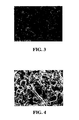
- the SEM in FIG. 3 is for Sample B (showing irregularly shaped particles and broad PSD), and the SEM in FIG. 4 is for Sample E (showing irregularly shaped particles, chunks, rods, wires, agglomerates, aggregates of agglomerates).
- PVP containing between 0.1 and 1 wt.% formate (63 g, M.W. 10,000, ISP) was weighed into a 500mL beaker. The PVP was then heated at 100°C for 70-90 hr. After cooling to room temperature, ethylene glycol (157 g) was added to the beaker. The mixture was then shear mixed for 10-30 min. at room temperature.
- silver nitrate (8 g) was weighed. Ethylene glycol (31 g) was added to the beaker. The mixture was then rapidly stirred on a magnetic stirrer until complete dissolution of the silver nitrate.
- the PVP solution was stirred at 300 RPM using a mechanical, overhead mixer while heating to 120° C.
- the silver nitrate solution was then rapidly added to the PVP solution, at which point the temperature of the combined solutions dropped to between 108 and 114°C.
- the temperature of the solution was allowed to return to 120° C and stabilized at this temperature for about 60 to 100 minutes.
- the reaction mixture was allowed to cool to room temperature.
- the resultant mixture was transferred to a mixing tank where about 0.8L of acetone and about 60 mL of ethylene glycol were added.
- the mixture was stirred thoroughly and then transferred to a centrifuge where it was centrifuged for about 20 minutes at 1,500 g to separate the silver nanoparticles from the liquid phase. This afforded nanoparticles having PVP adsorbed thereon.
- the particles were subsequently suspended in 25 mL of ethanol to remove, inter alia, excess PVP that was not adsorbed on the nanoparticles but was present merely as a contaminant.
- FIGS. 1 & 2 are for Sample G.
- PVP containing about 0.6 wt.% formate (63 g, M.W. 10,000, ISP) was weighed into a 500mL beaker. The PVP was then heated at 100°C for 70 hr. After cooling to room temperature the formate content was determined to be 0.04 wt.%. Ethylene glycol (157 g) was added to the beaker. The mixture was then shear mixed for 15 min. at room temperature.
- silver nitrate (8 g) was weighed. Ethylene glycol (31 g) was added to the beaker. The mixture was then rapidly stirred on a magnetic stirrer until complete dissolution of the silver nitrate.
- the PVP solution was stirred at 300 RPM using a mechanical, overhead mixer while heating to 120° C. 0.19g (0.35 wt.% based on PVP) formic acid was added to the solution. After 3 minutes the silver nitrate solution was then rapidly added to the PVP solution, at which point the temperature of the combined solutions dropped to 111 °C.
- the temperature of the solution was allowed to return to 120° C and stabilized at this temperature for about 85 minutes.
- the reaction mixture was allowed to cool to room temperature.
- the resultant mixture was transferred to a mixing tank where about 0.8L of acetone and about 60 mL of ethylene glycol were added.
- the mixture was stirred thoroughly and then transferred to a centrifuge where it was centrifuged for about 20 minutes at 1,500 g to separate the silver nanoparticles from the liquid phase. This afforded nanoparticles having PVP adsorbed thereon.
- the particles were subsequently suspended in 25 mL of ethanol to remove, inter alia, excess PVP that was not adsorbed on the nanoparticles but was present merely as a contaminant.
- the suspension was subsequently centrifuged and the resulting cake was dried in a vacuum oven at about 35 °C and about 10 -2 torr to afford dry nanoparticles.
- the particles as characterized by TGA exhibited a weight loss of about 7.5 wt.% when heated to 600 °C.
- PVP 1000 g, M.W. 10,000, ISP
- the PVP was then heated at 100°C for 72 hr. After cooling to room temperature the PVP was transferred into a 4-L Erlenmeyer flask. Ethylene glycol (2.5 L) was added to the flask. The mixture was then shear mixed until completely dissolved at room temperature which gradually increased to 50-60°C due to mechanical and shear friction energy transfer to the polymer and solvent.
- silver nitrate (128 g) was weighed. Ethylene glycol (500 mL) was added to the beaker. The mixture was then rapidly stirred on a magnetic stirrer until complete dissolution of the silver nitrate.
- the PVP solution was stirred using a mechanical, overhead mixer while heating to 120° C.
- the silver nitrate solution was then rapidly added to the PVP solution, at which point the temperature of the combined solutions dropped to between 108 and 114 °C.
- the temperature of the solution was allowed to return to 120° C and stabilized at this temperature for about 60 to 100 minutes.
- the reaction mixture was allowed to cool to room temperature.
- the reaction mixture was allowed to cool to room temperature and about 200 mL of ethylene glycol were added thereto to replace evaporated ethylene glycol.
- the resultant mixture was transferred to a mixing tank where 9 L of acetone and about 1 L of ethylene glycol were added.
- the mixture was stirred thoroughly and then transferred to a centrifuge where it was centrifuged for about 10 minutes at 2,200 rpm to separate the silver nanoparticles from the liquid phase. This afforded nanoparticles having PVP adsorbed thereon.
- the particles were subsequently suspended in 500 mL of ethanol to remove, inter alia, excess PVP that was not adsorbed on the nanoparticles but was present merely as a contaminant.
- the suspension was subsequently centrifuged and the resulting cake was dried in a vacuum oven at about 35° C and about 10 -2 torr to afford dry nanoparticles.
- Three samples were run, two employing PVP from a first PVP lot, and the other employing PVP from a second PVP lot.
- the particles were characterized by TGA, He Pycnometry, quasi elastic light scattering and large particle count (LPC) (Table 3).
- PVP containing between 0.1 and 1 wt.% formate (63 g, M.W. 10,000, ISP) was weighed into a 500mL beaker. The PVP was then heated at 100°C for 144 hr. After cooling to room temperature, ethylene glycol (157 g) was added to the beaker. The mixture was then shear mixed for 10-30 min. at room temperature
- silver nitrate (8 g) was weighed. Ethylene glycol (31 g) was added to the beaker. The mixture was then rapidly stirred on a magnetic stirrer until complete dissolution of the silver nitrate.
- the PVP solution was stirred at 300 RPM using a mechanical, overhead mixer while heating to 120° C.
- the silver nitrate solution was then rapidly added to the PVP solution, at which point the temperature of the combined solutions dropped to between 108 and 114° C.
- the temperature of the solution was allowed to return to 120° C and stabilized at this temperature for about 60 to 100 minutes.
- the reaction mixture was allowed to cool to room temperature.
- the resultant mixture was transferred to a mixing tank where about 0.8L of acetone and about 60 mL of ethylene glycol were added.
- the mixture was stirred thoroughly and then transferred to a centrifuge where it was centrifuged for about 20 minutes at 1,500 g to separate the silver nanoparticles from the liquid phase. This afforded nanoparticles having PVP adsorbed thereon.
- the particles were subsequently suspended in 25 mL of ethanol to remove, inter alia, excess PVP that was not adsorbed on the nanoparticles but was present merely as a contaminant.
- PVP containing between 0.1 and 1 wt.% formate (63g, M.W. 10,000, ISP) was weighed into a 1-L beaker. The PVP was then heated at 100°C for 72 - 93hr. After cooling to room temperature, ethylene glycol (312g or 471 g) was added to the beaker. The mixture was then shear mixed for 10 min. at room temperature
- silver nitrate (16g or 24 g) was weighed.
- Ethylene glycol (62 g or 93g) was added to the beaker. The mixture was then rapidly stirred on a magnetic stirrer until complete dissolution of the silver nitrate.
- the PVP solution was stirred at 300 RPM using a mechanical, overhead mixer while heating to 110 - 130° C.
- the silver nitrate solution was then rapidly added to the PVP solution, at which point the temperature of the combined solutions dropped by between 5 and 12°C.
- the temperature of the solution was allowed to return to 110 - 130°C and stabilized at this temperature for about 60 to 100 minutes.
- the reaction mixture was allowed to cool to room temperature.
- the resultant mixture was transferred to a mixing tank where about 0.8L of acetone and about 60 mL of ethylene glycol were added.
- the mixture was stirred thoroughly and then transferred to a centrifuge where it was centrifuged for about 20 minutes at 1,500 g to separate the silver nanoparticles from the liquid phase. This afforded nanoparticles having PVP adsorbed thereon.
- the particles were subsequently suspended in 25 mL of ethanol to remove, inter alia, excess PVP that was not adsorbed on the nanoparticles but was present merely as a contaminant.
- the suspension was subsequently centrifuged and the resulting cake was dried in a vacuum oven at about 35 °C and about 10 -2 torr to afford dry nanoparticles.
- Four samples were run, each with the same PVP.
- the particles were characterized by TGA and Helium pycnometry (Table 5).
- PVP 1000 g, M.W. 10,000, BASF
- Ethylene glycol 2.5 L was added to the beaker.
- the mixture was then shear mixed until completely dissolved at room temperature which gradually increased to from 50 to 60°C due to mechanical and shear friction energy transfer to the polymer and solvent.
- silver nitrate (128 g) was weighed. Ethylene glycol (500 mL) was added to the beaker. The mixture was then rapidly stirred on a magnetic stirrer until complete dissolution of the silver nitrate.
- the PVP solution was transferred to a 4-L Erlenmeyer flask and stirred using a mechanical, overhead mixer. The solution was heated to 120° C. The silver nitrate solution was then rapidly added to the PVP solution, at which point the temperature of the combined solutions dropped to less than 120° C.
- the mixture was maintained at 120°C for about 60 minutes.
- the reaction mixture was then allowed to cool to room temperature and about 200 mL of ethylene glycol was added thereto to replace evaporated ethylene glycol.
- the resultant mixture was transferred to a mixing tank where 9 L of acetone and about 1 L of ethylene glycol were added.
- the mixture was stirred thoroughly and then transferred to a centrifuge where it was centrifuged for about 10 minutes at 3,000 rpm to separate the silver nanoparticles from the liquid phase. This afforded silver nanoparticles having PVP adsorbed thereon.
- the particles were subsequently suspended in about 500 mL of ethanol to remove, inter alia, excess PVP that was not adsorbed on the nanoparticles but was present merely as a contaminant.
- the suspension was subsequently centrifuged and the resulting cake was dried in a vacuum oven at about 35°C and about 10 -2 torr to afford dry nanoparticles.
- the silver particles exhibited a TGA weight loss of between 0.8 and 0.9 wt.% and a density as measured by Helium pycnometry of between 10.0 and 10.2 g/cm 3 .
- the z-average particle size of the particles produced in the reaction described above as measured by quasi elastic light scattering (Malvern Instruments) was between 100 and 200 nm.
- Size statistics by volume showed multimodal size distributions with main peaks centered around 40 to 60 nm, 200 to 300 nm and 4200 nm. In one case more than 52% of the nanoparticles produced had a diameter of 200 to 300 nm. In another case more than 85% of the nanoparticles produced had a diameter centered around 4200 nm.
- Example 8 Heating PVP and Employing a Non-Polyol Reducing Agent in the First Solution
- This example describes five Ag/PVP nanoparticle syntheses where the amount of a non-polyol reducing agent in the first solution was varied between 250 mg and 1000 mg.
- PVP M.W. 10,000, BASF
- the PVP was then heated to 100°C for 48 hr. After cooling to room temperature, ethylene glycol (684 g) was added to the beaker. Ammonium formate (250 mg to 1 g) was then added to the beaker. The mixture was then shear mixed for 30 min. at room temperature.
- silver nitrate 32 g was weighed.
- Ethylene glycol 133 g was added to the beaker. The mixture was then rapidly stirred on a magnetic stirrer until the silver nitrate completely dissolved.
- the PVP solution was transferred to a 1-L Erlenmeyer flask and stirred at 300 RPM using a mechanical, overhead mixer. The solution was heated to 120° C. The silver nitrate solution was then rapidly added to the PVP solution, at which point the temperature of the combined solutions dropped to less than 120° C.
- the reaction was maintained at about 120°C for about 60 minutes.
- the reaction mixture was then allowed to cool to room temperature and about 50 mL of ethylene glycol was added to replace evaporated ethylene glycol. This mixture was stirred at high speed for about 30 minutes to resuspend any particles that had settled during the reaction.
- the resultant mixture was transferred to a mixing tank where 3 L of acetone and about 250 mL of ethylene glycol were added. The mixture was stirred thoroughly and then transferred to a centrifuge where it was centrifuged for about 20 minutes at 3,000 rpm to separate the silver nanoparticles from the liquid phase.
- nanoparticles having PVP adsorbed thereon This afforded between 16.0 and 19.4g of nanoparticles having PVP adsorbed thereon.
- the particles were subsequently suspended in about 100 mL of ethanol to remove, inter alia, excess PVP that was not adsorbed on the nanoparticles but was present merely as a contaminant.
- the suspension was subsequently centrifuged and the resulting cake was dried in a vacuum oven at about 35 °C and about 10 -2 torr to afford dry nanoparticles.
- These nanoparticles exhibited a TGA weight loss of about 3.0 to about 4.5 weight percent.
- the z-average particle size of the particles produced in the reactions described above as measured by quasi elastic light scattering (Malvern Instruments) was between 75 and 116 nm.
- Size statistics by volume showed bimodal or trimodal size distributions with peaks centered around 4 to 8 nm, 15 to 25 nm and 150 to 300 nm. Between 75 and 99% of the nanoparticles produced had a diameter centered around 4 to 8 nm and 15 to 25 nm. Less than about 25% of the nanoparticles had a diameter centered around 150 to 300 nm. The particles exhibited a density as measured by Helium pycnometry of between 8.1 and 8.6 g/cm 3 . The results are summarized in Table 7.
- Example 9 Employing a Base in the First Solution
- the PVP/ethylene glycol solution was heated at a rate of 60°C/hour up to 120°C.
- tetramethylammonium hydroxide (mole ratio to Ag: 0.22-0.5) was added to all samples except Sample BB.
- the silver nitrate/ethylene glycol solution was rapidly poured into the PVP/ethylene glycol solution in 5 seconds.
- the reagent solutions were combined by transferring the PVP/ethylene glycol solution into the reaction vessel at 100°C and continuing to heat the PVP/ethylene glycol solution in the reaction vessel to 120°C. Once the PVP/ethylene glycol solution was at temperature in the reaction vessel, the AgNO 3 /ethylene glycol solution was quickly pumped into reaction vessel (less than 17 seconds) and the reaction was allowed to proceed pseudo-adiabatically for 90-120 mins. In the other example, the reagent solutions were combined in a static mixer before they reached the reaction vessel.
- the two reagent solutions were pumped in a ratio-controlled fashion (ratio of AgNO 3 solution flow rate to PVP solution flow rate of 0.181) into the reaction vessel via that static mixer over 6-8 mins. The reaction was allowed to proceed pseudo-adiabatically for 90-120 mins.
Landscapes
- Chemical & Material Sciences (AREA)
- Engineering & Computer Science (AREA)
- Materials Engineering (AREA)
- Nanotechnology (AREA)
- Organic Chemistry (AREA)
- Wood Science & Technology (AREA)
- Life Sciences & Earth Sciences (AREA)
- General Chemical & Material Sciences (AREA)
- Chemical Kinetics & Catalysis (AREA)
- Condensed Matter Physics & Semiconductors (AREA)
- Crystallography & Structural Chemistry (AREA)
- General Physics & Mathematics (AREA)
- Physics & Mathematics (AREA)
- Composite Materials (AREA)
- Dispersion Chemistry (AREA)
- Inorganic Chemistry (AREA)
- Manufacture Of Metal Powder And Suspensions Thereof (AREA)
Claims (16)
- Ein Verfahren zur Herstellung von Metallnanopartikeln, worin das Verfahren umfasst(a) das Erwärmen eines Pulvers eines Vinylpyrrolidonpolymers auf eine Temperatur von 70°C bis 120°C,(b) die Bildung einer erwärmten ersten Lösung enthaltend das Pulver und ein Polyol,(c) das Mischen der erwärmten ersten Lösung mit einer zweiten Lösung enthaltend einen Metallvorläufer, der zu einem Metall reduzierbar ist.
- Das Verfahren des Anspruchs 1, worin die erste Lösung eine aus substituierten und unsubstituierten Alkylaminen, cyclischen Aminen, Arylaminen, aromatischen stickstoffhaltigen Basen, Alkyl- und Arylalkoxiden, Carbonaten, Hydroxiden und Hydriden ausgewählte Base enthält.
- Das Verfahren des Anspruchs 2, worin die Base Natriumhydroxid oder Tetramethylammoniumhydroxid enthält.
- Das Verfahren der Ansprüche 2-3, worin die Base in der ersten Lösung in einer Menge von 0,1 mol pro Mol des Metallvorläufers bis 0,5 mol pro Mol des Metallvorläufers vorliegt.
- Das Verfahren gemäß einem der vorstehenden Ansprüche, worin die zweite Lösung weiterhin das Polyol enthält und worin die resultierende Mischung auf eine Temperatur von 110°C bis 130°C erwärmt wird.
- Das Verfahren gemäß einem der vorstehenden Ansprüche, worin die erwärmte erste Lösung eine Temperatur von 110°C bis 130°C aufweist.
- Das Verfahren gemäß einem der vorstehenden Ansprüche, worin das Metall ein aus der aus Gold, Silber, Kupfer, Nickel, Cobalt, Palladium, Platin, Indium, Osmium, Rhodium, Ruthenium, Rhenium, Vanadium, Chrom, Mangan, Niob, Molybdän, Wolfram, Tantal, Eisen und Cadmium bestehenden Gruppe ausgewähltes Übergangsmetall umfasst.
- Das Verfahren gemäß einem der vorstehenden Ansprüche, worin der Metallvorläufer mindestens ein Salz von einem Salz einer anorganischen Säure, einem Nitrat, einem Salz einer organischen Säure, einem Acetat oder einem Trifluoracetat umfasst.
- Das Verfahren gemäß einem der vorstehenden Ansprüche, worin der Metallvorläufer mindestens eine der Verbindungen Silbernitrat, Silberacetat, Silbertrifluoracetat, Silberoxid, Kupferoxid, Kupferhydroxid, Kupfersulfat, Nickeloxid, Nickelhydroxid, Nickelchlorid, Nickelsulfat, Nickelacetat, Cobaltoxid, Cobalthydroxid, Cobaltchlorid oder Cobaltsulfat enthält.
- Das Verfahren gemäß einem der vorstehenden Ansprüche, worin das Polyol Ethylenglykol umfasst.
- Das Verfahren gemäß einem der vorstehenden Ansprüche, worin das Polymer ein Gewichtsmittel des Molekulargewichts von 5.000 bis 100.000 aufweist.
- Das Verfahren gemäß einem der vorstehenden Ansprüche, worin das Polymer ein Gewichtsmittel des Molekulargewichts von 5.000 bis 15.000 aufweist.
- Das Verfahren gemäß einem der vorstehenden Ansprüche, worin die erste Lösung ein nicht-polyolreduzierendes Agens enthaltend mindestens eine der Verbindungen von Ammoniumformiat, Ameisensäure, Formaldehyd, Acetaldehyd, Propionaldehyd, Ascorbinsäure, Zitronensäure, Natriumborhydrid, Lithiumaluminiumhydrid oder Lithiumtriethylborhydrid umfasst.
- Das Verfahren gemäß einem der vorstehenden Ansprüche, worin das Mischen die Einführung der zweiten Lösung in die erste Lösung umfasst und wahlweise in einem statischen Mixer erfolgt.
- Das Verfahren gemäß einem der vorstehenden Ansprüche, worin das Vinylpyrrolidonpolymer aus der aus Vinylpyrrolidon-Homopolymeren, alkylierten Polyvinylpyrrolidonen, Vinylpyrrolidon-Vinylacetat-Copolymeren, Vinylpyrrolidon-Dimethylaminoethylmethacrylat-Copolymeren, Vinylpyrrolidon-Methacrylamidopropyltrimethylammoniumchlorid-Copolymeren, Vinylpyrrolidon-Vinylcaprolactam-Dimethylaminoethylmethacrylat-Terpolymeren, Vinylpyrrolidon-Styrol-Copolymeren und Vinylpyrrolidon-Acrylsäure-Copolymeren bestehenden Gruppe ausgewählt wird.
- Das Verfahren gemäß einem der vorstehenden Ansprüche, worin das Pulver des Vinylpyrrolidonpolymers mehr als 8 Stunden erwärmt wird.
Applications Claiming Priority (2)
| Application Number | Priority Date | Filing Date | Title |
|---|---|---|---|
| US11/755,720 US7824466B2 (en) | 2005-01-14 | 2007-05-30 | Production of metal nanoparticles |
| PCT/US2008/065398 WO2008151066A1 (en) | 2007-05-30 | 2008-05-30 | Production of metal nanoparticles |
Publications (2)
| Publication Number | Publication Date |
|---|---|
| EP2178662A1 EP2178662A1 (de) | 2010-04-28 |
| EP2178662B1 true EP2178662B1 (de) | 2011-07-20 |
Family
ID=39739314
Family Applications (1)
| Application Number | Title | Priority Date | Filing Date |
|---|---|---|---|
| EP08769922A Not-in-force EP2178662B1 (de) | 2007-05-30 | 2008-05-30 | Herstellung von metallischen nanoteilchen |
Country Status (4)
| Country | Link |
|---|---|
| US (2) | US7824466B2 (de) |
| EP (1) | EP2178662B1 (de) |
| AT (1) | ATE516906T1 (de) |
| WO (1) | WO2008151066A1 (de) |
Cited By (1)
| Publication number | Priority date | Publication date | Assignee | Title |
|---|---|---|---|---|
| EP3730212A1 (de) * | 2019-04-26 | 2020-10-28 | Umicore Ag & Co. Kg | Edelmetall- und edelmetalllegierungsnanopartikel mit bimodaler grössenverteilung |
Families Citing this family (98)
| Publication number | Priority date | Publication date | Assignee | Title |
|---|---|---|---|---|
| US7824466B2 (en) * | 2005-01-14 | 2010-11-02 | Cabot Corporation | Production of metal nanoparticles |
| US7732330B2 (en) | 2005-06-30 | 2010-06-08 | Semiconductor Energy Laboratory Co., Ltd. | Semiconductor device and manufacturing method using an ink-jet method of the same |
| KR100768706B1 (ko) * | 2006-06-08 | 2007-10-19 | 삼성전기주식회사 | 잉크젯용 금속 잉크 조성물 |
| EP2032291A2 (de) * | 2006-06-19 | 2009-03-11 | Cabot Corporation | Metallhaltige nanopartikel, ihre synthese und verwendung |
| KR100790458B1 (ko) * | 2006-07-10 | 2008-01-02 | 삼성전기주식회사 | 구리 나노입자 및 그 제조방법 |
| DE102007037079A1 (de) * | 2006-10-25 | 2008-04-30 | Bayer Materialscience Ag | Silberhaltige wässrige Formulierung und ihre Verwendung zur Herstellung von elektrisch leitenden oder spiegelnden Beschichtungen |
| KR100874709B1 (ko) * | 2006-11-14 | 2008-12-18 | 광주과학기술원 | 영가 철 나노와이어의 합성방법 및 지하수처리 적용 |
| US8101231B2 (en) | 2007-12-07 | 2012-01-24 | Cabot Corporation | Processes for forming photovoltaic conductive features from multiple inks |
| US8852316B2 (en) * | 2008-04-28 | 2014-10-07 | Tata Chemicals Limited | Process for the preparation of silver nano particles |
| CN102105245A (zh) * | 2008-07-23 | 2011-06-22 | 建筑研究和技术有限公司 | 在多元醇中制备金属纳米颗粒的方法 |
| CN102119182B (zh) * | 2008-08-08 | 2013-02-06 | 建筑研究和技术有限公司 | 甲硅烷基化聚氨酯和/或聚脲的制备 |
| WO2010045223A2 (en) * | 2008-10-14 | 2010-04-22 | Laird Technologies, Inc. | Acicular metal particles having a high aspect ratio and non-catalytic methods for making same |
| DE102009015470A1 (de) * | 2008-12-12 | 2010-06-17 | Byk-Chemie Gmbh | Verfahren zur Herstellung von Metallnanopartikeln und auf diese Weise erhaltene Metallnanopartikel und ihre Verwendung |
| US20100163861A1 (en) * | 2008-12-29 | 2010-07-01 | Motorola, Inc. | Method and apparatus for optically transparent transistor |
| US9052304B2 (en) | 2009-03-13 | 2015-06-09 | Terrasep, Llc | Methods and apparatus for centrifugal liquid chromatography |
| WO2010107824A1 (en) * | 2009-03-16 | 2010-09-23 | University Of Massachusetts | Methods for the fabrication of nanostructure heating elements |
| ES2360649B2 (es) * | 2009-11-25 | 2011-10-17 | Universidade De Santiago De Compostela | Tintas conductoras obtenidas por combinación de aqcs y nanopartículas metálicas. |
| WO2011132952A2 (ko) * | 2010-04-21 | 2011-10-27 | 한양대학교 산학협력단 | 전기화학소자 전극, 이의 제조 방법 및 전기화학소자 |
| DE102010017706B4 (de) * | 2010-07-02 | 2012-05-24 | Rent-A-Scientist Gmbh | Verfahren zur Herstellung von Silber-Nanodrähten |
| DE102010033924A1 (de) * | 2010-08-03 | 2012-02-09 | Fraunhofer-Gesellschaft zur Förderung der angewandten Forschung e.V. | Verfahren zur Herstellung von Nanopartikeln aus einem Edelmetall und die Verwendung der so hergestellten Nanopartikel |
| CN102059346B (zh) * | 2010-12-08 | 2012-10-03 | 厦门大学 | 一种金-二氧化锰核壳结构纳米粒子的制备方法 |
| EP2468827B1 (de) | 2010-12-21 | 2014-03-12 | Agfa-Gevaert | Dispersion mit metallischen, Metalloxid- oder Metallvorläufernanopartikeln |
| US8551211B2 (en) * | 2011-02-15 | 2013-10-08 | Carestream Health, Inc. | Nanowire preparation methods, compositions, and articles |
| RU2448810C1 (ru) * | 2011-04-05 | 2012-04-27 | Государственное образовательное учреждение высшего профессионального образования "Башкирский государственный университет" (ГОУ ВПО БашГУ) | Способ получения наночастиц серебра |
| JP5310967B1 (ja) * | 2011-11-18 | 2013-10-09 | 住友金属鉱山株式会社 | 銀粉の製造方法 |
| EP2784784A4 (de) * | 2011-11-21 | 2015-07-15 | Hanwha Chemical Corp | Pastenzusammensetzung für vorderseitige elektrode einer solarzelle und solarzelle damit |
| KR101151366B1 (ko) * | 2011-11-24 | 2012-06-08 | 한화케미칼 주식회사 | 도전성 입자 및 이의 제조방법 |
| TWI569700B (zh) * | 2011-11-25 | 2017-02-01 | 昭和電工股份有限公司 | 導電性圖案生成方法 |
| EP2608217B1 (de) | 2011-12-21 | 2014-07-16 | Agfa-Gevaert | Dispersion, die metallische, Metalloxid- oder Metallvorläufernanoteilchen, ein polymeres Dispersionsmittel und ein Sinteradditiv umfasst |
| EP2608218B1 (de) | 2011-12-21 | 2014-07-30 | Agfa-Gevaert | Dispersion, die metallische, Metalloxid- oder Metallvorläufernanoteilchen, ein polymeres Dispersionsmittel und ein thermisch spaltbares Mittel umfasst |
| WO2013126491A1 (en) * | 2012-02-21 | 2013-08-29 | Georgetown University | Polyvinylpyrrolidone (pvp) for enhancing the activity and stability of platinum-based electrocatalysts |
| EP2671927B1 (de) | 2012-06-05 | 2021-06-02 | Agfa-Gevaert Nv | Metallnanopartikeldispersion |
| US9920207B2 (en) | 2012-06-22 | 2018-03-20 | C3Nano Inc. | Metal nanostructured networks and transparent conductive material |
| US10029916B2 (en) | 2012-06-22 | 2018-07-24 | C3Nano Inc. | Metal nanowire networks and transparent conductive material |
| CA2787584A1 (en) | 2012-08-22 | 2014-02-22 | Hy-Power Nano Inc. | Method for continuous preparation of indium-tin coprecipitates and indium-tin-oxide nanopowders with substantially homogeneous indium/tin composition, controllable shape and particle size |
| US9457128B2 (en) | 2012-09-07 | 2016-10-04 | President And Fellows Of Harvard College | Scaffolds comprising nanoelectronic components for cells, tissues, and other applications |
| US9786850B2 (en) * | 2012-09-07 | 2017-10-10 | President And Fellows Of Harvard College | Methods and systems for scaffolds comprising nanoelectronic components |
| US9744594B2 (en) | 2012-09-12 | 2017-08-29 | M. Technique Co., Ltd. | Method for producing nickel microparticles |
| CA2886404A1 (en) * | 2012-09-27 | 2014-04-03 | Rhodia Operations | Process for making silver nanostructures and copolymer useful in such process |
| TW201416327A (zh) * | 2012-10-16 | 2014-05-01 | Niching Ind Corp | 奈米銀線之製備方法 |
| US10020807B2 (en) | 2013-02-26 | 2018-07-10 | C3Nano Inc. | Fused metal nanostructured networks, fusing solutions with reducing agents and methods for forming metal networks |
| EP2781562B1 (de) | 2013-03-20 | 2016-01-20 | Agfa-Gevaert | Verfahren zur herstellung einer metallnanopartikeldispersion |
| EP2983850A1 (de) | 2013-04-12 | 2016-02-17 | Board of Regents, The University of Texas System | Synthese von bimetallischen nanopartikelkatalysatoren unter verwendung einer mikrowellenbestrahlung |
| HU230721B1 (hu) * | 2013-04-26 | 2017-11-28 | Auro-Science Consulting Kft. | Nanovas-szuszpenzió, eljárás előállítására, alkalmazása és berendezés nanovas-szuszpenzió gyártására |
| TWM512217U (zh) | 2013-06-20 | 2015-11-11 | Plant PV | 太陽能電池 |
| KR101802458B1 (ko) | 2013-07-04 | 2017-11-28 | 아그파-게바에르트 엔.브이. | 금속 나노입자 분산액 |
| EP2821164A1 (de) | 2013-07-04 | 2015-01-07 | Agfa-Gevaert | Metallnanopartikeldispersion |
| EP3017664A1 (de) | 2013-07-04 | 2016-05-11 | Agfa-Gevaert | Verfahren zur herstellung einer leitfähigen metallischen schicht oder eines musters |
| US9331216B2 (en) | 2013-09-23 | 2016-05-03 | PLANT PV, Inc. | Core-shell nickel alloy composite particle metallization layers for silicon solar cells |
| US11274223B2 (en) | 2013-11-22 | 2022-03-15 | C3 Nano, Inc. | Transparent conductive coatings based on metal nanowires and polymer binders, solution processing thereof, and patterning approaches |
| US10130992B2 (en) * | 2013-12-31 | 2018-11-20 | Rhodia Operations | Processes for making silver nanostructures |
| US9224412B2 (en) | 2014-01-31 | 2015-12-29 | HGST Netherlands B.V. | Perpendicular magnetic recording disk with template layer formed of a blend of nanoparticles |
| US11343911B1 (en) | 2014-04-11 | 2022-05-24 | C3 Nano, Inc. | Formable transparent conductive films with metal nanowires |
| EP3169465A1 (de) * | 2014-07-17 | 2017-05-24 | King Abdullah University Of Science And Technology | Skalierbare form- und grössengesteuerte synthese von metallnanolegierungen |
| US9183968B1 (en) | 2014-07-31 | 2015-11-10 | C3Nano Inc. | Metal nanowire inks for the formation of transparent conductive films with fused networks |
| DE102015013219A1 (de) * | 2014-10-28 | 2016-04-28 | Dow Global Technologies Llc | Verfahren zur Herstellung von Silber-Nanodrähten |
| EP3037161B1 (de) | 2014-12-22 | 2021-05-26 | Agfa-Gevaert Nv | Metallnanopartikeldispersion |
| US9388477B1 (en) * | 2015-01-20 | 2016-07-12 | Uchicago Argonne, Llc | Noble metal superparticles and methods of preparation thereof |
| TWI576255B (zh) * | 2015-04-17 | 2017-04-01 | 國立陽明大學 | 防僞標記的製作方法、檢測方法及其應用之防僞用具 |
| EP3099145B1 (de) | 2015-05-27 | 2020-11-18 | Agfa-Gevaert | Verfahren zur vorbereitung einer silbernen schicht oder eines musters mit einer silbernanopartikel-dispersion |
| EP3099146B1 (de) | 2015-05-27 | 2020-11-04 | Agfa-Gevaert | Verfahren zur vorbereitung einer silbernen schicht oder eines musters mit einer silbernanopartikel-dispersion |
| CN104942303B (zh) * | 2015-07-01 | 2017-09-15 | 崇义章源钨业股份有限公司 | 制备钨粉的方法 |
| CN106312087B (zh) * | 2015-07-03 | 2019-02-22 | 王东 | 纳米金属颗粒及其制备方法 |
| WO2017035103A1 (en) | 2015-08-25 | 2017-03-02 | Plant Pv, Inc | Core-shell, oxidation-resistant particles for low temperature conductive applications |
| US10418497B2 (en) | 2015-08-26 | 2019-09-17 | Hitachi Chemical Co., Ltd. | Silver-bismuth non-contact metallization pastes for silicon solar cells |
| HK1250682A1 (zh) | 2015-10-01 | 2019-01-11 | Bg Research Ltd | 核酸扩增 |
| US9741878B2 (en) | 2015-11-24 | 2017-08-22 | PLANT PV, Inc. | Solar cells and modules with fired multilayer stacks |
| CN105606419A (zh) * | 2016-01-11 | 2016-05-25 | 天津师范大学 | 铵态氮、硝酸根、亚硝酸根及氮氧化物测定的样品前处理方法 |
| US10174136B2 (en) * | 2016-02-29 | 2019-01-08 | University Of South Carolina | Separation of oil-water mixtures using nanotechnology |
| RU2618303C1 (ru) * | 2016-03-11 | 2017-05-03 | Федеральное Государственное Унитарное Предприятие "Государственный Ордена Трудового Красного Знамени Научно-Исследовательский Институт Химических Реактивов И Особо Чистых Химических Веществ" | Коллоидный раствор наносеребра в метилцеллозольве и способ его получения |
| US9902862B2 (en) * | 2016-07-06 | 2018-02-27 | National Cheng Kung University | Method of fabricating nano-silver paste having high bonding strength |
| CN106362775B (zh) * | 2016-08-10 | 2018-10-19 | 西北工业大学 | 一种基于硫化钼的高效光催化制备氢气的纳米材料及制备方法 |
| EP3287499B1 (de) | 2016-08-26 | 2021-04-07 | Agfa-Gevaert Nv | Metallnanopartikeldispersion |
| TWI842668B (zh) | 2017-02-08 | 2024-05-21 | 加拿大國家研究委員會 | 具低黏度與低加工溫度之銀分子油墨 |
| TW201842087A (zh) | 2017-02-08 | 2018-12-01 | 加拿大國家研究委員會 | 具改良之熱穩定性的分子油墨 |
| TWI874294B (zh) | 2017-02-08 | 2025-03-01 | 加拿大國家研究委員會 | 可印刷分子油墨 |
| WO2018182995A1 (en) | 2017-03-17 | 2018-10-04 | Board Of Regents, The University Of Texas System | Methods of making metal particles |
| CN107008920B (zh) * | 2017-03-21 | 2019-04-09 | 昆明理工大学 | 一种利用还原性有机酸制备钨粉的方法 |
| RU2644176C1 (ru) * | 2017-06-08 | 2018-02-08 | Федеральное государственное бюджетное учреждение науки Институт неорганической химии им. А.В. Николаева Сибирского отделения Российской академии наук | Способ получения стабильных высококонцентрированных органозолей на основе наночастиц серебра для получения электропроводящих пленок |
| TWI856947B (zh) | 2017-08-01 | 2024-10-01 | 加拿大國家研究委員會 | 銅墨水 |
| TWI856948B (zh) * | 2017-08-03 | 2024-10-01 | 美商電子墨水股份有限公司 | 包含鈀之導電墨水組成物及用於製造其之方法 |
| IN201711031533A (de) * | 2017-09-06 | 2024-02-23 | ||
| US10561041B2 (en) * | 2017-10-18 | 2020-02-11 | Pimems, Inc. | Titanium thermal module |
| CL2017003488A1 (es) * | 2017-12-29 | 2018-05-25 | Univ Chile | Método bimetálico para la construcción de nanopartícular (nps) de cobre metálico, para el revestimiento con nanoparticulas más pequeñas del metal secundario. |
| CL2017003489A1 (es) * | 2017-12-29 | 2018-05-25 | Univ Chile | Método secuencial para la construcción de nanopartículas de cobre metálico y su posterior decoración o revestimiento con nanopartículas más pequeñas del metal secundario |
| US20210253887A1 (en) | 2018-05-08 | 2021-08-19 | Agfa-Gevaert Nv | Conductive inks |
| CN114450356B (zh) | 2019-08-29 | 2023-03-14 | 法国比克公司 | 制备包括金纳米颗粒的具有固定颜色的水性凝胶油墨的方法 |
| DE102020121603A1 (de) | 2019-09-05 | 2021-03-11 | Huf Hülsbeck & Fürst Gmbh & Co. Kg | Betätigungsvorrichtung mit bewegbarem Schaltelement, Fahrzeug sowie Betätigungsverfahren |
| DE102020122424A1 (de) | 2019-09-05 | 2021-03-11 | Huf Hülsbeck & Fürst Gmbh & Co. Kg | Betätigungsvorrichtung zur Montage an einem Fahrzeugteil, Fahrzeug sowie Betätigungsverfahren zum Auslösen einer Fahrzeugfunktion |
| CN113118433B (zh) * | 2019-12-31 | 2022-06-24 | Tcl科技集团股份有限公司 | 一种贵金属纳米粒子的形貌重构的方法 |
| US12577423B2 (en) * | 2020-05-12 | 2026-03-17 | Xtpl S.A. | Metallic nanoparticle composition and method of dispensing metallic nanoparticle composition |
| CN114589312B (zh) * | 2022-01-20 | 2024-03-15 | 昆明贵研新材料科技有限公司 | 一种圆形银纳米片的制备方法 |
| CN116037912A (zh) * | 2022-12-28 | 2023-05-02 | 天津农学院 | 一种纳米金属颗粒Cu-NPs的制备方法及其应用 |
| US12692857B2 (en) | 2023-05-08 | 2026-07-28 | University Of South Carolina | Massively parallel flow-through system for nanoparticle synthesis |
| US20250101237A1 (en) * | 2023-09-22 | 2025-03-27 | Xtpl S.A. | Conductive compositions for additive manufacturing, additive manufacturing methods, electrically conductive traces produced therefrom, and electronic articles |
| WO2026043474A1 (en) * | 2024-08-20 | 2026-02-26 | Hewlett-Packard Development Company, L.P. | Binder fluid for three-dimensional printing |
| CN119319253B (zh) * | 2024-09-24 | 2025-09-09 | 中船黄冈贵金属有限公司 | 一种表面具有粗糙结构的类球形银粉及其制备方法和应用 |
| CN120679525B (zh) * | 2025-06-26 | 2026-06-19 | 肇庆学院 | 一种锇-钌纳米酶及其制备方法和应用 |
Family Cites Families (385)
| Publication number | Priority date | Publication date | Assignee | Title |
|---|---|---|---|---|
| US2785964A (en) | 1953-08-17 | 1957-03-19 | Phillips Petroleum Co | Process, apparatus, and system for producing, agglomerating, and collecting carbon black |
| US3313632A (en) | 1962-11-27 | 1967-04-11 | Engelhard Ind Inc | Gold-silver coordination compounds and decorating compositions containing same |
| US3401020A (en) | 1964-11-25 | 1968-09-10 | Phillips Petroleum Co | Process and apparatus for the production of carbon black |
| US3683382A (en) | 1969-05-29 | 1972-08-08 | Honeywell Inc | Recording medium responsive to force fields and apparatus for recording and reproducing signals on the medium |
| USRE28972E (en) | 1969-07-10 | 1976-09-21 | Boehringer Ingelheim Gmbh | 5-Aryl-1H-1,5-benzodiazepine-2,4-diones |
| US3922388A (en) | 1971-03-02 | 1975-11-25 | Honeywell Inc | Method of making an encapsulated thick film resistor and associated encapsulated conductors for use in an electrical circuit |
| US3814696A (en) | 1972-06-19 | 1974-06-04 | Eastman Kodak Co | Colloidal metal in non-aqueous media |
| AU5910773A (en) | 1972-08-23 | 1975-02-13 | Uncle Ben S Australia Pty | Treatment of meat products |
| US3957694A (en) | 1974-09-27 | 1976-05-18 | General Electric Company | Radiation curable inks |
| US4019188A (en) | 1975-05-12 | 1977-04-19 | International Business Machines Corporation | Micromist jet printer |
| US4094853A (en) | 1975-05-15 | 1978-06-13 | Kenrich Petrochemicals, Inc. | Alkoxy titanate salts useful as coupling agents |
| US4051074A (en) | 1975-10-29 | 1977-09-27 | Shoei Kagaku Kogyo Kabushiki Kaisha | Resistor composition and method for its manufacture |
| JPS5332015A (en) | 1976-09-07 | 1978-03-25 | Fuji Photo Film Co Ltd | Thermodevelopable photosensitive material |
| US4105483A (en) | 1977-02-14 | 1978-08-08 | Globe Industries Corporation | Printing ink transfer process |
| US4211668A (en) | 1977-03-07 | 1980-07-08 | Thalatta, Inc. | Process of microencapsulation and products thereof |
| US4186244A (en) | 1977-05-03 | 1980-01-29 | Graham Magnetics Inc. | Novel silver powder composition |
| US4289534A (en) | 1977-05-03 | 1981-09-15 | Graham Magnetics, Inc. | Metal powder paint composition |
| US4130671A (en) | 1977-09-30 | 1978-12-19 | The United States Of America As Represented By The United States Department Of Energy | Method for preparing a thick film conductor |
| US4266229A (en) | 1979-03-26 | 1981-05-05 | Whittaker Corporation | Light sensitive jet inks |
| US4255291A (en) | 1979-06-21 | 1981-03-10 | E. I. Du Pont De Nemours And Company | Air-fireable conductor composition |
| US4463030A (en) | 1979-07-30 | 1984-07-31 | Graham Magnetics Incorporated | Process for forming novel silver powder composition |
| US4333966A (en) | 1979-07-30 | 1982-06-08 | Graham Magnetics, Inc. | Method of forming a conductive metal pattern |
| US4419383A (en) | 1979-12-26 | 1983-12-06 | Magnavox Government And Industrial Electronics Company | Method for individually encapsulating magnetic particles |
| US4407674A (en) | 1980-03-03 | 1983-10-04 | Ercon, Inc. | Novel electroconductive compositions and powder for use therein |
| US4487811A (en) | 1980-12-29 | 1984-12-11 | General Electric Company | Electrical conductor |
| US4370308A (en) | 1981-05-15 | 1983-01-25 | Cabot Corporation | Production of carbon black |
| US4381945A (en) | 1981-08-03 | 1983-05-03 | E. I. Du Pont De Nemours And Company | Thick film conductor compositions |
| US4416932A (en) | 1981-08-03 | 1983-11-22 | E. I. Du Pont De Nemours And Company | Thick film conductor compositions |
| US4388346A (en) | 1981-11-25 | 1983-06-14 | Beggs James M Administrator Of | Electrodes for solid state devices |
| US4418099A (en) | 1982-02-05 | 1983-11-29 | Engelhard Corporation | Non-burnished precious metal composition |
| US4508753A (en) | 1982-08-19 | 1985-04-02 | Gte Automatic Electric Inc. | Method of producing fine line conductive/resistive patterns on an insulating coating |
| FR2537898A1 (fr) | 1982-12-21 | 1984-06-22 | Univ Paris | Procede de reduction de composes metalliques par les polyols, et poudres metalliques obtenues par ce procede |
| US4517252A (en) | 1983-05-06 | 1985-05-14 | The Boeing Company | Pre-alloyed thick film conductor for use with aluminum wire bonding and method of bonding |
| US4775439A (en) | 1983-07-25 | 1988-10-04 | Amoco Corporation | Method of making high metal content circuit patterns on plastic boards |
| JPS6060170A (ja) | 1983-09-12 | 1985-04-06 | Canon Inc | 記録液 |
| WO1985003460A1 (en) | 1984-02-13 | 1985-08-15 | Schmitt Jerome J Iii | Method and apparatus for the gas jet deposition of conducting and dielectric thin solid films and products produced thereby |
| JPS60195077A (ja) | 1984-03-16 | 1985-10-03 | 奥野製薬工業株式会社 | セラミツクスの無電解めつき用触媒組成物 |
| US5049434A (en) | 1984-04-30 | 1991-09-17 | National Starch And Chemical Investment Holding Corporation | Pre-patterned device substrate device-attach adhesive transfer system |
| US4548879A (en) | 1984-05-21 | 1985-10-22 | Rohm And Haas Company | Solderable polymer thick films |
| EP0175253B1 (de) | 1984-09-19 | 1989-07-12 | Bayer Ag | Verfahren zur partiellen Aktivierung von Substratoberflächen |
| US4599277A (en) | 1984-10-09 | 1986-07-08 | International Business Machines Corp. | Control of the sintering of powdered metals |
| US4594311A (en) | 1984-10-29 | 1986-06-10 | Kollmorgen Technologies Corporation | Process for the photoselective metallization on non-conductive plastic base materials |
| US4697041A (en) | 1985-02-15 | 1987-09-29 | Teijin Limited | Integrated solar cells |
| US4668533A (en) | 1985-05-10 | 1987-05-26 | E. I. Du Pont De Nemours And Company | Ink jet printing of printed circuit boards |
| US4720418A (en) | 1985-07-01 | 1988-01-19 | Cts Corporation | Pre-reacted resistor paint, and resistors made therefrom |
| US4650108A (en) | 1985-08-15 | 1987-03-17 | The United States Of America As Represented By The Administrator Of The National Aeronautics And Space Administration | Method for forming hermetic seals |
| EP0241432B1 (de) | 1986-03-07 | 1993-08-11 | Tanaka Kikinzoku Kogyo K.K. | Gasdurchlässige Elektrode |
| US4859241A (en) | 1986-04-16 | 1989-08-22 | Johnson Matthey Inc. | Metal flake and use thereof |
| US4877647A (en) | 1986-04-17 | 1989-10-31 | Kansas State University Research Foundation | Method of coating substrates with solvated clusters of metal particles |
| US5039552A (en) | 1986-05-08 | 1991-08-13 | The Boeing Company | Method of making thick film gold conductor |
| JPH0797696B2 (ja) | 1986-07-05 | 1995-10-18 | 株式会社豊田自動織機製作所 | ハイブリツドic基板と回路パタ−ン形成方法 |
| US4746838A (en) | 1986-07-30 | 1988-05-24 | Telegenix, Inc. | Ink for forming resistive structures and display panel containing the same |
| US4808274A (en) | 1986-09-10 | 1989-02-28 | Engelhard Corporation | Metallized substrates and process for producing |
| US4879104A (en) | 1987-06-16 | 1989-11-07 | Cabot Corporation | Process for producing carbon black |
| US4948623A (en) | 1987-06-30 | 1990-08-14 | International Business Machines Corporation | Method of chemical vapor deposition of copper, silver, and gold using a cyclopentadienyl/metal complex |
| DK648187D0 (da) | 1987-12-09 | 1987-12-09 | Linkease Test Systems A S | Fremgangsmaade og apparat til fremstilling af kredsloebsdel |
| US4857241A (en) | 1987-12-10 | 1989-08-15 | Colgate-Palmolive Company | Apparatus for making post-foaming gels and method |
| US4931323A (en) | 1987-12-10 | 1990-06-05 | Texas Instruments Incorporated | Thick film copper conductor patterning by laser |
| DE3809331C1 (de) | 1988-03-19 | 1989-04-27 | Degussa Ag, 6000 Frankfurt, De | |
| DE3843412A1 (de) | 1988-04-22 | 1990-06-28 | Bayer Ag | Neue polythiophene, verfahren zu ihrer herstellung und ihre verwendung |
| US5132248A (en) | 1988-05-31 | 1992-07-21 | The United States Of America As Represented By The United States Department Of Energy | Direct write with microelectronic circuit fabrication |
| US5045141A (en) | 1988-07-01 | 1991-09-03 | Amoco Corporation | Method of making solderable printed circuits formed without plating |
| US4877451A (en) | 1988-08-17 | 1989-10-31 | Xerox Corporation | Ink jet inks containing colored silica particles |
| US5121127A (en) | 1988-09-30 | 1992-06-09 | Sony Corporation | Microstrip antenna |
| US4892798A (en) | 1988-12-13 | 1990-01-09 | Minnesota Mining And Manufacturing Company | Electrophoretic imaging metal-toner fluid dispersion |
| EP0406376A1 (de) | 1988-12-24 | 1991-01-09 | Technology Applications Company Limited | Verfahren zur herstellung von gedruckten schaltungen |
| JP2538043B2 (ja) | 1989-04-05 | 1996-09-25 | 松下電器産業株式会社 | パタ―ン形成用材料とそれを用いたパタ―ン形成基板の作製方法 |
| GB8917078D0 (en) | 1989-07-26 | 1989-09-13 | Emi Plc Thorn | An electrically conductive ink |
| US5028473A (en) | 1989-10-02 | 1991-07-02 | Hughes Aircraft Company | Three dimensional microcircuit structure and process for fabricating the same from ceramic tape |
| EP0435655B1 (de) | 1989-12-26 | 1998-02-25 | Sumitomo Metal Mining Company Limited | Verbundwerkstoff von Silber und Metalloxyd und Verfahren zur Herstellung desselben |
| US5057363A (en) | 1989-12-27 | 1991-10-15 | Japan Capsular Products Inc. | Magnetic display system |
| US5716663A (en) | 1990-02-09 | 1998-02-10 | Toranaga Technologies | Multilayer printed circuit |
| US5183784A (en) | 1990-02-21 | 1993-02-02 | Johnson Matthey Inc. | Silver-glass pastes |
| US5075262A (en) | 1990-02-21 | 1991-12-24 | Johnson Matthey, Inc. | Silver-glass pastes |
| US5587111A (en) | 1990-03-29 | 1996-12-24 | Vacuum Metallurgical Co., Ltd. | Metal paste, process for producing same and method of making a metallic thin film using the metal paste |
| JPH03281783A (ja) | 1990-03-29 | 1991-12-12 | Vacuum Metallurgical Co Ltd | 金属薄膜の形成方法 |
| EP0452118B1 (de) | 1990-04-12 | 1996-08-21 | Matsushita Electric Industrial Co., Ltd. | Leitende Tintenzusammensetzung und Verfahren zum Herstellen eines dickschichtigen Musters |
| US5059242A (en) | 1990-04-27 | 1991-10-22 | Firmstone Michael G | Seed layer compositions containing organogold and organosilver compounds |
| US5091003A (en) | 1990-06-15 | 1992-02-25 | Ford Motor Company | Ink compositions and method for placing indicia on glass |
| US5281261A (en) | 1990-08-31 | 1994-01-25 | Xerox Corporation | Ink compositions containing modified pigment particles |
| JP3056522B2 (ja) | 1990-11-30 | 2000-06-26 | 三菱レイヨン株式会社 | 金属―導電性高分子複合微粒子及びその製造方法 |
| US5153023A (en) | 1990-12-03 | 1992-10-06 | Xerox Corporation | Process for catalysis of electroless metal plating on plastic |
| DE4040446A1 (de) | 1990-12-18 | 1992-06-25 | Degussa | Gold(i)mercaptocarbonsaeureester, verfahren zu ihrer herstellung und verwendung |
| US5244538A (en) | 1991-07-26 | 1993-09-14 | Microelectronics And Computer Technology Corporation | Method of patterning metal on a substrate using direct-write deposition of a mask |
| US5962085A (en) | 1991-02-25 | 1999-10-05 | Symetrix Corporation | Misted precursor deposition apparatus and method with improved mist and mist flow |
| US5216207A (en) | 1991-02-27 | 1993-06-01 | David Sarnoff Research Center, Inc. | Low temperature co-fired multilayer ceramic circuit boards with silver conductors |
| US5329293A (en) | 1991-04-15 | 1994-07-12 | Trident | Methods and apparatus for preventing clogging in ink jet printers |
| US5176764A (en) | 1991-05-08 | 1993-01-05 | The Goodyear Tire & Rubber Company | Tire assembly with inner and outer tires having cooperating vent components |
| US5139818A (en) | 1991-06-06 | 1992-08-18 | General Motors Corporation | Method for applying metal catalyst patterns onto ceramic for electroless copper deposition |
| US5539041A (en) | 1991-06-11 | 1996-07-23 | Fiberite, Inc. | Siloxane and phosphazene modified cyanate resin compositions |
| US5176744A (en) | 1991-08-09 | 1993-01-05 | Microelectronics Computer & Technology Corp. | Solution for direct copper writing |
| US5250229A (en) | 1991-10-10 | 1993-10-05 | E. I. Du Pont De Nemours And Company | Silver-rich conductor compositions for high thermal cycled and aged adhesion |
| FR2682625B1 (fr) | 1991-10-18 | 1997-04-11 | Degussa Prod Ceramiques | Poudres de metaux et d'alliages de metaux sous forme de grains microcristallins spheriques et compacts, et procede et dispositif pour la fabrication des poudres. |
| US5411792A (en) | 1992-02-27 | 1995-05-02 | Sumitomo Metal Mining Co., Ltd. | Transparent conductive substrate |
| SG49195A1 (en) | 1992-03-05 | 1998-05-18 | Cabot Corp | Process for producing carbon blacks and new carbon blacks |
| US5378508A (en) | 1992-04-01 | 1995-01-03 | Akzo Nobel N.V. | Laser direct writing |
| DE4214723C2 (de) | 1992-05-04 | 1994-08-25 | Starck H C Gmbh Co Kg | Feinteilige Metallpulver |
| JP3253734B2 (ja) | 1992-06-19 | 2002-02-04 | 富士通株式会社 | 半導体装置製造用の石英製装置 |
| US5270368A (en) | 1992-07-15 | 1993-12-14 | Videojet Systems International, Inc. | Etch-resistant jet ink and process |
| US5312674A (en) | 1992-07-31 | 1994-05-17 | Hughes Aircraft Company | Low-temperature-cofired-ceramic (LTCC) tape structures including cofired ferromagnetic elements, drop-in components and multi-layer transformer |
| GB9217811D0 (en) | 1992-08-21 | 1992-10-07 | Graetzel Michael | Organic compounds |
| US5332646A (en) | 1992-10-21 | 1994-07-26 | Minnesota Mining And Manufacturing Company | Method of making a colloidal palladium and/or platinum metal dispersion |
| US5444453A (en) | 1993-02-02 | 1995-08-22 | Ball Corporation | Microstrip antenna structure having an air gap and method of constructing same |
| US5433893A (en) | 1993-02-03 | 1995-07-18 | Chemet Corporation | Conductive compositions |
| US5384953A (en) | 1993-07-21 | 1995-01-31 | International Business Machines Corporation | Structure and a method for repairing electrical lines |
| US5378408A (en) | 1993-07-29 | 1995-01-03 | E. I. Du Pont De Nemours And Company | Lead-free thick film paste composition |
| EP0641670B1 (de) | 1993-09-07 | 1996-07-31 | Agfa-Gevaert N.V. | Tintenstrahldruckverfahren |
| US5494550A (en) | 1993-09-07 | 1996-02-27 | Sensormatic Electronics Corporation | Methods for the making of electronic article surveillance tags and improved electronic article surveillance tags produced thereby |
| US5838271A (en) | 1997-01-31 | 1998-11-17 | Lg Semicon Co., Ltd. | Digital to analog converter and bias circuit therefor for providing weighed currents |
| US5712673A (en) | 1993-12-01 | 1998-01-27 | Dai Nippon Printing Co., Ltd. | Thermal transfer recording medium and thermal transfer recording method |
| ATE440480T1 (de) | 1993-12-30 | 2009-09-15 | Miyake Kk | Verbundfolie mit schaltungsfírmiger metallfolie oder dergleichen und verfahren zur herstellung |
| US5559057A (en) | 1994-03-24 | 1996-09-24 | Starfire Electgronic Development & Marketing Ltd. | Method for depositing and patterning thin films formed by fusing nanocrystalline precursors |
| DE19502434A1 (de) | 1994-04-29 | 1995-11-02 | Hewlett Packard Co | System und Verfahren zur inkrementalen Herstellung von Schaltungsplatinen |
| US5599046A (en) | 1994-06-22 | 1997-02-04 | Scientific Games Inc. | Lottery ticket structure with circuit elements |
| US6379742B1 (en) | 1994-06-22 | 2002-04-30 | Scientific Games Inc. | Lottery ticket structure |
| EP0696515B1 (de) | 1994-07-11 | 1998-12-02 | Agfa-Gevaert N.V. | Tintenstrahldruckverfahren |
| JP3587884B2 (ja) | 1994-07-21 | 2004-11-10 | 富士通株式会社 | 多層回路基板の製造方法 |
| JPH08148787A (ja) | 1994-11-21 | 1996-06-07 | Sumitomo Kinzoku Ceramics:Kk | 厚膜ペースト |
| IL116377A (en) | 1994-12-15 | 2003-05-29 | Cabot Corp | Reaction of carbon black with diazonium salts, resultant carbon black products and their uses |
| US5571311A (en) | 1994-12-15 | 1996-11-05 | Cabot Corporation | Ink jet ink formulations containing carbon black products |
| US5604027A (en) | 1995-01-03 | 1997-02-18 | Xerox Corporation | Some uses of microencapsulation for electric paper |
| EP0729189A1 (de) | 1995-02-21 | 1996-08-28 | Interuniversitair Micro-Elektronica Centrum Vzw | Herstellungsverfahren von Solarzellen und so hergestellte Produkte |
| EP0736892B1 (de) | 1995-04-03 | 2003-09-10 | Canon Kabushiki Kaisha | Verfahren zur Herstellung einer elektronenemittierende Vorrichtung, einer Elektronenquelle und eines Bilderzeugungsgerätes |
| KR100229231B1 (ko) | 1995-04-04 | 1999-11-01 | 미다라이 후지오 | 전자 방출 소자 형성용 금속 함유 조성물, 및 전자방출소자,전자원및화상형성장치의제조방법 |
| WO1996034426A1 (fr) | 1995-04-24 | 1996-10-31 | Ntt Mobile Communications Network Inc. | Antenne microruban |
| US5781158A (en) | 1995-04-25 | 1998-07-14 | Young Hoek Ko | Electric/magnetic microstrip antenna |
| US6548036B2 (en) | 1995-05-04 | 2003-04-15 | Cabot Corporation | Method for producing carbon black |
| US5565143A (en) | 1995-05-05 | 1996-10-15 | E. I. Du Pont De Nemours And Company | Water-based silver-silver chloride compositions |
| US5604673A (en) | 1995-06-07 | 1997-02-18 | Hughes Electronics | Low temperature co-fired ceramic substrates for power converters |
| US5882722A (en) | 1995-07-12 | 1999-03-16 | Partnerships Limited, Inc. | Electrical conductors formed from mixtures of metal powders and metallo-organic decompositions compounds |
| US6118426A (en) | 1995-07-20 | 2000-09-12 | E Ink Corporation | Transducers and indicators having printed displays |
| US6124851A (en) | 1995-07-20 | 2000-09-26 | E Ink Corporation | Electronic book with multiple page displays |
| US6080261A (en) | 1995-08-25 | 2000-06-27 | Popat; Ghanshyam H. | Adhesive image transfer technique |
| JP3585598B2 (ja) | 1995-08-25 | 2004-11-04 | 大日本印刷株式会社 | 熱転写シート |
| JP3017422B2 (ja) | 1995-09-11 | 2000-03-06 | キヤノン株式会社 | 光起電力素子アレー及びその製造方法 |
| KR0155877B1 (ko) | 1995-09-12 | 1998-12-15 | 이대원 | 다층 회로기판 및 그 제조방법 |
| US5679724A (en) | 1995-09-29 | 1997-10-21 | Xerox Corporation | Submicron particles for ink jet inks |
| US5759230A (en) | 1995-11-30 | 1998-06-02 | The United States Of America As Represented By The Secretary Of The Navy | Nanostructured metallic powders and films via an alcoholic solvent process |
| US5814683A (en) | 1995-12-06 | 1998-09-29 | Hewlett-Packard Company | Polymeric additives for the elimination of ink jet aerosol generation |
| US5932280A (en) | 1995-12-19 | 1999-08-03 | Ncr Corporation | Printed circuit board having printed resistors and method of making printed resistors on a printed circuit board using thermal transfer techniques |
| US5826329A (en) | 1995-12-19 | 1998-10-27 | Ncr Corporation | Method of making printed circuit board using thermal transfer techniques |
| DE19548421B4 (de) | 1995-12-22 | 2004-06-03 | Celanese Ventures Gmbh | Verfahren zur kontinuierlichen Herstellung von Membranelektrodeneinheiten |
| US5909083A (en) | 1996-02-16 | 1999-06-01 | Dai Nippon Printing Co., Ltd. | Process for producing plasma display panel |
| US5922403A (en) | 1996-03-12 | 1999-07-13 | Tecle; Berhan | Method for isolating ultrafine and fine particles |
| FR2747527B1 (fr) * | 1996-04-12 | 1998-05-15 | Cit Alcatel | Procede et dispositif d'amplification de canaux extraits d'un multiplex de longueurs d'onde |
| CN1137285C (zh) | 1997-04-30 | 2004-02-04 | 高松研究所 | 金属糊和金属膜的制造方法 |
| US6027762A (en) | 1996-05-23 | 2000-02-22 | Mitsumi Electric Co., Ltd. | Method for producing flexible board |
| CA2258108A1 (en) | 1996-06-12 | 1997-12-18 | Brunel University | Microwave stripline structure |
| US5747562A (en) | 1996-06-14 | 1998-05-05 | Cabot Corporation | Ink and coating compositions containing silicon-treated carbon black |
| US5837045A (en) | 1996-06-17 | 1998-11-17 | Cabot Corporation | Colored pigment and aqueous compositions containing same |
| US5998085A (en) | 1996-07-23 | 1999-12-07 | 3M Innovative Properties | Process for preparing high resolution emissive arrays and corresponding articles |
| US5948200A (en) | 1996-07-26 | 1999-09-07 | Taiyo Yuden Co., Ltd. | Method of manufacturing laminated ceramic electronic parts |
| US5756008A (en) | 1996-08-14 | 1998-05-26 | E. I. Du Pont De Nemours And Company | Water cleanable silver composition |
| EP0933010B1 (de) | 1996-08-16 | 2002-01-23 | Hugh P. Craig | Druckfähige zusammensetzungen und deren auftragung auf dielektrische oberflächen für die herstellung von gedruckten leiterplatten |
| US6344271B1 (en) | 1998-11-06 | 2002-02-05 | Nanoenergy Corporation | Materials and products using nanostructured non-stoichiometric substances |
| WO2004050350A1 (en) | 2002-11-27 | 2004-06-17 | Nanoproducts Corporation | Nano-engineered inks, methods for their manufacture and their applications |
| US6652967B2 (en) | 2001-08-08 | 2003-11-25 | Nanoproducts Corporation | Nano-dispersed powders and methods for their manufacture |
| US5801108A (en) | 1996-09-11 | 1998-09-01 | Motorola Inc. | Low temperature cofireable dielectric paste |
| US5874770A (en) | 1996-10-10 | 1999-02-23 | General Electric Company | Flexible interconnect film including resistor and capacitor layers |
| TW353762B (en) | 1996-10-21 | 1999-03-01 | Dainippon Printing Co Ltd | Transfer sheet, and pattern-forming method |
| US5930026A (en) | 1996-10-25 | 1999-07-27 | Massachusetts Institute Of Technology | Nonemissive displays and piezoelectric power supplies therefor |
| US6207268B1 (en) | 1996-11-12 | 2001-03-27 | Dai Nippon Printing Co., Ltd. | Transfer sheet, and pattern-forming method |
| US5725647A (en) | 1996-11-27 | 1998-03-10 | Minnesota Mining And Manufacturing Company | Pigmented inks and humectants used therewith |
| JP3205793B2 (ja) | 1996-12-19 | 2001-09-04 | 株式会社巴製作所 | 超微粒子及びその製造方法 |
| US6103868A (en) | 1996-12-27 | 2000-08-15 | The Regents Of The University Of California | Organically-functionalized monodisperse nanocrystals of metals |
| US5759712A (en) | 1997-01-06 | 1998-06-02 | Hockaday; Robert G. | Surface replica fuel cell for micro fuel cell electrical power pack |
| US6099897A (en) | 1997-01-29 | 2000-08-08 | Mitsuboshi Belting Ltd. | Method for producing metal particulate dispersion and metal particle-carrying substance |
| WO1998037133A1 (en) | 1997-02-20 | 1998-08-27 | Partnerships Limited, Inc. | Low temperature method and compositions for producing electrical conductors |
| US6019926A (en) | 1997-02-20 | 2000-02-01 | The United States Of America As Represented By The Administrator Of The National Aeronautics And Space Adminstration | Reflective silvered polyimide films via in situ thermal reduction silver (I) complexes |
| US6379745B1 (en) | 1997-02-20 | 2002-04-30 | Parelec, Inc. | Low temperature method and compositions for producing electrical conductors |
| TW340296B (en) | 1997-02-21 | 1998-09-11 | Ricoh Microelectronics Kk | Method and apparatus of concave plate printing, method and apparatus for formation of wiring diagram, the contact electrode and the printed wiring nickel substrate |
| US6103393A (en) | 1998-02-24 | 2000-08-15 | Superior Micropowders Llc | Metal-carbon composite powders, methods for producing powders and devices fabricated from same |
| EP1007308B1 (de) | 1997-02-24 | 2003-11-12 | Superior Micropowders LLC | Aerosolverfahren und -gerät, teilchenförmige produkte, und daraus hergestellte elektronische geräte |
| US6660680B1 (en) | 1997-02-24 | 2003-12-09 | Superior Micropowders, Llc | Electrocatalyst powders, methods for producing powders and devices fabricated from same |
| US6338809B1 (en) | 1997-02-24 | 2002-01-15 | Superior Micropowders Llc | Aerosol method and apparatus, particulate products, and electronic devices made therefrom |
| US6159267A (en) | 1997-02-24 | 2000-12-12 | Superior Micropowders Llc | Palladium-containing particles, method and apparatus of manufacture, palladium-containing devices made therefrom |
| US5894038A (en) | 1997-02-28 | 1999-04-13 | The Whitaker Corporation | Direct deposition of palladium |
| US5846615A (en) | 1997-02-28 | 1998-12-08 | The Whitaker Corporation | Direct deposition of a gold layer |
| US6399230B1 (en) | 1997-03-06 | 2002-06-04 | Sarnoff Corporation | Multilayer ceramic circuit boards with embedded resistors |
| US5828271A (en) | 1997-03-06 | 1998-10-27 | Northrop Grumman Corporation | Planar ferrite toroid microwave phase shifter |
| US5837041A (en) | 1997-04-15 | 1998-11-17 | Xerox Corporation | Ink cartridges having ink compositions with pigmented particles and methods for their manufacture and use |
| US5853470A (en) | 1997-04-28 | 1998-12-29 | Eastman Kodak Company | Pigmented ink jet inks containing aldehydes |
| US6025026A (en) | 1997-06-30 | 2000-02-15 | Transitions Optical, Inc. | Process for producing an adherent polymeric layer on polymeric substrates and articles produced thereby |
| US6599631B2 (en) | 2001-01-26 | 2003-07-29 | Nanogram Corporation | Polymer-inorganic particle composites |
| DE19734974A1 (de) * | 1997-08-13 | 1999-02-25 | Hoechst Ag | Verfahren zur Herstellung von porös geträgerten Metall-Nanopartikel-haltigen Katalysatoren, insbesondere für die Gasphasenoxidation von Ethylen und Essigsäure zu Vinylacetat |
| KR100274317B1 (ko) | 1997-08-26 | 2001-01-15 | 정명식 | 화학증착에의한개구충전방법 |
| US5879715A (en) | 1997-09-02 | 1999-03-09 | Ceramem Corporation | Process and system for production of inorganic nanoparticles |
| US6090671A (en) | 1997-09-30 | 2000-07-18 | Siemens Aktiengesellschaft | Reduction of gate-induced drain leakage in semiconductor devices |
| JP2001518693A (ja) | 1997-09-30 | 2001-10-16 | パレレック,インコーポレイテッド | 薄金属物質の製造 |
| AU9593198A (en) | 1997-09-30 | 1999-04-23 | Partnerships Limited, Inc. | Method for metallizing holes |
| US6268014B1 (en) | 1997-10-02 | 2001-07-31 | Chris Eberspacher | Method for forming solar cell materials from particulars |
| AU9451098A (en) | 1997-10-14 | 1999-05-03 | Patterning Technologies Limited | Method of forming an electronic device |
| JP3320745B2 (ja) | 1997-12-05 | 2002-09-03 | 住友電気工業株式会社 | 分散フラット光ファイバ |
| US6074725A (en) | 1997-12-10 | 2000-06-13 | Caliper Technologies Corp. | Fabrication of microfluidic circuits by printing techniques |
| JPH11186572A (ja) | 1997-12-22 | 1999-07-09 | Canon Inc | 光起電力素子モジュール |
| JP4003273B2 (ja) | 1998-01-19 | 2007-11-07 | セイコーエプソン株式会社 | パターン形成方法および基板製造装置 |
| WO1999038176A1 (en) | 1998-01-22 | 1999-07-29 | Matsushita Electric Industrial Co., Ltd. | Ink for electronic component, method for producing electronic component by using the ink for electronic component, and ink-jet device |
| JP2002501965A (ja) | 1998-01-29 | 2002-01-22 | キャボット コーポレイション | 分散体の純化方法及びインクジェットインクの製造方法 |
| EP0947245B1 (de) | 1998-02-05 | 2004-04-07 | Motorola Semiconducteurs S.A. | Verfahren zur Herstellung von Metallenthaltenden Kolloidalen und Verfahren zur Herstellung von Metalloxyden enthaltenden empfindlichen Schichten für chemisches Sensorgerät |
| US6753108B1 (en) | 1998-02-24 | 2004-06-22 | Superior Micropowders, Llc | Energy devices and methods for the fabrication of energy devices |
| NL1008460C2 (nl) | 1998-03-03 | 1999-09-06 | Acheson Colloiden B V | Geleidende inkt of verf. |
| AU6016999A (en) | 1998-04-20 | 1999-12-13 | University Of North Carolina At Chapel Hill, The | Nanometer sized particles containing a reactive monolayer adsorbed thereon and methods of making the same |
| US6329899B1 (en) | 1998-04-29 | 2001-12-11 | Microcoating Technologies, Inc. | Formation of thin film resistors |
| JP2000011875A (ja) | 1998-06-19 | 2000-01-14 | Dainippon Toryo Co Ltd | プラズマディスプレイの製造方法 |
| US6262129B1 (en) | 1998-07-31 | 2001-07-17 | International Business Machines Corporation | Method for producing nanoparticles of transition metals |
| US6153348A (en) | 1998-08-07 | 2000-11-28 | Parelec Llc | Electrostatic printing of conductors on photoresists and liquid metallic toners therefor |
| US6214259B1 (en) | 1998-08-10 | 2001-04-10 | Vacuum Metallurgical Co., Ltd. | Dispersion containing Cu ultrafine particles individually dispersed therein |
| US6780765B2 (en) | 1998-08-14 | 2004-08-24 | Avery N. Goldstein | Integrated circuit trenched features and method of producing same |
| US6277740B1 (en) | 1998-08-14 | 2001-08-21 | Avery N. Goldstein | Integrated circuit trenched features and method of producing same |
| US6294401B1 (en) | 1998-08-19 | 2001-09-25 | Massachusetts Institute Of Technology | Nanoparticle-based electrical, chemical, and mechanical structures and methods of making same |
| CN1314829A (zh) | 1998-08-21 | 2001-09-26 | 斯里国际 | 电子线路和元件的印刷 |
| US6697694B2 (en) | 1998-08-26 | 2004-02-24 | Electronic Materials, L.L.C. | Apparatus and method for creating flexible circuits |
| EP0982090B1 (de) | 1998-08-27 | 2003-05-02 | Agfa-Gevaert | Verfahren zur Herstellung von Elemente für Aufnahmen |
| US20030148024A1 (en) | 2001-10-05 | 2003-08-07 | Kodas Toivo T. | Low viscosity precursor compositons and methods for the depositon of conductive electronic features |
| US6245494B1 (en) | 1998-08-27 | 2001-06-12 | Agfa-Gevaert | Method of imaging a heat mode recording element comprising highly dispersed metal alloys |
| US7098163B2 (en) | 1998-08-27 | 2006-08-29 | Cabot Corporation | Method of producing membrane electrode assemblies for use in proton exchange membrane and direct methanol fuel cells |
| JP3323887B2 (ja) | 1998-09-08 | 2002-09-09 | 富士ゼロックス株式会社 | インクジェット式プリンタ及び印刷方法 |
| US6743319B2 (en) | 1998-09-30 | 2004-06-01 | Paralec Inc. | Adhesiveless transfer lamination method and materials for producing electronic circuits |
| US20030020768A1 (en) | 1998-09-30 | 2003-01-30 | Renn Michael J. | Direct write TM system |
| US6251488B1 (en) | 1999-05-05 | 2001-06-26 | Optomec Design Company | Precision spray processes for direct write electronic components |
| US6636676B1 (en) | 1998-09-30 | 2003-10-21 | Optomec Design Company | Particle guidance system |
| DE19847161A1 (de) | 1998-10-14 | 2000-04-20 | Degussa | Mittels Aerosol dotiertes pyrogen hergestelltes Siliciumdioxid |
| US6707680B2 (en) | 1998-10-22 | 2004-03-16 | Board Of Trustees Of The University Of Arkansas | Surface applied passives |
| WO2000029208A1 (en) | 1998-11-16 | 2000-05-25 | Parelec Inc. | Electrically heatable, transparent windows and mirrors and method for production |
| US6506438B2 (en) | 1998-12-15 | 2003-01-14 | E Ink Corporation | Method for printing of transistor arrays on plastic substrates |
| JP2000182889A (ja) | 1998-12-16 | 2000-06-30 | Matsushita Electric Ind Co Ltd | 積層セラミック電子部品の製造方法、これに用いるインキジェット用インキおよびその製造方法 |
| US6274412B1 (en) | 1998-12-21 | 2001-08-14 | Parelec, Inc. | Material and method for printing high conductivity electrical conductors and other components on thin film transistor arrays |
| US6358567B2 (en) | 1998-12-23 | 2002-03-19 | The Regents Of The University Of California | Colloidal spray method for low cost thin coating deposition |
| US6114088A (en) | 1999-01-15 | 2000-09-05 | 3M Innovative Properties Company | Thermal transfer element for forming multilayer devices |
| EP1022560B1 (de) | 1999-01-21 | 2004-12-22 | Sony International (Europe) GmbH | Nanoteilchenstruktur zur Anwendung in einer elektronischen Anordnung, insbesondere in einem chemischen Sensor |
| US6177151B1 (en) | 1999-01-27 | 2001-01-23 | The United States Of America As Represented By The Secretary Of The Navy | Matrix assisted pulsed laser evaporation direct write |
| US6348295B1 (en) | 1999-03-26 | 2002-02-19 | Massachusetts Institute Of Technology | Methods for manufacturing electronic and electromechanical elements and devices by thin-film deposition and imaging |
| JP3571957B2 (ja) | 1999-03-30 | 2004-09-29 | 松下電器産業株式会社 | 導体ペーストおよびセラミック多層基板の製造方法 |
| US6251471B1 (en) | 1999-05-12 | 2001-06-26 | University Of New Hampshire | Surface trace electrical feedthru |
| EP1099183A4 (de) | 1999-05-24 | 2004-12-15 | Potomac Photonics Inc | Materialauslieferungssystem für miniaturstruktur-fabrikation |
| US6811885B1 (en) | 1999-06-06 | 2004-11-02 | Agfa-Gevaert | Acid stable aqueous dispersion of metal particles and applications |
| US6667360B1 (en) | 1999-06-10 | 2003-12-23 | Rensselaer Polytechnic Institute | Nanoparticle-filled polymers |
| JP4732645B2 (ja) | 1999-06-15 | 2011-07-27 | 丸山 稔 | 金属複合超微粒子の製造方法 |
| US6238734B1 (en) | 1999-07-08 | 2001-05-29 | Air Products And Chemicals, Inc. | Liquid precursor mixtures for deposition of multicomponent metal containing materials |
| EP1198852B1 (de) | 1999-07-21 | 2009-12-02 | E Ink Corporation | Bevorzugte methode, elektrische leiterbahnen für die kontrolle eines elektronischen displays herzustellen |
| US6143356A (en) | 1999-08-06 | 2000-11-07 | Parelec, Inc. | Diffusion barrier and adhesive for PARMOD™ application to rigid printed wiring boards |
| US6317023B1 (en) | 1999-10-15 | 2001-11-13 | E. I. Du Pont De Nemours And Company | Method to embed passive components |
| JP2001135138A (ja) | 1999-10-29 | 2001-05-18 | Matsushita Electric Ind Co Ltd | 導体ペースト |
| JP2001167633A (ja) | 1999-12-09 | 2001-06-22 | Ebara Corp | 金属成分含有溶液及び金属薄膜形成方法 |
| TW476073B (en) | 1999-12-09 | 2002-02-11 | Ebara Corp | Solution containing metal component, method of and apparatus for forming thin metal film |
| BR0016661B1 (pt) | 1999-12-21 | 2013-11-26 | Métodos para formação de um dispositivo eletrônico, dispositivo eletrônico e dispositivo de exibição | |
| EP1110647A3 (de) | 1999-12-22 | 2004-02-11 | Mitsui Mining and Smelting Co., Ltd | Sinterpaste für Leiterplatte und Verfahren zur Herstellung von oberflächenmodifiziertem Silberpulver |
| EP1441864B1 (de) | 2000-01-21 | 2009-11-18 | Midwest Research Institute | Verfahren zur herstellung von dünnfilmleitern durch zersetzung von metallchelaten in verbindung mit metallteilchen |
| AU2001247961A1 (en) | 2000-02-04 | 2001-08-14 | Optomec Design Company | Modified absorption through unique composite materials and material combinations |
| US6501663B1 (en) | 2000-02-28 | 2002-12-31 | Hewlett Packard Company | Three-dimensional interconnect system |
| US6360656B2 (en) | 2000-02-28 | 2002-03-26 | Minolta Co., Ltd. | Apparatus for and method of printing on three-dimensional object |
| US20020020491A1 (en) | 2000-04-04 | 2002-02-21 | Price David M. | High speed flip chip assembly process |
| KR100744306B1 (ko) | 2000-04-17 | 2007-07-30 | 마츠시타 덴끼 산교 가부시키가이샤 | 표시패널용 잉크와 이것을 이용한 플라즈마 디스플레이패널의 제조방법 |
| WO2001082315A1 (en) | 2000-04-20 | 2001-11-01 | Parelec, Inc. | Compositions and method for printing resistors, capacitors and inductors |
| JP3753925B2 (ja) | 2000-05-12 | 2006-03-08 | 株式会社ルネサステクノロジ | 半導体集積回路 |
| WO2001087503A1 (en) | 2000-05-12 | 2001-11-22 | Parelec, Inc. | Additive electronic circuits on thermally unstable substrates |
| EP1301341B1 (de) | 2000-06-30 | 2006-08-23 | nGimat Co. | Verfahren zum kunststoffbeschichten |
| US6734029B2 (en) | 2000-06-30 | 2004-05-11 | Seiko Epson Corporation | Method for forming conductive film pattern, and electro-optical device and electronic apparatus |
| GB0016747D0 (en) | 2000-07-08 | 2000-08-30 | Johnson Matthey Plc | Ink |
| DE10035211A1 (de) | 2000-07-20 | 2002-01-31 | Beiersdorf Ag | Geformtes Seifenprodukt, enthaltend Talkum, eine oder mehrere Fettsäuren in Form ihrer Alkaliseifen und ein oder mehrere nichtionische Tenside bei gleichzeitiger Abwesenheit von Alkyl-(oligo)-glycosiden |
| US6458431B2 (en) | 2000-07-28 | 2002-10-01 | Ekc Technology, Inc. | Methods for the lithographic deposition of materials containing nanoparticles |
| US6660058B1 (en) * | 2000-08-22 | 2003-12-09 | Nanopros, Inc. | Preparation of silver and silver alloyed nanoparticles in surfactant solutions |
| US7351449B2 (en) | 2000-09-22 | 2008-04-01 | N Gimat Co. | Chemical vapor deposition methods for making powders and coatings, and coatings made using these methods |
| JP2002124016A (ja) | 2000-10-13 | 2002-04-26 | Mitsubishi Electric Corp | ディスク再生装置及びディスク再生方法 |
| JP4871443B2 (ja) | 2000-10-13 | 2012-02-08 | 株式会社アルバック | 金属超微粒子分散液の製造方法 |
| JP5008216B2 (ja) | 2000-10-13 | 2012-08-22 | 株式会社アルバック | インクジェット用インクの製法 |
| US6649138B2 (en) | 2000-10-13 | 2003-11-18 | Quantum Dot Corporation | Surface-modified semiconductive and metallic nanoparticles having enhanced dispersibility in aqueous media |
| CA2426861C (en) | 2000-10-25 | 2008-10-28 | Yorishige Matsuba | Conductive metal paste |
| US20030151030A1 (en) | 2000-11-22 | 2003-08-14 | Gurin Michael H. | Enhanced conductivity nanocomposites and method of use thereof |
| US20040206941A1 (en) | 2000-11-22 | 2004-10-21 | Gurin Michael H. | Composition for enhancing conductivity of a carrier medium and method of use thereof |
| JP4677092B2 (ja) | 2000-12-04 | 2011-04-27 | 株式会社アルバック | フラットパネルディスプレイの電極形成方法 |
| GB0030095D0 (en) | 2000-12-09 | 2001-01-24 | Xaar Technology Ltd | Method of ink jet printing |
| TW533446B (en) | 2000-12-22 | 2003-05-21 | Koninkl Philips Electronics Nv | Electroluminescent device and a method of manufacturing thereof |
| US6467897B1 (en) | 2001-01-08 | 2002-10-22 | 3M Innovative Properties Company | Energy curable inks and other compositions incorporating surface modified, nanometer-sized particles |
| US6872444B2 (en) | 2001-01-30 | 2005-03-29 | The Procter & Gamble Company | Enhancement of color on surfaces |
| US6686045B2 (en) | 2001-01-31 | 2004-02-03 | Shin-Etsu Chemical Co., Ltd. | Composite fine particles, conductive paste, and conductive film |
| JP3693647B2 (ja) | 2001-02-08 | 2005-09-07 | 日立マクセル株式会社 | 金属合金微粒子及びその製造方法 |
| US6830806B2 (en) | 2001-04-12 | 2004-12-14 | Kreido Laboratories | Methods of manufacture of electric circuit substrates and components having multiple electric characteristics and substrates and components so manufactured |
| JP4300801B2 (ja) | 2001-04-20 | 2009-07-22 | パナソニック株式会社 | 下地材、インキ及びそれを用いた電子部品の製造方法 |
| US7348365B2 (en) | 2001-04-30 | 2008-03-25 | Postech Foundation | Colloid solution of metal nanoparticles, metal-polymer nanocomposites and methods for preparation thereof |
| US20030211246A1 (en) | 2001-05-11 | 2003-11-13 | Kydd Paul H. | Additive electronic circuits on thermally unstable substrates |
| WO2002098576A1 (en) | 2001-06-01 | 2002-12-12 | Litrex Corporation | Industrial microdeposition system for polymer light emitting diode displays, printed circuit boards and the like |
| US20040231594A1 (en) | 2001-06-01 | 2004-11-25 | Edwards Charles O. | Microdeposition apparatus |
| US7115218B2 (en) | 2001-06-28 | 2006-10-03 | Parelec, Inc. | Low temperature method and composition for producing electrical conductors |
| TW498409B (en) | 2001-07-04 | 2002-08-11 | Ind Tech Res Inst | Forming method and apparatus of integrated circuit with passive devices |
| KR100804924B1 (ko) | 2001-08-22 | 2008-02-20 | 스미토모덴키고교가부시키가이샤 | 도전페이스트와 그것을 이용한 도전막, 도금방법 및미세금속부품의 제조방법 |
| AUPR725701A0 (en) | 2001-08-24 | 2001-09-20 | Commonwealth Scientific And Industrial Research Organisation | Functionalised nanoparticle concentrates |
| EP1438197B1 (de) | 2001-09-03 | 2008-10-15 | Basf Se | Verfahren zur erhöhung der weisse von papier mit hilfe von kationischen polyelektrolyten |
| US7629017B2 (en) | 2001-10-05 | 2009-12-08 | Cabot Corporation | Methods for the deposition of conductive electronic features |
| US6951666B2 (en) | 2001-10-05 | 2005-10-04 | Cabot Corporation | Precursor compositions for the deposition of electrically conductive features |
| US20060001726A1 (en) | 2001-10-05 | 2006-01-05 | Cabot Corporation | Printable conductive features and processes for making same |
| US20030108664A1 (en) | 2001-10-05 | 2003-06-12 | Kodas Toivo T. | Methods and compositions for the formation of recessed electrical features on a substrate |
| US7524528B2 (en) | 2001-10-05 | 2009-04-28 | Cabot Corporation | Precursor compositions and methods for the deposition of passive electrical components on a substrate |
| JP2005537386A (ja) | 2001-10-05 | 2005-12-08 | スーペリア マイクロパウダーズ リミテッド ライアビリティ カンパニー | 導電性電子フィーチャを堆積するための低粘度前駆体組成物および方法 |
| US6701605B2 (en) | 2001-10-09 | 2004-03-09 | Sonoco Development, Inc. | Conductive electrical element and antenna with ink additive technology |
| US20030215565A1 (en) | 2001-10-10 | 2003-11-20 | Industrial Technology Research Institute | Method and apparatus for the formation of laminated circuit having passive components therein |
| US20030070569A1 (en) | 2001-10-11 | 2003-04-17 | Colin Bulthaup | Micro-stencil |
| US6936181B2 (en) | 2001-10-11 | 2005-08-30 | Kovio, Inc. | Methods for patterning using liquid embossing |
| US6562403B2 (en) | 2001-10-15 | 2003-05-13 | Kansas State University Research Foundation | Synthesis of substantially monodispersed colloids |
| US20030073042A1 (en) | 2001-10-17 | 2003-04-17 | Cernigliaro George J. | Process and materials for formation of patterned films of functional materials |
| JP4763237B2 (ja) | 2001-10-19 | 2011-08-31 | キャボット コーポレイション | 基板上に導電性電子部品を製造する方法 |
| JP2003133691A (ja) | 2001-10-22 | 2003-05-09 | Seiko Epson Corp | 膜パターンの形成方法、膜パターン形成装置、導電膜配線、電気光学装置、電子機器、並びに非接触型カード媒体 |
| JP4039035B2 (ja) | 2001-10-31 | 2008-01-30 | セイコーエプソン株式会社 | 線パターンの形成方法、線パターン、電気光学装置、電子機器、非接触型カード媒体 |
| CA2465124A1 (en) | 2001-11-01 | 2003-05-08 | Yissum Research Development Company Of The Hebrew University In Jerusalem | Ink-jet inks containing metal nanoparticles |
| US7553512B2 (en) | 2001-11-02 | 2009-06-30 | Cabot Corporation | Method for fabricating an inorganic resistor |
| US20030146019A1 (en) | 2001-11-22 | 2003-08-07 | Hiroyuki Hirai | Board and ink used for forming conductive pattern, and method using thereof |
| US6814795B2 (en) | 2001-11-27 | 2004-11-09 | Ferro Corporation | Hot melt conductor paste composition |
| DE10297544B4 (de) | 2001-12-18 | 2015-10-29 | Asahi Kasei Kabushiki Kaisha | Verfahren zur Herstellung eines Metall-Dünnfilms |
| JP4020764B2 (ja) | 2001-12-21 | 2007-12-12 | Jfeミネラル株式会社 | 分散性に優れた金属超微粉スラリー |
| JP3803062B2 (ja) | 2001-12-27 | 2006-08-02 | 矢崎総業株式会社 | 車両用指示装置 |
| JP2003288812A (ja) | 2001-12-29 | 2003-10-10 | Samsung Electronics Co Ltd | 金属ナノ粒子クラスターインクおよびこれを用いた金属パターン形成方法 |
| DE10209835A1 (de) | 2002-03-06 | 2003-10-16 | Bosch Gmbh Robert | Wasserlösliche Paste und deren Verwendung |
| JP3966034B2 (ja) | 2002-03-14 | 2007-08-29 | セイコーエプソン株式会社 | 吐出パターンデータ生成方法および吐出パターンデータ生成装置 |
| US20030185889A1 (en) | 2002-03-27 | 2003-10-02 | Jixiong Yan | Colloidal nanosilver solution and method for making the same |
| JPWO2003084297A1 (ja) | 2002-03-28 | 2005-08-11 | 新光電気工業株式会社 | 配線構造体及びその製造方法 |
| JP3805273B2 (ja) | 2002-03-29 | 2006-08-02 | Uht株式会社 | 積層型電子部品の製造装置 |
| TWI251018B (en) | 2002-04-10 | 2006-03-11 | Fujikura Ltd | Electroconductive composition, electroconductive coating and method of producing the electroconductive coating |
| JP4042497B2 (ja) | 2002-04-15 | 2008-02-06 | セイコーエプソン株式会社 | 導電膜パターンの形成方法、配線基板、電子デバイス、電子機器、並びに非接触型カード媒体 |
| US6773614B2 (en) | 2002-04-16 | 2004-08-10 | Hewlett-Packard Development Company, L.P. | Method of patterning conductive films |
| EP1383364A3 (de) | 2002-05-23 | 2006-01-04 | Nashua Corporation | Schaltungselemente mit tintenaufnehmender Beschichtung und einer Leiterbahn und Verfahren zu deren Herstellung |
| US6827772B2 (en) | 2002-05-24 | 2004-12-07 | Cabot Corporation | Carbon black and compositions containing same |
| US20040173144A1 (en) | 2002-05-31 | 2004-09-09 | Edwards Charles O. | Formation of printed circuit board structures using piezo microdeposition |
| JP4636496B2 (ja) | 2002-06-13 | 2011-02-23 | シーマ ナノテック イスラエル リミテッド | 導電性及び透明性を有するナノ被覆物及びナノインクの製造方法、並びにこの製造方法により製造されるナノ粉末被覆物及びインク |
| US7736693B2 (en) | 2002-06-13 | 2010-06-15 | Cima Nanotech Israel Ltd. | Nano-powder-based coating and ink compositions |
| KR100453131B1 (ko) | 2002-08-10 | 2004-10-15 | 율촌화학 주식회사 | 사슬 말단 기능성 고분자를 이용하여 안정화시킨 나노크기 금속 또는 금속염 및 이들의 제조 방법 |
| US6890050B2 (en) | 2002-08-20 | 2005-05-10 | Palo Alto Research Center Incorporated | Method for the printing of homogeneous electronic material with a multi-ejector print head |
| US20040058457A1 (en) | 2002-08-29 | 2004-03-25 | Xueying Huang | Functionalized nanoparticles |
| JP2004111253A (ja) | 2002-09-19 | 2004-04-08 | Noda Screen:Kk | 電子デバイスの電気的接続用導電性組成物および電子デバイス |
| GB0221893D0 (en) | 2002-09-20 | 2002-10-30 | Avecia Ltd | Process |
| JP4687107B2 (ja) | 2002-09-25 | 2011-05-25 | コニカミノルタホールディングス株式会社 | 電気回路、薄膜トランジスタ、電気回路の製造方法及び薄膜トランジスタの製造方法 |
| US7297179B2 (en) * | 2002-09-30 | 2007-11-20 | Fujifilm Corporation | Method of producing metal particles, and metal oxide obtained from the particles |
| JP3801158B2 (ja) | 2002-11-19 | 2006-07-26 | セイコーエプソン株式会社 | 多層配線基板の製造方法、多層配線基板、電子デバイス及び電子機器 |
| ATE539888T1 (de) | 2002-11-27 | 2012-01-15 | Ulvac Inc | Industrielles mikroauftragesystem mit auftrageverteilung zur verminderung der auswirkung von tröpfchenausrichtungstoleranzen und -fehlern sowie tröpfchenvolumentoleranzen und fehlern |
| US7585349B2 (en) | 2002-12-09 | 2009-09-08 | The University Of Washington | Methods of nanostructure formation and shape selection |
| US20040126708A1 (en) | 2002-12-31 | 2004-07-01 | 3M Innovative Properties Company | Method for modifying the surface of a polymeric substrate |
| JP2006517329A (ja) | 2003-01-10 | 2006-07-20 | キネテイツク・ナノマテリアルズ・リミテツド | 構造体の付着の改良およびその関連の改良 |
| GB0300529D0 (en) | 2003-01-10 | 2003-02-12 | Qinetiq Nanomaterials Ltd | Improvements in and relating to ink jet deposition |
| TWI265762B (en) | 2003-01-14 | 2006-11-01 | Sharp Kk | Wiring material, wiring substrate and manufacturing method thereof, display panel, fine particle thin film material, substrate including thin film layer and manufacturing method thereof |
| US7380690B2 (en) | 2003-01-17 | 2008-06-03 | Ricoh Company, Ltd. | Solution jet type fabrication apparatus, method, solution containing fine particles, wiring pattern substrate, device substrate |
| JP2004235272A (ja) | 2003-01-28 | 2004-08-19 | Kyocera Corp | 太陽電池素子およびその製造方法 |
| US7211205B2 (en) | 2003-01-29 | 2007-05-01 | Parelec, Inc. | High conductivity inks with improved adhesion |
| US7141185B2 (en) | 2003-01-29 | 2006-11-28 | Parelec, Inc. | High conductivity inks with low minimum curing temperatures |
| WO2004068918A2 (en) | 2003-01-31 | 2004-08-12 | Aktina Limited | Method for producing thin silver layers |
| WO2004075211A1 (en) | 2003-02-20 | 2004-09-02 | The Regents Of The University Of California | Method of forming conductors at low temperatures using metallic nanocrystals and product |
| JP4332360B2 (ja) | 2003-02-28 | 2009-09-16 | 大日本印刷株式会社 | 濡れ性パターン形成用塗工液およびパターン形成体の製造方法 |
| KR100401335B1 (en) | 2003-03-08 | 2003-10-10 | Mijitech Co Ltd | Metal nanoparticle surface-coated with silicon oxides and preparation thereof |
| US6921626B2 (en) | 2003-03-27 | 2005-07-26 | Kodak Polychrome Graphics Llc | Nanopastes as patterning compositions for electronic parts |
| JP2004304129A (ja) | 2003-04-01 | 2004-10-28 | Seiko Epson Corp | 液滴吐出法によるパターン形成方法、多層配線構造の形成方法 |
| JP4432347B2 (ja) | 2003-04-07 | 2010-03-17 | ソニー株式会社 | 液体吐出装置及び液体吐出方法 |
| US6880909B2 (en) | 2003-04-22 | 2005-04-19 | Lexmark International Inc. | Method and apparatus for adjusting drop velocity |
| KR20030044987A (ko) | 2003-05-22 | 2003-06-09 | 넵테크놀로지주식회사 | 나노 크기의 입자가 첨가 된 액상 세탁 세제의 제조 방법 |
| JP3861854B2 (ja) | 2003-05-28 | 2006-12-27 | セイコーエプソン株式会社 | 電気回路の製造方法 |
| WO2004105985A1 (en) | 2003-05-29 | 2004-12-09 | Seagate Technology Llc | Synthesis of iron-based alloy nanoparticles |
| US7393081B2 (en) | 2003-06-30 | 2008-07-01 | Semiconductor Energy Laboratory Co., Ltd. | Droplet jetting device and method of manufacturing pattern |
| US7202155B2 (en) | 2003-08-15 | 2007-04-10 | Semiconductor Energy Laboratory Co., Ltd. | Method for manufacturing wiring and method for manufacturing semiconductor device |
| US20050089683A1 (en) | 2003-09-12 | 2005-04-28 | Fuji Photo Film Co., Ltd. | Magnetic particles and method of producing the same and magnetic recording medium |
| EP1678761A1 (de) | 2003-10-29 | 2006-07-12 | Conductive Inkjet Technology Limited | Elektrische verbindung von komponenten |
| JP4157468B2 (ja) | 2003-12-12 | 2008-10-01 | 日立電線株式会社 | 配線基板 |
| JP2005191059A (ja) | 2003-12-24 | 2005-07-14 | Seiko Epson Corp | 電気回路の形成方法、電気回路製造装置 |
| JP2005219873A (ja) | 2004-02-06 | 2005-08-18 | Fuji Xerox Co Ltd | 記録材の除湿装置 |
| KR101215119B1 (ko) | 2004-03-01 | 2012-12-24 | 스미토모덴키고교가부시키가이샤 | 금속콜로이드용액 및 잉크젯용 금속잉크 |
| US7335245B2 (en) * | 2004-04-22 | 2008-02-26 | Honda Motor Co., Ltd. | Metal and alloy nanoparticles and synthesis methods thereof |
| US7718094B2 (en) | 2004-06-18 | 2010-05-18 | The Research Foundation Of State University Of New York | Preparation of metallic nanoparticles |
| US20060083694A1 (en) | 2004-08-07 | 2006-04-20 | Cabot Corporation | Multi-component particles comprising inorganic nanoparticles distributed in an organic matrix and processes for making and using same |
| GB0427164D0 (en) | 2004-12-11 | 2005-01-12 | Eastman Kodak Co | Conductive silver dispersions and uses thereof |
| US20060115536A1 (en) | 2004-11-12 | 2006-06-01 | Board Of Regents, The University Of Texas System | Glycerin based synthesis of silver nanoparticles and nanowires |
| US8167393B2 (en) | 2005-01-14 | 2012-05-01 | Cabot Corporation | Printable electronic features on non-uniform substrate and processes for making same |
| WO2006076607A1 (en) | 2005-01-14 | 2006-07-20 | Cabot Corporation | Ink-jet printing of passive electricalcomponents |
| US7533361B2 (en) | 2005-01-14 | 2009-05-12 | Cabot Corporation | System and process for manufacturing custom electronics by combining traditional electronics with printable electronics |
| ATE485171T1 (de) | 2005-01-14 | 2010-11-15 | Cabot Corp | Sicherheitseinrichtungen sowie verwendung und herstellungsverfahren davon |
| US20060163744A1 (en) | 2005-01-14 | 2006-07-27 | Cabot Corporation | Printable electrical conductors |
| WO2006076612A2 (en) | 2005-01-14 | 2006-07-20 | Cabot Corporation | A process for manufacturing application specific printable circuits (aspc’s) and other custom electronic devices |
| US7824466B2 (en) * | 2005-01-14 | 2010-11-02 | Cabot Corporation | Production of metal nanoparticles |
| WO2006076610A2 (en) | 2005-01-14 | 2006-07-20 | Cabot Corporation | Controlling ink migration during the formation of printable electronic features |
| WO2006076606A2 (en) | 2005-01-14 | 2006-07-20 | Cabot Corporation | Optimized multi-layer printing of electronics and displays |
| WO2006076604A2 (en) | 2005-01-14 | 2006-07-20 | Cabot Corporation | Processes for planarizing substrates and encapsulating printable electronic features |
| WO2006076615A1 (en) | 2005-01-14 | 2006-07-20 | Cabot Corporation | Ink-jet printing of compositionally no-uniform features |
| WO2006078825A2 (en) | 2005-01-21 | 2006-07-27 | Cabot Corporation | Processes for forming nanoparticles |
| US20090053400A1 (en) | 2005-02-23 | 2009-02-26 | La Vega Fernando De | Ink jet printable compositions for preparing electronic devices and patterns |
| KR100716201B1 (ko) | 2005-09-14 | 2007-05-10 | 삼성전기주식회사 | 금속 나노 입자 및 이의 제조방법 |
| EP1957608A2 (de) | 2005-10-28 | 2008-08-20 | Cabot Corporation | Leuchtende zusammensetzungen, verfahren zu deren herstellung und diese enthaltende tinten |
| US8721931B2 (en) | 2005-12-21 | 2014-05-13 | E I Du Pont De Nemours And Company | Paste for solar cell electrode, solar cell electrode manufacturing method, and solar cell |
| KR20070080467A (ko) * | 2006-02-07 | 2007-08-10 | 삼성전자주식회사 | 구리 나노 입자, 이의 제조 방법 및 이를 이용한 구리피막의 제조 방법 |
| EP2032291A2 (de) | 2006-06-19 | 2009-03-11 | Cabot Corporation | Metallhaltige nanopartikel, ihre synthese und verwendung |
| KR100836659B1 (ko) * | 2006-07-06 | 2008-06-10 | 삼성전기주식회사 | 금속 및 금속 산화물 나노입자의 제조방법 |
-
2007
- 2007-05-30 US US11/755,720 patent/US7824466B2/en active Active
-
2008
- 2008-05-30 WO PCT/US2008/065398 patent/WO2008151066A1/en not_active Ceased
- 2008-05-30 AT AT08769922T patent/ATE516906T1/de not_active IP Right Cessation
- 2008-05-30 EP EP08769922A patent/EP2178662B1/de not_active Not-in-force
-
2010
- 2010-07-02 US US12/829,934 patent/US8597397B2/en not_active Expired - Fee Related
Cited By (1)
| Publication number | Priority date | Publication date | Assignee | Title |
|---|---|---|---|---|
| EP3730212A1 (de) * | 2019-04-26 | 2020-10-28 | Umicore Ag & Co. Kg | Edelmetall- und edelmetalllegierungsnanopartikel mit bimodaler grössenverteilung |
Also Published As
| Publication number | Publication date |
|---|---|
| ATE516906T1 (de) | 2011-08-15 |
| US20080034921A1 (en) | 2008-02-14 |
| WO2008151066A1 (en) | 2008-12-11 |
| US7824466B2 (en) | 2010-11-02 |
| US8597397B2 (en) | 2013-12-03 |
| US20100269635A1 (en) | 2010-10-28 |
| EP2178662A1 (de) | 2010-04-28 |
Similar Documents
| Publication | Publication Date | Title |
|---|---|---|
| US7824466B2 (en) | Production of metal nanoparticles | |
| US7749299B2 (en) | Production of metal nanoparticles | |
| US7625637B2 (en) | Production of metal nanoparticles from precursors having low reduction potentials | |
| KR100716201B1 (ko) | 금속 나노 입자 및 이의 제조방법 | |
| EP2254692B1 (de) | Verfahren zur herstellung von dispersionen aus edelmetallnanopartikeln und zur isolierung solcher nanopartikel aus besagten dispersionen | |
| EP3150306B1 (de) | Beschichtete kupferartikel und verfahren zur herstellung davon | |
| US20200306836A1 (en) | Methods for the production of silver nanowires | |
| KR100809982B1 (ko) | 마이크로파를 이용한 구리 나노입자 제조방법 | |
| US20140251086A1 (en) | Production of nanostructures | |
| EP2649621B1 (de) | Stabile dispersionen aus monokristallinen nanometrischen silberteilchen | |
| US20070275259A1 (en) | Method of producing metal nanoparticles and metal nanoparticles produced thereby | |
| KR20090012605A (ko) | 금속 나노입자의 제조방법 | |
| CN102453374B (zh) | 金属纳米粒子分散体 | |
| US10226822B2 (en) | Method for preparing metal nanoparticles using a multi-functional polymer and a reducing agent | |
| KR20110099731A (ko) | 금속 나노입자의 제조 방법 및 이 방법으로 얻어진 금속 나노입자와 그것의 사용 | |
| KR101526234B1 (ko) | 극성 매체와의 친화성이 우수한 은 미분 및 은 잉크 | |
| Titkov et al. | Synthesis of Cu@ Ag nanoparticles with a core–shell structure stabilized with oxyethylated carboxylic acid | |
| KR100654668B1 (ko) | 금속 나노 입자와 그 제조방법 및 도전성 잉크 |
Legal Events
| Date | Code | Title | Description |
|---|---|---|---|
| PUAI | Public reference made under article 153(3) epc to a published international application that has entered the european phase |
Free format text: ORIGINAL CODE: 0009012 |
|
| 17P | Request for examination filed |
Effective date: 20091230 |
|
| AK | Designated contracting states |
Kind code of ref document: A1 Designated state(s): AT BE BG CH CY CZ DE DK EE ES FI FR GB GR HR HU IE IS IT LI LT LU LV MC MT NL NO PL PT RO SE SI SK TR |
|
| AX | Request for extension of the european patent |
Extension state: AL BA MK RS |
|
| 17Q | First examination report despatched |
Effective date: 20100429 |
|
| RIN1 | Information on inventor provided before grant (corrected) |
Inventor name: KIM, HYUNGRAK Inventor name: STUMP, AARON D. Inventor name: KODAS, TOIVO T. Inventor name: JAMES, ANTHONY R. Inventor name: SCHULT, ALLEN B. Inventor name: HAMPDEN-SMITH, MARK J. Inventor name: CARUSO, JAMES Inventor name: STOTT, NATHAN E. Inventor name: KOWALSKI, MARK H. Inventor name: HAUBRICH, SCOTT T. Inventor name: VANHEUSDEN, KAREL Inventor name: EDWARDS, CHUCK Inventor name: KUNZE, KLAUS |
|
| DAX | Request for extension of the european patent (deleted) | ||
| GRAP | Despatch of communication of intention to grant a patent |
Free format text: ORIGINAL CODE: EPIDOSNIGR1 |
|
| GRAS | Grant fee paid |
Free format text: ORIGINAL CODE: EPIDOSNIGR3 |
|
| GRAA | (expected) grant |
Free format text: ORIGINAL CODE: 0009210 |
|
| AK | Designated contracting states |
Kind code of ref document: B1 Designated state(s): AT BE BG CH CY CZ DE DK EE ES FI FR GB GR HR HU IE IS IT LI LT LU LV MC MT NL NO PL PT RO SE SI SK TR |
|
| REG | Reference to a national code |
Ref country code: GB Ref legal event code: FG4D |
|
| REG | Reference to a national code |
Ref country code: CH Ref legal event code: EP |
|
| REG | Reference to a national code |
Ref country code: DE Ref legal event code: R096 Ref document number: 602008008395 Country of ref document: DE Effective date: 20110915 |
|
| REG | Reference to a national code |
Ref country code: NL Ref legal event code: VDEP Effective date: 20110720 |
|
| REG | Reference to a national code |
Ref country code: AT Ref legal event code: MK05 Ref document number: 516906 Country of ref document: AT Kind code of ref document: T Effective date: 20110720 |
|
| PG25 | Lapsed in a contracting state [announced via postgrant information from national office to epo] |
Ref country code: BE Free format text: LAPSE BECAUSE OF FAILURE TO SUBMIT A TRANSLATION OF THE DESCRIPTION OR TO PAY THE FEE WITHIN THE PRESCRIBED TIME-LIMIT Effective date: 20110720 Ref country code: LT Free format text: LAPSE BECAUSE OF FAILURE TO SUBMIT A TRANSLATION OF THE DESCRIPTION OR TO PAY THE FEE WITHIN THE PRESCRIBED TIME-LIMIT Effective date: 20110720 Ref country code: PT Free format text: LAPSE BECAUSE OF FAILURE TO SUBMIT A TRANSLATION OF THE DESCRIPTION OR TO PAY THE FEE WITHIN THE PRESCRIBED TIME-LIMIT Effective date: 20111121 Ref country code: NL Free format text: LAPSE BECAUSE OF FAILURE TO SUBMIT A TRANSLATION OF THE DESCRIPTION OR TO PAY THE FEE WITHIN THE PRESCRIBED TIME-LIMIT Effective date: 20110720 Ref country code: FI Free format text: LAPSE BECAUSE OF FAILURE TO SUBMIT A TRANSLATION OF THE DESCRIPTION OR TO PAY THE FEE WITHIN THE PRESCRIBED TIME-LIMIT Effective date: 20110720 Ref country code: SE Free format text: LAPSE BECAUSE OF FAILURE TO SUBMIT A TRANSLATION OF THE DESCRIPTION OR TO PAY THE FEE WITHIN THE PRESCRIBED TIME-LIMIT Effective date: 20110720 Ref country code: NO Free format text: LAPSE BECAUSE OF FAILURE TO SUBMIT A TRANSLATION OF THE DESCRIPTION OR TO PAY THE FEE WITHIN THE PRESCRIBED TIME-LIMIT Effective date: 20111020 Ref country code: HR Free format text: LAPSE BECAUSE OF FAILURE TO SUBMIT A TRANSLATION OF THE DESCRIPTION OR TO PAY THE FEE WITHIN THE PRESCRIBED TIME-LIMIT Effective date: 20110720 Ref country code: IS Free format text: LAPSE BECAUSE OF FAILURE TO SUBMIT A TRANSLATION OF THE DESCRIPTION OR TO PAY THE FEE WITHIN THE PRESCRIBED TIME-LIMIT Effective date: 20111120 |
|
| PG25 | Lapsed in a contracting state [announced via postgrant information from national office to epo] |
Ref country code: CY Free format text: LAPSE BECAUSE OF FAILURE TO SUBMIT A TRANSLATION OF THE DESCRIPTION OR TO PAY THE FEE WITHIN THE PRESCRIBED TIME-LIMIT Effective date: 20110720 Ref country code: PL Free format text: LAPSE BECAUSE OF FAILURE TO SUBMIT A TRANSLATION OF THE DESCRIPTION OR TO PAY THE FEE WITHIN THE PRESCRIBED TIME-LIMIT Effective date: 20110720 Ref country code: AT Free format text: LAPSE BECAUSE OF FAILURE TO SUBMIT A TRANSLATION OF THE DESCRIPTION OR TO PAY THE FEE WITHIN THE PRESCRIBED TIME-LIMIT Effective date: 20110720 Ref country code: SI Free format text: LAPSE BECAUSE OF FAILURE TO SUBMIT A TRANSLATION OF THE DESCRIPTION OR TO PAY THE FEE WITHIN THE PRESCRIBED TIME-LIMIT Effective date: 20110720 Ref country code: GR Free format text: LAPSE BECAUSE OF FAILURE TO SUBMIT A TRANSLATION OF THE DESCRIPTION OR TO PAY THE FEE WITHIN THE PRESCRIBED TIME-LIMIT Effective date: 20111021 Ref country code: LV Free format text: LAPSE BECAUSE OF FAILURE TO SUBMIT A TRANSLATION OF THE DESCRIPTION OR TO PAY THE FEE WITHIN THE PRESCRIBED TIME-LIMIT Effective date: 20110720 |
|
| PG25 | Lapsed in a contracting state [announced via postgrant information from national office to epo] |
Ref country code: CZ Free format text: LAPSE BECAUSE OF FAILURE TO SUBMIT A TRANSLATION OF THE DESCRIPTION OR TO PAY THE FEE WITHIN THE PRESCRIBED TIME-LIMIT Effective date: 20110720 Ref country code: SK Free format text: LAPSE BECAUSE OF FAILURE TO SUBMIT A TRANSLATION OF THE DESCRIPTION OR TO PAY THE FEE WITHIN THE PRESCRIBED TIME-LIMIT Effective date: 20110720 |
|
| PLBE | No opposition filed within time limit |
Free format text: ORIGINAL CODE: 0009261 |
|
| STAA | Information on the status of an ep patent application or granted ep patent |
Free format text: STATUS: NO OPPOSITION FILED WITHIN TIME LIMIT |
|
| PG25 | Lapsed in a contracting state [announced via postgrant information from national office to epo] |
Ref country code: EE Free format text: LAPSE BECAUSE OF FAILURE TO SUBMIT A TRANSLATION OF THE DESCRIPTION OR TO PAY THE FEE WITHIN THE PRESCRIBED TIME-LIMIT Effective date: 20110720 Ref country code: RO Free format text: LAPSE BECAUSE OF FAILURE TO SUBMIT A TRANSLATION OF THE DESCRIPTION OR TO PAY THE FEE WITHIN THE PRESCRIBED TIME-LIMIT Effective date: 20110720 Ref country code: IT Free format text: LAPSE BECAUSE OF FAILURE TO SUBMIT A TRANSLATION OF THE DESCRIPTION OR TO PAY THE FEE WITHIN THE PRESCRIBED TIME-LIMIT Effective date: 20110720 |
|
| 26N | No opposition filed |
Effective date: 20120423 |
|
| PG25 | Lapsed in a contracting state [announced via postgrant information from national office to epo] |
Ref country code: DK Free format text: LAPSE BECAUSE OF FAILURE TO SUBMIT A TRANSLATION OF THE DESCRIPTION OR TO PAY THE FEE WITHIN THE PRESCRIBED TIME-LIMIT Effective date: 20110720 |
|
| REG | Reference to a national code |
Ref country code: DE Ref legal event code: R097 Ref document number: 602008008395 Country of ref document: DE Effective date: 20120423 |
|
| PG25 | Lapsed in a contracting state [announced via postgrant information from national office to epo] |
Ref country code: MC Free format text: LAPSE BECAUSE OF NON-PAYMENT OF DUE FEES Effective date: 20120531 |
|
| REG | Reference to a national code |
Ref country code: CH Ref legal event code: PL |
|
| PG25 | Lapsed in a contracting state [announced via postgrant information from national office to epo] |
Ref country code: LI Free format text: LAPSE BECAUSE OF NON-PAYMENT OF DUE FEES Effective date: 20120531 Ref country code: CH Free format text: LAPSE BECAUSE OF NON-PAYMENT OF DUE FEES Effective date: 20120531 |
|
| REG | Reference to a national code |
Ref country code: IE Ref legal event code: MM4A |
|
| PG25 | Lapsed in a contracting state [announced via postgrant information from national office to epo] |
Ref country code: IE Free format text: LAPSE BECAUSE OF NON-PAYMENT OF DUE FEES Effective date: 20120530 Ref country code: ES Free format text: LAPSE BECAUSE OF FAILURE TO SUBMIT A TRANSLATION OF THE DESCRIPTION OR TO PAY THE FEE WITHIN THE PRESCRIBED TIME-LIMIT Effective date: 20111031 |
|
| PG25 | Lapsed in a contracting state [announced via postgrant information from national office to epo] |
Ref country code: BG Free format text: LAPSE BECAUSE OF FAILURE TO SUBMIT A TRANSLATION OF THE DESCRIPTION OR TO PAY THE FEE WITHIN THE PRESCRIBED TIME-LIMIT Effective date: 20111020 |
|
| PG25 | Lapsed in a contracting state [announced via postgrant information from national office to epo] |
Ref country code: MT Free format text: LAPSE BECAUSE OF FAILURE TO SUBMIT A TRANSLATION OF THE DESCRIPTION OR TO PAY THE FEE WITHIN THE PRESCRIBED TIME-LIMIT Effective date: 20110720 |
|
| PG25 | Lapsed in a contracting state [announced via postgrant information from national office to epo] |
Ref country code: TR Free format text: LAPSE BECAUSE OF FAILURE TO SUBMIT A TRANSLATION OF THE DESCRIPTION OR TO PAY THE FEE WITHIN THE PRESCRIBED TIME-LIMIT Effective date: 20110720 |
|
| PG25 | Lapsed in a contracting state [announced via postgrant information from national office to epo] |
Ref country code: LU Free format text: LAPSE BECAUSE OF NON-PAYMENT OF DUE FEES Effective date: 20120530 |
|
| PG25 | Lapsed in a contracting state [announced via postgrant information from national office to epo] |
Ref country code: HU Free format text: LAPSE BECAUSE OF FAILURE TO SUBMIT A TRANSLATION OF THE DESCRIPTION OR TO PAY THE FEE WITHIN THE PRESCRIBED TIME-LIMIT Effective date: 20080530 |
|
| REG | Reference to a national code |
Ref country code: FR Ref legal event code: PLFP Year of fee payment: 8 |
|
| PGFP | Annual fee paid to national office [announced via postgrant information from national office to epo] |
Ref country code: DE Payment date: 20150601 Year of fee payment: 8 Ref country code: GB Payment date: 20150424 Year of fee payment: 8 |
|
| PGFP | Annual fee paid to national office [announced via postgrant information from national office to epo] |
Ref country code: FR Payment date: 20150424 Year of fee payment: 8 |
|
| REG | Reference to a national code |
Ref country code: DE Ref legal event code: R119 Ref document number: 602008008395 Country of ref document: DE |
|
| GBPC | Gb: european patent ceased through non-payment of renewal fee |
Effective date: 20160530 |
|
| REG | Reference to a national code |
Ref country code: FR Ref legal event code: ST Effective date: 20170131 |
|
| PG25 | Lapsed in a contracting state [announced via postgrant information from national office to epo] |
Ref country code: FR Free format text: LAPSE BECAUSE OF NON-PAYMENT OF DUE FEES Effective date: 20160531 Ref country code: DE Free format text: LAPSE BECAUSE OF NON-PAYMENT OF DUE FEES Effective date: 20161201 |
|
| PG25 | Lapsed in a contracting state [announced via postgrant information from national office to epo] |
Ref country code: GB Free format text: LAPSE BECAUSE OF NON-PAYMENT OF DUE FEES Effective date: 20160530 |