EP2180032B1 - Phosphores bleus-verts et verts pour applications d'éclairage - Google Patents
Phosphores bleus-verts et verts pour applications d'éclairage Download PDFInfo
- Publication number
- EP2180032B1 EP2180032B1 EP09167926.6A EP09167926A EP2180032B1 EP 2180032 B1 EP2180032 B1 EP 2180032B1 EP 09167926 A EP09167926 A EP 09167926A EP 2180032 B1 EP2180032 B1 EP 2180032B1
- Authority
- EP
- European Patent Office
- Prior art keywords
- phosphor
- phosphors
- light
- green
- combinations
- Prior art date
- Legal status (The legal status is an assumption and is not a legal conclusion. Google has not performed a legal analysis and makes no representation as to the accuracy of the status listed.)
- Active
Links
Images



Classifications
-
- C—CHEMISTRY; METALLURGY
- C09—DYES; PAINTS; POLISHES; NATURAL RESINS; ADHESIVES; COMPOSITIONS NOT OTHERWISE PROVIDED FOR; APPLICATIONS OF MATERIALS NOT OTHERWISE PROVIDED FOR
- C09K—MATERIALS FOR MISCELLANEOUS APPLICATIONS, NOT PROVIDED FOR ELSEWHERE
- C09K11/00—Luminescent materials, e.g. electroluminescent or chemiluminescent
- C09K11/08—Luminescent materials, e.g. electroluminescent or chemiluminescent containing inorganic luminescent materials
- C09K11/77—Luminescent materials, e.g. electroluminescent or chemiluminescent containing inorganic luminescent materials containing rare earth metals
- C09K11/7715—Luminescent materials, e.g. electroluminescent or chemiluminescent containing inorganic luminescent materials containing rare earth metals containing cerium
- C09K11/77214—Aluminosilicates
-
- C—CHEMISTRY; METALLURGY
- C09—DYES; PAINTS; POLISHES; NATURAL RESINS; ADHESIVES; COMPOSITIONS NOT OTHERWISE PROVIDED FOR; APPLICATIONS OF MATERIALS NOT OTHERWISE PROVIDED FOR
- C09K—MATERIALS FOR MISCELLANEOUS APPLICATIONS, NOT PROVIDED FOR ELSEWHERE
- C09K11/00—Luminescent materials, e.g. electroluminescent or chemiluminescent
- C09K11/08—Luminescent materials, e.g. electroluminescent or chemiluminescent containing inorganic luminescent materials
- C09K11/77—Luminescent materials, e.g. electroluminescent or chemiluminescent containing inorganic luminescent materials containing rare earth metals
-
- C—CHEMISTRY; METALLURGY
- C09—DYES; PAINTS; POLISHES; NATURAL RESINS; ADHESIVES; COMPOSITIONS NOT OTHERWISE PROVIDED FOR; APPLICATIONS OF MATERIALS NOT OTHERWISE PROVIDED FOR
- C09K—MATERIALS FOR MISCELLANEOUS APPLICATIONS, NOT PROVIDED FOR ELSEWHERE
- C09K11/00—Luminescent materials, e.g. electroluminescent or chemiluminescent
- C09K11/08—Luminescent materials, e.g. electroluminescent or chemiluminescent containing inorganic luminescent materials
- C09K11/77—Luminescent materials, e.g. electroluminescent or chemiluminescent containing inorganic luminescent materials containing rare earth metals
- C09K11/7715—Luminescent materials, e.g. electroluminescent or chemiluminescent containing inorganic luminescent materials containing rare earth metals containing cerium
- C09K11/7721—Aluminates
-
- F—MECHANICAL ENGINEERING; LIGHTING; HEATING; WEAPONS; BLASTING
- F21—LIGHTING
- F21K—NON-ELECTRIC LIGHT SOURCES USING LUMINESCENCE; LIGHT SOURCES USING ELECTROCHEMILUMINESCENCE; LIGHT SOURCES USING CHARGES OF COMBUSTIBLE MATERIAL; LIGHT SOURCES USING SEMICONDUCTOR DEVICES AS LIGHT-GENERATING ELEMENTS; LIGHT SOURCES NOT OTHERWISE PROVIDED FOR
- F21K2/00—Non-electric light sources using luminescence; Light sources using electrochemiluminescence
- F21K2/06—Non-electric light sources using luminescence; Light sources using electrochemiluminescence using chemiluminescence
- F21K2/08—Non-electric light sources using luminescence; Light sources using electrochemiluminescence using chemiluminescence activated by an electric field, i.e. electrochemiluminescence
-
- H—ELECTRICITY
- H05—ELECTRIC TECHNIQUES NOT OTHERWISE PROVIDED FOR
- H05B—ELECTRIC HEATING; ELECTRIC LIGHT SOURCES NOT OTHERWISE PROVIDED FOR; CIRCUIT ARRANGEMENTS FOR ELECTRIC LIGHT SOURCES, IN GENERAL
- H05B33/00—Electroluminescent light sources
- H05B33/12—Light sources with substantially two-dimensional [2D] radiating surfaces
- H05B33/14—Light sources with substantially two-dimensional [2D] radiating surfaces characterised by the chemical or physical composition or the arrangement of the electroluminescent material, or by the simultaneous addition of the electroluminescent material in or onto the light source
-
- H—ELECTRICITY
- H10—SEMICONDUCTOR DEVICES; ELECTRIC SOLID-STATE DEVICES NOT OTHERWISE PROVIDED FOR
- H10H—INORGANIC LIGHT-EMITTING SEMICONDUCTOR DEVICES HAVING POTENTIAL BARRIERS
- H10H20/00—Individual inorganic light-emitting semiconductor devices having potential barriers, e.g. light-emitting diodes [LED]
- H10H20/80—Constructional details
- H10H20/85—Packages
- H10H20/851—Wavelength conversion means
- H10H20/8511—Wavelength conversion means characterised by their material, e.g. binder
- H10H20/8512—Wavelength conversion materials
-
- H—ELECTRICITY
- H10—SEMICONDUCTOR DEVICES; ELECTRIC SOLID-STATE DEVICES NOT OTHERWISE PROVIDED FOR
- H10W—GENERIC PACKAGES, INTERCONNECTIONS, CONNECTORS OR OTHER CONSTRUCTIONAL DETAILS OF DEVICES COVERED BY CLASS H10
- H10W72/00—Interconnections or connectors in packages
- H10W72/01—Manufacture or treatment
- H10W72/015—Manufacture or treatment of bond wires
- H10W72/01515—Forming coatings
-
- H—ELECTRICITY
- H10—SEMICONDUCTOR DEVICES; ELECTRIC SOLID-STATE DEVICES NOT OTHERWISE PROVIDED FOR
- H10W—GENERIC PACKAGES, INTERCONNECTIONS, CONNECTORS OR OTHER CONSTRUCTIONAL DETAILS OF DEVICES COVERED BY CLASS H10
- H10W72/00—Interconnections or connectors in packages
- H10W72/071—Connecting or disconnecting
- H10W72/075—Connecting or disconnecting of bond wires
-
- H—ELECTRICITY
- H10—SEMICONDUCTOR DEVICES; ELECTRIC SOLID-STATE DEVICES NOT OTHERWISE PROVIDED FOR
- H10W—GENERIC PACKAGES, INTERCONNECTIONS, CONNECTORS OR OTHER CONSTRUCTIONAL DETAILS OF DEVICES COVERED BY CLASS H10
- H10W72/00—Interconnections or connectors in packages
- H10W72/071—Connecting or disconnecting
- H10W72/075—Connecting or disconnecting of bond wires
- H10W72/07541—Controlling the environment, e.g. atmosphere composition or temperature
- H10W72/07554—Controlling the environment, e.g. atmosphere composition or temperature changes in dispositions
-
- H—ELECTRICITY
- H10—SEMICONDUCTOR DEVICES; ELECTRIC SOLID-STATE DEVICES NOT OTHERWISE PROVIDED FOR
- H10W—GENERIC PACKAGES, INTERCONNECTIONS, CONNECTORS OR OTHER CONSTRUCTIONAL DETAILS OF DEVICES COVERED BY CLASS H10
- H10W72/00—Interconnections or connectors in packages
- H10W72/50—Bond wires
- H10W72/541—Dispositions of bond wires
- H10W72/547—Dispositions of multiple bond wires
-
- H—ELECTRICITY
- H10—SEMICONDUCTOR DEVICES; ELECTRIC SOLID-STATE DEVICES NOT OTHERWISE PROVIDED FOR
- H10W—GENERIC PACKAGES, INTERCONNECTIONS, CONNECTORS OR OTHER CONSTRUCTIONAL DETAILS OF DEVICES COVERED BY CLASS H10
- H10W72/00—Interconnections or connectors in packages
- H10W72/50—Bond wires
- H10W72/59—Bond pads specially adapted therefor
-
- H—ELECTRICITY
- H10—SEMICONDUCTOR DEVICES; ELECTRIC SOLID-STATE DEVICES NOT OTHERWISE PROVIDED FOR
- H10W—GENERIC PACKAGES, INTERCONNECTIONS, CONNECTORS OR OTHER CONSTRUCTIONAL DETAILS OF DEVICES COVERED BY CLASS H10
- H10W72/00—Interconnections or connectors in packages
- H10W72/851—Dispositions of multiple connectors or interconnections
- H10W72/874—On different surfaces
- H10W72/884—Die-attach connectors and bond wires
-
- H—ELECTRICITY
- H10—SEMICONDUCTOR DEVICES; ELECTRIC SOLID-STATE DEVICES NOT OTHERWISE PROVIDED FOR
- H10W—GENERIC PACKAGES, INTERCONNECTIONS, CONNECTORS OR OTHER CONSTRUCTIONAL DETAILS OF DEVICES COVERED BY CLASS H10
- H10W72/00—Interconnections or connectors in packages
- H10W72/90—Bond pads, in general
- H10W72/941—Dispositions of bond pads
- H10W72/944—Dispositions of multiple bond pads
-
- H—ELECTRICITY
- H10—SEMICONDUCTOR DEVICES; ELECTRIC SOLID-STATE DEVICES NOT OTHERWISE PROVIDED FOR
- H10W—GENERIC PACKAGES, INTERCONNECTIONS, CONNECTORS OR OTHER CONSTRUCTIONAL DETAILS OF DEVICES COVERED BY CLASS H10
- H10W74/00—Encapsulations, e.g. protective coatings
-
- H—ELECTRICITY
- H10—SEMICONDUCTOR DEVICES; ELECTRIC SOLID-STATE DEVICES NOT OTHERWISE PROVIDED FOR
- H10W—GENERIC PACKAGES, INTERCONNECTIONS, CONNECTORS OR OTHER CONSTRUCTIONAL DETAILS OF DEVICES COVERED BY CLASS H10
- H10W90/00—Package configurations
- H10W90/701—Package configurations characterised by the relative positions of pads or connectors relative to package parts
- H10W90/751—Package configurations characterised by the relative positions of pads or connectors relative to package parts of bond wires
- H10W90/756—Package configurations characterised by the relative positions of pads or connectors relative to package parts of bond wires between a chip and a stacked lead frame, conducting package substrate or heat sink
-
- Y—GENERAL TAGGING OF NEW TECHNOLOGICAL DEVELOPMENTS; GENERAL TAGGING OF CROSS-SECTIONAL TECHNOLOGIES SPANNING OVER SEVERAL SECTIONS OF THE IPC; TECHNICAL SUBJECTS COVERED BY FORMER USPC CROSS-REFERENCE ART COLLECTIONS [XRACs] AND DIGESTS
- Y02—TECHNOLOGIES OR APPLICATIONS FOR MITIGATION OR ADAPTATION AGAINST CLIMATE CHANGE
- Y02B—CLIMATE CHANGE MITIGATION TECHNOLOGIES RELATED TO BUILDINGS, e.g. HOUSING, HOUSE APPLIANCES OR RELATED END-USER APPLICATIONS
- Y02B20/00—Energy efficient lighting technologies, e.g. halogen lamps or gas discharge lamps
Definitions
- the present techniques generally relate to novel phosphor compositions. More specifically, the present techniques describe phosphors that retain a substantial portion of their room temperature quantum efficiency at elevated temperatures.
- the phosphors may be used in light emitting diodes, Hg-based fluorescent lamps, gas discharge lamps, in UV, violet and/or blue lasers, as well as other white or colored light sources for different applications.
- a phosphor is a luminescent material that absorbs radiation energy in one portion of the electromagnetic spectrum and emits energy in another portion of the electromagnetic spectrum.
- One important class of phosphors includes crystalline inorganic compounds of very high chemical purity and of controlled composition, to which small quantities of other elements, called “activators,” have been added for fluorescent emission. With the right combination of activators and inorganic compounds, the color of the emission of these crystalline phosphors may be controlled.
- Most useful phosphors emit radiation in the visible portion of the electromagnetic spectrum in response to excitation by electromagnetic energy outside the visible range. For example, phosphors have been used in mercury vapor discharge lamps to convert the ultraviolet (UV) radiation emitted by the excited mercury to visible light. Further, phosphors may be used in light emitting diodes (LEDs) to generate colors that may generally not be obtained from the LED chip itself.
- LEDs light emitting diodes
- LEDs Light emitting diodes
- LEDs are semiconductor light emitters that may be used as replacements for other light sources, such as incandescent lamps. They are particularly useful as display lights, warning lights and indicating lights or in other applications where colored light is desired. The color of light produced by an LED is dependent on the type of semiconductor material used in its manufacture.
- Colored semiconductor light emitting devices including light emitting diodes and semiconductor lasers (which are both generally referred to herein as LEDs), have been produced from Group III-V alloys such as gallium nitride (GaN).
- Group III-V alloys such as gallium nitride (GaN).
- GaN gallium nitride
- layers of the alloys are typically deposited epitaxially on a substrate, such as silicon carbide or sapphire, and may be doped with a variety of n- and p-type dopants to improve properties, such as light emission efficiency.
- GaN-based LEDs With reference to the GaN-based LEDs, light is generally emitted in the UV to green range of the electromagnetic spectrum.
- LEDs have not been suitable for lighting uses where a bright white light is needed, due to the inherent color of the light produced by the LED.
- the LED may be coated or covered with a phosphor layer.
- a phosphor layer By interposing a phosphor excited by the radiation generated by the LED, light of a different wavelength, such as in the visible range of the spectrum, may be generated.
- Colored LEDs are often used in toys, indicator lights and other devices. Manufacturers are continuously looking for new colored phosphors for use in such LEDs to produce custom colors and higher luminosity.
- Phosphors may respond to this heat with a decrease in quantum efficiency, which is the number of photons emitted by the phosphor versus the number of photons absorbed by the phosphor. Accordingly, as the quantum efficiency of different phosphors may change at different rates as temperature increases, the light emitted by the device may dim or the color may shift as the device enters steady state operation.
- phosphor compositions that may be used as components, individually or as part of a phosphor blend, in the manufacture of LEDs and other light sources.
- Such phosphor compositions should allow a wider array of light sources with desirable properties including good color quality (CRI>80), a large range of color temperatures, and a relative insensitivity to temperature changes.
- US 2007/0182309 discloses a phosphor of the formula, Me 3-a YO 5-b :aCe, wherein Me is calcium (Ca), strontium (Sr), barium (Ba), europium (Eu), terbium (Tb), or combinations thereof: Y is silicon (Si), boron (B), alumium (A1), or combinations thereof: X is fluorine (F), chlorine (C1), bormine (Br), or nitrogen (N): a is between 0.001 and 0.5 and b is between 0 and 5.
- the present invention provides a lighting apparatus comprising: a light source configured to emit radiation with a peak intensity at a wavelength between 250 nm and 550 nm; and a phosphor composition comprising a blue-green to green phosphor having a peak emission wavelength between 485 nm and 540 nm, using a 405 nm excitation wavelengths, configured to be radiationally coupled to the light source, of formula ((Sr 1-z M z ) 1-(x+w) A w Ce x ) 3 (Al 1-y Si y )O 4+y+3(x-w) F 1-y-3(x-w) , wherein 0 ⁇ x ⁇ 0.10, 0 ⁇ y ⁇ 0.5, 0 ⁇ 0.5, 0 ⁇ w ⁇ x, A is Li, Na, K, or any combinations thereof, and M is Ca, Ba, Mg, or any combinations thereof.
- a phosphor comprising a general formula of ((Sr 1z M z ) 1-(x+w) A w Ce x ) 3 (Al 1-y Si y )O 4+y+3(x-w) F 1-y-3(x-w) , wherein 0 ⁇ x ⁇ 0.10, 0 ⁇ y ⁇ 0.5, 0 ⁇ z ⁇ 0.5, 0 ⁇ w ⁇ x, A is Li, Na, K, or any combinations thereof, and M is Ca, Ba, Mg, or any combinations thereof; and light emitted by the phosphor is blue-green to green in color, having a peak emission wavelength between 485 nm and 540 nm, using a 405 nm excitation wavelength.
- a last embodiment provides a method for producing a phosphor, the method comprising: providing amounts of oxygen-containing compounds of aluminum, cerium , silicon, and at least one alkaline-earth metal selected from the group consisting of Sr, Ba, Ca, and combinations thereof; mixing together the oxygen-containing compounds with a fluoride containing compound to form a mixture; and then firing the mixture at a temperature between 900°C and 1700°C under a reducing atmosphere for a sufficient period of time to convert the mixture to a phosphor comprising a general formula of ((Sr 1-z M z ) 1-(x+w) A w Ce x ) 3 (Al 1-y Si y )O 4+y+3(x-w) F 1-y-3(x-w) , wherein 0 ⁇ x ⁇ 0.10, 0 ⁇ y ⁇ 0.5, 0 ⁇ z ⁇ 0.5, 0 ⁇ w ⁇ x, A is Li, Na, K, or any combinations thereof, and M is Ca, Ba, Mg, or any combinations thereof; and
- Embodiments of the present techniques provide phosphors that may be used in lighting systems to generate blue or blue-green light.
- the phosphors include systems having a general formula of: ((Sr 1-z M z ) 1-(x+w) A w Ce x ) 3 (Al 1-y Si y )O 4+y+3(x-w) F 1-y-3(x-w) (I), wherein 0 ⁇ x ⁇ 0.10 and 0 ⁇ y ⁇ 0.5, 0 ⁇ z ⁇ 0.5, 0 ⁇ w ⁇ x, A is Li, Na, K, or any combinations thereof, and M is Ca, Ba, Mg, or any combinations thereof.
- phosphors made accordingly to these formulations may maintain emission intensity (quantum efficiency) across a wide range of temperatures.
- the phosphors may be used in lighting systems, such as LEDs and fluorescent tubes, among others, to produce blue and blue/green light. Further, other embodiments provide phosphor blends that may be used to generate other colors, such as white light suitable for general illumination and other purposes.
- the resulting formula is ((Sr 1-z M z ) 1-x Ce x ) 3 (Al 1-y Si y )O 4+y+3x F 1-y-3x (III), wherein 0 ⁇ x ⁇ 0.10 and 0 ⁇ y ⁇ 0. 5, 0 ⁇ z ⁇ 0.5, and M is Ca, Ba, Mg, or any combinations thereof.
- Al 3+ may be replaced with other equivalently charged ions.
- Al 3+ may be partially or totally replaced with B 3+ , Ga 3+ , Sc 3+ , or Y 3+ , among others, or any combinations thereof. This may allow for tuning the spectrum obtained from the phosphors.
- Ce 3+ the phosphors above may be additionally doped with other activator ions. Such ions may include Pr, Sm, Eu, Tb, Dy, Tm, Er, Ho, Nd, Bi, Yb, Pb, Yb, Mn, Ag, or Cu or any combinations thereof.
- the phosphors of the present techniques have the advantage of a reduced quenching of the luminescence at high temperatures, for example, having a quantum efficiency at about 150 °C that is at least about 80 % of the quantum efficiency measured at ambient temperature, such as between about 15 °C and about 25 °C.
- many current phosphors have a quantum efficiency at 150 °C that is only about 60% of the quantum efficiency at ambient temperature. Accordingly, the present phosphors maintain their emission intensity across a large range of temperatures, which may mitigate losses of intensity or lamp color shifts as the temperature of a lighting system increases during use.
- the phosphors disclosed above, and other phosphors used to make blends with these phosphors may be produced by mixing powders of oxygen-containing compounds of the relevant metals and a fluoride species, and then firing the mixture under a reducing atmosphere.
- the exemplary phosphor (Sr 0.75 Ca 0.23 Na 0.01 Ce 0.01 )(Al 0.75 Si 0.25 )O 4.25 F 0.75 , discussed further in the examples below, may be produced by mixing the appropriate amounts of oxygen-containing compounds of strontium, calcium, sodium, cerium, aluminum, and silicon with the appropriate amount of a fluoride containing compound, and then firing the mixture under a reducing atmosphere.
- the phosphor may be ball milled, or otherwise ground, to break up any conglomerates that may have formed during the firing procedure. The grinding may be performed after all firing steps are completed, or may be interspersed with additional firing steps.
- Non-limiting examples of suitable oxygen-containing compounds include oxides, hydroxides, alkoxides, carbonates, nitrates, aluminates, silicates, citrates, oxalates, carboxylates, tartarates, stearates, nitrites, peroxides and combinations of these compounds.
- the carboxylates used may generally have from one to five carbon atoms, such as formates, ethanoates, proprionates, butyrates, and pentanoates, although carboxylates having larger numbers of carbon atoms may be used.
- the mixture of starting materials for producing the phosphor may also comprise a flux, such as boric acid, lithium tetraborate, an alkali carbonate, an alkali phosphate, or a mixture of these compounds. Fluoride and other halide compounds may also perform as a flux. The flux may lower the firing temperature and/or time for the phosphor. If a flux is used, it may be desirable to wash the final phosphor product with a suitable solvent to remove any residual soluble impurities that may have originated from the flux.
- a flux such as boric acid, lithium tetraborate, an alkali carbonate, an alkali phosphate, or a mixture of these compounds. Fluoride and other halide compounds may also perform as a flux. The flux may lower the firing temperature and/or time for the phosphor. If a flux is used, it may be desirable to wash the final phosphor product with a suitable solvent to remove any residual soluble impurities that may have originated from the flux.
- the oxygen containing compounds may be mixed together by any mechanical method. Such methods may include stirring or blending the powders in a high speed blender or a ribbon blender, or combining and pulverizing the powders in a ball mill, hammer mill, or jet mill. Any number of other techniques may also suitable for making a well-blended mixture of powders. If the mixture is wet, it may be dried first before being fired. The drying may be carried out at ambient atmosphere or under a vacuum.
- the mixture of oxide and fluoride powders is fired in a reducing atmosphere at a temperature between 900 °C and 1700 °C, for a time sufficient to convert the mixture to the phosphor.
- the firing may be conducted in a batch or continuous process.
- the firing time required may range from about one to twenty hours, depending on the amount of the mixture being fired, the extent of contact between the solid and the gas of the atmosphere, and the degree of mixing while the mixture is fired or heated.
- the mixture may rapidly be brought to and held at the final temperature, or the mixture may be heated to the final temperature at a lower rate such as from about 2 °C/minute to about 200 °C/minute.
- the temperature may be raised to the final temperature at rates of about 2 °C/minute to about 100 °C/minute.
- the firing is performed under a reducing atmosphere, which may include such reagents as hydrogen, carbon monoxide, ammonia, hydrazine, or a mixture of these reagents with an inert gas such as nitrogen, helium, argon, etc.
- a mixture of hydrogen and nitrogen containing hydrogen in an amount from about 0.5 volume percent to about 10 volume percent, or from about 0.75 volume percent to about 2 volume percent may be used as a reducing gas.
- the reducing gas may be carbon monoxide, generated in situ in the firing chamber by the reaction between residual oxygen and carbon particles placed in the firing chamber.
- the reducing atmosphere may also be generated by the decomposition of ammonia or hydrazine in the firing chamber.
- the phosphor may be ground in an organic solvent slurry to break up aggregates that may have formed during firing.
- the phosphors discussed above may be made into solid solutions with phosphors based on compositions with similar structures.
- One method to do this could be by making each of the individual phosphors, and then firing a raw blend of the two, or more, phosphors together.
- phosphors may be made that contain solid solutions of phosphors having the general formulas I-III with compositions having the general formulas: (Ba,Sr,Ca) 3 SiO 5 , Sr 2 (Gd,La,Y)AlO 5 , (La,Gd,Y) 3 SiO 4 N, or any combinations thereof. Any of the dopants discussed above may be used in these phosphors to obtain the desired emission spectrum.
- the phosphor (Ba,Sr,Ca) 5 (PO 4 ) 3 (Cl,F,Br,OH):Eu 2+ (SECA), used in blend calculations with the presently disclosed phosphors, may be commercially available.
- the phosphors of the present techniques may be blended with other phosphors to create other colors, such as white light for illumination applications. Other blends may be used to create different colors, such as yellow, green, red, etc. Lighting systems using the phosphors of the present techniques to generate blue or blue/green light may be combined with lighting systems using other phosphors that generate red light to form a white light source.
- complex fluorides doped with Mn 4+ e.g.
- phosphors listed above are not intended to be limiting. Any other phosphors, commercial and non-commercial, that form non-reactive blends with the phosphors of the present techniques may be used in blends and are to be considered to be within the scope of the present techniques.
- a phosphor formulation indicates the presence of two or more dopant ions (i.e. those ions following the colon in the above compositions), this is to mean that the phosphor has at least one (but not necessarily all) of those dopant ions within the material.
- this type of notation means that the phosphor can include any or all of those specified ions as dopants in the formulation.
- a combination of the light from a light source and the light from a phosphor or phosphor blend may be used to produce white light.
- a white LED may be based on a blue emitting InGaN chip.
- the blue emitting chip may be coated with a phosphor or a phosphor blend to convert some of the blue radiation to a complementary color, e.g. a yellow-green emission.
- the light emitted from the lighting system may be characterized using any number of standard measurements. This characterization may normalize the data and make the comparison of light emitted by different lighting systems easier to determine. For example, the total of the light from a phosphor and from an LED chip provides a color point with corresponding color coordinates (x and y) in the CIE 1931 chromaticity diagram and correlated color temperature (CCT), and its spectral distribution provides a color rendering capability, measured by the color rendering index (CRI).
- CRI is commonly defined as a mean value for 8 standard color samples (R1-8), usually referred to as the general Color Rendering Index, or R a . A higher value for CRI produces a more "natural" appearance for illuminated objects.
- an incandescent light has a CRI of 100, while a typical compact fluorescent light may have a CRI of about 82.
- the luminosity, or apparent brightness, of a source may also be determined from the spectrum of the emitted light. The luminosity is measured as lm/W-opt, which represents the number of lumens that 1 watt of light having a particular spectral distribution would represent. A higher lm/W-opt value indicates that a particular source would appear brighter to an observer.
- the final spectra of phosphor blends and/or lighting systems may be predicted.
- the amount of light emitted from each phosphor in a blend may be proportional to the amount of that phosphor within the blend.
- the emission spectrum resulting from the blend can be modeled, and the spectral properties, e.g., the CCT, the CRI, color axes (x and y), and Im/W-opt may be calculated from the predicted emission spectrum.
- the spectral properties e.g., the CCT, the CRI, color axes (x and y), and Im/W-opt
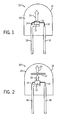
- FIG. 1 illustrates an exemplary LED based light 10 that may incorporate the phosphors and phosphor blends of the present techniques.
- the LED based light 10 includes a semiconductor UV or visible radiation source, such as a light emitting diode (LED) chip 12.
- Power leads 14 that are electrically attached to the LED chip 12 provide the current that causes the LED chip 12 to emit radiation.
- the leads 14 may include thin wires supported on thicker package leads 16. Alternatively, the package leads 16 may be directly attached to the LED chip 12.
- the LED based light 10 may include any LED chip 12 that is capable of producing visible or UV light and which may produce colored or white light when its emitted radiation is blended with light emitted by a phosphor composition.
- the peak emission of the LED chip 12 may be selected at least in part on the identity of the phosphors in the blend, e.g., selected to match the maximum absorbance of the phosphors.
- the emitted light from the chip 12 may peak in the range from about 250 nm to about 550 nm.
- the emission of the LED will be in the near UV to blue region and have a peak wavelength in the range from about 350 to about 500 nm.
- the LED chip 12 is typically a semiconductor that has been doped with various impurities and may include a semiconductor diode based on any suitable III-V, II-VI or IV-IV semiconductor layers.
- the LED chip 12 may contain at least one semiconductor layer comprising GaN, ZnO or SiC.
- Such LED chips 12 are known in the art.
- the radiation source is described as an LED, the term is meant to encompass all semiconductor radiation sources including semiconductor laser diodes, among others.
- the LED chip 12 may be replaced by an organic light emissive structure or other radiation source.
- organic light emissive structure or other radiation source.
- Other types of light sources may be used as a radiation source in place of LEDs, such as the gas discharge tubes discussed with respect to FIG. 5 , below.
- the LED chip 12 may be encapsulated within a shell 18, which encloses the LED chip and an encapsulant material 20.
- the shell 18 may be glass or plastic.
- the encapsulant 20 may be an epoxy, plastic, low temperature glass, polymer, thermoplastic, thermoset material, resin, silicone, silicone epoxy, or any other type of LED encapsulating material. Further, the encapsulant 20 may be a spin-on glass or some other high index of refraction material.
- the encapsulant material 20 is an epoxy or a polymer material, such as silicone.
- the shell 18 and the encapsulant 20 are transparent, i.e., substantially optically transmissive, with respect to the wavelength of light produced by the LED chip 12 and a phosphor material 22, such as the phosphors and phosphor blends of the present techniques. However, if the LED chip 12 emits light that is within the UV spectrum, the encapsulant 20 may only be transparent to light from the phosphor material 22.
- the LED based light 10 may include an encapsulant 20 without an outer shell 18. In this application, the LED chip 12 may be supported by the package leads 16, or by a pedestal (not shown) mounted to the package leads 16.
- the structure of the lighting system further includes a phosphor material 22 radiationally coupled to the LED chip 12.
- Radiationally coupled means that the elements are associated with each other so radiation from one is transmitted to the other.
- a phosphor that is radiationally coupled to the LED chip 12 may absorb radiation, such as blue or UV light, emitted by the LED chip 12, and emit longer wavelengths, such as blue, blue-green, red, or other colors of light.
- This phosphor material 22 may be deposited on the LED chip 12 by any appropriate method.
- a solvent based suspension of a phosphor or phosphors can be formed, and applied as a layer onto the surface of the LED chip 12.
- a silicone slurry in which the phosphor particles are randomly suspended may be placed over the LED chip 12.
- the phosphor material 22 may be coated over or directly on the light emitting surface of the LED chip 12 by coating and drying the phosphor suspension over the LED chip 12.
- the shell 18 and the encapsulant 20 will generally be transparent, the emitted light 24 from the LED chip 12 and phosphor material 22 will be transmitted through those elements.
- FIG. 2 A second structure that may incorporate the phosphors and phosphor blends of the present techniques is illustrated in the cross section of FIG. 2 .
- the structure in FIG. 2 is similar to that of FIG. 1 , except that the phosphor material 22 is interspersed within the encapsulant 20, instead of being formed directly on the LED chip 12.
- the phosphor material 22 may be interspersed within a single region of the encapsulant 20 or throughout the entire volume of the encapsulant 20.
- Radiation 26 emitted by the LED chip 12 mixes with the light emitted by the phosphor material 22, and the mixed light may be visible through the transparent encapsulant 20, appearing as emitted light 24.
- the encapsulant 20 with the interspersed phosphor material 22 may be formed by any number of suitable plastics processing techniques.
- the phosphor material 22 may be combined with a polymer precursor, molded around the LED chip 12, and then cured to form the solid encapsulant 20 with the interspersed phosphor material 22.
- the phosphor material 22 may be blended into a molten encapsulant 20, such as a polycarbonate, formed around the LED chip 12, and allowed to cool. Processing techniques for molding plastics that may be used, such as injection molding, are known in the art.
- FIG. 3 is a cross section of another structure that may incorporate the phosphor material 22 of the present techniques.
- the structure shown in FIG. 3 is similar to that of FIG. 1 , except that the phosphor material 22 may be coated onto a surface of the shell 18, instead of being formed over the LED chip 12.
- the phosphor material 22 is coated on the inside surface of the shell 18, although the phosphor material 22 may be coated on the outside surface of the shell 18, if desired.
- the phosphor material 22 may be coated on the entire surface of the shell 18 or only a top portion of the surface of the shell 18.
- the radiation 26 emitted by the LED chip 12 mixes with the light emitted by the phosphor material 22, and the mixed light appears as emitted light 24.
- the structures discussed with respect to FIGS. 1-3 may be combined, with the phosphor located in any two or all three locations or in any other suitable location, such as separately from the shell or integrated into the LED. Further, different phosphors may be used in different parts of the structure. For example, a phosphor according to formula I may be incorporated into the encapsulant 20, while a complementary phosphor, such as from the list of phosphors discussed previously, may be coated onto the shell 18. This may provide a convenient technique for combining complementary colors, for example, to form a white light source.
- the LED based light 10 may also include a plurality of particles (not shown) to scatter or diffuse the emitted light. These particles would generally be embedded in the encapsulant 20.
- the scattering particles may include, for example, particles made from Al 2 O 3 (alumina) or TiO 2 . The scattering particles may effectively scatter the light emitted from the LED chip 12, and are generally selected to have a negligible amount of absorption.
- the LED chip 12 may be mounted in a reflective cup 28, as illustrated by the cross section shown in FIG. 4 .
- the reflective cup 28 may be made from or coated with a reflective material, such as alumina, titania, or other dielectric powder known in the art. Generally, the reflective surface may be made from Al 2 O 3 .
- the remainder of the structure of the LED based light 10 of FIG. 4 is the same as that of the previous figure, and includes two leads 16, a conducting wire 30 electrically connecting the LED chip 12 with one of the leads 16, and an encapsulant 20.
- the reflective cup 28 may conduct current to energize the LED chip 12, or a second conducting wire 32 may be used.
- the phosphor material 22 may be dispersed throughout the encapsulant 20, as described above, or may be dispersed in a smaller transparent casing 34 formed within the reflective cup 28.
- the transparent casing 34 may be made from the same materials as the encapsulant 20.
- the use of the transparent casing 34 within the encapsulant 20 may be advantageous in that a smaller amount of the phosphor material 22 may be required than if the phosphor were to be dispersed throughout the encapsulant 20.
- the encapsulant 20 may contain particles (not shown) of a light scattering material, as previously described to diffuse the emitted light 24.
- the phosphors and phosphor blends of the present techniques may be used with other radiation sources.
- the radiation source may be a gas discharge device.
- gas discharge devices include low-, medium-, and high-pressure mercury gas discharge lamps.
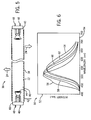
- FIG. 6 is a perspective view of a light source 36 based on a gas discharge device, such as a fluorescent lamp, which may use the phosphors and phosphor blends of the present techniques.
- the light source 36 may include an evacuated sealed housing 38, an excitation system 42 for generating UV radiation and located within the housing 38, and a phosphor material 22 disposed within the housing 38. End caps 40 are attached to either end of the housing 30 to seal the housing 38.
- the phosphor material 22, such as the phosphors and phosphor blends of the present techniques, may be disposed on an inner surface of the housing 38.
- the excitation system 42 for generating the UV radiation may include an electron generator 44 for generating high-energy electrons and a fill gas 46 configured to absorb the energy of the high-energy electrons and emit UV light.
- the fill gas 46 may include mercury vapor, which absorbs energy of the high-energy electrons and emits UV light.
- the fill gas 46 may include a noble gas such as argon, krypton, and the like.
- the electron generator 46 may be a filament of a metal having a low work function (for example, less than 4.5 eV), such as tungsten, or a filament coated with alkaline earth metal oxides.
- Pins 48 may be provided to supply electrical power to the electron generator 46.
- the filament is coupled to a high-voltage source to generate electrons from the surface thereof.
- the phosphor material 22 is radiationally coupled to the UV light from the excitation system 42.
- radiationally coupled means that the phosphor material 22 is associated with the excitation system 42 so that radiation from the UV light from the excitation system 42 is transmitted to the phosphor material 22.
- a phosphor that is radiationally coupled to the excitation system 42 may absorb radiation, such as the UV light emitted by the excitation system 42, and, in response, emit longer wavelengths, such as blue, blue-green, green, yellow, or red light. The longer wavelength of light may be visible as emitted light 24 transmitted through the housing 38.
- the housing 38 is generally made of a transparent material such as glass or quartz. Glass is commonly used as the housing 38 in fluorescent lamps, as the transmission spectrum of the glass may block a substantial portion of the "short wave" UV radiation, i.e., light having a wavelength of less than about 300 nm.
- the phosphor material 22 may be a blend of phosphors configured to produce particular colors of light, e.g., to produce white light.
- a particulate material such as TiO 2 or Al 2 O 3 , may be used in conjunction with the phosphor material 22 to diffuse light generated by the light source 36.
- Such a light scattering material may be included with the phosphor material 22 or separately disposed as a layer between the inner surface of the housing 38 and the phosphor material 22.
- it may be advantageous to have the median size of the particles of the scattering material range from about 10 nm to about 400 nm.
- a compact fluorescent lamp may have a housing 38 that has one or more bends or is in a spiral shape, with electrical supply pins 48 that are disposed at one end of the light source 36.
- inventive phosphors described herein are not limited to the particularly preferred general illumination purposes. They may include, among others, backlighting applications (such as in cellular phones, PDA's, computer monitors, and TV sets), as well as display, traffic, automotive, signage and other specialty lighting applications.
- the amounts of the listed components were mixed as powders and placed into an open high purity alumina crucible.
- the crucible containing the powder blend was then fired under a N 2 atmosphere to which between about 0.75 volume percent to about 1.5 volume % H 2 was added.
- the firing was conducted in six stages, and between each firing stage, the phosphor was removed from the furnace and passed through a grinding step.
- the phosphors were fired for about 10 hours at 750 °C, 10 hours at 850 °C, 10 hours at 950 °C, 10 hours at 1100 °C, 10 hours at 1200 °C, and 6 hours at 1300 °C.
- Phosphor E was produced using a newer technique to determine if the procedures described above could be simplified.
- the component powders were dry-blended using ZrO 2 media and then placed into a high purity alumina crucible.
- the powder mixture was fired at about 850 °C for about 10 hrs in a N 2 atmosphere containing about 1 volume % H 2 .
- the sample was re-ground using a mortar and pestle and then fired for a second time at 1200 °C for 8 hrs in a N 2 atmosphere containing about 1 volume % H 2 .
- the sample was ground and passed through a 270 mesh screen.
- the emission spectra for the five phosphors described above are shown in the chart 50 presented in FIG. 6 .
- the y-axis 52 plots emission intensity in relative units and the x-axis 54 plots the wavelength in nanometers (nm).
- the excitation wavelength for all five spectra was 405 nm.
- the emission spectrum of phosphor A is indicated by reference numeral 56, phosphor B by reference numeral 58, phosphor C by reference numeral 60, phosphor D by reference numeral 62, and phosphor E by reference numeral 64.
- the emission is generally blue-green to green-yellow, e.g., having a peak emission wavelength between about 485 nm and about 540 nm.
- the quantum efficiency at a wavelength of 405 nm of each the five phosphors was measured against a known phosphor, Sr 4 Al 14 O 25 :Eu 2+ (SAE) with the results shown in the column labeled QE/Abs in Table 2, wherein the relative efficiency of the example phosphor versus SAE is the first number (before the slash) and the absorbance at the excitation wavelength (about 405 nm) is the second number.
- the quantum efficiency of the example phosphors were at least within about 10% of the standard phosphor (SAE).
- Table 2 Optical Characteristics of Example Phosphors Phosphor Qe/Abs (at 405 nm) Thermal derating at 150 °C x y A 81 / 90 18 % 0.230 0.394 B 91 / 89 15 % 0.293 0.495 C 95 / 92 15 % 0.331 0.534 D 90 / 90 16.5 % 0.387 0.544 E 103 / 74 13% 0.384 0.537
- the emission spectra of the example phosphors may be used to calculate the spectral characteristics that may be obtained for blends with other phosphors.
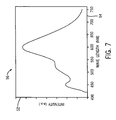
- the spectra of phosphors having the formulas indicated in Table 3 were used in calculations with the emission spectra of the example phosphors to predict emission spectra for blends. Further, the calculations also included any visible light emitted by the source. Examples of predicted spectra are shown in FIGS. 7-9 , which correspond to the blends in rows 3 (spectrum 56), 24 (spectrum 58), and 30 (spectrum 60) of Table 4.
- Table 3 Formulas of Additional Phosphors Used in Blend Calculations Name
- Formula Orange Ca 2 Si 5 N 8 Ce 3+ ,Eu 2+ SECA (Ba,Sr,Ca) 5 (PO 4 ) 3 (Cl,F,Br,OH): Eu 2+ Yellow Ca 1.5 Al 3 Si 9 N 16 : Ce 3+ ,Eu 2+ PFS K 2 [SiF 6 ]: Mn 4+ SASI (Ba,Sr,Ca) 2 Si 1-x O 4-2x : Eu 2+ (wherein 0 ⁇ x ⁇ 0.2)
- the CIE color coordinates of the emitted light is a measured characteristic that may be used in choosing phosphors and phosphor blends for illumination applications.
- lower values for color temperatures (CCT) indicates that the light has more intensity at red wavelengths, while higher values may indicate light that has more intensity at blue wavelengths.
- CCT color temperatures
- the spectral distribution may also be used to determine the CRI, as well as the luminosity values.
- the phosphors of the present techniques could be used to obtain blends generating white light with a low CCT.
- the calculations also indicate that the present phosphors could be used to obtain blends generating white light with a high CRI, for example, greater than about 80 or greater than about 90.
- the phosphors of the present techniques may be used in blends to form illumination systems that are useful in general lighting systems, such as white light lamps. Further, their weak thermal derating may assist in preventing dimming or color shifting as the temperature of the phosphor in the illumination systems increases.
- favorable results may also be obtained by combining the emission from a light source, e.g., a blue LED chip having a peak wavelength of 450 nm, with the phosphors of the present techniques or their blends.
- a light source e.g., a blue LED chip having a peak wavelength of 450 nm
- this combination can produce white light having a high CRI and a tunable CCT, e.g. from 2700K to 6500K.
- Table 4 Spectral Characteristics of Example Phosphor Blends No.
Landscapes
- Chemical & Material Sciences (AREA)
- Engineering & Computer Science (AREA)
- Inorganic Chemistry (AREA)
- Materials Engineering (AREA)
- Organic Chemistry (AREA)
- Electrochemistry (AREA)
- Physics & Mathematics (AREA)
- Electromagnetism (AREA)
- General Engineering & Computer Science (AREA)
- Luminescent Compositions (AREA)
- Led Device Packages (AREA)
- Led Devices (AREA)
Claims (10)
- Appareil d'éclairage, comprenant :une source lumineuse, configurée pour émettre un rayonnement, avec une intensité maximale à une longueur d'onde entre 250 nm et 550 nm etune composition de luminophore, comprenant un luminophore bleu-vert à vert, ayant une longueur d'onde d'émission maximale entre 485 nm et 540 nm, qui utilise des longueurs d'ondes d'excitation de 405 nm, configurées pour être couplées par rayonnement à la source lumineuse, selon la formule {(Sr1 - zMz)1-(x +w)AwCex)3(Al1-y+3(Siy)O4+y+3(x - w)F1-y-3(x - w), dans laquelle 0<x≤0,10; 0≤y≤0,5; 0≤z≤0,5; 0≤w≤x, A est du Li, Na, K ou toutes combinaisons de ceux-ci et est du Ca, Ba, Mg ou toutes combinaisons de ceux-ci.
- Appareil d'éclairage selon la revendication 1, dans lequel la source lumineuse est une diode électroluminescente (DEL) à semi-conducteurs.
- Appareil d'éclairage selon la revendication 2, dans lequel la DEL comprend un semi-conducteur à composé de nitrure, représenté par la formule IniGajAlkN, où 0 ≤ i ; 0 ≤ j ; 0 ≤ k et i+ j + k = 1.
- Appareil d'éclairage selon la revendication 1, dans lequel la source lumineuse comprend une lumière d'émission à décharge de nuage de gaz, ayant une intensité maximale à une longueur d'onde entre 250 à 400 nm.
- Appareil d'éclairage selon l'une quelconque des revendications 1 à 4, dans lequel la composition de luminophore est revêtue à la surface de la source lumineuse.
- Appareil d'éclairage selon l'une quelconque des revendications 1 à 4, dans lequel la composition de luminophore est dispersée dans un encapsulant, qui entoure la source lumineuse et la composition de luminophore.
- Appareil d'éclairage selon l'une quelconque des revendications précédentes, dans lequel la composition de luminophore comprend un ou plusieurs luminophores supplémentaires.
- Appareil d'éclairage selon la revendication 7, dans lequel les un ou plusieurs luminophores supplémentaires comprennent : un fluorure complexe, dopé avec du Mn4+ ; du (Ba, Sr, Ca)5(PO4)3(Cl, F, OH) : Eu2+ ; du Ca2Si5N8 : Ce3+, Eu2+ du (Lu, Ca, Li, Mg, Y)1,5Al3Si9N16 : Eu2+ Ce3+ ou du (Ba, Sr, Ca)2Si1 - x O4 - 2 x : Eu2+ (dans lequel 0 ≤ x ≤ 0,2) ou toutes combinaisons de ceux-ci.
- Luminophore, comprenant une formule générale de ((Sr1 - zMz)1 - (x + w)AwCex)3(Al1 - ySiy)O4 + y+3(x-w)F1 - y - 3(x - w), dans lequel 0 < x ≤ 0,10 ; 0 ≤ y ≤ 0,5 ; 0 ≤ z ≤ 0,5 ; 0 ≤ w ≤ x, A est du Li, Na, K ou toutes combinaisons de ceux-ci et est du Ca, Ba, Mg ou toutes combinaisons de ceux-ci et la lumière, émise par le luminophore, est d'une couleur bleue-verte à verte et a une longueur d'onde d'émission maximale entre 485 nm et 540 nm, en utilisant une longueur d'onde d'excitation de 405 nm.
- Procédé de production d'un luminophore, le procédé comprenant les opérations, consistant à :fournir des quantités de composés d'aluminium, de cérium, de silicium, contenant de l'oxygène et au moins un métal alcalinoterreux, sélectionné dans le groupe, se composant de Sr, Ba, Ca et de combinaisons de ceux-ci ;mélanger ensemble les composants, contenant de l'oxygène, avec un fluorure, contenant un composé, pour former un mélange puischauffer le mélange à une température entre 900° C et 1 700° C, dans une atmosphère réductrice, pendant une période de temps, suffisante pour convertir le mélange en un luminophore, comprenant une formule générale de ((Sr1 - zMz)1 -(x + w)AwCex)3(Al1 - ySiy)O4 + y + 3(x-w)F1 - y -3(x - w), dans lequel 0 < x ≤ 0,10 ; 0 ≤ y ≤ 0,5 ; 0 ≤ z ≤ 0,5 ; 0 ≤ w ≤ x, A est du Li, Na, K ou toutes combinaisons de ceux-ci et M est du Ca, Ba, Mg ou toutes combinaisons de ceux-ci et la lumière, émise par le luminophore, est d'une couleur bleue-verte à verte et a une longueur d'onde d'émission maximale entre 485 nm et 540 nm, en utilisant une longueur d'onde d'excitation de 405 nm.
Applications Claiming Priority (1)
| Application Number | Priority Date | Filing Date | Title |
|---|---|---|---|
| US12/256,142 US8329060B2 (en) | 2008-10-22 | 2008-10-22 | Blue-green and green phosphors for lighting applications |
Publications (3)
| Publication Number | Publication Date |
|---|---|
| EP2180032A2 EP2180032A2 (fr) | 2010-04-28 |
| EP2180032A3 EP2180032A3 (fr) | 2010-11-10 |
| EP2180032B1 true EP2180032B1 (fr) | 2013-10-16 |
Family
ID=41581121
Family Applications (1)
| Application Number | Title | Priority Date | Filing Date |
|---|---|---|---|
| EP09167926.6A Active EP2180032B1 (fr) | 2008-10-22 | 2009-08-14 | Phosphores bleus-verts et verts pour applications d'éclairage |
Country Status (6)
| Country | Link |
|---|---|
| US (1) | US8329060B2 (fr) |
| EP (1) | EP2180032B1 (fr) |
| JP (1) | JP5535548B2 (fr) |
| KR (1) | KR101619520B1 (fr) |
| CN (1) | CN101725847B (fr) |
| ES (1) | ES2436659T3 (fr) |
Families Citing this family (30)
| Publication number | Priority date | Publication date | Assignee | Title |
|---|---|---|---|---|
| US8703016B2 (en) * | 2008-10-22 | 2014-04-22 | General Electric Company | Phosphor materials and related devices |
| TWI385834B (zh) * | 2009-02-06 | 2013-02-11 | 沈育濃 | Light emitting diode chip package and manufacturing method thereof |
| US8344611B2 (en) * | 2009-06-16 | 2013-01-01 | The Regents Of The University Of California | Oxyfluoride phosphors and white light emitting diodes including the oxyfluoride phosphor for solid-state lighting applications |
| KR101055762B1 (ko) * | 2009-09-01 | 2011-08-11 | 서울반도체 주식회사 | 옥시오소실리케이트 발광체를 갖는 발광 물질을 채택한 발광 장치 |
| DE102009030205A1 (de) * | 2009-06-24 | 2010-12-30 | Litec-Lp Gmbh | Leuchtstoffe mit Eu(II)-dotierten silikatischen Luminophore |
| US8535565B2 (en) * | 2009-10-30 | 2013-09-17 | The Regents Of The University Of California | Solid solution phosphors based on oxyfluoride and white light emitting diodes including the phosphors for solid state white lighting applications |
| JP5698762B2 (ja) | 2009-12-17 | 2015-04-08 | コーニンクレッカ フィリップス エヌ ヴェ | ルミネッセント材料を含む発光ダイオードデバイス |
| JP5795771B2 (ja) | 2009-12-17 | 2015-10-14 | コーニンクレッカ フィリップス エヌ ヴェ | 光源および波長変換構成要素を含む照明デバイス |
| US8593062B2 (en) | 2010-04-29 | 2013-11-26 | General Electric Company | Color stable phosphors for LED lamps and methods for preparing them |
| EP2402648A1 (fr) * | 2010-07-01 | 2012-01-04 | Koninklijke Philips Electronics N.V. | Module DEL formant une source allongée, avec DEL situées hors d'un tube en verre étanche |
| KR101142758B1 (ko) * | 2010-07-22 | 2012-05-08 | 한국세라믹기술원 | 유리 형광 렌즈를 이용한 발광다이오드 램프 및 그 제조방법 |
| WO2013048865A1 (fr) * | 2011-09-30 | 2013-04-04 | General Electric Company | Matières luminophores et dispositifs associés |
| TW201324875A (zh) * | 2011-12-01 | 2013-06-16 | Hung Ta Trading Co Ltd | 增強白光發光二極體演色性之方法 |
| US20130143334A1 (en) * | 2011-12-01 | 2013-06-06 | Hung Ta Trading Co., Ltd. | Method of enhancing color rendering index of a white led |
| US20130178001A1 (en) * | 2012-01-06 | 2013-07-11 | Wen-Lung Chin | Method for Making LED LAMP |
| KR101405596B1 (ko) * | 2012-03-15 | 2014-06-10 | 엘지이노텍 주식회사 | 알루미늄 실리케이트계 형광체 및 이의 제조방법 |
| JP5840540B2 (ja) | 2012-03-15 | 2016-01-06 | 株式会社東芝 | 白色照明装置 |
| KR101430585B1 (ko) * | 2012-06-12 | 2014-08-18 | 한국화학연구원 | Rare earth가 첨가된 oxy-fluoride계 형광체 및 상기 형광체가 적용된 백색 발광소자 |
| WO2014017613A1 (fr) * | 2012-07-25 | 2014-01-30 | 独立行政法人物質・材料研究機構 | Fluorophore, son procédé de fabrication, dispositif émettant de la lumière utilisant le fluorophore, dispositif d'affichage d'images, pigment et absorbant ultraviolet |
| KR102259343B1 (ko) | 2012-11-07 | 2021-06-09 | 더 리전츠 오브 더 유니버시티 오브 캘리포니아 | 형광체를 펌핑하는 iii-족 질화물계 레이저 다이오드를 채용한 백색 광원 |
| CN104870605A (zh) * | 2012-12-21 | 2015-08-26 | 默克专利有限公司 | 无机发光材料 |
| US20140327023A1 (en) * | 2013-05-02 | 2014-11-06 | General Electric Company | Phosphor assembly for light emitting devices |
| KR102246211B1 (ko) * | 2013-09-09 | 2021-05-04 | 커런트 라이팅 솔루션즈, 엘엘씨 | 향상된 컬러 선호 광원 |
| US20150123153A1 (en) * | 2013-11-06 | 2015-05-07 | General Electric Company | Led package with red-emitting phosphors |
| US9328878B2 (en) * | 2014-07-02 | 2016-05-03 | General Electric Company | Phosphor compositions and lighting apparatus thereof |
| US9335011B2 (en) * | 2014-07-02 | 2016-05-10 | General Electric Company | Oxyfluoride phosphor compositions and lighting apparatus thereof |
| JP6882164B2 (ja) * | 2014-09-09 | 2021-06-02 | コンシューマー ライティング (ユー.エス.),エルエルシー | Lag、窒化物及びpfs蛍光体を用いた色嗜好度の向上したled光源 |
| US10193030B2 (en) | 2016-08-08 | 2019-01-29 | General Electric Company | Composite materials having red emitting phosphors |
| US12129413B2 (en) * | 2016-11-22 | 2024-10-29 | Honeywell International Inc. | Luminescent taggant compositions, luminescent materials including the same, and articles including the same |
| US10720554B2 (en) * | 2017-09-20 | 2020-07-21 | General Electric Company | Green-emitting phosphors and devices thereof |
Family Cites Families (100)
| Publication number | Priority date | Publication date | Assignee | Title |
|---|---|---|---|---|
| US478395A (en) * | 1892-07-05 | Half to james m | ||
| GB8615202D0 (en) | 1986-06-21 | 1986-07-23 | Emi Plc Thorn | Inorganic phosphors |
| US4748395A (en) | 1987-08-07 | 1988-05-31 | General Motors Corporation | Dual voltage electrical system |
| US6005024A (en) | 1994-06-09 | 1999-12-21 | Anders; Irving | Phosphorescent epoxy overlay |
| US5874491A (en) | 1994-06-09 | 1999-02-23 | Anders; Irving | Phosphorescent highway paint composition |
| US6074739A (en) | 1995-03-01 | 2000-06-13 | Katagiri; Noboru | Colored composites exhibiting long afterglow characteristics and colored articles exhibiting long afterglow characteristics |
| GB9508065D0 (en) | 1995-04-20 | 1995-06-07 | Saf T Glo Ltd | Emergency lighting |
| US6362548B1 (en) * | 1997-04-14 | 2002-03-26 | Donnelly Corporation | Housing with integral gasket components for a rearview mirror actuator assembly |
| US6375864B1 (en) | 1998-11-10 | 2002-04-23 | M.A. Hannacolor, A Division Of M.A. Hanna Company | Daylight/nightglow colored phosphorescent plastic compositions and articles |
| US6123871A (en) | 1999-01-11 | 2000-09-26 | Carroll; Michael Lee | Photoluminescence polymers, their preparation and uses thereof |
| US6190577B1 (en) | 1999-07-20 | 2001-02-20 | Usr Optonix Inc. | Indium-substituted aluminate phosphor and method for making the same |
| JP3511083B2 (ja) | 1999-08-06 | 2004-03-29 | 独立行政法人産業技術総合研究所 | 高輝度応力発光材料、その製造方法及びそれを用いた発光方法 |
| US6696126B1 (en) | 1999-08-12 | 2004-02-24 | The United States Of America As Represented By The Secretary Of The Navy | Visual-tactile signage |
| KR100396340B1 (ko) | 2000-12-19 | 2003-09-02 | 주식회사 글로얀 | 축광특성을 갖는 합성섬유사 및 이의 제조방법 |
| EP1116755A1 (fr) | 2000-01-10 | 2001-07-18 | Sicpa Holding S.A. | Composition de revêtement, de préférence d 'encre d'imprimerie pour marquage de sécurité, procédé de production pour une composition de revêtement et utilisation de vitro-céramique |
| US6911159B2 (en) | 2000-06-22 | 2005-06-28 | Nite-Glo Innovations Pty Ltd | Phosphorescent pigments |
| US6720799B2 (en) * | 2001-01-11 | 2004-04-13 | Broadcom Corporation | Replica network for linearizing switched capacitor circuits |
| KR100715943B1 (ko) * | 2001-01-29 | 2007-05-08 | 삼성전자주식회사 | 액정표시장치 및 그 제조방법 |
| US6685852B2 (en) | 2001-04-27 | 2004-02-03 | General Electric Company | Phosphor blends for generating white light from near-UV/blue light-emitting devices |
| WO2003002063A2 (fr) * | 2001-06-28 | 2003-01-09 | Essential Therapeutics, Inc. | Procedes de developpement de medicaments sur la base de la structure destines a identifier des inhibiteurs de d-ala-d-ala ligase en tant qu'agents antibacteriens |
| DE10210009B3 (de) * | 2002-03-07 | 2004-01-08 | Fresenius Medical Care Deutschland Gmbh | Verfahren zur Bestimmung des Hämatokrit und/oder Blutvolumens und Vorrichtung zur extrakorporalen Blutbehandlung mit einer Einrichtung zur Bestimmung des Hämatokrit und/oder Blutvolumens |
| US6761837B2 (en) | 2002-06-12 | 2004-07-13 | General Electric Company | Europium-activated phosphors containing oxides of rare-earth and group-IIIB metals and method of making the same |
| US7022263B2 (en) | 2002-06-12 | 2006-04-04 | General Electric Company | Europium-activated phosphors containing oxides of rare-earth and group-IIIB metals and method of making the same |
| US7391148B1 (en) | 2002-06-13 | 2008-06-24 | General Electric Company | Phosphor blends for high-CRI fluorescent lamps |
| US6809471B2 (en) | 2002-06-28 | 2004-10-26 | General Electric Company | Phosphors containing oxides of alkaline-earth and Group-IIIB metals and light sources incorporating the same |
| US7024781B1 (en) | 2002-08-27 | 2006-04-11 | Johnson Level & Tool Mfg. Co., Inc. | Vial illumination feature for a tool such as a level |
| US7800121B2 (en) | 2002-08-30 | 2010-09-21 | Lumination Llc | Light emitting diode component |
| US7224000B2 (en) | 2002-08-30 | 2007-05-29 | Lumination, Llc | Light emitting diode component |
| US7768189B2 (en) | 2004-08-02 | 2010-08-03 | Lumination Llc | White LEDs with tunable CRI |
| US7479662B2 (en) | 2002-08-30 | 2009-01-20 | Lumination Llc | Coated LED with improved efficiency |
| US6809781B2 (en) | 2002-09-24 | 2004-10-26 | General Electric Company | Phosphor blends and backlight sources for liquid crystal displays |
| US6969475B2 (en) | 2002-11-22 | 2005-11-29 | Kb Alloys | Photoluminescent alkaline earth aluminate and method for making the same |
| US6965193B2 (en) | 2002-12-12 | 2005-11-15 | General Electric Company | Red phosphors for use in high CRI fluorescent lamps |
| US20040113539A1 (en) | 2002-12-12 | 2004-06-17 | Thomas Soules | Optimized phosphor system for improved efficacy lighting sources |
| US6867536B2 (en) | 2002-12-12 | 2005-03-15 | General Electric Company | Blue-green phosphor for fluorescent lighting applications |
| DE10259946A1 (de) | 2002-12-20 | 2004-07-15 | Tews, Walter, Dipl.-Chem. Dr.rer.nat.habil. | Leuchtstoffe zur Konversion der ultravioletten oder blauen Emission eines lichtemittierenden Elementes in sichtbare weiße Strahlung mit sehr hoher Farbwiedergabe |
| US6844671B2 (en) | 2003-01-31 | 2005-01-18 | General Electric Company | High luminosity phosphor blends for generating white light from near-UV/blue light-emitting devices |
| US6936857B2 (en) | 2003-02-18 | 2005-08-30 | Gelcore, Llc | White light LED device |
| US6847162B2 (en) | 2003-04-29 | 2005-01-25 | General Electric Company | Light source with organic layer and photoluminescent layer |
| CN1802533B (zh) | 2003-05-05 | 2010-11-24 | 吉尔科有限公司 | 基于led的灯泡 |
| EP1627179B1 (fr) | 2003-05-05 | 2008-10-08 | Lumination LLC | Procede et appareil pour systemes de lampes a panneau de diodes electroluminescentes |
| WO2005004202A2 (fr) | 2003-06-24 | 2005-01-13 | Gelcore Llc | Melanges de phosphore en spectre continu de generation de lumiere blanche a l'aide de puces a diodes electroluminescentes |
| US7088038B2 (en) | 2003-07-02 | 2006-08-08 | Gelcore Llc | Green phosphor for general illumination applications |
| US7026755B2 (en) | 2003-08-07 | 2006-04-11 | General Electric Company | Deep red phosphor for general illumination applications |
| US7488432B2 (en) | 2003-10-28 | 2009-02-10 | Nichia Corporation | Fluorescent material and light-emitting device |
| US7442326B2 (en) | 2003-10-29 | 2008-10-28 | Lumination Llc | Red garnet phosphors for use in LEDs |
| US7252787B2 (en) | 2003-10-29 | 2007-08-07 | General Electric Company | Garnet phosphor materials having enhanced spectral characteristics |
| US7094362B2 (en) | 2003-10-29 | 2006-08-22 | General Electric Company | Garnet phosphor materials having enhanced spectral characteristics |
| US7128849B2 (en) | 2003-10-31 | 2006-10-31 | General Electric Company | Phosphors containing boron and metals of Group IIIA and IIIB |
| TWI250664B (en) | 2004-01-30 | 2006-03-01 | South Epitaxy Corp | White light LED |
| EP1718715B1 (fr) | 2004-02-20 | 2010-09-08 | Lumination, LLC | Règles d'obtention de sources lumineuses efficaces utilisant des dels en présence de luminophore(s) |
| US7573072B2 (en) | 2004-03-10 | 2009-08-11 | Lumination Llc | Phosphor and blends thereof for use in LEDs |
| US7327078B2 (en) | 2004-03-30 | 2008-02-05 | Lumination Llc | LED illumination device with layered phosphor pattern |
| US7229573B2 (en) | 2004-04-20 | 2007-06-12 | Gelcore, Llc | Ce3+ and Eu2+ doped phosphors for light generation |
| US20070040502A1 (en) | 2004-04-20 | 2007-02-22 | Gelcore Llc | High CRI LED lamps utilizing single phosphor |
| US7077980B2 (en) | 2004-05-03 | 2006-07-18 | General Electric Company | Phosphors containing oxides of alkaline-earth and group-13 metals, and light sources incorporating the same |
| US7077978B2 (en) | 2004-05-14 | 2006-07-18 | General Electric Company | Phosphors containing oxides of alkaline-earth and group-IIIB metals and white-light sources incorporating same |
| US8324640B2 (en) | 2004-07-02 | 2012-12-04 | GE Lighting Solutions, LLC | LED-based edge lit illumination system |
| US20060181192A1 (en) | 2004-08-02 | 2006-08-17 | Gelcore | White LEDs with tailorable color temperature |
| US20070241657A1 (en) | 2004-08-02 | 2007-10-18 | Lumination, Llc | White light apparatus with enhanced color contrast |
| US7453195B2 (en) * | 2004-08-02 | 2008-11-18 | Lumination Llc | White lamps with enhanced color contrast |
| US7601276B2 (en) | 2004-08-04 | 2009-10-13 | Intematix Corporation | Two-phase silicate-based yellow phosphor |
| US7265493B2 (en) * | 2004-10-04 | 2007-09-04 | General Electric Company | Mercury-free compositions and radiation sources incorporating same |
| US7321191B2 (en) | 2004-11-02 | 2008-01-22 | Lumination Llc | Phosphor blends for green traffic signals |
| US7648649B2 (en) | 2005-02-02 | 2010-01-19 | Lumination Llc | Red line emitting phosphors for use in led applications |
| US7497973B2 (en) | 2005-02-02 | 2009-03-03 | Lumination Llc | Red line emitting phosphor materials for use in LED applications |
| US7358542B2 (en) | 2005-02-02 | 2008-04-15 | Lumination Llc | Red emitting phosphor materials for use in LED and LCD applications |
| DE102005005263A1 (de) | 2005-02-04 | 2006-08-10 | Patent-Treuhand-Gesellschaft für elektrische Glühlampen mbH | Gelb emittierender Leuchtstoff und Lichtquelle mit derartigem Leuchtstoff |
| US7253675B2 (en) * | 2005-03-08 | 2007-08-07 | Texas Instruments Incorporated | Bootstrapping circuit capable of sampling inputs beyond supply voltage |
| US7274045B2 (en) | 2005-03-17 | 2007-09-25 | Lumination Llc | Borate phosphor materials for use in lighting applications |
| US8048338B2 (en) | 2005-03-31 | 2011-11-01 | Dowa Electronics Materials Co., Ltd. | Phosphor, phosphor sheet, and manufacturing method therefore, and light emission device using the phosphor |
| US20060222757A1 (en) | 2005-03-31 | 2006-10-05 | General Electric Company | Method for making phosphors |
| US7329371B2 (en) | 2005-04-19 | 2008-02-12 | Lumination Llc | Red phosphor for LED based lighting |
| BRPI0612463A2 (pt) * | 2005-04-20 | 2010-11-23 | Etech Ag | composição luminescente, método para induzir a emissão de radiação eletromagnética, dispositivo emissor de luz, material para uma composição luminescente, uso de ácido bórico e/ou fluoreto de sódio e fonte de luz de radiação eletromagnética |
| KR100704492B1 (ko) | 2005-05-02 | 2007-04-09 | 한국화학연구원 | 형광체를 이용한 백색 발광 다이오드의 제조 방법 |
| US7319246B2 (en) | 2005-06-23 | 2008-01-15 | Lumination Llc | Luminescent sheet covering for LEDs |
| KR100612962B1 (ko) | 2005-06-29 | 2006-08-16 | 한국화학연구원 | 삼파장 형광체를 이용한 백색 발광 다이오드 |
| US7707810B2 (en) | 2005-07-15 | 2010-05-04 | Cnh America Llc | Apparatus and method to vary the reel speed versus ground speed of an agricultural windrower |
| KR100927154B1 (ko) | 2005-08-03 | 2009-11-18 | 인터매틱스 코포레이션 | 실리케이트계 오렌지 형광체 |
| US7262439B2 (en) | 2005-11-22 | 2007-08-28 | Lumination Llc | Charge compensated nitride phosphors for use in lighting applications |
| US7501753B2 (en) | 2005-08-31 | 2009-03-10 | Lumination Llc | Phosphor and blends thereof for use in LEDs |
| US7859182B2 (en) | 2005-08-31 | 2010-12-28 | Lumination Llc | Warm white LED-based lamp incoporating divalent EU-activated silicate yellow emitting phosphor |
| US20070114561A1 (en) | 2005-11-22 | 2007-05-24 | Comanzo Holly A | High efficiency phosphor for use in LEDs |
| TWI317756B (en) * | 2006-02-07 | 2009-12-01 | Coretronic Corp | Phosphor, fluorescent gel, and light emitting diode device |
| KR100735453B1 (ko) | 2006-02-22 | 2007-07-04 | 삼성전기주식회사 | 백색 발광 장치 |
| US7449129B2 (en) | 2006-03-07 | 2008-11-11 | Osram Sylvania Inc. | Ce,Pr-coactivated strontium magnesium aluminate phosphor and lamp containing same |
| CN100590173C (zh) | 2006-03-24 | 2010-02-17 | 北京有色金属研究总院 | 一种荧光粉及其制造方法和所制成的电光源 |
| US20070236956A1 (en) | 2006-03-31 | 2007-10-11 | Gelcore, Llc | Super bright LED power package |
| KR100785492B1 (ko) | 2006-04-17 | 2007-12-13 | 한국과학기술원 | 새로운 조성의 황색 발광 Ce3+부활 실리케이트황색형광체, 그 제조방법 및 상기 형광체를 포함하는 백색발광 다이오드 |
| US20070273282A1 (en) | 2006-05-25 | 2007-11-29 | Gelcore Llc | Optoelectronic device |
| US7842960B2 (en) | 2006-09-06 | 2010-11-30 | Lumination Llc | Light emitting packages and methods of making same |
| US7648650B2 (en) * | 2006-11-10 | 2010-01-19 | Intematix Corporation | Aluminum-silicate based orange-red phosphors with mixed divalent and trivalent cations |
| CN101182416B (zh) | 2006-11-13 | 2010-09-22 | 北京有色金属研究总院 | 含二价金属元素的铝酸盐荧光粉及制造方法和发光器件 |
| EP2087563B1 (fr) | 2006-11-15 | 2014-09-24 | The Regents of The University of California | Diode électroluminescente à couche de conversion de phosphore texturée |
| US8003012B2 (en) | 2007-01-17 | 2011-08-23 | General Electric Company | Method for producing a palette of colors for persistent phosphors and phosphors made by same |
| US20080171229A1 (en) | 2007-01-17 | 2008-07-17 | General Electric Company | Method of producing a palette of colors for persistent phosphors and phosphors made by same |
| US8168085B2 (en) | 2008-01-03 | 2012-05-01 | University Of South Carolina | White light phosphors for fluorescent lighting |
| WO2009108840A1 (fr) | 2008-02-27 | 2009-09-03 | The Regents Of The University Of California | Substances fluorescentes émettant du jaune à base d’aluminate dopé par ce<sp>3+</sp> et solution solide de trou d’interconnexion pour applications d’éclairage de semi-conducteur |
| CN101270286B (zh) | 2008-05-21 | 2011-07-20 | 中国科学院长春应用化学研究所 | 一种紫外及近紫外激发的白光led用荧光粉及其制备方法 |
| US8168086B2 (en) | 2008-06-03 | 2012-05-01 | University Of South Carolina | Inorganic luminescent phosphor materials for lighting |
-
2008
- 2008-10-22 US US12/256,142 patent/US8329060B2/en active Active
-
2009
- 2009-08-14 EP EP09167926.6A patent/EP2180032B1/fr active Active
- 2009-08-14 ES ES09167926.6T patent/ES2436659T3/es active Active
- 2009-08-18 JP JP2009188805A patent/JP5535548B2/ja active Active
- 2009-08-19 KR KR1020090076547A patent/KR101619520B1/ko active Active
- 2009-08-21 CN CN200910167355.9A patent/CN101725847B/zh active Active
Also Published As
| Publication number | Publication date |
|---|---|
| JP5535548B2 (ja) | 2014-07-02 |
| EP2180032A3 (fr) | 2010-11-10 |
| ES2436659T3 (es) | 2014-01-03 |
| CN101725847B (zh) | 2014-09-17 |
| CN101725847A (zh) | 2010-06-09 |
| EP2180032A2 (fr) | 2010-04-28 |
| JP2010100825A (ja) | 2010-05-06 |
| US8329060B2 (en) | 2012-12-11 |
| KR101619520B1 (ko) | 2016-05-10 |
| US20100096974A1 (en) | 2010-04-22 |
| KR20100044691A (ko) | 2010-04-30 |
Similar Documents
| Publication | Publication Date | Title |
|---|---|---|
| EP2180032B1 (fr) | Phosphores bleus-verts et verts pour applications d'éclairage | |
| US8703016B2 (en) | Phosphor materials and related devices | |
| EP2760970B1 (fr) | Matières luminophores et dispositifs associés | |
| US7274045B2 (en) | Borate phosphor materials for use in lighting applications | |
| KR101147560B1 (ko) | 형광체와 발광기구 | |
| US7026755B2 (en) | Deep red phosphor for general illumination applications | |
| EP1735816B1 (fr) | Compositions phosphorescentes, et leurs melanges s'utilisant dans des dels | |
| KR101168177B1 (ko) | 형광체와 그 제조방법 및 발광기구 | |
| US7094362B2 (en) | Garnet phosphor materials having enhanced spectral characteristics | |
| JP5188687B2 (ja) | 蛍光体及びその製造法並びに発光装置 | |
| US7252787B2 (en) | Garnet phosphor materials having enhanced spectral characteristics | |
| US20060231851A1 (en) | Red phosphor for LED based lighting | |
| TWI443854B (zh) | 包含黃綠冷光材料的照明系統 | |
| US8440104B2 (en) | Kimzeyite garnet phosphors | |
| JP2023522185A (ja) | 緑色発光蛍光体およびそのデバイス | |
| HK1112478B (en) | Phosphor |
Legal Events
| Date | Code | Title | Description |
|---|---|---|---|
| PUAI | Public reference made under article 153(3) epc to a published international application that has entered the european phase |
Free format text: ORIGINAL CODE: 0009012 |
|
| AK | Designated contracting states |
Kind code of ref document: A2 Designated state(s): AT BE BG CH CY CZ DE DK EE ES FI FR GB GR HR HU IE IS IT LI LT LU LV MC MK MT NL NO PL PT RO SE SI SK SM TR |
|
| AX | Request for extension of the european patent |
Extension state: AL BA RS |
|
| PUAL | Search report despatched |
Free format text: ORIGINAL CODE: 0009013 |
|
| AK | Designated contracting states |
Kind code of ref document: A3 Designated state(s): AT BE BG CH CY CZ DE DK EE ES FI FR GB GR HR HU IE IS IT LI LT LU LV MC MK MT NL NO PL PT RO SE SI SK SM TR |
|
| AX | Request for extension of the european patent |
Extension state: AL BA RS |
|
| RIC1 | Information provided on ipc code assigned before grant |
Ipc: C09K 11/64 20060101AFI20101006BHEP |
|
| 17P | Request for examination filed |
Effective date: 20110510 |
|
| 17Q | First examination report despatched |
Effective date: 20111019 |
|
| RIC1 | Information provided on ipc code assigned before grant |
Ipc: H01L 33/50 20100101ALN20130314BHEP Ipc: C09K 11/64 20060101AFI20130314BHEP |
|
| GRAP | Despatch of communication of intention to grant a patent |
Free format text: ORIGINAL CODE: EPIDOSNIGR1 |
|
| RIC1 | Information provided on ipc code assigned before grant |
Ipc: H01L 33/50 20100101ALN20130325BHEP Ipc: C09K 11/64 20060101AFI20130325BHEP |
|
| INTG | Intention to grant announced |
Effective date: 20130419 |
|
| GRAS | Grant fee paid |
Free format text: ORIGINAL CODE: EPIDOSNIGR3 |
|
| GRAA | (expected) grant |
Free format text: ORIGINAL CODE: 0009210 |
|
| AK | Designated contracting states |
Kind code of ref document: B1 Designated state(s): AT BE BG CH CY CZ DE DK EE ES FI FR GB GR HR HU IE IS IT LI LT LU LV MC MK MT NL NO PL PT RO SE SI SK SM TR |
|
| REG | Reference to a national code |
Ref country code: GB Ref legal event code: FG4D |
|
| REG | Reference to a national code |
Ref country code: CH Ref legal event code: EP |
|
| REG | Reference to a national code |
Ref country code: IE Ref legal event code: FG4D |
|
| REG | Reference to a national code |
Ref country code: AT Ref legal event code: REF Ref document number: 636530 Country of ref document: AT Kind code of ref document: T Effective date: 20131115 |
|
| REG | Reference to a national code |
Ref country code: DE Ref legal event code: R096 Ref document number: 602009019440 Country of ref document: DE Effective date: 20131212 |
|
| REG | Reference to a national code |
Ref country code: NL Ref legal event code: T3 |
|
| REG | Reference to a national code |
Ref country code: SE Ref legal event code: TRGR |
|
| REG | Reference to a national code |
Ref country code: ES Ref legal event code: FG2A Ref document number: 2436659 Country of ref document: ES Kind code of ref document: T3 Effective date: 20140103 |
|
| REG | Reference to a national code |
Ref country code: AT Ref legal event code: MK05 Ref document number: 636530 Country of ref document: AT Kind code of ref document: T Effective date: 20131016 |
|
| REG | Reference to a national code |
Ref country code: LT Ref legal event code: MG4D |
|
| PG25 | Lapsed in a contracting state [announced via postgrant information from national office to epo] |
Ref country code: LT Free format text: LAPSE BECAUSE OF FAILURE TO SUBMIT A TRANSLATION OF THE DESCRIPTION OR TO PAY THE FEE WITHIN THE PRESCRIBED TIME-LIMIT Effective date: 20131016 Ref country code: NO Free format text: LAPSE BECAUSE OF FAILURE TO SUBMIT A TRANSLATION OF THE DESCRIPTION OR TO PAY THE FEE WITHIN THE PRESCRIBED TIME-LIMIT Effective date: 20140116 Ref country code: FI Free format text: LAPSE BECAUSE OF FAILURE TO SUBMIT A TRANSLATION OF THE DESCRIPTION OR TO PAY THE FEE WITHIN THE PRESCRIBED TIME-LIMIT Effective date: 20131016 Ref country code: BE Free format text: LAPSE BECAUSE OF FAILURE TO SUBMIT A TRANSLATION OF THE DESCRIPTION OR TO PAY THE FEE WITHIN THE PRESCRIBED TIME-LIMIT Effective date: 20131016 Ref country code: HR Free format text: LAPSE BECAUSE OF FAILURE TO SUBMIT A TRANSLATION OF THE DESCRIPTION OR TO PAY THE FEE WITHIN THE PRESCRIBED TIME-LIMIT Effective date: 20131016 Ref country code: IS Free format text: LAPSE BECAUSE OF FAILURE TO SUBMIT A TRANSLATION OF THE DESCRIPTION OR TO PAY THE FEE WITHIN THE PRESCRIBED TIME-LIMIT Effective date: 20140216 |
|
| PG25 | Lapsed in a contracting state [announced via postgrant information from national office to epo] |
Ref country code: AT Free format text: LAPSE BECAUSE OF FAILURE TO SUBMIT A TRANSLATION OF THE DESCRIPTION OR TO PAY THE FEE WITHIN THE PRESCRIBED TIME-LIMIT Effective date: 20131016 Ref country code: LV Free format text: LAPSE BECAUSE OF FAILURE TO SUBMIT A TRANSLATION OF THE DESCRIPTION OR TO PAY THE FEE WITHIN THE PRESCRIBED TIME-LIMIT Effective date: 20131016 Ref country code: CY Free format text: LAPSE BECAUSE OF FAILURE TO SUBMIT A TRANSLATION OF THE DESCRIPTION OR TO PAY THE FEE WITHIN THE PRESCRIBED TIME-LIMIT Effective date: 20131016 |
|
| PG25 | Lapsed in a contracting state [announced via postgrant information from national office to epo] |
Ref country code: PT Free format text: LAPSE BECAUSE OF FAILURE TO SUBMIT A TRANSLATION OF THE DESCRIPTION OR TO PAY THE FEE WITHIN THE PRESCRIBED TIME-LIMIT Effective date: 20140217 |
|
| REG | Reference to a national code |
Ref country code: DE Ref legal event code: R097 Ref document number: 602009019440 Country of ref document: DE |
|
| PG25 | Lapsed in a contracting state [announced via postgrant information from national office to epo] |
Ref country code: EE Free format text: LAPSE BECAUSE OF FAILURE TO SUBMIT A TRANSLATION OF THE DESCRIPTION OR TO PAY THE FEE WITHIN THE PRESCRIBED TIME-LIMIT Effective date: 20131016 |
|
| PLBE | No opposition filed within time limit |
Free format text: ORIGINAL CODE: 0009261 |
|
| STAA | Information on the status of an ep patent application or granted ep patent |
Free format text: STATUS: NO OPPOSITION FILED WITHIN TIME LIMIT |
|
| PG25 | Lapsed in a contracting state [announced via postgrant information from national office to epo] |
Ref country code: RO Free format text: LAPSE BECAUSE OF FAILURE TO SUBMIT A TRANSLATION OF THE DESCRIPTION OR TO PAY THE FEE WITHIN THE PRESCRIBED TIME-LIMIT Effective date: 20131016 Ref country code: CZ Free format text: LAPSE BECAUSE OF FAILURE TO SUBMIT A TRANSLATION OF THE DESCRIPTION OR TO PAY THE FEE WITHIN THE PRESCRIBED TIME-LIMIT Effective date: 20131016 Ref country code: SK Free format text: LAPSE BECAUSE OF FAILURE TO SUBMIT A TRANSLATION OF THE DESCRIPTION OR TO PAY THE FEE WITHIN THE PRESCRIBED TIME-LIMIT Effective date: 20131016 Ref country code: PL Free format text: LAPSE BECAUSE OF FAILURE TO SUBMIT A TRANSLATION OF THE DESCRIPTION OR TO PAY THE FEE WITHIN THE PRESCRIBED TIME-LIMIT Effective date: 20131016 |
|
| 26N | No opposition filed |
Effective date: 20140717 |
|
| PG25 | Lapsed in a contracting state [announced via postgrant information from national office to epo] |
Ref country code: DK Free format text: LAPSE BECAUSE OF FAILURE TO SUBMIT A TRANSLATION OF THE DESCRIPTION OR TO PAY THE FEE WITHIN THE PRESCRIBED TIME-LIMIT Effective date: 20131016 |
|
| REG | Reference to a national code |
Ref country code: DE Ref legal event code: R097 Ref document number: 602009019440 Country of ref document: DE Effective date: 20140717 |
|
| PG25 | Lapsed in a contracting state [announced via postgrant information from national office to epo] |
Ref country code: SI Free format text: LAPSE BECAUSE OF FAILURE TO SUBMIT A TRANSLATION OF THE DESCRIPTION OR TO PAY THE FEE WITHIN THE PRESCRIBED TIME-LIMIT Effective date: 20131016 |
|
| PG25 | Lapsed in a contracting state [announced via postgrant information from national office to epo] |
Ref country code: MC Free format text: LAPSE BECAUSE OF FAILURE TO SUBMIT A TRANSLATION OF THE DESCRIPTION OR TO PAY THE FEE WITHIN THE PRESCRIBED TIME-LIMIT Effective date: 20131016 Ref country code: LU Free format text: LAPSE BECAUSE OF FAILURE TO SUBMIT A TRANSLATION OF THE DESCRIPTION OR TO PAY THE FEE WITHIN THE PRESCRIBED TIME-LIMIT Effective date: 20140814 |
|
| REG | Reference to a national code |
Ref country code: CH Ref legal event code: PL |
|
| PG25 | Lapsed in a contracting state [announced via postgrant information from national office to epo] |
Ref country code: CH Free format text: LAPSE BECAUSE OF NON-PAYMENT OF DUE FEES Effective date: 20140831 Ref country code: LI Free format text: LAPSE BECAUSE OF NON-PAYMENT OF DUE FEES Effective date: 20140831 |
|
| REG | Reference to a national code |
Ref country code: IE Ref legal event code: MM4A |
|
| PG25 | Lapsed in a contracting state [announced via postgrant information from national office to epo] |
Ref country code: IE Free format text: LAPSE BECAUSE OF NON-PAYMENT OF DUE FEES Effective date: 20140814 |
|
| PG25 | Lapsed in a contracting state [announced via postgrant information from national office to epo] |
Ref country code: SM Free format text: LAPSE BECAUSE OF FAILURE TO SUBMIT A TRANSLATION OF THE DESCRIPTION OR TO PAY THE FEE WITHIN THE PRESCRIBED TIME-LIMIT Effective date: 20131016 |
|
| PG25 | Lapsed in a contracting state [announced via postgrant information from national office to epo] |
Ref country code: MT Free format text: LAPSE BECAUSE OF FAILURE TO SUBMIT A TRANSLATION OF THE DESCRIPTION OR TO PAY THE FEE WITHIN THE PRESCRIBED TIME-LIMIT Effective date: 20131016 Ref country code: GR Free format text: LAPSE BECAUSE OF FAILURE TO SUBMIT A TRANSLATION OF THE DESCRIPTION OR TO PAY THE FEE WITHIN THE PRESCRIBED TIME-LIMIT Effective date: 20140117 Ref country code: BG Free format text: LAPSE BECAUSE OF FAILURE TO SUBMIT A TRANSLATION OF THE DESCRIPTION OR TO PAY THE FEE WITHIN THE PRESCRIBED TIME-LIMIT Effective date: 20131016 |
|
| PG25 | Lapsed in a contracting state [announced via postgrant information from national office to epo] |
Ref country code: HU Free format text: LAPSE BECAUSE OF FAILURE TO SUBMIT A TRANSLATION OF THE DESCRIPTION OR TO PAY THE FEE WITHIN THE PRESCRIBED TIME-LIMIT; INVALID AB INITIO Effective date: 20090814 Ref country code: TR Free format text: LAPSE BECAUSE OF FAILURE TO SUBMIT A TRANSLATION OF THE DESCRIPTION OR TO PAY THE FEE WITHIN THE PRESCRIBED TIME-LIMIT Effective date: 20131016 |
|
| REG | Reference to a national code |
Ref country code: FR Ref legal event code: PLFP Year of fee payment: 8 |
|
| REG | Reference to a national code |
Ref country code: FR Ref legal event code: PLFP Year of fee payment: 9 |
|
| PG25 | Lapsed in a contracting state [announced via postgrant information from national office to epo] |
Ref country code: MK Free format text: LAPSE BECAUSE OF FAILURE TO SUBMIT A TRANSLATION OF THE DESCRIPTION OR TO PAY THE FEE WITHIN THE PRESCRIBED TIME-LIMIT Effective date: 20131016 |
|
| REG | Reference to a national code |
Ref country code: FR Ref legal event code: PLFP Year of fee payment: 10 |
|
| PGFP | Annual fee paid to national office [announced via postgrant information from national office to epo] |
Ref country code: IT Payment date: 20190722 Year of fee payment: 11 Ref country code: SE Payment date: 20190726 Year of fee payment: 11 Ref country code: FR Payment date: 20190723 Year of fee payment: 11 Ref country code: ES Payment date: 20190902 Year of fee payment: 11 |
|
| PGFP | Annual fee paid to national office [announced via postgrant information from national office to epo] |
Ref country code: GB Payment date: 20190722 Year of fee payment: 11 |
|
| REG | Reference to a national code |
Ref country code: SE Ref legal event code: EUG |
|
| GBPC | Gb: european patent ceased through non-payment of renewal fee |
Effective date: 20200814 |
|
| PG25 | Lapsed in a contracting state [announced via postgrant information from national office to epo] |
Ref country code: SE Free format text: LAPSE BECAUSE OF NON-PAYMENT OF DUE FEES Effective date: 20200815 |
|
| PG25 | Lapsed in a contracting state [announced via postgrant information from national office to epo] |
Ref country code: FR Free format text: LAPSE BECAUSE OF NON-PAYMENT OF DUE FEES Effective date: 20200831 Ref country code: IT Free format text: LAPSE BECAUSE OF NON-PAYMENT OF DUE FEES Effective date: 20200814 |
|
| PG25 | Lapsed in a contracting state [announced via postgrant information from national office to epo] |
Ref country code: GB Free format text: LAPSE BECAUSE OF NON-PAYMENT OF DUE FEES Effective date: 20200814 |
|
| REG | Reference to a national code |
Ref country code: ES Ref legal event code: FD2A Effective date: 20220110 |
|
| PG25 | Lapsed in a contracting state [announced via postgrant information from national office to epo] |
Ref country code: ES Free format text: LAPSE BECAUSE OF NON-PAYMENT OF DUE FEES Effective date: 20200815 |
|
| P01 | Opt-out of the competence of the unified patent court (upc) registered |
Effective date: 20230518 |
|
| PGFP | Annual fee paid to national office [announced via postgrant information from national office to epo] |
Ref country code: NL Payment date: 20250723 Year of fee payment: 17 |
|
| PGFP | Annual fee paid to national office [announced via postgrant information from national office to epo] |
Ref country code: DE Payment date: 20250724 Year of fee payment: 17 |