EP2180085A1 - Tôle d'acier étamée traitée en surface pour boîte soudée et boîte soudée réalisée à l'aide de celle-ci - Google Patents
Tôle d'acier étamée traitée en surface pour boîte soudée et boîte soudée réalisée à l'aide de celle-ci Download PDFInfo
- Publication number
- EP2180085A1 EP2180085A1 EP08827772A EP08827772A EP2180085A1 EP 2180085 A1 EP2180085 A1 EP 2180085A1 EP 08827772 A EP08827772 A EP 08827772A EP 08827772 A EP08827772 A EP 08827772A EP 2180085 A1 EP2180085 A1 EP 2180085A1
- Authority
- EP
- European Patent Office
- Prior art keywords
- tin
- steel sheet
- layer
- welded
- plated
- Prior art date
- Legal status (The legal status is an assumption and is not a legal conclusion. Google has not performed a legal analysis and makes no representation as to the accuracy of the status listed.)
- Withdrawn
Links
Images

Classifications
-
- C—CHEMISTRY; METALLURGY
- C25—ELECTROLYTIC OR ELECTROPHORETIC PROCESSES; APPARATUS THEREFOR
- C25D—PROCESSES FOR THE ELECTROLYTIC OR ELECTROPHORETIC PRODUCTION OF COATINGS; ELECTROFORMING; APPARATUS THEREFOR
- C25D5/00—Electroplating characterised by the process; Pretreatment or after-treatment of workpieces
- C25D5/34—Pretreatment of metallic surfaces to be electroplated
- C25D5/36—Pretreatment of metallic surfaces to be electroplated of iron or steel
-
- C—CHEMISTRY; METALLURGY
- C23—COATING METALLIC MATERIAL; COATING MATERIAL WITH METALLIC MATERIAL; CHEMICAL SURFACE TREATMENT; DIFFUSION TREATMENT OF METALLIC MATERIAL; COATING BY VACUUM EVAPORATION, BY SPUTTERING, BY ION IMPLANTATION OR BY CHEMICAL VAPOUR DEPOSITION, IN GENERAL; INHIBITING CORROSION OF METALLIC MATERIAL OR INCRUSTATION IN GENERAL
- C23C—COATING METALLIC MATERIAL; COATING MATERIAL WITH METALLIC MATERIAL; SURFACE TREATMENT OF METALLIC MATERIAL BY DIFFUSION INTO THE SURFACE, BY CHEMICAL CONVERSION OR SUBSTITUTION; COATING BY VACUUM EVAPORATION, BY SPUTTERING, BY ION IMPLANTATION OR BY CHEMICAL VAPOUR DEPOSITION, IN GENERAL
- C23C22/00—Chemical surface treatment of metallic material by reaction of the surface with a reactive liquid, leaving reaction products of surface material in the coating, e.g. conversion coatings, passivation of metals
- C23C22/05—Chemical surface treatment of metallic material by reaction of the surface with a reactive liquid, leaving reaction products of surface material in the coating, e.g. conversion coatings, passivation of metals using aqueous solutions
- C23C22/06—Chemical surface treatment of metallic material by reaction of the surface with a reactive liquid, leaving reaction products of surface material in the coating, e.g. conversion coatings, passivation of metals using aqueous solutions using aqueous acidic solutions with pH less than 6
- C23C22/48—Chemical surface treatment of metallic material by reaction of the surface with a reactive liquid, leaving reaction products of surface material in the coating, e.g. conversion coatings, passivation of metals using aqueous solutions using aqueous acidic solutions with pH less than 6 not containing phosphates, hexavalent chromium compounds, fluorides or complex fluorides, molybdates, tungstates, vanadates or oxalates
- C23C22/58—Treatment of other metallic material
-
- C—CHEMISTRY; METALLURGY
- C23—COATING METALLIC MATERIAL; COATING MATERIAL WITH METALLIC MATERIAL; CHEMICAL SURFACE TREATMENT; DIFFUSION TREATMENT OF METALLIC MATERIAL; COATING BY VACUUM EVAPORATION, BY SPUTTERING, BY ION IMPLANTATION OR BY CHEMICAL VAPOUR DEPOSITION, IN GENERAL; INHIBITING CORROSION OF METALLIC MATERIAL OR INCRUSTATION IN GENERAL
- C23C—COATING METALLIC MATERIAL; COATING MATERIAL WITH METALLIC MATERIAL; SURFACE TREATMENT OF METALLIC MATERIAL BY DIFFUSION INTO THE SURFACE, BY CHEMICAL CONVERSION OR SUBSTITUTION; COATING BY VACUUM EVAPORATION, BY SPUTTERING, BY ION IMPLANTATION OR BY CHEMICAL VAPOUR DEPOSITION, IN GENERAL
- C23C28/00—Coating for obtaining at least two superposed coatings either by methods not provided for in a single one of groups C23C2/00 - C23C26/00 or by combinations of methods provided for in subclasses C23C and C25C or C25D
-
- C—CHEMISTRY; METALLURGY
- C25—ELECTROLYTIC OR ELECTROPHORETIC PROCESSES; APPARATUS THEREFOR
- C25D—PROCESSES FOR THE ELECTROLYTIC OR ELECTROPHORETIC PRODUCTION OF COATINGS; ELECTROFORMING; APPARATUS THEREFOR
- C25D5/00—Electroplating characterised by the process; Pretreatment or after-treatment of workpieces
- C25D5/48—After-treatment of electroplated surfaces
-
- C—CHEMISTRY; METALLURGY
- C25—ELECTROLYTIC OR ELECTROPHORETIC PROCESSES; APPARATUS THEREFOR
- C25D—PROCESSES FOR THE ELECTROLYTIC OR ELECTROPHORETIC PRODUCTION OF COATINGS; ELECTROFORMING; APPARATUS THEREFOR
- C25D7/00—Electroplating characterised by the article coated
- C25D7/06—Wires; Strips; Foils
- C25D7/0614—Strips or foils
-
- C—CHEMISTRY; METALLURGY
- C23—COATING METALLIC MATERIAL; COATING MATERIAL WITH METALLIC MATERIAL; CHEMICAL SURFACE TREATMENT; DIFFUSION TREATMENT OF METALLIC MATERIAL; COATING BY VACUUM EVAPORATION, BY SPUTTERING, BY ION IMPLANTATION OR BY CHEMICAL VAPOUR DEPOSITION, IN GENERAL; INHIBITING CORROSION OF METALLIC MATERIAL OR INCRUSTATION IN GENERAL
- C23C—COATING METALLIC MATERIAL; COATING MATERIAL WITH METALLIC MATERIAL; SURFACE TREATMENT OF METALLIC MATERIAL BY DIFFUSION INTO THE SURFACE, BY CHEMICAL CONVERSION OR SUBSTITUTION; COATING BY VACUUM EVAPORATION, BY SPUTTERING, BY ION IMPLANTATION OR BY CHEMICAL VAPOUR DEPOSITION, IN GENERAL
- C23C2222/00—Aspects relating to chemical surface treatment of metallic material by reaction of the surface with a reactive medium
- C23C2222/20—Use of solutions containing silanes
-
- Y—GENERAL TAGGING OF NEW TECHNOLOGICAL DEVELOPMENTS; GENERAL TAGGING OF CROSS-SECTIONAL TECHNOLOGIES SPANNING OVER SEVERAL SECTIONS OF THE IPC; TECHNICAL SUBJECTS COVERED BY FORMER USPC CROSS-REFERENCE ART COLLECTIONS [XRACs] AND DIGESTS
- Y10—TECHNICAL SUBJECTS COVERED BY FORMER USPC
- Y10T—TECHNICAL SUBJECTS COVERED BY FORMER US CLASSIFICATION
- Y10T428/00—Stock material or miscellaneous articles
- Y10T428/12—All metal or with adjacent metals
- Y10T428/12493—Composite; i.e., plural, adjacent, spatially distinct metal components [e.g., layers, joint, etc.]
- Y10T428/12535—Composite; i.e., plural, adjacent, spatially distinct metal components [e.g., layers, joint, etc.] with additional, spatially distinct nonmetal component
- Y10T428/12542—More than one such component
- Y10T428/12549—Adjacent to each other
-
- Y—GENERAL TAGGING OF NEW TECHNOLOGICAL DEVELOPMENTS; GENERAL TAGGING OF CROSS-SECTIONAL TECHNOLOGIES SPANNING OVER SEVERAL SECTIONS OF THE IPC; TECHNICAL SUBJECTS COVERED BY FORMER USPC CROSS-REFERENCE ART COLLECTIONS [XRACs] AND DIGESTS
- Y10—TECHNICAL SUBJECTS COVERED BY FORMER USPC
- Y10T—TECHNICAL SUBJECTS COVERED BY FORMER US CLASSIFICATION
- Y10T428/00—Stock material or miscellaneous articles
- Y10T428/12—All metal or with adjacent metals
- Y10T428/12493—Composite; i.e., plural, adjacent, spatially distinct metal components [e.g., layers, joint, etc.]
- Y10T428/12535—Composite; i.e., plural, adjacent, spatially distinct metal components [e.g., layers, joint, etc.] with additional, spatially distinct nonmetal component
- Y10T428/12556—Organic component
-
- Y—GENERAL TAGGING OF NEW TECHNOLOGICAL DEVELOPMENTS; GENERAL TAGGING OF CROSS-SECTIONAL TECHNOLOGIES SPANNING OVER SEVERAL SECTIONS OF THE IPC; TECHNICAL SUBJECTS COVERED BY FORMER USPC CROSS-REFERENCE ART COLLECTIONS [XRACs] AND DIGESTS
- Y10—TECHNICAL SUBJECTS COVERED BY FORMER USPC
- Y10T—TECHNICAL SUBJECTS COVERED BY FORMER US CLASSIFICATION
- Y10T428/00—Stock material or miscellaneous articles
- Y10T428/13—Hollow or container type article [e.g., tube, vase, etc.]
Definitions
- This invention relates to a surface-treated tin-plated steel sheet for welded cans and to welded cans made from the surface-treated tin-plated steel sheet. More specifically, the invention relates to a surface-treated tin-plated steel sheet for welded cans featuring excellent weldability, close adhesion of an organic resin coating and corrosion resistance, and to welded cans.
- materials for metal containers such as tin-plated steel sheet (tin plate), tin-free steel (TFS), tin/nickel steel (TNS) and low tin-coated steel (LTS), usually, have a chromium-type surface-treating film comprising a chromium oxide hydrate layer or a metal chromium layer formed on the surfaces thereof in order to prevent the steel surfaces or tin-plated surfaces from being oxidized at the time of transporting the steel sheets, to improve close adhesion of the film and to improve the corrosion resistance.
- a chromium-type surface-treating film comprising a chromium oxide hydrate layer or a metal chromium layer formed on the surfaces thereof in order to prevent the steel surfaces or tin-plated surfaces from being oxidized at the time of transporting the steel sheets, to improve close adhesion of the film and to improve the corrosion resistance.
- the amount of free tin necessary for the welding becomes in short supply as the oxidation of tin proceeds, or
- the chromium-type surface treatment uses hexavalent chromium in the step of treatment, and it is desired to conduct the non-chromium surface treatment from the standpoint of environmental load and working environment.
- a variety of non-chromium type surface treatments have also been proposed.
- a seamless can comprising a laminated steel sheet featuring improved corrosion resistance by plating nickel and forming a film chiefly comprising an organic resin thereon (patent document 1), and a surface-treated steel sheet having a tin alloy layer and forming a film containing P and Si as an upper layer, the amounts of P and Si in the formed film lying in particular ranges (patent document 2).
- the present applicant has proposed a surface-treated tin-plated steel sheet for welded cans having a treating layer of a silane coupling agent formed on the tin-plated layer (patent document 3).
- the electric conductivity becomes poor due to electric resistance of the surface-treating film that contains organic matter such as silane coupling agent posing a problem in that the weldable range becomes narrow. Besides, satisfactory results are not obtained even from the standpoint of high-speed weldability.
- the welded cans too, are subjected to severe workings such as necking, beading and flanging. It is important from the standpoint of corrosion resistance that the resin film does not become defective through the above workings. For this purpose, the organic resin film must satisfy the requirement of close adhesion during the working.
- the welded can having the treating layer of silane coupling agent disclosed in the above patent document 3 of the present applicant is for containing chiefly fishes, shellfishes and meats that contain sulfides. Therefore, zinc is an essential component for treating the surfaces of the steel sheet to prevent discoloration of tin and to prevent the formation of iron sulfide due to hydrogen sulfide generated from the content at the time of retort treatment or while the can is being preserved. Therefore, the welded can could not cope with the content of the type of dissolving metals having a strongly corrosive acidity.
- an object of the present invention to provide a tin-plated steel sheet for welded cans, which features excellent weldability and, particularly, high-speed weldability as well as excellent adhesion during the working and corrosion resistance despite of its non-chromium type surface treatment.
- Another object of the present invention is to provide a welded can having excellent corrosion resistance and excellent appearance.
- a surface-treated tin-plated steel sheet for welded cans forming a surface-treating layer comprising chiefly silane coupling agent on the surface of a tin-plated layer formed on the surface of a steel sheet, wherein the amount of free tin (Sn) (X g/m 2 ) in the tin-plated layer and the amount of silicon (Si) (Y mg/m 2 ) in the surface-treating layer lie in ranges satisfying all of the following formulas (1) to (4); 0.2 ⁇ x ⁇ 13 Y ⁇ 1.0 Y ⁇ 1.58 ⁇ X + 6.92 Y ⁇ - 0.36 ⁇ X + 10.70
- the surface-treated tin-plated steel sheet for welded cans of the invention features excellent weldability and, particularly, high-speed weldability enabling the welding to be reliably carried out at a speed as high as 30 m/min.
- the surface-treated tin-plated steel sheet further exhibits excellent corrosion resistance even when the can is filled with a highly corrosive acidic beverage of the type of dissolving metals.
- the surface-treated tin-plated steel sheet further enables a resin coating to excellently adhere thereto and features excellent adhesion during the working even when subjected to severe working such as triple necking. According to the present invention, further, even when the pigment concentration is increased at the time of printing, the resin coating adheres so excellently that vivid printing can be accomplished relying on the sheet printing possessed by the welded can and excellent appearance is exhibited.
- the surface-treated tin-plated steel sheet for welded cans must satisfy weldability, close adhesion during the working and corrosion resistance.
- the silane coupling agent is used for forming the surface-treating film, however, the weldability and, particularly, the high-speed weldability is not satisfactory.
- the treatment with the silane coupling agent works to improve the close adhesion between the tin-plated steel sheet and the organic resin film; i.e., the organic resin film exhibits improved adhesion during the working even when subjected to severe working making it possible to attain excellent corrosion resistance.
- the inventors therefore, have forwarded keen study in an effort to attain excellent weldability even by using the silane coupling agent, and have discovered that it is important to satisfy a particular relationship between the thickness of the treating layer of silane coupling agent and the amount of free tin.
- the inventors have evaluated the weldability, close adhesion and corrosion resistance while varying the amount of Si in the surface-treating layer of silane coupling agent and the amount of free tin in the tin-plated layer, and have discovered a predetermined condition for the upper limit of the amount of Si with respect to the amount of free tin. That is, referring to Fig.
- the silane coupling agent exhibits a decreased effect for suppressing the oxide film and, besides, the effect is not sufficient for closely adhering the organic resin coating. This deteriorates the close adhesion after aging and close adhesion during the working (above formula (2)). Further, referring to the above formulas (3) and (4) defining the upper limit in the amount of Si in the treating layer of silane coupling agent, it will be learned that the amount X of free tin intersects near 1.95 g/m 2 , and the tendency of upper limit in the amount of Si that corresponds to the amount X of free tin is varying with the point of intersection as a boundary.
- the amount X of free tin increases up to about 1.95 g/m 2 , the upper limit in the amount of Si increases, too. If the amount X of free tin exceeds about 1.95 g/m 2 , however, the upper limit in the amount of Si decreases. If the above amount is exceeded, therefore, satisfactory weldability is not obtained. Further, in a range where the amount X of free tin exceeds 1.95 g/m 2 , the close adhesion, too, decreases if the amount of Si exceeds its upper limit.
- the surface-treated tin-plated steel sheet for welded cans of the invention has a tin-plated layer and a treating layer of silane coupling agent formed on at least one surface thereof.
- a treating layer of silane coupling agent formed on at least one surface thereof.
- an organic resin coating and, particularly, an organic film is formed on the treating layer of silane coupling agent.
- the steel sheet used in the invention may be a known cold rolled steel sheet that has heretofore been used for producing welded cans.
- the invention particularly desirably, uses a low-carbon steel sheet containing carbon (C) in an amount of not larger than 0.10% by weight.
- C carbon
- the weldability is affected not only by the amount of Si in the treating layer of silane coupling agent but also by the amount of C in the steel sheet.
- the amount of C affects the high-speed welability. That is, if the amount of C increases, splash tends to be formed at the time of welding. On the other hand, if the amount of C is small, dents tend to form in the neck and shoulder portions.
- a steel sheet containing C in an amount of not larger than 0.10% by weight and, particularly, in a range of 0.03 to 0.1% by weight. It is further desired that the low-carbon steel sheet has a thickness of about 0.1 to about 0.4 mm.
- the tin-plated layer formed on at least one surface of the steel sheet constitutes the tin-plated layer on the steel sheet and contains free tin in an amount of 0.2 to 13 g/m 2 as described above.
- free tin stands for metal tin which is not forming an alloy with iron or nickel.
- the tin-plated layer is formed on the steel sheet in such a manner that the amount of free tin lies in the above-mentioned range, and the reflow treating temperature, treating time and heating/firing condition after the organic resin coating is formed are controlled so as to improve the corrosion resistance of the steel sheet itself.
- the surface is treated by using the silane coupling agent to improve weldability, adhesion to the organic resin coating during the working and adhesion after aging in order to further improve the corrosion resistance after the working.
- the tin-plated layer may uniformly cover the surface of the steel sheet or may cover the surface in the form of islands.
- the tin-plated layer is formed on at least one surface of the steel sheet, i.e., on the surface on the inner side of the can. Desirably, however, the tin-plated layer may also be formed on the other surface which is on the outer side of the can.
- the amount of tin may be the same as, or different from, the amount on the surface on the inner side of the can. It is desired that a difference in the amount of tin plating between the inner surface of the can and the outer surface of the car is not larger than 6 g/m 2 from economical point of view.
- the tin-plated layer formed on the steel sheet may be partly a tin-iron alloy on the side of the steel sheet to obtain a two-layer constitution of tin-plated layer/tin-iron alloy layer. Formation of the tin-iron alloy layer improves close adhesion during the working and, further, improves the corrosion resistance of the steel sheet itself.
- tin is plated in a predetermined amount on the steel sheet, followed by heating at a temperature higher than the melting point of tin and, thereafter, by cooling (reflow treatment) to thereby transform part of the tin-plated layer on the side of the steel sheet into the iron-tin alloy layer.
- the present invention makes it possible to form a fine alloy layer suppressing free tin from being transformed into an alloy thereof.
- the amount of free tin which has not been transformed into an alloy thereof lies within the above-mentioned range. It is desired that the tin-plated layer contains no zinc. If zinc is contained as described above, it is not possible to obtain corrosion resistance that can be applied, particularly, to corrosive contents of the type of dissolving metals and, besides, close adhesion during the working is deteriorated. Further, at the time of high-speed welding, splashes and blow holes occur to deteriorate the weldability.
- the treating layer of silane coupling agent formed on the tin-plated layer works to improve close adhesion between the tin-plate layer or the tin-iron alloy layer and the organic resin film due to the reaction group possessed by the silane coupling agent. Further, the treating layer of silane coupling agent itself improves the durability and resistance against water while suppressing gases from permeating into the tin-plated layer. This suppresses the tin-plated layer from forming an oxide film thereof and prevents a drop in the close adhesion of the organic resin coating caused by the formation and growth of oxide film. According to the present invention as described above, the upper limit of the amount of Si in the treating layer of silane coupling agent is determined in relation to the amount of free tin in the tin-plated layer.
- the lower limit of the amount of Si is 1.0 mg/m 2 .
- the silane coupling agent used for forming the surface-treating layer of silane coupling agent has a reaction group that chemically bonds to the organic resin coating and a reaction group that chemically bonds to the tin-plated steel sheet, and may be an organosilane having such a reaction group as vinyl group, styryl group, acryloxy group, ureido group, chloropropyl group, sulfide group, isocyanate group, amino group, epoxy group, methacryloxy group or mercapto group, and a hydrolyzing alkoxy group such as methoxy group or ethoxy group, or a silane containing an organic substituent such as methyl group or phenyl group and a hydrolyzing alkoxy group.
- the treating layer of silane coupling agent can be formed on the tin-plated layer by applying a solution of the silane coupling agent onto the tin-plated layer or by dipping the steel sheet forming the tin-plated layer in the solution of the silane coupling agent and, thereafter, removing an excess of solution by using squeeze rolls.
- Preferred combinations of solutions of silane coupling agents and the order of treatments are as described below.
- the organic resin coating formed on the treating layer of silane coupling agent may be a thermoplastic resin film or a film formed by applying a thermosetting coating material. From the standpoint of close adhesion, however, an organic film formed by applying an organic resin coating material is desired.
- the organic resin coating material there can be used a Known thermosetting coating materials that has heretofore been used for coating metal cans, such as epoxy coating material, phenol coating material, acrylic coating material and urethane coating material. From the standpoint of workability, in particular, it is desired to use a water-soluble coating material without containing organic solvent. It is, therefore, desired to use an epoxy/acrylic aqueous coating material.
- thermoplastic resin As the resin film that can be used for the organic resin coating, a known thermoplastic resin can be exemplified, such as polyolefin resin, thermoplastic polyester resin and the like. However, it is most desired to use a thermoplastic polyester resin.
- the thermoplastic polyester resin little adsorbs fragrant components in the content, and exhibits excellent barrier property against corrosive components and shock resistance.
- thermoplastic polyester resin there can be used a polyester resin derived from a known carboxylic acid component and an alcohol component, which may be a homopolyester, a copolymerized polyester or a blend of two or more kinds thereof.
- a polyethylene terephthalate-type copolymerized resin i.e., an ethylene terephthalate-type copolymerized polyester resin in which not less than 50 mol% of the carboxylic acid component is a terephthalic acid and not less than 50 mol% of the alcohol component is an ethylene glycol component.
- polyethylene terephthalate/isophthalate can be used containing 3 to 18 mol% of isophthalic acid as carboxylic acid component.
- the polyester resin that is used has a molecular weight capable of forming a film and has an intrinsic viscosity [ ⁇ ] in a range of 0.6 to 1.2 as measured in orthochlorophenol at 25°C.
- the thermoplastic film can be arranged via an adhesive primer resin such as epoxyphenol resin or epoxyacrylic resin.
- any known means can be employed, such as extrusion coating method, cast film heat-adhesion method or film heat-adhesion method for forming the resin film layer on the steel sheet on which the treating layer of silane coupling agent has been formed.
- the film is obtained by a T-die method or an inflation film-forming method.
- the film is an undrawn film obtained by the cast-forming method by quickly quenching the extruded film, since the film has no distortion and features excellent workability and close adhesion. It is, however, also allowable to use a biaxially drawn film obtained by successively or simultaneously biaxially drawing the film at a drawing temperature and thermally setting the film after it has been drawn.
- the thickness thereof is in a range of 1 to 16 ⁇ m and, particularly, 3 to 10 ⁇ m. Further, when a resin film layer is formed, it is desired that the thickness thereof is in a range of 8 to 42 ⁇ m and, particularly, 10 to 40 ⁇ m from the standpoint of balance between protecting the surface-treated tin-plated steel sheet and the workability. If the thickness of the organic resin coating is smaller than the above range, barrier property decreases, corrosion occurs due to the infiltration of the content, the coating is easily scratched at the time of working, and the probability of occurrence of corrosion increases.
- the thickness is larger than the above range, on the other hand, the rigidity of the film itself increases, and the adhesion during the working is deteriorated at the necking portion and the wrap-seamed portion that are subjected to severe working.
- the organic resin coating is formed on the treating layer of silane coupling agent but excluding the welding portion and the vicinity thereof from the standpoint of weldability.
- the surface-treated tin-plated steel sheet for welded cans of the invention has the tin-plated layer, treating layer of silane coupling agent and organic resin coating formed in this order on at least one surface of the steel sheet.
- a tin-iron alloy layer or a tin-iron-nickel alloy layer is formed between the surface of the steel sheet and the tin-plated layer.
- any other layer may be formed. That is, the tin-plated layer and the organic resin coating may be provided even on the other surface of the steel sheet which is on the outer surface side of the can like on the inner surface side.
- a white coating and a printed layer may be provided on the organic resin coating, as a matter of course.
- the surface-treated tin-plated steel sheet for welded cans of the invention features excellent adhesiveness making it possible to increase the content of pigment in the printed layer and in the underlying layer, and exhibits excellent appearance.
- the welded can of the invention is obtained by effecting the welding in a state where both edge portions of the can body blank comprising a surface-treated tin-plated steel sheet coated with the above organic resin are overlapped over a width of not larger than 1 mm and, particularly, not larger than 0.4 mm.
- the welding conditions desirably consist of a welding speed in a range of 30 to 120 m/min. and a welding pressure in a range of 40 to 60 kgf. Excellent weldability can be expressed even at a high welding speed of, particularly, 55 m/min. or higher.
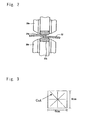
- FIG. 2 is a view illustrating the welding in which a seam is welded by holding an overlapped portion 23 of the organic resin-coated surface-treated steel sheet 22 by using electrode rolls 20a and 20b or by using welding copper wires 21a and 21b backed up by the electrode rolls 20a and 20b and, thereafter, the metal exposed at the welded portion is mended by using the thermosetting coating material.
- the necking, beading and flanging are effected to form the can body portion.
- separately formed can end portions (can lid and can bottom) are wrap-seamed to form a welded can.
- the welded can of the invention can be favorably used for containing beverages, and its diameter can be contracted by necking to a high degree like that of triple necking.
- the inner surface of the can before or after the necking can be partly or entirely spray-coated.
- Preferred examples of the coating material for being sprayed include an epoxyacrylic coating material and an epoxyphenol coating material.
- the welded can of the invention has excellent corrosion resistance and can be preferably used for containing beverages such as metal-corroding acidic beverages.
- the welded can can be further desirably used as an aerosol can, an 18-liter can for containing solvent and the like, to which only, however, the invention is not limited.
- the materials of samples Nos. 1 to 73 and 77 were the resin-coated tin-plated steel sheets obtained by coating the above tin-plated steel sheet with an epaxyacrylic phenol type aqueous coating material except the welding margin portion which is a seam portion of the can body in such a manner that the film thickness after firing was 5 ⁇ m on the inner surface side and 3 ⁇ m on the outer surface side, effecting the firing and curing in a hot air drying furnace at 185°C for 10 minutes and 205°C for 10 minutes and, thereafter, similarly printing the outer surface, too, leaving the welding margin portion.
- the material of the sample No. 74 was the resin-coated tin-plated steel sheet obtained like those of the samples Nos.
- the material of the sample No. 75 was the resin-coated tin-plated steel sheet obtained like those of the samples Nos. 1 to 73 but laminating a biaxially drawn polyethylene terephthalate/isophthalate film (melting point, 230°C) of a thickness of 20 ⁇ m on which an epoxyphenol type adhesive primer has been applied in advance onto the inner surface side of the can leaving the welding margin portion.
- the material of the sample No. 76 was the resin-coated tin-plated steel sheet obtained like those of the samples Nos. 1 to 73 but applying the epoxyphenol type coating material onto the inner surface side of the can in a manner that the thickness of the coating was 65 mg/dm 2 .
- the material of the samples Nos. 1 to 77 i.e., the resin-coated surface-treated tin-plated steel sheets, were so cut that the vicinities of the blank edges became the welding margin portions.
- the blanks were welded while overlapping the welding portions over a width of 0.3 mm in a cylindrical shape.
- the welding conditions consisted of a welding speed of 55 m/min and a welding pressing force of 50 kgf.
- 74 and 75 were formed into welded can bodies in the same manner as described above but applying a polyester powder onto the inner surface side of the can bodies at the weld-seaming portions in a manner that the thickness of the film after drying was 70 ⁇ m and firing the powder-coated portions only at 240°C for 3 seconds in the hot air drying furnace.
- the welding voltage was regarded to be the upper limit when the splash and blow holes occurred, was regarded to be the lower limit when there was even a small portion that had not been welded in the welded portion peel testing, and the weldability was evaluated based on the number of voltage points therebetween on the following basis.
- the welded cans could be stably produced when they were evaluated to be ⁇ and ⁇ .
- the occurrence of splash was observed by naked eyes and the occurrence of blow holes was observed by the permeation of X-rays.
- the can bodies were cut opened, test pieces measuring 60 mm x 60 mm were cut out from the portions other than the welded portions, and the inner surfaces of the cans were evaluated for their corrosion resistances. The edges were covered with a protection tape so that corrosion did not take place from the ends of the test pieces. Thereafter, the test pieces were dipped in a solution of 1.5% NaCl + 1.5% citric acid at 37°C for 12 days. The corroded state was evaluated into 5 steps by eyes. The evaluation was made on the following basis. The products were acceptable when they were evaluated to be ⁇ and ⁇ .
- the surface-treated steel sheets without, however, coated with the resin were preserved at room temperature for 6 months.
- the thus preserved steel sheets were coated with the resin and were evaluated in the same manner as evaluating the close adhesion of the can body portions.
- the close adhesion was evaluated to be ⁇ when the score was not larger than 2 points, to be ⁇ when the score was 3 to 4 points, and to be ⁇ when the score was 5 points.
- the products were acceptable when they were evaluated to be ⁇ and ⁇ .
- Table 1 shows the results of evaluations and decisions of the above five kinds. Symbol "-" represents no evaluation since the welding could not be effected. Fig. 1 shows the results of total evaluation as obtained by preparing a diagram of relationship between the amounts of free Sn and the amounts of Si from the results of Tables 1 and 2. It will be learned that favorable properties are exhibited when the amount of free Sn (X g/m 2 ) and the amount of Si (Y mg/m 2 ) in the surface-treating layer are in such ranges that satisfy all of the following formulas, 0.2 ⁇ X ⁇ 13 Y ⁇ 1.0 Y ⁇ 1.58 ⁇ X + 6.92 Y ⁇ - 0.36 ⁇ X + 10.70
Landscapes
- Chemical & Material Sciences (AREA)
- Engineering & Computer Science (AREA)
- Chemical Kinetics & Catalysis (AREA)
- Materials Engineering (AREA)
- Metallurgy (AREA)
- Organic Chemistry (AREA)
- Electrochemistry (AREA)
- Mechanical Engineering (AREA)
- General Chemical & Material Sciences (AREA)
- Laminated Bodies (AREA)
- Other Surface Treatments For Metallic Materials (AREA)
- Details Of Rigid Or Semi-Rigid Containers (AREA)
Applications Claiming Priority (2)
| Application Number | Priority Date | Filing Date | Title |
|---|---|---|---|
| JP2007216609A JP2009046754A (ja) | 2007-08-23 | 2007-08-23 | 溶接缶用表面処理錫めっき鋼板及びこれから成る溶接缶 |
| PCT/JP2008/064101 WO2009025179A1 (fr) | 2007-08-23 | 2008-08-06 | Tôle d'acier étamée traitée en surface pour boîte soudée et boîte soudée réalisée à l'aide de celle-ci |
Publications (2)
| Publication Number | Publication Date |
|---|---|
| EP2180085A1 true EP2180085A1 (fr) | 2010-04-28 |
| EP2180085A4 EP2180085A4 (fr) | 2011-10-19 |
Family
ID=40378086
Family Applications (1)
| Application Number | Title | Priority Date | Filing Date |
|---|---|---|---|
| EP08827772A Withdrawn EP2180085A4 (fr) | 2007-08-23 | 2008-08-06 | Tôle d'acier étamée traitée en surface pour boîte soudée et boîte soudée réalisée à l'aide de celle-ci |
Country Status (6)
| Country | Link |
|---|---|
| US (1) | US20100320216A1 (fr) |
| EP (1) | EP2180085A4 (fr) |
| JP (1) | JP2009046754A (fr) |
| KR (1) | KR20100023839A (fr) |
| CN (1) | CN101778966A (fr) |
| WO (1) | WO2009025179A1 (fr) |
Families Citing this family (2)
| Publication number | Priority date | Publication date | Assignee | Title |
|---|---|---|---|---|
| TWI686304B (zh) * | 2016-03-10 | 2020-03-01 | 日商日本製鐵股份有限公司 | 容器用金屬板及其製造方法 |
| CN113695191A (zh) * | 2020-05-21 | 2021-11-26 | 上海梅山钢铁股份有限公司 | 一种用粉末涂料涂覆三片罐罐身焊缝的试验方法 |
Family Cites Families (10)
| Publication number | Priority date | Publication date | Assignee | Title |
|---|---|---|---|---|
| JP3695048B2 (ja) * | 1997-03-04 | 2005-09-14 | Jfeスチール株式会社 | 変形3ピース缶用鋼板およびその製造方法 |
| JP4132468B2 (ja) * | 1999-09-14 | 2008-08-13 | 新日本製鐵株式会社 | 耐錆性、耐食性および密着性に優れた容器用金属板 |
| JP4278271B2 (ja) | 2000-03-22 | 2009-06-10 | 新日本製鐵株式会社 | ラミネートシームレス缶 |
| JP4270768B2 (ja) * | 2000-11-08 | 2009-06-03 | Jfeスチール株式会社 | 錫めっき鋼板及び化成処理液 |
| JP3846210B2 (ja) | 2001-03-21 | 2006-11-15 | Jfeスチール株式会社 | 表面処理鋼板 |
| JP4285924B2 (ja) * | 2001-03-23 | 2009-06-24 | 東洋製罐株式会社 | Snめっき鋼板に樹脂皮膜を被覆してなる樹脂被覆Snめっき鋼板から成る缶体及びその製造方法 |
| EP1518944B1 (fr) * | 2002-06-05 | 2014-05-14 | JFE Steel Corporation | Plaque d'acier etamee et son procede de production |
| JP3896108B2 (ja) * | 2003-11-19 | 2007-03-22 | 新日本製鐵株式会社 | 溶接缶用ストライプラミネート鋼板およびその製造方法 |
| JP4280181B2 (ja) * | 2004-03-09 | 2009-06-17 | 新日本製鐵株式会社 | 溶接性、密着性、耐食性に優れた溶接缶用鋼板 |
| JP4293065B2 (ja) * | 2004-06-21 | 2009-07-08 | 東洋製罐株式会社 | 耐硫化変色性、耐食性に優れた溶接缶 |
-
2007
- 2007-08-23 JP JP2007216609A patent/JP2009046754A/ja not_active Withdrawn
-
2008
- 2008-08-06 US US12/666,261 patent/US20100320216A1/en not_active Abandoned
- 2008-08-06 KR KR1020097024990A patent/KR20100023839A/ko not_active Ceased
- 2008-08-06 WO PCT/JP2008/064101 patent/WO2009025179A1/fr not_active Ceased
- 2008-08-06 EP EP08827772A patent/EP2180085A4/fr not_active Withdrawn
- 2008-08-06 CN CN200880103264A patent/CN101778966A/zh active Pending
Also Published As
| Publication number | Publication date |
|---|---|
| WO2009025179A1 (fr) | 2009-02-26 |
| US20100320216A1 (en) | 2010-12-23 |
| EP2180085A4 (fr) | 2011-10-19 |
| CN101778966A (zh) | 2010-07-14 |
| KR20100023839A (ko) | 2010-03-04 |
| JP2009046754A (ja) | 2009-03-05 |
Similar Documents
| Publication | Publication Date | Title |
|---|---|---|
| CN101010452B (zh) | 表面处理金属材料及其表面处理方法、和包覆树脂的金属材料、罐及罐盖 | |
| CN103097583B (zh) | 容器用钢板及其制造方法 | |
| EP1566467B1 (fr) | Matériau métallique traité en surface, procédé de traitement de ladite surface, et matériau métallique revêtu de résine, boite de conserve métallique et son couvercle | |
| EP2006416B1 (fr) | Feuille en acier pour contenants | |
| CN103097582B (zh) | 容器用钢板及其制造方法 | |
| JP4492224B2 (ja) | 表面処理金属材料及びその表面処理方法、並びに樹脂被覆金属材料 | |
| US6797372B2 (en) | Resin-coated steel for fuel tanks of automobile and method for manufacturing the same | |
| CN102822387B (zh) | 耐蚀性优异的容器用钢板 | |
| EP1518944B1 (fr) | Plaque d'acier etamee et son procede de production | |
| US20100320216A1 (en) | Surface-treated tin-plated steel sheet for welded cans and welded cans made therefrom | |
| EP1484174B1 (fr) | Feuille d'acier a revetement de resine et canette produite par compression de celle-ci | |
| KR102088247B1 (ko) | 용기용 강판 및 용기용 강판의 제조 방법 | |
| JP4019751B2 (ja) | プレコート鋼板から成るプレス成形缶 | |
| JP4293065B2 (ja) | 耐硫化変色性、耐食性に優れた溶接缶 | |
| JP5377817B2 (ja) | 耐食性に優れたキャップ適用可能な缶体 | |
| JP4569247B2 (ja) | 耐硫化変色性、耐食性に優れたプレス成形缶及び蓋 | |
| WO2001004380A1 (fr) | Tole en acier pour contenant feuillete et procede de fabrication de boite l'utilisant et boite associee | |
| CN107709630B (zh) | 容器用钢板及容器用钢板的制造方法 | |
| JP3893964B2 (ja) | ポリエチレンフィルム被覆錫合金めっき鋼板 | |
| JP3890700B2 (ja) | 溶接缶用めっき鋼板 | |
| JP2004285380A (ja) | 密着性、耐食性、加工性、溶接性に優れた高機能容器用鋼板 | |
| JPS62297473A (ja) | 耐食性、溶接性及び塗装性能にすぐれたNi合金系多層メツキ鋼板 | |
| JP2005029809A (ja) | 溶接性及び耐内容物性に優れた容器用表面処理鋼板 | |
| JPH0569508A (ja) | 食缶用フイルムラミネート鋼板 | |
| JPH1088392A (ja) | 溶接缶用表面処理鋼板および溶接缶体 |
Legal Events
| Date | Code | Title | Description |
|---|---|---|---|
| PUAI | Public reference made under article 153(3) epc to a published international application that has entered the european phase |
Free format text: ORIGINAL CODE: 0009012 |
|
| 17P | Request for examination filed |
Effective date: 20091116 |
|
| AK | Designated contracting states |
Kind code of ref document: A1 Designated state(s): AT BE BG CH CY CZ DE DK EE ES FI FR GB GR HR HU IE IS IT LI LT LU LV MC MT NL NO PL PT RO SE SI SK TR |
|
| AX | Request for extension of the european patent |
Extension state: AL BA MK RS |
|
| DAX | Request for extension of the european patent (deleted) | ||
| A4 | Supplementary search report drawn up and despatched |
Effective date: 20110919 |
|
| RIC1 | Information provided on ipc code assigned before grant |
Ipc: C23C 22/00 20060101ALI20110913BHEP Ipc: C23C 22/58 20060101ALI20110913BHEP Ipc: C25D 5/48 20060101ALI20110913BHEP Ipc: C25D 5/26 20060101ALI20110913BHEP Ipc: C23C 28/00 20060101AFI20110913BHEP |
|
| STAA | Information on the status of an ep patent application or granted ep patent |
Free format text: STATUS: THE APPLICATION IS DEEMED TO BE WITHDRAWN |
|
| 18D | Application deemed to be withdrawn |
Effective date: 20120417 |