EP2180130B1 - Porte coupe-feu avec un cadre métallique et des plaques collées - Google Patents
Porte coupe-feu avec un cadre métallique et des plaques collées Download PDFInfo
- Publication number
- EP2180130B1 EP2180130B1 EP20080167372 EP08167372A EP2180130B1 EP 2180130 B1 EP2180130 B1 EP 2180130B1 EP 20080167372 EP20080167372 EP 20080167372 EP 08167372 A EP08167372 A EP 08167372A EP 2180130 B1 EP2180130 B1 EP 2180130B1
- Authority
- EP
- European Patent Office
- Prior art keywords
- door
- door frame
- bonding agent
- door panel
- screw
- Prior art date
- Legal status (The legal status is an assumption and is not a legal conclusion. Google has not performed a legal analysis and makes no representation as to the accuracy of the status listed.)
- Not-in-force
Links
- 229910000831 Steel Inorganic materials 0.000 title claims description 14
- 239000010959 steel Substances 0.000 title claims description 14
- 239000007767 bonding agent Substances 0.000 claims description 34
- 238000000034 method Methods 0.000 claims description 24
- 238000004519 manufacturing process Methods 0.000 claims description 17
- 238000009413 insulation Methods 0.000 claims description 11
- 239000000853 adhesive Substances 0.000 claims description 4
- 230000001070 adhesive effect Effects 0.000 claims description 4
- 238000003825 pressing Methods 0.000 claims description 4
- 239000003292 glue Substances 0.000 claims description 2
- 239000011490 mineral wool Substances 0.000 claims description 2
- 229920002635 polyurethane Polymers 0.000 claims description 2
- 239000004814 polyurethane Substances 0.000 claims description 2
- 238000005520 cutting process Methods 0.000 claims 1
- 238000004079 fireproofing Methods 0.000 claims 1
- 230000008569 process Effects 0.000 description 5
- 238000003466 welding Methods 0.000 description 5
- 229910052782 aluminium Inorganic materials 0.000 description 4
- XAGFODPZIPBFFR-UHFFFAOYSA-N aluminium Chemical compound [Al] XAGFODPZIPBFFR-UHFFFAOYSA-N 0.000 description 4
- 239000000463 material Substances 0.000 description 3
- 239000004033 plastic Substances 0.000 description 3
- 229920003023 plastic Polymers 0.000 description 3
- 238000003892 spreading Methods 0.000 description 3
- 230000007480 spreading Effects 0.000 description 3
- 229910001220 stainless steel Inorganic materials 0.000 description 3
- 239000010935 stainless steel Substances 0.000 description 3
- 238000012360 testing method Methods 0.000 description 3
- 238000012546 transfer Methods 0.000 description 3
- 238000004026 adhesive bonding Methods 0.000 description 2
- 239000004411 aluminium Substances 0.000 description 2
- 238000005452 bending Methods 0.000 description 2
- 230000009286 beneficial effect Effects 0.000 description 2
- 238000010276 construction Methods 0.000 description 2
- 238000002845 discoloration Methods 0.000 description 2
- 230000000694 effects Effects 0.000 description 2
- 230000009970 fire resistant effect Effects 0.000 description 2
- 239000006260 foam Substances 0.000 description 2
- 229910052751 metal Inorganic materials 0.000 description 2
- 239000002184 metal Substances 0.000 description 2
- 239000000919 ceramic Substances 0.000 description 1
- 230000008859 change Effects 0.000 description 1
- 239000003795 chemical substances by application Substances 0.000 description 1
- 238000004140 cleaning Methods 0.000 description 1
- 230000006835 compression Effects 0.000 description 1
- 238000007906 compression Methods 0.000 description 1
- 238000011161 development Methods 0.000 description 1
- 238000005516 engineering process Methods 0.000 description 1
- 238000007730 finishing process Methods 0.000 description 1
- 238000010438 heat treatment Methods 0.000 description 1
- 239000004615 ingredient Substances 0.000 description 1
- 238000005304 joining Methods 0.000 description 1
- 238000002844 melting Methods 0.000 description 1
- 230000008018 melting Effects 0.000 description 1
- 238000002360 preparation method Methods 0.000 description 1
- 238000012797 qualification Methods 0.000 description 1
- 230000004044 response Effects 0.000 description 1
- 230000024042 response to gravity Effects 0.000 description 1
- 230000000979 retarding effect Effects 0.000 description 1
- 239000000126 substance Substances 0.000 description 1
- 238000011282 treatment Methods 0.000 description 1
- 230000007306 turnover Effects 0.000 description 1
Images

Classifications
-
- E—FIXED CONSTRUCTIONS
- E06—DOORS, WINDOWS, SHUTTERS, OR ROLLER BLINDS IN GENERAL; LADDERS
- E06B—FIXED OR MOVABLE CLOSURES FOR OPENINGS IN BUILDINGS, VEHICLES, FENCES OR LIKE ENCLOSURES IN GENERAL, e.g. DOORS, WINDOWS, BLINDS, GATES
- E06B3/00—Window sashes, door leaves, or like elements for closing wall or like openings; Layout of fixed or moving closures, e.g. windows in wall or like openings; Features of rigidly-mounted outer frames relating to the mounting of wing frames
- E06B3/70—Door leaves
- E06B3/72—Door leaves consisting of frame and panels, e.g. of raised panel type
- E06B3/725—Door leaves consisting of frame and panels, e.g. of raised panel type with separate hollow frames, e.g. foam-filled
- E06B3/726—Door leaves consisting of frame and panels, e.g. of raised panel type with separate hollow frames, e.g. foam-filled of metal
-
- E—FIXED CONSTRUCTIONS
- E06—DOORS, WINDOWS, SHUTTERS, OR ROLLER BLINDS IN GENERAL; LADDERS
- E06B—FIXED OR MOVABLE CLOSURES FOR OPENINGS IN BUILDINGS, VEHICLES, FENCES OR LIKE ENCLOSURES IN GENERAL, e.g. DOORS, WINDOWS, BLINDS, GATES
- E06B5/00—Doors, windows, or like closures for special purposes; Border constructions therefor
- E06B5/10—Doors, windows, or like closures for special purposes; Border constructions therefor for protection against air-raid or other war-like action; for other protective purposes
- E06B5/16—Fireproof doors or similar closures; Adaptations of fixed constructions therefor
-
- E—FIXED CONSTRUCTIONS
- E06—DOORS, WINDOWS, SHUTTERS, OR ROLLER BLINDS IN GENERAL; LADDERS
- E06B—FIXED OR MOVABLE CLOSURES FOR OPENINGS IN BUILDINGS, VEHICLES, FENCES OR LIKE ENCLOSURES IN GENERAL, e.g. DOORS, WINDOWS, BLINDS, GATES
- E06B3/00—Window sashes, door leaves, or like elements for closing wall or like openings; Layout of fixed or moving closures, e.g. windows in wall or like openings; Features of rigidly-mounted outer frames relating to the mounting of wing frames
- E06B3/70—Door leaves
- E06B3/7015—Door leaves characterised by the filling between two external panels
- E06B2003/7042—Door leaves characterised by the filling between two external panels with a fire retardant layer
-
- E—FIXED CONSTRUCTIONS
- E06—DOORS, WINDOWS, SHUTTERS, OR ROLLER BLINDS IN GENERAL; LADDERS
- E06B—FIXED OR MOVABLE CLOSURES FOR OPENINGS IN BUILDINGS, VEHICLES, FENCES OR LIKE ENCLOSURES IN GENERAL, e.g. DOORS, WINDOWS, BLINDS, GATES
- E06B3/00—Window sashes, door leaves, or like elements for closing wall or like openings; Layout of fixed or moving closures, e.g. windows in wall or like openings; Features of rigidly-mounted outer frames relating to the mounting of wing frames
- E06B3/70—Door leaves
- E06B2003/7059—Specific frame characteristics
- E06B2003/7074—Metal frames
Definitions
- the invention relates to a steel-structured door, which comprises a door frame of steel, a refractory heat insulation, and a door panel on each face of the door, making up an external side of the door.
- the invention relates also to a method of manufacturing a steel-structured door, which method comprises attaching to a door frame of steel on each side a door panel as a face for making up an external side of the door.
- Steel-structured doors are typically used in projects, wherein the door is used for establishing a compartment stopping or retarding the spreading of fire in a building.
- Such typical projects include, among others, doors between stairwells used as emergency exit routes in shopping malls and office buildings and the rest of the business premises or other premises, doors between parking facilities and exit routes, and so on.
- the rate of using a door can often be remarkably high, the door being thus subjected to numerous loading times throughout the day.
- EP 1 207 239 A2 which deals with fireproof panels.
- the structure described in the cited publication includes a metal layer, adhesion means, a fire-resistant foam, a mechanical bonding element with adhesion means, and a fire-resistant foam with mechanical bonding elements.
- US 6389769 patent describes a method of manufacturing a steel-structured door by attaching to a door frame of steel on each side a door panel as a face for making up an external side of the door.
- the door panel is attached to the door frame by the application of an adhesive.
- US 2005/0144871 describes a door and a method for assembling a door.
- the door is assembled by placing internal frame components on a surface and securing an interior sheath to the internal frame components, and then securing an exterior sheath to the internal frame components.
- the interior sheath and exterior sheath are secured to the frame by adhesive or other structural fastening methods.
- WO 8604108 describes a security door, which comprises a sheet of aluminium and a sheet profile frame of steel.
- the steel frame is fastened to the strips welded to the rear face of aluminium sheet by means of mechanical joining agent, e.g. bolts.
- the type approval refers to: A section in the Finnish building code, entitled Doors, a Ministry of the Environment statute of October 22, 2007 regarding type approval of doors, the EI class fire door of metal.
- Another objective of the invention is to provide a steel-structured door, which fulfils the quality criteria set therefor, regarding, among other things, straightness, appearance, finish, and durability, the door being still economically viable to manufacture and simple in terms of manufacturing technology, whereby the door structure makes its own contribution towards minimizing possible quality discrepancies in production.
- a still further objective is to provide a steel-structured door, which is as resistant as possible to vandalism and other possible unconventional use.
- a yet further objective in a method according to the invention is to provide a straightforward, simple, and economically attractive way of manufacturing a steel-structured door.
- An objective according to one feature of the method is to provide such a door assembly process, by means of which the appearance changes of a door can be maintained at a minimum, i.e. the manufacturing-related stresses applied to the door panel do not result in a change of the door appearance.
- this process step enables providing a fire-resistance upgrading structural detail regarding the construction of a door. This constitutes an objective, especially in cases where the exterior of a steel-structured door consists of stainless steel, which is not actually further coated, painted or similarly surface-treated in the finishing process.
- a steel-structured door has been attached to the door frame by means of a bonding agent, which is applied as an undulating, such as a sine-wave shaped, continuous extrudate by means of a die onto the door frame or the door panel.
- a bonding agent which is applied as an undulating, such as a sine-wave shaped, continuous extrudate by means of a die onto the door frame or the door panel.
- the door panel is attached to the door frame by the application of a bonding agent), which is applied as an undulating, such as a sine-wave shaped, continuous extrudate by means of a die onto the door frame or the door panel.
- a bonding agent which is applied as an undulating, such as a sine-wave shaped, continuous extrudate by means of a die onto the door frame or the door panel.
- the X-direction corresponds to a lengthwise dimension of the structure, which is hence for example the vertical direction of a door.
- the Y-direction corresponds to a lateral dimension of the door opening. Consequently, the XY-plane is essentially the same as the direction of the door plane.
- the Z-direction is a thickness or depth dimension. As this invention is particularly concerned with thermal engineering features of the structural elements, the Z-direction is generally also consistent with the direction of an installed structure's temperature gradient in a fire situation.
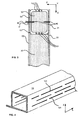
- FIG. 1 illustrates a door structure in a general view.
- a steel-structured door 1 of the invention comprises a door frame 10 of steel, a fireproof heat insulation 30, and a door panel 20 on each face of the door 1, making up a façade for the door and said door panel 20 being fixed to the door frame 10 by means of a bonding agent 50.
- Fig. 2 illustrates one cross-section of a steel-structured door in Z-direction.
- the bonding agent 50 represents such a material which is capable of forming an adhesion-based joint between the door panel 20 and the door frame 10.
- the bonding agent 50 includes plastics as its basic ingredient, thus providing a sufficient toughness and elasticity for the joint. Toughness, elasticity, and impact resistance are particularly desirable qualities for normal use of the door. The users often apply substantial forces to the door, especially if an optional door-mounted damper is out of order. The attachment of a door panel to a door frame must not start to crack or delaminate. On the other hand, there are no prior known proposals for providing a fire resistance, which is sufficient for obtaining a type approval for a door and which is implemented by means of a plastic-based adhesive bonding agent.
- the bonding agent is applied as an undulating, such as a sine-wave shaped, continuous extrudate by means of a die onto the door frame or the door panel.
- the elements to be connected to each other are placed precisely in a correct position and said elements are pressed together.
- a suitable amount and application geometry of bonding agent provide a sought-after final result.
- the undulating continuous extrudate or ribbon of a bonding agent turns into a flat film, which retains the door panel securely in place and seals the joint hermetically.
- the extrudate turns into a relatively consistent film as a result of flattening, whereby the number of air pockets or non-adhered spots can be minimized.
- the sine-wave form is particularly beneficial as the air is able to discharge thoroughly from the joint and the wave form is mathematically simple to calculate, which in turn facilitates an automated application of the proper amount.
- the film thickness bears an effect not only on the strength alone of a steel-structured door in normal use but also in a possible extreme situation, i.e. when fire resistance is called for.
- the bonding agent admittedly becomes charred and turns brittle, yet is still able to hold the door panel fixed to the door frame.
- it will lose its adhesiveness too quickly and, on the other hand, if there is too much bonding agent, it does not work as desired.
- the film thickness in a finished door is preferably within the range of 0,1-1 mm, more preferably 200-500 pm, the optimal end result shall be attained.
- the door frame 10 can be optionally constructed in a steel profile, wherein the propagation of heat in the Z-direction of a door is retarded by means of heat discontinuities 101.
- a highly appropriate heat discontinuity profile has been described in the same Patent Applicant's earlier utility model, application number FI-U 20060166 (the same patent family includes also DE-UM 202007005298.7 ).
- a refractory heat insulation inside the door can be preferably provided by using for example a highly appropriate fire protection insulation, such as mineral wool-based PAROC FPS 14, ISOVER PKOL or the like.
- the door manufacturing process comprises performing the following steps of:
- the first door panel 20 is placed on a working tool, a worktable or the like, the bonding agent 50 is applied to the door panel 20 in spots against which the door frame 10 settles, the door frame 10 is installed, the insulations 30 are installed, the bonding agent 50 is applied on the door frame 10, the second door panel 20 is placed on top of the door frame 10.
- This sequence may be slightly quicker than the above-described assembly sequence which requires a turnover of the frame but, on the other hand, it is slightly more difficult in this process to set the elements in precise alignment with each other by first attempt.
- One way of constructing a door frame 10 is, for example, such that elements like frame profiles, which make up the door frame 10, are assembled in a ring configuration and joined together, for example by welding X- and Y-directed frame profiles to each other.
- the door frame 10 can be constructed in the previously described step of the same process or can be acquired for example from a subcontractor.
- the attachment of the door panel 20 to the door frame 10 is backed up mechanically at least along an upper edge of the door panel 20. Further, according to a preferred embodiment, the mechanical backup is provided by way of screws 40.
- the upper edge of a door refers to such a region of the door which, when the door has been assembled and installed in its working position, lies in the X-direction (vertical direction) within a top quarter of the door panel 20. Preferably, this upper edge is a zone even narrower than the quarter area, but the precise structure is determined according to the construction of a door frame 10.
- the screws 40 can be left with their heads 42 exposed.
- a more preferred embodiment is such that the screws 40 for mechanical backup are made headless.
- This provides several benefits from the standpoint of a final result.
- the appearance of doors is almost without exception to provide information about the intended use thereof and to convey a certain image or impression about this particular location.
- the neatness and intactness of a door appearance are desirable qualities.
- the structures assembled by robust riveting, welding or by means of screws do not necessarily provide a desired final result, despite being potentially highly functional in technical sense. Welded structures, especially, are problematic as described earlier.
- the method further comprises steps, in which the screw 40 is left protrusive in the screwing process, such that between the screw's head 42 and the door panel's 20 surface 21 is visible some of the screw's threaded portion 41 (as shown in fig. 3 to the left of the door frame 10), after which the screw 40 is cut off to the flushness with or along the plane of the door panel's 20 surface 21 (as shown in fig. 3 to the right of the door frame 10).
- the screw 40 is left protrusive in the screwing process, such that between the screw's head 42 and the door panel's 20 surface 21 is visible some of the screw's threaded portion 41 (as shown in fig. 3 to the left of the door frame 10), after which the screw 40 is cut off to the flushness with or along the plane of the door panel's 20 surface 21 (as shown in fig. 3 to the right of the door frame 10).
- the presently described invention is applicable to projects other than those intended for fire door service.
- this option does not pass a fire test, which is specified in standard SFS-EN 1634-1 which was mentioned above when describing the objective of the claimed subject-matter.
- the melting point of aluminum is about 660°C (as compared to 1535° in steel)
- T the average temperature [°C]
- t time [min].
Landscapes
- Engineering & Computer Science (AREA)
- Civil Engineering (AREA)
- Structural Engineering (AREA)
- Special Wing (AREA)
Claims (14)
- Porte structurée en acier (1), qui comprend un cadre de porte (10) en acier, une isolation thermique réfractaire (30), et un panneau de porte (20) sur chaque face de la porte, constituant un côté externe de la porte, caractérisé en ce que les panneaux de porte (20) sont attachés au cadre de porte (10) au moyen d'un agent de liaison (50), qui est appliqué comme un extrudé continu ondulé, sous la forme d'une bande sinusoïdale, au moyen d'un dé sur le cadre de porte (10) ou le panneau de porte (20), de manière à ce que grâce à sa forme ondulée, l'extrudé se transforme en un film relativement consistant comme résultat de l'aplatissement, par lequel le nombre de poches d'air ou de points non adhérant est minimisé.
- Porte (1) selon la revendication 1, caractérisée en ce que l'agent de liaison (50) consiste en un agent de liaison élastique à base de polyuréthane, tel que la colle ou une pâte adhésive.
- Porte (1) selon la revendication 1, caractérisée en ce que le cadre de porte (10) est construit à partir d'une section d'acier, où la propagation de chaleur dans une direction (Z) perpendiculaire au plan de porte est retardée au moyen de discontinuités thermiques (101).
- Porte (1) selon la revendication 1, caractérisée en ce que l'attachement du panneau de porte (20) au cadre de porte (10) a été assuré mécaniquement, au moins le long d'une arête supérieure du panneau de porte (20).
- Porte (1) selon la revendication 4, caractérisée en ce que la sécurité mécanique est pourvue au moyen de vis (40).
- Porte (1) selon la revendication 4, caractérisée en ce que les vis (40) pour la sécurité mécanique sont des vis sans tête.
- Porte (1) selon la revendication 1, caractérisée en ce que l'isolation thermique réfractaire (30) est située dans la porte et est constituée d'une isolation ignifuge à base de laine minérale.
- Procédé de fabrication d'une porte structurée en acier (1), lequel procédé consiste à attacher au cadre de porte (10) d'acier sur chaque côté un panneau de porte (20) comme une face pour le montage d'un côté externe de la porte, caractérisée en ce que les panneaux de porte (20) sont attachés au cadre de porte (10) par l'application d'un agent de liaison (50), qui est appliqué comme un extrudé continu ondulé, sous forme de bande sinusoïdale, au moyen d'un dé sur le cadre de porte (10) ou le panneau de porte (20).
- Procédé selon la revendication 8, caractérisé en ce que l'épaisseur du film (50) de l'agent de liaison dans une porte finie est de préférence dans la gamme de 0,1-1 mm, mieux, entre 200-500 µn.
- Procédé selon la revendication 8, caractérisé en ce que l'attachement du panneau de porte (20) au cadre de porte (10) est soutenu mécaniquement, au moins le long d'une arête supérieure de la porte.
- Procédé selon la revendication 10, caractérisé en ce que le soutien mécanique est pourvu en utilisant une vis (40) .
- Procédé selon la revendication 11, caractérisé en ce que la vis (40) a une propulsion vers la gauche lors de l'étape de vissage, de manière à ce qu'entre la tête de la vis (42) et la surface (20) du panneau de porte (21) soit visible une portion filetée de la vis (41), après laquelle la vis (40) est coupée à l'affleurement avec la surface (20) du panneau de porte (21).
- Procédé selon la revendication 8, caractérisé en ce que la procédure de fabrication de la porte comprend la réalisation des étapes suivantes de:- préparation d'un cadre de porte (10) pour l'application d'un agent de liaison (50),- application d'un agent de liaison (50) sur un premier côté du cadre de porte (10) pour attacher un premier panneau de porte (20),- installation correcte du premier panneau de porte (20) contre le cadre de porte et sa pression pour assurer l'adhérence de l'agent de liaison (50),- installation d'une isolation thermique (30),- application d'un agent de liaison (50) sur un second côté du cadre de porte (10) pour attacher un second panneau de porte (20),- installation correcte d'un second panneau de porte (20) contre le cadre de porte et sa pression pour assurer de l'adhérence de l'agent de liaison (50).
- Procédé selon la revendication 13, caractérisé en ce que le procédé inclut d'autres étapes de:- vissage de la vis (40) ou des vis (40) à travers une couche formée par le panneau de porte (20) et l'agent de liaison (50) dans le cadre de porte (10), de manière à ce qu'entre une tête (42) de la vis et une surface (21) du panneau de porte (20) soit visible une portion filetée de la vis (41),- coupage de la vis (40) dans le sens de la surface du panneau de porte (21).
Priority Applications (1)
| Application Number | Priority Date | Filing Date | Title |
|---|---|---|---|
| EP20080167372 EP2180130B1 (fr) | 2008-10-23 | 2008-10-23 | Porte coupe-feu avec un cadre métallique et des plaques collées |
Applications Claiming Priority (1)
| Application Number | Priority Date | Filing Date | Title |
|---|---|---|---|
| EP20080167372 EP2180130B1 (fr) | 2008-10-23 | 2008-10-23 | Porte coupe-feu avec un cadre métallique et des plaques collées |
Publications (2)
| Publication Number | Publication Date |
|---|---|
| EP2180130A1 EP2180130A1 (fr) | 2010-04-28 |
| EP2180130B1 true EP2180130B1 (fr) | 2012-10-10 |
Family
ID=40459677
Family Applications (1)
| Application Number | Title | Priority Date | Filing Date |
|---|---|---|---|
| EP20080167372 Not-in-force EP2180130B1 (fr) | 2008-10-23 | 2008-10-23 | Porte coupe-feu avec un cadre métallique et des plaques collées |
Country Status (1)
| Country | Link |
|---|---|
| EP (1) | EP2180130B1 (fr) |
Families Citing this family (3)
| Publication number | Priority date | Publication date | Assignee | Title |
|---|---|---|---|---|
| KR20170108608A (ko) * | 2016-03-18 | 2017-09-27 | (주)엘지하우시스 | 방화문 구조체 및 그 제조 방법 |
| GB2560143B (en) * | 2016-11-16 | 2020-04-08 | Assa Abloy Ltd | Door leaf and door frame assembly |
| US10597932B1 (en) * | 2019-08-14 | 2020-03-24 | John Cipri | Swinging type fire door |
Family Cites Families (14)
| Publication number | Priority date | Publication date | Assignee | Title |
|---|---|---|---|---|
| DE6942145U (de) * | 1969-10-30 | 1971-06-24 | Schwarze Ag Metalltueren | Feuerschutztor, bestehend aus vorzugsweise einem metallgehaeuse und in diesem angeordnate feuerschutzplatten. |
| DE2528245C2 (de) * | 1975-06-25 | 1983-01-20 | Josef 8890 Aichach Gail | Feuerschutztüre |
| LU80591A1 (fr) * | 1978-11-28 | 1979-03-22 | Feidert Ateliers | Ensemble de porte avec accessoires coupe-feu |
| US4416084A (en) * | 1982-05-07 | 1983-11-22 | Giuseppe Zen | Protective device |
| DE3316432A1 (de) * | 1982-05-10 | 1983-11-10 | Voest-Alpine Krems Gesellschaft mbH, 3502 Krems | Feuerschutztuer |
| SE454791B (sv) | 1984-12-27 | 1988-05-30 | Lindsdals Smide Ab | Sekerhetsdorr med tva sidoplatar bestaende av olika metaller |
| GB2183706B (en) * | 1985-12-07 | 1988-08-24 | David Hunt | A door |
| US5154461A (en) * | 1990-04-27 | 1992-10-13 | Prescott Joseph G | Door secured system |
| GB9614803D0 (en) * | 1996-07-15 | 1996-09-04 | Caradon Everest Ltd | Improvements in and relating to doors |
| US6389769B1 (en) | 2000-07-05 | 2002-05-21 | Efp Corporation | Door and method of making same |
| GB0027632D0 (en) | 2000-11-11 | 2000-12-27 | Pyro Foam Ltd | Improvements in or relating to thermally insulating and fire resistant panels |
| US20040035070A1 (en) * | 2002-06-21 | 2004-02-26 | Chen Kuei Yung Wang | Economical impact resistant compression molded door |
| US20040177585A1 (en) * | 2003-03-10 | 2004-09-16 | Vermette Robert M. | Industrial door assembly and method of assembling same |
| US7228667B2 (en) | 2003-12-19 | 2007-06-12 | Tuff Shed, Inc. | Door system for a building |
-
2008
- 2008-10-23 EP EP20080167372 patent/EP2180130B1/fr not_active Not-in-force
Also Published As
| Publication number | Publication date |
|---|---|
| EP2180130A1 (fr) | 2010-04-28 |
Similar Documents
| Publication | Publication Date | Title |
|---|---|---|
| US7856775B2 (en) | Thermal insulation and sealing means for a safing slot | |
| US20220275643A1 (en) | Foam panel with drainage plane | |
| EP2180130B1 (fr) | Porte coupe-feu avec un cadre métallique et des plaques collées | |
| JP3623929B2 (ja) | 外壁仕上げ材用金属製下地材に用いる金属製スペーサと外壁仕上げ材の固定構造 | |
| CN101027451A (zh) | 覆层 | |
| WO2016074116A1 (fr) | Procédé pour fabriquer un matériau d'intérieur de porte coupe-feu en utilisant de la peinture de revêtement ignifuge et procédé pour fabriquer une porte coupe-feu en utilisant le matériau d'intérieur | |
| JPH0449349A (ja) | 鉄骨構造物の耐火被覆 | |
| KR100604411B1 (ko) | 복합패널을 이용한 조립식 이중벽 칸막이의 시공 방법 | |
| JP7675470B1 (ja) | 板状建材を用いた内装の施工方法、及び内装材ユニット | |
| WO2012088673A1 (fr) | Appareil de fixation pour panneau d'isolation thermique | |
| KR200250659Y1 (ko) | 건축물용 내외장재 | |
| JP2007002580A (ja) | 有孔板継目部の補強構造 | |
| JP2510329B2 (ja) | コ―ナ―外壁 | |
| JP3422908B2 (ja) | ユニット式建物の仕上げ構造 | |
| JPH02266040A (ja) | 壁耐火構造 | |
| WO2007064307A1 (fr) | Systeme de parement pour batiment en panneaux fixes a une sous-structure | |
| JPH0765357B2 (ja) | 新規な中空間仕切壁及びその組立方法 | |
| JPS59169628A (ja) | 金属板の成形加工方法 | |
| JP2004324371A (ja) | 組立式構造物の耐火被覆構造物 | |
| JP2564021B2 (ja) | コーナー外壁の構造 | |
| JPH0351457A (ja) | 両面薄層石貼りパネル | |
| JPH09295306A (ja) | 建築用化粧パネル | |
| CN113502955A (zh) | 防火玻璃弯弧幕墙 | |
| JP2020094418A (ja) | 外壁目地構造 | |
| JP2001065152A (ja) | 建築物の外壁面施工方法 |
Legal Events
| Date | Code | Title | Description |
|---|---|---|---|
| PUAI | Public reference made under article 153(3) epc to a published international application that has entered the european phase |
Free format text: ORIGINAL CODE: 0009012 |
|
| AK | Designated contracting states |
Kind code of ref document: A1 Designated state(s): AT BE BG CH CY CZ DE DK EE ES FI FR GB GR HR HU IE IS IT LI LT LU LV MC MT NL NO PL PT RO SE SI SK TR |
|
| AX | Request for extension of the european patent |
Extension state: AL BA MK RS |
|
| 17P | Request for examination filed |
Effective date: 20101025 |
|
| AKX | Designation fees paid |
Designated state(s): AT BE BG CH CY CZ DE DK EE ES FI FR GB GR HR HU IE IS IT LI LT LU LV MC MT NL NO PL PT RO SE SI SK TR |
|
| 17Q | First examination report despatched |
Effective date: 20110908 |
|
| GRAP | Despatch of communication of intention to grant a patent |
Free format text: ORIGINAL CODE: EPIDOSNIGR1 |
|
| GRAS | Grant fee paid |
Free format text: ORIGINAL CODE: EPIDOSNIGR3 |
|
| GRAA | (expected) grant |
Free format text: ORIGINAL CODE: 0009210 |
|
| AK | Designated contracting states |
Kind code of ref document: B1 Designated state(s): AT BE BG CH CY CZ DE DK EE ES FI FR GB GR HR HU IE IS IT LI LT LU LV MC MT NL NO PL PT RO SE SI SK TR |
|
| REG | Reference to a national code |
Ref country code: GB Ref legal event code: FG4D |
|
| REG | Reference to a national code |
Ref country code: AT Ref legal event code: REF Ref document number: 579072 Country of ref document: AT Kind code of ref document: T Effective date: 20121015 Ref country code: CH Ref legal event code: EP |
|
| REG | Reference to a national code |
Ref country code: IE Ref legal event code: FG4D |
|
| REG | Reference to a national code |
Ref country code: DE Ref legal event code: R096 Ref document number: 602008019254 Country of ref document: DE Effective date: 20121206 |
|
| PG25 | Lapsed in a contracting state [announced via postgrant information from national office to epo] |
Ref country code: SI Free format text: LAPSE BECAUSE OF FAILURE TO SUBMIT A TRANSLATION OF THE DESCRIPTION OR TO PAY THE FEE WITHIN THE PRESCRIBED TIME-LIMIT Effective date: 20121010 |
|
| REG | Reference to a national code |
Ref country code: NL Ref legal event code: VDEP Effective date: 20121010 |
|
| REG | Reference to a national code |
Ref country code: AT Ref legal event code: MK05 Ref document number: 579072 Country of ref document: AT Kind code of ref document: T Effective date: 20121010 |
|
| REG | Reference to a national code |
Ref country code: LT Ref legal event code: MG4D |
|
| PG25 | Lapsed in a contracting state [announced via postgrant information from national office to epo] |
Ref country code: NO Free format text: LAPSE BECAUSE OF FAILURE TO SUBMIT A TRANSLATION OF THE DESCRIPTION OR TO PAY THE FEE WITHIN THE PRESCRIBED TIME-LIMIT Effective date: 20130110 Ref country code: NL Free format text: LAPSE BECAUSE OF FAILURE TO SUBMIT A TRANSLATION OF THE DESCRIPTION OR TO PAY THE FEE WITHIN THE PRESCRIBED TIME-LIMIT Effective date: 20121010 Ref country code: IS Free format text: LAPSE BECAUSE OF FAILURE TO SUBMIT A TRANSLATION OF THE DESCRIPTION OR TO PAY THE FEE WITHIN THE PRESCRIBED TIME-LIMIT Effective date: 20130210 Ref country code: FI Free format text: LAPSE BECAUSE OF FAILURE TO SUBMIT A TRANSLATION OF THE DESCRIPTION OR TO PAY THE FEE WITHIN THE PRESCRIBED TIME-LIMIT Effective date: 20121010 Ref country code: LT Free format text: LAPSE BECAUSE OF FAILURE TO SUBMIT A TRANSLATION OF THE DESCRIPTION OR TO PAY THE FEE WITHIN THE PRESCRIBED TIME-LIMIT Effective date: 20121010 Ref country code: SE Free format text: LAPSE BECAUSE OF FAILURE TO SUBMIT A TRANSLATION OF THE DESCRIPTION OR TO PAY THE FEE WITHIN THE PRESCRIBED TIME-LIMIT Effective date: 20121010 Ref country code: ES Free format text: LAPSE BECAUSE OF FAILURE TO SUBMIT A TRANSLATION OF THE DESCRIPTION OR TO PAY THE FEE WITHIN THE PRESCRIBED TIME-LIMIT Effective date: 20130121 Ref country code: HR Free format text: LAPSE BECAUSE OF FAILURE TO SUBMIT A TRANSLATION OF THE DESCRIPTION OR TO PAY THE FEE WITHIN THE PRESCRIBED TIME-LIMIT Effective date: 20121010 |
|
| PG25 | Lapsed in a contracting state [announced via postgrant information from national office to epo] |
Ref country code: MC Free format text: LAPSE BECAUSE OF NON-PAYMENT OF DUE FEES Effective date: 20121031 Ref country code: LV Free format text: LAPSE BECAUSE OF FAILURE TO SUBMIT A TRANSLATION OF THE DESCRIPTION OR TO PAY THE FEE WITHIN THE PRESCRIBED TIME-LIMIT Effective date: 20121010 Ref country code: PT Free format text: LAPSE BECAUSE OF FAILURE TO SUBMIT A TRANSLATION OF THE DESCRIPTION OR TO PAY THE FEE WITHIN THE PRESCRIBED TIME-LIMIT Effective date: 20130211 Ref country code: BE Free format text: LAPSE BECAUSE OF FAILURE TO SUBMIT A TRANSLATION OF THE DESCRIPTION OR TO PAY THE FEE WITHIN THE PRESCRIBED TIME-LIMIT Effective date: 20121010 Ref country code: PL Free format text: LAPSE BECAUSE OF FAILURE TO SUBMIT A TRANSLATION OF THE DESCRIPTION OR TO PAY THE FEE WITHIN THE PRESCRIBED TIME-LIMIT Effective date: 20121010 Ref country code: GR Free format text: LAPSE BECAUSE OF FAILURE TO SUBMIT A TRANSLATION OF THE DESCRIPTION OR TO PAY THE FEE WITHIN THE PRESCRIBED TIME-LIMIT Effective date: 20130111 |
|
| REG | Reference to a national code |
Ref country code: CH Ref legal event code: PL |
|
| PG25 | Lapsed in a contracting state [announced via postgrant information from national office to epo] |
Ref country code: AT Free format text: LAPSE BECAUSE OF FAILURE TO SUBMIT A TRANSLATION OF THE DESCRIPTION OR TO PAY THE FEE WITHIN THE PRESCRIBED TIME-LIMIT Effective date: 20121010 |
|
| REG | Reference to a national code |
Ref country code: IE Ref legal event code: MM4A |
|
| PG25 | Lapsed in a contracting state [announced via postgrant information from national office to epo] |
Ref country code: CZ Free format text: LAPSE BECAUSE OF FAILURE TO SUBMIT A TRANSLATION OF THE DESCRIPTION OR TO PAY THE FEE WITHIN THE PRESCRIBED TIME-LIMIT Effective date: 20121010 Ref country code: BG Free format text: LAPSE BECAUSE OF FAILURE TO SUBMIT A TRANSLATION OF THE DESCRIPTION OR TO PAY THE FEE WITHIN THE PRESCRIBED TIME-LIMIT Effective date: 20130110 Ref country code: SK Free format text: LAPSE BECAUSE OF FAILURE TO SUBMIT A TRANSLATION OF THE DESCRIPTION OR TO PAY THE FEE WITHIN THE PRESCRIBED TIME-LIMIT Effective date: 20121010 Ref country code: LI Free format text: LAPSE BECAUSE OF NON-PAYMENT OF DUE FEES Effective date: 20121031 Ref country code: EE Free format text: LAPSE BECAUSE OF FAILURE TO SUBMIT A TRANSLATION OF THE DESCRIPTION OR TO PAY THE FEE WITHIN THE PRESCRIBED TIME-LIMIT Effective date: 20121010 Ref country code: IE Free format text: LAPSE BECAUSE OF NON-PAYMENT OF DUE FEES Effective date: 20121023 Ref country code: DK Free format text: LAPSE BECAUSE OF FAILURE TO SUBMIT A TRANSLATION OF THE DESCRIPTION OR TO PAY THE FEE WITHIN THE PRESCRIBED TIME-LIMIT Effective date: 20121010 Ref country code: CH Free format text: LAPSE BECAUSE OF NON-PAYMENT OF DUE FEES Effective date: 20121031 |
|
| PLBE | No opposition filed within time limit |
Free format text: ORIGINAL CODE: 0009261 |
|
| STAA | Information on the status of an ep patent application or granted ep patent |
Free format text: STATUS: NO OPPOSITION FILED WITHIN TIME LIMIT |
|
| PG25 | Lapsed in a contracting state [announced via postgrant information from national office to epo] |
Ref country code: RO Free format text: LAPSE BECAUSE OF FAILURE TO SUBMIT A TRANSLATION OF THE DESCRIPTION OR TO PAY THE FEE WITHIN THE PRESCRIBED TIME-LIMIT Effective date: 20121010 Ref country code: IT Free format text: LAPSE BECAUSE OF FAILURE TO SUBMIT A TRANSLATION OF THE DESCRIPTION OR TO PAY THE FEE WITHIN THE PRESCRIBED TIME-LIMIT Effective date: 20121010 |
|
| REG | Reference to a national code |
Ref country code: FR Ref legal event code: ST Effective date: 20130805 |
|
| 26N | No opposition filed |
Effective date: 20130711 |
|
| GBPC | Gb: european patent ceased through non-payment of renewal fee |
Effective date: 20130110 |
|
| REG | Reference to a national code |
Ref country code: DE Ref legal event code: R097 Ref document number: 602008019254 Country of ref document: DE Effective date: 20130711 |
|
| PG25 | Lapsed in a contracting state [announced via postgrant information from national office to epo] |
Ref country code: GB Free format text: LAPSE BECAUSE OF NON-PAYMENT OF DUE FEES Effective date: 20130110 Ref country code: FR Free format text: LAPSE BECAUSE OF NON-PAYMENT OF DUE FEES Effective date: 20121210 Ref country code: MT Free format text: LAPSE BECAUSE OF FAILURE TO SUBMIT A TRANSLATION OF THE DESCRIPTION OR TO PAY THE FEE WITHIN THE PRESCRIBED TIME-LIMIT Effective date: 20121010 Ref country code: CY Free format text: LAPSE BECAUSE OF FAILURE TO SUBMIT A TRANSLATION OF THE DESCRIPTION OR TO PAY THE FEE WITHIN THE PRESCRIBED TIME-LIMIT Effective date: 20121010 |
|
| PG25 | Lapsed in a contracting state [announced via postgrant information from national office to epo] |
Ref country code: TR Free format text: LAPSE BECAUSE OF FAILURE TO SUBMIT A TRANSLATION OF THE DESCRIPTION OR TO PAY THE FEE WITHIN THE PRESCRIBED TIME-LIMIT Effective date: 20121010 |
|
| PG25 | Lapsed in a contracting state [announced via postgrant information from national office to epo] |
Ref country code: LU Free format text: LAPSE BECAUSE OF NON-PAYMENT OF DUE FEES Effective date: 20121023 |
|
| PG25 | Lapsed in a contracting state [announced via postgrant information from national office to epo] |
Ref country code: HU Free format text: LAPSE BECAUSE OF FAILURE TO SUBMIT A TRANSLATION OF THE DESCRIPTION OR TO PAY THE FEE WITHIN THE PRESCRIBED TIME-LIMIT Effective date: 20081023 |
|
| PGFP | Annual fee paid to national office [announced via postgrant information from national office to epo] |
Ref country code: DE Payment date: 20141024 Year of fee payment: 7 |
|
| REG | Reference to a national code |
Ref country code: DE Ref legal event code: R119 Ref document number: 602008019254 Country of ref document: DE |
|
| PG25 | Lapsed in a contracting state [announced via postgrant information from national office to epo] |
Ref country code: DE Free format text: LAPSE BECAUSE OF NON-PAYMENT OF DUE FEES Effective date: 20160503 |