EP2180621A1 - Kommunikationsteuerungssverfahren, mobilstation und basisstation - Google Patents
Kommunikationsteuerungssverfahren, mobilstation und basisstation Download PDFInfo
- Publication number
- EP2180621A1 EP2180621A1 EP08827218A EP08827218A EP2180621A1 EP 2180621 A1 EP2180621 A1 EP 2180621A1 EP 08827218 A EP08827218 A EP 08827218A EP 08827218 A EP08827218 A EP 08827218A EP 2180621 A1 EP2180621 A1 EP 2180621A1
- Authority
- EP
- European Patent Office
- Prior art keywords
- symbols
- mobile station
- control channel
- uplink control
- base station
- Prior art date
- Legal status (The legal status is an assumption and is not a legal conclusion. Google has not performed a legal analysis and makes no representation as to the accuracy of the status listed.)
- Withdrawn
Links
Images


Classifications
-
- H—ELECTRICITY
- H04—ELECTRIC COMMUNICATION TECHNIQUE
- H04J—MULTIPLEX COMMUNICATION
- H04J13/00—Code division multiplex systems
- H04J13/10—Code generation
- H04J13/14—Generation of codes with a zero correlation zone
-
- H—ELECTRICITY
- H04—ELECTRIC COMMUNICATION TECHNIQUE
- H04L—TRANSMISSION OF DIGITAL INFORMATION, e.g. TELEGRAPHIC COMMUNICATION
- H04L1/00—Arrangements for detecting or preventing errors in the information received
- H04L1/0001—Systems modifying transmission characteristics according to link quality, e.g. power backoff
- H04L1/0036—Systems modifying transmission characteristics according to link quality, e.g. power backoff arrangements specific to the receiver
- H04L1/0039—Systems modifying transmission characteristics according to link quality, e.g. power backoff arrangements specific to the receiver other detection of signalling, e.g. detection of TFCI explicit signalling
-
- H—ELECTRICITY
- H04—ELECTRIC COMMUNICATION TECHNIQUE
- H04L—TRANSMISSION OF DIGITAL INFORMATION, e.g. TELEGRAPHIC COMMUNICATION
- H04L1/00—Arrangements for detecting or preventing errors in the information received
- H04L1/12—Arrangements for detecting or preventing errors in the information received by using return channel
- H04L1/16—Arrangements for detecting or preventing errors in the information received by using return channel in which the return channel carries supervisory signals, e.g. repetition request signals
- H04L1/1607—Details of the supervisory signal
- H04L1/1628—List acknowledgements, i.e. the acknowledgement message consisting of a list of identifiers, e.g. of sequence numbers
-
- H—ELECTRICITY
- H04—ELECTRIC COMMUNICATION TECHNIQUE
- H04L—TRANSMISSION OF DIGITAL INFORMATION, e.g. TELEGRAPHIC COMMUNICATION
- H04L1/00—Arrangements for detecting or preventing errors in the information received
- H04L1/12—Arrangements for detecting or preventing errors in the information received by using return channel
- H04L1/16—Arrangements for detecting or preventing errors in the information received by using return channel in which the return channel carries supervisory signals, e.g. repetition request signals
- H04L1/18—Automatic repetition systems, e.g. Van Duuren systems
- H04L1/1829—Arrangements specially adapted for the receiver end
-
- H—ELECTRICITY
- H04—ELECTRIC COMMUNICATION TECHNIQUE
- H04L—TRANSMISSION OF DIGITAL INFORMATION, e.g. TELEGRAPHIC COMMUNICATION
- H04L27/00—Modulated-carrier systems
- H04L27/26—Systems using multi-frequency codes
- H04L27/2601—Multicarrier modulation systems
-
- H—ELECTRICITY
- H04—ELECTRIC COMMUNICATION TECHNIQUE
- H04L—TRANSMISSION OF DIGITAL INFORMATION, e.g. TELEGRAPHIC COMMUNICATION
- H04L1/00—Arrangements for detecting or preventing errors in the information received
- H04L1/0001—Systems modifying transmission characteristics according to link quality, e.g. power backoff
- H04L1/0023—Systems modifying transmission characteristics according to link quality, e.g. power backoff characterised by the signalling
- H04L1/0026—Transmission of channel quality indication
Definitions
- the present invention relates a communication control method. More particularly, the present invention relates to a communication control method for determining whether feedback information from a mobile station includes reception state information and acknowledgement information, and relates to a base station and a mobile station that can use the communication control method.
- E-UTRA Evolved-UMTS (Universal Mobile Telecommunications System) Terrestrial Radio Access
- SC single-carrier
- FDMA Frequency Division Multiplexing Access
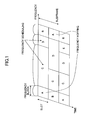
- Fig.1 users A, B, C, D and E in a cell perform transmission by using different time and frequency resources (the minimum unit is called a resource block), so that orthogonality among users is realized in the cell, and single-carrier transmission with low PAPR (Peak-to-Average Power Ratio) can be realized by assigning consecutive frequencies.
- PAPR Peak-to-Average Power Ratio
- the scheduler of the base station determines time or frequency resources to be assigned based on propagation state of each user and QoS (data rate, required error rate, delay, etc.) of data that should be sent, so that each user is assigned time/frequency resources of good propagation state. As a result, there is an advantage that throughput increases.
- an uplink control channel is used for transmission of CQI(Channel Quality Indicator) for realizing frequency scheduling and adaptive modulation/channel coding for the downlink data channel, and used for transmission of acknowledgement information for retransmitting downlink data and the like.
- the acknowledgement information (that may be referred to as ACK/NACK information hereinafter) is obtained by error detection such as Cyclic Redundancy Check (CRC), and includes positive acknowledgement (ACK) that is for a case when an error is not detected, and negative acknowledgement (NACK) that is for a case when an error is detected.
- CRC Cyclic Redundancy Check
- the single-carrier based radio access scheme since the single-carrier based radio access scheme is adopted in the uplink, it is necessary to multiplex CQI and ACK/NACK information using the same resources when a user transmits CQI and ACK/NACK information in the same subframe. In addition, corresponding to that, in the base station, it is necessary to change methods of reception processing between a case in which only CQI is transmitted and a case in which CQI and ACK/NACK information are multiplexed and transmitted.
- the base station can properly receive CQI and ACK/NACK information, and can perform demultiplexing processing, the base station can properly select RV parameter for retransmission of downlink data, and can perform transmission power control for the downlink control channel, and the like.
- the above-mentioned DTX determination for the ACK/NACK information is performed by transmitting a bit indicating DTX.
- the bit indicating DTX should be always transmitted, which includes a problem in transmission efficiency.
- DTX determination based on received power may be performed. That is, when transmitting both of CQI and ACK/NACK information, the mobile station transmits uplink control channel information with higher transmission power compared to the case where only CQI is transmitted. Therefore, the base station can perform DTX determination by comparing the received power with a predetermined threshold value.
- An object of the present invention is to provide a method that can accurately determine presence or absence of acknowledgement information in the uplink of Evolved UTRA, and to provide a mobile station and a base station that can apply the method.
- an embodiment of the present invention provides a communication control method for determining whether information transmitted from a mobile station in a single-carrier scheme includes reception state information and acknowledgement information.
- the communication control method includes:
- Another embodiment of the present invention provides a mobile station including: an uplink control channel generation unit configured to generate a first uplink control channel when transmitting reception state information, and to generate a second uplink control channel when transmitting reception state information and acknowledgement information.
- Another embodiment of the present invention provides a base station used with the mobile station, including:
- a method that can accurately determine presence or absence of acknowledgement information in the uplink of Evolved UTRA can be provided, and a mobile station and a base station that can apply the method can be provided.
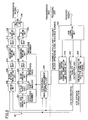
- Fig. 2 is a block diagram of a mobile station according to an embodiment of the present invention.
- the mobile station 20 includes a receiving unit and a transmission unit.
- the transmission unit includes an OFDM (Orthogonal Frequency Division Multiplexing) signal demodulation unit 200, a CQI estimation unit 202, an ACK/NACK determination unit 204, a broadcast channel/dedicated control channel demodulation and decoding unit 218.
- OFDM Orthogonal Frequency Division Multiplexing
- the receiving unit includes a coding unit 206, a block-by-block modulation unit 208, a discrete Fourier transform (DFT) unit 210, a subcarrier mapping unit 212, an inverse fast Fourier transform (DFT) unit 214, a cyclic prefix (CP) adding unit 216, an orthogonal resource assignment control unit 220, a CAZAC code generation unit 222, a cyclic shift unit 224, a block spreading unit 226, and a multiplexing unit 236.
- DFT discrete Fourier transform
- DFT inverse fast Fourier transform
- CP cyclic prefix
- the OFDM signal demodulation unit 200 receives a signal (received signal in Fig. 2 ) transmitted from the base station, and demultiplexes the received signal into signal components such as a pilot channel, a broadcast channel, a control channel and the like, and demodulates them. In addition, the OFDM signal demodulation unit 200 outputs the demodulated signal to the CQI estimation unit 202, the ACK/NACK determination unit 204, and the demodulation and decoding unit 218.
- the CQI estimation unit 202 measures downlink channel state using the signal based on the pilot channel and the like received from the OFDM signal demodulation unit 200, and outputs the result as channel state information (Channel Quality Indicator : CQI).
- CQI can be derived by converting a measurement value into a predetermined number value, wherein the measured value is obtained by measuring a reception quality of the pilot channel transmitted from the base station, that is, for example, Signal to Interference Ratio (SIR), Signal to Interference Noise Ratio (SINR) or the like.
- SIR Signal to Interference Ratio
- SINR Signal to Interference Noise Ratio
- the ACK/NACK determination unit 204 determines whether there is an error in each packet that forms the received downlink data channel based on the signal received from the OFDM signal demodulation unit 200, and outputs the determination result as acknowledgement information. As the acknowledgement information, there are a positive acknowledgement signal (ACK) indicating there is no error and a negative acknowledgement signal (NACK) indicating there is an error.
- ACK positive acknowledgement signal
- NACK negative acknowledgement signal
- CQI and acknowledgement information are input to the coding unit 206 from the ACK/NACK determination unit 204.
- the coding unit 206 properly performs channel coding according to a case when both of CQI and acknowledgement information are fed back or a case when only CQI is fed back. Then, the coding unit 206 outputs the coded signal to the block-by-block modulation unit 208.
- the modulation unit 208 performs predetermined modulation processing on the signal received from the coding unit 206, and generates a sequence of information (only CQI or both of CQI and acknowledgement information) to be fed back to the base station for each block.
- the block is an information unit forming a slot as described later. Seven blocks form a slot. Also, five blocks of seven blocks are associated with feedback information.
- the DFT unit 210 performs discrete Fourier transform on the signal received from the modulation unit 208 to transform the signal of the time domain into a signal of a frequency domain, and outputs the signal obtained by the transform to the subcarrier mapping unit 212.
- the subcarrier mapping unit 212 performs mapping in the frequency domain, and outputs the result to the IFFT unit 214.
- the IFFT unit 214 performs inverse Fourier transform on the result that is obtained from the subcarrier mapping unit 212 so as to re-transform the signal of the frequency domain to a signal of the time domain.
- the IFFT unit 214 outputs the signal of the time domain obtained by re-transform to the CP adding unit 216.
- the CP adding unit 216 adds a cyclic prefix (CP) to the signal received from the IFFT unit 214.
- the CP functions as a guard interval for ensuring tolerance against multipath propagation delay, and difference of receiving timing among a plurality of users in the base station.
- the CP adding unit 216 outputs the signal to which CP has been added to the multiplexing unit 236.
- the broadcast channel/dedicated control channel demodulation and decoding unit 218 Based on the signal received from the OFDM signal demodulation unit 200, the broadcast channel/dedicated control channel demodulation and decoding unit 218 specifies code information that includes information on a CASAC code sequence (CAZAC sequence number) used in the mobile station, cyclic shit amount of the CAZAC code sequence, block spreading code and a resource number.
- the broadcast channel/dedicated control channel demodulation and decoding unit 218 outputs the code information to the orthogonal resource assignment control unit 220.
- the orthogonal resource assignment control unit 220 outputs the CAZAC sequence number in the code information obtained from the broadcast channel/dedicated control channel demodulation and decoding unit 218 to the CAZAC code generation unit 222, and outputs the cyclic shift number to the cyclic shift unit 224. In addition, the orthogonal resource assignment control unit 220 outputs the block spreading code in the code information obtained from the broadcast channel/dedicated control channel demodulation and decoding unit 218 to the block spreading code unit 226. Further, the orthogonal resource assignment control unit 220 outputs the resource number (described later) in the code information obtained from the broadcast channel/dedicated control channel demodulation and decoding unit 218 to the subcarrier mapping unit 230.
- the CAZAC code generation unit 222 By receiving the CAZAC sequence number from the orthogonal resource assignment control unit 220, the CAZAC code generation unit 222 generates a CAZAC code according to the number, and outputs the generated CAZAC code to the cyclic shift unit 224.
- the cyclic shift unit 224 cyclically shifts each symbol (12 symbols or factors) received from the CAZAC code generation unit 222 based on the cyclic shift number received from the orthogonal resource assignment control unit 220, so as to generate another CAZAC code.
- One CAZAC code and another CAZAC code obtained by shifting the CAZAC code are orthogonal with each other. Details for the CAZAC code are described in D.C.Chu, "Polyphase codes with good periodic correlation properties", IEEE Trans. Inform. Theory, vol. IT-18, pp. 531-532, July 1972 ; 3GPP, R1-050822, Texas Instruments, "On allocation of uplink sub-channels in EUTRA SC-FDMA", for example.
- the cyclic shift unit 224 outputs the other CAZAC code obtained by the cyclic shift to the block spreading unit 226.
- the cyclic shift unit 224 does not perform the cyclic shift depending on the obtained cyclic shift number (0, for example).
- the same CAZAC code as the CAZAC code received from the CAZAC code generation unit 222 is output to the block spreading unit 226.
- the block spreading unit 226 performs block spreading processing on the CAZAC code received from the cyclic shift unit 224 according to the block spreading number received from the orthogonal resource assignment control unit 220.
- the block spreading number may be typically +1 and - 1, for example.
- spreading processing may be multiplying the CAZAC code (each symbol of the CAZAC code) by +1, and when the block spreading number is -1, the spreading processing may be multiplying the CAZAC code by -1.
- the signal obtained by the block spreading processing is output to the DFT unit 228 from the block spreading unit 226.
- the block spreading unit 226 Like the cyclic shift unit 224 in which there is a case where cyclic shift is not performed depending on the cyclic shift number, there is a case in which the block spreading unit 226 does not perform block spreading processing depending on the obtained block spreading number. In this case, the block spreading unit 226 outputs the received CAZAC code to the DFT unit 228 as it is. That is, the base station properly selects the cyclic shift number and the block spreading number and sends them to the mobile station, so that the mobile station performs one of or both of the cyclic shift and block spreading for the CAZAC code.
- the DFT unit 228 performs discrete Fourier transform on the signal received from the block spreading unit 226 to transform the signal of the time domain to a signal of the frequency domain, and outputs the signal obtained by the transform to the subcarrier mapping unit 230.
- the subcarrier mapping unit 230 maps the signal received from the DFT unit 228 in the time domain based on the resource number received from the orthogonal resource assignment control unit 220.
- the resource number is information for specifying frequency and time used for transmission.
- the resource number specifies frequency and time in which only CQI is transmitted, and specifies frequency and time in which CQI and ACK/NACK information (that is, combination of CQI and ACK or combination of CQI and NACK) are transmitted.
- the subcarrier mapping unit 230 outputs the result of the mapping to the IFFT unit 232.
- the IFFT unit 232 performs inverse Fourier transform on the mapping result obtained from the subcarrier mapping unit 230 so as to re-transform the signal of the frequency domain to the signal of the time domain.
- the IFFT unit 214 outputs the signal of the time domain obtained by the re-transform to the CP adding unit 232.
- the CP adding unit 234 adds CP to the signal received from the IFFT unit 232, and outputs the signal to which CP has been added to the multiplexing unit 236.
- the multiplexing unit 236 receives the corresponding signals from the CP adding units 216 and 234, multiplexes the received signals so as to generate a signal to be transmitted.
- the signal is output to an RF transmission circuit (not shown in the figure), and transmitted to the base station via a power amplifier and a duplexer (not shown in the figure).
- Fig. 3 is a block diagram of the base station according to an embodiment of the present invention.
- the base station 30 includes a transmission unit and a receiving unit.
- the transmission unit includes a scheduler 302, a downlink channel generation unit 304, a broadcast channel/dedicated control channel generation unit 306, and an OFDM signal generation unit 308.
- the receiving unit includes a DTX determination unit 310 for the ACK/NACK information, a synchronization detection and channel estimation unit 312, a SC-FDMA signal demodulation unit 314, and a channel decoding unit 316.
- the scheduler 302 determines resource assignment in the downlink based on service quality (QoS: Quality of Service) of each mobile station, wherein the service quality is required data rate, buffer state, required error rate, delay or the like.
- the scheduler 302 outputs the determined information to the downlink channel generation unit 304 as scheduling information.
- the scheduling information includes frequency, time and transmission format that are used for signal transmission.
- the downlink channel generation unit 304 generates a downlink channel based on scheduling information received from the scheduler 302, and outputs a generated downlink channel to the OFDM signal generation unit 308.
- the broadcast channel/dedicated control channel generation unit 306 determines CAZAC sequence number, cyclic shift number, block spreading code, and resource number to be used by the mobile station, and outputs these pieces of information to the OFDM signal generation unit 308.
- the OFDM signal generation unit 308 multiplexes the downlink channel received from the downlink channel generation unit 304 and information received from the broadcast channel/dedicated control channel generation unit 306 to generate a signal to be transmitted, and transmits the signal to the mobile station.
- the DTX determination unit 310 of the ACK/NACK information in the base station 30 receives information (received signal) transmitted from the mobile station, and performs correlation detection twice for the information. How the correlation detection is performed depends on the CAZAC sequence number, the cyclic shift number, the block spreading code, and the resource number reported to the mobile station (details of correlation detection are described later). In addition, the DTX determination unit 310 compares two correlation values obtained by the correlation detection performed twice, and based on the result, determines whether the mobile station has sent only CQI or the mobile station has sent CQI and ACK/NACK information.
- the DTX determination unit 310 determines that ACK/NACK information has been transmitted, the DTX determination unit 310 sends information indicating that ACK/NACK information has been transmitted to the synchronization detection and channel estimation unit 312, the SC-FDMA signal demodulation unit 314, and the channel decoding unit 318.
- the synchronization detection and channel estimation unit 312 Based on the uplink pilot channel (or synchronization channel) in the received signal received from the mobile station, the synchronization detection and channel estimation unit 312 specifies reception timing, estimates channel state of the uplink based on the reception state of the uplink pilot channel, and generates information for channel compensation. The synchronization detection and channel estimation unit 312 outputs these pieces of information to the SC-FDMA signal demodulation unit 314.
- the SC-FDMA signal demodulation unit 314 demodulates the received SC-FDMA signal based on the information received from the synchronization detection and channel estimation unit 312 and the DTX determination unit 310, and outputs a demodulated signal to the channel decoding unit 316.
- the channel decoding unit 316 properly performs channel decoding processing on the demodulated signal based on the information received from the DTX determination unit 310. Accordingly, the channel decoding unit 316 obtains restored control information and output it, that is, the channel decoding unit 316 obtains CQI and outputs it when the mobile station has sent only CQI, and when the mobile station has sent CQI and ACK/NACK information, the channel decoding unit 316 obtains both of them and outputs them.
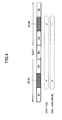
- Fig. 4 shows a slot assigned to a user (mobile station).
- the slot includes seven blocks, and two of them are associated with reference signals.
- the two reference signal (RS) blocks are referred to as RS#1 and RS#2.
- RS#1 and RS#2 include symbols of the same sequence. In the example 1, so-called orthogonal covering is used.
- One slot corresponds to 0.5 msec, and two slots form one subframe (1msec) (refer to Fig. 1 ).
- the base station transmits, in addition to a reference signal, information including the CAZAC sequence number and the block spreading number to the mobile station.
- the mobile station that receives the reference signal and the like from the base station measures reception state of the propagation route, and generates CQI corresponding to the measurement result.
- the mobile station stores CQI in blocks B1 - B5, generates symbols specified by the CAZAC sequence number reported from the base station. Then, the mobile station multiplies the symbols by +1, and stores the obtained symbols in RS#1 and RS#2 to generate a slot to be transmitted as an uplink control channel.
- the RS blocks are represented as (+, +) for convenience sake. After that, the mobile station transmits a signal corresponding to the slot to the base station.
- the base station that receives the signal from the mobile station performs correlation detection for RS#1 and RS#2. More particularly, the base station, in the DTX determination unit 310, prepares two RS blocks (+, +) that have been obtained by multiplying symbols determined by the CAZAC sequence number by +1, then, the base station performs first correlation detection between these and the received RS#1 and RS#2. Next, the base station prepares an RS block including symbols obtained by multiplying symbols determined by the CAZAC sequence number by +1, and prepares another RS block including other symbols obtained by multiplying the same symbol determined by the CAZAC sequence number by -1 (these RS blocks are represented as (+, -)). Then, the base station performs second correlation detection between these RS blocks and received RS#1 and RS#2.
- the base station can determine that the mobile station has sent only CQI. After that, the base station can perform processing for the received signal based on the determination without delay. More particularly, the base station performs processing such as demultiplexing, demodulation and decoding for CQI.
- the mobile station in the case when the mobile station feeds CQI and ACK/NACK information back to the base station, the mobile station multiplexes CQI and ACK/NACK information and stores the multiplexed information in B1-B5. Then, the mobile station generates symbols specified by a CAZAC sequence number reported from the base station, multiplies the symbols by +1 to obtain symbols, and stores the obtained symbols in RS#1. Also, the mobile station multiples the symbols specified by the CAZAC sequence number by -1 to obtain symbols, and stores the obtained symbols in RS#2, so that the mobile station generates a slot (+, -) to be transmitted as an uplink channel. Then, the mobile station transmits a signal corresponding to the slot to the base station.
- the base station receives the signal from the mobile station, and performs correlation detection for RS#1 and RS#2. More particularly, the base station performs first correlation detection between RS blocks (+, +) in which each symbol is multiplied by +1, and received RS#1 and RS#2. Next, the base station performs second correlation detection between RS blocks (+, -) and the received RS#1 and RS#2, wherein the RS blocks (+, -) include an RS block multiplied by +1 and another RS block multiplied by -1.
- the base station can determine that the mobile station has transmitted CQI and ACK/NACK information. After that, the base station can perform processing for the received signal based on the determination without delay. More particularly, the base station performs processing such as demultiplexing, demodulation and decoding for each of CQI and ACK/NACK information.
- the base station Even in a case when the base station expects to receive CQI and ACK/NACK information transmitted from the mobile station, there is a case in which a large correlation value is obtained in the first correlation detection in the base station, and a small correlation value is obtained in the second correlation detection. In this case, the base station recognizes that the mobile station has transmitted only CQI for some reason even though CQI and ACK/NACK information should be fed back from the mobile station. In other words, the base station recognizes that an error occurs in communication of information between the base station and the mobile station. Based on this recognition, the base station can request the mobile station to retransmit ACK or NACK.
- the base station can transmit a control channel with high transmission power when requesting retransmission. As a result, it becomes possible to improve probability for obtaining CQI and ACK/NACK information in retransmission.
- orthogonal covering for the reference signal is used.
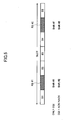
- the base station transmits, to the mobile station, information including a CAZAC sequence number and a cyclic shift number in addition to the reference signal.
- both cyclic shit numbers are the same, which is Shift#1 in this example. That is, the mobile station generates symbols specified by the CAZAC sequence number, performs cyclic shift represented by Shift#1 on the symbols to obtain shifted symbols, and stores the obtained symbols in RS#1 and RS#2.
- the RS blocks are represented as (Shift#1, Shift#1) for convenience sake. A signal corresponding to the slot generated in this way is transmitted from the mobile station to the base station.
- the base station that receives the signal from the mobile station performs correlation detection on RS#1 and RS#2. More particularly, the base station generates symbols specified by the CAZAC sequence number, performs cyclic shift represented by Shift#1 on the symbols to generate shifted symbols, and stores the generated symbols in two RS blocks (Shift#1, Shift#1). The base station performs first correlation detection between the two RS blocks (Shift#1, Shift#1), and RS#1 and RS#2 received from the mobile station.
- the base station performs second correlation detection between two RS blocks (Shift#2, Shift#2), and the received RS#1 and RS#2, in which the two RS blocks (Shift#2, Shift#2) stores symbols generated by performing cyclic shift represented by Shift#2 different from Shift#1 on the symbols specified by the CAZAC sequence number.
- the base station can determine that the mobile station has sent a slot of (Shift#1, Shift#1). That is, the base station can determine that the mobile station has sent only CQI. After that, the base station can perform processing for the received signal based on the determination.
- the mobile station transmits CQI and ACK/NACK information to the base station as feedback, the mobile station generates a slot of (Shift#2, Shift#2), and transmits a signal corresponding to the slot to the base station.
- the base station When the base station receives the signal from the mobile station, in the same way as mentioned above, the base station performs correlation detection between (Shift#1, Shift#1) and the received slot as first correlation detection. Next, the base station performs correlation detection between (Shift#2, Shift#2) and the received slot as second correlation detection.
- the base station can determine that the mobile station has transmitted CQI and ACK/NACK information. After that, the base station can perform processing for the received signal based on the determination without delay.
- the base station can recognize that the mobile station has transmitted only CQI erroneously. Based on this recognition, the base station can request the mobile station to perform retransmission. In this case, the base station can transmit a control channel with high transmission power.
- the whole of the slot is used instead of the reference signal blocks in the slot. More particularly, difference between radio resource blocks is used.
- Fig.6 is a diagram showing resource assignment in cases where the mobile station transmits only CQI and transmits CQI and ACK/NACK information.
- the mobile station uses slots 1A and 1B, for example, according to resource numbers reported from the base station without using slots 2A and 2B.
- Slots 1A and 1B (2A, 2B) form a subframe (Transmission Time Interval (TTI)) .
- TTI Transmission Time Interval
- the base station that receives the signal When a signal corresponding to the slots is transmitted from the mobile station, the base station that receives the signal performs correlation detection, as first correlation detection, using the slots 1A and 1B, and performs correlation detection, as second correlation detection, using slots 2A and 2B.
- the base station can determine that the mobile station has transmitted only CQI, and can perform reception processing after that without delay.
- slots 1A and 1B are not used, but slots 2A and 2B are used.
- the base station that receives the signal When a signal corresponding to the slots is transmitted from the mobile station, the base station that receives the signal performs correlation detection, as first correlation detection, using slots 1A and 1B, and performs correlation detection using slots 2A and 2B as second correlation detection, in the same way as mentioned above.
- the base station can determine that the mobile station has transmitted CQI and ACK/NACK information, and can perform reception processing after that without delay.
- the base station determines whether the mobile station has transmitted only CQI or transmitted CQI and ACK/NACK information by comparing correlation values obtained by correlation detection performed twice.
- accuracy for determination improves compared to a method for determining whether the mobile station has transmitted only CQI or both of CQI and ACK/NACK information by comparing received power and a predetermined threshold.
- slot (+, -) is generated when transmitting only CQI and slot (+, -) is generated when transmitting CQI and ACK/NACK information
- the reverse can be applied.
- the value used for multiplying can be determined arbitrarily.
Landscapes
- Engineering & Computer Science (AREA)
- Computer Networks & Wireless Communication (AREA)
- Signal Processing (AREA)
- Quality & Reliability (AREA)
- Mobile Radio Communication Systems (AREA)
Applications Claiming Priority (2)
| Application Number | Priority Date | Filing Date | Title |
|---|---|---|---|
| JP2007211600 | 2007-08-14 | ||
| PCT/JP2008/064548 WO2009022710A1 (ja) | 2007-08-14 | 2008-08-13 | 通信制御方法、移動局、および基地局 |
Publications (2)
| Publication Number | Publication Date |
|---|---|
| EP2180621A1 true EP2180621A1 (de) | 2010-04-28 |
| EP2180621A4 EP2180621A4 (de) | 2014-11-05 |
Family
ID=40350762
Family Applications (1)
| Application Number | Title | Priority Date | Filing Date |
|---|---|---|---|
| EP08827218.2A Withdrawn EP2180621A4 (de) | 2007-08-14 | 2008-08-13 | Kommunikationsteuerungssverfahren, mobilstation und basisstation |
Country Status (6)
| Country | Link |
|---|---|
| US (1) | US8331301B2 (de) |
| EP (1) | EP2180621A4 (de) |
| JP (1) | JP5355404B2 (de) |
| KR (1) | KR20100042655A (de) |
| CN (1) | CN101821982B (de) |
| WO (1) | WO2009022710A1 (de) |
Cited By (4)
| Publication number | Priority date | Publication date | Assignee | Title |
|---|---|---|---|---|
| WO2011143595A1 (en) * | 2010-05-14 | 2011-11-17 | Qualcomm Incorporated | Method and apparatus for facilitating tri-state decoding on a shared uplink channel |
| CN102468912A (zh) * | 2010-11-11 | 2012-05-23 | 中兴通讯股份有限公司 | 上行控制信道的解码方法和装置 |
| CN102740316A (zh) * | 2011-04-08 | 2012-10-17 | 中兴通讯股份有限公司 | Dtx状态的检测方法及装置 |
| EP2579535A4 (de) * | 2010-05-25 | 2017-06-07 | China Academy of Telecommunications Technology | Verfahren und vorrichtung für den empfang von signalen |
Families Citing this family (10)
| Publication number | Priority date | Publication date | Assignee | Title |
|---|---|---|---|---|
| CN102282817B (zh) * | 2008-08-19 | 2014-07-02 | 韩国电子通信研究院 | 用于接收和发送应答/无应答信息的方法 |
| CN101635980B (zh) * | 2009-08-28 | 2012-12-12 | 中国科学院上海微系统与信息技术研究所 | 利用cazac序列降低参考信号papr的装置和方法 |
| CN102158437B (zh) * | 2010-02-11 | 2014-07-02 | 富士通株式会社 | 信道频域相关性计算设备及方法 |
| JP5427162B2 (ja) * | 2010-11-26 | 2014-02-26 | 株式会社Nttドコモ | 無線基地局装置及び制御情報検出方法 |
| EP2810527B1 (de) * | 2012-02-03 | 2019-05-15 | Nokia Technologies Oy | Datenpufferstatusbeeinflusste steuerkanalüberwachung |
| US9661612B2 (en) * | 2012-06-29 | 2017-05-23 | Samsung Electronics Co., Ltd. | Methods and apparatus for uplink control channel multiplexing in beamformed cellular systems |
| CN103947148B (zh) * | 2014-03-28 | 2017-02-08 | 华为技术有限公司 | 一种非连续传输检测装置及方法 |
| CN107994922A (zh) * | 2017-12-05 | 2018-05-04 | 上海无线电设备研究所 | 一种提高扩频系统通信速率的方法及其系统 |
| WO2019157726A1 (zh) * | 2018-02-14 | 2019-08-22 | Oppo广东移动通信有限公司 | 资源上报的方法、终端设备和网络设备 |
| US10772153B2 (en) * | 2018-04-27 | 2020-09-08 | Cavium, Llc. | Methods and apparatus for two-stage ACK/DTX detection |
Family Cites Families (10)
| Publication number | Priority date | Publication date | Assignee | Title |
|---|---|---|---|---|
| US7813322B2 (en) * | 2003-02-19 | 2010-10-12 | Qualcomm Incorporated | Efficient automatic repeat request methods and apparatus |
| JP2005260851A (ja) * | 2004-03-15 | 2005-09-22 | Nec Corp | 無線通信システムと方法並びに移動局と基地局 |
| JP4527067B2 (ja) * | 2005-03-31 | 2010-08-18 | 株式会社エヌ・ティ・ティ・ドコモ | 移動局、送信方法及び移動通信システム |
| US7499434B2 (en) * | 2005-08-24 | 2009-03-03 | Alcatel-Lucent Usa Inc. | Mapping uplink signaling channels |
| CN1992559B (zh) * | 2005-12-30 | 2011-04-20 | 中兴通讯股份有限公司 | 一种终端上行语音速率动态调整的方法 |
| WO2007078146A1 (en) * | 2006-01-06 | 2007-07-12 | Samsung Electronics Co., Ltd. | Method and apparatus for transmitting/receiving uplink signaling information in a single carrier fdma system |
| JP5206921B2 (ja) * | 2007-03-16 | 2013-06-12 | 日本電気株式会社 | 移動無線システムにおけるリソース割当制御方法および装置 |
| JP4601637B2 (ja) * | 2007-03-20 | 2010-12-22 | 株式会社エヌ・ティ・ティ・ドコモ | 移動局、送信方法及び無線通信システム |
| JP4531784B2 (ja) * | 2007-03-20 | 2010-08-25 | 株式会社エヌ・ティ・ティ・ドコモ | ユーザ装置および送信方法 |
| US7787418B2 (en) * | 2007-06-08 | 2010-08-31 | Intel Corporation | Apparatus and method to support VoIP calls for mobile subscriber stations |
-
2008
- 2008-08-13 CN CN200880110531.9A patent/CN101821982B/zh not_active Expired - Fee Related
- 2008-08-13 KR KR1020107005125A patent/KR20100042655A/ko not_active Withdrawn
- 2008-08-13 EP EP08827218.2A patent/EP2180621A4/de not_active Withdrawn
- 2008-08-13 JP JP2009528138A patent/JP5355404B2/ja not_active Expired - Fee Related
- 2008-08-13 US US12/673,240 patent/US8331301B2/en not_active Expired - Fee Related
- 2008-08-13 WO PCT/JP2008/064548 patent/WO2009022710A1/ja not_active Ceased
Cited By (7)
| Publication number | Priority date | Publication date | Assignee | Title |
|---|---|---|---|---|
| WO2011143595A1 (en) * | 2010-05-14 | 2011-11-17 | Qualcomm Incorporated | Method and apparatus for facilitating tri-state decoding on a shared uplink channel |
| CN102907034A (zh) * | 2010-05-14 | 2013-01-30 | 高通股份有限公司 | 用于促成共享上行链路信道上的三态解码的方法和装置 |
| US8514956B2 (en) | 2010-05-14 | 2013-08-20 | Qualcomm Incorporated | Method and apparatus for facilitating tri-state decoding on a shared uplink channel |
| EP2579535A4 (de) * | 2010-05-25 | 2017-06-07 | China Academy of Telecommunications Technology | Verfahren und vorrichtung für den empfang von signalen |
| CN102468912A (zh) * | 2010-11-11 | 2012-05-23 | 中兴通讯股份有限公司 | 上行控制信道的解码方法和装置 |
| CN102468912B (zh) * | 2010-11-11 | 2014-12-10 | 中兴通讯股份有限公司 | 上行控制信道的解码方法和装置 |
| CN102740316A (zh) * | 2011-04-08 | 2012-10-17 | 中兴通讯股份有限公司 | Dtx状态的检测方法及装置 |
Also Published As
| Publication number | Publication date |
|---|---|
| WO2009022710A1 (ja) | 2009-02-19 |
| US20120033561A1 (en) | 2012-02-09 |
| CN101821982A (zh) | 2010-09-01 |
| JPWO2009022710A1 (ja) | 2010-11-18 |
| CN101821982B (zh) | 2013-02-13 |
| JP5355404B2 (ja) | 2013-11-27 |
| US8331301B2 (en) | 2012-12-11 |
| KR20100042655A (ko) | 2010-04-26 |
| EP2180621A4 (de) | 2014-11-05 |
Similar Documents
| Publication | Publication Date | Title |
|---|---|---|
| US8331301B2 (en) | Communication control method, mobile station and base station | |
| US9220020B2 (en) | User apparatus, base station apparatus, and method in mobile communication system | |
| RU2455762C2 (ru) | Терминал пользователя, базовая станция и способ передачи сигнала | |
| US8325666B2 (en) | User equipment terminal, base station apparatus, and channel state information communication method | |
| US7969943B2 (en) | User apparatus, base station apparatus, and method in mobile communication system | |
| CN101779392B (zh) | 用于在移动通信系统中分配资源的设备和方法 | |
| EP2176964B1 (de) | Vorrichtung und verfahren zum senden über uplink-steuerkanäle in einem drahtlosen kommunikationssystem | |
| US8873499B2 (en) | User apparatus, base station apparatus, and method | |
| EP2214335A1 (de) | Mobiles kommunikationssystem, basisstationsgerät, benutzergerät und verfahren | |
| US20100172373A1 (en) | Control data communication method and apparatus thereof |
Legal Events
| Date | Code | Title | Description |
|---|---|---|---|
| PUAI | Public reference made under article 153(3) epc to a published international application that has entered the european phase |
Free format text: ORIGINAL CODE: 0009012 |
|
| 17P | Request for examination filed |
Effective date: 20100225 |
|
| AK | Designated contracting states |
Kind code of ref document: A1 Designated state(s): AT BE BG CH CY CZ DE DK EE ES FI FR GB GR HR HU IE IS IT LI LT LU LV MC MT NL NO PL PT RO SE SI SK TR |
|
| AX | Request for extension of the european patent |
Extension state: AL BA MK RS |
|
| DAX | Request for extension of the european patent (deleted) | ||
| A4 | Supplementary search report drawn up and despatched |
Effective date: 20141007 |
|
| RIC1 | Information provided on ipc code assigned before grant |
Ipc: H04W 88/08 20090101ALI20140930BHEP Ipc: H04W 4/00 20090101ALI20140930BHEP Ipc: H04L 27/01 20060101ALI20140930BHEP Ipc: H04J 11/00 20060101AFI20140930BHEP |
|
| STAA | Information on the status of an ep patent application or granted ep patent |
Free format text: STATUS: THE APPLICATION IS DEEMED TO BE WITHDRAWN |
|
| 18D | Application deemed to be withdrawn |
Effective date: 20150505 |