EP2180643A1 - Untersuchungsverfahren - Google Patents
Untersuchungsverfahren Download PDFInfo
- Publication number
- EP2180643A1 EP2180643A1 EP07792470A EP07792470A EP2180643A1 EP 2180643 A1 EP2180643 A1 EP 2180643A1 EP 07792470 A EP07792470 A EP 07792470A EP 07792470 A EP07792470 A EP 07792470A EP 2180643 A1 EP2180643 A1 EP 2180643A1
- Authority
- EP
- European Patent Office
- Prior art keywords
- voice
- pattern
- frame
- unit
- test
- Prior art date
- Legal status (The legal status is an assumption and is not a legal conclusion. Google has not performed a legal analysis and makes no representation as to the accuracy of the status listed.)
- Withdrawn
Links
Images




Classifications
-
- H—ELECTRICITY
- H04—ELECTRIC COMMUNICATION TECHNIQUE
- H04M—TELEPHONIC COMMUNICATION
- H04M3/00—Automatic or semi-automatic exchanges
- H04M3/22—Arrangements for supervision, monitoring or testing
- H04M3/2236—Quality of speech transmission monitoring
-
- H—ELECTRICITY
- H04—ELECTRIC COMMUNICATION TECHNIQUE
- H04L—TRANSMISSION OF DIGITAL INFORMATION, e.g. TELEGRAPHIC COMMUNICATION
- H04L65/00—Network arrangements, protocols or services for supporting real-time applications in data packet communication
- H04L65/80—Responding to QoS
-
- H—ELECTRICITY
- H04—ELECTRIC COMMUNICATION TECHNIQUE
- H04L—TRANSMISSION OF DIGITAL INFORMATION, e.g. TELEGRAPHIC COMMUNICATION
- H04L69/00—Network arrangements, protocols or services independent of the application payload and not provided for in the other groups of this subclass
- H04L69/40—Network arrangements, protocols or services independent of the application payload and not provided for in the other groups of this subclass for recovering from a failure of a protocol instance or entity, e.g. service redundancy protocols, protocol state redundancy or protocol service redirection
-
- H—ELECTRICITY
- H04—ELECTRIC COMMUNICATION TECHNIQUE
- H04M—TELEPHONIC COMMUNICATION
- H04M7/00—Arrangements for interconnection between switching centres
- H04M7/006—Networks other than PSTN/ISDN providing telephone service, e.g. Voice over Internet Protocol (VoIP), including next generation networks with a packet-switched transport layer
Definitions
- the present invention relates to a test for voice quality degradation in a packet exchange network.
- NGN Next Generation Network
- Japanese Laid-open Patent Publication No. 2000-332758 and Japanese Laid-open Patent Publication No. 07-250107 disclose technology for estimating voice quality.
- the object of the present invention is to provide a test method for detecting a factor of voice quality degradation such as noise involved in a network without affecting voice communication even while the network is being operated.
- a test method of the embodiment is a test method of test equipment configured to test voice communication quality of a voice communication system configured to transfer a digital signal.
- the test method is characterized by including an analysis procedure for distinguishing a voice signal and a non-voice signal on the basis of a characteristic amount of the digital signal, a replacement procedure for replacing a portion of the distinguished non-voice with a particular signal, and a test procedure for identifying whether or not the non-voice signal includes the particular signal.
- test method of the embodiment is characterized by the analysis procedure adapted for obtaining the digital signal in chronological order on a certain frame by frame basis, and for identifying whether the frame is a voice frame or a non-voice frame.
- test method of the embodiment is characterized by the replacement procedure adapted for replacing a portion of the non-voice signal with a particular pattern formed by a combination of the particular signal.
- test method of the embodiment is characterized by the test procedure adapted for detecting the particular pattern.
- test method of the embodiment is characterized by further including a detection procedure for identifying degradation of a voice signal formed by the digital signal on the basis of a detection result of the particular pattern in the test procedure.
- test method of the embodiment is characterized by the analysis procedure adapted for calculating an amplitude level of background noise in the non-voice frame.
- test method of the embodiment is characterized by the replacement procedure adapted for replacing a portion of the non-voice frame with the particular pattern by referring to the amplitude level of the background noise.
- test method of the embodiment is characterized by the replacement procedure adapted for replacing a portion belonging to a range equal to or lower than the amplitude level of the background noise in the non-voice frame with the particular pattern.
- test method of the embodiment is a test method of test equipment configured to test voice communication quality of a voice communication system configured to send and receive data. The test method is characterized by including an analysis procedure for distinguishing a non-voice data on the basis of a characteristic amount of received data, and a test procedure for identifying whether a portion of the non-voice signal is a particular signal.
- test method of the embodiment is a test method of test equipment configured to test voice communication quality of a voice communication system configured to send and receive data.
- the test method is characterized by including an analysis procedure for distinguishing a non-voice signal on the basis of a characteristic amount of received data, a replacement procedure for replacing a portion of the non-voice signal with a particular signal, and a sending procedure for sending the replaced non-voice signal.
- a non-voice code of a level equal to or lower than background noise is replaced with a particular code, and respective nodes can detect a factor of voice quality degradation by testing the code change without affecting voice communication even while the network is being operated.
- Fig. 1 shows a network system 100 of the embodiment configured to test voice quality degradation.
- a test for a voice quality degradation factor of the network system 100 will be explained hereafter.
- a factor of voice quality degradation caused by a change of data itself transferred by the network system 100 such as noise involved in a quality controlled area 115 of the network system 100 can be detected while the network is being practically operated.
- operations of a pattern replacement unit 101 and pattern test units 102 and 103 will be explained in detail with reference to Fig. 4 and Fig. 5 .
- the network system 100 is constituted by the pattern replacement unit 101, the pattern test units 102 and 103, a detection identification unit 104, a terminal adaptor (TA) 106, a core edge (CE) 107, gateways 108 and 109, a terminal adaptor (TA) 110 and terminals 111 and 112.
- a terminal 105 performs voice communication with the terminals 111 and 112 through a residential network 112, an access network 113, a core network 114 and a public network 116.
- the network system 100 is a network system in which the terminal 105 obtains a voice signal as an interface, encodes the voice signal and transfers the voice signal to the terminals 111 and 112 in real time in an IP packet form and so on (VoIP: Voice over Internet Protocol).
- VoIP Voice over Internet Protocol
- the network system 100 is a network system configured to detect a failure that occurs in the quality controlled area 115 (the access network 113 and the core network 114) by using the pattern replacement unit 101 and the pattern test units 102 and 103.
- the network system 100 of the embodiment can detect voice quality degradation caused by noise involved in the quality controlled area 115 in the network. Further, the network system 100 of the embodiment can also detect voice quality degradation caused by code conversion such that a compression format of data is converted in the quality controlled area 115 in the network.
- the pattern replacement unit 101 replaces a portion of a non-voice code to be sent to the quality controlled area 115 with a particular pattern. Then, the pattern test units 102 and 103 detect the particular pattern in the quality controlled area 115. The detection identification unit 104 senses an involved factor of voice quality degradation from whether or not the particular pattern has been detected.
- the particular pattern of the embodiment is a code pattern that the pattern replacement unit 101 and the pattern test units 102 and 103 mutually hold, and is a code pattern that has been determined in advance. Further, the particular pattern is a code sequence having same weights of a plurality of code series.
- the network system 100 can test a factor of voice quality degradation of data flowing through the quality controlled area 115 in the network system 100 even while the network is being practically operated.
- voice quality degradation caused by involved noise of a change of data itself can be detected as well as usual voice quality degradation caused by a data delay or a packet loss.
- the pattern replacement unit 101 is provided at the CE107, i.e., a point corresponding to an entrance to the quality controlled area 115 (the access network 113 and the core network 114).
- the pattern replacement unit 101 replaces a portion of a non-voice code with a particular pattern for sensing a failure.
- the non-voice code described here is a code corresponding to background noise included in a code that the terminal 105 produces by receiving a voice signal as an interface and encoding the received voice signal.
- Codec technology of the embodiment is, e.g., G. 711 recommended by ITU-T.
- an analog voice signal received by the terminal 105 is encoded in accordance with G. 711.
- the TA 106 encodes and decodes (codec) the analog voice signal.
- the terminals 105, 111 and 112 may be configured to encode and decode the analog voice signal into a digital voice signal.
- the encoding technology according to G. 711 recommended by ITU-T is a system for implementing a data rate of 64 kbps on a telephone line by using a PCM (pulse code modulation) system. Specifically, the analog signal is sampled at 8 kHz (sampling), and every sample is represented in 8 bits.
- the pattern replacement unit 101 takes in a code 300 transferred by the network system 100 through the CE 107 every frame of 20 msec including 160 samples. Then, the pattern replacement unit 101 analyzes a voice characteristic amount of the code 300, and detects a non-voice frame.
- the voice characteristic amount indicates data classifying every frame of the code 300 into a voice frame and a non-voice frame. Specifically, the voice characteristic amount is formed by a number of zero-crossings and an amplitude level.
- the number of zero-crossings represents how many times a voice waveform crosses a zero level in a certain period of time.
- the amplitude level is an average amplitude value of each of data 310-318 in a certain period of time.
- the pattern replacement unit 101 identifies a frame of a data amplitude level being equal to or greater than a certain value and of a number of zero-crossings being equal to or smaller than a certain number in a certain period of time as a voice frame. Then, the pattern replacement unit 101 identifies a frame other than the voice frame as a non-voice frame.
- the pattern replacement unit 101 analyzes a characteristic amount of a frame identified as a non-voice frame.
- the pattern replacement unit 101 detects a background noise level from the characteristic amount analysis. Then, the pattern replacement unit 101 replaces a portion of a level range lower than or around the detected background noise level of the detected non-voice frame with a particular pattern.
- the level described here is an amplitude value when one sample of an analog signal is encoded to 8-bit data in accordance to G. 711. The less significant digit and the more significant digit of the 8-bit data indicate portions of the smaller and greater amplitude values, respectively.
- the pattern replacement unit 101 does not perform a particular pattern replacement process for a silent frame.
- the silent frame is a frame such that frame data includes all zero bits or at most bits indicating a faint sound of a value equal to or lower than a certain threshold.
- a reason why is that replacement of a portion of the silent frame with the particular pattern affects subjective sound quality a lot.
- the pattern replacement unit 101 can prevent noise from being involved by using a masking effect (refer to Wegel, R. L. and Lane, C. E.: Phys. Rev., 23, pp. 266-285 (1924 )).
- the pattern replacement unit 101 replaces a portion of a non-voice code with the particular pattern.
- an amount of data that flows through the network system 100 does not increase.
- a traffic increase in the network caused by the test for voice quality degradation can be removed. That is, the test method of the embodiment enables the voice quality degradation to be tested without causing ill effects such as a traffic increase in the network and resultant congestion.
- the pattern test units 102 and 103 are provided at the GWs 108 and 109, respectively.
- the pattern test units 102 and 103 take in the code 300 transferred by the network system 100 through the GWs 108 and 109, respectively, every frame of 20 msec including 160 samples.
- the pattern test units 102 and 103 choose a non-voice frame as a frame to be tested. A reason why is that the pattern replacement unit 101 performs a replacement process with the particular pattern for a non-voice frame.
- the pattern test units 102 and 103 detect a background noise level from a characteristic amount analysis of a frame identified as a non-voice frame.
- the pattern test units 102 and 103 refer to the background noise level, and examine whether or not the particular pattern exists in a frame to be tested of a level lower than or around the background noise level. The pattern test units 102 and 103 can thereby efficiently detect the particular pattern. A reason why is that a replacement position of the particular pattern is of a level equal to or lower than the background noise level of the frame to be tested. Then, the pattern test units 102 and 103 send existence data indicating whether or not the particular pattern exists to the detection identification unit 104. The detection identification unit 104 detects a failure and estimates where the failure occurs from the existence data.
- the detection identification unit 104 identifies no occurrence of voice quality degradation. Meanwhile, in a case where the particular pattern does not exist in the non-voice frame for which the pattern replacement unit 101 has performed the replacement process, the detection identification unit 104 identifies an occurrence of voice quality degradation.
- the detection identification unit 104 can make the above identification by comparing data of a replacement-processed non-voice frame that the detection identification unit 104 has ready beforehand and the existence data. That is, in a case where the existence data of a non-voice frame expected to include the particular pattern indicates "no particular pattern", the detection identification unit 104 identifies an occurrence of voice quality degradation.
- the detection identification unit 104 obtains existence data of a particular pattern 319 from the pattern test units 102 and 103, and can test existence of an occurrence of voice quality degradation of data that flows through the quality controlled area 115 in the network system 100. Further, the detection identification unit 104 can estimate a position of the occurrence of the voice quality degradation by analyzing where the pattern test units 102 and 103 are provided.
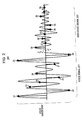
- Fig. 2 shows a schematic diagram of an analog signal 200 of the embodiment.
- the terminal 105 sends the code 300 into which the analog signal 200 is digitized to the terminals 111 and 112.
- the code 300 into which the analog signal 200 is digitized is to be tested with respect to the voice quality degradation.
- the TA 106 of the embodiment shown in Fig. 1 encodes the analog signal 200 into the code 300.
- the TA 106 of the embodiment samples the analog signal 200 with a desired frequency. Specifically, the TA 106 samples the analog signal 200 as 21-38. Then, the TA 106 quantizes and thereby encodes amplitude values of 21-38 into data 301-318, respectively.
- the TA 106 of the embodiment sends the code to the network as frames of 160 samples each. That is, one frame to be sent includes 160 samples.
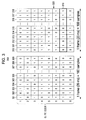
- Fig. 3 shows a schematic diagram of the code 300 corresponding to the analog signal 200.
- the code 300 is formed by the data 301-318. Although one frame includes 160 samples as described above, Fig. 3 typically shows nine samples per one frame (data 301-309 and data 310-318).
- the data 301 is an amplitude value of a quantized and digitally encoded sampling value 21. Further, the data 302 is an encoded 22.
- the data (300+n) is similarly an encoded (20+n) (n is a natural number of 1-18).
- Encoding technology of the embodiment is G. 711.
- G. 711 is a waveform encoding method of analog voice data recommended by ITU-T.
- the sampling rate (sampling speed) is 8 kHz.
- the data 301-318 are in 8 bits each.
- the data 301 of the sampling 21 is, e.g., "10101111”.
- the data 302 of the sampling 22 is "00110001”.
- the data 303 of the sampling 23 is "10111000”.
- the other following data 304-318 are in 8 bits each.
- the data 301-318 are in 8 bits each.
- First bits of the data 301-318 represent a portion of a great amplitude of the samplings 21-38, respectively.
- Second, third and other bits are data indicating portions of small amplitudes in the above order.
- One frame is formed by 160 data (samples) of the data 301-309.
- the network system 100 of the embodiment transfers data every frame (160 samples).
- ⁇ -Law and A-Law Two kinds of quantization methods, ⁇ -Law and A-Law, are specified.
- the methods, ⁇ -Law and A-Law are one of encoding laws for converting an analog signal into a digital signal by using PCM (pulse code modulation) each.
- G. 711 is one of simplest methods for waveform encoding called PCM (pulse code modulation).
- An amplitude value of each of samples sampled at 8 kHz is quantized into a discrete value of 256 (8 bit) levels. At that moment, as amplitude distribution of a voice signal shows exponential distribution, quantized bits can be made appear equally frequently to one another by logarithmic conversion so that distortion can be minimized.
- G. 711 two kinds of equations, ⁇ -law and A-law, are adopted as logarithmic conversion rules.
- one of the conversion rules e.g., ⁇ -Law
- ⁇ -Law one of the conversion rules
- the pattern replacement unit 101 replaces a portion of an area in the code 300 which corresponds to the non-voice signal 202 (the frame including the data 310-318) with the particular pattern 319.
- the particular pattern 319 is "010110...011".
- a position where the pattern replacement unit 101 replaces the particular pattern 319 can be fixed depending on the background noise level.
- the pattern replacement unit 101 can, e.g., render a portion of bit weight equal to or less than 320.
- the pattern test units 102 and 103 detect the particular pattern 319 replaced by the pattern replacement unit 101.
- the detection identification unit 104 obtains the particular pattern 319 from the pattern test units 102 and 103, and identifies whether or not voice quality degradation exists in the code 300.
- Fig. 4 shows a block diagram of the pattern replacement unit 101 of the embodiment shown in Fig. 1 . Operation of the pattern replacement unit 101 will be explained below in detail with reference to Fig. 4 .
- the pattern replacement unit 101 is constituted by a voice analysis unit 401, an object frame selection unit 402, a particular pattern replacement unit 403 and a detection use pattern saving unit 404.
- the voice analysis unit 401 takes in the code 300 shown in Fig. 3 from the CE 107 shown in Fig. 1 every frame of 20 msec including 160 samples. Then, the voice analysis unit 401 analyzes a voice characteristic amount of the code 300 that has been taken in.
- the voice characteristic amount is data that classifies every frame of the code 300 into a voice frame and a non-voice frame. Specifically, the voice characteristic amount is formed by a number of zero-crossings and an amplitude level.
- the number of zero-crossings represents how many times a voice waveform crosses a zero level in a certain period of time.
- the amplitude level is an average amplitude value of each of data 310-318 in a certain period of time.
- the voice analysis unit 401 identifies a frame of a data amplitude level being equal to or greater than a certain value and of a number of zero-crossings being equal to or smaller than a certain number in a certain period of time as a voice frame.
- the voice analysis unit 401 brings the start of the voice frame interval forward and puts the end of the voice frame interval off so as to severally give margins for identifying voice and non-voice frames.
- the object frame selection unit 402 selects the non-voice frame that the voice analysis unit 401 has detected as a frame to be replaced with the particular pattern 319. Why the object frame selection unit 402 does not cause a voice frame to be a frame to be replaced with the particular pattern 319 is for preventing the particular pattern 319 from causing noise. Meanwhile, a non-voice frame is in general background noise data. Thus, a partial change of a non-voice frame can hardly be sensed as voice quality degradation.
- the particular pattern replacement unit 403 replaces a portion of the non-voice frame that the object frame selection unit 402 has selected with the particular pattern 319.
- the particular pattern replacement unit 403 of the embodiment replaces a seventh bit of the non-voice frame with the particular pattern 319 (see Fig. 3 ).
- the seventh bit of the non-voice frame means a code sequence corresponding to the seventh row from the MSB (Most Significant Bit) of the G. 711 code (data 310-318) of the non-voice frame shown in Fig. 3 . That is, the data 310-318 are arranged in chronological order for the code 319 shown in Fig. 3 .
- the particular pattern replacement unit 403 replaces the seventh row corresponding to a portion of a small amplitude of the non-voice signal 202 with the particular pattern 319.
- the voice analysis unit 401 performs an amplitude analysis of a frame identified as a non-voice frame, and determines a background noise level 320.
- the amplitude analysis is a process by means of the voice analysis unit 401 for averaging amplitude values of non-voice frames for a certain period of time so as to cause the average value to be the background noise level.
- the particular pattern 319 is saved in the detection use pattern saving unit 404.
- the particular pattern replacement unit 403 reads the particular pattern 319 from the detection use pattern saving unit 404. Then, the particular pattern replacement unit 403 replaces a portion of a non-voice frame with the particular pattern 319 with reference to the background noise level 320.
- the particular pattern replacement unit 403 replaces the seventh row of the non-voice frame with the particular pattern 319 ("010110...011"). As a replacement position of the particular pattern 319 is equal to or lower than the background level, the particular pattern replacement unit 403 refers to the background noise level 320. Further, the particular pattern replacement unit 403 does not perform a replacement process of the particular pattern 319 for a non-voice frame of volume imperceptible for a person.
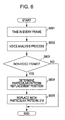
- Fig. 6 shows a flowchart of a process performed by the pattern replacement unit 101. Further, Fig. 4 shows a configuration of the pattern replacement unit 101. The process flowchart shown in Fig. 6 will be explained below with reference to the configuration of the pattern replacement unit 101 shown in Fig. 4 .
- the voice analysis unit 401 takes in the code 300 shown in Fig. 3 every frame (160 samples) (step S601).
- the voice analysis unit 401 performs a voice analysis process on the code 300 from the voice characteristic amount of the code 300 that has been taken in (step S602).
- the voice analysis unit 401 identifies whether the frame that has been taken in is a voice frame or a non-voice frame in order from a result of the voice analysis process (step S603).
- the voice analysis unit 401 identifies a frame of an amplitude level of the data forming the code 300 being equal to or greater than a certain value and of a number of zero-crossings being equal to or smaller than a certain number in a certain period of time as a voice frame, and identifies a frame other than that as a non-voice frame.
- the particular pattern replacement unit 403 fixes a position of the non-voice frame to be replaced with the particular pattern 319 (particular pattern replacement position) (step S604).
- the particular pattern replacement unit 403 fixes the particular pattern replacement position with reference to the background noise level 320.
- the voice analysis unit 401 determines the background noise level 320.
- the particular pattern replacement unit 403 causes a code pattern in a level range equal to or lower than the background noise level to be replaced with the particular pattern.
- the code pattern is a combination of bits of samples showing a same amplitude level in a frame formed by a plurality of samples.
- the code pattern is a chain of codes having a same bit weight in a frame formed by a plurality of samples.
- a portion of the code pattern to be replaced is formed by a combination of the codes in a level range equal to or lower than the background noise level, and the one formed with respect to the amplitude level is an example.
- the voice analysis unit 401 calculates an average value of amplitude values of a non-voice frame for a certain period of time, and causes the average value to be the background noise level. Further, the voice analysis unit 401 may be configured to calculate an average value of amplitude values of a past non-voice frame and to cause the average value to be the background noise level.
- the past non-voice frame means a non-voice frame existing chronologically ahead of the non-voice frame to be replaced with the particular pattern 319. Further, the past non-voice frame is in other words a non-voice frame that the voice analysis unit 401 receives, and a non-voice frame that the voice analysis unit 401 receives before receiving the non-voice frame to be partially replaced with the particular pattern 319.
- the position of the non-voice frame to be replaced with the particular pattern 319 by the particular pattern replacement unit 403 is a position of a code belonging to a level equal to or lower than the background noise level.
- the particular pattern replacement unit 403 replaces a code pattern that is a portion of a non-voice frame selected by the object frame selection unit 402 and of a level range equal to or lower than the background noise level (step S605).
- the pattern replacement unit 101 ends the replacement process.
- Fig. 5 shows a block diagram of the pattern test unit 102 of the embodiment.
- the pattern test unit 102 is constituted by a voice analysis unit 501, an object frame selection unit 502, a pattern detection unit 503 and a detection use pattern saving unit 504. Operation of the pattern test unit 102 will be explained below in detail with reference to Fig. 5 .
- the pattern test unit 103 has a same configuration and performs a same operation process as the pattern test unit 102.
- the voice analysis unit 501 takes in the code 300 shown in Fig. 3 from the GW 108 shown in Fig. 1 every frame of 20 msec including 160 samples. Then, the voice analysis unit 501 identifies whether the frame that has been taken in is a voice frame or a non-voice frame in order. Specifically, the voice analysis unit 501 analyzes a voice characteristic amount of the code 300, and classifies every frame into a voice frame and a non-voice frame.
- the voice analysis unit 501 In order to prevent portions of small amplitudes corresponding to a rise and a fall in voice from being clipped at a start and an end of a voice frame interval, respectively, the voice analysis unit 501 also brings the start of the voice frame interval forward and puts the end of the voice frame interval off so as to severally give margins for identifying voice and non-voice frames.
- the object frame selection unit 502 selects the non-voice frame identified by the voice analysis unit 501 as a frame to be replaced with the particular pattern 319. That is, an object to be tested by the pattern test unit 503 is a non-voice frame. The pattern test unit 503 does not test a voice frame.
- the pattern detection unit 503 identifies whether or not the particular pattern 319 exists in the non-voice frame selected by the object frame selection unit 502.
- the particular pattern to be detected by the pattern detection unit 503 is saved in the detection use pattern saving unit 504.
- the pattern detection unit 503 reads the particular pattern saved in the detection use pattern saving unit 504, and identifies whether or not the particular pattern exists in the non-voice frame while referring to the particular pattern.
- the voice analysis unit 501 performs an amplitude value analysis of the non-voice frame, and determines a background noise level.
- the pattern detection unit 503 identifies whether or not the particular pattern exists in the non-voice frame with reference to the background noise level.
- the pattern detection unit 503 identifies whether or not the particular pattern exists in the level range equal to or lower than the background noise level. Thus, as the pattern detection unit 503 does not search a level range higher than the background noise level for the particular pattern, the particular pattern detection can be made more efficient.
- the pattern detection unit 503 provides the detection identification unit 104 with pattern replacement existence data indicating whether or not the particular pattern exists in the tested non-voice frame.
- Fig. 7 shows a flowchart of a process performed by the pattern test unit 102 of the embodiment.
- the pattern test unit 102 detects the particular pattern 319 in the non-voice frame.
- the pattern test unit 103 performs a same process as the pattern test unit 102.
- Fig. 5 shows a configuration of the pattern test unit 102. The process flowchart shown in Fig. 7 will be explained below with reference to the configuration of the pattern replacement unit 101 shown in Fig. 5 .
- the voice analysis unit 501 takes in the code 300 from the GW 108 every frame of 20 msec including 160 samples (step S701).
- the voice analysis unit 501 performs a voice analysis process on the code 300 from the voice characteristic amount of the code 300 that has been taken in (step S702).
- the voice analysis unit 501 identifies whether the frame that has been taken in is a voice frame or a non-voice frame in order from a result of the voice analysis process (step S703).
- the object frame selection unit 502 selects the non-voice frame as an object to be tested with respect to the particular pattern. Then, the pattern test unit 503 obtains the background noise level from the voice analysis unit 501, and determines with reference to the background noise level a level range in which the particular pattern of the non-voice frame is tested (step S704).
- the level range in which the particular pattern is tested described above is a portion of the code pattern in the non-voice frame of a level equal to or lower than the background noise level.
- the level described here is an amplitude value when one sample of an analog signal is encoded to 8-bit data in accordance to G. The less significant digit and the more significant digit of the 8-bit data represent portions of the smaller and greater amplitude values, respectively.
- the pattern detection unit 503 identifies whether or not the particular pattern 319 exists in a level range equal to or lower than the background noise level in the non-voice frame selected by the object frame selection unit 502 (step S705).
- the particular pattern to be detected by the pattern detection unit 503 is saved in the detection use pattern saving unit 504.
- the pattern detection unit 503 reads the particular pattern saved in the detection use pattern saving unit 504, and identifies whether or not the particular pattern exists in the level range equal to or lower than the background noise level in the non-voice frame while referring to this particular pattern.
- the pattern detection unit 503 Upon identifying the particular pattern as existing in the non-voice frame (S705 YES), the pattern detection unit 503 sends pattern replacement existence data indicating that the particular pattern exists in the non-voice frame to the detection identification unit 104. What is described above means that the particular pattern with which the pattern replacement unit 101 has replaced a portion of the non-voice frame has not changed and has flown in the quality controlled area 115, and shows that degradation of the sound quality of the code 300 has not occurred.
- the pattern detection unit 503 Upon identifying the particular pattern as not existing in the non-voice frame (step S705 NO), the pattern detection unit 503 sends pattern replacement absence data indicating that no particular pattern exists in a non-silent frame to the detection identification unit 104. What is described above means that the particular pattern with which the pattern replacement unit 101 has replaced a portion of the non-voice frame has changed and has flown in the quality controlled area 115, and shows that a change such as degradation of the sound quality of the code 300 has occurred.
- the pattern detection unit 503 provides the detection identification unit 104 with pattern replacement existence/absence data (indicating the pattern replacement existence data and the pattern replacement absence data) indicating whether or not the particular pattern exists in the tested non-voice frame.
- the pattern test unit 101 does not perform the replacement process of the particular pattern 319.
- Fig. 8 shows a block diagram of a pattern replacement unit 800 of the embodiment.
- the pattern replacement unit 800 changes a position of each of the non-voice frames replaced with the particular pattern in accordance with a certain rule.
- the pattern replacement unit 800 of the embodiment causes a position at which an amplitude level periodically changes to be the particular pattern replacement position.
- the pattern replacement unit 800 is constituted by a voice analysis unit 801, an object frame selection unit 802, a particular pattern replacement unit 803 and a detection use pattern saving unit 804. Further, the particular pattern replacement unit 803 has a pattern position fixing unit 805.
- the pattern position fixing unit 805 has a function of fixing particular pattern replacement positions of a series of non-voice frames in accordance with a certain rule.
- the voice analysis unit 801 takes in the code 300 every frame of 20 msec including 160 samples. Where the voice analysis unit 801 takes in the frames is the CE 107 (CE: core edge) shown in Fig. 1 and so on. As a matter of course, a network device other than the core edge will do.
- the voice analysis unit 801 analyzes a voice characteristic amount of the code that has been taken in.
- the voice characteristic amount is data that identifies a voice frame and a non-voice frame of the code.
- the voice characteristic amount is formed by a number of zero-crossings and an amplitude level.
- the number of zero-crossings represents how many times a voice waveform crosses a zero level in a certain period of time.
- the amplitude level is an average amplitude value of each of data 310-318 in a certain period of time.
- the voice analysis unit 801 identifies a frame of a data amplitude level being equal to or greater than a certain value and of a number of zero-crossings being equal to or smaller than a certain number in a certain period of time as a voice frame. Further, the voice analysis unit 801 identifies background noise from the amplitude level and the number of zero-crossings which are the voice characteristic amount of the data. In order to prevent portions of small amplitudes corresponding to a rise and a fall in voice from being clipped at a start and an end of a voice frame interval, respectively, the voice analysis unit 801 brings the start of the voice frame interval forward and puts the end of the voice frame interval off so as to severally give margins for identifying voice and non-voice frames.
- the voice analysis unit 801 identifies whether the frame that has been taken in is a voice frame or a non-voice frame in order from the analysis of the voice characteristic amount.
- the voice characteristic amount is data that identifies a voice frame and a non-voice frame of the code 300. Specifically, the voice characteristic amount is formed by a number of zero-crossings and an amplitude level. The number of zero-crossings represents how many times a voice waveform of a zero-crossing wave crosses a zero level. The voice waveform of the zero-crossing wave is a waveform having no amplitude component. The amplitude level is an amplitude value of each of data 310-318.
- the voice analysis unit 801 identifies, in a certain period of time, a frame of a data amplitude level being equal to or greater than a certain value and taken in in a certain period of time since the number of zero-crossings becomes equal to or greater than a certain number until the number of zero-crossings becomes equal to or smaller than a certain number as a voice frame.
- the voice analysis unit 801 brings the start of the voice frame interval forward and puts the end of the voice frame interval off so as to severally give margins for identifying voice and non-voice frames.
- the object frame selection unit 802 selects the non-voice frame detected by the voice analysis unit 801 as a frame to be replaced with the particular pattern 319. Why the object frame selection unit 802 does not cause a voice frame to be a frame to be replaced with the particular pattern 319 is for preventing the particular pattern from causing noise.
- a non-voice frame is in general background noise data. Thus, a partial change of a non-voice frame can hardly be sensed as new voice quality degradation.
- the particular pattern replacement unit 803 replaces a portion of the non-voice frame selected by the object frame selection unit 802 with the particular pattern 319.
- the pattern position fixing unit 805 fixes a position of the non-voice frame to be replaced with the particular pattern. That is, the pattern position fixing unit 805 fixes particular pattern replacement positions of a plurality of non-voice frames in accordance with a given rule.
- the above given rule is, e.g., the amplitude levels at the particular pattern replacement positions are periodically different in a series of the non-voice frames to be replaced. That is, the particular pattern replacement positions of the respective non-voice frames have a periodic correlation.
- the function processed by the pattern position fixing unit 805 is a new function that the pattern replacement unit 800 has in comparison with the pattern replacement unit 101.
- the pattern position fixing unit 805 obtains a background noise level from the voice analysis unit 801.
- the voice analysis unit 801 performs an amplitude analysis of a frame identified as a non-voice frame, and determines the background noise level 320.
- the amplitude analysis is a process by means of the voice analysis unit 801 for averaging amplitude values of non-voice frames for a certain period of time so as to cause the average value to be the background noise level.
- the pattern position fixing unit 805 causes a code pattern in a level range equal to or lower than the background noise level to be replaced with the particular pattern.
- the code pattern is a combination of bits of respective samples showing a same amplitude level in a frame formed by a plurality of samples. A portion of the code pattern to be replaced is formed by a combination of the codes in a level range equal to or lower than the background noise level, and the one formed with respect to the amplitude level is an example. If, e.g., the code 300 shown in Fig. 3 is taken as an example, the pattern position fixing unit 805 fixes a replacement position of the particular pattern 319 "010110...011".
- the replacement position of the particular pattern 319 of the embodiment is a code pattern position of a level in the level range equal to or lower than the background noise level and closest to an average value of the level range.
- the pattern position fixing unit 805 fixes a position to be replaced with the particular pattern (particular pattern replacement position) in accordance with a certain rule. That is, the pattern position fixing unit 805 fixes the particular pattern replacement position of a non-voice frame while referring to the particular pattern replacement position of a past non-voice frame.
- the particular pattern is saved in the detection use pattern saving unit 804.
- the particular pattern replacement unit 803 reads the particular pattern from the detection use pattern saving unit 804. Then, the particular pattern replacement unit 803 replaces the position of the code pattern fixed by the pattern position fixing unit 805 with the particular pattern. Further, the particular pattern replacement unit 803 does not perform a particular pattern replacement process for a silent frame of volume imperceptible for a person.
- the silent frame is a frame such that frame data includes all zero bits or at most bits indicating a faint sound of a value equal to or lower than a certain threshold.
- Fig. 9 shows a block diagram of a pattern test unit 900 of the embodiment.
- the pattern test unit 900 can detect a level of involved noise.
- the pattern test unit 900 detects the particular pattern replaced by the pattern replacement unit 800. Then, the pattern test unit 900 can calculate amplitude data of a level of the involved noise from detection positions of respective particular patterns in the non-voice frames which are tested in order.
- the pattern test unit 900 is constituted by a voice analysis unit 901, an object frame selection unit 902, a pattern detection unit 903 and a detection use pattern saving unit 904.
- the pattern detection unit 903 has a level estimation unit 905.
- the level estimation unit 905 estimates amplitude data of noise involved in the network from data with respect to whether or not particular patterns exist in a plurality of non-voice frames obtained in chronological order.
- the voice analysis unit 901 takes in the code 300 every frame of 20 msec including 160 samples. Then, the voice analysis unit 901 identifies whether the frame that has been taken in is a voice frame or a non-voice frame in order.
- the object frame selection unit 902 selects the non-voice frame identified by the voice analysis unit 901 as a detection object of the particular pattern.
- the voice analysis unit 901 analyzes an amplitude value of the non-voice frame and determines a background noise level.
- the pattern detection unit 903 obtains the background noise level from the voice analysis unit 901, and determines a level range in which the particular pattern of the non-voice frame is tested with reference to the background noise level. Further, the particular pattern to be detected by the pattern detection unit 903 is saved in the detection use pattern saving unit 904.
- the pattern detection unit 903 reads the particular pattern saved in the detection use pattern saving unit 904, and identifies whether or not the particular pattern exists in the non-voice frame while referring to the background noise level and the particular pattern that has been read.
- the level estimation unit 905 identifies regularity of the particular pattern detection positions of the non-voice frames obtained in order, and estimates amplitude data of noise involved in the network.
- the particular pattern replacement unit 803 fixes a position to be replaced with the particular pattern for a series of non-voice frames in accordance with a given rule.
- the level estimation unit 905 identifies whether or not detection positions of the particular pattern in a plurality of the non-voice frames obtained in chronological order follow the given rule.
- the level estimation unit 905 estimates amplitude data of involved noise from the particular pattern detection position that does not follow the given rule.
- the pattern position fixing unit 805 fixes particular pattern replacement positions at which the amplitude levels are periodically different.
- the level estimation unit 905 estimates amplitude data of the involved noise from to what extent periodicity of the amplitude level is disturbed, i.e., an average value of an amplitude level of a particular pattern that should have been detected (an amplitude level of a particular pattern that the pattern detection unit 903 has not detected owing to noise).
- the pattern detection unit 903 Upon identifying a particular pattern as existing in a non-voice frame, the pattern detection unit 903 sends pattern replacement existence data indicating that the particular pattern exists in the object non-voice frame to the detection identification unit. If the pattern detection unit 903 identifies a particular pattern as not existing in the non-voice frame, the pattern detection unit 903 sends pattern replacement absence data indicating that no particular pattern exists in the object non-voice frame to the detection identification unit. Further, the pattern detection unit 903 also sends amplitude estimation data of involved noise calculated by the level estimation unit 905 to the detection identification unit. If there is no involved noise, the amplitude data of the involved noise indicates "nothing", e.g., "0".
- Fig. 10 shows a flowchart of a process performed by the pattern test unit 900 of the embodiment.
- the voice analysis unit 901 takes in the code 300 every frame of 20 msec including 160 samples, and cuts a frame out (step S1001).
- the voice analysis unit 901 analyzes a voice characteristic amount of the frame that has been taken in (step S1002).
- the voice analysis unit 901 identifies whether the frame that has been taken in is a voice frame or a non-voice frame in order from the analysis of the voice characteristic amount (step S1003).
- the object frame selection unit 902 selects the non-voice frame as an object to be tested with respect to the particular pattern. Then, the pattern test unit 903 obtains the background noise level from the voice analysis unit 901, and determines with reference to the background noise level a level range in which the particular pattern of the non-voice frame is tested (step S1004).
- the level range in which the particular pattern is tested is a portion of the code pattern in the non-voice frame for which the level is determined with reference to the background noise level in accordance with a certain rule.
- the code pattern is data of a combination of codes in the level range equal to or lower than the background noise level.
- a voice code chain is, e.g., data formed by bits of respective samples showing a same amplitude level in a frame formed by a plurality of samples.
- the particular pattern to be detected by the pattern detection unit 903 is saved in the detection use pattern saving unit 904.
- the pattern detection unit 903 reads the particular pattern from the detection use pattern saving unit 904, and identifies whether or not the particular pattern exists in the level range equal to or lower than the background noise level in the non-voice frame while referring to the particular pattern (step S1005).
- the pattern detection unit 903 Upon identifying the particular pattern as existing in the non-voice frame (S1005 YES), the pattern detection unit 903 sends pattern replacement existence data indicating that the particular pattern exists in the non-voice frame to the detection identification unit.
- the level estimation unit 905 Upon identifying the particular pattern as not existing in the non-voice frame (step S1005 NO), the level estimation unit 905 calculates amplitude data (noise level) of involved noise (step S1006).
- the level estimation unit 905 identifies regularity of particular pattern detection positions of non-voice frames obtained in order, and estimates the amplitude data of the noise (noise level) involved in the network system. In other words, the level estimation unit 905 identifies whether or not detection positions of the particular pattern in a series of the non-voice frames follow the given rule.
- the level estimation unit 905 estimates amplitude data of involved noise (noise level) from the particular pattern detection position that does not follow the given rule.
- the pattern detection unit 903 sends pattern replacement absence data indicating that no particular pattern exists in a non-silent frame and the amplitude data of the involved noise to the detection identification unit.
- the pattern test unit 900 does not test the particular pattern 319.
- the pattern replacement unit 800 performs a replacement process of a particular pattern on a non-voice frame that flows in the network system and the pattern test unit 900 performs a detection process of the particular pattern, noise involved in the network system can thereby be detected and further an amplitude level of the noise can be identified.
- the network system of the embodiment can detect voice quality degradation caused by noise involved in the quality controlled area 115 in the network. Further, the network system of the embodiment can also detect voice quality degradation caused by a code conversion for converting a compression format of data in the quality controlled area 115 in the network. According to the test method of the embodiment, further, the pattern replacement unit 800 replaces a portion of the non-voice frame with the particular pattern. Thus, an amount of data that flows through the network system 100 does not increase. Hence, according to the test method of the embodiment, a traffic increase in the network caused by the test of voice quality degradation can be removed. That is, the test method of the embodiment enables the voice quality degradation to be tested without causing ill effects such as a traffic increase in the network and resultant congestion.
- test system is constituted by including the pattern replacement unit 101, the pattern test units 102 and 103 and the detection identification unit 104.
- the test system may be constituted by including the pattern replacement unit 800 instead of the pattern replacement unit 101, and the pattern test unit 900 instead of the pattern test units 102 and 103.
- the digital signal corresponds to a signal into which an analog voice signal is encoded.
- the particular signal corresponds to a code that constitutes the particular pattern.
- the test method of the present invention is for testing voice quality degradation in a packet switching network.
- the test method of the present invention is quite useful for implementing detection of a factor of voice quality degradation involved in the network without affecting voice communication even while the network is being operated.
Landscapes
- Engineering & Computer Science (AREA)
- Signal Processing (AREA)
- Computer Networks & Wireless Communication (AREA)
- Multimedia (AREA)
- Health & Medical Sciences (AREA)
- Audiology, Speech & Language Pathology (AREA)
- Computer Security & Cryptography (AREA)
- Telephonic Communication Services (AREA)
- Monitoring And Testing Of Exchanges (AREA)
- Maintenance And Management Of Digital Transmission (AREA)
Applications Claiming Priority (1)
| Application Number | Priority Date | Filing Date | Title |
|---|---|---|---|
| PCT/JP2007/065827 WO2009022407A1 (ja) | 2007-08-13 | 2007-08-13 | 検査方法 |
Publications (2)
| Publication Number | Publication Date |
|---|---|
| EP2180643A1 true EP2180643A1 (de) | 2010-04-28 |
| EP2180643A4 EP2180643A4 (de) | 2013-04-10 |
Family
ID=40350471
Family Applications (1)
| Application Number | Title | Priority Date | Filing Date |
|---|---|---|---|
| EP07792470.2A Withdrawn EP2180643A4 (de) | 2007-08-13 | 2007-08-13 | Untersuchungsverfahren |
Country Status (4)
| Country | Link |
|---|---|
| US (1) | US8488473B2 (de) |
| EP (1) | EP2180643A4 (de) |
| JP (1) | JP4985774B2 (de) |
| WO (1) | WO2009022407A1 (de) |
Families Citing this family (5)
| Publication number | Priority date | Publication date | Assignee | Title |
|---|---|---|---|---|
| US9232048B2 (en) | 2013-12-04 | 2016-01-05 | International Business Machines Corporation | Quality of experience determination for multi-party VoIP conference calls that account for focus degradation effects |
| CN106934000B (zh) * | 2017-03-03 | 2020-10-09 | 深圳市彬讯科技有限公司 | 一种呼叫系统的语音自动质检方法及系统 |
| CN107333014A (zh) * | 2017-06-29 | 2017-11-07 | 上海澄美信息服务有限公司 | 一种智能录音质检系统 |
| CN111383663A (zh) * | 2018-12-29 | 2020-07-07 | 北京嘀嘀无限科技发展有限公司 | 一种录音控制方法、装置、用户终端及存储介质 |
| US11924368B2 (en) * | 2019-05-07 | 2024-03-05 | Nippon Telegraph And Telephone Corporation | Data correction apparatus, data correction method, and program |
Family Cites Families (10)
| Publication number | Priority date | Publication date | Assignee | Title |
|---|---|---|---|---|
| JPH03226145A (ja) * | 1990-01-31 | 1991-10-07 | Nippon Telegr & Teleph Corp <Ntt> | 音声パケット通信方式 |
| JP3220321B2 (ja) | 1994-03-09 | 2001-10-22 | 日本電信電話株式会社 | 回線品質推定回路 |
| JPH096383A (ja) * | 1995-06-23 | 1997-01-10 | Omron Corp | 音声認識装置および方法 |
| JPH09200878A (ja) * | 1996-01-12 | 1997-07-31 | Nec Corp | 時分割通話路装置のパス正常性試験方法及びその試験装置 |
| JP3687412B2 (ja) | 1999-05-21 | 2005-08-24 | Kddi株式会社 | パケット交換網におけるサービス品質評価方法及び装置並びにシステム |
| US7376132B2 (en) * | 2001-03-30 | 2008-05-20 | Verizon Laboratories Inc. | Passive system and method for measuring and monitoring the quality of service in a communications network |
| JP3925164B2 (ja) * | 2001-11-12 | 2007-06-06 | 株式会社豊田中央研究所 | 車輌制御装置 |
| JP2004091183A (ja) | 2002-09-03 | 2004-03-25 | Fuji Photo Film Co Ltd | 画像記録装置 |
| US7746797B2 (en) * | 2002-10-09 | 2010-06-29 | Nortel Networks Limited | Non-intrusive monitoring of quality levels for voice communications over a packet-based network |
| US7181000B2 (en) * | 2003-04-04 | 2007-02-20 | Mitsubishi Denki Kabushiki Kaisha | Voice transmission device and voice transmission system |
-
2007
- 2007-08-13 EP EP07792470.2A patent/EP2180643A4/de not_active Withdrawn
- 2007-08-13 WO PCT/JP2007/065827 patent/WO2009022407A1/ja not_active Ceased
- 2007-08-13 JP JP2009527996A patent/JP4985774B2/ja not_active Expired - Fee Related
-
2010
- 2010-02-04 US US12/700,200 patent/US8488473B2/en not_active Expired - Fee Related
Also Published As
| Publication number | Publication date |
|---|---|
| WO2009022407A1 (ja) | 2009-02-19 |
| US20100135185A1 (en) | 2010-06-03 |
| JP4985774B2 (ja) | 2012-07-25 |
| JPWO2009022407A1 (ja) | 2010-11-11 |
| US8488473B2 (en) | 2013-07-16 |
| EP2180643A4 (de) | 2013-04-10 |
Similar Documents
| Publication | Publication Date | Title |
|---|---|---|
| US7680655B2 (en) | Method and apparatus for measuring the quality of speech transmissions that use speech compression | |
| US7099282B1 (en) | Determining the effects of new types of impairments on perceived quality of a voice service | |
| US6434198B1 (en) | Method for conveying TTY signals over wireless communication systems | |
| US20140358526A1 (en) | Methods and apparatus for signal quality analysis | |
| Ding et al. | Assessment of effects of packet loss on speech quality in VoIP | |
| EP3788745A1 (de) | System und verfahren zur lernbasierten qoe-vorhersage von voice- und videodiendiensten in drahtlosen netzwerken | |
| EP2180643A1 (de) | Untersuchungsverfahren | |
| CN101202040A (zh) | 有效的用来检测固定功率信号的语音活动检测器 | |
| JP4759230B2 (ja) | 品質評価装置 | |
| EP1443496B1 (de) | Werkzeug zur nicht invasiven Bestimmung der Qualität eines Sprachsignals | |
| Ding et al. | Non-intrusive single-ended speech quality assessment in VoIP | |
| CN101292459B (zh) | 用于估计语音质量的方法和设备 | |
| US7657388B2 (en) | Quality assessment tool | |
| EP1443497B1 (de) | Verfahren zur Qualitätsbestimmung eines Audiosignals | |
| US7050400B1 (en) | End-to-end connection packet loss detection algorithm using power level deviation | |
| Abareghi et al. | Improved ITU-P. 563 non-intrusive speech quality assessment method for covering VOIP conditions | |
| Rahdari et al. | Using Bayesian classifiers for estimating quality of VoIP | |
| US20010056556A1 (en) | Channel check test system | |
| JP2002290436A (ja) | 音声通信装置、その方法及びプログラムを記録した記録媒体 | |
| CN112291421B (zh) | 基于语音通信的单通检测方法、装置及存储介质、电子设备 | |
| Conway et al. | Analyzing voice-over-IP subjective quality as a function of network QoS: A simulation-based methodology and tool | |
| WO2002098030A1 (en) | Determining the effects of new types of impairments on perceived quality of a voice service | |
| Li et al. | Quality assessment for networked speech based on active packet detection |
Legal Events
| Date | Code | Title | Description |
|---|---|---|---|
| PUAI | Public reference made under article 153(3) epc to a published international application that has entered the european phase |
Free format text: ORIGINAL CODE: 0009012 |
|
| 17P | Request for examination filed |
Effective date: 20100308 |
|
| AK | Designated contracting states |
Kind code of ref document: A1 Designated state(s): AT BE BG CH CY CZ DE DK EE ES FI FR GB GR HU IE IS IT LI LT LU LV MC MT NL PL PT RO SE SI SK TR |
|
| AX | Request for extension of the european patent |
Extension state: AL BA HR MK RS |
|
| DAX | Request for extension of the european patent (deleted) | ||
| A4 | Supplementary search report drawn up and despatched |
Effective date: 20130312 |
|
| RIC1 | Information provided on ipc code assigned before grant |
Ipc: H04M 3/26 20060101AFI20130306BHEP Ipc: H04L 29/14 20060101ALI20130306BHEP Ipc: H04L 29/06 20060101ALI20130306BHEP Ipc: H04M 3/22 20060101ALI20130306BHEP |
|
| STAA | Information on the status of an ep patent application or granted ep patent |
Free format text: STATUS: THE APPLICATION HAS BEEN WITHDRAWN |
|
| 18W | Application withdrawn |
Effective date: 20130830 |