EP2182741A1 - Dispositif auditif doté d'une unité de reconnaissance de situation spéciale et procédé de fonctionnement d'un dispositif auditif - Google Patents
Dispositif auditif doté d'une unité de reconnaissance de situation spéciale et procédé de fonctionnement d'un dispositif auditif Download PDFInfo
- Publication number
- EP2182741A1 EP2182741A1 EP09173019A EP09173019A EP2182741A1 EP 2182741 A1 EP2182741 A1 EP 2182741A1 EP 09173019 A EP09173019 A EP 09173019A EP 09173019 A EP09173019 A EP 09173019A EP 2182741 A1 EP2182741 A1 EP 2182741A1
- Authority
- EP
- European Patent Office
- Prior art keywords
- signal
- microphone
- classification
- signals
- hearing
- Prior art date
- Legal status (The legal status is an assumption and is not a legal conclusion. Google has not performed a legal analysis and makes no representation as to the accuracy of the status listed.)
- Granted
Links
Images
Classifications
-
- H—ELECTRICITY
- H04—ELECTRIC COMMUNICATION TECHNIQUE
- H04R—LOUDSPEAKERS, MICROPHONES, GRAMOPHONE PICK-UPS OR LIKE ACOUSTIC ELECTROMECHANICAL TRANSDUCERS; ELECTRIC HEARING AIDS; PUBLIC ADDRESS SYSTEMS
- H04R25/00—Electric hearing aids
- H04R25/43—Electronic input selection or mixing based on input signal analysis, e.g. mixing or selection between microphone and telecoil or between microphones with different directivity characteristics
-
- H—ELECTRICITY
- H04—ELECTRIC COMMUNICATION TECHNIQUE
- H04R—LOUDSPEAKERS, MICROPHONES, GRAMOPHONE PICK-UPS OR LIKE ACOUSTIC ELECTROMECHANICAL TRANSDUCERS; ELECTRIC HEARING AIDS; PUBLIC ADDRESS SYSTEMS
- H04R25/00—Electric hearing aids
- H04R25/40—Arrangements for obtaining a desired directivity characteristic
- H04R25/407—Circuits for combining signals of a plurality of transducers
Definitions
- the present invention relates to a hearing device with a microphone device for recording a sound signal, a receiving device for receiving an electrical or electromagnetic signal, a classification device for determining an acoustic situation from the signals of the microphone device and the receiving device and a signal processing device for processing the signals of the microphone device and the Receiving device in response to an output signal of the classification device.
- the present invention relates to a method for operating a corresponding hearing device.
- a hearing device here means any device that can be carried in or on the ear or head, in particular a hearing device, a headset, headphones and the like.
- Hearing aids are portable hearing aids that are used to care for the hearing impaired.
- different types of hearing aids such as behind-the-ear hearing aids (BTE), hearing aid with external receiver (RIC: receiver in the canal) and in-the-ear hearing aids (IDO), e.g. Concha hearing aids or canal hearing aids (ITE, CIC).
- BTE behind-the-ear hearing aids
- RIC hearing aid with external receiver
- IDO in-the-ear hearing aids
- ITE canal hearing aids
- the hearing aids listed by way of example are worn on the outer ear or in the ear canal.
- bone conduction hearing aids, implantable or vibrotactile hearing aids are also available on the market. The stimulation of the damaged hearing takes place either mechanically or electrically.
- Hearing aids have in principle as essential components an input transducer, an amplifier and an output transducer.
- the input transducer is usually a sound receiver, z. As a microphone, and / or an electromagnetic Receiver, e.g. B. an induction coil.
- the output transducer is usually used as an electroacoustic transducer, z. As miniature speaker, or as an electromechanical transducer, z. B. bone conduction, realized.
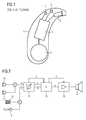
- the amplifier is usually integrated in a signal processing unit. This basic structure is in FIG. 1 shown using the example of a behind-the-ear hearing aid. In a hearing aid housing 1 for carrying behind the ear, one or more microphones 2 for receiving the sound from the environment are installed.
- a signal processing unit 3 which is also integrated in the hearing aid housing 1, processes the microphone signals and amplifies them.
- the output signal of the signal processing unit 3 is transmitted to a loudspeaker or earpiece 4, which outputs an acoustic signal.
- the sound is optionally transmitted via a sound tube, which is fixed with an earmold in the ear canal, to the eardrum of the device carrier.
- the power supply of the hearing device and in particular the signal processing unit 3 is effected by a likewise integrated into the hearing aid housing 1 battery. 5
- Modern hearing aids usually have powerful directional microphones that are often adaptive and multi-channel realized.
- directional microphones can be activated and deactivated by situation detection algorithms to always provide the user with the most advantageous microphone mode.
- the input signal of the hearing aid is supplied.
- the operation is flawless.
- problems arise in the superimposition of microphone signals in addition to, for example, wirelessly fed audio signals.
- the situation recognition unit works on the signal mixed together from microphone and audio signal and adapts the microphone setting on the basis of this.
- the situation detection is fed in this case with a little meaningful signal and can consequently the Microphone mode does not adapt correctly to the actual situation.
- the microphone mode In order to meet this problem reasonably, is currently fixed as a workaround, the microphone mode often manually from "automatic" to "omnidirectional".
- the hearing aid has several input sources such as microphone, telecoil and the like.
- the hearing device has a selection unit, a signal processing unit and a classification unit. One or more active sources are selected in the selection unit, and information in the classification unit is also processed in relation to the selected or selected sources.
- a controller analyzes the signals received from the transducers and controls the transfer function between the transducers and a loudspeaker. Parallel to the signals of the microphones, the signals of the induction sensors are used for switching or control.
- a classification device examines whether the induction signal and the acoustic signal are each a useful signal.
- the document discloses DE 10 2007 008 738 A1 a method for improving spatial perception.
- the input signal is analyzed, with a separation of sound sources.
- when analyzing a signal class can be determined to control the hearing aid accordingly.
- the hearing device receives at least one externally fed signal next to a microphone signal and controls the hearing device accordingly.
- the object of the present invention is therefore to provide a hearing device with which it is possible to more reliably recognize an acoustic situation, if there are several different input signals.
- a corresponding method for operating a hearing device to be proposed.
- this object is achieved by a hearing device with a microphone device for recording a sound signal, a receiving device for receiving an electrical or electromagnetic signal, a classification device for determining an acoustic situation from the signals of the microphone device and the receiving device and a signal processing device for processing the signals of the microphone device and the receiving device in response to an output signal of the classification device, wherein the signals of the microphone device and the receiving device of the classification device for situation recognition are provided individually.
- the invention provides a method for operating a hearing device by recording a sound signal, recording an electrical or electromagnetic signal, determining an acoustic situation from the recorded signals and processing the recorded signals in dependence on the determined acoustic situation, wherein for determining the acoustic situation the recorded signals are made available separately.
- the inventive hearing device or the inventive method acoustic situations depending on the one to recognize individual input signals better.
- the situation recognition may be performed separately in response to microphone signals and audio signals that have been received electromagnetically.
- the classification device is preceded by a preprocessing device with which it is possible to determine with the aid of the level which of the recorded signals is dominant, and with which a corresponding control signal of the classification device can be provided.
- the level makes it possible to reliably detect the dominance of an input signal, which in turn allows the dominant signal to be analyzed to better identify the situation.
- a correlation of the recorded signals can be determined with the preprocessing device, so that a corresponding control signal of the classification device can also be provided by the preprocessing device.
- the correlation of the recorded signals also gives a clear indication of the acoustic situation.
- a delay of the signal from the microphone device may be preconfigured for the correlation analysis according to a known delay of the signal from the receiving device. In this way, a reliable result can be quickly determined for the correlation analysis.
- a decision matrix can be implemented in the classification device in order to determine the output signal of the classification device on the basis of a signal obtained by the preprocessing device. As a result, a decision based on the determined acoustic situation can be made without calculation effort.
- the signal processing means may include a directional microphone control unit, a noise canceling unit and have a feedback unit, wherein upon dominance of the signal of the receiving device relative to the signal of the microphone device of the three units, only the noise reduction unit and the feedback unit are adapted according to the determined acoustic situation.
- the microphone device is permanently switched to omnidirectional mode so that the user remains responsive from all directions.
- the classification device can use the signal of the microphone device at predetermined time intervals for determining the acoustic situation when the signal of the receiving device dominates. This further refines the situation detection, because it is not only the dominant signal used for situation detection.
- the signal of the microphone device is used by the classification device for determining the acoustic situation. This reflects the principle that the natural acoustic environment is paramount for situational awareness.
- a microphone device with two microphones 10 and 11 is provided here.
- the signals of both microphones 10, 11 are linked together so that a signal m of the microphone device results.
- the hearing aid has, for example, a telephone coil 12 and an audio input 13.
- these receiving components 12, 13 are subsumed under the term "receiving device" here. From this receiving device, that is, from the electrical or electromagnetic receivers, at least one signal e is provided.
- the signal m of the microphone device and the signal e of the receiving device is fed to a pre-processing device 13.
- a pre-processing device 13 This has, for example, a level meter to determine which of the two signals m or e has the higher level.
- the preprocessing device 14 can also perform a correlation analysis with which a correlation variable between the two signals m and e can be determined.
- the preprocessing device 14 passes the signals m and e to a classification device 15 and supplies it with an additional control signal s in accordance with its level or correlation variable.
- the situation detection is then practically carried out on the basis of the control signal s by supplying one of the two signals m or e to a downstream signal processing unit 16 in accordance with a predetermined logic.
- the signal processing device 16 is additionally controlled or adapted on the basis of the classification result or the situation recognition, for which reason the classification device 15 of the signal processing device 16 can provide an additional control signal c. Finally, the output signal a of the classification device 15 amplified by the signal processing device 16 to a receiver 17.
- the situation recognition unit e.g., the classification means 15
- the situation recognition unit provides acoustic and electrical input signals m and e separately.
- an independent check of the input signals m and e takes place in advance, e.g. as mentioned by criteria such as level or correlation.
- criteria such as level or correlation.
- the delay of an audio signal e.g. caused by processing elements of a wireless transmission path, to be preconfigured.
- acoustic situations can be detected more reliably.
- the acoustic situation "television” can be recognized by the fact that in addition to the acoustic transmission, an additional similarly strong wireless transmission takes place and both signals are correlated with each other.
- the acoustic situation "music transmission in a quiet environment” e.g., jogging in the forest with music entertainment by radio
- the electromagnetic input signal has a much higher level than the microphone signal and both signals are uncorrelated.
- the situation detection can be configured via a decision matrix as to which signal is to be used for the situation detection.
- a decision matrix could look like this: Audio microphone directional microphone X interference X X SoundSmoothing X X feedback X X
- This decision matrix means that if the audio signal outweighs the directional microphone is not turned on, but an adaptation in terms of noise, sound smoothing and feedback takes place. If, on the other hand, the microphone signal predominates, the directional microphone is additionally switched on.
- the decision matrix may be configurable in the form of software by, for example, an acoustician. Alternatively, the decision matrix can also be fixed.
- the situation recognition preferably takes place exclusively on the basis of the microphone signal.
- the situation recognition unit operates exclusively on the basis of the audio signal.
- the microphone is set to the omnidirectional operation to ensure responsiveness of the user from all directions.
- the microphone can be adjusted for the dominance of the audio signal by means of the independently available microphone signal. For this purpose, for example, the microphone signal is supplied to the situation detection for a short time at longer intervals and classifies the environment. After a decision, the classification unit continues to work with the dominant audio signal.
- both signals m and e of the microphone device 10, 11 and the receiving device 12, 13 are approximately the same, and if there is also a high correlation between the two signals, it is advantageous if the situation recognition is performed primarily on the basis of the microphone signal.
- the described embodiment thus shows for the hearing aid wearer the advantage that the situation recognition with a "pure" signal is free of superposition effects is carried out.
- the correlation can contribute several signals to the situation detection. The situation detection is thus much more reliable.
- the hearing aid wearer has the advantage that the adaptation of the directional microphone in the case of dominant audio signals is not based on the audio signal but on the basis of the microphone, which characterizes the actual acoustic situation.
Landscapes
- Health & Medical Sciences (AREA)
- General Health & Medical Sciences (AREA)
- Neurosurgery (AREA)
- Otolaryngology (AREA)
- Physics & Mathematics (AREA)
- Engineering & Computer Science (AREA)
- Acoustics & Sound (AREA)
- Signal Processing (AREA)
- Circuit For Audible Band Transducer (AREA)
- Measurement Of The Respiration, Hearing Ability, Form, And Blood Characteristics Of Living Organisms (AREA)
Applications Claiming Priority (1)
| Application Number | Priority Date | Filing Date | Title |
|---|---|---|---|
| DE102008053458A DE102008053458A1 (de) | 2008-10-28 | 2008-10-28 | Hörvorrichtung mit spezieller Situationserkennungseinheit und Verfahren zum Betreiben einer Hörvorrichtung |
Publications (3)
| Publication Number | Publication Date |
|---|---|
| EP2182741A1 true EP2182741A1 (fr) | 2010-05-05 |
| EP2182741B1 EP2182741B1 (fr) | 2011-06-29 |
| EP2182741B2 EP2182741B2 (fr) | 2014-10-15 |
Family
ID=41491497
Family Applications (1)
| Application Number | Title | Priority Date | Filing Date |
|---|---|---|---|
| EP09173019.2A Active EP2182741B2 (fr) | 2008-10-28 | 2009-10-14 | Dispositif auditif doté d'une unité de reconnaissance de situation spéciale et procédé de fonctionnement d'un dispositif auditif |
Country Status (5)
| Country | Link |
|---|---|
| US (1) | US8355516B2 (fr) |
| EP (1) | EP2182741B2 (fr) |
| AT (1) | ATE515153T1 (fr) |
| DE (1) | DE102008053458A1 (fr) |
| DK (1) | DK2182741T4 (fr) |
Cited By (4)
| Publication number | Priority date | Publication date | Assignee | Title |
|---|---|---|---|---|
| WO2011027004A3 (fr) * | 2010-12-20 | 2011-11-03 | Phonak Ag | Procédé d'utilisation d'un dispositif auditif et dispositif auditif |
| EP2822300A1 (fr) | 2013-07-02 | 2015-01-07 | Siemens Medical Instruments Pte. Ltd. | Reconnaissance de situations d'écoute à l'aide de différentes sources de signal |
| EP2835986A1 (fr) | 2013-08-09 | 2015-02-11 | Oticon A/s | Dispositif d'écoute doté d'un transducteur d'entrée et d'un récepteur sans fil |
| EP3364668A1 (fr) * | 2017-02-16 | 2018-08-22 | Sivantos Pte. Ltd. | Procédé de fonctionnement d'un dispositif auditif et dispositif auditif |
Families Citing this family (3)
| Publication number | Priority date | Publication date | Assignee | Title |
|---|---|---|---|---|
| JP5514698B2 (ja) * | 2010-11-04 | 2014-06-04 | パナソニック株式会社 | 補聴器 |
| EP2528358A1 (fr) * | 2011-05-23 | 2012-11-28 | Oticon A/S | Procédé d'identification d'un canal de communication sans fil dans un système sonore |
| EP3879847A1 (fr) * | 2020-03-10 | 2021-09-15 | Austrian Audio GmbH | Circuit de microphone destiné à la linéarisation de l'effet de proximité dans un microphone directionnel |
Citations (5)
| Publication number | Priority date | Publication date | Assignee | Title |
|---|---|---|---|---|
| DE10146886A1 (de) * | 2001-09-24 | 2003-04-30 | Siemens Audiologische Technik | Hörgerät mit automatischer Umschaltung auf Hörspulenbetrieb |
| EP1653773A2 (fr) | 2005-08-23 | 2006-05-03 | Phonak Ag | Procédé d'opération d'une prothèse auditive et prothèse auditive |
| DE102005019149B3 (de) | 2005-04-25 | 2006-08-31 | Siemens Audiologische Technik Gmbh | Hörhilfevorrichtung mit Kompensation von akustischen und elektromagnetischen Rückkopplungssignalen |
| WO2008071236A2 (fr) | 2006-12-15 | 2008-06-19 | Phonak Ag | Système auditif à suppression de bruit améliorée |
| DE102007008738A1 (de) | 2007-02-22 | 2008-08-28 | Siemens Audiologische Technik Gmbh | Verfahren zur Verbesserung der räumlichen Wahrnehmung und entsprechende Hörvorrichtung |
Family Cites Families (7)
| Publication number | Priority date | Publication date | Assignee | Title |
|---|---|---|---|---|
| EP0772375A3 (fr) † | 1995-10-31 | 1998-06-24 | Lux-Wellenhof, Gabriele | Prothèse auditive et appareil auxiliaire |
| DK0814634T3 (da) * | 1996-06-21 | 2003-02-03 | Siemens Audiologische Technik | Programmerbart høreapparatsystem og fremgangsmåde til fastsættelse af optimale parametersæt i et høreapparat |
| WO2001020965A2 (fr) † | 2001-01-05 | 2001-03-29 | Phonak Ag | Procede de determination d'une situation d'environnement acoustique momentanee, utilisation de ce procede, et prothese auditive |
| US6862359B2 (en) * | 2001-12-18 | 2005-03-01 | Gn Resound A/S | Hearing prosthesis with automatic classification of the listening environment |
| US7889879B2 (en) * | 2002-05-21 | 2011-02-15 | Cochlear Limited | Programmable auditory prosthesis with trainable automatic adaptation to acoustic conditions |
| WO2005018279A1 (fr) † | 2003-08-05 | 2005-02-24 | Oticon A/S | Systeme de prothese auditive a dispositif de commutation |
| DE102007033877B3 (de) * | 2007-07-20 | 2009-02-05 | Siemens Audiologische Technik Gmbh | Verfahren zur Signalverarbeitung in einer Hörhilfe |
-
2008
- 2008-10-28 DE DE102008053458A patent/DE102008053458A1/de not_active Ceased
-
2009
- 2009-10-14 EP EP09173019.2A patent/EP2182741B2/fr active Active
- 2009-10-14 DK DK09173019.2T patent/DK2182741T4/en active
- 2009-10-14 AT AT09173019T patent/ATE515153T1/de active
- 2009-10-28 US US12/607,124 patent/US8355516B2/en active Active
Patent Citations (6)
| Publication number | Priority date | Publication date | Assignee | Title |
|---|---|---|---|---|
| DE10146886A1 (de) * | 2001-09-24 | 2003-04-30 | Siemens Audiologische Technik | Hörgerät mit automatischer Umschaltung auf Hörspulenbetrieb |
| DE10146886B4 (de) | 2001-09-24 | 2007-11-08 | Siemens Audiologische Technik Gmbh | Hörgerät mit automatischer Umschaltung auf Hörspulenbetrieb |
| DE102005019149B3 (de) | 2005-04-25 | 2006-08-31 | Siemens Audiologische Technik Gmbh | Hörhilfevorrichtung mit Kompensation von akustischen und elektromagnetischen Rückkopplungssignalen |
| EP1653773A2 (fr) | 2005-08-23 | 2006-05-03 | Phonak Ag | Procédé d'opération d'une prothèse auditive et prothèse auditive |
| WO2008071236A2 (fr) | 2006-12-15 | 2008-06-19 | Phonak Ag | Système auditif à suppression de bruit améliorée |
| DE102007008738A1 (de) | 2007-02-22 | 2008-08-28 | Siemens Audiologische Technik Gmbh | Verfahren zur Verbesserung der räumlichen Wahrnehmung und entsprechende Hörvorrichtung |
Cited By (8)
| Publication number | Priority date | Publication date | Assignee | Title |
|---|---|---|---|---|
| WO2011027004A3 (fr) * | 2010-12-20 | 2011-11-03 | Phonak Ag | Procédé d'utilisation d'un dispositif auditif et dispositif auditif |
| US9363612B2 (en) | 2010-12-20 | 2016-06-07 | Sonova Ag | Method for operating a hearing device and a hearing device |
| EP2822300A1 (fr) | 2013-07-02 | 2015-01-07 | Siemens Medical Instruments Pte. Ltd. | Reconnaissance de situations d'écoute à l'aide de différentes sources de signal |
| DE102013212853A1 (de) | 2013-07-02 | 2015-01-08 | Siemens Medical Instruments Pte. Ltd. | Erkennen von Hörsituationen mit unterschiedlichen Signalquellen |
| US9565501B2 (en) | 2013-07-02 | 2017-02-07 | Sivantos Pte. Ltd. | Hearing device and method of identifying hearing situations having different signal sources |
| EP2835986A1 (fr) | 2013-08-09 | 2015-02-11 | Oticon A/s | Dispositif d'écoute doté d'un transducteur d'entrée et d'un récepteur sans fil |
| US10070231B2 (en) | 2013-08-09 | 2018-09-04 | Oticon A/S | Hearing device with input transducer and wireless receiver |
| EP3364668A1 (fr) * | 2017-02-16 | 2018-08-22 | Sivantos Pte. Ltd. | Procédé de fonctionnement d'un dispositif auditif et dispositif auditif |
Also Published As
| Publication number | Publication date |
|---|---|
| US8355516B2 (en) | 2013-01-15 |
| ATE515153T1 (de) | 2011-07-15 |
| EP2182741B2 (fr) | 2014-10-15 |
| DE102008053458A1 (de) | 2010-04-29 |
| DK2182741T3 (da) | 2011-10-31 |
| US20100104120A1 (en) | 2010-04-29 |
| DK2182741T4 (en) | 2015-01-19 |
| EP2182741B1 (fr) | 2011-06-29 |
Similar Documents
| Publication | Publication Date | Title |
|---|---|---|
| EP2603018B1 (fr) | Dispositif auditif avec détection d'activité de locuteur et procédé de fonctionnement d'un dispositif auditif | |
| EP3222057B1 (fr) | Procédé et dispositif de détection rapide de la voix naturelle | |
| DE102008064430B4 (de) | Hörvorrichtung mit automatischer Algorithmenumschaltung | |
| EP1377118B1 (fr) | Système de prothèse auditive avec prothèse auditive et unité processeur externe | |
| EP2182741B1 (fr) | Dispositif auditif doté d'une unité de reconnaissance de situation spéciale et procédé de fonctionnement d'un dispositif auditif | |
| DE10146886A1 (de) | Hörgerät mit automatischer Umschaltung auf Hörspulenbetrieb | |
| EP2991379B1 (fr) | Procede et dispositif de perception amelioree de sa propre voix | |
| WO2009016012A1 (fr) | Appareil de correction auditive commandé par un modèle perceptif et procédé correspondant | |
| EP2200345B1 (fr) | Procédé de sélection d'une direction préférentiel d'un microphone directionnel et dispositif auditif correspondant | |
| EP2373062A2 (fr) | Procédé de réglage double pour un système auditif | |
| EP2658289B1 (fr) | Procédé de commande d'une caractéristique de guidage et système auditif | |
| EP1962554A2 (fr) | Appareil auditif doté d'une séparation de signal d'erreur et procédé correspondant | |
| DE102010041435A1 (de) | Verfahren zum Rekonstruieren eines Sprachsignals und Hörvorrichtung | |
| EP2023667A2 (fr) | Procédé de réglage d'un système auditif doté d'un modèle perceptif pour oreilles binaurales et système auditif correspondant | |
| EP2222096A2 (fr) | Procédé destiné au traitement du signal d'un dispositif auditif et dispositif auditif correspondant | |
| DE102009014053B4 (de) | Verfahren zum Einstellen einer Richtcharakteristik und Hörvorrichtungen | |
| EP3863306B1 (fr) | Système auditif pourvu d'au moins un instrument auditif porté dans ou sur l'oreille de l'utilisateur ainsi que procédé de fonctionnement d'un tel système auditif | |
| EP1909535B1 (fr) | Appareil auditif avec canaux d'entrée controlés et procédé correspondant | |
| WO2012019636A1 (fr) | Procédé permettant de faire fonctionner un appareil auditif et appareil auditif correspondant | |
| DE102007030067B4 (de) | Hörgerät mit passiver, eingangspegelabhängiger Geräuschreduktion und Verfahren | |
| WO2014049455A1 (fr) | Système auditif ainsi que procédé de transmission |
Legal Events
| Date | Code | Title | Description |
|---|---|---|---|
| PUAI | Public reference made under article 153(3) epc to a published international application that has entered the european phase |
Free format text: ORIGINAL CODE: 0009012 |
|
| AK | Designated contracting states |
Kind code of ref document: A1 Designated state(s): AT BE BG CH CY CZ DE DK EE ES FI FR GB GR HR HU IE IS IT LI LT LU LV MC MK MT NL NO PL PT RO SE SI SK SM TR |
|
| AX | Request for extension of the european patent |
Extension state: AL BA RS |
|
| 17P | Request for examination filed |
Effective date: 20100809 |
|
| 17Q | First examination report despatched |
Effective date: 20101119 |
|
| GRAP | Despatch of communication of intention to grant a patent |
Free format text: ORIGINAL CODE: EPIDOSNIGR1 |
|
| RIC1 | Information provided on ipc code assigned before grant |
Ipc: H04R 25/00 20060101AFI20110107BHEP |
|
| GRAS | Grant fee paid |
Free format text: ORIGINAL CODE: EPIDOSNIGR3 |
|
| GRAA | (expected) grant |
Free format text: ORIGINAL CODE: 0009210 |
|
| AK | Designated contracting states |
Kind code of ref document: B1 Designated state(s): AT BE BG CH CY CZ DE DK EE ES FI FR GB GR HR HU IE IS IT LI LT LU LV MC MK MT NL NO PL PT RO SE SI SK SM TR |
|
| REG | Reference to a national code |
Ref country code: GB Ref legal event code: FG4D Free format text: NOT ENGLISH |
|
| REG | Reference to a national code |
Ref country code: CH Ref legal event code: EP |
|
| REG | Reference to a national code |
Ref country code: IE Ref legal event code: FG4D Free format text: LANGUAGE OF EP DOCUMENT: GERMAN |
|
| REG | Reference to a national code |
Ref country code: CH Ref legal event code: NV Representative=s name: SIEMENS SCHWEIZ AG |
|
| REG | Reference to a national code |
Ref country code: DE Ref legal event code: R096 Ref document number: 502009000863 Country of ref document: DE Effective date: 20110818 |
|
| REG | Reference to a national code |
Ref country code: NL Ref legal event code: VDEP Effective date: 20110629 |
|
| PG25 | Lapsed in a contracting state [announced via postgrant information from national office to epo] |
Ref country code: HR Free format text: LAPSE BECAUSE OF FAILURE TO SUBMIT A TRANSLATION OF THE DESCRIPTION OR TO PAY THE FEE WITHIN THE PRESCRIBED TIME-LIMIT Effective date: 20110629 Ref country code: SE Free format text: LAPSE BECAUSE OF FAILURE TO SUBMIT A TRANSLATION OF THE DESCRIPTION OR TO PAY THE FEE WITHIN THE PRESCRIBED TIME-LIMIT Effective date: 20110629 Ref country code: LT Free format text: LAPSE BECAUSE OF FAILURE TO SUBMIT A TRANSLATION OF THE DESCRIPTION OR TO PAY THE FEE WITHIN THE PRESCRIBED TIME-LIMIT Effective date: 20110629 Ref country code: NO Free format text: LAPSE BECAUSE OF FAILURE TO SUBMIT A TRANSLATION OF THE DESCRIPTION OR TO PAY THE FEE WITHIN THE PRESCRIBED TIME-LIMIT Effective date: 20110929 |
|
| REG | Reference to a national code |
Ref country code: DK Ref legal event code: T3 |
|
| PG25 | Lapsed in a contracting state [announced via postgrant information from national office to epo] |
Ref country code: GR Free format text: LAPSE BECAUSE OF FAILURE TO SUBMIT A TRANSLATION OF THE DESCRIPTION OR TO PAY THE FEE WITHIN THE PRESCRIBED TIME-LIMIT Effective date: 20110930 Ref country code: LV Free format text: LAPSE BECAUSE OF FAILURE TO SUBMIT A TRANSLATION OF THE DESCRIPTION OR TO PAY THE FEE WITHIN THE PRESCRIBED TIME-LIMIT Effective date: 20110629 Ref country code: SI Free format text: LAPSE BECAUSE OF FAILURE TO SUBMIT A TRANSLATION OF THE DESCRIPTION OR TO PAY THE FEE WITHIN THE PRESCRIBED TIME-LIMIT Effective date: 20110629 Ref country code: FI Free format text: LAPSE BECAUSE OF FAILURE TO SUBMIT A TRANSLATION OF THE DESCRIPTION OR TO PAY THE FEE WITHIN THE PRESCRIBED TIME-LIMIT Effective date: 20110629 |
|
| REG | Reference to a national code |
Ref country code: IE Ref legal event code: FD4D |
|
| PG25 | Lapsed in a contracting state [announced via postgrant information from national office to epo] |
Ref country code: PT Free format text: LAPSE BECAUSE OF FAILURE TO SUBMIT A TRANSLATION OF THE DESCRIPTION OR TO PAY THE FEE WITHIN THE PRESCRIBED TIME-LIMIT Effective date: 20111031 Ref country code: EE Free format text: LAPSE BECAUSE OF FAILURE TO SUBMIT A TRANSLATION OF THE DESCRIPTION OR TO PAY THE FEE WITHIN THE PRESCRIBED TIME-LIMIT Effective date: 20110629 Ref country code: NL Free format text: LAPSE BECAUSE OF FAILURE TO SUBMIT A TRANSLATION OF THE DESCRIPTION OR TO PAY THE FEE WITHIN THE PRESCRIBED TIME-LIMIT Effective date: 20110629 Ref country code: CZ Free format text: LAPSE BECAUSE OF FAILURE TO SUBMIT A TRANSLATION OF THE DESCRIPTION OR TO PAY THE FEE WITHIN THE PRESCRIBED TIME-LIMIT Effective date: 20110629 Ref country code: IS Free format text: LAPSE BECAUSE OF FAILURE TO SUBMIT A TRANSLATION OF THE DESCRIPTION OR TO PAY THE FEE WITHIN THE PRESCRIBED TIME-LIMIT Effective date: 20111029 Ref country code: IE Free format text: LAPSE BECAUSE OF FAILURE TO SUBMIT A TRANSLATION OF THE DESCRIPTION OR TO PAY THE FEE WITHIN THE PRESCRIBED TIME-LIMIT Effective date: 20110629 |
|
| PG25 | Lapsed in a contracting state [announced via postgrant information from national office to epo] |
Ref country code: SK Free format text: LAPSE BECAUSE OF FAILURE TO SUBMIT A TRANSLATION OF THE DESCRIPTION OR TO PAY THE FEE WITHIN THE PRESCRIBED TIME-LIMIT Effective date: 20110629 Ref country code: CY Free format text: LAPSE BECAUSE OF FAILURE TO SUBMIT A TRANSLATION OF THE DESCRIPTION OR TO PAY THE FEE WITHIN THE PRESCRIBED TIME-LIMIT Effective date: 20110629 Ref country code: PL Free format text: LAPSE BECAUSE OF FAILURE TO SUBMIT A TRANSLATION OF THE DESCRIPTION OR TO PAY THE FEE WITHIN THE PRESCRIBED TIME-LIMIT Effective date: 20110629 |
|
| PLBI | Opposition filed |
Free format text: ORIGINAL CODE: 0009260 |
|
| BERE | Be: lapsed |
Owner name: SIEMENS MEDICAL INSTRUMENTS PTE. LTD. Effective date: 20111031 |
|
| PLAX | Notice of opposition and request to file observation + time limit sent |
Free format text: ORIGINAL CODE: EPIDOSNOBS2 |
|
| 26 | Opposition filed |
Opponent name: OTICON A/S (DK)/GN RESOUND A/S (DK)/ PHONAK AG (CH Effective date: 20120329 |
|
| PG25 | Lapsed in a contracting state [announced via postgrant information from national office to epo] |
Ref country code: IT Free format text: LAPSE BECAUSE OF FAILURE TO SUBMIT A TRANSLATION OF THE DESCRIPTION OR TO PAY THE FEE WITHIN THE PRESCRIBED TIME-LIMIT Effective date: 20110629 Ref country code: MC Free format text: LAPSE BECAUSE OF NON-PAYMENT OF DUE FEES Effective date: 20111031 |
|
| REG | Reference to a national code |
Ref country code: DE Ref legal event code: R026 Ref document number: 502009000863 Country of ref document: DE Effective date: 20120329 |
|
| PLBB | Reply of patent proprietor to notice(s) of opposition received |
Free format text: ORIGINAL CODE: EPIDOSNOBS3 |
|
| PLAB | Opposition data, opponent's data or that of the opponent's representative modified |
Free format text: ORIGINAL CODE: 0009299OPPO |
|
| PG25 | Lapsed in a contracting state [announced via postgrant information from national office to epo] |
Ref country code: BE Free format text: LAPSE BECAUSE OF NON-PAYMENT OF DUE FEES Effective date: 20111031 |
|
| R26 | Opposition filed (corrected) |
Opponent name: OTICON A/S (DK)/GN RESOUND A/S (DK)/ PHONAK AG (CH Effective date: 20120329 |
|
| PG25 | Lapsed in a contracting state [announced via postgrant information from national office to epo] |
Ref country code: MK Free format text: LAPSE BECAUSE OF FAILURE TO SUBMIT A TRANSLATION OF THE DESCRIPTION OR TO PAY THE FEE WITHIN THE PRESCRIBED TIME-LIMIT Effective date: 20110629 Ref country code: MT Free format text: LAPSE BECAUSE OF FAILURE TO SUBMIT A TRANSLATION OF THE DESCRIPTION OR TO PAY THE FEE WITHIN THE PRESCRIBED TIME-LIMIT Effective date: 20110629 |
|
| PG25 | Lapsed in a contracting state [announced via postgrant information from national office to epo] |
Ref country code: ES Free format text: LAPSE BECAUSE OF FAILURE TO SUBMIT A TRANSLATION OF THE DESCRIPTION OR TO PAY THE FEE WITHIN THE PRESCRIBED TIME-LIMIT Effective date: 20111010 Ref country code: SM Free format text: LAPSE BECAUSE OF FAILURE TO SUBMIT A TRANSLATION OF THE DESCRIPTION OR TO PAY THE FEE WITHIN THE PRESCRIBED TIME-LIMIT Effective date: 20110629 |
|
| PG25 | Lapsed in a contracting state [announced via postgrant information from national office to epo] |
Ref country code: LU Free format text: LAPSE BECAUSE OF NON-PAYMENT OF DUE FEES Effective date: 20111014 |
|
| PG25 | Lapsed in a contracting state [announced via postgrant information from national office to epo] |
Ref country code: BG Free format text: LAPSE BECAUSE OF FAILURE TO SUBMIT A TRANSLATION OF THE DESCRIPTION OR TO PAY THE FEE WITHIN THE PRESCRIBED TIME-LIMIT Effective date: 20110929 |
|
| PG25 | Lapsed in a contracting state [announced via postgrant information from national office to epo] |
Ref country code: TR Free format text: LAPSE BECAUSE OF FAILURE TO SUBMIT A TRANSLATION OF THE DESCRIPTION OR TO PAY THE FEE WITHIN THE PRESCRIBED TIME-LIMIT Effective date: 20110629 |
|
| PG25 | Lapsed in a contracting state [announced via postgrant information from national office to epo] |
Ref country code: HU Free format text: LAPSE BECAUSE OF FAILURE TO SUBMIT A TRANSLATION OF THE DESCRIPTION OR TO PAY THE FEE WITHIN THE PRESCRIBED TIME-LIMIT Effective date: 20110629 |
|
| PUAH | Patent maintained in amended form |
Free format text: ORIGINAL CODE: 0009272 |
|
| STAA | Information on the status of an ep patent application or granted ep patent |
Free format text: STATUS: PATENT MAINTAINED AS AMENDED |
|
| 27A | Patent maintained in amended form |
Effective date: 20141015 |
|
| AK | Designated contracting states |
Kind code of ref document: B2 Designated state(s): AT BE BG CH CY CZ DE DK EE ES FI FR GB GR HR HU IE IS IT LI LT LU LV MC MK MT NL NO PL PT RO SE SI SK SM TR |
|
| REG | Reference to a national code |
Ref country code: CH Ref legal event code: AELC Ref country code: DE Ref legal event code: R102 Ref document number: 502009000863 Country of ref document: DE |
|
| REG | Reference to a national code |
Ref country code: DE Ref legal event code: R102 Ref document number: 502009000863 Country of ref document: DE Effective date: 20141015 |
|
| REG | Reference to a national code |
Ref country code: DK Ref legal event code: T4 Effective date: 20150116 |
|
| REG | Reference to a national code |
Ref country code: DE Ref legal event code: R082 Ref document number: 502009000863 Country of ref document: DE Representative=s name: FDST PATENTANWAELTE FREIER DOERR STAMMLER TSCH, DE |
|
| PG25 | Lapsed in a contracting state [announced via postgrant information from national office to epo] |
Ref country code: LV Free format text: LAPSE BECAUSE OF FAILURE TO SUBMIT A TRANSLATION OF THE DESCRIPTION OR TO PAY THE FEE WITHIN THE PRESCRIBED TIME-LIMIT Effective date: 20141015 |
|
| REG | Reference to a national code |
Ref country code: DE Ref legal event code: R082 Ref document number: 502009000863 Country of ref document: DE Representative=s name: FDST PATENTANWAELTE FREIER DOERR STAMMLER TSCH, DE Ref country code: FR Ref legal event code: PLFP Year of fee payment: 7 Ref country code: DE Ref legal event code: R081 Ref document number: 502009000863 Country of ref document: DE Owner name: SIVANTOS PTE. LTD., SG Free format text: FORMER OWNER: SIEMENS MEDICAL INSTRUMENTS PTE. LTD., SINGAPORE, SG |
|
| REG | Reference to a national code |
Ref country code: AT Ref legal event code: MM01 Ref document number: 515153 Country of ref document: AT Kind code of ref document: T Effective date: 20141014 |
|
| PG25 | Lapsed in a contracting state [announced via postgrant information from national office to epo] |
Ref country code: AT Free format text: LAPSE BECAUSE OF NON-PAYMENT OF DUE FEES Effective date: 20141014 |
|
| REG | Reference to a national code |
Ref country code: FR Ref legal event code: PLFP Year of fee payment: 8 |
|
| REG | Reference to a national code |
Ref country code: FR Ref legal event code: PLFP Year of fee payment: 9 |
|
| REG | Reference to a national code |
Ref country code: FR Ref legal event code: PLFP Year of fee payment: 10 |
|
| PGFP | Annual fee paid to national office [announced via postgrant information from national office to epo] |
Ref country code: DK Payment date: 20240919 Year of fee payment: 16 |
|
| PGFP | Annual fee paid to national office [announced via postgrant information from national office to epo] |
Ref country code: GB Payment date: 20240919 Year of fee payment: 16 |
|
| PGFP | Annual fee paid to national office [announced via postgrant information from national office to epo] |
Ref country code: FR Payment date: 20240919 Year of fee payment: 16 |
|
| PGFP | Annual fee paid to national office [announced via postgrant information from national office to epo] |
Ref country code: DE Payment date: 20240919 Year of fee payment: 16 |
|
| PGFP | Annual fee paid to national office [announced via postgrant information from national office to epo] |
Ref country code: CH Payment date: 20241101 Year of fee payment: 16 |